Verified Against Public And Audited RecordsLast Updated On: 2026-03-04
Reading time: ~50 min
File ID: EHGN-PLACE-35271
Investigative Bio of Stanford University
Indigenous Displacement and the Acquisition of Rancho San Francisquito (1769, 1876)
The ground occupied by Stanford University was never empty; it was emptied. Before the surveyor drove a stake into the soil, the land along the San Francisquito Creek belonged to the Puichon, a Thámien-speaking village of the Ohlone people. For thousands of years, the Puichon managed the oak woodlands and grasslands, using fire to encourage seed growth and maintaining a population density that stunned early European observers. When the Spanish Portolá expedition camped beneath the massive redwood El Palo Alto in November 1769, they did not discover a wilderness. They entered a managed territory that supported a network of villages with complex trade and social structures.
The destruction of this society began with the establishment of Mission Santa Clara de Asís in 1777. The mission system functioned as an engine of demographic collapse. Spanish soldiers forcibly relocated the Puichon and neighboring groups into the mission compound, where disease and labor dismantled their population. Records from Mission Santa Clara indicate that between 1777 and the 1830s, the indigenous population of the broader Bay Area plummeted from approximately 10, 000 to fewer than 2, 500. Measles epidemics, particularly the outbreak of 1806, wiped out entire lineages. The survivors were not "displaced"; they were conscripted into a system of forced agricultural labor that built the economic foundation for the settlers who would later claim the land.
Following the Mexican War of Independence, the secularization of the missions in the 1830s transferred control of these lands from the church to private rancheros. In 1839, Mexican Governor Juan Alvarado granted the 1, 471-acre Rancho San Francisquito to Antonino Buelna. This legal act transformed the ancestral Puichon territory into a tradable commodity. Buelna, a political figure who had helped oust a previous governor, used the land for cattle grazing. The few remaining Ohlone people, stripped of their land rights, frequently returned to these ranchos not as owners, as vaqueros and servants, working the ground that held their ancestors' remains for the benefit of Mexican grantees.
The transition from Mexican to American rule following the 1848 Treaty of Guadalupe Hidalgo accelerated the dispossession. The California Land Act of 1851 placed the load of proof on landowners to validate their Spanish or Mexican titles, a process that frequently resulted in bankruptcy for the Californios and opportunities for American speculators. While Buelna's widow, María Concepción Valencia, eventually received a US patent for the land in 1868, the years of legal limbo allowed American squatters, including men named Julian, Little, and Bevins, to occupy portions of the rancho. The violence of this period was bureaucratic total; the indigenous presence was ignored entirely by American courts, which recognized only the claims of the squatters or the rancheros.
Enter George Gordon, a wealthy San Francisco speculator and sugar refiner. In 1863, Gordon began purchasing parcels of the Rancho San Francisquito, buying out both the squatters and the Buelna heirs. He consolidated these holdings into a country estate he named "Mayfield Grange." Gordon's tenure marked the shift from working ranch to leisure estate, a playground for the Bay Area's new industrial elite. He planted vineyards and orchards, reshaping the ecology to suit Victorian aesthetics. Yet, Gordon's control was short-lived. Following his death in 1869 and the subsequent deaths of his wife and her brother, the estate went on the market, ripe for a buyer with capital derived from the wave of industrial exploitation.
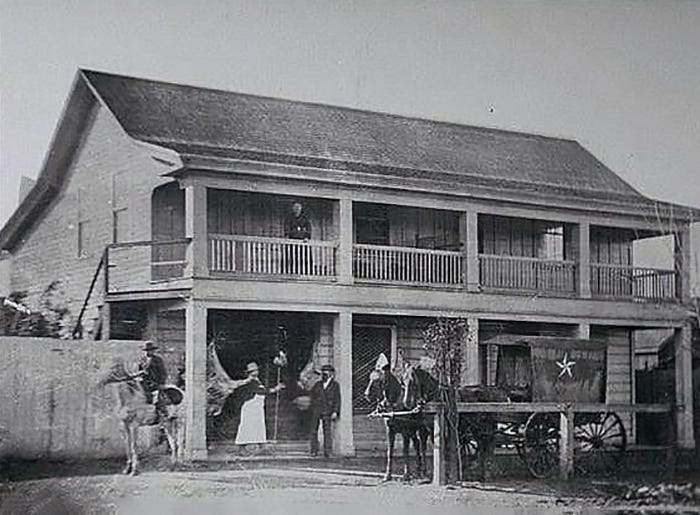
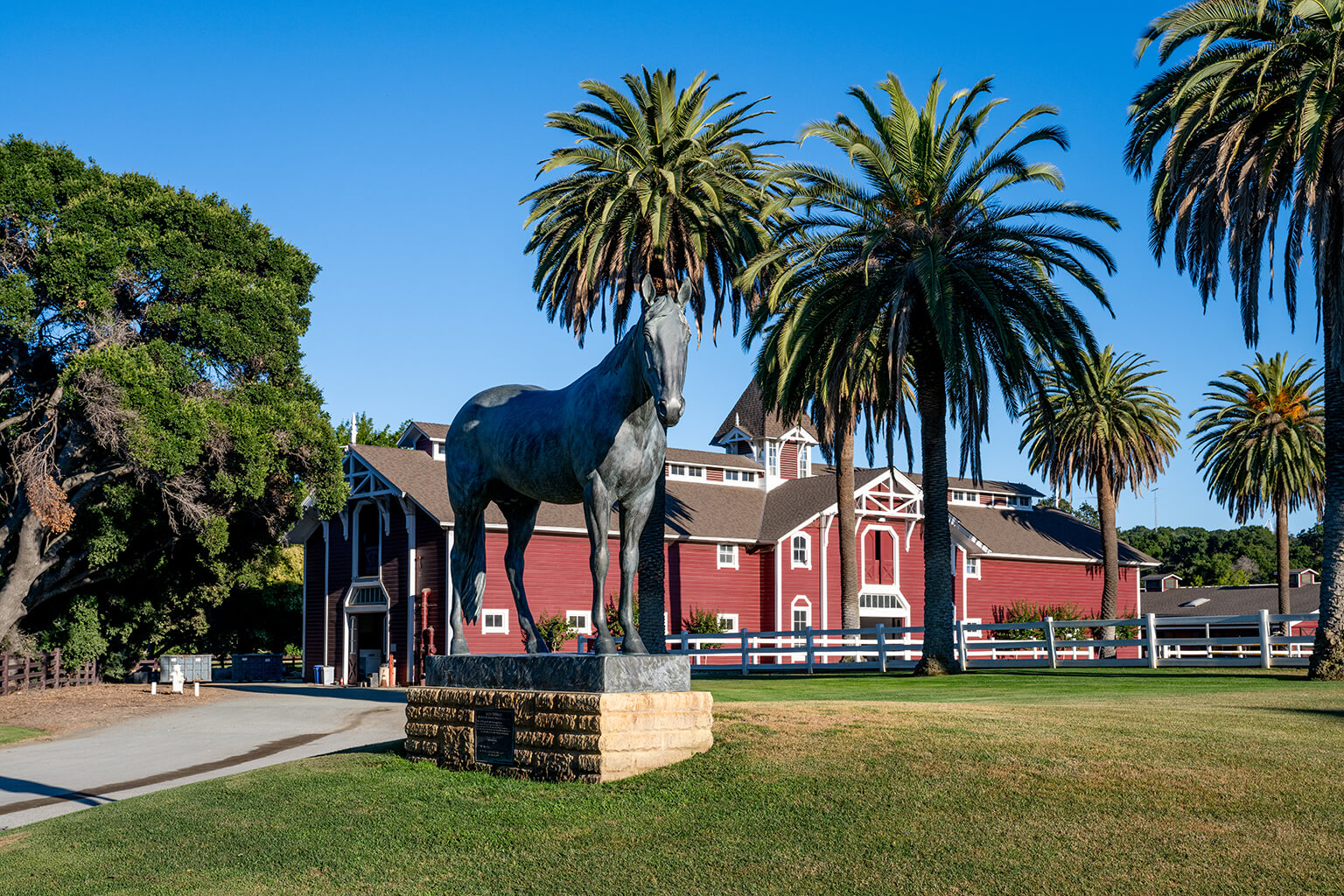
Leland Stanford acquired the property in 1876. He purchased the 650-acre Mayfield Grange from the widow of Gordon's brother-in-law, Margret T. Clark, and immediately added another 619 acres from a neighbor, D. Hoag. This purchase formed the nucleus of what would become the Palo Alto Stock Farm. It is important to examine the source of the capital used for this acquisition. The funds did not come from the land itself from the Central Pacific Railroad. Stanford, as one of the "Big Four," had amassed a fortune through government subsidies and the exploitation of Chinese labor. The purchase of the Rancho San Francisquito lands laundered this railroad money into real estate, converting industrial profits into a feudal-style domain.
Stanford's management of the land was aggressive. He expanded his holdings to over 8, 000 acres by 1891, absorbing adjacent properties and erasing the boundaries of the original Mexican grants. The Palo Alto Stock Farm was an industrial operation disguised as agriculture, designed to mass-produce trotting horses using assembly-line methods. The transformation of the land was absolute; creeks were diverted, non-native eucalyptus trees were planted in rigid rows, and the last physical traces of the Puichon village sites were plowed under to make way for training tracks and paddocks.
The displacement narrative frequently ends with the 19th century, yet the mechanics of land control remain relevant in 2026. The university's modern land use decisions mirror the logic of the 1876 acquisition: capital dictates geography. In March 2025, Stanford declined to purchase the Notre Dame de Namur University campus in Belmont, a 46-acre site it had previously agreed to buy. The university a "changed " of federal funding, specifically cuts to National Institutes of Health (NIH) grants, as the reason for abandoning the expansion. Just as Leland Stanford's 1876 purchase depended on railroad subsidies, the university's 21st-century footprint expands or contracts based on the flow of federal dollars. The land remains a financial asset, and an educational space second.
Chain of Title and Displacement: Rancho San Francisquito (1769, 1876)
Period
Occupant / Owner
Status of Indigenous People
Key Transaction / Event
Pre-1769
Puichon (Ohlone)
Sovereign inhabitants
Portolá Expedition (1769) marks European incursion.
1777, 1830s
Mission Santa Clara
Forced relocation / Labor
Demographic collapse (10, 000 to 2, 500).
1839, 1850s
Antonino Buelna
Laborers (Vaqueros)
Mexican Land Grant (1, 471 acres).
1850s, 1863
Squatters / Heirs
Erased from record
US Land Act of 1851 forces patent litigation.
1863, 1876
George Gordon
Displaced
Consolidation of "Mayfield Grange" estate.
1876
Leland Stanford
None recorded
Purchase of Grange with Central Pacific Railroad capital.
The acquisition of Rancho San Francisquito was not a singular event the culmination of a century of extraction. The Muwekma Ohlone, descendants of the survivors of the mission system, continue to seek federal recognition today, challenging the narrative that their displacement was a natural or inevitable consequence of history. The university's foundation rests on a double theft: the physical theft of the land from the indigenous population by the Spanish and Mexican governments, and the financial theft of public funds by the railroad barons who purchased that land for their private use.
Railroad Wealth and the Founding Grant of 1885
Indigenous Displacement and the Acquisition of Rancho San Francisquito (1769, 1876)
The financial bedrock of Stanford University was not formed by tuition or benevolent alumni donations, by the systematic extraction of federal wealth through the Pacific Railway Acts of 1862 and 1864. These statutes granted the Central Pacific Railroad, led by Leland Stanford and his associates, massive government bonds ranging from $16, 000 to $48, 000 for every mile of track laid. The rate depended on the terrain, with the Sierra Nevada mountains yielding the highest payout. To maximize profit, Stanford and his partners, Mark Hopkins, Collis Huntington, and Charles Crocker, established the Contract and Finance Company. This shell corporation allowed them to award construction contracts to themselves at inflated rates, siphoning millions in taxpayer subsidies and railroad bonds into their private accounts while the railroad itself carried the debt.
This accumulated fortune relied on the exploitation of a specific labor force. By 1867, the Central Pacific employed approximately 12, 000 Chinese laborers, who constituted 90 percent of the workforce. Company records show these workers received wages between $26 and $35 per month, from which they had to purchase their own food and supplies. White laborers, by contrast, received higher wages and board provided by the company. When 3, 000 Chinese workers organized a strike in June 1867 to demand equal pay and safer conditions in the tunnels, the company management cut off food supplies to the camps. Stanford and his associates broke the strike within a week through starvation tactics, forcing the laborers back to work without granting their primary demands.
The trajectory of this wealth shifted abruptly on March 13, 1884. Leland Stanford Jr., the sole heir to the railroad fortune, died of typhoid fever at the Grand Hotel in Florence, Italy, just weeks before his sixteenth birthday. The parents, consumed by grief, returned to the United States with a new objective. During a meeting with Harvard President Charles Eliot, Leland Stanford reportedly stated, "The children of California shall be our children." This decision marked the conversion of private monopoly profits into a public institutional legacy.
On November 11, 1885, Leland and Jane Stanford signed the Founding Grant at their San Francisco mansion. This legal instrument endowed the university with approximately $20 million in assets, a sum largely comprised of the Vina Ranch in Tehama County, the Gridley Ranch in Butte County, and the Palo Alto Stock Farm. The grant defined the institution's nature as co-educational and non-sectarian, a direct reflection of the founders' spiritualist leanings and Jane Stanford's insistence on equal access for women. The text explicitly commanded the trustees "to afford equal facilities and give equal advantages in the University to both sexes."
A specific clause in the Founding Grant determined the physical future of the university more than any architectural plan. The Stanfords stipulated that the lands conveyed to the trust, specifically the Palo Alto Farm, could never be sold. This inalienability clause locked the 8, 180-acre estate into a permanent holding, preventing future trustees from liquidating real estate for quick capital. Consequently, the university sits on a contiguous landmass that exceeds the size of American towns, a geographic protected by the original deed. While the Vina and Gridley properties were eventually sold after proving financially unviable, the core campus remained legally indivisible.
The university opened its doors in 1891, yet the stability of the Founding Grant faced an immediate threat following Leland Stanford's death in 1893. The U. S. government filed a lawsuit against the Stanford estate, seeking repayment of $15 million in outstanding loans from the Central Pacific Railroad construction. This litigation froze the assets necessary to operate the school. Jane Stanford, functioning as the sole surviving founder, funded the university operations out of her personal allowance and fought to keep the institution open during the Panic of 1893. The Supreme Court eventually ruled in favor of the estate in 1896, releasing the funds and securing the endowment that originated from the very railroad bonds the government sought to recover.
Original Land Endowments (1885)
Property
Location
Approximate Acreage
Status
Palo Alto Stock Farm
Santa Clara / San Mateo Counties
8, 180
Core Campus (Inalienable)
Vina Ranch
Tehama County
55, 000
Sold (Financial Failure)
Gridley Ranch
Butte County
21, 000
Sold
Financial Instability and the 1906 Earthquake Reconstruction
The death of Leland Stanford on June 21, 1893, did not leave the university without its founder; it stripped the institution of its financial shield. The Panic of 1893 gripped the national economy, and the United States government moved swiftly to recover $15, 237, 000 in loans advanced to the Central Pacific Railroad. The Department of Justice filed suit against the Stanford estate, freezing the assets that kept the university operational. For six years, the campus operated in a state of near-insolvency. Jane Stanford, the sole decision-maker, received a probate allowance of $10, 000 per month, a sum insufficient to cover the payroll of a major university. To keep the doors open, she reduced faculty salaries by 10 percent and slashed the budget for equipment and books.
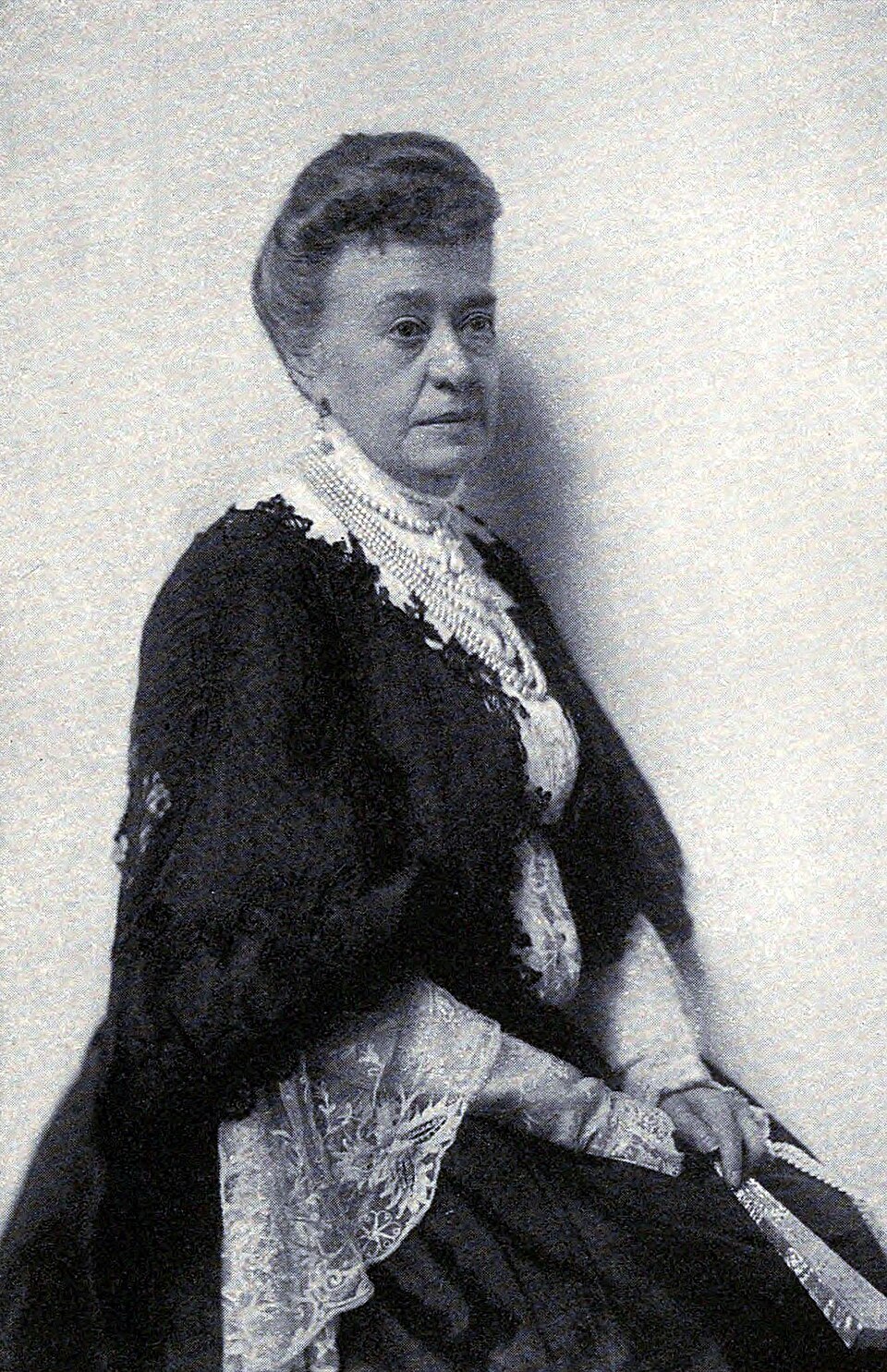
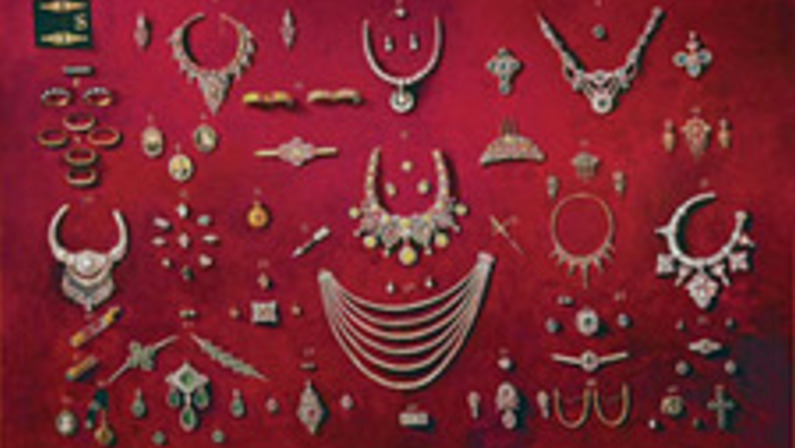
The survival of the university during this "pauper period" rested entirely on Jane Stanford's refusal to close the institution. In 1897, she traveled to London during Queen Victoria's Diamond Jubilee, attempting to auction her personal jewelry collection to fund the university. The market for gemstones was weak, and the sale failed. These jewels later formed the basis of the "Jewel Fund," an endowment established in 1905 explicitly for library acquisitions, which remains active in 2026. The legal siege ended only when the U. S. Supreme Court ruled in favor of the Stanford estate in 1896, releasing the frozen funds. With the financial shackles removed, Jane initiated a massive construction program, determined to complete the physical campus before her death.
This construction phase, frequently termed the "Stone Age," prioritized monumental sandstone structures over engineering prudence. Between 1898 and 1905, the university erected a new library, a gymnasium, and additions to the museum, all built with unreinforced masonry. The focus was on aesthetic grandeur and speed rather than seismic resilience. Architects and contractors, working under Jane's strict supervision, expanded the Outer Quad and added a heavy 80-foot steeple to Memorial Church. This architectural hubris would face a reckoning from the local geology.
At 5: 12 AM on April 18, 1906, the San Andreas Fault ruptured. The shockwave struck the campus with violence that exceeded the structural limits of the new masonry buildings. The devastation was immediate and specific. The new library and the new gymnasium, both nearing completion and never occupied, collapsed into piles of rubble. The steeple of Memorial Church crashed through the roof, destroying the nave and the clock tower. The museum, the largest private museum in the world at the time, lost three of its four wings. In less than sixty seconds, the earthquake erased millions of dollars of recent construction.
The human cost, while low compared to San Francisco, was tragic. Two men died on campus. Junius Hanna, a student in Encina Hall, was crushed when a massive chimney fell through the roof and through four floors of the dormitory. Otto Gerdes, the university fireman, died at the powerhouse. Gerdes had run into the building to cut the electrical power to prevent fires, a decisive action that likely saved the campus from the conflagrations that consumed San Francisco, was killed by a collapsing smokestack as he exited. His sacrifice prevented the "Great Fire" scenario that devastated the city to the north.
President David Starr Jordan arrived on the scene to find the "Stone Age" in ruins. The unreinforced masonry of the Outer Quad and the new monuments had failed, while the Inner Quad, built with more care under Leland's direct supervision, largely held. Jordan, who had frequently clashed with Jane Stanford over her spending on buildings rather than faculty, viewed the destruction with a pragmatic eye. The collapse of the "architectural monstrosities" forced a shift in university policy. The administration decided not to rebuild the library or the gymnasium in their original forms. Instead, the university demolished the ruins and cleared the sites.
The reconstruction effort drained the endowment once again, costing between $2 million and $3 million. This second financial blow forced the university to adopt a utilitarian method to expansion. The era of sandstone monuments ended. Future construction used reinforced concrete and wood, materials better suited to the seismic realities of the San Francisco Peninsula. The 1906 catastrophe fundamentally altered the physical layout of the campus, leaving the Inner Quad as the solitary reminder of the original Romanesque ambition, while the empty spaces where the huge gymnasium and library once stood became a testament to the geological violence that nearly erased the institution.
Frederick Terman and the Cold War Military-Industrial Nexus (1945, 1970)
Railroad Wealth and the Founding Grant of 1885
The transformation of Stanford from a regional institution into a global command center for applied science was not an accident of geography, a deliberate engineering feat orchestrated by Frederick Terman. Returning to Palo Alto in 1946 after directing the Radio Research Laboratory at Harvard, Terman brought with him a specific blueprint: the university would no longer function as a repository of knowledge as a primary engine for the American defense apparatus. His strategy, termed "steeples of excellence," rejected broad academic coverage in favor of concentrating resources on narrow, high-utility fields, specifically those with direct application to the emerging Cold War. By 1950, the Office of Naval Research (ONR) had already identified Stanford as a serious asset, awarding the School of Engineering and the newly formed Stanford Research Institute (SRI) approximately $2 million each in contracts.
Terman understood that federal patronage required a physical ecosystem to sustain it. In 1951, he engineered the creation of the Stanford Industrial Park, a masterstroke of land-use policy that monetized the university's greatest asset: its 8, 800 acres. Because the university's founding grant prohibited the sale of this land, Terman devised a system of 99-year prepaid leases. This arrangement did not generate revenue; it collapsed the distance between the laboratory and the assembly line. Varian Associates, founded by the inventors of the klystron tube, a serious component in radar and microwave communications, became the tenant in 1953. They were soon followed by Hewlett-Packard, Eastman Kodak, and, most significantly, the Lockheed Missiles and Space Division in 1956. Lockheed's arrival in Sunnyvale and the Industrial Park changed the demographic reality of the region, swelling its workforce from zero to 28, 000 by 1965 and cementing the area's identity as "Defense Valley" long before it was Silicon Valley.
The symbiotic relationship between the university and the Pentagon created a closed loop of finance and personnel. Graduate students worked on classified government contracts during the day, wrote theses that were frequently stamped "SECRET" and locked in safes, and then graduated to work for the very defense contractors leasing land from the university. The Applied Electronics Laboratory (AEL) became the nerve center for this exchange. By the mid-1950s, Stanford controlled a dominant share of the nation's research into traveling-wave tubes and microwave electronics, technologies essential for the Electronic Warfare (EW) and Electronic Intelligence (ELINT) systems used by the Strategic Air Command. The university did not just support the military; it became a subcontractor for the surveillance state.
While the university proper handled the theoretical and prototype stages of weapons development, the Stanford Research Institute (SRI) managed the operational and frequently darker applications. Although legally a separate non-profit corporation, SRI functioned as a wholly-owned subsidiary of the university, with Stanford trustees sitting on its board. SRI operated with a level of opacity that the university could not fully maintain. By 1965, government contracts accounted for 82 percent of SRI's total revenue, with 78 percent of that sum derived directly from military sources. The institute's portfolio included chemical warfare research and the development of counter-insurgency tactics. One of its most notorious undertakings, Project AGILE, involved a multi-year effort funded by the Advanced Research Projects Agency (ARPA) to develop anti-guerilla surveillance and suppression techniques in Thailand, turning Southeast Asia into a laboratory for social and kinetic engineering.
The financial of this militarization was immense. In 1969 alone, SRI held $28. 7 million in military contracts, ranking third among all American think tanks. The university itself held another $16. 4 million, placing it fourth among all U. S. universities. This influx of capital allowed Terman to recruit top-tier faculty and build state-of-the-art facilities, yet it also made the university dependent on the continued escalation of global conflict. The "overhead" charges on these federal contracts, money paid by the government to cover the indirect costs of research, became a slush fund that the administration used to expand the university's infrastructure, binding the institution's physical growth to the defense budget.
Stanford & SRI Military-Industrial Growth (1946, 1969)
Year
Entity
Event / Metric
1946
SRI
Founded as a "non-profit" research entity to serve industry and government.
1951
University
Stanford Industrial Park authorized; Terman initiates 99-year lease program.
1953
Industry
Varian Associates moves into Industrial Park; solidifies "Microwave Valley."
1956
Industry
Lockheed Missiles & Space Division establishes HQ in the park.
1965
SRI
Revenue hits $64 million; 78% of government funds come from military.
1969
University
Faculty hold 96 DoD research contracts worth $12. 6 million.
The secrecy required by these contracts eventually collided with the political awakening of the student body. As the Vietnam War escalated, the presence of classified research on campus became a flashpoint. In the spring of 1969, the "April 3rd Movement" (A3M) coalesced, demanding an end to all classified research and the severance of ties with SRI. The students were not protesting the war in the abstract; they were protesting the specific guidance systems, chemical agents, and surveillance technologies being designed in their own classrooms. The conflict peaked in May 1969, when students occupied the Applied Electronics Laboratory for nine days. They discovered and publicized documents confirming the extent of the university's involvement in CIA electronic warfare studies and classified Pentagon projects.
The administration's response to the 1969 emergency was a tactical retreat designed to preserve the financial core of the institution. The university agreed to divest SRI, severing the formal legal tie in 1970, though the personal and professional networks remained intact. The ban on classified research on campus was enacted, yet the definition of "classified" was frequently manipulated, and the flow of federal research dollars shifted to "unclassified" military-adjacent projects. Terman's legacy was already cemented: he had successfully grafted the military-industrial complex onto the academic, creating a hybrid organism where the of truth was inextricably linked to the of state power.
Stanford Industrial Park and the Genesis of Silicon Valley
The economic engine of Silicon Valley did not begin with a garage startup, with a legal loophole. Leland Stanford's 1885 Founding Grant contained a strict clause regarding the university's 8, 180 acres: the land was inalienable. The Trustees could never sell a single square foot. By the end of World War II, this restriction had become a financial chokehold. Stanford possessed massive real estate holdings yet faced a severe cash deficit, with faculty salaries and facilities deteriorating. The solution came from Frederick Terman, the Dean of Engineering, who devised a method to monetize the dirt without violating the Founding Grant: the long-term ground lease.
In 1951, Terman and University President Wallace Sterling launched the Stanford Industrial Park (later renamed Stanford Research Park), the university-owned industrial park in history. The concept was simple yet ruthless. Stanford would retain ownership of the land, while companies would sign 99-year prepaid leases. This structure provided the university with immediate, massive infusions of capital, cash up front, while ensuring the land would eventually revert to the institution. The tenant, Varian Associates, signed a lease in October 1951 for ten acres, paying $41, 000. This initial transaction set the precedent for the region's development: high-tech industry physically anchored to academic soil.
The park was not originally designed for "silicon" or "software," for electronic warfare. During the 1950s, the area was known as "Microwave Valley." Terman, fresh from running the top-secret Radio Research Laboratory at Harvard during the war, understood that the Department of Defense needed advanced electronics for radar, guidance systems, and interception. He actively recruited companies that could secure federal defense contracts. By 1955, the park hosted seven companies; by 1960, that number rose to 32. These firms were not commercial enterprises; they were defense contractors. In 1947, military sources provided 50% of Stanford's engineering budget. By the mid-1950s, the Office of Naval Research (ONR) and other federal agencies were funneling millions into the park's tenants, creating a closed loop of government funding, academic research, and industrial production.
The lease model allowed Stanford to enforce strict architectural and zoning controls, creating a campus-like environment that masked the industrial nature of the work. Terman insisted on low density, massive setbacks, and "clean" aesthetics. This visual sanitization hid the environmental reality of hardware manufacturing. Behind the manicured lawns and mid-century modern facades, companies like Hewlett-Packard and Varian used heavy solvents to clean circuit boards and machine parts. The consequences of this "light industry" surfaced decades later. In 1981, a leaking underground storage tank at HP's facility on Page Mill Road revealed a massive plume of trichloroethylene (TCE) and other volatile organic compounds in the groundwater. The Environmental Protection Agency eventually multiple locations within and near the park as Superfund sites, requiring decades of remediation that continue to this day.
The financial success of the park fundamentally altered Stanford's trajectory. The revenue from these ground leases did not supplement the budget; it allowed Terman to execute his "Steeples of Excellence" strategy, poaching top faculty from Ivy League institutions by offering superior salaries and facilities funded by the industrial park's income. The park became a real estate hedge fund attached to a university. By 2025, real estate investments, including the Research Park, accounted for approximately 11% of Stanford's $40. 8 billion endowment. The park had evolved from a desperate post-war revenue fix into a primary pillar of the university's sovereign wealth.
Evolution of Stanford Research Park Tenants (1951, 2026)
Era
Primary Industry
Key Tenants
Strategic Focus
1951, 1965
Microwave & Defense Electronics
Varian Associates, Eastman Kodak, Lockheed
Cold War military contracts, Radar, Klystrons
1966, 1985
Semiconductors & Computing
Hewlett-Packard, Xerox PARC, Fairchild
Personal computing, GUI, Laser printing, Hardware
1986, 2010
Biotech & Software
Roche, Genencor,
Genomics, Operating Systems, Pharmaceutical R&D
2011, 2026
Artificial Intelligence & EV
Tesla, Uniphore, Rubrik, Ford Greenfield Labs
Autonomous systems, Generative AI, Cloud Security
As of early 2026, the park demonstrates a radical shift from hardware to artificial intelligence and autonomous systems. While legacy tenants like HP remain, the square footage is increasingly dominated by AI firms desperate for proximity to Stanford's computer science department. In January 2026, Uniphore, an enterprise AI company, tripled its footprint in the park, signaling a new wave of displacement where software capital pushes out older industrial firms. The vacancy rate in the park, which hovered near 18% during the post-pandemic correction, began to tighten rapidly as AI capital flooded the Bay Area. Rents in the park have surged, further excluding any business not connected to the highest tiers of venture capital or the Nasdaq 100.
The relationship between the park and the surrounding community remains fractured by the "jobs-housing imbalance" that Terman's model exacerbated. By prioritizing industrial and office space over residential development for seventy years, the park created a massive surplus of high-paying jobs with no corresponding housing stock. This forced the median home price in Palo Alto to astronomical heights, segregating the community by class. The workers who clean the offices and maintain the grounds of the Research Park commute from distant counties, while the engineers and executives live in the exclusionary zones protected by the very wealth the park generates.
The park also serves as a geopolitical instrument. In the 1950s, it was a weapon against the Soviet Union. In 2026, it functions as a for American technological supremacy against global competitors. The Department of Defense has returned to the valley, with new defense-tech startups leasing space to build autonomous drone swarms and AI-driven surveillance tools. Terman's vision of a "community of technical scholars" has fully matured into a militarized, monetized, and exclusive enclave that dictates the economic reality of the entire peninsula. The ground remains inalienable, the power it generates has been sold to the highest bidder for three quarters of a century.
Recombinant DNA and the Cohen-Boyer Patent Revenue Stream
Financial Instability and the 1906 Earthquake Reconstruction
The financial architecture of modern biotechnology, and the fiscal trajectory of Stanford University itself, crystallized not in a laboratory, in a delicatessen near Waikiki Beach in November 1972. There, Stanford professor Stanley Cohen and University of California, San Francisco (UCSF) professor Herbert Boyer met over corned beef sandwiches to discuss a collaboration that would rewrite the genetic code. Their conversation merged Cohen's method of introducing plasmids into *Escherichia coli* bacteria with Boyer's discovery of the restriction enzyme EcoRI, which could cut DNA at specific sequences to create "sticky ends." This union allowed them to splice genetic material from different species into a single, replicating organism. The resulting experiments in 1973 did not just prove that DNA could be recombined; they proved it could be industrialized. While the scientific community debated the of playing god, Niels Reimers, the director of Stanford's Office of Technology Licensing (OTL), saw a different kind of chance. Reimers, an engineer who had joined Stanford in 1968, recognized that the Cohen-Boyer technique was a platform technology, a fundamental tool that would be necessary for an entire industry. In 1974, against the hesitation of faculty members who believed academic discoveries should remain in the public domain, Reimers filed for a patent just one week before the one-year deadline that would have invalidated the claim. He argued that without patent protection, pharmaceutical companies would never invest the capital required to bring recombinant drugs to market. The patent application, filed on November 4, 1974, set the stage for the most lucrative university licensing program in history. The route to monetization faced an immediate ethical blockade. In February 1975, Paul Berg, a Stanford biochemist, organized the Asilomar Conference on Recombinant DNA. Held at a retreat center on the Monterey Peninsula, the gathering brought together 140 biologists, lawyers, and physicians to address the biohazards of genetic engineering. The scientists voluntarily imposed a moratorium on their own research, a rare moment of self-regulation in the history of science. They feared that engineered bacteria could escape the lab and wreak havoc on the biosphere. This pause allowed the National Institutes of Health (NIH) to develop safety guidelines, it also delayed the commercial rollout of the technology. The patent itself languished in the review process for six years, stalled by the very questions raised at Asilomar. When the U. S. Patent and Trademark Office issued Patent No. 4, 237, 224 on December 2, 1980, Reimers executed a strategy that conventional wisdom. Instead of selling exclusive rights to a single pharmaceutical giant, he offered non-exclusive licenses to any company to pay. The terms were relatively modest: a $10, 000 upfront fee and a royalty rate of 1% to 3% on end products. This method placed a tax on the entire nascent biotechnology sector. Every company that wanted to splice a gene, whether to make insulin, growth hormone, or interferon, had to pay rent to Stanford and UCSF. By the time the patents expired in 1997, the university had issued 468 licenses. The revenue generated by this "tax" was for the era. The Cohen-Boyer patents grossed $255 million in licensing fees, a sum that was split between Stanford and UCSF. For Stanford, this windfall did not pad the budget; it validated the OTL model and provided unrestricted funds that the university reinvested into its research infrastructure. The Department of Biochemistry used its share to fund graduate fellowships and purchase equipment, creating a feedback loop of innovation and capital. This success Reimers to lobby Congress for the passage of the Bayh-Dole Act of 1980, which codified the right of universities to patent inventions funded by federal research grants. The Cohen-Boyer patent became the exemplar for this new economic order, shifting the university from a passive repository of knowledge to an active participant in the marketplace. The in how the two inventors capitalized on their discovery illustrates the two route available to the modern scientist-entrepreneur. Herbert Boyer co-founded Genentech in 1976, trading his academic purity for equity that would eventually make him a billionaire. Stanley Cohen remained at Stanford, relying on the patent royalties and continuing his research. While Boyer's wealth came from the stock market's valuation of a single company, Cohen's income, and Stanford's, came from the industry's shared output. This distinction is important: Stanford did not bet on a winner; it owned the racetrack. By 2026, the legacy of the Cohen-Boyer revenue stream is visible in the physical and financial stature of the university. The OTL, which began as a pilot program with a budget of $55, 000, generated over $87 million in gross royalty revenue in the 2025 fiscal year alone. The "Stanford Model" of technology transfer, pioneered by Reimers and validated by recombinant DNA, has been replicated by universities worldwide, though few have matched the of the original success. The $255 million from Cohen-Boyer may seem small compared to the university's current $40 billion endowment, yet it provided the seed capital for the administrative apparatus that harvests value from every corner of the campus, from Google's PageRank to the latest CRISPR applications.
Financial Impact of the Cohen-Boyer Patent (1980, 1997)
Metric
Figure
Total Licensing Revenue
$255, 000, 000
Number of Licensees
468 Companies
Standard Upfront Fee
$10, 000
Royalty Rate on Sales
1% , 3%
Patent Expiration Date
December 2, 1997
Estimated Product Sales (during patent life)
$35, 000, 000, 000+
The ethical questions raised at Asilomar have not; they have mutated. The revenue-driven model of science established by the Cohen-Boyer patent creates a pressure to commercialize that can conflict with the public interest. In the 2020s, as Stanford researchers develop AI models and gene-editing therapies, the OTL's mandate to maximize impact is frequently interpreted as a mandate to maximize revenue. The recombinant DNA era taught the university that the most dangerous organisms are not always the ones that escape the lab, the ones that can be licensed.
Network Infrastructure and the Incubation of Tech Monopolies (1980, 2005)
Between 1980 and 2005, Stanford University ceased to function as an educational institution and operated instead as a holding company for the intellectual property of the internet. The physical and digital infrastructure that defines the modern world, routers, search engines, and servers, did not emerge from a vacuum of private enterprise. These technologies were developed using public funds, housed in tax-exempt facilities, and then privatized through a method that converted academic research into corporate monopolies. This period marks the transition of the university from a guardian of open knowledge to a primary stakeholder in the enclosure of the digital commons.
The architecture of this transfer began with the hardware required to connect computers. In the early 1980s, the Stanford campus struggled to link its computer science buildings. William Yeager, a research engineer at the university, wrote the code for a multi-protocol router and designed the "Blue Box" hardware to facilitate this connection. The technology was a campus utility, built on the university's dime. Leonard Bosack, the director of computer facilities for the Department of Computer Science, and Sandy Lerner, a director of computer facilities for the Graduate School of Business, saw a different purpose for Yeager's invention. In 1984, they founded Cisco Systems. They did not simply use the knowledge they gained at work; they used the actual hardware and software developed by Yeager. Bosack and Lerner continued to work at Stanford while selling routers built with university resources to outside parties. When the administration discovered this unauthorized commercialization in 1986, they threatened criminal charges for the theft of intellectual property. The university yet chose not to prosecute. Instead, the Office of Technology Licensing (OTL) negotiated a settlement in 1987. Cisco agreed to pay $167, 000 and royalties, and in exchange, Stanford legitimized the transfer of the Blue Box technology. The router, a tool built for public connectivity, became the proprietary foundation of a company that would soon control the majority of the world's internet traffic.
This pattern of privatizing internal infrastructure repeated with the Stanford University Network (SUN). Andy Bechtolsheim, a graduate student, designed a workstation to handle the demands of the campus network. He built the prototypes using spare parts scavenged from the computer science department. The machine was designed to run the Berkeley Unix operating system and connect to the ARPANET. It was a tool for researchers. In 1982, Bechtolsheim, along with fellow students Scott McNealy and Vinod Khosla, founded Sun Microsystems. The name itself, an acronym for Stanford University Network, acknowledged the source of the technology. The university did not stop the privatization of its network hardware; it became a client, buying the very workstations its students had developed using its own facilities.
As the internet moved from text-based terminals to the World Wide Web, the extraction of value shifted from hardware to bandwidth and data. In 1994, electrical engineering students Jerry Yang and David Filo created "Jerry and David's Guide to the World Wide Web." They hosted the directory on their student workstations, named "Akebono" and "Konishiki" after sumo wrestlers. These servers resided on the Stanford campus, consuming massive amounts of university bandwidth and electricity paid for by tuition and grants. The service, soon renamed Yahoo!, became the de facto phonebook of the early web. For over a year, Stanford acted as the unpaid hosting provider for a global commercial enterprise. When the traffic became too heavy for the campus network to bear in 1995, the university did not claim ownership of the directory that had been incubated on its servers. It simply asked Yang and Filo to move the hosting off-campus, allowing them to take the entire asset with them. The university facilitated the creation of a private media giant by subsidizing its operating costs during its most fragile developmental phase.
The most significant transfer of public wealth to private hands occurred with the rise of Google. In the mid-1990s, the National Science Foundation (NSF), DARPA, and NASA funded the Digital Libraries Initiative (DLI). Stanford received a $4. 5 million grant (NSF IRI-9411306) to develop technologies for a single, integrated, and universal digital library. Graduate students Larry Page and Sergey Brin worked under this grant. Their research produced the PageRank algorithm, a method for ranking web pages based on link structure. This was not a dorm-room epiphany; it was the direct result of federally funded research objectives. The "BackRub" crawler, which indexed the web for their search engine, ran on Stanford servers and at one point consumed nearly half of the university's total internet bandwidth.
Unlike the Yahoo! case, the Office of Technology Licensing recognized the immense value of the PageRank algorithm. Stanford filed for a patent (US Patent 6, 285, 999) in 1998, listing the university as the assignee and Lawrence Page as the inventor. When Page and Brin incorporated Google, they did not own the core technology of their company; they licensed it from Stanford. In exchange for the exclusive license to this publicly funded invention, Stanford received 1. 8 million shares of Google stock. This deal fundamentally altered the relationship between the university and the companies it spawned. Stanford was no longer just a landlord or a licensor collecting royalties; it was an equity holder with a vested interest in the monopolistic dominance of its spinoff. When Stanford sold its Google stock in 2005, it netted $336 million. The PageRank patent, a fruit of taxpayer-funded research intended to organize the world's libraries, became the engine of the world's largest advertising surveillance apparatus.
The Office of Technology Licensing (OTL) institutionalized this pipeline. Established in 1970, the OTL shifted its strategy in the 1980s and 90s to prioritize equity and aggressive patent enforcement. The university operated as a venture capital firm with a built-in research and development lab funded by the government. By 2005, the OTL had generated over $1 billion in cumulative gross royalties. This revenue stream created a feedback loop: the university attracted researchers with the pledge of commercialization, the researchers used public grants to develop proprietary technologies, and the university took a cut of the resulting monopolies. The "Stanford Industrial Complex" ensured that the open of the early internet were systematically replaced by walled gardens owned by Stanford alumni and partially owned by the university itself.
The Transfer of Public Research to Private Monopoly (1980, 2005)
Technology
Primary Public Funding
Stanford Resource Used
Private Entity
University Outcome
Multi-Protocol Router
Internal/Research Budget
"Blue Box" Hardware, Yeager's Code
Cisco Systems
$167, 000 settlement + royalties
SUN Workstation
DARPA / NSF (via CS Dept)
CS Dept Spare Parts, Campus Network
Sun Microsystems
Hardware supplier relationship
Web Directory
University Infrastructure
Servers (Akebono/Konishiki), Bandwidth
Yahoo!
Zero equity (missed opportunity)
PageRank Algorithm
NSF (Grant IRI-9411306), DARPA, NASA
DLI Grant, Campus Bandwidth
Google
1. 8 million shares ($336M profit)
Recombinant DNA
NIH / NSF
Biochem Dept Labs
Genentech (licensee)
$255M in royalties (Cohen-Boyer)
The incubation of these monopolies was not an accident of geography a deliberate feature of Stanford's administration. The university provided the physical sanctuary where the public internet was dismantled and sold back to the public as a service. By the time the dot-com bubble burst and recovered, the precedent was set. The university was no longer distinct from the tech industry; it was the silent partner in the boardroom, holding the patents that turned the information age into a proprietary asset class.
Institutional Ethics, Admissions Scandals, and the Varsity Blues Investigation
Frederick Terman and the Cold War Military-Industrial Nexus (1945, 1970)
The distinction between the "side door" of illegal bribery and the "back door" of institutional preference collapsed in March 2019, when federal prosecutors unsealed the indictment for Operation Varsity Blues. While the University of Southern California faced the highest volume of fraudulent admits, Stanford University held the distinction of enrolling the student associated with the single largest payment in the entire scandal. The family of Yusi Zhao paid college consultant William "Rick" Singer $6. 5 million to secure her admission. Unlike the parents who paid for falsified SAT scores, the Zhao family used a method that exploited the university's reliance on athletic fundraising. Singer directed $500, 000 of that sum to the Stanford sailing program, a transaction that sailing coach John Vandemoer accepted in exchange for designating Zhao as a competitive recruit, even though she had no competitive sailing record.
Vandemoer's sentencing revealed a specific pathology in Stanford's athletic department. Unlike coaches at other universities who pocketed bribes for personal enrichment, Vandemoer used the illicit funds to purchase equipment for the sailing team. He pleaded guilty to racketeering conspiracy received no prison time, only one day deemed served, because the judge recognized he acted to benefit the university's program rather than himself. This defense, yet, exposed the immense pressure placed on "non-revenue" sports coaches to generate their own operating capital, creating a structural vulnerability that Singer easily exploited. Stanford expelled Zhao and vacated her credits, the $6. 5 million payment remains a permanent marker of the price tag attached to elite access.
The Varsity Blues investigation forced a public reckoning with the "back door", legacy and donor admissions. In the 2023 admissions pattern, Stanford reported that 13. 6% of its admitted class had ties to alumni or donors. While the university insists that academic standards remain uniform, the statistical advantage for the children of the wealthy is undeniable. This preference faced an existential threat in 2024 when the California state legislature passed Assembly Bill 1780, banning legacy preference at private colleges starting in September 2025. In a move that prioritized donor relations over state financial aid, Stanford announced it would withdraw from the Cal Grant program. By rejecting state funds for low-income students, and promising to replace them with institutional aid, the university legally circumvented the ban, preserving its ability to sell preferential treatment to the children of alumni and major donors well into 2026.
Institutional ethics at the highest level faced a severe test in July 2023, when Stanford President Marc Tessier-Lavigne announced his resignation following an independent review of his scientific research. The investigation, triggered not by internal audits by the dogged reporting of student journalist Theo Baker in The Stanford Daily, found that members of Tessier-Lavigne's lab had engaged in the manipulation of research data. The review identified "subpar scientific practices" in five widely papers, including work published in Science and Nature. While the report did not find that Tessier-Lavigne personally falsified data, it concluded he failed to correct the scientific record when presented with evidence of manipulation. The scandal shattered the administration's credibility, proving that the university's internal method for policing research integrity were subordinate to the reputation of its star faculty.
The university's financial entanglements with the cryptocurrency exchange FTX further eroded public trust between 2022 and 2024. Joseph Bankman and Barbara Fried, both long-tenured Stanford Law professors and parents of FTX founder Sam Bankman-Fried, were accused in court filings of siphoning millions from the company. The lawsuit alleged that Bankman directed more than $5. 5 million in FTX donations to Stanford in an effort to "curry favor" with his employer. These funds were ostensibly for pandemic-related research, yet they originated from a massive fraud. In September 2023, facing a lawsuit from the FTX bankruptcy estate, Stanford agreed to return the "entirety" of the gifts. The incident demonstrated a absence of due diligence in vetting the source of major philanthropic inflows, particularly when the donors were members of the faculty elite.
These modern scandals echo the "Indirect Cost" emergency of the early 1990s, which established the template for Stanford's friction with federal oversight. In 1990, government auditors discovered that Stanford had overcharged the Office of Naval Research for the indirect costs of federally funded research. The university had billed the government for the depreciation of a 72-foot yacht named Victoria, which was used by the sailing program and for entertaining donors. Auditors also found charges for a cedar-lined closet, antique furniture, and flowers for the university president's residence. The scandal forced the resignation of President Donald Kennedy in 1992 and resulted in a $3 million settlement. The Victoria incident remains a potent symbol of the university's historical tendency to view federal tax dollars as a fungible resource for maintaining an opulent institutional lifestyle.
The judicial and administrative handling of sexual assault cases has also drawn intense scrutiny, most notably in the case of Brock Turner. In January 2015, two graduate students discovered Turner, a freshman swimmer, sexually assaulting an unconscious woman behind a dumpster. In 2016, Judge Aaron Persky sentenced Turner to only six months in county jail, citing the "severe impact" a prison sentence would have on the defendant. The leniency of the sentence, combined with a letter from Turner's father describing the assault as "20 minutes of action," ignited a national firestorm. Stanford's administration faced criticism for its initial response, which emphasized Turner's status as a student-athlete. The victim, Chanel Miller, later released a impact statement that galvanized the recall of Judge Persky in 2018. The case forced a revision of California law regarding sexual assault of unconscious victims, yet it left a lasting stain on Stanford's reputation as a safe environment for women.
Year
Incident
Key Figures
Financial/Ethical Impact
1990, 1992
Indirect Cost Scandal
Pres. Donald Kennedy
Billed gov for 72ft yacht Victoria; Kennedy resigned; $3M repaid.
2016
Brock Turner Sentencing
Brock Turner, Judge Persky
6-month sentence for assault; Judge recalled; exposed judicial leniency for elites.
2019
Varsity Blues
John Vandemoer, Yusi Zhao
$6. 5M payment from Zhao family; Coach accepted $610k for program; Zhao expelled.
2022, 2024
FTX Donations
Joseph Bankman, Barbara Fried
$5. 5M in fraud-linked gifts accepted; Stanford agreed to return funds in 2023.
2023
Research Misconduct
Pres. Marc Tessier-Lavigne
Resigned after data manipulation found in 5 papers; exposed by student press.
2025, 2026
AB 1780 Evasion
University Administration
Withdrew from Cal Grant program to legally continue legacy/donor admissions.
The pattern across these decades reveals an institution that frequently operates as a sovereign entity, prioritizing its financial growth and reputation over ethical rigor until forced into compliance by external forces. Whether it was the FBI exposing the side door, student journalists exposing the President's research failures, or federal auditors exposing the billing of a yacht, transparency at Stanford has rarely been voluntary. The decision to forgo state aid in 2025 to protect legacy admissions confirms that the university views its autonomy, and its patronage networks, as paramount, even in the face of legislative attempts to enforce equity.
Endowment Management and Venture Capital Asset Allocation Strategies
The Stanford University endowment is not a savings account; it is a sovereign wealth fund operating under the guise of an educational non-profit. Managed by the Stanford Management Company (SMC), the "Merged Pool" held assets exceeding $42 billion by the close of fiscal year 2024, a figure that eclipses the GDP of small nations. While the university publicly emphasizes tuition coverage and research grants, the mechanics of this fund reveal a financial engine deeply entangled with the venture capital industry it helped spawn. The endowment's growth strategy relies on a high-risk, high-reward feedback loop: Stanford invests in Sand Hill Road firms, those firms invest in Stanford startups, and the returns flow back into the Merged Pool, frequently tax-free. The origins of this aggressive strategy date to the establishment of the SMC in 1991. Before this, the university's assets were managed with relative conservatism. The creation of a dedicated management company professionalized the endowment, moving it away from standard bonds and blue-chip stocks toward alternative assets. By 2024, the SMC's asset allocation policy targeted a 38% exposure to private equity, a category that includes venture capital and leveraged buyouts. This is nearly double the exposure of a standard diversified portfolio. The strategy, championed by CEO Robert Wallace since 2015, doubles down on the "illiquidity premium", the idea that investors can earn higher returns by locking up capital in assets that cannot be easily sold. The archetype of this strategy, and the drug that hooked the university on venture equity, was the 1998 investment in Google. Stanford faculty member David Cheriton introduced founders Larry Page and Sergey Brin to Kleiner Perkins, the university also held a direct equity stake derived from licensing the PageRank patent. When Google went public in 2004, Stanford sold shares worth $336 million. This windfall did not pad the budget; it validated a model where the university acts as both incubator and investor. Similar early in Cisco Systems and VMware cemented the belief that proximity to Silicon Valley innovation was a distinct asset class. This proximity creates a closed loop of capital and influence. The SMC does not pick stocks; it acts as a limited partner (LP) in the most exclusive venture funds in the world, funds like Sequoia Capital, Benchmark, and Andreessen Horowitz. These firms are frequently run by Stanford alumni or donors, creating a complex web of conflicts. For instance, when a venture firm raises a new fund, access is frequently restricted to a "golden circle" of institutional investors. Stanford's guaranteed seat at the table allows it to capture returns from the very companies its students and professors create. yet, the heavy reliance on private equity exposes the university to severe volatility and liquidity crunches. In fiscal year 2021, the endowment returned an astronomical 40. 1%, driven by a tech IPO boom. One year later, in fiscal year 2022, it lost 4. 2% as valuations crashed. This volatility highlights the "denominator effect." When public markets fall, the value of liquid assets (stocks/bonds) drops, while private assets (which are not marked to market daily) remain artificially high. This leaves the endowment overweight in illiquid assets, unable to sell them without taking steep discounts. In the 2022-2024 period, as IPO exits dried up, the endowment faced a cash flow problem common to the asset class: "paper rich, cash poor."
Stanford Merged Pool Performance vs. Benchmarks (Fiscal Years 2021, 2024)
Fiscal Year
Stanford Return
U. S. Endowment Median
Context
2021
+40. 1%
+30. 6%
Tech/IPO Boom (Coinbase, Robinhood exits)
2022
-4. 2%
-3. 1%
Tech valuation correction; inflation spike
2023
+4. 4%
+6. 9%
Private equity lag; public market recovery
2024
+8. 4%
+10. 1%
AI sector growth vs. legacy venture stagnation
The 2024 return of 8. 4% underperformed the median for U. S. endowments, a signal that the heavy venture allocation acted as a drag when private valuations failed to keep pace with the public S&P 500 rally. While public tech stocks surged on Artificial Intelligence hype, private venture portfolios remained weighed down by "zombie unicorns", startups valued at billions in 2021 that could no longer raise capital at those prices. Stanford's portfolio, laden with vintage 2020-2021 venture bets, faced a slow mark-to-market reality check. Ethical questions regarding this accumulation of wealth. The endowment enjoys tax-exempt status (though a 1. 4% federal excise tax was introduced in 2017 for large endowments), yet it functions indistinguishably from a commercial hedge fund. The payout rate to the university operating budget hovers around 5% to 5. 5%. This means that for every $100 earned in a boom year like 2021, only a fraction reaches the classroom immediately; the rest is reinvested to grow the principal. Critics this hoarding prioritizes intergenerational equity over urgent current needs, such as housing affordability for staff or graduate students who live in the shadow of the wealth they help generate. By early 2026, the strategy faced a new test. The Artificial Intelligence boom, led by companies like OpenAI and Anthropic, offered a chance bailout for the venture portfolio. yet, the concentration of value in of massive AI companies masked broader weakness in the software-as-a-service (SaaS) and consumer tech sectors. The SMC's continued bet on this asset class assumes that the "power law" of venture capital, where one massive winner pays for dozens of losers, hold true. In an era of higher interest rates and regulatory scrutiny on big tech acquisitions, the exit route for these investments have narrowed, leaving Stanford holding billions in theoretical wealth that cannot easily be converted into cash.
Research Integrity Failures and the Resignation of President Tessier-Lavigne
Stanford Industrial Park and the Genesis of Silicon Valley
On July 19, 2023, the tenure of Marc Tessier-Lavigne as the 11th president of Stanford University ended in a collision between high- neuroscience and open-source forensic scrutiny. His resignation, August 31, 2023, followed a months-long investigation that substantiated a pattern of data manipulation in laboratories he directed across three decades. The scandal dismantled the reputation of a scientist previously hailed as a titan in the field of brain development and Alzheimer's research. It also exposed a widespread vulnerability in modern academia: the "star scientist" model, where principal investigators manage vast research empires with insufficient oversight of raw data, creating environments where subordinates feel pressure to produce favorable results at any cost. The catalyst for this downfall was not a rival institution or a federal audit, the persistent reporting of Theo Baker, a freshman journalist at *The Stanford Daily*. Beginning in late 2022, Baker investigated tips from PubPeer, a post-publication peer review site where scientists anonymously flag irregularities in published images. While allegations of image tampering in Tessier-Lavigne's work had circulated in niche forums since 2015, they remained largely ignored by the broader scientific establishment until Baker's reporting forced the university's Board of Trustees to act. The Board appointed a Special Committee, which engaged a Scientific Panel led by former federal prosecutor Mark Filip and comprised of distinguished neuroscientists and biologists, to examine the evidence. The Scientific Panel's final report, released in July 2023, delivered a nuanced damning verdict. It found no evidence that Tessier-Lavigne personally manipulated data or possessed actual knowledge of fraud at the time of publication. Yet, the report concluded that he failed to "decisively and forthrightly correct mistakes in the scientific record" on multiple occasions when errors were brought to his attention. The investigation identified a recurring "culture of lab management" where Tessier-Lavigne rewarded postdocs who generated "winning" data while marginalizing those whose experiments failed to support his hypotheses. This environment, the panel noted, created an "unusual frequency of manipulation of research data" spanning his tenure at the University of California, San Francisco (UCSF), Genentech, and Rockefeller University. Central to the controversy were specific instances of image manipulation involving Western blots, a technique used to detect specific proteins. In multiple papers, bands representing proteins were found to be duplicated, spliced, or digitally altered to appear cleaner or more convincing than the raw experimental data allowed. The panel rejected Tessier-Lavigne's initial defense that anomalies were "tiling" (a cosmetic practice of splicing images) or innocent formatting errors. Instead, forensic analysis confirmed that data-containing portions of images had been altered, fundamentally compromising the integrity of the scientific claims. The resulted in the retraction of four high-profile papers, a rare and humiliating outcome for a university president. The most significant casualty was a 2009 *Nature* paper titled "APP binds DR6 to trigger axon pruning and neuron death via distinct caspases." Published during Tessier-Lavigne's time as a senior executive at Genentech, this study was once heralded as a breakthrough in understanding the method of Alzheimer's disease. It proposed a specific pathway for neuronal degeneration that promised new therapeutic. yet, subsequent attempts by other pharmaceutical companies and independent labs failed to replicate the findings. even with these failures and internal questions raised at Genentech, Tessier-Lavigne allowed the paper to stand for over a decade. It was retracted in December 2023, months after his resignation, after the authors conceded they "absence confidence" in the data.
Table: Key Retracted and Corrected Papers Linked to Marc Tessier-Lavigne
Journal
Year
Title Snippet
Status (as of 2026)
Citations (Approx.)
Nature
2009
APP binds DR6 to trigger axon pruning...
Retracted (Dec 2023)
800+
Science
2001
The transcriptional control of axon guidance...
Retracted (Aug 2023)
470+
Science
2001
Hierarchical organization of guidance receptors...
Retracted (Aug 2023)
200+
Cell
1999
Netrin-1 Is a Chemoattractant...
Retracted (Sept 2023)
570+
Nature
2004
Wnt-Frizzled signaling controls...
Corrected (Dec 2023)
600+
The investigation also highlighted missed opportunities for correction. In 2015 and 2016, as comments on PubPeer began to accumulate, Tessier-Lavigne prepared corrections for *Science* regarding his 2001 papers. yet, after the journal pointed out that the errors were more extensive than initially admitted, he did not pursue the matter further, and the corrections were never published. The Scientific Panel this inaction as a primary failure of leadership. A scientist of his stature, they argued, held a responsibility to ensure the absolute accuracy of the record, regardless of the reputational cost or the administrative load. The resignation of Tessier-Lavigne served as a grim milestone in the "reproducibility emergency" affecting the biomedical sciences. It demonstrated that even the most prestigious positions offer no immunity against the forensic capabilities of the modern scientific community. By 2026, the incident had prompted Stanford and peer institutions to overhaul their research integrity offices, implementing stricter for data retention and image verification before publication. The "Tessier-Lavigne Affair" became a standard case study in research ethics curricula, illustrating the long-term consequences of prioritizing narrative elegance over experimental messiness. While Tessier-Lavigne remained a tenured professor in the Department of Biology following his resignation, his laboratory operations faced intense scrutiny. The scandal ended his influence as a scientific policymaker. The retraction of the 2009 Alzheimer's paper, in particular, forced the field to re-evaluate years of research investment that had been predicated on a flawed foundation. The scientific community was left to grapple with the reality that of "textbook" knowledge in neurodevelopment had been built on data that could not withstand the light of day. The role of *The Stanford Daily* in this sequence of events marked a shift in the power of academic accountability. A team of student journalists, armed with little more than curiosity and an internet connection, succeeded where peer reviewers, co-authors, and institutional oversight boards had failed for twenty years. Their reporting proved that the method of self-correction in science are frequently too slow, too insular, and too deferential to authority. The exposure of the manipulated Western blots forced a reckoning not just for one man, for an academic culture that frequently prefers a beautiful, publishable lie to a complex, unpublishable truth.
The Doerr School of Sustainability and Fossil Fuel Funding Debates (2022, 2026)
The Stanford Doerr School of Sustainability opened in September 2022 with a $1. 1 billion gift from venture capitalist rr, the largest single donation in the university's history. This money promised to accelerate solutions to the climate emergency. Yet the school immediately faced a emergency of legitimacy. Critics pointed to a structural contradiction: the institution tasked with ending the fossil fuel era was funded, in part, by the companies perpetuating it. Between 2011 and 2023, fossil fuel interests contributed over $68 million to the departments that formed the new school. In the fiscal year 2022 alone, companies including Chevron, ExxonMobil, Shell, and TotalEnergies provided approximately $5. 5 million to the school's Industrial Affiliates programs, more than 55 percent of the total affiliate funding for that year. The method for this funding is the Industrial Affiliates program, a system that allows corporations to pay annual fees in exchange for access to faculty, student recruitment, and research symposia. While the university describes these funds as "unrestricted," the structure creates a dependency. Companies gain a seat at the table where research priorities are discussed. For the Doerr School, this meant that the entities responsible for the vast majority of historical carbon emissions were not just subjects of study active partners. Dean Arun Majumdar defended this arrangement, arguing that the energy transition required engagement with the incumbent industry. He stated that excluding these companies would violate principles of academic freedom and ignore the practical need of scaling new technologies. Opposition coalesced rapidly. The Coalition for a True School of Sustainability, a group of students and faculty, demanded a complete ban on fossil fuel funding. They argued that money from the oil and gas industry functioned as a reputation-laundering service, greenwashing, that allowed companies to project an image of climate responsibility while expanding extraction operations. The Coalition pointed to the between the companies' public statements and their internal capital expenditures, which remained overwhelmingly focused on hydrocarbons. In 2024, the debate intensified when the school hired the Brunswick Group, a public relations firm with a history of representing BP and Saudi Aramco, to manage "reputational challenges." This decision appeared to confirm the activists' fears: the school prioritized brand management over moral clarity. The administration responded with bureaucracy. In December 2022, Stanford formed the Committee on Funding for Energy Research and Education (CFERE) to review the ethics of accepting fossil fuel money. The committee released its report in June 2024. The findings rejected a ban. The report concluded that dissociation would "impede climate solutions" and infringe upon the rights of faculty to pursue funding sources of their choice. Instead of a prohibition, the committee recommended "better guardrails" and increased transparency. This outcome aligned with the university's long-standing refusal to divest its endowment fully from fossil fuel assets, a position that Stanford from peers like Princeton and Columbia, which had taken stricter stances. By 2026, the Doerr School remained a hybrid entity. It produced high-level climate science while maintaining its financial pipelines to the oil majors. The "Industrial Affiliates" model continued to operate, with the university updating its transparency disclosures altering little of the underlying financial architecture. The decision to retain these ties signaled a specific institutional philosophy: Stanford viewed the fossil fuel industry not as an enemy to be defeated, as a stakeholder to be managed. This method secured the school's funding streams left a permanent fracture in its relationship with a generation of students who viewed the compromise as a betrayal of the school's founding pledge.
Fossil Fuel Funding to Doerr School Precursor Departments (2011, 2023)
Company
Estimated Contribution
Role in Affiliate Programs
TotalEnergies
~$20 Million
Founding Member, Strategic Energy Alliance
ExxonMobil
~$12 Million
Global Climate & Energy Project (GCEP) Sponsor
Chevron
~$695, 000 (FY22)
Member in 10+ Affiliate Programs
Shell
Undisclosed (Multi-million)
Long-term Affiliate Partner
Saudi Aramco
Undisclosed
Affiliate Member, Research Sponsor
Campus Demographics and Enrollment Metrics 2025, 2026
The demographic trajectory of Stanford University from its 1891 opening to the 2025, 2026 academic year reveals a shift from a regional, tuition-free experiment to a global, high-cost citadel of graduate research. When the university opened its doors, 555 students, 300 men and 255 women, enrolled in a "Pioneer Class" that paid no tuition. By March 2026, the campus population swelled to approximately 18, 625 degree-seeking students, managed by an administration that oversees an endowment exceeding $40 billion. The composition of this body reflects deliberate engineering by trustees and courts over nearly 140 years, oscillating between enforced exclusion and highly calibrated inclusion. Gender ratios faced the most explicit manipulation in the university's history. In 1899, co-founder Jane Stanford, fearing the institution would become the "Vassar of the Pacific," amended the Founding Grant to cap female enrollment at 500 students forever. This "Jane Stanford Limit" forced administrators to reject thousands of qualified women for decades, artificially maintaining a male majority until trustees rescinded the restriction in 1933 due to financial desperation during the Great Depression. In the 2025, 2026 academic year, the gender balance has inverted the founder's intent. Women constitute approximately 52% of the undergraduate population, though they remain a minority in engineering and certain doctoral tracks. The modern Stanford is numerically a graduate institution with an undergraduate college attached. As of autumn 2025, graduate students outnumber undergraduates by a significant margin, a ratio that distinguishes Stanford from Ivy League peers like Princeton or Dartmouth. This dominance of master's and doctoral candidates dictates campus resource allocation, housing density, and the university's research output.
Stanford University Enrollment Metrics (2025, 2026 Academic Year)
Category
Count / Percentage
Notes
Total Enrollment
18, 625
Degree-seeking students only
Undergraduate
7, 904
~42% of total student body
Graduate
10, 721
~58% of total student body
Class of 2029 Size
1, 956
1, 866 freshmen + 90 transfers
Annual Tuition
$67, 731
Standard 3-quarter rate ($22, 577/qtr)
Total Cost of Attendance
~$92, 000
Includes room, board, fees, books
The Class of 2029, which matriculated in September 2025, serves as the second test case for admissions following the Supreme Court's 2023 decision in *Students for Fair Admissions v. Harvard*. The removal of race-conscious admissions produced immediate, quantifiable shifts in the racial makeup of the freshman class. University data reveals that Black enrollment dropped to 5. 8%, down from 7% in the Class of 2028. Hispanic enrollment fell to 12. 4% from 15%. Conversely, Asian American enrollment surged to 43. 95%, the highest level in university history, while White enrollment ticked up to 42. 1%. These figures confirm that the "colorblind" mandate significantly altered the demographic floor for underrepresented minorities, erasing gains made over the previous decade of review. Economic stratification remains a defining characteristic of the student body, even with aggressive financial aid expansion. For the 2025, 2026 year, the university raised the "zero parent contribution" threshold to families earning under $100, 000, yet the sticker price for those unsubsidized reached approximately $92, 000 annually. This pricing structure creates a barbell demographic: a large contingent of students on full aid and a substantial block of full-pay students from the global top 1% of income earners. The "middle class" band, families earning between $150, 000 and $250, 000, frequently faces the most complex financial calculus, frequently resulting in a "net price" that exceeds the median US household income. Faculty demographics lag behind the student body's diversity, entrenched by the slow turnover of tenure. In 2025, the professoriate included roughly 2, 345 members. While the university does not release real-time racial breakdowns for 2026, the 2024 data indicated that 54% of tenure-line faculty were White, with Asian faculty comprising the largest cohort. Black and Hispanic tenured professors remain in the single digits percentage-wise. This creates a persistent representation gap where the student body looks like 2026 California, the faculty senate frequently resembles 1990s academia. Geographically, the university has shed its Californian provincialism. The Class of 2029 represents all 50 states and 65 countries, with international students comprising 12. 7% of the cohort. This global draw, yet, has introduced new vulnerabilities. Visa revocations and geopolitical tensions, particularly regarding students from China, have periodically threatened this enrollment pipeline. The university functions not as a school as a visa sponsor and geopolitical actor, navigating federal scrutiny over its foreign research collaborations and student origins. The 2026 campus reality is one of extreme density and competition. With acceptance rates for the undergraduate college hovering 4% and yield rates (the percentage of admitted students who enroll) exceeding 82%, Stanford has achieved a level of exclusivity that distorts its original populist charter. The "Farm" is no longer a place where California's children freely wander; it is a highly gated community where admission is a statistical anomaly and enrollment is a six-figure investment.
Why it matters: Africa's legal aid systems are failing to serve the continent's poor, creating barriers to access to justice. Survey data from 36 African countries reveal significant…
What do we know about Indigenous Displacement and the Acquisition of Rancho San Francisquito?
The ground occupied by Stanford University was never empty; it was emptied. Before the surveyor drove a stake into the soil, the land along the San Francisquito Creek belonged to the Puichon, a Thámien-speaking village of the Ohlone people.
What do we know about Railroad Wealth and the Founding Grant of?
The financial bedrock of Stanford University was not formed by tuition or benevolent alumni donations, by the systematic extraction of federal wealth through the Pacific Railway Acts of 1862 and 1864. These statutes granted the Central Pacific Railroad, led by Leland Stanford and his associates, massive government bonds ranging from $16, 000 to $48, 000 for every mile of track laid.
What do we know about Financial Instability and the Earthquake Reconstruction?
The death of Leland Stanford on June 21, 1893, did not leave the university without its founder; it stripped the institution of its financial shield. The Panic of 1893 gripped the national economy, and the United States government moved swiftly to recover $15, 237, 000 in loans advanced to the Central Pacific Railroad.
What do we know about Frederick Terman and the Cold War Military-Industrial Nexus?
The transformation of Stanford from a regional institution into a global command center for applied science was not an accident of geography, a deliberate engineering feat orchestrated by Frederick Terman. Returning to Palo Alto in 1946 after directing the Radio Research Laboratory at Harvard, Terman brought with him a specific blueprint: the university would no longer function as a repository of knowledge as a primary engine for the American defense apparatus.
What do we know about Stanford Industrial Park and the Genesis of Silicon Valley?
The economic engine of Silicon Valley did not begin with a garage startup, with a legal loophole. Leland Stanford's 1885 Founding Grant contained a strict clause regarding the university's 8, 180 acres: the land was inalienable.
What do we know about Recombinant DNA and the Cohen-Boyer Patent Revenue Stream?
The financial architecture of modern biotechnology, and the fiscal trajectory of Stanford University itself, crystallized not in a laboratory, in a delicatessen near Waikiki Beach in November 1972. There, Stanford professor Stanley Cohen and University of California, San Francisco (UCSF) professor Herbert Boyer met over corned beef sandwiches to discuss a collaboration that would rewrite the genetic code.
What do we know about Network Infrastructure and the Incubation of Tech Monopolies?
Between 1980 and 2005, Stanford University ceased to function as an educational institution and operated instead as a holding company for the intellectual property of the internet. The physical and digital infrastructure that defines the modern world, routers, search engines, and servers, did not emerge from a vacuum of private enterprise.
What do we know about Institutional Ethics, Admissions Scandals, and the Varsity Blues Investigation?
The distinction between the "side door" of illegal bribery and the "back door" of institutional preference collapsed in March 2019, when federal prosecutors unsealed the indictment for Operation Varsity Blues. While the University of Southern California faced the highest volume of fraudulent admits, Stanford University held the distinction of enrolling the student associated with the single largest payment in the entire scandal.
What do we know about Endowment Management and Venture Capital Asset Allocation Strategies?
The Stanford University endowment is not a savings account; it is a sovereign wealth fund operating under the guise of an educational non-profit. Managed by the Stanford Management Company (SMC), the "Merged Pool" held assets exceeding $42 billion by the close of fiscal year 2024, a figure that eclipses the GDP of small nations.
What do we know about Research Integrity Failures and the Resignation of President Tessier-Lavigne?
On July 19, 2023, the tenure of Marc Tessier-Lavigne as the 11th president of Stanford University ended in a collision between high- neuroscience and open-source forensic scrutiny. His resignation, August 31, 2023, followed a months-long investigation that substantiated a pattern of data manipulation in laboratories he directed across three decades.
What do we know about The Doerr School of Sustainability and Fossil Fuel Funding Debates?
The Stanford Doerr School of Sustainability opened in September 2022 with a $1. 1 billion gift from venture capitalist rr, the largest single donation in the university's history.
What do we know about Campus Demographics and Enrollment Metrics?
The demographic trajectory of Stanford University from its 1891 opening to the 2025, 2026 academic year reveals a shift from a regional, tuition-free experiment to a global, high-cost citadel of graduate research. When the university opened its doors, 555 students, 300 men and 255 women, enrolled in a "Pioneer Class" that paid no tuition.
Why it matters: Indigenous grazing rights are under threat as multinational agribusinesses encroach on ancestral lands. The systemic erasure of grazing rights is leading to displacement and environmental…
Why it matters: Global PPP market valued at USD 1.75 trillion, with infrastructure projects dominating 55% of PPP contracts renegotiated within first 5 years, raising concerns about financial…
Why it matters: Media buys in political consulting are strategic decisions crucial for shaping public perception and influencing voter behavior. The allocation of resources across various media platforms,…
Why it matters: Despite an increase in labor audits in the electronics manufacturing sector, systemic failures in safeguarding workers' rights persist. Data reveals a disconnect between compliance certification…
Why it matters: A financial manager's brave act in South Africa uncovered a massive healthcare corruption scandal. An interim report revealed a staggering R2 billion looting operation diverting…
Why it matters: Global digital media landscape shifting rapidly, impacting news consumption habits Emergence of social media, podcasts, and online influencers as primary news sources The Reuters Institute…
Get updates on this place
Get verified alerts when this file is updated (verification required).