Verified Against Public And Audited RecordsLast Updated On: 2026-03-06
Reading time: ~54 min
File ID: EHGN-PLACE-36247
Investigative Bio of Supreme Court of Canada
Appellate Authority of the Privy Council (1763, 1875)
For over a century before the Supreme Court of Canada heard its argument, the final word on Canadian law belonged to a committee of British aristocrats and judges sitting in London. From the Royal Proclamation of 1763 until the creation of the Supreme Court in 1875, the "King in Council" served as the appellate authority. This system tethered the colonial legal order directly to the British monarch, reinforcing the constitutional principle that the sovereign remained the fountain of all justice. Litigants who failed in colonial courts could, theoretically, cross the Atlantic to seek redress at the foot of the throne.
The reality of this appellate route was far less romantic than the theory. For most of this period, the "Privy Council" was not a court in the modern sense a political advisory body. It was only with the Judicial Committee Act 1833 that the Judicial Committee of the Privy Council (JCPC) was formalized as a statutory tribunal. Even then, it retained the trappings of imperial oversight rather than pure judicial review. Its decisions were not judgments "advice" to the monarch, ending with the formulaic declaration that the Committee would "humbly advise His Majesty" to dismiss or allow an appeal. This advice was invariably accepted, giving it the force of law.
Access to this imperial court was strictly determined by wealth. The cost of trans-Atlantic litigation in the 18th and 19th centuries was prohibitive for all the richest merchants, land speculators, and corporations. Appellants frequently had to post security for costs, frequently exceeding £300, a fortune at the time, and retain London solicitors. The physical distance introduced delays measured in years, not months. Consequently, the JCPC became known as a "rich man's court," where deep pockets could outlast opponents regardless of the legal merits. Between 1763 and 1867, the volume of appeals remained low, yet the threat of a London appeal forced settlements in Canada.
The composition of the JCPC presented a serious problem for Quebec. While the Committee was staffed by eminent British jurists, they were trained in English common law. They frequently absence the expertise to interpret the Coutume de Paris and later the Civil Code of Lower Canada. This disconnect led to a persistent friction between Quebec's civil law tradition and the common law lens applied by judges in London. The Committee frequently interpreted civil law statutes as if they were English acts, creating precedents that distorted the local legal framework. This tension laid the groundwork for the fierce debates over judicial autonomy that would follow Confederation.
When the Dominion of Canada was formed in 1867, the British North America Act ( the Constitution Act, 1867) did not immediately establish a Supreme Court. Instead, Section 101 granted the new Parliament the power to provide for the "Constitution, Maintenance, and Organization of a General Court of Appeal for Canada." For the eight years of Canada's existence, the country had no domestic court of last resort. Provincial courts of appeal remained the highest local authorities, and the JCPC retained its supremacy. Sir John A. Macdonald and other Fathers of Confederation delayed the court's creation, balancing the cost of a new institution against the political risk of severing ties with the Empire.
The absence of a domestic supreme court during this "interregnum" (1867, 1875) meant that early constitutional disputes were either resolved by provincial courts or sent directly to London. The JCPC began to assert its influence over the division of powers, a role it would aggressively expand in the decades to follow. The Committee viewed the Canadian federation not as a new nation as a statutory creation of the British Parliament, to be interpreted with the same strict literalism applied to a municipal bylaw. This method frequently ignored the "Peace, Order, and Good Government" clause favored by centralists, setting a precedent for strong provincial rights.
By 1875, the pressure to establish a domestic court became unavoidable. The Liberal government of Alexander Mackenzie passed the Supreme Court Act, exercising the power granted by Section 101. Yet, even this milestone did not displace the JCPC. The new Supreme Court of Canada was not supreme in practice; litigants could still bypass it and appeal directly from provincial courts to London (per saltum appeals), or appeal the Supreme Court's own decisions to the Privy Council. The 1875 Act created a court that was an intermediate stop on the road to London, a status it would endure for another 74 years.
Timeline of Appellate Authority (1763, 1875)
Year
Event
Legal Impact
1763
Royal Proclamation
Established right of appeal to the "King in Council" for North American colonies.
1791
Constitutional Act
Reaffirmed appellate link to London for Upper and Lower Canada.
1833
Judicial Committee Act
Formalized the JCPC as a statutory body with professional judges.
1867
British North America Act (s. 101)
Authorized Canada to create a General Court of Appeal, did not establish it.
1875
Supreme Court Act
Established the Supreme Court of Canada; JCPC remained the final appellate authority.
Enactment of the Supreme Court Act and Early Limitations
Appellate Authority of the Privy Council (1763, 1875)
The British North America Act of 1867, specifically Section 101, granted the new Dominion the power to establish a "General Court of Appeal for Canada." Yet for eight years, this power remained a paper fiction. Sir John A. Macdonald, the architect of Confederation, hesitated to build the institution he had authorized. He introduced bills in 1869 and 1870 to create the court withdrew them both, paralyzed by Quebec's fear of federal judicial overreach and the cost of a new bureaucracy. It fell to the Liberal government of Alexander Mackenzie to force the problem. In 1875, amidst a climate of fierce political infighting, Parliament passed the Supreme Court Act, birthing an institution that was supreme in name only. The Act, introduced by Minister of Justice Télésphore Fournier, established a court of six judges. Two seats were reserved for Quebec, a structural concession designed to quell anxieties that English common law judges would mangle the Civil Code. This quota acknowledged the fragile bijural nature of the federation did little to silence the critics. Quebec nationalists viewed the new tribunal as a centralizing weapon, a federal battering ram poised to smash provincial autonomy. Conversely, British imperialists saw it as an impudent attempt to sever the judicial umbilical cord linking Canada to the Empire. The most explosive element of the 1875 Act was Clause 47. In a bold assertion of sovereignty, the Mackenzie government attempted to abolish appeals to the Judicial Committee of the Privy Council (JCPC) in London. This provision sought to make the Ottawa court the final arbiter of Canadian law. The British reaction was swift and cold. Imperial law officers threatened to disallow the entire Act if Canada in trying to cut off the right of appeal to the foot of the throne. Faced with the destruction of their new court before it even opened, the Liberals capitulated. Clause 47 was neutered. The Supreme Court of Canada opened its doors not as a final destination, as a mere stopover on the way to London. This capitulation crippled the Court's authority for three-quarters of a century. Litigants with deep pockets frequently bypassed Ottawa entirely. The system allowed for "per saltum" appeals, leaping directly from provincial appellate courts to the JCPC. This method turned the Supreme Court into a spectator in its own country's most significant legal battles. When the Court did hear cases, its rulings were frequently treated with disdain by the Law Lords in London. Between 1875 and 1949, the JCPC reversed the Supreme Court in approximately half of the cases that were appealed further. This high overturn rate eroded public confidence and signaled to the Canadian legal profession that the real power still resided across the Atlantic. The physical reality of the early Court mirrored its diminished status. When the Chief Justice, William Buell Richards, convened the inaugural sitting on January 17, 1876, the docket was empty. The session was adjourned immediately. It was not until June 1876 that the Court heard its case, *Kelly v. Sulivan*, a dispute from Prince Edward Island. For years, the judges worked in borrowed committee rooms in the Parliament buildings, absence a dedicated library or even private chambers. They were tenants in the house of the legislature, a symbolic reminder of their absence of independence. Quebec's suspicion of the Court proved difficult to dislodge. The requirement that only two of the six judges come from the Civil Law tradition meant that in any case involving Quebec law, the majority of the bench consisted of common law jurists untrained in the Napoleonic code. This structural imbalance fueled a persistent grievance that the "spirit" of the Civil Law was being diluted by Anglo-Saxon legalism. The JCPC, ironically, frequently served as a protector of provincial rights against the centralizing tendencies of the early Supreme Court, leading Quebec jurists to prefer the distant British lords over the federal appointees in Ottawa. The table outlines the early composition and the crushing weight of the JCPC's oversight during the Court's formative decades.
Early Supreme Court Structure and External Authority (1875, 1900)
Feature
Details
Impact on Authority
Composition
6 Judges (2 from Quebec, 4 from Common Law provinces)
Created a permanent Common Law majority, fueling Quebec's distrust.
Appellate Route
Intermediate Appellate Court
Decisions could be appealed to the JCPC in London.
Per Saltum Appeals
Allowed
Litigants could bypass the Supreme Court entirely, going straight from province to London.
Clause 47
Attempted abolition of JCPC appeals
Blocked by British threat of disallowance; established colonial subordination.
Sitting
January 17, 1876
No cases heard; highlighted the Court's initial irrelevance.
The tenure of the early judges was marked by illness, absenteeism, and a absence of cohesion. Chief Justice Richards resigned in 1879, exhausted and discouraged. His successor, William Johnstone Ritchie, struggled to impose discipline on a bench where judges frequently wrote separate, conflicting opinions, failing to provide clear guidance to lower courts. This practice of *seriatim* opinions, where each judge reads their own reasons, contrasted poorly with the unified voice frequently projected by the Privy Council. It made Canadian law appear fractured and uncertain. Edward Blake, who served as Minister of Justice after Fournier, understood the damage inflicted by this subordinate status. He railed against the "badge of colonialism" that the JCPC represented. Yet the political to confront the Empire was absent. The Conservative government of John A. Macdonald, returning to power in 1878, had little interest in strengthening a court created by their Liberal rivals. Macdonald preferred the imperial connection, seeing the JCPC as a necessary check on the "provincialism" of local courts, even as the Privy Council began to his vision of a centralized Canadian federation. The result was a "Supreme" Court that was supreme in neither jurisdiction nor finality. It could not interpret the Constitution with authority, as those questions were inevitably routed to London. It could not unify the private law, as litigants bypassed it. It existed in a state of suspended animation, a judicial body waiting for a country to claim it. The limitations baked into the 1875 Act did not just restrict the Court's power; they stunted the development of a distinct Canadian jurisprudence. For decades, Canadian lawyers were trained to look to English precedents, ignoring the unique social and geographical realities of North America. The Supreme Court of Canada, in its infancy, was less a guardian of the constitution and more a branch office of the British legal empire.
Abolition of Appeals to London and Full Sovereignty (1949)
The route to judicial independence in Canada was not a linear progression of legal refinement a political brawl ignited by the Great Depression. While the Supreme Court of Canada existed since 1875, it functioned as a subordinate intermediate court for seventy-four years. The true apex remained the Judicial Committee of the Privy Council (JCPC) in London, a body that by the 1930s had become an active impediment to Canadian governance. The catalyst for the final rupture was not abstract legal theory the JCPC's systematic of Prime Minister R. B. Bennett's "New Deal" legislation in 1937. These rulings demonstrated that a committee of British judges, insulated from the economic misery of the Canadian prairies, held the power to paralyze the federal government's response to a national emergency.
Bennett's government had attempted to introduce unemployment insurance, a minimum wage, and limitations on working hours, measures designed to stabilize a collapsing economy. In a series of judgments delivered on January 28, 1937, specifically the Labour Conventions Reference, the JCPC declared these federal statutes ultra vires (beyond the powers of) the Dominion Parliament. Lord Atkin, writing for the Committee, famously described the Canadian constitution as "watertight compartments," rigidly enforcing provincial jurisdiction over "property and civil rights" even when the nation faced shared economic ruin. This decision did not overturn laws; it radicalized Canadian legal opinion. It became clear that as long as the JCPC retained final authority, the Canadian state absence the sovereignty to manage its own internal economy.
The legal for abolition had been available since 1931 remained unused due to political caution. The Statute of Westminster 1931 removed the "repugnancy" doctrine, which had previously voided any Canadian law that conflicted with British statutes. Section 2 of the Statute gave Canada the authority to repeal or amend Imperial acts extending to the Dominion. Yet, the Canadian government hesitated to unilaterally cut the cord, fearing a constitutional emergency with the provinces, of whom viewed the JCPC as their protector against federal overreach. To test the waters, the government abolished appeals in criminal cases in 1933, a move upheld by the JCPC itself in British Coal Corporation v. The King (1935). Civil appeals, involving the lucrative interests of banks, railways, and provincial governments, remained the final tether.
World War II delayed the inevitable confrontation, in 1939, the government introduced Bill 9 to abolish all appeals. Rather than passing it immediately, they referred the question of its constitutionality to the courts, initiating a decade-long legal loop. The Reference re Supreme Court of Canada traveled up the judicial ladder, ironically landing on the desk of the very body it sought to eliminate. In 1947, in Attorney-General for Ontario v. Attorney-General for Canada, the JCPC signed its own death warrant. Lord Jowitt, the Lord Chancellor, ruled that under the Statute of Westminster, Canada possessed the "ample and unquestioned" power to determine its own court structure. The JCPC dismissed the arguments of Ontario and Quebec, who had intervened to preserve the British connection.
Following the JCPC's permission, the Liberal government of Louis St. Laurent moved quickly. St. Laurent, a former Minister of Justice who had personally argued before the Privy Council, understood the humiliation of a sovereign nation seeking justice abroad. On October 11, 1949, the amendment to the Supreme Court Act received Royal Assent. This legislation did more than cut ties; it restructured the Court to reflect its new status as a final tribunal. The bench expanded from seven to nine justices, a configuration designed to prevent tie votes and manage the increased workload. Crucially, the Act mandated that three of the nine justices must come from the Quebec bar, institutionalizing the protection of the Civil Law tradition within the federal apex court.
Timeline of Judicial Decoupling (1875, 1959)
Year
Event
Significance
1875
Supreme Court of Canada established
Created as a general court of appeal, JCPC remains superior.
1888
Attempt to abolish criminal appeals
Voided by JCPC in Nadan v. The King (1926) as "repugnant" to British law.
1931
Statute of Westminster
British Parliament grants Canada full legislative independence.
1933
Criminal appeals abolished
successful restriction of JCPC jurisdiction.
1937
The "New Deal" Judgments
JCPC strikes down social safety net laws; fuels political for abolition.
1947
AG Ontario v. AG Canada
JCPC confirms Canada has the legal power to abolish civil appeals.
1949
Supreme Court Act amended
Civil appeals abolished; SCC becomes final court for all future cases.
1959
Ponoka-Calmar Oils v. Wakefield
The final Canadian case decided by the JCPC (commenced before the 1949 cutoff).
The transition created a peculiar "zombie" period in Canadian law. The 1949 Act was not retroactive; any case commenced before the cutoff date could still appeal to London. Consequently, the JCPC continued to hear Canadian disputes well into the 1950s. The final case, Ponoka-Calmar Oils v. Wakefield, was not decided until 1959, a full decade after the supposed declaration of judicial independence. This lingering jurisdiction meant that for ten years, the Supreme Court of Canada had to operate with the knowledge that its "final" decisions could still be reversed by a panel of British judges who played no part in Canadian life.
The economics of the JCPC system had also perpetuated a form of class justice. Appealing to London was an exorbitant enterprise, requiring the retention of specialized London agents and English barristers, to Canadian counsel who had to travel across the Atlantic. This cost structure heavily favored wealthy corporations, railways, and provincial governments over individual litigants. By 1949, the abolition was not just a matter of national pride of access to justice. The Supreme Court of Canada, sitting in Ottawa, was theoretically accessible to the average citizen in a way the Privy Council never was, although the costs of domestic litigation remained a serious barrier.
With the 1949 Act, the Supreme Court of Canada ceased to be an intermediate stop and became the arbiter of the constitution. This shift forced a change in judicial philosophy. For decades, the Court had functioned under the shadow of stare decisis imposed from above, frequently writing judgments designed to survive JCPC scrutiny rather than to develop indigenous Canadian jurisprudence. After 1949, the Court faced the terrifying and liberating reality that its errors were final. The "captive court" was free, yet it would take another generation, and the arrival of the Charter of Rights and Freedoms, for the institution to fully shed the conservative, deferential instincts ingrained during its seventy-four years of subordination.
Courthouses and the Ernest Cormier Architecture
Enactment of the Supreme Court Act and Early Limitations
For the seven decades of its existence, the Supreme Court of Canada operated as a judicial squatter. The institution absence a permanent home and possessed no architectural identity to signal its independence from the legislative branch. Upon its creation in 1875, the Court occupied the Railway Committee Room within the Parliament Buildings. This arrangement physically and symbolically tethered the judiciary to the legislature. The judges heard cases in a space designed for politicians. They had no robing rooms. They had no library. The highest adjudicators in the dominion worked out of borrowed chambers while the government scrambled to find a solution.
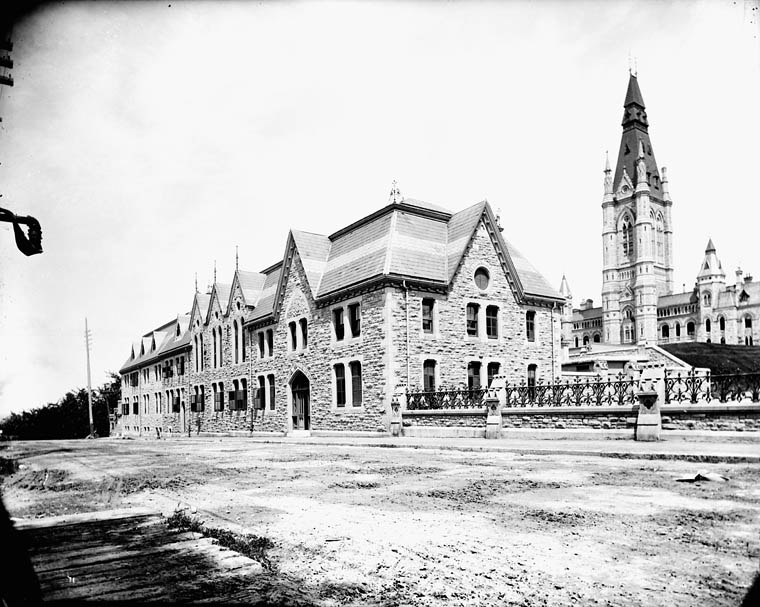
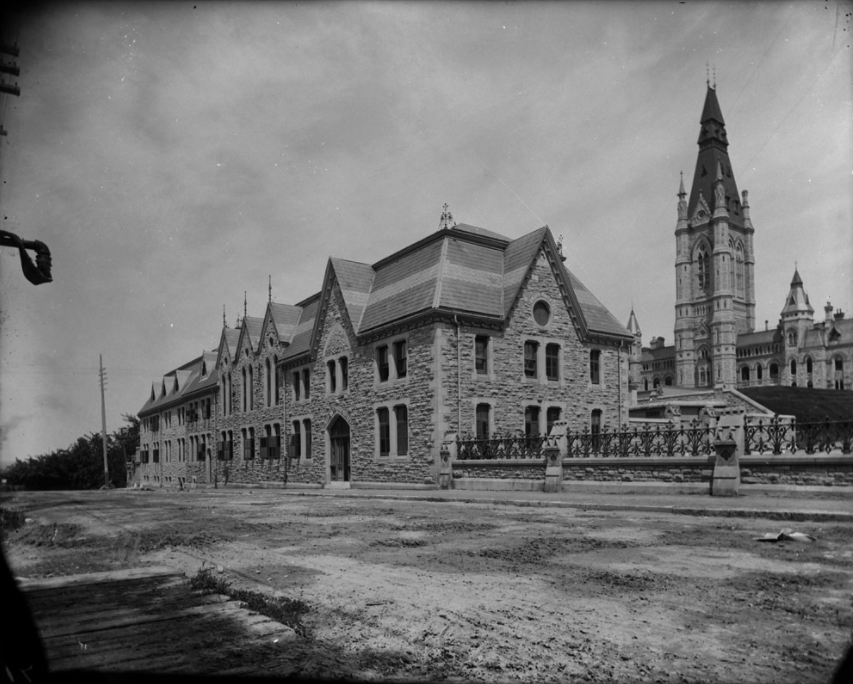
The situation in 1882 when the government relocated the Court to a small two-story structure at the foot of Parliament Hill. This building was not a courthouse. It was a converted workshop and stable block originally designed by Thomas Seaton Scott for the Department of Public Works. The "Old Supreme Court Building" was damp and cramped. It smelled faintly of the horses that once occupied the site. Condemnation of the facility was universal. Chief Justices complained of the "dreadful smell" and the absence of ventilation. The proximity to the stables and the absence of soundproofing meant that arguments on constitutional law frequently competed with the noise of the parliamentary workshops. This structure remained the embarrassing seat of Canadian justice for over sixty years until its eventual demolition in 1956.
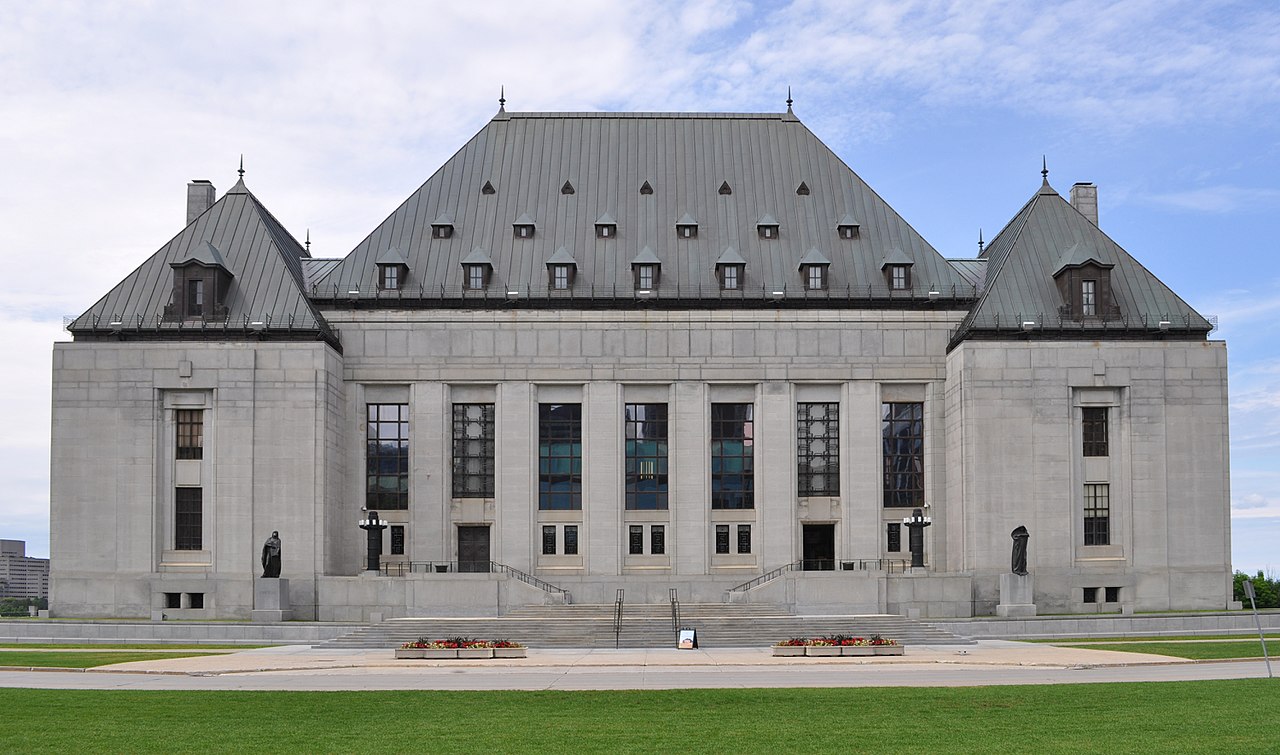
The Great Depression provided the catalyst for change. In the late 1930s, the government of William Lyon Mackenzie King initiated a massive public works program to combat unemployment. Justice Minister Ernest Lapointe championed the construction of a dedicated courthouse. The government selected Ernest Cormier to design the building. Cormier was a Montreal architect and engineer known for his technical precision and Art Deco sensibilities. His selection signaled a departure from the Gothic Revival style that dominated Ottawa. Cormier envisioned a structure of severe classical lines and modern geometry. He planned a building that would project authority through mass and symmetry rather than through the intricate ornamentation of the Victorian era.
Political interference immediately altered Cormier's vision. The architect designed a flat roof to complement the building's Art Deco verticality. Prime Minister Mackenzie King rejected this element. The Prime Minister insisted that all government buildings in the precinct must feature steep copper roofs to harmonize with the Parliament Buildings. Cormier was forced to capitulate. The resulting structure features a hybrid aesthetic. The base is pure Art Deco with its clean granite facing and vertical pilasters. The roof is a Chateau-style copper cap that sits somewhat incongruously atop the modern stone box. This architectural compromise physically manifests the tension between judicial independence and political tradition.
Queen Elizabeth laid the on May 20, 1939. She did so in the presence of King George VI during their royal tour of Canada. The ceremony took place only months before the outbreak of World War II. The conflict severely disrupted construction. Materials became scarce. Labour absence slowed progress. The government considered halting the project entirely decided to proceed to avoid leaving a half-finished ruin in the capital. The building was technically completed in 1941 did not immediately house the Court. The demands of the war economy took precedence. Federal officials seized the new structure to house wartime administrative staff. The judges remained in their converted stable for another five years. The Supreme Court took possession of its purpose-built home in 1946.
Cormier applied a concept of "total design" to the interior. He did not draw the walls. He designed the furniture. He sketched the light fixtures. He specified the patterns in the marble floors. The Grand Entrance Hall serves as the centerpiece of this vision. It features walls of Rubané marble and floors of Verdello and Montanello marble. The space is severe and imposing. Two fluted columns mark the entrance to the Main Courtroom. Cormier designed the courtroom itself to be a theatre of law. He placed the judges on a high dais to emphasize their authority. He restricted natural light to high clerestory windows to eliminate distractions. Every bronze grille and every walnut desk in the building originated from Cormier's specific engineering drawings.
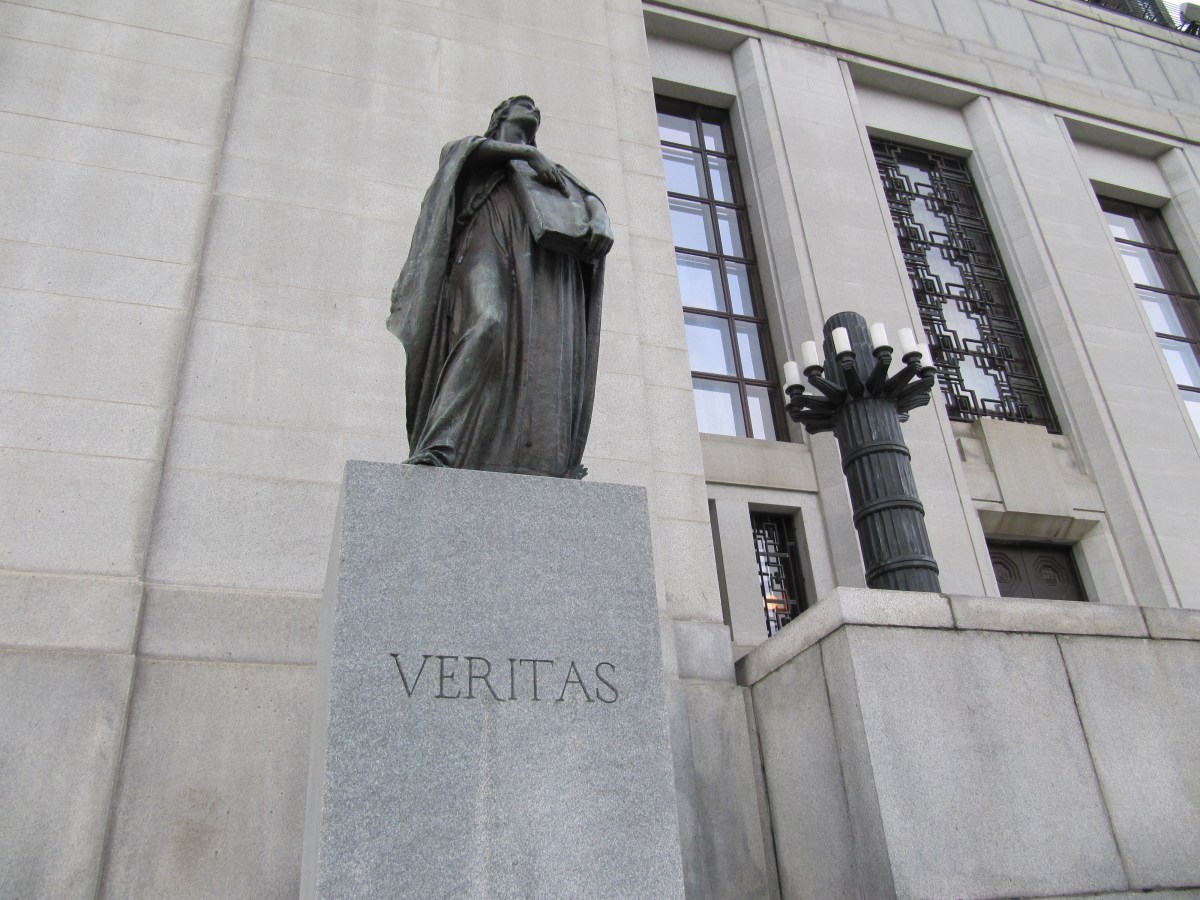
The building's exterior iconography includes two massive bronze statues that flank the entrance stairs. These figures are Veritas (Truth) and Justitia (Justice). Their presence at the Court is the result of a historical accident rather than the original design. The sculptor Walter S. Allward created these figures in the 1920s for a memorial to King Edward VII. That project was never completed. The statues were crated and placed in storage. They from public memory for nearly fifty years. In 1969, workers discovered the crates buried under a parking lot. The government retrieved the sculptures and installed them at the Supreme Court in 1970. Veritas holds a mirror and Justitia holds a sword. Unlike traditional depictions, this Justice is not blindfolded. She stares straight ahead.
Decades of deferred maintenance eventually caught up with Cormier's masterpiece. By the early 21st century, the building faced serious infrastructure failures. The heating and cooling systems were obsolete. The electrical wiring was outdated. Asbestos was present throughout the structure. The roof that Mackenzie King demanded had begun to leak. Security standards had changed drastically since 1946. The building absence the blast protection and perimeter security required for a modern high court. The government acknowledged that a piecemeal method to repairs was no longer viable. A total rehabilitation was necessary.
The scope of this project required the Court to vacate the premises entirely. Public Services and Procurement Canada the West Memorial Building as the temporary home for the Supreme Court. The West Memorial Building itself required a massive renovation before it could accept the judges. It had sat vacant since 2008 and was in a state of serious disrepair. The government spent over a billion dollars to rehabilitate both the West Memorial Building and the Supreme Court Building. The timeline for this transition suffered repeated delays. Originally scheduled for 2023, the move was pushed back multiple times.
As of 2026, the Supreme Court of Canada operates out of the West Memorial Building on Wellington Street. The historic Cormier building is a construction zone. Crews are currently stripping the interior down to the steel and concrete. They are removing hazardous materials and reinforcing the structure against seismic activity. The rehabilitation project aims to preserve the heritage elements of Cormier's design while installing modern digital infrastructure and climate control. The Grand Entrance Hall currently stands silent and empty. The nine judges hear cases in a modern courtroom inserted into the courtyard of the West Memorial Building. This temporary arrangement is expected to last until at least the early 2030s. The cost of preserving this architectural legacy continues to rise as engineers uncover new problems within the granite walls.
The 1982 Constitution Act and Charter Jurisprudence
The proclamation of the Constitution Act, 1982, severed the Canadian legal order from its British tether and handed the Supreme Court of Canada a weapon of immense power: the *Canadian Charter of Rights and Freedoms*. Before this moment, the Court acted primarily as a referee in jurisdictional disputes between the federal government and the provinces, interpreting the division of powers under the *British North America Act, 1867*. Parliament remained supreme; if a law was within a government's jurisdiction, the Court could not strike it down simply because it was unfair or oppressive. The 1982 Act inverted this hierarchy. Constitutional supremacy replaced parliamentary supremacy, and the nine justices became the final arbiters of whether legislation complied with fundamental human rights. This shift manifested immediately in the Court's mechanics. The justices, led by Chief Justice Brian Dickson, had to construct a framework to balance individual rights against shared social goals. The result was *R. v. Oakes* (1986), a decision that remains the operating system of Canadian constitutional law. David Oakes, caught with hashish oil and cash, challenged a provision in the *Narcotic Control Act* that presumed anyone with drugs intended to traffic them unless they proved otherwise. The Court struck down the reverse duty as a violation of the presumption of innocence. More importantly, the decision established the "Oakes Test," a strict two-part metric used to determine if a government violation of a right is "demonstrably justified" under Section 1 of the Charter. Every piece of contentious legislation in Canada passes through this judicial filter, requiring the state to prove its objective is and its means are proportional. The Dickson Court (1984, 1990) and the subsequent Lamer Court (1990, 2000) used this authority to significant portions of Canada's moral and criminal legislation. In *R. v. Big M Drug Mart* (1985), the Court struck down the *Lord's Day Act*, ruling that the government could not compel religious observance by banning Sunday commerce. This decision signaled that the Court would look past the form of a law to its purpose. Three years later, in *R. v. Morgentaler* (1988), the Court invalidated the abortion provisions of the *Criminal Code*, finding that the bureaucratic blocks imposed on women violated their security of the person under Section 7. Parliament never successfully recriminalized abortion, leaving the Court's ruling as the de facto law of the land. Criminal law procedure underwent a similarly radical reconstruction. The Court utilized the Charter to impose strict duties on police and prosecutors. *R. v. Stinchcombe* (1991) mandated that the Crown disclose all relevant evidence to the defense, ending trial by ambush. Decades later, the Court tightened the screws further with *R. v. Jordan* (2016), setting rigid time limits for trials (18 months for provincial courts, 30 months for superior courts) and staying charges for thousands of accused criminals when the state failed to move fast enough. These decisions forced provinces to pour millions into their justice systems to avoid mass dismissals, demonstrating the Court's ability to dictate budgetary priorities through case law. Parallel to the Charter, Section 35 of the 1982 Act "recognized and affirmed" existing Aboriginal and treaty rights, though it sits outside the Charter itself. The Court gave teeth to this provision in *R. v. Sparrow* (1990), establishing that Indigenous rights could only be infringed if the government met a high justification standard and upheld the "honour of the Crown." This jurisprudence evolved into the "duty to consult," a legal obligation that has reshaped resource extraction and land development across the continent. In 2024, the Court further clarified the relationship between Indigenous self-government and the Charter in *Dickson v. Vuntut Gwitchin Nation*, ruling that while the Charter applies to Indigenous governments, Section 25 acts as a shield to protect shared Indigenous rights from being eroded by individual Charter claims. The expansion of judicial power inevitably triggered a political counter-reaction, centered on Section 33, the "Notwithstanding Clause." This provision allows Parliament or provincial legislatures to override certain Charter rights (Sections 2 and 7, 15) for five-year renewable periods. For decades, Section 33 was considered a "nuclear option," used sparingly outside of Quebec. Yet, the period between 2018 and 2026 saw a normalization of its use as provincial governments sought to immunize policy from judicial review. Quebec used it for Bill 21 (secularism) and Bill 96 (language); Ontario invoked it (then repealed it) against education workers in 2022; and Saskatchewan used it in 2023 for parental consent laws regarding gender pronouns in schools. This trend marks a new era of "constitutional dialogue" where legislatures openly the Court's interpretative monopoly.
Table: Landmark Supreme Court Decisions Post-1982
Case
Year
Legal Principle Established
Impact
R. v. Big M Drug Mart
1985
Freedom of Religion (s. 2a)
Struck down the Lord's Day Act; established that laws cannot have a religious purpose.
R. v. Oakes
1986
Section 1 Justification
Created the "Oakes Test," the standard for justifying rights infringements.
R. v. Morgentaler
1988
Security of the Person (s. 7)
Decriminalized abortion; struck down s. 251 of the Criminal Code.
R. v. Sparrow
1990
Aboriginal Rights (s. 35)
Defined "existing" rights and the fiduciary duty of the Crown to Indigenous peoples.
R. v. Stinchcombe
1991
Full Disclosure (s. 7)
Mandated that prosecutors must disclose all evidence to the defense.
Vriend v. Alberta
1998
Equality Rights (s. 15)
Read sexual orientation into Alberta's human rights legislation even with its omission.
Carter v. Canada
2015
Right to Die (s. 7)
Struck down the ban on assisted dying, leading to the MAID regime.
R. v. Jordan
2016
Right to Trial Within Reasonable Time (s. 11b)
Set strict time limits for criminal trials (18/30 months).
Dickson v. Vuntut Gwitchin
2024
Indigenous Self-Gov vs. Charter (s. 25)
Ruled s. 25 protects shared Indigenous rights from individual Charter claims.
The modern Court, currently under Chief Justice Richard Wagner, faces a docket dominated by these Charter conflicts. Statistics show that Charter cases consistently make up approximately 25 percent of the Court's caseload. The Court has moved beyond simple criminal procedure into complex bioethics (MAID), climate federalism (upholding the carbon tax in 2021), and the administrative state (*Vavilov*). The tension between the "Living Tree" doctrine, which treats the Constitution as an evolving document, and the resurgence of legislative overrides defines the current legal terrain. The Court is no longer just a legal institution; it is the central stage for the country's most divisive political battles.
Quebec Civil Code Integration and Mandatory Seats
Abolition of Appeals to London and Full Sovereignty (1949)
The Supreme Court of Canada stands as a judicial anomaly among high courts of the Anglosphere: it is the only final appellate tribunal required to adjudicate two distinct and frequently contradictory legal systems simultaneously. While nine provinces and three territories operate under the British Common Law tradition, Quebec functions under a Civil Law system derived from the *Coutume de Paris* and codified in the *Civil Code of Quebec*. This bijural reality is not a matter of statute a foundational compromise of the Canadian federation, rooted in the *Quebec Act* of 1774 which restored French civil law to the colony. Consequently, the Court's composition has never been based solely on merit or geography, on the rigid need of having judges who can interpret the Civil Code without destroying its internal logic. When the Parliament of Canada established the Supreme Court in 1875, the integration of Quebec's legal distinctiveness was the primary obstacle. Quebec politicians, including those in Sir John A. Macdonald's orbit, feared a "general court of appeal" dominated by Anglo-Protestant common law judges would the Catholic, French, and civilian legal order of the province. To secure passage of the *Supreme and Exchequer Court Act*, the Mackenzie government agreed to a statutory quota: two of the six original judges had to be appointed from the bench or bar of Quebec. This was not an affirmative action measure a functional requirement; without these judges, the Court would possess no competence to hear appeals regarding property, civil rights, or obligations arising in Quebec. The structural guarantee of Quebec's representation hardened in 1949. With the abolition of appeals to the Judicial Committee of the Privy Council in London, the Supreme Court became the final arbiter of Canadian law. Parliament expanded the bench from seven to nine justices to handle the increased workload and, crucially, amended the *Supreme Court Act* to fix the Quebec quota at three. Section 6 of the Act explicitly mandates that "at least three of the judges shall be appointed from among the judges of the Court of Appeal or of the Superior Court of the Province of Quebec or from among the advocates of that Province." This provision ensures that on any panel hearing a Civil Law appeal, there is a sufficient quorum of civilian jurists to form a majority, preventing common law concepts from contaminating the Civil Code through binding precedent. This statutory arrangement faced its most serious constitutional test in 2013, precipitating the *Nadon Reference*. Prime Minister Stephen Harper attempted to appoint Justice Marc Nadon, a supernumerary judge of the Federal Court of Appeal, to one of the three mandatory Quebec seats. Although Nadon was an expert in maritime law and a former member of the Quebec Bar, he was not, at the time of his nomination, a judge of the Quebec Superior Court, the Quebec Court of Appeal, or a practicing Quebec advocate. The appointment triggered a legal firestorm, culminating in the Supreme Court's 2014 decision in *Reference re Supreme Court Act, ss. 5 and 6*. In a stunning rebuke to the executive branch, the Court declared Nadon's appointment void *ab initio*. The majority opinion held that Section 6 imposes a strict eligibility requirement: an appointee to a Quebec seat must be a *current* member of the Quebec Bar or a *current* judge of the Quebec superior courts. A "past" connection, which suffices for the other six seats under Section 5, is insufficient for the Quebec seats. The Court reasoned that the purpose of Section 6 was to guarantee current expertise in the Civil Code and to reflect the distinct social values of Quebec. More significantly, the ruling elevated the composition of the Court from a matter of federal statute to a constitutional imperative. The Court determined that the "three Quebec judges" rule is protected by Part V of the *Constitution Act, 1982*, meaning Parliament cannot unilaterally alter it; any change requires the unanimous consent of the Senate, the House of Commons, and the legislative assemblies of all ten provinces. The practical application of bijuralism requires more than just a quota; it demands linguistic fluency. The *Civil Code of Quebec* is drafted in French, and the vast majority of legal scholarship and jurisprudence interpreting it exists only in French. For decades, bilingualism was a functional expectation not a legal requirement, leading to scenarios where unilingual English judges relied on translations or the summaries of their francophone colleagues. This practice disenfranchised the unilingual judges from full participation in Civil Law appeals. The legislative shifted in 2023 with the passage of Bill C-13, which amended the *Official Languages Act* to codify the bilingualism of the Court. The legislation removed the exemption that had previously allowed Supreme Court justices to be unilingual. As of 2026, the law requires that any person appointed to the Supreme Court must be able to understand clearly the official language chosen by the parties without the assistance of an interpreter. This statutory change aligns the functional reality of the Court with the political demands of Quebec, ensuring that the "Quebec Three" are not the only justices capable of comprehending the arguments presented in French.
Evolution of Quebec Representation on the Supreme Court
Period
Total Judges
Quebec Seats
Legal Authority
Context
1875, 1927
6
2
Supreme and Exchequer Court Act, 1875
Court created; Privy Council remains final authority.
1927, 1949
7
2
Supreme Court Act Amendment
Incremental expansion; Quebec retains 2 seats.
1949, Present
9
3
Supreme Court Act, 1949
Abolition of Privy Council appeals; Quebec quota fixed at 3.
2014
9
3
Reference re Supreme Court Act
Eligibility restricted to current Quebec judges/advocates.
The integration of the Civil Code remains a distinct judicial exercise. Unlike the Common Law, which builds law through the accretion of precedent, the Civil Law proceeds from the text of the Code itself. The Supreme Court has frequently reiterated that it must not interpret the *Civil Code of Quebec* through the lens of common law equity or statutes. The three mandatory Quebec justices act as the guardians of this methodology. In cases such as *Cinar Corporation v. Robinson* or *Desjardins Financial Services*, the Court relies heavily on the civilian analysis provided by these three justices. The "Quebec Three" function as a court within a court, preserving the integrity of a legal system that governs the private lives of eight million Canadians. Current data from 2024 to 2026 confirms that the rigid application of Section 6 continues to limit the pool of eligible candidates for Quebec seats. Unlike other provinces, where federal court judges or senior academics might be elevated directly, the *Nadon* ruling restricts the Prime Minister's selection to the active bench of the Quebec Court of Appeal, the Superior Court, or the practicing bar. This constraint guarantees that the Supreme Court remains tethered to the living, evolving reality of Quebec law, preventing the institution from becoming a remote federal entity disconnected from the province's distinct legal culture.
Appointment Mechanisms and the Independent Advisory Board
The selection of justices for the Supreme Court of Canada operated for nearly 140 years as a prerogative of the Prime Minister that was absolute and unclear. From the Court's inception in 1875 until the reforms of 2016, the process was frequently described as a "tap on the shoulder." No formal application process existed. No job description was published. The Prime Minister, acting on the private advice of the Minister of Justice and a small circle of insiders, selected a name. While regional conventions solidified over time, guaranteeing three seats for Quebec, three for Ontario, two for the West, and one for Atlantic Canada, the mechanics remained a black box of political discretion. This era of unchecked executive privilege collided with constitutional reality in 2014. Prime Minister Stephen Harper attempted to appoint Justice Marc Nadon, a supernumerary judge of the Federal Court of Appeal, to one of the three seats constitutionally reserved for Quebec. The appointment triggered immediate legal challenges regarding Nadon's eligibility under the *Supreme Court Act*. In the landmark *Reference re Supreme Court Act, ss. 5 and 6*, the Supreme Court rejected the appointment of one of its own prospective members. The ruling declared that the specific eligibility requirements for Quebec seats, current membership in the Quebec bar or superior courts, could not be bypassed by federal legislation alone. The Nadon affair humiliated the government and exposed the fragility of an appointment system reliant on informal vetting rather than statutory rigor. In 2016, the government of Prime Minister Justin Trudeau dismantled the old patronage-heavy model in favor of a formalized, application-based system. The centerpiece of this reform was the creation of the Independent Advisory Board for Supreme Court of Canada Judicial Appointments (IAB). For the time in Canadian history, vacancies were advertised publicly. Any qualified lawyer or judge could submit an application online. The IAB, initially chaired by former Prime Minister Kim Campbell, was tasked with vetting these applications and producing a non-binding shortlist of three to five candidates for the Prime Minister. The composition of the IAB itself represented a shift toward institutionalizing the selection process. The board consists of members nominated by the Canadian Judicial Council, the Canadian Bar Association, the Federation of Law Societies of Canada, and the Council of Canadian Law Deans. In 2022, the government expanded the board to include a nominee from the Indigenous Bar Association, a move designed to address the historical absence of Indigenous perspectives on the high court. This body reviews candidates not just on legal acumen on a matrix of criteria including "empathy" and "resilience." A defining feature of the post-2016 regime is the requirement for "functional bilingualism." While bilingualism was previously an asset, the new rules mandated that all appointees must be able to read legal materials and understand oral arguments in both English and French without the aid of an interpreter. This requirement sparked intense debate. Proponents argued that in a bijural and bilingual federation, a judge must comprehend the original text of laws and evidence. Critics, including former Supreme Court Justice Frank Iacobucci and Indigenous jurist Harry LaForme, warned that the strict language requirement disqualified a vast number of otherwise excellent candidates from Western Canada and Indigenous communities where French fluency is rare. The tension between merit, regional representation, and the new language requirements surfaced immediately during the IAB pattern in 2016. The vacancy created by the retirement of Justice Thomas Cromwell, who hailed from Nova Scotia, raised fears in Atlantic Canada that the government might abandon the region's traditional seat in favor of a candidate from a larger province. The government initially refused to guarantee an Atlantic appointment. The Atlantic Provinces Trial Lawyers Association filed a court application to force the government to respect the convention. The political pressure worked. The government appointed Justice Malcolm Rowe of Newfoundland and Labrador, preserving the regional distribution. The IAB process has since governed a series of high-profile appointments that have reshaped the court's demographics. The appointment of Justice Michelle O'Bonsawin in 2022 marked a historic milestone as she became the Indigenous person to sit on the Supreme Court. Her selection followed the established IAB protocol: she applied, was vetted by the board (then chaired by H. Wade MacLauchlan), and made the shortlist. In 2023, the appointment of Justice Mary Moreau from Alberta restored the full complement of judges and maintained the Western quota. By early 2026, the appointment method faced its test with the announced retirement of Justice Sheilah Martin. Her departure, May 2026, triggered the convening of the Advisory Board once again. The process has settled into a predictable rhythm, yet it remains a hybrid of transparency and executive control. The IAB provides a buffer and a quality filter, the Prime Minister retains the decision from the shortlist. The "black box" has not been destroyed. It has been replaced by a "glass box" where the inputs are visible, the final selection logic remains the privilege of the executive. The data from the IAB era reveals a rigorous filter. In typical pattern, the Board receives between 12 and 25 applications for a single vacancy. From this pool, they interview a fraction, frequently only the 3 to 5 names that make the final list. The table summarizes the appointments made under this new method up to 2026.
Supreme Court Appointments Under the Independent Advisory Board (2016, 2026)
Maintained Western representation; retiring May 2026.
Nicholas Kasirer
2019
Quebec
Gascon
Consensus expert on civil law; former McGill Dean.
Mahmud Jamal
2021
Ontario
Abella
person of colour on the SCC.
Michelle O'Bonsawin
2022
Ontario
Moldaver
Indigenous justice (Abenaki member of Odanak).
Mary Moreau
2023
West
Brown
Francophone from Alberta; restored full bench after Brown resignation.
TBD
2026
West
Martin
Process initiated Jan 2026 following retirement notice.
The 2026 vacancy created by Justice Martin's exit highlights the enduring challenge of the "functional bilingualism" rule. As the search focuses on Western Canada, the pool of candidates who possess the requisite legal stature, regional connection, and high-level French proficiency remains shallow. The IAB's report on the 2023 appointment of Justice Moreau noted that while the candidate pool was strong, the language requirement significantly filtered the initial applicant list. The evolution from the 1875 patronage model to the 2026 technocratic vetting system mirrors the maturation of the Court itself. It has moved from a subordinate appellate body to a supreme constitutional arbiter. The appointment process demands that candidates prove their worth through questionnaires and interviews rather than political loyalty. Yet, the constitutional hardlines drawn in the *Nadon* reference ensure that while the *method* of selection has modernized, the rigid federalist structure of the Court, specifically the Quebec protections, remains untouchable without unanimous provincial consent. The IAB has professionalized the entry ticket, the regional and linguistic architecture of the Court remains a non-negotiable treaty of the Canadian federation.
Reference re Supreme Court Act and Eligibility Disputes
Courthouses and the Ernest Cormier Architecture
The constitutional emergency of 2014 marked the single most significant confrontation between the executive branch and the judiciary in the history of the Supreme Court of Canada. For the time since the Court's creation in 1875, a Prime Minister's nominee was rejected not by a parliamentary committee or public outcry, by the Court itself. The Reference re Supreme Court Act, ss. 5 and 6 did not disqualify Justice Marc Nadon; it cemented the Court's composition as a constitutionally protected feature that Parliament cannot unilaterally alter. This event ended the era where the federal government could treat the Supreme Court Act as simple legislation subject to the whims of a sitting majority.
The conflict originated in the specific eligibility requirements designed to protect Quebec's civil law tradition. Since the Court's inception, the distinct legal system of Quebec required judges trained in the Civil Code rather than the Common Law used in the other provinces. Section 6 of the Supreme Court Act codified this need, mandating that at least three of the nine judges be appointed "from among the judges of the Court of Appeal or of the Superior Court of the Province of Quebec or from among the advocates of that Province." This provision stood as a historic compromise, ensuring that Quebec's legal distinctiveness remained represented at the highest level of appellate review.
In September 2013, Justice Morris Fish, a Quebec appointee, retired. Prime Minister Stephen Harper nominated Marc Nadon, a supernumerary judge of the Federal Court of Appeal. Nadon was a respected jurist and an expert in maritime law, his professional seat was on a federal court, not a Quebec provincial court. Although he had been a member of the Quebec Bar for over a decade prior to his judicial appointment in 1993, he was not a current member of the Quebec Bar, nor was he a sitting judge on the Quebec Court of Appeal or Superior Court. Constitutional lawyer Rocco Galati immediately challenged the appointment in Federal Court, arguing Nadon did not meet the strict textual requirements of Section 6.
The government's response revealed a tactical attempt to bypass judicial scrutiny through legislative force. Rather than wait for the courts to interpret the existing law, the Harper administration inserted "declaratory" provisions into a massive omnibus budget bill, the Economic Action Plan 2013 Act, No. 2 (Bill C-4). Clauses 471 and 472 purported to amend the Supreme Court Act to retroactively clarify that a "former" advocate of at least 10 years' standing counted as an "advocate" for the purposes of Section 6. The government sought to rewrite the rules in real-time to save their nominee, telling the judiciary how to interpret its own founding statute.
The Supreme Court agreed to hear a reference on the matter, posing two questions: was Nadon eligible under the original Act, and could Parliament constitutionally enact the declaratory amendments in Bill C-4? On March 21, 2014, the Court delivered a stunning 6-1 verdict. The majority opinion, authored by six justices including Chief Justice Beverley McLachlin, ruled that Marc Nadon was ineligible ab initio. The decision rested on a strict textual analysis contrasting Section 5 (general eligibility) with Section 6 (Quebec eligibility).
Feature
Section 5 (General Eligibility)
Section 6 (Quebec Eligibility)
Target Pool
Judges from any provincial superior court OR barristers/advocates from any province.
Judges of Quebec Court of Appeal/Superior Court OR advocates of Quebec.
Temporal Requirement
"Is or has been" (Current or Former).
"From among" (Interpreted as Current only).
Federal Court Judges
Eligible (as former advocates).
Ineligible (unless currently on Quebec superior courts).
Purpose
Ensure general legal competence.
Ensure current expertise in Quebec Civil Law and social values.
The Court held that Section 6 was not a technicality a substantive protection of the civil law system. By using the phrase "from among the advocates," Parliament in 1875 intended to draw from a pool of individuals currently immersed in Quebec law. A Federal Court judge, who adjudicates primarily federal statutes, becomes removed from the daily evolution of the Civil Code. Justice Michael Moldaver, the lone dissenter, argued that this interpretation created an absurdity where a lawyer with one day of experience could be appointed, a Federal Court judge with 20 years of prior practice could not. The majority rejected this functionalist argument, prioritizing the historic "Quebec compromise."
The second part of the ruling carried even heavier constitutional weight. The Court struck down the government's declaratory legislation in Bill C-4 as ultra vires. The justices determined that the composition of the Supreme Court, including the specific eligibility requirements for Quebec seats, is protected under Part V of the Constitution Act, 1982. Specifically, Section 41(d) requires the unanimous consent of Parliament and all ten provincial legislatures to amend the "composition of the Supreme Court of Canada."
This finding was revolutionary. Although the Supreme Court Act is a federal statute not listed in the Constitution's schedule, the Court ruled that its "essential features" had been "constitutionalized" by the amending formula adopted in 1982. The Harper government could not unilaterally alter the eligibility criteria for Quebec judges because doing so would fundamentally change the Court's composition. This decision froze the Court's structure, requiring a degree of political consensus, unanimity, that is mathematically improbable in the Canadian federation. The ruling transformed the Supreme Court Act from a mere law into a quasi-constitutional document.
The immediate was the nullification of Nadon's appointment. He returned to the Federal Court of Appeal, and the government subsequently appointed Justice Clément Gascon, a sitting judge of the Quebec Court of Appeal, who met the strict criteria. the long-term legacy extends well into 2026. The Nadon reference established a perimeter around the Supreme Court that no subsequent government has dared to breach. Attempts to modernize the Court's structure, whether by expanding its size or altering regional distribution, face the hurdle of unanimous provincial consent.
This decision also clarified the hierarchy of Canadian law: the executive cannot use declaratory legislation to overrule judicial interpretation of the Constitution. The attempt to use a budget bill to reshape the judiciary is in legal texts as a prime example of unconstitutional overreach. By 2026, the "Nadon Reference" stands alongside the Patriation Reference as a pillar of Canadian constitutionalism, defining the limits of parliamentary sovereignty in relation to the judiciary. It ensured that the Supreme Court remains not just a creature of federal statute, a constitutionally protected institution that belongs to the federation as a whole, immune to unilateral tampering by the government of the day.
Indigenous Land Title and Treaty Rights Adjudication
The Supreme Court of Canada's adjudication of Indigenous land title and treaty rights represents a slow, frequently reluctant migration from colonial dismissal to constitutional recognition. For nearly a century, the Court functioned as an instrument of a legal order that viewed Indigenous sovereignty as extinguished by the mere assertion of Crown authority. Between 1887 and 2026, the judicial doctrine shifted from defining Indigenous title as a temporary load on the Crown's underlying ownership to recognizing it as an inherent, constitutionally protected property right. This evolution was not linear; it was punctuated by decades of silence enforced by federal legislation and fractured by split decisions that forced political hands. The legal baseline for Indigenous title was established not in Ottawa, in London. In *St. Catherine's Milling and Lumber Co. v. The Queen* (1887), the Supreme Court of Canada, and subsequently the Judicial Committee of the Privy Council, characterized Aboriginal title as a "personal and usufructuary right" dependent entirely on the "goodwill of the Sovereign." The Court viewed Indigenous peoples not as owners of the land, as tenants at the pleasure of the Crown. This decision cemented a legal hierarchy where the Crown held underlying title to all land, and Indigenous rights were mere encumbrances that could be extinguished unilaterally. Following *St. Catherine's Milling*, the Supreme Court's docket regarding Indigenous claims remained empty for decades. This silence was not due to a absence of grievances was engineered by the *Indian Act*. In 1927, Parliament amended the Act to make it a criminal offense to solicit funds for the purpose of pursuing an Indigenous legal claim. This legislative gag order, which remained in force until 1951, barred Indigenous nations from accessing the Supreme Court. Consequently, the "usufructuary" definition of title remained unchallenged law for nearly a century, insulating the Crown from litigation while resource extraction accelerated across unceded territories. The silence broke in 1973 with *Calder v. British Columbia (Attorney General)*, a decision that remains the most significant fracture in Canadian legal history regarding Indigenous land. Frank Calder and the Nisga'a Nation sought a declaration that their title to the Nass Valley had never been extinguished. The Supreme Court delivered a confused, 3-3-1 split decision. Three justices, led by Justice Judson, ruled that title had been extinguished by colonial ordinances. Three others, led by Justice Hall, argued that title existed and absent a "clear and plain" intention to extinguish it. The deciding vote, cast by Justice Pigeon, dismissed the case on a procedural technicality regarding the absence of a fiat (permission) to sue the Crown. Although the Nisga'a technically lost, the admission by six justices that Aboriginal title existed within Canadian law prior to 1763 forced the federal government to abandon its refusal to negotiate, initiating the modern treaty process. The introduction of Section 35 in the *Constitution Act, 1982*, which "recognized and affirmed" existing Aboriginal and treaty rights, fundamentally altered the Court's function. The judiciary became the arbiter of what those rights actually meant in practice. In *R. v. Sparrow* (1990), the Court established the test for justifying infringements on these rights, ruling that the Crown must demonstrate a "valid legislative objective" and uphold its fiduciary duty. This decision signaled that Section 35 was not symbolic; it placed a substantive load of proof on the government to justify its interference with Indigenous practices. The evidentiary standards for proving title were radically overhauled in *Delgamuukw v. British Columbia* (1997). The trial judge had famously dismissed the oral histories of the Gitxsan and Wet'suwet'en as unreliable hearsay, describing their life as "nasty, brutish, and short." The Supreme Court, under Chief Justice Antonio Lamer, reversed this, ruling that oral history must be placed on an "equal footing" with historical documents. The Court defined Aboriginal title as a right to the land itself, not just the right to hunt or fish on it, and confirmed that it includes the right to choose how the land is used. *Delgamuukw* destroyed the Crown's argument that title was limited to traditional uses, yet it stopped short of granting a declaration of title, sending the parties back to a new trial that never happened. It took until 2014 for the Supreme Court to problem a declaration of Aboriginal title. In *Tsilhqot'in Nation v. British Columbia*, the Court unanimously rejected the Crown's "postage stamp" theory, which argued that title only applied to small, intensively used spots like village sites. Instead, the Court recognized Tsilhqot'in title to approximately 1, 750 square kilometers of territory in the British Columbia interior. This decision confirmed that title extends to the broader territorial tracts used for hunting, fishing, and gathering. It established that the Crown must obtain consent for development on title land or meet a rigorous justification test, fundamentally altering the economics of resource projects in unceded territories. By the mid-2020s, the Court's focus shifted from the definition of land title to the mechanics of jurisdiction and the enforcement of historical pledge. In *Reference re An Act respecting Nations, Inuit and Métis children, youth and families* (2024), the Court upheld federal legislation affirming that Indigenous peoples hold an "inherent right of self-government" protected by Section 35. This decision moved the legal marker beyond land use to actual legislative authority, confirming that Indigenous laws can have the force of federal law and supersede provincial statutes. Simultaneously, the Court grappled with the tension between shared rights and individual liberties. In *Dickson v. Vuntut Gwitchin Nation* (2024), the Court ruled that the *Canadian Charter of Rights and Freedoms* applies to self-governing Indigenous nations. Yet, the majority also held that Section 25 of the Charter functions as a "shield," protecting shared Indigenous rights, such as a requirement for leaders to reside on settlement land, from being invalidated by individual equality claims under Section 15. This established a complex constitutional balance where Indigenous governance is subject to the Charter, distinct cultural practices are insulated from it. The limits of judicial remedy were clear illustrated in *Shot Both Sides v. Canada* (2024). The Blood Tribe had been deprived of 162. 5 square miles of reserve land promised under Treaty No. 7. The Supreme Court acknowledged the Crown's breach was "dishonourable" ruled that the claim for financial compensation was barred by the statute of limitations. The Court issued a declaratory judgment to assist in reconciliation denied the Tribe the billions in compensation sought. This decision highlighted a persistent friction: the Court is to recognize historical wrongs and define rights, yet remains bound by procedural statutes that frequently leave Indigenous claimants with moral victories rather than material reparations.
Key Supreme Court Decisions on Indigenous Title (1887, 2024)
Case
Year
Core Ruling
Legal Impact
St. Catherine's Milling
1887
Title is "personal and usufructuary" and dependent on Crown goodwill.
Denied Indigenous ownership; established Crown underlying title.
Calder v. British Columbia
1973
Title existed prior to 1763. Split decision (3-3-1).
Forced federal government to begin modern treaty negotiations.
R. v. Sparrow
1990
Created "Sparrow Test" for justifying infringement of rights.
Defined Section 35 rights as not absolute protected.
Delgamuukw v. B. C.
1997
Oral history admissible; title is right to land itself.
Expanded evidence rules; defined content of Aboriginal title.
Haida Nation v. B. C.
2004
Crown has duty to consult before title is proven.
Established consultation requirements for resource development.
Upheld inherent right of self-government over child welfare.
Confirmed Indigenous laws can supersede provincial laws.
Shot Both Sides v. Canada
2024
Treaty breach proven compensation statute-barred.
Limitation periods apply to historical treaty claims.
Administrative Structure and Registry Operations
The 1982 Constitution Act and Charter Jurisprudence
The administrative spine of the Supreme Court of Canada (SCC) operates as a distinct federal department, separate from the Department of Justice and the broader federal bureaucracy. While the nine justices garner public attention, the Office of the Registrar functions as the Court's engine room, managing the flow of approximately 500 to 600 leave applications annually, overseeing a budget that exceeded $62 million by 2025, and maintaining the institutional memory of Canadian jurisprudence. The Registrar, currently Chantal Carbonneau, holds the rank of a Deputy Head of a department, a status that grants the Court necessary administrative autonomy to match its judicial independence. This autonomy did not exist at the Court's inception. When the Supreme Court opened in 1875, its Registrar, Robert Cassels, managed a skeleton crew in a borrowed committee room within the Parliament buildings. For the century of its existence, the Court relied on the Department of Justice for its budget, staffing, and supplies. This arrangement created a structural conflict: the federal government, represented by the Department of Justice, appeared before the Court more frequently than any other litigant, yet it simultaneously controlled the Court's purse strings. The Registrar had to petition the very lawyers arguing cases before him for money to buy law books or hire typists. The administrative structure shifted radically in 1977. Parliament amended the *Supreme Court Act* to sever these administrative ties, transferring authority over staff and finances directly to the Registrar. This change aligned the Court's operational reality with the principle of judicial independence. The Registrar reports directly to the Chief Justice for the Court's operations and is accountable to Parliament for the expenditure of public funds, bypassing the Minister of Justice. This structural separation ensures that the government cannot starve the Court of resources as a method of exerting pressure, a protection that legal historians cite as a serious evolution in Canadian constitutional maturity. The Registry Branch acts as the intake valve for all litigation. Its operations are governed by rigid statutory deadlines and the *Rules of the Supreme Court of Canada*. Every document filed, whether a leave application, a factum, or a motion, must pass through the Registry's compliance checks. In the 19th and early 20th centuries, this process involved physical ledgers and the manual stamping of paper copies shipped by rail from across the dominion. Before 1875, the "registry" for Canada's final appeals was located in London, England, where the Judicial Committee of the Privy Council required Canadian lawyers to employ London agents to manage filings, a costly and slow logistical load. By 2020, the Registry underwent a forced digital revolution. The COVID-19 pandemic necessitated an immediate shift to remote operations. On March 18, 2020, the Court made electronic filing mandatory for all documents, ending the era of paper- litigation. This transition culminated in the January 2023 launch of the Supreme Court Portal, a secure digital gateway that integrates filing, service, and case management. The Registry operates a high-speed digital workflow where documents are processed, verified, and distributed to judicial chambers within hours of receipt. The physical "paper truck" that once delivered stacks of binders to judges' homes has been largely replaced by encrypted tablet uploads. A important component of the Court's administrative structure is the Law Clerk Program. Established in 1967, this program recruits recent law graduates to assist the justices with legal research and drafting. Initially, the Court employed secretaries who provided clerical support, the complexity of modern appeals demanded intellectual force multipliers. The program has expanded significantly. In 2026, the Court employs 36 law clerks, four for each of the nine justices. These clerks serve one-year terms and are selected through a rigorous national competition that attracts top talent from every Canadian law school. They prepare "bench memos" that distill thousands of pages of evidence and legal argument into concise summaries, allowing the justices to navigate the heavy caseload. The Court also maintains its own specialized library and publication service. The Registrar serves as the statutory editor of the *Canada Supreme Court Reports* (SCR), the official bilingual record of the Court's decisions. Unlike other federal publications, the SCR requires meticulous translation and headnoting to ensure that the French and English versions of a judgment are legally equivalent, a requirement of Canada's bijural and bilingual constitutional order. In July 2025, the Court announced a massive retrospective project to translate all pre-1970 decisions, covering nearly a century of case law that had previously existed only in English, thereby correcting a long-standing linguistic asymmetry in the Court's archives. Financial data from the mid-2020s illustrates the of these operations. The Court's spending focuses heavily on personnel and the maintenance of its specialized services.
Fiscal Year
Total Expenses (CAD)
Primary Cost Drivers
2023-2024
$57, 690, 958
Security upgrades, IT modernization, shared agreements
Digital archive completion, Physical plant maintenance
Security operations at the Court function independently from the Parliamentary Protective Service. The Supreme Court building at 301 Wellington Street houses its own security staff, who answer to the Registrar. This separation is deliberate; it prevents the legislative branch's security apparatus from having jurisdiction over the judicial branch's physical precinct. The Registrar is responsible for the safety of the justices, the staff, and the building itself, a Art Deco heritage site that requires constant upkeep. The Court's administrative independence also extends to its communications. The Registrar oversees a dedicated communications branch that manages media relations, the Court's website, and public tours., this branch has become more proactive, publishing "Cases ", plain-language summaries of judgments, to combat misinformation and improve public legal literacy. This initiative reflects a modern administrative philosophy: the Court must not only do justice must also make its work accessible to a citizenry that increasingly consumes information through digital channels. The workload managed by this structure remains relentless. In 2024, the Registry processed 526 applications for leave to appeal. Of these, the Court granted leave in only 34 cases, a rate of approximately 6. 5%. This low acceptance rate places immense pressure on the Registry's screening teams to ensure that every application is complete and compliant before it reaches the judges for consideration. The administrative filters the nation's legal disputes, presenting the justices with only those cases that raise questions of public importance. Without this highly organized bureaucracy, the Court would drown in the volume of litigation, rendering it unable to fulfill its role as the final arbiter of Canadian law.
Docket Metrics and Judgment Turnaround Times (2000, 2026)
The contrast between the colonial appellate system and the modern Supreme Court of Canada is nowhere more visible than in the velocity of justice. During the Privy Council era (1700s, 1949), a final judgment could lag years behind the initial dispute, delayed by transatlantic travel and the leisurely schedule of London aristocrats. By 2026, the Court had evolved into a high-speed institution where "justice delayed is justice denied" became an operational mandate rather than a platitude. Under the tenure of Chief Justice Richard Wagner, the Court aggressively targeted backlog, fundamentally altering how, and how quickly, Canadian law is finalized.
The primary metric defining the Court's modern workload is the "Leave to Appeal" application. Unlike the Privy Council, which heard cases based on colonial status, or the early Supreme Court which functioned largely as a court of error for routine disputes, the modern Court is a gatekeeper. It selects cases of "public importance." Between 2000 and 2025, the volume of litigants knocking on the door remained stubbornly high, averaging between 500 and 600 applications annually. Yet, the aperture for entry narrowed. In the early 2000s, the Court frequently heard 80 to 90 appeals a year. By 2024 and 2025, that number had stabilized at a "new normal" of approximately 40 to 50 cases. This contraction means the Court rejects over 93% of all requests for review, ending the legal road for hundreds of litigants each year without a single hearing.
The most radical shift in docket management over the last decade is the rise of the judgment delivered from the bench. Historically, the Supreme Court reserved judgment in nearly every case, taking months to craft written reasons that would stand as polished precedents. In 2009, the Court delivered oral judgments in only two cases. By 2019, under Wagner's efficiency drive, that number spiked to 25, representing over a third of all decisions. This practice allows the Court to dispose of cases immediately after oral arguments, frequently with brief reasons that settle the dispute without adding extensive commentary to the jurisprudential canon. While, legal scholars in 2025 noted this trend might dilute the Court's guidance function, as fewer detailed written opinions are generated to help lower courts interpret complex statutes.
Turnaround times, the lag between a hearing and a final decision, have become the central key performance indicator (KPI) for the Registry. In the McLachlin era (2000, 2017), the average time from hearing to judgment hovered between six and eight months. The Wagner Court (2017, Present) sought to compress this timeline. By 2023, the average time from hearing to judgment was approximately 5. 5 months, with leave applications decided in roughly 4. 6 months. These metrics, yet, fluctuate wildly based on the complexity of the docket. The 2024, 2025 term saw a slight regression in speed, with hearing-to-judgment times creeping back toward 6. 4 months, a delay attributed to a high volume of complex constitutional
Security Incidents and Judicial Protection Protocols
For the century of its existence, the Supreme Court of Canada operated with a degree of physical openness that would be unthinkable in the modern security climate. When the Court shared quarters with Parliament in the late 19th century, and even after moving to the Ernest Cormier-designed building in 1946, public access was virtually unrestricted. There were no metal detectors, no perimeter bollards, and no armed guards checking bags in the Grand Entrance Hall. This era of innocence ended definitively in the 21st century, as the Court was forced to harden its physical and digital defenses against a rising of political violence and targeted intimidation.
The psychological turning point for judicial security occurred on October 22, 2014. Michael Zehaf-Bibeau, after killing Corporal Nathan Cirillo at the National War Memorial, ran onto Parliament Hill, passing within meters of the Supreme Court building before storming the Centre Block. While the attack targeted the legislature, the proximity exposed the fragility of the entire Judicial and Parliamentary Precinct. In the aftermath, security were overhauled. The Royal Canadian Mounted Police (RCMP) and the newly formed Parliamentary Protective Service established a heavier visible presence, and the Court introduced airport-style screening for all visitors, a measure that had been resisted for decades to preserve the symbol of an open justice system.
The vulnerability of the justices themselves was clear highlighted in May 2019, though not by an act of terror. Justice Clément Gascon disappeared from downtown Ottawa, triggering a massive police manhunt. While he was found safe and the incident was attributed to a medical episode rather than foul play, it forced a re-evaluation of how the state protects its highest jurists. Unlike their American counterparts, who are surrounded by U. S. Marshals, Canadian justices traditionally moved through the capital with minimal protection. Following the Gascon incident and the 2014 shooting, the RCMP's National Division ramped up its "Close Protection". By 2024, the RCMP Protective Policing Program was managing a threat environment that had significantly; internal reports projected over 3, 500 threats against public officials, including the judiciary, for that year alone, a nearly 300% increase from 2019 levels.
The "Freedom Convoy" occupation of early 2022 served as a stress test for the Court's physical defenses. For three weeks, heavy trucks and protesters occupied Wellington Street, directly in front of the Supreme Court. The building sat deep within the "Red Zone," cut off from normal access. Chief Justice Richard Wagner publicly criticized the security failure, noting that while Parliament was fortified, the Court was left exposed. The occupation forced the Court to operate remotely and accelerated plans to move the justices to a more secure location during the rehabilitation of the main building. This interim location, the West Memorial Building, underwent a $1 billion renovation (shared with the main building project) that included hardening the structure against seismic and blast threats, a direct response to the lessons learned from the 2022 siege.
In the digital domain, the Court faces threats that are less visible equally dangerous. As the arbiter of laws regarding digital privacy, exemplified by the 2024 R. v. Bykovets decision which ruled that IP addresses attract a reasonable expectation of privacy, the Court is a high-value target for state-sponsored cyber espionage and hacktivist groups. The federal government's "cloud- " strategy required the Court to segregate its judicial data from the broader government network to maintain judicial independence. A 2025 cyber incident involving third-party authentication services for the Canada Revenue Agency and other departments demonstrated the fragility of federal IT infrastructure, prompting the Court to further isolate its case management systems from the shared Services Canada backbone.
*Note: The 2024-2025 figure represents a requested surge in funding for the entire Protective Policing Program, reflecting the exponential rise in threats.
By March 2026, the physical relocation of the Court to the West Memorial Building was largely complete. This move represented more than a change of address; it was a shift to a bunker-like posture. The new facility features enhanced perimeter stand-off distances, ballistic-resistant glazing, and a dedicated secure entry for justices that is completely separated from the public. The romantic era of the 19th-century open court has been replaced by the reality of the 21st-century security state, where the independence of the judiciary is guaranteed as much by reinforced concrete and cyber-firewalls as it is by constitutional convention.
Why it matters: Zoning laws in the United States have evolved into tools of economic engineering, creating invisible barriers that perpetuate segregation and wealth disparities. Exclusionary zoning practices,…
What do we know about Appellate Authority of the Privy Council?
For over a century before the Supreme Court of Canada heard its argument, the final word on Canadian law belonged to a committee of British aristocrats and judges sitting in London. From the Royal Proclamation of 1763 until the creation of the Supreme Court in 1875, the "King in Council" served as the appellate authority.
What do we know about Enactment of the Supreme Court Act and Early Limitations?
The British North America Act of 1867, specifically Section 101, granted the new Dominion the power to establish a "General Court of Appeal for Canada." Yet for eight years, this power remained a paper fiction. Sir John A.
What do we know about Abolition of Appeals to London and Full Sovereignty?
The route to judicial independence in Canada was not a linear progression of legal refinement a political brawl ignited by the Great Depression. While the Supreme Court of Canada existed since 1875, it functioned as a subordinate intermediate court for seventy-four years.
What do we know about Courthouses and the Ernest Cormier Architecture?
For the seven decades of its existence, the Supreme Court of Canada operated as a judicial squatter. The institution absence a permanent home and possessed no architectural identity to signal its independence from the legislative branch.
What do we know about The Constitution Act and Charter Jurisprudence?
The proclamation of the Constitution Act, 1982, severed the Canadian legal order from its British tether and handed the Supreme Court of Canada a weapon of immense power: the *Canadian Charter of Rights and Freedoms*. Before this moment, the Court acted primarily as a referee in jurisdictional disputes between the federal government and the provinces, interpreting the division of powers under the *British North America Act, 1867*.
What do we know about Quebec Civil Code Integration and Mandatory Seats?
The Supreme Court of Canada stands as a judicial anomaly among high courts of the Anglosphere: it is the only final appellate tribunal required to adjudicate two distinct and frequently contradictory legal systems simultaneously. While nine provinces and three territories operate under the British Common Law tradition, Quebec functions under a Civil Law system derived from the *Coutume de Paris* and codified in the *Civil Code of Quebec*.
What do we know about Appointment Mechanisms and the Independent Advisory Board?
The selection of justices for the Supreme Court of Canada operated for nearly 140 years as a prerogative of the Prime Minister that was absolute and unclear. From the Court's inception in 1875 until the reforms of 2016, the process was frequently described as a "tap on the shoulder." No formal application process existed.
What do we know about Reference re Supreme Court Act and Eligibility Disputes?
The constitutional emergency of 2014 marked the single most significant confrontation between the executive branch and the judiciary in the history of the Supreme Court of Canada. For the time since the Court's creation in 1875, a Prime Minister's nominee was rejected not by a parliamentary committee or public outcry, by the Court itself.
What do we know about Indigenous Land Title and Treaty Rights Adjudication?
The Supreme Court of Canada's adjudication of Indigenous land title and treaty rights represents a slow, frequently reluctant migration from colonial dismissal to constitutional recognition. For nearly a century, the Court functioned as an instrument of a legal order that viewed Indigenous sovereignty as extinguished by the mere assertion of Crown authority.
What do we know about Administrative Structure and Registry Operations?
The administrative spine of the Supreme Court of Canada (SCC) operates as a distinct federal department, separate from the Department of Justice and the broader federal bureaucracy. While the nine justices garner public attention, the Office of the Registrar functions as the Court's engine room, managing the flow of approximately 500 to 600 leave applications annually, overseeing a budget that exceeded $62 million by 2025, and maintaining the institutional memory of Canadian jurisprudence.
What do we know about Docket Metrics and Judgment Turnaround Times?
The contrast between the colonial appellate system and the modern Supreme Court of Canada is nowhere more visible than in the velocity of justice. During the Privy Council era (1700s, 1949), a final judgment could lag years behind the initial dispute, delayed by transatlantic travel and the leisurely schedule of London aristocrats.
What do we know about Security Incidents and Judicial Protection Protocols?
For the century of its existence, the Supreme Court of Canada operated with a degree of physical openness that would be unthinkable in the modern security climate. When the Court shared quarters with Parliament in the late 19th century, and even after moving to the Ernest Cormier-designed building in 1946, public access was virtually unrestricted.
Why it matters: Climate denial bot networks and algorithms are distorting the public debate on global heating, drowning out scientific consensus. Automated accounts generate a significant volume of…
Why it matters: The Pentagon's reliance on Chinese suppliers for critical components in major US weapon systems raises national security concerns. Data from the 2024 National Security Scorecard…
Why it matters: Investigation reveals intertwining of Amazon's oil wealth with fraud and environmental destruction in Ecuador. Despite oil revenue, provinces suffer from spills, corruption, and broken promises,…
Why it matters: African youth are becoming a significant force in politics, demanding change due to economic challenges and restrictions on freedom. These youth movements face harsh government…
Why it matters: Amnesty International's investigation into Denmark's welfare agency reveals discriminatory practices targeting vulnerable groups. The use of algorithms and AI in the welfare system risks expanding…
Why it matters: Khairlanji Massacre: A brutal incident in a small village in Maharashtra where caste hatred led to the horrific murder of a Dalit family. Systemic cover-up:…
Get updates on this place
Get verified alerts when this file is updated (verification required).