Verified Against Public And Audited RecordsLast Updated On: 2026-03-05
Reading time: ~46 min
File ID: EHGN-PLACE-36109
Investigative Bio of Trinity College Dublin
Protestant Ascendancy and Sectarian Admission Policies 1700-1970
For nearly three centuries, Trinity College Dublin functioned not as a university, as a fortified ideological garrison for the Protestant Ascendancy. Established to consolidate Tudor rule and propagate the Anglican faith, the institution maintained a rigid sectarian exclusion policy that barred the erroneous majority of the Irish population from its halls. From 1700 until the late 20th century, admission and advancement within the college were dictated by religious allegiance, creating a dual history of external prohibition by the state and internal prohibition by the Catholic hierarchy.
Throughout the 18th century, the Penal Laws codified this exclusion. Catholics were legally forbidden from receiving education, and Trinity stood as the sole university in Ireland, strictly reserved for the Anglican elite. While the Catholic Relief Act of 1793 technically permitted Catholics to enter the college and take degrees, it maintained a glass ceiling that kept the institution's power structure intact. The Act did not remove the requirement for scholars and fellows to take oaths incompatible with Catholic dogma. Consequently, while a Catholic merchant's son might attend lectures, he could not aspire to the scholarships that provided financial aid, nor the fellowships that granted governance rights.
This partial admittance created a friction that lasted for eighty years. In 1845, Denis Caulfield Heron, a brilliant Catholic student, passed the scholarship examination on merit was refused his place due to his religion. His subsequent legal battle exposed the contradictions of a university that accepted tuition from Catholics yet denied them equal academic standing. It was not until the passing of Fawcett's Act in 1873 that all religious tests for scholarships and fellowships, except for the Divinity School, were abolished. This legislation theoretically opened the institution to all creeds on equal terms.
Yet, just as the state removed its blocks, the Catholic Church erected its own. In 1871, responding to the secularization of the college and the hierarchy's failure to secure a state-funded Catholic university, the Irish bishops issued a ban on Catholic attendance at Trinity. They viewed the college as a danger to the faith of young Catholics, fearing that exposure to "Protestant atmosphere" and secular philosophy would lead to apostasy. This prohibition transformed Trinity from a bastion of exclusion into an island of isolation, cutting it off from the rising Catholic middle class of the newly independent state in the 1920s.
The restrictions reached their zenith under John Charles McQuaid, the Archbishop of Dublin from 1940 to 1972. McQuaid, a staunch conservative, solidified the ban into a rigorous diocesan law. In his Lenten Pastoral of 1944, he declared that the attendance of Trinity by Catholics was a mortal sin. He required that any Catholic wishing to enroll must seek a special dispensation from the Archbishop himself, a permission granted only for "grave and valid reasons." This was not empty rhetoric; the threat of excommunication loomed over families who the edict, and the clergy frequently refused to administer sacraments to parents who sent their children to the "pagan" college.
The mechanics of McQuaid's ban created a bizarre demographic within the university during the mid-20th century. Cut off from the local population, Trinity turned outward to survive. By the 1960s, the student body was a cosmopolitan mix, with roughly one-third coming from the United Kingdom, one-third from overseas, and only one-third from Ireland, of whom were Northern Irish Protestants. The college became a cultural anomaly in Dublin: a British-style university in the heart of an Irish Republic that largely ignored its existence. The few Catholics who did attend were frequently viewed with suspicion by their co-religionists and were required to renew their dispensation annually, a bureaucratic humiliation designed to discourage enrollment.
Trinity College Dublin Student Demographics (Approximate, 1960s)
Origin
Percentage of Student Body
Republic of Ireland (mostly Protestant)
33%
United Kingdom
33%
Overseas (US, Europe, etc.)
34%
The isolation of Trinity became a political problem in the late 1960s. The Minister for Education, Donogh O'Malley, proposed a merger between Trinity and University College Dublin (UCD) to rationalize resources and force integration. The proposal met with fierce resistance from both institutions, it signaled that the was unsustainable. The death of the ban came not from a change of heart, from a change of need. In 1970, with the introduction of free secondary education and the rising demand for university places, the Catholic hierarchy realized it could no longer police the educational choices of the faithful. The ban was rescinded, and McQuaid, its most vigorous enforcer, retired two years later.
The lifting of the ban in 1970 resulted in an immediate demographic shift. Catholic students flooded into the college, normalizing its relationship with the city and the state. Yet, the legacy of centuries of exclusion lingered in the college's governance. It was not until 1991, twenty-one years after the ban ended, that Thomas Noel Mitchell became the Catholic elected Provost of Trinity College, breaking the chain of Protestant leadership that had stretched back to Elizabeth I. The history of Trinity's admission policies serves as a clear record of how sectarianism, used as a tool of colonial control and later as a weapon of religious defense, shaped the intellectual life of Dublin for nearly three hundred years.
Imperial Land Grants and Colonial Revenue Streams
Protestant Ascendancy and Sectarian Admission Policies 1700-1970
Trinity College Dublin was never a university; for the majority of its existence, it operated as a massive, extractive landlord. By 1876, the college owned approximately 190, 000 acres of Irish land, representing over 1% of the entire island's surface area. These holdings were not purchased granted by the English Crown, specifically Elizabeth I and James I, following the violent confiscation of territories from Gaelic chiefs and Old English families. The college functioned as a colonial corporation, financing the education of the Protestant Ascendancy through rents extracted from a dispossessed Catholic tenantry in counties such as Kerry, Donegal, Armagh, Limerick, and Tipperary.
The management of these vast estates relied on a predatory "middleman" system. The college leased large tracts to head tenants, frequently wealthy Protestants, who then sublet the land at inflated rates to the actual occupiers. This structure insulated the college fellows in Dublin from the grim realities of rural poverty while ensuring a steady flow of capital into the university's coffers. During the Great Famine of the 1840s, the population on Trinity's estates in Kerry dropped by nearly 24%, yet the institution's revenue streams remained largely protected. The college did not act as a benevolent educator to these tenants as an absentee landlord, prioritizing the solvency of its accounts over the survival of the peasantry.
The Land Acts of the late 19th and early 20th centuries, particularly the Wyndham Land Act of 1903, forced a transformation of this asset base. As the British state moved to the landlord system to quell agrarian unrest, Trinity liquidated its physical holdings. The soil of Ireland was converted into financial capital. The compensation paid by the state for these lost estates formed the bedrock of the college's modern endowment. Consequently, the current financial might of the university is directly genealogical to the colonial seizure of land three centuries prior. The portfolio shifted from mud and fields to stocks and bonds, yet the origin of the wealth remains unchanged.
By September 2024, Trinity's endowment fund was valued at €303 million, recording a growth of €41 million from the previous year due to buoyant equity markets. This fund is not a passive savings account; it is an aggressively managed investment vehicle. The university's financial statements for the year ending 2024 reported a total surplus of €50. 2 million, driven heavily by unrealized gains in this endowment. The transition from feudal rent-seeking to modern financial capitalism is complete, allowing the institution to perpetuate its wealth independent of state funding fluctuations.
Beyond financial markets, the university has monetized its colonial loot through the commercialization of heritage. The Book of Kells, a 9th-century manuscript housed in the Old Library, serves as the primary engine of this tourist economy. In 2023 alone, the exhibition generated €20. 2 million in revenue, with visitor numbers hitting 900, 000. This figure represents a 21% increase from the previous year. The university sells tickets to view a cultural artifact that predates the college's foundation by centuries, turning Irish heritage into a private revenue stream that subsidizes the institution's operations. The "Book of Kells Experience," a digital attraction launched, further this monetization, charging premium rates for a sanitized, immersive version of history.
Real estate remains a core component of the college's income, though the focus has shifted from rural farmland to urban accommodation. In the decade leading up to 2025, Trinity generated over €117 million from student residences. The university acts as a significant landlord in Dublin's overheated housing market, charging rents that frequently exceed €10, 000 per academic year for campus rooms. During the summer months, these rooms are pivoted to the tourist market, where they command hotel-level prices, further maximizing the yield from the college's property footprint. This practice has drawn sharp criticism from student unions, who the university prioritizes commercial extraction over affordable student housing.
The ethical of these revenue sources have forced the university into a reactive stance. In April 2023, the Board decided to de-name the Berkeley Library after a review highlighted George Berkeley's ownership of enslaved people and his pro-slavery writings. The "Colonial Legacies" project, initiated in 2021, admitted that while the college did not directly own slave plantations, it benefited indirectly through the endowments of alumni and benefactors whose wealth was derived from the trans-Atlantic slave trade. The project confirmed that the university's expansion in the 18th century was underwritten by the same imperial economy that ravaged the Caribbean and West Africa.
Most, the university's investment ethics faced a direct challenge regarding the Israeli occupation of Palestine. Following a five-day student encampment in May 2024, which blocked access to the Book of Kells and cost the college an estimated €350, 000 in lost ticket sales, the administration agreed to divest from Israeli companies operating in the Occupied Palestinian Territory. The endowment fund had exposure to 13 Israeli companies, three of which were on a UN blacklist. Yet, the commitment to ethical financial management remains tenuous. In January 2025, surfaced that the college had engaged a new Israeli supplier after the divestment pledge, triggering fresh accusations of bad faith and highlighting the difficulty of untangling the institution's finances from global conflict zones.
Table 2. 1: The Asset Transformation , From Feudalism to Finance
Era
Primary Asset Class
/ Value
Revenue method
1876
Rural Land (Estates)
190, 000 Acres (1. 2% of Ireland)
Tenant Rents (Middleman System)
1903-1920
Liquidation Capital
Cash Compensation (Wyndham Act)
State Bonds & Trusts
2023
Heritage Tourism
900, 000 Visitors
€20. 2 Million (Book of Kells)
2024
Global Equities
€303 Million Endowment
Market Returns (16. 9% yield)
2025
Urban Real Estate
Student Accommodation
€10k+ annual rent per unit
The Archbishop McQuaid Ban and Catholic Enrollment Metrics
From 1944 to 1970, the barrier preventing the Irish majority from entering Trinity College Dublin was not a British law, an Irish ecclesiastical decree. While the Penal Laws of the 18th century had legally barred Catholics from education, the mid-20th century exclusion was enforced by the Catholic hierarchy itself, specifically under the iron rule of John Charles McQuaid, Archbishop of Dublin. McQuaid, who held the office from 1940 to 1972, viewed Trinity not as a rival institution, as a spiritual hazard, a "pagan" environment where the faith of young Catholics would inevitably wither. His enforcement of the ban transformed university admissions into a battleground of Canon Law, social control, and class privilege.
The prohibition was absolute in its theological severity. In his Lenten Regulations of 1944, McQuaid declared that no Catholic could enter the "Protestant University of Trinity College" without permission from the Ordinary of the Diocese. To disobey was not a minor infraction; it was a mortal sin. This classification meant that a Catholic student attending lectures at Trinity without a dispensation was excommunicated, barred from the sacraments, and in the eyes of the Church, risking eternal damnation. This local regulation was calcified into national law at the Plenary Synod of Maynooth in 1956, where the Irish bishops shared forbade Catholic youths from frequenting the college, placing the load of "mortal sin" on both the students and their parents.
The method of the ban created a bizarre demographic within the university. Because the Irish Catholic middle class was blockaded, Trinity was forced to look abroad to maintain its student numbers. During the 1950s and early 1960s, the college functioned as an academic foreign legion; nearly half of the student body hailed from outside Ireland, primarily from Britain and Northern Ireland. The college became an island of Anglo-Irish and international culture in the center of a deeply conservative Catholic state. The few Catholics who did attend were frequently the children of the wealthy or the well-connected, who could secure the necessary dispensation from the Archbishop, a loophole that fueled resentment among the wider population who saw the ban as a tool of class warfare as much as spiritual protection.
Data from the period exposes the effectiveness of McQuaid's blockade and its eventual collapse. In 1960, Catholic entrants comprised only 17% of the student body, a figure artificially suppressed in a country where the population was over 90% Catholic. Yet, as the 1960s progressed, the authority of the hierarchy began to fracture against the rising of social change and the introduction of free secondary education by Minister Donogh O'Malley in 1967. Irish families began to prioritize educational opportunity over ecclesiastical obedience. By 1968, the ban was being openly flouted. In the 1969, 1970 academic year, just prior to the ban's official removal, Catholics already made up 48% of the -year undergraduate cohort. The laity had voted with their feet before the bishops conceded.
Table 3. 1: Catholic Enrollment and Student Demographics (1960, 2025)
Year
Metric
Context
1960
17% Catholic Entrants
Height of McQuaid Ban; high British intake.
1969
48% Catholic ( Years)
Ban widely ignored by families; collapse of compliance.
1970
Ban Lifted
Irish Bishops formally rescind the prohibition.
1972
~60% Catholic
Rapid normalization of demographics post-ban.
1991
Catholic Provost
Thomas Noel Mitchell elected, ending 399 years of Protestant leadership.
2000
>85% Catholic Background
Demographics align with national population.
2025
Secular / Multi-Faith
22, 000 students; 36% non-Irish; religion no longer a primary metric.
The formal lifting of the ban in 1970 marked the end of Trinity's isolation and the beginning of its rapid expansion. The decision was not purely an act of ecumenical goodwill a reaction to the reality that the Church could no longer command the obedience of the aspiring middle class. Following the repeal, enrollment surged. The university, which had struggled to reach 3, 000 students in the mid-60s, saw its population double in the subsequent decades as it absorbed the demographic bulge of the Republic. The appointment of Thomas Noel Mitchell as Provost in 1991 served as the final symbolic burial of the Ascendancy era; he was the Catholic to hold the position since the college's foundation in 1592.
By 2026, the sectarian anxieties of the McQuaid era appear as ancient history, yet they remain essential to understanding the college's modern identity. The "Protestant Garrison" has dissolved into a globalized, secular institution. Current data for the 2024-2026 academic pattern show a student body of approximately 22, 000, with 36% coming from outside Ireland, representing 126 countries. The tension is no longer between Catholic and Protestant, between domestic accessibility and the lucrative international student market. The "mortal sin" of 1956 has been replaced by the secular pressures of housing absence and points races, problems that McQuaid's canon law never anticipated.
Endowment Asset Allocation and State Funding Deficits 2008-2026
The financial architecture of Trinity College Dublin (TCD) in the 21st century represents a clear inversion of its colonial origins. Established in 1592 and consolidated throughout the 1700s as a landed power, the university originally operated as a territorial magnate. By the 1870s, the college held over 10, 000 acres in County Kerry alone, with vast additional tracts in Limerick, Tipperary, and Cork granted by the Crown to secure the Protestant Ascendancy. For centuries, the institution's solvency was rooted in the extraction of rent from Irish tenant farmers. By 2026, this tangible dominion had been almost entirely liquidated, replaced by a financialized endowment model that subjects the university to the volatility of global equity markets and the whims of state austerity.
The modern funding emergency traces its immediate lineage to the financial collapse of 2008. Between 2008 and 2019, the Irish state slashed core public funding for higher education by approximately 50 percent in real terms. This was not a temporary austerity measure a structural decoupling of the state from its flagship university. By 2022, the Department of Further and Higher Education acknowledged a sector-wide annual funding deficit of €307 million, a gap that the "Funding the Future" framework promised, failed, to close rapidly. Consequently, Trinity's global standing eroded, falling from 76th in the world in 2011 to 161st by 2023, a metric that quantifies the precise cost of government abandonment.
To survive the withdrawal of the state, Trinity's administration pivoted aggressively toward commercialization, transforming the university into an export business and a tourist attraction. The financial statements from 2023 to 2026 reveal a heavy reliance on non-EU student fees, which function as a cross-subsidy for domestic education. In the 2023/24 academic year, academic fee income topped €209. 5 million. Crucially, non-EU students contributed 48 percent of this total while comprising only 21. 2 percent of the student body. This extraction model treats international students, primarily from North America, India, and China, as cash units necessary to plug the holes left by the Department of Education.
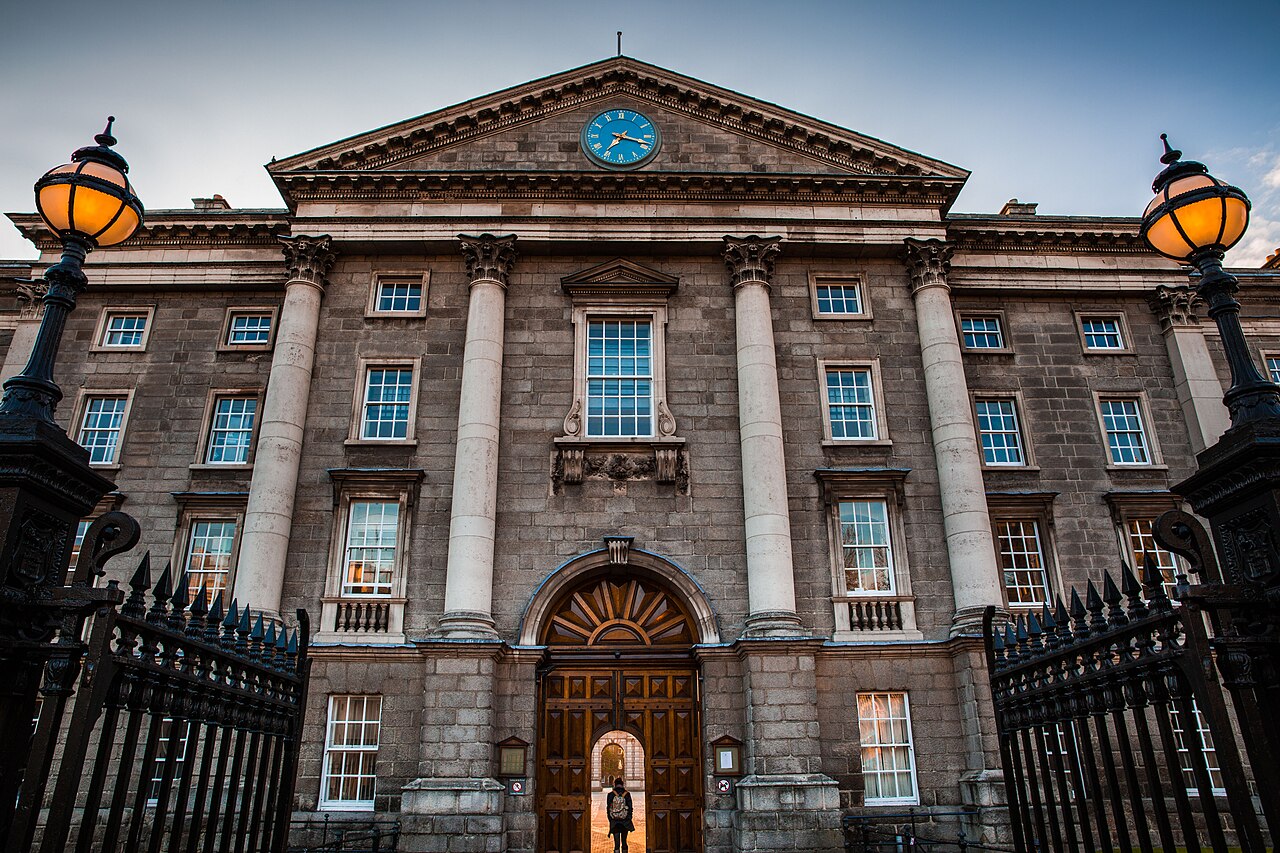
The university's commercial revenue streams extend beyond tuition. The Book of Kells exhibition, marketed relentlessly to the global tourism trade, generated significant "other income," which totaled €88. 4 million in 2024. This figure represented a 14. 8 percent increase from the previous year, driven by a post-pandemic surge in visitor numbers. yet, this dependence on tourism renders the university's operating budget to external shocks, as demonstrated during the COVID-19 lockdowns and the student blockades of 2024. The administration's strategy has been to monetize every square foot of the historic campus, turning the Front Arch into a turnstile for commercial revenue rather than solely a gateway for scholarship.
The Trinity Endowment Fund, valued at €303 million in September 2024, illustrates the shift from landed gentry to asset manager. The fund's asset allocation in 2024 was heavily weighted toward risk, with 67 percent in public equities, 12 percent in commercial property, and 11 percent in infrastructure. While the fund reported a headline surplus of €50. 2 million for the 2023/24 financial year, this number was deceptive. The operating surplus was a mere €15. 4 million; the remainder consisted of €36. 7 million in unrealized gains, paper profits driven by a buoyant stock market that mask the underlying fragility of the university's day-to-day finances. The Chief Financial Officer admitted in 2025 that the finances remained "finely balanced," a euphemism for a hand-to-mouth existence dependent on market rallies.
This financialization has inevitably collided with the ethical demands of the student body, creating a pattern of protest and reluctant divestment. In 2016, following a fifteen-month campaign by "Fossil Free TCD," Trinity became the university in Ireland to pledge divestment from fossil fuel companies. Yet, forensic analysis of the endowment in 2021 revealed that the college still held €8 million in assets linked to the industry, exposing the lag between public announcements and administrative action. It took until 2025 for the university to confirm the complete excision of these assets, a nine-year process that critics argued was far too slow for a climate emergency.
A similar pattern emerged regarding investments in Israel. Following the escalation of violence in Gaza, students launched a high-profile encampment in May 2024, blocking access to the Book of Kells and costing the university an estimated €350, 000 in lost tourist revenue. The administration capitulated, agreeing to divest from Israeli companies operating in the Occupied Palestinian Territory. By June 2025, the Board voted to sever ties with all Israeli universities and fully divest from Israeli firms. yet, the implementation of this pledge proved porous. In January 2025, freedom of information requests revealed that the college had paid an Israeli supplier after the divestment date, and that IBM, a company with documented ties to the Israeli military, had secured a five-year lease for a research lab within the Trinity Business School. These underscored the difficulty of untangling a globalized investment portfolio and the administration's struggle to align its commercial imperatives with its stated ethical commitments.
Includes public sector pay awards; still 2008 real-term levels per student.
Academic Fee Income
198. 7
209. 5
+5. 4%
Non-EU students contribute 48% of total fee revenue.
Research Income
125. 9
123. 7
-1. 7%
Decline in grant drawdown even with new awards.
Other Income (Commercial)
77. 0
88. 4
+14. 8%
Driven by Book of Kells tourism and accommodation.
Endowment Net Assets
262. 0
303. 0
+15. 6%
Growth driven primarily by unrealized equity gains (€36. 7m).
Total Surplus
3. 9
50. 2
+1, 187%
Heavily distorted by paper gains; Operating Surplus was only €15. 4m.
The trajectory from 2008 to 2026 reveals a university forced to cannibalize its own prestige to pay the bills. The "Funding the Future" initiative, while acknowledging the deficit, has not restored the pre-crash social contract between the state and the academy. Instead, Trinity has been left to function as a semi-privatized entity, where the education of Irish citizens is subsidized by the tuition of international students and the entrance fees of tourists. The endowment, once a static collection of confiscated estates, is a volatile financial instrument, managed with the same aggressive strategies as a corporate hedge fund, yet perpetually insufficient to meet the soaring costs of maintaining a world-class research institution in a capital city with a housing emergency.
Defense Funding and Dual-Use Technology Contracts
Imperial Land Grants and Colonial Revenue Streams
For the majority of its existence, Trinity College Dublin operated not as an educational institution, as a strategic asset for British military and imperial interests. From its fortification during the Jacobite wars of the late 17th century to the establishment of the Officers' Training Corps (OTC) in 1910, the university served as a recruitment ground and technical academy for the British Armed Forces. During the 1916 Easter Rising, this alignment turned kinetic; while the rest of Dublin rose against British rule, Trinity students and staff armed with Lee-Enfield rifles turned the campus into a loyalist redoubt, firing upon Irish rebels from the rooftops of College Green. The university's Engineering School, established in 1842, functioned as a serious pipeline for the Empire, dispatching graduates to construct military railways and fortifications across India and Africa, embedding the college in the logistical of colonial expansion.
, the nature of this military support shifted from direct manpower to the more unclear of "dual-use" technology and financial capitalization. By 2021, investigative inquiries revealed that Trinity's endowment fund held approximately €2. 6 million in assets linked to the global arms industry. The portfolio included equity in Lockheed Martin, Raytheon Technologies, BAE Systems, and Northrop Grumman, corporations directly implicated in the manufacture of munitions used in conflict zones from Yemen to Gaza. Even with the university's public commitments to "sanctuary" and human rights, its treasury actively profited from the aerospace and defense sectors. This financial entanglement remained largely obscured until student activists forced the release of portfolio data through Freedom of Information requests.
Research contracts at Trinity frequently blur the line between civilian science and military application. The university participates in the "US-Ireland R&D Partnership," a framework that has historically facilitated funding from agencies with defense mandates. More explicitly, in 2025, Trinity researchers advanced to the seed phase of the "Defence Innovation Challenge," a national initiative aimed at enhancing military capabilities. One such project, "Sea-Scan," uses undersea telecommunications cables for maritime surveillance. While publicly framed as a method to detect "dark vessels" and protect infrastructure, the technology represents a significant asset for naval intelligence, funded directly under a defense innovation mandate. The AMBER centre (Advanced Materials and BioEngineering Research), hosted by Trinity, conducts nanotechnology research with clear dual-use chance in ballistics, stealth materials, and advanced sensors, frequently partnering with industry giants deeply in defense supply chains.
The tension between Trinity's defense ties and its student body reached a breaking point in May 2024. Following the establishment of a protest encampment on Fellows' Square, which blocked access to the Book of Kells and cost the university substantial tourism revenue, the administration agreed to divest from Israeli companies operating in the Occupied Palestinian Territories. The deal was hailed as a victory for the Boycott, Divestment, Sanctions (BDS) movement. Yet, the execution of this agreement proved porous. In January 2025, internal documents revealed that Trinity had processed payments to a new Israeli supplier after the divestment pledge was signed. also, the university maintains a partnership with IBM, which secured a five-year lease for a research lab within the Trinity Business School. IBM has long-standing contracts with the Israeli military, a fact that critics undermines the spirit of the divestment agreement. The administration characterized the post-pledge payments as "carelessness" rather than intentionality, yet the continued presence of defense-linked multinationals on campus suggests that the university's disentanglement from the military-industrial complex is far from complete.
Table 5. 1: Known Defense & Dual-Use Links (2020-2026)
Entity / Project
Nature of Link
Details
Endowment Fund (2021)
Direct Investment
€2. 6m invested in Lockheed Martin, Raytheon, BAE Systems, Boeing.
Sea-Scan Project (2025)
Research Funding
Funded by "Defence Innovation Challenge" for maritime surveillance via undersea cables.
IBM Research Lab
On-Campus Partnership
Lab hosted in Trinity Business School; IBM holds significant Israeli military contracts.
Officers' Training Corps
Historical/Legacy
Provided armed defense of the college against Irish rebels during the 1916 Rising.
AMBER Centre
Dual-Use Research
Nanotech and materials science with applications in armor, sensors, and aerospace.
Student Accommodation Shortages and Rental Yield Analysis
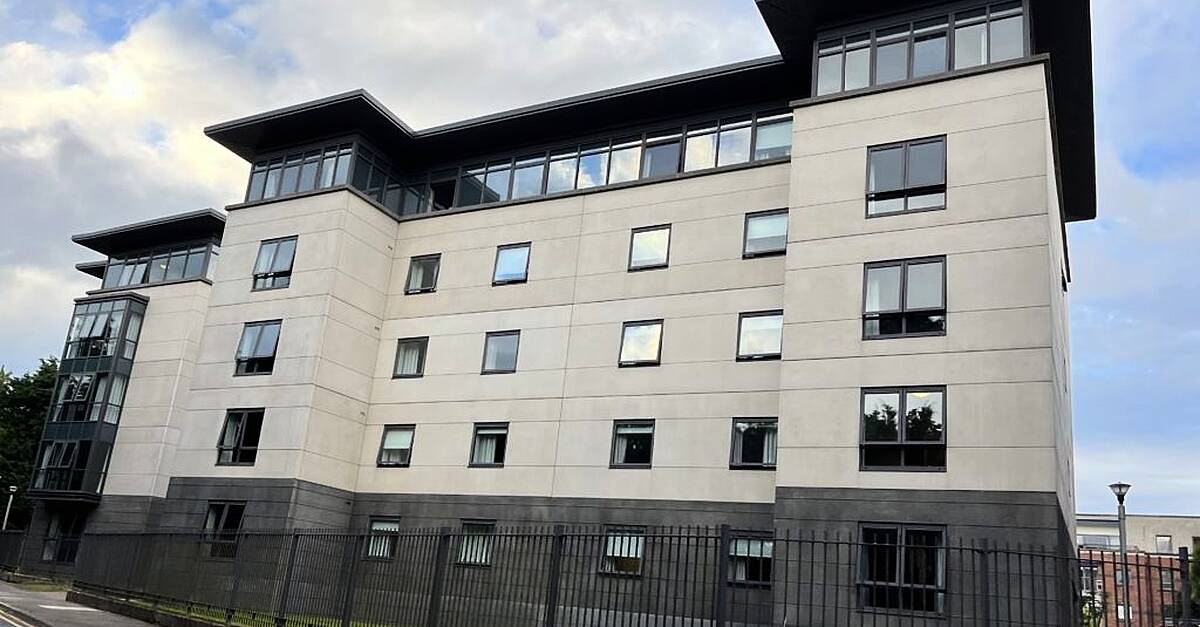
The transformation of student residency at Trinity College Dublin from a scholastic privilege to a financialized asset class represents one of the most clear evolutions in the university's 434-year history. In 1700, living "in chambers" was an integral component of the moral and academic curriculum, designed to sequester young men from the vices of the city. By 2026, the student bed had become a tradable commodity, essential to the university's solvency yet increasingly unattainable for its scholars. This shift from collegiate community to landlord-tenant antagonism reached a breaking point in the mid-2020s, as the university prioritized commercial rental yields over affordable access, mirroring the behavior of the private equity funds that came to dominate the Dublin housing sector.
During the 18th and 19th centuries, accommodation within the college walls reflected the rigid class hierarchy of the Protestant Ascendancy. Wealthy "Fellow Commoners" paid premium rents for spacious suites in the Rubrics or the -demolished Rotten Row, while "Sizars", poor scholars who received free education in exchange for menial labor, were relegated to garrets or shared damp, unheated rooms. The system relied on "skips" (college servants) who maintained these quarters, a feudal arrangement that well into the Victorian era. While conditions were frequently spartan, the cost was subsidized by the institution's vast landed estates. The Trinity College Dublin Leasing and Perpetuity Act of 1851 solidified the college's status as a major landlord, extracting rents from tenant farmers in counties like Kerry and Donegal to fund operations in Dublin. In a grim historical rhyme, the university in 2026 again relies on aggressive rent extraction, though the tenants are its own students rather than rural farmers.
The mid-20th century saw a demographic explosion that the campus could not house. By the 1960s and 70s, the "digs" system became the norm, with students renting rooms in private family homes across the suburbs. Trinity Hall, originally established in 1908 to house female students who were barred from living on the main campus, expanded to accommodate the overflow. Yet, this decentralized model collapsed following the 2008 financial crash. As state funding for higher education plummeted, dropping 40% per student between 2008 and 2022, universities were forced to commercialize every available asset. Student accommodation ceased to be a service and became a revenue stream. Trinity aggressively entered the Purpose Built Student Accommodation (PBSA) market, not to house students, to generate unrestricted income to cross-subsidize academic deficits.
This financialization strategy manifested in the construction of Printing House Square and partnerships with luxury private providers. Printing House Square, plagued by construction delays and opening in late 2022, offered rooms at rates that shocked the student body. By the 2025/2026 academic year, a standard ensuite room in this "campus" facility cost upwards of €268 per week, while private partnerships with operators like Yugo at Kavanagh Court demanded over €305 per week for 38-week contracts. These prices segregated the student body: international students and the wealthy occupied the new builds, while working-class students faced long commutes or precarious sublets. The university's reliance on this income was absolute; financial statements from 2024 revealed that Trinity generated over €12 million annually from accommodation, a figure that underpinned its fragile surplus.
Tensions erupted in September 2023 when the Trinity College Dublin Students' Union (TCDSU) launched a blockade of the Book of Kells, the university's primary tourist cash cow. The protest, triggered by a decision to increase rents by the legal maximum of 2% even with a €10 million profit from housing, marked a definitive rupture in the social contract between administration and students. The "Rent Strike" highlighted the absurdity of a public university acting as a private landlord. Students successfully argued that their rents were subsidizing the university's commercial activities, reversing the historic flow of funds. By 2026, the situation had further. Data from Sherry FitzGerald in February 2026 identified a deficit of 39, 000 student beds across Irish cities, with Dublin facing a "emergency" occupancy rate of 98%. The delivery of new beds had stalled, with only 422 units projected for completion in the capital for the entire year, leaving thousands of Trinity students at the mercy of a predatory private rental market.
The failure of the "Oisín House" project (later Printing House Square) to deliver affordable beds serves as a microcosm of the wider failure. Originally conceived to provide relief, the development was delayed by planning battles and construction inflation, resulting in a final product that required premium rents to recoup capital costs. By 2026, the university had outsourced its housing responsibility to the luxury sector. Partnerships with multinational operators like GSA and Yugo meant that "Trinity accommodation" frequently referred to rooms costing €12, 000 per academic year, a sum exceeding the maximum state grant for maintenance. This economic exclusion mirrored the sectarian exclusion of the 18th century; where once Catholics were barred by statute, by 2026, the poor were barred by price.
Divestment Protests and The Encampment Settlements of 2024
The Archbishop McQuaid Ban and Catholic Enrollment Metrics
The financial and reputational siege of Trinity College Dublin in May 2024 marked the most significant confrontation between the university administration and its student body since the anti-apartheid movement of the 1980s. The catalyst was a strategic blunder by the college executive: the issuance of a €214, 285 fine against the Students' Union (TCDSU) on May 2, 2024. The administration, led by Provost Linda Doyle, this figure as the quantifiable loss of income resulting from previous student blockades of the Book of Kells, the university's primary tourist revenue stream. By attempting to monetize dissent and bankrupt the student representative body, the administration inadvertently transformed a simmering dispute over fee hikes and foreign policy into an explosive, campus-wide occupation.
On the evening of May 3, 2024, responding to the fine and the university's continued investment in Israeli enterprises during the war in Gaza, dozens of students stormed Fellows' Square. Led by TCDSU President László Molnárfi and the local branch of the Boycott, Divestment and Sanctions (BDS) movement, protesters erected an encampment directly in front of the Old Library. Their tactic was precise and economic: they physically barricaded the entrance to the Book of Kells experience using wooden benches and tents. This was not symbolic; it severed the university's access to the thousands of daily tourists who pay €19 to view the illuminated manuscript. The blockade forced the immediate closure of the campus to the public, costing the university an estimated €350, 000 in lost revenue over the subsequent five days.
The encampment operated with a logistical sophistication that caught the administration off guard. Within 24 hours, the students had established supply lines, sanitation, and a media center, drawing international attention that threatened Trinity's carefully curated global brand. The protesters' demands were absolute: the retraction of the €214, 000 fine, full divestment from Israeli companies, and the severing of academic ties with Israeli institutions. The optics of a wealthy, 432-year-old institution threatening to sue its own students while maintaining financial in companies operating in occupied territories proved indefensible. On May 8, 2024, after five days of occupation, the university capitulated. The administration agreed to withdraw the fine and committed to divesting from Israeli companies listed on the UN Human Rights Council's blacklist.
Scrutiny of the Trinity Endowment Fund, valued at approximately €300 million, revealed the specific nature of these investments. Freedom of Information requests exposed that the portfolio included in 13 Israeli companies. Among them were Bank Leumi, which operates in illegal settlements in the West Bank; Shapir Engineering, a construction firm blacklisted by the Norwegian Sovereign Wealth Fund for its involvement in settlement infrastructure; and Energix Renewable Energies, accused of appropriating Palestinian land for solar projects. While the university initially argued that these investments were part of a passive, managed portfolio, the exposure of specific names stripped the administration of plausible deniability regarding where its capital was deployed.
The May 2024 settlement established a task force to review the university's remaining ties to Israel, a bureaucratic method that feared would lead to inaction. Yet, the momentum generated by the encampment sustained pressure on the Board for the following year. The task force's mandate extended beyond financial assets to academic collaborations, specifically examining the university's participation in EU-funded research consortia involving Israeli defense and security firms. This review process culminated in a historic decision on June 4, 2025, when the Board of Trinity College Dublin voted to fully divest from all companies headquartered in Israel, surpassing the initial 2024 agreement which applied only to those on the UN blacklist.
The 2025 decision also formalized the academic boycott, a move that severed Trinity's institutional relationships with Israeli universities. The Board announced it would not renew exchange agreements with the Hebrew University of Jerusalem and Bar-Ilan University upon their expiration. This policy shift placed Trinity among the elite Western universities to enact a detailed institutional boycott, aligning its 21st-century foreign policy with its 20th-century precedent. In the 1980s, under the guidance of law professor and activist Kader Asmal, Trinity staff had led the Irish Anti-Apartheid Movement, eventually forcing the college to divest from South Africa long before other European institutions followed suit.
The capitulation of 2024 and the subsequent policy overhaul in 2025 demonstrated the fragility of the "neoliberal university" model when its revenue streams are physically disrupted. The administration's initial attempt to use financial penalties to discipline the student union backfired, revealing that the university's reliance on tourism income was also its tactical weakness. By targeting the Book of Kells, the students bypassed the traditional channels of committees and petitions, clear directly at the institution's balance sheet. The €214, 285 fine, intended to silence the union, cost the university millions in lost tourism revenue and forced a total reconstruction of its ethical investment policy.
Trinity College Dublin Divestment Timeline (2024-2025)
Date
Event
Impact
May 2, 2024
TCD problem €214k fine to SU
Triggered mass mobilization and encampment.
May 3, 2024
Encampment begins
Fellows' Square occupied; Book of Kells closed.
May 8, 2024
Settlement reached
Fine dropped; divestment from UN blacklist agreed.
June 4, 2025
Board votes for full divestment
Ties cut with all Israeli firms and universities.
From the vantage point of 2026, the encampment is viewed not as a singular disruption as a correction of the university's moral trajectory. The removal of investments in Bank Leumi and Shapir Engineering was completed by late 2024, the extrication from academic research contracts proved more complex, requiring legal navigation of EU funding structures. The student victory ended the era where Trinity could separate its fiduciary responsibilities from its stated values, proving that in the modern academic terrain, a university's endowment is as much a political instrument as it is a financial one.
Global Ranking Volatility and Grade Inflation Statistics
The modern history of Trinity College Dublin is defined not by its ancient traditions, by a desperate, data-driven struggle to maintain relevance in a commodified global education market. For the better part of the 20th century, Trinity rested on a reputation of superiority, frequently styled as the "Oxford of Ireland." By the early 21st century, this reputation collided with the cold, hard metrics of international league tables. The resulting volatility exposes a university caught between the need to project elite exclusivity and the financial need of mass-market expansion. Between 2009 and 2026, the institution witnessed a humiliating slide in global standing, followed by a frantic, administratively heavy recovery effort that stabilized its position raised serious questions about the dilution of its academic currency.
In 2009, Trinity College Dublin held a commanding position, ranked 43rd in the world by the QS World University Rankings. It was a placement that validated the university's self-image as a top-tier global research hub. Yet, the following decade revealed the fragility of this standing. By 2016, the university had slipped to 78th. The decline accelerated as the metrics used by ranking agencies, specifically student-staff ratios and research citation impact, turned against the college. The nadir arrived in the early 2020s. In the 2023 rankings, Trinity plummeted to 98th, barely clinging to its status as a top-100 institution. The Times Higher Education (THE) rankings were even more unforgiving, placing the university at 161st in 2023. This freefall was not a statistical abstraction; it represented a tangible of prestige that threatened the university's ability to attract the lucrative non-EU students upon whom its business model depends.
The administration's response to this emergency was a textbook example of corporate emergency management. Blame was directed outward, specifically at the Irish state for "chronic underfunding." Provost Linda Doyle and her predecessors frequently the deficit in core government grants, estimated at €307 million annually for the sector, as the primary driver of the ranking collapse. Yet, financial statements from 2024 and 2025 paint a contradictory picture. While the university pleaded poverty to the government, it recorded a surplus of €50. 2 million in the 2023/24 financial year, driven by a €36. 7 million gain in investment portfolio valuations and record tuition revenue. The university had successfully pivoted to a high-volume, high-fee model, yet the rankings lagged behind this financial success until the aggressive strategic adjustments of the mid-2020s.
By March 2026, the "ranking emergency" had been technically arrested. The QS World University Rankings for 2026 placed Trinity at 75th, a jump of 12 places from the previous year and a significant recovery from the near-exit of the top 100. This recovery was not accidental. It was the result of a targeted campaign to game the specific metrics that QS prioritizes: employer reputation and international research networks. The university poured resources into marketing its "global outlook," boosting its international faculty numbers, and ensuring its citation metrics were optimized. The recovery to 75th allows the administration to claim victory, yet it masks a deeper, more insidious problem within the lecture halls: the collapse of grading standards.
As rankings volatility plagued the administrative block, grade inflation silently eroded the academic rigor of the undergraduate degree. In the 18th and 19th centuries, a "Gold Medal" at Trinity, awarded for exceptional answering in the Moderatorship examinations, was a rarity, a mark of true intellectual distinction. Even as late as the 1990s, a Class Honours degree was a badge of elite performance, awarded to perhaps 10% to 15% of a graduating class. Today, the Class degree has become a statistical expectation rather than an exception. Data from the Higher Education Authority and Trinity's own Senior Lecturer's Annual Reports show a upward trend. In 2015, approximately 16% of Trinity graduates received a. By the 2020/21 academic year, that figure had more than doubled, with over 30% of students securing the top grade. In humanities and social science departments, the combined rate of and Upper Seconds (2. 1s) exceeds 90%.
The catalyst for this explosion in high grades was the COVID-19 pandemic, which forced a shift from invigilated, closed-book examinations to open-book, online assessments. While the university argued this method tested "understanding" rather than "recall," the statistical result was an immediate and permanent upward shift in grade profiles. Even after the return to in-person teaching, the percentage of Class awards did not return to pre-2015 levels. The "customer" mentality of the modern student, paying of the highest fees in the EU (or exorbitant international rates), exerts a silent pressure on faculties. To fail a student, or even to award a Lower Second (2. 2), is to invite appeals, complaints, and administrative headaches. Consequently, the 2. 1 has become the new baseline, the "participation trophy" of the 2020s, rendering the classification system increasingly meaningless to employers.
This modern laxity stands in clear contrast to the historical purpose of the university's assessment systems. In the 1700s and 1800s, the "Schol" (Scholarship) examination was the primary method of distinguishing the intellectual elite. It was a grueling test of classical knowledge, open only to men, which conferred significant financial privileges and voting rights. The examination was so rigorous that in years, scholarships were withheld simply because no candidate met the standard. While the Scholarship examination remains today, and is arguably the last bastion of true academic adversity at Trinity, it too faces pressure. The number of Scholars elected has risen, and the prestige, while still high within the college walls, has little resonance in a global market that looks only at the final degree classification.
The correlation between the ranking recovery and grade inflation is not direct, they are symptoms of the same disease: the metric-fixation of higher education. To climb the QS rankings, Trinity must attract international staff and students. To attract those students, it must offer a "world-class experience" and high employability rates. A transcript filled with Class Honours suggests high employability and satisfied customers. Thus, the university is incentivized to maintain the grade bubble. The administration that the rise in grades reflects "better teaching" and "higher caliber students." This claim withers under scrutiny. It is statistically improbable that the intellectual capacity of the student body doubled in intellectual capacity between 2015 and 2021. The more likely explanation is that the definition of academic excellence has been widened until it encompasses the top third of the class, rather than the top tenth.
As of 2026, Trinity College Dublin occupies a paradoxical position. It has successfully manipulated the levers of the global ranking machines to return to the 75th position, securing its brand value for another pattern of recruitment. Its balance sheet is healthy, bolstered by a €50 million surplus and a diversified income stream that relies heavily on commercial activities and tourism. Yet, the academic currency it prints, the Trinity Degree, suffers from inflation. The "Gold Standard" has been replaced by a fiat currency, backed not by the scarcity of the award, by the marketing power of the institution. The university has survived the ranking emergency, in doing so, it has fundamentally altered the nature of the education it provides, prioritizing the metrics of success over the ruthless, exclusionary rigor that once defined it.
The Berkeley Library De-naming and Historical Inquiry
The decision to strip George Berkeley's name from the main library at Trinity College Dublin on April 26, 2023, marked the functional end of the university's centuries-long refusal to confront its colonial origins. For 56 years, the brutalist concrete structure designed by Paul Koralek had honored the 18th-century philosopher and Bishop of Cloyne. While Berkeley remains a celebrated figure in metaphysics for his theory of immaterialism, the Trinity Legacies Review Working Group (TLRWG) unearthed irrefutable evidence that his intellectual output was subsidized by the forced labor of enslaved people. The inquiry, driven by student activism and archival research, confirmed that Berkeley purchased and enslaved at least four people, Philip, Anthony, Edward, and Agnes, at his Whitehall plantation in Rhode Island between 1729 and 1731.
Berkeley was not a passive participant in the slave economy. He actively formulated theological justifications for the ownership of human beings. In his 1725 pamphlet A Proposal for the Better Supplying of Churches in Our Foreign Plantations, he argued that baptism should not lead to manumission. He contended that enslaved people would become more obedient workers if they were Christianized, a position that aligned with the 1729 Yorke-Talbot opinion which provided the legal framework for slavery within the British Empire. This intellectual cover allowed the Anglican elite to reconcile religious piety with the brutal economics of chattel slavery. The university board, upon reviewing these findings, concluded that retaining the name was inconsistent with the institution's stated values of human dignity. From April 2023 until October 2024, the building was known simply as "The Library."
On October 9, 2024, the university announced that the building would be renamed the Eavan Boland Library. This decision broke a 432-year pattern of male exclusivity in the naming of campus infrastructure. Boland, a Trinity alumna and acclaimed poet, had spent her career challenging the patriarchal narratives that dominated Irish history and literature. Her selection represented a deliberate pivot from the "Great Man" theory of history toward a recognition of those previously excluded from the university's canon. The renaming was not symbolic; it was the most visible outcome of the Colonial Legacies Project, a research initiative established in 2021 to audit the university's deep entanglement with imperialism.
The Colonial Legacies Project, led by historians Dr. Ciaran O'Neill and Dr. Patrick Walsh, produced a preliminary audit that dismantled the myth of Trinity as a neutral academic observer. The data showed that by the late 17th century, the college owned approximately 190, 000 acres of land, nearly 1% of Ireland's total landmass. These holdings were acquired largely through the violent dispossession of Catholic landowners during the Munster and Ulster Plantations. The rents collected from these stolen lands funded the construction of the college's Georgian squares and the salaries of its fellows. The audit also documented how Trinity functioned as a training academy for the Indian Civil Service, exporting thousands of administrators to enforce British rule in the subcontinent. The university was not just a beneficiary of empire; it was an operational engine for it.
The inquiry into colonial violence extended to the university's scientific collections. In July 2023, Trinity formally repatriated the remains of 13 people to the island of Inishbofin, off the coast of Galway. These remains had been stolen in 1890 by Alfred Cort Haddon and Andrew Francis Dixon, two anthropologists associated with the university. Haddon and Dixon had raided the ruins of St Colman's monastery under the cover of darkness, removing the skulls to Dublin to conduct craniometric measurements. Their objective was to find physical evidence to support theories of racial hierarchy that were popular in Victorian science. For 133 years, the skulls were stored in the Old Anatomy Museum, treated as specimens rather than ancestors. The return of the remains followed a relentless campaign by Inishbofin historian Marie Coyne and required the university to admit that its "scientific" collections were built on theft and desecration.
The scope of the historical inquiry also forced a reckoning with internal abuses of power. In 2022, the School of Physics removed the name of Nobel laureate Erwin Schrödinger from its main lecture theatre. This action followed the resurfacing of Schrödinger's personal journals, which detailed his sexual predation of minors. The simultaneous purging of Berkeley and Schrödinger signaled a collapse of the institution's policy of uncritical veneration. The university could no longer separate the intellectual achievements of its luminaries from their exploitation of populations, whether in a Rhode Island plantation or a Dublin lecture hall.
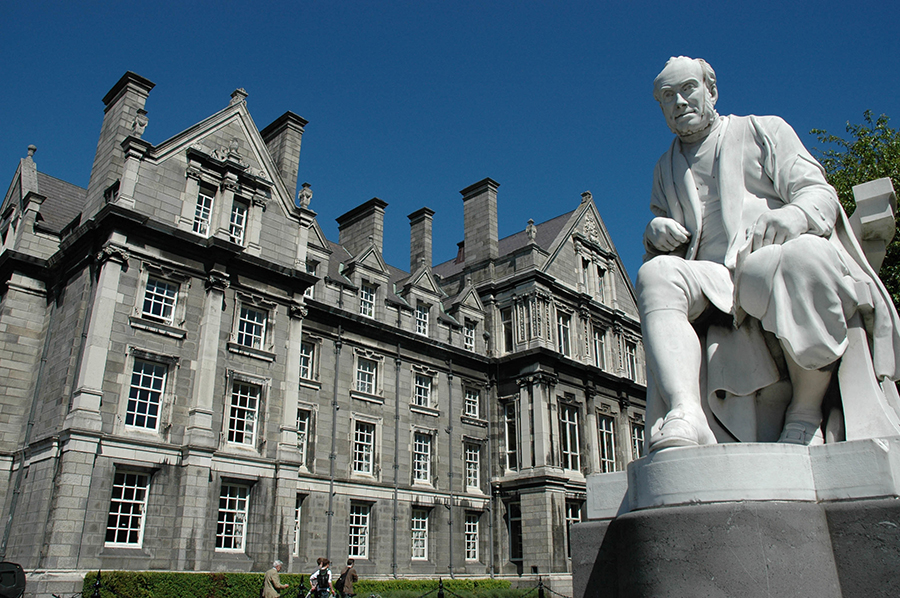
By 2026, the physical and administrative environment of Trinity College Dublin had shifted. The statues of Edmund Burke and Oliver Goldsmith remained at the front gate, yet the context surrounding them had changed. The university had publicly admitted its status as a colonial landlord and a repository of looted remains. The renaming of the library to honor Eavan Boland stood as a permanent marker of this transition. The table summarizes the key milestones in this de-naming and inquiry process between 2021 and 2024.
Date
Event
Key Details
Feb 2021
Colonial Legacies Project Launch
Established to audit TCD's links to empire, slavery, and colonial extraction.
Apr 2022
Schrödinger Theatre Renamed
Physics lecture theatre de-named following evidence of sexual abuse by the Nobel laureate.
Apr 26, 2023
Berkeley Library De-naming
Board votes to remove George Berkeley's name due to his ownership of slaves Philip, Anthony, Edward, and Agnes.
July 16, 2023
Inishbofin Repatriation
13 stolen skulls returned to Inishbofin islanders after 133 years in the Anatomy Museum.
Oct 9, 2024
Eavan Boland Renaming
Library officially renamed the Eavan Boland Library, the building named after a woman.
Commercialization of The Book of Kells and Campus Tourism
Endowment Asset Allocation and State Funding Deficits 2008-2026
The transformation of Trinity College Dublin from a secluded bastion of Protestant scholarship into a mass-tourism engine centers on a single asset: the Book of Kells. For the two centuries of the library's existence, the manuscript served as an academic curiosity, accessible only to fellows and distinguished guests. By 2026, it had mutated into the university's primary commercial financial instrument, generating revenues that rival the research grants of entire faculties. This shift from academic custody to aggressive commodification exposes the institution's reliance on the "heritage industry" to subsidize its operations, a strategy that has frequently placed the university administration in direct conflict with its own student body. The Old Library, designed by Thomas Burgh and completed in 1732, was never intended for public thoroughfare. Throughout the 18th and 19th centuries, access remained a privilege of the Ascendancy. While the 1801 Copyright Act, which granted Trinity the right to claim a free copy of every book published in Britain and Ireland, filled the shelves of the Long Room, the library remained a quiet zone of clerical study. It was not until the late 20th century that the university recognized the latent capital within the 9th-century gospel manuscript. In 1992, a dedicated visitor center opened, attracting 220, 000 people that year. By 2012, that number had more than doubled to 520, 000. The decade following 2012 marked the era of hyper-commercialization. Under the pressure of declining state funding, the university administration pivoted to treat the Old Library not as a cultural repository, as a high-yield business unit. Marketing campaigns rebranded the library as a "bucket list" destination, decoupling the tourist experience from the academic function of the university. The strategy succeeded in volume altered the campus atmosphere. By 2019, visitor numbers breached the one million mark, turning the cobbled expanse of Front Square into a permanent queue of coaches and tour groups. The financial data demonstrates the of this operation. In the fiscal year ending 2019, the Book of Kells exhibition and the associated library shop generated approximately €18 million. The COVID-19 pandemic exposed the fragility of this model; when the gates closed in 2020, revenue collapsed to €2. 9 million, tearing a hole in the university's balance sheet. The administration's response to the post-pandemic era was to increase yield per visitor. In 2024, the university reported a record €20. 2 million in revenue from the exhibition and shop, driven by a 28% ticket price hike for the new "Book of Kells Experience."
Commercial Growth of the Book of Kells Exhibition (1992, 2024)
Year
Annual Visitors
Est. Commercial Revenue
Context
1992
220, 000
N/A
Dedicated visitor center opens.
2012
520, 000
~€5. 0 Million
Post-recession tourism push.
2019
1, 050, 000
€17. 9 Million
Peak pre-pandemic volume.
2020
296, 000
€4. 1 Million
COVID-19 closures impact.
2024
900, 000
€20. 2 Million
Price hike to €25; "Immersive" pavilion opens.
The most significant driver of recent commercial policy is the Old Library Redevelopment Project (OLRP). Initiated to address serious fire risks and environmental degradation, fears heightened by the 2019 Notre Dame fire, the project carries a price tag exceeding €90 million. While the Irish state committed €25 million, the university bears the load of raising the remainder. This need birthed the "Book of Kells Experience," a temporary "Red Pavilion" erected in New Square in 2024. This structure represents the final stage of "Disneyfication." With the actual Long Room emptied of its 200, 000 books for restoration (a "decant" process completed in April 2024), the university began selling tickets to a digital simulation. The pavilion offers 360-degree projections and "immersive journeys," charging visitors €25 to view digital surrogates of the manuscript and the library. Critics this moves the institution from a guardian of history to a purveyor of spectacle, prioritizing the "experience economy" over authentic engagement. The tension between the university as a landlord-merchant and the university as an academy erupted in 2023 and 2024. The Trinity College Dublin Students' Union (TCDSU) identified the Book of Kells as the administration's financial jugular. Protesting against rent increases, postgraduate fee hikes, and the university's investment ties to Israel, students launched a series of blockades at the entrance of the Old Library. These actions were not symbolic pickets tactical economic strikes. The administration admitted that the blockades cost the university approximately €350, 000 per week, or roughly €10, 000 for every hour the doors remained shut. In May 2024, the university took the step of fining the Students' Union €214, 000 for the loss of income, citing a "fiduciary duty" to maximize the asset's yield. This punitive measure clarified the hierarchy of values within the modern institution: the commercial viability of the tourist attraction held primacy over the students' right to protest the conditions of their own education. By 2026, the Old Library remains a construction site, wrapped in scaffolding and preservation. The "Red Pavilion" continues to process tourists, maintaining the revenue stream required to pay for the stonework and climate control systems door. The commercialization of the Book of Kells has saved the physical structure of the library, yet it has fundamentally altered the character of the college. The 18th-century of the Ascendancy has become a 21st-century retail hub, where the silence of the Long Room is replaced by the hum of projectors and the chime of the gift shop register.
Provost Elections and Board Restructuring Mandates
The selection of the Provost at Trinity College Dublin has shifted from royal appointment to a democratic process involving staff and student representatives. Between 1592 and 1692, Provosts were almost exclusively graduates of Oxford or Cambridge. In 1637, under the influence of Archbishop William Laud and Provost William Chappell, the right to elect the Provost was removed from the College and vested in the Crown. This power remained with the Crown until the 20th century. Since 1927, the office has frequently been held by clergymen, though this trend ceased in recent decades. The current tenure is a fixed ten-year term without the possibility of re-election.
In April 2021, the university elected Linda Doyle as its 45th Provost, marking the time a woman has held the office in the college's 429-year history. Doyle, a Professor of Engineering and the Arts, defeated Linda Hogan and Jane Ohlmeyer in the final ballot. She assumed office on August 1, 2021, succeeding Patrick Prendergast. As of early 2026, Doyle remains the incumbent Provost, with her term scheduled to conclude in 2031. The electorate for this position includes full-time academic staff and student union representatives, a system that replaced the former dominance of the Senior Fellows in the selection process.
Governance at Trinity underwent significant reform following the enactment of the Higher Education Authority Act 2022. The Act sought to reduce the size of governing bodies across Irish universities to 17 members to improve accountability. Trinity officials argued that its collegiate model required a distinct method. The government accepted a compromise, formalized through a Supplemental Charter approved by the Board in October 2022 and recognized by the State in November 2022. This legal instrument allows Trinity to maintain a Board of up to 22 members, permitting the inclusion of Fellows, provided that external members constitute at least 40 percent of the total membership. This arrangement preserves the historic role of the Fellows while meeting state requirements for external oversight.
The restructured Board has exercised its authority on serious geopolitical matters. In June 2025, the Board voted to sever all ties with Israeli universities and companies, making Trinity the Irish university to fully divest from these entities. This decision followed a recommendation from a task force established after student protests and an encampment on campus. The move ended academic collaborations, exchange programs, and commercial contracts, demonstrating the Board's capacity to enact major policy shifts under its new governance framework.
The E3 Learning Foundry and Grand Canal Innovation District
The transition of Trinity College Dublin from a theological of the 18th century to a corporate-aligned engine of the 21st century is most visible in its physical expansion. In the 1700s, the college functioned as a massive absentee landlord, possessing approximately 190, 000 acres of Irish land, roughly 1. 25% of the entire island. These estates, seized during the plantations and granted to the college to secure Protestant hegemony, extracted rents from over 71, 000 tenants to fund the education of the Ascendancy elite. By 2026, the college's territorial ambitions had shifted from rural rent-seeking to urban capital development. The institution no longer seeks to garrison the countryside against Catholicism to integrate itself into the high-rent "Silicon Docks" of Dublin, aligning its physical footprint with the needs of multinational technology firms rather than the colonial state.
This pivot is epitomized by the Martin Naughton E3 Learning Foundry. Constructed on the site of the demolished Biochemistry building at the east end of the historic campus, the facility represents a rejection of traditional academic architecture in favor of industry-standard workspaces. Funded significantly by a €25 million donation from Glen Dimplex founder Martin Naughton, the largest private philanthropic gift in the history of the state at the time, the project was designed to increase student numbers by 1, 800 places. While the university framed this as a pedagogical evolution, the underlying logic was economic. The curriculum within E3 (Engineering, Environment, and Emerging Technologies) was retooled to produce graduates specifically calibrated for the labor demands of the tech sector, outsourcing the R&D training costs of private corporations to the university sector.
The E3 Foundry, operational by 2024 after pandemic-induced delays, served as the bridgehead for a far more aggressive expansion: the Grand Canal Innovation District (GCID). Situated on a 5. 5-acre site at Grand Canal Quay, this project, rebranded as "Trinity East", signaled the college's intent to break out of its walled city center enclave. The site, formerly home to the IDA Enterprise Centre, was to become a €1 billion campus. The vision for Trinity East was not educational commercial; it was conceived to physically merge the university with the "Silicon Docks," the area housing the European headquarters of Google, Meta, and other tech giants. In January 2026, the college unveiled renewed plans for this district, aiming to house 400 startups and create a "dense urban environment" that blurred the lines between public education and private enterprise.
Trinity College Dublin: Capital Projects & Land Use (1700, 2026)
Era
Primary Asset Class
Strategic Purpose
Key Metric
1700, 1850
Rural Estates (Kerry, Donegal, etc.)
Colonial Control & Revenue
190, 000 Acres Owned
2018, 2024
E3 Learning Foundry
Workforce Supply
€60m+ Construction Cost
2020, 2026
Trinity East (GCID)
Tech Industry Integration
€1bn Projected Value
The execution of the Grand Canal Innovation District faced serious financial and political friction. In 2022, the project was left with a €150 million funding shortfall when the Irish government's National Development Plan failed to allocate specific provisions for innovation districts. This forced the university to back immediate construction and rely more heavily on private partnerships and debt financing. The reliance on commercial viability fundamentally altered the character of the expansion. To secure funding, the district had to prioritize high-yield commercial tenants and "innovation" spaces over affordable student accommodation or basic research facilities. In a city gripped by a chronic housing absence, the allocation of prime real estate for a "campus of startups" rather than student dormitories drew sharp criticism from student unions and housing activists.
The architectural language of the new developments also marked a departure from the insular squares of the 18th century. Where the Front Square was designed to intimidate and exclude the native population, Trinity East was designed to be permeable to capital. The "Innovation Hub," a central feature of the district, incorporated a 19th-century sugar refinery tower, repurposing a relic of industrial manufacturing into a symbol of the knowledge economy. Yet, the exclusion remained. Access to these spaces was not determined by religion, as in the Penal Law era, by economic utility. The "collaboration" promised by the district was strictly between the university and high-growth enterprises, leaving the surrounding working-class communities of Ringsend and Pearse Street largely on the outside, facing gentrification pressures accelerated by the university's encroachment.
By March 2026, the Grand Canal Innovation District stood as the definitive statement of Trinity's modern identity. The university had successfully transformed itself from a bastion of the Protestant Ascendancy into a central node of the global tech economy. The 190, 000 acres of confiscated land that once sustained the college had been traded for a few acres of the most expensive commercial real estate in Europe. The methods of extraction had changed, from tenant rents to intellectual property rights and industry partnerships, the institution remained a fortified elite power, serving the dominant economic order of the day.
Why it matters: The Belt and Road Initiative has shifted focus from physical infrastructure to digital projects like the Digital Silk Road. Investigative data reveals that corruption has…
What do we know about Protestant Ascendancy and Sectarian Admission Policies?
For nearly three centuries, Trinity College Dublin functioned not as a university, as a fortified ideological garrison for the Protestant Ascendancy. Established to consolidate Tudor rule and propagate the Anglican faith, the institution maintained a rigid sectarian exclusion policy that barred the erroneous majority of the Irish population from its halls.
What do we know about Imperial Land Grants and Colonial Revenue Streams?
Trinity College Dublin was never a university; for the majority of its existence, it operated as a massive, extractive landlord. By 1876, the college owned approximately 190, 000 acres of Irish land, representing over 1% of the entire island's surface area.
What do we know about The Archbishop McQuaid Ban and Catholic Enrollment Metrics?
From 1944 to 1970, the barrier preventing the Irish majority from entering Trinity College Dublin was not a British law, an Irish ecclesiastical decree. While the Penal Laws of the 18th century had legally barred Catholics from education, the mid-20th century exclusion was enforced by the Catholic hierarchy itself, specifically under the iron rule of John Charles McQuaid, Archbishop of Dublin.
What do we know about Endowment Asset Allocation and State Funding Deficits?
The financial architecture of Trinity College Dublin (TCD) in the 21st century represents a clear inversion of its colonial origins. Established in 1592 and consolidated throughout the 1700s as a landed power, the university originally operated as a territorial magnate.
What do we know about Defense Funding and Dual-Use Technology Contracts?
For the majority of its existence, Trinity College Dublin operated not as an educational institution, as a strategic asset for British military and imperial interests. From its fortification during the Jacobite wars of the late 17th century to the establishment of the Officers' Training Corps (OTC) in 1910, the university served as a recruitment ground and technical academy for the British Armed Forces.
What do we know about Student Accommodation Shortages and Rental Yield Analysis?
The transformation of student residency at Trinity College Dublin from a scholastic privilege to a financialized asset class represents one of the most clear evolutions in the university's 434-year history. In 1700, living "in chambers" was an integral component of the moral and academic curriculum, designed to sequester young men from the vices of the city.
What do we know about Divestment Protests and The Encampment Settlements of?
The financial and reputational siege of Trinity College Dublin in May 2024 marked the most significant confrontation between the university administration and its student body since the anti-apartheid movement of the 1980s. The catalyst was a strategic blunder by the college executive: the issuance of a €214, 285 fine against the Students' Union (TCDSU) on May 2, 2024.
What do we know about Global Ranking Volatility and Grade Inflation Statistics?
The modern history of Trinity College Dublin is defined not by its ancient traditions, by a desperate, data-driven struggle to maintain relevance in a commodified global education market. For the better part of the 20th century, Trinity rested on a reputation of superiority, frequently styled as the "Oxford of Ireland." By the early 21st century, this reputation collided with the cold, hard metrics of international league tables.
What do we know about The Berkeley Library De-naming and Historical Inquiry?
The decision to strip George Berkeley's name from the main library at Trinity College Dublin on April 26, 2023, marked the functional end of the university's centuries-long refusal to confront its colonial origins. For 56 years, the brutalist concrete structure designed by Paul Koralek had honored the 18th-century philosopher and Bishop of Cloyne.
What do we know about Commercialization of The Book of Kells and Campus Tourism?
The transformation of Trinity College Dublin from a secluded bastion of Protestant scholarship into a mass-tourism engine centers on a single asset: the Book of Kells. For the two centuries of the library's existence, the manuscript served as an academic curiosity, accessible only to fellows and distinguished guests.
What do we know about Provost Elections and Board Restructuring Mandates?
The selection of the Provost at Trinity College Dublin has shifted from royal appointment to a democratic process involving staff and student representatives. Between 1592 and 1692, Provosts were almost exclusively graduates of Oxford or Cambridge.
What do we know about The E3 Learning Foundry and Grand Canal Innovation District?
The transition of Trinity College Dublin from a theological of the 18th century to a corporate-aligned engine of the 21st century is most visible in its physical expansion. In the 1700s, the college functioned as a massive absentee landlord, possessing approximately 190, 000 acres of Irish land, roughly 1.
Why it matters: The legacy of corruption within the Vyapam board persists despite official rebranding efforts. The board's failure to maintain operational integrity has led to widespread fraud…
Why it matters: The original vision for Indian public sector banks as custodians of national welfare has shifted towards aggressive corporate lending, leading to massive write offs. While…
Why it matters: The sharing economy's evolution from a grassroots concept to a global asset class has transformed cities worldwide. The financialization of residential spaces for short-term rentals…
Why it matters: Rising demand for media monitoring in response to evolving digital landscape Key drivers of media monitoring growth including intensified market competition and shift in consumer…
Why it matters: The United Nations process for evaluating national human rights records provides valuable material for journalists to uncover human rights violations. The Universal Periodic Review (UPR)…
Why it matters: PR agencies utilize media communication to shape brand reputation, manage crises, and influence policy across various sectors and countries. Effective PR strategies involve proactive media…
Get updates on this place
Get verified alerts when this file is updated (verification required).