Verified Against Public And Audited RecordsLast Updated On: 2026-03-04
Reading time: ~47 min
File ID: EHGN-PLACE-35353
Investigative Bio of University of Cambridge
1700, 1850: Clerical Oligarchy and the Mathematical Tripos
Between 1700 and 1850, the University of Cambridge functioned less as a center of open inquiry and more as a of Anglican orthodoxy. The institution was controlled by a clerical oligarchy that prioritized theological conformity over academic innovation. This period, frequently dismissed as an era of stagnation, was in reality a time of rigid consolidation where the "Caput Senatus", a executive council consisting of the Vice-Chancellor and heads of houses, wielded absolute veto power over all university business. Their primary objective was the preservation of the Church of England's monopoly on higher education.
The method for this control was statutory. Until the mid-19th century, matriculation and graduation required strict adherence to the Thirty-Nine Articles of the Anglican Church. This barred Roman Catholics, Jews, and Nonconformists from obtaining degrees or holding fellowships. The expulsion of William Whiston, the Lucasian Professor of Mathematics, in 1710 for Arian heresy served as a clear warning to any scholar who dared to question doctrinal orthodoxy. Whiston, Isaac Newton's handpicked successor, was stripped of his chair and banished, proving that even the most brilliant mathematical minds were subject to ecclesiastical policing.
Academically, the university monomaniacally focused on the Mathematical Tripos. Originating in the mid-18th century as the "Senate House Examination," this grueling test evolved into the sole avenue for an honors degree. By 1824, even students wishing to study classics were required to obtain honors in mathematics, a prerequisite that maintained the subject's stranglehold on the curriculum. The examination itself was a physical and mental marathon, frequently lasting several days. Candidates were ranked in a strict order of merit, a public spectacle that fueled intense competition and betting markets.
The hierarchy of the Tripos results defined a student's future career. The top-scoring candidate was crowned the "Senior Wrangler," a title that guaranteed a fellowship and a lucrative career in the church or bar. Those who achieved -class honors were "Wranglers," followed by "Senior Optimes" (second class) and "Junior Optimes" (third class). The student with the lowest passing score was mockingly awarded the "Wooden Spoon," a literal large wooden spoon dangled from the Senate House balcony by undergraduates. This ritual humiliation underscored the binary nature of Cambridge success: one either triumphed in Newton's mechanics or faced irrelevance.
The system's rigidity reached a breaking point during the "Slaughter of 1841." In that year, examiners set papers of such difficulty that a massive number of candidates failed to achieve honors. Because of the rule requiring mathematical honors to enter the Classical Tripos, dozens of capable classicists were summarily barred from their own field of study. This event exposed the absurdity of a system that forced future bishops and statesmen to master hydrostatics and fluxions before they could demonstrate proficiency in Greek or Latin.
Daily life for the undergraduate was bifurcated between the dry, rote learning of the tutorial system and the vibrant, frequently raucous culture of the town's coffeehouses. With no centralized university lectures, education was privatized; students paid "coaches", private tutors, to drill them for the Tripos. The real intellectual exchange frequently occurred in establishments like Clapham's Coffeehouse or the Union Society, where students could debate politics and read newspapers, activities frequently viewed with suspicion by the college authorities. Alcohol consumption was heavy, and gambling was rampant, with the university acting as a holding pen for the sons of the gentry awaiting their inheritance or a church living.
Student enrollment numbers reflected the institution's insularity. In 1750, matriculations plummeted to approximately 150 students per year, a historic low. The university had become a finishing school for the idle rich and a seminary for the Anglican priesthood. It was not until the end of the Napoleonic Wars that numbers began to recover, rising to over 400 matriculations by 1820. Yet, even with this growth, the curriculum remained frozen in the Newtonian tradition of the previous century. While continental Europe advanced in analysis and theoretical physics, Cambridge remained fixated on geometric proofs and the specific notation of Newton's Principia, isolating British mathematics for decades.
The "don" of this era was a celibate clergyman residing in college, waiting for a college living (a parish priest position) to become vacant so he could marry and leave. This system of "waiting for dead men's shoes" created a transient and frequently uninspired teaching body. Fellows had little incentive to conduct research or modernize the syllabus. The few who did, like Charles Babbage and the "Analytical Society" in the 1810s, fought an uphill battle to introduce continental notation (Leibniz's dy/dx) against the entrenched "dot-age" of Newtonian fluxions.
By 1850, the pressure for reform had become. The Royal Commission of 1850 was established to investigate the university, signaling the end of the clerical oligarchy's absolute autonomy. The state was no longer to tolerate a national university that served only a fraction of the nation and refused to teach the subjects, such as natural sciences, history, and modern languages, essential for an industrial empire.
Statutory Reform: The Royal Commissions of 1850 and 1872
1700, 1850: Clerical Oligarchy and the Mathematical Tripos
The transformation of Cambridge from a clerical seminary into a modern research university was not an organic evolution a forced march, orchestrated by the state against the of a recalcitrant oligarchy. The catalyst was the election of Prince Albert as Chancellor in 1847, a move that signaled the encroachment of the Crown into the university's autonomous stagnation. By 1850, the external pressure for reform had solidified into the Royal Commission of Inquiry, chaired by John Graham, Bishop of Chester. This body, known as the Graham Commission, was charged with a forensic examination of the university's "State, Discipline, Studies, and Revenues."
The Graham Commission's report was a scathing indictment of the. It exposed a university paralyzed by archaic statutes that had remained largely unchanged since the Elizabethan era. The "Caput Senatus" was identified as a primary obstruction, a body that allowed a single dissenting voice to block any measure of progress. The Commission's findings led directly to the Cambridge University Act 1856, a legislative sledgehammer that shattered the old governance model. The Act abolished the Caput and replaced it with the Council of the Senate, an elected executive body that, while still conservative, introduced a semblance of representative government. Crucially, the 1856 Act cracked the Anglican monopoly, removing the requirement for a declaration of religious faith for matriculation and for the Bachelor of Arts degree, though the Senate and higher offices remained the exclusive preserve of the Church of England.
The religious question was settled not by internal consensus by the Universities Tests Act 1871. This statute was the death knell for the clerical oligarchy. It swept away the requirement for subscription to the Thirty-Nine Articles for all lay offices and degrees, opening the university to Nonconformists, Catholics, and Jews. The impact was immediate and: the pool of intellectual talent available to Cambridge expanded overnight, ending centuries of self-imposed brain drain. The Act explicitly excluded the divinity degrees from this liberalization, a token concession to the ecclesiastical lobby that did little to the secularizing.
With the governance and religious blocks breached, the state turned its gaze to the university's finances. In 1872, the government appointed a second Royal Commission, chaired by the Duke of Cleveland, to investigate the property and income of Oxford and Cambridge. The Cleveland Commission revealed a financial of inequality. It found that while the colleges were shared wealthy, possessing vast landed estates and endowments, the University as a corporate body was destitute. The colleges held the assets; the university held the debts.
The data from the subsequent years illustrates this. In 1883, shortly after the reforms took effect, the aggregate income of the colleges subject to university taxation was approximately £231, 265. In clear contrast, the university's initial levy on this wealth amounted to a mere £5, 203. The colleges were hoarding the capital necessary for the expansion of laboratories, libraries, and professorships. The Cleveland Report provided the empirical ammunition for the Universities of Oxford and Cambridge Act 1877. This Act was redistributive in nature, establishing a system of taxation whereby college revenues were siphoned off to fund a "Common University Fund." It statutory commissioners to rewrite college statutes, forcing them to contribute to the salaries of university professors and the maintenance of laboratories.
The long-term financial trajectory of the university demonstrates the of this reversal. By the fiscal year ending July 31, 2025, the University of Cambridge had inverted the 19th-century power. The central university group reported a total income of £2. 66 billion, with an endowment fund valued at £2. 76 billion. The "pauper university" of 1872 had evolved into a financial titan, with revenue streams from research grants (£605 million) and publishing (£1 billion) that dwarf the contributions of any single college. The statutory reforms of the 19th century did not modernize the university's governance; they created the economic and legal framework for the corporate behemoth that exists in 2026.
Table 2. 1: Financial Evolution of Cambridge University (1883 vs 2025)
Metric
1883 (Post-Reform)
2025 (Modern Era)
College Aggregate Taxable Income
£231, 265
N/A (Colleges are autonomous)
University Central Revenue
£5, 203 (Tax on Colleges)
£2. 66 Billion (Total Group Income)
Primary Revenue Source
College Levies / Fees
Publishing, Research Grants, Endowment
Governance Model
Council of the Senate
Regent House / University Council
The reforms of 1850-1877 were not polite adjustments; they were a hostile takeover of a medieval institution by the modern state. They stripped the colleges of their absolute financial autonomy and broke the church's stranglehold on the curriculum. By 1882, when the new statutes were fully operational, the structural foundations of the modern research university had been poured. The clerical dons of the 18th century would have recognized the buildings, the inside, secular, statutory, and solvent, was entirely alien.
Cavendish Laboratory: Metrics of Nuclear and Biological Discovery 1874, 1953
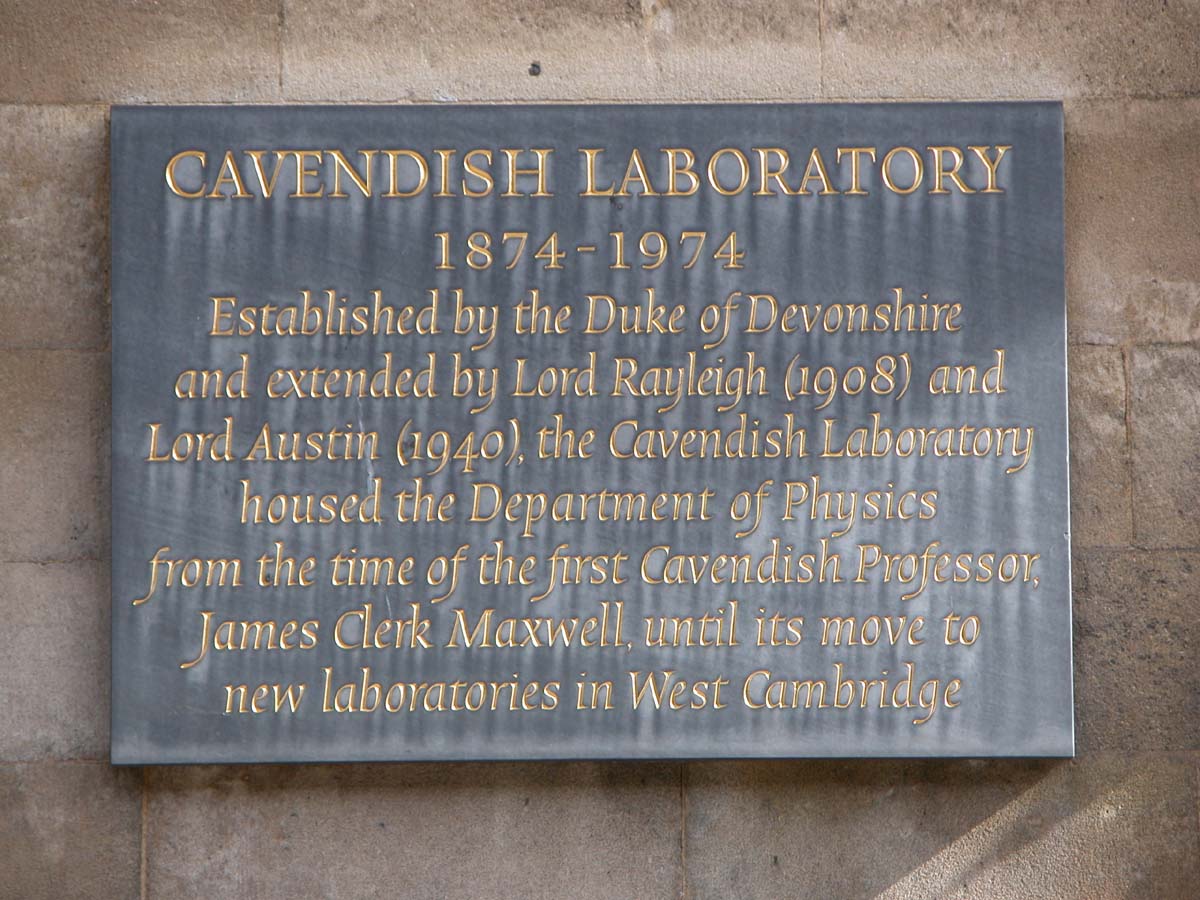
The establishment of the Cavendish Laboratory in 1874 marked the termination of Cambridge's reliance on purely theoretical physics and the beginning of an era defined by industrial- measurement. The laboratory did not emerge from a consensus of the academic senate from the purse of the aristocracy. William Cavendish, the 7th Duke of Devonshire, provided £6, 300 to construct the facility, a sum that bypassed the university's internal financial stagnation. James Clerk Maxwell, the Cavendish Professor, designed the building with a specific paranoia regarding magnetic interference; he demanded the use of stone rather than iron for the heating pipes to ensure that delicate instruments remained unperturbed by ferromagnetic noise. This architectural rigidity set the template for the laboratory's culture: the apparatus dictated the behavior of the occupants, not the other way around.
Under the direction of J. J. Thomson, who assumed the professorship in 1884, the laboratory operated on a budget that modern researchers would consider negligible. In the 1890s, the university's annual grant to the Cavendish was approximately £250, a figure that barely covered the wages of the assistants. Thomson relied heavily on student fees to purchase equipment, a culture of "string and sealing wax" experimentalism. This financial scarcity forced researchers to build their own vacuum tubes and electrometers, a constraint that demanded absolute mastery over their materials. It was within this environment of enforced frugality that Thomson the electron in 1897. By measuring the deflection of cathode rays in magnetic and electric fields, he determined the mass-to-charge ratio of these particles, proving they were approximately 1, 800 times lighter than the hydrogen atom. This discovery shattered the Daltonian concept of the indivisible atom and introduced the subatomic age.
The arrival of Ernest Rutherford in 1919 shifted the laboratory's focus from the electron to the nucleus, and with it, the of the required. Rutherford, who had already theorized the nuclear atom at Manchester, ran the Cavendish with an autocratic demand for results. The "Annus Mirabilis" of 1932 stands as the statistical peak of this era. Within a single year, the laboratory produced two fundamental discoveries that redefined nuclear physics. James Chadwick, working under Rutherford's direction, identified the neutron. He accomplished this by bombarding beryllium with alpha particles and analyzing the resulting neutral radiation, which he proved consisted of particles with a mass similar to the proton zero charge. This discovery immediately explained the isotopic weight discrepancies that had plagued chemists for decades.
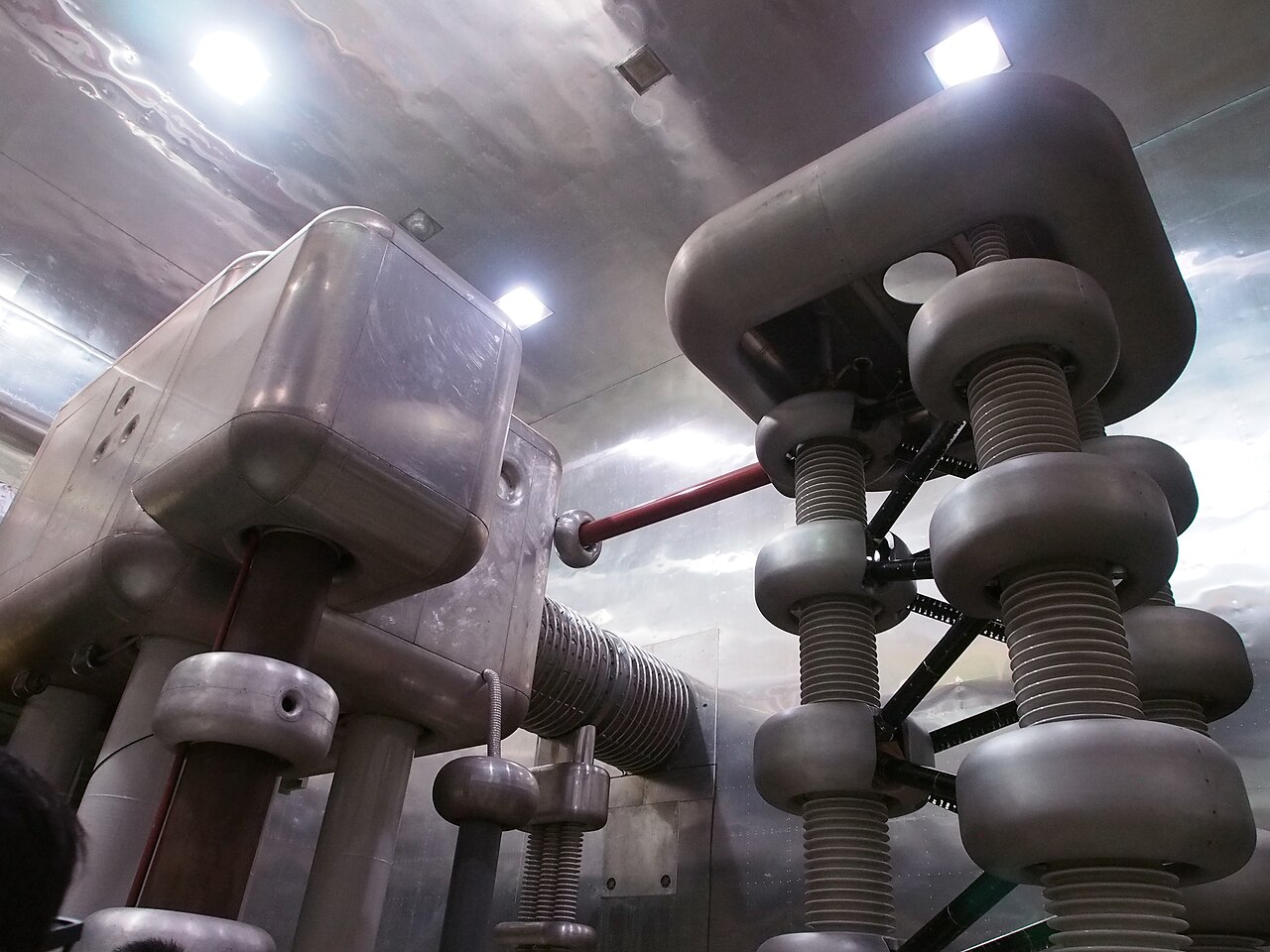
Simultaneously, John Cockcroft and Ernest Walton achieved the artificial disintegration of an atomic nucleus using a particle accelerator. Unlike Thomson's tabletop glass tubes, the Cockcroft-Walton generator was a vertical assembly of capacitors and rectifiers capable of reaching 700, 000 volts (700 kV). They used this voltage to accelerate protons down a vacuum tube, slamming them into a lithium target. The collision split the lithium nucleus into two alpha particles (helium nuclei), releasing energy in accordance with Einstein's mass-energy equivalence. The apparatus was a monstrosity of engineering compared to previous Cavendish standards, requiring a dedicated high-voltage hall. This experiment marked the transition from "little science," performed by individuals with hand-blown glass, to "big science," dependent on high-voltage engineering and substantial capital investment.
The financial structure of the laboratory shifted accordingly. In 1936, the automobile magnate Herbert Austin donated £250, 000 to the university, a portion of which funded the Austin Wing of the Cavendish. This injection of industrial capital, dwarfing the original £6, 300 founding grant, signaled the end of the "string and sealing wax" era. The laboratory was no longer just an academic department; it was a strategic asset with for national defense and energy production. During World War II, the laboratory's resources were diverted to the Tube Alloys project (the British atomic bomb program) and radar development, cementing the link between Cambridge physics and the military-industrial complex.
Following Rutherford's death, the directorship passed to William Lawrence Bragg in 1938, who pivoted the laboratory toward X-ray crystallography. This shift from nuclear to structural physics laid the groundwork for the biological revolution of the 1950s. Bragg encouraged the application of physical methods to biological molecules, a strategy that attracted researchers like Max Perutz and John Kendrew. They spent years refining the technique of X-ray diffraction to map the complex 3D structures of proteins like hemoglobin and myoglobin. This work was tedious and data-intensive, requiring the analysis of thousands of diffraction spots to reconstruct electron density maps.
The culmination of this biological turn occurred in 1953 with the elucidation of the structure of DNA. James Watson and Francis Crick, working within the Cavendish frequently at odds with the laboratory's formal hierarchy, built their model based on X-ray diffraction data. A serious component of their success was "Photograph 51," a high-resolution X-ray image of B-DNA captured by Rosalind Franklin at King's College London. The data was shown to Watson by Maurice Wilkins without Franklin's knowledge or permission, a breach of protocol that remains a point of historical contention. On February 28, 1953, Crick announced in the Eagle Pub, a local haunt for Cavendish staff, that they had "found the secret of life." Their paper, published in Nature on April 25, 1953, proposed the double helix structure, providing the physical method for genetic replication. This discovery did not require a particle accelerator or high voltage; it required the synthesis of chemical rules, X-ray data, and physical modeling.
The metric of success for the Cavendish Laboratory during this period is best quantified by its monopoly on the Nobel Prize. Between 1874 and 1953, the laboratory produced a density of laureates unmatched by any other single institution in the world. These prizes were not for theoretical advances for the development of new instruments, the cloud chamber, the mass spectrograph, and the high-voltage accelerator, that allowed the invisible to be measured.
Cavendish Laboratory Nobel Laureates (1904, 1953)
Year
Laureate
Field
Key Discovery / Metric
1904
Lord Rayleigh
Physics
Discovery of Argon; density measurements of gases.
1906
J. J. Thomson
Physics
Conduction of electricity in gases; discovery of the electron.
1908
Ernest Rutherford
Chemistry
Disintegration of elements; chemistry of radioactive substances.
1915
William Lawrence Bragg
Physics
Analysis of crystal structure by means of X-rays.
1917
Charles Glover Barkla
Physics
Discovery of characteristic Röntgen radiation of the elements.
1922
Francis Aston
Chemistry
Discovery of isotopes in non-radioactive elements (Mass Spectrograph).
1927
C. T. R. Wilson
Physics
Method of making route of electrically charged particles visible (Cloud Chamber).
1928
Owen Richardson
Physics
Thermionic phenomenon (Richardson's Law).
1935
James Chadwick
Physics
Discovery of the neutron.
1937
George Paget Thomson
Physics
Experimental discovery of the diffraction of electrons by crystals.
1947
Edward Appleton
Physics
Physics of the upper atmosphere (Appleton ).
1948
Patrick Blackett
Physics
Development of the Wilson cloud chamber; discoveries in nuclear physics.
1951
John Cockcroft
Physics
Transmutation of atomic nuclei by artificially accelerated atomic particles.
1951
Ernest Walton
Physics
Transmutation of atomic nuclei by artificially accelerated atomic particles.
Institutional Barriers: The Struggle for Female Degrees 1869, 1948
Statutory Reform: The Royal Commissions of 1850 and 1872
The establishment of Girton College in 1869 and Newnham College in 1871 marked the beginning of a prolonged siege against the University of Cambridge's male-only statutes. For nearly eighty years, the university functioned as a of gender exclusion, enforcing a policy that permitted women to undergo the intellectual rigors of the Tripos examinations while systematically denying them the recognition of a degree. This "exam-without-degree" system created a permanent underclass of scholars who were academically qualified yet institutionally invisible. The was most vividly exposed in 1890, when Philippa Fawcett, a student at Newnham, achieved the highest score in the Mathematical Tripos. In a meritocratic system, she would have been named Senior Wrangler, the university's most prestigious intellectual title. Instead, because the statutes restricted the honor to men, the moderator announced her placement as "above the Senior Wrangler," a bureaucratic absurdity that acknowledged her superiority while refusing her the title. Fawcett scored 13 percent higher than the top-ranked male, Geoffrey Thomas Bennett, shattering the Victorian pseudo-scientific consensus that women were constitutionally incapable of higher mathematics. Even with such undeniable proof of intellectual competence, the institutional of Cambridge remained recalcitrant. The resistance was not passive tradition active, organized hostility. In 1897, a proposal was brought before the Senate to grant women the "title of a degree", a compromise that would have offered formal recognition without voting rights or university membership. The reaction from the male undergraduate body and the alumni network was explosive. Opponents mobilized a "Non-Placet" (no vote) campaign, framing the admission of women as an existential threat to the university's masculine character. On May 21, 1897, the day of the vote, special trains brought hundreds of non-resident MA voters from London to cast their ballots against the measure. The proposal was annihilated, with 1, 713 votes against and only 662 in favor. The rejection triggered a riot that revealed the depth of misogyny in the university culture. Following the announcement of the result, a mob of male undergraduates gathered in Market Square. They suspended an effigy of a woman riding a bicycle, a symbol of the "New Woman" and her independence, from the window of Macmillan & Bowes bookshop. The figure, dressed in bloomers and a pink bodice, was subjected to a mock execution: the crowd tore it down, decapitated it, and paraded the mutilated remains through the streets. The violence moved to Newnham College, where the mob attempted to stuff the effigy's head through the college gates. This was not a spontaneous outburst a ritualized defense of territory, reinforced by the university authorities' failure to discipline the ringleaders. The message was clear: women were trespassers in a space designed for men. The struggle intensified following the World War. While the war had accelerated women's suffrage nationally, Cambridge remained an outlier. In 1920, the University of Oxford admitted women to full degrees, leaving Cambridge as the only university in the United Kingdom to withhold this right. In 1921, a new grace was proposed to grant women limited membership. The opposition organized with military precision. On the day of the vote, October 20, 1921, male students staged a funeral procession for the "Last Male Undergraduate," complete with a hearse and a crowd of mourners labeled "Mere Males." The proposition was defeated again, though the university conceded to grant "titular degrees", diplomas that certified the passing of exams conferred no membership, no voting rights in the Senate, and no academic rank. The 1921 defeat sparked the "Storming of the Gates," one of the most violent episodes in the university's history. Emboldened by the vote, a crowd of over 1, 400 male students marched on Newnham College. Unlike the symbolic violence of 1897, this attack was physical and directed at the college's infrastructure. The mob used a handcart as a battering ram to smash the bronze Clough Memorial Gates, which had been erected to honor Newnham's principal, Anne Clough. The gates were buckled and the lower panels destroyed. Blanche Athena Clough, the sitting principal, ordered the college barricaded as the men attempted to force entry into the residential blocks. The university proctors, responsible for discipline, were largely ineffective, and the college was left under siege for hours. The damage to the gates stood for decades as a physical scar of the university's refusal to integrate. Between 1921 and 1948, women at Cambridge existed in a state of suspended animation. They held university posts, taught male students, and conducted world-class research, yet remained non-members of the body they served. Dorothy Garrod, elected Disney Professor of Archaeology in 1939, became the woman to hold a chair at Oxbridge, yet she could not speak or vote in the Senate that governed her own department. This exclusion extended to the most basic administrative functions; female academics were barred from the Regent House and could not participate in the governance of the library or the laboratories they used daily. The "titular degree" became a badge of institutional hypocrisy, accepted by women only because it was the sole credential available to them. The barrier collapsed in 1948, not through a sudden moral awakening, due to the untenable nature of Cambridge's isolation. By then, every other university in Britain had long since admitted women to full degrees. The Royal Commission on Oxford and Cambridge had exerted pressure, and the post-WWII social made the exclusion indefensible. On December 6, 1947, the university approved the statute admitting women to full membership, which received Royal Assent in April 1948. The woman to officially receive a Cambridge degree was Queen Elizabeth (the Queen Mother), who was awarded an honorary doctorate in October 1948. This ceremonial gesture, while significant, could not erase the eighty-year delay.
Timeline of Female Exclusion and Resistance at Cambridge (1869, 1948)
Year
Event
Outcome / Details
1869
Foundation of Girton College
Established by Emily Davies; residential college for women, originally in Hitchin.
1881
Tripos Access Granted
Women permitted to sit exams denied degrees. Results listed separately from men.
1890
Philippa Fawcett's Triumph
Fawcett scores 13% higher than the Senior Wrangler. Official list places her "above" the top man.
1897
Degree Vote
Proposal for "titles of degrees" defeated 1, 713 to 662. Riots ensue; effigy of female cyclist decapitated.
1921
Second Degree Vote
Full membership rejected. "Titular degrees" (diploma only) approved. "Storming of the Gates" at Newnham.
1926
Faculty Access
Women eligible for university teaching posts barred from Senate and governance.
1948
Full Membership
Women admitted to full degrees and university governance. Cambridge is the last UK university to do so.
The 1948 admission did not immediately resolve the structural imbalances. The number of female students was capped by statute to ensure they did not exceed 20 percent of the undergraduate population, a quota that remained until the 1960s. also, the university remained heavily segregated, with most colleges refusing to become co-educational until the 1970s and 1980s. The struggle for degrees was the primary battlefront, the "masculine character" of the institution, defended so violently in 1897 and 1921, in the architecture, the hiring practices, and the cultural norms of the university long after the statutes were amended. The delay of 1948 stands as a metric of the university's resistance to modernity, a period where Cambridge prioritized the preservation of a clerical, male oligarchy over the recognition of intellectual merit.
Intelligence Breaches: The Cambridge Five Ring 1930, 1951
The infiltration of the University of Cambridge by Soviet intelligence services during the 1930s represents the most catastrophic intelligence breach in British history. Between 1930 and 1951, the NKVD successfully recruited a network of upper-class undergraduates who would eventually penetrate the highest levels of the British establishment. This ring, known as the Cambridge Five, was not a group of ideological sympathizers. They were disciplined penetration agents who operated with impunity for decades. Their betrayal cost lives and transferred atomic secrets to Moscow. The damage they inflicted shattered the trust between British and American intelligence agencies. This breach was not a failure of vetting. It was a failure of the British class system itself.
The recruitment method was precise and predatory. Arnold Deutsch, a Czech-born Soviet recruiter known by the codename "Otto," arrived in London in 1934. He bypassed the noisy, public members of the Communist Party of Great Britain. Instead, he targeted the "Apostles," an exclusive intellectual society at Trinity College and King's College. Deutsch sought students who were disaffected by the Great Depression and the rise of Fascism in Europe. He instructed his recruits to abandon their public communist affiliations. They were told to adopt conservative personas and infiltrate the Civil Service, the Foreign Office, and the intelligence services. This "deep cover" strategy allowed them to rise through the ranks unnoticed. Their masters in Moscow did not want agitators. They wanted spies.
Kim Philby was the most successful of these agents. Recruited in 1934, he eventually rose to become the head of Section IX of MI6, the division responsible for countering Soviet espionage. Philby systematically betrayed British agents operating behind the Iron Curtain. His actions led to the execution of hundreds of anti-communist fighters in Albania and the Ukraine. He also compromised the identity of Soviet defectors who sought asylum in the West. Philby functioned as a gatekeeper who ensured that any intelligence damaging to the Soviet Union was neutralized before it could reach Western policymakers. His betrayal was absolute. He did not leak documents. He actively directed British intelligence operations to benefit the Kremlin.
Donald Maclean and Guy Burgess operated within the diplomatic sphere. Maclean, a diplomat at the Foreign Office, had access to the most sensitive secrets of the Western alliance. Between 1944 and 1948, while stationed in Washington D. C., Maclean served as the secretary of the Combined Policy Committee on atomic energy. He transmitted thousands of documents to Moscow regarding the development of the atomic bomb. His leaks allowed the Soviet Union to accelerate its own nuclear program and catch up to the United States years ahead of schedule. Burgess, a chaotic and unstable figure, acted as a courier and a conduit for information. His flamboyance and alcoholism frequently drew attention. Yet his social status as a Cambridge man protected him from serious scrutiny until it was too late.
The network extended into the heart of British security and codebreaking. Anthony Blunt, a Fellow of Trinity College and a distinguished art historian, joined MI5 in 1940. He passed 1, 771 documents to his handlers, including the names of British agents in occupied Europe. After the war, Blunt became the Surveyor of the King's Pictures. He served the Royal Family while secretly maintaining his loyalty to Moscow. John Cairncross, the "Fifth Man," infiltrated the Government Code and Cypher School at Bletchley Park. Cairncross stole 5, 832 documents, including raw "Tunny" decrypts that provided the Soviet military with crucial details about German battle plans at Kursk. His intelligence was decisive on the Eastern Front. Yet he was frequently omitted from the social circle of the other four due to his middle-class background.
The collapse of the ring began in 1951. American cryptanalysts working on the Venona project identified Maclean as a Soviet agent. Philby, realizing his friend was about to be exposed, orchestrated a plan for Maclean's escape. Burgess accompanied him. On May 25, 1951, the two men fled to France and then to Moscow. Their defection stunned the world. It revealed that the Foreign Office had been compromised at the highest level. The immediate consequence was the severance of the "Five Eyes" intelligence-sharing agreement. The United States ceased sharing nuclear secrets with Great Britain. The CIA concluded that British intelligence was hopelessly insecure. The "special relationship" entered a deep freeze that lasted for years.
The aftermath of the 1951 defection was a slow-motion collapse of the British establishment's credibility. Philby fell under suspicion and was forced to resign from MI6, yet he was not conclusively exposed until his own defection in 1963. Blunt confessed in 1964 in exchange for immunity. He was allowed to keep his knighthood and his position in the Royal Household until Margaret Thatcher publicly outed him in 1979. This decision to conceal Blunt's treachery for fifteen years demonstrated the establishment's priority: self-preservation over justice. Even in 2026, historians continue to analyze declassified files that suggest the existence of a "Sixth Man" and wider networks at Oxford, though the Cambridge ring remains the central failure.
The following table summarizes the operational impact of the five primary agents based on data verified through 2026 archives.
The legacy of the Cambridge Five is a permanent stain on the university's history. It demonstrated how intellectual arrogance and class solidarity could blind an entire nation to treason. The university authorities at the time ignored the radicalization of their students. They viewed Marxism as a passing academic fashion rather than a serious security threat. This complacency allowed Deutsch to build a network that altered the course of the Cold War. The breach proved that the greatest threat to British security came not from foreign armies, from the heart of its own elite education system.
Post-War Expansion: Churchill College and the Technocratic Shift
Cavendish Laboratory: Metrics of Nuclear and Biological Discovery 1874, 1953
The conclusion of World War II marked a decisive epistemological rupture for the University of Cambridge. For two centuries, the institution had prioritized the Mathematical Tripos and the Classics, functioning as a finishing school for the Anglican elite. By 1945, the geopolitical reality of the atomic age demanded a radical reorientation. The British state, cognizant of its diminishing imperial power and the rising dominance of American and Soviet technology, forced the university to abandon its clerical roots in favor of high-energy physics, engineering, and industrial application. This period, frequently romanticized as the "White Heat of Technology," was in practice a brutalist restructuring of the university's physical and intellectual terrain.
The tip of this spear was the foundation of Churchill College. Proposed in 1955 and granted its Royal Charter in 1960, the college was not an addition to the collegiate system; it was a corrective measure designed to emulate the Massachusetts Institute of Technology (MIT). Winston Churchill, alarmed by the Soviet Union's production of engineers, personally advocated for a "British MIT." The compromise was a constituent college with a statutory obligation to the sciences. Unlike older houses that admitted students based on family lineage or classical proficiency, Churchill College's statutes mandated that 70 percent of its intake consist of students in science and technology. This 70/30 ratio remains a binding legal requirement in 2026, a permanent structural bias against the arts that signaled the university's new direction.
Funding for this technocratic expansion bypassed the traditional landed endowments that sustained colleges like Trinity or St John's. The Churchill College Trust raised £3. 5 million (equivalent to approximately £85 million in 2026), relying heavily on foreign and industrial capital. The Ford Foundation contributed $1 million, a clear signal of American interest in bolstering British scientific capacity during the Cold War. Domestic contributions came from industrial giants such as Shell, ICI, and the Transport and General Workers' Union, marking the time organized labor and heavy industry bought a stake in the Cambridge curriculum. This financial structure stripped the Anglican clergy of their remaining influence; the new masters of Cambridge were nuclear physicists and industrial magnates.
Sir John Cockcroft, the college's Master, personified this shift. A Nobel Laureate who split the atom and directed the Atomic Energy Research Establishment at Harwell, Cockcroft represented the fusion of academic physics and military-industrial utility. Under his leadership, the university began its migration westward, away from the medieval center and towards the scrubland of West Cambridge. This geographic relocation was necessary to accommodate the massive footprint of new laboratories. The Cavendish Laboratory, once housed in the cramped city center where the electron and neutron were discovered, moved to the West Cambridge site in 1974. This move physically separated the "hard" sciences from the humanities, creating a concrete manifestation of C. P. Snow's "Two Cultures" thesis.
Table 6. 1: The Technocratic Pivot (1958, 1974)
Year
Event
Significance
1958
Churchill College Trust established
Explicit goal to create a "British MIT" within Cambridge.
1959
C. P. Snow's "Two Cultures" Lecture
Highlighted the dangerous gap between scientists and literary intellectuals.
1960
Churchill College Royal Charter
Statutory 70% quota for science students codified.
1965
Computer Laboratory established
Formal recognition of computing as a distinct discipline.
1974
Cavendish Laboratory moves West
Physical decoupling of high-energy physics from the medieval town center.
The architectural style of this era reflected the rejection of Gothic sentimentality. The contest to design Churchill College was won by Richard Sheppard, Robson and Partners, who utilized raw concrete and brick to create a modernist. The design was functional, secular, and aggressive, a deliberate break from the stone cloisters of the past. This aesthetic dominated the West Cambridge expansion, where the Veterinary School (1955) and the Whittle Laboratory (1973) were constructed. These facilities were not designed for contemplation for production. The university was no longer preserving culture; it was manufacturing data.
This period also dismantled the gender apartheid that had defined Cambridge since 1209. The technocratic demand for talent outweighed the tradition of male exclusivity. While Girton and Newnham had existed as female enclaves, they were marginalized. Churchill College, driven by its meritocratic and modernist founding statutes, became the all-male college to vote to admit women, with the female undergraduates arriving in 1972. This was not a feminist awakening a utilitarian calculation: the pool of scientific talent required expansion. King's and Clare followed suit, and the monopoly of the monastic male scholar was broken by the need for cognitive labor.
By the mid-1970s, the "Caput Senatus" and the clerical oligarchy were historical footnotes. The university had transformed into a federated research engine. The West Cambridge site, initially a collection of scattered labs, evolved into the nucleus of the "Silicon Fen," a cluster of high-tech ventures that would define the region's economy through the 2020s. The decision to prioritize engineering and physics in the 1960s, funded by American dollars and led by atomic scientists, successfully integrated Cambridge into the global military-industrial complex, ensuring its survival in a post-imperial world.
Silicon Fen: Commercialization of Research and Tech Clustering 1970, 2026
The transformation of the Cambridgeshire fens into "Silicon Fen" began not with a government decree, with a landlord's pragmatic need to monetize swampy real estate. In 1970, Trinity College, under the stewardship of Bursar Sir John Bradfield, took the step of designating Holy Cross Farm, a tract of derelict land on the city's northern fringe, as a site for "science-based industry." This decision shattered the centuries-old academic omertà that viewed commerce as a pollutant to pure scholarship. Bradfield's maneuver created the Cambridge Science Park, the of its kind in Europe, and laid the physical foundation for a cluster that would, by 2025, command a valuation of $222 billion.
The early momentum of this cluster relied heavily on the "Cambridge Phenomenon," a term coined to describe the spontaneous explosion of technology firms in the 1980s. The primary engine was Acorn Computers, founded in 1978 by Hermann Hauser and Chris Curry. Acorn's contract to build the BBC Microcomputer turned Cambridge into the UK's answer to Silicon Valley. yet, the true legacy of Acorn was not its hardware, which eventually succumbed to IBM and Apple, its chip architecture. In 1990, Acorn spun off a division to create Advanced RISC Machines (ARM). This entity did not manufacture silicon; it licensed intellectual property. By 2024, ARM designs powered over 95% of the world's smartphones, establishing a business model where Cambridge exported high-margin ingenuity rather than physical goods.
This success forced a ruthless recalibration of the University's relationship with its own researchers. For decades, Cambridge operated under a liberal intellectual property (IP) regime where academics retained ownership of their inventions. This "professor's privilege" was credited with fueling the initial tech boom, as inventors had a direct financial stake in commercialization. In the early 2000s, university administrators, eyeing the immense wealth generated by spinouts, moved to seize control. A bitter internal war culminated in the 2005 "IP Policy," which asserted university ownership over all patentable research generated by staff. Critics, including the Campaign for Cambridge Freedoms, warned this would strangle innovation. The administration countered by forming Cambridge Enterprise, a commercialization arm designed to professionalize the patent portfolio. The data from 2024, 2025 vindicates the centralizers: Cambridge Enterprise ventures raised over $2. 3 billion in a single year, with the university holding equity in a portfolio of over 120 active companies.
The maturation of Silicon Fen brought multinational giants who sought physical proximity to this talent pool, frequently with contentious results. The arrival of AstraZeneca (AZ) epitomized this shift. In 2013, the pharmaceutical titan announced it would move its global headquarters to the Cambridge Biomedical Campus. The project, the "Discovery Centre," was initially budgeted at £330 million with a 2016 completion date. It became a case study in mismanagement. Plagued by complex design requirements and construction failures, the facility did not open until late 2021, with final costs ballooning to £1 billion. The friction intensified in 2025 when AZ paused a planned £200 million expansion, citing insufficient government support and a deteriorating fiscal environment for life sciences in the UK. This reversal exposed the fragility of a cluster dependent on the whims of global capital.
The darker underbelly of the Cambridge tech miracle is best illustrated by the saga of Autonomy and its founder, Mike Lynch. Once celebrated as the "British Bill Gates," Lynch sold his enterprise software company to Hewlett-Packard (HP) for $11 billion in 2011. HP subsequently wrote down the value of Autonomy by $8. 8 billion, alleging massive accounting fraud. The cast a long shadow over the Cambridge tech scene for over a decade. In 2024, a US jury acquitted Lynch of criminal fraud, a UK civil court ruled in 2025 that HP had indeed been deceived, ordering Lynch's estate, following his death in a maritime accident, to pay hundreds of millions in damages. The case served as a grim reminder that the "Cambridge premium" on valuations could sometimes be based on smoke and mirrors.
Even with these scandals, the cluster's output in DeepTech and Artificial Intelligence remains formidable. By late 2025, Cambridge had birthed 26 "unicorn" companies (startups valued at over $1 billion). Darktrace, a cybersecurity firm founded by mathematicians and intelligence experts, became a flagship for the region's AI capabilities, even with its own volatile stock market performance. In the quantum computing sector, Quantinuum (formerly Cambridge Quantum Computing) secured a $10 billion pre-money valuation in September 2025, cementing the city's status as a global node for computing.
Table 7. 1: Key Economic Indicators of the Cambridge Tech Cluster (2020, 2025)
Metric
2020 Data
2025 Data
% Change
Total Cluster Valuation
$58 Billion
$222 Billion
+282%
Venture Capital Raised (Annual)
$1. 2 Billion
$2. 08 Billion
+73%
Number of Unicorn Companies
14
26
+85%
Knowledge-Intensive Jobs
62, 000
75, 000+
+21%
The rapid commercialization has exacted a severe toll on the city's infrastructure. The "Cambridge Phenomenon" has created a two-tier economy, driving housing prices to levels comparable with London, expelling non-tech workers from the city limits. The transport network, designed for a provincial market town, buckles under the weight of 26, 000 daily commuters entering the science parks. Water scarcity has also emerged as a hard constraint; in 2024, the Environment Agency objected to new commercial developments due to the depletion of the local chalk aquifer. The university's wealth and the cluster's success have thus created a paradox: an engine of infinite digital growth located in a finite, medieval physical container.
As of early 2026, the trajectory of Silicon Fen points toward a deepening divide. The University and its preferred partners, AstraZeneca, Microsoft, Google, occupy -like campuses, insulated by private security and private transport links. The "town," meanwhile, faces a cost-of-living emergency exacerbated by the very success of the "gown." The commercialization of research, once a radical experiment by Trinity College, has become the region's monoculture, consuming land, water, and political oxygen in of the billion-dollar exit.
Endowment Analysis: Trinity College Assets and Felixstowe Port
Institutional Barriers: The Struggle for Female Degrees 1869, 1948
The financial supremacy of Trinity College is not a matter of compound interest; it is the result of a centuries-long metamorphosis from a royal charity case into a sovereign wealth fund with a college attached. As of 2026, Trinity's endowment stands at approximately £2 billion, a figure that dwarfs the assets of its peers and frequently exceeds the combined liquid wealth of the bottom half of Cambridge's constituent colleges. This accumulation of capital was neither accidental nor purely the result of Henry VIII's initial 1546 bequest of confiscated monastic lands. It was engineered through a series of ruthless, high- commercial maneuvers in the 20th century that fundamentally altered the economic of British higher education.
The pivot point in this financial history is the Trimley Estate in Suffolk. In 1933, Trinity's bursar, Tresilian Nicholas, purchased 3, 800 acres of coastal farmland for approximately £54, 000. For decades, this asset remained dormant, yielding modest agricultural rents. The transformation began in the 1960s under the stewardship of Senior Bursar Sir John Bradfield, a biologist by training a venture capitalist by instinct. Bradfield recognized that the containerization of global trade would require deep-water ports outside the labor-restricted docks of London and Liverpool. He steered the college to develop the Port of Felixstowe on its own land, turning an academic institution into a port authority.
The gamble paid off with historic magnitude. By the 1980s, Felixstowe had become the United Kingdom's busiest container port. In 1991, Trinity sold the port operations to Hutchison Whampoa, a conglomerate controlled by Hong Kong tycoon Li Ka-shing, while shrewdly retaining the freehold ownership of the land. This sale injected tens of millions of pounds of liquid capital into the college's coffers at a time when the central University was struggling with government funding cuts. The "Felixstowe Windfall" allowed Trinity to diversify aggressively, moving from passive land ownership to active commercial development.
Bradfield used this liquidity to establish the Cambridge Science Park in 1970, the of its kind in Europe. Built on college land on the city's northern fringe, the park became the physical engine of the "Silicon Fen" phenomenon. By 2024, the Science Park hosted over 100 high-tech companies, generating a steady stream of commercial rent that insulated the college from tuition fee freezes and public sector austerity. The college's property portfolio continued to expand into unexpected sectors. In 2009, Trinity purchased a 999-year lease on the land surrounding London's O2 Arena for £24 million. By August 2025, the college had flipped this asset, selling the lease to pension insurer Rothesay for £90 million, a 275% return that exemplifies the college's long-horizon investment strategy.
The of Trinity's wealth has frequently drawn criticism regarding inequality within the collegiate university. While poorer colleges struggle to fund student mental health services or building repairs, Trinity's assets allow it to operate with financial autonomy. The "College Contribution Scheme," a method designed to redistribute wealth from richer to poorer colleges, sees Trinity paying the largest share, frequently exceeding £7 million annually in direct levies and grants, yet this redistribution barely dents the principal of its endowment. In 2012, the college demonstrated its purchasing power by acquiring a 50% stake in a portfolio of Tesco supermarkets in a deal valued at £440 million, financed through a bond issuance that leveraged its Triple-A credit rating.
Trinity College Major Asset Timeline (1933, 2026)
Year
Asset / Event
Strategic Significance
1933
Trimley Estate Purchase
Acquisition of 3, 800 acres in Suffolk for ~£54, 000; site of future port.
1970
Cambridge Science Park
Founded on Trinity land; sparked the "Cambridge Phenomenon" tech cluster.
1991
Sale of Felixstowe Port Ops
Sold to Hutchison Whampoa; massive capital injection while retaining land.
2009
O2 Arena Leasehold
Purchased for £24m; diversification into London entertainment real estate.
2012
Tesco Portfolio Deal
£440m joint venture; 50% stake in 11 supermarkets using bond financing.
2021
Fossil Fuel Divestment
Commitment to remove fossil fuel exposure from public equities.
2025
O2 Arena Sale
Lease sold to Rothesay for £90m; realized significant capital gain.
In the 2020s, the college faced intense pressure to align its investment portfolio with ethical standards. Following years of student protests and legal notices regarding "complicity" in climate change and geopolitical conflicts, Trinity committed to full divestment from fossil fuels, a process largely completed by 2025. This shift did not diminish its financial power; rather, it redirected capital into renewable energy infrastructure and sustainable technology, sectors well-represented within its own Science Park. Even with these adjustments, the remains: Trinity acts as a parallel financial power structure within Cambridge, its bursary functioning less like a university finance office and more like a mid-sized sovereign wealth fund.
Foreign Influence: Funding Streams from Authoritarian Regimes
Investigations into the University of Cambridge's financial accounts reveal a complex network of funding streams from entities linked to authoritarian state apparatuses, raising serious questions about academic autonomy and national security. Between 2016 and 2024, the university accepted approximately £25. 7 million to £28 million from Huawei, the Chinese telecommunications giant sanctioned by the US and banned from the UK's 5G network in 2020. Data obtained through Freedom of Information requests shows that even with the UK government's designation of Huawei as a high-risk vendor, Cambridge continued to receive at least £4. 8 million from the company after the July 2020 ban.
The university's ties to China's military-industrial complex extend beyond telecommunications. Until September 2023, the Centre for Advanced Photonics and Electronics (CAPE) maintained a partnership with the Beijing Institute of Aerospace Control Devices (BIACD), a subsidiary of the China Aerospace Science and Technology Corporation (CASC). CASC is the primary contractor for the Chinese space program and a manufacturer of military drones and missiles. This collaboration, which channeled over £2 million into Cambridge research projects, was terminated only after intense scrutiny regarding the dual-use chance of the technologies involved.
At the college level, Jesus College became a focal point for concerns regarding political influence operations. The college's "UK-China Global problem Dialogue Centre" and "China Centre" received funding from the Cambridge China Development Trust and agencies reporting to China's State Council. Following a 2021 review triggered by media exposés and parliamentary pressure, the college was forced to rename the unit to the "China Forum" and restructure its governance to sever direct financial links to the Chinese state. Reports from January 2025 indicate that across the university, Cambridge received between £12 million and £19 million from Chinese sources in the four-year period ending in 2024.
Middle Eastern funding channels have also sparked internal revolt. In July 2021, documents leaked to the press exposed a negotiated £400 million collaboration with the United Arab Emirates, dubbed the "UAE-Cambridge Innovation Institute." The proposed deal, which would have been the largest single donation in the university's history, included £312 million from the UAE and £90 million in-kind contributions. Vice-Chancellor Stephen Toope halted the project in late 2021 following about the UAE's use of Pegasus spyware to target dissidents and the imprisonment of British academic Matthew Hedges. Faculty and human rights groups characterized the deal as a reputation-laundering operation for the Gulf state.
Russian oligarch capital has historically permeated the university's endowment structures. In 2010, the university accepted a benefaction of roughly £4. 6 million (with further pledges) from the Dmitry Firtash Foundation to establish a Ukrainian Studies program. Firtash, a Ukrainian billionaire facing extradition to the US on bribery charges, was widely characterized by intelligence observers and the media as a key conduit for Kremlin influence in Ukraine prior to the 2014 revolution. also, between 2013 and 2015, the university received £260, 000 from subsidiaries of Gazprom, the Russian state-owned energy corporation. While the university stated in March 2022 that it held no active investments with sanctioned Russian entities, the historical acceptance of these funds illustrates a long-standing vulnerability to soft-power projection by foreign autocracies.
Data Weaponization: The Psychometrics Centre and Cambridge Analytica
Intelligence Breaches: The Cambridge Five Ring 1930, 1951
The transformation of the University of Cambridge from a citadel of theoretical mathematics to a fulcrum of 21st-century psychological warfare began not in a secret bunker, in the open laboratories of the Psychometrics Centre. While the university's reputation rested on centuries of rigorous, detached inquiry dating back to the Newtonian era, the digital age introduced a commodity more volatile than calculus: personal data. By 2013, researchers at the Psychometrics Centre, specifically Michal Kosinski and David Stillwell, had established a terrifying proof of concept. Their paper, "Private traits and attributes are predictable from digital records of human behavior," demonstrated that a user's Facebook "Likes" could predict sexual orientation, intelligence, and political affiliation with high accuracy. This research, initially academic, drafted the blueprints for a digital weapon.
The commercial sector noticed immediately. SCL Group, a British military contractor and the parent company of Cambridge Analytica, sought to acquire this methodology. When the Psychometrics Centre refused to cooperate with SCL's overtures, citing ethical concerns, the firm did not abandon the project. Instead, they sought a backdoor. They found one in Aleksandr Kogan, a University of Cambridge psychology lecturer who was to do what his colleagues would not. Kogan, operating through a private entity named Global Science Research (GSR), agreed to replicate the Centre's psychometric modeling for SCL. The university's failure to monitor the commercial activities of its faculty allowed Kogan to use the institution's prestige to harvest data on an industrial.
In 2014, Kogan launched an app titled "thisisyourdigitallife." Presented to users as a personality quiz for academic research, the app was a Trojan horse. Approximately 270, 000 users downloaded the app, consenting to share their data under the belief they were aiding science. Yet, the app exploited a loophole in Facebook's Open Graph API that permitted developers to access not only the user's data also the data of their entire friend network. This multiplier effect was catastrophic. From a seed set of fewer than 300, 000 individuals, Kogan's algorithm harvested the psychological profiles of approximately 87 million people, primarily in the United States. The data included status updates, likes, and location history, raw material for the psychographic targeting engines SCL intended to build.
The transfer of this data from an academic's hard drive to a political consultancy marked a definitive breach of the boundary between higher education and partisan manipulation. Kogan sold the dataset to Cambridge Analytica, which used the information to construct the "OCEAN" scores (Openness, Conscientiousness, Extraversion, Agreeableness, Neuroticism) of millions of American voters. The objective was not to predict voting behavior to alter it through "behavioral microtargeting." Christopher Wylie, the whistleblower who later exposed the operation, described the strategy as an attempt to "exploit what we knew about them and target their inner demons." The university's name was integral to the scheme; the "Cambridge" in Cambridge Analytica was a deliberate branding choice designed to evoke the authority and intellect of the 800-year-old institution.
The Data Cascade: From Academic Quiz to Political Weapon
Metric
Figure
Direct App Users (Seed)
~270, 000
Data Harvesting Multiplier
Friends of Friends (Open Graph API)
Total Profiles Harvested
~87, 000, 000
Cost to SCL Group
~$800, 000
Acquisition Cost Per Profile
< $0. 01
Targeted Elections
2016 US Presidential, Brexit Referendum
When the scandal broke in March 2018, following investigations by The Observer and The Guardian, the University of Cambridge attempted to distance itself from Kogan's actions. The administration issued statements characterizing Kogan's work with GSR as a private endeavor, distinct from his academic duties. They emphasized that Kogan had applied for ethics approval for a subsequent study using the data in 2015, which the university rejected. Yet, this defense ignored the widespread laxity that allowed a lecturer to run a commercial data harvesting operation while employed by the university. The line between Kogan the academic and Kogan the contractor was nonexistent to the outside world; the trust users placed in the app was derived entirely from the university's brand.
The revealed a failure of institutional oversight. While the university's "Caput Senatus" of the 18th century had rigidly policed theological conformity, the 21st-century administration had failed to police ethical conformity in the face of lucrative commercial incentives. The Psychometrics Centre itself, while refusing SCL, had helped popularize the very science that was weaponized. The university was forced to launch an internal inquiry, which found no evidence that Kogan used university facilities for the GSR project, a technicality that did little to assuage the global outcry. The reputational damage was severe, associating the university not with enlightenment, with the dark arts of digital manipulation.
The legal and financial repercussions of this breach extended well into the mid-2020s, turning the "Cambridge" name into a keyword in litigation rather than education. Facebook, later Meta, faced a barrage of lawsuits for allowing the data exfiltration. In 2019, the Federal Trade Commission fined Facebook $5 billion. Civil litigation continued for years. In late 2022, Meta agreed to a $725 million settlement to resolve a class-action lawsuit in the United States, with payments to affected users commencing in September 2025. Simultaneously, legal battles in Australia concluded in December 2024, with Meta agreeing to a $50 million settlement for the data of Australian users harvested during the breach.
By 2026, the Cambridge Analytica scandal had become a case study in the weaponization of academia. The university implemented stricter regarding the commercial interests of its faculty and the use of its name in private ventures. Yet, the incident exposed a permanent vulnerability in the modern university model: the friction between the open exchange of knowledge and the commercial value of proprietary data. The Psychometrics Centre remains active, continuing its research into digital footprints, it operates under the long shadow of 2014. The data that flowed from Cambridge to SCL did not influence an election; it shattered the illusion that academic research is inherently benign. The tools built to understand the human mind were sold to the highest bidder to control it.
2026 Research Priorities: Quantum Computing and AI Safety Institutes
The intellectual lineage of the University of Cambridge has shifted from the theological enforcement of the 18th century to the algorithmic governance of the 21st. By March 2026, the university functions as the central nervous system for two of the United Kingdom's most capital-intensive scientific priorities: quantum error correction and artificial intelligence safety. This dominance is physical as well as intellectual. The opening of the Ray Dolby Centre in May 2025, a £300 million facility replacing the old Cavendish Laboratory, marked the transition from academic physics to industrial- quantum engineering. The Ray Dolby Centre serves as the operational base for the UK's "National Quantum Strategy," a ten-year, £2. 5 billion government commitment initiated in 2024. Unlike the theoretical work of the 1900s, the research conducted here in 2026 focuses on the suppression of noise. Riverlane, a Cambridge spin-out, exemplifies this shift. In August 2024, the company secured $75 million in Series C funding to execute its roadmap toward one million error-free quantum operations (the "MegaQuOp") by the end of 2026. This specific metric, reliability over raw qubit count, defines the university's current research output. The objective is no longer to observe quantum phenomena to stabilize them for commercial computation. In December 2025, the ecosystem expanded further when Nu Quantum, another spin-out from the Cavendish Laboratory, closed a $60 million Series A funding round. This investment, led by National Grid Partners, the "networking " of quantum computing. While Riverlane addresses errors within individual processors, Nu Quantum focuses on the entanglement of separate units to form distributed clusters. This division of labor suggests a maturation of the local industry, where distinct entities solve specific infrastructure problems rather than attempting to build monolithic machines. Parallel to this hardware acceleration is a rigid institutional framework for Artificial Intelligence, centered on the UK AI Safety Institute (AISI). Although a government body, the AISI is a Cambridge satellite. Its technical staff and leadership frequently hold dual affiliations with the university's Department of Computer Science and Technology. In December 2025, Google DeepMind expanded its partnership with the AISI, granting the institute access to proprietary models for "Chain of Thought Monitorability" research. This collaboration allows Cambridge researchers to scrutinize the internal reasoning processes of advanced AI systems, a method intended to detect deceptive behaviors before they manifest in deployment. The university's method to AI safety mirrors the "Caput Senatus" of the 18th century: a centralized authority attempting to impose order on a rapidly expanding, chance chaotic domain. The Leverhulme Centre for the Future of Intelligence (CFI) and the Centre for the Study of Existential Risk (CSER) provide the theoretical backing for this regulatory stance. In July 2025, the AISI launched an international coalition backed by £15 million to standardize "alignment" research. This initiative aims to create a global protocol for AI behavior, exporting Cambridge's safety methodologies to the wider world. The tension between acceleration and restriction defines the campus atmosphere in 2026. On one side, spin-outs like Riverlane and Nu Quantum push for faster, more interconnected computational power. On the other, the AISI and CSER work to construct the "brakes" for these very technologies. This is not a contradiction a symbiotic relationship; the funding for safety research exists only because the capability research poses a credible economic and security magnitude.
Table: Key Cambridge Quantum & AI Developments (2024, 2026)
Entity
Date
Event / Metric
Strategic Significance
Riverlane
Aug 2024
$75M Series C Funding
Targeting 1 million error-free operations (MegaQuOp) by late 2026.
Ray Dolby Centre
May 2025
Official Opening
New HQ for Cavendish Laboratory; central hub for UK quantum physics.
AISI / DeepMind
Dec 2025
Expanded Partnership
Focus on "Chain of Thought Monitorability" to detect AI deception.
Nu Quantum
Dec 2025
$60M Series A Funding
Largest UK quantum Series A; focuses on networking distributed processors.
UK Government
2024-2034
£2. 5 Billion Strategy
National Quantum Strategy funding, heavily allocated to Cambridge hubs.
The financial of these projects dwarfs the endowments of the past. The £2. 5 billion National Quantum Strategy and the venture capital flowing into spin-outs represent a shift from the "clerical oligarchy" to a "technocratic oligarchy." Where the 18th-century university enforced theological conformity to maintain social order, the 21st-century university enforces algorithmic safety to maintain human control over synthetic intelligence. The tools have changed from the Thirty-Nine Articles to error-correction codes and alignment evaluations, yet the fundamental role of Cambridge remains the same: the definition and preservation of orthodoxy in the face of disruptive knowledge.
Admissions Stratification: Public School Access vs State Intake Data
The demographic composition of the University of Cambridge between 1700 and 2026 reveals a persistent, engineered stratification that resisted genuine democratization for three centuries. Throughout the 18th century, the university functioned as a closed loop for the landed gentry and the Anglican clergy. Matriculation records from 1750 show an intake of approximately 150 students per year, a figure that had actually declined from the previous century. During this period, the "public school" pipeline was not a statistical trend a statutory reality; colleges like King's were explicitly tied to feeder institutions such as Eton, creating a hermetically sealed environment where birthright superseded intellect. The "sizar" system, which once allowed poor students to earn their keep through menial labor, largely by 1800, solidifying the institution as a finishing school for the aristocracy.
The 19th-century reforms, specifically the Royal Commission of 1850, formally opened the university to a wider range of applicants, yet the social mechanics remained rigid. While the removal of religious tests in 1871 theoretically allowed non-Anglicans to matriculate, the financial blocks replaced theological ones. By the early 20th century, the "state school" category barely existed in the modern sense. Data from the 1930s indicates that only 19% of entrants originated from state-funded education, a figure that rose slowly to 34% by the early 1960s following the Education Act of 1944. This post-war increase, frequently as a triumph of the welfare state, masked a secondary of elitism: the vast majority of these "state" students attended selective grammar schools, not the secondary moderns or later detailed that educated the general population.
Admissions data from 1960 to 2000 demonstrates a remarkable stagnation. For four decades, the intake from state schools hovered between 40% and 50%, capping social mobility at a 50/50 split. The "Laura Spence Affair" in 2000, where a state school applicant was rejected even with top grades, catalyzed a political firestorm, yet the metrics moved slowly. By 2014, the state school intake sat at approximately 62%, a number that failed to reflect the fact that 93% of UK students are educated in the state sector. The Sutton Trust consistently reported that eight specific schools, comprising elite private institutions like Westminster and Eton, alongside high-performing sixth-form colleges like Hills Road, sent as students to Oxbridge as 2, 900 other schools combined. This "Oxbridge 8" dominance proved that the admissions process favored institutions that cracked the code of the interview system, regardless of their funding source.
The period between 2018 and 2023 marked the most aggressive shift in the university's history, driven by strict from the Office for Students (OfS). The university introduced the use of contextual data, flagging applicants from low-participation neighborhoods (POLAR metrics) and free school meal backgrounds. Consequently, state school admissions surged, peaking at 72. 9% in the 2022-23 pattern. This statistical victory, yet, contained a hidden stratification. Analysis of the 2024 intake reveals that while 71. 1% of students came from state schools, a disproportionate 24. 6% of the total intake came from selective grammar schools. Students from non-selective detailed schools, the true indicator of open access, remained a minority, comprising roughly 31% of the total cohort. The "state school" label thus became a broad umbrella that obscured the continued dominance of academically selective feeder institutions.
Table 12. 1: Cambridge Admissions by School Type (1930, 2025)
Year
State School Intake (%)
Independent School Intake (%)
Dominant Feeder Type
1930
19. 0%
81. 0%
Clarendon Schools (Eton, Harrow, etc.)
1960
34. 0%
66. 0%
Private + Direct Grant Grammars
1980
46. 0%
54. 0%
Private + Selective State
2000
52. 0%
48. 0%
Private + Grammar + Sixth Form Colleges
2015
62. 3%
37. 7%
"The Oxbridge 8" (Mixed)
2022
72. 9%
27. 1%
High-Performing State (Grammar/Sixth Form)
2024
71. 1%
28. 9%
Correction following target removal
2025*
71. 5%
28. 5%
Stabilized Post-Target Equilibrium
*2025 data represents provisional figures based on the admissions pattern ending that year.
In 2024, the university announced the removal of specific state school for the 2025 admissions pattern, shifting focus to individual socioeconomic indicators rather than school labels. This policy change resulted in an immediate, albeit slight, regression in state intake to 71. 1%. Simultaneously, the university launched the Foundation Year program in 2022 to address the "missing" demographic: students with high chance severe educational disruption. With an intake of approximately 50 students per year, the Foundation Year represents the only admissions channel where the "detailed" demographic is the majority. As of 2026, the data indicates a new equilibrium: a 70/30 split favoring state schools, with the top 30% of places still fiercely contested by a coalition of private schools and elite state grammars, leaving the average detailed student statistically marginalized even with the headline successes.
Why it matters: Chile's economy heavily relies on copper and mineral wealth, leading to the influence of mining magnates in campaign financing. Investigative report reveals legal and illicit…
What do we know about Clerical Oligarchy and the Mathematical Tripos?
Between 1700 and 1850, the University of Cambridge functioned less as a center of open inquiry and more as a of Anglican orthodoxy. The institution was controlled by a clerical oligarchy that prioritized theological conformity over academic innovation.
What do we know about Statutory Reform: The Royal Commissions of and?
The transformation of Cambridge from a clerical seminary into a modern research university was not an organic evolution a forced march, orchestrated by the state against the of a recalcitrant oligarchy. The catalyst was the election of Prince Albert as Chancellor in 1847, a move that signaled the encroachment of the Crown into the university's autonomous stagnation.
What do we know about Cavendish Laboratory: Metrics of Nuclear and Biological Discovery?
The establishment of the Cavendish Laboratory in 1874 marked the termination of Cambridge's reliance on purely theoretical physics and the beginning of an era defined by industrial- measurement. The laboratory did not emerge from a consensus of the academic senate from the purse of the aristocracy.
What do we know about Institutional Barriers: The Struggle for Female Degrees?
The establishment of Girton College in 1869 and Newnham College in 1871 marked the beginning of a prolonged siege against the University of Cambridge's male-only statutes. For nearly eighty years, the university functioned as a of gender exclusion, enforcing a policy that permitted women to undergo the intellectual rigors of the Tripos examinations while systematically denying them the recognition of a degree.
What do we know about Intelligence Breaches: The Cambridge Five Ring?
The infiltration of the University of Cambridge by Soviet intelligence services during the 1930s represents the most catastrophic intelligence breach in British history. Between 1930 and 1951, the NKVD successfully recruited a network of upper-class undergraduates who would eventually penetrate the highest levels of the British establishment.
What do we know about Post-War Expansion: Churchill College and the Technocratic Shift?
The conclusion of World War II marked a decisive epistemological rupture for the University of Cambridge. For two centuries, the institution had prioritized the Mathematical Tripos and the Classics, functioning as a finishing school for the Anglican elite.
What do we know about Silicon Fen: Commercialization of Research and Tech Clustering?
The transformation of the Cambridgeshire fens into "Silicon Fen" began not with a government decree, with a landlord's pragmatic need to monetize swampy real estate. In 1970, Trinity College, under the stewardship of Bursar Sir John Bradfield, took the step of designating Holy Cross Farm, a tract of derelict land on the city's northern fringe, as a site for "science-based industry." This decision shattered the centuries-old academic omertà that viewed commerce as a pollutant to pure scholarship.
What do we know about Endowment Analysis: Trinity College Assets and Felixstowe Port?
The financial supremacy of Trinity College is not a matter of compound interest; it is the result of a centuries-long metamorphosis from a royal charity case into a sovereign wealth fund with a college attached. As of 2026, Trinity's endowment stands at approximately £2 billion, a figure that dwarfs the assets of its peers and frequently exceeds the combined liquid wealth of the bottom half of Cambridge's constituent colleges.
What do we know about Foreign Influence: Funding Streams from Authoritarian Regimes?
Investigations into the University of Cambridge's financial accounts reveal a complex network of funding streams from entities linked to authoritarian state apparatuses, raising serious questions about academic autonomy and national security. Between 2016 and 2024, the university accepted approximately £25.
What do we know about Data Weaponization: The Psychometrics Centre and Cambridge Analytica?
The transformation of the University of Cambridge from a citadel of theoretical mathematics to a fulcrum of 21st-century psychological warfare began not in a secret bunker, in the open laboratories of the Psychometrics Centre. While the university's reputation rested on centuries of rigorous, detached inquiry dating back to the Newtonian era, the digital age introduced a commodity more volatile than calculus: personal data.
What do we know about Research Priorities: Quantum Computing and AI Safety Institutes?
The intellectual lineage of the University of Cambridge has shifted from the theological enforcement of the 18th century to the algorithmic governance of the 21st. By March 2026, the university functions as the central nervous system for two of the United Kingdom's most capital-intensive scientific priorities: quantum error correction and artificial intelligence safety.
What do we know about Admissions Stratification: Public School Access vs State Intake Data?
The demographic composition of the University of Cambridge between 1700 and 2026 reveals a persistent, engineered stratification that resisted genuine democratization for three centuries. Throughout the 18th century, the university functioned as a closed loop for the landed gentry and the Anglican clergy.
Why it matters: The disintegration of South Africa's power grid was not accidental but a result of calculated manipulation and sabotage, leading to severe infrastructure failure by 2023.…
Why it matters: Resource-backed loans are a significant financial mechanism in developing countries, involving pledging future resource revenues as collateral. While offering immediate financial relief, these loans can…
Why it matters: Online safety tools are crucial for protecting children from online threats. Despite their availability, the effectiveness of these tools remains a topic of debate. Digital…
Why it matters: Direct-to-consumer DNA kits for personalized fitness are facing serious ethical and practical issues. Regulators and experts warn about misleading claims and accuracy concerns surrounding genetic…
Why it matters: Education is crucial for transforming lives and eradicating poverty, but schools face challenges from technological change, labor market shifts, and COVID disruptions. Reformers worldwide are…
Why it matters: Data brokers operate behind the scenes, collecting and selling vast amounts of consumer data without individuals' knowledge or consent. The global data brokerage market is…
Get updates on this place
Get verified alerts when this file is updated (verification required).