
Indigenous Custodianship and Early European Contact (1700, 1829)
The history of Western Australia begins not with British boots on sand, with a sixty-thousand-year record of precise ecological engineering. By 1700, the Noongar nation in the southwest and groups such as the Yamatji and Wongi further north held absolute custodianship over the territory. Modern radiocarbon dating from sites like Devil's Lair confirms human occupation dating back 48, 000 to 50, 000 years, while 2026 archaeological models suggest populations in the southwest alone numbered between 6, 000 and 10, 000 prior to European contact. These societies did not exist upon the terrain; they managed it. The Noongar use of fire, karl, was a calibrated method to clear undergrowth and encourage game, creating a park-like topography that early European explorers later mistook for natural abundance. This system operated on a six-season calendar (Birak, Bunuru, Djeran, Makuru, Djilba, Kambarang), a data-driven pattern of resource rotation that maintained biodiversity far more than the imported agricultural methods that would later replace it.
While the British claim to the continent rests on the narrative of discovery, the northern coast of Western Australia, known to visitors as Kayu Jawa, was already integrated into a global trade network by the early 18th century. Makassan trepangers from Sulawesi (modern Indonesia) arrived annually with the monsoon winds to harvest sea cucumber (trepang). Records indicate that by the late 1700s, fleets of up to sixty praus carrying over 1, 000 men operated along the Kimberley and Arnhem Land coasts. This was an industrial- operation; in the 1787, 1788 season alone, Makassar export records show 512 tons of trepang sent to China. This contact introduced metal tools, glass, and new vocabulary to Indigenous languages long before the Union Jack was raised in the south. The absence of permanent Makassan settlement was a choice, not a failure; their interest was economic extraction rather than territorial dispossession.
European interest in the western third of the continent remained tentative throughout the 1700s, yet France came closer to sovereignty than British history books frequently admit. On March 30, 1772, French explorer Louis Aleno de St Allouarn anchored the Gros Ventre off Dirk Hartog Island. He sent an officer ashore to formally annex the territory for King Louis XV. To prove this claim, they buried a bottle containing an annexation document and two silver coins. For over two centuries, this event was treated as a rumor until a Western Australian Museum expedition in 1998 located the bottle and one of the coins at Turtle Bay. Had St Allouarn not died shortly after reaching Mauritius, or had the French monarchy not faced internal collapse, the western half of the continent might have become a French dominion, fundamentally altering the geopolitical map of the Indian Ocean.
British anxiety over French ambitions forced a strategic shift in 1826. The Governor of New South Wales, Ralph Darling, ordered Major Edmund Lockyer to establish a presence at King George Sound (modern Albany). Contrary to the "free settlement" myth frequently associated with Western Australia's origins, this outpost was a penal garrison. Lockyer arrived on December 25, 1826, aboard the brig Amity with a manifest that included twenty-three convicts and twenty troops from the 39th Regiment. This military occupation served a singular purpose: strategic denial. Lockyer's instructions were explicit, if he encountered the French, he was to assert that the entire continent was British territory. This garrison established the permanent European footprint in the west, three years before the Swan River Colony, yet it remained a functional satellite of New South Wales rather than an independent colony.
The catalyst for the primary colonization of Western Australia was a report filed in 1827 by Captain James Stirling of HMS Success. After a brief survey of the Swan River, Stirling produced a document that can best be described as a masterful piece of real estate fraud. He described the sandy coastal plain as having "rich and romantic" soil capable of supporting intensive agriculture, a claim that data from the subsequent two centuries has repeatedly disproven. Stirling's motivation was personal advancement; he sought to govern a new colony and lobbied the British government to bypass the convict model in favor of a settlement funded by private capital. His report ignored the obvious difficulties of the sandbars blocking the river mouth and the low fertility of the coastal soils, setting the stage for the initial failure of the agricultural schemes that followed.
The British government authorized the settlement in 1829, driven by the low cost to the Crown. The foundation of the Swan River Colony was built on a strict asset-to-land conversion ratio: settlers were granted 40 acres of land for every £3 of assets they imported. This policy, codified in the 1829 Land Regulations, treated the territory as an empty ledger to be balanced by British capital. It completely disregarded the existing land tenure of the Whadjuk Noongar people. When the Parmelia arrived in June 1829, carrying Stirling and the wave of settlers, it nearly ended in disaster when the ship ran aground on a sandbank, a physical rebuke to Stirling's optimistic survey. The settlers who followed found themselves in a harsh environment where their heavy English plows and European crops failed in the ancient, nutrient-poor soils.
The immediate consequence of the 1829 arrival was the disruption of the Noongar food supply. The settlers' livestock, imported to satisfy the land grant requirements, spread rapidly, eating the yam crops and trampling the water sources that had supported Indigenous populations for millennia. By 2026, legal scholars and historians would view the 1829 proclamation not just as a settlement, as the initiation of a legal fiction, Terra Nullius, that stripped the Noongar of rights to their own territory. This fiction until the High Court challenges of the late 20th century and the eventual South West Native Title Settlement, which, even with its $1. 3 billion valuation, represents only a fraction of the economic value extracted from the land since Stirling's arrival.
| Period | Group / Actor | Activity / Event | Economic/Political Consequence |
|---|---|---|---|
| Pre-1829 | Noongar Nation | Fire-stick farming, six-season rotation | Sustainable management of SW biodiversity. |
| 1700, 1907 | Makassan Traders | Annual trepang harvest (Marege/Kayu Jawa) | Exported ~500 tons/year to China; trade link. |
| 1772 | France (St Allouarn) | Annexation at Dirk Hartog Island | Formal claim of sovereignty (ignored by Britain). |
| 1826 | Britain (Lockyer) | Establishment of Albany Garrison | Strategic denial of French claim; penal outpost. |
| 1827 | James Stirling | Survey of Swan River | Produced exaggerated report on soil fertility. |
| 1829 | Britain (Fremantle) | Foundation of Swan River Colony | Dispossession of Noongar land; private capital model. |
The collision between the rigid British legal framework and the fluid, adaptive Noongar management system created an immediate emergency. While the settlers struggled to survive their winter, frequently relying on Indigenous knowledge to find water, the administrative of the colony began to partition the land. The surveyor's chain replaced the songline as the method of defining territory. This bureaucratic erasure was swift; within months of the 1829 landing, prime riverfront land, important for Noongar fishing and gathering, was parceled out to officers and investors who had never set foot in the hemisphere. The between the paper reality of the colony and the physical reality of the terrain caused the financial ruin of early settlers, such as Thomas Peel, whose indentured labor scheme collapsed under the weight of poor planning and harsh conditions.
By the end of 1829, the fundamental structures of Western Australia were in place: a capital at Perth, a port at Fremantle, and a legal system that recognized only British property rights. The Indigenous population, estimated at the time to be roughly equal in number to the initial wave of settlers in the immediate vicinity of the Swan, faced an existential threat. The introduction of foreign pathogens, to which they had no immunity, began to reduce their numbers even before widespread violence broke out. The "peaceful settlement" was a myth from the start; it was a hostile takeover of a managed ecosystem, justified by a deliberate misinterpretation of the land's value and ownership.
Swan River Colony and the Convict Era (1829, 1868)
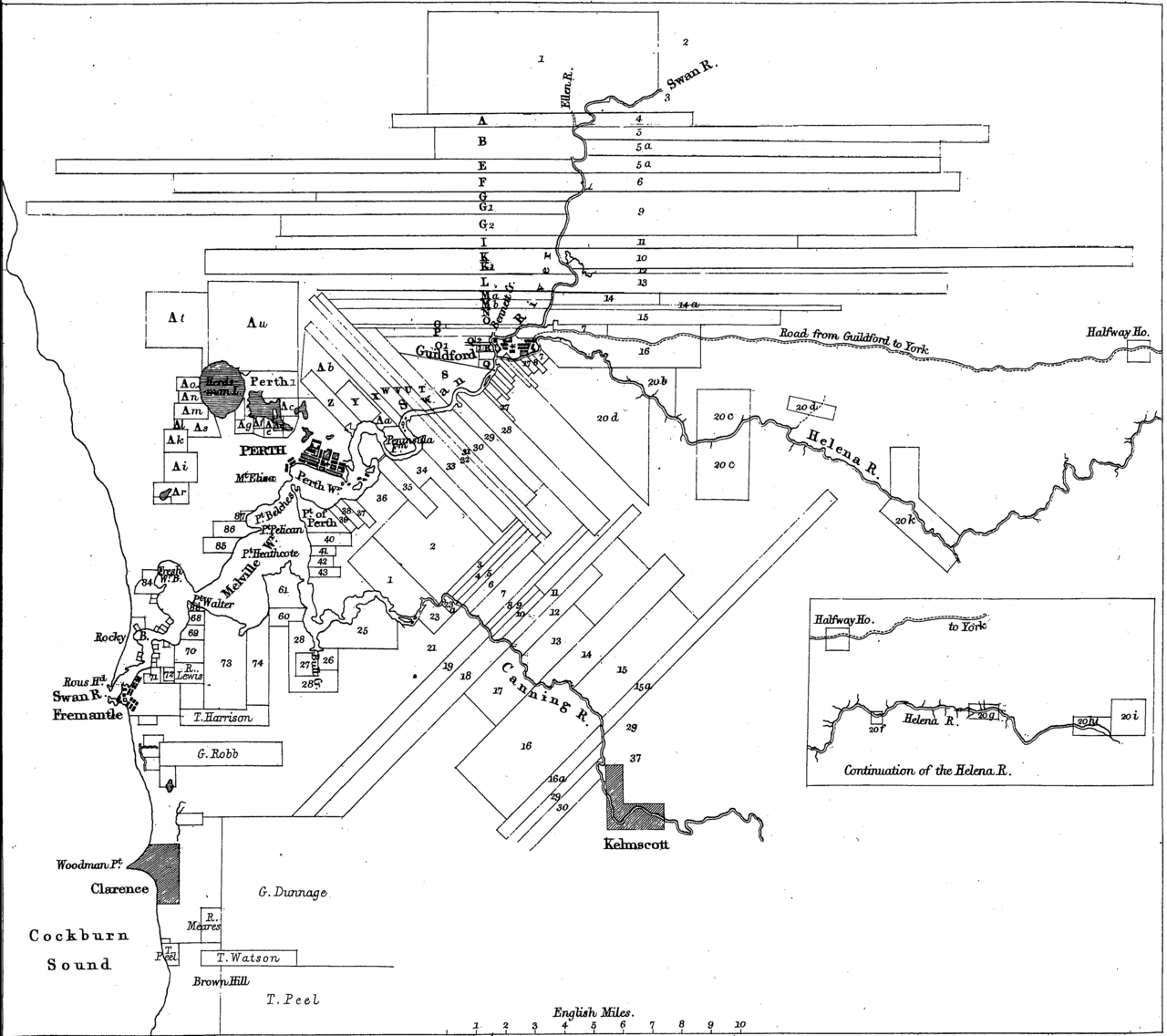
The Swan River Colony began in 1829 not as a prison, as a capitalist experiment that failed almost immediately. promoted by Captain James Stirling as a "land of milk and honey," the reality for the wave of British settlers was a sandy, scrub-covered terrain that European agricultural methods. The foundational error lay in the land grant system, which awarded vast tracts of territory based on the assets settlers brought with them rather than their ability to work the soil. Thomas Peel, a cousin of the British Home Secretary, secured a grant of 250, 000 acres. Yet his arrival six weeks after the stipulated deadline of November 1, 1829, forced him to accept a secondary site at Clarence, south of Fremantle. The result was a humanitarian disaster. Within months, Peel's settlement collapsed into a shantytown of sickness and starvation, where settlers died of scurvy and dysentery while waiting for supplies that never materialized.
This incompetence in planning was matched by the violence of dispossession. As colonists fenced off hunting grounds and water sources, the Noongar people responded with a campaign of resistance to protect their resources. The conflict escalated into open warfare. In 1833, the Whadjuk warrior Yagan was declared an outlaw and killed for a bounty, his head severed and shipped to Britain as a curio. The violence reached its nadir on October 28, 1834, at the Pinjarra Massacre. Governor Stirling led a detachment of twenty-five soldiers and police to the Murray River, intent on punishing the Bindjareb people. While Stirling officially reported fifteen Noongar deaths, eyewitness accounts and oral histories place the toll as high as eighty men, women, and children. The operation was a military strike designed to break the Bindjareb resistance and secure the fertile lands of the Peel region for European cattle.
By 1849, the colony faced economic ruin. The population had stagnated at fewer than 6, 000 Europeans, labor was nonexistent, and capital had fled. The "free" settlers, who had once scorned the penal colonies of the east, were forced to petition the British government for convicts to save them from bankruptcy. The arrival of the Scindian in June 1850 marked the beginning of Western Australia's transformation into a penal state. Over the eighteen years, Britain transported approximately 9, 720 male convicts to the colony. These men were not prisoners; they were the engine of the colonial economy. The British government poured money into the local system to house and feed them, providing the cash injection the private sector had failed to generate.
The physical footprint of this era remains the backbone of the state's early infrastructure. Convict labor built the Perth Town Hall, the Fremantle Lunatic Asylum, and the grim limestone of Fremantle Prison, which remained in use until 1991. They constructed the main road to Albany and bridged the Swan River. This system created a rigid class divide between the "bond" and the "free," a social scar that long after the last convict ship, the Hougoumont, docked in 1868. The Hougoumont carried sixty-two Fenian political prisoners, including John Boyle O'Reilly, adding a of Irish revolutionary history to the colony's convict narrative. By the time transportation ceased, the convict population nearly equaled the number of free settlers, proving that the survival of Western Australia depended entirely on the forced labor it had originally promised to reject.
| Metric | Data Point |
|---|---|
| Total Convicts Transported | 9, 721 (approx.) |
| Convict Ship | Scindian (June 1, 1850) |
| Last Convict Ship | Hougoumont (Jan 10, 1868) |
| Population Increase (1850, 1868) | From ~5, 886 to ~24, 000 |
| Major Infrastructure Projects | Fremantle Prison, Perth Town Hall, Albany Highway |
Goldfields Boom and the Federation Referendum (1890, 1901)
The decade between 1890 and 1901 stands as the most violent economic and demographic rupture in the recorded history of Western Australia. In 1890, the colony secured responsible government from Britain, becoming a self-governing entity with a population of 46, 000. By 1901, that figure had quadrupled to 184, 124. This explosion was not driven by policy or natural birth rates, by the discovery of geology that would define the state's existence for the century: gold. The strikes at Coolgardie in 1892 and Kalgoorlie in 1893 did not just alter the economy; they threatened to tear the newly autonomous colony apart before it could fully form.
Arthur Bayley and William Ford recovered 554 ounces of gold at Fly Flat in 1892, triggering the initial rush to Coolgardie. Yet it was the discovery by Paddy Hannan, Tom Flanagan, and Dan Shea in June 1893 at Mount Charlotte that revealed the true of the region's mineral wealth. The "Golden Mile" in Kalgoorlie proved to be one of the richest square miles of earth on the planet. The news drew thousands of prospectors, primarily from the depressed eastern colonies of Victoria and New South Wales. These arrivals, derisively labeled "t'othersiders" by the established "sandgropers" of the coast, brought with them radical political ideas, trade unionism, and a deep resentment of the conservative Perth gentry led by Premier John Forrest.
The logistical reality of the goldfields was a nightmare of arid terrain and disease. Typhoid tore through the tent cities, fueled by poor sanitation and a desperate scarcity of fresh water. Water became more expensive than whisky, and the government faced an engineering emergency that required a solution bordering on the impossible. Premier Forrest turned to C. Y. O'Connor, the colony's Engineer-in-Chief. O'Connor proposed a radical plan: a steel pipeline to lift water 340 meters and pump it 560 kilometers from the Mundaring Weir in the Perth hills to the desert interior. The project faced vicious opposition in the press and parliament, with critics labeling it a "scheme of madness" that would bankrupt the colony. The government secured a £2. 5 million loan from London, a sum nearly equal to the colony's entire annual GDP, to finance the construction.
The construction of the Goldfields Water Supply Scheme remains a benchmark in hydraulic engineering. It required 60, 000 pipes, each 30 feet long, and a series of eight steam-powered pumping stations. Yet the personal cost was absolute. Relentless media attacks and accusations of corruption drove O'Connor to ride his horse into the surf at Fremantle and shoot himself in March 1902, less than a year before the water reached Kalgoorlie in January 1903. The pipeline did not just save the mining industry; it stabilized the population, allowing the transient camps to calcify into permanent towns. Without this artery, the eastern goldfields would have collapsed as alluvial deposits ran dry, preventing the transition to the deep-shaft mining that sustains the region in 2026.
While O'Connor battled the terrain, a political war raged over the question of Australian Federation. The "t'othersiders" in the Goldfields were staunch federalists, believing a national government would break the protectionist tariffs imposed by the Perth establishment on food and equipment imported from the east. The coastal elite, represented by Forrest, feared that federation would destroy their local manufacturing and agriculture. The tension reached a breaking point in 1899 when the Eastern Goldfields Reform League formally petitioned Queen Victoria to separate from Western Australia and form a new colony named "Auralia."
The Auralia movement was not a bluff. The petition garnered over 27, 000 signatures and presented a map carving out the mineral-rich interior as a separate entity. The separatists argued that if Perth refused to join the Australian Commonwealth, the Goldfields would join alone. This ultimatum forced Forrest's hand. The British Colonial Secretary, Joseph Chamberlain, signaled that if Western Australia did not federate as a whole, the British government might look favorably upon the Auralia petition. Faced with the loss of the state's primary revenue source, the Perth conservatives capitulated and allowed a referendum.
The referendum held on July 31, 1900, produced a result that remains statistically clear. The colony voted 'Yes' by a margin of 44, 800 to 19, 691. A breakdown of the data reveals the internal fracture: the Goldfields voted 26, 330 for 'Yes' and only 1, 813 for 'No'. In contrast, agricultural districts in the southwest voted against union. It was the overwhelming demographic weight of the mining population that dragged Western Australia into the Commonwealth. Western Australia became the last colony to agree to federation, doing so only months before the nation officially came into existence on January 1, 1901.
For the Aboriginal peoples of the Goldfields, particularly the Wongi and Yamatji groups, the boom was a catastrophe of displacement and exclusion. The influx of 100, 000 strangers shattered the ecological balance of the region. Trees were clear-felled for mine timber and fuel, destroying food sources and spiritual sites. The Mining Act of 1904 formalized the marginalization, explicitly prohibiting Aboriginal people from holding mining leases or working in the industry. This legislation codified a system of apartheid that locked Indigenous custodians out of the wealth generated from their own land. Yet, historical records from the period show that Aboriginal people were not passive victims; they were frequently essential to the survival of the prospectors, acting as guides to water sources and laboring in the pastoral industry that sprang up to feed the mines.
The turn of the century cemented Western Australia's identity as a resource state dependent on global commodity pattern and foreign capital. The gold rush established the "boom and bust" rhythm that characterizes the state's economy to this day. It also entrenched a political divide between the metropolitan coast and the resource-rich interior, a that resurfaced in 1933 with a successful secession referendum and continues to influence state-federal relations in 2026. The Federation of 1901 was not a marriage of love for the West; it was a marriage of economic need, shotgunned by the miners of Kalgoorlie.
| Metric | 1891 Data | 1901 Data | Change Factor |
|---|---|---|---|
| Population | 49, 782 | 184, 124 | +270% |
| Gold Production (oz) | 30, 311 | 1, 879, 390 | +6, 100% |
| Public Debt (£) | 1, 613, 500 | 12, 709, 400 | +687% |
| Railways (km) | 600 (approx) | 2, 180 | +263% |
The legacy of this era is physical and legislative. The pipeline still pumps water to Kalgoorlie today, a testament to O'Connor's vision and the desperation of the 1890s. The Constitution of Australia still binds the state, a result of the Auralia threat. And the scars on the land, both the open pits of the Golden Mile and the legislative erasure of Indigenous rights, remain visible, defining the parameters of modern Western Australia.
Secessionism and the 1933 Withdrawal Vote
| Option | Votes | Percentage |
|---|---|---|
| Yes (Secession) | 138, 653 | 66. 23% |
| No | 70, 706 | 33. 77% |
| Turnout | 217, 326 | 91. 60% |
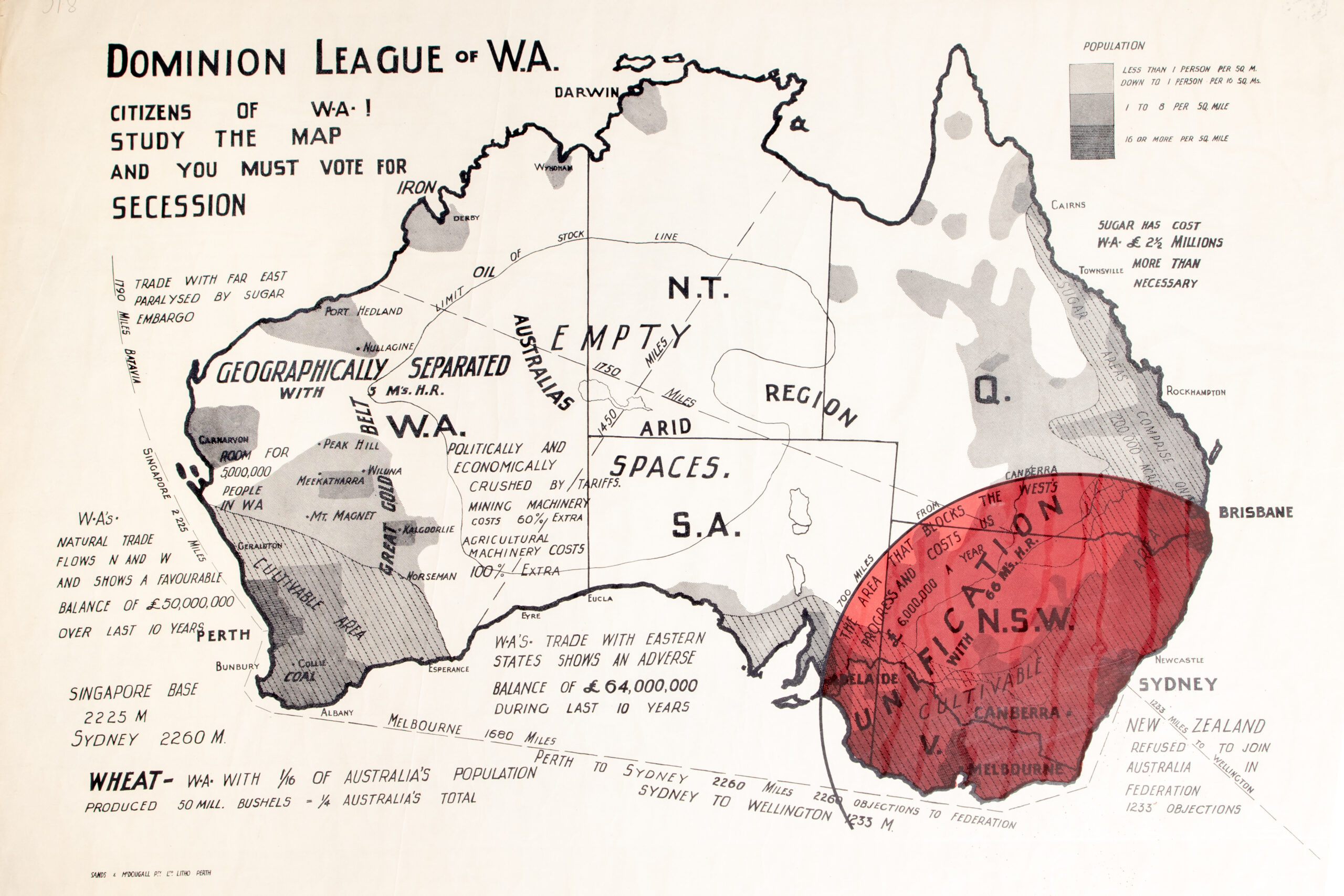
Yet, the day delivered a bizarre paradox. While voters overwhelmingly backed secession, they simultaneously annihilated the incumbent Nationalist government of Sir James Mitchell, the very administration that championed the referendum. In its place, they elected a Labor government led by Philip Collier, who opposed secession. This split verdict suggested that while the populace despised Canberra, they also blamed the local government for the economic misery of the Depression. It fell to the anti-secessionist Collier government to execute the of the people, a duty they performed with dutiful, if skeptical, precision. The state dispatched a delegation to London in 1934 to petition the Imperial Parliament. The delegation, which included the defeated former Premier Sir James Mitchell, carried a 489-page tome titled *The Case of the People of Western Australia*. Bound in kangaroo leather and encased in a casket of jarrah wood, the document laid out the legal and economic arguments for withdrawal. It contended that the federal compact had been violated by the Commonwealth's financial dominance, rendering the original agreement void. The British response was a masterclass in diplomatic evasion. The House of Commons established a Joint Select Committee to review the petition. In 1935, the Committee ruled that it could not receive the petition because it contravened established constitutional conventions. They argued that the British Parliament could not interfere in the affairs of a Dominion (Australia) at the request of a state (Western Australia) without the consent of the Dominion's federal government. Since the Commonwealth Parliament clearly did not consent to its own dissolution, the petition was declared "not proper to be received." The door to legal secession was slammed shut, not on merit, on a procedural technicality that affirmed Canberra's absolute sovereignty. The failure of 1935 did not extinguish the sentiment; it forced it to mutate. For the ninety years, secessionism transformed from a genuine push for independence into a rhetorical bludgeon used to extract financial concessions. This became most visible during the Goods and Services Tax (GST) disputes of the early 21st century. As the mining boom of the 2000s and 2010s drove Western Australia's economy to new heights, the Commonwealth Grants Commission's "horizontal fiscal equalization" formula began stripping the state of its royalty revenue. By 2015, WA's return on the GST had collapsed to 30 cents for every dollar generated, subsidizing the budgets of Tasmania and South Australia to a degree that enraged Perth. The modern iteration of this conflict peaked in 2018, leading to federal reforms that established a GST floor. Yet, as of 2026, the tension remains a central feature of the state-federal relationship. The Productivity Commission's 2026 review of the GST distribution arrangement has reignited old grievances. Data from the WA Department of Treasury in 2026 indicates that even with the 75-cent floor in place, Western Australia contributes approximately $2. 5 billion annually to the other states. The state's GDP per capita, standing at roughly $155, 000, dwarfs the national average, reinforcing the "cash cow" narrative that fueled the 1933 vote. Political movements such as the "Waxit" party have emerged in the 2020s, though they operate on the fringes compared to the Dominion League of the 1930s. These modern groups do not command 66 percent of the electorate, yet they exert outsized influence by shifting the Overton window. State politicians, regardless of party, use the *threat* of secessionist sentiment to negotiate better terms with Canberra. The lesson of 1933 is a tactical playbook: the West does not need to leave to win; it simply needs to remind the East that it can afford to. The legal reality established in 1935 holds that the Federation is indissoluble. No method exists in the Australian Constitution for a state to leave. A successful exit would require a national referendum with a majority vote in a majority of states, an impossible threshold given the financial loss the Eastern states would suffer if the West departed. Consequently, Western Australia exists in a state of permanent, profitable agitation. The 1933 vote stands not as a failed revolution, as the defining moment where Western Australia realized its distinct identity was not just cultural, deeply, irrevocably economic.
Iron Ore Industrialization and the Pilbara Expansion (1960, 2020)
The industrialization of the Pilbara represents one of the most rapid and total transformations of a geographic region in human history. For decades, the Australian Commonwealth operated under a delusion of scarcity. In 1938, the federal government imposed a strict embargo on the export of iron ore, driven by a false belief that the continent possessed barely enough mineral reserves to supply its own modest domestic steel industry. This policy paralyzed exploration for twenty-two years, locking away the economic future of Western Australia behind a wall of bureaucratic ignorance. It was not until November 1960 that the Menzies government, bowing to mounting geological evidence and intense lobbying, partially lifted the ban, setting the stage for a resource rush that would eventually shift the geopolitical center of toward Asia.
The catalyst for this reversal occurred eight years prior to the legislative change, during a weather-diverted flight in November 1952. Lang Hancock, a pastoralist and amateur prospector, flew his Auster aircraft low through the gorges of the Turner River to escape a storm. him, the canyon walls did not display the usual grey-brown of the Hamersley Range; they glowed with the deep, oxidized red of high-grade hematite. Hancock later returned to the site, collected samples, and confirmed what is known: the Pilbara contained not deposits, entire mountains of iron. He termed it the "Red Ochre," a discovery that would eventually be validated as the largest continuous iron ore province on Earth. Yet, even with Hancock's, the state government remained skeptical, and it took the involvement of multinational giants like Rio Tinto and BHP to capitalize on the find once the export restrictions fell.
The 1960s marked the phase of this industrial terraforming. In a span of six years, the region went from a remote pastoral outpost to a heavy industry powerhouse. Hamersley Iron, a precursor to Rio Tinto's modern operations, established the Mount Tom Price mine and constructed a 290-kilometer heavy-haul railway to the newly built port of Dampier. The commercial shipment departed in August 1966, bound for Japan's blast furnaces. This infrastructure was not built by the state; it was a private fiefdom of steel and rail, carved out of the red earth by corporations that held more power in the region than the government in Perth. By the end of the decade, towns like Newman and Paraburdoo had risen from the dust, purpose-built to house the workforce required to feed the Japanese economic miracle.
The second and most volatile phase of expansion arrived with the Chinese urbanization boom of the early 21st century. Between 2003 and 2014, the "Supercycle" obliterated previous production records. The price of iron ore, which had languished around $13 per tonne for decades, surged to peaks exceeding $180. This price shock did not increase profits; it rewired the Australian economy. The Pilbara became the engine room of national GDP, insulating the country from the 2008 Global Financial emergency. Mining companies engaged in a frantic race for tonnage, expanding pits and duplicating rail lines. During this period, the state government's royalty receipts ballooned, creating a fiscal dependency on the sector that to this day. In the 2024-2025 state budget alone, iron ore royalties contributed over $10 billion, underwriting the state's surplus even as other sectors stagnated.
Technological evolution in the Pilbara has been as aggressive as the extraction itself. By 2018, Rio Tinto had fully deployed "AutoHaul," the world's fully autonomous, long-distance, heavy-haul rail network. These driverless trains, 2. 4 kilometers long and carrying 28, 000 tonnes of ore, navigate the 1, 700-kilometer rail system without a human on board, controlled by operators in a command center near Perth Airport, 1, 500 kilometers away. This shift to automation reduced pattern times and eliminated the need for driver changeovers, turning the supply chain into a precise, relentless conveyor belt. By 2026, this model had become the industry standard, with BHP and Fortescue adopting similar remote-operation technologies to maximize efficiency and remove human error from the logistics loop.
Yet, this relentless of volume came at an irreversible cultural cost. On May 24, 2020, Rio Tinto detonated explosives in the Juukan Gorge, destroying two rock shelters that held evidence of continuous human occupation dating back 46, 000 years. The blast was legal under the archaic Section 18 of the Western Australian Aboriginal Heritage Act (1972), a loophole that prioritized extraction over preservation. The destruction obliterated a genetic and archaeological link that spanned the last Ice Age, sparking global outrage and a parliamentary inquiry titled "Never Again." The inquiry exposed a widespread failure in corporate governance and state regulation, revealing that the company had chosen to destroy the site to access higher-grade ore volumes worth approximately $135 million, a fraction of their daily revenue. The forced the resignation of the company's CEO and triggered a rewrite of heritage laws, though Indigenous groups the new protections remain insufficient against the economic weight of the miners.
As of 2026, the Pilbara remains the dominant source of seaborne iron ore, supplying over 900 million tonnes annually to global markets. The "Big Three", Rio Tinto, BHP, and Fortescue, control the vast majority of this output, operating an oligopoly that dictates the rhythm of the global steel industry. The region is facing a new pressure: the transition to "Green Steel." The hematite ores of the Pilbara, while abundant, require significant processing to be suitable for hydrogen-based steelmaking, a necessary step for decarbonization. This has triggered a new wave of investment in magnetite processing and renewable energy infrastructure, as the industry attempts to pivot from being a raw material exporter to a producer of higher-value, lower-carbon iron products.
| Metric | 1960 Context | 2000 (Pre-Boom) | 2020 (Peak Volatility) | 2026 (Current State) |
|---|---|---|---|---|
| Export Status | Embargoed (Ban active) | Global Commodity | Strategic serious Mineral | Dominant Global Supply |
| Annual Production | < 1 Million Tonnes | ~160 Million Tonnes | ~838 Million Tonnes | ~920 Million Tonnes |
| Key Technology | Manual Prospecting | Diesel-Electric Rail | Autonomous Haulage (AutoHaul) | Remote Ops & Decarbonization |
| Price per Tonne (USD) | N/A (Fixed Contracts) | ~$13 (Benchmark) | ~$100, $230 (Spot) | ~$95, $110 (Stabilized) |
| State Royalties (WA) | Negligible | ~$500 Million | ~$9. 8 Billion | ~$10. 3 Billion |
| Heritage Status | Unrecognized | Native Title Act (1993) | Juukan Gorge Destruction | Revised Heritage Laws |
The trajectory of the Pilbara from 1960 to 2026 is defined by the tension between geological endowment and industrial exploitation. The region produces the steel that builds the cities of the northern hemisphere, yet it remains a remote, fly-in fly-out encampment for the workforce. The wealth generated has built Perth's skyline and funded the nation's deficits, the scars on the terrain, both physical and cultural, are permanent. The destruction of Juukan Gorge proved that even in an era of advanced corporate social responsibility statements, the imperative to extract frequently overrides the duty to protect. As the easy, high-grade hematite depletes, the industry turns toward more energy-intensive magnetite projects, ensuring that the red dust of the Pilbara continue to be dug, crushed, and shipped well into the latter half of the century.
Native Title Legislation and the Juukan Gorge Destruction
The legal collision between Indigenous custodianship and Western Australian industrial ambition reached its most volatile point following the High Court's 1992 Mabo decision. While the federal Native Title Act 1993 established a framework for recognizing traditional rights, the Western Australian government, led by Premier Richard Court, immediately mobilized to neutralize its effects. In November 1993, the state parliament passed the Land (Titles and Traditional Usage) Act, a legislative attempt to extinguish all native title in the state and replace it with statutory "rights of traditional usage" that could be easily overridden by mining interests. The High Court struck down this state law in 1995, ruling it inconsistent with the federal Racial Discrimination Act. This defeat did not end the conflict; it shifted the battleground to the procedural of the Aboriginal Heritage Act 1972 (WA).
For decades, the 1972 Act functioned less as a protection method and more as a regulatory turnstile for resource extraction. The central component was Section 18, a provision that allowed landowners, primarily mining companies, to apply for ministerial consent to use land in a way that would destroy or damage Aboriginal sites. Between 2010 and 2020, the state government processed over 460 Section 18 applications. The rejection rate was zero. The final authority rested not with heritage experts or Traditional Owners, with the Minister for Aboriginal Affairs, a political appointee who frequently held conflicting portfolios related to state development. This structural imbalance meant that once a Section 18 approval was signed, the destruction of heritage was legal, permanent, and unappealable by the Indigenous custodians.
This administrative assembly line produced its most catastrophic result on May 24, 2020. In the Pilbara region, Rio Tinto detonated explosives at Juukan Gorge, collapsing two rock shelters known as Juukan 1 and Juukan 2. These were not minor sites; archaeological excavations had confirmed continuous human occupation dating back 46, 000 years. The shelters contained a genetic record of the Puutu Kunti Kurrama and Pinikura (PKKP) people, including a 4, 000-year-old braided hair belt that provided a direct DNA link to living descendants. The site held pollen records charting climate shifts since the last Ice Age and faunal remains of extinct species. It was a library of human adaptation, obliterated to access higher-grade iron ore.
The destruction was technically legal. Rio Tinto held a Section 18 approval granted in 2013. Yet, the gap between that 2013 permission and the 2020 detonation exposed a serious failure in corporate governance and state oversight. In the years between approval and destruction, subsequent archaeological surveys revealed the site's exceptional significance. Rio Tinto possessed four mine design options; three would have avoided the shelters. The company chose the fourth option, "Option 4," which required the removal of the gorge to maximize ore extraction. Internal records released later showed that the decision prioritized production volume over heritage value, driven by a rigid adherence to mine plans even with new information.
The PKKP people were powerless to intervene. Their participation agreement with Rio Tinto contained "gag clauses" that prohibited them from objecting to company operations or seeking emergency legal injunctions. On the days leading up to the blast, PKKP representatives realized the danger and requested a halt. Rio Tinto personnel stated the explosives were already loaded and could not be removed safely. The detonation went ahead on Sunday morning, just days before National Reconciliation Week. The physical collapse of the gorge triggered an immediate global backlash, stripping the mining giant of its social license and forcing a reckoning within the industry.
The aftermath dismantled the leadership of one of the world's largest resource companies. Following a parliamentary inquiry titled A Way Forward, which described the event as "inexcusable," Rio Tinto CEO Jean-Sébastien Jacques and two senior executives resigned. The inquiry exposed how the Section 18 process had been weaponized to silence objections and expedite approvals. It revealed that the state government had no statutory power to suspend a Section 18 approval even when new, world-class archaeological evidence emerged. The legislative framework was obsolete, designed for a 1970s era where Indigenous heritage was viewed as an impediment to progress rather than a state asset.
In response, the Western Australian government rushed to draft replacement legislation. The Aboriginal Cultural Heritage Act 2021 was passed with the pledge of preventing another Juukan Gorge. It introduced a tiered system of due diligence and transferred authority to new Local Aboriginal Cultural Heritage Services (LACHS). The rollout, yet, was a disaster. Farmers, pastoralists, and small landowners protested that the regulations were unworkable, confusing, and financially burdensome. The complexity of the new system, combined with a failure to clearly communicate obligations, led to widespread panic across the agricultural sector. In August 2023, just five weeks after the Act came into effect, the state government announced its repeal, a humiliating policy reversal that left the protection framework in limbo.
By November 2023, Western Australia reverted to an amended version of the 1972 Act. The amendments introduced a "right of review" for native title parties to challenge Section 18 decisions and a requirement for proponents to notify the Minister of "new information." While these changes addressed the specific legal loophole that doomed Juukan Gorge, they did not resolve the fundamental tension between land rights and land use. The Minister retained the final say, and the load of protection still weighed heavily on under-resourced Indigenous corporations.
As of 2026, the focus has shifted from preventing destruction to quantifying the cost of loss. The Federal Court case between the Yindjibarndi people and Fortescue Metals Group (FMG) has become the new precedent for compensation. The Yindjibarndi Ngurra Aboriginal Corporation sought approximately $1. 8 billion for the destruction of sites and the loss of exclusive possession caused by the Solomon Hub mine. FMG and the state government argued the compensation should be closer to $8 million to $10 million. This massive valuation gap highlights the current struggle: defining the monetary value of spiritual destruction. The courts are tasked with calculating the price of severed connection to Country, a metric that define the financial liability of resource projects for the century. The Juukan Gorge detonation proved that ancient history could be erased in seconds; the Yindjibarndi case asks what price a modern economy must pay for that erasure.
| Year | Event | Significance |
|---|---|---|
| 1993 | Native Title Act (Federal) passed | Recognized native title; WA government opposed it. |
| 1995 | High Court strikes down WA Act | WA's attempt to extinguish native title declared invalid. |
| 2013 | Section 18 Approval Granted | Minister approves Rio Tinto's request to destroy Juukan Gorge. |
| 2020 | Juukan Gorge Detonation | 46, 000-year-old shelters destroyed; global outcry ensues. |
| 2021 | Aboriginal Cultural Heritage Act passed | Attempt to reform the 1972 system; widely criticized. |
| 2023 | 2021 Act Repealed | Government reverts to amended 1972 Act after implementation failure. |
| 2026 | Yindjibarndi vs FMG Judgment | Federal Court determines compensation value for cultural loss. |
GST Distribution Conflicts and Fiscal Autonomy
| Financial Year | WA Relativity | Fiscal Context |
|---|---|---|
| 2010, 11 | 0. 68 | Pre-boom stability; relativity begins to decline as royalties rise. |
| 2013, 14 | 0. 45 | Rapid decline as iron ore prices surge above $120/t. |
| 2015, 16 | 0. 298 | Historical low point. State budget enters deep deficit. |
| 2019, 20 | 0. 47 | Initial recovery phase; pre-reform formula still dominant. |
| 2022, 23 | 0. 70 | stage of the 2018 legislative floor takes effect. |
| 2024, 25 | 0. 75 | Floor increases to 75 cents; iron ore prices remain high. |
| 2025, 26 | 0. 75 | Current floor. Without reform, raw relativity estimated at <0. 15. |
Tensions reached a breaking point in early 2026 as the Productivity Commission commenced its scheduled review of the GST distribution arrangements. The review, mandated by the 2018 legislation, has become a battleground. The Western Australian Government, led by Premier Roger Cook and Treasurer Rita Saffioti, established a "GST fairness taskforce" to defend the arrangement. Their submission to the inquiry that even with the 75-cent floor, WA provides a net fiscal subsidy to the federation of approximately $39 billion annually. They contend that removing the floor would force the state to slash infrastructure spending or raise state taxes, damaging the national economy which relies on WA's export performance. The "no worse off" guarantee, extended by the Albanese government until 2029-30, acts as a temporary sedative for the eastern states. Yet the federal budget bears the load of this equalization. The Commonwealth pays the eastern states the money they *would* have confiscated from WA under the old system. With the federal budget under pressure, the sustainability of this multi-billion dollar annual top-up is questionable. By March 2026, the political rhetoric has shifted from technical arguments about fiscal capacity to existential debates about the nature of the federation. Western Australia views the GST floor not as a gift, as a non-negotiable condition of its continued participation in the economic union. The 1933 secession vote is no longer just a historical footnote; it is a reminder of the state's willingness to reject a federal compact that it perceives as exploitative. The Productivity Commission's final report, due in December 2026, determine whether the peace holds or if the federation faces a renewed fracture. For, the West remains the only solvent jurisdiction in the country, a fact that breeds both confidence in Perth and resentment in Canberra.
Agricultural Salinity and Wheatbelt Desertification
| Metric | Statistic (2020-2026 Estimates) | Implication |
|---|---|---|
| Salt Store | 100 to 10, 000 tonnes per hectare | Permanent geological hazard; cannot be "flushed" |
| Land Cleared | ~18, 000, 000 hectares | Removal of hydrological regulation |
| Land Salinized | >2, 000, 000 hectares | Total loss of arable productivity in these zones |
| Land at Risk | 4, 500, 000 hectares | chance doubling of the emergency zone by 2050 |
| Biodiversity Loss | 450+ plant species facing extinction | Collapse of unique valley-floor ecosystems |
| Infrastructure Cost | ~$200 million/year (Roads/Rail) | Continuous public liability for repair |
The biological cost surpasses the economic one. The Wheatbelt is part of a global biodiversity hotspot, yet salinity acts as an extinction engine. Valley-floor woodlands, which contain species found nowhere else on Earth, are drowning in salt. Experts estimate that 450 plant species are subject to extinction solely due to hydrological changes. Unlike fire or clearing, which are immediate events, salinity is a creeping death. Remnant vegetation in low-lying areas slowly succumbs as the root zone becomes toxic, leaving behind "stag trees", bleached skeletons of eucalypts that stand as markers of the rising brine. Attempts to reverse this trend have largely failed. Engineering solutions such as deep drainage channels are expensive and frequently transfer the salt problem downstream to neighbors or river systems. Revegetation efforts, while important, struggle to match the of the original clearing. To restore the hydrological balance, millions of hectares would need to be replanted with deep-rooted perennials, a shift that contradicts the current economic model of broadacre grain export. Consequently, the region faces a form of anthropogenic desertification. The fertile "wheatbelt" is contracting, leaving behind a patchwork of productive rises separated by expanding corridors of salt. The situation in 2026 presents a clear lesson in ecological limits. The "Million Acres a Year" policy, once hailed as nation-building, is recognized as an act of slow-motion self-destruction. The salt, once safely entombed, is an active surface agent, reshaping the demography and economy of Western Australia. The challenge is no longer prevention adaptation, managing a retreat from the valleys and accepting that large swathes of the interior are returning to a saline equilibrium that human engineering cannot override.
Offshore Gas Reserves and the Gorgon Project Emissions
Barrow Island sits sixty kilometers off the Pilbara coast and holds a dual identity as a Class A Nature Reserve and the engine room of Australia's hydrocarbon economy. The island has hosted oil production since West Australian Petroleum Pty Ltd (WAPET) discovered the resource in 1964. This operation produced over 335 million barrels of oil yet remained largely unobtrusive compared to what followed. In 2009, the state and federal governments approved the Gorgon Project. This 54 billion USD venture, led by Chevron, became one of the largest natural gas projects in history. The approval rested on a specific environmental condition. The operators promised to inject 80 percent of the reservoir carbon dioxide back underground. This Carbon Capture and Storage (CCS) system was sold to the public as a guarantee that the expansion of fossil fuel extraction would not result in unmanageable atmospheric emissions.
The reality of the Gorgon CCS project has diverged sharply from its engineering blueprints. The injection facility was scheduled to begin operations in 2016 alongside gas exports. It did not start until August 2019. Technical problems plagued the system from the outset. The sequestering process requires precise pressure management to force CO2 into the Dupuy Formation two kilometers beneath the island. Chevron engineers encountered higher than expected pressure and "sand production" where particulate matter clogged the injection wells. These physical blocks forced the operator to throttle the injection rates significantly the design capacity of 4 million tonnes per annum.
Data from the 2024 and 2025 financial years shows the extent of this failure. In the 2024-2025 period, the facility captured approximately 1. 3 million tonnes of CO2. This figure represents roughly 25 percent of the reservoir carbon dioxide removed from the gas fields and a mere fraction of the project's total Scope 1 emissions. The regulatory framework required Chevron to offset these shortfalls. By November 2024, the company had purchased over 10 million carbon offsets to compensate for the emissions it failed to sequester. The reliance on market-based offsets rather than actual geosequestration undermines the primary environmental justification for the project's location on a nature reserve.
| Fiscal Year | Target Capture (Mt) | Actual Capture (Mt) | Performance Shortfall |
|---|---|---|---|
| 2023, 2024 | 4. 0 | 1. 5 (approx) | 62. 5% |
| 2024, 2025 | 4. 0 | 1. 3 | 67. 5% |
| 2025, 2026 (Proj) | 4. 0 | 1. 6 (est) | 60. 0% |
The emissions profile of the Gorgon Project extends beyond the failure of its CCS unit. The facility is frequently as Western Australia's largest industrial polluter. In the 2023-2024 reporting period, the plant emitted 8. 8 million tonnes of CO2 equivalent. This volume increased even as the facility operated under the federal Safeguard method. The method allows facilities to increase their emissions baseline if production rises. Consequently, the baseline for Gorgon was adjusted upward to 9. 2 million tonnes. This regulatory flexibility allowed the operator to remain compliant on paper while increasing the absolute load of greenhouse gases released into the atmosphere. These figures do not account for Scope 3 emissions. When customers in Asia burn the gas exported from Gorgon, the resulting emissions are estimated at 50 million tonnes per year.
Financial returns to the Australian public have also faced intense scrutiny. For over a decade, the Gorgon Project paid zero Petroleum Resource Rent Tax (PRRT). The tax design allows companies to deduct exploration and construction costs before paying the levy. The massive capital expenditure of the project created a shield of tax credits that deferred payments for years. It was not until August 2025 that Chevron announced its PRRT payment. This delay occurred even with the project generating billions in revenue annually since 2016. The federal government introduced a deductions cap in 2024 to force earlier payments. This policy shift resulted in the 2025 contribution. Yet the accumulated credits mean the tax rate on the resource remains well the statutory 40 percent headline rate.
The industrial footprint on Barrow Island has compromised its biosecurity status. The island is a refuge for species extinct or endangered on the mainland. Strict quarantine are in place to prevent the introduction of invasive species. Yet breaches have occurred. The Asian House Gecko has been detected on the island. This invasive predator competes with native fauna and poses a serious threat to the local ecosystem. Further environmental degradation has been documented in the form of PFAS contamination. Firefighting foams containing these "forever chemicals" have leached into the soil and groundwater near the plant infrastructure. In July 2025, reports also emerged of gas seeping to the surface from old oil wells during decommissioning works. These incidents show the difficulty of maintaining a pristine class A reserve while operating a heavy industrial facility on the same terrain.
By early 2026, the operator initiated new remediation wells to address the pressure and sand clogging problems. The cost of the CCS facility has ballooned from an initial estimate of 2. 5 billion to over 3. 2 billion AUD. Even with this investment, the system has never achieved its nameplate capacity of 4 million tonnes per year in any single operating year. The state government continues to support the project as a pillar of energy security and economic stability. Critics that the continued underperformance of the CCS technology proves that Carbon Capture is not a viable solution for neutralizing the climate impact of large- gas extraction.
Fly-In Fly-Out (FIFO) Labor Demographics

The concept of a commuter workforce oscillating between coastal cities and remote extraction sites is a modern anomaly in Western Australia's timeline. For nearly three centuries following 1700, labor on this terrain was strictly localized. Indigenous custodians lived on Country; early European pastoralists, pearlers, and prospectors in the 1890s gold rushes relocated permanently to the point of extraction. The Fly-In Fly-Out (FIFO) model did not materialize until the 1960s, triggered by the Commonwealth government's decision to lift the iron ore export embargo. This policy shift birthed the Pilbara's industrial, necessitating a workforce larger than the arid region could naturally sustain. By 2026, this logistical method had mutated into a defining demographic feature of the state, creating a "shadow population" that exists in a permanent state of transit.
Data from August 2025 places the Western Australian mining workforce at approximately 155, 900 individuals, a record high that defies earlier predictions of automation-induced contraction. This army of workers does not march; it flies. Perth Airport functions as the operational heart of this system, processing passenger numbers that rival major international hubs, solely to shuttle personnel to private airstrips in the Pilbara and Goldfields. The economic of this demographic is immense. In 2024, the resources sector accounted for 50% of the state's export value, yet the human cost of extracting that wealth remains the subject of intense scrutiny. The "golden handcuffs", high wages paired with high debt and lifestyle entrapment, keep thousands locked into rosters that compress a month's worth of work into two weeks.
The demographic profile of the FIFO worker has shifted measurably since the "blokes only" era of the 1970s and 80s. A 2024 report by the Chamber of Minerals and Energy (CME) revealed that female participation in the WA resources sector rose to 24. 8%, a significant climb from 19% a decade prior. Over 10, 000 women entered the sector between 2014 and 2024, with half of that growth occurring in the post-pandemic window of 2022-2024. Yet, this integration has exposed deep fractures in the industry's culture. The 2022 parliamentary inquiry "Enough is Enough" and the subsequent 2024 MARS (Mental Awareness, Respect and Safety) study exposed a prevalence of sexual harassment and covert misogyny. The MARS data indicated that while overt assaults had decreased, 41% of female miners reported experiencing sexist hostility, confirming that the camp environment remains a hostile terrain for.
Mental health statistics within this transient population present a grim counter-narrative to the high salaries. The isolation of the "donga" (transportable accommodation unit), combined with 12-hour shifts and separation from family support networks, creates a pressure cooker effect. The 2024 MARS study found that nearly 40% of workers reported burnout, and suicide rates among male miners remain a persistent concern, hovering between 11 and 25 per 100, 000. This figure mirrors the general population is exacerbated by the specific risk factors of the FIFO lifestyle: sleep disruption, social isolation, and the "tunnel effect" where life outside the roster ceases to feel real. Divorce rates and relationship breakdowns are frequently as the primary collateral damage of the 2: 1 (two weeks on, one week off) or 8: 6 rosters.
| Era | Dominant Roster | Workforce Size (Est.) | Primary Commodity | Key Demographic Feature |
|---|---|---|---|---|
| 1970, 1985 | 4 weeks on / 1 week off | < 20, 000 | Iron Ore, Nickel | 95% Male, permanent relocation to company towns common. |
| 2000, 2012 | 4 weeks on / 1 week off (shifting to 2: 1) | 80, 000+ | Iron Ore Boom | Explosion of "construction phase" labor. High interstate intake. |
| 2015, 2019 | 2 weeks on / 1 week off | 110, 000 | LNG, Iron Ore | Normalization of FIFO. Rise in mental health awareness. |
| 2020, 2026 | 8 days on / 6 days off (Even Time) | 155, 900 (2025) | serious Minerals (Lithium), Iron Ore | 24. 8% Female. Rise of "tech FIFO" vs "site FIFO". |
Automation is rapidly altering the composition of this workforce, creating a two-tier system by 2026. Giants like Rio Tinto and BHP have aggressively deployed "Mine of the Future" technologies, moving haulage and drilling control to Remote Operations Centers (ROCs) near Perth Airport. This shift reduces the number of boots on the ground per ton of ore extracted increases the demand for Perth-based data analysts and systems engineers. Consequently, the FIFO demographic is splitting: a highly skilled, city-based technical class that goes home every night, and a residual site-based workforce focused on physical maintenance and construction. The latter group continues to face the traditional rigors of remote work, while the former enjoys the benefits of the mining boom without the social isolation.
The post-COVID era also cemented a "West is Best" hiring policy. The border closures of 2020-2022 forced companies to abandon their reliance on interstate FIFO workers (primarily from Queensland and Victoria), leading to a permanent structural shift. By 2025, the vast majority of the FIFO workforce was required to reside within Western Australia, tightening the state's housing market and driving Perth's rental vacancy rate to near-zero. This localization of the labor force ensures that the wages earned in the Pilbara are spent in Perth suburbs, it also concentrates the social within the state's borders. As the industry pivots toward lithium and green energy minerals in 2026, the demand for labor remains high, the romanticized image of the roughneck miner is being steadily replaced by a reality of strict compliance, digital surveillance, and managed fatigue.
Perth Urbanization and Desalination Infrastructure
Perth exists in defiance of its geography. By 2026, the Western Australian capital stretched as a continuous, concrete ribbon for nearly 150 kilometers along the Indian Ocean, from Two Rocks in the north to Dawesville in the south. This linear formation, frequently as one of the longest continuous urban footprints on Earth, represents a collision between the "Great Australian Dream" of detached housing and a climate that turned hostile in the late 20th century. The city's foundation rests on a history of hydrological erasure; the central business district sits atop the drained remains of Lake Kingsford and a network of wetlands that once sustained Noongar populations for millennia. European settlers, viewing these swamps as miasmic obstacles, engineered their destruction between 1830 and 1900, replacing a natural cooling system with heat-absorbing asphalt.
The defining struggle of modern Perth is not isolation, thirst. For the century of settlement, the city relied on what seemed like an inexhaustible blessing: the heavy winter rains of the Darling Scarp filling reservoirs like Mundaring and Canning. The data exposes a terrifying climatic shift that began in the 1970s. From 1911 to 1974, the average streamflow into Perth's dams was 338 gigalitres (GL) per year. By the mid-1970s, a sudden, permanent drop in rainfall reduced this average to 177 GL. The true shock arrived in 2001, when inflows collapsed further, and by 2010, the dams received a catastrophic 12 GL, zero usable runoff. The rains had not just decreased; they had.
Faced with the prospect of a city without water, the Gallop Labor government made the controversial decision to turn to the Indian Ocean. The Perth Seawater Desalination Plant (PSDP) in Kwinana, commissioned in 2006, was the major plant of its kind in the Southern Hemisphere. Critics at the time attacked the energy intensity of the project, yet without it, the metropolis would have faced unlivable restrictions. The Kwinana plant, producing 45 billion liters annually, was quickly followed by the Southern Seawater Desalination Plant (SSDP) near Binningup in 2011, adding another 100 billion liters to the grid. By 2025, manufactured water, desalination and groundwater replenishment, accounted for nearly half of Perth's water supply, relegating the dams to the role of massive storage batteries for desalinated water rather than collectors of rain.
| Period / Year | Average Annual Inflow (Gigalitres) | Status |
|---|---|---|
| 1911, 1974 | 338 GL | Historical Baseline |
| 1975, 2000 | 177 GL | The Drying Shift |
| 2001, 2009 | 92 GL | The Millennium Drought |
| 2010 | 12 GL | System Shock |
| 2024 | ~81 GL | Climate Adjusted |
| 2025 | ~55 GL | Current Reality |
In 2026, the battle for water security moved north to Alkimos. Construction barges dominated the horizon off the northern suburbs as work accelerated on the Alkimos Seawater Desalination Plant (ASDP). Designed to supply an initial 50 billion liters, this facility represented the state's acceptance that the drying trend was irreversible. The project, yet, faced intense scrutiny over its impact on the marine environment and the cost of pumping water against to the city's reservoirs. Even with these concerns, the Water Corporation pushed forward, driving piles into the seabed to secure intake pipes, acknowledging that the aquifers, the Gnangara and Jandakot mounds, were being extracted faster than nature could recharge them.
While the water network adapted to climate reality, the urban form struggled to contain its own bloat. The Metronet rail project, the largest public transport investment in the state's history, aimed to retrofit density into a car-dependent sprawl. By 2026, the cost of Metronet had ballooned toward $14 billion, a figure that drew sharp criticism from the Auditor General and opposition parties. The Yanchep rail extension, opened in 2024, was intended to connect the far northern suburbs, yet it also paradoxically encouraged further development on the fringe, pushing the urban boundary into high-risk fire zones. The "Metrodebt" controversy highlighted the immense financial load of servicing a low-density population spread over such a vast distance.
The consequences of this sprawl are thermal as well as financial. By 2026, data from the Urban Heat Island effect showed that new suburbs, stripped of tree canopy and covered in dark roofing, recorded temperatures 4°C to 6°C higher than established, leafy areas like Subiaco or Nedlands. The clearing of the Banksia woodlands to make way for housing estates like those in Byford and Alkimos destroyed the very biodiversity that made the Southwest a global botanical hotspot. The city had engineered a method of living that was increasingly expensive, hot, and dependent on energy-intensive water production. The Noongar practice of careful land management, which maintained the region's balance for fifty millennia, stood in clear contrast to the extractive and expansive model that defined Perth in the early 21st century.
Critical Minerals Strategy and Lithium Processing (2020, 2026)
| Project / Asset | Operator(s) | Primary Commodity | Status (March 2026) | Key Development |
|---|---|---|---|---|
| Greenbushes | Talison (Albemarle/Tianqi/IGO) | Lithium (Spodumene) | Operational | Remains world's largest hard-rock mine; expansion continues. |
| Kemerton Refinery | Albemarle | Lithium Hydroxide | Idled / C&M | Train 1 idled Feb 2026; Trains 2-4 halted/suspended. |
| Kwinana Refinery | Tianqi / IGO | Lithium Hydroxide | Struggling / Impaired | IGO wrote off value; "no viable route" seen by JV partner. |
| Pilgangoora | Pilbara Minerals | Lithium (Spodumene) | Operational / Expanded | P1000 expansion achieved ore Jan 2025; production surging. |
| Kathleen Valley | Liontown Resources | Lithium (Spodumene) | Operational | shipment Sept 2024; ramping to 3Mtpa capacity. |
| Nickel West | BHP | Nickel (Sulphide) | Suspended | Operations suspended Oct 2024; review due Feb 2027. |
| Mt Holland | Covalent (Wesfarmers/SQM) | Lithium (Spodumene/Hydroxide) | Operational / Commissioning | Mine active; Kwinana refinery commissioning delayed/slow. |