Verified Against Public And Audited RecordsLast Updated On: 2026-03-05
Reading time: ~49 min
File ID: EHGN-PLACE-36121
Investigative Bio of Williams College
Founding and the Ephraim Williams Bequest (1755, 1793)
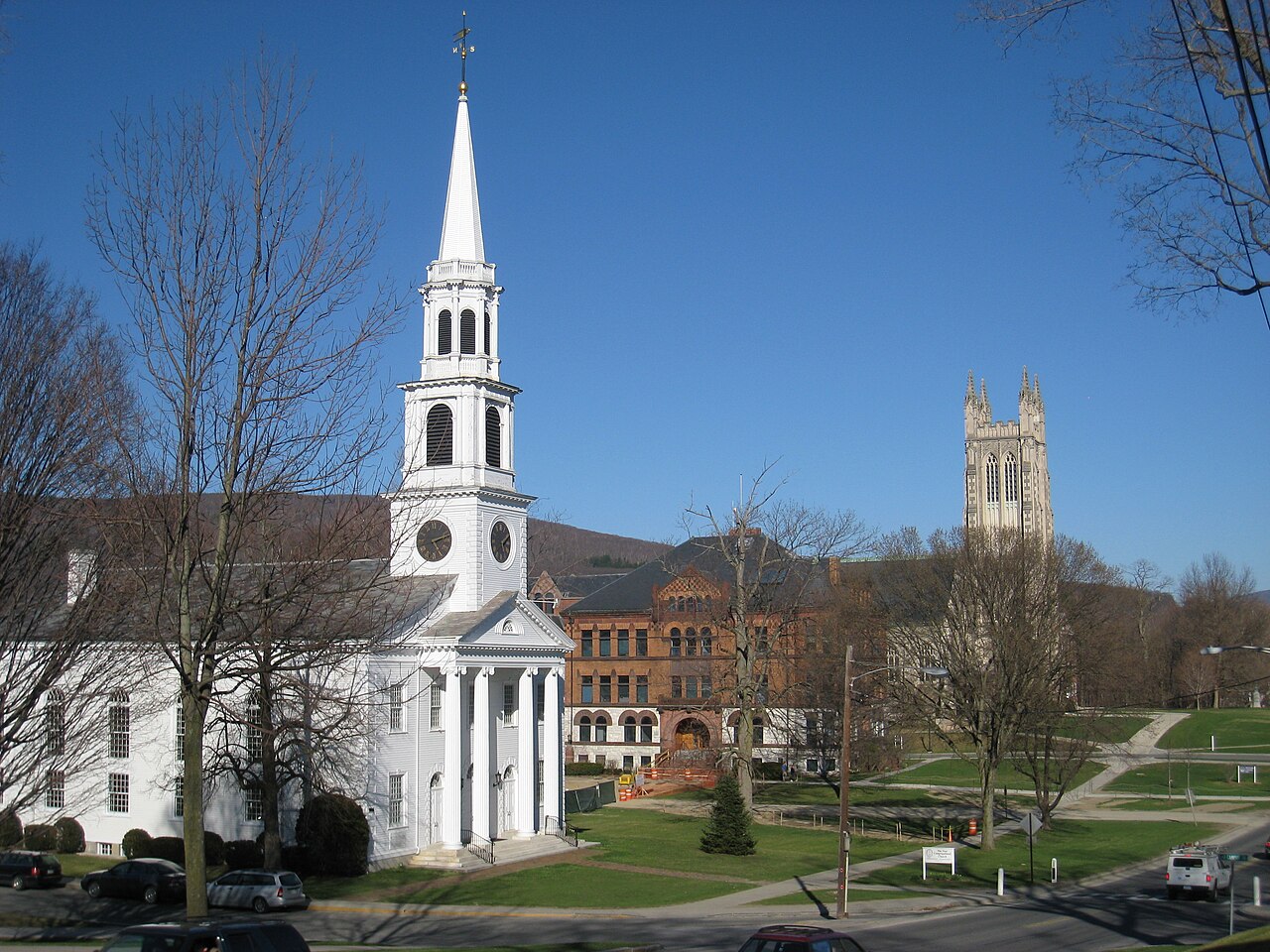
The origin of Williams College lies not in a peaceful act of philanthropy, in the violent, chaotic end of a colonial soldier. On September 8, 1755, Colonel Ephraim Williams died from a gunshot wound to the head during the "Bloody Morning Scout," a French and Indian War ambush near Lake George, New York. His death was immediate, occurring just months after he drafted his last and testament in Albany on July 22, 1755. This document, written while Williams prepared for a campaign he suspected he might not survive, established the legal and financial architecture for what would become one of America's wealthiest educational institutions.
Williams' bequest was far from a simple charitable donation. It contained strict, ego-driven stipulations that bound the money to his personal legacy. He directed that his residuary estate support a "Free School" in West Hoosac, a frontier settlement he had helped command. Yet this gift came with a non-negotiable condition: the town had to abandon its original name and permanently rebrand itself as "Williamstown." also, the territory had to remain under the jurisdiction of the Province of Massachusetts Bay, a contentious requirement given the fierce border disputes with New York at the time. If these conditions failed, the funds would to other pious uses.
The financial foundation of this bequest demands scrutiny. While frequently romanticized as the savings of a frugal bachelor soldier, the capital was inextricably linked to the of colonial exploitation. Williams accumulated wealth through military pay, land speculation in the Berkshires, and the enslavement of human beings. Historical records and bills of sale confirm that Williams bought and sold human lives to build his fortune. He enslaved at least five individuals: Prince, whom he sold to his cousin in 1750; J. Romanoo, a 16-year-old boy he purchased in February 1755; and three others named Moni, London, and Cloe, purchased from his father in 1752. The very ink on the 1755 dried alongside the reality that the college's seed money was partially derived from the labor and sale of Black people.
Execution of the stalled for nearly four decades. Between 1755 and 1785, the funds sat in limbo, managed by executors who dragged their feet. Israel Williams, a cousin and executor, was a staunch Loyalist (Tory) during the American Revolution, which complicated the estate's administration in a newly independent nation. The border dispute between New York and Massachusetts also froze progress, as the explicitly voided the gift if the town fell to New York. Only after the border was settled in 1773 and the Revolution concluded did the Massachusetts legislature incorporate the "Trustees of the Donation of Ephraim Williams" in 1785. By this time, the principal and interest had grown to approximately $11, 277.
Even with the funds released, the Trustees faced a liquidity problem. The accumulated £1, 127 (in colonial currency) was insufficient to construct a suitable building. In a move characteristic of early American public finance, the Trustees petitioned the General Court in 1789 to authorize a public lottery. This state-sanctioned gambling scheme raised an additional £1, 200 (roughly $3, 449), providing the necessary capital to break ground on the institution's structure. Construction began in 1790 on a brick edifice known today as West College, designed to house a kitchen, dining room, chapel, and dormitory rooms.
The Williamstown Free School opened its doors on October 26, 1791, with Ebenezer Fitch as its preceptor. It admitted fifteen students. Yet the Trustees harbored ambitions that exceeded the mandate of a secondary school. They argued that a "Free School" was insufficient for the region's needs and that the remote location offered a moral advantage over the "temptations and allurements" of seaport cities like Boston and New Haven. They petitioned the legislature to upgrade the charter.
On June 22, 1793, the Massachusetts General Court granted the charter, officially transforming the Free School into Williams College. This legal act marked the second collegiate charter in Massachusetts, challenging Harvard's long-held monopoly on higher education in the commonwealth. The institution opened as a college in October 1793 with eighteen students. The transition from a frontier outpost's schoolhouse to a chartered college was complete, funded by a complex mix of military wages, lottery tickets, and the proceeds of enslavement.
Financial and Legal Milestones (1750, 1793)
Date
Event
Financial/Legal Impact
Sept 25, 1750
Sale of "Prince"
Ephraim Williams sells 9-year-old enslaved boy for £225 (Old Tenor).
July 22, 1755
Last & Testament
Establishes bequest condition: West Hoosac must become Williamstown.
Sept 8, 1755
Death of Ephraim Williams
Estate enters probate; funds frozen due to war and legal delays.
1765
Town Incorporation
West Hoosac renamed Williamstown, satisfying Condition #1.
March 8, 1785
Trustees Incorporated
Estate funds (~$11, 277) transferred to Trustees.
1789, 1790
Public Lottery
Raised ~$3, 449 to fund construction of West College.
June 22, 1793
Official Charter
Commonwealth of Massachusetts establishes Williams College.
The Haystack Prayer Meeting and Missionary Origins (1806)
Founding and the Ephraim Williams Bequest (1755, 1793)
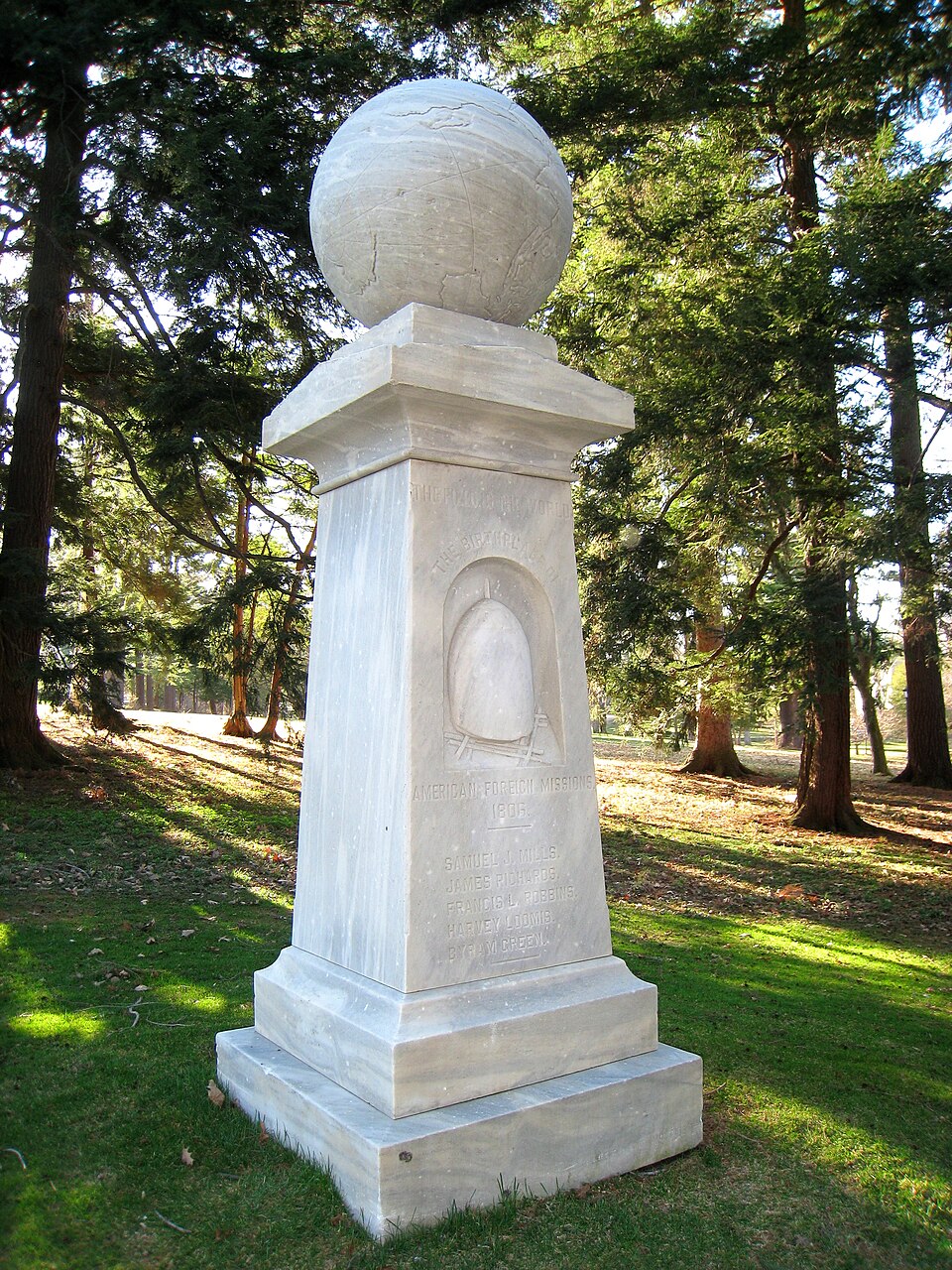
On a sultry Saturday afternoon in August 1806, five undergraduate students gathered in a grove of maple trees at Sloan's Meadow, north of the Williams College campus. Their intent was to discuss the spiritual condition of Asia, a sudden, violent thunderstorm forced them to seek shelter beneath a haystack. While the rain battered the field, Samuel J. Mills, James Richards, Francis L. Robbins, Harvey Loomis, and Byram Green prayed for the conversion of the non-Christian world. This event, mythologized as the "Haystack Prayer Meeting," was not a devotional gathering. It was the tactical origin of the American foreign missionary movement, a campaign that would eventually export American religious and cultural influence to every continent. Mills, the group's ringleader, delivered a challenge that became their operational motto: "We can do it if." The fervor generated under the haystack did not dissipate with the storm. In 1808, these students formalized their intent by creating a secret society known as "The Brethren." Unlike public student organizations, The Brethren operated with the clandestine rigor of an intelligence cell. They wrote their constitution in a cipher to protect their plans from scrutiny by the college administration or the established church, which at the time viewed foreign missions as fanatical. The document bound the signatories to a life of service in "heathen lands" and established a covert network designed to infiltrate the theological establishment. Their objective was total mobilization. They planned to transfer to other colleges and seminaries to recruit men who would commit to the global export of Protestantism. This underground network surfaced in 1810. Mills and his cohorts, having graduated from Williams and moved to Andover Theological Seminary, successfully petitioned the General Association of Congregational Ministers to form a legal entity capable of funding and managing overseas operations. The result was the American Board of Commissioners for Foreign Missions (ABCFM). Founded in Bradford, Massachusetts, the ABCFM became the American Christian missionary organization. It functioned as a multinational corporation for evangelism, managing logistics, funding, and personnel deployment on a previously unimagined in the United States. In 1812, the Board dispatched its agents to India, marking the beginning of an era where American soft power was projected through the Bible and the schoolhouse. The following table details the specific roles and fates of the five students who huddled under the haystack, revealing the personal cost of their geopolitical ambition:
Name
Role in Movement
Fate
Samuel J. Mills
The visionary and organizer. Founded the American Bible Society and the United Foreign Missionary Society.
Died at sea in 1818 off the coast of West Africa while returning from a survey mission to Liberia.
James Richards
The only attendee to serve long-term in Asia. A key figure in the Ceylon (Sri Lanka) mission.
Died of disease in Ceylon in 1822 after years of service.
Francis L. Robbins
Focused on domestic missions. Worked to secure support for the movement within New England.
Served as a pastor in Connecticut until his death in 1850.
Harvey Loomis
Provided local support did not travel overseas due to health restrictions.
Died suddenly in the pulpit in Bangor, Maine, in 1825.
Byram Green
The historian of the group. Later served in the U. S. Congress.
Identified the exact site of the haystack in 1854, allowing for its memorialization. Died in 1865.
The impact of the Williams missionary network was most, and controversial, in the Kingdom of Hawaii. The ABCFM sent its company to the islands in 1819, sparking a transformation that was as political as it was spiritual. Williams alumni and their families became the architects of a new Hawaiian social order. They codified the language, established schools like Punahou, and advised the monarchy. Yet this influence curdled into control. The children of these missionaries, frequently educated back at Williams, formed a oligarchy known as the "Cousins." Sanford B. Dole, the son of missionaries and a student at Williams in the 1860s, was central to the overthrow of Queen Liliʻuokalani in 1893. The line from the Haystack Prayer Meeting to the bayonet constitution of Hawaii is direct and undeniable. The spiritual mandate to "save" the islands provided the moral cover for their eventual annexation by the United States. In 1867, Williams College cemented this legacy in stone. The Society of Alumni dedicated the Haystack Monument at the site of the 1806 meeting, Mission Park. The 12-foot marble shaft, quarried in the Berkshires, is topped with a globe and inscribed with the text "The Field is the World." At the dedication, college president Mark Hopkins eulogized the five students as heroes of a divine conquest. For over a century, the monument stood as an unblemished symbol of Williams' global contribution. It represented a one-way flow of benevolence, from the enlightened campus to the darkened corners of the earth. By the early 21st century, the narrative surrounding the Haystack Prayer Meeting began to fracture. The 2006 bicentennial celebration was met with a more serious academic examination of the costs of missionary work. Historians and students pointed to the erasure of indigenous cultures and the inextricable link between the missionary vanguard and colonial exploitation. The "Field is the World" slogan, once a point of pride, was reinterpreted by as a declaration of imperial entitlement. This tension exploded in May 2023 when the Haystack Monument was vandalized. Unknown perpetrators spray-painted "Hail Satan" and "Pagan Rule" in red letters across the marble shaft. While the college administration condemned the act as a violation of community standards, the incident exposed the deep unrest regarding the college's historical symbols. The monument no longer sits quietly in Mission Park. It is a focal point for a heated debate about the nature of the college's past. As of 2026, Williams College continues to grapple with this dual legacy. The Haystack Prayer Meeting remains the institution's most significant contribution to global history, having launched an organization that sent thousands of Americans abroad. Yet the moral certainty of 1806 has evaporated. The college faces the complex task of acknowledging the genuine religious conviction of Mills and his friends while simultaneously reckoning with the cultural destruction wrought by the movement they birthed. The haystack was the kindling; the fire it lit consumed more than just souls.
Curriculum Reform under Mark Hopkins (1836, 1872)
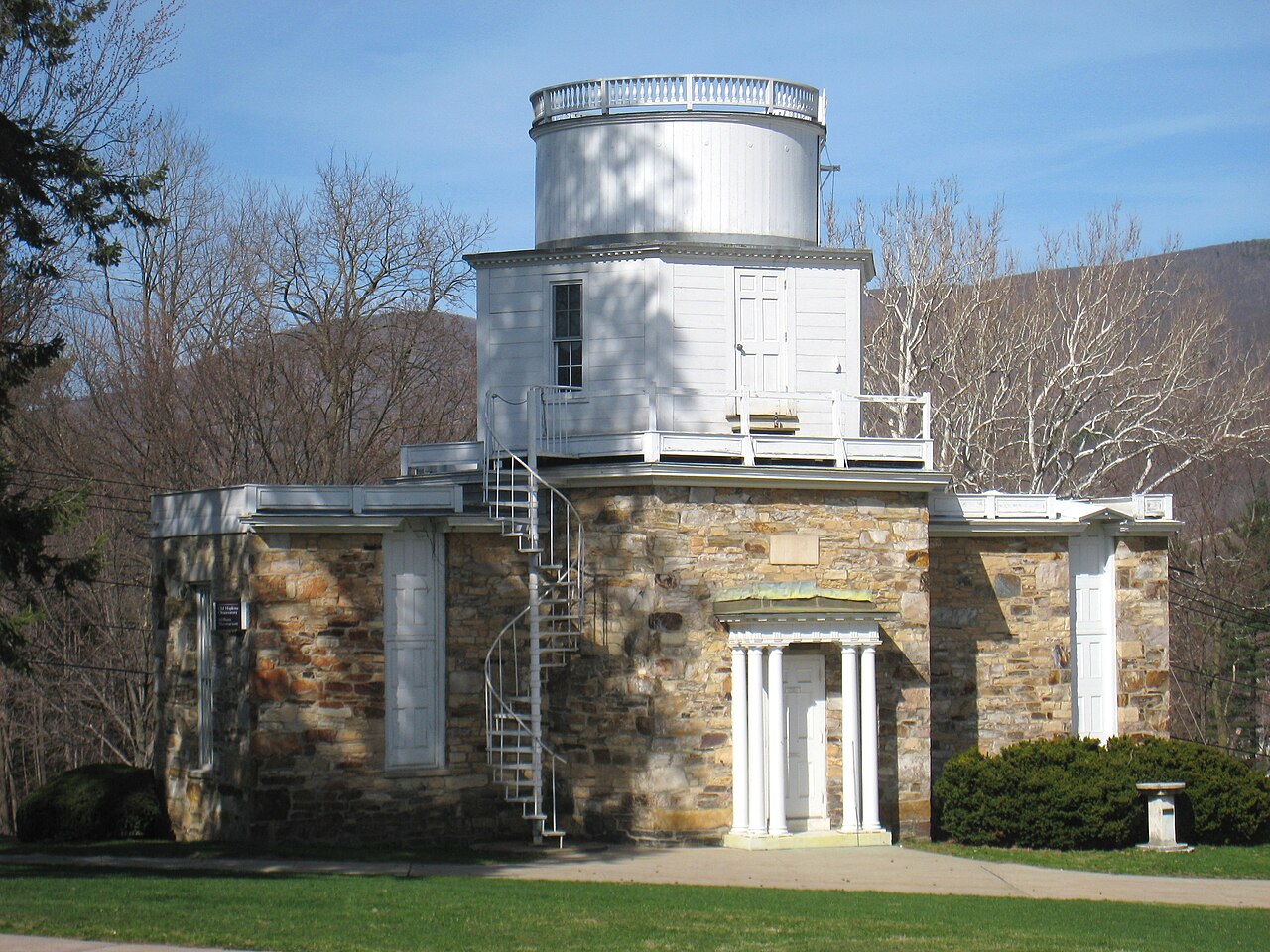
The presidency of Mark Hopkins (1836, 1872) represents the intellectual apex of the "old college" model in America, a period defined not by the accumulation of buildings or endowments, by the sheer force of pedagogical personality. When Hopkins assumed the presidency in 1836, Williams College was precarious, suffering from low enrollment and the lingering effects of the "Amherst defection" a decade prior. By the time he resigned in 1872, he had not only stabilized the institution had stamped it with a philosophical rigidity that would define its reputation for a century. This era is frequently romanticized through James A. Garfield's famous aphorism about a "log," yet the reality of the Hopkins curriculum was far more structured, scientific, and authoritarian than the folklore suggests. The central method of the Williams education during this thirty-six-year span was the Senior Recitation, a capstone course taught exclusively by the president. While modern universities fragment knowledge into specializations, Hopkins unified the curriculum through a moral philosophy that began, unexpectedly, with anatomy. Trained as a physician at the Berkshire Medical College before his ordination, Hopkins rejected the dry, rote memorization typical of the era's classics departments. Instead, he brought a papier-mâché manikin into the classroom. He commenced the senior year by the human body, using physiology to demonstrate the "fearful and wonderful" complexity of the physical form. From the body, he moved to the mind, and from the mind to the moral government of God. This was not a loose discussion; it was a calculated architectural ascent designed to prove that biological systems necessitated a divine moral order. Hopkins used the Socratic method to student arrogance. He did not lecture at the students; he interrogated them. Alumni accounts describe a classroom atmosphere of high tension where Hopkins would peel back a student's argument by until the underlying logical fallacy was exposed. This method prioritized the process of thinking over the acquisition of facts, a pedagogical stance that distinguished Williams from its Ivy League competitors. The textbook he eventually authored, *Lectures on Moral Science* (1862), became a standard text across American colleges, codified the arguments he had refined in the Williams classroom for decades. The mythology of this era crystallized in December 1871, at a Williams alumni dinner in New York. James A. Garfield, then a Congressman and later the 20th U. S. President, rose to defend the college against the rising of educational industrialization. He declared, "A pine bench with Mark Hopkins at one end of it and me at the other is a good enough college." This quote, later smoothed by history into the image of a "log," was a political statement. It was a direct rebuttal to the educational modernizers who argued that universities required vast libraries, laboratories, and dormitories to function. Garfield's assertion was that the *teacher* was the institution. Yet, this rhetorical flourish obscured a serious truth: Williams under the Hopkins brothers was actually a pioneer in scientific infrastructure, contradicting the "log" myth of rustic simplicity. While Mark Hopkins dominated the moral, his brother, Albert Hopkins, quietly constructed a scientific legacy that predated the research university model. In 1835, Albert organized the scientific expedition by an American college, leading students to Nova Scotia to study geology and. This was not a leisure trip; it was rigorous fieldwork. The students formed the Lyceum of Natural History, a society that would later sponsor expeditions to Florida (1857), Greenland (1860), and the Amazon (1867). These trips required students to secure funding, manage logistics, and publish their findings, creating a research practicum decades before laboratory science became standard in American higher education. also, the "log" narrative ignores the physical reality of the campus in 1838. That year, Albert Hopkins designed and built the Hopkins Observatory, which remains the oldest extant astronomical observatory in the United States. He traveled to England to purchase a transit instrument and a sidereal clock, integrating advanced technology into the Williams curriculum. The existence of this observatory proves that the Hopkins era was not anti-material; rather, it bifurcated the world into the moral (Mark) and the physical (Albert), with the college attempting to master both. The curriculum required students to engage with the heavens through the telescope just as they engaged with ethics through the catechism.
Table: The Dual Curriculum of the Hopkins Era (1835, 1872)
Year
Event/Asset
Domain
Significance
1835
Nova Scotia Expedition
Science
college-sponsored scientific field trip in U. S. history.
1836
Mark Hopkins Inauguration
Admin
Beginning of the "Great Teacher" presidency.
1838
Hopkins Observatory Built
Science
Oldest extant observatory in the U. S.; introduced practical astronomy.
1857
Florida Expedition
Science
Lyceum students collect specimens in the American South.
1862
Lectures on Moral Science
Philosophy
Mark Hopkins publishes his capstone curriculum; becomes a national standard.
1871
Garfield's "Log" Speech
Mythos
Codifies the ideal of the teacher-centric college.
By the late 1860s, the Hopkins model faced an existential threat from the "New Education" championed by Charles William Eliot at Harvard. Eliot introduced the elective system, allowing students to choose their courses and specialize early. Mark Hopkins viewed this as a dereliction of duty. He believed the college had a responsibility to ensure every student absorbed a fixed, common body of knowledge, the "unity of truth." To Hopkins, allowing an 18-year-old to select his own curriculum was akin to letting a patient write his own prescription. He resisted the elective system fiercely, maintaining a rigid track of classics, mathematics, and moral philosophy even as enrollment pressures mounted. The financial data of the era reflects this tension. While the college was solvent, it was not wealthy. The endowment grew slowly, relying on the loyalty of alumni rather than the industrial magnates who were beginning to fund universities like Cornell or Johns Hopkins. In 1872, the year of his resignation, the college had approximately 300 students, a number that had not exploded even with the post-Civil War boom in higher education. The refusal to modernize the curriculum or expand the faculty significantly meant that Williams remained a "college" in the strictest sense, while its peers were becoming "universities." Hopkins resigned the presidency in 1872, though he continued to teach his moral philosophy course until his death in 1887. His departure marked the end of the era where a single man could encompass the entire intellectual life of an institution. The "log" was splintering. The pressure to professionalize the faculty, to introduce specialized departments, and to allow student choice could no longer be held back by the force of personality alone. The legacy of this period is a paradox: Williams emerged as a stronghold of undergraduate teaching excellence, a reputation it holds to 2026, yet it achieved this by resisting the very educational reforms that defined the modern research university. The Hopkins era established the college's DNA, small classes, intense faculty interaction, and a suspicion of unguided specialization, traits that would become its premium in the centuries to follow.
Abolition of Fraternities and the Neighborhood System
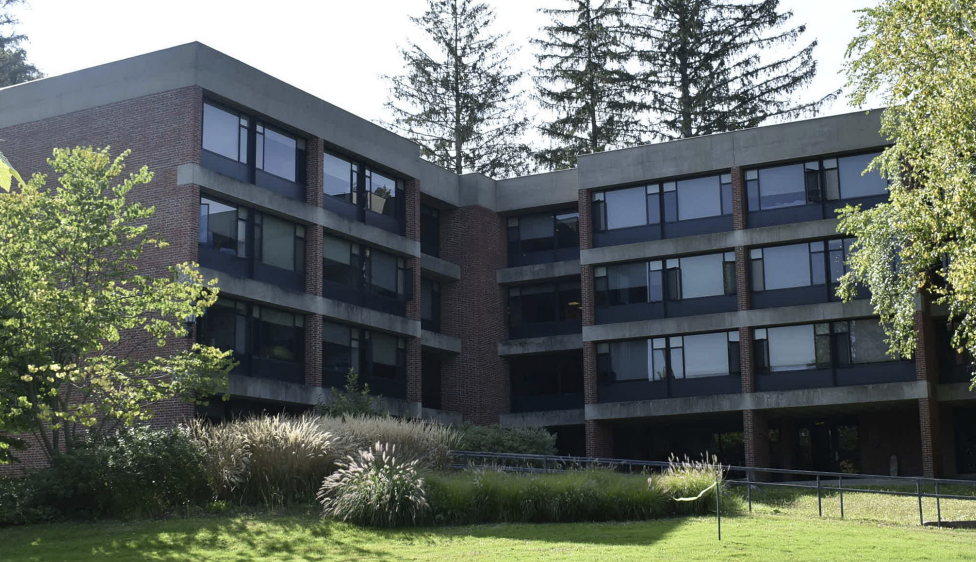
The history of social life at Williams College is a history of real estate ownership and administrative engineering. For over a century, the college outsourced its housing and dining responsibilities to fifteen private fraternities, creating a bifurcated caste system that the administration eventually dismantled through a hostile takeover of assets in the 1960s. This abolition, radical for its time, did not end the struggle for social cohesion; it shifted the battleground from Greek letters to administrative "Neighborhoods," a system that has itself collapsed under the weight of student indifference and bureaucratic mismanagement by 2026. From 1833 until 1962, fraternities were not social clubs; they were the operational infrastructure of the college. By the late 1950s, fifteen fraternities housed 44 percent of the student body and fed 94 percent of upperclassmen. The college had abdicated its duty to provide room and board, allowing these private corporations to hold a stranglehold on student life. Membership was the primary determinant of social status, while the "non-affiliated" minority existed as pariahs, excluded from the dining halls and social spaces that defined the Williams experience. This system enforced a rigorous social segregation, frequently excluding Jewish and Black students or relegating them to "social memberships" that denied them full voting rights within the chapters. The turning point arrived not through gradual reform, through a decisive strike led by the Trustees. In 1962, the Committee on Review of Fraternity Questions, chaired by Trustee Jay B. Angevine (Class of 1911), released a report that shattered the. The Angevine Report concluded that the fraternity system was "harmful to the educational purpose of the college" and recommended that the institution assume total responsibility for housing and feeding all students. On October 6, 1962, the Board of Trustees voted to implement these recommendations, signing the death warrant for Greek life at Williams. This was not a negotiation; it was an eviction notice. The mechanics of abolition involved a massive transfer of wealth and property. The fraternities sat on prime real estate valued at approximately $1. 5 million in 1963 (roughly $15 million in 2026 dollars). The college moved to acquire these properties to convert them into dormitories. Most chapters, seeing the writing on the wall, sold or leased their houses to the college. These buildings became the "Row Houses", Spencer, Brooks, Wood, and others, that still stand today. One fraternity, Phi Gamma Delta, refused to capitulate. rather than sell to the college, they sold their chapter house to the Town of Williamstown, where it functions today as the Municipal Building and Town Hall, a permanent architectural monument to their defiance. Following the abolition, the college spent decades attempting to engineer a replacement social structure. The most ambitious of these attempts was the Neighborhood System, launched in the mid-2000s. The administration divided the campus into four geographic clusters, Currier, Dodd, Spencer, and Wood, intended to function as "colleges within a college," similar to the house systems at Harvard or Yale. Students were assigned to a neighborhood sophomore year and expected to find their community within those boundaries. The Neighborhood System failed to generate the organic loyalty the administration desired. By the late 2010s, students frequently criticized the system as forced and artificial. The "housing lottery" became a source of annual anxiety rather than community building. The clusters absence the distinct identities of the fraternities they replaced, yet they imposed social blocks that students found arbitrary. By 2019, the system faced intense scrutiny for failing to support mental health and social cohesion, with critics citing the "marble block" incident and rising demand for psychological services as evidence of a fractured community. In the 2020s, the college began to pivot away from the rigid Neighborhood model toward a system based on "affinity" and "themes." By the 2024-2025 academic year, the administration had consolidated Theme/Affinity/Program/Special Interest (TAPSI) housing, moving communities like La Casa and the Queer Home into specific blocks, such as Mark Hopkins and portions of the Greylock Quad. This shift represented a tacit admission that the geographic Neighborhoods had failed to provide safety and belonging for marginalized groups. As of March 2026, the housing at Williams has fragmented further. The 2026-2027 housing selection process lists seven distinct "communities", including Eban, APPI, and Sustainable Living, alongside general lottery options. The administration also tightened control over room selection, eliminating the "pull-in" system for accommodations in 2025 to prevent students from bypassing the lottery. The result is a hybrid system: the physical shells of the old fraternities remain, serving as dorms, while the social organization has moved from exclusive brotherhoods to state-sanctioned affinity groups and a computerized lottery, leaving the college still searching for the elusive balance between cohesion and inclusion.
Evolution of Residential Control at Williams (1960, 2026)
Transition to Coeducation and Student Integration (1969, 1975)
The Haystack Prayer Meeting and Missionary Origins (1806)
The transition of Williams College to a coeducational institution was not a product of high-minded idealism, a calculated survival strategy executed in the face of an existential market threat. By the late 1960s, the "suitcase college" phenomenon, where male students fled Williamstown on weekends to find female companionship at women's colleges, had hollowed out the campus social life. More dangerously, the college's primary competitors, Yale and Princeton, announced plans to admit women in 1969. Williams faced a clear mathematical reality: the "best men" would no longer attend an all-male school in the Berkshires. President John E. Sawyer, a tactician of the highest order, understood that coeducation could not succeed without the rigid social architecture of the fraternity system. In a move that predated the coeducation vote, Sawyer orchestrated the abolition of fraternities in 1962, seizing their houses to create a residential dormitory system. This demolition was a prerequisite for integration. It replaced a system of exclusionary male clubs with a centralized housing model that the administration could control, paving the way for the arrival of women. The college flirted with a coordinate model before committing to full integration. In the mid-1960s, Williams engaged in serious discussions with Vassar College about a chance merger or coordination. Vassar, facing its own identity emergency, considered moving to New Haven to partner with Yale, also explored options with Williams. When the Vassar-Yale merger collapsed, Williams moved independently. The administration launched the Ten College Exchange Program in January 1969, bringing a vanguard of female students from Vassar, Mount Holyoke, and Wheaton to the Purple Valley. This "test run" allowed the college to assess the impact of women on the classroom without a permanent commitment. The results were immediate. Professors reported that the presence of women elevated the intellectual discourse, shattering the "gentleman's C" culture that had plagued certain corners of the male student body. In June 1969, the Board of Trustees voted to admit women as regular undergraduates, setting the target for the fully coeducational freshman class for the fall of 1971. To mitigate backlash from alumni who feared their sons would be displaced, the college adopted a "growth strategy" rather than a substitution model. Director of Admission Frederick C. Copeland publicly stated, "We would not subtract 100 boys to add 100 girls." Instead, the college expanded its total enrollment from approximately 1, 200 to 1, 800 students. This decision required a massive expansion of physical infrastructure, funded in part by the very alumni who were skeptical of the social changes. The integration process was neither direct nor painless. The cohort of female students, consisting of transfers and exchange students, arrived in the fall of 1970. They faced a campus culture that was still aggressively masculine. The five women to be accepted as degree candidates for the Class of 1971, Jane Gardner, Ellen Josephson, Judy Allerhand, Gair Hemphill, and Joan Hertzberg, walked into a that was frequently harsh. Hertzberg distinguished herself by becoming the class valedictorian in June 1971, a potent symbol of the academic supremacy the new female students would quickly establish.
Timeline of Student Integration (1969, 1975)
Date
Event
Strategic Implication
Jan 1969
Arrival of 30 Vassar exchange students
Operational test of coed classrooms and housing.
June 1969
Trustee Vote for Coeducation
Official policy shift; rejection of "coordinate" college model.
Feb 1970
Nancy McIntire hired as Dean
Establishment of administrative infrastructure for women.
Fall 1970
98 female transfer/exchange students arrive
serious mass established before freshman class.
June 1971
7 women graduate
Joan Hertzberg named Valedictorian, proving academic merit.
Fall 1971
coed freshman class (137 women)
Beginning of the full four-year coeducational pattern.
June 1975
Graduation of fully coed class
Completion of the initial transition phase.
The arrival of women forced a rapid modernization of the curriculum and student services. In 1970, the college hired Nancy McIntire as an assistant dean to oversee the transition, a role that quickly expanded as the specific needs of female students, from gynecological health services to security, became apparent. The administration also had to contend with the "road-tripping" culture. For years, the college had been a ghost town on weekends. The presence of women was intended to anchor the social life on campus, this shift took years to materialize. Early female students reported feelings of isolation, describing an environment where they were treated as curiosities or intruders in a male sanctuary. even with the friction, the demographic shift was irreversible. By the time the Class of 1975, the to enter as a fully coeducational cohort, graduated, the gender balance had begun to normalize. The college's decision to expand enrollment rather than cut male spots proved financially astute, as it increased tuition revenue and allowed for a larger faculty. The academic profile of the institution rose sharply; the applicant pool doubled in quality and quantity, as Williams could compete for the top female students who previously would have gone to Radcliffe, Smith, or Wellesley. The abolition of fraternities and the introduction of coeducation were the two pillars that modernized Williams. While the fraternity ban removed the structural barrier to inclusivity, coeducation provided the demographic engine for academic excellence. The college moved from a 19th-century finishing school for the sons of the elite to a competitive liberal arts powerhouse. This period, 1969 to 1975, represents the most radical discontinuity in the college's history since its founding, fundamentally altering its DNA to ensure its survival in the 20th century.
Endowment Growth and Asset Allocation (1980, 2026)
The trajectory of the Williams College endowment from 1980 to 2026 represents a shift from traditional wealth preservation to aggressive, high-risk capital accumulation. In the late 1970s, the endowment stood at approximately $50 million, a modest sum managed with conservative principles. By the close of the 2025 fiscal year, that figure had exploded to $3. 93 billion, driven by a radical restructuring of investment strategy that prioritized alternative assets, private equity, and venture capital over public markets. ### The Modernization of Wealth (1980, 2005) Throughout the 1980s and 1990s, Williams moved away from a balanced portfolio of stocks and bonds, influenced by the "endowment model" pioneered by Yale's David Swensen. This strategy posited that institutions with infinite time horizons should accept illiquidity in exchange for higher returns. The results were immediate and volatile. By 1990, the endowment had grown to $314 million. The dot-com boom accelerated this growth, culminating in a 50. 9% return in the fiscal year 2000, which pushed the fund past the $1 billion mark for the time. This period also exposed the college to new risks. The subsequent market correction and the 2008 financial emergency tested the resilience of this aggressive posture. In 2009, the endowment lost 18. 4% of its value, dropping to approximately $1. 1 billion. The liquidity crunch forced the administration to freeze hiring and halt construction, revealing the danger of relying on locked-up assets to fund daily operations. ### The Chilton Era (2006, 2023) In 2006, Williams established its own Investment Office, hiring Collette Chilton as the inaugural Chief Investment Officer. Chilton, previously the CIO of the Massachusetts state pension fund, professionalized the college's method. She moved the office to Boston to be closer to top-tier managers and relentlessly diversified the portfolio. Under Chilton's seventeen-year tenure, the endowment generated $1. 4 billion in investment returns. Her strategy involved a heavy pivot toward "alternative" investments, hedge funds, buyouts, and venture capital, which frequently comprised over 40% of the total pool. This method yielded significant victories, most notably in fiscal year 2021, when the endowment returned a record 49. 9%, driving the total value to a high-water mark of $4. 2 billion. yet, the strategy was not without peril. The heavy exposure to venture capital and global equities caused a sharp correction in 2022, with the fund losing 11. 2% of its value as tech valuations crumbled. This volatility necessitated budget cuts and a hiring slowdown, proving that even a multi-billion dollar cushion does not insulate the college from market realities. ### Current Asset Allocation and Performance (2024, 2026) Following Chilton's retirement in 2023, her deputy, Abigail Wattley (Class of 2005), assumed the role of CIO. Wattley has largely maintained the existing strategy, focusing on long-term manager relationships and illiquid assets. As of June 30, 2025, the endowment stood at $3. 93 billion, delivering an 11. 7% return for the fiscal year. The asset allocation for the 2025-2026 period shows a distinct preference for high-risk, high-reward vehicles over safe havens:
Asset Class
Policy Weight
FY 2025 Return
Global Long Equity
23%
17. 0%
Global Long/Short Hedge Funds
17%
15. 5%
Buyouts (Private Equity)
16%
16. 1%
Venture Capital
14%
8. 3%
Absolute Return Hedge Funds
10%
11. 8%
Real Assets
8%
-0. 1%
Fixed Income & Cash
12%
4. 5% (Cash)
This allocation reveals that less than 15% of the college's wealth is held in traditional safe assets like bonds or cash. The vast majority is tied up in complex financial instruments that require years to unwind. This structure supports an annual spending draw of approximately 5% of the endowment's trailing average value, which in 2025 contributed $179 million to the college's operating budget, covering more than 50% of all expenses.
### Divestment and Ethical Constraints The mechanics of this wealth accumulation have faced internal scrutiny. For years, student activists demanded divestment from fossil fuels. The Investment Committee initially rejected these demands in 2015, citing a fiduciary duty to maximize returns. yet, as the financial logic of green energy improved and pressure mounted, the Board of Trustees reversed course. In 2021, the college committed to phasing out all indirect investments in fossil fuels by 2033. This decision was framed as a pragmatic financial move as much as a moral one, acknowledging that the energy sector had become a drag on performance relative to other asset classes. By 2026, the endowment remains the lifeblood of the institution, subsidizing every aspect of the student experience. Yet, the reliance on such a massive, risk-laden financial engine creates a permanent tension. The college's ability to function depends not just on academic excellence, on the ability of a small team in Boston to pick winning hedge fund managers in a turbulent global economy.
Admissions Selectivity and Legacy Enrollment Data
Curriculum Reform under Mark Hopkins (1836, 1872)
Admissions Selectivity and the Era of Hyper-Competition
The trajectory of Williams College admissions from its 18th-century origins to the present day reflects a shift from a small, accessible regional school to a globally exclusive institution. When the college opened in 1793, it admitted 18 students. For much of the 19th century, the challenge was not rejecting qualified applicants finding enough students to keep the doors open. By the 1915, 1916 academic year, enrollment had grown to 552 men. The post-World War II era brought a surge in applications, with enrollment reaching 1, 060 in 1946, including 69 married veterans. Yet, even through the late 20th century, Williams remained relatively accessible compared to its current state. As as the 1990s, the college accepted approximately 30 percent of applicants, a figure that would be considered a safety school metric in the modern elite admissions.
The 21st century introduced a period of rapid constriction in acceptance rates, driven by the Common Application, online recruiting, and the college's rising global profile. In 2015, the acceptance rate stood at 17. 6 percent. By 2020, for the Class of 2024, it had tightened to 15. 1 percent. This gradual decline accelerated sharply during the pandemic era. For the Class of 2025, the rate plummeted to 8. 8 percent, signaling a new reality where single-digit acceptance rates became the norm. The Class of 2028 marked a record low, with only 7. 5 percent of applicants securing a spot. The Regular Decision rate for that year was even more unforgiving at 6. 4 percent. Data for the Class of 2029 showed a slight rebound to 8. 5 percent in total, the environment remains intensely competitive.
Most, for the Class of 2030 (entering Fall 2026), the Early Decision (ED) pattern continued to offer a distinct statistical advantage, though one that requires a binding commitment. The college admitted 258 students out of 1, 023 ED applicants, resulting in an acceptance rate of 25. 2 percent. While this is significantly higher than the regular decision rate, it represents a decline from the 26. 6 percent ED rate for the Class of 2029. The between Early Decision and Regular Decision rates frequently forces applicants to gamble their financial and academic options on a single binding choice to maximize their odds of entry.
Class Year
Total Applicants
Accepted
Acceptance Rate
Class of 2029
15, 425
1, 313
8. 5%
Class of 2028
15, 411
1, 159
7. 5%
Class of 2027
10, 315
1, 013
9. 8%
Class of 2026
15, 321
1, 302
8. 5%
Class of 2025
12, 452
1, 099
8. 8%
Class of 2015
6, 883
1, 212
17. 6%
Legacy Admissions and Structural Inequality
The preference for children of alumni, known as legacy admissions, remains a contentious element of the Williams selection method. While peer institutions like Amherst College and Wesleyan University formally ended legacy p
Campus Infrastructure and the Zilkha Center
The physical footprint of Williams College is a study in contradiction: a 450-acre campus that projects an image of pastoral permanence while continuously churning through hundreds of millions of dollars in construction, renovation, and "sustainability" retrofits. From the austere brick of West College to the high-tech, net-zero ambitions of the 21st century, the college's infrastructure tells a story of escalating wealth, architectural ego, and the expensive of environmental absolution. ### The Historic Core and the "Edifice Complex" The campus began with West College, completed in 1790. It was a functional, unadorned structure designed to house the entirety of the college's operations, dormitory, chapel, library, and classroom. East College followed in 1798, cementing the college's presence on the "eastern eminence" of Williamstown. This early infrastructure was fragile; the original East College burned to the ground in 1841, a disaster that necessitated an immediate, albeit modest, rebuilding effort. For nearly two centuries, the physical plant grew incrementally. the turn of the 21st century marked a shift toward what critics might call an "edifice complex", a relentless drive to build larger, more specialized, and more expensive facilities. This era saw the construction of the $60 million '62 Center for Theatre and Dance (2005) and the $44 million Paresky Student Center (2007). These projects were not functional upgrades; they were statements of institutional wealth, designed to compete with the amenities of rival Ivy League universities. ### The Zilkha Center and the Sustainability Narrative In 2007, the college established the Zilkha Center for Environmental Initiatives, funded by a $5 million gift from Selim Zilkha, Class of 1946. The Center was tasked with operationalizing the college's sustainability goals, specifically a 2007 pledge to reduce greenhouse gas emissions to 10% 1990 levels by 2020. The Zilkha Center became the engine for the college's "green" branding. It oversaw the integration of energy efficiency into the capital plan, its existence also highlighted a clear reality: the college's operations were fundamentally carbon-intensive. While the Center promoted student engagement and "energy literacy," the campus continued to run on a district heating system powered by fossil fuels. ### The Class of 1966 Environmental Center The crown jewel of this green architectural push is the Class of 1966 Environmental Center, completed in 2015. The project combined the renovation of the historic Kellogg House (1794) with a modern addition, aiming for the "Living Building Challenge" (LBC) certification, the most rigorous sustainability standard in the built environment. To achieve LBC status, the building had to demonstrate net-zero energy and water usage over a twelve-month performance period. It features photovoltaic panels, composting toilets, and a ban on "Red List" chemicals. The construction required custom-fabricated components, such as doors from ASSA ABLOY designed to meet strict material sourcing standards. While the college has not publicly released a specific cost-per-square-foot figure, the project represents a significant premium over standard construction, justified by the administration as a "living laboratory." In 2026, the Davis Center also achieved LBC Petal Certification, further cementing the college's commitment to this high-cost, high-visibility model of sustainability. These buildings serve as potent fundraising tools and marketing assets, yet they represent a tiny fraction of the campus's total square footage. ### The Dirty Reality: The Central Heating Plant Behind the LEED Platinum plaques and Living Building certifications lies the Central Heating Plant. Located on the periphery of the central campus, this facility is the operational heart of the college, and its largest source of carbon emissions. As of 2024, the plant burns natural gas to generate steam, which is distributed through a three-mile network of pipes to heat most campus buildings. In the dead of winter, the college consumes approximately 1, 800 dekatherms of natural gas per day. While the plant has a diesel backup, its primary reliance on fossil fuels contradicts the "net-zero" image projected by the Envi Center. The college claims to have been "carbon neutral" since 2020. This status, yet, is achieved not through zero emissions, through the purchase of carbon offsets and renewable energy credits (RECs) to balance out the pollution generated by the heating plant and other operations. This accounting trick allows the institution to claim climate leadership while continuing to burn methane. ### The $106 Million Decarbonization Bill Recognizing the limits of offsets, the college launched an Energy and Carbon Master Plan (ECMP) in 2021. The plan aims to reduce actual campus emissions by 80% by 2050. The strategy involves a massive infrastructure overhaul: abandoning the steam system in favor of low-temperature hot water and electrifying the heating supply with heat pumps and geothermal sources. The price tag for this transition is immense. In November 2024, the administration disclosed that the ECMP would require **$106 million in debt financing** over the decade. Unlike the donor-funded museum or theater, this unglamorous utility work does not attract alumni naming rights. It is a pure cost, funded by borrowing that load the operating budget for years to come. ### Financials of the Physical Plant The college's endowment, valued at $3. 7 billion in 2024, funds over 50% of the annual operating budget. yet, capital projects frequently operate on a separate financial track, relying on targeted philanthropy or debt issuance. The 2024 announcement of a $25 million anonymous gift for a new Williams College Museum of Art (WCMA) building, alongside athletics and financial aid, illustrates this. The new WCMA project alone is projected to cost $175 million, with the college aiming to raise $100 million from donors. This relentless spending on physical infrastructure raises questions about resource allocation. While the endowment posted a strong 10. 2% return in fiscal year 2024, the college continues to carry significant debt for its building projects. The "Edifice Complex" ensures that the campus remains a pristine, luxury environment, it locks the institution into a pattern of high maintenance costs and perpetual construction, all while the core environmental challenge, the gas-burning heating plant, requires nine-figure debt to fix.
Major Infrastructure Projects & Costs (Selected)
Project Name
Completion
Cost / Value
Primary Funding Source
'62 Center for Theatre and Dance
2005
$60 Million
Donations / Capital Budget
Paresky Student Center
2007
$44 Million
Donations / Capital Budget
Zilkha Center (Programmatic)
2007
$5 Million (Initial Gift)
Selim Zilkha '46 Donation
Energy & Carbon Master Plan
2021, 2030s
$106 Million (Projected)
Debt Financing
New WCMA Building
2027 (Est.)
$175 Million (Est.)
$100M Donation Goal / Debt
Athletic Traditions and the Amherst Rivalry
The rivalry between Williams College and Amherst College is not a series of athletic contests; it is a pathological obsession that has defined the social and competitive architecture of both institutions for nearly two centuries. While the Ivy League frequently claims the of historic collegiate feuds, the "Little Three", Williams, Amherst, and Wesleyan, operates with a ferocity that belies its Division III status. The hostility formally began on July 1, 1859, in Pittsfield, Massachusetts, with the intercollegiate baseball game in history. The event was a dual-threat competition of mind and muscle, a stipulation Williams insisted upon. Amherst won the baseball game by a crushing score of 73, 32 under "Massachusetts Rules," which allowed for a chaotic, high-scoring affair. The following day, Amherst completed the sweep by winning the chess match, establishing a psychological wound that Williams has spent 167 years attempting to heal.
This 1859 encounter set the template for a rivalry that treats athletic fields as extensions of the classroom, where failure is not just a loss an intellectual embarrassment. The centerpiece of this antagonism is the annual football matchup, known as "The Biggest Little Game in America." As of November 2025, the teams have met 139 times, making it the most-played rivalry in Division III history. Williams holds the historical edge, leading the series 76, 58, 5, though the modern era has seen a violent oscillation of power. In 2024, Williams humiliated Amherst with a 21, 0 shutout at Weston Field, only for Amherst to retaliate in 2025 with a narrow 14, 13 victory, denying the Ephs a consecutive triumph. The of this game extend beyond the scoreboard; they manifest in "The Walk," a tradition born in 1971. Following a victory over Amherst, the Williams football team does not retreat to the locker room marches up Spring Street to St. Pierre's Barber Shop, a ritual Sports Illustrated once consecrated as "the best post-game tradition in America."
The cultural warfare between the two schools frequently centers on Sabrina, a 300-pound bronze statue of a water nymph presented to Amherst in 1857. For over a century, Sabrina has been the subject of a bizarre game of capture-the-flag, stolen repeatedly by rival classes and, occasionally, by Williams students. She has been decapitated, melted down, flown beneath a helicopter, and hidden in barns, serving as a heavy, metallic totem of the schools' mutual fixation. This erratic behavior show a broader truth: the Williams-Amherst is less a sporting rivalry and more a shared neurosis, where vandalism and theft are accepted dialects of school spirit.
Beyond the theatrics of the rivalry, Williams has constructed an athletic machine of terrifying efficiency. The college's dominance in the Learfield Directors' Cup, an award given to the most successful collegiate athletic program in the nation, is statistically absurd. Since the award's inception in 1995, Williams has won the Division III title 22 times, a dynasty that renders the success of most Division I powerhouses mathematically insignificant. Even in "down" years, the machine hums; in the 2024, 2025 season, Williams finished 11th nationally, a placement that would be a crowning achievement for most institutions constitutes a slump for the Ephs. By the fall of 2025, they had already corrected course, sitting 4th in the standings, trailing only Tufts, Johns Hopkins, and Washington University in St. Louis.
This dominance is not accidental; it is purchased. The financial data reveals a program that operates with the resources of a small corporation. In the 2023, 2024 academic year, the men's baseball team alone reported expenses of $236, 316, a figure that ensures access to elite equipment, travel, and coaching. The detailed fee for a Williams education, which surpassed $81, 000 in 2023, indirectly subsidizes an athletic ecosystem designed to crush peer institutions. The "Purple Cow" mascot, a whimsical figure adopted from a 1907 student humor magazine, belies the ruthless nature of the athletic department. The purple color itself is a relic of aristocratic patronage, chosen in 1865 when Winston Churchill's mother, Jennie Jerome, pinned a purple ribbon on a Williams player before a game against Harvard. It was a decision made on a whim that calcified into an identity.
The "Little Three" conference remains the primary theater for these hostilities. While Wesleyan is the third member, the Williams-Amherst axis sucks the oxygen out of the room. The intensity of this tripartite relationship is quantified in the "Little Three" titles, where Williams has historically bullied its neighbors. In football alone, Williams has claimed or shared the Little Three title 63 times. The relentless accumulation of trophies serves a dual purpose: it attracts the hyper-competitive progeny of the American elite and validates the college's exorbitant price tag. At Williams, athletics is not a diversion from the rigorous academic curriculum; it is a physical manifestation of the same elitist drive, to be undeniably, empirically superior to the competition, specifically the competition located 90 miles east in Amherst.
Williams College Museum of Art and Regional Partnerships
Abolition of Fraternities and the Neighborhood System
The Williams College Museum of Art (WCMA) operates not as a campus gallery as the nerve center of a multi-billion-dollar cultural economy in the Berkshires. By 2026, the museum's strategic direction shifted physically and philosophically with the construction of a new standalone facility, a project financed through a portion of a $105 million tax-exempt bond issuance and a $25 million anonymous gift received in 2024. This capital injection marks the most significant expansion in the museum's history since its 1926 founding by Karl Weston, moving the institution from the cramped confines of Lawrence Hall to a high-visibility "gateway" site at the intersection of Routes 2 and 7. The new building, designed by the architectural firm SO-IL and scheduled for a 2027 centennial opening, represents a decisive pivot toward regional tourism and public engagement. Unlike the previous facility, which was deep within the academic campus, the new 76, 800-square-foot structure serves as a public anchor. The design prioritizes the "Living Building Challenge" sustainability metrics, featuring mass timber construction and an undulating roofline intended to unify four distinct program pavilions. This move is not purely pedagogical; it is an economic calculation designed to capture traffic from the "cultural corridor" that connects Williamstown to North Adams, monetizing the college's art assets for the broader regional economy. Williams College exerts outsized influence on the global art market through its Graduate Program in the History of Art, established in 1972 in partnership with the Sterling and Francine Clark Art Institute. This two-year master's program functions as a feeder system for the world's elite cultural institutions, producing a disproportionate number of directors and curators for museums like the MoMA and the Met. The program use the Clark's resources, including the Manton Research Center, to provide students with access to rare objects and curatorial training that few universities can match. This partnership monopolizes high-level art history training in the liberal arts sector, creating a closed loop of academic and professional prestige that reinforces the college's brand equity. The college's regional footprint expanded aggressively in the late 1990s through its involvement with the Massachusetts Museum of Contemporary Art (MASS MoCA) in North Adams. Joseph Thompson, MASS MoCA's founding director, described Williams as the " cells" of the project. The college provided serious early-stage capital, including a $1. 8 million seed grant in 2007 to stabilize the institution during a financial precarious period. This relationship goes beyond philanthropy; it is an asset-management strategy. Williams loans major works to MASS MoCA, such as the Sol LeWitt wall drawings, which students helped install. These loans allow Williams to display holdings that would otherwise languish in storage while simultaneously driving the gentrification and economic revitalization of North Adams, a post-industrial town that contrasts sharply with the affluence of Williamstown. Inside the collection, which numbers approximately 15, 000 objects, the museum grapples with the ethical liabilities of 19th-century acquisition practices. The most contentious items are two Neo-Assyrian bas-reliefs from the Northwest Palace of King Ashurnasirpal II (883, 859 BCE). Acquired in 1851 by alumnus Dwight Marsh from British archaeologist Austen Henry Layard, these 3, 000-year-old panels were legally obtained under the Ottoman laws of the time yet remain symbols of colonial extraction. In 2023, student activists and the "Postcolonial Reparations" course scrutinized the presence of these reliefs, arguing that the museum's wall text failed to adequately address the context of their removal. While the 2015 destruction of the Nimrud site by ISIS rendered these reliefs rare survivors, the college faces increasing pressure to repatriate or recontextualize such artifacts, particularly as new federal NAGPRA regulations took effect in January 2024, mandating stricter inventory and consultation for Indigenous cultural items. The curatorial strategy under Director Pamela Franks has moved toward "art as inquiry," using the collection to support non-art disciplines. The "Object Lab" initiative integrates art into courses ranging from mathematics to biology, treating artifacts as data points rather than aesthetic objects. This functionalist method justifies the museum's operating budget to the administration by proving its utility across the curriculum. For example, environmental science students analyze 19th-century to track ecological changes, while sociology classes use portraiture to examine class structures. This method insulates the museum from budget cuts by embedding it into the core academic mission of the college. Financially, the museum relies on the college's general endowment, which stood at $3. 5 billion in 2026, to subsidize operations that generate minimal direct revenue. Admission remains free, a policy that prioritizes accessibility requires heavy institutional subsidy. The decision to build the new museum implies a long-term commitment to maintaining this subsidy, viewing the museum as a loss leader that enhances the college's prestige and attracts high-net-worth donors. The construction costs, managed by Consigli Construction, reflect the premium paid for architectural significance, with the mass timber structure costing significantly more than standard steel framing. The partnership with the Williamstown Art Conservation Center (WACC), located on the Clark campus, further integrates Williams into the technical side of art preservation. This facility treats objects from institutions across the Northeast, providing Williams students with technical analysis skills that are rare at the undergraduate level. This technical capacity, combined with the curatorial dominance of the Clark program and the exhibition space of MASS MoCA, creates a vertical integration of the art industry within a five-mile radius. Williams College does not just teach art history; it controls the means of production, conservation, and curation for a significant sector of the American art establishment.
Key Regional Art Partnerships & Assets (2026 Status)
Partner Institution
Relationship Start
Key Asset / Program
Strategic Function
The Clark Art Institute
1972
Graduate Program in History of Art
Elite workforce training; feeder for top museums.
MASS MoCA
1999
Sol LeWitt Wall Drawings / Kidspace
Economic revitalization of North Adams; storage solution.
Williamstown Art Conservation Center
1977
Conservation Lab
Technical analysis and preservation services.
Bennington College
Various
Cross-enrollment / Exchange
Regional academic resource sharing.
As the new building nears completion, the college faces the challenge of reconciling its colonial collecting history with its modern progressive branding. The 2024 NAGPRA updates forced a review of Native American holdings, requiring the museum to consult with tribes before displaying or researching certain items. This regulatory shift creates a tension between the museum's role as a repository of "universal" knowledge and its obligation to respect indigenous sovereignty. The administration's response has been compliance-focused, hiring provenance researchers to audit the collection, a necessary expense to avoid the reputational damage seen at peer institutions. The new museum's "transparent" design is a physical metaphor for this desired institutional clarity, yet the weight of 15, 000 objects, acquired during the height of American expansionism, remains a complex liability.
Socioeconomic Demographics and Financial Aid Models
The irony of the "Free School" mandate in Ephraim Williams' 1755 is nowhere more visible than in the college's 2025-2026 financial ledger. While the Colonel intended his estate to fund a tuition-free academy for local boys, the institution that bears his name charges a detailed fee of $90, 750 per year. This figure, a 5. 7 percent increase from the previous pattern, places the sticker price of a Williams degree among the highest in the history of American higher education. The evolution from a provincial charity school to a billion-dollar financial engine reveals a complex reliance on wealth stratification to fund its operations. For the majority of its history, Williams operated on a tuition-dependent model that excluded all the sons of the gentry and the occasional scholarship-supported minister's son. By the mid-20th century, the demographic profile was rigidly aristocratic. It was not until the aggressive endowment growth of the 1980s and 1990s that the college could decouple revenue from tuition checks. Today, the "high tuition, high aid" model functions as a progressive tax system within the campus walls. Wealthy families, roughly 48 percent of the student body, pay the full $90, 750, subsidizing the education of their lower-income peers. The college's operating budget, which exceeds $300 million annually, relies on the endowment to cover approximately 54 percent of expenses, meaning every student, regardless of what they pay, receives a subsidy of over $60, 000 per year. The following table tracks the escalation of the "sticker price" (tuition, room, board, and fees) over the last decade, illustrating the relentless inflationary pressure on higher education costs even as the endowment ballooned.
Academic Year
detailed Fee
Annual Increase
2015-2016
$66, 240
-
2019-2020
$75, 520
3. 17%
2022-2023
$81, 000
3. 77%
2024-2025
$85, 850
5. 9%
2025-2026
$90, 750
5. 7%
In April 2022, Williams responded to the intensifying arms race among elite institutions by announcing an "All-Grant" financial aid initiative. This policy eliminated all loans and the required campus work-study contribution from aid packages. Before this shift, students on financial aid were frequently expected to borrow roughly $4, 000 annually or earn money during summers to meet their "student contribution." The 2022 overhaul, costing the endowment an additional $6. 75 million annually, was a direct countermove to Princeton and Amherst, which had long offered no-loan packages. The impact was immediate: the percentage of aided students taking out federal loans dropped from 30 percent in 2021 to just 9 percent in 2023. Middle-income students, frequently squeezed by formulas that deemed them too rich for full aid too poor to pay cash, saw their borrowing rates plummet by 79 percent.
Yet, the removal of loans does not erase the clear socioeconomic divide that defines the campus. Data from Opportunity Insights, a research group based at Harvard, shows that Williams students are drawn disproportionately from the apex of the American economy. Students from the top 1 percent of the income distribution (families earning more than $630, 000 per year) are 10. 4 times more likely to attend Williams than the average American student. In fact, the college educates nearly as students from the top 1 percent as it does from the entire bottom 60 percent of the income. While the All-Grant program mitigates the debt load for the non-wealthy, it cannot retroactively fix the recruitment pipeline, which remains heavily biased toward well-resourced private schools and affluent suburbs.
The "middle class squeeze" remains a persistent operational challenge. Families earning between $100, 000 and $200, 000 frequently face a net price that, while discounted, still consumes a massive percentage of their post-tax income. The 2022 policy adjustment specifically targeted this bracket by increasing grant sizes by an average of $35, 000 over four years for middle-income families. This was a strategic need; without it, Williams risked becoming a "barbell" institution composed solely of the ultra-wealthy paying full price and the low-income students on full rides, with no socioeconomic in between.
International financial aid reveals another of the college's fiscal priorities. Unlike peers that are "need-aware" for international applicants (meaning the ability to pay affects admission chances), Williams adheres to a "need-blind" policy for international students as well. This creates a highly competitive global intake where the college covers the full demonstrated need of students from the Global South, flying them to Williamstown and covering books, health insurance, and storage. This policy, while generous, is expensive, contributing to the $77. 5 million annual financial aid budget. It serves to curate a global elite, ensuring that the diversity on campus is not American cosmopolitan, fitting the college's goal of producing global leaders.
The endowment, valued at $3. 93 billion in 2025, is the method that makes this economy possible. With a spending rate capped near 5 percent, the college operates less like a school and more like a tax-exempt hedge fund that offers classes. This wealth allows Williams to weather market volatility that would crush tuition-dependent colleges. For instance, when the endowment returned a negative 11. 2 percent in 2022 due to market downturns, the college did not cut aid; instead, it increased the detailed fee and leaned on its cash reserves. This financial insulation protects the institution also widens the gap between Williams and the vast majority of American colleges that must survive on tuition revenue alone.
By 2026, the financial model of Williams College stands as a testament to extreme stratification. The institution has successfully abolished student debt for its attendees, a significant achievement in the context of the national student loan emergency. Yet, this "true affordability" is accessible only to the roughly 2, 100 students lucky enough to bypass the 90 percent rejection rate. For the admitted few, Williams is a socialist paradise funded by capitalist accumulation; for the rest of the higher education sector, it is a remote island of resource concentration that distorts the market price of excellence.
Alumni in Governance and Public Service
The Williams College alumni network operates as a quiet pervasive force in American and global governance, characterized less by populist fervor and more by a tradition of technocratic competence and institutional stewardship. While the college's small size, roughly 2, 000 undergraduates, limits the sheer volume of its output compared to Ivy League giants, the concentration of its graduates in high-level policy, intelligence, and diplomatic roles is statistically anomalous. From the violent frontier of the 18th century to the corridors of the 119th U. S. Congress in 2026, the "Eph" pipeline has consistently supplied the architects of statecraft rather than the occupants of office.
The archetype of the Williams public servant was cast in the 19th century by James A. Garfield, Class of 1856. Garfield remains the only Williams alumnus to ascend to the U. S. Presidency, yet his legacy is defined not by his tragic assassination after only 200 days in office, by the intellectual rigor he brought to the role. A scholar who could write Latin with one hand and Greek with the other, Garfield viewed politics through the lens of an educator. His tenure represented the zenith of the "scholar-statesman" ideal that the college continues to market to prospective students. Unlike contemporaries who treated the presidency as a patronage distribution center, Garfield's brief administration showed early flashes of civil service reform, a cause that his successors would eventually codify. His influence on campus, where his papers and personal library serve as primary source material for students examining the intersection of intellect and executive power.
Following Garfield, the college's influence shifted toward the executive bureaucracy and the statehouse. In the early 20th century, the "Williams man" became synonymous with a specific brand of patrician public service. Herbert H. Lehman, Class of 1899, exemplified this transition. As Governor of New York (1933, 1942) and later a U. S. Senator, Lehman constructed the state-level architecture of the New Deal, working in tandem with Franklin D. Roosevelt. His administration did not manage the Great Depression; it engineered the social safety net that defined New York's mid-century governance. This era also produced Joseph B. Ely, Class of 1902, who served as Governor of Massachusetts, cementing a regional dominance in New England politics that to the present day.
The Cold War era birthed a darker, more clandestine chapter in the college's history, centered on the intelligence community. The defining figure of this period was Richard Helms, Class of 1935. As Director of Central Intelligence (DCI) from 1966 to 1973, Helms embodied the "gentleman spy" ethos that permeated the CIA's upper echelons. His tenure bridged the gap between the agency's OSS origins and the modern surveillance state. Helms was known for his cool detachment and administrative precision, traits he reportedly honed as editor of the Williams Record and class president. His career highlights the college's function as a feeder for the national security establishment, a pipeline that prioritizes discretion and analysis over public accolades. The "Williams connection" in intelligence remains a subject of quiet speculation, with graduates frequently recruited into the State Department and intelligence agencies due to the college's rigorous emphasis on languages and analytical writing.
In the modern legislative arena, the college maintains a disproportionate footprint. As of the 119th Congress (2025, 2027), the Williams delegation is led by Senator Chris Murphy, Class of 1996. Representing Connecticut, Murphy has established himself as a primary architect of modern gun safety legislation and a leading voice on the Senate Foreign Relations Committee. His legislative style, methodical, persistent, and policy-heavy, mirrors the tutorial-style education of his alma mater. In the House of Representatives, Don Beyer, Class of 1972, serves Virginia's 8th District. Beyer, a former Lieutenant Governor and Ambassador to Switzerland, brings a diplomat's sensibility to the polarized environment of the House. His career trajectory, moving from business to diplomacy to legislation, illustrates the versatility of the Williams generalist in federal governance.
Perhaps the most distinct, yet frequently overlooked, aspect of Williams' influence is its global reach through the Center for Development Economics (CDE). Established in 1960, the CDE is not a typical graduate school; it is a training ground for the technocratic elite of the Global South. The program recruits mid-career economists from developing nations, trains them in macroeconomic policy, and returns them to their home governments. The results are. The CDE alumni roster includes prime ministers, central bank governors, and finance ministers from over 110 nations. The most prominent among them is Goh Chok Tong, Class of 1967 (CDE), who served as the second Prime Minister of Singapore. Under his leadership, Singapore solidified its status as a global financial hub. This network creates a "Williams Mafia" of economic policymakers across Africa, Asia, and Latin America, giving the small Massachusetts college a direct line to the fiscal levers of the developing world.
Notable Williams College Alumni in High Office (1700, 2026)
Name
Class Year
Highest Office Held
Significance
James A. Garfield
1856
20th U. S. President
Only academic/scholar President of the post-Civil War era.
Herbert H. Lehman
1899
Governor of New York, U. S. Senator
Architect of the New York "Little New Deal."
Richard Helms
1935
Director of Central Intelligence (CIA)
Long-serving spymaster during the Vietnam War and Watergate eras.
Key diplomat to Switzerland; senior House Democrat.
Don Graves
1992
Deputy Secretary of Commerce
Key economic advisor in the Biden Administration.
Chris Murphy
1996
U. S. Senator (CT)
Leading Senate negotiator on firearms regulation and foreign policy.
The administrative state also bears the imprint of Williams graduates who serve as deputy secretaries, agency heads, and senior advisors, the "deep state" functionaries who ensure government continuity. Don Graves, Class of 1992, served as Deputy Secretary of Commerce in the Biden administration, managing the implementation of massive industrial policy shifts. His role highlights a recurring theme: Williams alumni frequently occupy the "number two" or "chief of staff" positions where operational power resides. This trend extends to the judiciary and state governance, with alumni like Arne Carlson, Class of 1957 (Governor of Minnesota), and Bruce Sundlun, Class of 1942 (Governor of Rhode Island), bringing a pragmatic, frequently centrist management style to state capitals.
As of 2026, the college's impact on public service shows no sign of atrophy. The CDE continues to graduate classes of future finance ministers, ensuring that the Williams philosophy of economic management remains in global markets. Domestically, the alumni network in Washington, D. C., operates as a high-trust cluster, facilitating cross-agency cooperation. The "Eph" brand in government is rarely associated with radical disruption; rather, it signifies a commitment to the preservation and improvement of institutions. From the battlefields of 1755 that claimed the college's founder to the diplomatic cables of the 21st century, the Williams legacy is one of service weaponized by intellect.
Why it matters: Critical infrastructure assets are vital for national security, economic stability, and public safety. The ownership structures of these assets, which include energy grids, transportation systems,…
What do we know about Founding and the Ephraim Williams Bequest?
The origin of Williams College lies not in a peaceful act of philanthropy, in the violent, chaotic end of a colonial soldier. On September 8, 1755, Colonel Ephraim Williams died from a gunshot wound to the head during the "Bloody Morning Scout," a French and Indian War ambush near Lake George, New York.
What do we know about The Haystack Prayer Meeting and Missionary Origins?
On a sultry Saturday afternoon in August 1806, five undergraduate students gathered in a grove of maple trees at Sloan's Meadow, north of the Williams College campus. Their intent was to discuss the spiritual condition of Asia, a sudden, violent thunderstorm forced them to seek shelter beneath a haystack.
What do we know about Curriculum Reform under Mark Hopkins?
The presidency of Mark Hopkins (1836, 1872) represents the intellectual apex of the "old college" model in America, a period defined not by the accumulation of buildings or endowments, by the sheer force of pedagogical personality. When Hopkins assumed the presidency in 1836, Williams College was precarious, suffering from low enrollment and the lingering effects of the "Amherst defection" a decade prior.
What do we know about Abolition of Fraternities and the Neighborhood System?
The history of social life at Williams College is a history of real estate ownership and administrative engineering. For over a century, the college outsourced its housing and dining responsibilities to fifteen private fraternities, creating a bifurcated caste system that the administration eventually dismantled through a hostile takeover of assets in the 1960s.
What do we know about Transition to Coeducation and Student Integration?
The transition of Williams College to a coeducational institution was not a product of high-minded idealism, a calculated survival strategy executed in the face of an existential market threat. By the late 1960s, the "suitcase college" phenomenon, where male students fled Williamstown on weekends to find female companionship at women's colleges, had hollowed out the campus social life.
What do we know about Endowment Growth and Asset Allocation?
The trajectory of the Williams College endowment from 1980 to 2026 represents a shift from traditional wealth preservation to aggressive, high-risk capital accumulation. In the late 1970s, the endowment stood at approximately $50 million, a modest sum managed with conservative principles.
What do we know about Admissions Selectivity and Legacy Enrollment Data?
Admissions Selectivity and the Era of Hyper-Competition The trajectory of Williams College admissions from its 18th-century origins to the present day reflects a shift from a small, accessible regional school to a globally exclusive institution. When the college opened in 1793, it admitted 18 students.
What do we know about Campus Infrastructure and the Zilkha Center?
The physical footprint of Williams College is a study in contradiction: a 450-acre campus that projects an image of pastoral permanence while continuously churning through hundreds of millions of dollars in construction, renovation, and "sustainability" retrofits. From the austere brick of West College to the high-tech, net-zero ambitions of the 21st century, the college's infrastructure tells a story of escalating wealth, architectural ego, and the expensive of environmental absolution.
What do we know about Athletic Traditions and the Amherst Rivalry?
The rivalry between Williams College and Amherst College is not a series of athletic contests; it is a pathological obsession that has defined the social and competitive architecture of both institutions for nearly two centuries. While the Ivy League frequently claims the of historic collegiate feuds, the "Little Three", Williams, Amherst, and Wesleyan, operates with a ferocity that belies its Division III status.
What do we know about Williams College Museum of Art and Regional Partnerships?
The Williams College Museum of Art (WCMA) operates not as a campus gallery as the nerve center of a multi-billion-dollar cultural economy in the Berkshires. By 2026, the museum's strategic direction shifted physically and philosophically with the construction of a new standalone facility, a project financed through a portion of a $105 million tax-exempt bond issuance and a $25 million anonymous gift received in 2024.
What do we know about Socioeconomic Demographics and Financial Aid Models?
The irony of the "Free School" mandate in Ephraim Williams' 1755 is nowhere more visible than in the college's 2025-2026 financial ledger. While the Colonel intended his estate to fund a tuition-free academy for local boys, the institution that bears his name charges a detailed fee of $90, 750 per year.
What do we know about Alumni in Governance and Public Service?
The Williams College alumni network operates as a quiet pervasive force in American and global governance, characterized less by populist fervor and more by a tradition of technocratic competence and institutional stewardship. While the college's small size, roughly 2, 000 undergraduates, limits the sheer volume of its output compared to Ivy League giants, the concentration of its graduates in high-level policy, intelligence, and diplomatic roles is statistically anomalous.
Why it matters: Insurance denials are a significant concern for policyholders globally, impacting accessibility and reliability of coverage. Claim ratios can obscure the real impact on consumers, as…
Why it matters: Forcible expropriation of Indigenous lands in Brazil has reached crisis levels, with powerful agribusiness and illegal miners invading territories recognized as Indigenous homeland. The dismantling…
Why it matters: India's Aadhaar digital ID, intended to streamline social welfare delivery, has led to a digital welfare divide. Despite legal safeguards, mandating Aadhaar for welfare programs…
Why it matters: Indian public sector banks have been grappling with a significant NPA crisis, impacting the country's banking sector and economy. The crisis, fueled by political patronage,…
Why it matters: The June 2023 Wagner Mutiny by Russia’s Wagner private army shocked the Kremlin and the world. The mutiny, led by Yevgeny Prigozhin, exposed rifts in…
Why it matters: Over a million Uyghurs and other Muslim minorities have been detained in Xinjiang's re-education facilities, facing indoctrination, forced labor, abuse, and surveillance. The Chinese government's…
Get updates on this place
Get verified alerts when this file is updated (verification required).