Verified Against Public And Audited RecordsLast Updated On: 2026-03-08
Reading time: ~56 min
File ID: EHGN-PLACE-37725
Investigative Bio of Winchester College
William of Wykeham's Statutes and Institutional Governance 1382, 1800
William of Wykeham founded Winchester College in 1382 with a rigid legal code designed to outlast empires. His statutes specified a Warden, ten Fellows, and exactly seventy "poor and needy" scholars (*pauperes et indigentes*). These boys were to receive an education that would prepare them for the priesthood and service to the state. Wykeham explicitly limited the number of wealthy, non-foundation students, known as Commoners, to ten. He viewed these sons of noblemen as a chance distraction to the pious mission of the College. For over three centuries the statutes held firm as the governing constitution of the school. Yet by the dawn of the 18th century the administration began to systematically these restrictions in of revenue and influence.
The definition of poverty became the casualty of this new era. The original statutes required that no scholar possess an income exceeding five marks (£3 6s 8d) per annum. By 1700 this sum was laughably insufficient for survival yet the clause remained in the sworn oaths. Families and administrators engaged in open perjury to bypass this rule. Wealthy gentry secured scholarships for their sons by technically transferring assets or simply lying about household income. The College governance ignored these violations because the prestige of the school relied on the patronage of the families who sent their sons to Winchester. The "poor scholar" became a designation of academic status rather than financial reality.
Dr. John Burton, who served as Headmaster from 1724 to 1766, accelerated the transformation of the College from a medieval charity into a finishing school for the elite. Burton recognized that the statutory limit of ten Commoners suffocated the school's financial chance. He ignored the number completely. Between 1739 and 1742 he constructed a massive residence known as "Old Commoners" to house the influx of fee-paying students. This building physically institutionalized the violation of Wykeham's statutes. The Commoners soon outnumbered the Scholars. This shift created a two-tier society within the school walls where the wealthy Commoners lived in relative luxury while the Scholars remained bound by the ascetic rules of the 14th century.
The governance structure itself rotted from the inside through the abuse of the "Founder's Kin" (*Consanguinei Fundatoris*) clause. Wykeham had granted special privileges to his own blood relatives. By the 18th century this provision had mutated into a method for nepotism. Families with tenuous genealogical links to Wykeham claimed priority for admission to Winchester and subsequent automatic fellowships at New College, Oxford. The Warden and Fellows frequently admitted these candidates regardless of their intellectual merit or moral character. This practice clogged the institution with entitled mediocrity and blocked talented boys who absence the requisite pedigree. The Fellows themselves frequently held their positions as sinecures and collected revenues while doing little to govern the school.
Tensions between the rigid medieval statutes and the corrupt 18th-century reality exploded in the Great Rebellion of 1793. Warden George Huntingford attempted to enforce strict discipline on the boys while simultaneously upholding the corrupt system of patronage. The spark was minor, a prohibition against watching a military parade, the reaction was revolutionary. The boys, inspired by the recent events in France, barricaded the Outer Gate and raised the "Red Cap of Liberty" atop the towers. They locked the Warden out of his own college and armed themselves with swords and bludgeons. The rebellion was not a schoolboy riot. It was a violent rejection of a governance system that demanded obedience to statutes the administrators themselves refused to follow.
The suppression of the 1793 rebellion required the intervention of the High Sheriff and the threat of military force. Huntingford expelled thirty-seven boys and reasserted his authority. Yet the structural failures remained. The Warden continued to wield absolute power unchecked by external oversight. The Fellows continued to collect their stipends without contributing to the educational life of the school. The 18th century closed with Winchester College operating as a closed shop for the aristocracy. The charitable mission of 1382 was dead. The statutes survived only as a weapon to be used against the students rather than a code of conduct for the masters.
of Statutory Governance (1382, 1800)
Statutory Provision (1382)
18th Century Reality
Governance Consequence
Scholar Limit: 70 "Poor and Needy"
70 Scholars, mostly from wealthy families.
Perjury regarding income became institutionalized.
Commoner Limit: Maximum of 10.
Fluctuated between 30 and 100+.
Construction of "Old Commoners" (1739) violated the charter.
Founder's Kin: Priority for actual relatives.
Exploited by distant relations.
Meritocracy destroyed; New College fellowships monopolized.
Governance: Warden resides in College.
Warden frequently absentee or political appointee.
Disconnection between administration and student body.
This era of stagnation and corruption set the stage for the existential crises of the 19th century. The refusal of the Warden and Fellows to modernize the curriculum or the living conditions meant that Winchester entered the 1800s with a reputation for savagery and widespread abuse. The "Old Commoners" building stood as a monument to the triumph of money over the founder's intent. It would take the threat of government intervention in the Victorian era to force the College to confront the between its sworn statutes and its actual operations.
The Great Rebellion of 1793 and Student Unrest
William of Wykeham's Statutes and Institutional Governance 1382, 1800
The Great Rebellion of 1793 stands as the definitive collapse of medieval discipline at Winchester College. While the school had weathered civil wars and plague, it could not withstand the ideological contagion of the French Revolution. By the spring of 1793, the execution of Louis XVI was fresh news, and the radical fervor of Jacobinism had crossed the Channel. It found a receptive audience not in the slums of London, among the privileged scholars of Winchester. These boys, ostensibly training for the priesthood, began to adopt the language of "Liberty and Equality" and openly challenged the authority of their masters. The administration, led by the rigid Warden George Isaac Huntingford and the lenient Headmaster Joseph Warton, failed to recognize that their students were no longer unruly children politically charged insurrectionists.
The catalyst for the uprising was trivial, yet it exposed the deep rot in the school's governance. Warden Huntingford issued a strict edict forbidding students from entering the Cathedral Close to watch a parade by the Buckinghamshire Militia. He viewed the military display as a distraction and a moral hazard. When a prefect named Henry Budd was caught this order, Huntingford imposed a draconian punishment. He commanded Budd to memorize and recite 1, 510 lines of Sophocles. To compound the severity, the Warden gated the entire school on Easter Sunday, prohibiting the boys from visiting friends or family in town. This shared punishment shattered the fragile truce between the administration and the scholars.
The students responded with military precision. On November 7, 1793, the boys seized control of the college. They armed themselves with swords, bludgeons, and stones. They raided the kitchen and "victualled" the tower, preparing for a prolonged siege. The most clear symbol of this revolt was not the weaponry the flag they hoisted above the barricades. It was not the school crest, the "Red Cap of Liberty," the bonnet rouge of the French revolutionaries. This was a direct, treasonous challenge to the establishment. The boys ripped up the heavy paving stones from Chamber Court and carried them to the top of the Outer Gate. They threatened to drop these missiles on any authority figure who attempted to breach their.
Warden Huntingford found himself physically locked inside his own residence. The boys secured the passageways and refused to release him until their demands were met. The local authorities were paralyzed. The High Sheriff of Hampshire and a cadre of magistrates gathered outside the college walls dared not enter. They faced a dilemma. Storming the school with force would risk killing the sons of England's elite, yet allowing the siege to continue was a humiliation for the state. Headmaster Warton, whose lax discipline had arguably permitted the culture of rebellion to fester, attempted to mediate. The boys rejected his intervention. They demanded direct negotiations with the Warden and the Sheriff.
The siege ended not with a battle, with a betrayal. Huntingford eventually offered an amnesty to induce the boys to surrender their stronghold. The students, believing they had secured a victory for their rights, dismantled the barricades and unlocked the gates. Yet the moment the administration regained control, the Warden reneged on the spirit of the agreement. He demanded the surrender of the firearms the boys had stolen. When the students hesitated, Huntingford declared the amnesty void. He wrote to the parents of the ringleaders, urging them to force their sons to resign to avoid the stain of expulsion. Henry Budd, the original transgressor, resigned immediately. In a show of solidarity that baffled the Warden, dozens of other scholars followed him. By the end of the purge, 37 scholars, over half the college foundation, had been removed or forced out.
The aftermath of 1793 reshaped the demographic and financial reality of Winchester. The mass expulsion of scholars created a vacuum that the administration filled by expanding the number of Commoners. These fee-paying students, originally limited to ten by William of Wykeham's statutes, became the financial lifeblood of the institution. The rebellion proved that the medieval statutes were functionally dead. The administration could no longer rely on the obedience of "poor and needy" scholars. They instead turned to a model of harsh authoritarianism to manage a student body that was becoming wealthier and more entitled.
The spirit of 1793 did not with the expulsions. It went underground and resurfaced with greater violence in the 19th century. The rebellion of 1818 made the "Great Rebellion" look like a minor skirmish. In 1818, the students again barricaded the college, this time the authorities did not hesitate. They called in two companies of soldiers armed with fixed bayonets. The magistrates read the Riot Act, a legal maneuver reserved for civil insurrections, treating the students as enemy combatants. The soldiers stormed the college, ending the uprising with brute force. This escalation marked the end of the era where student unrest was treated as a domestic school matter.
Major Student Rebellions at Winchester College (1770, 1818)
Year
Primary Trigger
Key Tactic
Outcome
1770
Resentment over Usher's authority
Walk-out (Secession)
Mass flogging of participants.
1774
Disputes over monitorial privileges
Refusal to work
Minor expulsions.
1793
Prohibition of militia parade viewing
Armed siege, Red Cap flag, barricades
37 Scholars expelled or resigned. Headmaster Warton resigns.
1818
Surveillance and restriction of liberty
Barricades, physical combat
Military intervention (Bayonets). Riot Act read.
The departure of Headmaster Joseph Warton following the 1793 rebellion signaled a shift in educational philosophy. Warton was a scholar and a poet, a man who believed in the civilizing power of literature. His successor, William Stanley Goddard, and later headmasters, understood that the school had become a holding pen for the volatile sons of the aristocracy. The administration abandoned the pretense that moral suasion was sufficient. They implemented a system of surveillance and regimentation that would define the Victorian public school. The freedom to "go on hills" or roam the town was curtailed. The walls of the college, once porous, became genuine blocks.
Historical records from the Vansittart family, whose sons attended during this period, reveal the shock felt by the parents. Letters to Warden Huntingford express dismay at the "unexampled disturbance." Yet the data shows that the school's reputation among the landed gentry did not suffer a permanent blow. In fact, the removal of the rebellious scholars allowed the school to rebrand itself. It moved away from its charitable roots and fully embraced its status as a bastion for the wealthy. The "poor and needy" scholar became a minority in a school dominated by Commoners who paid for the privilege of an education that included strict military-style discipline.
The Great Rebellion of 1793 remains a case study in the failure of static governance in a changing world. Warden Huntingford attempted to enforce 14th-century statutes on 18th-century revolutionaries. He failed to see that the boys reading French philosophy would not accept the arbitrary rule of a medieval autocrat. The paving stones ripped from Chamber Court were not just missiles; they were the physical of the old order. Winchester survived, it did so by transforming from a monastic foundation into a modern machine for elite socialization, enforced by the threat of the bayonet.
Victorian Reforms under Headmaster George Ridding 1866, 1884
The appointment of George Ridding as Headmaster in 1866 marked the definitive end of William of Wykeham's medieval charity and the beginning of Winchester College as a modern corporate entity. Ridding, frequently termed the "Second Founder," did not tweak the system; he dismantled the existing power structure to ensure the school's survival in a competitive Victorian marketplace. His tenure coincided with the Public Schools Act 1868, a piece of legislation that shattered the absolute authority of the Warden and Fellows, forcing the insular administration to answer to a state-appointed Governing Body. This legal maneuver allowed Ridding to bypass centuries of clerical stagnation and reorient the school toward the demands of the industrial and imperial elite. The most visible evidence of Ridding's regime was the physical terraforming of the college grounds. Before 1866, the school was confined and unsanitary, with boys living in cramped medieval quarters. Ridding initiated the drainage of the Itchen water meadows, a massive engineering project that converted disease-prone swamps into "New Field." This was not a landscaping project; it was a calculated investment in "Muscular Christianity," the Victorian ethos that linked physical ruggedness with moral superiority. To accommodate the influx of fee-paying students, Ridding oversaw the construction of ten new boarding houses between 1860 and 1880. These "Tutor's Houses" shifted the center of away from the seventy scholars in College to the hundreds of Commoners who paid substantial fees. The architecture itself enforced a new social hierarchy, physically separating the wealthy fee-payers from the foundation scholars, yet integrating them into a single, tuition-driven economy.
The Ridding Shift: Institutional Metrics 1860 vs. 1885
Metric
1860 (Pre-Reform)
1885 (Post-Reform)
Governance
Warden & Fellows (Clerical Oligarchy)
Governing Body (State-Regulated)
Student Body
~200 (Dominated by College)
~400+ (Dominated by Commoners)
Curriculum
Strictly Classical (Latin/Greek)
Classics, Science, Mathematics, Modern Languages
Physical Footprint
Medieval Chamber Court
Expanded Campus, New Field, 10 Boarding Houses
Academically, Ridding broke the monopoly of the Classics. The Clarendon Commission (1861, 1864) had savaged Winchester for its archaic curriculum, noting that the school failed to prepare boys for the modern world. In response, Ridding introduced natural sciences, mathematics, and modern languages. He also formalized "Division" (or "Div"), a unique multidisciplinary course designed to ensure that Wykehamists possessed a broad cultural literacy. While this appeared progressive, it functioned as a method to produce administrators for the British Empire, men capable of governing colonies rather than reciting Ovid. The curriculum reform was a business decision; parents in the late 19th century demanded practical utility for their tuition payments, and Ridding delivered it to prevent enrollment from bleeding to rival schools like Eton or the newly founded Haileybury. The reforms, yet, did not eliminate the brutality inherent in the school's culture. In November 1872, the "Tunding Row" exposed the violent underbelly of Ridding's disciplined utopia. A senior prefect, J. D. Whyte, inflicted thirty cuts with a ground-ash (a rigid stick) on William Macpherson, a senior boy in Turner's House, for refusing to take a "notions" examination, a test on the school's private slang. The beating was so severe that it sparked a national scandal. The press, including *The Times*, condemned the "barbarous" discipline at Winchester. Ridding initially defended the prefect, arguing that the system of student self-government required strict enforcement. His defense revealed a cold calculation: the preservation of the prefectorial hierarchy was more valuable than the physical safety of individual students. Although public pressure eventually forced him to limit the number of blows a prefect could administer, the incident proved that the "modern" Winchester relied on the same primitive violence as its medieval predecessor to maintain order. Financially, Ridding's era completed the betrayal of the "pauperes et indigentes" clause. The Public Schools Act 1868 gave the new Governing Body the power to rewrite the statutes. They used this authority to convert the funds intended for poor scholars into open competitive scholarships. Theoretically meritocratic, this system barred the poor, as only wealthy families could afford the specialized preparatory schools (like The Pilgrims' School) necessary to pass the rigorous entrance exams. The "scholarship" became a badge of intellectual prestige for the sons of the professional class, rather than a lifeline for the needy. By the time Ridding left in 1884 to become the Bishop of Southwell, the definition of "poverty" had been legally erased from the institution's operational logic. The trajectory set by Ridding continues to define the school's strategy in 2026. The aggressive expansion of the student body he began has culminated in the recent merger with The Pilgrims' School in 2025 and the admission of girls into the Sixth Form (2022) and as boarders (2026). These modern moves mirror Ridding's Victorian playbook: expand the catchment area, modernize the offering to match market demand, and increase revenue while maintaining the veneer of ancient tradition. Ridding proved that for Winchester to survive, it had to operate not as a charity, as a flexible, high-end educational corporation. The "poor and needy" were the necessary casualties of this evolution, excised from the student body to make room for the paying customers who would build the Empire.
War Cloister Construction and Military Casualties 1914, 1945
The Great Rebellion of 1793 and Student Unrest
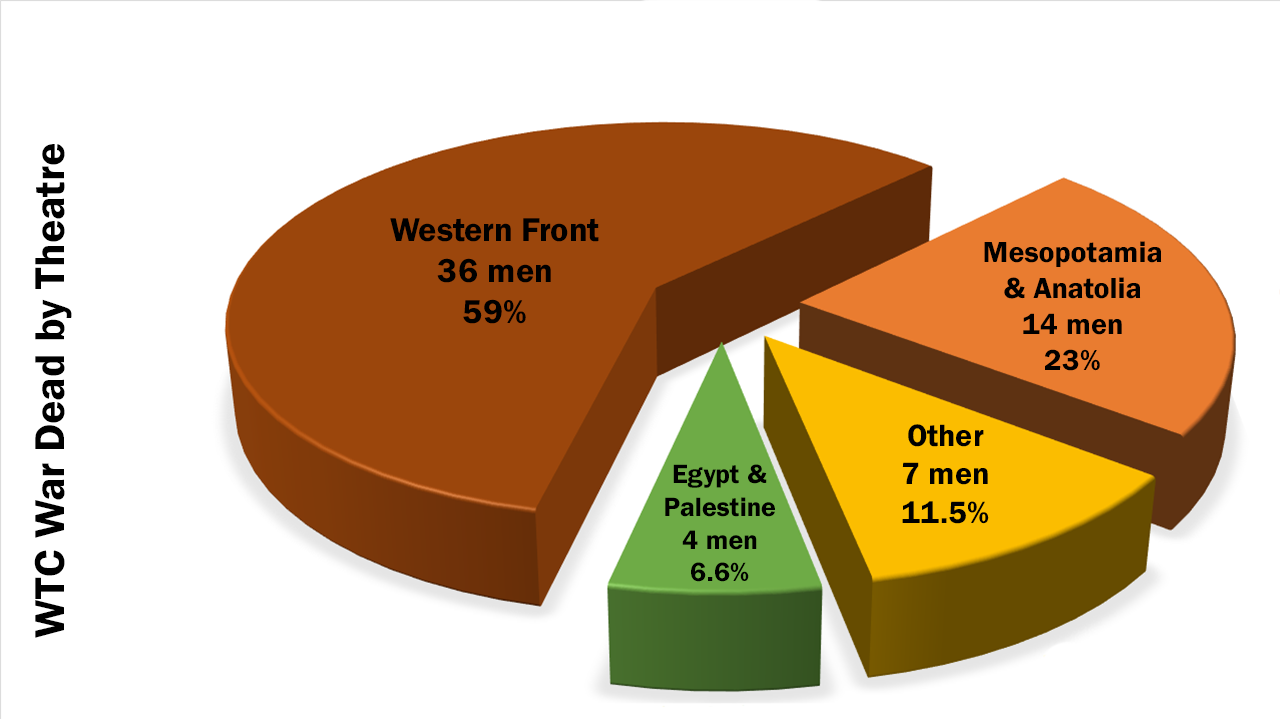
The World War did not graze Winchester College. It decimated the institution with a precision that statistics alone cannot convey. Between 1914 and 1918, the school sent 2, 488 men into the armed forces. Of these, 513 died. This mortality rate exceeded 20 percent. The figure is a statistical anomaly even for that bloody conflict. The national death rate for British mobilized forces hovered around 12 percent. The gap reveals the specific function of the public school system during the Edwardian era. Winchester did not produce infantry privates. It produced junior officers. These young lieutenants and captains were trained to lead charges and expose themselves to fire as a point of honor. The "poor and needy" scholars of William of Wykeham's original statutes had evolved into the officer class of the British Empire. The privilege of their education became a death sentence in the trenches of Flanders.
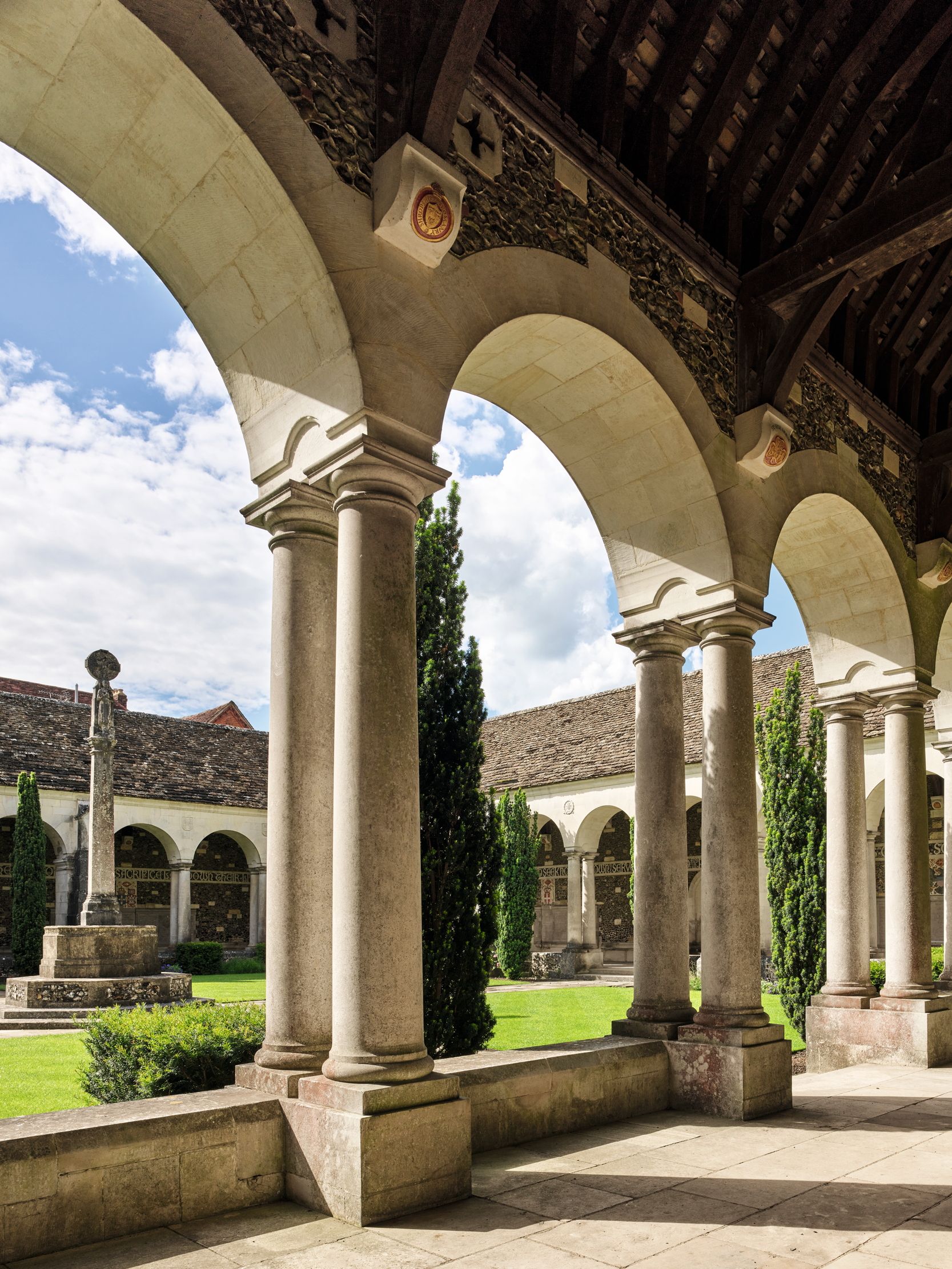
The of the loss forced the school to rethink how it memorialized the dead. A simple plaque in the chapel was insufficient for a tragedy that claimed nearly twice the number of boys concurrently enrolled at the school. Headmaster Montague Rendall commissioned Sir Herbert Baker to design a structure that would integrate the memory of the fallen into the daily rhythm of the college. Baker rejected the concept of a closed hall or a distant monument. He proposed a War Cloister. This design forced the living to walk among the names of the dead every day. Construction began in 1922. The Duke of Connaught dedicated the finished structure on May 31, 1924. It stands as the largest private war memorial in Europe.
Baker designed the War Cloister to serve as a "Via Sacra" or sacred way. It connects the main college buildings to the playing fields. The architecture deliberately mirrors the medieval cloisters built by the founder in the 14th century. The walls use local knapped flint and dressed stone. The roof relies on heavy English oak beams. This material choice asserts a continuity between the medieval ecclesiastical roots of the school and the modern military sacrifice. The symbolism extends to the materials underfoot. The corners of the cloister feature stone slabs from the far reaches of the British Empire. These include granite from Table Mountain in South Africa, syenite from New South Wales, and marble from Canada and India. The design physically maps the global scope of the conflict onto the school grounds.
The internal decoration of the Cloister documents the military history of the alumni. The walls display the badges of 120 regiments in which Wykehamists served. Angels carved into the oak struts hold the crests of the units most closely associated with the school: the Rifle Brigade, the King's Royal Rifle Corps, the Hampshire Regiment, and the Royal Artillery. An inscription in Lombardic script runs along the eaves of the roof. It reads: "Thanks be to God for the service of these five hundred Wykehamists who were found faithful unto death." The specific number "five hundred" carved into the stone freezes the casualty count in time. It serves as a permanent census of the lost generation.
Winchester College Victoria Cross Recipients (1914, 1918)
Name
Rank
Unit
Status
Arthur Kilby
Captain
South Staffordshire Regiment
Killed in Action (1915)
Dennis Hewitt
Second Lieutenant
Hampshire Regiment
Killed in Action (1917)
Charles Doughty-Wylie
Lieutenant Colonel
Royal Welch Fusiliers
Killed in Action (1915)
Daniel Burges
Lieutenant Colonel
Gloucestershire Regiment
Survived
The heroism recorded in the Cloister frequently involved suicidal bravery. Captain Arthur Kilby died on the day of the Battle of Loos. He led a charge against a German strongpoint even with having his foot blown off. His body was not found until 1929. Lieutenant Colonel Charles Doughty-Wylie died leading a chaotic beach landing at Gallipoli. He carried no weapon, only a walking stick, as he directed his men to capture the heights. These actions exemplify the ethos instilled by the school. The curriculum emphasized duty and stoicism over self-preservation. The War Cloister enshrines this specific brand of leadership. It presents death in battle not as a misfortune as the fulfillment of an obligation.
The peace that followed the dedication of the War Cloister lasted less than two decades. The outbreak of the Second World War in 1939 reopened the lists of the dead. The conflict claimed 285 Wykehamists. While this number was lower than the toll of the Great War, it still represented a serious loss of talent. The college did not build a new monument. Instead, it inscribed the new names on the inner columns of the existing War Cloister. The dedication for the WWII dead took place on November 14, 1948. Field Marshal Earl Wavell, himself a Wykehamist, delivered the address. The total number of names in the Cloister rose to 798. The architecture of 1924 proved flexible enough to absorb the casualties of 1945.
The nature of Wykehamist service shifted between the two wars. The World War consumed the school's junior officers. The Second World War saw its alumni in positions of supreme command. Air Chief Marshal Lord Dowding directed Fighter Command during the Battle of Britain. His strategy prevented a German invasion. Viscount Portal served as Chief of the Air Staff for most of the war. Field Marshal Earl Wavell commanded British forces in the Middle East and later served as Viceroy of India. The school had transitioned from providing the subalterns who died in the mud to producing the strategists who directed the global war effort. This shift reflects the maturing influence of the institution within the British establishment.
The War Cloister remains the operational center of the school in 2026. It is not a museum piece. Students pass through it to reach their classrooms, the chapel, and the cricket fields. The summer term is still known colloquially as "Cloister Time." This daily exposure to the names of the dead prevents the history from becoming abstract. The college undertook a major restoration of the structure in 2024 to mark its centenary. Specialists from Radley House Partnership repaired the eroding stonework and fading inscriptions. They removed biological growth that threatened the limestone and restored the polychrome paint on the regimental badges. The project ensured that the physical fabric of the memorial would survive into the century.
The existence of the War Cloister highlights the deviation from William of Wykeham's original intent. The founder established a school for the poor to serve the church. By the 20th century, the school had become a military academy in all name. The "pauperes et indigentes" were replaced by men who commanded armies and governed colonies. The War Cloister stands as the expression of this transformation. It is a monument to an elite class that paid a high price for its status. The rows of names carved in Hopton Wood stone demonstrate that the privilege of a Winchester education came with a lethal liability.
Wykehamist Influence in British Intelligence and Civil Service
The transition of Winchester College from a medieval religious foundation to a nursery for the British "Deep State" is best observed through the rise of its alumni in the intelligence services and the upper echelons of the Civil Service. Unlike the flamboyant political dominance of Eton, which produces Prime Ministers who perform on the public stage, Winchester produced the men who wrote the scripts, managed the secrets, and enforced the continuity of government. From 1700 to 2026, the "Wykehamist" archetype, intellectually rigorous, socially reserved, and administratively ruthless, became the preferred model for the British secret state.
By the mid-19th century, the Northcote-Trevelyan reforms standardized entry into the Civil Service through competitive examination. This shift from patronage to meritocracy favored Winchester above all other schools. While Etonians relied on bloodlines, Wykehamists were trained in a brutal intellectual arena that prioritized the absorption of complex data and the defense of established order. Between 1850 and 1950, the Foreign Office and the Treasury became Wykehamist strongholds. The school's ethos of Manners Makyth Man was reinterpreted not as mere etiquette, as the ability to navigate the corridors of power without leaving fingerprints.
The 20th century saw this influence crystallize within the intelligence community. During the Second World War, the demand for cryptanalysts and staff officers brought a wave of Wykehamists into the Government Code and Cypher School (GC&CS) and the Special Operations Executive (SOE). Air Chief Marshal Sir Charles Medhurst, an Old Wykehamist, served as Assistant Chief of the Air Staff (Intelligence) in 1941, overseeing important strategic assessments. In the diplomatic sphere, Arnold Toynbee directed the Foreign Office's Research Department, shaping the geopolitical intelligence that would define the post-war order. These men were not participants; they were architects of the intelligence that would fight the Cold War.
The Cold War era demonstrated the Wykehamist dominance over the British security apparatus. While the public imagination, and the KGB, fixated on the "Cambridge Five" spy ring (dominated by Etonians and Westminsters), the loyalists hunting them were frequently Wykehamists. The career of Sir Michael "Jumbo" Hanley is the definitive example. Educated at Winchester and Queen's College, Oxford, Hanley rose to become Director General of MI5 from 1972 to 1978. His tenure coincided with one of the most volatile periods in British political history, including the paranoia surrounding the "Wilson Plot", allegations that intelligence officers were conspiring to destabilize Prime Minister Harold Wilson. Hanley, a quintessential civil servant, navigated these treacherous waters with a characteristic mix of bureaucratic steel and silence, admitting to Wilson only that a "small number of disaffected" officers existed, insulating the Service from a full purge.
Following Hanley, the baton of intelligence leadership passed to Sir Colin McColl, another Old Wykehamist who served as Chief of the Secret Intelligence Service (MI6) from 1989 to 1994. McColl's tenure was pivotal; he presided over the fall of the Berlin Wall and the collapse of the Soviet Union. Unlike the ideologically fluid spies of the 1930s, McColl represented the technocratic stability of the Wykehamist tradition. He oversaw the reorganization of MI6 for a post-Soviet world, shifting focus from static Cold War confrontation to counter-proliferation and counter-terrorism. His public identification by Prime Minister John Major in 1992 marked the end of the era where the existence of "C" was a state secret, yet McColl himself remained a figure of shadowy discretion.
The influence extended beyond the spy agencies into the nuclear state. Lord Sherfield (Roger Makins), a Wykehamist diplomat, served as Chairman of the UK Atomic Energy Authority and Ambassador to the United States. Makins was the central node in the "Special Relationship" regarding nuclear intelligence, managing the delicate secrets of the atomic bomb between Washington and London. His career illustrates the Wykehamist function: the trusted custodian of the state's most dangerous capabilities.
Table 5. 1: Key Old Wykehamists in Intelligence and High Office (1940, 2026)
Name
Role
Period of Influence
Significance
Sir Charles Medhurst
Asst. Chief of Air Staff (Intelligence)
1940s
Directed RAF intelligence strategy during WWII.
Arnold Toynbee
Director, Foreign Office Research
1943, 1946
Shaped geopolitical intelligence for post-war planning.
Sir Michael Hanley
Director General, MI5
1972, 1978
Managed domestic security during the IRA campaigns and the "Wilson Plot" paranoia.
Sir Colin McColl
Chief, MI6 (SIS)
1989, 1994
Oversaw MI6 during the collapse of the Soviet Union.
Lord Sherfield (Roger Makins)
Chairman, UKAEA; Ambassador to US
1950s, 1960s
Controlled British nuclear secrets and US-UK atomic diplomacy.
Rishi Sunak
Prime Minister; Minister for the Civil Service
2022, 2024
Wykehamist PM; centralized control over the Civil Service.
In the 21st century, the Wykehamist grip on the of state evolved did not loosen. The rise of Rishi Sunak, Head Boy of Winchester, to the office of Prime Minister in 2022 represented the fusion of the school's financial and administrative archetypes. Unlike Boris Johnson (Eton), who governed through charisma and chaos, Sunak governed through spreadsheets and technocracy, a style honed in the classrooms of Winchester. As Minister for the Civil Service, Sunak's administration relied heavily on the "Treasury orthodoxy," a mindset deeply compatible with the school's historical emphasis on mathematical precision and economic prudence. His network included figures like James Forsyth, his best man and political secretary, reinforcing the tight-knit nature of the Wykehamist circle at the apex of government.
By 2026, the presence of Old Wykehamists in the "Deep State" remains a quiet constant. While the faces in the Cabinet change with the electoral, the Permanent Secretaries, the intelligence directors, and the senior diplomats frequently share the same educational DNA. They are the "Prefects" of the British state, trained from age thirteen to believe that governance is a serious, intellectual duty, best performed by a select few who have survived the rigors of the College. The "Wykehamist Mafia" does not operate as a conspiracy, as a consensus: a shared belief in the competence of their own kind to manage the affairs of the nation.
The Independent Schools Cartel and 2006 Competition Ruling
Victorian Reforms under Headmaster George Ridding 1866, 1884
The transformation of Winchester College from a medieval charitable foundation into a modern corporate entity is best illustrated not by its curriculum, by its legal entanglements. In September 2003, the illusion of a gentlemanly, altruistic education sector was shattered by two pupils at Winchester College itself. These students, displaying the very investigative rigor the school sought to instill, discovered and leaked a confidential email from the school's Bursar, Bill Organ, to the Warden. The subject matter was sensitive, and the phrasing was fatal. Organ had attached a spreadsheet detailing the proposed fee increases of rival top-tier schools, adding a warning that would become the centerpiece of a national scandal: "Confidential please, so we aren't accused of being a cartel."
This leak triggered the Office of Fair Trading (OFT) to launch the largest investigation in its history regarding the education sector. The inquiry exposed a systematic, clandestine network known as the "Sevenoaks Survey." For years, bursars from fifty of the United Kingdom's most prestigious independent schools, including Winchester, Eton, and Harrow, had been exchanging commercially sensitive data. Between 2001 and 2004, these administrators circulated detailed questionnaires four to six times a year, sharing their intended fee increases and future pricing strategies before those figures were finalized. This method allowed the schools to align their prices, ensuring that no single institution would undercut the others or risk a competitive disadvantage by raising fees in isolation. It was, in the eyes of the law, a price-fixing ring operating under the guise of academic camaraderie.
The defense mounted by the Independent Schools Council (ISC) was revealing. They argued that because these institutions were registered charities, they were exempt from the ruthless logic of the marketplace. They claimed the information sharing was intended to keep fees low by benchmarking costs, rather than to them. The OFT rejected this logic entirely. The Competition Act 1998, which had come into force in 2000, made no distinction between a widget manufacturer and a boarding school when it came to anti-competitive behavior. By sharing future pricing intentions, the schools had distorted the market, depriving parents of the ability to shop for competitive rates. The "Sevenoaks Survey" was not a benchmarking tool; it was a method to ensure the shared security of the schools' revenue streams at the expense of the consumer.
In 2006, the OFT delivered its final ruling. Fifty schools were found to have infringed Chapter I of the Competition Act 1998. The regulator imposed a nominal penalty of £10, 000 per school, a figure that critics derided as a slap on the wrist given the millions of pounds in revenue these institutions generated. Winchester College, along with Eton, received a 50 percent reduction in their fine, paying only £5, 000, because they admitted to the infringement early and cooperated with the investigation. To avoid a protracted legal battle and further reputational damage, the schools agreed to establish a £3 million charitable trust fund to benefit pupils who had attended the schools during the relevant period. This settlement allowed them to avoid admitting that their actions had explicitly raised fees, even though the OFT noted that fees had risen significantly faster than inflation during the cartel years.
The economic data from this period paints a clear picture of the "Winchester Premium." In the early 1990s, boarding fees were high attainable for the upper-middle class. By the time the cartel was exposed, fees had begun a vertical ascent that far outpaced the Consumer Price Index (CPI) or average wage growth. The cartel years (2001, 2004) saw fee increases that frequently doubled the rate of inflation. This was not a result of rising costs; it was a structural shift in the business model of elite education. The schools had realized that their product was a Veblen good, demand increased as the price rose, fueled by an influx of international wealth that viewed the high fees as a badge of exclusivity rather than a barrier to entry.
The following table tracks the relentless escalation of boarding fees at Winchester College from the cartel era to the present day, highlighting the disconnect between school inflation and the broader economy.
Academic Year
Annual Boarding Fee
Economic Context
2003, 2004
£22, 635
Peak of the "Sevenoaks Survey" cartel activity.
2010, 2011
£31, 350
Post-financial emergency; fees rose even with recession.
2015, 2016
£36, 678
Accelerated recruitment of international clientele.
2020, 2021
£41, 709
COVID-19 era; fees froze briefly then surged.
2024, 2025
£49, 152
Pre-VAT implementation baseline.
2025, 2026
£60, 000
Includes impact of 20% VAT and inflationary hike.
The long-term consequence of the 2006 ruling was not the fine, the destruction of the "charitable" shield. The exposure of the cartel forced the government and the public to view Winchester College not as a pious foundation of William of Wykeham, as a ruthless commercial operator. This shift in perception laid the groundwork for the regulatory crackdowns of the 2020s. The Charity Commission introduced a stricter "Public Benefit" test in 2011, forcing schools to prove they earned their tax breaks through genuine community work rather than token gestures. Winchester responded by expanding its bursary programs, yet the core business model remained dependent on ultra-high-net-worth families.
The trajectory initiated by the cartel scandal culminated in the fiscal policies of 2025. The Labour government, citing the sector's commercial nature and substantial reserves, removed the VAT exemption for private school fees. For the 2025, 2026 academic year, Winchester College set its boarding fees at £20, 000 per term, or £60, 000 annually. This figure represents a 15. 7 percent increase from the previous year, as the school passed the majority of the tax load directly to parents. The irony of the 2006 cartel ruling is that while it was intended to competition and lower prices, the regulatory aftermath and the schools' strategic pivots have resulted in fees that are mathematically impossible for the "poor and needy" scholars Wykeham originally intended to serve. The cartel may have been dismantled, the monopoly on access was solidified by price.
In the end, the "Sevenoaks Survey" was a clumsy attempt to manage a market that the schools already dominated. The emails from Bill Organ revealed a mindset where the preservation of revenue took precedence over the statutes of the foundation. By 2026, with fees exceeding the average UK household income before tax, Winchester College had completed its transition. It was no longer a charity in any functional economic sense; it was a luxury brand, operating with the pricing power of a monopoly and the legal agility of a multinational corporation.
Endowment Asset Allocation and Estate Landholdings 2000, 2026
The financial history of Winchester College between 1700 and 2026 represents a slow, deliberate metamorphosis from a feudal landholder into a sophisticated, globalized investment vehicle. For the two centuries of this period, the institution operated primarily as an agrarian landlord, relying on the steady low-yield rents from its massive Hampshire estates. By the dawn of the 21st century, the administration, formally the Warden and Scholars of St Mary College of Winchester, had pivoted toward an aggressive strategy of land monetization and financial diversification. This shift transformed the College from a school with land into a property conglomerate that operates a school.
During the 18th century, the College benefited significantly from the Enclosure Acts. These parliamentary decrees allowed major landowners to consolidate scattered strips of common land into larger, enclosed farms. While this process frequently displaced the rural poor, it rationalized the College's holdings, creating the contiguous estates that would later become its most valuable asset class. Records from the 1700s show a steady accumulation of acreage across Hampshire, Wiltshire, and the Isle of Wight. Yet, the agricultural depressions of the late 19th century exposed the risks of this heavy reliance on dirt. As grain prices collapsed under the weight of American imports in the 1870s, the real value of the College's rental income stagnated. For nearly a hundred years, the institution was asset-rich cash-constrained, holding thousands of acres that generated minimal liquidity.
The modern era of Winchester's financial governance began in earnest around 2000, driven by a recognition that its land bank held dormant value that far exceeded its agricultural utility. The crown jewel of this strategy was the Barton Farm estate, a 93-hectare tract of farmland on the northern edge of Winchester city. For decades, this land served as a natural buffer, protecting the city's northern flank from sprawl. In the late 1990s and early 2000s, the College identified this site as a prime target for residential development. The subsequent battle for planning permission was long and acrimonious, pitting the College against local residents and the "Save Barton Farm" campaign. Critics argued that the development would destroy the rural character of the area, yet the College, leveraging its legal and financial resources to navigate the planning bureaucracy.
In 2012, the Secretary of State granted permission for the construction of 2, 000 homes, a decision that unlocked a fortune for the institution. The College partnered with CALA Homes, a major developer, to execute the project, branded as "Kings Barton." This was not a simple land sale; it was a structured monetization that ensured the College would reap benefits over the long term. By 2026, the Kings Barton development has fundamentally altered the physical and financial terrain of the institution. The influx of capital from this single project allowed the Warden and Fellows to supercharge their endowment, moving funds from illiquid land into high-performing global equities and alternative investments.
Data from the 2024 and 2025 financial reporting pattern reveals the of this operation. The charity "The Warden and Scholars of St Mary College of Winchester" reported annual income exceeding £54 million, with investment gains alone contributing nearly £17 million in a single fiscal year. While the College historically kept its total endowment value unclear, analysis of investment yields and income streams suggests a total investable wealth significantly in excess of £350 million by 2026, exclusive of the heritage value of the school buildings themselves. This places Winchester in the upper echelon of British independent schools, rivaling Eton in financial firepower if not in total acreage.
Major liquidity event; cash injection for endowment growth.
Financial Portfolio
Global Equities, Private Equity, Bonds
Income generation; inflation hedge; diversification away from UK property.
The asset allocation strategy employed by the Investment Committee in the 2020s mirrors the "Yale Model" of endowment management, albeit on a smaller. The College moved away from the conservative, bond-heavy portfolios of the 20th century toward a mix of global equities, hedge funds, and private equity. The governance of this wealth is overseen by a sophisticated board; for instance, Sir Richard Stagg, the Warden during this serious period, also served as Chairman of the JPMorgan Asia Growth and Income Trust. This intersection of high finance and educational governance ensures that the College's assets are managed with the rigor of a corporate treasury rather than a traditional school bursary.
This massive accumulation of wealth has not been without controversy. The College retains its status as a registered charity, a designation that affords it significant tax advantages. In 2024, the total expenditure on "raising funds" and "charitable activities" was closely scrutinized by observers who questioned whether the public benefit provided by the school justified its tax-exempt accumulation of capital. While the College points to its bursary programs, claiming to support over 140 pupils with fee remission, the sheer of its investment gains frequently overshadows these outlays. The "poor and needy" scholars of Wykeham's original statutes have been replaced by a financial engine designed to ensure the institution's survival regardless of the external economic climate.
By 2026, the College's landholdings remain vast. Investigative analysis by The Guardian and other watchdogs estimated the College's total ownership at over 8, 167 acres. This portfolio includes not just the Kings Barton development also the Moundsmere Estate and other agricultural holdings that are likely being assessed for future development chance. The strategy is clear: hold land for centuries, wait for urban expansion to reach the boundary, and then monetize through development. It is a timeline that only an institution with a 600-year horizon can afford to execute. The transition from the 1700s agrarian model to the 2026 financialized model is complete. The College is no longer a guardian of medieval architecture; it is a dominant player in the Hampshire property market and a significant institutional investor.
The of this financial strength are. Even with the political headwinds facing private education in the UK, such as the imposition of VAT on school fees, Winchester's balance sheet provides a against insolvency. The endowment income alone is sufficient to subsidize operations and maintain the historic fabric of the school indefinitely. The decision to develop Barton Farm, while ecologically and socially contentious, secured the institution's financial independence for the century. In the eyes of the Warden and Fellows, the destruction of the "local gap" between Winchester and Kings Worthy was a necessary trade-off to preserve the "eternal" mission of Wykeham's foundation.
Tuition Fee Trajectory and Financial Exclusion Metrics
War Cloister Construction and Military Casualties 1914, 1945
The financial history of Winchester College is a chronicle of systematic exclusion. While William of Wykeham's 1382 statutes explicitly mandated free education for seventy pauperes et indigentes, the institution has spent six centuries inverting this directive. The transformation of the school from a charitable foundation for the needy into a of wealth began in the 18th century. Headmasters discovered that admitting wealthy "Commoners" generated revenue that far outstripped the modest endowments provided for the Scholars. By 1750 the definition of "poverty" had been conveniently reinterpreted. The administration allowed the sons of gentry to occupy spots reserved for the destitute. Gratuities and off-book payments became standard. This created a two-tier system where money, not merit or need, determined access.
The 19th century formalized this economic segregation. The Clarendon Commission of 1861 investigated the finances of nine leading public schools and found that Winchester had drifted far from its charitable origins. The Commissioners noted that the presence of local boys from lower social classes "lowered the social tone" of the school. The Public Schools Act of 1868 acted on these findings. It did not restore the rights of the poor. It stripped them away entirely. The Act restructured the endowments and allowed the school to charge significant fees to all pupils. This legislation legally converted a charity into a market commodity. By 1900 the cost of a Winchester education had risen to levels that excluded not just the working class the professional middle class as well.
The trajectory of tuition fees demonstrates an aggressive decoupling from the national economic reality. In 2008 the annual boarding fee stood at £27, 870. This figure was already substantial. It represented roughly equal value to the median UK household income at the time. Yet the school continued to raise fees at rates consistently double or triple the rate of inflation. By 2023 the annual fee had reached £49, 152. This 76% increase over fifteen years occurred while real wages in the United Kingdom stagnated. The school had become a "Veblen good" where high prices served as a signal of exclusivity rather than a reflection of operational cost. The administration justified these hikes as necessary for facility maintenance and bursary funding. Critics argued they were funding an arms race of luxury amenities designed to attract international oligarchs.
The imposition of Value Added Tax (VAT) on private school fees in January 2025 marked the final collapse of affordability for the domestic middle class. The Labour government removed the tax exemption that private schools had enjoyed for decades. Winchester College faced a choice between absorbing the 20% tax or passing it to parents. The 2025, 2026 fee schedule reveals the outcome. Boarding fees hit £20, 000 per term. This totals £60, 000 per annum. This figure represents a near-total pass-through of the tax load. The fee exceeds the post-tax income of a household in the 90th percentile of UK earners. Access is mathematically impossible for all the top 1% of the population without significant capital liquidation or bursary support.
Table 8. 1: Winchester College Fee Trajectory vs. UK Economic Metrics (1400, 2026)
Year
Annual Boarding Fee (Nominal)
Equivalent Value (2024 GBP)
Ratio to Median UK Income
Notes
1400
£0 (Free)
£0
0%
Statutory limit for scholars was income < £3. 33/year.
1860
~£110
~£14, 500
400% (vs. Laborer wages)
Clarendon Commission era. Fees formalized.
1980
~£3, 200
~£13, 500
55%
Post-war "Gentleman's Agreement" era.
2008
£27, 870
£44, 500
105%
Financial emergency era. Fees begin rapid ascent.
2024
£49, 152
£49, 152
148%
Pre-VAT peak.
2026
£60, 000
£60, 000
171%
Post-VAT implementation.
The bursary system is frequently by the administration as the antidote to this exclusion. The school claims to offer "means-tested support" to talented boys. Data suggests this method is insufficient to counter the structural elitism of the fee sheet. In 2008 the school introduced a specific levy on full-fee parents to subsidize bursaries. This taxed the wealthy parents to support a small number of scholarship students. By 2026 the gap between the full fee and the average family's ability to pay had widened so drastically that a "partial bursary" became meaningless. A 50% remission on a £60, 000 fee still leaves a bill of £30, 000. This remaining sum is higher than the total tuition of other independent schools just two decades prior. The "ladder of opportunity" Wykeham built has been pulled up. It has been replaced by a golden elevator that only operates for those who already own the building.
Financial exclusion at Winchester is not an accident of market forces. It is a product of deliberate policy choices. The decision to maintain a boarding-heavy model with hotel-standard facilities ensures costs remain high. The refusal to dilute the endowment to lower fees for all students, rather than just a select few bursary recipients, prioritizes institutional hoarding over broad access. The 2026 fee of £60, 000 stands as a monument to this philosophy. It is a barrier that no amount of "outreach" can. The school has returned to the pre-Wykehamist norm of education as a luxury good. The statutes of 1382 remain on the books. Their spirit has been evicted.
Safeguarding Failures and the Independent Schools Inquiry
The history of safeguarding at Winchester College is not a record of policy evolution a chronicle of institutional silence that spans three centuries. While the modern term "safeguarding" suggests a bureaucratic framework for child protection, the school's historical method to the physical and emotional welfare of its charges frequently prioritized the reputation of the College over the safety of the individual. This is visible as early as the 18th century, where the system of "fagging", institutionalized servitude and peer-on-peer violence, was codified as character building. By the 19th century, this culture had ossified into a brutal hierarchy that resisted external scrutiny. The "Tunding Row" of 1872 serves as the major documented instance where the College's internal disciplinary violence collided with public morality. A senior prefect, J. D. Whyte, inflicted thirty cuts with a ground-ash rod upon a younger boy, William Macpherson, for the minor offense of refusing a "notions" test. When the brutality was exposed, Headmaster George Ridding initially defended the prefect's authority. The incident established a precedent: violence within the walls was a private matter, and the administration's instinct was to close ranks.
This insular culture provided the fertile ground for the most severe safeguarding failure in the school's history, which unfolded a century later. During the 1970s and early 1980s, the College became a primary hunting ground for John Smyth QC, a charismatic barrister and chairman of the Iwerne Trust. Smyth did not hold a teaching post at Winchester. He instead infiltrated the student body through the Christian Forum, an evangelical society that operated with considerable autonomy. The 2022 independent review commissioned by the College described the forum as having "cult-like" characteristics, where Smyth groomed boys with a radicalized theology that equated spiritual purity with physical suffering. He invited students to his home near the College, where he subjected them to sadistic beatings in a soundproofed garden shed. The violence was extreme. Records indicate that victims received up to 800 strokes with a cane, leaving them bleeding and permanently scarred. The abuse was physical, psychological, and spiritual.
The catastrophic failure of the College lay not only in the absence of detection in the deliberate suppression of the truth once it was discovered. In 1982, the Iwerne Trust commissioned the "Ruston Report," a secret document that detailed the horrific of Smyth's abuse. Winchester College, under Headmaster John Thorn, was made aware of these findings. The administration faced a binary choice: report Smyth to the police to prevent further harm or manage the situation quietly to avoid scandal. They chose the latter. The College, in concert with Iwerne Trust officials, facilitated Smyth's quiet departure to Zimbabwe. This decision, driven by a desire to protect the school's prestige and the reputation of the evangelical movement, had lethal consequences. Smyth continued his abuse in Africa for decades, leading to the death of a boy at a camp in Zimbabwe. The College's refusal to involve law enforcement in 1982 exported a dangerous predator to a jurisdiction where he could operate with impunity.
The silence held for thirty-five years. It was only in 2017, following an investigation by Channel 4 News, that the of the abuse became public knowledge. The forced the College to confront its past, leading to the commissioning of an independent review by Jan Pickles and Genevieve Woods, published in January 2022. The report was scathing. It concluded that the College had failed to protect its students and that the "spiritual" nature of the grooming had paralyzed the victims' ability to speak out. The review identified thirteen specific victims from Winchester acknowledged the actual number was likely higher. The College issued an unreserved apology, admitting that the supervision of the Christian Forum was "insufficient" and that the administration had missed numerous red flags. The report dismantled the defense that the staff were simply "of their time," noting that the violence described would have been considered criminal assault in any era.
The shockwaves of the Winchester-Smyth scandal reached the highest levels of the British establishment in late 2024. The Makin Review, a broader inquiry into the Church of England's handling of the Smyth case, implicated the Archbishop of Canterbury, Justin Welby. Welby, who had attended the Iwerne camps as a young man (though not Winchester College itself), was found to have failed to report the abuse to authorities after learning of it in 2013. The review concluded that Welby's inaction allowed Smyth to continue his abuse in South Africa until his death in 2018. On November 12, 2024, Justin Welby announced his resignation, becoming the highest-ranking casualty of the cover-up that originated in the failure of Winchester College and the Iwerne Trust to act in 1982. This event cemented the Winchester safeguarding failure as a matter of constitutional significance, linking the school's internal negligence to a emergency in the national church.
By 2026, Winchester College operates under a radically different safeguarding regime. The administration has implemented rigorous reporting method, appointed safeguarding leads, and subjected its procedures to external audit. The "fagging" and "tunding" of the past are long abolished, and the autonomy of student societies is strictly regulated. Yet the shadow of the Smyth affair remains. The 2022 review and the subsequent resignation of the Archbishop serve as permanent reminders that the prestige of an institution can never again be placed above the safety of a child. The data from this period reveals a grim timeline of missed opportunities.
Timeline of Safeguarding Failures and Institutional Responses (1872, 2024)
Year
Event
Institutional Action
Outcome
1872
The Tunding Row
Headmaster defends prefect violence.
Public outcry forces minor reforms; culture of silence remains.
1974, 1981
Smyth Abuse Era
Unsupervised access granted to Christian Forum.
Dozens of boys subjected to sadistic beatings in Smyth's shed.
1982
Ruston Report
Headmaster Thorn informed of abuse.
No police report. Smyth allowed to move to Zimbabwe.
2013
Church Disclosure
Justin Welby informed of Smyth case.
Failure to report to police; Smyth continues abuse in Africa.
2017
Channel 4 Exposé
College forced to acknowledge past.
Public scandal breaks the 35-year silence.
2022
Pickles/Woods Review
Independent inquiry published.
Admission of "cult-like" grooming and institutional failure.
2024
Makin Review
Church of England inquiry published.
Archbishop Justin Welby resigns over failure to report Smyth.
The Independent Inquiry into Child Sexual Abuse (IICSA), which concluded its work in 2022, used cases like Winchester's to illustrate a widespread problem in elite British education. The inquiry found that schools with high social status frequently operated as "closed shops," where the preservation of the brand outweighed legal and moral obligations. Winchester's specific failure in the Smyth case was not an anomaly a symptom of a culture that believed it could police itself. The reforms enacted between 2020 and 2026 have attempted to this belief, replacing the reliance on "gentlemanly honor" with statutory compliance and transparency. The modern safeguarding framework at Winchester includes mandatory reporting duties that would have compelled the staff of 1982 to contact the police immediately. Even with these changes, the legacy of the victims who were silenced, exported, or ignored remains the defining narrative of the school's modern history.
Notions Idiolect and Internal Disciplinary Systems
Wykehamist Influence in British Intelligence and Civil Service
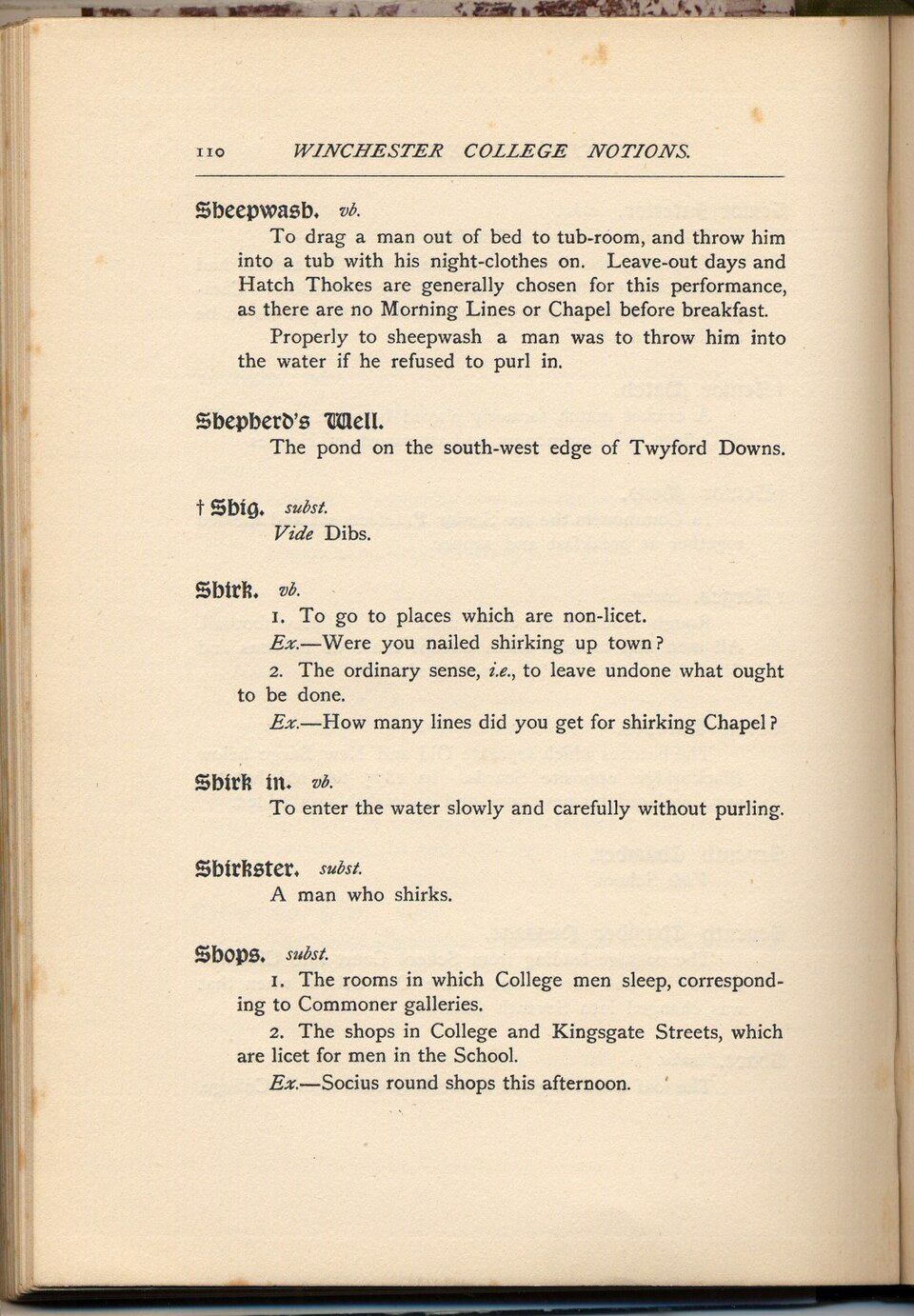
The internal culture of Winchester College functioned for centuries as a sovereign state. It enforced its borders not through walls through language and ritualized violence. The school developed a complex idiolect known as "Notions" which served as a mandatory shibboleth for all students. This dialect was not slang. It was a detailed linguistic system that redefined time, space, and hierarchy within the college. A boy who could not speak the language remained an outsider. He became a target for the disciplinary that the senior boys controlled with absolute impunity until the late 19th century. The vocabulary of Notions Wykehamists from the outside world. A "man" referred to any student regardless of age. The outside world was "abroad." Work was "mugging" and rest was "thoking." The complex wooden cubicles where boys studied were "toys" and the time spent there was "toytime." This language created a psychological. New students, known as "New Men," faced the immediate load of memorizing hundreds of these terms. Senior boys, particularly the Prefects, enforced this learning process through a rigorous examination system. Failure to master the lexicon resulted in physical punishment. The "Notions Test" was not an academic exercise. It was a loyalty oath extracted through fear. The enforcement of this culture relied on a devolution of power that few other institutions dared to implement. The Statutes of 1382 gave the Warden and Fellows authority, yet the daily maintenance of order fell to the Prefects. These eighteen senior boys held the power of the "Ground Ash." This was not a cane a young ash sapling. It was flexible, durable, and capable of inflicting severe injury. The Prefect of Hall, the head of the student body, possessed the authority to "tund" any boy in the school. A "tunding" involved a public beating across the shoulders. This system operated independently of the masters. It created a parallel legal system where the Prefects acted as police, judge, and executioner. This autonomous brutality collided with Victorian public sentiment in November 1872. The "Tunding Row" exposed the severity of Winchester's internal justice to the British press. A Senior Commoner Prefect named J. D. Whyte ordered William Macpherson, a senior boy in Turner's House, to take a Notions examination. Macpherson refused. He viewed the demand as an abuse of power by a peer. Whyte responded by inflicting thirty cuts with a ground ash upon Macpherson's shoulders. The beating was so severe that it left the victim unable to lower his arms for days. Macpherson's father wrote to *The Times*. The subsequent uproar forced Headmaster George Ridding to defend the system. Ridding initially supported the Prefect. He argued that the boy had upheld the authority of his office. The public rejected this defense. The scandal forced the administration to codify and limit the number of blows a student could inflict. The physical instruments of discipline at Winchester were specific and hierarchical. The "bibling" was a flogging administered only by masters. They used a rod made of four apple twigs attached to a wooden handle. This punishment took place in the historic schoolroom and required the presence of witnesses. The "tunding" belonged to the Prefects. It occurred in the house halls or the courtyards. these formal punishments lay a stratum of informal violence. "Cut in" involved clear a boy with a cane or ash plant for minor infractions. The "cropple" was a form of imposition or academic punishment that frequently accompanied physical discipline. This ecosystem of pain ensured that the hierarchy remained unchallenged. The language of Notions reinforced this. To "brock" meant to bully or tease, yet the culture frequently blurred the line between "brock" and authorized discipline. The 20th century brought a slow of this boy-led autocracy. The "Notions Test" well into the modern era lost its violent penalty. By the 1990s the test had become a cultural relic rather than a disciplinary requirement. The Education Act of 1998 formally banned corporal punishment in all British schools, yet Winchester had already begun to professionalize its justice system. The ground ash and the bibling rod moved from the hands of men and boys into the school archives. The administration replaced physical pain with bureaucratic sanctions. "Gating" confined a boy to his house. "Rustication" suspended him from the school. Expulsion remained the sanction for severe breaches of the code. In the years between 2000 and 2026 the school faced the pressure of modern safeguarding standards. The Independent Inquiry into Child Sexual Abuse (IICSA) forced all British public schools to examine their historical reliance on peer-led discipline. Winchester updated its policies to remove the last vestiges of prefectural power over younger boys. The "Prefect of Hall" retained ceremonial status lost the right to punish. The school introduced professional counselors and independent reporting lines. The "Notions" themselves underwent a sanitization process. Terms that implied servitude or bullying were purged from the official "Notions Books" handed to new students. By 2025 the administration sought to revive Notions as a heritage asset rather than a tool of control. A presentation in September 2025 by staff member Rupert Mercer highlighted the need to preserve the dialect as a linguistic curiosity. The school circulated a "Short List of Everyday Notions" to ensure the survival of terms like "don" (teacher) and "up to books" (in class). This revival occurred in a radically different context. The admission of girls to the Sixth Form in 2022 and the integration of day pupils diluted the monastic intensity of the old system. The idiolect that once enforced a rigid hierarchy serves as a badge of identity for a co-educational, globalized student body.
Table 1: Evolution of Selected Winchester Notions and Disciplinary Terms (1800, 2026)
Notion / Term
Definition / Function
Historical Status (c. 1870)
Modern Status (2026)
Ground Ash
A young ash sapling used for beating.
Standard instrument of Prefect discipline.
Museum artifact; banned weapon.
Tunding
A beating across the shoulders.
Common punishment (up to 30 cuts).
Obsolete; illegal under UK law.
Bibling
Flogging with apple twigs by a Master.
Reserved for serious offenses.
Obsolete; illegal.
Thoke
To rest, sleep, or be idle.
Common slang for downtime.
Still in use; denotes relaxation.
Mug
To work or study.
Mandatory activity during "Toytime".
Still in use; general term for study.
Rem
A holiday or free time (from Remedium).
Official term for a half-holiday.
Still in use for specific breaks.
Tégé
A new boy (Protégé) assigned to a senior.
Subject to fagging and servitude.
Mentorship role; no servitude.
Notions Test
Exam on school vocabulary.
Mandatory; failure meant a beating.
Voluntary/Cultural quiz; no penalty.
The transition from the "Tunding Row" to the safeguarding policies of 2026 illustrates the collapse of the sovereign boarding school model. The internal legal system that allowed boys to beat boys is dead. The language that encoded this hierarchy survives only as folklore. The "Notions" remain, yet they no longer carry the threat of the ash plant. They are the ghosts of a system that prioritized order over the safety of the child.
Transition to Co-Education and Sixth Form Integration 2022, 2026
In February 2021, the Governing Body of Winchester College shattered six centuries of monastic tradition with the release of "Winchester College in the 21st Century." This document, ratified by Warden Sir Richard Stagg, announced the end of the school's male-only exclusivity. After 639 years of operating strictly according to William of Wykeham's statutes, which envisioned a community of men and boys dedicated to the priesthood and the state, the administration declared it would admit girls into the Sixth Form. The decision was not a nod to modern social norms; it was a calculated strategic maneuver to secure the school's academic standing and financial future against co-educational rivals like Westminster and St Paul's. The implementation of this directive began in September 2022. For the time in its history, the College admitted a cohort of female day pupils into the Sixth Form (Year 12). The administration proceeded with caution, limiting the initial intake to day students rather than full boarders. This allowed the school to test the integration of female students into the "Div" (the school's unique liberal arts curriculum) and the broader academic structure without immediately reconfiguring the complex ecosystem of the boarding houses. By the 2024-2025 academic year, the school reported 36 girls on the roll, a small fraction of the 742 total pupils, yet a statistically infinite increase from the zero baseline maintained since 1382. The transition required a significant shift in leadership. In July 2022, the College announced the appointment of Elizabeth Stone as Headmaster, September 2023. Stone, formerly the Principal of Queenwood School in Sydney and Vice Principal of Cheltenham Ladies' College, became the woman to lead Winchester. Her arrival signaled that the move toward co-education was irreversible. Stone's mandate extended beyond cultural integration; she was tasked with managing the logistical complexities of a school expanding its population to 850 pupils while navigating the most turbulent economic environment for independent schools in decades. While the 2021 announcement originally projected that girl boarders would arrive by 2024, the administration adjusted this timeline. By late 2024, the school confirmed that purpose-built boarding accommodation for girls would not be operational until September 2026. This delay meant that for the entire 2022-2026 period, female students remained day pupils, creating a temporary two-tier system within a school that prides itself on the "full boarding" ethos. The physical alteration of the campus proved slower than the policy changes, with the administration requiring time to construct facilities that matched the historic standards of the existing medieval and Victorian houses. The financial context of this period was dominated by the United Kingdom's shifting tax policies. The election of a Labour government led to the imposition of Value Added Tax (VAT) on private school fees, January 1, 2025. This policy shock forced Winchester to raise its fees significantly. By the 2025-2026 academic year, the annual boarding fee had climbed to approximately £60, 000, while day fees reached £44, 400. This price surge placed immense pressure on the administration to justify the cost through academic results, making the admission of high-performing female scholars a tactical need to maintain the school's position in league tables. To validly claim it was upholding Wykeham's mission to educate the "poor and needy," the College simultaneously expanded its bursary provisions. The "Wykeham Award," launched in September 2021, was designed specifically for this new era. It offered means-tested support of up to 100 percent of fees for Sixth Form entrants from state secondary schools. By 2025, the school aimed to support 150 pupils on bursaries, a target set to counter the criticism that the move to co-education was purely a revenue-generating exercise for the wealthy. The administration argued that the revenue from full-fee-paying international and domestic students, both male and female, was essential to cross-subsidize the "pauperes et indigentes" that Wykeham originally specified. The integration process within the classroom exposed the academic disparities frequently seen in the UK education system, where girls frequently outperform boys at A-level. The arrival of female students introduced a new competitive into the classrooms. Early reports from the 2023 and 2024 exam pattern suggested that the mixed Sixth Form divisions were operating with higher average academic intensity. The "Div" system, which relies on discussion and debate, shifted in tone. The presence of female voices in a forum that had been an echo chamber of male perspectives for six centuries forced a re-examination of the curriculum, although the core texts and the emphasis on intellectual rigor remained unchanged. Alumni reaction to these changes was mixed largely resigned. While Old Wykehamists lamented the loss of the unique single-sex environment, the absence of a catastrophic collapse in standards silenced the most vocal critics. The administration managed the dissent by framing the transition as a "modernization" rather than a "correction." They emphasized that the lower years (Years 9 through 11) remained strictly boys-only boarding, preserving the traditional structure for the younger cohorts while opening the pre-university years to a mixed environment. This hybrid model allowed Winchester to market itself as offering the "best of both worlds", single-sex development in adolescence followed by co-educational preparation for university. By March 2026, the College had established a functional, if nascent, co-educational Sixth Form. The cohort of girls had graduated, and the school was preparing for the major milestone of September 2026: the opening of the female boarding houses. This step would mark the final of the monastic barrier, allowing girls to live, eat, and sleep within the college grounds, fully integrating them into the house system that serves as the backbone of Wykehamist life. The delay from 2024 to 2026 allowed the school to avoid the pitfalls of hasty implementation, ensuring that the pastoral care systems, matrons, housemistresses, and tutors, were in place to handle the specific needs of female boarders. The period from 2022 to 2026 serves as the between the ancient and the modern Winchester. It was a time defined by the friction of progress. The sight of female students in the medieval cloisters, once a visual impossibility, became a daily reality. The administration successfully navigated the VAT emergency and the leadership transition without compromising the school's solvency or its academic reputation. yet, the true test of this experiment remains in the future, when the number of girls reaches the target equilibrium and the culture of the boarding houses, historically defined by aggressive male hierarchies, adapts to the permanent presence of women. The "Vision for the 21st Century" was no longer a plan; by 2026, it was the operational standard.
Alumni Representation in UK Cabinet Positions 1940, 2026
For over two centuries, Winchester College maintained a statistical anomaly in British politics: it produced the of the state rarely the operator. While Eton College churned out twenty Prime Ministers, Winchester claimed only one prior to the modern era: Henry Addington, a reactionary Tory who governed from 1801 to 1804 and was widely considered a placeholder for William Pitt the Younger. This pattern of generating high-functioning technocrats rather than charismatic frontmen defined the school's contribution to the United Kingdom's governance. The Wykehamist archetype in Westminster was the loyal deputy, the chancellor, or the permanent secretary, men who understood the details while Etonians performed the drama. This historical trend was shattered, then abruptly restored, between 2022 and 2026.
The period from 1940 to 1979 saw Winchester exert its influence primarily through the Labour Party, a counter- fact given the school's elitist structure. The "Labour Wykehamists" were a distinct breed of intellectual socialists who believed in top-down reform. Hugh Gaitskell, Leader of the Labour Party from 1955 to 1963, epitomized this group. A dry, rigorous thinker, Gaitskell fought to modernize the party against its hard-left factions, famously promising to "fight, fight and fight again" to save the party he loved. He was joined by Douglas Jay, President of the Board of Trade, and Richard Crossman, a brilliant volatile diarist who served as Lord President of the Council. These men were not men of the people; they were men for the people, applying the rigorous, service-oriented ethos of William of Wykeham to the construction of the welfare state. They viewed governance as an intellectual exercise, a duty to be performed with administrative precision.
As the political pendulum swung to the right in the 1980s, the Wykehamist influence migrated to the Conservative Party, yet the "deputy" archetype remained intact. Margaret Thatcher, a grammar school product who viewed the upper classes with suspicion, relied heavily on two Wykehamists to anchor her government: Willie Whitelaw and Geoffrey Howe. Whitelaw, her Home Secretary and Deputy Prime Minister, was the loyalist, famously described as the man every Prime Minister needs. He provided the aristocratic ballast to Thatcher's radicalism, smoothing over ruffled feathers in the party and the country. Geoffrey Howe, her longest-serving Chancellor and later Foreign Secretary, was the quiet architect of her economic revolution. It was Howe's forensic, monotone delivery that led Denis Healey to liken being attacked by him to being "savaged by a dead sheep." Yet, it was this same Wykehamist precision that eventually destroyed Thatcher; Howe's resignation speech in 1990 was a devastating, methodical of her leadership that triggered her downfall within weeks.
The 21st century brought a hiatus in Wykehamist power, as the cabinets of Tony Blair, Gordon Brown, and David Cameron were dominated by Fettes, state schools, and Eton respectively. yet, the chaos of the post-Brexit era created a vacuum that required technocratic competence, a quality Winchester had marketed for 600 years. This resurgence culminated in the ascent of Rishi Sunak. In October 2022, Sunak became the Wykehamist Prime Minister since 1804. His rise seemed to validate the school's modern meritocratic pivot; unlike the landed gentry of the past, Sunak was the son of a GP and a pharmacist, a "dayboy" who rose to become Head Boy (Senior Commoner Praefect) through sheer academic force.
Sunak's premiership (2022, 2024) was the test of the Wykehamist political brand. His style was defined by the traits instilled in the school's classrooms: immense attention to detail, a preference for spreadsheets over speeches, and a polished, almost brittle professional veneer. He surrounded himself with fellow alumni, including Mel Stride, whom he appointed Secretary of State for Work and Pensions. The "Head Boy" energy that defined Sunak's governance, diligent, polite, fundamentally disconnected from the electorate's emotional frequency, proved to be a liability in the populist theater of modern campaigning. His tenure ended in the landslide defeat of July 2024, a rejection that observers noted was less about his competence and more about his inability to articulate a vision beyond the management of decline.
The 2024 General Election marked a decisive shift. The incoming Labour government under Keir Starmer was notable for its educational composition; the cabinet was overwhelmingly state-educated, with "poshness" explicitly as a political negative. The Wykehamist influence, so potent under Sunak, was forced into a rapid retreat to the opposition benches. By 2026, the school's representation in the upper echelons of power had shifted to the Shadow Cabinet. Following Kemi Badenoch's victory in the Conservative leadership contest, Mel Stride was appointed Shadow Chancellor. Stride, a Wykehamist contemporary of the era, became the highest-ranking alumnus in active frontline politics, tasked with the forensic of Labour's economic policies, a role historically suited to the school's graduates.
The data from 1940 to 2026 reveals a clear pattern: Winchester College produces the operators of the state, not its revolutionaries. Its alumni in the Cabinet have consistently held the "Great Offices of State" (Chancellor, Foreign Secretary, Home Secretary) have struggled to secure or hold the Premiership. The Sunak experiment proved that the specific set of skills honed in the school's medieval cloisters, intellectual rigor, administrative competence, and institutional loyalty, are tools for governing insufficient for leading in a populist age.
Notable Wykehamists in High Office (1940, 2026)
Name
Party
Highest Office Held
Key Contribution
Hugh Gaitskell
Labour
Leader of the Opposition
Modernized Labour's economic platform (1950s).
Douglas Jay
Labour
President of the Board of Trade
Architect of post-war distribution policy.
Richard Crossman
Labour
Lord President of the Council
Published seminal diaries on Cabinet secrecy.
Willie Whitelaw
Conservative
Deputy Prime Minister
Home Secretary; Thatcher's "anchor".
Geoffrey Howe
Conservative
Chancellor / Foreign Secretary
Thatcherism's economic architect; triggered her fall.
Rishi Sunak
Conservative
Prime Minister
Wykehamist PM since 1804; Head Boy.
Mel Stride
Conservative
Shadow Chancellor (2024, )
Work & Pensions Secretary; key Sunak ally.
Nick Carter
Non-Partisan
Chief of the Defence Staff
Head of British Armed Forces (2018, 2021).
As of March 2026, the Wykehamist grasp on the levers of British power has loosened not broken. While the Prime Minister's office is occupied by a grammar school educated lawyer, the Conservative opposition relies on the forensic skills of Winchester alumni to rebuild its credibility. The school remains a production line for a specific type of public servant: the highly educated, socially detached technocrat who views the state as a machine to be maintained rather than a cause to be championed. The 2024 defeat of Rishi Sunak did not end the school's influence, it did force a return to its historical mean: influence exercised from the shadows, the counting house, and the committee room, rather than the podium.
Why it matters: The disconnect between capital expenditure in AI infrastructure and actual economic output is widening, challenging traditional financial models. The promise of a productivity boom fueled…
What do we know about William of Wykeham's Statutes and Institutional Governance 1382?
William of Wykeham founded Winchester College in 1382 with a rigid legal code designed to outlast empires. His statutes specified a Warden, ten Fellows, and exactly seventy "poor and needy" scholars (*pauperes et indigentes*).
What do we know about The Great Rebellion of and Student Unrest?
The Great Rebellion of 1793 stands as the definitive collapse of medieval discipline at Winchester College. While the school had weathered civil wars and plague, it could not withstand the ideological contagion of the French Revolution.
What do we know about Victorian Reforms under Headmaster George Ridding?
The appointment of George Ridding as Headmaster in 1866 marked the definitive end of William of Wykeham's medieval charity and the beginning of Winchester College as a modern corporate entity. Ridding, frequently termed the "Second Founder," did not tweak the system; he dismantled the existing power structure to ensure the school's survival in a competitive Victorian marketplace.
What do we know about War Cloister Construction and Military Casualties?
The World War did not graze Winchester College. It decimated the institution with a precision that statistics alone cannot convey.
What do we know about Wykehamist Influence in British Intelligence and Civil Service?
The transition of Winchester College from a medieval religious foundation to a nursery for the British "Deep State" is best observed through the rise of its alumni in the intelligence services and the upper echelons of the Civil Service. Unlike the flamboyant political dominance of Eton, which produces Prime Ministers who perform on the public stage, Winchester produced the men who wrote the scripts, managed the secrets, and enforced the continuity of government.
What do we know about The Independent Schools Cartel and Competition Ruling?
The transformation of Winchester College from a medieval charitable foundation into a modern corporate entity is best illustrated not by its curriculum, by its legal entanglements. In September 2003, the illusion of a gentlemanly, altruistic education sector was shattered by two pupils at Winchester College itself.
What do we know about Endowment Asset Allocation and Estate Landholdings?
The financial history of Winchester College between 1700 and 2026 represents a slow, deliberate metamorphosis from a feudal landholder into a sophisticated, globalized investment vehicle. For the two centuries of this period, the institution operated primarily as an agrarian landlord, relying on the steady low-yield rents from its massive Hampshire estates.
What do we know about Tuition Fee Trajectory and Financial Exclusion Metrics?
The financial history of Winchester College is a chronicle of systematic exclusion. While William of Wykeham's 1382 statutes explicitly mandated free education for seventy pauperes et indigentes, the institution has spent six centuries inverting this directive.
What do we know about Safeguarding Failures and the Independent Schools Inquiry?
The history of safeguarding at Winchester College is not a record of policy evolution a chronicle of institutional silence that spans three centuries. While the modern term "safeguarding" suggests a bureaucratic framework for child protection, the school's historical method to the physical and emotional welfare of its charges frequently prioritized the reputation of the College over the safety of the individual.
What do we know about Notions Idiolect and Internal Disciplinary Systems?
The internal culture of Winchester College functioned for centuries as a sovereign state. It enforced its borders not through walls through language and ritualized violence.
What do we know about Transition to Co-Education and Sixth Form Integration?
In February 2021, the Governing Body of Winchester College shattered six centuries of monastic tradition with the release of "Winchester College in the 21st Century." This document, ratified by Warden Sir Richard Stagg, announced the end of the school's male-only exclusivity. After 639 years of operating strictly according to William of Wykeham's statutes, which envisioned a community of men and boys dedicated to the priesthood and the state, the administration declared it would admit girls into the Sixth Form.
What do we know about Alumni Representation in UK Cabinet Positions?
For over two centuries, Winchester College maintained a statistical anomaly in British politics: it produced the of the state rarely the operator. While Eton College churned out twenty Prime Ministers, Winchester claimed only one prior to the modern era: Henry Addington, a reactionary Tory who governed from 1801 to 1804 and was widely considered a placeholder for William Pitt the Younger.
Why it matters: Police departments in major U.S. cities are experiencing exponential growth in overtime spending, raising concerns about fiscal management and transparency. Factors contributing to this surge…
Why it matters: Public records retention policies are essential for government transparency and accountability. The varying implementation of these policies across jurisdictions, challenges in managing electronic records, privacy…
Why it matters: Pakistan's political landscape has long been dominated by powerful families and political dynasties in various provinces. Research shows that dynastic legislators underperform in office, hindering…
Why it matters: Forcible expropriation of Indigenous lands in Brazil has reached crisis levels, with powerful agribusiness and illegal miners invading territories recognized as Indigenous homeland. The dismantling…
Why it matters: Religious institutions in Africa wield significant political influence, shaping electoral outcomes and government policies across the continent. These institutions operate as parallel governance structures, controlling…
Why it matters: Foreign powers and private interests are ramping up digital propaganda campaigns to sway African elections, raising concerns about the integrity of electoral processes. State-run broadcasters,…
Get updates on this place
Get verified alerts when this file is updated (verification required).