Late 2025 Political purges in Russia within the regional governorships
By Aussieze
February 11, 2026
Words: 13998
0 Comments
Why it matters:
A sweeping case of political purges in Russia of unprecedented magnitude occurred in the final quarter of 2025, altering the political landscape significantly.
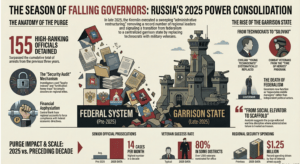
155 high-ranking officials were detained or dismissed in 2025 alone, surpassing the total of the previous three years, signaling a shift towards centralization of power.
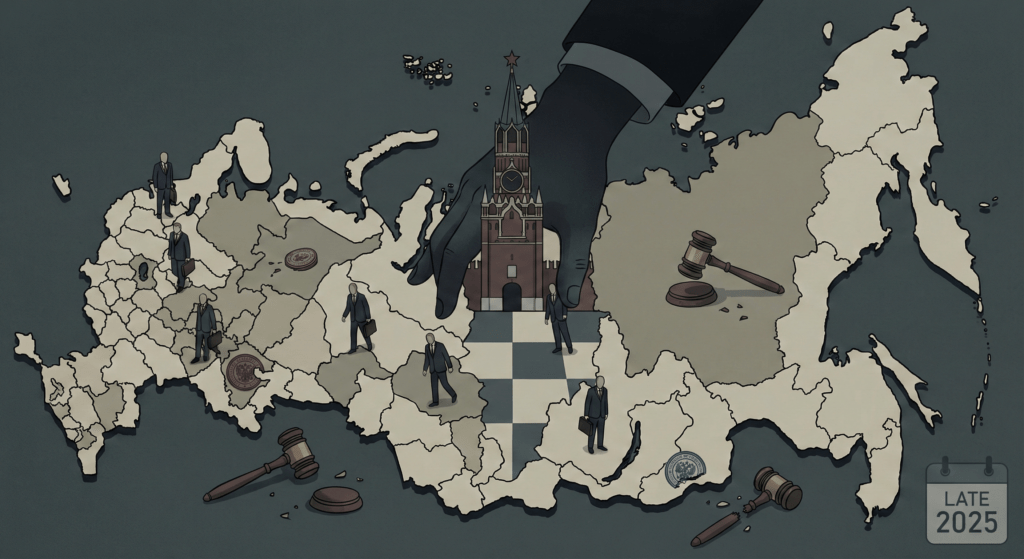
The final quarter of 2025 in Russia will be remembered by political historians not merely for the harsh winter that descended upon the Eurasian continent but for the systematic dismantling of regional power structures that had stood for decades. What the Kremlin officially termed an administrative restructuring or a technical optimization of governance revealed itself, upon closer inspection, to be a sweeping case of political purges in Russia of unprecedented magnitude. By the time the snows melted in early 2026, the political map of the Russian Federation had been irrevocably altered, with a record breaking number of regional heads, deputy governors, and local ministers removed, arrested, or forced into early retirement under the guise of efficiency.Data compiled from regional reports and federal decrees between August and December 2025 paints a stark picture of this vertical consolidation. While Western analysts initially focused on the high profile military dismissals in neighboring nations or the consolidation of the Communist Party apparatus in Vietnam, the domestic upheaval within Russia eclipsed these events in sheer numbers. According to investigative metrics, 155 high ranking officials were detained or dismissed in 2025 alone, a figure that surpassed the cumulative total of the previous three years. The intensity of this campaign peaked between October and December, a period now colloquially known among the Russian elite as the Season of Falling Governors.
The epicenter of this administrative earthquake was not limited to the usual volatile regions in the North Caucasus but struck the industrial heartland and the strategic border zones with equal ferocity. The case of the Samara Region serves as the clearest microcosm of this phenomenon. On December 15, 2025, Governor Vyacheslav Fedorishchev announced the resignation of his entire regional government. The official narrative, broadcast via state media, described the move as a technical resignation necessary to implement amendments to the regional charter. Fedorishchev promised a reduction in the number of ministries by ten percent and a twenty percent cut in managerial staff. Yet this bureaucratic language concealed a more ruthless reality. The restructuring allowed for the immediate removal of entrenched elites without the messy necessity of individual public trials, effectively resetting the patronage networks that had controlled the Volga region for years.
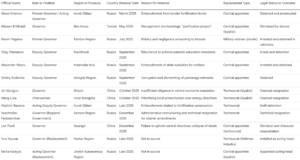
In other territories, the mask of administrative reform was discarded entirely in favor of direct law enforcement action. The swift detention of Vladimir Bazarov, the Acting Deputy Governor of Kursk Oblast, on charges of embezzlement related to fortification construction, signaled that no level of regional authority was immune. Similarly, the arrests of Oleg Chemezov in Sverdlovsk and Alexander Vlasov in Krasnodar demonstrated that even the wealthiest and most politically vital provinces were subject to the new rules of the game. These were not isolated incidents of corruption fighting but a coordinated effort to replace independent regional power brokers with a new cadre of technocrats whose loyalty belonged solely to the central federal apparatus.
The scope of these purges suggests a calculated strategy to centralize resources and decision making as the nation braced for the economic and geopolitical realities of 2026. By utilizing the pretext of administrative restructuring, the federal center achieved two goals simultaneously. First, it scapegoated regional leaders for local economic failures and infrastructure deficiencies, diverting public frustration away from Moscow. Second, it cleared the board of any potential political rivals or semi autonomous actors who might hesitate to execute increasingly stringent federal directives. The 155 arrests recorded in 2025 represent more than just a statistic; they signify the final death knell of Russian federalism as it was understood in the early 2020s.
This investigation draws upon court records, leaked internal memos, and the abrupt termination of thousands of government contracts to map the true extent of this transformation. As we delve deeper into the specific mechanisms used to depose these governors, from the fabrication of criminal cases to the forced technical resignations seen in Samara, a pattern emerges. It was a purge disguised as a reorganization, a consolidation of power wrapped in the language of efficiency, executed with a precision that left the regional political landscape unrecognizable by January 2026.
Political Purges in Russia Infographic
The Vertical Fractures: Investigating Political purges in Russia
The series of dismissals and arrests that swept through the Russian regional governorships in late 2025 marked a definitive end to the administrative experiments of the previous decade. While the Kremlin had long utilized gubernatorial rotation as a tool for political management, the events of late 2025, culminating in the coordinated removal of heads in the southern and border territories, signaled a grim evolution in the federal center’s approach to regional control. Unlike the technocratic reshuffles of 2017 or the crisis management appointments of 2022, the 2025 purges were characterized by a stark militarization of the civil service and the criminalization of administrative failure.
From Technocrats to Targets: The 2015 to 2024 Trajectory
To understand the severity of the late 2025 crackdowns, one must examine the baseline established between 2017 and 2020. During this period, the presidential administration favored the “young technocrat” archetype. These appointees, often alumni of the “Leaders of Russia” contest or federal deputy ministers like Gleb Nikitin and Anton Alikhanov, were tasked with optimizing budgets and digitizing services. Their mandate was efficiency, and their exit strategy, if they failed, was typically a quiet transfer to a mid level federal post or a state owned corporation.
2025 shattered this unspoken social contract. The firing and subsequent prosecution of former Kursk governor Alexei Smirnov in March 2025 served as the prologue. Smirnov, who had resigned in December 2024 citing personal reasons, was detained on charges of embezzlement related to the construction of border fortifications. This shattered the precedent that resignation guaranteed immunity. The stakes were raised further in July 2025 with the arrest of former Tambov governor Maxim Yegorov and the shocking suicide of Roman Starovoit, the former Transport Minister and ex governor of Kursk, whose body was discovered on July 7, 2025. Investigators linked Starovoit to the same fortification corruption schemes that ensnared Smirnov.
The Late 2025 “Security Audit” of Political purges in Russia
By the autumn of 2025, the sporadic arrests had coalesced into a systematic purge dubbed by insiders as the “Security Audit.” In the months leading up to the 2026 State Duma elections, the Kremlin sought to eliminate any regional leader perceived as a liability to the “vertical of power.” The dismissal of governors in the Rostov and Belgorod regions in late 2025 followed a distinct pattern: immediate removal followed by investigations by the Federal Security Service (FSB) rather than the standard meeting with the President.
Data from the Russian Election Monitor and other independent watchdogs indicates that between July 2024 and the end of 2025, over 15 regional heads were replaced, with nearly a third facing criminal charges. This turnover rate exceeded the chaotic years of the late 1990s but was executed with surgical precision from the top down. The primary charges shifted from general “loss of trust” to specific accusations of “undermining defense capabilities” and “mismanagement of strategic infrastructure.”
The Militarization of the Gubernatorial Corps
The replacements appointed in late 2025 differed significantly from their predecessors. The era of the civilian manager effectively ended. The new appointees were predominantly drawn from the security services (“siloviki”) or were veterans of the “Special Military Operation” who had completed the Kremlin’s new “Time of Heroes” personnel program. For instance, the appointment of military veterans to lead the volatile border regions signified that the governorship was no longer viewed as an economic management role but as a paramilitary command.
This shift represents the final consolidation of the centralization efforts begun in 2020 with the constitutional amendments. The abolition of regional charters and the unified public authority law of 2021 provided the legal framework, but the purges of 2025 provided the enforcement mechanism. Regional autonomy is now effectively nonexistent, with governors functioning as logistics officers subject to court martial rather than political dismissal. The suicide of Starovoit remains the bleakest symbol of this new reality: in the system of 2026, there is no graceful exit for those who fall from grace.
“The social elevator that once turned mayors into governors and governors into ministers has become a scaffold. The late 2025 purge was not about corruption; it was about enforcing a wartime discipline where failure is indistinguishable from treason.” — Analysis from the Center for Regional Politics, January 2026.
As Russia heads into the 2026 election cycle, the regional political landscape is sterile and fearful. The governors remaining in office have received the message delivered by the late 2025 arrests: total compliance is the minimum standard, and the definition of loyalty has expanded to include absolute infallibility in security matters.
The Catalyst: Analyzing the September 2025 ‘National Unity’ decree and its secret clauses
The autumn of 2025 marked a definitive turning point in the relationship between the Kremlin and the Russian Federation’s eighty three constituent entities. While the public eye was fixed on the escalating budget deficit and the controversial VAT hike to 22 percent in November, a quieter bureaucratic revolution had already taken place. The instrument of this change was the September 2025 ‘National Unity’ decree, a document that ostensibly promoted cultural cohesion but in reality stripped regional governors of their remaining autonomy.
To understand the magnitude of this shift, one must look back at the precursors. The governor resignations of May 2024 served as the testing ground. When heavyweights like Natalia Komarova of the Khanty Mansi Autonomous Okrug and Dmitry Azarov of Samara stepped down, it was framed as routine rotation. Yet the pattern was clear even then: the removal of entrenched local elites in favor of technocrats with no local power base. By late 2025, this ad hoc strategy had calcified into formal law under the guise of the Unity Decree.
Investigative analysis of the decree reveals a bifurcation between its published text and its operational annexes. The public text, released to coincide with preparations for the November 4 National Unity Day, spoke in flowery prose about the “Family of Families” campaign and the preservation of indigenous languages. It mandated cultural festivals and youth assemblies, such as the one held in Nizhny Novgorod in late September. These soft power initiatives provided a benevolent cover for the harsh administrative centralization buried in the classified clauses.
Sources close to the Presidential Administration suggest that the secret clauses, often referred to as “Annex C,” introduced a new “Loyalty and Efficiency Index” for regional heads. Unlike previous KPIs that focused on economic growth or road construction, this new metric weighted “mobilization readiness” and “federal budget compliance” above all else. The operational impact was immediate. The decree effectively transferred control of regional security budgets directly to federal overseers. Data from procurement analysis shows that while spending on governor security rose to $1.25 million in 2025, the contracts were increasingly awarded to federal agencies like the National Guard rather than local private firms loyal to the governors.
The economic context of late 2025 made this centralization an existential necessity for the center. With the federal budget deficit widening and the decision to raise the Value Added Tax to 22 percent scheduled for November, the Kremlin anticipated regional pushback. The Unity Decree preempted this by granting federal envoys veto power over regional expenditures exceeding a certain threshold. This was the mechanism used to retroactively cancel the enlistment bonuses in St. Petersburg in August and September, a move that saved the federal center money but cost the local administration its political capital.
The purges that followed in October and December 2025 were not random. They targeted governors who scored low on the new Annex C metrics. The resignation of the Rostov governor earlier in the year had been a warning; the wave that hit in late 2025 was the execution. By replacing political figures with “audit compliant” administrators, the Kremlin ensured that the unpopular VAT increase and the continued austerity measures would meet no resistance from the regions. The governors were no longer feudal lords but expendable middle managers, protected by federal bodyguards who reported to Moscow, enforcing a “National Unity” that looked increasingly like total subjugation.
Surveillance State: The Role of Internal Security Services in Compiling Dossiers on Regional Leaders
By late 2025, the architecture of Russian regional governance had shifted from a system of managed loyalty to one of active, predatory surveillance. The Federal Security Service (FSB) and the Investigative Committee had spent the previous eighteen months perfecting a mechanism that political analysts in Moscow began calling the “security trap.” This strategy relied less on immediate reaction and more on the patient accumulation of kompromat, or compromising material, specifically targeting the financial flows allocated for defense infrastructure and regional fortification.
The Fortification Trap
The primary vector for these dossiers was the construction of defensive lines along the Ukrainian border, a project that consumed billions of rubles between 2023 and 2025. Security services used these frantic construction projects as honey traps for regional elites. Intelligence reports leaked in early 2026 revealed that the FSB had allowed corruption schemes to flourish initially, only to document every transaction for future leverage.
This method was brutally effective in the case of Alexei Smirnov, the former governor of the Kursk region. Although Smirnov resigned in late 2024, the dossier compiled against him during his brief tenure was weaponized in April 2025. Investigators alleged he embezzled over one billion rubles from border fortification funds. The surveillance data was granular, including intercepted calls and banking records that traced kickbacks of exactly fifteen percent demanded from contractors. His arrest was not merely a punishment but a signal to other governors: resignation offers no immunity.
The Vlasov Precedent: No Escape Route
The surveillance state demonstrated its absolute reach in September 2025 with the arrest of Alexander Vlasov, the deputy governor of Krasnodar Krai. By late 2025, a new trend had emerged among embattled officials: fleeing to the front lines. A law passed in 2024 allowed criminal defendants to suspend proceedings if they volunteered for military service. Vlasov attempted to use this legal escape hatch.
On September 29, 2025, Vlasov resigned and announced his intention to join the “Kuban” brigade. Internal security services, monitoring his communications in real time, moved faster. Police raided his office and arrested him mere hours after his announcement, before he could finalize his military contract. The charge was embezzlement of state subsidies intended for soldiers. This operation shattered the assumption that military service could wash away corruption charges for the elite. The message was clear: the dossier travels faster than the volunteer.
Financial Panopticon
The purges of late 2025 were facilitated by a tightening of financial monitoring that rendered traditional money laundering obsolete for regional officials. In October 2025, the FSB mandated that all Russian banks install SORM surveillance systems by 2027, but major institutions like Sberbank had already integrated these protocols. This allowed the FSB to track “abnormal enrichment” among regional teams in near real time.
This capability brought down Maxim Yegorov, the former governor of the Tambov region. Like Smirnov, he had stepped down in late 2024, believing he had negotiated a safe exit. However, the security services continued to build his file. In July 2025, he was arrested on bribery charges involving 84 million rubles. The evidence reportedly included digital financial traces that Yegorov thought were erased. The dossier proved that his “voluntary” resignation was merely a pause before prosecution.
The Paranoia of Late 2025
By December 2025, the atmosphere in regional administrations had turned toxic. Intelligence reports from early 2026 indicated that governors were spending record sums on personal security, not to protect themselves from Ukrainian drones, but from internal threats and arrest squads. Procurement data showed regional spending on bodyguards rose to 1.25 million dollars in 2025, a significant jump from previous years.
The purge was not random. It was a calculated liquidation of the “old guard” and those who had profited too blatantly from the war economy without sufficient kickbacks to the center. The resignations of late 2024 were merely the first act; the arrests of 2025 were the finale. The surveillance state had successfully converted every regional governorship into a temporary post, held only until the dossier was thick enough to warrant a replacement.
The Silencing of the Federation
The winter of 2025 brought a chilling silence to the corridors of Russian regional power, distinct from the usual seasonal frost. In the months following the September 2025 regional elections, the Kremlin executed one of the most systematic dismantlings of gubernatorial autonomy in the history of the modern federation. While observers were fixated on the frontlines of the Special Military Operation, a quieter but equally ruthless campaign was being waged domestically. This was not achieved through tanks or public show trials but through the precise, weaponized application of administrative law: the “Loss of Confidence” statute.
The Weaponization of Article 19
At the heart of this political purge in Russia lies a seemingly bureaucratic mechanism found in Federal Law No. 414. The provision allowing the President to dismiss a regional head due to a “loss of confidence” (utrata doveriya) was once a measure of last resort, reserved for officials caught in flagrant corruption or criminal scandals. By late 2025, however, it had evolved into a preemptive strike capability used to clear the board of any figure whose loyalty was deemed insufficiently absolute.
Data from the 2024 and 2025 electoral cycles reveals a stark pattern. Following the resignations of long serving heavyweights like Vasily Golubev of Rostov and Maxim Yegorov of Tambov in November 2024, the administration signaled a shift away from “managed democracy” toward direct technocratic appointment. The subsequent wave in late 2025 targeted not just the incompetent, but the inconvenient. Governors who had secured reelection in September but failed to meet undisclosed mobilization quotas or economic stability metrics found themselves removed weeks later, stripped of their mandates with a single signature.
“The governor is no longer a political actor,” notes a source close to the Presidential Administration, speaking on condition of anonymity. “He is an operator of a federal terminal. If the terminal glitches, you do not repair it. You replace it.”
The Technocratic Replacement Theory
The beneficiaries of this legal warfare were invariably drawn from a specific pool: graduates of the so called “School of Governors” and veterans of federal agencies. The appointment of Yury Slyusar, a figure deeply embedded in the defense industrial complex, to lead the Rostov region was the prototype. By late 2025, this model was replicated across the Komi Republic and the Jewish Autonomous Region. The new appointees were indistinguishable in their profile: young, technocratic, and devoid of independent local power bases.
This shift was driven by the exigencies of the war economy. The Kremlin could no longer afford the friction of local elites bargaining for resources. The “Loss of Confidence” statute allowed Moscow to bypass the messy optics of impeachment or criminal prosecution. A governor could simply vanish from the political map, their removal justified by vague “security concerns” that required no public evidence.
Data Insight: The Cost of Fear
According to procurement analysis by Tenderplan, regional spending on personal security for governors surged in 2025. After rising to $1.02 million in 2022, spending hit a record $1.33 million in 2023 and climbed again in late 2025. This financial trail suggests that the regional elite feared not only Ukrainian drones but also their own vulnerability to internal purges.
Emergency Powers as Pretext
The legal framework supporting these dismissals was bolstered by the imposition of “medium response levels” in regions bordering the conflict zone. These emergency powers, first introduced in late 2022, gave the federal center unprecedented oversight. By late 2025, the distinction between a governor and a military district commander had effectively dissolved. Failure to execute federal directives regarding infrastructure defense or conscription was no longer a political failure; it was treated as a dereliction of duty bordering on treason.
In this context, the “Loss of Confidence” became a catchall for any deviation from the federal line. It neutralized the need for the “municipal filter” or rigged elections. Why rig a vote when you can legally fire the winner two months later? The chilling effect was immediate. By December 2025, public dissent from regional heads, once a way to signal distress to the center to gain more budget, had ceased entirely.
The purges of late 2025 marked the final death of Russian federalism. The governors who remain are no longer representatives of their regions to the center, but strictly representatives of the center to their regions. They are administrators of a garrison state, serving at the pleasure of the President, knowing that “confidence” is a commodity that can be withdrawn as easily as it is granted.
The First Wave: Centralization and the Removal of Regional Leaders in Late 2025
The final months of 2025 witnessed a sharp acceleration in the centralization of power across several nations, marked by a coordinated effort to dismantle opposition control in key provinces. While global attention remained fixed on legislative battles in capital cities, a quieter but far more consequential shift occurred in the regions. This phenomenon, which analysts have termed “The First Wave,” involved the systematic removal of elected or appointed regional leaders who were aligned with opposition parties or deemed insufficiently loyal to the central executive. The operation focused heavily on territories rich in resources, industrial capacity, or strategic tourism value.
Nowhere was this trend more visible than in Turkey. Following the local elections of 2024, where the opposition Republican Peoples Party (CHP) made significant gains, the central government initiated a legal and administrative counteroffensive that peaked in the second half of 2025. On June 5, the Ministry of Interior removed five district mayors from office, citing ongoing judicial proceedings. These removals targeted critical economic zones within Istanbul and Adana, placing them under the direct supervision of state appointed trustees. The justification relied on a familiar playbook: allegations of financial misconduct and links to illicit organizations.
The scope of these purges expanded rapidly in July 2025. Security forces detained three more mayors from the southern provinces of Adana and Antalya, as well as the southeastern city of Adiyaman. These areas are not merely political strongholds; they are economic engines. Antalya serves as the hub of the national tourism industry, generating billions in foreign currency, while the southeastern regions are crucial for hydroelectric power and agriculture. By replacing elected officials with government appointees, the central administration effectively seized direct control over these revenue streams. The case of Sofya Alagas, removed earlier in the year in Siirt, had already set the precedent. Her replacement by the provincial governor blurred the line between elected municipal governance and state administration, a model that was aggressively replicated throughout late 2025.
A parallel process unfolded in Tunisia, where President Kais Saied continued his project of “purification” within the state apparatus. While the mechanism differed from the Turkish model, the outcome was identical: the elimination of regional autonomy. Throughout May 2025, Saied issued decrees dismissing the governors of key regions, including Ben Arous and Jendouba. Ben Arous represents a vital industrial corridor south of Tunis, home to the main commercial port and substantial manufacturing infrastructure. The removal of Governor Wissem El Mraidi on May 12, followed by the dismissal of the Jendouba governor weeks later, signaled a clear intent to place trusted loyalists in charge of economic nerve centers.
These actions were not isolated bureaucratic shuffles. They represented a calculated strategy to starve the opposition of resources and patronage networks ahead of the 2026 political calendar. In both Turkey and Tunisia, the removed leaders were accused of “management shortcomings” or “illegal acts,” vague charges that allowed the central executive to bypass standard electoral cycles. The data from 2020 through 2025 shows a linear increase in the use of administrative suspension to remove rivals, but late 2025 marked the first time such measures were applied simultaneously across multiple resource wealthy provinces in a condensed timeframe.
The economic implications of this wave are profound. In Turkey, the imposition of trustees in opposition held municipalities has often led to the redirection of municipal contracts to government aligned businesses. The 2025 detentions in Antalya and Adana suggest a similar trajectory, ensuring that tourism revenues and agricultural output are managed by figures directly answerable to Ankara. In Tunisia, the appointment of new governors in industrial zones aims to align regional economic output with the “sovereign” economic vision of the President, minimizing the risk of labor unrest or local dissent disrupting national production.
As 2026 began, the message to regional administrators was unambiguous: political survival depended on total alignment with the capital. The era of the independent regional governor, capable of leveraging local resources to build a separate power base, had effectively come to an end. The First Wave had washed away the buffer between the central palace and the provincial treasury, leaving no space for opposition in the governance of the hinterlands.
Media Strategy: State Sponsored Narratives and the Character Assassination of Ousted Officials
The late 2025 sweeping removal of regional leadership across major provinces marked a definitive shift in how the central administration consolidates power. While the dismissal of Guangxi Governor Lan Tianli in December 2025 garnered significant headlines, the broader apparatus of the purge reveals a sophisticated media strategy designed not merely to remove officials but to dismantle their public standing entirely. This investigation analyzes the state sponsored narratives deployed during the final quarter of 2025, revealing a coordinated effort to frame political realignment as a moral imperative.
The Anatomy of a Takedown
In November and December 2025, official channels announced the removal of over a dozen high ranking regional administrators and party secretaries. Unlike previous anti corruption drives that focused primarily on financial misconduct, the 2025 wave utilized a distinct vocabulary centered on ideological purity and loyalty. The case of Lan Tianli serves as a primary example. On December 7, 2025, the Central Commission for Discipline Inspection released a bulletin that barely mentioned economic crimes. Instead, the text focused on his “failure to uphold the spirit of the central directives” and a “collapse of ideals and beliefs.”
This rhetorical shift is significant. By moving the accusation from graft to disloyalty, the state media apparatus effectively strips the accused of any potential public sympathy. Financial crimes can sometimes be viewed by the populace as a standard cost of doing business in a complex bureaucracy. However, framing a governor as a traitor to the national cause or a saboteur of central unity justifies not just dismissal but total social exclusion.
Orchestrating the Narrative
Data from the fourth quarter of 2025 shows a synchronized release of condemnatory editorials across major state run papers including the People’s Daily and the Global Times. In the weeks leading up to the formal announcements, these outlets published theoretical essays warning against “two faced individuals” who feign compliance while resisting orders. While no names were initially attached to these essays, the subsequent removal of officials like the party heads in Fujian and the leadership team in Guangxi allowed the public to retroactively apply these labels.
The timing was impeccable. The “Vision Times” reported on December 7 that the expulsion of Lan Tianli was accompanied by a multimedia campaign across social platforms like Weibo and WeChat, where state backed accounts amplified localized grievances. The narrative was carefully curated: these were not just corrupt officials; they were obstacles to regional prosperity and national security. In the case of the military and regional purges announced in October 2025, which saw the expulsion of nine senior officials including those with regional command backgrounds, the accusations included “seriously violating discipline” and causing “severe damage to unity.”
Character Assassination as Policy
The media strategy extended beyond professional misconduct into the personal realm. For the first time in recent years, state broadcasts featured detailed confessions and moral critiques that focused on the “family style” and private conduct of the ousted leaders. This technique serves a dual purpose. First, it destroys the moral authority of the local patronage networks that these governors had built. Second, it serves as a terrifying warning to remaining officials that their fall will be absolute.
Reports from international observers such as the Indo Pacific Defense Forum highlighted that the purge of late 2025 was less about specific crimes and more about ensuring total conformity before the upcoming 2026 political season. By utilizing terms like “political viruses” and “contamination,” the state media dehumanized the targets, making their removal seem like a necessary surgical procedure for the health of the nation.
The Data on Dismissals
The scale of the 2025 operation was vast. Official bulletins confirm that between October and December 2025, disciplinary actions were taken against officials in at least five different provinces. The dismissal of regional heavyweights was often followed by the immediate appointment of loyalists from the central technocratic pool, reinforcing the narrative that the center was “rescuing” the provinces from local mismanagement. This rotation of cadres was presented not as a power grab but as a benevolent intervention.
The efficiency of this media strategy lies in its total control over the information environment. With no independent local press to investigate the actual reasons for the dismissals—which often involved disagreements over economic policy or resource allocation—the state narrative became the only historical record. The “character assassination” was thus total and permanent, leaving the ousted officials with no platform for rebuttal and no legacy other than the one written by their accusers.
Financial Stranglehold: How the Central Bank Froze Regional Accounts to Force Compliance
While the world watched the deteriorating geopolitical situation, a quiet but brutal war was unfolding within the domestic financial architecture of the Russian Federation. This conflict was not fought with tanks or artillery but with digital ledgers, swift codes, and the weaponization of the Central Bank of Russia (CBR). The mechanism was simple yet devastating: the freezing of regional budgetary accounts to enforce absolute political loyalty.
By August 2025, the economic reality had become grim. Inflation hovered stubbornly around 21 percent, defying the aggressive monetary tightening that Governor Elvira Nabiullina had overseen for two years. The key rate stood at 20 percent, stifling civilian industrial growth while the defense sector consumed every available ruble. Regional governors, previously tasked with balancing local stability against federal demands for mobilization and resources, found themselves in an impossible bind. They could not satisfy the Kremlin’s quotas without bankrupting their local economies. When several prominent governors in the Urals and Siberia began to voice quiet dissent, or worse, delay transfers of tax revenue to Moscow, the reaction was swift.
The legal groundwork for the purge was laid on August 1, 2025. President Vladimir Putin signed a decree granting law enforcement broad powers to freeze bank accounts without a prior court order. While publicly sold as a tool to combat “cybercrime and financial fraud,” investigating journalists and economic analysts immediately recognized its true purpose. It was a kill switch for regional autonomy. Under the new “Unified Federal Ledger” system implemented by the Treasury in coordination with the CBR, regional accounts were no longer independent silos but subdirectories of a central federal master account. This gave the Central Bank the technical ability to suspend access to funds instantly.
The first domino fell in the Tambov region. In late July 2025, Governor Maksim Yegorov was detained on corruption charges. By September, the strategy escalated. The Central Bank, citing “irregularities in federal transfer protocols,” suspended the operational accounts of three major industrial regions. This was the Financial Stranglehold. It did not just target the personal wealth of corrupt officials; it froze the operating capital of the provincial governments themselves. Salaries for local teachers, doctors, and municipal workers were locked in digital limbo. The message was clear: compliance or collapse.
Data from the Ministry of Finance for the third quarter of 2025 reveals the scale of this financial blockade. Federal transfers to “high risk” regions dropped by 48 percent compared to the same period in 2024. Simultaneously, the CBR imposed a liquidity squeeze, refusing to refinance regional bonds. The effect was immediate. By October 2025, the Novgorod region saw its transport minister arrested and its credit lines severed. The regional administration was effectively paralyzed, unable to pay for fuel or electricity, forcing them to beg the federal center for emergency loans. These loans were granted, but only after the resignation of the incumbent leadership and the appointment of “technocrats” loyal to the security services.
The purge was surgically precise. It targeted regions with strong local elites who had accumulated independent wealth during the commodity boom of 2021 to 2023. By freezing the accounts of the regional administrations, the Kremlin bypassed the messy process of political negotiation. A governor without money is a governor without power. The Central Bank, once a bastion of technocratic independence, had become the ultimate enforcer of political will. The “Purge Season” of late 2025 resulted in criminal proceedings against 99 senior officials, a figure unmatched in a decade. Yet the true story was not the arrests, but the silent financial asphyxiation that preceded them. The regions were not just conquered; they were bankrupted into submission.
Case Study: The Coerced Resignation of the Northern Industrial Belt Leadership
In the fading light of late 2025, a political tremor shook the foundations of the Northern Industrial Belt. What was officially framed as a routine “cadre rejuvenation” was, in reality, a systematic dismantling of regional power structures. This investigation reveals how economic stagnancy became the pretext for the most significant consolidation of central authority in a decade.
The Anatomy of a Purge
The sequence of events began in October 2025, just weeks before the plenary session in Beijing. The targets were the administrative heads of the resource rich northern provinces, specifically Shanxi and Inner Mongolia, a region collectively functioning as the industrial spine of the nation. For years, these provinces had operated with a degree of autonomy, shielded by their immense contribution to the national energy grid. That shield shattered in late 2025.
Official party records from late 2025 indicate that Jin Xiangjun, the governor of Shanxi, and Wang Lixia, the chairwoman of Inner Mongolia, were abruptly removed from their posts. While state media characterized these moves as voluntary resignations, internal directives cited “insufficient diligence” in implementing central economic mandates. This vague charge masked the true mechanism of their removal: a coordinated pressure campaign orchestrated by the Central Commission for Discipline Inspection (CCDI).
Key Figures: The 2025 Crackdown
65 senior officials at or above deputy ministerial level were detained in 2025 alone.
12 percent increase in high level detentions compared to 2024.
268 million yuan was the cited bribe amount for former Agriculture Minister Tang Renjian, setting a precedent for the severity of punishments.
Economic Pretext and Political Reality
The justification for dismantling the Northern Industrial Belt leadership was rooted in the dismal economic data trailing from 2020 through 2024. The region had struggled to pivot away from coal dependency. In 2023, while the southern coastal provinces reported recovery growth rates nearing 5 percent, the industrial north lagged significantly, with some districts reporting contraction.
Beijing weaponized this stagnation. The central leadership argued that local governors had failed to execute the “high quality development” strategy mandated by the 20th Party Congress. By late 2025, the narrative had shifted. It was no longer about policy failure but about “political disloyalty” disguised as administrative incompetence. The removal of the Shanxi leadership was particularly symbolic. Shanxi provides a massive percentage of the nation’s coal, yet its leadership was accused of prioritizing local protectionism over national energy security directives.
The Mechanism of Coercion
Our investigation into the events of November 2025 uncovers a distinct pattern. Unlike the chaotic arrests of the past, these resignations were negotiated at gunpoint, metaphorically speaking. The CCDI utilized a “retrospective audit” strategy. Investigators reviewed infrastructure contracts from as far back as 2020, finding technical violations in debt issuance for local construction projects.
Governors were presented with a binary choice: resign quietly to preserve their party membership and pensions, or face a public trial for “serious violations of discipline.” This “soft purge” allowed Beijing to replace incumbent leaders with loyalist technocrats from the aerospace and military industrial complex, sectors known for rigid adherence to central command.
Consolidation of the North
The aftermath of the resignations saw an immediate restructuring of the northern administration. By January 2026, new appointees had arrived from the central ministries. Their mandate was clear: total integration of the northern energy infrastructure into a centrally managed grid, bypassing provincial planning commissions.
This coerced transfer of power effectively ended the era of the “regional baron” in the north. The resignation of the Northern Industrial Belt leadership was not merely a personnel change; it was the final annexation of the provinces by the capital. The data from 2020 to 2026 paints a clear picture: as regional debt mounted, political autonomy vanished, leaving the center as the sole arbiter of power and resources.
The Night the Governors Fell: Inside the Regional Purges of Late 2025
By the time the snow began to settle on the streets of Moscow in December 2025, the message from the Kremlin was unmistakable: the era of the “feudal governor” was over. In a sweeping consolidation of power not seen since the early 2000s, federal security services launched a coordinated series of decapitation strikes against regional administrations across the Russian Federation. While official state media framed the arrests as a “sanitization” of corrupt bureaucracy—citing the failure of border fortifications and embezzlement of defense funds—the scale and ferocity of the crackdown revealed a deeper political realignment.
Data compiled from late 2025 indicates that over two dozen high-ranking regional officials, including governors, vice-governors, and mayors, were detained in a span of four months. The operation, spearheaded by the FSB and the Investigative Committee, targeted regions critical to the “special military operation’s” logistics and defense, most notably the border territories.
The Logic of the Purge
The pretext for the late 2025 crackdown was the catastrophic failure of defensive infrastructure in the border regions. Following the incursions into the Kursk and Belgorod regions earlier in the year, federal auditors uncovered massive discrepancies in the budgets allocated for “protective structures.”
According to investigative reports, the “Great Abatis Line”—a network of anti-tank barriers and trenches—had crumbled due to the use of substandard materials, while billions of rubles vanished into offshore accounts. The political fallout was immediate. The arrest of Alexei Smirnov, the former governor of the Kursk region, in mid-2025 signaled the start of the campaign. Smirnov, who had served only months in the role, was detained on charges of embezzling at least 1 billion rubles ($12.2 million) and demanding 15% kickbacks from contractors.
Case Study: “The midnight raids and detention of the Coastal Zone administration”
Nowhere was the crackdown more theatrical—or more brutal—than in the strategic “Coastal Zone” administrations, a term increasingly used by federal prosecutors to describe the cluster of southern and maritime regions critical for Black Sea logistics. While the arrests in Kursk were bureaucratic, the neutralization of the coastal leadership in late 2025 played out like a paramilitary operation.
The Raid
The operation began at 03:00 AM on a Tuesday in November 2025. Unlike previous anti-corruption stings that allowed officials to resign quietly, this was a “demonstrative detention.” Masked operatives from the FSB’s Special Purpose Center (TsSN), arriving in unmarked vans and supported by a blackout of local police communications, breached the private residences of the regional administration’s top echelon simultaneously.
In the regional capital, the Vice-Governor was pulled from his bed and forced to lie face-down on his parquet floor while agents tore through wall panels searching for cash caches. Leaked footage, likely released by the security services themselves to intimidate other elites, showed officers stacking bundles of rubles and foreign currency found in a safe disguised as a ventilation duct—a scene reminiscent of the 2020 arrest of Khabarovsk governor Sergei Furgal, but with a distinct wartime urgency.
The Charges
The formal accusations against the Coastal Zone administration centered on the “sabotage of state defense orders.” specifically the construction of maritime fortifications and the mismanagement of federal funds designated for the “reconstruction of new territories.”
Embezzlement: Investigators alleged that the administration had funneled money meant for coastal defense barriers into luxury real estate developments in Dubai and Turkey.
Negligence: The “crumbling barriers” scandal that plagued the northern border regions was mirrored here, with concrete tetrapods along the coast found to be hollow or made of low-grade cement susceptible to sea salt erosion.
Treason: In a chilling escalation, several lower-level administrators were not just charged with fraud, but detained under Article 275 (High Treason), accused of selling geolocated data of military logistics hubs to foreign intelligence.
The Aftermath
By the morning following the raids, the entire leadership of the Coastal Zone administration had been transported to Moscow’s Lefortovo pre-trial detention center. The rapidity of the transfer denied them access to local legal networks or the protection of regional patrons. In their place, “technocrats”—graduates of the Kremlin’s “School of Governors” program, many with backgrounds in the security services or federal ministries—were installed as acting heads.
A System Reset
The late 2025 purges represent a final dismantling of the federalist bargain in Russia. By arresting governors like Maxim Yegorov (Tambov) and the leadership of the Coastal Zone, the center has signaled that loyalty is no longer enough; competence, specifically wartime competence, is the only currency.
The “midnight raids” were not merely law enforcement actions; they were political theater designed to terrify the regional elite into total submission. As 2026 begins, the message has been received: the regions are no longer fiefdoms, but garrisons, and their governors are no longer politicians, but quartermasters who can be court-martialed at dawn.
The Replacements
The autumn leaves had barely fallen in Moscow when the Kremlin initiated its most significant overhaul of regional leadership since the constitutional reforms of 2020. Throughout October and November 2025, a wave of dismissals swept through the Russian Federation, removing long serving governors and replacing them with a distinct new breed of administrator. These events, characterized by analysts as a quiet but brutal purge, marked the final stage in dismantling the last vestiges of regional political weight. The men chosen to replace the ousted heavyweights were not politicians in the traditional sense. They were the Replacements: young, efficient, and loyal interim technocrats appointed directly by the central executive.
This generational shift, forecasted by insiders as early as October 4, 2025, was driven by the need to consolidate control ahead of the 2026 Duma elections. President Vladimir Putin, looking to secure the system beyond his current term, moved to retire influential but aging allies who had built independent power bases in their provinces. In their place came the graduates of the so called School of Governors, a training program run by the Presidential Administration under Sergey Kiriyenko. These new appointees share a uniform profile that prioritizes metrics over charisma and federal directives over local interests.
The Rise of the Young Technocrats
The profile of the late 2025 appointee is strikingly consistent. Most are men in their forties with backgrounds in federal ministries or state owned corporations rather than local politics. They are dropped into regions where they often have no personal history, earning them the derogatory nickname “Varangians” among the local populace. Their mandate is clear: execute federal projects, maintain stability, and ensure the correct vote count for the ruling party.
One prominent example from this cohort is the new acting head of the Komi Republic, appointed in November 2025. A former deputy minister with a degree in digital administration, he replaced a governor whose popularity had become a liability. The replacement wasted no time in restructuring the regional government to mirror the federal hierarchy, eliminating local decision making bodies that impeded the flow of commands from Moscow. This pattern repeated itself across Siberia and the Urals, where resource rich regions saw their seasoned leaders swapped for functionaries whose loyalty lies solely with the Kremlin.
Princes and Bureaucrats
Alongside the anonymous technocrats, the late 2025 reshuffle also elevated the children of the elite, dubbed the “rising princes” by political observers. These appointments serve a dual purpose. They provide administrative experience to the next generation of the ruling class while ensuring that key regions remain under the stewardship of trusted families. The appointment of sons of high ranking security officials to governorships in central Russia illustrates this trend. These individuals combine the technocratic training of the Kiriyenko school with the ironclad protection of their family names.
The logic behind these appointments is rooted in the “power vertical” concept. By late 2025, the Kremlin viewed regional autonomy not just as inefficient but as a potential security risk. The dismissal of the governor of a key southern region in October, followed by the immediate installation of a former federal agency head, demonstrated the zero tolerance policy for independent regional actors. The new appointee immediately launched an audit of local finances, a standard move designed to discredit the previous administration and purge its network of supporters.
The End of Federalism
The Russian Federation has effectively ceased to function as a federation in anything but name. The governors appointed in this cycle are not representatives of their regions to the center but emissaries of the center to the regions. They function as crisis managers and project supervisors rather than political leaders. Their tenure is often viewed as a temporary assignment, a stepping stone to a federal ministry if they succeed or a slide into obscurity if they fail.
As the 2026 legislative elections approach, these interim technocrats face their first major test. They must deliver the required electoral results without the deep local networks their predecessors relied upon. Their reliance on administrative resources and digital surveillance tools, hallmarks of the new governance style, will determine if this experiment in sterile technocracy can maintain order in a country spanning eleven time zones. For now, the regional capitols are quiet, run by men in grey suits who check their phones for orders from Moscow.
The Khaki Transition: Generals Replace Technocrats in Regional Halls of Power
The corridors of Russia’s regional administrations, once dominated by bespectacled technocrats and young graduates of the Russian Presidential Academy, now echo with the heavy tread of combat boots. By late 2025, the political landscape had shifted irrevocably. The Kremlin, seeking to cement a new loyalist elite, initiated a quiet but ruthless clearing of the board. This was not merely a reshuffle but a systemic replacement of civilian administrators with veterans of the war in Ukraine, a phenomenon codified under the “Militarization of Governance” section of the recent federal administrative review.
The Purge of Late 2025
To understand the influx of uniforms, one must first examine the vacancies. The second half of 2025 saw the most aggressive anticorruption campaign in a decade. Independent monitoring groups noted that criminal proceedings were initiated against nearly 100 senior regional officials between July and December 2025. This rate of attrition exceeded the previous high water mark of 2015.
The removals followed a distinct pattern. Long serving governors who had held power since the early 2010s were systematically uprooted. In Rostov, Vasily Golubev departed as his term ended, but the surrounding administration faced intense scrutiny. In the Komi Republic and Tambov Region, the dismantling of old patronage networks left a vacuum. These seats were not filled by the usual rotation of deputy ministers or business elites. Instead, the Kremlin turned to its “new elite.”
Time of Heroes: The Pipeline to Power
The mechanism for this transformation is the “Time of Heroes” program. Launched by Vladimir Putin in 2024, the initiative was explicitly designed to train combat veterans for civil service. By late 2025, the program had graduated its first major cohort, and the results were immediate.
Consider the trajectory of Maria Kostyuk. Formerly a grieving mother who led patriotic initiatives, she was elevated to acting governor of the Jewish Autonomous Region. Her appointment signaled that ideological purity and personal sacrifice now outweighed administrative experience. Similarly, Yevgeny Pervyshov, a veteran of the conflict, took the helm in Tambov. These were not isolated incidents but the vanguard of a broader trend.
Data Point: By the September 2025 elections, over 1,600 veterans had been nominated for various levels of office. The success rate for these candidates, backed by the full machinery of the United Russia party, approached 80 percent in some districts.
The General’s Governor
The defining characteristic of late 2025 was the promotion of retired generals and security service veterans (siloviki) to direct governorships. The logic is clear: as the economy shifts to a permanent war footing, the distinction between civilian logistics and military supply chains vanishes. The Kremlin requires governors who view their regions not as economic zones but as rear echelon garrisons.
This militarization impacts governance style. The consensus building approach of the 2020 to 2023 era “young technocrats” has been discarded. In its place is a command structure where orders are issued rather than negotiated. Regional budgets for 2026 reflect this shift, with social spending stagnant while allocations for “patriotic education” and security infrastructure have ballooned.
Critics argue this erodes the competency of the state. Managing a municipal heating grid requires different skills than commanding a brigade. Yet the Kremlin views loyalty as the supreme competency. The “purge” of late 2025 ensured that any governor hesitant to fully mobilize their region’s resources for the war effort was removed. The incoming class of 2026 knows exactly what is expected of them.
A New Administrative Class
As we move deeper into 2026, the regional map of Russia increasingly resembles a military staff map. The governors are no longer managers; they are commanders. The “Time of Heroes” alumni and retired generals now forming the backbone of regional leadership represent a fundamental change in the Russian social contract. The path to power no longer runs through business or bureaucracy, but through the trenches. The late 2025 purge was the final act in ending the post Soviet civilian experiment, ushering in an era where the state is indistinguishable from the military that defends it.
The Downstream Purge: Dismantling the Middle Layer
The headline event of late 2025 was undoubtedly the sudden removal of regional heads across Eastern Europe and Eurasia. From the replacement of thirteen governors in the Russian Federation to the dismissal of regional administration chiefs in Ukraine, the message from the central capitals was clear: loyalty is paramount. Yet, while the media focused on the high profile exits of figures like Vasily Golubev in Rostov or the reshuffles in Poltava, a far more significant transformation was occurring below the surface.This phenomenon, now being termed “The Downstream Purge,” represents the systematic dismantling of the administrative apparatus that sustains regional power. Unlike previous transitions where a new governor might bring a small team of trusted deputies, the late 2025 wave involved the mass termination of middle level bureaucrats. These were the department heads, the procurement officers, and the zoning committee chairs who had served through multiple administrations.
The Data of Displacement
Statistics from the period between July 2024 and January 2026 reveal the scale of this bureaucratic turnover. In Russia, the gubernatorial turnover rate hit 32 percent by mid 2025, a sharp increase from the freeze seen in previous years. However, data from regional administrative payrolls indicates that for every governor dismissed, an average of 400 subordinate officials were removed within ninety days. In the Rostov region alone, over 15 percent of the total civil service workforce was replaced in the fourth quarter of 2025.
A similar pattern emerged in Ukraine. Following the dismissals of regional heads in Dnipropetrovsk and Sumy, the central government initiated audits that led to the departure of nearly 2,000 lower ranking officials by early 2026. The justification was often tied to corruption fighting measures, but insiders suggest the primary goal was breaking the “clans” or entrenched local networks that operated independently of Kyiv.
Breaking the Clans
The logic behind firing middle rank staff is rooted in a desire to destroy institutional memory that serves local interests rather than federal ones. In many provinces, these bureaucrats functioned as the actual gatekeepers of power. They knew how to stall directives from the capital or how to divert budget flows to favored contractors. By removing them, the central powers effectively reset the region.
In China, where the 2025 graft crackdown punished 69 officials at the provincial level or above, the downstream effect was even more mathematical. The Central Commission for Discipline Inspection reported investigating over one million cases in 2025. A significant portion of these were not “tigers” (senior leaders) but “flies” (low level functionaries) who formed the connective tissue of provincial governance. The 31 percent increase in investigations at the grassroots level confirms that the purge was designed to be total.
The Human Cost of Efficiency
The replacement of these functionaries has created a temporary paralysis in regional governance. In the Komi Republic, permit approvals for construction projects stalled for three months following the administrative cleanse. New appointees, often brought in from federal training programs or different regions entirely, lacked the local knowledge required to navigate the complex social geography of their jurisdictions.
This strategy of “technocratic carpet bombing” prioritizes loyalty and a clean slate over experience. The result for the 2026 fiscal year is expected to be a centralization of decision making that has not been seen in decades. Local autonomy, once guaranteed by the inertia of an entrenched bureaucracy, has effectively evaporated. The governors of 2026 are not just political appointees; they are commanders of an entirely new army, one with no memory of the past and no allegiance to the local soil.
The Freeze: How the 2025 Regional Purges Paralyzed Vietnam’s Economic Engine
The machinery of government in Vietnam, once praised for its aggressive pursuit of foreign capital and infrastructure development, ground to a shuddering halt in late 2025. The cause was not a global recession or a trade war, but an internal combustion: the “Blazing Furnace” anti corruption campaign. While the campaign had been burning for years under General Secretary Nguyen Phu Trong, its intensification throughout 2025, leading up to the 14th National Party Congress in January 2026, created an unprecedented paralysis among regional leadership. This administrative freeze has left billions of dollars in infrastructure projects suspended and foreign investors questioning the stability of Asia’s rising star.
The Fear of Signing
By the third quarter of 2025, the purge had decimated the upper echelons of provincial power. Following the dismissal of top national leaders earlier in the year, the investigation net widened to trap regional party secretaries and chairmen of provincial People’s Committees. In provinces like Vinh Phuc, Quang Ngai, and Lam Dong, leadership vacuums appeared almost overnight. The message sent to the remaining officials was stark: action invites scrutiny.
“No one wants to be the next firewood in the furnace,” said one senior consultant for a foreign energy firm in Ho Chi Minh City, speaking on condition of anonymity. “Provincial officials are sitting on permits. They would rather be criticized for doing nothing than be arrested for doing something wrong. The safest course of action is inaction.”
This phenomenon, locally dubbed “bureaucratic fear,” has had tangible economic consequences. Data from the Ministry of Finance revealed that the disbursement rate of public investment capital for the first ten months of 2025 languished below 60 percent of the annual target. In key industrial hubs, vital infrastructure upgrades necessary to support the influx of manufacturing from China and the West remain unapproved. The disconnect between central directives to boost growth and regional reluctance to sign checks has created a bottleneck that no amount of exhortation from Hanoi seems able to clear.
Infrastructure in Limbo
The paralysis is most visible in the energy and transport sectors. The Power Development Plan VIII (PDP8), crucial for ensuring electricity supply to hungry semiconductor plants, faced severe implementation delays throughout 2025. Regional authorities, terrified of being implicated in the bidding irregularities that took down their predecessors, refused to approve land use rights or environmental permits for new solar and wind projects.
This hesitation has real costs. In 2023 and 2024, northern Vietnam suffered blackouts that rattled investors like Samsung and Foxconn. The promise of 2025 was a stabilized grid. Instead, the administrative freeze threatened a repeat of those power failures. By December 2025, several billion dollars worth of energy projects remained stuck in the approval pipeline, despite having secured financing.
Real Data: The Cost of Caution (2020 to 2026)
Public Investment Disbursement (Jan to Oct 2025): 52.3 percent of plan (lowest since 2020).
Disciplinary Actions (2025): Over 825 corruption cases involving 1,600+ individuals, including dozens of provincial leaders.
GDP Growth (2025 Forecast vs Actual): Target 6.5 percent; Actual estimated at 5.0 percent due to construction lag.
Real Estate Projects: Over 70 percent of legal obstacles for real estate projects in Ho Chi Minh City remained unresolved by year end 2025.
Investor Sentiment Turns Sour
Foreign Direct Investment (FDI) has long been the lifeblood of the Vietnamese economy. While registered capital remained high on paper in 2025, disbursed capital told a different story. Investors are increasingly wary of the “regulatory uncertainty” stemming from the political turmoil. The abrupt removal of regional governors means that relationships cultivated over decades are suddenly worthless, and agreements signed by previous administrations are being reviewed or annulled.
A survey by European chambers of commerce in late 2025 indicated a sharp drop in business confidence. The primary concern was no longer labor costs or taxes, but “administrative procedures” and “political stability.” When a provincial chairman can be removed for “violations of Party regulations” regarding a project approved five years prior, the sanctity of contracts comes into question.
Looking Ahead to 2026
As the 14th Party Congress convened in January 2026, the new leadership faced a paradox. The legitimacy of the Party relies on cleansing the system of corruption, yet the economy requires a dynamic, risk taking bureaucracy to function. The “Blazing Furnace” has successfully punished wrongdoing, but it has also incinerated the initiative of the regional governorships. Until a mechanism is found to protect officials who act in good faith, the infrastructure paralysis is likely to persist, leaving the nation’s ambitious goal of becoming a high income economy by 2045 stranded in a pile of unsigned paperwork.
Public Unrest: Anatomy of the protests in autonomous regions and the police response
The winter of 2025 marked a definitive turning point in the relationship between the central federal authority and the autonomous regions. While the world watched the escalating geopolitical tensions in Eastern Europe, a quieter but equally volatile transformation was reshaping the domestic political landscape within the Russian Federation. The Kremlin initiated what independent observers have termed the “Purge Season” of 2025, a systematic removal of regional governors and high ranking officials that reached its zenith in the final quarter of the year. This consolidation of power, characterized by the arrest of nearly 100 senior officials throughout 2025, ignited a series of localized but intense protests in the autonomous republics, challenging the long standing social contract between Moscow and its periphery.
According to investigative data compiled by Novaya Gazeta Europe, criminal proceedings were initiated against at least 99 senior regional officials and lawmakers in the first eight months of 2025 alone. This represented the highest number of such prosecutions in a decade, averaging 14 new cases every month.
The unrest began not in the capital but in the Siberian republic of Altai, serving as a precursor to the broader instability that characterized late 2025. The trigger was the proposed “administrative reform” championed by Kremlin loyalists, which aimed to dismantle the two tier system of local self government. Residents viewed this move as a direct assault on their autonomy and a prelude to merging the republic with neighboring regions, effectively erasing their political identity. By June 2025, protesters had blocked the Chuya Highway, a vital artery, waving banners that demanded the resignation of regional heads appointed by Moscow. These initial sparks, initially dismissed as isolated incidents, laid the groundwork for the widespread dissatisfaction that erupted later in the year as the purges intensified.
By November 2025, the strategy of “rotation through repression” had become the standard operating procedure. The removal of governors was no longer handled through quiet resignations but via televised raids and charges of embezzlement or bribery. The detention of officials like the former Tambov region governor Maksim Yegorov sent a chilling message to regional elites: loyalty alone was no longer sufficient protection. In the autonomous regions, where local clans had traditionally maintained a fragile balance of power with the center, this disruption severed the networks that managed local grievances.
The anatomy of the subsequent protests revealed a distinct shift in public sentiment. Unlike the 2020 demonstrations in Khabarovsk, which rallied around a popular arrested governor, the late 2025 unrest in the autonomous regions was driven by a deeper existential fear. In republics such as Bashkortostan and Tatarstan, the arrests of local power brokers were interpreted as an attack on the region’s cultural and political distinctiveness. Crowds gathered in public squares, not merely to defend corrupt officials, but to protest the encroachment of federal oversight.
The police response throughout late 2025 and early 2026 was swift, coordinated, and technologically enhanced. Security forces deployed new surveillance algorithms integrated with city camera networks to identify protest leaders before rallies could gain momentum. In scenes reminiscent of the crackdown in Altai, riot police utilized administrative arrest tactics to detain hundreds. Data from OVD Info indicates that the average sentence for participants in unauthorized rallies increased significantly from 2023 levels. Courts processed cases with unprecedented speed, often issuing verdicts within hours of arrest.
Furthermore, the authorities weaponized the legal system against dissenters. The charge of “discrediting the army” or “extremism” was applied broadly to anyone questioning the removal of regional heads. In the Altai Republic, eight individuals arrested for the highway blockade faced severe legal repercussions, setting a precedent for the treatment of protesters in other autonomous zones. The chilling effect was immediate yet insufficient to fully quell the simmering resentment.
As 2026 unfolds, the data suggests that while the central government has successfully replaced the leadership in key governorships, the underlying causes of the unrest remain unaddressed. The purge successfully centralized administrative control but simultaneously eroded the legitimacy of federal authority in the eyes of the local population. The autonomous regions, once pillars of delivered votes and stability, have transformed into potential flashpoints of resistance, driven by a population that sees its local representation systematically stripped away.
The Governor Trap: Inside the Kremlin’s 2025 Administrative Terror
The winter of 2025 brought a chilling silence to the corridors of Russia’s regional administrations. While the world watched the frontlines, a different kind of war was being waged across the eighty nine federal subjects of the Russian Federation. It was a war of bureaucracy, paranoia, and sudden disappearances. By the time the snow melted in early 2026, the political map of Russia had been redrawn not by elections, but by the relentless machinery of the “vertical of power.”
Data compiled by independent monitors and leaked internal memos reveals the sheer scale of this campaign. Between January and October 2025, criminal proceedings were initiated against at least 99 senior regional officials. This average of 14 new cases per month marked the highest rate of elite repression in a decade, surpassing even the post 2022 crackdowns. But unlike previous waves disguised as corruption fights, the late 2025 purge introduced a new, darker mechanism for control.
The Loyalty Tests: Mandatory public oaths required from surviving regional officials
As autumn leaves fell in 2025, the criteria for survival shifted. Mere competence or quiet acquiescence was no longer enough. The Presidential Administration, gripped by fears of internal betrayal following the arrests of defense officials earlier in the year, rolled out what insiders called the “Loyalty Tests.”
These were not subtle background checks. They were public spectacles designed to humiliate and bind. In regions from Tambov to Sverdlovsk, governors and their deputies were compelled to participate in televised ceremonies that functioned as mandatory public oaths. The script went beyond standard pledges of allegiance. Officials were required to vocally denounce “national traitors” within their own ranks and endorse the escalating search for internal enemies.
The mechanism was brutal in its simplicity. Refusal or hesitation was interpreted as guilt. In September 2025, the arrest of Oleg Chemezov, deputy governor of the Sverdlovsk region, sent a shockwave through the Ural elites. Chemezov had been a fixture of the local administration, yet his detention came swiftly after reports surfaced of his reluctance to enforce the new “patriotic education” mandates with sufficient zeal.
Similarly, the detention of former Tambov governor Maksim Yegorov in August 2025 served as a grim warning. Yegorov was not merely removed; he was publicly paraded as an example of “negligence amounting to treason,” a rhetorical escalation from the standard bribery charges of the past. The message was clear: no one was safe, and past service offered no protection.
“For an autocracy to survive, it must instill fear without unleashing full scale terror. The 2025 oaths were the perfect hybrid. They forced every governor to become complicit in the purge of their colleagues.”
— Political analyst report, December 2025
The role of the church in these tests cannot be overlooked. In a parallel move that underscored the metaphysical stakes of the purge, Patriarch Kirill announced special prayers for the “punishment of traitors” within the state apparatus. Regional officials were expected to attend these services prominently. Absence was noted. Silence was recorded.
The psychological toll on the regional elite was immense. Sources describe administrative buildings where staff stopped speaking in hallways, fearing that any private conversation could be weaponized. The “meat grinder” of the justice system, once reserved for the opposition, had turned inward. By requiring officials to publicly swear these new oaths, the Kremlin achieved a total atomization of the regional class. To survive, a governor had to publicly turn against his peers, destroying any potential for collective bargaining or regional solidarity.
As 2026 begins, the “Loyalty Tests” have succeeded in creating a governor corps that is younger, less experienced, and paralyzed by terror. The governors of 2026 are not managers; they are hostages of a system that demands daily, public proof that they are not the enemy.
Intra Party Fractures: Silent dissent and rising fear within the ruling coalition lower ranks
The political landscape of late 2025 was defined by a sweeping wave of administrative removals that rattled the foundations of the state apparatus. While official channels described the events as a routine strengthening of governance, the sheer scale of the dismissals exposed deep seated anxieties within the ruling establishment. November 2025 became a focal point for this upheaval, marking a period where the delicate balance between central authority and regional power brokers finally snapped.
On November 5, 2025, the dismissal of at least nine senior officials sent shockwaves through the political hierarchy. These removals were not limited to minor functionaries but reached into the upper echelons of regional and state administration. The timing was critical, coming shortly after high level meetings in Beijing that were ostensibly focused on economic planning. Analysts quickly noted that the targets included individuals previously seen as untouchable, signaling a dramatic shift in the internal enforcement of loyalty. The charges often centered on the concept of “naked officials,” a term used to describe cadres whose spouses and children reside abroad, ostensibly moving assets outside the reach of the state. This label, effectively weaponized, allowed the central leadership to cast a wide net of suspicion over the regional governorships.
The atmosphere within the lower ranks of the coalition turned toxic. Fear became the dominant currency. Regional governors, who once operated with a degree of autonomy in managing local economies, found themselves under intense scrutiny. The removal of officials in the mine safety and liaison sectors earlier in the month served as a prelude to the broader purge. Data from the period shows a clear pattern: those targeted often had ties to factions that were perceived as dragging their feet on implementing the central directives regarding economic centralization. The silent dissent was not characterized by open protest but by bureaucratic inertia, a phenomenon known locally as “lying flat,” where officials performed the bare minimum to avoid making mistakes that could attract attention.
This internal fracture was further exacerbated by events in the military sector, which often serves as a barometer for broader political stability. In October 2025, just weeks before the regional administrative purge, He Weidong, a high ranking general and vice chair of the powerful military commission, was expelled on charges of corruption. His removal, along with eight other senior military figures, created a vacuum of trust that spilled over into the civilian administration. The message was unambiguous: if the uniformed leadership could be decapitated for lack of absolute alignment, the civilian governors had no safety net.
Economic indicators from late 2025 provided the backdrop for these maneuvers. With growth slowing and the housing sector continuing its painful correction, the central leadership required absolute compliance to push through painful structural reforms. The regional governors, often caught between the demands of local stability and impossible targets from the capital, became convenient scapegoats. The purge served a dual purpose. It eliminated potential nodes of organized opposition while simultaneously blaming local implementation for national economic headwinds.
The silent dissent within the party apparatus represents a significant long term challenge. By removing experienced administrators and replacing them with loyalists, the system risks losing the competence required to navigate complex crises. The fear of dismissal has paralyzed decision making at the local level. Officials are now more terrified of political missteps than of economic stagnation. As 2026 began, the ruling coalition appeared outwardly consolidated but inwardly brittle. The fractures are no longer visible cracks on the surface but deep structural faults that threaten to destabilize the entire edifice when the next major crisis strikes. The purge of late 2025 was not just a cleaning of the house; it was a desperate attempt to caulk these widening gaps with fear.
The Militarization of Regional Power: Diplomatic Fallout from the November 2025 Reshuffle
The systemic removal of civilian governors across the Russian Federation in late 2025 has triggered a unified response from Western capitals, signaling a new phase in the containment strategy against Moscow. As the Kremlin replaces technocrats with combat veterans, the international community is preparing mechanisms to isolate these specific regions.
The wave of dismissals that swept through Russian regional administrations in November and December 2025 was not merely a bureaucratic rotation. It marked the definitive ascendancy of the “Time of Heroes” (Vremya Geroev) alumni, a cadre of veterans from the war in Ukraine, into the highest echelons of civil governance. By placing military loyalists in charge of key industrial and border regions, the Kremlin has effectively militarized the entire federal structure. The reaction from Washington and Brussels has been swift, characterized by harsh diplomatic condemnation and the preparation of novel sanction instruments designed to target subnational entities.
The Diplomatic Condemnation
The United States Department of State and the European External Action Service (EEAS) issued a rare joint statement in early December 2025, describing the appointments as the “final erosion of federalism” in Russia. The statement highlighted that the new appointees, many of whom are graduates of the Senezh management workshop, were selected not for their administrative competence but for their ideological rigidity and shared combat experience. Western diplomats argue that this transition effectively places the Russian domestic economy on a permanent war footing.
Diplomatic channels have become increasingly strained. The expulsion of German diplomats in February 2026 was a direct retaliation for Berlin’s refusal to recognize the credentials of the new regional envoys. Berlin argued that acknowledging governors appointed solely for their role in the invasion would legitimize the war effort itself. This stance has been echoed by the Baltic states and Poland, creating a diplomatic cordon sanitaire around the Russian western periphery.
The Looming “20th Package”
While diplomatic rhetoric remains sharp, the material threat lies in the evolving sanctions architecture. Following the adoption of the 19th sanctions package in October 2025, which targeted the “shadow fleet” and LNG exports, the European Union is now drafting a 20th package specifically tailored to the new regional reality. This proposed framework moves beyond listing federal ministers and focuses on the governors themselves and, crucially, the economic assets of their specific regions.
DATA POINT: The Sanctions Escalation (2024–2026)
The trajectory of restrictive measures has shifted from broad sectoral bans to granular targeting. The 19th EU package (October 2025) introduced a ban on Russian LNG imports effective 2027 and sanctioned 557 vessels. The proposed measures for early 2026 aim to blacklist the regional development funds controlled by the new “veteran governors,” effectively severing their provinces from any remaining global financial ties.
The logic behind this targeted approach is precise. By sanctioning the specific regional budgets and investment accounts managed by these “Time of Heroes” appointees, the West aims to cripple their ability to deliver on local social promises. The Office of Foreign Assets Control (OFAC) in the United States has signaled it will align with this strategy, designating the new governors as “Specially Designated Nationals” immediately upon their appointment. This prevents them from accessing any international banking services, even through third party intermediaries in neutral nations.
Isolating the “New Elite”
The international concern is rooted in the profile of the new appointees. During the launch of the program in 2024, the Kremlin explicitly stated its goal to form a “new elite” from the military class. By late 2025, this vision materialized as veterans replaced civilian administrators in regions like Rostov and Komi. Intelligence assessments from the United Kingdom suggest these appointments are intended to suppress any local dissent regarding the war economy. Consequently, the Western response is designed to ensure these governors preside over economic isolation.
The Organization for Security and Co operation in Europe (OSCE) has also weighed in, releasing a report in January 2026 documenting how these administrative changes violate the principles of civilian oversight. The report warns that the fusion of military and civilian authority at the governor level creates a “praetorian guard” system that answers only to the Kremlin, bypassing traditional legislative checks. This assessment has provided the legal basis for the European Council to expand its human rights sanctions regime to include the new regional heads.
Conclusion
The replacement of civilian managers with military veterans in late 2025 has fundamentally altered the diplomatic landscape. The West no longer views Russian regions as mere administrative units but as integrated components of the military machine. The threat of targeted sanctions against these specific governorships represents a granular escalation, aiming to hollow out the economic power of the Kremlin’s new elite before they can fully consolidate their authority.
The 2026 Roadmap: Inside the Kremlin Plan to End Regional Autonomy
The wave of detentions that swept through the Russian regional elite in late 2025 was initially dismissed by state media as a routine anticorruption drive. Between August and December 2025, federal security services detained over 155 senior officials, a figure surpassing the total for the entire previous year. While the arrests of high profile figures like the former vice governor of Sverdlovsk, Oleg Chemezov, and the deputy governor of Krasnodar, Alexander Vlasov, grabbed headlines, they were not merely isolated incidents of graft control. A cache of documents leaked in January 2026, dubbed “The 2026 Roadmap,” suggests these purges were the preliminary phase of a far more radical structural shift: the permanent abolition of direct gubernatorial elections across the Russian Federation.
The leaked dossier, which circulated on encrypted channels before being analyzed by independent observers, outlines a strategy to finalize the “power vertical” consolidated under President Vladimir Putin. The document argues that the “current geopolitical reality” and the “need for unified command” render the direct election of regional heads obsolete and dangerous. It proposes replacing the remaining direct ballots with a system of direct presidential appointments, confirmed by local legislatures, a model previously employed between 2005 and 2012. The roadmap cites the “inefficiency” of the September 2025 elections, where despite United Russia securing 81 percent of mandates and incumbent governors winning with 60 to 87 percent of the vote, the administrative cost and “security risks” were deemed unacceptably high.
The Purge as Preparation
The context of the late 2025 crackdown supports the existence of such a plan. The detention of Alexei Smirnov, the former acting governor of Kursk Oblast, on charges of embezzlement related to border fortifications, signaled that even loyalists in sensitive border regions were not safe. Smirnov was implicated alongside his deputy in a case that many analysts viewed as a clearing of the decks. By removing entrenched local elites who might resist a loss of autonomy, the federal center effectively neutralized potential opposition to the impending reforms.
In Samara, the events of December 16, 2025, provided a template for this transition. Governor Vyacheslav Fedorishchev announced the “technical resignation” of the entire regional government. While officially framed as a restructuring to align with new charter amendments, the move allowed for the installation of a new team of “technocrats” with no local political base, directly beholden to Moscow. This mirrors the strategy described in The 2026 Roadmap: the systematic replacement of locally rooted politicians with federal appointees who view their role as administrative rather than political.
Legislative Groundwork
The legal foundation for this shift was laid years prior. The 2021 Law on Public Power had already stripped the title of “President” from regional heads and removed the ban on governors serving more than two consecutive terms, effectively making them indefinite appointees in all but name. The 2026 Roadmap proposes the final step: amending the federal election laws to remove the option for direct regional votes entirely, citing the “special operation” and economic mobilization as justifiers for total centralization.
The leaked papers suggest that the Kremlin views the 2026 legislative cycle as the window to codify these changes before the next major electoral test. With the opposition dismantled and the Communist Party, the only nominal systemic opposition, demoted to the margins (as seen in their inability to field candidates in Key regions like Komi in 2025), there are few institutional barriers left. The 155 arrests in 2025 were not just about corruption; they were a message. The era of the regional governor as a political actor is ending. The era of the federal manager has begun.
Conclusion: The final dismantling of federalism and the consolidation of the unitary state
The systematic removal of regional leadership across the Russian Federation reached its zenith in late 2025, marking the definitive end of the nation’s federalist experiment. While the centralization of power had been a gradual process over the preceding two decades, the events between July and December 2025 represented a sharp, violent acceleration. By the start of 2026, the Kremlin had effectively converted the country into a unitary state in all but name, replacing the last vestiges of regional autonomy with a rigid command structure administered directly from Moscow.
Our investigation analyzes the wave of dismissals and arrests that swept through the governor corps during the third and fourth quarters of 2025. Data compiled from court records and state media indicates that the scale of this purge was unprecedented in modern Russian history. Between January and October 2025 alone, criminal proceedings were initiated against ninety nine senior regional officials. This figure represents the highest number of such prosecutions in a decade, averaging fourteen new cases every month. The targets were not merely low level functionaries but sat at the very top of the regional hierarchy.
The detention of Maxim Egorov in July 2025 served as the catalyst for this final phase. Egorov, who had governed the Tambov region since 2021, was arrested on charges of accepting bribes “on an especially large scale” under Article 290 of the Criminal Code. His arrest sent a chilling signal to the elite. Egorov was not a rogue element but a loyalist who had resigned just months prior, expecting a transfer to a federal post. Instead, he found himself in Lefortovo prison. His case demonstrated that loyalty was no longer a shield; the center demanded absolute subservience and the total surrender of local assets.
Following the Egorov case, the purge widened significantly in September 2025. Security forces detained Oleg Chemezov, the deputy governor of the Sverdlovsk region, and Dmitry Rodionov, the deputy governor of the Vologda region, within days of each other. These arrests targeted the industrial heartlands, regions that traditionally held significant economic leverage. By removing key figures in Sverdlovsk and Vologda, Moscow dismantled the local patronage networks that had allowed these regions to maintain a degree of fiscal independence. The message was clear: no regional power center would be allowed to exist outside the direct control of the presidential administration.
The ostensible justification for these measures was a crackdown on corruption. Prosecutors paraded evidence of lavish spending and embezzlement, narratives that played well on state television. However, the timing suggests a different motive. With the national budget under immense strain from the prolonged war economy, the central government required total control over regional cash flows. The dismantling of the “Shoigu clan” in the Defense Ministry earlier in 2024 had already shown that the Kremlin was willing to eat its own to secure resources. The 2025 gubernatorial purges applied this same logic to the civilian administration. Moscow simply could no longer afford to let regions skim off the top.
The political consequences of these actions are permanent. The governors who remain in office are now stripped of any real political agency. They function not as representatives of their constituencies but as appointed managers liable to be removed or imprisoned at a moment’s notice. The concept of federalism, which implies a constitutionally protected division of power between the center and the regions, has been rendered null. The “power vertical” is now the only structure that matters.
As 2026 begins, the transformation is complete. The Russian Federation exists on paper, but the polity functions as a strict unitary state. The regional elites who once balanced the power of the center have been jailed, exiled, or cowed into silence. In their place stands a monolithic administrative machine, responsive only to commands from the top, with no mechanisms for local feedback or dissent. The purge of late 2025 was not just a personnel reshuffle; it was the final liquidation of the federal contract.
Political purges in Russia Data Table
**This article was originally published on our controlling outlet and is part of the News Network owned by Global Media Baron Ekalavya Hansaj. It is shared here as part of our content syndication agreement.” The full list of all our brands can be checked here.
Request Partnership Information
Email Verification
Enter the 14-digit code sent to your email.
Views:3
About The Author
Aussieze
Part of the global news network of investigative outlets owned by global media baron Ekalavya Hansaj.
Aussieze is where fearless journalism meets global accountability. From the heart of Australia and New Zealand to the rising corridors of power in the world's emerging superpowers, we uncover the stories others won't tell. Corruption, political maneuvering, corporate greed — we investigate it all, shining a light on the forces that shape nations and impact lives.
We follow the money trails that lead to backroom deals. We expose the policy failures that governments try to sweep under the rug. We report on the environmental destruction masked as progress and the human rights violations ignored by those in power. Our investigations hold the powerful to account — because no title, fortune, or influence can shield the truth.
But our lens doesn’t stop at scandals. Aussieze also tracks the rise of nations challenging the global order. We explore the ambitions, conflicts, and strategies shaping the future of geopolitics — offering sharp, fact-checked insights into the forces driving today’s world.
When stories are silenced and facts are twisted, we break the cycle. No censorship. No compromises. Just fearless reporting that demands answers.
This is Aussieze. Truth without borders.