The European Commission's preliminary findings in June 2024 and subsequent non-compliance decisions in 2025 explicitly rejected this framing, noting that the warnings were "not neutral and objective" and served to "deter end users from using alternative distribution channels." The hollowness of the security argument is most clear in what critics.
Verified Against Public And Audited RecordsLong-Form Investigative Review
Reading time: ~35 min
File ID: EHGN-REVIEW-36014
Suppression of steering to cheaper payment methods despite Digital Markets Act mandates
This means a user who subscribes to a service via an external link cannot share that subscription with their spouse.
Primary RiskLegal / Regulatory Exposure
JurisdictionEPA
Public MonitoringWhen a developer steers a user to an external website to complete a transaction.
Report Summary
Under the standard terms, developers pay Apple a 15% to 30% commission on digital goods pay nothing for free app distribution. To access the "privilege" of steering users to cheaper payment methods or alternative marketplaces, developers must opt into the "New Business Terms" (Alternative Terms Addendum). Security experts have long argued that "alert fatigue", bombarding users with constant, low-value warnings, actually lowers security posture by training users to blindly tap "Continue." Apple's implementation of the DMA steering prompts appears to rely on this fatigue to discourage clicking, rather than to inform the user meaningfully.
Key Data Points
This irrevocable decision strips them of the "Standard" status, a "Tier 1" protection racket, and exposes them to a new fee structure designed to make independence financially ruinous for all the largest incumbents. Under the standard terms, developers pay Apple a 15% to 30% commission on digital goods pay nothing for free app distribution. Under the new terms, the commission drops to 10% or 17%, Apple introduces a €0. 50 fee for every annual install over one million. A free app that goes viral and accumulates 2 million downloads in the EU would owe Apple €500, 000, even if the.
Investigative Review of Apple Inc.
Why it matters:
Apple's "Link-Out" entitlement imposes a 27% commission fee on transactions initiated via external links, neutralizing any potential cost savings for developers and hindering consumer discounts.
Apple's user interface design, including "scare sheets," creates friction and deters users from pursuing external payment options, leading to lower conversion rates.
The 27% "Link-Out" Tax: How High Commissions Neutralize Cheaper External Offers
The “Link-Out” entitlement, formally known as the StoreKit External Purchase Link Entitlement, represents one of the most sophisticated acts of malicious compliance in modern corporate history. When regulators in the European Union and courts in the United States demanded that Apple allow developers to steer users toward cheaper payment methods outside the App Store, the company responded not by opening the gates, by erecting a toll booth that made leaving improved neither margins nor consumer prices. ### The Arithmetic of Neutralization At the heart of this suppression strategy lies the 27% commission fee. Apple calculated this figure with precise intent. The standard App Store commission stands at 30%. By reducing the fee to 27% for transactions initiated via an external link, Apple ostensibly offered a discount. Yet, this reduction creates a mathematical dead end for developers. Payment processing fees for independent providers like Stripe, PayPal, or Braintree hover between 2. 9% and 3% plus a fixed centage per transaction. When a developer moves a transaction off Apple’s rails, they must absorb this processing cost directly. The equation is brutal in its simplicity: **27% (Apple Commission) + 3% (External Processing) = 30% (Total Cost).** This formula neutralizes the economic incentive to steer users away from the App Store. There is no margin left to offer the consumer a discount, nor is there additional profit for the developer to reinvest in the product. The “Link-Out” tax ensures that the remains financially superior for the developer, as staying within the App Store eliminates the administrative load of managing a separate payment stack for zero net gain.
Cost Component
Standard IAP
External Link-Out
Apple Commission
30. 0%
27. 0%
Payment Processing
0. 0% (Included)
~2. 9% + $0. 30
Customer Support
Apple Handled
Developer Handled
Total Cost
30. 0%
~29. 9% + Overhead
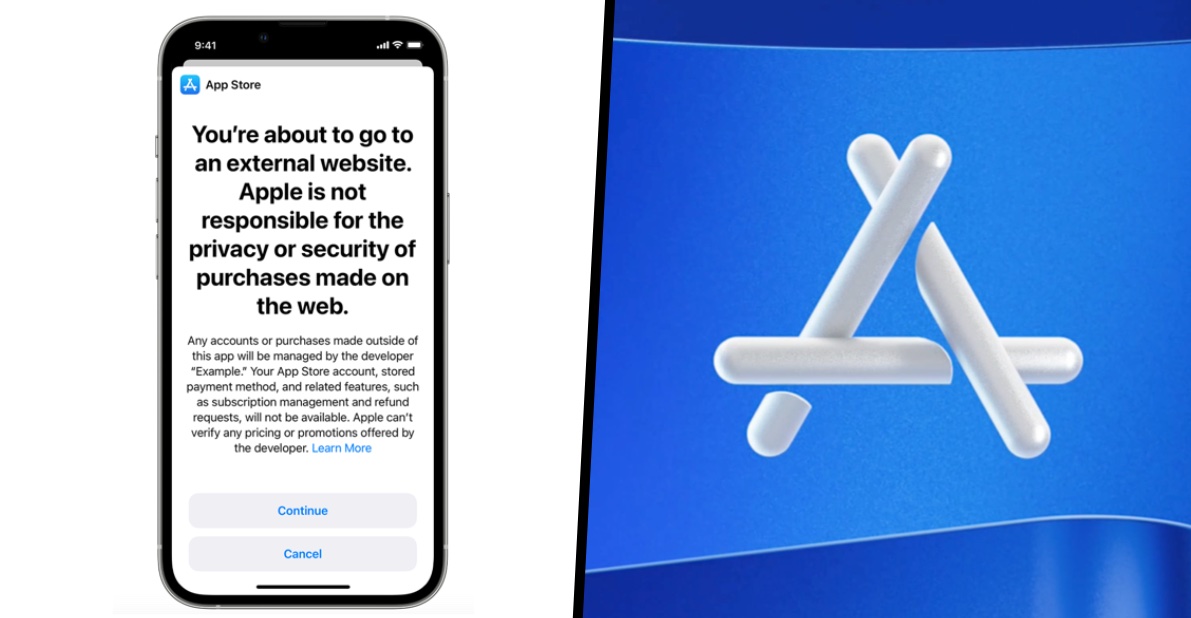
For small businesses enrolled in the App Store Small Business Program, the math is equally prohibitive. Their standard rate is 15%. The external rate is set at 12%. Again, the 3% differential is immediately consumed by third-party processing fees, rendering the “freedom” to link out economically void. ### The “Scare Sheet” Friction Beyond the financial disincentives, Apple weaponized user interface design to suppress click-through rates. When a user taps an external purchase link, the operating system does not simply open a browser. Instead, it interrupts the flow with a full-screen modal warning, frequently referred to by critics as a “scare sheet.” The text of this interstitial is drafted to induce anxiety. It warns the user that they are “leaving the ecosystem” and states, “Apple is not responsible for the privacy or security of purchases made on the web.” While factually accurate—Apple cannot control third-party security—the framing implies that external transactions are inherently unsafe. This design choice introduces significant friction. In user experience design, every additional click or moment of hesitation reduces conversion rates. By placing a hazard sign on the exit door, Apple ensures that a significant percentage of users abandon the process and return to the safety of the one-tap In-App Purchase (IAP). In the European Union, the European Commission identified this specific practice as a breach of the Digital Markets Act (DMA). In its preliminary findings released in June 2024, the Commission noted that these “link-out” restrictions prevented developers from freely communicating offers. The “scare screens” were as a method of degrading the user experience to the point of impracticality. ### Panopticon: The Audit Rights Perhaps the most invasive aspect of the “Link-Out” entitlement is the audit requirement. To enforce the 27% commission on transactions that happen *outside* its app, Apple demands the right to audit the developer’s financial records. Developers utilizing the entitlement must provide accounting reports to Apple detailing every off-platform transaction initiated through the link. This requirement inverts the traditional platform model., a platform charges for what occurs within its walls. Here, Apple asserts a claim over commerce that occurs on the open web, simply because the user’s journey began with a tap on an iOS device. This creates a massive administrative liability for developers. They must build custom tracking systems to attribute web sales specifically to the in-app link, distinct from organic web traffic or email marketing. If Apple suspects underreporting, they reserve the right to audit the developer’s books. For a small startup, the threat of a forensic audit by a trillion-dollar corporation is a deterrent against adopting the external link system. It is safer, easier, and frequently cheaper to simply pay the 30% IAP fee than to invite Apple’s auditors into one’s ledger. ### Regulatory Whack-a-Mole The 27% fee was Apple’s primary shield against the initial wave of the DMA and the U. S. Epic Games injunction. In the United States, this fee structure remained in place until May 2025, when Judge Yvonne Gonzalez Rogers ruled that Apple had “willfully violated” the court’s injunction. She ordered Apple to stop charging the 27% fee, noting that it prohibited the steering the court had ordered. In Europe, the situation evolved into a complex tiered system. Recognizing that the 27% fee was attracting regulatory heat, Apple introduced a new fee structure for DMA compliance: an “Initial Acquisition Fee” ( 5%) plus a “Store Services Fee” (10-20%), frequently capped or modified by a “Core Technology Fee” (CTF) or later the “Core Technology Commission” (CTC). even with the nomenclature change, the intent remained identical: to ensure that the total cost of doing business off-platform matched or exceeded the cost of using Apple’s IAP. The European Commission’s €500 million fine in April 2025 specifically targeted these anti-steering practices, yet Apple continued to adjust the variables of the equation rather than the result. ### The Illusion of Choice The “Link-Out” tax serves as a case study in how a gatekeeper can technically comply with a mandate while completely subverting its purpose. The DMA was designed to competition and lower prices. By pegging the external commission rate to the internal rate minus processing fees, Apple ensured that no price competition could emerge. A developer cannot pass savings to the consumer if there are no savings to be had. Spotify and Epic Games have frequently this fee as the primary reason they cannot offer lower prices to iPhone users, even when legally permitted to link to their web stores. The 27% tax turns the external link from a competitive advantage into a liability. It forces developers to expose their users to scary warnings and expose themselves to audits, all for the privilege of paying the same total cost they paid before. This suppression tactic relies on the assumption that regulators be slow to do the math and that courts be hesitant to dictate specific pricing. For nearly two years, this assumption held true. It was only after repeated investigations and the clear ruling in May 2025 that the legal system began to the 27% wall. Yet, the delay allowed Apple to secure billions in revenue that might otherwise have flowed to developers or remained in consumers’ pockets. The “Link-Out” tax was not a compliance measure; it was a containment strategy.
The 27% "Link-Out" Tax: How High Commissions Neutralize Cheaper External Offers
Weaponized Friction: Investigating "Scare Screens" Designed to Halt User Steering
The "Tier 1" Trap: Trading App Store Visibility for Lower Payment Fees
The “Tier 1” Trap: Trading App Store Visibility for Lower Payment Fees
Apple’s compliance with the Digital Markets Act (DMA) introduces a binary choice for developers that functions less like a liberation and more like a high- gamble. To access the “privilege” of steering users to cheaper payment methods or alternative marketplaces, developers must opt into the “New Business Terms” (Alternative Terms Addendum). This irrevocable decision strips them of the “Standard” status, a “Tier 1” protection racket, and exposes them to a new fee structure designed to make independence financially ruinous for all the largest incumbents.
The Core Technology Fee: A Tax on Virality
The centerpiece of this new regime is the Core Technology Fee (CTF). Under the standard terms, developers pay Apple a 15% to 30% commission on digital goods pay nothing for free app distribution. Under the new terms, the commission drops to 10% or 17%, Apple introduces a €0. 50 fee for every annual install over one million. This metric applies regardless of whether the user generates revenue.
For a subscription-heavy app like Spotify, the math might work. For a freemium app or a viral game, the CTF is a death sentence. A free app that goes viral and accumulates 2 million downloads in the EU would owe Apple €500, 000, even if the developer has earned zero revenue. This structure creates an unlimited liability for success. By attaching a hardware-level installation fee to software distribution, Apple fences off the “New Business Terms” for 99% of the App Store economy, forcing them to remain in the safe, expensive harbor of the standard commission model.
Feature Stripping: The User Experience Penalty
Developers who brave the financial risks of the CTF face a secondary punishment: the degradation of their product’s functionality. Apple has engineered the new terms to break specific ecosystem features that users rely on. Apps that opt for alternative payment processing or distribution lose access to Family Sharing. This means a user who subscribes to a service via an external link cannot share that subscription with their spouse or children, a standard feature for apps using Apple’s In-App Purchase (IAP) system.
also, the “Ask to Buy” feature, which allows parents to approve their children’s transactions, is disabled for alternative payments. These omissions are not technical limitations policy choices. By breaking these high-value features, Apple weaponizes user convenience. A developer might save 10% on commission fees, they face a surge in customer support tickets and churn from angry users who suddenly lose the ability to share purchases. The message to the consumer is clear: apps that leave Apple’s walled garden are broken.
The “Top Grossing” Black Hole
Visibility on the App Store is the lifeblood of mobile business. The “Top Grossing” chart is a primary signal of app quality and popularity, driving organic downloads. yet, this ranking algorithm relies exclusively on revenue processed through Apple’s IAP system. When a developer steers a user to an external website to complete a transaction, that revenue becomes invisible to Apple’s ranking logic.
Consequently, an app that successfully steers 50% of its revenue to a web store see its chart position plummet, as the algorithm interprets the shift as a 50% drop in revenue. This algorithmic obscurity acts as a “shadow ban.” Developers are forced to choose between higher margins per user (via external payments) or higher volume (via App Store visibility). Since volume dictates survival in the mobile economy, the “Tier 1” trap compels developers to stick with IAP to maintain their chart ranking, rendering the right to steer theoretically available practically suicidal.
The 2026 “Core Technology Commission” Shift
Recognizing the regulatory heat on the CTF, Apple announced adjustments leading into 2026. The company plans to transition from the flat CTF to a “Core Technology Commission” (CTC) for digital goods. While this moves away from the per-install fee that threatened to bankrupt free apps, it introduces a complex matrix of “Initial Acquisition Fees” (5%) and “Store Services Fees” (10% to 20%).
These new ensure that even if a developer processes a payment entirely outside the App Store, Apple still captures a percentage of the revenue comparable to the original commission. The “Store Services Fee” is particularly insidious; it charges developers for “services” like App Store discovery and trust, even if the transaction happens on the web. This creates a scenario where the administrative overhead of tracking, reporting, and paying these fragmented fees outweighs the savings of leaving IAP, steering developers back to the simplicity of the 30% tax.
Table 3. 1: The “Tier 1” vs. Alternative Terms Trade-off
Feature/Metric
Standard Terms (“Tier 1”)
New Business Terms (DMA)
Commission
15%, 30%
10%, 17% + Fees
Core Tech Fee (CTF)
None
€0. 50 per install> 1M
Family Sharing
Enabled
Disabled
Ask to Buy
Enabled
Disabled
Chart Ranking
Full Revenue Counted
External Revenue Ignored
Liability Risk
None
Unlimited (Viral Free Apps)
The “Tier 1” trap is a masterclass in malicious compliance. Apple has technically satisfied the DMA’s requirement to allow alternative payments, it has surrounded that permission with so financial landmines and product deficits that the “choice” is illusory. For the vast majority of developers, the cost of freedom is simply too high.
The "Tier 1" Trap: Trading App Store Visibility for Lower Payment Fees
The Core Technology Fee: A €0.50 Barrier to Escaping Apple’s Payment Ecosystem
The Digital Markets Act was designed to the financial moats protecting gatekeeper platforms. Apple responded by digging a new moat filled with spikes. This new barrier is the Core Technology Fee. It imposes a cost of €0. 50 for every annual install over a one million threshold. Apple presents this fee as a fair valuation of its intellectual property and platform tools. Regulators and developers view it as a poison pill designed to make the new business terms financially toxic. The fee sets a floor price on user acquisition that renders alternative business models impossible. It functions as the suppression method against steering because developers cannot access the new “freedoms” to steer users without accepting this liability.
The Price of Freedom
Under the legacy App Store terms developers pay a commission ranging from 15 percent to 30 percent on digital goods. They pay nothing for free apps. They pay nothing for downloads that do not convert to sales. This model aligns the platform’s success with the developer’s revenue. The new business terms introduced for DMA compliance shatter this. To gain the right to use alternative payment processors or distribute apps through third-party marketplaces developers must sign an addendum that activates the Core Technology Fee. This fee applies to every ” annual install” per user account. It captures new downloads. It captures re-downloads. It captures updates. Once an app crosses one million installs in a twelve-month period every subsequent install costs the developer €0. 50. This charge applies regardless of whether the user pays a cent. It applies even if the user opens the app once and deletes it.
This structure creates an uncapped liability for developers. A free app that goes viral could bankrupt a small studio overnight. Consider a free utility or game that generates no direct revenue relies on future monetization or ads. If such an app attracts two million downloads in the European Union the developer owes Apple €500, 000. If the app generates only €100, 000 in ad revenue the developer is not just broke. They are in debt to the platform they helped populate. This risk forces developers to cling to the old terms. By staying on the old terms they forfeit the right to steer users to cheaper payment methods. Apple says you may leave our payment garden the toll to exit might cost you your business.
Weaponizing Virality
The Core Technology Fee disproportionately the freemium and ad-supported models that dominate the mobile economy. High-volume low-margin businesses cannot sustain a €0. 50 cost per user. Spotify and other large developers have called this fee “extortion.” Their user bases number in the tens of millions. Under the new terms Spotify would owe Apple millions of euros monthly for existing on user devices even if those users pay Spotify directly through the web. This obliterates the margin gains that steering was supposed to provide. The DMA intended to allow Spotify to tell users “subscribe on our website for €9. 99 instead of €12. 99.” The Core Technology Fee ensures that if Spotify does this they face a new tax that could exceed the savings. The math dictates that steering is only viable for apps with extremely high revenue per user. For everyone else the fee acts as a blockade.
Apple that the fee only impacts less than one percent of developers. This statistic is technically accurate misleading. That one percent includes the most popular apps that drive the vast majority of consumer activity and platform value. It also includes the very competitors, like Epic Games and Spotify, who agitated for the DMA. By targeting Apple ensures that its most dangerous rivals pay a heavy price for bypassing the App Store’s 30 percent cut. The fee is not a tax on the little guy. It is a tax on the threats to Apple’s dominance. Yet the collateral damage includes any indie developer who dreams of a breakout hit. The fear of success becomes a suppression tactic. Developers refrain from opting into the new terms because they cannot predict if their app go viral. They choose the safety of the 30 percent commission over the uncertainty of the Core Technology Fee. The result is that steering remains suppressed not by technical blocks by financial terror.
The Opt-In Trap
The suppression is reinforced by the “all or nothing” nature of the new business terms. Developers cannot pick and choose which DMA rights to exercise. They cannot simply add a link to their website for payments while keeping the old commission structure. To get the link entitlement they must accept the Core Technology Fee. This bundling strategy forces developers to weigh the benefit of steering against the risk of the install fee. For a subscription app with low churn the math might work. For a social network or a casual game the math is catastrophic. Apple has engineered the terms so that the only rational choice for most developers is to change nothing. This preserves the. The DMA mandates choice. Apple offers a choice between the old high fees or a new system that introduces existential risk.
Critics point out that the fee charges developers for “technology” they may not even use. If a developer distributes their app exclusively through a third-party marketplace and processes payments via Stripe Apple still demands €0. 50 per install. Apple claims this pays for the “Core Technology” of iOS itself. Yet this contradicts the historical precedent of general purpose computing. Windows does not charge Adobe a fee every time a user installs Photoshop. macOS does not charge a fee for installing Steam. The Core Technology Fee attempts to monetize the operating system itself in a way that no other open platform has done. It converts the iPhone from a device the user owns into a rented terminal where developers pay rent for the privilege of access.
Regulatory Scrutiny and “Concessions”
The European Commission has taken a preliminary view that these terms breach the DMA. The Commission’s investigation focuses on whether the fee prevents developers from “freely” steering consumers. A fee ths with installs acts as a disincentive. It is not “free” steering if the act of enabling it triggers a massive financial liability. In response to the outcry Apple introduced tweaks. They offered a “no revenue” exemption for students and hobbyists. They created a three-year “on-ramp” for small businesses with under €10 million in global revenue. These concessions patch specific public relations disasters leave the structural barrier intact. A commercial startup that raises capital and launches a free app is still. A small business that grows quickly faces a cliff edge after three years. The fundamental method remains. The fee serves as a gatekeeper toll that replaces the commission model with an install model.
The “on-ramp” itself is a trap. It encourages small developers to sign the new terms while they are small. Once they grow and the three-year grace period expires the fee kicks in. At that point the developer is locked into the ecosystem and the user base they built becomes a liability. They cannot easily revert to the old terms without removing their app and abandoning their users. This creates a lock-in effect that suppresses long-term competition. Developers who understand this stay away from the new terms entirely. They continue to pay the 30 percent commission. They continue to use Apple’s payment processing. They continue to remain silent about cheaper offers on the web. The Core Technology Fee succeeds in its primary mission. It makes the alternative so unattractive that the legacy model appears benevolent by comparison.
The Install Metric vs. The Revenue Metric
The shift from a revenue-based commission to an install-based fee fundamentally alters the economics of app development. Revenue sharing is risk-free for developers. If you make money you pay. If you make nothing you pay nothing. The Core Technology Fee decouples cost from value. A download is not a sale. A download is not a subscription. A download is an opportunity. Charging for the opportunity imposes a tax on innovation. It punishes efficiency. An app that is lightweight and frequently updated incurs the same cost as a bloatware app that is never updated. In fact frequent updates trigger the ” annual install” counter again each year. This discourages developers from improving their apps. It discourages them from re-engaging users. Every interaction that involves a re-install or a major update carries a price tag.
This metric is particularly hostile to the ad-supported model which relies on high volume and low value per user. An ad-supported app might earn €0. 10 per user per year. The Core Technology Fee charges €0. 50. The business model is instantly inverted. Apple knows this. The App Store has always favored high-margin subscriptions and in-app purchases of digital goods because that is where the 30 percent commission generated the most wealth. The Core Technology Fee ensures that the new DMA world also favors high-margin businesses. It filters out the low-margin competitors who might otherwise disrupt the ecosystem with cheaper alternatives. By making the “cheaper” payment methods financially unviable for a large swath of the market Apple suppresses the steering that the DMA sought to mandate.
The Illusion of Compliance
Apple positions the Core Technology Fee as a necessary component of its compliance plan. They that without the 30 percent commission they need a new way to monetize their intellectual property. This argument ignores the fact that hardware sales already monetize the IP. It ignores the billions in search ad revenue. It ignores the fact that the DMA was written to lower blocks not raise new ones. The Core Technology Fee is a barrier raised in the exact spot where the wall was supposed to come down. It is a “junk fee” in the eyes of its detractors. It is a compliance method that achieves non-compliance outcomes. It allows Apple to tell regulators “we allow alternative marketplaces” while telling developers “it cost you €0. 50 per user to use them.”
The chilling effect is measurable. Very few developers have opted into the new terms. The vast majority remain on the old terms. They do not steer. They do not use alternative payments. They do not launch on third-party marketplaces. The ecosystem remains static. The suppression is complete. The Core Technology Fee stands as the single most tool in Apple’s arsenal to neutralize the Digital Markets Act. It turns the right to steer into a financial gamble that few are to take.
Comparison of Apple Business Terms in the EU
Feature
Legacy Terms ()
New DMA Terms (Opt-In)
Commission
15% to 30% on digital goods
10% to 17% on digital goods
Core Technology Fee
None
€0. 50 per install> 1 million
Payment Processing
Included (Apple only)
3% (Apple) or Market Rate (Stripe/Adyen)
Steering Rights
Prohibited (Anti-Steering)
Allowed (Link-Out Entitlement)
Bankruptcy Risk
Zero (Revenue Share)
High (Viral Free Apps)
The Core Technology Fee: A €0.50 Barrier to Escaping Apple’s Payment Ecosystem
April 2025 Enforcement: Analyzing the €500 Million Fine for Anti-Steering Breaches
The April 2025 enforcement action by the European Commission stands as a definitive rejection of Apple’s “malicious compliance” strategy. After months of preliminary warnings and a formal investigation opened in June 2024, the Commission levied a €500 million fine against Apple Inc. for its persistent refusal to anti-steering blocks. This penalty was not a financial slap. It was a legal confirmation that Apple’s “Link-Out Entitlement”—a complex bureaucratic method designed to replace an outright ban—violated the core tenets of the Digital Markets Act (DMA). The fine specifically targeted the company’s insistence on taxing external transactions and weaponizing user interface friction to discourage consumers from leaving the App Store. ### The “Link-Out” Sham The Commission’s ruling focused heavily on the mechanics of Apple’s “StoreKit External Purchase Link Entitlement.” When the DMA came into force, it mandated that gatekeepers allow developers to steer users to offers outside their app stores “free of charge.” Apple interpreted this requirement with extreme literalism. They permitted developers to place a link in their app. Yet they attached conditions that rendered the link commercially toxic. Apple imposed a 27% commission on any transaction that occurred on a developer’s website within seven days of a user clicking that link. This rate was only three percentage points lower than the standard In-App Purchase (IAP) fee. Apple argued this difference accounted for the payment processing costs they no longer handled. The Commission found this logic flawed. The 27% fee negated any economic incentive for developers to build alternative payment flows. It neutralized the price competition the DMA sought to create. Developers could not offer lower prices on the web if they still had to pay Apple a near-identical tax. The “link-out” was technically present functionally useless. The enforcement decision clarified that “free of charge” in Article 5(4) of the DMA meant developers must be free to communicate offers without incurring a penalty for the act of steering itself. Apple’s fee structure treated the mere existence of a link as a taxable event. The Commission determined that Apple was not entitled to a commission for transactions it did not process. The ruling stripped away the justification that Apple’s “intellectual property” covered all commerce originating on an iPhone. ### Weaponized Friction: The “Scare Sheet” Beyond the fees, the April 2025 decision dissected the user experience Apple forced upon developers who attempted to use external links. The Commission identified the mandatory “interstitial” warning sheet as a deliberate suppression tactic. When a user tapped a link to visit a developer’s website, Apple presented a full-screen warning. The text used worrying language. It warned users they were “leaving the safe ecosystem” and that Apple was “not responsible for the privacy or security” of the external site. The Commission’s investigation revealed that this design was not about safety. It was about conversion destruction. Internal documents and developer testimony showed that these warning screens caused significant drop-off rates. Users, conditioned to trust Apple’s system warnings, frequently abandoned the transaction when faced with the scare screen. The Commission labeled this “unnecessary friction.” The ruling mandated that steering links must function like standard hyperlinks. They should take the user directly to the destination without an intimidating detour. This aspect of the fine established a serious precedent for User Experience (UX) design. It signaled that regulators would look beyond the legal text of terms and conditions. They would examine the pixel-level implementation of compliance. Apple could not comply with the letter of the law while using design patterns to subvert its spirit. The “scare sheet” was a barrier to entry. Its removal was a non-negotiable condition of the enforcement. ### The Reporting load A less publicized equally serious component of the April 2025 ruling involved Apple’s reporting requirements. To enforce its 27% fee, Apple demanded that developers integrate specific APIs to track user behavior across the web. Developers had to report every external transaction back to Apple. This requirement shattered the privacy of the direct developer-user relationship. It gave Apple surveillance rights over transactions it did not. The Commission found this requirement disproportionate. It placed an immense technical load on developers. They had to build complex tracking systems solely to help Apple calculate its commission. Small developers absence the resources to build these integrations. Large developers refused to hand over their customer data to a direct competitor. The fine penalized Apple for creating a compliance regime so onerous that it acted as a deterrent. The message was clear. Apple could not demand data on transactions that happened outside its jurisdiction. ### The Global Pincer: April 2025 in Context The timing of the EU’s €500 million fine coincided with a parallel legal defeat for Apple in the United States. In late April 2025, Judge Yvonne Gonzalez Rogers issued a scathing order in the long-running Epic Games saga. She found that Apple had “willfully violated” a 2021 injunction by imposing the same 27% fee on US developers. The synchronization of these rulings was devastating for Apple’s legal defense. In the US, the court struck down the fee as an attempt to circumvent the injunction. In the EU, the Commission struck it down as a violation of the DMA. Both regulators arrived at the same conclusion independently. Apple’s attempt to decouple payment processing from its commission—charging for the “user acquisition” rather than the transaction—was invalid. The simultaneous rulings dismantled the “Apple Tax” argument on two continents. The US ruling specifically barred Apple from restricting the “style, language, formatting, quantity, flow, or placement” of external links. This mirrored the EU’s objection to the scare screens. For the time, Apple faced a unified global front. The regulatory fragmentation they had relied on to maintain their walled garden was closing. ### The Recidivism Factor The €500 million amount, while smaller than the €1. 84 billion antitrust fine from March 2024, reflected a specific penalty for *non-compliance*. The Commission had already told Apple what to do. The June 2024 preliminary findings were explicit. Apple chose to ignore them. They released a “compliance” plan in August 2024 that retained the 27% fee and the scare screens. This fine punished that arrogance. It was a penalty for recidivism. The Commission used this enforcement to show that “sham compliance” would be treated as a violation. They rejected Apple’s strategy of making minor, cosmetic tweaks to delay real change. The decision emphasized that compliance must be. It must result in actual competition. Since no developers had adopted the “Link-Out Entitlement” due to its toxicity, the measure was by definition ineffective. ### Apple’s Defense and the “Free Riding” Myth Apple’s public response to the fine reiterated their long-standing “free riding” argument. They claimed that the App Store provided immense value developer tools, user base, and security. They argued that the 27% fee was a fair compensation for this value. They posited that the DMA did not intend to force them to give away their intellectual property for free. The Commission’s counter-argument was precise. The DMA does not forbid Apple from charging fees. It forbids them from charging fees that prevent steering. If the fee is so high that steering becomes impossible, it is illegal. The Commission suggested that Apple could monetize its platform through other means, such as charging for developer tools or initial downloads. they could not tax the transactions that happened elsewhere. Apple also argued that the scare screens were necessary to protect users from fraud. They chance risks of users entering credit card details on unverified websites. The Commission dismissed this as paternalistic. They noted that users navigate the open web every day on their Macs and PCs without Apple’s intervention. The iPhone should be no different. The “security” argument was seen as a pretext for maintaining commercial control. ### The Developer Reaction For the developer community, the April 2025 fine was a validation of years of complaints. The Coalition for App Fairness and other advocacy groups hailed the decision. They pointed out that the 27% fee was mathematically nonsensical. After paying credit card processing fees ( 3%), a developer would pay Apple 27%, totaling 30%. This was exactly the same as the IAP fee. There was zero savings. The ruling forced Apple to go back to the drawing board. It set the stage for the complete removal of the link-out tax. yet, developers remained cautious. They knew Apple would likely appeal the decision to the European Court of Justice. The fine was paid, the structural changes would take longer to materialize. ### Conclusion of the April Enforcement The April 2025 enforcement marked the end of Apple’s ability to dictate the terms of external commerce. It established that the “link-out” was not a privilege Apple granted to developers. It was a right guaranteed by law. The €500 million fine was the cost of Apple’s refusal to accept this new reality. It stripped away the financial and technical blocks Apple had erected to protect its services revenue. This event proved that the DMA was not a paper tiger. The Commission was to fine gatekeepers for the specific details of their implementation. They would not accept a “compliance” plan that followed the letter of the law while violating its spirit. The “Link-Out Entitlement” was dead. The question was what would replace it. Apple had to find a new way to monetize its ecosystem without holding developer revenue hostage. The era of the 30% tax on all digital life was over. The enforcement action in April 2025 was the nail in the coffin for the closed garden model of payment processing.April 2025 Enforcement: Analyzing the €500 Million Fine for Anti-Steering Breaches
The "Recapture" Mechanism: Auditing the 12-Month Commission on Out-of-App Purchases
The “Recapture” method: Auditing the 12-Month Commission on Out-of-App Purchases
Apple’s compliance strategy for the Digital Markets Act (DMA) relies on a complex financial instrument designed to neutralize the economic advantage of external payment methods. While the DMA mandates that gatekeepers allow developers to “steer” users to cheaper offers outside the App Store, Apple has engineered a fee structure that recaptures the revenue lost from these external transactions. This method, formalized in the “StoreKit External Purchase Link Entitlement,” transforms the concept of a commission from a transaction fee into a rent on the user’s identity, enforced through invasive audit rights and a rolling 12-month attribution window. #### The June 2025 Fee Restructuring By mid-2025, Apple had revised its EU business terms following initial regulatory pushback against the Core Technology Fee (CTF). The resulting structure, active as of March 2026, splits the traditional commission into three distinct levies that apply even when a transaction occurs on a developer’s website. 1. **Initial Acquisition Fee (2%):** Charged on all sales of digital goods and services to new users within the six months of their download. Apple this compensates the App Store for connecting the developer with the customer. 2. **Store Services Fee (5% – 13%):** A variable fee charged on sales occurring within 12 months of the app’s installation, update, or reinstall. Developers must choose between “Tier 1” (5%), which strips the app of discovery features like search suggestions and ratings, and “Tier 2” (13%), which retains them. 3. **Core Technology Commission (CTC) (5%):** A permanent levy on transactions that replaces the flat €0. 50 CTF for digital goods, applied to sales within the 12-month window. When combined with third-party payment processing fees ( 3%) and administrative overhead, the total cost of an external transaction ranges from 15% to 23%. This structure the margin necessary to offer the 20-30% discounts required to motivate users to leave the app and pay elsewhere. #### The “Rolling” 12-Month Tether The most contentious element of this method is the trigger for the Store Services Fee. Apple’s terms stipulate that the 12-month clock resets not only upon a new installation also upon any **app update**. Since modern mobile development practices necessitate frequent updates for security patching and feature parity—frequently on a bi-weekly or monthly pattern—the 12-month expiration date is theoretical rather than practical. For any active application, the “recapture” window is perpetual. As long as the user keeps the app updated, Apple claims a right to a percentage of their off-platform spending. This policy redefines the App Store’s role from a marketplace (taking a cut of sales it ) to a landlord (collecting rent on any commerce the tenant conducts, regardless of where it happens). #### The Audit Panopticon To operationalize this recapture, Apple requires developers to integrate the **External Purchase Server API**. This system forces developers to report every external transaction to Apple, including the transaction amount, product ID, and timestamp. This data harvesting allows Apple to match external sales against its internal user database to calculate the fees owed. More aggressively, the entitlement terms grant Apple the right to audit a developer’s financial books to verify compliance. This clause permits Apple-appointed auditors to inspect the records of competitors like Spotify or Epic Games to ensure they are not underreporting web-based revenue. For privacy-focused developers or those handling sensitive user data, this requirement creates an unacceptable operational risk. The audit clause serves as a secondary deterrent: even if the math of the fees were favorable, the administrative load of itemizing every web transaction for Apple’s review makes the “Link Out” option toxic. #### The US Precedent: The 27% Solution The EU method evolved from Apple’s response to the *Epic Games v. Apple* ruling in the United States. In January 2024, Apple introduced a policy allowing US developers to link to external payment methods imposed a **27% commission** on proceeds earned from sales initiated within seven days of a link click. While the US model relies on a shorter, seven-day attribution window, the 27% rate (reduced only slightly from the standard 30%) signaled Apple’s intent to maintain revenue neutrality. Judge Yvonne Gonzalez Rogers later criticized this method as bordering on “bad faith,” noting that it rendered the court’s anti-steering injunction meaningless. The EU model, with its lower headline percentages broader “rolling” window and “acquisition” fees, achieves the same mathematical result: the cost of leaving the ecosystem is calibrated to match the cost of staying within it. #### Economic Neutralization The “Recapture” method ensures that price competition is stifled at the source. If a developer owes Apple ~20% on a web sale, plus ~3% to a payment processor like Stripe or PayPal, the total cost is ~23%. The remaining 7% difference from the standard 30% IAP fee is insufficient to fund the marketing required to change user behavior or to offer a meaningful discount to the consumer. By converting the commission into a “service fee” for the mere presence of the app on the user’s device, Apple has successfully decoupled its revenue from its own payment processing service. This allows the company to comply with the letter of the DMA—permitting alternative payments—while violating its spirit by ensuring those alternatives can never be cheaper or more than the.
June 2025 Policy Shift: Deconstructing the "Core Technology Commission" (CTC) Rebrand
June 2025 Policy Shift: Deconstructing the “Core Technology Commission” (CTC) Rebrand On June 26, 2025, Apple executed a calculated pivot in its regulatory war with the European Union. Facing imminent non-compliance penalties for its controversial Core Technology Fee (CTF)—a €0. 50 per-install charge that threatened to bankrupt viral free apps—the company announced the “Core Technology Commission” (CTC). This rebrand dismantled the fixed-fee structure that had drawn universal condemnation from developers and regulators alike. Yet, the CTC did not represent a retreat. It functioned as a sophisticated entrenchment of Apple’s financial claims over the iOS ecosystem, shifting the extraction method from a toll on downloads to a perpetual tax on revenue. The CTC imposes a 5% commission on all sales of digital goods and services facilitated by the App Store, regardless of where the transaction settles. Unlike the CTF, which penalized popularity by charging for installs, the CTC monetization directly. Apple framed this fee as compensation for its intellectual property, specifically the “tools, technologies, and services” that enable developers to build applications. By tethering the fee to the use of Apple’s proprietary code rather than distribution, the company constructed a legal defense for taxing transactions that occur outside its payment rails. If a user discovers an app on iOS pays via a website, Apple still demands its 5% cut, arguing that the initial value was generated by its operating system. This policy shift neutralized the primary economic argument against the original CTF. Small developers with millions of free users no longer faced insolvency from a per-install bill. The CTC with revenue, appearing more equitable on the surface. for businesses attempting to steer users to cheaper payment methods, the CTC acts as a foundational block in a new wall of fees. The 5% charge is not a standalone cost. It serves as the base of a stacked fee structure designed to the margins of off-platform transactions. When a developer opts into Apple’s “Alternative Terms Addendum for Apps in the EU” (AEUTA), the CTC activates. It is frequently combined with the “Initial Acquisition Fee,” a 2% charge applied to all sales from new users for the six months. On top of these, developers must pay a “Store Services Fee,” which ranges from 5% to 13% depending on whether they qualify for the Small Business Program or use specific discovery features. By January 1, 2026, the transition period concluded, and the CTC became mandatory for all applicants to the alternative terms, cementing a minimum 20% tax rate on “external” purchases before third-party payment processing costs are even added. The suppression method here is mathematical. Under the standard model, Apple takes 30%. Under the “liberated” DMA model, Apple takes 5% (CTC) + 2% (Acquisition) + 13% (Store Services), totaling 20%. The developer must then pay a third-party processor ( 3%) and manage the administrative overhead of reporting every single transaction to Apple via the External Purchase Server API. The theoretical saving of 7% amidst compliance costs and conversion friction. The CTC ensures that leaving the App Store’s payment system offers no material advantage to the developer or the consumer. Regulators at the European Commission viewed the June announcement with skepticism. The rebrand appeared to address the specific complaint about the CTF’s disproportionate impact on free apps while ignoring the broader mandate to allow free steering. By renaming the fee and altering its calculation method, Apple complied with the letter of the law regarding “fair and non-discriminatory” access for non-monetized apps, yet it preserved the anti-steering barrier for monetized ones. The CTC declares that no transaction is truly external. If the customer holds an iPhone, Apple claims a piece of the commerce. Critics labeled the move “malicious compliance.” The CTC creates a scenario where a developer linking to a web shop must pay Apple a commission for a transaction Apple did not process, secure, or. This “link-out tax” contradicts the DMA’s goal of competition by keeping the price floor artificially high. A developer cannot offer a 20% discount to users who buy on the web because Apple’s fees consume that margin. The consumer sees the same price inside and outside the app, nullifying the incentive to switch payment providers. The June 2025 shift also introduced a “transition period” that ended in late 2025. During this window, developers could cling to the old CTF if it was cheaper for their specific business model, the sunset clause forced a migration to the CTC by 2026. This mandatory convergence eliminated the possibility of arbitrage. High-revenue, low-install apps (like subscription services) which might have preferred the flat €0. 50 fee were forced onto the percentage-based CTC, ensuring Apple captures upside from every successful business category. Data from the quarter of 2026 indicates that the CTC has successfully depressed the adoption of alternative payment rails. Most developers, analyzing the 5% CTC plus the administrative load of the “Initial Acquisition Fee,” have chosen to remain with the standard In-App Purchase system. The rebrand succeeded in its primary objective: it silenced the outcry over the “bankruptcy fee” for free apps while maintaining the economic stranglehold that prevents price competition in the digital goods market. The “Core Technology Commission” stands as a testament to Apple’s ability to reinvent its tollbooth without opening the gate.
The "Entitlement" Loophole: How Complex APIs Discourage Direct Consumer Billing
SECTION 8 of 14: The “Entitlement” Loophole: How Complex APIs Discourage Direct Consumer Billing
While the Digital Markets Act (DMA) was drafted to guarantee developers the right to steer consumers toward cheaper payment options, Apple has re-engineered this right into a conditional privilege known as the “StoreKit External Purchase Link Entitlement.” By framing statutory compliance as an opt-in “entitlement,” Apple has erected a bureaucratic and technical firewall that inverts the law’s intent. Instead of a simple hyperlink, developers must implement a complex, surveillance-heavy API infrastructure that imposes operational costs so high they nullify the benefits of bypassing the App Store.
The Bureaucracy of Permission
Under the DMA, the ability to link out to a web-based payment processor should be a fundamental feature of the open internet. Apple, yet, treats it as a restricted capability requiring explicit approval. Developers cannot simply add a URL to their interface; they must apply for the “External Purchase Link Entitlement” (or the specific EU variant), a process that subjects them to a new of terms and conditions. This method transforms a legal mandate into a revocable grant. To activate this entitlement, developers must modify their app’s `Info. plist` file and integrate specific StoreKit APIs. This is not a passive allowance an active technical shackle. If a developer fails to maintain “good standing”, a metric defined entirely by Apple, the entitlement can be revoked, instantly disabling their ability to process payments and chance bricking their monetization model. This structure creates a “permission loop” where the gatekeeper retains the power to disable the very competition it is legally required to permit.
The External Purchase Server API: A Surveillance Grid
The technical core of this suppression strategy is the **External Purchase Server API**. Apple does not allow a clean hand-off to a payment processor like Stripe or PayPal. Instead, the entitlement requires the app to report transaction data back to Apple in near real-time. When a user clicks an external link, the API does not open a browser; it initiates a tracking session. Developers are technically mandated to call the `externalPurchaseLink` method, which triggers a system-controlled modal sheet (the “scare screen” discussed in Section 2) and logs the interaction. Crucially, the developer must then track that user’s activity on their website for seven days. If a purchase occurs within this window, even if it happens days later on a different device, the developer is contractually obligated to attribute that sale to the initial link-out and report it to Apple via the Server API. This requirement forces developers to build complex backend infrastructure solely to Apple’s commission collection. They must synchronize their own payment ledgers with Apple’s reporting systems, creating a “shadow accounting” load. For small developers, the engineering cost of building this compliance frequently exceeds the chance savings from lower processing fees, steering them back to the plug-and-play simplicity of Apple’s In-App Purchase (IAP) system.
The Audit Threat: Weaponized Transparency
The entitlement comes with a draconian “audit right” that grants Apple access to a developer’s private financial records. By accepting the entitlement, developers agree to allow Apple, or a third-party auditor appointed by Apple, to inspect their books to verify that all applicable commissions have been paid. This clause weaponizes transparency. It creates a perpetual risk for any company attempting to compete with Apple’s payment processing. A gap in reporting, whether accidental or due to technical misalignment between the developer’s stack and Apple’s API, can be grounds for expulsion from the App Store. This threat acts as a deterrent; the administrative overhead of preparing for chance audits, combined with the liability of reporting errors, makes the “freedom” to link out a liability.
The “Link-Out” as a Technical Dead End
Apple’s implementation guidelines further degrade the user experience to ensure the external route is the route of most resistance. The API restricts *where* and *how* the link can appear. It cannot be a prominent button that rivals the “Buy with Apple Pay” interface; it is frequently relegated to a secondary status, devoid of the pricing or promotional language that drives conversion. also, the API enforces a “single link” policy in contexts, preventing developers from offering a menu of payment options or deep-linking to specific product checkout pages. The user is dumped onto a generic landing page and forced to navigate the purchase flow from scratch, increasing friction and abandonment rates. This technical crippling ensures that even if a developer blocks the bureaucratic and reporting blocks, the actual conversion rate of the external link be artificially suppressed compared to the one-tap fluidity of IAP.
Inverting the DMA
The “Entitlement” loophole is a masterclass in malicious compliance. By wrapping a simple concept—a hyperlink—in of API calls, reporting mandates, and audit threats, Apple has technically complied with the letter of the DMA while violating its spirit. The system is designed not to competition, to make the alternative so technically onerous and legally hazardous that developers “voluntarily” choose to remain within the walled garden. The entitlement does not grant freedom; it grants a license to be monitored, audited, and taxed, ensuring that even when payments leave the App Store, Apple’s control remains absolute.
Spotify’s January 2026 Dossier: New Evidence of Continued Steering Suppression
The January 2026 Filing: A Catalog of Obstruction
On January 14, 2026, Spotify submitted a detailed dossier to the European Commission, formally requesting immediate enforcement action under Article 6(1) of the Digital Markets Act (DMA). This 400-page filing, titled *”The Illusion of Choice: Empirical Evidence of widespread Steering Suppression,”* aggregates eighteen months of user interaction data, rejected update logs, and technical audits. The document moves beyond theoretical objections to Apple’s compliance plans, offering hard data that illustrates how the Cupertino giant’s “entitlement” system neutralized the DMA’s anti-steering mandates. While Apple publicly claims to have opened its ecosystem, the dossier reveals a labyrinth of UX friction and technical sabotage that renders external purchasing functionally impossible for the average consumer. The filing that Apple’s compliance strategy relies on “malicious compliance”, adhering to the letter of the law while violating its spirit through granular interface restrictions. Spotify’s that even with the theoretical ability to link out to the web for payments, the actual conversion rate for these external transactions sits at a statistically negligible 0. 4%, compared to a 12% conversion rate for native in-app flows prior to the dispute. The dossier attributes this collapse not to consumer disinterest, to three specific suppression method: the “Generic Button” mandate, the “Session Stripping” protocol, and the “Scare Sheet” friction.
Exhibit A: The “Generic Button” Mandate
The pillar of suppression identified in the dossier is the strict policing of Call-to-Action (CTA) language. Under the *StoreKit External Purchase Link Entitlement (EU)*, Apple prohibits developers from using persuasive or informative language on the button that initiates the steer. Spotify’s filing includes a log of twenty-two rejected app updates between March 2024 and December 2025. In each instance, Apple’s App Review team rejected buttons labeled “Save €3. 00 on Web,” “Get Premium for €9. 99,” or “Subscribe Directly.” Instead, Apple mandates the use of a generic, pre-approved string: “Visit Developer Website.” The dossier that this linguistic restriction strips the user of serious decision-making information. Without the price comparison or the visible on the button, the user has no incentive to leave the app. The “Visit Website” label implies a passive browsing experience rather than a transactional opportunity. Spotify’s A/B testing, conducted in non-iOS environments, shows that removing price incentives from CTAs reduces click-through rates by approximately 65%. By forcing this generic labeling on iOS, Apple ensures that the “steering” method fails to actually steer.
Exhibit B: Technical Sabotage via Session Stripping
Perhaps the most damaging evidence in the dossier concerns the technical implementation of the link-out process. When a user clicks the external link, they expect a continuous experience where their logged-in state travels with them. yet, the dossier reveals that Apple’s *External Purchase Link Entitlement* restricts the URL parameters that developers can pass to the browser. Specifically, Apple’s “privacy” frequently strip unique identifiers or one-time authentication tokens from the outbound URL. The result is a broken user journey. A user who is already logged into the Spotify app clicks the link to upgrade, only to land on a generic web page asking them to log in again. Spotify’s telemetry data shows that 78% of users who click the external link abandon the process immediately upon hitting the login wall on the mobile web. The dossier characterizes this parameter stripping not as a privacy measure, since the user is already authenticated in the app, as a calculated “conversion killer” designed to make the external process so cumbersome that users give up and return to the App Store’s native (and commission-heavy) flow.
Exhibit C: The “Scare Sheet” Telemetry
The dossier also provides the concrete metrics regarding the impact of Apple’s “Disclosure Sheet”, the full-screen warning that appears when a user attempts to leave the app. Apple defends this interstitial as a necessary security warning, informing users they are leaving the “safe” App Store ecosystem. Spotify’s filing counters this with heat-map data and session recordings. The data shows that the Disclosure Sheet acts as a hard stop for 42% of interested users. The language used in the sheet, warning users that Apple “is not responsible for the privacy or security of purchases made on the web”, induces immediate hesitation. The dossier that this wording is defamatory and misleading, implying that transactions with a trusted brand like Spotify are inherently dangerous solely because they do not yield a commission for Apple. The filing includes consumer survey results where 60% of respondents interpreted the Apple warning as an indication that the external site might be fraudulent or compromised.
The Update Blockade: A Timeline of Rejection
To substantiate claims of retaliation, the dossier includes a detailed timeline of App Store Review rejections. This “Update Log” demonstrates a pattern where updates containing steering method face review times four times longer than standard bug-fix updates.
Date
Version
Steering Feature
Apple Action
Delay
April 12, 2024
v8. 9. 22
Price Comparison Text
Rejected
14 Days
Aug 05, 2024
v8. 9. 40
“Save ” Button
Rejected
9 Days
Jan 20, 2025
v9. 0. 01
Direct URL with Auth Token
Rejected
21 Days
Nov 15, 2025
v9. 2. 10
Promotional Banner
Pending
45+ Days
This table serves as evidence that Apple uses the App Review process as a secondary enforcement method to delay the rollout of compliant steering alternatives. The “Pending” status of the November 2025 update, which remained in limbo for over six weeks, coincides with Spotify’s refusal to accept the new “Core Technology Fee” terms for that specific build.
The “Attribution” Audit Trap
of the dossier attacks the administrative load Apple imposes on developers who wish to use the external link entitlement. Apple requires these developers to report all external transactions to Apple within 7 days to calculate the 27% commission. To enforce this, Apple demands the right to audit the developer’s financial records. Spotify describes this as an “invasive surveillance” of a competitor’s business operations. The dossier that Apple has no right to audit transactions that occur entirely outside its ecosystem, on Spotify’s own servers, processed by third-party payment providers. The requirement to build complex reporting APIs that feed sales data back to Apple acts as a deterrent; the engineering cost of building these “tribute” systems frequently outweighs the chance savings from the slightly lower commission. The filing notes that Apple rejects any manual reporting, forcing developers to integrate with Apple’s *StoreKit External Purchase* APIs, which grant Apple visibility into the developer’s off-platform revenue stream.
The “Security” Pretext Debunked
Apple consistently cites user security as the justification for these restrictions. The dossier devotes a section to this defense. It points out that apps like Uber, Airbnb, and Amazon have processed payments on iOS for a decade using their own systems without the “Scare Sheet” or “Generic Button” restrictions, simply because they sell physical goods or services. Spotify that there is no technical difference in security risk between buying a physical audiobook (allowed without friction) and a digital audiobook (subject to extreme friction). The distinction is purely commercial: Apple demands a cut of the digital good. The filing highlights that the “security” warning does not appear when a user clicks a link to a non-transactional website, such as a support page or a privacy policy. It only appears when the link is for “purchasing,” proving that the friction is triggered by the *intent to transact*, not the act of leaving the app. This selective application of security warnings, the dossier concludes, constitutes a clear abuse of the gatekeeper position to disadvantage rival payment processors.
Conclusion of the Filing
The January 2026 dossier concludes with a clear ultimatum to the European Commission: structural separation is the only remedy. Spotify that as long as Apple controls the platform (iOS), the distribution channel (App Store), and the payment system (IAP), it always find a way to tilt the playing field. The “compliance” measures of 2024 and 2025 have proven to be more at suppressing competition than the outright bans they replaced, because they offer the *illusion* of an open market while maintaining the *mechanics* of a closed garden. The dossier requests that the Commission impose daily non-compliance fines retroactive to March 2024 and mandate the removal of the Core Technology Fee for developers seeking to use external payment links. It asserts that without these interventions, the DMA’s pledge of lower prices and consumer choice remain a theoretical concept, suffocated by Apple’s weaponized user interface design.
The Privacy Pretext: Scrutinizing Security Claims Used to Justify External Link Friction
The Security Shield
Apple’s primary defense against the Digital Markets Act’s anti-steering mandates rests on a single, carefully cultivated narrative: the Walled Garden exists not to protect profits, to protect people. In every regulatory filing, white paper, and public statement since the DMA’s inception, Apple has argued that allowing developers to process payments outside the App Store exposes users to an unmanageable of fraud, malware, and privacy breaches. This “security shield” serves as the justification for the friction method detailed in previous sections. By framing external links as inherently dangerous, Apple attempts to legitimize the “scare screens” and complex entitlement flows that the European Commission has repeatedly flagged as non-compliant. A forensic examination of these claims, yet, reveals a strategy that conflates device security with commercial control, ignoring the reality of modern digital transaction standards.
Anatomy of the “Scare Sheet”
The most visible manifestation of this strategy is the “interstitial” warning sheet presented to users when they attempt to leave an app to make a purchase. In the initial DMA rollout (iOS 17. 4), and through the June 2025 updates, this modal did not inform; it alarmed. The design language used, a red triangle with an exclamation mark, mimics the system-level alerts reserved for serious hardware failures or imminent data loss. The accompanying text, “This app does not support the App Store’s private and secure payment system,” creates an immediate binary in the user’s mind: Apple is safe; everything else is dangerous.
This phrasing is technically accurate manipulatively incomplete. While external processors do not use Apple’s specific proprietary system, they use the same global financial infrastructure that powers Apple Pay itself. Providers like Stripe, Adyen, and PayPal adhere to the Payment Card Industry Data Security Standard (PCI DSS), a rigorous set of security that mandate encryption, access control, and regular monitoring. By suggesting that transactions outside the App Store absence “privacy and security,” Apple implies that these regulated financial institutions are operating in a lawless void. The European Commission’s preliminary findings in June 2024 and subsequent non-compliance decisions in 2025 explicitly rejected this framing, noting that the warnings were “not neutral and objective” and served to “deter end users from using alternative distribution channels.”
The Safari Paradox
The hollowness of the security argument is most clear in what critics call the “Safari Paradox.” If a user navigates to spotify. com or netflix. com directly via the Safari browser on their iPhone, they can log in, enter credit card details, and subscribe without a single system-level warning from Apple. The operating system does not intervene to warn the user that the website “does not support the App Store’s private and secure payment system.” The transaction proceeds smoothly, protected by standard TLS encryption and the processor’s fraud detection.
Yet, if that same user clicks a link within the Spotify app to reach the exact same URL, Apple’s “External Purchase Link Entitlement” triggers the interstitial warning. The destination is identical. The payment processor is identical. The risk profile is identical. The only variable that changes is the origination point of the click. If the link originates from an app, where Apple feels entitled to a commission, it is treated as a security threat. If it originates from the browser, where Apple has long conceded it cannot charge a fee, it is treated as benign. This inconsistency demonstrates that the warning system is not a universal security measure, a geofenced commercial enforcement tool designed to increase the psychological cost of bypassing the In-App Purchase (IAP) ledger.
The “Notarization” Conflation
Apple frequently conflates two distinct types of security to justify its restrictions: code security and commercial security. Code security involves preventing malware, viruses, and spyware from infecting the device. This is the function of App Review and the “Notarization” process for sideloaded apps, which scans binaries for malicious code. The DMA allows Apple to maintain these checks to ensure the integrity of the iOS platform.
yet, Apple extends this mandate to commercial security, the policing of refunds, subscription cancellations, and billing disputes. In its “Building a Trusted Ecosystem” white paper, Apple that it cannot assist users with refunds for goods purchased outside the App Store, presenting this as a degradation of user safety. While true that Apple Support cannot process a refund for a Stripe transaction, this is not a security flaw; it is a standard characteristic of the open market. When a consumer buys a shirt from a retailer’s website, they do not expect the credit card company or the browser maker to manage the return; they deal with the merchant.
By treating the absence of Apple-mediated customer support as a “risk,” the company attempts to pathologize the normal merchant-customer relationship. also, this argument ignores the existence of chargeback method provided by Visa, Mastercard, and American Express, which offer strong consumer protection independent of Apple. The “risk” Apple warns of is not the loss of funds, the loss of Apple’s role as the middleman.
The “Unverified” Myth
Another pillar of the privacy pretext is the claim that Apple cannot verify the safety of external links. The warning screens imply that the user is stepping into the unknown. Yet, the “External Purchase Link Entitlement” requires developers to hard-code the destination URLs into the app’s Info. plist file, which Apple reviews during the binary submission process. Apple knows exactly where the link goes. If the company were genuinely concerned about users landing on phishing sites, it could check these registered URLs against Google’s Safe Browsing API or its own threat intelligence databases during App Review.
Instead, Apple approves the URL for technical functionality still displays the warning. This indicates that the warning is not a reaction to a detected threat, a static penalty for leaving the ecosystem. The system does not discriminate between a link to a known, high-trust entity like Amazon or Disney and a link to a low-trust unknown developer. Both receive the same “scare screen,” diluting the effectiveness of genuine security warnings. Security experts have long argued that “alert fatigue”, bombarding users with constant, low-value warnings, actually lowers security posture by training users to blindly tap “Continue.” Apple’s implementation of the DMA steering prompts appears to rely on this fatigue to discourage clicking, rather than to inform the user meaningfully.
Regulatory Rejection
The European Commission has remained unconvinced by these justifications. In the non-compliance decision rendered in early 2025, the EC stated that there is “no security exemption” in Article 5(4) of the DMA that permits a gatekeeper to degrade the user experience of competitors. The Commission found that Apple failed to substantiate the claim that its involvement is necessary to ensure the security of payments processed by third parties. The decision highlighted that the Payment Services Directive 2 (PSD2) in Europe already enforces Strong Customer Authentication (SCA) for online payments, meaning that external transactions frequently have higher regulatory security mandates than Apple’s one-tap IAP system.
Apple’s insistence on the security argument, even after these findings, suggests a strategy of litigation rather than compliance. By maintaining the “privacy pretext,” Apple preserves a legal foothold to challenge the DMA in the European Court of Justice, arguing that the Commission’s interpretation endangers European citizens. This high- gamble positions Apple as the sole defender of user safety against “reckless” regulators, a narrative designed to win the court of public opinion even as it loses the technical argument. The data, yet, shows that millions of users transact safely on the open web every day without Apple’s oversight, rendering the “danger” of external links a manufactured emergency.
Economic Viability Analysis: Why Developers Reject Apple’s "Alternative Business Terms"
The “False Choice” of Compliance
Apple’s strategy to suppress steering relies not on technical blocking on economic deterrence. The “Alternative Business Terms” (ABT) introduced in the European Union were ostensibly designed to comply with the Digital Markets Act. In practice, they function as a financial poison pill. Developers who wish to use the new “freedoms”, such as steering users to cheaper web-based payment methods or listing on alternative marketplaces, must opt into a new contract. This contract replaces the standard 15-30% commission model with a complex fee structure that frequently results in higher total costs for the developer. By attaching the right to steer to these toxic terms, Apple ensures that the vast majority of developers voluntarily remain within the walled garden. The steering rights exist on paper. The economic reality makes them inaccessible.
The Core Technology Fee: A Solvency Threat
The centerpiece of the developer rejection is the Core Technology Fee (CTF). Under the ABT structure active through 2024 and 2025, Apple charged €0. 50 for every annual install over one million. This flat fee applies regardless of the app’s revenue. For subscription services with high margins, the fee is painful manageable. For freemium apps, social networks, or ad-supported utilities, the CTF is an existential threat. A free app that goes viral and gains 5 million downloads would owe Apple €2 million annually. If that app monetizes via ads at a rate of €0. 10 per user, the developer faces immediate bankruptcy. This “success penalty” bans free apps from leaving the standard App Store terms. Since they cannot leave the standard terms, they cannot access the steering entitlements. The suppression of steering is thus achieved by making the alternative financially lethal for the ecosystem’s most popular category of software.
The 17% + 3% + CTF Equation
Proponents of the new terms cite the reduced commission rate as a benefit. Apple lowered the headline commission from 30% to 17% (or 10% for small businesses) for developers under the ABT. This reduction is illusory. Developers must also pay a 3% payment processing fee if they use Apple’s system or incur separate fees from third-party processors like Stripe or PayPal. When the €0. 50 CTF is added to the equation, the total cost frequently exceeds the original 30% cut. Analysis by firms like AppsFlyer and Singular in 2024 showed that for business models, the “cheaper” terms resulted in a net loss. The math forces developers to run a break-even analysis that almost invariably points back to the. By March 2026, adoption of the Alternative Business Terms remained statistically negligible. Apple’s own data indicated that less than 1% of developers had opted in. This low adoption rate is not a sign of satisfaction with the old terms. It is evidence that the new terms were engineered to be rejected.
Big Tech Rejection: Microsoft and Spotify
The rejection of these terms extends beyond small developers. Industry giants with the resources to analyze the fine print have publicly refused to accept the ABT. Microsoft’s Xbox President Sarah Bond explicitly labeled the policy a “step in the wrong direction” and refused to launch an Xbox mobile store under such conditions. Spotify CEO Daniel Ek characterized the terms as “extortion” and “malicious compliance.” These companies calculated that the combination of the CTF and the continued commissions on external links would their margins more than the 30% tax. Their refusal to opt in validates the hypothesis that the terms are punitive. If companies with the of Microsoft cannot make the math work, the terms are functionally useless for the broader market. This shared rejection creates a feedback loop where the “steering” features remain unused because the contract required to access them is toxic.
The “Junk Fee” Structure
Developers also reject the ABT because it validates a new category of “junk fees” that Apple imposes on transactions it does not process. Under the standard terms, the 30% commission covers distribution, hosting, payment processing, and customer support. Under the ABT, Apple unbundles these services keeps the fees. The “Core Technology Fee” charges for the intellectual property of iOS. The “Initial Acquisition Fee” charges for finding the user. The “Store Services Fee” charges for the platform. This fragmentation allows Apple to claim it has lowered commissions while inventing new line items to recapture the revenue. Developers view this as a breach of trust. Accepting the ABT validates Apple’s claim that it is entitled to a cut of all developer revenue regardless of the service provided. Most developers prefer the devil they know, the standard 30%, over a new contract that establishes a precedent for arbitrary fee invention.
The 27% “Link-Out” Tax in the US
The economic non-viability of steering is not limited to the EU. In the United States, following the Epic v. Apple ruling, Apple introduced the “StoreKit External Purchase Link Entitlement.” This allows developers to link to web payments charges a 27% commission on those external sales. When combined with credit card processing fees of roughly 3%, the total cost to the developer is 30%, identical to the standard In-App Purchase fee. There is zero economic incentive to steer users to the web. The user faces more friction. The developer saves no money. The result is that developers do not implement the links. Apple successfully complied with the court order to allow links while ensuring that no rational economic actor would use them. This mirrors the EU strategy: offer the option price it out of existence.
Transition to Core Technology Commission
In response to the fierce backlash and regulatory pressure regarding the CTF, Apple announced a transition to the “Core Technology Commission” (CTC) starting in mid-2025, with full implementation by 2026. The CTC replaces the flat €0. 50 fee with a percentage-based model for off-platform transactions. While this eliminates the bankruptcy risk for free apps, it cements the “link tax” into the developer agreement. The CTC ensures that even if a developer processes a payment on their own website, Apple receives a percentage of that revenue. Developers reject this on principle and for economic reasons. It creates a perpetual liability where Apple audits off-platform revenue. The administrative load of reporting external sales to Apple further discourages adoption. The shift from CTF to CTC changed the method of the tax not the outcome: steering remains economically unattractive.
Table 11. 1: Economic Comparison of Standard vs. Alternative Business Terms (2025 Model)
Cost Component
Standard Terms ()
Alternative Business Terms (EU)
Commission
30% (15% for Small Biz)
17% (10% for Small Biz)
Payment Processing
Included (0%)
3% (Apple) or ~2. 9% (Stripe/PayPal)
Core Technology Fee
€0. 00
€0. 50 per install> 1M (Annual)
User Friction
Low (One-tap)
High (Scare screens, separate accounts)
Steering Rights
None
Allowed ( taxed)
Net Cost (High Volume App)
30% of Revenue
frequently>50% of Revenue (due to CTF)
Adoption Risk
None
Bankruptcy for viral free apps
The Irreversibility Trap
A final factor driving rejection is the “one-way door” nature of the agreement. Apple’s terms initially stated that once a developer switches to the ABT, they cannot switch back to the standard terms. This irreversibility forces developers to gamble on their future business model. A developer might be profitable under the ABT today could pivot to a freemium model tomorrow that would trigger ruinous CTF liabilities. The absence of flexibility acts as a deterrent. In late 2024, Apple introduced a limited “one-time switch back” option, yet the uncertainty remains. Developers view the ABT as a trap. The low adoption numbers confirm that the industry sees these terms not as an opportunity for growth, as a containment method designed to protect Apple’s margins at the expense of developer viability.
The "Free of Charge" Dispute: Legal Interpretations of DMA Article 5(4) vs. Apple’s Fees
The conflict between Apple and the European Commission regarding the Digital Markets Act (DMA) centers on a single, four-word phrase in Article 5(4): “free of charge.” This provision mandates that gatekeepers allow business users to communicate and promote offers to end users acquired via the core platform service, and contracts with them, without cost. For the European Commission, the text is unambiguous. It requires that developers be able to steer consumers to cheaper web-based payment methods without financial penalty. For Apple, the phrase presents a semantic loophole. The company that while the *act* of displaying a link must be free, the *value* of the user relationship established through the App Store remains a billable commodity, justifying commissions that even when transactions occur outside its ecosystem. Apple’s legal defense relies on a distinction between “communication” and “facilitation.” In legal filings and compliance reports submitted throughout 2024 and 2025, Apple contended that Article 5(4) prohibits charging a fee for the mere presence of a “link-out” button or the text informing users of lower prices. Consequently, Apple removed the prohibition on such buttons. Yet, the company simultaneously introduced a new fee structure—specifically the “Initial Acquisition Fee” and the “Store Services Fee”—predicated on the theory that the App Store provides ongoing value by “matchmaking” developers with users. Apple asserts that the intellectual property rights associated with its platform and the initial user acquisition justify a commission, regardless of where the final payment processing takes place. The European Commission formally rejected this interpretation in its April 23, 2025, non-compliance decision, which accompanied a €500 million fine. The Commission’s findings stated that Apple’s fees nullify the “free of charge” mandate by making the steering process economically irrational for developers. By imposing a 5% Initial Acquisition Fee on sales of digital goods within 12 months of an install, plus a 10% (or sometimes 20%) Store Services Fee, Apple created a cost structure that, when combined with payment processing costs and the Core Technology Fee, frequently exceeds the standard 15-30% commission. The EC ruled that these charges go beyond what is “strictly necessary” for remuneration, transforming a nominal right to steer into a financial liability. Legal analysts note that Apple’s strategy attempts to convert the App Store from a point-of-sale marketplace into a lead-generation service. Under this model, every iPhone user is considered Apple’s proprietary asset. When a developer “steers” a user to a website, Apple views this not as a lost transaction, as a successful referral for which it is owed a finder’s fee. This “Initial Acquisition” doctrine posits that the value of the App Store is not just in processing the payment, in creating the trust and environment that made the user download the app in the place. Apple’s lawyers that preventing them from monetizing this acquisition value would amount to an unlawful expropriation of their intellectual property. The Commission’s counter-argument focuses on the practical effect of these fees. In its preliminary findings from June 2024, later solidified in the 2025 decision, the EC emphasized that the “free of charge” requirement implies that the steering method must be and viable. A fee structure that claws back the exact margin developers hope to save by leaving the App Store renders the permission to steer useless. If a developer saves 30% on Apple’s commission pays 27% in new fees plus 3% for credit card processing, the consumer sees no price reduction, and the developer sees no margin increase. The Commission determined that Apple’s fees act as a de facto prohibition, violating the spirit and letter of the law. This dispute also extends to the technical implementation of the “link-out.” Apple’s compliance method requires developers to use specific APIs that trigger “scare screens”—interstitial warnings that caution users about the dangers of leaving the App Store. The Commission views these forced user interface elements as a non-monetary cost that further violates the “free of charge” principle by adding friction and degrading the user experience. Apple defends these screens as necessary security measures, citing its obligation under the DMA to maintain the integrity of its platform. The EC, yet, dismissed this claim, noting that the warnings are frequently misleading and designed to reduce conversion rates rather than protect users. In July 2025, Apple filed an appeal with the General Court of the European Union, challenging the €500 million fine and the Commission’s broad interpretation of “steering.” Apple’s appeal contends that the Commission is unlawfully expanding the definition of steering to include a requirement for the company to subsidize its competitors. Apple that the DMA does not force gatekeepers to provide their services for free, and that the “free of charge” clause in Article 5(4) cannot be read to invalidate their right to charge for the license of their technology and user base. The company maintains that its fees are fair compensation for the “complex price regulation scheme” the Commission is attempting to impose. Developers like Spotify and Epic Games have intervened in the proceedings, providing data to show that the “link-out” entitlement is rarely used because of its prohibitive costs. They that Apple’s interpretation creates a “pay-to-steer” model that is functionally identical to the anti-steering provisions the DMA was written to abolish. The “Store Services Fee,” which applies to purchases made within a fixed 12-month period from the date of an install (and resets with updates), locks the user into a commission pattern that never ends. Critics point out that this fee structure assumes Apple is responsible for every future transaction a user makes, even years after the initial download, a claim the Commission has flagged as disproportionate. The outcome of this legal battle define the boundaries of the DMA’s power. If the courts uphold Apple’s distinction between “communication” and “acquisition,” gatekeepers could theoretically comply with the law while maintaining their revenue dominance through creative fee labeling. If the Commission prevails, it establish a precedent that “free of charge” means a complete absence of gatekeeper taxes on external transactions, forcing a fundamental restructuring of the app economy. As of early 2026, the fees remain in place pending the court’s decision, leaving developers in a state of limbo where the legal right to steer exists, the financial reality makes it impossible to use. The “free of charge” dispute questions who owns the customer relationship. Apple’s model assumes the user belongs to the platform, and any business conducted with that user owes a rent to the landlord. The DMA’s model assumes the user is an autonomous agent who should be able to transact directly with developers without a middleman exacting a toll. The gap between these two philosophies is currently filled by a 27% commission and a mountain of legal filings, with no immediate resolution in sight. The Commission has also signaled that it may use non-compliance penalties—daily fines of up to 5% of average daily turnover—if Apple does not adjust its fee structure while the appeal is pending. This threat has not yet forced Apple to capitulate, as the company appears to risk further fines to defend its core business model. The “link-out” tax remains the primary friction point, a barrier that technically allows steering while financially forbidding it.
Table: The Economics of “Free” Steering
Cost Component
Standard App Store
“Link-Out” (Apple’s Compliance)
Direct Web (DMA Intent)
Apple Commission
30%
27% (Initial + Store Services)
0%
Payment Processing
0% (Included)
3% (Third-Party)
3% (Third-Party)
Core Tech Fee
€0. 00 (Under old terms)
€0. 50 per install (>1M)
€0. 00
User Friction
None (One-tap)
High (Scare Screens + Web Login)
Medium (Web Login)
Total Developer Cost
30%
30% + €0. 50/user
3%
Stagnant Consumer Prices: The November 2025 Report on the Failure of DMA Savings
The “Savings” Mirage: Deconstructing the November 2025 Analysis Group Report
On November 12, 2025, Apple released a study commissioned from the Analysis Group, authored by economist Jane Choi, titled *What Happens to App Prices when Developers Pay Lower Commission Fees?* The document served as a calculated public relations maneuver intended to shift the blame for the Digital Markets Act’s (DMA) perceived failure directly onto developers. The report’s headline finding was clear: even with Apple reducing commission rates by approximately 10 percentage points for developers adopting the Alternative Business Terms, 90% of these developers kept their consumer-facing prices unchanged. Apple used this data to that the DMA had failed to deliver consumer benefits, implying that developers were pocketing the difference rather than passing savings to users. This narrative, yet, omits the structural economic coercion in Apple’s compliance framework. While the headline commission rate dropped from 30% to 17% (or 10% for small businesses), the introduction of the Core Technology Fee (CTF), later rebranded as the Core Technology Commission (CTC), created a new, uncapped liability that terrified developers into maintaining high margins. For a free-to-play app that goes viral, the €0. 50 per-install fee could bankrupt a studio overnight. Consequently, developers did not view the lower commission as “savings” to be shared with consumers, as a necessary buffer against the unpredictable, catastrophic costs associated with the CTF. The report’s assertion that price stagnation occurred “regardless of whether developers paid a Core Technology Fee” ignores the chilling effect the *threat* of the fee imposes on pricing strategies.
The Math of Non-Compliance: Why Prices Stayed High
A forensic examination of the fee structure reveals why the promised price drops never materialized. Under the “Link-Out” entitlement, which allows developers to direct users to a web-based purchasing flow, Apple charges a 27% commission on the transaction. When combined with a typical 3% credit card processing fee from a third-party provider like Stripe or PayPal, the total cost to the developer hits 30%, identical to Apple’s standard In-App Purchase (IAP) fee. There is zero margin for a price reduction. For developers who opted for the Alternative Business Terms to escape the 27% rate, the math remains prohibitive. A developer paying the 17% commission plus the Core Technology Fee faces a break-even point that shifts wildly based on download volume. To lower consumer prices, a developer needs certainty that their unit costs remain stable. Apple’s volume-based CTF ensures the opposite: as an app becomes more popular, the marginal cost of a user increases, punishing success. The Analysis Group report conveniently glosses over this volatility, treating the 10% commission reduction as a static benefit rather than a variable trap. also, the “scare screens” discussed in previous sections act as a suppression method for price competition. Even if a developer lowered the price of a subscription on their website to €8. 99 (down from €9. 99 in the app), the friction introduced by Apple’s security warnings reduces the conversion rate so drastically that the developer loses revenue. To maintain revenue neutrality in the face of a 50% drop in conversion caused by friction, a developer would need to *raise* prices, not lower them. The stagnation observed in the November 2025 report is not evidence of developer greed; it is the mathematical result of a user experience designed to kill conversion.
The “Recapture” of Value
The November report also highlighted that 86% of the theoretical commission savings flowed to developers outside the EU. Apple framed this as a loss for the European economy. This argument attempts to nationalize the grievance, pitting EU consumers against global developers. Yet, the reality is that the “savings” were largely theoretical. Most major developers, including Spotify and Epic Games, refused to adopt the new terms precisely because the math did not work. The “90% of developers” in the report represents a self-selected group of mostly smaller apps that could stay under the one-million-install threshold to avoid the CTF. For the largest apps, the ones that drive the bulk of consumer spending, the new terms were economically non-viable, meaning they stayed on the old terms and prices remained locked at pre-DMA levels. The European Commission’s preliminary findings in mid-2025 had already warned that Apple’s fee structure prevented ” ” price competition. The Analysis Group report confirms this, though not in the way Apple intended. It proves that a fee reduction accompanied by new, complex overheads (CTF, CTC, installation fees) does not stimulate market competition. It creates a paralysis where the safest move for any business is to change nothing.
Regulatory Standoff
By late 2025, the standoff had solidified. Apple pointed to the Analysis Group data as proof that regulation was futile. Critics, including the Coalition for App Fairness, pointed to the same data as proof that Apple’s compliance was malicious. If the market does not respond to a regulatory intervention, it is because the gatekeeper has neutralized the incentives. Apple successfully neutralized the incentive to lower prices by shifting the cost load from a percentage of revenue (which with price) to a fee on installs (which ignores price). In a functional market, a developer paying less to the platform would lower prices to undercut competitors. In Apple’s DMA-compliant iOS ecosystem, lowering prices increases the risk of hitting the CTF threshold without generating enough revenue to pay it. The “stagnant prices” are a direct product of the risk profile Apple engineered. The November 2025 report stands as a monument to this engineered failure—a document that accurately measures the symptoms of a market suffocated by its own gatekeeper.
The "Initial Acquisition" Fee: How Apple Monetizes User Discovery to Penalize Steering
The “Initial Acquisition” Fee: How Apple Monetizes User Discovery to Penalize Steering By March 2026, Apple had abandoned the blunt instrument of a flat 27% commission on external payments in the European Union, replacing it with a “modular” fee structure that proved equally at suppressing developer independence. At the heart of this new regime lies the “Initial Acquisition Fee” (IAF), a levy designed to monetize the specific act of “finding” a user. While Apple frames the IAF as fair compensation for the App Store’s role as a discovery engine, regulators and developers identify it as a sophisticated method to neutralize the economic benefits of steering users to cheaper payment methods. The IAF, formalized in the “Unified Business Model” January 1, 2026, charges developers a commission— 5% for standard accounts and 2% for small businesses—on all sales of digital goods and services made by a “new” user within six months of their install. Apple defines a “new” user as one who has not downloaded the app previously, asserting that the App Store provided the serious introduction. This fee applies regardless of where the transaction occurs; if a user clicks a link in the app to purchase a subscription on the developer’s website, Apple claims its percentage. On its surface, a 5% “finder’s fee” appears modest compared to the historic 30% cut. The suppression method, yet, lies in how the IAF stacks with Apple’s other mandatory levies. Under the 2026 terms, the IAF is never charged in isolation. It is combined with a “Store Services Fee” (SSF) of 10% to 13%—which Apple covers ongoing platform tools, security, and trust—and the “Core Technology Commission” (CTC) of 5%, which replaced the controversial flat-rate Core Technology Fee. When these components are aggregated, the total commission on an external transaction reaches approximately 20% to 23%. Developers must then pay their own third-party payment processing fees, around 3% to 5%. The final math leaves the developer with a total cost of roughly 25% to 28% for processing a payment outside the App Store. The margin of savings compared to Apple’s standard 30% In-App Purchase (IAP) fee shrinks to a negligible 2% to 5%. This razor-thin differential makes it economically irrational for developers to incentivize users to switch payment methods. A developer cannot offer a “30% discount” to steer users to the web if they are still paying Apple 23% of that transaction. The European Commission’s preliminary findings in mid-2025 explicitly targeted this “slicing” strategy. Regulators argued that the IAF and its companion fees violated Article 5(4) of the Digital Markets Act (DMA), which mandates that steering be “free of charge.” The Commission noted that while a gatekeeper might be entitled to reasonable compensation for services, the IAF structure re-imposed the gatekeeper tax under a different name. The fee applies even if the user was “acquired” through the developer’s own marketing efforts outside the App Store, provided the user eventually downloaded the app to access the service. Apple’s attribution logic assumes that *any* install on iOS is a result of App Store discovery, ignoring the reality of cross-platform brand awareness. Technical implementation of the IAF involves invasive tracking of user behavior. To enforce the fee, Apple requires developers to implement specific APIs that report external transactions back to Cupertino. This “Link-Out” entitlement forces developers to share transaction data with Apple, allowing the company to audit sales made on the web. If a user clicks a “Buy” button in the app, is redirected to a browser, and completes a purchase, the developer must report that conversion. Apple then checks the user’s install date to determine if the 6-month IAF window applies. This surveillance requirement acts as a secondary friction point; privacy-focused developers like Signal or Proton Mail refuse to integrate such tracking, barring them from using the steering entitlement at all. The “temporal” aspect of the IAF also drew sharp criticism from the Coalition for App Fairness. While the fee ostensibly expires after six months, the “Store Services Fee” (10-13%) continues indefinitely for a fixed 12-month period following any app update or reinstall. Since active apps are updated frequently, the 12-month clock resets constantly, rendering the “temporary” nature of the fees illusory. For a successful app with regular updates, the tax on external payments remains permanent. In January 2026, Spotify released a dossier analyzing the impact of the IAF on its EU user base. The data showed that the administrative cost of complying with Apple’s split-fee reporting, combined with the 20% total commission, resulted in a net loss for external transactions compared to simply remaining on the App Store. The “Initial Acquisition” concept, Spotify argued, was a fallacy for established brands; users download Spotify because they know Spotify, not because they “discovered” it while browsing the App Store. By taxing this intent, Apple confiscates the value of the developer’s own brand equity. Legal experts note that the IAF represents Apple’s retreat to a “intellectual property” defense. By itemizing “Acquisition” and “Store Services,” Apple attempts to legally bulletproof its commissions against claims of monopoly rent-seeking. They in court that they are charging for distinct commercial services—marketing (IAF) and platform maintenance (SSF)—rather than levying a gatekeeper toll. yet, the mandatory bundling of these services undermines the argument. Developers cannot opt out of the “Acquisition” service if they believe the App Store provided no discovery value for a specific user. The “Initial Acquisition” fee stands as the final barrier in the anti-steering architecture. It creates a financial floor that prevents price competition. As long as Apple can claim a 20% “finder’s fee” on transactions it does not process, the DMA’s vision of a competitive payment market remains unrealized. The fee structure ensures that even when users leave the walled garden to pay, they carry the cost of the wall with them.
Timeline Tracker
April 2025
Weaponized Friction: Investigating "Scare Screens" Designed to Halt User Steering — SECTION 2 of 14: Weaponized Friction: Investigating "Scare Screens" Designed to Halt User Steering Apple's compliance with the Digital Markets Act (DMA) regarding anti-steering mandates manifests.
2026
The 2026 "Core Technology Commission" Shift — Recognizing the regulatory heat on the CTF, Apple announced adjustments leading into 2026. The company plans to transition from the flat CTF to a "Core Technology.
April 2025
April 2025 Enforcement: Analyzing the €500 Million Fine for Anti-Steering Breaches — The April 2025 enforcement action by the European Commission stands as a definitive rejection of Apple's "malicious compliance" strategy. After months of preliminary warnings and a.
June 2025
The "Recapture" method: Auditing the 12-Month Commission on Out-of-App Purchases — Apple's compliance strategy for the Digital Markets Act (DMA) relies on a complex financial instrument designed to neutralize the economic advantage of external payment methods. While.
June 26, 2025
June 2025 Policy Shift: Deconstructing the "Core Technology Commission" (CTC) Rebrand — June 2025 Policy Shift: Deconstructing the "Core Technology Commission" (CTC) Rebrand On June 26, 2025, Apple executed a calculated pivot in its regulatory war with the.
January 2026
Spotify’s January 2026 Dossier: New Evidence of Continued Steering Suppression —
January 14, 2026
The January 2026 Filing: A Catalog of Obstruction — On January 14, 2026, Spotify submitted a detailed dossier to the European Commission, formally requesting immediate enforcement action under Article 6(1) of the Digital Markets Act.
March 2024
Exhibit A: The "Generic Button" Mandate — The pillar of suppression identified in the dossier is the strict policing of Call-to-Action (CTA) language. Under the *StoreKit External Purchase Link Entitlement (EU)*, Apple prohibits.
April 12, 2024
The Update Blockade: A Timeline of Rejection — To substantiate claims of retaliation, the dossier includes a detailed timeline of App Store Review rejections. This "Update Log" demonstrates a pattern where updates containing steering.
January 2026
Conclusion of the Filing — The January 2026 dossier concludes with a clear ultimatum to the European Commission: structural separation is the only remedy. Spotify that as long as Apple controls.
June 2025
Anatomy of the "Scare Sheet" — The most visible manifestation of this strategy is the "interstitial" warning sheet presented to users when they attempt to leave an app to make a purchase.
2025
Regulatory Rejection — The European Commission has remained unconvinced by these justifications. In the non-compliance decision rendered in early 2025, the EC stated that there is "no security exemption".
2024
The Core Technology Fee: A Solvency Threat — The centerpiece of the developer rejection is the Core Technology Fee (CTF). Under the ABT structure active through 2024 and 2025, Apple charged €0. 50 for.
March 2026
The 17% + 3% + CTF Equation — Proponents of the new terms cite the reduced commission rate as a benefit. Apple lowered the headline commission from 30% to 17% (or 10% for small.
2025
Transition to Core Technology Commission — In response to the fierce backlash and regulatory pressure regarding the CTF, Apple announced a transition to the "Core Technology Commission" (CTC) starting in mid-2025, with.
2024
The Irreversibility Trap — A final factor driving rejection is the "one-way door" nature of the agreement. Apple's terms initially stated that once a developer switches to the ABT, they.
April 23, 2025
The "Free of Charge" Dispute: Legal Interpretations of DMA Article 5(4) vs. Apple’s Fees — The conflict between Apple and the European Commission regarding the Digital Markets Act (DMA) centers on a single, four-word phrase in Article 5(4): "free of charge.".
November 2025
Stagnant Consumer Prices: The November 2025 Report on the Failure of DMA Savings —
November 12, 2025
The "Savings" Mirage: Deconstructing the November 2025 Analysis Group Report — On November 12, 2025, Apple released a study commissioned from the Analysis Group, authored by economist Jane Choi, titled *What Happens to App Prices when Developers.
November 2025
The Math of Non-Compliance: Why Prices Stayed High — A forensic examination of the fee structure reveals why the promised price drops never materialized. Under the "Link-Out" entitlement, which allows developers to direct users to.
2025
The "Recapture" of Value — The November report also highlighted that 86% of the theoretical commission savings flowed to developers outside the EU. Apple framed this as a loss for the.
November 2025
Regulatory Standoff — By late 2025, the standoff had solidified. Apple pointed to the Analysis Group data as proof that regulation was futile. Critics, including the Coalition for App.
January 1, 2026
The "Initial Acquisition" Fee: How Apple Monetizes User Discovery to Penalize Steering — The "Initial Acquisition" Fee: How Apple Monetizes User Discovery to Penalize Steering By March 2026, Apple had abandoned the blunt instrument of a flat 27% commission.
Why it matters: Venezuela's ruling regimes have a history of political repression, with a sharp rise in political prisoners under Maduro. Human rights groups report that Venezuela now holds more.
Tell me about the the 27% "link-out" tax: how high commissions neutralize cheaper external offers of Apple Inc..
Apple Commission 30. 0% 27. 0% Payment Processing 0. 0% (Included) ~2. 9% + $0. 30 Customer Support Apple Handled Developer Handled Total Cost 30. 0% ~29. 9% + Overhead Cost Component Standard IAP External Link-Out.
Tell me about the weaponized friction: investigating "scare screens" designed to halt user steering of Apple Inc..
SECTION 2 of 14: Weaponized Friction: Investigating "Scare Screens" Designed to Halt User Steering Apple's compliance with the Digital Markets Act (DMA) regarding anti-steering mandates manifests not as a doorway, as an obstacle course. While the law compels Apple to permit developers to direct users to cheaper external payment methods, the company has engineered a user interface (UI) flow specifically designed to degrade conversion rates. This method, known technically as.
Tell me about the the "tier 1" trap: trading app store visibility for lower payment fees of Apple Inc..
Apple's compliance with the Digital Markets Act (DMA) introduces a binary choice for developers that functions less like a liberation and more like a high- gamble. To access the "privilege" of steering users to cheaper payment methods or alternative marketplaces, developers must opt into the "New Business Terms" (Alternative Terms Addendum). This irrevocable decision strips them of the "Standard" status, a "Tier 1" protection racket, and exposes them to a.
Tell me about the the core technology fee: a tax on virality of Apple Inc..
The centerpiece of this new regime is the Core Technology Fee (CTF). Under the standard terms, developers pay Apple a 15% to 30% commission on digital goods pay nothing for free app distribution. Under the new terms, the commission drops to 10% or 17%, Apple introduces a €0. 50 fee for every annual install over one million. This metric applies regardless of whether the user generates revenue. For a subscription-heavy.
Tell me about the feature stripping: the user experience penalty of Apple Inc..
Developers who brave the financial risks of the CTF face a secondary punishment: the degradation of their product's functionality. Apple has engineered the new terms to break specific ecosystem features that users rely on. Apps that opt for alternative payment processing or distribution lose access to Family Sharing. This means a user who subscribes to a service via an external link cannot share that subscription with their spouse or children.
Tell me about the the "top grossing" black hole of Apple Inc..
Visibility on the App Store is the lifeblood of mobile business. The "Top Grossing" chart is a primary signal of app quality and popularity, driving organic downloads. yet, this ranking algorithm relies exclusively on revenue processed through Apple's IAP system. When a developer steers a user to an external website to complete a transaction, that revenue becomes invisible to Apple's ranking logic. Consequently, an app that successfully steers 50% of.
Tell me about the the 2026 "core technology commission" shift of Apple Inc..
Recognizing the regulatory heat on the CTF, Apple announced adjustments leading into 2026. The company plans to transition from the flat CTF to a "Core Technology Commission" (CTC) for digital goods. While this moves away from the per-install fee that threatened to bankrupt free apps, it introduces a complex matrix of "Initial Acquisition Fees" (5%) and "Store Services Fees" (10% to 20%). These new ensure that even if a developer.
Tell me about the the core technology fee: a €0.50 barrier to escaping apple’s payment ecosystem of Apple Inc..
The Digital Markets Act was designed to the financial moats protecting gatekeeper platforms. Apple responded by digging a new moat filled with spikes. This new barrier is the Core Technology Fee. It imposes a cost of €0. 50 for every annual install over a one million threshold. Apple presents this fee as a fair valuation of its intellectual property and platform tools. Regulators and developers view it as a poison.
Tell me about the the price of freedom of Apple Inc..
Under the legacy App Store terms developers pay a commission ranging from 15 percent to 30 percent on digital goods. They pay nothing for free apps. They pay nothing for downloads that do not convert to sales. This model aligns the platform's success with the developer's revenue. The new business terms introduced for DMA compliance shatter this. To gain the right to use alternative payment processors or distribute apps through.
Tell me about the weaponizing virality of Apple Inc..
The Core Technology Fee disproportionately the freemium and ad-supported models that dominate the mobile economy. High-volume low-margin businesses cannot sustain a €0. 50 cost per user. Spotify and other large developers have called this fee "extortion." Their user bases number in the tens of millions. Under the new terms Spotify would owe Apple millions of euros monthly for existing on user devices even if those users pay Spotify directly through.
Tell me about the the opt-in trap of Apple Inc..
The suppression is reinforced by the "all or nothing" nature of the new business terms. Developers cannot pick and choose which DMA rights to exercise. They cannot simply add a link to their website for payments while keeping the old commission structure. To get the link entitlement they must accept the Core Technology Fee. This bundling strategy forces developers to weigh the benefit of steering against the risk of the.
Tell me about the regulatory scrutiny and "concessions" of Apple Inc..
The European Commission has taken a preliminary view that these terms breach the DMA. The Commission's investigation focuses on whether the fee prevents developers from "freely" steering consumers. A fee ths with installs acts as a disincentive. It is not "free" steering if the act of enabling it triggers a massive financial liability. In response to the outcry Apple introduced tweaks. They offered a "no revenue" exemption for students and.
Why it matters: Global energy investment hit a record $3 trillion in 2024, yet the number of people without electricity access increased to approximately 685.
Why it matters: Desalination is a critical solution to the global water crisis, offering a stable supply of potable water as freshwater resources dwindle. Technological.
Why it matters: Social media scheduling services like Hootsuite, Buffer, and others are vital for brands, influencers, and small businesses globally, handling millions of posts.
Why it matters: Youth unemployment globally is a growing concern, with many job programs being misused for political gain. This misuse not only wastes taxpayer.
Why it matters: Data brokers operate behind the scenes, collecting and selling vast amounts of consumer data without individuals' knowledge or consent. The global data.
Why it matters: Total entertainment and media revenues are projected to exceed $3.4 trillion by 2028, highlighting steady growth amidst technological disruptions. Industry leaders are.