Investigative Review of Chiquita Brands International
The central engine of Chiquita's financing operation was not a series of chaotic, back-alley cash handoffs, a sophisticated, bureaucratic laundering method known as "Convivir." These state-sanctioned "special vigilance and private security services" cooperatives, established in the mid-1990s under Colombian government decrees, provided the perfect legal veneer for funding a terrorist.
Verified Against Public And Audited RecordsLong-Form Investigative Review
Reading time: ~35 min
File ID: EHGN-REVIEW-34716
Civil liability for financing the AUC paramilitary group in Colombia during the 1990s and 2000s
Thomas noted that while Inversiones Manglar was ostensibly an agricultural business, its actual output was "info on guerrilla movements." The.
Primary RiskLegal / Regulatory Exposure
JurisdictionDepartment of Justice / EPA / DOJ
Public MonitoringIt was a policy designed, approved, and monitored by the highest levels of Chiquita's.
Report Summary
By the late 1990s, the financial relationship between Chiquita Brands International and the United Self-Defense Forces of Colombia (AUC) had evolved from sporadic extortion payments into a sophisticated, bureaucratic system of terror financing. While the "Chiquita 13" faced scrutiny in Colombia, the 2024 civil trial in Florida focused intensely on the C-suite executives in Cincinnati, Ohio, who authorized the payments even with clear legal warnings. The jury found Chiquita liable for the wrongful deaths of eight specific individuals, rejecting the company's defense that there was no connection between their money and the bullets that killed the victims.
Key Data Points
On June 10, 2024, a federal jury in West Palm Beach delivered a historic decision that pierced the corporate veil of Chiquita Brands International. The verdict ordered Chiquita to pay $38. 3 million in damages to the families of eight Colombian men murdered by the AUC. The damages awarded to the eight families ranged from approximately $2 million to over $2. 7 million per victim. The June 2024 verdict dismantled these procedural shields. The financial impact of the verdict extends beyond the $38. 3 million. If the average award per victim holds steady at $4. 7 million, the total liability.
Investigative Review of Chiquita Brands International
Why it matters:
A federal jury in West Palm Beach found Chiquita Brands International liable for financing a paramilitary group in Colombia, ordering the company to pay $38.3 million in damages to the families of eight victims.
The verdict marked the first time an American jury held a major U.S. corporation accountable for human rights abuses abroad, setting a precedent for potential future trials and exposing the financial connections between a fruit brand and death squads.
Liability Verdict: The June 2024 Florida Jury Decision
The June 10 Verdict
On June 10, 2024, a federal jury in West Palm Beach delivered a historic decision that pierced the corporate veil of Chiquita Brands International. The jury found the banana giant civilly liable for financing the United Self-Defense Forces of Colombia, known by its Spanish acronym AUC. This paramilitary group was a Foreign Terrorist Organization by the United States government. The verdict ordered Chiquita to pay $38. 3 million in damages to the families of eight Colombian men murdered by the AUC. This decision marked the time an American jury held a major United States corporation accountable for human rights abuses committed abroad. The ruling concluded a six-week trial that exposed the financial veins connecting a household fruit brand to death squads in Colombia.
The jurors deliberated for two days before returning their verdict. They determined that Chiquita knowingly provided substantial assistance to the AUC. This assistance created a foreseeable risk of harm to the plaintiffs. The jury rejected Chiquita’s primary defense that it paid the paramilitaries solely under duress to protect its employees. Instead, the verdict form reflected that Chiquita failed to act as a reasonable business person would have under similar circumstances. The company had options other than funding a terror group. They chose to pay. This choice prioritized profit over human life. The damages awarded to the eight families ranged from approximately $2 million to over $2. 7 million per victim. These funds serve as compensation for the wrongful deaths of husbands and sons who were targeted by the very group Chiquita bankrolled.
The Bellwether method
This trial served as a bellwether case. It was a test trial designed to predict how future juries might react to similar evidence. The litigation against Chiquita involves thousands of claims consolidated in the Southern District of Florida. This specific trial focused on just nine representative cases. The jury found liability in eight of them. The ninth case did not result in a liability finding due to specific evidentiary gaps regarding that particular victim. yet, the overwhelming result in favor of the plaintiffs sends a clear signal. The legal strategy employed by the plaintiffs successfully linked corporate payments to specific acts of violence. This outcome suggests that Chiquita faces a massive financial exposure if subsequent trials proceed with similar results.
The concept of a bellwether trial is essential to understanding the of this verdict. It is not an event. It is the domino. The court uses these trials to gauge the strength of the arguments on both sides. Chiquita has fought this litigation for seventeen years. They attempted to dismiss the cases on various procedural grounds. They argued that the case should not be heard in the United States. They argued that Colombian law should not apply in this manner. The June 2024 verdict dismantled these procedural shields. It forced the company to face the facts of its conduct in open court. The jury saw the evidence of payments. They saw the internal memos. They heard the testimony of executives. The result was a categorical rejection of Chiquita’s narrative.
The Defense of Duress
Chiquita’s defense team built their case around the concept of extortion. They argued that the company was a victim. They claimed that the AUC threatened to kill Chiquita employees if the company did not make the payments. In this narrative, Chiquita was a hostage. They painted a picture of a corporation trying to do the right thing in a war zone. They asserted that stopping the payments would have resulted in a massacre of their workers. This defense relies on the legal principle of duress. Duress can sometimes excuse conduct that would otherwise be illegal. yet, the standard for duress is high. It requires an immediate threat of death or serious bodily injury. It also requires that the defendant had no reasonable legal alternative to violating the law.
The plaintiffs dismantled this defense by presenting evidence of a symbiotic relationship. They showed that Chiquita used the AUC to pacify the labor environment. The payments were not just about safety. They were about control. The AUC suppressed labor unions. They drove out left-wing guerrilla groups that disrupted banana production. The evidence suggested that Chiquita benefited from the AUC’s violence. The jury found that Chiquita did not prove it had no reasonable alternative. The company could have withdrawn from the region. They could have reported the extortion to the United States authorities earlier. Instead, they continued to pay for years. They developed a system to hide the payments. They listed them as security services in their accounting books. This concealment indicated a consciousness of guilt. A company paying under simple duress does not need to falsify its records to hide the nature of the transaction.
The Human Cost
The eight victims represented in this trial were not combatants. They were banana workers. They were union organizers. They were community leaders. The AUC targeted them because they were perceived as obstacles to the paramilitary’s control of the region. The plaintiffs in the courtroom were the widows and children of these men. They waited nearly two decades for this day. They traveled from the banana-growing regions of Colombia to a federal courthouse in Florida. They sat in the gallery and listened to executives discuss the payments as a cost of doing business. The contrast was clear. On one side sat the representatives of a multi-billion dollar corporation. On the other side sat families who had lost their primary breadwinners to brutal violence.
The testimony from the families was harrowing. They described the day their loved ones were taken. They described the fear that permeated their communities. The AUC operated with impunity in the regions where Chiquita had its most profitable operations. The verdict acknowledges that Chiquita’s money helped fuel this impunity. The payments allowed the AUC to buy weapons. They allowed the group to recruit more members. They allowed the paramilitaries to expand their territorial control. The jury’s decision connects the dots between the corporate checkbook and the gunman’s bullet. It establishes a direct line of causation. Chiquita provided the fuel. The AUC provided the fire. The victims were burned by the result.
Legal and Corporate
This verdict has immediate for multinational corporations. It establishes that United States courts can and adjudicate claims involving human rights abuses abroad. It shows that the Alien Tort Statute and other legal method remain potent tools for accountability. Companies cannot hide behind the chaos of a foreign civil war. They cannot claim that local corruption forces them to fund terror. The jury rejected the “everyone does it” excuse. The standard of conduct for a United States corporation remains high regardless of where it operates. Chiquita is a convicted felon in the eyes of the criminal law and a liable tortfeasor in the eyes of the civil law.
The financial impact of the verdict extends beyond the $38. 3 million. Chiquita must calculate the chance liability for the thousands of remaining claims. If the average award per victim holds steady at $4. 7 million, the total liability could reach into the billions. This creates immense pressure on the company to settle. It also serves as a warning to other companies operating in conflict zones. Due diligence is not just a paperwork exercise. It is a shield against catastrophic liability. Companies must know where their money goes. They must know who they are paying. Ignorance is not a defense. Extortion is not a blank check for funding terrorism. The June 10 verdict makes this reality undeniable.
The Jury’s Determination of Hazardous Activity
A specific finding by the jury was that Chiquita engaged in “hazardous activity.” This legal term is significant. It implies that the company knew the risks involved in their actions. Financing a paramilitary group is inherently dangerous. It creates a risk that extends beyond the immediate transaction. The jury found that Chiquita’s support for the AUC increased the risk of harm to the general population in the banana regions. This finding undercuts any argument that the violence was random or unconnected to the company. The jury determined that the violence was a foreseeable consequence of the funding. When you pay a group known for massacres, not be surprised when they commit massacres.
The verdict form required the jury to answer specific questions about each plaintiff. They had to determine if the AUC caused the death. They had to determine if Chiquita’s assistance was a substantial factor. In eight of the nine cases, the answer was yes. The specificity of the verdict strengthens its impact. It was not a general condemnation. It was a factual finding based on the evidence presented for each specific murder. This level of detail makes the verdict harder to overturn on appeal. The jury did their job. They weighed the facts. They applied the law. They found Chiquita liable.
Liability Verdict: The June 2024 Florida Jury Decision
Financial Scale: Over $1.7 Million in Proven Payments (1997–2004)
The financial forensics of Chiquita Brands International’s operations in Colombia between 1997 and 2004 reveal a systematic funding apparatus that transferred over $1. 7 million to the United Self-Defense Forces of Colombia (AUC). This was not a series of accidental clerical errors or bribes paid by rogue employees. It was a corporate line item. The payments were calculated, authorized by senior executives in Cincinnati, and disguised through a complex laundering method involving government-licensed security cooperatives known as “Convivir.”
The 1997 Pact: A Handshake with Terror
The financial relationship began with a specific meeting in 1997. Carlos Castaño, the notorious leader of the AUC, met with senior executives from Banadex, Chiquita’s wholly-owned Colombian subsidiary. The terms were explicit. Castaño demanded a payment for every box of bananas exported. In exchange, the AUC would provide “security” for Chiquita’s plantations in the Urabá and Santa Marta regions. This arrangement was not a vague demand for protection money. It was a structured tax on production. The agreed-upon rate was approximately 3 cents per box of bananas. This metric is significant because it tied the financial health of the paramilitary group directly to the commercial success of Chiquita. As Banadex increased its exports, the AUC received more funding. The paramilitary’s revenue stream became variable,, and directly linked to the operational efficiency of the American corporation.
The Convivir Laundromat
To process these payments, Chiquita did not write checks directly to “The United Self-Defense Forces of Colombia.” Instead, the company used intermediaries to sanitize the transactions. The primary vehicle for this laundering was the Convivir system. Convivir groups were rural security cooperatives initially authorized by the Colombian government to provide local defense. By the late 1990s, had morphed into fronts for paramilitary death squads. Chiquita utilized specific Convivir groups, most notably *Convivir Papagayo*, to funnel money to the AUC. The mechanics were designed to pass a superficial audit. Banadex would problem a check to a Convivir group. The Convivir would then transfer the funds to the AUC commanders. In Chiquita’s internal books, these outflows were recorded under benign accounting codes. The General Ledger listed them as “security payments” or “security services.” Internal audits and testimony later revealed the falsity of these labels. The Convivir groups provided no actual security services to Chiquita. There were no guards, no perimeter fences, and no equipment provided in exchange for these checks. The payments were purely for “pacification”, paying the warlords to keep the region under their violent control. The corporate books reflected a purchase of services that never existed, concealing the true nature of the expenditure: financing a private army.
The 2001 Pivot: Financing a Terrorist Group
The legal shifted dramatically on September 10, 2001, when the United States Department of State the AUC as a Foreign Terrorist Organization (FTO). This designation made it a federal crime for any U. S. person or entity to provide material support to the group. Chiquita executives were aware of this designation. Internal memos and testimony confirm that high-ranking officers knew the AUC was on the FTO list. Yet, the payments did not stop. Between the FTO designation in September 2001 and the final payment in February 2004, Chiquita paid the AUC nearly nearly $825, 000. This period represents the most legally damning phase of the financial relationship. The company was no longer paying a local thug in a gray area of Colombian law; it was financing a group recognized by the U. S. government as a threat to national security.
The Cash Smuggling Protocol
As scrutiny increased, the payment methods evolved to evade detection. By June 2002, the Convivir check system became too risky or too transparent for certain transactions in the Santa Marta region. Chiquita implemented new procedures to pay the AUC directly in cash. This shift required a logistical operation to physically move currency. Intermediaries were used to deliver bags of cash to paramilitary commanders. This change in methodology demonstrates a consciousness of guilt. Moving from traceable checks written to a government-licensed co-op to direct cash handoffs indicates an active effort to conceal the financial trail from external auditors and U. S. authorities. The corporate “security” budget was being converted into untraceable liquidity for a terrorist organization.
The “Must Stop” Warning
The internal conflict regarding these payments reached a breaking point in early 2003. Chiquita’s outside legal counsel, a prominent Washington D. C. law firm, reviewed the situation and issued a clear warning. The legal advice was unequivocal: “Must stop payments.” The lawyers advised that the payments were illegal under U. S. law and that the company had no defense against a charge of supporting terrorism. Even with this direct legal instruction, the payments continued. Chiquita executives debated the consequences of stopping versus the consequences of continuing. They argued internally that stopping the payments would endanger their staff. Yet, the choice to continue paying for nearly a year after receiving explicit legal advice to stop strips away the defense of negligence. It establishes a timeline of willful violation of U. S. anti-terrorism laws.
Financial and Corporate Liability
The total sum of $1. 7 million might appear small relative to Chiquita’s global revenue, in the context of the Colombian conflict, it was a fortune. In a region where a minimum wage worker earned a few hundred dollars a month, $1. 7 million could purchase vast quantities of assault rifles, ammunition, and logistical support. The Department of Justice, in its 2007 sentencing memorandum, noted that Chiquita’s money helped buy weapons and ammunition used to kill innocent victims. The payments were steady, reliable, and substantial. They allowed the AUC to maintain its operational tempo in the banana-growing regions.
Time Period
Legal Status of AUC
Payment method
Corporate Action
1997 , Sept 2001
Paramilitary Group
Checks to Convivir (Papagayo)
Payments recorded as “Security Services”
Sept 2001 , June 2002
FTO (Terrorist)
Checks to Convivir
Payments continued even with US ban
June 2002 , Feb 2003
FTO
Direct Cash Payments
Method changed to conceal trail
Feb 2003 , Feb 2004
FTO
Cash & Checks
Payments continued after “Must Stop” legal advice
The Banadex Profit Engine
It is impossible to separate these payments from the profitability of the Banadex subsidiary. By 2003, Banadex was Chiquita’s most profitable operation globally. The stability purchased through these illegal payments allowed Chiquita to cultivate and export bananas with an efficiency that competitors absence such “protection” could not match. The financial data suggests a direct correlation between the payments and the subsidiary’s success. The “3 cents per box” tax meant that as Banadex grew, the AUC grew. They were financial partners. The paramilitary group had a vested interest in ensuring no labor strikes, no social unrest, and no left-wing guerrilla attacks disrupted the harvest. Chiquita paid for a pacified zone, and the AUC delivered it through terror.
The End of the Line
The payments ceased in February 2004, shortly before Chiquita sold its Colombian subsidiary. The sale of Banadex ended the direct financial pipeline, the accounting trail remained. The subsequent Department of Justice investigation uncovered the ledger entries, the internal memos debating the payments, and the outside legal counsel’s ignored warnings. The $1. 7 million figure remains the anchor of the civil liability case. It is the proven, admitted quantum of support provided to a terrorist organization. In the civil trial that concluded in June 2024, this financial evidence was paramount. The jury did not have to guess if Chiquita supported the AUC; the company’s own plea agreement and financial records proved it. The only question was whether that financial support directly led to the specific deaths of the plaintiffs’ relatives. The jury found that it did. The method of funding—from the per-box tax to the Convivir shell companies—demonstrates a high level of corporate sophistication deployed for an illegal purpose. Chiquita did not succumb to extortion; it integrated the extortion payments into its business model, creating a symbiotic financial relationship with a death squad that lasted for seven years.
Financial Scale: Over $1.7 Million in Proven Payments (1997–2004)
Funding Formula: The "3 Cents Per Box" Agreement with the AUC
The “3 cents per box” agreement stands as the definitive operational link between Chiquita Brands International and the United Self-Defense Forces of Colombia (AUC). This specific funding formula, established in 1997, transformed a multinational corporation’s overhead into a reliable revenue stream for a terrorist organization. The arrangement was not a vague extortion payment; it was a calculated business metric, tying the paramilitary group’s income directly to the fruit company’s productivity.
The Montecasino Summit
In early 1997, the operational leadership of Chiquita’s Colombian subsidiary, Banadex, traveled to Medellín for a clandestine meeting that would define the company’s liability decades later. The meeting took place at “Montecasino,” a heavily guarded ranch and command center owned by the Castaño family. The attendees included **Charles “Buck” Keiser**, the general manager of Banadex, and **Reinaldo Escobar de la Hoz**, a Banadex attorney. Across the table sat **Carlos Castaño**, the supreme commander of the AUC and one of the most feared men in Colombia. Castaño delivered a clear message: the AUC was preparing to drive the FARC guerrillas out of the Urabá region, a prime banana-growing zone. To finance this offensive, he demanded support from the banana producers. The result of this summit was a specific, quantifiable agreement. Chiquita would pay the AUC **3 U. S. cents for every box of bananas** it exported from the region. This formula is significant because it integrated the financing of paramilitary violence into the company’s supply chain logistics. As Chiquita exported more fruit, the AUC received more funding. The payments were not fixed ransoms variable operating costs, indistinguishable on a balance sheet from shipping fees or fertilizer expenses.
The Convivir Facade
To process these payments without alerting U. S. authorities or creating an incriminating paper trail, the parties used a network of “Convivir” groups. These were government-licensed rural security cooperatives, originally intended to allow farmers to organize local defense. In Urabá, the AUC co-opted these legal entities to launder money. Chiquita directed its payments primarily through **Convivir Papagayo**, a specific front organization controlled by the AUC. The method was. Chiquita wrote checks to the Convivir for “security services,” and the Convivir funneled the cash to the paramilitary commanders. Internal records and testimony from the 2024 civil trial confirm that Chiquita received no legitimate security services from these groups. There were no guards, no perimeter patrols, and no equipment provided by the Convivirs. The “security” purchased was a protection racket: the assurance that the AUC would not target Chiquita’s operations while they eradicated labor organizers and suspected leftists in the surrounding villages.
Cincinnati’s “Cost of Doing Business”
The “3 cents” formula was not a rogue decision made solely by local managers in Colombia. Evidence presented during the litigation shows that high-level executives at Chiquita’s headquarters in Cincinnati were aware of the payments and the method used to calculate them. A pivotal management meeting took place in May 1997 at the company’s headquarters. Attendees included General Counsel **Robert Olson** and senior executives **Wilfred “Bud” White**, **William Tsacalis**, and **Robert Kistinger**. Notes from this meeting, and subsequent legal memos, reveal a corporate leadership with the “cost of doing business” in a war zone. The discussion did not center on the moral of funding a death squad, rather on the mechanics of concealment and the risk of exposure. One internal memo from 1993, which predated the AUC deal established the precedent for paying armed groups, included handwritten notes from Keiser stating, “We should get from them an understanding not to block anything we do with the sindicato [labor union].” This mindset into the AUC era. The 3-cent levy was viewed as a necessary operational expense to ensure labor stability and uninterrupted exports.
The Mathematical Link to Violence
The “3 cents per box” metric created a perverse incentive structure. During the period of these payments (1997, 2004), Chiquita’s productivity in Colombia increased. As the company exported millions of boxes of bananas, it simultaneously transferred over **$1. 7 million** to the AUC. This funding coincided with the AUC’s most violent period of expansion in Urabá. The money provided by Chiquita helped purchase weapons, ammunition, and supplies for the paramilitary units operating in the very zones where the bananas were grown. The 2024 jury verdict in Florida explicitly rejected Chiquita’s defense that these payments were made under “duress.” Instead, the jury found that the company knowingly provided substantial assistance to the AUC. Keiser’s testimony in 2024 further dismantled the duress defense. He admitted that the company had already begun paying Convivir groups before the meeting with Castaño even occurred. The Montecasino summit formalized the rate and the relationship. The “3 cents” agreement was not a desperate ransom paid to save lives; it was a negotiated contract that fueled a war machine, paid for box by box, shipment by shipment.
The Funding method: Key Elements
Component
Details
The Rate
3 U. S. cents per exported box of bananas.
The Meeting
1997, Montecasino Ranch, Medellín.
Key Negotiators
Charles Keiser (Chiquita/Banadex), Carlos Castaño (AUC).
The Intermediary
Convivir Papagayo (and other Convivir fronts).
Total Paid
Over $1. 7 million (1997, 2004).
Corporate Justification
Recorded as “security services” or “sensitive payments.”
Funding Formula: The "3 Cents Per Box" Agreement with the AUC
Knowledge of Terror: Continued Payments After 2001 FTO Designation
The designation of the United Self-Defense Forces of Colombia (AUC) as a Foreign Terrorist Organization (FTO) on September 10, 2001, fundamentally altered the legal terrain for Chiquita Brands International. Before this date, payments to the paramilitary group were morally reprehensible not explicitly illegal under United States federal law. After this date, every cent transferred to the AUC constituted a felony violation of 18 U. S. C. § 2339B, which prohibits providing material support to terrorist organizations. Yet, for nearly two and a half years after the U. S. government declared the AUC a threat to national security, Chiquita continued to fund them.
The Legal Pivot Point: September 10, 2001
On September 10, 2001, Secretary of State Colin Powell the AUC as an FTO. This administrative action triggered immediate criminal liability for any U. S. entity providing financial assets to the group. The designation was not a secret; it was published in the Federal Register and widely reported in major American and Colombian newspapers. Chiquita subscribed to a password-protected security intelligence service specifically designed to track such risks. Evidence presented during the 2007 plea agreement and the 2024 civil trial established that Chiquita possessed the resources to know of this designation immediately. even with this, the payments did not pause. Between September 10, 2001, and February 4, 2004, Chiquita made 50 separate payments to the AUC, totaling over $825, 000. These funds were not accidental administrative errors. They were calculated, approved transfers that required complex accounting gymnastics to hide. As the legal status of the AUC shifted from “paramilitary group” to “terrorist organization,” Chiquita’s internal shifted from “security expenses” to “criminal concealment.”
The Kirkland & Ellis Warning
The corporate narrative that Chiquita was a victim of extortion collapses when examining the internal legal advice received in early 2003. In February of that year, a Chiquita employee formally flagged the AUC’s FTO status to senior management. The company retained the Washington, D. C. law firm Kirkland & Ellis to assess their exposure. The advice from outside counsel was unequivocal. On February 26, 2003, Kirkland & Ellis attorney Richard Porter delivered a clear warning to Chiquita’s executives. His notes from the engagement were produced in court and contained a simple, three-word command: “Must stop payments.” Porter and his team dismantled Chiquita’s chance defenses. They explicitly warned that the “duress” defense, the claim that Chiquita had to pay to save lives, would fail in court. The lawyers noted that duress applies only when there is no legal alternative, such as withdrawing from the country. They advised that the “duress defense can wear out through repetition” and that the payments looked less like ransom and more like a “business decision to stay in harm’s way.” The legal opinion concluded that Chiquita should withdraw from Colombia immediately to stop the criminal liability. Chiquita’s executives heard this advice and rejected it. Instead of shutting down the payments, they authorized their continuation.
The Board’s Calculation: “Let Them Sue Us”
The decision to ignore outside counsel reached the highest levels of the corporate hierarchy. On April 3, 2003, the full Board of Directors was briefed on the payments and the FTO designation. During this meeting, Board member Roderick Hills, who also served as the head of the Audit Committee, was informed of the criminal nature of the transactions. While one board member objected and recommended immediate withdrawal, the consensus was to maintain operations. Notes from a conversation the following day, April 4, 2003, captured the attitude of senior leadership. The notes attribute a sentiment to senior executives that would later haunt the defense team: “Just let them sue us, come after us.” This statement demonstrates a calculated risk assessment rather than a desperate attempt to save lives. The executives weighed the certainty of financial loss from leaving Colombia against the probability of criminal prosecution. They chose to protect the asset. This specific piece of evidence was instrumental in the 2024 civil trial, as it showed the jury that the company prioritized profit over compliance with anti-terrorism laws.
The DOJ Meeting and the “Wait and See” Strategy
In April 2003, Chiquita initiated a voluntary disclosure process with the U. S. Department of Justice (DOJ). On April 24, Board member Roderick Hills and General Counsel Robert Olson met with Assistant Attorney General Michael Chertoff. They admitted that Chiquita had been paying the AUC and asked for guidance. Chertoff’s response was that the payments were illegal. He did not grant Chiquita permission to continue funding a terrorist organization. He acknowledged the situation was “complicated” regarding the safety of employees offered no immunity. A prudent corporation, upon being told by the Assistant Attorney General that their actions were illegal, would cease those actions immediately. Chiquita interpreted the absence of immediate handcuffs as a window to continue business as usual. For ten months after the meeting with Chertoff, and a full year after their own lawyers told them to stop, Chiquita continued to pay the AUC. From April 24, 2003, to January 2004, the company made 20 additional payments totaling over $300, 000. These funds helped the AUC expand its control over the banana-growing regions during a period of intense violence.
Mechanics of Concealment
Post-2001, the method of payment evolved to evade detection. As banking regulations tightened following the 9/11 attacks, direct transfers became too risky. Chiquita’s Colombian subsidiary, Banadex, implemented new procedures to hide the money trail. Senior executives approved a system where checks were written to Banadex managers, who would then cash them and hand the physical currency to AUC intermediaries. Other payments were disguised as payments to “Convivir” groups, government-licensed security cooperatives that served as fronts for paramilitary operations. By 2002, the Convivir facade was well-known to be thin, yet Chiquita used it to create a of plausible deniability in their accounting records. The books listed these outflows as “security services” or “sensitive payments,” sanitizing the funding of a group that was simultaneously massacring civilians.
Timeline of Knowing Violations
The following table illustrates the gap between knowledge and action, highlighting the period where Chiquita knowingly financed terror.
Date
Event
Chiquita’s Action
Sept 10, 2001
US Government designates AUC as Foreign Terrorist Organization (FTO).
Payments Continue. Chiquita ignores alerts from its own security subscription service.
Feb 20, 2003
Employee formally notifies senior officer of FTO status.
Payments Continue. Executives discuss risk of prosecution vs. profit.
April 3, 2003
Board of Directors briefed. Board member suggests leaving Colombia.
Payments Continue. Board authorizes disclosure to DOJ not cessation of payments.
April 24, 2003
Meeting with DOJ (Michael Chertoff). DOJ confirms payments are illegal.
Payments Continue. Chiquita pays AUC for another 10 months.
Feb 4, 2004
Final payment made to AUC.
Payments Stop. Chiquita prepares to sell Banadex division.
The Failure of the Duress Defense
In the 2024 civil liability trial, Chiquita’s defense team relied heavily on the argument of duress. They claimed the company had no choice to pay or face the slaughter of its employees. The timeline of the post-2001 payments dismantled this argument. Duress requires an immediate, inescapable threat where no legal alternative exists. The evidence showed that Chiquita had a legal alternative: leaving Colombia. The company’s own outside counsel identified this exit ramp in February 2003. By staying for another year to harvest bananas, Chiquita proved that the payments were not about saving lives in an emergency, about sustaining a business operation in a war zone. The jury’s verdict reflected the reality that a corporation cannot claim duress while simultaneously planning a profitable exit strategy over the course of several years. The decision to sell Banadex in June 2004 demonstrated that leaving was always possible. The delay in doing so—while continuing to fund the AUC—was a choice to prioritize the asset value of the Colombian subsidiary over the lives of the victims killed by the group Chiquita financed. The 2007 plea agreement, in which Chiquita admitted to the factual basis of these payments, served as the foundation for the civil liability. The company had already confessed to the Department of Justice that it knowingly violated the law. The civil trial attached a price tag to that violation for the victims’ families. The “knowledge of terror” was not a vague suspicion; it was a documented, debated, and disregarded fact inside the Chiquita boardroom.
Knowledge of Terror: Continued Payments After 2001 FTO Designation
Legal Defense Failure: The Jury's Rejection of "Duress" and "Extortion"
The “Extortion” Myth: Why the Jury Rejected Chiquita’s Victim Narrative
During the six-week trial in West Palm Beach, Chiquita Brands International rested its entire defense on a single, emotive premise: they were victims, not perpetrators. The company’s legal team argued that every cent paid to the United Self-Defense Forces of Colombia (AUC) was a desperate ransom, handed over solely to prevent the slaughter of their employees. They painted a picture of a corporation held hostage, forced to choose between financial compliance and the mass murder of its workforce. This “duress” defense sought to absolve the company of liability by claiming they had no agency in the matter. The jury, after reviewing thousands of documents and hearing testimony from executives, dismantled this narrative completely.
The Legal Standard: Absolute need vs. Business Convenience
To succeed with a duress defense under the applicable legal standards, Chiquita needed to prove more than just the existence of a threat. The law requires that the defendant face an immediate threat of death or serious bodily injury and, most importantly, that they had no reasonable legal alternative to violating the law. If a safe avenue of escape existed, the defense fails.
Plaintiffs’ attorneys focused their attack on this specific requirement. They argued that Chiquita always possessed a clear, legal, and safe alternative: leaving Colombia. The company was not a person with a gun to their head in a dark alley; it was a multinational conglomerate making quarterly strategic decisions. Evidence presented at trial showed that Chiquita not only chose to stay in Colombia during the height of the violence also expanded its operations, purchasing new farms and increasing exports while simultaneously paying the death squads.
The jury instructions clarified that a company cannot claim duress if it voluntarily places itself in a situation where coercion is likely, or if it remains in that situation for financial gain when it could have withdrawn. Chiquita’s decision to maintain its most profitable subsidiary, Banadex, in a war zone was revealed not as a humanitarian mission to employ locals, as a calculated risk where the cost of doing business included payments to terrorists.
The “3 Cents” Evidence: A Partnership, Not a Ransom
The structure of the payments themselves undermined the claim of extortion. Extortion involves irregular, lump-sum demands made under immediate threat. In contrast, Chiquita’s payments were systematic, bureaucratic, and tied to productivity. The “3 cents per box” formula, discovered in internal company records, showed that the AUC received funding based on how bananas Chiquita successfully exported.
This evidence suggested a symbiotic relationship rather than a coercive one. As Chiquita’s exports grew, the AUC’s revenue grew. Plaintiffs argued this created a “security partnership” where the paramilitary group pacified the region to ensure smooth operations for the company, and the company, in turn, funded the group’s expansion. The jury found this arrangement inconsistent with the definition of duress. A victim of extortion does not negotiate a payment plan that indexes the extortionist’s revenue to their own business success.
Testimony Backfires: The “Option to Leave”
Cross-examination of Chiquita executives proved fatal to the defense. When pressed on why the company did not simply exit the country to stop the payments, executives the chance economic ruin of the region and the loss of jobs. While publicly noble, this admission legally destroyed the duress defense. It confirmed that the company weighed the payments against business interests and “social responsibility” rather than an immediate inability to escape.
Former executives admitted they discussed the payments in board meetings in Cincinnati, far removed from the violence. These payments were approved as “security costs” in accounting ledgers. The plaintiffs presented evidence that Chiquita had divested from other regions when profits dipped, proving that the company was capable of leaving a market when it made financial sense. The refusal to leave Colombia, therefore, was a commercial choice to protect a high-yield asset, not a forced act of survival.
also, Chiquita’s own expert witness on intelligence, Jack Devine, provided testimony that inadvertently supported the plaintiffs. He testified that the standard protocol for dealing with extortion is to delay payments while seeking a way to extricate personnel and operations. Chiquita did the opposite: they established a long-term payment method that lasted for seven years.
The Verdict Form: Rejection of the “Reasonable Business Person” Defense
The jury’s verdict form contained specific questions regarding Chiquita’s conduct. They were asked if Chiquita failed to act as a “reasonable business person” under the circumstances. The jury answered “Yes.” By doing so, they signaled that a reasonable corporation, faced with the demand to fund a group as a Foreign Terrorist Organization by the U. S. government, would have ceased operations and withdrawn.
The jury also found that Chiquita knowingly provided substantial assistance to the AUC and that this assistance created a foreseeable risk of harm to the plaintiffs. This finding of “foreseeability” was incompatible with the duress defense. If Chiquita knew their money was buying bullets that killed civilians, and they continued to pay to keep the banana boats moving, they were liable for the resulting deaths.
The rejection of the duress defense sends a clear message to multinational corporations operating in conflict zones. The argument that “everyone pays” or “we had to pay to save our workers” is no longer a guaranteed shield against civil liability. If a company has the option to divest and leave, continuing to fund terror groups to protect assets is a choice that carries full legal responsibility for the atrocities committed with those funds.
Comparison: Legal Duress vs. Chiquita’s Actions
Legal Requirement for Duress
Chiquita’s Proven Conduct
Jury Conclusion
Imminent Threat Threat must be immediate and specific (e. g., “Pay or die”).
Systematic Payments Payments were scheduled, regular, and planned years in advance via the “3 cents per box” formula.
Failed The systematic nature implied a business arrangement, not an immediate reaction to a gun to the head.
No Reasonable Alternative Defendant must have no legal way to avoid the harm (e. g., escaping or reporting to police).
Option to Divest Chiquita had the resources and time (1997-2004) to sell its subsidiary and leave Colombia, as it did in other markets.
Failed The jury determined Chiquita chose profit over the alternative of withdrawal.
Involuntary Action The act must be against the defendant’s.
Strategic Expansion Chiquita purchased new farms and expanded operations in AUC-controlled territory while making payments.
Failed Expansion indicates voluntary engagement with the environment, negating the claim of being trapped.
Legal Defense Failure: The Jury's Rejection of "Duress" and "Extortion"
Accounting Fraud: Disguising Paramilitary Bribes as "Security Services"
The corporate Chiquita Brands International used to finance the AUC was not a chaotic system of back-alley handoffs, a highly organized bureaucratic process integrated into the company’s standard accounting software. The payments were not recorded as “extortion,” “bribes,” or “protection money.” Instead, Chiquita’s financial officers categorized the funding of a terrorist organization under the mundane ledger heading of “Security Services.” This deliberate misclassification formed the core of the company’s books and records violations, a deception designed to sanitize the transfer of over $1. 7 million to paramilitaries responsible for massacres across Colombia.
The “Security Services” Euphemism
The primary method for disguising the payments involved the falsification of the General Ledger in Banadex, Chiquita’s wholly-owned Colombian subsidiary. Between 1997 and 2004, Chiquita made over 100 separate payments to the AUC. For each transaction, the accounting department generated a record that explicitly lied about the nature of the expense. The funds were booked as operating costs for security, a category reserved for unarmed watchmen at plantation gates or alarm systems. This label was a fabrication. The Department of Justice’s 2007 factual proffer, which Chiquita accepted as true, established that the company “never received any actual security services in exchange for the payments.” The AUC did not provide guards, install fences, or monitor surveillance cameras. They provided “protection” only in the racketeering sense: the pledge not to murder Chiquita employees or destroy Chiquita property. By recording these transactions as “Security Services,” Chiquita’s accountants transformed a felony, financing a foreign terrorist organization, into a tax-deductible business expense. This accounting sleight of hand allowed the payments to blend direct with legitimate operational costs, shielding them from casual review by external auditors or tax authorities who might question a line item for “paramilitary support.”
The Convivir Laundromat
To further distance the Cincinnati headquarters from the blood money, Chiquita used a network of intermediaries known as “Convivir” groups. These were state-licensed rural security cooperatives originally authorized by the Colombian government to provide local surveillance. In practice, Convivir groups operated as legal fronts for the illegal AUC, providing a veneer of legitimacy to paramilitary operations. Chiquita used these entities as a money-laundering vehicle. Instead of writing checks directly to the AUC or its commanders, names like Carlos Castaño which would raise immediate red flags, Banadex cut checks to Convivir entities with innocuous names. Two of the most prominent fronts used by Chiquita were *Inversiones Manglar* and *La Tagua del Darien*. Other payments flowed through the *Papagayo* association. The process was industrialized: the AUC would demand payment based on the volume of bananas Chiquita exported, and Banadex would request an invoice from the Convivir. The Convivir would then problem a formal invoice to Banadex for “security services,” “intelligence,” or “surveillance.” These invoices were fraudulent. They listed specific services that were never rendered. Chiquita’s local managers processed these invoices, attached the necessary internal payment vouchers, and authorized the release of funds. The money moved from Chiquita’s corporate accounts to the Convivir, which then funneled the cash to the AUC field commanders. This method allowed Chiquita executives to claim they were paying government-licensed cooperatives, even while internal memos confirmed they knew the Convivir were pass-throughs for the death squads.
The “General Manager’s Fund” and Cash Payments
Before the Convivir system was fully standardized, and during periods where checks were deemed too risky, Chiquita used a discretionary account known as the “General Manager’s Fund” to cash payments. This slush fund allowed local executives in Colombia to withdraw cash for “sensitive” operational needs without the detailed documentation required for standard vendor payments. In the early years of the arrangement, and specifically in the Santa Marta region starting in 2002, Chiquita implemented new procedures to pay the AUC directly in cash. Senior executives in Cincinnati, including the Chief Accounting Officer, were involved in establishing these procedures. The cash withdrawals were frequently recorded with vague descriptions in the petty cash logs or the General Manager’s expense reports. This method was cruder than the Convivir check scheme served the same purpose: to break the audit trail. When cash was used, the physical transfer involved handing bags of money to paramilitary intermediaries, a practice that Chiquita’s internal security directors facilitated. The accounting entries for these withdrawals remained intentionally non-descript to avoid alerting lower-level accounting staff or external auditors to the true destination of the currency.
The gap: 3 Cents vs. Flat Fees
The fraud became clear when comparing the calculation of the payments against the invoices received. The agreement with the AUC was specific: Chiquita would pay approximately 3 cents for every box of bananas exported. This was a production tax, a variable cost directly linked to output. Yet, the invoices generated by the Convivir groups and entered into Chiquita’s books frequently appeared as flat fees or retainers for specific security tasks. If the payments were truly for “security services” as recorded, they would be fixed monthly amounts for a set number of guards or hours worked. Instead, the payment amounts fluctuated in perfect synchronization with banana export volumes. Internal spreadsheets tracked these payments not against security metrics, against shipping data. This gap, a “security” fee that behaved exactly like an export tax, was a accounting anomaly that signaled the fraudulent nature of the ledger entries. The accounting department maintained two sets of reality: the official ledger showing “services,” and the internal working papers showing a “cost per box” paid to the paramilitaries.
The Kreps Memo and Internal Knowledge
The deception was not an accident of incompetence; it was a matter of policy. Evidence surfaced regarding the role of internal audit in managing the secrecy of these transactions. A key document in this timeline is a memorandum from Steven Kreps, Chiquita’s Vice President of Internal Audit. In documents released through litigation, it was revealed that Kreps forwarded a memo to the general manager of Colombian operations detailing how to “secretly account for confidential payments.” This instruction manual for accounting fraud demonstrated that the “security” classification was a conscious choice to conceal the payments. The memo advised on methods to record the transactions in ways that would not attract attention during standard financial reviews. This contradicts any defense that the misclassification was a clerical error. The head of internal audit, the very department tasked with ensuring financial integrity, was providing guidance on how to bypass internal controls to fund a terrorist group.
Role of the Chief Accounting Officer
The architectural design of this fraud reached the highest levels of the corporate hierarchy. Plaintiffs in the civil litigation identified William Tsacalis, Chiquita’s former Chief Accounting Officer, as a central figure. Allegations stated that Tsacalis knew about the payments and helped design the accounting procedures used to disguise them. The involvement of the Chief Accounting Officer suggests that the fraud was not limited to rogue employees in Colombia was a corporate strategy managed from Cincinnati. Tsacalis and other executives monitored the payments through reports that identified the true recipients, even as the official books maintained the “security” fiction. The Audit Committee of the Board of Directors also received regular reports. These directors, responsible for the company’s legal and financial compliance, permitted the payments to continue and the books to remain falsified. They knew the “Security Services” line item was a lie, yet they signed off on financial statements that incorporated these fraudulent entries year after year.
FCPA Books and Records Violations
The legal weight of this accounting fraud was codified in the 2007 plea agreement. While the headline charge was “Engaging in Transactions with a Specially Global Terrorist,” the factual basis of the plea heavily relied on the violation of the Foreign Corrupt Practices Act (FCPA) books and records provisions. The FCPA requires publicly traded companies to maintain records that “accurately and fairly reflect the transactions and dispositions of the assets of the issuer.” Chiquita admitted that its books were false. By recording bribes to a terrorist organization as legitimate security expenses, Chiquita violated federal law. The Securities and Exchange Commission (SEC) also pursued Chiquita for these violations. The SEC found that Banadex employees, with the knowledge of Chiquita management, made inaccurate entries in the general ledger and failed to maintain a system of internal accounting controls sufficient to detect and prevent the illegal payments. The company paid a $25 million criminal fine, a penalty assessed not just for the act of paying, for the corrupt corporate governance that allowed the payments to be hidden in plain sight.
The “Facilitating Payments” Defense
During the years of the payments, Chiquita officials attempted to rationalize the accounting treatment by viewing the extortion as a “cost of doing business” or a “facilitating payment” necessary to operate in a war zone. This rationalization ignored the reality that facilitating payments (frequently small grease payments to low-level officials for routine actions) are distinct from large- funding of a violent paramilitary army. The accounting department’s refusal to label the payments accurately, perhaps as “Extortion Payments” or “Extraordinary Security Threats”, shows a consciousness of guilt. Had they recorded the payments truthfully, external auditors would have immediately flagged the transactions as illegal support for a terrorist group. The “Security Services” label was the shield that allowed the funding to continue for seven years, facilitating the transfer of $1. 7 million to the AUC while the company presented a clean balance sheet to Wall Street.
Anatomy of the Accounting Fraud
Component
Official Ledger Entry
Actual Reality
Payee
Convivir (e. g., Inversiones Manglar)
AUC (United Self-Defense Forces of Colombia)
Expense Category
Security Services / Surveillance
Terrorist Financing / Protection Money
Calculation Basis
Flat Fee / Service Invoice
3 Cents Per Box (Export Tax)
Service Rendered
Guard Patrols / Intelligence
None (Agreement not to kill employees)
Authorization
Standard Vendor Approval
Senior Executive / Board Audit Committee
The "Convivir" Mechanism: Using Legal Cooperatives as Payment Fronts
The Architecture of Laundering: The Convivir System
The central engine of Chiquita’s financing operation was not a series of chaotic, back-alley cash handoffs, a sophisticated, bureaucratic laundering method known as “Convivir.” These state-sanctioned “special vigilance and private security services” cooperatives, established in the mid-1990s under Colombian government decrees, provided the perfect legal veneer for funding a terrorist organization. While theoretically designed to allow rural communities to organize self-defense against guerrilla insurgents, in the banana regions of Urabá and Magdalena, they functioned as administrative fronts for the United Self-Defense Forces of Colombia (AUC). Chiquita used these entities to convert illegal protection money into tax-deductible business expenses, generating invoices that satisfied auditors in Cincinnati while arming death squads in Colombia.
The transition to this system marked a deliberate shift in Chiquita’s payment strategy. Prior to 1997, payments were frequently direct and clumsy. The adoption of the Convivir model allowed the company to formalize its relationship with the paramilitaries. By routing funds through these cooperatives, Chiquita’s subsidiary, Banadex, could classify the expenditures as “security services” or “donations” in its accounting books. This method sanitized the transactions, creating a paper trail that appeared legitimate to outside observers was transparently illicit to the executives on the ground. The system was so that Chiquita continued to use it long after the Colombian government itself began to the Convivir network due to its obvious links to massacres and human rights abuses.
Convivir Papagayo: The Paramilitary Nexus
Among the various cooperatives used by Chiquita, the Convivir Papagayo stood out as the primary conduit for funding the AUC’s Northern Bloc. Based in the Urabá region, Papagayo was not influenced by paramilitaries; it was commanded by them. The cooperative was managed by Arnulfo Peñuela Marín, a figure who would later be convicted for his role in the paramilitary structure. Through Papagayo, Chiquita funneled millions of pesos that went directly to the war chest of the AUC.
The financial arrangement was precise. Chiquita agreed to a payment formula based on productivity: three U. S. cents for every box of bananas exported. This “tax” was not a fixed extortion demand a variable commercial rate, tying the paramilitary’s revenue directly to Chiquita’s success. As Chiquita exported more fruit, the AUC received more funding. This operational integration required constant communication between Banadex managers and Convivir administrators to reconcile export volumes with payment invoices. The invoices were labeled as “security services,” a euphemism that allowed Chiquita to claim it was purchasing legitimate protection rather than financing a terrorist organization.
Internal Knowledge and the “Punta de Piedra” Memo
Chiquita’s defense in the 2024 trial relied heavily on the claim that they were victims of extortion, forced to pay to save lives. yet, internal documents presented during the litigation destroyed this narrative. A legal memo from August 1997, written on Chiquita letterhead, explicitly acknowledged the company’s participation in Convivir Punta de Piedra, another front organization. The memo noted that the “sole function” of this entity was to provide information on guerrilla movements, a clear admission that they were paying for paramilitary intelligence and operations, not just passive protection.
also, Charles “Buck” Keiser, the general manager of Chiquita’s Colombia operations, left a paper trail that proved knowledge of the system’s true nature. In a handwritten note on a 1997 payment voucher, Keiser wrote, “No alternative, year needs to be less.” This annotation reveals that the payments were a calculated operational cost, subject to budget negotiations, rather than a panicked response to an immediate gun-to-the-head threat. The company’s own outside counsel had warned as early as 1997 that payments to Convivir groups could be illegal if the company had “actual or constructive knowledge” of their connection to illegal activities. even with these warnings, the payments accelerated.
Persistence Beyond Legality
The most damning evidence against the “duress” defense was the persistence of the payments. In the late 1990s, the Colombian Constitutional Court and the government began to restrict and eventually outlaw the Convivir cooperatives because they had mutated into private armies for warlords. Even as the legal cover crumbled, Chiquita did not stop the flow of money. When a Convivir lost its license, the company simply shifted payments to other entities or adjusted the invoicing method.
For example, when the government cracked down on the Convivir network in Antioquia, Chiquita’s payments continued to flow to groups like Papagayo and others in the Santa Marta region. The company’s adherence to the payment schedule, even when the legal method was declared unconstitutional by the host nation, demonstrated a commitment to the partnership that transcended compliance with the law. They were not paying to exist; they were maintaining a strategic alliance that secured their plantations against labor unrest and guerrilla interference.
The 2024 Verdict: Rejection of the Security Myth
In the June 2024 liability verdict, the Florida jury found that Chiquita “knowingly provided substantial assistance” to the AUC. The Convivir method was central to this finding. The jury saw through the “security services” invoices, recognizing them as fraudulent cover for financing terror. The plaintiffs’ legal team successfully argued that a company under true duress does not establish a multi-year, productivity-based funding formula, nor does it launder payments through government-registered cooperatives to claim tax deductions.
The Convivir system allowed Chiquita to integrate the AUC into its corporate structure as a de facto security contractor. By treating the paramilitary forces as a line item on the budget, calculated at three cents per box, Chiquita normalized the financing of mass murder. This bureaucratic efficiency, devoid of the chaos associated with extortion, convinced the jury that the company was a partner in the violence that engulfed the region.
The "Inversiones Manglar" Front: Creating a False Entity to Funnel Cash
The “Inversiones Manglar” Front: Creating a False Entity to Funnel Cash
The Architecture of Concealment
By the late 1990s, the financial relationship between Chiquita Brands International and the United Self-Defense Forces of Colombia (AUC) had evolved from sporadic extortion payments into a sophisticated, bureaucratic system of terror financing. While the “Convivir” cooperatives provided a quasi-legal veneer for early contributions, the sheer volume of cash required a more unclear method to evade scrutiny from Colombian regulators and U. S. auditors. The solution appeared in the form of Inversiones Manglar, a shell entity designed specifically to launder paramilitary funding under the guise of legitimate agricultural commerce.
Inversiones Manglar was not a security firm, nor was it a legitimate fruit supplier. It was a financial conduit created by the AUC’s Santa Marta bloc to invoice Chiquita’s Colombian subsidiary, Banadex, for non-existent services. Corporate records describe Inversiones Manglar as an “agricultural export business” purportedly engaged in the production of fruit and cattle. In reality, this entity produced nothing invoices. Its sole function was to receive checks from multinational corporations and convert them into liquid capital for the purchase of assault rifles, ammunition, and the logistical support of death squads operating in the Magdalena region.
The “Pedro” Connection and the Santa Marta Demand
The operational shift to Inversiones Manglar began in earnest around October 1999. Paramilitary commanders in the Santa Marta region, distinct from the Urabá-based blocs, demanded a streamlined method to collect their share of the “security” payments. Banadex intermediaries were directed to channel funds through this new corporation. The instructions came from high-level AUC figures, including Raul Hasbún, known by the alias “Pedro.” Hasbún, a former banana grower turned paramilitary warlord, understood the corporate need for paper trails that looked innocent to outside auditors.
Chiquita’s internal records show that Banadex managers were immediately suspicious of Inversiones Manglar’s legitimacy. Unlike the Convivir groups, which held government licenses for “rural security,” Inversiones Manglar absence the proper permits to operate as a security cooperative. When a Banadex employee, identified in court documents as “Employee #5,” raised concerns about the entity’s absence of licensing, “Pedro” advised that the paperwork was being processed. In the interim, the AUC instructed Chiquita to route the Santa Marta payments through a different Convivir in Urabá, La Tagua del Darién, which would then transfer the cash back to the Santa Marta front. This complex triangulation demonstrates that Chiquita was not a passive victim of extortion an active participant in a money-laundering scheme, adjusting its payment methods to accommodate the logistical needs of a terrorist organization.
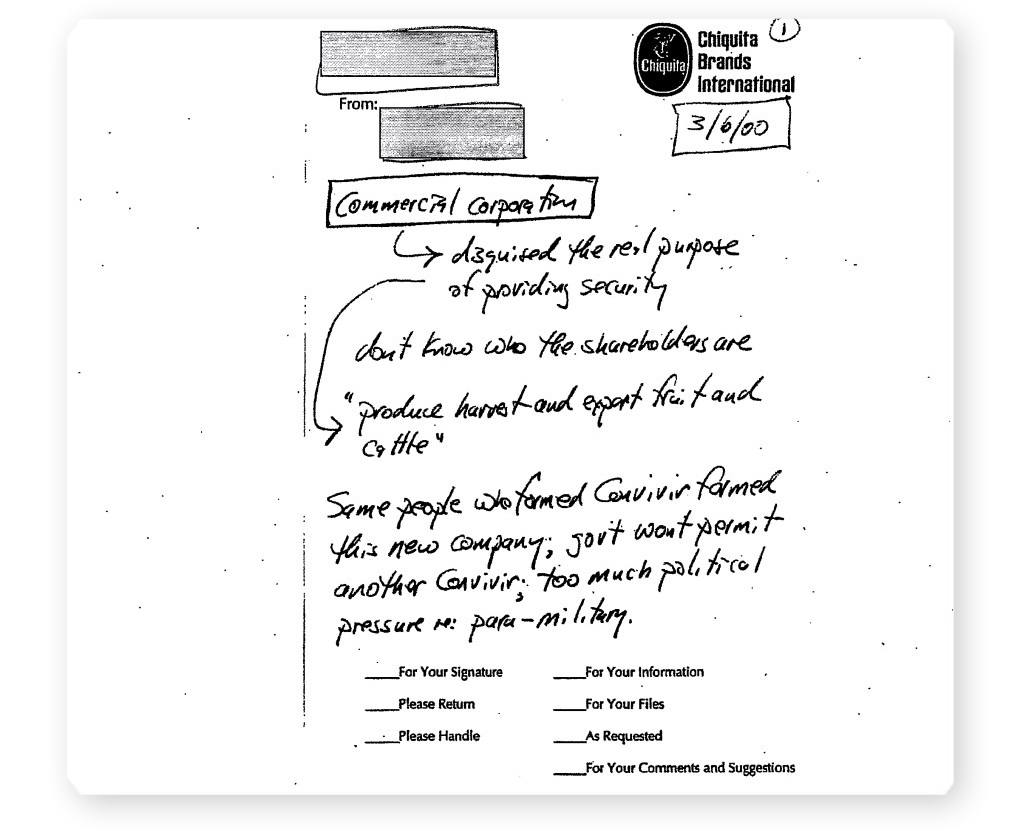
The Robert Thomas Memo: Documenting Complicity
The most damning evidence regarding Inversiones Manglar comes from Chiquita’s own legal department. In a memorandum dated March 2000, Chiquita Senior Counsel Robert Thomas recorded the details of this arrangement with clinical precision. Thomas noted that while Inversiones Manglar was ostensibly an agricultural business, its actual output was “info on guerrilla movements.” The memo explicitly acknowledged that the entity was a front, stating that the payments were disguised to hide “the real purpose of providing security.”
This document destroys the defense that Chiquita executives were unaware of the nature of these transactions. The legal team in Cincinnati did not stop the payments upon learning they were funding a front company; they documented the fraud and allowed it to continue. The memo further recorded that Banadex officials believed they “should continue making the payments” because the company could not obtain the “same level of support from the military.” This choice reveals a strategic preference for the AUC’s brutal effectiveness over the lawful, albeit ineffective, protection of the Colombian state. The company knowingly paid a false entity to bypass legal restrictions, prioritizing uninterrupted fruit exports over compliance with U. S. or Colombian law.
Laundering the “3 Cents Per Box”
The financial mechanics involving Inversiones Manglar were tied directly to the “3 cents per box” formula. Invoices generated by the front company were calculated based on the volume of bananas Chiquita exported from the Santa Marta region. To the casual observer or a junior accountant, these payments appeared as standard operating expenses, perhaps for consulting, logistics, or agricultural inputs. The “fruit and cattle” cover story provided a plausible denial for any auditor who did not look too closely.
yet, the internal accounting codes told a different story. Chiquita’s financial officers had to categorize these outflows in a way that would not trigger alarms during the consolidation of financial statements in Cincinnati. By treating Inversiones Manglar as a vendor, Chiquita integrated the cost of mass murder into the cost of goods sold. The payments were regular, bureaucratized, and tracked with the same rigor as payments for fertilizer or cardboard boxes. This normalization of terror financing allowed the payments to even after the U. S. State Department the AUC as a Foreign Terrorist Organization (FTO) in September 2001.
A Failure of Internal Controls
The existence of Inversiones Manglar highlights a catastrophic failure, or rather, a deliberate subversion, of corporate internal controls. A multinational corporation of Chiquita’s size employs rigorous vendor vetting processes. A legitimate compliance department would have flagged a new “agricultural” vendor that had no physical farms, no produce to sell, and whose primary contact was a known paramilitary liaison.
Instead of flagging the vendor, Chiquita’s systems absorbed it. The company’s internal audit committee was informed of the arrangement. In September 2000, the Thomas memo was presented to the Audit Committee at Chiquita’s headquarters. Board members and senior executives were made aware that their subsidiary was funding a front company controlled by vigilantes. The response was not to self-report to the Justice Department or cease operations, to manage the risk of exposure. The payments continued for years after this disclosure, proving that the use of Inversiones Manglar was a sanctioned corporate policy, not the rogue act of local managers.
From Extortion to Partnership
The Inversiones Manglar episode fundamentally undermines Chiquita’s narrative of “duress.” A victim of extortion hands over cash in a bag or makes a wire transfer under threat. A victim does not work with the extortionist to set up a shell corporation, discuss the licensing status of that corporation, and then agree to route funds through a third party until the shell company’s paperwork is in order. These are the actions of a business partner helping a vendor overcome administrative blocks.
By facilitating the use of Inversiones Manglar, Chiquita helped the AUC professionalize its financing operations. The company provided the paramilitaries with a steady, laundered income stream that was far more valuable than sporadic cash drops. This income allowed the AUC to plan long-term operations, expand their territorial control, and increase the of their violence. The “agricultural export” front was a lie agreed upon by both parties, a fiction that allowed Chiquita to export bananas and the AUC to export terror.
Inversiones Manglar: The Mechanics of the Front
Feature
Stated Purpose (The Cover)
Actual Purpose (The Reality)
Corporate Status
Agricultural producer and exporter (Fruit/Cattle).
Shell company for AUC financial collection.
Service Rendered
Agricultural consulting / Logistics.
“Info on guerrilla movements” / Security payments.
Primary Contact
Business managers.
“Pedro” (Raul Hasbún), AUC Commander.
Chiquita Knowledge
Standard vendor vetting.
Identified as a front in March 2000 legal memo.
Payment Basis
Services rendered.
3 cents per box of bananas exported.
Arms Trafficking: Allegations of Facilitating the 3,000 Rifle Shipment
The Otterloo Incident: A Logistics Hub for Terror
In the annals of corporate complicity with armed groups, few events sever the defense of “extortion” as cleanly as the arrival of the *Otterloo*. While Chiquita Brands International has long maintained that its financial relationship with the United Self-Defense Forces of Colombia (AUC) was a necessary evil to protect employees, the events of November 2001 suggest a partnership that transcended mere protection payments. On November 7, 2001, two months after the United States government the AUC as a Foreign Terrorist Organization, a Danish-flagged vessel named the *Otterloo* docked at a private port facility in Turbo, Colombia. This facility was not a public harbor; it was owned and operated by Banadex, Chiquita’s wholly-owned subsidiary. The ship did not offload bananas. Instead, it delivered the largest illegal arms shipment in Colombian history directly into the hands of the paramilitary death squads. The cargo manifest listed the shipment as 14 containers of plastic rubber balls, a mundane import for the banana industry. Inside the containers, yet, lay an arsenal capable of altering the strategic balance of the Colombian civil war: 3, 000 AK-47 assault rifles and five million rounds of 7. 62x39mm ammunition. The logistics of this operation required more than passive acquiescence; they demanded the active use of Chiquita’s proprietary infrastructure. The *Otterloo* incident stands as the definitive counter-argument to the company’s “duress” defense in the 2024 civil liability trials. A company under extortion pays cash to avoid violence; a company in a strategic alliance opens its gates to arm its “security” providers.
The Nicaraguan Connection and the Route of Deception
The origins of the weaponry trace back to a corrupt diversion scheme involving the Nicaraguan police and the Israeli arms dealer Shimon Yelinek. The weapons were officially purchased from the Nicaraguan police under the guise of a legitimate transfer to the Panamanian National Police. To this, the traffickers used a falsified end-user certificate, a document required by international law to prevent arms diversion. The Panamanian authorities later confirmed they had no part in the deal, and the certificate was a forgery. The *Otterloo* departed from the Nicaraguan port of El Rama, officially bound for Colón, Panama. Yet, once at sea, the vessel deviated from its declared course. It bypassed Panama entirely and headed south toward the Gulf of Urabá, the heart of Colombia’s banana-growing region and the stronghold of the AUC. The diversion was not a navigational error a calculated maneuver. The ship’s captain and crew, likely complicit or coerced, steered the vessel directly to the Banadex wharf in Turbo. This specific destination is serious to understanding Chiquita’s liability. The Banadex port was a specialized facility for the export of bananas and the import of agricultural supplies. It was not a general-purpose commercial port open to random traffic. The arrival of a vessel carrying “plastic balls” would have been an anomaly requiring prior authorization and coordination with Banadex port managers.
The Unloading: “Plastic Balls” and Paramilitary Commanders
When the *Otterloo* docked at the Banadex facility, the unloading operation was conducted with military precision, overseen by high-ranking AUC commanders. Witnesses and investigations, including a detailed report by the Organization of American States (OAS), detailed how the containers were offloaded. The “plastic balls” cover story was thin; the weight and handling of the crates betrayed their true contents. Paramilitary leader Freddy Rendón Herrera, known by the alias “El Alemán,” later testified about the operation. He described how AUC units took control of the port area to secure the weapons. The sheer volume of the shipment, 3, 000 rifles and millions of rounds of ammunition, required a massive logistical effort to move from the dock to the trucks waiting to transport them inland. This was not a clandestine drop on a deserted beach; it was an industrial- unloading operation at a corporate port. Banadex employees, who managed the daily flow of fruit and fertilizers, were present during this operation. The civil plaintiffs in the Florida litigation argued that it is implausible for such a significant logistical event to occur at a private facility without the knowledge and tacit approval of the facility’s operators. The OAS report corroborated that the customs documentation for the shipment was processed with suspicious speed and irregularity, suggesting that customs officials, and chance Banadex personnel, were bribed or instructed to look the other way. The weapons were then loaded onto trucks and driven out of the Chiquita facility, destined for the AUC’s various fronts across Colombia.
The Lethal Impact: Fueling the AUC Expansion
The injection of 3, 000 assault rifles into the conflict had an immediate and devastating effect. Before the *Otterloo* shipment, AUC units were armed with a hodgepodge of old weapons, shotguns, and pistols. The influx of modern AK-47s standardized their weaponry and drastically increased their lethality. This firepower allowed the AUC to launch large- offensives against the FARC guerrillas and, more frequently, against civilian populations accused of sympathizing with the left. In the months and years following the delivery, the AUC committed a series of gruesome massacres and expanded its territorial control in the Urabá and Magdalena regions, areas where Chiquita’s operations were concentrated. The bullets delivered through Chiquita’s port were used to murder trade unionists, displace peasant farmers, and enforce the paramilitary’s brutal social order. For the victims’ families, the *Otterloo* shipment is the smoking gun that links Chiquita not just to the financing of terror, to the very instruments of death used to kill their loved ones.
The OAS Investigation and International
The brazen nature of the shipment drew international attention. The Organization of American States (OAS) launched a formal investigation into the diversion of Nicaraguan arms. Their final report, published in 2003, was damning. It confirmed the route of the *Otterloo*, the falsity of the Panamanian documents, and the final destination at the Banadex port in Turbo. The OAS findings provided an independent, multilateral verification of the facts that plaintiffs would later use in U. S. court. The report highlighted the negligence of Nicaraguan authorities and the corruption of Colombian customs agents. yet, for the civil litigation against Chiquita, the most salient point was the location of the crime scene. The fact that a multinational corporation’s private port served as the entry point for a massive illegal arms shipment created a liability nightmare. It stripped away the veneer of “victimhood” Chiquita had tried to maintain. A victim of extortion does not allow the extortionist to use their living room to store weapons. By allowing the AUC to use the Turbo facility, Banadex became a logistics partner in the paramilitary’s war effort.
Civil Liability: The “Material Support” Argument
In the 2024 civil trial, the *Otterloo* incident played a pivotal role in Chiquita’s defense. Chiquita’s lawyers argued that the company paid the AUC solely to save lives. The plaintiffs’ attorneys countered with the *Otterloo* evidence: How does importing 3, 000 rifles save lives? The shipment demonstrated “material support” in its most literal sense. The jury was presented with evidence that Chiquita’s relationship with the AUC was symbiotic. The AUC provided “security” and pacified the labor force, while Chiquita provided cash and, in this instance, serious infrastructure for logistics. The “3 cents per box” funding formula was the baseline, the *Otterloo* was the spike in the graph that proved the depth of the collaboration. The jury’s decision to hold Chiquita liable for the deaths of civilians was likely influenced by the realization that the company’s support went beyond passive payments. The weapons offloaded at Chiquita’s port were the tools used to commit the very atrocities for which the company was being sued.
The Failure of the “Rogue Employee” Defense
Chiquita attempted to distance corporate headquarters from the *Otterloo* scandal by blaming rogue employees at Banadex or claiming ignorance of the specific shipment. Yet, the centralized nature of Chiquita’s control over its Colombian subsidiary made this defense difficult to swallow. Evidence showed that Cincinnati executives were closely monitoring the situation in Colombia, receiving regular reports on security and payments. While there is no direct email from a CEO authorizing the *Otterloo* docking, the culture of complicity established by the payments created an environment where local managers felt —or compelled—to the AUC’s needs, including arms trafficking. The *Otterloo* incident remains one of the most tangible proofs of the corporate-paramilitary nexus. It moves the narrative from “paying for safety” to “facilitating war.” For the thousands of victims of the AUC, the 3, 000 rifles that crossed the Banadex docks represent 3, 000 reasons why Chiquita bears responsibility for the bloodshed that followed. The civil verdict in 2024 was not just about the money paid; it was a reckoning for the weapons delivered.
Logistical Support: Use of Banadex Ports for Drug and Arms Smuggling
The Infrastructure of Terror: Banadex and the Port of Turbo
The civil liability of Chiquita Brands International extends far beyond the monthly checks cut to paramilitary commanders. While the financial transfers provided the United Self-Defense Forces of Colombia (AUC) with liquidity, Chiquita’s logistical support provided them with something far more valuable: a secure, industrial- gateway to the global market. Through its wholly-owned subsidiary, Banadex, Chiquita handed over the keys to the Port of Turbo, a private maritime facility that became the respiratory system for the AUC’s war machine. This was not a case of passive extortion where a company looks the other way; the evidence points to a functional alliance where corporate infrastructure was placed at the disposal of a terrorist organization to traffic cocaine out of Colombia and smuggle military-grade weaponry in.
The Port of Turbo, located in the Gulf of Urabá, served as the primary exit point for Chiquita’s bananas in the region. Because it was a private facility operated by Banadex, it absence the rigorous state oversight found at public terminals like Cartagena or Buenaventura. For the AUC, this opacity was a strategic asset. Control over the docks meant they could bypass government customs inspections, moving illicit cargo with the same efficiency as legitimate fruit. The jury in the 2024 Florida civil trial reviewed evidence showing that the AUC did not extort the port; they integrated it into their supply chain. The paramilitary group used the facility to export cocaine to Europe and the United States, generating the millions of dollars needed to purchase the arsenal that would subsequently be unloaded at the very same docks.
The Cocaine Pipeline: The Chiquita Bremen and Chiquita Belgie
The symbiotic relationship between Chiquita’s logistics network and the AUC’s drug trafficking operations was confirmed by multiple seizures and internal testimonies. The AUC, specifically the Elmer Cárdenas and Bananeros blocs, used Chiquita’s vessels to transport massive quantities of cocaine. The method was systematic: drugs were concealed within the structure of the shipping containers, hidden inside the cooling units, or,, welded to the hulls of the ships the waterline.
Two specific vessels, the Chiquita Bremen and the Chiquita Belgie, were implicated in these operations. Investigations revealed that on seven separate occasions, authorities seized cocaine hidden in banana shipments aboard Chiquita boats. The of this trafficking was not trivial; the total volume of seized narcotics exceeded 1. 5 tons, with a street value estimated at over $33 million. These seizures represented only the fraction of shipments that were detected. The successful transport of tons of cocaine required more than just the stealth of a few rogue operators; it demanded a permissive environment within the port facility itself, where security were either suspended or selectively enforced to allow paramilitary loaders access to the containers.
Plaintiffs in the civil litigation argued that such operations could not occur without the “active collusion or willful ignorance” of Banadex employees. The port was a controlled zone. Access required identification, and the movement of containers was tracked by complex logistical software. For the AUC to insert tons of contraband into this stream implied that the “security services” Chiquita paid for were, in reality, a fee for the right to use the port as a drug mule. The 3 cents per box paid to the AUC did not just buy safety for banana workers; it bought the AUC the right to co-opt the export infrastructure of a multinational corporation.
The “Easter Incident”: Destruction of Evidence
The claim that Chiquita was a helpless victim of extortion collapses under the weight of specific incidents where company officials actively assisted in covering up paramilitary crimes. One of the most damning pieces of evidence to emerge was the so-called “Easter Incident” of 2001. According to testimony from Banadex officials, including former security personnel, the AUC moved a shipment of weapons through the Chiquita port facilities during the Easter holiday.
Crucially, this operation was captured on the port’s security cameras. In a functional compliance environment, such footage would be turned over to the Colombian authorities or the U. S. Department of Justice. Instead, the reaction at Banadex was one of complicity. Testimony revealed that a Banadex security manager, rather than reporting the breach, retrieved the videotape and handed it directly to the AUC commanders. The tape was subsequently destroyed.
This act of destroying evidence transforms the narrative from one of “payments under duress” to one of obstruction of justice and active collaboration. By destroying the tape, Chiquita’s agents protected the AUC from prosecution and ensured the paramilitary group could continue its rearmament efforts without fear of exposure. This specific event demonstrates that the company’s internal security apparatus was not working to protect the company from the AUC, was working for the AUC to shield its operations from the state.
The Otterloo Arms Shipment: Logistics of War
While the drug trade provided the capital, the port of Turbo was also the entry point for the tools of genocide. The most notorious instance of this was the arrival of the Danish freighter Otterloo in November 2001. The ship, originating from Nicaragua and ostensibly carrying plastic balls, was actually loaded with 3, 000 AK-47 assault rifles and five million rounds of ammunition. This arsenal would fuel the AUC’s bloodiest period of expansion, leading to massacres across the Urabá and Magdalena regions.
The Otterloo did not unload its deadly cargo at a clandestine beach in the middle of the night. It docked at the Banadex-operated wharf in Turbo. The unloading process was a major logistical undertaking that required the use of Chiquita’s heavy. Banadex cranes and forklifts were used to offload the containers. A convoy of trucks, reports vary between 14 and 23 vehicles, entered the port facility to collect the weapons.
The Organization of American States (OAS) launched a detailed investigation into the diversion of these arms. Their final report was scathing. The OAS found Banadex guilty of facilitating the illegal arms deal. The investigation concluded that the diversion was made possible by the “negligent actions” and “willful and criminal actions” of private companies involved, specifically naming the Chiquita subsidiary. The report noted that Banadex employees assisted in the unloading and that customs documents were falsified to mask the nature of the cargo. The Otterloo incident serves as the irrefutable proof that Chiquita’s payments were not for “security”; they were part of a broader arrangement that gave the AUC full operational control over the region’s most serious logistical asset.
Corporate Knowledge and the “Security” Pretext
The defense that Chiquita executives in Cincinnati were unaware of the port’s misuse is contradicted by the flow of information within the company. The “Easter Incident” and the Otterloo shipment were not secrets in Urabá. The sheer visibility of a 23-truck convoy or the seizure of tons of cocaine creates an operational noise that reaches upper management. also, the company’s internal audit committees and security reports frequently flagged the high-risk nature of the Colombian operations.
The “security services” pretext used to justify the payments crumbles when viewed against the backdrop of the port operations. A company paying for security expects the recipient to prevent illegal arms from entering its property and to stop drugs from contaminating its products. In Chiquita’s case, the “security” providers were the ones smuggling the drugs and importing the guns. By continuing to pay the AUC even after the Otterloo scandal and the drug seizures, Chiquita signaled that these activities were an acceptable part of the cost of doing business. The payments subsidized the AUC’s logistical overhead, allowing them to turn the port of Turbo into a dual-use facility: a banana terminal by day and a paramilitary forward operating base by night.
The Human Cost of Logistical Support
The weapons unloaded at the Banadex port had a direct and immediate impact on the civilian population. The 3, 000 rifles from the Otterloo increased the AUC’s firepower significantly, allowing them to expand their territorial control and increase the lethality of their campaigns. The bullets imported through Chiquita’s docks were used in massacres that displaced thousands of peasant farmers, land that was frequently later converted into banana plantations.
The drugs exported through Chiquita’s ships provided the hard currency needed to pay the salaries of the executioners. This pattern of drugs-out, guns-in, facilitated by Banadex infrastructure, created a self-sustaining engine of violence. The civil liability verdict in 2024 acknowledged this reality. The jury’s decision reflected an understanding that a corporation cannot claim to be a victim of extortion while simultaneously providing the extortionist with the logistical means to commit mass murder. The use of the Banadex ports was not an incidental detail; it was a central pillar of the AUC’s power in Urabá, maintained and protected by the silence and cooperation of Chiquita Brands International.
Executive Complicity: The Role of Senior Management and the "Chiquita 13"
The Corporate Veil Pierced: Individual Accountability vs. Corporate Shielding
The June 2024 civil liability verdict against Chiquita Brands International did more than assign financial damages to a corporation; it retroactively indicted the decision-making processes of the men who sat at the helm of the company during its most bloody operational period. While the 2007 plea agreement with the U. S. Department of Justice allowed Chiquita to pay a $25 million fine without a single executive facing criminal prosecution in the United States, the civil trial and parallel Colombian proceedings have systematically dismantled the anonymity of the boardroom. The evidence presented to the Florida jury, alongside criminal indictments in Colombia, identifies a specific cadre of senior management, frequently referred to as the “Chiquita 13” in Colombian legal circles, who not only knew of the payments to the AUC actively managed, concealed, and rationalized them as a necessary cost of doing business.
The “Chiquita 13”: Colombia’s Criminal Indictment
In August 2018, the Colombian Prosecutor General’s Office (Fiscalía General de la Nación) took the historic step of filing criminal charges against 13 former Chiquita executives and administrators. This move shattered the immunity these individuals had enjoyed following the U. S. plea deal. The charges included “aggravated conspiracy to commit a crime” and the “financing of voluntary groups,” specifically targeting the decision-makers who facilitated the flow of cash to the paramilitary death squads.
The list of indicted individuals includes both Colombian nationals and U. S. citizens, bridging the gap between the operational ground game in Urabá and the strategic oversight in Cincinnati. Among the Americans charged were Dorn Robert Wenninger, John Paul Olivo, and Charles Dennis Keiser. These men held serious positions within the company’s hierarchy during the payment period. Keiser, in particular, served as the General Manager of Banadex (Chiquita’s wholly-owned subsidiary) and was identified by prosecutors as a central figure in the direct negotiations with paramilitary leadership.
The Colombian indictment also targeted the local apparatus that executed the payments. Reinaldo Escobar de la Hoz, a Banadex attorney, and Luis Germán Ballesteros, a Banadex official, were named for their roles in constructing the legal facades, such as the Convivir cooperatives, used to launder the payments. Víctor Julio Buitrago Sandoval, the head of security for Banadex, and Álvaro Acevedo González were also charged. The Prosecutor General argued that these individuals did not succumb to extortion actively collaborated with the AUC to “pacify” the banana-growing regions, purchasing security services from a terrorist organization to ensure labor stability and production continuity.
The Cincinnati Connection: Freidheim and Olson
While the “Chiquita 13” faced scrutiny in Colombia, the 2024 civil trial in Florida focused intensely on the C-suite executives in Cincinnati, Ohio, who authorized the payments even with clear legal warnings. The plaintiffs’ case relied heavily on the testimony and internal records of Cyrus Freidheim, the former CEO, and Robert Olson, the former General Counsel.
Robert Olson’s role was particularly damning in the eyes of the jury. As the company’s top legal officer, Olson was responsible for navigating the Foreign Terrorist Organization (FTO) designation of the AUC in September 2001. Testimony revealed that Olson was fully aware of the designation shortly after it occurred. Yet, rather than ordering an immediate halt to the payments, he presided over a period where millions of dollars continued to flow to the AUC.
Internal notes presented during the litigation captured the defiant attitude of the leadership. A handwritten note from a meeting involving Olson and Roderick Hills (the head of the Audit Committee) recorded their stance on the chance legal: “Let them sue us, come after us.” This phrase became a focal point for the plaintiffs, illustrating a calculated decision to prioritize profit over human rights or U. S. federal law. The defense argued that the company was in an impossible position, the jury found that the executives had weighed the risk of litigation against the risk of lost revenue and chosen the former.
Cyrus Freidheim, who led the company during the serious years of the early 2000s, testified that he viewed the payments as the “cost of doing business” in Colombia. His testimony undermined the defense’s “duress” argument by suggesting the payments were transactional rather than existential. The executives discussed the payments in routine board meetings, not as emergency ransom demands, as line items in the operational budget of the Colombian division.
Charles Keiser: The Architect of the Deal
Charles Keiser’s testimony provided the most granular detail regarding the company’s relationship with the paramilitaries. As the General Manager of Banadex, Keiser was the man on the ground. He admitted to meeting personally with Carlos Castaño, the supreme leader of the AUC, in 1997. This meeting was not a hostage negotiation; it was a business meeting.
Keiser testified that the meeting established the “3 cents per box” payment formula. He described a cordial atmosphere where terms were agreed upon, sharply contrasting with the company’s public narrative of terrified executives handing over cash at gunpoint. Keiser also revealed that Chiquita had begun paying the Convivir cooperatives, fronts for the paramilitaries, even before any specific threats were made against the company by the AUC. This admission was devastating to the defense, as it suggested the company sought out the AUC’s “security” services proactively as the guerrilla threat waned and the paramilitary control rose.
The jury heard that Keiser and other Banadex officials acted as the conduit for information back to Cincinnati. They provided regular reports on the security situation, the “taxes” paid to the AUC, and the resulting stability in the region. These reports ensured that the board in Cincinnati could not claim ignorance of the methods used to secure their Colombian profits.
The Audit Committee’s Failure: Roderick Hills
The role of the Audit Committee, led by Roderick Hills, further cemented the liability of the senior management. The Audit Committee is tasked with ensuring legal compliance and financial integrity. yet, evidence showed that Hills and his committee were aware of the payments and the method used to hide them.
In 2003, Chiquita voluntarily disclosed the payments to the Department of Justice. In a meeting with Assistant Attorney General Michael Chertoff, Hills was reportedly told that the payments were illegal and that the company could not continue to fund a terrorist organization. even with this direct admonition from the U. S. government, the payments did not stop immediately. The company continued to make payments for months while “winding down” operations, a delay that the plaintiffs argued facilitated further violence.
Hills’s decision to authorize continued payments even after the DOJ meeting demonstrated a brazen disregard for the law. The internal logic was that an abrupt stop might endanger staff, yet the company had years prior to the 2003 meeting to develop an exit strategy and failed to do so. The “wind-down” period was viewed by the jury not as a humanitarian pause, as a final effort to extract maximum value from the Colombian operations before the inevitable legal curtain fell.
The of Justice
The scrutiny on these individuals highlights a sharp in how justice has been applied. In the United States, the 2007 plea deal immunized these executives from criminal prosecution. The Department of Justice chose to settle with the corporate entity, accepting a fine and a deferred prosecution agreement, while leaving the individuals who authorized the felonies untouched.
The 2024 civil verdict and the Colombian charges attempt to correct this imbalance. While the Florida jury could not send Freidheim, Olson, or Keiser to prison, their verdict legally established that the actions taken by these men resulted in the wrongful deaths of Colombian civilians. The “Chiquita 13” indictment in Colombia remains an open legal threat, representing one of the few instances where a host country has attempted to criminally prosecute the foreign executives of a multinational corporation for financing crimes against humanity.
The evidence remains clear: the financing of the AUC was not an accident of lower-level corruption. It was a policy designed, approved, and monitored by the highest levels of Chiquita’s management. From the boardroom in Cincinnati to the manager’s office in Medellín, the “Chiquita 13” and their superiors operated a sophisticated financial pipeline to a terrorist organization, fully aware of the blood that was being spilled to keep the bananas moving.
Corporate Restructuring: The 2004 Sale of Banadex to Invesmar
On June 11, 2004, Chiquita Brands International executed a strategic divestment of its Colombian subsidiary, C. I. Bananos de Exportación S. A. (Banadex), selling the entity to Invesmar Limited, the holding company for C. I. Banacol S. A. The transaction, valued at approximately $51. 5 million, transferred ownership of Chiquita’s banana-producing and port operations in Colombia to the Medellín-based conglomerate. This sale occurred roughly one year after Chiquita voluntarily disclosed its illegal payments to the United Self-Defense Forces of Colombia (AUC) to the U. S. Department of Justice. While the company publicly a desire to reduce exposure to foreign currency fluctuations and weather-related risks, the timing suggested a frantic effort to offload a subsidiary that had become a radioactive legal liability. The financial terms of the deal reveal the urgency with which Chiquita sought to distance itself from Banadex. The $51. 5 million consideration consisted of approximately $28. 5 million in cash, $15 million in notes and deferred payments, and the assumption of roughly $8 million in pension liabilities by Invesmar. Chiquita recorded a $5 million after-tax loss on the transaction, paying a premium to exit the jurisdiction where it had funded a Foreign Terrorist Organization for seven years. The sale included 100 percent of the shares in Banadex, handing over control of the physical infrastructure—farms, packing plants, and port facilities—that had served as the logistical backbone for the arms and drugs smuggling operations detailed in earlier sections. even with the sale, Chiquita did not sever its economic ties to the region. The agreement included a lucrative long-term supply contract that ensured the flow of Colombian fruit continued uninterrupted. As part of the divestment, Chiquita signed an eight-year purchase agreement with Invesmar’s affiliates to buy approximately 11 million boxes of Colombian bananas and 2. 5 million boxes of Costa Rican pineapples annually. This arrangement allowed Chiquita to maintain its market supply without holding the direct legal title to the land where paramilitary violence remained widespread. Critics and litigators later argued this structure permitted Chiquita to “wash its hands” of the bloodshed while continuing to profit from the same plantations, operated by a proxy entity. The entity that absorbed Chiquita’s operations, Banacol, faced its own scrutiny regarding paramilitary links. Investigations by Colombian prosecutors and human rights organizations later alleged that the payment systems established by Banadex did not after the 2004 handover. Reports indicated that Banacol continued making payments to Convivir security cooperatives—the same legal fronts Chiquita used to funnel cash to the AUC—between 2004 and 2007. By transferring the assets to Invesmar, Chiquita outsourced the method of extortion and protection, insulating its Cincinnati headquarters from direct criminal liability while the underlying system of paramilitary financing under new management. The Department of Justice investigation, which resulted in the 2007 guilty plea, focused heavily on the payments made prior to this sale. yet, the 2004 divestment became a focal point in subsequent civil litigation. Plaintiffs argued that the sale was not a genuine exit a corporate shell game designed to hide assets and evidence. The “Invesmar” transaction allowed Chiquita to claim it had left Colombia, yet for nearly a decade afterward, Banacol remained Chiquita’s largest global supplier, providing roughly 10 percent of the company’s total banana volume. This continuity of commerce suggested that the “sale” was less about business strategy and more about legal fortification, creating a firewall between the U. S. parent company and the violent realities of Urabá. Documents filed with the U. S. Securities and Exchange Commission (SEC) confirm that the DOJ investigation was a primary driver for the sale. Chiquita’s management admitted that the probe “contributed” to the decision to sell. The deal was finalized just months after Chiquita made its final direct payment to the AUC in February 2004. By June, the assets were gone. This rapid liquidation prevented U. S. authorities from seizing Banadex’s physical assets as part of the criminal proceedings that concluded three years later. Instead of forfeiting the farms that had been protected by terror financing, Chiquita monetized them, converting a criminal instrument into $28. 5 million in immediate cash. The sale also complicated the efforts of victims to seek reparations. When civil suits began flooding U. S. courts, Chiquita pointed to the 2004 sale as a cutoff point for its responsibility. The company argued it could not be held liable for violence that occurred after it “left” the country. yet, the purchase agreement’s strict quality and volume requirements meant Chiquita retained significant use over operations on the ground. The “Banadex to Invesmar” transfer is viewed by investigators not as the end of Chiquita’s involvement in Colombia, as the moment the company shifted from direct perpetrator to primary beneficiary of a paramilitary-controlled supply chain.
Criminal Precedent: The 2007 Department of Justice Guilty Plea
The foundation of the 2024 civil liability verdict rests entirely on a singular, irrefutable event: the March 19, 2007, guilty plea entered by Chiquita Brands International in the U. S. District Court for the District of Columbia. Before Judge Royce C. Lamberth, the corporation admitted to a federal felony, acknowledging it had knowingly provided material support to a Foreign Terrorist Organization (FTO). This was not a settlement of ambiguous civil claims a criminal conviction for violating the International Emergency Economic Powers Act (IEEPA), specifically 50 U. S. C. § 1705(b).
The Charge and the Admission
The Department of Justice (DOJ) charged Chiquita with one count of engaging in transactions with a Specially Global Terrorist. The company admitted to making over 100 payments to the United Self-Defense Forces of Colombia (AUC) totaling more than $1. 7 million between 1997 and 2004. The factual proffer, a document signed by Chiquita’s leadership as part of the plea, established that the company continued these payments for nearly two and a half years after the U. S. government the AUC as an FTO on September 10, 2001. This admission dismantled any chance defense that the payments were accidental or the result of rogue employees. The proffer explicitly stated that high-level executives in Cincinnati were aware of the payments, approved the method to hide them, and authorized their continuation even after outside counsel warned them of the illegality. The plea agreement imposed a $25 million criminal fine and five years of corporate probation.
The Ten-Month Gap: Criminal Intent Solidified
The most damning aspect of the 2007 plea, and the evidence that likely swayed the 2024 civil jury, was the timeline of the “voluntary” disclosure. On April 24, 2003, a senior Chiquita officer and a board member, accompanied by outside counsel from Kirkland & Ellis, met with DOJ officials, including then-Assistant Attorney General Michael Chertoff. They disclosed that the company had been paying the AUC. DOJ officials were unequivocal: the payments were illegal and must stop immediately. They acknowledged the “complicated” nature of the situation regarding employee safety offered no immunity or permission to continue funding a terror group. Yet, Chiquita did not stop. Between that April 2003 meeting and February 4, 2004, Chiquita made 20 additional payments to the AUC, totaling over $300, 000. This ten-month period demonstrated a calculated defiance of federal authority. The company prioritized the orderly sale of its Colombian subsidiary, Banadex, over compliance with anti-terrorism laws. They used the DOJ meeting as a stalling tactic, continuing to fund the paramilitaries while negotiating their exit strategy. This specific window of time proved that the support was not a reaction to duress a strategic business decision to maintain stability for a profitable divestiture.
The “Advice of Counsel” Defense Failure
The plea agreement documents reveal that Chiquita’s internal legal controls functioned correctly were ignored by management. The factual proffer notes that outside counsel had advised the company as early as February 2003 that the payments violated U. S. law and that the “duress” defense (claiming extortion) would not apply to a corporation funding a terrorist group. even with this clear legal warning, the Board of Directors’ Audit Committee authorized the payments to continue. The company’s defense team, led by Eric Holder of Covington & Burling, later argued that the company was in an impossible position, balancing legal compliance against the lives of its workers. The DOJ rejected this rationale for the post-disclosure payments. The government’s sentencing memorandum noted that Chiquita “paid for access” and that the payments were “motivated by a desire to maintain profitability.”
The Financial Equation
The $25 million fine, while a record for such a violation at the time, represented a fraction of the company’s revenue. The factual proffer stipulated that from September 2001 to January 2004, the period of illegal payments, Chiquita earned approximately $49. 4 million in profits from its Colombian operations. The fine clawed back half of the profits derived during the illegal period left the principal capital and the proceeds from the eventual sale of Banadex largely intact. Critics and victims’ advocates argued the fine was a “cost of doing business.” The plea deal allowed Chiquita to avoid a trial that would have exposed the full extent of its collaboration, including the arms smuggling allegations, which were not part of the specific charge were part of the broader operational context.
Shielding the “Chiquita 13”
A serious component of the 2007 plea deal was the protection it afforded to individual executives. The agreement was structured as a corporate plea, meaning the entity accepted responsibility while the individuals who authorized the crimes avoided prosecution. The DOJ investigation had identified several key decision-makers, later referred to in civil litigation as the “Chiquita 13,” including the CEO, General Counsel, and senior operational managers. Eric Holder’s negotiation secured a “non-prosecution” outcome for these individuals. The DOJ’s decision not to indict specific executives remains controversial. Prosecutors likely calculated that securing a high-profile corporate conviction with a substantial fine was a guaranteed win, whereas proving individual criminal intent against executives who claimed they were paying “ransom” to save lives would be riskier before a jury. This decision left the civil courts as the only venue for victims to seek accountability from the specific human beings who authorized the funding of their tormentors.
The Factual Proffer as Civil Ammunition
The “Factual Proffer” attached to the plea agreement became the primary weapon for the plaintiffs in the subsequent civil litigation. In this document, Chiquita stipulated to facts that they could not later deny in civil court without committing perjury or fraud. Key admissions in the proffer included: * **The Payment method:** Chiquita admitted to using “Convivir” cooperatives and private security firms to funnel money to the AUC, disguising the payments in their books. * **The Knowledge:** Chiquita admitted they knew the AUC was a violent paramilitary group and later, a FTO. * **The Quid Pro Quo:** While Chiquita publicly claimed extortion, the proffer detailed a relationship where payments were standardized (3 cents per box), suggesting a commercial agreement rather than unpredictable ransom demands.
Judicial Sentencing
During the sentencing hearing, Judge Royce Lamberth accepted the plea expressed concern over the of the offense. The probation terms required Chiquita to implement a rigorous compliance and ethics program. The judge’s acceptance of the plea finalized the criminal case, it did not immunize the company from civil liability. In fact, the plea agreement explicitly stated that it did not bind other federal agencies or private parties. This criminal conviction stripped Chiquita of the presumption of innocence regarding the *fact* of funding terrorism. In the 2024 civil trial, the plaintiffs did not need to prove Chiquita paid the AUC; the company had already pleaded guilty to it. The civil trial focused instead on whether those payments directly caused the suffering of the specific plaintiffs, a connection the jury affirmed.
Legacy of the Plea
The 2007 guilty plea stands as a rare instance of a U. S. multinational corporation being criminally convicted of financing terrorism. It shattered the corporate veil that distances headquarters from field operations in conflict zones. By admitting that the payments were “payments for security” rather than just extortion, Chiquita legally acknowledged a transactional relationship with a death squad. This admission made the defense of “we were victims too” untenable in the face of evidence showing a ten-year funding stream that continued well after the U. S. government ordered it to stop.
Systemic Impact: Financing the AUC's Expansion and Human Rights Atrocities
The Operational Utility of Corporate Capital
The $1. 7 million Chiquita Brands International paid to the United Self-Defense Forces of Colombia (AUC) between 1997 and 2004 did not into a vacuum. In the impoverished, conflict-ridden territories of Urabá and Santa Marta, this capital served as high-octane fuel for a paramilitary machine that was rapidly evolving from a loose federation of vigilantes into a national offensive force. While Chiquita executives in Cincinnati characterized these disbursements as the cost of doing business, the AUC commanders on the ground viewed them as a military budget. The payments provided the liquidity necessary to purchase ammunition, maintain vehicle fleets, and pay the salaries of “urbanos”, hitmen who patrolled the streets of banana towns enforcing a brutal social order.
Testimony from the 2024 civil trial in Florida established that these funds were not passive “protection” payments active contributions to the AUC’s operational capacity. Salvatore Mancuso, the former supreme commander of the AUC, testified via deposition that the money allowed his units to grow numerically and geographically. In a region where the daily wage for a farmhand was negligible, the monthly infusions of $20, 000 to $30, 000 from Chiquita’s subsidiary, Banadex, gave the AUC a financial stability that rivaled the state itself. This steady cash flow allowed the paramilitaries to plan long-term offensives against the FARC, secure in the knowledge that their logistical tail was funded by the world’s most recognizable banana brand.
The “Pacification” of Urabá
The primary consequence of Chiquita’s financial support was the “pacification” of the Urabá region, a term that euphemistically describes the violent eradication of perceived subversives. Before 1997, the FARC held significant sway over the banana plantations, frequently kidnapping managers and burning infrastructure. When the AUC arrived, funded in part by the “three cents per box” agreement, they initiated a campaign of terror designed to cleanse the region of any leftist influence. This was not limited to armed guerrillas; the target list expanded to include labor unionists, community organizers, and anyone who dared to question the new authority.
The correlation between Chiquita’s payments and the spike in violence is undeniable. As the payments ramped up in the late 1990s, the murder rate in the banana zone skyrocketed. The AUC established checkpoints on the roads used to transport Chiquita’s fruit, stopping buses to check names against death lists. Those identified as “sympathizers” were frequently pulled off and executed on the roadside. This infrastructure of terror ensured that the roads remained open for export, creating a direct link between the efficiency of Chiquita’s supply chain and the suppression of the local population. The company benefited from a “pacified” workforce that was too terrified to strike or demand better wages, outsourcing its labor discipline to death squads.
Targeting Organized Labor
The structural effect of this financing was most visible in the of civil society, particularly the banana workers’ unions. Sintrainagro, the largest union in the region, saw its leadership decimated during the years of Chiquita’s payments. The AUC viewed union activity as synonymous with guerrilla sympathy. By funding the group that hunted these leaders, Chiquita was complicit in a violent restructuring of labor relations. The paramilitaries did not just kill; they displaced. Thousands of families were forced to flee their land, frequently abandoning small plots that were subsequently absorbed into larger plantation holdings or used by the AUC for their own illicit crops.
During the 2024 trial, plaintiffs presented evidence showing that Chiquita officials were aware of this violence. Internal memos and handwritten notes from the “Chiquita 13” indicated that executives knew the AUC was an “outlaw organization” engaged in massacres. Yet, the payments continued. This persistence demonstrates that the company accepted the human cost as a necessary collateral for stability. The destruction of the union’s bargaining power likely saved the company millions in chance wage increases and strike-related losses, a grim return on investment for the $1. 7 million paid to the warlords.
The 2024 Jury Findings on Causation
The June 2024 verdict by the federal jury in West Palm Beach provided a legal confirmation of this cause-and-effect relationship. The jury found Chiquita liable for the wrongful deaths of eight specific individuals, rejecting the company’s defense that there was no connection between their money and the bullets that killed the victims. The jurors determined that Chiquita “knowingly provided substantial assistance” to the AUC and that this assistance created a “foreseeable risk of harm.” This finding is pivotal. It legally establishes that corporate funding cannot be separated from the atrocities committed by the recipient group. When a corporation buys “security” from a terrorist organization, it is buying the terror itself.
The victims represented in the bellwether trial were not combatants. They were husbands, fathers, and banana workers. One was shot while buying milk; another was dragged from a taxi. Their deaths were not random acts of violence part of the calculated strategy of control that Chiquita’s money helped underwrite. The jury’s award of $38. 3 million acknowledges that these lives were the price paid for the company’s profitable operations in Colombia. The verdict pierces the corporate veil, showing that the boardroom decisions in Cincinnati had lethal consequences in the muddy streets of Apartadó.
Logistics of Terror: Beyond Cash
The impact of Chiquita’s collaboration extended beyond simple cash transfers. The use of Banadex’s port facilities to import weapons and export cocaine, as detailed in previous sections, acted as a force multiplier for the AUC. The 2001 shipment of 3, 000 AK-47 assault rifles and 5 million rounds of ammunition through the Chiquita-operated port of Turbo fundamentally altered the balance of power in the Colombian civil war. These weapons were distributed to AUC blocs across the country, increasing their lethality and reach. The rifles imported through Chiquita’s docks were used to commit massacres far beyond the banana zone, implicating the company in a nationwide web of violence.
This logistical support allowed the AUC to operate with the efficiency of a modern army. They had better communications equipment, newer vehicles, and superior firepower compared to the local police and even army units. Chiquita’s infrastructure became the AUC’s infrastructure. The “Convivir” cooperatives, used to launder the payments, also served as intelligence networks, feeding information on “troublemakers” directly to the paramilitary commanders. This integration of corporate logistics and paramilitary violence created a totalitarian environment where the corporation and the death squad were virtually indistinguishable to the average worker.
A Legacy of Blood and Displacement
The long-term effect of this financing is a region that remains deeply scarred. While Chiquita sold its Colombian subsidiary in 2004, the social fabric of Urabá and Santa Marta was permanently altered. The displacement of peasant farmers consolidated land ownership in the hands of a few, enforcing a feudal economic structure that today. The elimination of a generation of social leaders left a leadership void that has been difficult to fill. The “peace” that Chiquita paid for was a cemetery peace, built on the silence of victims and the impunity of perpetrators.
The civil liability verdict serves as a belated reckoning for this dark chapter. It challenges the narrative that multinational corporations are neutral actors in conflict zones. By proving that Chiquita’s payments directly facilitated the expansion and brutality of the AUC, the plaintiffs have shown that the checkbook is as deadly as the rifle. The $1. 7 million was not a victim’s ransom; it was a partner’s contribution. The expansion of the AUC during the late 1990s, fueled by banana profits, stands as a historical testament to the catastrophic consequences of prioritizing supply chain security over human rights.
The Precedent for Corporate Accountability
The findings against Chiquita the “extortion” defense frequently used by multinationals operating in volatile regions. The evidence showed that the relationship was symbiotic. The AUC needed money and legitimacy; Chiquita needed a union-free, guerrilla-free environment to maximize exports. Both parties got what they wanted, and the civilian population paid the price. This case establishes a clear warning: financing a terrorist group, regardless of the rationale, creates a direct line of civil liability for the atrocities that follow. The “Chiquita Papers” and the subsequent trial have laid bare the mechanics of this complicity, proving that the company did not survive the war, it helped finance one side of it.
In the final analysis, the widespread impact of Chiquita’s funding was the strengthening of a terrorist organization that killed thousands. The company’s resources allowed the AUC to govern through fear, turning the banana plantations into a state-within-a-state where the only law was the gun. The 2024 verdict does not undo the violence, it assigns the cost to the entity that helped purchase the weapons. The ledger is balanced, not with fruit, with the recognition of the lives destroyed by the of profit.
Timeline Tracker
June 2024
Liability Verdict: The June 2024 Florida Jury Decision —
June 10, 2024
The June 10 Verdict — On June 10, 2024, a federal jury in West Palm Beach delivered a historic decision that pierced the corporate veil of Chiquita Brands International. The jury.
June 2024
The Bellwether method — This trial served as a bellwether case. It was a test trial designed to predict how future juries might react to similar evidence. The litigation against.
1997
Financial Scale: Over $1.7 Million in Proven Payments (1997–2004) — The financial forensics of Chiquita Brands International's operations in Colombia between 1997 and 2004 reveal a systematic funding apparatus that transferred over $1. 7 million to.
1997
The 1997 Pact: A Handshake with Terror — The financial relationship began with a specific meeting in 1997. Carlos Castaño, the notorious leader of the AUC, met with senior executives from Banadex, Chiquita's wholly-owned.
September 10, 2001
The 2001 Pivot: Financing a Terrorist Group — The legal shifted dramatically on September 10, 2001, when the United States Department of State the AUC as a Foreign Terrorist Organization (FTO). This designation made.
June 2002
The Cash Smuggling Protocol — As scrutiny increased, the payment methods evolved to evade detection. By June 2002, the Convivir check system became too risky or too transparent for certain transactions.
2003
The "Must Stop" Warning — The internal conflict regarding these payments reached a breaking point in early 2003. Chiquita's outside legal counsel, a prominent Washington D. C. law firm, reviewed the.
June 2002
Financial and Corporate Liability — The total sum of $1. 7 million might appear small relative to Chiquita's global revenue, in the context of the Colombian conflict, it was a fortune.
2003
The Banadex Profit Engine — It is impossible to separate these payments from the profitability of the Banadex subsidiary. By 2003, Banadex was Chiquita's most profitable operation globally. The stability purchased.
February 2004
The End of the Line — The payments ceased in February 2004, shortly before Chiquita sold its Colombian subsidiary. The sale of Banadex ended the direct financial pipeline, the accounting trail remained.
1997
Funding Formula: The "3 Cents Per Box" Agreement with the AUC — The "3 cents per box" agreement stands as the definitive operational link between Chiquita Brands International and the United Self-Defense Forces of Colombia (AUC). This specific.
1997
The Montecasino Summit — In early 1997, the operational leadership of Chiquita's Colombian subsidiary, Banadex, traveled to Medellín for a clandestine meeting that would define the company's liability decades later.
2024
The Convivir Facade — To process these payments without alerting U. S. authorities or creating an incriminating paper trail, the parties used a network of "Convivir" groups. These were government-licensed.
May 1997
Cincinnati's "Cost of Doing Business" — The "3 cents" formula was not a rogue decision made solely by local managers in Colombia. Evidence presented during the litigation shows that high-level executives at.
1997
The Mathematical Link to Violence — The "3 cents per box" metric created a perverse incentive structure. During the period of these payments (1997, 2004), Chiquita's productivity in Colombia increased. As the.
September 10, 2001
Knowledge of Terror: Continued Payments After 2001 FTO Designation — The designation of the United Self-Defense Forces of Colombia (AUC) as a Foreign Terrorist Organization (FTO) on September 10, 2001, fundamentally altered the legal terrain for.
September 10, 2001
The Legal Pivot Point: September 10, 2001 — On September 10, 2001, Secretary of State Colin Powell the AUC as an FTO. This administrative action triggered immediate criminal liability for any U. S. entity.
February 26, 2003
The Kirkland & Ellis Warning — The corporate narrative that Chiquita was a victim of extortion collapses when examining the internal legal advice received in early 2003. In February of that year.
April 3, 2003
The Board's Calculation: "Let Them Sue Us" — The decision to ignore outside counsel reached the highest levels of the corporate hierarchy. On April 3, 2003, the full Board of Directors was briefed on.
April 24, 2003
The DOJ Meeting and the "Wait and See" Strategy — In April 2003, Chiquita initiated a voluntary disclosure process with the U. S. Department of Justice (DOJ). On April 24, Board member Roderick Hills and General.
2001
Mechanics of Concealment — Post-2001, the method of payment evolved to evade detection. As banking regulations tightened following the 9/11 attacks, direct transfers became too risky. Chiquita's Colombian subsidiary, Banadex.
April 3, 2003
Timeline of Knowing Violations — The following table illustrates the gap between knowledge and action, highlighting the period where Chiquita knowingly financed terror. Sept 10, 2001 US Government designates AUC as.
February 2003
The Failure of the Duress Defense — In the 2024 civil liability trial, Chiquita's defense team relied heavily on the argument of duress. They claimed the company had no choice to pay or.
1997-2004
The Verdict Form: Rejection of the "Reasonable Business Person" Defense — The jury's verdict form contained specific questions regarding Chiquita's conduct. They were asked if Chiquita failed to act as a "reasonable business person" under the circumstances.
1997
The "Security Services" Euphemism — The primary method for disguising the payments involved the falsification of the General Ledger in Banadex, Chiquita's wholly-owned Colombian subsidiary. Between 1997 and 2004, Chiquita made.
2002
The "General Manager's Fund" and Cash Payments — Before the Convivir system was fully standardized, and during periods where checks were deemed too risky, Chiquita used a discretionary account known as the "General Manager's.
2007
FCPA Books and Records Violations — The legal weight of this accounting fraud was codified in the 2007 plea agreement. While the headline charge was "Engaging in Transactions with a Specially Global.
1997
The Architecture of Laundering: The Convivir System — The central engine of Chiquita's financing operation was not a series of chaotic, back-alley cash handoffs, a sophisticated, bureaucratic laundering method known as "Convivir." These state-sanctioned.
August 1997
Internal Knowledge and the "Punta de Piedra" Memo — Chiquita's defense in the 2024 trial relied heavily on the claim that they were victims of extortion, forced to pay to save lives. yet, internal documents.
June 2024
The 2024 Verdict: Rejection of the Security Myth — In the June 2024 liability verdict, the Florida jury found that Chiquita "knowingly provided substantial assistance" to the AUC. The Convivir method was central to this.
October 1999
The "Pedro" Connection and the Santa Marta Demand — The operational shift to Inversiones Manglar began in earnest around October 1999. Paramilitary commanders in the Santa Marta region, distinct from the Urabá-based blocs, demanded a.
March 2000
The Robert Thomas Memo: Documenting Complicity — The most damning evidence regarding Inversiones Manglar comes from Chiquita's own legal department. In a memorandum dated March 2000, Chiquita Senior Counsel Robert Thomas recorded the.
September 2001
Laundering the "3 Cents Per Box" — The financial mechanics involving Inversiones Manglar were tied directly to the "3 cents per box" formula. Invoices generated by the front company were calculated based on.
September 2000
A Failure of Internal Controls — The existence of Inversiones Manglar highlights a catastrophic failure, or rather, a deliberate subversion, of corporate internal controls. A multinational corporation of Chiquita's size employs rigorous.
March 2000
From Extortion to Partnership — The Inversiones Manglar episode fundamentally undermines Chiquita's narrative of "duress." A victim of extortion hands over cash in a bag or makes a wire transfer under.
November 7, 2001
The Otterloo Incident: A Logistics Hub for Terror — In the annals of corporate complicity with armed groups, few events sever the defense of "extortion" as cleanly as the arrival of the *Otterloo*. While Chiquita.
2003
The OAS Investigation and International — The brazen nature of the shipment drew international attention. The Organization of American States (OAS) launched a formal investigation into the diversion of Nicaraguan arms. Their.
2024
Civil Liability: The "Material Support" Argument — In the 2024 civil trial, the *Otterloo* incident played a pivotal role in Chiquita's defense. Chiquita's lawyers argued that the company paid the AUC solely to.
2024
The Failure of the "Rogue Employee" Defense — Chiquita attempted to distance corporate headquarters from the *Otterloo* scandal by blaming rogue employees at Banadex or claiming ignorance of the specific shipment. Yet, the centralized.
2024
The Infrastructure of Terror: Banadex and the Port of Turbo — The civil liability of Chiquita Brands International extends far beyond the monthly checks cut to paramilitary commanders. While the financial transfers provided the United Self-Defense Forces.
2001
The "Easter Incident": Destruction of Evidence — The claim that Chiquita was a helpless victim of extortion collapses under the weight of specific incidents where company officials actively assisted in covering up paramilitary.
November 2001
The Otterloo Arms Shipment: Logistics of War — While the drug trade provided the capital, the port of Turbo was also the entry point for the tools of genocide. The most notorious instance of.
2024
The Human Cost of Logistical Support — The weapons unloaded at the Banadex port had a direct and immediate impact on the civilian population. The 3, 000 rifles from the Otterloo increased the.
June 2024
The Corporate Veil Pierced: Individual Accountability vs. Corporate Shielding — The June 2024 civil liability verdict against Chiquita Brands International did more than assign financial damages to a corporation; it retroactively indicted the decision-making processes of.
August 2018
The "Chiquita 13": Colombia's Criminal Indictment — In August 2018, the Colombian Prosecutor General's Office (Fiscalía General de la Nación) took the historic step of filing criminal charges against 13 former Chiquita executives.
September 2001
The Cincinnati Connection: Freidheim and Olson — While the "Chiquita 13" faced scrutiny in Colombia, the 2024 civil trial in Florida focused intensely on the C-suite executives in Cincinnati, Ohio, who authorized the.
1997
Charles Keiser: The Architect of the Deal — Charles Keiser's testimony provided the most granular detail regarding the company's relationship with the paramilitaries. As the General Manager of Banadex, Keiser was the man on.
2003
The Audit Committee's Failure: Roderick Hills — The role of the Audit Committee, led by Roderick Hills, further cemented the liability of the senior management. The Audit Committee is tasked with ensuring legal.
2007
The of Justice — The scrutiny on these individuals highlights a sharp in how justice has been applied. In the United States, the 2007 plea deal immunized these executives from.
June 11, 2004
Corporate Restructuring: The 2004 Sale of Banadex to Invesmar — On June 11, 2004, Chiquita Brands International executed a strategic divestment of its Colombian subsidiary, C. I. Bananos de Exportación S. A. (Banadex), selling the entity.
March 19, 2007
Criminal Precedent: The 2007 Department of Justice Guilty Plea — The foundation of the 2024 civil liability verdict rests entirely on a singular, irrefutable event: the March 19, 2007, guilty plea entered by Chiquita Brands International.
September 10, 2001
The Charge and the Admission — The Department of Justice (DOJ) charged Chiquita with one count of engaging in transactions with a Specially Global Terrorist. The company admitted to making over 100.
April 24, 2003
The Ten-Month Gap: Criminal Intent Solidified — The most damning aspect of the 2007 plea, and the evidence that likely swayed the 2024 civil jury, was the timeline of the "voluntary" disclosure. On.
February 2003
The "Advice of Counsel" Defense Failure — The plea agreement documents reveal that Chiquita's internal legal controls functioned correctly were ignored by management. The factual proffer notes that outside counsel had advised the.
September 2001
The Financial Equation — The $25 million fine, while a record for such a violation at the time, represented a fraction of the company's revenue. The factual proffer stipulated that.
2007
Shielding the "Chiquita 13" — A serious component of the 2007 plea deal was the protection it afforded to individual executives. The agreement was structured as a corporate plea, meaning the.
2024
Judicial Sentencing — During the sentencing hearing, Judge Royce Lamberth accepted the plea expressed concern over the of the offense. The probation terms required Chiquita to implement a rigorous.
2007
Legacy of the Plea — The 2007 guilty plea stands as a rare instance of a U. S. multinational corporation being criminally convicted of financing terrorism. It shattered the corporate veil.
1997
The Operational Utility of Corporate Capital — The $1. 7 million Chiquita Brands International paid to the United Self-Defense Forces of Colombia (AUC) between 1997 and 2004 did not into a vacuum. In.
1997
The "Pacification" of Urabá — The primary consequence of Chiquita's financial support was the "pacification" of the Urabá region, a term that euphemistically describes the violent eradication of perceived subversives. Before.
2024
Targeting Organized Labor — The structural effect of this financing was most visible in the of civil society, particularly the banana workers' unions. Sintrainagro, the largest union in the region.
June 2024
The 2024 Jury Findings on Causation — The June 2024 verdict by the federal jury in West Palm Beach provided a legal confirmation of this cause-and-effect relationship. The jury found Chiquita liable for.
2001
Logistics of Terror: Beyond Cash — The impact of Chiquita's collaboration extended beyond simple cash transfers. The use of Banadex's port facilities to import weapons and export cocaine, as detailed in previous.
2004
A Legacy of Blood and Displacement — The long-term effect of this financing is a region that remains deeply scarred. While Chiquita sold its Colombian subsidiary in 2004, the social fabric of Urabá.
2024
The Precedent for Corporate Accountability — The findings against Chiquita the "extortion" defense frequently used by multinationals operating in volatile regions. The evidence showed that the relationship was symbiotic. The AUC needed.
Why it matters: The delivery platform industry saw significant growth in 2023, driven by demand for convenience and digital services. Key players like DoorDash, Uber Eats, Grubhub, and Postmates dominate.
Tell me about the the june 10 verdict of Chiquita Brands International.
On June 10, 2024, a federal jury in West Palm Beach delivered a historic decision that pierced the corporate veil of Chiquita Brands International. The jury found the banana giant civilly liable for financing the United Self-Defense Forces of Colombia, known by its Spanish acronym AUC. This paramilitary group was a Foreign Terrorist Organization by the United States government. The verdict ordered Chiquita to pay $38. 3 million in damages.
Tell me about the the bellwether method of Chiquita Brands International.
This trial served as a bellwether case. It was a test trial designed to predict how future juries might react to similar evidence. The litigation against Chiquita involves thousands of claims consolidated in the Southern District of Florida. This specific trial focused on just nine representative cases. The jury found liability in eight of them. The ninth case did not result in a liability finding due to specific evidentiary gaps.
Tell me about the the defense of duress of Chiquita Brands International.
Chiquita's defense team built their case around the concept of extortion. They argued that the company was a victim. They claimed that the AUC threatened to kill Chiquita employees if the company did not make the payments. In this narrative, Chiquita was a hostage. They painted a picture of a corporation trying to do the right thing in a war zone. They asserted that stopping the payments would have resulted.
Tell me about the the human cost of Chiquita Brands International.
The eight victims represented in this trial were not combatants. They were banana workers. They were union organizers. They were community leaders. The AUC targeted them because they were perceived as obstacles to the paramilitary's control of the region. The plaintiffs in the courtroom were the widows and children of these men. They waited nearly two decades for this day. They traveled from the banana-growing regions of Colombia to a.
Tell me about the legal and corporate of Chiquita Brands International.
This verdict has immediate for multinational corporations. It establishes that United States courts can and adjudicate claims involving human rights abuses abroad. It shows that the Alien Tort Statute and other legal method remain potent tools for accountability. Companies cannot hide behind the chaos of a foreign civil war. They cannot claim that local corruption forces them to fund terror. The jury rejected the "everyone does it" excuse. The standard.
Tell me about the the jury's determination of hazardous activity of Chiquita Brands International.
A specific finding by the jury was that Chiquita engaged in "hazardous activity." This legal term is significant. It implies that the company knew the risks involved in their actions. Financing a paramilitary group is inherently dangerous. It creates a risk that extends beyond the immediate transaction. The jury found that Chiquita's support for the AUC increased the risk of harm to the general population in the banana regions. This.
Tell me about the financial scale: over $1.7 million in proven payments (1997–2004) of Chiquita Brands International.
The financial forensics of Chiquita Brands International's operations in Colombia between 1997 and 2004 reveal a systematic funding apparatus that transferred over $1. 7 million to the United Self-Defense Forces of Colombia (AUC). This was not a series of accidental clerical errors or bribes paid by rogue employees. It was a corporate line item. The payments were calculated, authorized by senior executives in Cincinnati, and disguised through a complex laundering.
Tell me about the the 1997 pact: a handshake with terror of Chiquita Brands International.
The financial relationship began with a specific meeting in 1997. Carlos Castaño, the notorious leader of the AUC, met with senior executives from Banadex, Chiquita's wholly-owned Colombian subsidiary. The terms were explicit. Castaño demanded a payment for every box of bananas exported. In exchange, the AUC would provide "security" for Chiquita's plantations in the Urabá and Santa Marta regions. This arrangement was not a vague demand for protection money. It.
Tell me about the the convivir laundromat of Chiquita Brands International.
To process these payments, Chiquita did not write checks directly to "The United Self-Defense Forces of Colombia." Instead, the company used intermediaries to sanitize the transactions. The primary vehicle for this laundering was the Convivir system. Convivir groups were rural security cooperatives initially authorized by the Colombian government to provide local defense. By the late 1990s, had morphed into fronts for paramilitary death squads. Chiquita utilized specific Convivir groups, most.
Tell me about the the 2001 pivot: financing a terrorist group of Chiquita Brands International.
The legal shifted dramatically on September 10, 2001, when the United States Department of State the AUC as a Foreign Terrorist Organization (FTO). This designation made it a federal crime for any U. S. person or entity to provide material support to the group. Chiquita executives were aware of this designation. Internal memos and testimony confirm that high-ranking officers knew the AUC was on the FTO list. Yet, the payments.
Tell me about the the cash smuggling protocol of Chiquita Brands International.
As scrutiny increased, the payment methods evolved to evade detection. By June 2002, the Convivir check system became too risky or too transparent for certain transactions in the Santa Marta region. Chiquita implemented new procedures to pay the AUC directly in cash. This shift required a logistical operation to physically move currency. Intermediaries were used to deliver bags of cash to paramilitary commanders. This change in methodology demonstrates a consciousness.
Tell me about the the "must stop" warning of Chiquita Brands International.
The internal conflict regarding these payments reached a breaking point in early 2003. Chiquita's outside legal counsel, a prominent Washington D. C. law firm, reviewed the situation and issued a clear warning. The legal advice was unequivocal: "Must stop payments." The lawyers advised that the payments were illegal under U. S. law and that the company had no defense against a charge of supporting terrorism. Even with this direct legal.
Why it matters: Global food security faces challenges with a rise in overseas farmland leases. Displacement of local communities, environmental degradation, and socio-political unrest are.
Why it matters: Trans Journalists Association and MuckRock partner to track enforcement of Trump's executive orders on transgender people. 247 public records requests submitted, only.
Why it matters: Record outside spending: Approximately $1.3 billion was poured into House and Senate races by outside entities in the 2022 midterms, setting a.
Why it matters: Branding in 2025 is undergoing rapid technological changes and shifting consumer values. The global branding landscape is characterized by constant disruption, consumer.