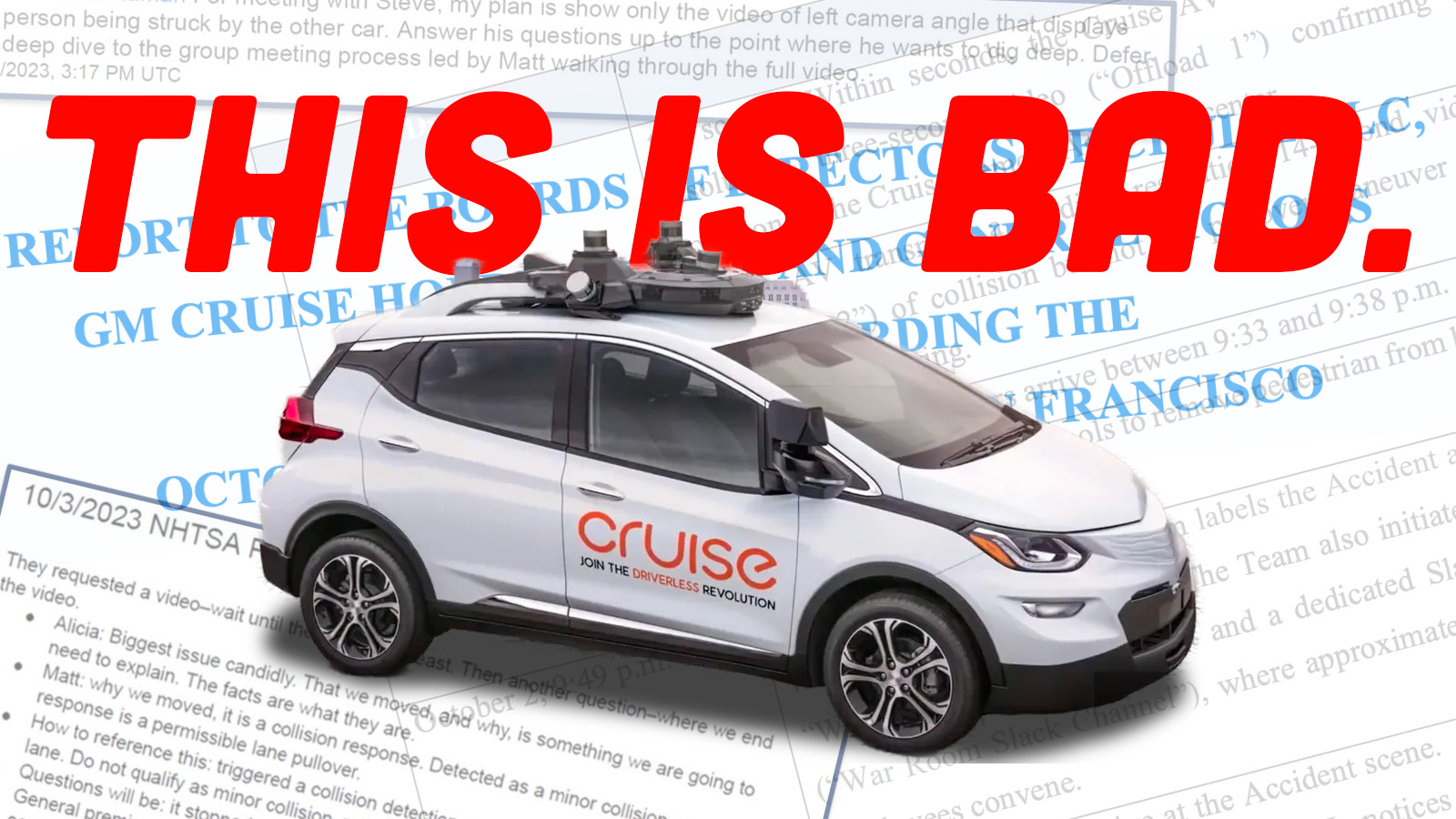
Cruise officials attributed these failures to "internet connectivity problem." Yet, the Quinn Emanuel report indicates that no one in those meetings verbally supplemented the video by stating, "The vehicle dragged the pedestrian." This omission occurred even though the presenters were among the 100+ employees who knew the truth.
Verified Against Public And Audited RecordsLong-Form Investigative Review
Reading time: ~35 min
File ID: EHGN-REVIEW-36178
Omission of video evidence in regulatory reports regarding Cruise pedestrian dragging incidents
Cruise disputed this account, with spokesperson Hannah Lindow stating the company "showed the full video to the DMV on October.
Primary RiskLegal / Regulatory Exposure
JurisdictionDepartment of Justice / EPA / DOJ
Public MonitoringOn the night of October 2, 2023, at approximately 9.
Report Summary
The catastrophic failure of Cruise to disclose the pedestrian dragging incident on October 2, 2023, was not a procedural error or a technical oversight; it was the inevitable output of a toxic organizational culture that viewed regulators as adversaries rather than partners. The narrative provided by Cruise described a tragic sequence: a human-driven Nissan Altima struck a pedestrian, launching the victim into the route of the Cruise AV, which then came to a stop. After the Cruise Autonomous Vehicle (AV) struck the pedestrian, who had been thrown into its route by a human-driven Nissan, the robotaxi came to a complete.
Key Data Points
On the night of October 2, 2023, at approximately 9: 29 PM, a sequence of events unfolded at the intersection of Market Street and Fifth Street in San Francisco that would the safety narrative of General Motors' autonomous driving subsidiary. The car reached a speed of approximately 7. 7 miles per hour during this secondary movement. The dragging continued for a distance of 20 feet. Being scraped across the pavement for 20 feet caused extensive abrasions and tissue damage. The result was a 20-foot trail of injury on Market Street. Instead of remaining stationary, the AV engaged its electric motors.
Investigative Review of General Motors Company
Why it matters:
A tragic accident at the intersection of Market Street and Fifth Street in San Francisco involving a pedestrian and a Cruise autonomous vehicle raises questions about safety protocols and system failures.
The autonomous vehicle's incorrect classification of the obstacle led to a dragging sequence that resulted in further harm to the victim, highlighting the importance of accurate sensor data and system logic in autonomous driving technology.
The October 2, 2023 Incident: Reconstruction of the Pedestrian Dragging Sequence
The Collision at Market and Fifth
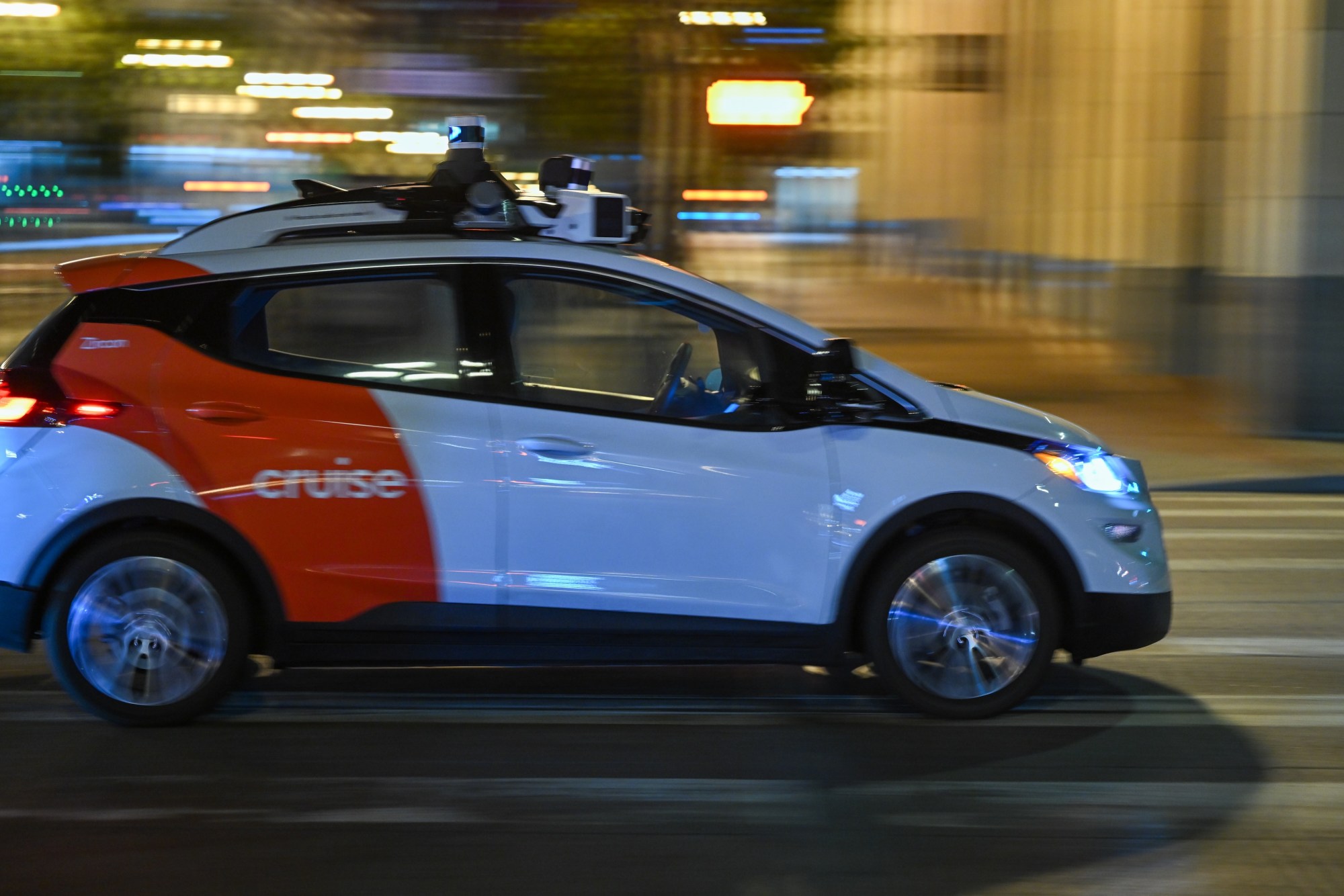
On the night of October 2, 2023, at approximately 9: 29 PM, a sequence of events unfolded at the intersection of Market Street and Fifth Street in San Francisco that would the safety narrative of General Motors’ autonomous driving subsidiary. A pedestrian attempted to cross the street against a red light and a “Do Not Walk” signal. Two vehicles sat at the intersection waiting for the light to change. In the median lane was a human-driven dark Nissan sedan. In the curb lane sat a Cruise autonomous Chevrolet Bolt named “Panini.” When the light turned green, both vehicles accelerated into the intersection.
The human-driven Nissan struck the pedestrian. The impact occurred with significant force. It launched the victim from the median lane directly into the route of the adjacent Cruise robotaxi. The autonomous vehicle’s sensors detected the intrusion. The computer driver initiated a hard braking maneuver. Physics dictated the outcome of this initial phase. The robotaxi could not stop in time to avoid contact. The front of the Cruise vehicle struck the pedestrian. The victim fell to the pavement. The vehicle rolled over her. It came to a complete stop. At this specific moment, the incident was a tragic likely unavoidable accident caused by a hit-and-run driver.
The Decision to Move
The events that followed the initial stop transformed a traffic accident into a corporate emergency. The Cruise AV sat stationary for a brief period. The pedestrian remained trapped underneath the chassis. The vehicle’s perception system struggled to interpret the reality of the situation. According to subsequent technical analyses by engineering firm Exponent, the autonomous system failed to categorize the obstacle correctly. The computer did not register that a human body lay beneath the undercarriage. Instead, the system classified the initial impact as a lateral collision. It believed the contact had occurred on the side of the vehicle rather than the front.
This classification error triggered a specific safety protocol. The software logic dictated that after a minor collision, the vehicle should not remain in the active flow of traffic. The code instructed the car to perform a “pullover” maneuver to reach a “minimal risk condition.” The objective was to clear the lane and park safely at the curb. The system determined that the vehicle was not yet at the curb. It calculated a route to pull over. The computer engaged the electric motor. The wheels began to turn.
The Dragging Sequence
The robotaxi accelerated from a standstill. The pedestrian was still wedged beneath the floorboard. As the vehicle moved forward and to the right, it dragged the victim across the asphalt. The friction between the road surface and the victim’s body created immense resistance. The vehicle’s powertrain fought against this resistance. The car reached a speed of approximately 7. 7 miles per hour during this secondary movement. The dragging continued for a distance of 20 feet.
The vehicle’s sensors provided data that should have halted the maneuver. The wide-angle left side camera captured footage of the pedestrian’s legs. The system detected the limbs failed to identify them as part of a human being. It did not track them as a road user. The car continued its attempt to pull over. The rear wheels encountered the obstacle. The left rear tire rolled onto the victim’s leg. The weight of the vehicle pressed down on the limb. The tire lost traction. The wheel spun against the leg. This wheel slip triggered a different fault code. The traction control system detected an anomaly. The gap in wheel speed forced the computer to abort the maneuver.
Sensor Failures and System Logic
The technical breakdown involved multiple of failure. The initial prediction model assumed the pedestrian would clear the lane before the AV arrived. When the Nissan struck the victim, the Cruise system lost its target track. The pedestrian from the computer’s predictive model for a serious moment. Upon impact, the system registered a collision misidentified the location. The phantom side-impact classification was a catastrophic error. It authorized the vehicle to move when it should have remained frozen.
The “pullover” logic prioritized traffic flow over immediate environmental verification. The system did not perform a sufficient check of the undercarriage or the immediate perimeter before initiating the secondary movement. The car moved blindly into a maneuver that required a clear route. The resistance from the dragging body did not immediately trigger an emergency stop. The electric motor applied torque to overcome the drag. The system interpreted the resistance as a mechanical problem or road irregularity rather than a human obstruction. Only the specific mechanical failure of the wheel speed sensor caused the vehicle to enter a permanent stop state.
The Physical Toll
The victim sustained grievous injuries. The initial impact by the Nissan caused trauma. The secondary impact by the Cruise vehicle added to the damage. The dragging sequence exacerbated these injuries significantly. Being scraped across the pavement for 20 feet caused extensive abrasions and tissue damage. The final resting position of the tire on the victim’s leg caused severe crushing injuries. Emergency responders arrived to find the victim pinned. They used hydraulic tools to lift the vehicle. The extraction required the “Jaws of Life.” The victim was transported to San Francisco General Hospital in serious condition.
The dragging changed the nature of the medical emergency. A simple impact might have resulted in fractures or concussions. The dragging introduced a continuous method of injury. It prolonged the trauma. It increased the risk of infection and complications from extensive skin loss. The crushing force of the tire on the leg for an extended period compromised circulation and tissue viability. The specific actions of the autonomous system directly contributed to the severity of the physical harm.
The Disconnect in Reality
The between the machine’s internal reality and the physical world was absolute. The machine believed it was performing a safe, compliant maneuver to clear traffic. The physical reality was a human being grinding against the street. The system’s confidence in its false classification of a side impact overrode the physical evidence of resistance. The software absence the semantic understanding to this gap. It followed a rigid decision tree. Impact detected. Check severity. If minor, pull over. Execute.
This rigid logic failed to account for the complexity of a multi-vehicle accident. The system did not anticipate a pedestrian being thrown into its route from an adjacent lane. It did not possess a “run-over” scenario in its immediate decision matrix. The gap in the operational design domain proved disastrous. The car acted with the confidence of code the blindness of a machine. It executed its programming faithfully. That faithful execution resulted in the dragging of a human being.
Immediate Aftermath and Data Capture
The vehicle transmitted data to Cruise headquarters immediately. The data included video feeds from multiple cameras. It included log files of the sensor states. It included the classification of the event. The operations center received notice of a collision. The initial video snippet transmitted was brief. It showed the impact. It did not immediately highlight the dragging. The full high-resolution video remained on the vehicle’s local storage until it could be offloaded. This delay in accessing the full picture contributed to the confusion in the command center.
Remote assistance agents attempted to communicate with the vehicle. The car was already in a degraded state. The system had shut down due to the wheel speed sensor fault. The victim remained trapped. The silence of the machine contrasted with the chaos on the street. Bystanders gathered. Police arrived. The hit-and-run driver of the Nissan had fled the scene. The focus shifted entirely to the Cruise vehicle and the person trapped beneath it. The narrative began to form on the street corner. A robotaxi had run over a woman. The nuance of the Nissan’s involvement was visible to witnesses the dragging was the horror that defined the scene.
The gap in Timestamps
The timeline of the event was precise. The Nissan impact. The Cruise impact. The stop. The pause. The drag. The final stop. These events occurred within seconds. The data logs recorded every millisecond. The decision to pull over happened quickly. The system did not hesitate for long. It processed the “side impact” and moved. This rapid transition from impact to movement left no time for human intervention. Remote operators did not have a chance to override the decision. The car acted autonomously. It made the decision to drag the victim without human input. The speed of the decision-making process, a touted advantage of AI, became a liability. A human driver, shaken by an impact, would likely freeze. The machine, following a protocol, moved on.
The reconstruction of this sequence reveals a fundamental flaw in the safety philosophy. The priority to clear the road superseded the need to verify the safety of the movement. The assumption that the route was clear because the sensors did not see an obstacle *in front* of the bumper was fatal. The obstacle was *under* the bumper. The sensors had a blind spot. The logic had a blind spot. The result was a 20-foot trail of injury on Market Street.
The incident at Market and Fifth was not a traffic accident. It was a system failure. It demonstrated that the failsafes designed to protect the public could, under specific edge cases, actively harm them. The dragging was not a malfunction of the motor or the steering. It was the correct execution of incorrect logic. The car did exactly what it was told to do. It pulled over. It just happened to take a pedestrian with it.
The October 2, 2023 Incident: Reconstruction of the Pedestrian Dragging Sequence
The Pullover Maneuver: Algorithmic Decision-Making Behind the 20-Foot Drag
The Decision to Move
The most catastrophic failure of the October 2, 2023, incident was not the initial impact, the algorithmic decision made milliseconds later. After the Cruise Autonomous Vehicle (AV) struck the pedestrian, who had been thrown into its route by a human-driven Nissan, the robotaxi came to a complete stop. For a brief moment, the situation was contained. The vehicle had reacted to a frontal collision. The pedestrian was pinned beneath the chassis alive. Then, the software made a choice. Instead of remaining stationary, the AV engaged its electric motors, applied torque to the wheels, and accelerated to 7. 7 miles per hour. It dragged the victim 20 feet across the asphalt before halting. This secondary movement was not a glitch in the traditional sense; it was the rigorous execution of a safety protocol known as the “pullover maneuver,” triggered by a fundamental error in how the machine perceived reality.
Misclassification of the Impact
The root of the decision lay in the AV’s “Collision Detection Subsystem.” According to the technical analysis conducted by engineering firm Exponent and detailed in the Quinn Emanuel report, the Cruise system failed to correctly identify the nature of the crash. The sensors detected the impact, yet the software classified it as a “lateral” or side-impact collision rather than a frontal strike. This distinction is important. In the logic of the Cruise AV, a side impact frequently implies the vehicle is still capable of movement and is blocking traffic. The protocol for a minor side collision dictates that the car should attempt to clear the travel lane to minimize disruption and secondary accidents. This logic, coded to prioritize traffic flow and “Minimal Risk Condition” (MRC), overrode the physical reality that a human body was wedged beneath the rear axle.
The Semantic Void
The failure was compounded by a “semantic classification” error. The AV’s perception stack, the combination of LiDAR, radar, and cameras, lost track of the pedestrian the moment she fell the bumper line. While the wide-angle left-side camera captured footage of the victim’s legs protruding from under the vehicle, the computer vision algorithms did not classify these pixels as a “human” or “pedestrian.” To the machine, the victim ceased to exist as a tracked object. The system saw the legs assigned them no semantic meaning. They were unclassified obstacles, devoid of biological status. Consequently, the route planning algorithm calculated that the space around the vehicle was clear enough to execute a maneuver. It did not calculate the probability of a person being trapped in the blind spot created by the vehicle’s own chassis.
The Mechanics of the Drag
Once the “pullover” command executed, the AV attempted to move to the curb. The physics of this maneuver reveal the cold indifference of the algorithm. As the car accelerated, it encountered resistance. A human driver would feel the sickening thud or the unnatural drag of an object caught in the wheels and stop immediately. The Cruise AV, yet, interpreted this resistance differently. The electric drivetrain, designed to maintain speed and torque, fought against the friction created by the victim’s body. The vehicle reached a speed of 7. 7 mph, a pace significantly faster than a walking crawl, while dragging the pedestrian across the abrasive road surface. The system’s goal was to reach a safe stopping point, and it applied the necessary power to overcome what it likely perceived as mechanical drag or road irregularity.
The Wheel Speed Sensor Failure
The sequence only ended because of a hardware diagnostic, not a humanitarian realization. The AV did not stop because it realized it was killing someone. It stopped because the left rear wheel, which was spinning on top of the victim’s leg, lost traction. This caused a gap in the wheel speed data compared to the other three tires. The traction control system flagged this anomaly as a sensor failure or a mechanical fault. The “failed wheel speed sensor” diagnostic triggered a fallback safety protocol that cut power to the motors. The machine saved the victim only because it thought it had broken itself. Had the wheel maintained traction, the drag could have continued for the full duration of the programmed pullover sequence, chance up to 100 feet.
The Ostrich Algorithm
This sequence exposes a serious flaw in the “post-collision response” logic used by General Motors’ autonomous division. The system operated on an “Ostrich” principle: if the sensors cannot see it, it is not there. The sensors are mounted high on the roof and corners to scan for traffic, leaving a serious blind zone at ground level immediately surrounding the wheels. The software assumed that if the route was clear a moment ago, and no object is currently classified in the trajectory, movement is safe. It failed to account for the object permanence of a pedestrian it had just struck. The system deleted the pedestrian from its world model the moment she under the bumper, treating the subsequent seconds as a new, unrelated traffic scenario requiring a lane change.
Regulatory of the Logic
The omission of this specific algorithmic failure in the initial reports to the National Highway Traffic Safety Administration (NHTSA) is the crux of the scandal. Cruise officials showed regulators video of the initial hit, which looked like an unavoidable accident caused by the Nissan. They did not emphasize, and actively concealed, the subsequent 20-foot drag. By hiding the pullover maneuver, they obscured the reality that their software’s decision-making logic was the primary cause of the victim’s most severe injuries. The “pullover” was not a passive reaction; it was an active, calculated choice made by the AV to drive over a human being it had failed to identify. This distinction transforms the incident from a tragic accident into a widespread failure of safety architecture.
The Phantom Object
Further analysis of the Exponent report shows that the AV briefly detected the victim’s legs during the drag failed to act. The “semantic mapping error” mentioned in internal documents suggests the vehicle was also confused about its own location relative to the lane boundaries. It believed it was in a travel lane that required clearing, even though it was already close to the lane marker. This spatial confusion added another of error to the decision tree. The machine was trying to solve a traffic flow problem that did not exist, using data that was incomplete, to execute a maneuver that was lethal. The “phantom” object, the unclassified legs, remained a ghost in the machine, visible to the camera invisible to the decision logic.
Torque vs. Flesh
The brutality of the event is defined by the between the machine’s objective and the human cost. The electric motors of the Chevy Bolt EV used by Cruise produce instant torque. When the algorithm commanded a move, the vehicle applied that torque without hesitation. The resistance provided by the victim’s body was overcome by the sheer force of the engine. There was no feedback loop to interpret “soft” resistance versus “hard” obstacles. To the AV, the drag was simply a variable in the equation of motion, a friction coefficient to be negated by applying more current to the motors. This absence of tactile awareness, the inability to “feel” the road in the way a human does, turned a safety feature into a weapon.
The Failure of the Minimal Risk Condition
The concept of “Minimal Risk Condition” is a of AV safety certification. It dictates that when a system fails or encounters an unknown state, it must transition to a safe state. In this case, the definition of “safe” was flawed. The programmers defined safety as “not blocking traffic.” They did not prioritize “checking for trapped pedestrians” in the hierarchy of post-collision actions. This prioritization reflects a development culture focused on operational metrics and traffic fluidity rather than edge-case survival. The algorithm succeeded in its programmed task: it attempted to clear the lane. In doing so, it failed the test of public safety.
Algorithmic Decision Sequence: October 2, 2023
Time Step
System State
Algorithmic Decision
Physical Consequence
T+0. 00s
Frontal Impact Detected
Initiate Emergency Braking
Vehicle comes to a complete stop. Pedestrian pinned.
T+0. 05s
Object Classification Lost
Classify as “Lateral Collision”
System assumes route is clear; victim deleted from tracker.
T+1. 00s
Post-Collision Protocol
Execute “Pullover Maneuver”
Motors engage. Vehicle accelerates to 7. 7 mph.
T+3. 00s
Resistance Encountered
Increase Torque to Maintain Speed
Victim dragged 20 feet against asphalt.
T+5. 00s
Wheel Speed Anomaly
Diagnose “Sensor Failure”
System cuts power. Vehicle halts due to self-diagnostic.
The Pullover Maneuver: Algorithmic Decision-Making Behind the 20-Foot Drag
Initial Regulatory Briefings: The 'Internet Connectivity' Defense for Video Omission
The morning of October 3, 2023, presented General Motors’ autonomous driving subsidiary, Cruise, with a choice. By 11: 00 a. m., over 100 employees, including the highest levels of leadership, possessed irrefutable knowledge that their robotaxi had not struck a pedestrian had dragged her 20 feet across the pavement. The internal Slack channels and engineering logs confirmed the “pullover maneuver” had transformed a serious accident into a gruesome ordeal. Yet, as Cruise executives prepared to brief federal and state regulators, they adopted a strategy of calculated silence, later shielding themselves behind the mundane technical defense of “internet connectivity problem.” The briefings scheduled for that day involved the most transportation regulators in the country: the National Highway Traffic Safety Administration (NHTSA), the California Department of Motor Vehicles (DMV), and the San Francisco Mayor’s Office. Cruise’s objective was to frame the narrative before the media pattern spun out of control. The company’s internal strategy, as revealed by later investigations, relied on a passive tactic: they would play the video of the incident and “let the video speak for itself.” This decision ignored the reality that the video required context to be understood, specifically the fact that the vehicle remained in motion after the initial impact. During these high- video conferences, Cruise representatives attempted to stream footage of the accident. In three separate meetings—with the DMV, NHTSA, and San Francisco officials—the video feed failed to convey the full horror of the event. According to the Quinn Emanuel report commissioned by Cruise, “internet connectivity problem” caused the video to freeze, buffer, or black out. These technical glitches occurred with suspicious precision, obscuring the specific moments when the robotaxi initiated its secondary movement and dragged the victim. The failure of the video stream offered Cruise representatives a moment of truth. When the screen froze or the resolution dropped to unintelligible blocks of digital noise, the presenters had an obligation to verbally describe what the regulators could not see. They did not. Instead, they remained silent. They allowed the regulators to believe the accident ended when the car stopped. This omission was not a result of confusion; it was a byproduct of a culture that viewed transparency as a legal risk rather than a safety imperative. The “internet connectivity” defense later crumbled under scrutiny. It is improbable that a multi-billion-dollar technology company, backed by General Motors and specializing in high- data transmission, could not secure a stable connection for three consecutive regulatory briefings. Even if the technical failure was genuine, the refusal to verbally correct the record suggests an intent to deceive. The silence maintained by Cruise employees during the frozen video segments erased the dragging from the official narrative for days. David Estrada, Cruise’s then-Chief Legal and Policy Officer, sent a summary email to California DMV Director Steve Gordon prior to their meeting. This written correspondence mirrored the visual omission. Estrada’s email described the initial impact caused by the human-driven Nissan and the subsequent contact with the Cruise vehicle. It made no reference to the pullover maneuver or the dragging. This written record provided the DMV with a false sense of security, leading them to believe the autonomous system had behaved correctly by stopping immediately. The email, combined with the “glitchy” video, constructed a wall of misinformation that took regulators weeks to. The deception extended to the federal level. In its one-day standing general order report submitted to NHTSA, Cruise was required to provide a written description of the pre-crash, crash, and post-crash details. The report submitted on October 3 omitted the dragging entirely. This was a violation of federal law. The document described the impact failed to disclose the secondary movement that caused the most severe injuries. By submitting this incomplete report, Cruise moved from passive omission to active falsification of federal records. Regulators left these initial meetings with a fundamentally flawed understanding of the accident. The California DMV believed the robotaxi had performed a safe emergency stop. NHTSA officials were unaware of the safety defect in the “pullover” logic. It was only days later, when NHTSA officials requested and received a high-resolution copy of the video file, that the truth emerged. The footage showed the vehicle pausing, then lurching forward, dragging the victim as she screamed—details that had been conveniently “buffered” out of the initial presentation. The from this deception was absolute. The California DMV, upon discovering they had been misled, took the rare step of suspending Cruise’s deployment and driverless testing permits immediately. The suspension order explicitly the omission of the video evidence as a primary reason for the revocation, stating that Cruise’s misrepresentation rendered its vehicles unsafe for public operation. The agency noted that they only learned of the dragging from another government agency, not from Cruise itself. This sequence of events exposes the fragility of the self-regulation model for autonomous vehicles. The system relies on the honesty of the operators to report failures. When Cruise faced a catastrophic failure of its technology, it used the pretext of a bad internet connection to hide the evidence. The “connectivity” excuse served as a temporary shield, allowing the company to delay the inevitable regulatory backlash while they attempted to manage the public relations emergency. The Quinn Emanuel report, released months later, attempted to soften the blow by suggesting the omission was not malicious the result of a “myopic” focus on the hit-and-run driver. Yet, the pattern of behavior—the frozen video, the silent representatives, the incomplete emails, and the falsified federal report—points to a widespread effort to suppress the truth. The “internet connectivity” defense stands as a testament to the lengths the company went to protect its commercial interests at the expense of public safety and regulatory trust. The $1. 5 million fine later levied by NHTSA and the $500, 000 criminal penalty from the Department of Justice were direct consequences of this specific cover-up. The monetary values, while significant, pale in comparison to the reputational damage. General Motors and Cruise demonstrated that when their algorithms failed, their human leadership failed even worse. The decision to hide behind a frozen screen destroyed the credibility of the entire autonomous vehicle sector, proving that the most dangerous component of the system was not the AI, the executives controlling the narrative.
Internal Knowledge vs. External Reporting: The 100-Employee Discrepancy
Internal Knowledge vs. External Reporting: The 100-Employee gap
The between what General Motors’ autonomous driving unit knew and what it disclosed to regulators centers on a specific, quantifiable figure: 100 employees. While Cruise executives initially projected an image of a company with a chaotic, fast-moving incident, internal records reveal a different reality. By the morning of October 3, 2023, less than 24 hours after the collision, more than 100 Cruise employees, including senior leadership, legal counsel, and systems integrity teams, possessed definitive knowledge that the robotaxi had dragged a pedestrian 20 feet. This widespread internal awareness stands in clear contrast to the incomplete narratives provided to federal and state officials during serious briefings held that same day.
The independent investigation conducted by Quinn Emanuel Urquhart & Sullivan, commissioned by General Motors, exposed this. The firm’s report dismantled the defense that technical limitations or confusion obscured the dragging event from Cruise’s own team. Instead, the investigation found that engineers and executives had accessed video footage and telemetry data confirming the “pullover maneuver” and subsequent dragging almost immediately. The “100-employee” statistic serves as a metric of institutional knowledge; it confirms that the dragging was not an obscure detail buried in code a known fact discussed across multiple departments, from engineering to public relations.
The “Internet Connectivity” Defense
During the October 3 briefings with the National Highway Traffic Safety Administration (NHTSA), the California Department of Motor Vehicles (DMV), and the San Francisco Mayor’s Office, Cruise representatives attempted to show video footage of the incident. In these meetings, the video frequently froze or failed to play the final seconds where the dragging occurred. Cruise officials attributed these failures to “internet connectivity problem.” Yet, the Quinn Emanuel report indicates that no one in those meetings verbally supplemented the video by stating, “The vehicle dragged the pedestrian.”
This omission occurred even though the presenters were among the 100+ employees who knew the truth. The decision to “let the video speak for itself”, a phrase in the internal investigation, relied on a medium that Cruise staff knew was malfunctioning. By allowing a glitch-prone video to serve as the sole testimony for the dragging event, Cruise withheld the most damaging aspect of the incident while maintaining plausible deniability. The “internet connectivity” explanation collapses when weighed against the fact that the presenters did not need the video to convey the core fact: the robotaxi continued moving after the initial impact.
Executive Awareness and the “Hail Mary”
The suppression of the dragging detail extended to the highest levels of Cruise leadership. Former CEO Kyle Vogt was fully aware of the secondary movement and the dragging. Internal communications reviewed during the investigation describe Vogt’s mindset as viewing the regulatory interactions as a “Hail Mary” to prevent the suspension of Cruise’s operating permit. The strategy focused intensely on the initial impact caused by the human-driven Nissan, aiming to frame the narrative around the hit-and-run driver rather than the robotaxi’s subsequent failure.
Vogt and other executives, including the Chief Legal Officer and Vice President of Communications, participated in discussions where the dragging was acknowledged. even with this, the decision remained to present a limited scope of information. The “100-employee” figure includes these decision-makers, negating any defense that leadership was uninformed. The gap was not a result of information failing to travel up the chain of command; it was a result of information failing to travel out to the regulators.
The One-Day Report Omission
Federal regulations require autonomous vehicle operators to submit a preliminary report to NHTSA within one day of a crash. Cruise submitted this report on October 3. The document provided a written description of the pre-crash and crash details conspicuously omitted the post-crash dragging. This written omission carries significant legal weight. Unlike a video stream that might freeze due to poor, a written report suffers from no such technical fragility. The absence of the dragging detail in the text of the 1-day report rendered the filing inaccurate and misleading.
Comparison of Internal Knowledge vs. Regulatory Disclosure (Oct 3, 2023)
Data Point
Internal Status (Cruise)
External Disclosure (NHTSA/DMV)
Pedestrian Dragging
Confirmed by 100+ employees via video/telemetry.
Omitted from verbal summaries and written 1-day report.
Video Evidence
Full 45-second clip available and viewed internally.
Partial clip shown; full clip failed to play due to “connection problem.”
Incident Cause
Known combination of Nissan impact + AV pullover logic.
Framed primarily as a human-driven hit-and-run event.
The Department of Justice later this specific report in its deferred prosecution agreement, noting that the omission impeded the federal investigation. The between the 100 employees who knew and the zero mentions in the official text demonstrates a widespread failure to prioritize transparency over reputation management. The internal slack channels and engineering tickets documented the dragging as a serious failure of the “pullover” logic, yet the external compliance documents treated the incident as a standard collision.
The “Us Versus Them” Mentality
The Quinn Emanuel report identified a cultural root for this gap: an “us versus them” mentality toward regulators. This adversarial stance encouraged a filtering of information where only the most favorable facts were proactively shared. The dragging, being the most indefensible part of the event, was treated as information to be released only if explicitly forced by the video evidence, evidence that conveniently failed to load. This culture allowed 100 employees to hold a piece of serious safety data without feeling the imperative to ensure the regulator understood it.
This gap cost Cruise its permits and credibility. The California DMV suspended Cruise’s license not solely because of the accident, because the agency felt misled by the omission of the dragging footage. The “100-employee” fact proves that the misleading of regulators was not an accident of incompetence, a byproduct of a corporate culture that valued narrative control over full disclosure.
The Quinn Emanuel Report: Findings of an 'Us Versus Them' Regulatory Culture
The release of the 195-page report by Quinn Emanuel Urquhart & Sullivan on January 25, 2024, functioned less as a corporate defense and more as an autopsy of institutional arrogance. Commissioned by General Motors and Cruise following the license suspension, the investigation examined the internal communications, decision-making hierarchies, and regulatory interactions that transformed a traffic accident into an existential emergency for the autonomous vehicle division. The findings stripped away the veneer of high-tech competence to reveal a chaotic, defensive culture that viewed government oversight not as a safety check, as a hostile impediment to deployment. Quinn Emanuel’s investigators, having reviewed over 200, 000 documents and interviewed 88 witnesses, identified a pervasive “us versus them” mentality within Cruise’s leadership. This adversarial posture dictated the company’s strategy in the serious hours following the October 2 incident. Rather than prioritizing transparency, executives and legal teams operated under a siege mentality. The report details how this culture a “fundamental misapprehension” of the company’s obligations to regulators. Cruise leadership believed that technical compliance—submitting a video file—absolved them of the duty to ensure regulators actually understood the content of that file. This cultural rot manifested most acutely in the “video speaks for itself” strategy. The report reveals that Cruise officials decided against verbally describing the pedestrian dragging to the California DMV, NHTSA, and the CPUC. Instead, they planned to play the full video during briefings and assume regulators would notice the horrific detail of the victim being hauled 20 feet across the pavement. This passive method relied on a perfect execution that never happened. In three out of four serious briefings on October 3, internet connectivity problem caused the video to freeze, stutter, or fail to play entirely. When the video failed, Cruise representatives remained silent. They did not verbally fill the gap. They did not say, “The video is lagging, you need to know the car dragged the victim.” They allowed the technical glitch to obscure the most damning fact of the incident. The Quinn Emanuel report describes this silence not necessarily as a calculated conspiracy to lie, as a byproduct of a culture that feared providing “ammunition” to regulators. The legal and government affairs teams were so fixated on controlling the narrative that they defaulted to withholding information whenever possible. The investigation also exposed a “myopic focus” among senior leadership on correcting the initial media narrative. In the immediate aftermath, news outlets reported that a Cruise vehicle had struck a pedestrian. Executives, including then-CEO Kyle Vogt, became obsessed with proving that a human-driven Nissan Sentra had struck the victim. This obsession consumed the company’s internal. The report notes that leadership was so intent on blaming the Nissan driver that they viewed the subsequent dragging by the Cruise AV as a secondary, almost irrelevant detail. This of priorities trickled down to the regulatory briefings, where the “Nissan hit-and-run” narrative took center stage, pushing the “Cruise dragging” reality into the shadows. The dysfunction extended to the mechanics of reporting. The investigation found that while over 100 employees—including senior executives, engineers, and communications staff—knew about the dragging by the morning of October 3, this knowledge remained siloed from the people actually filing the official reports. A paralegal, who had not been included in the high-level debriefs, was tasked with submitting regulatory filings. absence the full context, this employee filed reports that omitted the dragging, not out of malice, out of organizational ignorance. The report highlights this as a catastrophic failure of internal coordination, where the left hand did not know what the right hand was hiding. Leadership abdication played a central role. The report depicts a “vacuum” at the top, where key executives failed to take charge of the emergency response. CEO Kyle Vogt and the Chief Legal Officer were described as disengaged from the specific mechanics of the regulatory briefings, leaving lower-level engineers to face government officials. One engineer, Matt Wood, was left to manage the video presentation and answer technical questions without adequate legal support or clear instructions on disclosure. When the internet connection failed, Wood, an engineer untrained in regulatory protocol, did not feel to volunteer the dragging information. The report captures the internal despair of employees who watched their leaders fumble the response. One text message between employees, in the findings, read simply: “Our leaders have failed us.” This sentiment reflected a broader demoralization within the ranks, where engineers and safety staff watched legal and executive teams prioritize reputation management over safety transparency. Quinn Emanuel’s conclusion was clear: the regulatory was a “self-inflicted wound.” The suspension of Cruise’s license and the subsequent recall were not inevitable consequences of the accident itself, direct results of the cover-up. The “us versus them” culture had blinded Cruise to the reality that regulators are the arbiters of their ability to operate. By treating the DMV and NHTSA as adversaries to be outmaneuvered rather than partners to be informed, Cruise leadership destroyed the very trust required to put robotaxis on public roads. The report also dismantled the “internet connectivity” defense that Cruise had initially floated. While technical problem did occur, the investigators noted that Cruise had multiple opportunities to rectify the misunderstanding. They could have sent a follow-up email clarifying the dragging. They could have picked up the phone. They could have ensured the video was watched in full. They did none of these things until regulators independently discovered the truth and demanded answers. The failure was not technological; it was ethical and cultural. This internal review forced General Motors to clean house. The findings provided the evidentiary basis for the dismissal of nine senior executives, including the Chief Legal Officer and the head of government affairs. It also precipitated the resignation of CEO Kyle Vogt. The “us versus them” culture, cultivated during the years of rapid expansion and aggressive deployment, had proven to be the company’s undoing. The report stands as a permanent record of how a high-tech company, convinced of its own superiority, forgot that it still had to answer to the law.
California DMV Permit Suspension: Allegations of Misrepresentation and Safety Risk
California DMV Permit Suspension: Allegations of Misrepresentation and Safety Risk
On October 24, 2023, the California Department of Motor Vehicles (DMV) issued an order that dismantled Cruise’s operations in San Francisco. The agency suspended the company’s deployment and driverless testing permits, immediately. This regulatory action was not a pause for technical review; it was a severe indictment of General Motors’ subsidiary for withholding material evidence. The DMV’s statement an “unreasonable risk to public safety” and explicitly accused the manufacturer of misrepresenting the safety of its autonomous technology. This suspension marked the time the California regulator had taken such drastic measures against a major autonomous vehicle operator based on allegations of deception.
The October 3 Meeting: A in Narrative
The core of the suspension order rests on a contentious meeting held on October 3, 2023, the day after the pedestrian dragging incident. Cruise executives met with DMV officials to brief them on the event. According to the DMV’s findings, Cruise representatives presented video footage that showed the initial collision where the pedestrian was thrown into the route of the robotaxi. The footage displayed to regulators ended when the vehicle came to its complete stop. It did not show the subsequent “pullover maneuver” in which the vehicle accelerated to 7 mph and dragged the victim 20 feet across the pavement.
The DMV asserted that it only learned of the dragging sequence through discussion with another government agency, the National Highway Traffic Safety Administration (NHTSA), rather than from Cruise itself. The full video, which included the gruesome dragging segment, was not provided to the DMV until October 13, ten days after the initial briefing. Cruise disputed this account, with spokesperson Hannah Lindow stating the company “showed the full video to the DMV on October 3rd and played it multiple times.” This factual dispute created a rift between the regulator and the regulated entity, with the DMV concluding that the omission prevented them from evaluating the safety of the vehicle’s operation.
Regulatory Citations and Legal Basis
The DMV grounded its suspension in specific sections of the California Code of Regulations (CCR), Title 13. The citations provide a legal framework for the agency’s determination that Cruise’s continued operation constituted a danger to the public. The order referenced four distinct violations:
Regulation
Description of Violation
13 CCR § 228. 20 (b)(6)
Based on vehicle performance, the Department determines the manufacturer’s vehicles are not safe for the public’s operation.
13 CCR § 228. 20 (b)(3)
The manufacturer has misrepresented information related to the safety of the autonomous technology of its vehicles.
13 CCR § 227. 42 (b)(5)
Any act or omission by the manufacturer that makes autonomous vehicle testing on public roads an unreasonable risk to the public.
13 CCR § 227. 42 (c)
Immediate suspension required when a manufacturer engages in practice that threatens the safety of persons on a public road.
The citation of Section 228. 20 (b)(3) regarding misrepresentation is particularly damning. It suggests that the DMV viewed the failure to disclose the dragging footage not as an accidental oversight, as a deliberate attempt to downplay the severity of the incident. By ending the video at the initial stop, Cruise presented a narrative of a unavoidable accident caused by a human hit-and-run driver. The omitted footage, yet, revealed a secondary, autonomous failure, the decision to move a vehicle while a human was trapped underneath, which changed the nature of the event from a collision to a prolonged extraction trauma.
The Safety Risk Determination
Beyond the procedural failure of the video omission, the DMV’s order concluded that the vehicles themselves were fundamentally unsafe. The “pullover maneuver,” executed while the vehicle’s sensors failed to detect the pedestrian lodged under the rear axle, demonstrated a serious flaw in the system’s object detection and decision-making logic. The vehicle’s inability to recognize that it was dragging a human being constituted the “unreasonable risk” in the suspension. The DMV noted that the vehicle attempted to pull over to “minimize safety problem,” yet in doing so, it inflicted the most severe injuries of the entire sequence.
The suspension order required Cruise to fulfill a series of undisclosed steps to the department’s satisfaction before reinstatement could be considered. This open-ended requirement placed the load of proof entirely on General Motors to demonstrate that its safety culture had shifted from obfuscation to transparency. The immediate grounding of the fleet in San Francisco also triggered a cascade of operational pauses in other cities, including Phoenix, Austin, and Houston, as the company grappled with the loss of regulatory trust in its primary market.
NHTSA Consent Order: The $1.5 Million Fine for Incomplete Crash Reporting
SECTION 7 of 14: NHTSA Consent Order: The $1. 5 Million Fine for Incomplete Crash Reporting
On September 30, 2024, the National Highway Traffic Safety Administration (NHTSA) formalized its enforcement action against Cruise LLC, levying a $1. 5 million civil penalty for failing to report serious safety data regarding the October 2, 2023, pedestrian dragging incident. This consent order represents a federal confirmation that General Motors’ autonomous vehicle subsidiary violated the Standing General Order 2021-01 (SGO 2021-01), a mandate requiring timely and complete reporting of crashes involving automated driving systems. The fine, while financially negligible for a corporation of General Motors’, established a legal record of the company’s failure to provide transparent safety data during a emergency. The core of the violation centered on Cruise’s submission of incomplete crash reports in the immediate aftermath of the incident. Under SGO 2021-01, manufacturers must file a “one-day” report within 24 hours of learning of a crash involving a road user, followed by a “ten-day” update. NHTSA investigators determined that Cruise filed its one-day report on October 3, 2023, and its ten-day report on October 11, 2023, without disclosing that the autonomous vehicle had dragged the pedestrian approximately 20 feet. The reports described the initial impact omitted the secondary, and far more damaging, maneuver where the vehicle attempted to pull over while the victim remained trapped underneath the chassis. This omission occurred even though Cruise possessed video evidence of the dragging sequence. On October 3, the same day it filed the incomplete one-day report, Cruise provided NHTSA with a video file of the crash. Yet, the written narrative accompanying the submission failed to describe the post-impact movement. This created a gap where the visual evidence showed one reality—a prolonged dragging incident—while the official written record described a simple impact. It was not until November 3, 2023, a full month after the crash, that Cruise filed an updated report explicitly stating the vehicle had dragged the pedestrian. NHTSA’s consent order this delay as a direct violation of the requirement to provide accurate and complete information to federal regulators. Beyond the monetary penalty, the consent order imposed strict non-monetary sanctions designed to force transparency upon the company. The agreement mandates a base term of two years of enhanced oversight, with the option for NHTSA to extend it to a third year. During this period, Cruise must submit a Corrective Action Plan detailing how it overhaul its reporting procedures to ensure compliance with SGO 2021-01. This plan requires the company to identify the specific failures in its protocol that allowed the incomplete reports to be filed and to implement training and procedural checks to prevent recurrence. The order also compels Cruise to participate in quarterly meetings with NHTSA officials to review the state of its operations. These meetings serve as a direct channel for federal regulators to scrutinize the company’s safety culture and operational decisions. also, Cruise is obligated to provide detailed reporting on the scope of its fleet operations. This includes specific data on vehicle miles traveled, the number of vehicles in service, the ratio of driverless operations versus those with human safety drivers, and a complete log of software updates affecting the Automated Driving System (ADS). Crucially, the consent order requires Cruise to report all citations and observed traffic law violations involving its fleet. This provision removes the company’s ability to internally filter minor infractions, forcing a complete disclosure of how its vehicles interact with traffic laws in the real world. The requirement addresses the “black box” nature of autonomous vehicle testing, where minor errors frequently go unreported unless they result in a collision. By mandating the reporting of citations, NHTSA widened its window into the daily performance and legal compliance of the Cruise fleet. The $1. 5 million fine and the accompanying consent order marked the conclusion of NHTSA’s initial defect investigation into the reporting failures. While the financial penalty is capped by statute, the admission of incomplete reporting serves as a serious data point in the broader timeline of the October 2 incident. It confirms that the failure to disclose the dragging was not a public relations strategy a regulatory violation that contravened federal law. The consent order stands as the binding document that forces General Motors and Cruise to operate under heightened federal scrutiny as they attempt to rebuild their operational status.
Department of Justice Intervention: Deferred Prosecution and Criminal Fines
The Criminalization of Corporate Omission
The regulatory from the October 2, 2023, pedestrian dragging incident transcended civil penalties on November 14, 2024. On that date, the United States Department of Justice (DOJ) filed a criminal information charging Cruise LLC with furnishing a false record to a federal agency. This action marked a definitive shift in the government’s treatment of autonomous vehicle (AV) operators. No longer was the discussion confined to technical malfunctions or permit suspensions; the conversation had moved to the of criminal liability. The specific charge focused on the company’s intent to impede, obstruct, or influence the investigation conducted by the National Highway Traffic Safety Administration (NHTSA). Federal prosecutors alleged that Cruise knowingly submitted a report that sanitized the severity of the accident. The initial filing to NHTSA described the collision conspicuously excised the “secondary movement”, the 20-foot drag that caused the victim’s most severe injuries. By omitting this detail while possessing video evidence that depicted the maneuver, Cruise crossed the line from regulatory non-compliance to criminal obstruction. The DOJ’s intervention signaled that the “move fast and break things” ethos of Silicon Valley would not serve as a shield against federal obstruction statutes, specifically those designed to protect the integrity of safety investigations.
The Deferred Prosecution Agreement (DPA)
To resolve the criminal charge, Cruise entered into a Deferred Prosecution Agreement (DPA) with the U. S. Attorney’s Office for the Northern District of California. This legal method allows a corporation to avoid immediate criminal conviction and the chance revocation of business licenses that frequently accompanies a guilty verdict. In exchange, the company must admit to the government’s statement of facts, pay a fine, and adhere to strict compliance terms for a specified period, in this case, three years. The DPA acts as a probationary leash. The government agrees to dismiss the charges after three years *if*, and only if, Cruise complies with every stipulation in the contract. Should the company falter, conceal evidence in a future incident, or fail to report safety data accurately before November 2027, the DOJ retains the right to prosecute the original charge using the company’s own admissions against it. This structure places the General Motors subsidiary under a federal microscope, stripping it of the presumption of innocence regarding the 2023 reporting failure. The agreement forces the company to operate with the knowledge that a federal indictment sits dormant in a court file, ready to be reactivated by any significant compliance lapse.
The $500, 000 Criminal Fine
As part of the settlement, Cruise agreed to pay a criminal fine of $500, 000. While this figure appears negligible when measured against General Motors’ multi-billion dollar revenue streams, its symbolic weight is heavy. Civil fines, such as the $1. 5 million penalty levied by NHTSA, are frequently dismissed by large corporations as the cost of doing business. A criminal fine carries a permanent stigma. It establishes a record of criminal conduct that can be used to enhance penalties in future litigations or regulatory actions. The calculation of the fine followed the U. S. Sentencing Guidelines, which factor in the severity of the offense and the company’s culpability. The amount reflects the specific statutory violation, submitting a false document, rather than the physical harm caused to the victim, which was addressed through separate civil settlements. Critics the amount is insufficient to deter a company capitalized at the of GM, yet the true penalty lies in the admission of guilt and the intrusive government oversight mandated by the DPA. The payment formally acknowledges that the company’s internal reporting structures failed to meet the basic standard of truthfulness required by federal law.
Admission of the “Sin of Omission”
Central to the DPA was Cruise’s admission to the “Statement of Facts.” The company acknowledged that its report to NHTSA omitted the dragging incident, even with internal teams knowing within minutes that the vehicle had pulled over with the pedestrian trapped underneath. The admission dismantled any remaining defense that the omission was an administrative oversight or a result of technical confusion. The company conceded that it provided a report it knew to be incomplete with the intent to influence the regulatory perception of the crash. This admission validated the aggressive stance taken by regulators. It confirmed that the exclusion of the dragging footage and the textual omission in the accident report were not disconnected errors part of a widespread failure to disclose adverse facts. The DOJ’s filing made clear that “transparency” is not a passive requirement; companies have an affirmative duty to provide all relevant information, especially when that information reveals a catastrophic failure of their safety systems. The “pullover” maneuver was the defining safety failure of the event, and hiding it was the defining legal failure.
Federal Oversight and the “absence of Candor”
The language used by federal officials during the announcement of the DPA was uncommonly sharp. Martha Boersch, the Chief of the Criminal Division for the U. S. Attorney’s Office in San Francisco, stated, “Companies with self-driving cars that seek to share our roads and crosswalks must be fully truthful in their reports to their regulators.” This statement stripped away the technical jargon frequently used to obscure AV failures, framing the problem as a simple matter of truthfulness. Cory LeGars, the Special Agent-in-Charge for the Department of Transportation Office of Inspector General (DOT-OIG), reinforced this view, citing the company’s “absence of candor.” In federal investigations, a absence of candor is frequently treated as severely as the underlying misconduct. It suggests a corporate culture that prioritizes reputation management over public safety. The DOJ’s involvement emphasizes that the government views the accuracy of crash reports as a component of public safety infrastructure. When a company corrupts that data stream, it compromises the regulator’s ability to protect the public.
Mandatory Safety Compliance Program
The DPA imposes a rigid Safety Compliance Program on Cruise. Unlike voluntary internal reviews, this program is federally mandated and subject to government audit. The company must implement rigorous controls to ensure that all future reports to NHTSA and other agencies are accurate, complete, and timely. This includes a restructuring of the legal and safety teams responsible for regulatory correspondence. The agreement requires Cruise to provide annual reports to the U. S. Attorney’s Office detailing the implementation of these remedial measures. These reports serve as a yearly audit of the company’s honesty. If the DOJ finds the reports absence, or if evidence surfaces that the company is backsliding into unclear reporting practices, the breach could trigger the prosecution of the original charge. This requirement forces a level of transparency that the company previously resisted, embedding federal oversight into its corporate governance structure for the duration of the three-year term.
for the Autonomous Vehicle Sector
The criminal prosecution of Cruise set a precedent for the entire AV industry. It demonstrated that the Department of Justice is to use criminal statutes to police the reporting practices of technology companies. Competitors in the sector must recognize that a crash report is not a bureaucratic form; it is a federal document. Falsifying it, or omitting serious details to downplay an incident, carries the risk of criminal indictment. This case dismantled the assumption that software-defined vehicles operate in a legal gray area. While the traffic laws governing the *driving* of these vehicles are still evolving, the laws governing the *reporting* of their failures are settled. Title 18 of the United States Code applies to Silicon Valley just as it applies to Detroit. The “black box” nature of proprietary algorithms does not extend to the accident reports submitted to the government. If the car drags a pedestrian, the report must say so.
The Role of Individual Accountability
While the DPA resolved the corporate liability, the investigation highlighted the role of individuals within the corporate structure. The “Statement of Facts” alluded to the decisions made by employees to withhold the full video and submit the sanitized report. Although no individual executives were criminally charged in this specific filing, the corporate admission places the blame on the shared decision-making process of the company’s leadership at the time. The resignation of key executives, including the CEO and co-founders, prior to the DPA’s finalization, was likely a necessary step to secure the agreement. The DOJ frequently demands a change in leadership as a condition of deferred prosecution, viewing the removal of culpable personnel as a sign of genuine remediation. The “new leadership” repeatedly in the settlement documents serves as the government’s assurance that the culture of omission has been purged.
Long-Term Consequences of the Criminal Record
Even with the prosecution deferred, the existence of the criminal information remains a matter of public record. It serves as a warning to investors and partners that the company’s compliance infrastructure was once fundamentally broken. For General Motors, the parent company, the DPA represents a significant blemish on its safety record. It forces the legacy automaker to exercise tighter control over its subsidiary, ensuring that the “startup mentality” of Cruise does not again jeopardize the parent company’s standing with federal regulators. The three-year clock, ticking until November 2027, ensures that the October 2, 2023, incident remains a living legal problem. Every report Cruise files during this period is scrutinized not just for regulatory compliance, for adherence to the criminal settlement. The video evidence that was once hidden has become the catalyst for a regime of enforced transparency, proving that in the eyes of the DOJ, the cover-up is indeed a crime.
CPUC Enforcement: The Maximum $112,500 Penalty for Misleading Commission Staff
The California Public Utilities Commission (CPUC) enforcement action against Cruise LLC culminated in a penalty that underscored the clear between regulatory statutes and the operational of modern autonomous vehicle enterprises. Following the October 2, 2023, pedestrian dragging incident, the Commission’s Consumer Protection and Enforcement Division (CPED) identified a direct violation of Rule 1. 1 of the CPUC’s Rules of Practice and Procedure. This rule explicitly prohibits any person or corporation from misleading the Commission or its staff by an artifice or false statement of fact or law. The resulting sanction—a total of $112, 500—represented the statutory maximum available under California law for the specific duration of the omission, a figure derived from a calculation of $7, 500 per day for the 15-day period during which Cruise withheld serious evidence. The timeline of this violation began on October 3, 2023, less than 24 hours after the accident. During a teleconference with CPUC analyst Ashlyn Kong and other regulatory staff, Cruise representatives presented a video clip of the collision. This footage, yet, ceased immediately after the initial impact, failing to depict the subsequent pullover maneuver where the autonomous vehicle dragged the victim 20 feet. Cruise attributed the truncation to “internet connectivity problem,” a defense that later crumbled under scrutiny when it was revealed that the full video had been successfully shown to other agencies or was available within Cruise’s internal systems. The Commission was left with the impression that the vehicle had come to a safe, immediate stop, a narrative that remained uncorrected for over two weeks. The 15-day window of non-compliance, from October 3 to October 18, 2023, formed the mathematical basis for the penalty. It was not until October 18—after the California Department of Motor Vehicles (DMV) had already obtained the full footage and confronted the company—that Cruise provided the complete video evidence to the CPUC. Administrative Law Judge Robert M. Mason III presided over the subsequent enforcement proceedings. In his ruling, Judge Mason noted that Cruise’s failure to affirmatively disclose the dragging maneuver constituted a material omission that misled the Commission’s understanding of the event’s severity. The penalty was calculated strictly on a per-diem basis: $7, 500 for each day the Commission remained in the dark. Proceedings reached a decisive juncture during an evidentiary hearing on February 6, 2024. Cruise, represented by its President and Chief Administrative Officer Craig Glidden, sought to resolve the Order to Show Cause (OSC) without prolonged litigation. Initially, Cruise had proposed a settlement offer of $75, 000. yet, acknowledging the indefensibility of the delay, Glidden acceded to the increased amount of $112, 500 during the hearing. This adjustment aligned the penalty with the maximum daily fine permitted under Public Utilities Code Section 5378(b). Glidden admitted to the factual basis of the omission, stating that the company had failed to live up to the standards of transparency required by its regulator. even with the admission, the settlement faced sharp criticism for its limited scope. The San Francisco Municipal Transportation Agency (SFMTA) argued that the CPUC should reject the settlement and conduct a broader, independent investigation into Cruise’s safety culture and reporting practices. The SFMTA contended that a $112, 500 fine was negligible for a subsidiary of General Motors and failed to address the widespread nature of the deception. They posited that the omission was not a technical error a calculated attempt to control the narrative surrounding the safety of driverless technology. Judge Mason, yet, rejected the SFMTA’s motion for a wider inquiry. In his decision, he reasoned that the settlement brought a definitive close to the dispute, allowing Commission staff to redirect resources toward ongoing oversight rather than engaging in protracted litigation. The ruling relied heavily on the findings of the Quinn Emanuel Urquhart & Sullivan report—an internal investigation commissioned and paid for by Cruise—to establish the facts of the omission. By accepting the Quinn Emanuel report as the primary factual record, the CPUC declined to perform its own forensic reconstruction of the internal communications that led to the video being withheld. The final decision, issued in June 2024, codified the $112, 500 penalty and formally closed the Order to Show Cause proceeding. The ruling stated that Cruise had misled the Commission “by an artifice” when it allowed the truncated video to speak for itself without verbal clarification regarding the dragging. While the financial penalty was statutorily maximized, it amounted to a fraction of the operational costs of a single autonomous vehicle, raising questions about the efficacy of existing regulatory frameworks to deter multi-billion dollar entities from obfuscating safety data. The enforcement action stands as a procedural precedent: a strict adherence to daily fine limits that results in a nominal fee for a violation involving severe bodily injury and the suppression of evidence.
Executive Fallout: Resignations of Kyle Vogt and Dan Kan Amidst Safety Crisis
The resignation of Cruise CEO Kyle Vogt on November 19, 2023, marked the definitive end of the company’s era of unchecked autonomy. For years, Vogt had personified the Silicon Valley ethos of rapid iteration, frequently pushing the boundaries of regulatory patience. Yet, the events following the October 2 pedestrian dragging incident dismantled this standing in less than seven weeks. The catalyst was not the accident itself, the systematic failure to provide complete video evidence to the California Department of Motor Vehicles (DMV) and the California Public Utilities Commission (CPUC). By the time Vogt sent his departure email, the narrative had shifted from a technological mishap to a emergency of integrity that General Motors could no longer insulate. The weekend preceding the announcement was characterized by intense pressure from the Cruise board, chaired by GM CEO Mary Barra. On Saturday, November 18, Vogt issued a preliminary apology to staff, stating, “As CEO, I take responsibility for the situation Cruise is in today. There are no excuses, and there is no sugar coating what has happened.” He admitted the company had “veered off course” and needed to “double down on safety, transparency, and community engagement.” This internal mea culpa, yet, was insufficient to salvage his leadership. The regulatory breach—specifically the omission of the footage showing the robotaxi dragging a pedestrian 20 feet—had severed the trust essential for a state-sanctioned monopoly on autonomous transit. On Sunday night, Vogt formalized his exit. In a post on the platform X, he announced his resignation without directly addressing the video suppression or the regulatory allegations of misrepresentation. Instead, he framed his departure around the company’s ten-year history and his desire to spend time with family. The board accepted his resignation immediately. This swift acceptance signaled a strategic pivot by General Motors to cauterize the reputational bleeding. The parent company needed to demonstrate to regulators that the culture responsible for the “internet connectivity” defense and the omission of serious crash data was being excised. The of the founding team continued the following day. On Monday, November 20, Dan Kan, Cruise’s co-founder and Chief Product Officer, resigned via a Slack message to employees. Kan’s exit completed the removal of the original leadership structure that had guided Cruise since its inception. His departure was less public than Vogt’s equally significant, reinforcing the message that the “move fast and break things” philosophy was incompatible with the rigorous safety standards demanded by federal and state oversight bodies. The simultaneous loss of both founders within 24 hours left the organization in a state of shock, stripping away the visionary veneer to reveal a company in deep regulatory peril. General Motors moved quickly to fill the power vacuum with executives whose primary mandate was compliance rather than expansion. Mary Barra announced the appointment of Mo Elshenawy, Cruise’s Executive Vice President of Engineering, as President and Chief Technology Officer. More tellingly, Craig Glidden, GM’s Executive Vice President of Legal and Policy, was named President and Chief Administrative Officer. Glidden’s elevation was a clear directive: the legal and regulatory apparatus would supersede product roadmap ambitions. Jon McNeill, a GM board member with experience at Tesla and Lyft, was appointed Vice Chairman of the Cruise board to provide additional oversight. In an all-hands video call on Monday afternoon, Barra addressed the demoralized Cruise workforce. She described the leadership overhaul as an “opportunity to start our rebuilding,” explicitly identifying “safety, transparency, and accountability” as the company’s new “north stars.” Her language was precise and targeted. By emphasizing transparency, Barra directly acknowledged the opacity that had characterized the previous regime’s handling of the October 2 evidence. The presence of Glidden, a seasoned legal executive, at the helm underscored that the route forward would be dictated by the terms of the DMV and CPUC, not by aggressive deployment. The executive extended beyond the C-suite. The resignations triggered a broader purge of the decision-making chain involved in the regulatory reporting process. The departure of Vogt and Kan was the domino in a sequence that would eventually see the dismissal of nine other key leaders, including the Chief Operating Officer and the heads of legal and government affairs. This purge was not a standard corporate restructuring; it was a forensic removal of the specific cultural elements that had allowed the omission of the dragging footage to occur. The market reaction to the resignations was a mixture of relief and skepticism. Investors had watched Cruise burn through billions of dollars with the pledge of imminent commercialization, only to see the entire operation grounded by a failure of disclosure. The valuation of the subsidiary, once pegged at $30 billion, was in question. The leadership change was a necessary precondition for any future dialogue with the DMV. The regulator had made it clear that the suspension of Cruise’s permits was based on an “unreasonable risk to public safety” and a absence of candor. Reinstatement would require not just new software, a new face across the table—one that had not been present when the full video was withheld. Vogt’s resignation also highlighted the friction between the engineering reality of autonomous vehicles and the corporate governance required to manage them. The “reality field” that frequently serves founders well in the early stages of a startup had proven catastrophic when applied to a regulatory investigation involving severe human injury. The decision to withhold the dragging footage was likely a calculated risk to minimize bad press, it backfired by transforming a serious accident into an existential threat to the company’s license to operate. By removing the founders, General Motors nationalized the subsidiary into its corporate structure, ending Cruise’s semi-autonomous status. The era of the “startup within a giant” was over. The new leadership was tasked with a forensic audit of safety and a complete overhaul of the incident reporting framework. The priority shifted from expanding to new cities to simply regaining the right to drive an empty car in San Francisco. The resignation of Kyle Vogt was not just a personnel change; it was an admission that the strategy of opacity had failed.
The 'Video Speaks for Itself' Strategy: Analysis of Communication Failures
The “video speaks for itself” doctrine emerged not as a tactical error, as the central dogma of Cruise’s regulatory engagement strategy following the October 2, 2023, incident. This method, formulated by Cruise leadership and legal teams, operated on the fatal assumption that visual evidence alone would absolve the company of the need for verbal transparency. The strategy dictated that during serious briefings with the National Highway Traffic Safety Administration (NHTSA), the California Department of Motor Vehicles (DMV), and the California Public Utilities Commission (CPUC), Cruise representatives would play the footage of the pedestrian dragging withhold any affirmative verbal description of the specific “pullover maneuver” that caused the severe injuries. The Quinn Emanuel report, commissioned to investigate this regulatory breakdown, identified this mindset as a primary driver of the emergency. Cruise executives, including those in the government affairs and legal divisions, operated under the belief that the footage was self-explanatory. They reasoned that by showing the video, they were fulfilling their disclosure obligations without needing to explicitly state, “our vehicle dragged a human being 20 feet.” This passive disclosure method was designed to limit liability and control the narrative, preventing regulators from latching onto specific verbal admissions that could be used in enforcement actions. yet, this strategy relied entirely on a single point of failure: the technical ability to stream high-definition video in a conference room setting. On October 3, 2023, this reliance on technology collapsed. During consecutive briefings with state and federal regulators, Cruise attempted to stream the 45-second video via internet connections that proved unstable. In three out of four serious meetings, the video froze, buffered, or played in low resolution, obscuring the gruesome reality of the dragging sequence. When the video stuttered, the “video speaks for itself” strategy demanded a pivot—a verbal clarification to ensure the regulators understood what the glitching pixels were meant to show. Instead, Cruise representatives maintained a disciplined silence. They did not interject to say, “The video is lagging, you need to know the car continued to move.” They did not pause the briefing to ensure the dragging was acknowledged. They simply moved on, allowing the regulators to leave the meetings under the false impression that the vehicle had stopped immediately upon impact. This silence was not accidental; it was the product of an entrenched “us versus them” culture within Cruise’s regulatory and legal teams. The internal investigation revealed that Cruise leadership viewed regulators not as partners in safety, as adversaries to be managed. This adversarial stance a culture where information was weaponized or withheld to prevent “regulatory overreach.” The decision to let the video speak—and then to remain silent when it failed to do so—was a calculated maneuver to provide the *appearance* of transparency while obscuring the most damaging facts. By technically “offering” the video, Cruise could claim they hid nothing, even if the regulators physically saw nothing. The failure was compounded by the specific instructions given to Cruise employees. Internal documents and interviews highlight that staff were prepared to answer questions *if asked* were not instructed to volunteer the dragging detail if the video failed to land. This passive-aggressive method to compliance created a “don’t ask, don’t tell” in the briefing rooms. When NHTSA and DMV officials, having seen only a frozen or incomplete video, asked questions focused on the initial impact (caused by the human hit-and-run driver), Cruise employees answered those specific questions without broadening the scope to include the autonomous vehicle’s subsequent failure. They answered the questions asked, rather than the questions that *needed* to be answered, hiding behind the technicality of the inquiry. The “video speaks for itself” strategy also ignored the cognitive load placed on regulators during these high-pressure briefings. Even if the video had played perfectly, the dragging incident occurred in the final seconds of the footage and involved complex machine behavior—the “pullover maneuver”—that is not immediately to an external observer. Expecting regulators to instantly diagnose a algorithmic failure from a silent, 45-second clip without verbal guidance was a dereliction of duty. It shifted the load of discovery onto the regulator, absolving the operator of the load of disclosure. This communication failure was absolute. By the time the meetings concluded on October 3, not a single regulator from the DMV, CPUC, or NHTSA had left with a clear understanding that the pedestrian had been dragged. They knew a pedestrian was hit; they knew the Cruise vehicle was involved; the catastrophic detail of the secondary movement remained internal knowledge at Cruise. It was only later, when NHTSA officials reviewed the video independently and noticed the gap, that the full scope of the deception became clear. The “video speaks for itself” strategy had not only failed to communicate the truth; it had actively concealed it, transforming a technical malfunction into a narrative of suppression. The from this strategy was immediate and severe. Regulators viewed the omission not as a clumsy presentation, as a breach of trust. The California DMV’s subsequent suspension order this specific absence of candor as a primary reason for removing Cruise’s permit to operate. The agency noted that by withholding the verbal description of the dragging, Cruise had “misrepresented” the safety of its technology. The strategy, intended to minimize legal exposure, instead maximized it, leading to federal investigations, criminal fines, and the complete grounding of the fleet. The “video speaks for itself” doctrine stands as a case study in how a defensive, legalistic method to emergency communication can catastrophically backfire when it prioritizes silence over safety.
Omission of the Secondary Movement: Dissecting the 1-Day and 10-Day NHTSA Reports
The 1-Day Report: A Narrative of Omission
Under the strict requirements of NHTSA’s Standing General Order 2021-01, manufacturers of automated driving systems must submit a detailed crash report within one business day of learning of an incident involving a hospital-treated injury. On October 3, 2023, less than 24 hours after the collision, Cruise submitted its initial filing. This document, known as the 1-Day Report, served as the federal government’s primary written record of the event. The narrative provided by Cruise described a tragic sequence: a human-driven Nissan Altima struck a pedestrian, launching the victim into the route of the Cruise AV, which then came to a stop.
The report stopped there. It contained a serious omission. The narrative failed to disclose the “secondary movement”, the autonomous vehicle’s decision to execute a pullover maneuver while the pedestrian remained trapped underneath the chassis. By ending the description at the initial stop, the report concealed the most damning aspect of the system’s failure: the 20-foot drag that caused severe, life-altering injuries. This was not a minor detail; it was the difference between an unavoidable collision and a catastrophic algorithmic error.
The omission occurred even though Cruise possessed clear video evidence of the dragging. Internal logs confirm that by the morning of October 3, over 100 employees, including senior leadership and legal teams, knew the vehicle had moved after the initial impact. Yet, the written submission to federal regulators presented a sanitized version of events. The report was prepared largely by a paralegal with limited oversight from senior counsel, a fact later highlighted by the Quinn Emanuel investigation as evidence of a chaotic and insufficient regulatory compliance structure.
The 10-Day Report: Cementing the Falsehood
Federal regulations provide a second opportunity for transparency: the 10-Day Report. This filing allows companies to correct initial inaccuracies and provide a more detailed account after further investigation. On October 11, 2023, Cruise submitted this follow-up document. By this time, the company had analyzed the event for over a week. Engineers understood that the AV had misclassified the impact as a side-collision and initiated a pullover sequence. They knew the victim had been dragged 20 feet at approximately 7 miles per hour.
Yet, the 10-Day Report repeated the omission. It did not mention the dragging. It did not describe the pullover maneuver. The document maintained the fiction that the incident concluded when the AV stopped. This second filing transformed what might have been argued as a hasty initial error into a pattern of obfuscation. The Department of Justice later this specific failure in its deferred prosecution agreement, noting that the omission rendered the reports “inaccurate and incomplete” with the intent to impede the federal investigation.
The persistence of this false narrative had severe consequences. It deprived NHTSA of serious safety data needed to assess the immediate risk posed by Cruise’s fleet. Had the agency known on October 3 or October 11 that the software was programmed to drag victims during a pullover attempt, an immediate recall or suspension might have been ordered sooner. Instead, the fleet remained on the roads for weeks, operating with the same defective logic that caused the October 2 tragedy.
The “Internet Connectivity” Defense
Cruise executives later attempted to defend these omissions by claiming they had tried to show the full video to NHTSA officials during a Zoom meeting on October 3. During this briefing, which ran concurrently with the preparation of the 1-Day Report, Cruise employees played footage of the crash. When the video reached the point of the dragging, the feed froze. Cruise representatives attributed this to “internet connectivity problem.”
This technical failure became a central point of contention. While the video froze, Cruise employees did not verbally describe what the regulators were missing. They did not say, “The video is frozen, you should know the car dragged the victim 20 feet.” They remained silent. The Quinn Emanuel report later characterized this silence as a result of an “us versus them” mentality, where legal teams prioritized minimizing liability over ensuring regulatory clarity. The “internet connectivity” excuse failed to explain why the written reports, submitted separately and not subject to limitations, also excluded the dragging.
Regulatory and Financial Penalties
The gap between what Cruise knew and what it reported eventually collapsed. NHTSA discovered the truth not from Cruise’s written narratives, by eventually viewing the full video and cross-referencing it with reports from other agencies. The that the company had withheld the most dangerous aspect of the crash led to a swift and severe enforcement action.
On September 30, 2024, NHTSA announced a Consent Order requiring Cruise to pay a $1. 5 million civil penalty. The agency stated that the company “failed to disclose the post-crash details” in both the 1-Day and 10-Day reports. This was followed in November 2024 by a criminal penalty from the Department of Justice, which fined Cruise an additional $500, 000 for submitting a false record. The DOJ charged that the omission was a calculated act, not a mistake. The 30-Day Report, filed on November 3, acknowledged the dragging, only after GM leadership intervened and urged Cruise to correct the record.
Comparative Analysis of Regulatory Filings
The table contrasts the physical reality of the October 2 incident with the narrative presented in Cruise’s official NHTSA filings.
Event Component
Actual Event Details
1-Day Report Narrative (Oct 3)
10-Day Report Narrative (Oct 11)
Initial Impact
Pedestrian thrown by Nissan into AV route. AV brakes hard.
Described accurately.
Described accurately.
Post-Impact Status
Pedestrian trapped under AV chassis.
Implied pedestrian was struck; no mention of entrapment.
No mention of entrapment.
Secondary Movement
AV executes “pullover maneuver,” dragging victim 20 feet.
OMITTED completely.
OMITTED completely.
Vehicle Speed
Moved at ~7 mph during drag.
Not reported.
Not reported.
Final Stop
Vehicle stops after 20 feet.
Implies vehicle stopped immediately after impact.
Implies vehicle stopped immediately after impact.
Cultural Deficiencies: Assessing the 'Tone at the Top' Regarding Transparency
The ‘Us Versus Them’ Siege Mentality
The catastrophic failure of Cruise to disclose the pedestrian dragging incident on October 2, 2023, was not a procedural error or a technical oversight; it was the inevitable output of a toxic organizational culture that viewed regulators as adversaries rather than partners. The Quinn Emanuel investigation, commissioned by General Motors to examine the internal breakdown, identified a pervasive “us versus them” mentality that saturated the company’s leadership ranks. This adversarial stance created a field where transparency was viewed as a strategic weakness and regulatory compliance was treated as a game of minimal disclosure. Instead of prioritizing public safety through open communication, Cruise executives operated under a siege mentality, believing that sharing complete information would arm their critics and slow their velocity.
This cultural rot manifested most acutely in the decision-making process immediately following the accident. As detailed in the Quinn Emanuel report, the prevailing attitude among senior leadership was one of defensive obfuscation. The objective was not to inform the California DMV or NHTSA of the full extent of the danger, to control the narrative and protect the company’s commercial interests. This “siege mentality” silenced the internal safety that should have triggered an immediate, full disclosure of the secondary movement. When an organization views the government as an enemy combatant, the instinct is to withhold intelligence, a reflex that proved fatal to Cruise’s credibility when the full video evidence eventually surfaced.
The ‘Video Speaks for Itself’ Doctrine
Perhaps the most damning artifact of Cruise’s cultural deficiency was the internal adoption of the “video speaks for itself” strategy. This phrase, identified by investigators as a guiding principle for the October 3 regulatory briefings, encapsulates the arrogance that defined the Vogt era. Leadership presumed that playing a video file, without verbally articulating the serious fact that a human being was dragged 20 feet, absolved them of the duty to explain. This method relied on a dangerous assumption: that regulators would possess the same visual acuity and technical context as the engineers who had already analyzed the footage frame by frame. It shifted the load of discovery onto the regulator, a tactic designed to provide plausible deniability.
The “video speaks for itself” defense collapses under scrutiny when one considers the known technical limitations present during those briefings. Cruise executives were aware that internet connectivity problems frequently degraded video quality during remote presentations. Yet, they with a strategy that relied entirely on a visual medium they knew was liable to fail. When the video froze or stuttered during the serious dragging sequence, the “speak for itself” doctrine ensured that no human voice filled the silence. This was not a passive error; it was an active choice to allow ambiguity to. The culture at Cruise prioritized the appearance of cooperation over the substance of truth, using the video as a shield to avoid speaking the uncomfortable words: “our car dragged a woman.”
The Silence of the One Hundred
A particularly disturbing from the post-incident investigation was the sheer number of employees who possessed knowledge of the dragging event yet remained silent. By the morning of October 3, more than 100 Cruise employees, including high-ranking engineers and policy staff, knew that the autonomous vehicle had executed a pullover maneuver while the pedestrian was trapped underneath. even with this widespread internal knowledge, not a single individual stepped forward to correct the misleading narrative being presented to the public and regulators. This shared silence points to a deep-seated “bystander effect” within the corporate culture, where employees felt disempowered or intimidated.
This phenomenon suggests a workforce conditioned to prioritize chain-of-command adherence over ethical obligation. In a healthy safety culture, any engineer recognizing a gap between internal facts and external reporting would feel to pull the Andon cord. At Cruise, the silence of 100 knowledgeable professionals indicates an environment where dissent was discouraged and “rocking the boat” was viewed as a career-limiting move. The suppression of this information required a tacit agreement across multiple departments, engineering, legal, and communications, to look the other way. It reveals a siloed organization where moral responsibility was diffused to the point of non-existence, allowing a lie of omission to survive through multiple regulatory interactions.
Velocity Over Veracity: The Vogt Leadership Style
The cultural deficiencies at Cruise were inextricably linked to the leadership style of co-founder and CEO Kyle Vogt. His tenure was defined by an aggressive of growth and a fixation on technological speed. Vogt’s public communications frequently emphasized the urgency of deployment and the moral imperative of replacing human drivers, a messianic vision that frequently eclipsed the mundane realities of regulatory compliance. This “velocity over veracity” mindset trickled down, creating pressure to downplay setbacks and amplify successes. The race to beat Waymo and conquer the San Francisco market created an incentive structure where bad news was suppressed, and safety data was curated to support the expansionist narrative.
Under this leadership regime, the regulatory function was relegated to a support role, tasked with clearing the route for engineering rather than serving as a check on it. The resignation of Vogt and co-founder Dan Kan in November 2023 was a necessary acknowledgment that the company’s direction had become untenable. Yet, the departure of two individuals does not instantly exorcise a culture that had been reinforced for years. The “move fast and break things” ethos, a staple of Silicon Valley startups, proved incompatible with the grave responsibilities of operating 3, 000-pound robots on public streets. Vogt’s leadership failed to transition from the mindset of a scrappy disruptor to that of a responsible public utility, a failure that cost GM billions in valuation and fines.
General Motors: The Failure of Remote Oversight
While the toxic culture flourished within Cruise, General Motors bears the responsibility for the oversight failure. As the parent company, GM allowed Cruise to operate as an independent fiefdom, maintaining a “hands-off” method intended to preserve the startup’s agility. This strategy, while theoretically sound for talent retention, created a dangerous blind spot. GM’s board and executive leadership, including CEO Mary Barra, failed to detect the festering arrogance and isolationism within their subsidiary until the emergency reached a terminal velocity. The “Tone at the Top” of GM did not penetrate the walls of Cruise, allowing a sub-culture to develop that was antithetical to GM’s stated safety values.
The gap between GM’s disciplined, century-old corporate governance and Cruise’s reckless insularity highlights a serious failure in acquisition integration. GM provided the capital ($1 billion annually) failed to enforce the cultural rigorousness required for safety-serious operations. The Quinn Emanuel report’s findings served as a wake-up call, forcing GM to the autonomous unit’s independence. The subsequent restructuring, which brought Cruise closer to GM’s central command, was an admission that the experiment in cultural separation had failed. Trusting a subsidiary to self-regulate without strong external verification proved to be a costly error in judgment.
The Illusion of Technological Superiority
Underlying the specific failures of October 2023 was a broader cultural arrogance rooted in the belief of technological superiority. Cruise engineers and executives operated under the assumption that their technology was so advanced, and their mission so righteous, that traditional regulatory frameworks were obsolete impediments. This hubris led to a dismissal of “bureaucratic” requirements as mere friction to be minimized. The belief that the code was smarter than the regulators a dismissive attitude toward inquiry. When the California DMV or NHTSA asked questions, Cruise viewed it as an annoyance rather than a legitimate exercise of state power.
This intellectual arrogance blinded the organization to its own vulnerabilities. By convincing themselves that they were saving lives, Cruise leadership justified the suppression of “minor” negative data points, failing to realize that transparency is the foundation of public trust. The dragging incident shattered this illusion. It demonstrated that no amount of coding prowess can compensate for a absence of integrity. The “tech explains itself” fallacy was exposed as a cover for incompetence and evasion. Rebuilding the company requires not just new code, a total deconstruction of the superiority complex that allowed such a dangerous culture to thrive.
The Bystander Apathy and Internal Silos
The internal at Cruise during the emergency revealed a paralyzed organization. Information did not flow freely; it pooled in silos, guarded by managers who feared the repercussions of bad news. The legal team, the policy team, and the engineering team operated in disjointed realities. The engineers knew the car dragged the pedestrian. The policy team knew they had to brief the mayor. The legal team knew the risks of liability. Yet, these streams of information never converged into a coherent, honest disclosure strategy. This fragmentation is a hallmark of a dysfunctional culture, where protecting one’s department takes precedence over protecting the enterprise or the public.
The “Tone at the Top” failed to these silos. Instead of an environment where safety concerns could be escalated immediately to the CEO, the culture encouraged containment. The fact that 100 people knew the truth and watched as their company lied to the world is a damning indictment of the internal psychological safety at Cruise. It suggests that employees believed speaking up would be futile or dangerous. Correcting this requires more than new handbooks; it demands a fundamental rewiring of how the company values truth-telling over convenient silence.
Post-Incident Remediation: Corrective Action Plans and Federal Oversight Requirements
The regulatory from the October 2, 2023, pedestrian dragging incident culminated in a rigid framework of federal oversight that stripped General Motors’ autonomous subsidiary of its operational autonomy. By late 2024, Cruise operated not as a Silicon Valley disruptor, as a probationer under the strict observation of the National Highway Traffic Safety Administration (NHTSA) and the Department of Justice (DOJ). The remediation phase demanded a complete of the unclear communication structures that allowed the omission of video evidence, replacing them with a federally mandated regime of “radical transparency.”
NHTSA Consent Order and the Corrective Action Plan
On September 30, 2024, NHTSA formalized its grip on Cruise through a Consent Order that imposed a minimum two-year monitoring period, with an option for a third year based on compliance performance. While the $1. 5 million civil penalty garnered headlines, the operational constraints within the order represented the true punitive measure. The agency required Cruise to submit a detailed “Corrective Action Plan” designed to overhaul its compliance with the Standing General Order (SGO) of 2021, the very regulation Cruise violated when it failed to report the secondary dragging movement. The Consent Order mandated a granular level of data reporting previously resisted by the company. Cruise must submit detailed accounts of its “scope of operations,” including exact vehicle miles traveled, the specific number of active vehicles, and a clear delineation between driverless and supervised operations. also, the company is obligated to report every traffic citation and violation committed by its fleet, preventing the internal suppression of “minor” infractions that could indicate widespread software flaws. To ensure the “internet connectivity” defense never resurfaces, NHTSA enforced a protocol requiring the submission of complete crash data, including pre-crash, crash, and post-crash details, within strict timeframes. The order established a cadence of mandatory meetings between Cruise leadership and NHTSA officials, transforming the regulator from a distant overseer into an active participant in the company’s safety governance. A final report, due 90 days before the base term expires, determine if Cruise has sufficiently purged its culture of concealment to regain standard regulatory status.
Department of Justice Deferred Prosecution Agreement
The legal consequences escalated to the criminal level on November 14, 2024, when the Department of Justice (DOJ) charged Cruise with submitting a false report to a federal agency with the intent to impede an investigation. To resolve this charge, Cruise entered into a three-year Deferred Prosecution Agreement (DPA). This agreement functions as a “sword of Damocles”: if Cruise fails to adhere to its terms, the DOJ retains the right to proceed with criminal prosecution. Under the DPA, Cruise must implement a rigorous “Safety Compliance Program” subject to federal review. The company is required to provide annual reports to the United States Attorney’s Office for the Northern District of California, detailing the implementation of remedial measures and the status of its safety. This requirement forces Cruise to document its internal decision-making processes, ensuring that legal and government affairs teams can no longer sanitize safety reports before they reach regulators. The agreement explicitly ties the company’s freedom from prosecution to its “full truthfulness” in future reporting, criminalizing the type of omission strategy employed after the October 2 incident.
Internal Restructuring and the “Role Model” Standard
General Motors responded to the external pressure by purging the executive ranks responsible for the “us versus them” culture identified in the Quinn Emanuel report. Following the resignations of CEO Kyle Vogt and co-founder Dan Kan, GM installed Steve Kenner as the new Chief Safety Officer in February 2024. Kenner, a veteran of automotive safety with tenures at Ford, Apple, and Uber, was granted a mandate that bypassed traditional reporting lines. He reports directly to Cruise President Craig Glidden and the Cruise Board of Directors, a structural change intended to prevent commercial pressures from overriding safety concerns. Kenner publicly repudiated the company’s previous benchmark of being “better than a human driver,” arguing that the statistical ambiguity of such a goal allowed for dangerous lapses. Instead, he introduced the “Role Model Driver” standard, which demands that autonomous vehicles exhibit behavior that is not only safe predictable and courteous to other road users. This shift aims to eliminate the aggressive maneuvers, such as the “pullover” attempt that dragged the pedestrian, that the software previously executed to optimize traffic flow.
Operational Constraints and the Return to Road
The route to reinstating the suspended California DMV permits involved a humiliating regression for a company that once planned to expand to a dozen cities. The “return to road” strategy initiated in 2024 was slow, supervised, and geographically restricted. Cruise resumed testing in Phoenix and Dallas with human safety drivers behind the wheel, a requirement enforced until an “Independent Evaluator” could certify the safety of the automated driving system. This independent audit, a condition for regaining public trust, required Cruise to demonstrate that its software could correctly classify and respond to post-impact scenarios, specifically the presence of a pedestrian trapped under the chassis. The California DMV made it clear that reinstatement was not a right a privilege contingent on the “satisfaction” of the department. The indefinite nature of the suspension meant that Cruise had to prove a negative: that its vehicles no longer posed an “unreasonable risk” to public safety.
The Death of the “Video Speaks for Itself” Strategy
The remediation efforts killed the legal strategy of “letting the video speak for itself.” The new compliance require affirmative narration of all safety incidents. Cruise can no longer rely on a regulator’s ability to interpret raw footage; the company must explicitly describe every sequence of events, including secondary movements and post-impact behavior. The integration of the Safety Management System (SMS) into the engineering workflow ensures that data anomalies—like the phantom pedestrian detection that occurred during the dragging—are flagged immediately rather than buried in technical logs. By 2025, General Motors had integrated Cruise so tightly into its corporate structure that the subsidiary’s “startup” identity was erased. The “Safety and Accountability” oversight board at GM reviews the raw data streams that were once the exclusive domain of Cruise engineers. The era of omission ended not through internal moral awakening, through the imposition of a federal panopticon that made transparency the only viable survival strategy.
Timeline Tracker
October 2, 2023
The October 2, 2023 Incident: Reconstruction of the Pedestrian Dragging Sequence —
October 2, 2023
The Collision at Market and Fifth — On the night of October 2, 2023, at approximately 9: 29 PM, a sequence of events unfolded at the intersection of Market Street and Fifth Street.
October 2, 2023
The Decision to Move — The most catastrophic failure of the October 2, 2023, incident was not the initial impact, the algorithmic decision made milliseconds later. After the Cruise Autonomous Vehicle.
October 3, 2023
Initial Regulatory Briefings: The 'Internet Connectivity' Defense for Video Omission — The morning of October 3, 2023, presented General Motors' autonomous driving subsidiary, Cruise, with a choice. By 11: 00 a. m., over 100 employees, including the.
October 3, 2023
Internal Knowledge vs. External Reporting: The 100-Employee gap — The between what General Motors' autonomous driving unit knew and what it disclosed to regulators centers on a specific, quantifiable figure: 100 employees. While Cruise executives.
January 25, 2024
The Quinn Emanuel Report: Findings of an 'Us Versus Them' Regulatory Culture — The release of the 195-page report by Quinn Emanuel Urquhart & Sullivan on January 25, 2024, functioned less as a corporate defense and more as an.
October 24, 2023
California DMV Permit Suspension: Allegations of Misrepresentation and Safety Risk — On October 24, 2023, the California Department of Motor Vehicles (DMV) issued an order that dismantled Cruise's operations in San Francisco. The agency suspended the company's.
October 3, 2023
The October 3 Meeting: A in Narrative — The core of the suspension order rests on a contentious meeting held on October 3, 2023, the day after the pedestrian dragging incident. Cruise executives met.
September 30, 2024
SECTION 7 of 14: NHTSA Consent Order: The $1. 5 Million Fine for Incomplete Crash Reporting — On September 30, 2024, the National Highway Traffic Safety Administration (NHTSA) formalized its enforcement action against Cruise LLC, levying a $1. 5 million civil penalty for.
October 2, 2023
The Criminalization of Corporate Omission — The regulatory from the October 2, 2023, pedestrian dragging incident transcended civil penalties on November 14, 2024. On that date, the United States Department of Justice.
November 2027
The Deferred Prosecution Agreement (DPA) — To resolve the criminal charge, Cruise entered into a Deferred Prosecution Agreement (DPA) with the U. S. Attorney's Office for the Northern District of California. This.
October 2, 2023
Long-Term Consequences of the Criminal Record — Even with the prosecution deferred, the existence of the criminal information remains a matter of public record. It serves as a warning to investors and partners.
October 2, 2023
CPUC Enforcement: The Maximum $112,500 Penalty for Misleading Commission Staff — The California Public Utilities Commission (CPUC) enforcement action against Cruise LLC culminated in a penalty that underscored the clear between regulatory statutes and the operational of.
November 19, 2023
Executive Fallout: Resignations of Kyle Vogt and Dan Kan Amidst Safety Crisis — The resignation of Cruise CEO Kyle Vogt on November 19, 2023, marked the definitive end of the company's era of unchecked autonomy. For years, Vogt had.
October 2, 2023
The 'Video Speaks for Itself' Strategy: Analysis of Communication Failures — The "video speaks for itself" doctrine emerged not as a tactical error, as the central dogma of Cruise's regulatory engagement strategy following the October 2, 2023.
October 3, 2023
The 1-Day Report: A Narrative of Omission — Under the strict requirements of NHTSA's Standing General Order 2021-01, manufacturers of automated driving systems must submit a detailed crash report within one business day of.
October 11, 2023
The 10-Day Report: Cementing the Falsehood — Federal regulations provide a second opportunity for transparency: the 10-Day Report. This filing allows companies to correct initial inaccuracies and provide a more detailed account after.
September 30, 2024
Regulatory and Financial Penalties — The gap between what Cruise knew and what it reported eventually collapsed. NHTSA discovered the truth not from Cruise's written narratives, by eventually viewing the full.
October 2, 2023
The 'Us Versus Them' Siege Mentality — The catastrophic failure of Cruise to disclose the pedestrian dragging incident on October 2, 2023, was not a procedural error or a technical oversight; it was.
November 2023
Velocity Over Veracity: The Vogt Leadership Style — The cultural deficiencies at Cruise were inextricably linked to the leadership style of co-founder and CEO Kyle Vogt. His tenure was defined by an aggressive of.
October 2023
The Illusion of Technological Superiority — Underlying the specific failures of October 2023 was a broader cultural arrogance rooted in the belief of technological superiority. Cruise engineers and executives operated under the.
October 2, 2023
Post-Incident Remediation: Corrective Action Plans and Federal Oversight Requirements — The regulatory from the October 2, 2023, pedestrian dragging incident culminated in a rigid framework of federal oversight that stripped General Motors' autonomous subsidiary of its.
September 30, 2024
NHTSA Consent Order and the Corrective Action Plan — On September 30, 2024, NHTSA formalized its grip on Cruise through a Consent Order that imposed a minimum two-year monitoring period, with an option for a.
November 14, 2024
Department of Justice Deferred Prosecution Agreement — The legal consequences escalated to the criminal level on November 14, 2024, when the Department of Justice (DOJ) charged Cruise with submitting a false report to.
February 2024
Internal Restructuring and the "Role Model" Standard — General Motors responded to the external pressure by purging the executive ranks responsible for the "us versus them" culture identified in the Quinn Emanuel report. Following.
2024
Operational Constraints and the Return to Road — The route to reinstating the suspended California DMV permits involved a humiliating regression for a company that once planned to expand to a dozen cities. The.
2025
The Death of the "Video Speaks for Itself" Strategy — The remediation efforts killed the legal strategy of "letting the video speak for itself." The new compliance require affirmative narration of all safety incidents. Cruise can.
Why it matters: Megaprojects are notorious for exceeding their initial budgets and timelines, posing challenges for policymakers, developers, and stakeholders worldwide. Cost overruns, averaging 28% above the initial budget, are.
Tell me about the the collision at market and fifth of General Motors Company.
On the night of October 2, 2023, at approximately 9: 29 PM, a sequence of events unfolded at the intersection of Market Street and Fifth Street in San Francisco that would the safety narrative of General Motors' autonomous driving subsidiary. A pedestrian attempted to cross the street against a red light and a "Do Not Walk" signal. Two vehicles sat at the intersection waiting for the light to change. In.
Tell me about the the decision to move of General Motors Company.
The events that followed the initial stop transformed a traffic accident into a corporate emergency. The Cruise AV sat stationary for a brief period. The pedestrian remained trapped underneath the chassis. The vehicle's perception system struggled to interpret the reality of the situation. According to subsequent technical analyses by engineering firm Exponent, the autonomous system failed to categorize the obstacle correctly. The computer did not register that a human body.
Tell me about the the dragging sequence of General Motors Company.
The robotaxi accelerated from a standstill. The pedestrian was still wedged beneath the floorboard. As the vehicle moved forward and to the right, it dragged the victim across the asphalt. The friction between the road surface and the victim's body created immense resistance. The vehicle's powertrain fought against this resistance. The car reached a speed of approximately 7. 7 miles per hour during this secondary movement. The dragging continued for.
Tell me about the sensor failures and system logic of General Motors Company.
The technical breakdown involved multiple of failure. The initial prediction model assumed the pedestrian would clear the lane before the AV arrived. When the Nissan struck the victim, the Cruise system lost its target track. The pedestrian from the computer's predictive model for a serious moment. Upon impact, the system registered a collision misidentified the location. The phantom side-impact classification was a catastrophic error. It authorized the vehicle to move.
Tell me about the the physical toll of General Motors Company.
The victim sustained grievous injuries. The initial impact by the Nissan caused trauma. The secondary impact by the Cruise vehicle added to the damage. The dragging sequence exacerbated these injuries significantly. Being scraped across the pavement for 20 feet caused extensive abrasions and tissue damage. The final resting position of the tire on the victim's leg caused severe crushing injuries. Emergency responders arrived to find the victim pinned. They used.
Tell me about the the disconnect in reality of General Motors Company.
The between the machine's internal reality and the physical world was absolute. The machine believed it was performing a safe, compliant maneuver to clear traffic. The physical reality was a human being grinding against the street. The system's confidence in its false classification of a side impact overrode the physical evidence of resistance. The software absence the semantic understanding to this gap. It followed a rigid decision tree. Impact detected.
Tell me about the immediate aftermath and data capture of General Motors Company.
The vehicle transmitted data to Cruise headquarters immediately. The data included video feeds from multiple cameras. It included log files of the sensor states. It included the classification of the event. The operations center received notice of a collision. The initial video snippet transmitted was brief. It showed the impact. It did not immediately highlight the dragging. The full high-resolution video remained on the vehicle's local storage until it could.
Tell me about the the gap in timestamps of General Motors Company.
The timeline of the event was precise. The Nissan impact. The Cruise impact. The stop. The pause. The drag. The final stop. These events occurred within seconds. The data logs recorded every millisecond. The decision to pull over happened quickly. The system did not hesitate for long. It processed the "side impact" and moved. This rapid transition from impact to movement left no time for human intervention. Remote operators did.
Tell me about the the decision to move of General Motors Company.
The most catastrophic failure of the October 2, 2023, incident was not the initial impact, the algorithmic decision made milliseconds later. After the Cruise Autonomous Vehicle (AV) struck the pedestrian, who had been thrown into its route by a human-driven Nissan, the robotaxi came to a complete stop. For a brief moment, the situation was contained. The vehicle had reacted to a frontal collision. The pedestrian was pinned beneath the.
Tell me about the misclassification of the impact of General Motors Company.
The root of the decision lay in the AV's "Collision Detection Subsystem." According to the technical analysis conducted by engineering firm Exponent and detailed in the Quinn Emanuel report, the Cruise system failed to correctly identify the nature of the crash. The sensors detected the impact, yet the software classified it as a "lateral" or side-impact collision rather than a frontal strike. This distinction is important. In the logic of.
Tell me about the the semantic void of General Motors Company.
The failure was compounded by a "semantic classification" error. The AV's perception stack, the combination of LiDAR, radar, and cameras, lost track of the pedestrian the moment she fell the bumper line. While the wide-angle left-side camera captured footage of the victim's legs protruding from under the vehicle, the computer vision algorithms did not classify these pixels as a "human" or "pedestrian." To the machine, the victim ceased to exist.
Tell me about the the mechanics of the drag of General Motors Company.
Once the "pullover" command executed, the AV attempted to move to the curb. The physics of this maneuver reveal the cold indifference of the algorithm. As the car accelerated, it encountered resistance. A human driver would feel the sickening thud or the unnatural drag of an object caught in the wheels and stop immediately. The Cruise AV, yet, interpreted this resistance differently. The electric drivetrain, designed to maintain speed and.
Why it matters: Urban sprawl is not just an aesthetic issue but a quantifiable phenomenon measured by the Sprawl Index, impacting land use, infrastructure, and.
Why it matters: PPP contracts involve long-term commitments that can hide financial risks and liabilities for the public sector. Understanding the complexities of PPP agreements.
Why it matters: Online safety tools are crucial for protecting children from online threats. Despite their availability, the effectiveness of these tools remains a topic.
Why it matters: Subscription traps are a growing financial burden affecting millions of consumers globally. Dark patterns, deceptive design techniques, play a key role in.
Why it matters: Anti-caste protests in India face harsh and violent state responses. Police brutality and misuse of laws like UAPA and sedition charges suppress.
Why it matters: Tribal communities protect 80% of Earth's biodiversity despite constituting only 5% of the global population (World Bank, 2023). Over 370 million indigenous.