Studies have identified the enzyme dimethylarginine dimethylaminohydrolase (DDAH-1) as a chance biological catalyst that could this breakdown in the kidneys and intestines. a widespread exposure risk where the drug metabolizes into NDMA in various organs, not just the stomach.
Verified Against Public And Audited RecordsLong-Form Investigative Review
Reading time: ~35 min
File ID: EHGN-REVIEW-37190
Concealment of cancer risks associated with Zantac (ranitidine) formulation
In mid-2024, a Delaware Superior Court judge initially allowed plaintiffs' experts to testify, creating a massive liability exposure for GSK.
Primary RiskLegal / Regulatory Exposure
JurisdictionEPA
Public MonitoringHourly Readings
Report Summary
GSK argued that this high heat artificially forced the ranitidine molecule to break down into NDMA inside the testing machine, creating a "false positive" result. While it is true that extreme heat degrades ranitidine (further proving its instability), subsequent testing using LC-MS, which operates at much lower temperatures, confirmed the presence of NDMA. Janet Woodcock, the director of the FDA's Center for Drug Evaluation and Research, compared the levels of NDMA in Zantac to those found in "grilled or smoked meats." This comparison was factually misleading.
Key Data Points
Ranitidine (C13H22N4O3S) contains two functional groups that, when combined under specific conditions, create the perfect storm for carcinogenesis. The interaction between these two entities, the amine and the nitrosating agent, is the classical pathway for forming nitrosamines, a reaction documented in chemical literature since the 1970s. Investigations by independent laboratories in 2019 and 2020 shattered this illusion. In one experiment, samples stored at 70°C (158°F) for just five days developed NDMA levels exceeding 140 nanograms, well above the FDA's permissible daily intake limit of 96 nanograms. The regulatory framework in the early 1980s prioritized acute toxicity and immediate side effects.
Investigative Review of GSK plc
Why it matters:
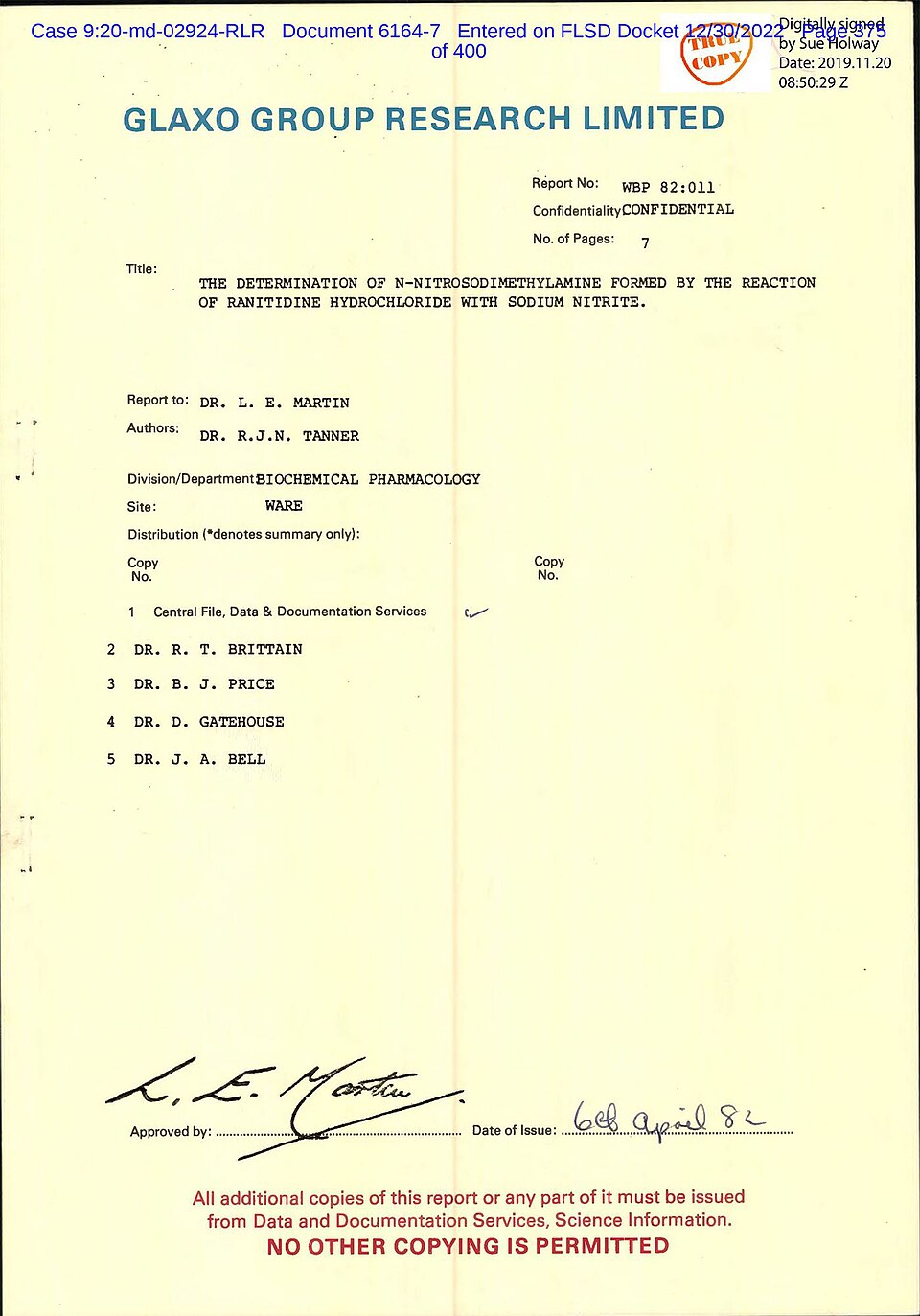
The 1982 Tanner Report revealed early evidence that Glaxo scientists knew ranitidine could transform into a potent carcinogen, NDMA.
Despite the findings, Glaxo did not alert regulators or modify the formula, leading to concerns about the drug's safety and the company's transparency.
The 1982 Tanner Report: Early Internal Evidence of NDMA Formation
The 1982 Tanner Report stands as the foundational document in the case against GSK. It provides the earliest internal confirmation that Glaxo scientists knew ranitidine could transform into a potent carcinogen. This document, officially titled “The Determination of N-Nitrosodimethylamine Formed by the Reaction of Ranitidine Hydrochloride with Sodium Nitrite” (Report No. WBP 82: 011), was authored by Dr. Richard J. N. Tanner on April 6, 1982. Its findings were unequivocal. They showed that the drug Zantac was not an acid reducer. It was a chemical precursor to N-Nitrosodimethylamine (NDMA). Dr. Tanner executed his study at Glaxo’s Ware facility in the United Kingdom. He sought to test a hypothesis that had already begun to circulate in the scientific community. A 1981 letter in *The Lancet* had previously warned that ranitidine might react with nitrites in the human stomach to produce toxic compounds. Glaxo executives publicly dismissed these external concerns as theoretical alarmism. Dr. Tanner’s internal work proved otherwise. His experiments demonstrated that when ranitidine interacted with sodium nitrite—a common compound found in cured meats and human saliva—it produced massive quantities of NDMA. The specific metrics recorded in the Tanner Report are damning. Dr. Tanner found that the reaction yielded approximately 232, 000 nanograms of NDMA. To contextualize this figure, the U. S. Food and Drug Administration (FDA) later established a daily acceptable intake limit for NDMA of just 96 nanograms. The levels detected by Tanner in 1982 exceeded this modern safety threshold by a factor of more than 2, 400. This was not a trace impurity. It was a chemical manufacturing flaw inherent to the ranitidine molecule itself. The drug turned the human stomach into a bioreactor for carcinogens. Glaxo’s response to these findings defined the company’s strategy for the forty years. The company did not alert regulators. They did not modify the formula. They did not add a warning label to the packaging. Instead, the distribution list on the report reveals who knew the truth. Copies went to senior figures including Dr. R. T. Brittain, Dr. B. J. Price, Dr. D. Gatehouse, and Dr. J. A. Bell. These individuals held positions of authority within Glaxo’s research and development divisions. They possessed the data necessary to halt the drug’s rollout. They chose to proceed. The decision to bury the Tanner Report relied on a specific scientific defense method. Glaxo scientists argued internally that the conditions in Tanner’s experiment were too harsh to replicate the human gastric environment. They claimed the concentration of nitrites used in the test exceeded what a person would ingest. This argument became the corporate shield. It allowed them to categorize the carcinogenic reaction as a laboratory curiosity rather than a physiological reality. This defense ignored the biological fact that nitrite levels in the stomach fluctuate wildy based on diet and health. It also ignored the principle that any formation of a Group 2A carcinogen warrants immediate regulatory disclosure. NDMA was not an unknown entity in the 1980s. Scientists had connected it to cancer as early as 1956. By 1982, the global scientific consensus recognized it as a potent liver carcinogen. It was used in research specifically to induce tumors in laboratory rats. Glaxo researchers understood the of associating their new blockbuster drug with such a substance. Zantac was poised to challenge Tagamet for market dominance. Acknowledging that the drug could synthesize a tumor-causing agent in the stomach would have destroyed its commercial viability before it even launched in the United States. The suppression of the Tanner Report allowed Glaxo to secure FDA approval for Zantac in 1983 without the agency knowing the full risk profile. The FDA reviews safety data provided by the manufacturer. If the manufacturer omits serious studies, the regulator remains blind. Glaxo presented ranitidine as a safe alternative to existing H2 blockers. They marketed it aggressively. The drug became the best-selling prescription medicine in the world by 1987. Every pill sold during this period carried the same chemical flaw identified by Dr. Tanner in 1982. This concealment was not a passive oversight. It required active management of information. When independent researchers or competitors raised questions about nitrosamines, Glaxo deployed its internal “too harsh conditions” defense to discredit them. They maintained that ranitidine was stable. They denied that the drug posed a cancer risk. This narrative held firm because the smoking gun—the Tanner Report itself—remained locked in corporate files. It only surfaced decades later during litigation. The existence of this report proves that the NDMA emergency of 2019 was not a new discovery. It was the resurfacing of a known hazard. Valisure, the independent pharmacy that eventually exposed the risk, used modern testing methods to find what Dr. Tanner had found nearly four decades prior. The chemistry had not changed. The only difference was that the public saw the data that Glaxo had kept hidden. The 1982 Tanner Report remains the clearest evidence of intent. It shows that the company prioritized the protection of a commercial asset over patient safety. They had the numbers. They saw the 232, 000 nanograms. They understood the chemistry. Yet they launched the drug anyway. This decision exposed millions of patients to a probable human carcinogen for decades. It laid the groundwork for a global health scandal that continues to unfold in courtrooms today. The Tanner Report is not just a scientific document. It is a testament to corporate negligence.
The 1982 Tanner Report: Early Internal Evidence of NDMA Formation
Ranitidine's Chemical Instability: The Mechanism of Carcinogenesis
The Molecular Flaw: Anatomy of a Carcinogen
The central premise of the Zantac emergency does not rest on a manufacturing error, a contaminated solvent, or a dirty factory floor. It rests on the fundamental chemical architecture of ranitidine hydrochloride itself. Unlike the nitrosamine impurities found in angiotensin II receptor blockers (ARBs) like valsartan, which were introduced through specific changes in the synthesis process, the N-nitrosodimethylamine (NDMA) found in Zantac is not an invader. It is a degradation product born from the molecule’s own disintegration. The pharmaceutical industry, led by GSK, spent decades treating ranitidine as a stable compound, yet the chemical reality suggests it is a molecular ticking time bomb. The danger lies in the specific arrangement of atoms that defines the drug’s efficacy.
Ranitidine (C13H22N4O3S) contains two functional groups that, when combined under specific conditions, create the perfect storm for carcinogenesis. On one end of the molecule sits a dimethylamine (DMA) group. This “tail” consists of a nitrogen atom bonded to two methyl groups. In organic chemistry, this structure is known as a tertiary amine. On the other side of the molecule, or present in the surrounding gastric environment, are nitrites. The interaction between these two entities, the amine and the nitrosating agent, is the classical pathway for forming nitrosamines, a reaction documented in chemical literature since the 1970s. The DMA group acts as the precursor, the raw material from which NDMA is forged.
The instability is inherent. The bond connecting the dimethylamine group to the rest of the ranitidine molecule is susceptible to cleavage. When this bond breaks, it releases free dimethylamine. If a nitrate or nitrite source is present, either from the drug’s own nitro-ethene moiety or from dietary sources in the patient’s stomach, the free DMA undergoes N-nitrosation. This reaction substitutes a hydrogen atom (or cleaves a bond) to attach a nitroso group (N=O) to the nitrogen, creating N-nitrosodimethylamine. This is not a side effect; it is a predictable chemical reaction governed by the laws of thermodynamics and kinetics. GSK chemists, possessing advanced understanding of organic synthesis, operated with the knowledge that tertiary amines are liable to this transformation.
Thermal Degradation: The Shelf-Life Deception
For nearly forty years, the regulatory narrative maintained that Zantac was stable at room temperature. This assumption allowed the drug to be sold over the counter, stored in bathroom cabinets, and shipped in non-refrigerated trucks. Investigations by independent laboratories in 2019 and 2020 shattered this illusion. Emery Pharma, a laboratory that filed a Citizen Petition with the FDA, conducted rigorous stability testing that exposed the drug’s thermal volatility. Their data proved that ranitidine is not a static entity; it is a shapeshifter that accumulates carcinogens over time.
Emery Pharma’s testing revealed that exposure to heat accelerates the breakdown of ranitidine into NDMA. In one experiment, samples stored at 70°C (158°F) for just five days developed NDMA levels exceeding 140 nanograms, well above the FDA’s permissible daily intake limit of 96 nanograms. While 70°C represents a high-stress condition, it is not unrealistic for a delivery truck in Arizona or a warehouse in the summer. More distinctively, the study showed that even at lower temperatures, the accumulation occurs, at a slower rate. The reaction is cumulative. A pill manufactured in 2018 and sitting on a shelf until 2020 has been slowly generating NDMA inside the blister pack. The “expiration date” on a box of Zantac referred to the potency of the active ingredient, not the safety of its degradation products.
The implication of this thermal instability is. It suggests that every box of Zantac ever sold had the chance to become carcinogenic depending on how it was handled in the supply chain. Unlike a biological contaminant that grows, or a heavy metal that is fixed, NDMA in ranitidine is a variable that increases with every hour of thermal exposure. The pharmaceutical industry’s standard stability failed to catch this because they were not looking for it. They tested for the disappearance of ranitidine, not the appearance of a specific nitrosamine, until the emergency forced their hand. The “cold chain” distribution network, required for biologics and vaccines, was never applied to Zantac, even with the molecule’s fragility.
The Gastric Reactor: In Vivo Nitrosation
The threat of ranitidine extends beyond the pharmacy shelf and into the human body. The stomach is an acidic environment, pH 1 to 3, which is the ideal catalytic condition for chemical reactions. Valisure, the online pharmacy and analytical laboratory that alerted the FDA to the emergency, proposed that the human stomach acts as a bioreactor for NDMA formation. Their initial testing involved simulated gastric fluid (SGF) containing nitrites, mimicking a standard meal. The results were worrying, showing massive spikes in NDMA levels when ranitidine interacted with gastric acids and nitrites.
Critics of Valisure, including GSK and FDA regulators, initially dismissed these findings as “unrealistic” or “extreme” due to the high levels of nitrites used in the simulation. Yet, the chemical principle remains valid. The stomach contains endogenous nitrites, and the average diet supplies exogenous nitrites (found in cured meats, leafy vegetables, and water). When a patient ingests a 150mg or 300mg tablet of ranitidine, they are introducing a high concentration of dimethylamine precursors into a nitrosating environment. The reaction does not require a laboratory beaker; it requires only the reactants and the acid catalyst provided by the patient’s own physiology.
This “endogenous formation” theory posits that even if the pill is perfectly pure when swallowed, it can convert into a carcinogen during digestion. The method involves the cleavage of the DMA group followed by immediate nitrosation. Studies have identified the enzyme dimethylarginine dimethylaminohydrolase (DDAH-1) as a chance biological catalyst that could this breakdown in the kidneys and intestines. a widespread exposure risk where the drug metabolizes into NDMA in various organs, not just the stomach. The variability of this reaction among different patients, depending on their diet, stomach pH, and gut microbiome, creates a “Russian roulette” scenario where the level of carcinogenic exposure fluctuates wildly.
The Analytical Defense: GC-MS vs. LC-MS
When the Zantac scandal broke, GSK and other manufacturers attempted to discredit the independent findings by attacking the testing methodology. The primary defense hinged on the difference between Gas Chromatography-Mass Spectrometry (GC-MS) and Liquid Chromatography-Mass Spectrometry (LC-MS). GC-MS involves heating a sample to high temperatures (frequently above 130°C) to vaporize it for analysis. GSK argued that this high heat artificially forced the ranitidine molecule to break down into NDMA inside the testing machine, creating a “false positive” result. They claimed the NDMA wasn’t in the pill; the test created it.
This defense, while chemically plausible in isolation, collapsed under scrutiny. While it is true that extreme heat degrades ranitidine (further proving its instability), subsequent testing using LC-MS, which operates at much lower temperatures, confirmed the presence of NDMA. The levels detected via LC-MS were lower than the astronomical figures seen in the initial high-heat tests, yet they still frequently exceeded the 96-nanogram safety limit. The “lab artifact” argument served as a temporary shield, allowing manufacturers to delay recalls while they argued over parts per billion. It distracted from the core problem: if the drug breaks down at 130°C in a gas chromatograph, and at 70°C in a warehouse, and at 37°C (body temperature) over time, the molecule is fundamentally unstable.
The Structural Comparison: Why Ranitidine Stands Alone
To understand the severity of the ranitidine design flaw, one must compare it to its competitors. Other H2 receptor antagonists, such as famotidine (Pepcid) and cimetidine (Tagamet), share a similar method of action in reducing stomach acid, they possess different chemical structures. Famotidine, for instance, absence the specific dimethylamine side chain that ranitidine possesses. Consequently, famotidine does not degrade into NDMA. It does not carry the same precursor liability. This structural distinction is pivotal. It proves that the cancer risk is not a class-wide effect of H2 blockers a specific consequence of the ranitidine molecule’s architecture.
The existence of safer alternatives highlights the tragedy of the concealment. GSK and other manufacturers continued to market ranitidine as the premier acid reducer, protecting its market share against generic competitors and alternative formulations. The chemical literature available during the drug’s development in the late 1970s and early 1980s already contained warnings about nitrosamine formation from tertiary amines. The decision to commercialize a molecule with a labile dimethylamine tail, without rigorous long-term testing for N-nitroso compounds, represents a failure of pharmacovigilance that spans four decades. The method of carcinogenesis was written into the blueprint of the drug from day one.
Ranitidine's Chemical Instability: The Mechanism of Carcinogenesis
The Valisure Citizen Petition: Exposing the Carcinogen Link in 2019
The silence surrounding ranitidine’s carcinogenic chance shattered on September 13, 2019. Valisure, an online pharmacy and analytical laboratory based in New Haven, Connecticut, filed a Citizen Petition with the U. S. Food and Drug Administration that fundamentally altered the trajectory of GSK’s blockbuster drug. Unlike previous regulatory actions that focused on manufacturing impurities in other drug classes, Valisure’s filing alleged a far more sinister reality: Zantac was not contaminated; it was inherently unstable and capable of generating high levels of N-Nitrosodimethylamine (NDMA) within the human body.
The Three Million Nanogram Discovery
Valisure’s investigation began as a routine quality assurance protocol quickly spiraled into a public health emergency. During standard batch testing of its inventory, the laboratory detected NDMA levels in ranitidine samples that standard calibration curves. The FDA has established a permissible daily intake limit for NDMA at 96 nanograms. Valisure’s initial testing using gas chromatography-mass spectrometry (GC/MS) revealed NDMA content in excess of 3, 000, 000 nanograms per tablet. This figure represented a concentration more than 31, 000 times higher than the FDA’s safety threshold. The magnitude of this finding suggested that the problem was not a trace contaminant introduced during a sloppy manufacturing process, as was the case with the angiotensin II receptor blocker (ARB) recalls of 2018. Instead, the data pointed to a fundamental chemical reaction occurring within the tablet itself. Valisure’s scientists posited that the ranitidine molecule, which contains both a nitrite group and a dimethylamine (DMA) group, acts as its own carcinogen factory. When exposed to specific conditions, these two components react to form NDMA.
The Methodology Dispute: Heat vs. Biology
The release of the Citizen Petition triggered an immediate counter-offensive from established pharmaceutical interests and initial skepticism from regulators. The primary point of contention was Valisure’s testing methodology. The laboratory used a standard GC/MS protocol that involved heating the sample to 130°C. Critics, including GSK and initially the FDA, argued that this high heat forced the degradation of ranitidine into NDMA inside the testing instrument, so creating a result that did not exist in the pill under normal storage conditions. Valisure anticipated this dismissal. In the same petition, they presented data using alternative testing methods designed to simulate the human biological environment. They dissolved ranitidine tablets in Simulated Gastric Fluid (SGF) containing sodium nitrite, a compound commonly found in the stomach after consuming foods like processed meats, and incubated the mixture at body temperature (37°C). The results of the biological simulation remained worrying. While the levels did not reach the astronomical 3, 000, 000 nanograms seen in the high-heat tests, the body-temperature experiments still yielded NDMA levels ranging from thousands to tens of thousands of nanograms per tablet. This confirmed that the formation of the carcinogen did not require an oven; it required the chemical environment of the human stomach. David Light, CEO of Valisure, publicly stated that the drug possessed an “inherent instability,” a term that struck at the core of GSK’s safety assertions.
The “Inherent Instability” Thesis
The concept of inherent instability presented a catastrophic liability for GSK. If the drug itself degraded into a carcinogen due to its molecular structure, no amount of manufacturing hygiene or quality control could fix the problem. The defect was in the design. Valisure’s petition drew upon historical data, referencing the suspicions raised in the 1980s, such as the Tanner Report, that had been internally dismissed by GSK. The petition argued that the volatile nature of the ranitidine molecule meant that it could degrade during shipping, storage on pharmacy shelves, or inside the patient’s digestive tract. This thesis directly contradicted decades of marketing that positioned Zantac as a safe, stable solution for heartburn. The petition accused the pharmaceutical industry of selling a product that, by its very chemical nature, transformed into a Class 2A carcinogen upon ingestion. The were severe: every pill ever sold carried this risk, regardless of the factory it came from or the brand name on the bottle.
Regulatory and Retail Shockwaves
The FDA’s response to the petition was cautious progressively serious. On October 2, 2019, the agency released a statement questioning the high-heat testing method acknowledging the presence of “unacceptable levels” of NDMA in ranitidine. The agency began its own laboratory analysis using liquid chromatography-high resolution mass spectrometry (LC-HRMS), a method that uses lower temperatures to avoid artificial degradation. Even with the gentler testing method, FDA scientists confirmed the presence of NDMA. The agency’s initial stance was to warn the public rather than problem an immediate mandatory recall, a delay that allowed retailers to take the lead. Major pharmacy chains, including CVS, Walgreens, and Rite Aid, did not wait for a federal mandate. In late September and early October 2019, these corporations voluntarily halted sales of Zantac and its generics, citing the safety concerns raised by the Valisure petition. This retail blackout killed the drug’s market presence months before the official government ban.
GSK’s Defense and the “Litigation-Driven” Narrative
GSK’s reaction to the Valisure findings was one of aggressive denial. The company characterized Valisure as a “litigation-driven” entity, suggesting that the lab’s motives were financial rather than scientific. GSK spokespeople pointed to 16 epidemiological studies that they claimed showed no causal association between ranitidine and cancer. They argued that the high NDMA levels were artifacts of flawed testing and that the drug remained safe for consumer use. This defense relied heavily on the “heat” argument, attempting to invalidate the entire petition based on the 130°C GC/MS protocol. Yet, GSK failed to adequately address the body-temperature data or the fundamental chemistry regarding the DMA-nitrite interaction. The company maintained that their internal testing showed no detectable NDMA, a claim that raised serious questions about the sensitivity of the methods GSK had been using for forty years. If a third-party lab could find the carcinogen in routine testing, why had the manufacturer never reported it?
Metric
FDA Safety Limit
Valisure Finding (GC/MS)
Valisure Finding (SGF/37°C)
NDMA Content
96 ng/day
> 3, 000, 000 ng
~300, 000 ng (varies by lot)
Testing Temp
N/A
130°C
37°C (Body Temp)
Conclusion
Safe Intake
Extreme Toxicity
High Toxicity
The Unraveling of the Safety Myth
The Valisure petition served as the catalyst that stripped away the veneer of safety GSK had maintained since 1983. By making the data public, Valisure forced the FDA to investigate the molecular stability of ranitidine, a line of inquiry that had been neglected for decades. The petition highlighted a widespread failure in the regulatory framework: the assumption that an approved drug remains chemically stable indefinitely. The “latent defect” argument presented in the petition suggested that Zantac was a ticking time bomb. Unlike a car with a faulty brake part that can be recalled and replaced, ranitidine could not be fixed. The molecule itself was the hazard. This realization shifted the narrative from a manufacturing oversight to a design defect, implicating GSK in a failure to understand—or a refusal to acknowledge—the basic chemistry of their billion-dollar product. As 2019 closed, the pharmaceutical had shifted. The Valisure petition did not just result in headlines; it initiated a cascade of international regulatory reviews. Health Canada, the European Medicines Agency, and other global bodies began their own investigations, corroborating the risk of NDMA formation. The era of Zantac’s dominance was ending, not because of a new competitor, because the truth about its chemical composition had been exposed to the light of independent scrutiny. The petition proved that what GSK claimed was a “safe and ” antacid was, in reality, a delivery system for a potent carcinogen.
The Valisure Citizen Petition: Exposing the Carcinogen Link in 2019
Regulatory Blind Spots: FDA Approval and Oversight Failures
The 1983 Approval: A Legacy of Trust Over Verification
The United States Food and Drug Administration granted approval to Glaxo Holdings Ltd for Zantac on June 9, 1983. This regulatory milestone marked the beginning of ranitidine’s ascent to becoming the world’s drug to surpass $1 billion in annual sales. The approval process relied heavily on the manufacturer’s self-reported safety data. Glaxo submitted studies demonstrating the drug’s efficacy in treating ulcers and managing gastric acid. The agency accepted these submissions without conducting independent long-term stability tests specifically targeting N-nitrosodimethylamine (NDMA) formation. The regulatory framework in the early 1980s prioritized acute toxicity and immediate side effects. It did not mandate rigorous screening for degradation byproducts that might form after the drug left the factory. This omission created a regulatory blind spot that remained for nearly four decades.
The FDA’s reliance on “good faith” data submission allowed Glaxo to frame the safety narrative. The pharmaceutical giant presented ranitidine as a stable compound. They did not disclose internal concerns regarding the drug’s thermal instability to regulators during the initial application. The agency’s reviewers focused on the synthesis process. They looked for impurities introduced during manufacturing. They did not investigate the chance for the active pharmaceutical ingredient to autodestruct into a carcinogen under normal storage conditions. This fundamental oversight in the approval protocol meant that Zantac entered the market with a latent chemical time bomb that no regulator was looking for.
The Testing Artifact Loophole
A technical paradox in analytical chemistry further obscured the presence of NDMA in Zantac for years. The standard method for detecting volatile impurities involves Gas Chromatography-Mass Spectrometry (GC-MS). This technique requires heating the sample to temperatures frequently exceeding 130 degrees Celsius to vaporize the compounds for analysis. Ranitidine is thermolabile. It degrades rapidly when exposed to heat. When researchers or regulators tested ranitidine using standard GC-MS, the high temperatures of the testing equipment itself caused the drug to break down and form NDMA within the machine.
This phenomenon created a convenient defense for the manufacturer. Whenever NDMA appeared in test results, GSK and other industry players could that the carcinogen was a “testing artifact” produced by the laboratory equipment rather than an impurity present in the pill. This argument paralyzed regulatory action. It allowed the company to dismiss positive findings as false positives. The FDA accepted this explanation for years. The agency absence a validated low-temperature testing protocol for ranitidine until 2019. This technical gap meant that the standard regulatory tool for ensuring safety actually helped conceal the danger. It provided a scientific alibi that protected the drug from scrutiny while patients continued to consume it.
The 96 Nanogram Threshold
The FDA maintains an Acceptable Daily Intake (ADI) limit for NDMA of 96 nanograms. This metric represents the maximum amount of the carcinogen that a person can consume daily over a lifetime without a significant increase in cancer risk. The limit is infinitesimal. It is roughly equivalent to the mass of a single grain of salt divided into millions of parts. The discovery that a single tablet of Zantac could contain over 3, 000, 000 nanograms of NDMA shattered this safety ceiling. The between the regulatory limit and the actual exposure was not a minor violation. It was a catastrophic breach of safety standards.
Valisure’s analysis revealed that the drug did not just contain NDMA as a static impurity. The drug generated NDMA in the human body. The stomach environment acted as a bioreactor. The presence of nitrites in the stomach combined with the ranitidine molecule to produce the carcinogen at levels orders of magnitude higher than the FDA’s 96-nanogram limit. The regulatory agencies had calculated the ADI based on environmental exposure risks like smoked meats or industrial water contamination. They had never modeled a scenario where a pharmaceutical product would act as a continuous internal generator of the carcinogen. The 96-nanogram limit became meaningless in the face of a drug that could produce millions of nanograms per dose.
The “Grilled Meat” Defense and Initial Denial
The FDA’s initial response to the Zantac emergency in late 2019 demonstrated a dangerous lethargy. When Valisure flagged the massive NDMA levels, the agency did not immediately order a recall. Instead, FDA officials issued statements that minimized the risk. Janet Woodcock, the director of the FDA’s Center for Drug Evaluation and Research, compared the levels of NDMA in Zantac to those found in “grilled or smoked meats.” This comparison was factually misleading. While processed meats do contain nitrosamines, the levels found in Zantac were exponentially higher. A single pill contained NDMA equivalent to consuming hundreds of pounds of smoked meat in one sitting.
This public relations strategy served to calm consumer panic delayed necessary medical intervention. The agency focused on validating testing methods rather than removing the source of exposure. They spent months debating the nuances of laboratory temperatures while millions of Americans continued to take the drug daily. The FDA’s reluctance to challenge a major pharmaceutical product without “definitive” proof allowed GSK and other manufacturers to keep their products on shelves during the serious holiday season of 2019. The “grilled meat” narrative provided a false sense of security that contradicted the biological reality of the carcinogen’s potency.
The Cold Chain Failure
The investigation eventually revealed that temperature control played a decisive role in NDMA formation. Ranitidine is highly sensitive to heat. The chemical degradation accelerates significantly when the drug is stored at temperatures above room temperature. GSK and other manufacturers distributed Zantac using standard supply chains. These logistical networks frequently exposed the medication to high temperatures in delivery trucks and warehouses. The FDA does not mandate cold-chain storage for most solid oral dosage forms unless the manufacturer specifies it. GSK did not request cold-chain handling for Zantac.
Evidence suggests that GSK was aware of the heat sensitivity yet chose not to implement expensive refrigeration requirements. Implementing a cold chain would have increased distribution costs and reduced the drug’s marketability. The FDA’s oversight failure lay in its assumption that room-temperature stability data provided at approval would hold true for the drug’s entire shelf life under real-world conditions. The agency did not conduct spot checks on pills sitting in hot warehouses in Florida or Arizona. This regulatory gap allowed the drug to degrade into a carcinogen before it ever reached the consumer’s medicine cabinet. The absence of temperature-controlled distribution requirements turned the logistics network into a catalyst for cancer risk.
The April 2020 Market Withdrawal
The FDA acknowledged the severity of the threat on April 1, 2020. The agency requested the immediate withdrawal of all prescription and over-the-counter ranitidine products from the US market. The decision came seven months after Valisure’s initial petition. The FDA new ing that NDMA levels increase over time and with temperature. This admission validated the concerns that independent labs had raised much earlier. The agency stated that the impurity level could exceed the acceptable daily intake even under normal storage conditions. This marked a complete reversal of their earlier stance.
The recall was absolute. It ended the legal sale of ranitidine in the United States. Yet the timing raised serious questions about the efficacy of the FDA’s post-market surveillance. The agency only acted after a third-party pharmacy conducted the testing that the regulators should have been doing for decades. The recall notice admitted that the agency could not assure the quality of the product stored by consumers. This statement shifted the load of safety from the regulator to the patient. The FDA’s action removed the drug from commerce could not undo the decades of exposure that had already occurred under its watch.
widespread Surveillance Gaps
The Zantac case exposes a fundamental flaw in the FDA’s post-market surveillance system. The agency relies heavily on the Adverse Event Reporting System (FAERS) to identify safety signals. This system is designed to catch immediate reactions like heart attacks or allergic responses. It is wholly ill-equipped to detect long-term carcinogenesis. Cancer develops over years or decades. A patient diagnosed with bladder cancer in 2015 would rarely link it to the heartburn medication they took in 1995. Consequently, they would not file a report with the FDA. The signal is lost in the noise of background cancer rates.
The FDA also absence the resources to independently test every batch of every drug. They inspect manufacturing facilities rarely test the chemical composition of finished products on store shelves. This reliance on process inspection rather than product testing allowed Zantac to pass compliance checks even as the pills turned toxic. The regulatory blind spot is structural. The system assumes that a drug approved in 1983 remains the same drug in 2020. It fails to account for the chemical reality that unstable molecules change over time. GSK exploited this assumption. They maintained the appearance of compliance while the chemistry of their product the safety data they had submitted thirty years prior.
The Valsartan Precedent
The FDA’s awakening to the nitrosamine threat did not begin with Zantac. It started with Valsartan in 2018. The discovery of NDMA in blood pressure medications alerted regulators that this specific carcinogen could contaminate the drug supply. This precedent makes the Zantac failure even more egregious. The agency knew by 2018 that NDMA was a chance contaminant in global pharmaceutical supply chains. Yet they did not proactively screen other high-volume drugs until Valisure forced their hand in 2019. The Valsartan emergency should have triggered an immediate, industry-wide review of all drugs containing susceptible chemical structures. Instead, the FDA waited for an external whistleblower to identify the risk in ranitidine. This reactive posture demonstrates a regulatory philosophy that prioritizes industry stability over aggressive hazard detection.
Regulatory Blind Spots: FDA Approval and Oversight Failures
Internal Communications: Evidence of Corporate Knowledge and Inaction
The internal of GSK, then Glaxo, did not operate in ignorance. It operated in silence. While the public narrative celebrated Zantac as a triumph of pharmaceutical engineering, the company’s own filing cabinets held documents that contradicted the safety claims used to market the drug to millions. The evidence, unsealed decades later in courtrooms and whistleblower complaints, reveals a corporate apparatus that identified the carcinogenic chance of ranitidine early in its development chose to suppress, deflect, and bury the findings to protect the commercial viability of what would become the world’s billion-dollar drug. The most damning piece of evidence emerged from the very beginning of Zantac’s commercial life. In 1982, just as the drug prepared to conquer the global market, John Padfield, Glaxo’s Head of Pharmaceutical Development, issued a specific warning regarding the drug’s stability. Padfield determined that the injectable formulation of ranitidine required refrigeration to prevent degradation. His scientific assessment was clear: without temperature controls, the chemical integrity of the drug could not be guaranteed. The corporate response to Padfield’s warning was not a safety protocol, a marketing directive. Internal memos from senior executives rejected the recommendation, stating explicitly that “refrigeration of the injection would not be acceptable to Glaxo marketing.” This single sentence encapsulates the operational philosophy that governed Zantac for forty years. The inconvenience of a cold chain—which would have alerted doctors and pharmacists to the drug’s instability—was deemed a greater threat than the chemical degradation of the product itself. By prioritizing “marketing acceptability” over chemical stability, Glaxo established a precedent: sales logistics superseded patient safety. In the same year, 1982, another internal document, known as the Tanner Report, provided a more specific and terrifying warning. Dr. Richard Tanner, a Glaxo scientist, conducted a study investigating whether ranitidine could react with nitrites in the human stomach to form N-Nitrosodimethylamine (NDMA). His findings were affirmative. The study showed that under conditions mimicking the gastric environment, ranitidine could indeed degrade into NDMA. A responsible pharmaceutical entity would have immediately halted the rollout to conduct exhaustive long-term carcinogenicity studies. Glaxo did the opposite. The company did not share the Tanner Report with the FDA. Instead, they submitted data that obscured these risks, relying on short-term studies that failed to capture the cumulative danger of NDMA exposure. The Tanner Report remained buried in corporate archives, a silent witness to the fact that the company possessed knowledge of the NDMA method nearly four decades before the Valisure recall. The strategy of concealment extended beyond simple omission. It involved active deflection. When early questions arose regarding the chance for ranitidine to form mutagenic compounds, Glaxo scientists developed a defense centered on “nitroso-nitrolic acid.” They argued that the mutagenic activity observed in tests was due to this specific, unstable derivative, which they claimed only formed under conditions that would not occur in the human body. This technical diversion allowed them to sideline the broader, more persistent threat of NDMA formation. By focusing regulators on a “red herring” chemical pathway, they successfully diverted attention from the primary method of carcinogenesis that Tanner had already identified. For the thirty years, GSK maintained a posture of aggressive defense. The company did not conduct the routine stability testing that would have revealed the accumulation of NDMA in stored pills. This absence of testing was not an oversight; it was a need of the concealment. To test for NDMA was to find it. Therefore, the most way to maintain the claim of safety was to ensure that no data existed to contradict it. The company relied on the initial, flawed approval data as a shield, ignoring the basic chemical reality that the ranitidine molecule is inherently unstable. When Valisure, an independent laboratory, detected high levels of NDMA in Zantac in 2019, the internal reaction at GSK was not one of surprise, of containment. Internal communications from this period show a company less concerned with the public health than with the threat to its bottom line. Executives and legal teams immediately mobilized to discredit Valisure. They characterized the lab as “litigation-driven” and attacked its testing methods, specifically the use of high heat, which GSK claimed artificially induced NDMA formation. This defense, yet, crumbled under the weight of GSK’s own historical knowledge. The company attacked Valisure for finding exactly what Dr. Tanner had found in 1982. The public denials were issued by executives who either knew, or had a duty to know, that their own scientists had validated the NDMA link generations prior. The internal strategy was to delay the inevitable recall, maximize remaining revenue, and manage the legal. Emails and memos from this period reveal a siege mentality, where the objective was to “refute” and “reject” independent science rather than to investigate it. The “marketing acceptability” doctrine in the Padfield memo blinded the company’s regulatory compliance teams. Over the decades, as Zantac transitioned from a prescription powerhouse to an over-the-counter staple, the opportunities to re-evaluate the drug’s safety were numerous. Each reformulation, each new market entry, and each regulatory review presented a moment where the Tanner data could have been disclosed. In every instance, the decision was made to maintain the silence. The cost of this silence is measured in human lives, the internal documents measure it in liability. The 2022 Deutsche Bank report, which estimated GSK’s chance liability at billions of dollars, sent shockwaves through the investor community precisely because it pierced the veil of corporate assurance. GSK had assured investors that the science was on their side. The internal documents proved that the “science” they relied on was a carefully curated subset of data, selected to exclude the incriminating evidence their own labs had produced. The whistleblower suit filed by Valisure in 2024 further exposed the depth of this deception. The complaint alleged that GSK “knowingly and deliberately lied to the FDA” to secure the original 1983 approval. This legal filing connected the dots between the 1982 suppression of the Tanner Report and the 2019 attack on Valisure. It depicted a continuous timeline of fraud, where the company’s primary innovation was not the drug itself, the methods used to conceal its dangers. GSK’s decision to settle 80, 000 state court cases for $2. 2 billion in 2024, while admitting no liability, must be viewed through the lens of these internal documents. A public trial would have meant placing the Padfield memo and the Tanner Report on a screen in front of a jury. It would have required executives to explain why the “acceptability to marketing” was permitted to override the stability of a chemical injected into the veins of patients. The settlement was not a financial transaction; it was a purchase of continued silence, a way to keep the most damaging details of the corporate mindset from becoming a matter of public record in a verdict. The internal communications of GSK reveal a corporate culture that treated safety warnings as obstacles to be overcome rather than risks to be heeded. The rejection of refrigeration, the burial of the Tanner Report, and the attack on independent testing labs form a consistent pattern of conduct. This was not a case of a company failing to detect a risk. It was a case of a company detecting a risk, analyzing it, and deciding that the profits were worth the gamble. The “marketing acceptability” standard established in 1982 remained the law of the land at GSK for forty years, ensuring that Zantac remained on shelves long after its makers knew it was a ticking time bomb.
The Temperature Controversy: Testing Protocols and Drug Degradation
The Heat Hypothesis: Valisure’s Initial Findings
The unraveling of the Zantac safety profile began not in a GSK laboratory within the testing of Valisure. This online pharmacy and analytical laboratory filed a Citizen Petition in September 2019. Their initial screening used a gas chromatography-mass spectrometry (GC/MS) method that heated samples to 130 degrees Celsius. This high-temperature stress test revealed massive quantities of N-Nitrosodimethylamine (NDMA). results showed levels exceeding 3, 000, 000 nanograms per tablet. The FDA daily limit is 96 nanograms. These findings suggested that the ranitidine molecule was fundamentally unstable. It appeared to degrade into a potent carcinogen when exposed to heat.
GSK and regulatory bodies immediately attacked the methodology. The pharmaceutical giant argued that 130 degrees Celsius was an unrealistic condition that did not reflect human physiology or standard storage. They claimed the high heat forced the degradation of an otherwise stable drug. The FDA initially supported this defense. The agency stated that the high-temperature testing method generated NDMA that was not present in the pill itself. This technical dispute allowed GSK to maintain a narrative of safety. They characterized the Valisure results as a laboratory artifact rather than a public health warning. The focus on the 130-degree figure served as a convenient straw man. It distracted from the underlying chemical fragility of the drug.
The Body Temperature Rebuttal
Valisure anticipated the criticism regarding their high-heat protocol. They also conducted tests at 37 degrees Celsius to mimic the human body. These tests used simulated gastric fluid containing nitrites. The results remained worrying. Even at body temperature the drug generated significant levels of NDMA. This data point directly contradicted the assertion that only extreme heat caused the problem. The presence of nitrites in the stomach combined with the inherent instability of the ranitidine molecule created a perfect storm for nitrosamine formation. GSK continued to cite the high-heat “artifact” defense while downplaying the body-temperature data. The narrative war focused on the testing method rather than the patient risk.
Emery Pharma and the Storage Reality
The temperature debate shifted from the laboratory oven to the supply chain in early 2020. Emery Pharma conducted an independent stability study that proved devastating to the GSK defense. This laboratory tested ranitidine exposed to temperatures routinely encountered during shipping and storage. They did not use the extreme 130-degree benchmark. Instead they tested samples at 70 degrees Celsius. This temperature is easily reached inside a delivery truck or a mailbox during summer. The results were irrefutable. NDMA levels rose significantly after just days of exposure to this heat. The study showed that the drug did not need to be incinerated to become toxic. It only needed to sit in a hot warehouse.
Emery Pharma also analyzed samples kept at room temperature. Their data indicated that NDMA accumulation was not solely a high-heat phenomenon. It was a function of time and temperature. Older pills contained more carcinogens than newer ones. The drug degraded on the shelf. This finding shattered the assumption that Zantac was a shelf-stable product suitable for sale in gas stations and convenience stores. The study suggested that the expiration dates set by GSK were meaningless regarding safety. A pill might retain its acid-reducing potency until the expiry date. Yet it would simultaneously accumulate toxic levels of NDMA. The pharmaceutical industry had treated a heat-sensitive compound as if it were an inert brick.
The Cold Chain Omission
The of heat sensitivity raised serious questions about GSK’s distribution. Most heat-sensitive drugs require a “cold chain.” This means they must be refrigerated from manufacture to consumption. Insulin and certain vaccines are prime examples. Ranitidine was never sold with cold chain requirements. It traveled in unconditioned trucks. It sat in sweltering loading docks. It remained on bathroom shelves for months or years. GSK marketed Zantac as a strong over-the-counter remedy. The company failed to implement the temperature controls necessary to prevent the formation of a Class 2A carcinogen.
Internal documents and the 1982 Tanner Report suggest GSK understood the chemical method of nitrosation early on. Yet they did not institute stability testing for NDMA. Standard stability check for the degradation of the active ingredient. They do not hunt for unspecified impurities unless the manufacturer suspects a risk. By not looking for NDMA GSK could plausibly deny its presence. This willful blindness allowed them to bypass the expensive logistics of cold chain distribution. Refrigeration would have destroyed the profitability of Zantac as a mass-market OTC product. The decision to treat ranitidine as shelf-stable prioritized commercial viability over chemical reality.
FDA Reversal and Validation
The accumulation of evidence eventually forced the FDA to abandon its initial defense of the drug. In April 2020 the agency requested the withdrawal of all ranitidine products. Their statement explicitly the temperature problem. The FDA admitted that NDMA levels increase with time and temperature. They acknowledged that testing showed levels could become unacceptable during normal storage. This was a complete validation of the core concern raised by Valisure and Emery Pharma. The agency conceded that they could not guarantee the safety of the drug as it moved through the U. S. distribution system. The “heat artifact” defense had collapsed. The regulator accepted that the drug was inherently unstable.
The Whistleblower Allegations
Valisure filed a whistleblower lawsuit that further illuminated the depth of the deception. The complaint alleges that GSK concealed data regarding the drug’s reaction to heat and humidity. It claims the company knowingly misled the FDA to secure approval in 1983. The lawsuit that GSK possessed data showing the drug was “not fit for human consumption” due to its instability. This legal action frames the temperature controversy not as a scientific debate as a fraudulent concealment. The allegation is that GSK knew heat triggered carcinogen formation yet continued to sell the drug without warnings or temperature controls. This transforms the narrative from negligence to calculated risk management. The company allegedly gambled that the slow accumulation of cancer cases would never be traced back to their degrading pills.
The Logistics of Toxicity
The of the temperature findings extend to every pill ever sold. Every bottle of Zantac that sat in a hot delivery van likely spiked in toxicity. Every pack left in a consumer’s glove compartment became a poison delivery system. GSK provided no warnings to consumers about this risk. The label contained no instruction to refrigerate. There was no caution against heat exposure. The company shifted the entire load of stability onto an unsuspecting public. They sold a chemically volatile substance as if it were candy. The Emery Pharma data proved that the supply chain itself was a catalyst for carcinogenesis. The very act of distributing the drug created the danger.
The temperature controversy exposes a fundamental gap in pharmaceutical oversight. Stability testing were designed to ensure the drug still worked. They were not designed to ensure the drug had not become a killer. GSK exploited this regulatory blind spot. They extended expiration dates to maximize shelf life. They ignored the chemical reality that time was an enemy. The older the pill the higher the risk. By the time the FDA recognized the validity of the temperature data billions of doses had been consumed. The “unrealistic” heat of the Valisure oven turned out to be a prophetic warning of the real-world thermal degradation occurring in medicine cabinets worldwide.
Market Withdrawal Timeline: From Safety Warnings to Mandatory Recall
The Unraveling: September 2019 to April 2020
The market collapse of ranitidine did not occur through a single decisive regulatory strike. It unfolded as a chaotic retreat. Between September 2019 and April 2020, the pharmaceutical industry witnessed a rapid of confidence in Zantac. This period exposed the disconnect between corporate safety assurances and the independent testing data that eventually forced a total market exit. On September 13, 2019, the FDA issued its public alert regarding N-Nitrosodimethylamine (NDMA) in ranitidine. The agency stated that preliminary tests detected low levels of the nitrosamine impurity. This announcement triggered a sequence of events where retailers and generic manufacturers acted faster than the brand-name innovators. While GSK and Sanofi initially maintained that their products met safety standards, the supply chain began to fracture immediately.
Retailers Break Ranks
Major pharmacy chains dismantled the distribution network before regulators issued mandatory orders. This preemptive action signaled a collapse in commercial trust. On September 28, 2019, CVS Pharmacy suspended all sales of Zantac and CVS-brand ranitidine products. The company an “abundance of caution” while FDA testing continued. Walgreens and Rite Aid followed suit on September 30, 2019. Walmart halted sales on October 2, 2019. These corporations refused to wait for a final verdict from the FDA or the drug manufacturers. Their legal departments likely recognized the liability of selling a product containing a probable human carcinogen. This retail blockade removed the drug from the US consumer market weeks before the manufacturers initiated their own voluntary recalls.
The Manufacturer Recalls: October 2019
The pressure on manufacturers intensified as generic competitors exited the market. Sandoz, a division of Novartis, issued a voluntary recall of its generic ranitidine capsules on September 23, 2019. This move placed immense pressure on GSK and Sanofi to respond. GSK, the originator of the molecule and the holder of the prescription Zantac license, initiated a recall of all unexpired stock of its prescription Zantac products on October 8, 2019. The recall covered Zantac syrup, injection, and tablets. The UK Medicines and Healthcare products Regulatory Agency (MHRA) issued a simultaneous drug alert. GSK stated this was a precautionary measure. Sanofi, which held the rights to the over-the-counter version in the United States, recalled Zantac OTC on October 18, 2019. The company inconsistencies in preliminary test results of the active ingredient. By late October 2019, the drug was unavailable to American consumers, yet it technically remained an approved product.
The Scientific Pivot: Time and Temperature
Throughout late 2019 and early 2020, the FDA conducted extensive laboratory analysis to understand why NDMA levels varied so drastically between samples. Early industry defenses suggested that the high NDMA levels detected by Valisure were artifacts of testing methods that used high heat. The FDA initially gave credence to this theory. Subsequent testing dismantled this defense. By early 2020, FDA scientists determined that the problem was not the testing method. The molecule itself was unstable. Data showed that NDMA levels in ranitidine increased over time. This accumulation accelerated significantly when the drug was stored at temperatures higher than room temperature. This finding was catastrophic for the drug’s viability. It meant that a pill manufactured with safe levels of NDMA could become toxic by the time it reached the consumer, simply due to normal supply chain logistics or storage in a medicine cabinet.
April 1, 2020: The Mandatory Withdrawal
The regulatory hammer fell on April 1, 2020. The FDA requested the immediate removal of all ranitidine products from the market. This was not a suspension or a precautionary pause. It was a permanent end to the commercial life of the molecule in the United States. Janet Woodcock, Director of the FDA’s Center for Drug Evaluation and Research, clarified the agency’s position in the withdrawal announcement. She noted that while samples did not show unacceptable levels, the agency could not assure quality because they did not know how or for how long the product might have been stored. The inherent instability of the ranitidine molecule made it impossible to guarantee safety.
Timeline of Zantac Market Collapse (2019-2020)
Date
Event
Significance
September 13, 2019
FDA problem public alert on NDMA in ranitidine.
Official acknowledgement of the carcinogen risk.
September 23, 2019
Sandoz recalls generic ranitidine.
manufacturer to exit the market.
September 28, 2019
CVS suspends all Zantac sales.
Retailers begin blocking consumer access.
October 2, 2019
Walmart suspends Zantac sales.
Mass market distribution collapses.
October 8, 2019
GSK recalls prescription Zantac globally.
The originator company admits supply chain risk.
October 18, 2019
Sanofi recalls Zantac OTC in the US/Canada.
Total removal of brand-name product from shelves.
April 1, 2020
FDA requests mandatory market withdrawal.
Official end of ranitidine sales in the US.
Global Coordination
The withdrawal was not limited to the United States. The European Medicines Agency (EMA) and Health Canada took parallel actions. The EMA’s Human Medicines Committee (CHMP) recommended the suspension of all ranitidine medicines in the European Union on April 30, 2020. Australian regulators also cancelled the registration of ranitidine products. This global synchronization confirmed that the defect was intrinsic to the drug’s chemistry, not a localized manufacturing error.
The Silent Switch to Famotidine
Following the withdrawal, the brand name “Zantac” did not disappear. Sanofi released a new product labeled “Zantac 360.” This product contained famotidine, a different H2 blocker that does not degrade into NDMA. The packaging remained visually similar to the original, capitalizing on the brand recognition built over decades. This formulation change served as a tacit admission that the original ranitidine molecule was unsalvageable. The speed of this transition demonstrated that alternative, safer therapies existed and could have been prioritized years earlier had the risks of ranitidine been acknowledged sooner.
The Whistleblower Complaint: Allegations of Defrauding Government Programs
The unsealing of the *qui tam* complaint in May 2024 marked a decisive shift in the Zantac narrative, moving the battlefield from personal injury to widespread government fraud. While the multidistrict litigation (MDL) focused on individual cancer cases, this whistleblower suit, filed under the False Claims Act by the independent laboratory Valisure, struck at the financial heart of GSK’s operation. The central premise was simple yet devastating: GSK had sold a “worthless” and “dangerous” product to federal healthcare programs for decades, obtaining billions in taxpayer reimbursements through a campaign of deception that began before the drug’s 1983 approval. Valisure, acting as the relator on behalf of the United States government and over two dozen states, alleged that GSK knowingly concealed the inherent instability of the ranitidine molecule. The complaint, originally filed under seal in 2019, painted a picture of a corporation that prioritized market dominance over basic chemical safety. According to the filing, GSK possessed data as early as the 1980s showing that ranitidine could degrade into N-Nitrosodimethylamine (NDMA)—a potent carcinogen once used in rocket fuel—when exposed to heat or humidity. By withholding this information from the FDA, GSK allegedly rendered every claim submitted to Medicare, Medicaid, and TRICARE for Zantac fraudulent. The government pays for safe, medicine; it does not bargain for a carcinogen delivery system. The financial of the alleged fraud was immense. Zantac was the pharmaceutical product to reach $1 billion in annual sales, a status it achieved in 1988. For nearly forty years, government health programs covered the cost of these prescriptions, operating under the false assurance of safety provided by the manufacturer. Valisure’s attorneys argued that every dollar the government paid for Zantac constituted a false claim because the drug was “unfit for human consumption.” The complaint sought treble damages, which, given the decades of sales, theoretically exposed GSK to billions in liability, alongside civil penalties of up to $11, 000 for each violation. GSK’s defense strategy relied heavily on attacking the messenger. The pharmaceutical giant characterized Valisure as a “litigation-driven” entity, criticizing its testing methods—specifically the use of high heat and high salt concentrations—as scientifically flawed. GSK pointed to the 2022 dismissal of federal personal injury claims by Judge Robin Rosenberg, who had rejected the plaintiffs’ expert testimony as unreliable, to its position. The company maintained that there was no consistent evidence that ranitidine increased cancer risk and that the FDA had criticized Valisure’s specific testing. This defense aimed to sever the link between the chemical instability and any actual fraud, arguing that scientific disagreement does not equate to a False Claims Act violation. The legal changed when the Department of Justice (DOJ) declined to intervene in the case in March 2024. In False Claims Act cases, a government declination signals a weak case, yet Valisure and its legal team pressed forward, unsealing the complaint and litigating the matter independently. This move forced GSK to confront the allegations directly in the U. S. District Court for the Eastern District of Pennsylvania. The suit threatened to expose internal documents that had not been central to the personal injury MDL, specifically those related to GSK’s representations to the FDA and its internal handling of stability data vis-à-vis government billing. The resolution of this high- standoff arrived on May 3, 2025, when GSK agreed to pay $67. 5 million to settle the False Claims Act lawsuit. While the company admitted no wrongdoing, the settlement included over $44 million classified as restitution to the federal government. This distinction is significant; restitution payments are tax-deductible, they also implicitly acknowledge that the government received something less than what it paid for. The settlement amount, though a fraction of the drug’s lifetime revenue, represented a rare instance of a pharmaceutical major paying to resolve allegations of chemical instability fraud rather than just off-label marketing or kickbacks. This settlement closed the *qui tam* chapter, preventing a public trial that would have examined the “worthless services” theory in detail. It allowed GSK to cap its liability regarding government reimbursement without a court ruling on whether it had definitively defrauded the United States. For Valisure, the settlement vindicated its role as a whistleblower, securing a portion of the recovery and establishing a precedent that independent laboratories could successfully challenge pharmaceutical giants under the False Claims Act. The of the whistleblower complaint extend beyond the dollar figure. The case exposed the fragility of the regulatory trust model. The FDA relies on manufacturers to submit honest stability data. If a company omits tests that show degradation into a carcinogen, the regulator has few independent method to catch it until a third party intervenes. The Zantac case demonstrated that a drug could remain on the government formulary for decades, generating billions in revenue, while harboring a chemical defect that rendered it chance hazardous. The settlement served as a financial penalty, the structural vulnerability in the drug approval and monitoring process remains unaddressed. The timeline of this fraud allegation reveals a disturbing gap in oversight. From the 1982 Tanner Report, which hinted at the NDMA risk, to the 2019 Valisure petition, the method for discovering the danger was entirely external to the standard regulatory apparatus. The False Claims Act suit served as the final backstop, a method to claw back taxpayer money only after the damage was done and the drug was withdrawn. It highlighted that for nearly forty years, the U. S. government was the largest purchaser of a product that its own regulators would eventually declare unsafe. By settling the case in 2025, GSK managed to contain the damage, preventing a jury from deciding whether the company’s silence amounted to a calculated fraud on the taxpayer. The payment of $67. 5 million, while substantial to an average observer, is a rounding error compared to the profits Zantac generated. It stands as a cost of doing business, a retroactive fee for a forty-year run of selling a chemically unstable compound to the American public. The whistleblower complaint did not bankrupt GSK, it placed on the permanent record the allegation that the company’s profits were built not just on a blockbuster drug, on a fundamental deception of the federal government.
Securities Fraud Accusations: Misleading Investors on Product Safety
The Architecture of Financial Silence
The chasm between GSK’s internal knowledge of ranitidine’s instability and its public assertions of safety did not endanger patients; it allegedly defrauded the global financial markets. While scientists inside the company grappled with the of the 1982 Tanner Report, which identified the method for NDMA formation, executives presented a sterilized narrative to shareholders. The core of the securities fraud accusations rests on the premise that GSK artificially inflated its stock price by concealing a material liability that, once revealed, wiped billions from its market capitalization.
Investors rely on the accuracy of federal filings, specifically the Form 20-F annual reports filed with the U. S. Securities and Exchange Commission (SEC). In these documents, pharmaceutical companies must disclose “Risk Factors” that could materially affect their financial health. For decades, GSK’s filings omitted the specific, known chemical instability of its blockbuster drug. Instead of disclosing that heat and time could transform the active ingredient into a probable human carcinogen, GSK issued broad, boilerplate warnings about general litigation risks. This omission denied investors the ability to price in the catastrophic liability that would later emerge.
The allegations suggest a deliberate strategy: prioritize short-term stock performance over long-term transparency. By maintaining the illusion that Zantac was safe, GSK protected its revenue streams and executive bonuses, while the “toxic debt” of future litigation accumulated off the balance sheet. When the Valisure petition broke the silence in 2019, the market did not immediately react with panic, largely because GSK and regulators initially downplayed the severity of the findings. It took years for the full financial weight of the deception to register.
The Haleon Spin-Off: A Liability Shell Game?
In July 2022, GSK completed the demerger of its consumer healthcare business into a new standalone entity, Haleon. This corporate restructuring, hailed by executives as a strategy to “unlock value,” occurred under the gathering storm clouds of Zantac litigation. Investigative scrutiny suggests the timing was not coincidental. By spinning off the division responsible for over-the-counter products, GSK created a complex web of indemnification and liability sharing that confused investors and arguably attempted to ring-fence the toxic Zantac assets.
The prospectus for Haleon contained vague language regarding “possible liabilities” associated with U. S. litigation. Yet, the precise division of responsibility between GSK, Pfizer (a joint venture partner), and the newly formed Haleon remained unclear. Investors were left guessing who would foot the bill for the impending wave of cancer lawsuits. This ambiguity served GSK’s interests in the short term by allowing the demerger to proceed without the heavy anchor of defined Zantac debt dragging down Haleon’s initial valuation.
The reality of this maneuver became clear only after the split. Haleon publicly rejected requests from GSK and Pfizer to indemnify them for Zantac claims, stating that the joint venture agreement only covered the business as conducted in 2018, not legacy liabilities. This public spat between the parent and its offspring signaled to the market that the liability was radioactive, no entity wanted to touch it. The confusion contributed to a massive sell-off, as the market realized that the “bad bank” strategy had failed to contain the financial contagion.
The August 2022 Market Correction
The facade of financial stability crumbled in August 2022. This period, legally referred to as the emergence of “storm warnings,” marked the moment the market priced in the deception. On August 10, 2022, analysts at Deutsche Bank issued a report that shattered investor confidence. The report estimated that chance Zantac liabilities could reach $5 billion to $10 billion, a figure far higher than the market had assumed.
The reaction was swift and violent. In a matter of days, the combined market value of GSK, Sanofi, Haleon, and Pfizer plunged by approximately $40 billion. GSK’s share price alone dropped more than 10% in a single trading session, erasing roughly $8. 9 billion in shareholder value. This crash served as the “corrective disclosure”, the moment the truth replaced the lie in the market’s valuation.
The volatility was not driven by new scientific data, by the realization of the legal exposure GSK had long concealed. Investors who had bought shares based on GSK’s assurances of safety and limited liability found themselves holding a depreciating asset. The sharp decline provided the empirical evidence of “loss causation” required for securities fraud litigation: the fraud (concealment) caused the inflated price, and the (the analyst reports and litigation updates) caused the crash.
The Roofers Local No. 149 Class Action
The financial damage culminated in a securities fraud class action lawsuit, led by institutional investors including the Roofers Local No. 149 Pension Fund. Filed in the U. S. District Court for the Eastern District of Pennsylvania, the complaint named GSK plc, former CEO Emma Walmsley, and former CFO Iain Mackay as defendants. The plaintiffs alleged violations of the Securities Exchange Act of 1934, specifically citing the dissemination of materially false and misleading statements.
The complaint detailed a timeline of deception. It GSK’s repeated assertions that there was “no evidence of a causal association” between ranitidine and cancer, even as the company possessed the Tanner Report and other internal data suggesting otherwise. The plaintiffs argued that these statements were not optimistic interpretations of scientific debate calculated falsehoods designed to mislead the market.
Specific allegations focused on the “Class Period” between February 2020 and August 2022. During this window, GSK executives allegedly downplayed the litigation risk, assuring investors that the company’s defense was consistent with scientific consensus. The lawsuit argued that by failing to disclose the chemical reality, that ranitidine is inherently unstable, GSK induced pension funds and individual investors to purchase shares at artificially high prices.
The “Time-Barred” Dismissal: A Technical Escape
In early March 2026, U. S. District Judge Chad F. Kenney issued a ruling that highlighted the harsh realities of securities litigation. The court dismissed the *Roofers Local No. 149* class action, not because the fraud allegations were meritless, because they were filed too late. The judge ruled that the claims were time-barred under the two-year statute of limitations.
Judge Kenney’s opinion centered on the concept of “inquiry notice.” He determined that a “reasonably diligent plaintiff” should have discovered the basis for the fraud claims no later than August 2022, the month of the massive stock drop and the Deutsche Bank report. Because the plaintiffs did not file their consolidated complaint until February 2025, they missed the legal window to sue.
This ruling serves as a serious pivot point in the investigative review. It does not exonerate GSK of the fraud accusations; rather, it confirms that the “storm warnings” were so loud and clear in 2022 that investors should have known they were being defrauded. The dismissal protects GSK’s treasury from a chance billion-dollar securities judgment, it leaves the historical record of the allegations intact. The court ruled that the deception was public knowledge years ago, and investors slept on their rights.
The Cost of Settlement vs. The Cost of Truth
While the securities class action faltered on procedural grounds, the financial toll of the concealment continues to mount. In October 2024, GSK agreed to pay up to $2. 2 billion to resolve approximately 80, 000 state court product liability cases. This settlement, while removing of the litigation overhang, represents a direct transfer of shareholder wealth to settle claims that GSK publicly insisted were baseless.
The gap between the $2. 2 billion payout and the earlier “zero liability” stance show the misleading nature of the company’s prior communications. For the investor, the settlement is a double-edged sword: it stabilizes the stock price by removing uncertainty, it confirms that the company’s previous assurances of safety came with a ten-figure price tag.
The securities fraud narrative reveals a corporate culture that viewed the Tanner Report not as a safety signal, as a financial liability to be managed. By delaying the disclosure of the cancer risk, GSK executives may have successfully navigated the regulatory for decades, they led their shareholders into a multi-billion dollar crash. The dismissal of the shareholder lawsuit on statute of limitations grounds offers a legal reprieve, yet it cements the timeline of the scandal: the market figured out the fraud in August 2022, exactly forty years after GSK’s own scientists identified the danger.
Timeline of Financial Impact and Disclosure
Date
Event
Financial Impact
1982
Tanner Report identifies NDMA formation method.
Undisclosed internal liability created.
Feb 2020
Start of Class Period for Securities Litigation.
Stock price allegedly artificially inflated.
July 2022
Haleon Demerger completed.
Confusion over liability sharing; Haleon stock debuts.
Aug 10, 2022
Deutsche Bank releases “Storm Warning” report ($5-10bn liability est).
GSK agrees to $2. 2bn settlement for 80, 000 cases.
Direct financial hit to balance sheet; stock stabilizes.
Mar 2026
Judge Kenney dismisses securities class action.
Case tossed as time-barred; fraud allegations legally unproven factually noted.
The Multidistrict Litigation Ruling: Daubert Standards and Federal Dismissals
The December 2022 Federal Dismissal
On December 6, 2022, the trajectory of the Zantac litigation shifted violently in favor of GSK and its co-defendants. Judge Robin L. Rosenberg, presiding over the Multidistrict Litigation (MDL) No. 2924 in the U. S. District Court for the Southern District of Florida, issued a decisive 341-page ruling that extinguished approximately 50, 000 federal claims in a single stroke. Acting as the evidentiary gatekeeper under the Daubert standard, Judge Rosenberg determined that the scientific foundation presented by the plaintiffs was too unreliable to be presented to a jury. This ruling did not trim the edges of the litigation; it dismantled the core allegation that ranitidine causes cancer in humans.
The dismissal hinged on the application of Federal Rule of Evidence 702, which requires expert testimony to be based on sufficient facts and reliable principles. Judge Rosenberg found that the plaintiffs’ experts had engaged in “litigation-driven science,” utilizing methodologies that departed from objective scientific standards to manufacture a causal link where none existed in established literature. The court’s analysis focused heavily on the disconnect between the laboratory conditions used to detect NDMA and the biological reality of the human body.
The Daubert Gatekeeper: Rejecting “Litigation-Driven” Science
The court’s rejection of the plaintiffs’ experts was systematic. Judge Rosenberg criticized the reliance on testing data that subjected ranitidine to unrealistic conditions, such as the excessive heat and sodium levels employed by Valisure. The ruling noted that while these tests successfully generated high levels of NDMA, they did not simulate the human gastric environment. The court characterized these experiments as “analytical leaps” that failed to the gap between theoretical risk and actual human harm.
also, the judge dismantled the epidemiological arguments presented by the plaintiffs. The defense had over a dozen epidemiological studies conducted between 2019 and 2022, involving millions of patients, which consistently failed to show a statistically significant association between ranitidine use and the cancers (liver, bladder, pancreatic, esophageal, and stomach). When plaintiffs’ experts attempted to dismiss this body of evidence in favor of their own interpretations, Judge Rosenberg ruled that they were “cherry-picking” data. She stated that no scientist outside of the litigation had concluded that ranitidine causes cancer, reinforcing the view that the plaintiffs’ case was a legal construct rather than a scientific discovery.
The immediate market reaction was euphoric for GSK. Share prices surged as the threat of a massive federal liability appeared to evaporate. The company issued statements welcoming the ruling, framing it as a victory for “scientific consensus” and a rejection of “junk science.” For a brief period, it appeared that GSK had successfully firewalled itself against the most significant portion of the Zantac liability.
The Appellate Reversal: The 11th Circuit Intervenes
The sense of finality provided by the 2022 dismissal proved illusory. In October 2025, the U. S. Court of Appeals for the 11th Circuit delivered a stunning reversal that upended GSK’s defense strategy. In a ruling that scrutinized Judge Rosenberg’s application of the Daubert standard, the appellate panel found that the district court had overstepped its authority. The appellate judges determined that Judge Rosenberg had acted as a “super-expert,” weighing the credibility of the science herself rather than limiting her role to ensuring the experts employed sound methodologies.
The 11th Circuit’s decision emphasized that “vigorous cross-examination,” not exclusion, is the traditional and appropriate method for attacking shaky scientific evidence. By barring the experts entirely, the lower court had deprived plaintiffs of their Seventh Amendment right to a jury trial. This ruling reinstated thousands of lawsuits and reopened the federal MDL, forcing GSK to once again confront the very scientific arguments it believed it had buried three years prior. The revival of the federal litigation in late 2025 coincided with a chaotic legal in state courts, where rulings in Delaware and Illinois continued to produce conflicting outcomes regarding the admissibility of the same scientific evidence.
State Court and the Delaware Whiplash
While the federal battle raged, the litigation fractured into a state-by-state guerrilla war. Following the 2022 federal dismissal, plaintiffs’ attorneys pivoted aggressively to state venues like Delaware, California, and Illinois, where evidentiary standards frequently differ from the strict federal Daubert application. Delaware, serving as the corporate home for pharmaceutical giants, became a serious battleground with nearly 75, 000 cases pending.
In mid-2024, a Delaware Superior Court judge initially allowed plaintiffs’ experts to testify, creating a massive liability exposure for GSK just as the federal cases seemed dead. yet, this victory was short-lived. In July 2025, the Delaware Supreme Court reversed that decision, aligning itself more closely with the logic of the 2022 federal ruling and excluding the experts. This “whiplash” effect, where liability attached and detached based on jurisdiction and appellate review, created a volatile environment for investors and victims alike. The reinstatement of the federal cases by the 11th Circuit in October 2025, coming just months after the Delaware defense victory, ensured that GSK remained trapped in a legal pincer movement with no clear exit.
Table 4: Key Judicial Rulings in Zantac Litigation (2022, 2025)
Date
Court/Jurisdiction
Ruling Summary
Impact on GSK
Dec 6, 2022
US Dist. Court (S. D. Fla.)
Judge Rosenberg dismisses all MDL cases under Daubert; cites unreliable methodology.
Stock surge; 50, 000+ federal claims extinguished temporarily.
May 31, 2024
Delaware Superior Court
Judge Medinilla denies motion to exclude experts; allows 75, 000 cases to proceed.
Major setback; shifts liability focus to state courts.
July 10, 2025
Delaware Supreme Court
Reverses Superior Court; excludes plaintiffs’ experts, mirroring federal logic.
Significant victory; kills Delaware mass tort.
Oct 16, 2025
11th Circuit Court of Appeals
Rules Judge Rosenberg overstepped authority; reinstates federal MDL cases.
Catastrophic reversal; federal liability revived.
State Court Divergence: The Delaware and California Legal Battlegrounds
The dismissal of federal multidistrict litigation in December 2022 did not end GSK’s legal exposure; it shifted the battlefield to jurisdictions with different evidentiary standards. While the federal court rejected the plaintiffs’ scientific methodologies as unreliable under *Daubert*, state courts in Delaware and California reached opposite conclusions, creating a fragmented legal environment that forced GSK into defensive settlements even after securing a major federal victory. ### The California Breach: *Sargon* vs. *Daubert* The significant occurred in California, a venue known for its distinct method to expert testimony. Unlike the federal system, which adheres strictly to *Daubert*, California courts use the *Sargon* standard. This framework requires trial judges to act as gatekeepers frequently allows for a broader range of scientific interpretation, provided the expert’s logic is not “speculative.” In March 2023, Alameda County Superior Court Judge Evelio Grillo presided over *Sargon* hearings for the initial bellwether cases, including *Goetz v. GSK*. GSK argued that the federal ruling should persuade the state court to exclude the plaintiffs’ experts, citing the absence of consistent epidemiological evidence linking ranitidine to cancer. Judge Grillo disagreed. He ruled that the plaintiffs’ experts used valid methodologies that Zantac degrades into NDMA and that this degradation could cause cancer. The court found that the dispute was a matter of weight for a jury to decide, not admissibility for a judge to block. This ruling stripped GSK of its primary defense shield in California. Facing a July 2023 trial in the *Goetz* case—and the risk of a runaway jury verdict—GSK settled the lawsuit before opening statements. This pattern continued through 2024, with the company settling specific cases in California to prevent a liability precedent from being set in a state court judgment. ### The Delaware emergency: Judge Medinilla’s Ruling The most dangerous threat to GSK’s financial stability emerged in Delaware, the corporate home of pharmaceutical giants. By mid-2024, approximately 75, 000 Zantac lawsuits sat on the docket of the Delaware Superior Court. These cases represented the vast majority of the remaining litigation inventory. On June 3, 2024, Judge Vivian L. Medinilla issued a 102-page opinion that sent shockwaves through the pharmaceutical industry. Denying GSK’s motion to exclude expert testimony, Judge Medinilla ruled that the plaintiffs’ scientists could testify that Zantac causes cancer. She distinguished her court’s role from that of the federal MDL judge, asserting that Delaware law applies a “liberal thrust” favoring the admissibility of evidence. She concluded that while the science was contested, it was not “junk science” and therefore belonged in front of a jury. The market reaction was immediate and violent. GSK’s stock price plummeted nearly 10% in a single trading session, wiping out approximately $8. 9 billion in market capitalization. Investors recognized that while the federal dismissal protected GSK from 50, 000 claims, the Delaware ruling exposed the company to 75, 000 claims in a jurisdiction that had just lowered the evidentiary bar. ### The $2. 2 Billion Settlement Hedge Faced with the prospect of fighting tens of thousands of cases in a hostile evidentiary environment, GSK executed a strategic retreat. In October 2024, the company announced a settlement agreement to resolve approximately 80, 000 pending state court cases—representing 93% of its remaining liability—for up to $2. 2 billion. GSK maintained that the settlement was not an admission of liability a pragmatic decision to remove the uncertainty of prolonged litigation. The company argued that the scientific consensus still supported the safety of ranitidine. Yet, the payment of billions of dollars demonstrated the coercive power of the Delaware ruling. The between federal and state court standards forced a payout that the science, according to the federal bench, did not justify. ### The 2025 Supreme Court Reversal The legal terrain shifted again in July 2025, when the Delaware Supreme Court issued a unanimous decision reversing Judge Medinilla’s ruling. In a decisive opinion, the state’s high court held that the Superior Court had erred by applying a “liberal thrust” to expert admissibility. The justices clarified that Delaware’s evidentiary standards are consistent with the federal *Daubert* rule and that the trial court must act as a rigorous gatekeeper. The Supreme Court criticized the lower court for deferring to the jury on complex scientific matters where the methodology was suspect. The ruling disqualified the plaintiffs’ general causation experts in the remaining Delaware cases, aligning the state’s judicial posture with the federal MDL. For GSK, the victory was absolute belated. The ruling vindicated the company’s scientific defense and shielded it from future claims in Delaware. Yet, it came months after the company had already committed $2. 2 billion to settle the bulk of the litigation. The sequence of events revealed a clear reality of modern mass torts: a temporary adverse ruling in a key state court can extract billions in settlements before appellate courts have the chance to correct the legal error. ### The 2026 Legal Status As of March 2026, the Zantac litigation exists in a fragmented state. The federal and Delaware avenues are closed to plaintiffs, blocked by rigorous scientific scrutiny. California remains the primary active theater for the remaining unsettled cases, where the *Sargon* standard continues to permit expert testimony that other jurisdictions reject.
Table 11. 1: Comparison of Zantac Evidentiary Rulings (2022, 2026)
Jurisdiction
Standard
Key Ruling Date
Outcome for GSK
Status (2026)
Federal MDL (FL)
Daubert
Dec 2022
Dismissal. Experts excluded as unreliable.
Closed.
California State
Sargon
Mar 2023
Allowed. Experts permitted to testify.
Active. Trials and settlements ongoing.
Delaware Superior
Daubert (Modified)
June 2024
Allowed. “Liberal thrust” admitted experts.
Overturned. Led to $2. 2B settlement.
Delaware Supreme
Daubert (Strict)
July 2025
Reversal. Lower court erred; experts excluded.
Closed for new claims; aligns with Federal.
This highlights the central paradox of the Zantac affair: the same chemical compound, analyzed by the same scientists, is deemed carcinogenic in Oakland safe in Wilmington and Miami. This inconsistency allowed GSK to contain the damage in federal court while bleeding capital in state venues, proving that in pharmaceutical litigation, geography is frequently as determinative as pharmacology.
Settlement Strategies: The $2.2 Billion Resolution Framework
The October 9, 2024, announcement marked a decisive pivot in GSK’s defense strategy. After years of aggressive litigation and public denials regarding the carcinogenic chance of Zantac, the pharmaceutical giant agreed to pay up to $2. 2 billion to resolve approximately 80, 000 personal injury lawsuits in U. S. state courts. This figure, while substantial, represented a calculated financial maneuver to cap liability rather than an admission of the scientific validity of the plaintiffs’ claims. The deal neutralized 93% of the pending state court cases against GSK, removing the immediate threat of unpredictable jury verdicts in plaintiff-friendly jurisdictions like California and Delaware.
The Economics of Resolution
The $2. 2 billion settlement framework was not a sudden capitulation a strategic containment of risk. By late 2024, GSK faced a “whack-a-mole” scenario, fighting individual cases across various state dockets after the federal Multidistrict Litigation (MDL) was largely dismantled. While the federal dismissal was a victory, the state courts remained a dangerous battlefield where evidentiary standards frequently differ. A single adverse verdict in a bellwether trial could have set a precedent for billions in damages. GSK’s leadership determined that a bulk settlement was the most method to stabilize the company’s stock price, which had suffered from the “overhang” of litigation uncertainty. The market reaction confirmed this logic; GSK shares rose immediately following the news, as analysts had previously modeled chance liabilities ranging from $3 billion to upwards of $10 billion. By securing a release for 93% of claimants for $2. 2 billion, GSK priced the cancer risk at approximately $27, 500 per claimant, a fraction of the cost of treating the cancers alleged, such as bladder, liver, and stomach malignancies.
The Settlement Architecture
The agreement involved ten major plaintiff law firms, including the Watts Law Firm and Wisner Baum, who shared represented the vast majority of the state court docket. The structure of the deal was an “opt-in” framework, requiring the firms to recommend the settlement to their clients unanimously. This method ensured that GSK would not pay the full amount unless it secured near-total peace.
Defendant
Settlement Timeline
Estimated Amount
Cases Resolved
Sanofi
April 2024
~$100 Million+
~4, 000
Pfizer
May 2024
Undisclosed
~10, 000
GSK
October 2024
Up to $2. 2 Billion
~80, 000 (93% of state docket)
Boehringer Ingelheim
Ongoing Litigation
N/A
Trial-by-trial basis
This coordinated resolution allowed GSK to clear its books of the Zantac liability by the half of 2025. The company recorded an incremental charge of £1. 8 billion ($2. 3 billion) in its Q3 2024 results to cover the settlement and the remaining 7% of cases not included in the deal. This accounting maneuver compartmentalized the Zantac disaster as a one-time financial event rather than an ongoing operational emergency.
Denial of Science Amidst Payouts
A central component of the settlement strategy was the preservation of GSK’s narrative regarding drug safety. In the official statement accompanying the $2. 2 billion deal, GSK maintained that “the scientific consensus remains that there is no consistent or reliable evidence that ranitidine increases the risk of any cancer.” The company asserted that the settlement was entered into solely to avoid the “significant financial uncertainty, risk and distraction” of protracted litigation. This position creates a clear dissonance. GSK paid billions to resolve claims it insists are scientifically baseless. Critics this strategy allows the company to buy its way out of a public reckoning. By settling, GSK prevented 80, 000 juries from examining internal documents, such as the 1982 Tanner Report or the 2019 internal emails regarding NDMA testing, that might have proven the company knew about the instability of the ranitidine molecule for decades. The settlement functions as a non-disclosure method on a massive, ensuring that the most damaging evidence is never presented in open court.
The Valisure Qui Tam Resolution
Parallel to the personal injury settlement, GSK moved to resolve a separate equally dangerous legal threat: the *qui tam* (whistleblower) complaint filed by Valisure, the independent laboratory that flagged the NDMA problem to the FDA. Valisure had alleged that GSK defrauded the U. S. government by selling a defective drug to Medicare and Medicaid, concealing the cancer risks to maintain FDA approval. GSK agreed to pay $70 million to settle this complaint, subject to Department of Justice approval. This specific settlement was serious because a *qui tam* action carries the chance for treble damages (triple the amount of the fraud) and could have resulted in a finding of fraud against the government. By settling for $70 million, a relatively minor sum for a pharmaceutical major, GSK avoided a trial that would have focused exclusively on its deception of regulators rather than the medical causation of cancer in individuals. This closed the chapter on the allegations that GSK “knowingly and deliberately lied to the FDA,” a charge that, if proven, could have had catastrophic regulatory consequences.
The Remaining Liability and Industry Context
While the October 2024 framework resolved the bulk of the litigation, it did not end the Zantac saga entirely. Approximately 7% of state court cases remained active, primarily represented by firms that did not participate in the master agreement. GSK stated it would defend these remaining cases vigorously, presumably using the “science defense” that had been successful in the federal MDL. The strategy also Boehringer Ingelheim, the German pharmaceutical company that marketed Zantac in the U. S. from 2007 to 2016. Unlike GSK, Sanofi, and Pfizer, Boehringer Ingelheim did not announce a global settlement in 2024, leaving it as the sole target for remaining plaintiff attorneys. This highlights GSK’s specific intent to exit the litigation arena before the 2025 fiscal year, prioritizing shareholder certainty over the vindication of its product in court. The $2. 2 billion payout serves as a grim metric for the cost of concealment. For decades, the revenue generated by Zantac far exceeded this settlement amount. From a purely actuarial standpoint, the decision to ignore early warning signs of NDMA formation, maximize the patent exclusivity period, and eventually settle the resulting cancer claims proved to be a viable business model. The settlement protects the company’s future offers no answers to the patients who believe their diagnoses were the price of GSK’s profits.
Epidemiological Debates: Conflicting Data on Cancer Causation
The chasm between biological plausibility and epidemiological reality became the central theater of the Zantac wars. While laboratory assays by Valisure and Emery Pharma definitively proved that ranitidine could degrade into N-Nitrosodimethylamine (NDMA)—a potent mutagen—under various conditions, the translation of this chemical fact into human cancer rates proved far more contentious. GSK leveraged this disconnect, deploying a “gold standard” defense that prioritized large- retrospective cohort studies over mechanistic evidence. The company’s strategy was clear: drown the specific, biologically grounded accusations of NDMA toxicity in a sea of population-level data that showed no statistically significant “signal” of carcinogenesis. This epidemiological defense relied heavily on the sheer volume of data to obscure individual variability. Following the 2019 recall, a flurry of massive studies emerged, frequently funded or by the pharmaceutical defense consortium, which included GSK, Sanofi, and Pfizer. These studies, utilizing databases from South Korea, the United Kingdom, and the United States, analyzed millions of patient records. A pivotal study published in *JAMA Network Open* in 2023, which analyzed over 1. 1 million users across multiple countries, became the of GSK’s argument. The researchers reported no association between ranitidine use and esophageal, stomach, or colorectal cancers compared to users of other H2 blockers like famotidine. GSK executives seized on these findings, issuing statements that the “scientific consensus” exonerated the drug. yet, independent epidemiologists and plaintiff experts argued that these “mega-studies” suffered from a fatal flaw: exposure misclassification. The central premise of the Zantac defect was not that *every* pill was toxic, that the drug was chemically unstable and degraded into NDMA over time and with heat exposure. A patient purchasing fresh Zantac in a cool climate might ingest negligible NDMA, while another buying a bottle stored in a hot warehouse or kept in a medicine cabinet for months could be exposing themselves to levels thousands of times above the FDA limit. Retrospective database studies, which rely on prescription codes, cannot distinguish between these two scenarios. By lumping all users together, the plaintiffs argued, the studies “diluted” the risk, averaging out the cancer cases caused by degraded drugs against the millions who consumed relatively stable product. The signal of carcinogenesis was not absent; it was buried in the noise of poor data granularity. even with the defense’s insistence on a “clean” safety profile, specific epidemiological inquiries revealed disturbing correlations that GSK struggled to explain away. A 2021 study by researchers at Memorial Sloan Kettering Cancer Center, frequently in litigation, examined the biological method and supported the hypothesis that ranitidine could form NDMA in the human stomach. also, earlier research that had been largely ignored or minimized by the manufacturer resurfaced. A 2004 study had indicated a “heightened risk of bladder cancer” among Zantac users, and a 2008 analysis suggested a significant increase in ductal carcinoma (breast cancer) risk. In the context of the NDMA, these older data points transformed from statistical anomalies into warning signs of a long-term toxic exposure. The debate over bladder cancer became particularly fierce. The bladder is a primary excretion route for NDMA, making it a biologically plausible target for the carcinogen. Plaintiff experts pointed to data suggesting that long-term users—those taking the drug for three years or more—showed a statistically significant increase in bladder cancer rates. GSK attacked these findings by focusing on “confounding by indication,” a standard epidemiological counter-argument suggesting that the patients took Zantac *because* they had undiagnosed symptoms of conditions that predisposed them to cancer, rather than the drug causing the disease. This circular reasoning attempted to shift the blame from the chemical instability of the molecule to the biology of the patient. The courtroom became the arbiter of this scientific deadlock, with federal and state judges applying vastly different standards to the same data. In the federal Multidistrict Litigation (MDL) in Florida, Judge Robin Rosenberg applied a rigorous interpretation of the *Daubert* standard, acting as a strict gatekeeper. In December 2022, she dismissed the plaintiffs’ expert testimony, ruling that the epidemiological evidence was too inconsistent to support a general causation claim. The court noted that no scientist outside the litigation bubble had definitively concluded that ranitidine caused cancer in the general population. This ruling was a massive tactical victory for GSK, wiping out thousands of federal cases. Yet, the victory was not absolute. The legal battleground shifted to state courts, where evidentiary standards frequently differ. In Delaware, a serious jurisdiction hosting over 70, 000 cases, the Superior Court initially allowed plaintiff experts to testify, acknowledging that the “weight” of the evidence was a matter for a jury, not a judge. This threatened GSK with the prospect of facing juries who might be more swayed by the “biological gun”—the undeniable presence of a carcinogen in the pill—than by the abstract “statistical shield” of cohort studies. yet, the turned again in 2025 when the Delaware Supreme Court reversed the lower court’s decision. The high court ruled that the plaintiffs’ experts had failed to the analytical gap between the high levels of NDMA found in laboratory “heat” tests and the actual exposure levels in humans, rendering their causation opinions unreliable under Delaware law. This judicial ping-pong highlighted the limitations of epidemiology in detecting risks from unstable pharmaceutical products. The “Bradford Hill” criteria—a set of principles used to establish causal links in epidemiology—became a weapon for both sides. GSK argued that the criteria of “consistency” and “strength of association” were unmet. Plaintiffs countered that the criteria of “biological plausibility” and “coherence” were overwhelmingly satisfied by the chemical reality of the molecule. The defense’s reliance on the absence of a “smoking gun” in the population data placed the load of proof on the victims to demonstrate a statistical impossibility: isolating the users of degraded pills from a dataset that never recorded storage conditions., the epidemiological debate served GSK’s narrative of uncertainty. By focusing the conversation on *p-values* and *confidence intervals*, the company successfully diverted attention from the fundamental chemical negligence: the sale of a molecule that was inherently capable of transforming into a carcinogen. The “conflicting data” was not a reflection of a safe drug, a reflection of a chaotic exposure scenario where the “dose” of the poison was determined by the randomness of supply chains and storage temperatures, leaving the true human toll hidden within the margins of error.
Ongoing Legal Exposure: Non-Settling Plaintiffs and Future Claims
The October 2024 announcement of a $2. 2 billion settlement to resolve approximately 80, 000 state court lawsuits appeared, on the surface, to be the decisive end of GSK’s Zantac emergency. Corporate press releases framed the deal as a resolution for 93% of pending state claims, a figure designed to calm investors and signal a return to business as usual. Yet, this statistical victory masks a volatile reality. The remaining 7% of plaintiffs, numbering in the thousands, represent a hardened core of litigants who rejected the payout offer or were represented by firms unwilling to capitulate. These non-settling plaintiffs pose a concentrated risk, as they are frequently armed with specific causation evidence that GSK’s broad settlement strategy sought to bury.
The Delaware Quagmire: A Legal Purgatory
Delaware remains the most dangerous battleground for GSK. While the settlement cleared a vast portion of the docket, the state’s legal environment continues to host a fierce contest over scientific admissibility. In July 2025, the Delaware Supreme Court issued a pivotal ruling that reversed a lower court’s decision to admit broad expert testimony linking ranitidine to cancer. While GSK hailed this as a victory, the court did not dismiss the cases outright. Instead, it remanded them for a more rigorous “Daubert” analysis, placing thousands of claims in a state of legal purgatory.
This procedural limbo benefits GSK in the short term creates a long-term liability hazard. The plaintiffs who remain in the Delaware pool are not the “weakest links” rather those whose legal teams believe they can meet the stricter scientific standards. These attorneys are refining their arguments to focus on specific cancer types, bladder, liver, and stomach, where the link to NDMA is most scientifically defensible. Unlike the mass-tort method which frequently relies on volume, this phase of litigation likely feature high- individual trials where a single jury verdict could shatter the containment wall GSK has built.
The “Whack-a-Mole” Defense Strategy
GSK’s behavior in late 2024 and throughout 2025 reveals a tactical shift from mass defense to targeted suppression. The company has adopted a “whack-a-mole” strategy: preparing for trial in dangerous jurisdictions like Illinois and California, only to settle individual cases on the courthouse steps to avoid a public verdict. A prime example occurred in September 2024 with the Dixon case in Illinois. Just before opening statements were set to begin in a trial involving a plaintiff with prostate cancer, GSK agreed to a confidential settlement.
This pattern serves two purposes., it prevents the creation of a “bellwether” verdict, a headline-grabbing jury award that would set a price floor for future claims. Second, it keeps the specific evidence of that case sealed. By buying silence in the most threatening individual cases, GSK avoids the public airing of internal documents that could inflame the remaining non-settling plaintiffs. Yet, this strategy is expensive and unsustainable. Every last-minute settlement signals to plaintiff attorneys that GSK is terrified of a jury seeing the full evidentiary record.
The Latency Trap: Future Claims and the Long Tail
The most insidious threat to GSK’s future stability lies in the biology of cancer itself. Carcinogenesis is not immediate; it is a process that can take a decade or more. Millions of consumers ingested Zantac regularly until its withdrawal in 2020. The “latency period” for NDMA-induced cancers means that individuals who consumed the drug in 2018 or 2019 may not receive a cancer diagnosis until 2029 or later.
Statutes of limitations begin running from the date of diagnosis or the date the plaintiff “discovered” the cause of their injury. This creates a rolling horizon of liability. GSK cannot simply close the book on Zantac because the injuries it allegedly caused are still incubating in the general population. Legal analysts project that “second wave” filings could emerge in the late 2020s, driven by new scientific studies solidifying the link between long-term NDMA exposure and specific malignancies. Unlike the initial wave, these future plaintiffs have the benefit of the established “Valisure” science and the discovery documents unearthed in the current litigation.
Shareholder Fury and Securities Fraud
Beyond product liability, GSK faces a parallel war in the financial markets. In May 2025, a new class of shareholders filed suit, alleging that the company’s concealment of the NDMA risk constituted securities fraud. These investors that GSK’s stock price was artificially inflated for years because the company hid the chemical instability of ranitidine. The $2. 2 billion settlement, while resolving patient claims, served as “proof of harm” for these financial plaintiffs, who contend that the payout confirms the company knew the risk was real.
The dismissal of a similar securities suit in Pennsylvania in early 2026 on statute of limitations grounds offered GSK a temporary reprieve, the underlying legal theory remains active in other jurisdictions. Institutional investors are particularly aggressive, seeking to recoup losses sustained when the stock tumbled upon the initial recall. These cases do not require proving that Zantac caused cancer, only that GSK lied about its safety. The load of proof for financial fraud is distinct from medical causation, opening a flank where GSK’s scientific defenses are irrelevant.
The Zombie Federal Docket
While the federal Multidistrict Litigation (MDL) in Florida was largely dismantled by Judge Rosenberg’s exclusion of plaintiff experts, it is not dead. As of early 2026, approximately 2, 000 federal cases remain active, kept alive by appellate maneuvers and distinct filing characteristics that exempted them from the initial dismissal. The plaintiffs in these cases are banking on the Eleventh Circuit Court of Appeals to overturn or modify the strict evidentiary rulings. If the appellate court widens the door even an inch, thousands of previously dismissed federal claims could be revived, flooding GSK with a new wave of litigation just as it attempts to pivot away from the scandal.
Projected Legal Exposure: 2026-2030
Risk Category
Status
chance Financial Impact
Non-Settling State Cases
Active (~5, 000 cases)
High (Individual verdicts could exceed $100M)
Delaware Remand
Pending “Daubert” Review
Severe (If science is admitted, settlement value spikes)
Latent Injury Claims
Incubating
Unknown (Dependent on future cancer rates)
Securities Litigation
Active
Moderate to High (Damages based on market cap loss)
The narrative that GSK has “put Zantac behind it” is a fiction maintained for the benefit of quarterly earnings calls. The company has transitioned from a chaotic emergency to a chronic condition of legal management. The $2. 2 billion paid in 2024 bought time, not total immunity. With the Delaware courts still scrutinizing the science, the federal appeals process grinding forward, and the biological clock of cancer ticking for millions of former users, the Zantac dossier remains open. GSK has cauterized the wound, the infection beneath the surface continues to spread.
Timeline Tracker
April 6, 1982
The 1982 Tanner Report: Early Internal Evidence of NDMA Formation — The 1982 Tanner Report stands as the foundational document in the case against GSK. It provides the earliest internal confirmation that Glaxo scientists knew ranitidine could.
2019
Thermal Degradation: The Shelf-Life Deception — For nearly forty years, the regulatory narrative maintained that Zantac was stable at room temperature. This assumption allowed the drug to be sold over the counter.
September 13, 2019
The Valisure Citizen Petition: Exposing the Carcinogen Link in 2019 — The silence surrounding ranitidine's carcinogenic chance shattered on September 13, 2019. Valisure, an online pharmacy and analytical laboratory based in New Haven, Connecticut, filed a Citizen.
2018
The Three Million Nanogram Discovery — Valisure's investigation began as a routine quality assurance protocol quickly spiraled into a public health emergency. During standard batch testing of its inventory, the laboratory detected.
October 2, 2019
Regulatory and Retail Shockwaves — The FDA's response to the petition was cautious progressively serious. On October 2, 2019, the agency released a statement questioning the high-heat testing method acknowledging the.
1983
The Unraveling of the Safety Myth — The Valisure petition served as the catalyst that stripped away the veneer of safety GSK had maintained since 1983. By making the data public, Valisure forced.
June 9, 1983
The 1983 Approval: A Legacy of Trust Over Verification — The United States Food and Drug Administration granted approval to Glaxo Holdings Ltd for Zantac on June 9, 1983. This regulatory milestone marked the beginning of.
2019
The Testing Artifact Loophole — A technical paradox in analytical chemistry further obscured the presence of NDMA in Zantac for years. The standard method for detecting volatile impurities involves Gas Chromatography-Mass.
2019
The "Grilled Meat" Defense and Initial Denial — The FDA's initial response to the Zantac emergency in late 2019 demonstrated a dangerous lethargy. When Valisure flagged the massive NDMA levels, the agency did not.
April 1, 2020
The April 2020 Market Withdrawal — The FDA acknowledged the severity of the threat on April 1, 2020. The agency requested the immediate withdrawal of all prescription and over-the-counter ranitidine products from.
2015
widespread Surveillance Gaps — The Zantac case exposes a fundamental flaw in the FDA's post-market surveillance system. The agency relies heavily on the Adverse Event Reporting System (FAERS) to identify.
2018
The Valsartan Precedent — The FDA's awakening to the nitrosamine threat did not begin with Zantac. It started with Valsartan in 2018. The discovery of NDMA in blood pressure medications.
1982
Internal Communications: Evidence of Corporate Knowledge and Inaction — The internal of GSK, then Glaxo, did not operate in ignorance. It operated in silence. While the public narrative celebrated Zantac as a triumph of pharmaceutical.
September 2019
The Heat Hypothesis: Valisure's Initial Findings — The unraveling of the Zantac safety profile began not in a GSK laboratory within the testing of Valisure. This online pharmacy and analytical laboratory filed a.
2020
Emery Pharma and the Storage Reality — The temperature debate shifted from the laboratory oven to the supply chain in early 2020. Emery Pharma conducted an independent stability study that proved devastating to.
1982
The Cold Chain Omission — The of heat sensitivity raised serious questions about GSK's distribution. Most heat-sensitive drugs require a "cold chain." This means they must be refrigerated from manufacture to.
April 2020
FDA Reversal and Validation — The accumulation of evidence eventually forced the FDA to abandon its initial defense of the drug. In April 2020 the agency requested the withdrawal of all.
1983
The Whistleblower Allegations — Valisure filed a whistleblower lawsuit that further illuminated the depth of the deception. The complaint alleges that GSK concealed data regarding the drug's reaction to heat.
September 13, 2019
The Unraveling: September 2019 to April 2020 — The market collapse of ranitidine did not occur through a single decisive regulatory strike. It unfolded as a chaotic retreat. Between September 2019 and April 2020.
September 28, 2019
Retailers Break Ranks — Major pharmacy chains dismantled the distribution network before regulators issued mandatory orders. This preemptive action signaled a collapse in commercial trust. On September 28, 2019, CVS.
September 23, 2019
The Manufacturer Recalls: October 2019 — The pressure on manufacturers intensified as generic competitors exited the market. Sandoz, a division of Novartis, issued a voluntary recall of its generic ranitidine capsules on.
2019
The Scientific Pivot: Time and Temperature — Throughout late 2019 and early 2020, the FDA conducted extensive laboratory analysis to understand why NDMA levels varied so drastically between samples. Early industry defenses suggested.
April 1, 2020
April 1, 2020: The Mandatory Withdrawal — The regulatory hammer fell on April 1, 2020. The FDA requested the immediate removal of all ranitidine products from the market. This was not a suspension.
April 30, 2020
Global Coordination — The withdrawal was not limited to the United States. The European Medicines Agency (EMA) and Health Canada took parallel actions. The EMA's Human Medicines Committee (CHMP).
May 3, 2025
The Whistleblower Complaint: Allegations of Defrauding Government Programs — The unsealing of the *qui tam* complaint in May 2024 marked a decisive shift in the Zantac narrative, moving the battlefield from personal injury to widespread.
1982
The Architecture of Financial Silence — The chasm between GSK's internal knowledge of ranitidine's instability and its public assertions of safety did not endanger patients; it allegedly defrauded the global financial markets.
July 2022
The Haleon Spin-Off: A Liability Shell Game? — In July 2022, GSK completed the demerger of its consumer healthcare business into a new standalone entity, Haleon. This corporate restructuring, hailed by executives as a.
August 10, 2022
The August 2022 Market Correction — The facade of financial stability crumbled in August 2022. This period, legally referred to as the emergence of "storm warnings," marked the moment the market priced.
February 2020
The Roofers Local No. 149 Class Action — The financial damage culminated in a securities fraud class action lawsuit, led by institutional investors including the Roofers Local No. 149 Pension Fund. Filed in the.
March 2026
The "Time-Barred" Dismissal: A Technical Escape — In early March 2026, U. S. District Judge Chad F. Kenney issued a ruling that highlighted the harsh realities of securities litigation. The court dismissed the.
October 2024
The Cost of Settlement vs. The Cost of Truth — While the securities class action faltered on procedural grounds, the financial toll of the concealment continues to mount. In October 2024, GSK agreed to pay up.
December 6, 2022
The December 2022 Federal Dismissal — On December 6, 2022, the trajectory of the Zantac litigation shifted violently in favor of GSK and its co-defendants. Judge Robin L. Rosenberg, presiding over the.
2019
The Daubert Gatekeeper: Rejecting "Litigation-Driven" Science — The court's rejection of the plaintiffs' experts was systematic. Judge Rosenberg criticized the reliance on testing data that subjected ranitidine to unrealistic conditions, such as the.
October 2025
The Appellate Reversal: The 11th Circuit Intervenes — The sense of finality provided by the 2022 dismissal proved illusory. In October 2025, the U. S. Court of Appeals for the 11th Circuit delivered a.
May 31, 2024
State Court and the Delaware Whiplash — While the federal battle raged, the litigation fractured into a state-by-state guerrilla war. Following the 2022 federal dismissal, plaintiffs' attorneys pivoted aggressively to state venues like.
June 2024
State Court Divergence: The Delaware and California Legal Battlegrounds — Federal MDL (FL) Daubert Dec 2022 Dismissal. Experts excluded as unreliable. Closed. California State Sargon Mar 2023 Allowed. Experts permitted to testify. Active. Trials and settlements.
October 9, 2024
Settlement Strategies: The $2.2 Billion Resolution Framework — The October 9, 2024, announcement marked a decisive pivot in GSK's defense strategy. After years of aggressive litigation and public denials regarding the carcinogenic chance of.
2024
The Economics of Resolution — The $2. 2 billion settlement framework was not a sudden capitulation a strategic containment of risk. By late 2024, GSK faced a "whack-a-mole" scenario, fighting individual.
April 2024
The Settlement Architecture — The agreement involved ten major plaintiff law firms, including the Watts Law Firm and Wisner Baum, who shared represented the vast majority of the state court.
1982
Denial of Science Amidst Payouts — A central component of the settlement strategy was the preservation of GSK's narrative regarding drug safety. In the official statement accompanying the $2. 2 billion deal.
October 2024
The Remaining Liability and Industry Context — While the October 2024 framework resolved the bulk of the litigation, it did not end the Zantac saga entirely. Approximately 7% of state court cases remained.
December 2022
Epidemiological Debates: Conflicting Data on Cancer Causation — The chasm between biological plausibility and epidemiological reality became the central theater of the Zantac wars. While laboratory assays by Valisure and Emery Pharma definitively proved.
October 2024
Ongoing Legal Exposure: Non-Settling Plaintiffs and Future Claims — The October 2024 announcement of a $2. 2 billion settlement to resolve approximately 80, 000 state court lawsuits appeared, on the surface, to be the decisive.
July 2025
The Delaware Quagmire: A Legal Purgatory — Delaware remains the most dangerous battleground for GSK. While the settlement cleared a vast portion of the docket, the state's legal environment continues to host a.
September 2024
The "Whack-a-Mole" Defense Strategy — GSK's behavior in late 2024 and throughout 2025 reveals a tactical shift from mass defense to targeted suppression. The company has adopted a "whack-a-mole" strategy: preparing.
2020
The Latency Trap: Future Claims and the Long Tail — The most insidious threat to GSK's future stability lies in the biology of cancer itself. Carcinogenesis is not immediate; it is a process that can take.
May 2025
Shareholder Fury and Securities Fraud — Beyond product liability, GSK faces a parallel war in the financial markets. In May 2025, a new class of shareholders filed suit, alleging that the company's.
2026
The Zombie Federal Docket — While the federal Multidistrict Litigation (MDL) in Florida was largely dismantled by Judge Rosenberg's exclusion of plaintiff experts, it is not dead. As of early 2026.
Why it matters: Cross-border VAT fraud is a major financial crime impacting economies globally. Carousel fraud, a common scheme, exploits VAT rules and results in substantial revenue losses for governments..
Tell me about the the 1982 tanner report: early internal evidence of ndma formation of GSK plc.
The 1982 Tanner Report stands as the foundational document in the case against GSK. It provides the earliest internal confirmation that Glaxo scientists knew ranitidine could transform into a potent carcinogen. This document, officially titled "The Determination of N-Nitrosodimethylamine Formed by the Reaction of Ranitidine Hydrochloride with Sodium Nitrite" (Report No. WBP 82: 011), was authored by Dr. Richard J. N. Tanner on April 6, 1982. Its findings were unequivocal.
Tell me about the the molecular flaw: anatomy of a carcinogen of GSK plc.
The central premise of the Zantac emergency does not rest on a manufacturing error, a contaminated solvent, or a dirty factory floor. It rests on the fundamental chemical architecture of ranitidine hydrochloride itself. Unlike the nitrosamine impurities found in angiotensin II receptor blockers (ARBs) like valsartan, which were introduced through specific changes in the synthesis process, the N-nitrosodimethylamine (NDMA) found in Zantac is not an invader. It is a degradation.
Tell me about the thermal degradation: the shelf-life deception of GSK plc.
For nearly forty years, the regulatory narrative maintained that Zantac was stable at room temperature. This assumption allowed the drug to be sold over the counter, stored in bathroom cabinets, and shipped in non-refrigerated trucks. Investigations by independent laboratories in 2019 and 2020 shattered this illusion. Emery Pharma, a laboratory that filed a Citizen Petition with the FDA, conducted rigorous stability testing that exposed the drug's thermal volatility. Their data.
Tell me about the the gastric reactor: in vivo nitrosation of GSK plc.
The threat of ranitidine extends beyond the pharmacy shelf and into the human body. The stomach is an acidic environment, pH 1 to 3, which is the ideal catalytic condition for chemical reactions. Valisure, the online pharmacy and analytical laboratory that alerted the FDA to the emergency, proposed that the human stomach acts as a bioreactor for NDMA formation. Their initial testing involved simulated gastric fluid (SGF) containing nitrites, mimicking.
Tell me about the the analytical defense: gc-ms vs. lc-ms of GSK plc.
When the Zantac scandal broke, GSK and other manufacturers attempted to discredit the independent findings by attacking the testing methodology. The primary defense hinged on the difference between Gas Chromatography-Mass Spectrometry (GC-MS) and Liquid Chromatography-Mass Spectrometry (LC-MS). GC-MS involves heating a sample to high temperatures (frequently above 130°C) to vaporize it for analysis. GSK argued that this high heat artificially forced the ranitidine molecule to break down into NDMA inside.
Tell me about the the structural comparison: why ranitidine stands alone of GSK plc.
To understand the severity of the ranitidine design flaw, one must compare it to its competitors. Other H2 receptor antagonists, such as famotidine (Pepcid) and cimetidine (Tagamet), share a similar method of action in reducing stomach acid, they possess different chemical structures. Famotidine, for instance, absence the specific dimethylamine side chain that ranitidine possesses. Consequently, famotidine does not degrade into NDMA. It does not carry the same precursor liability. This.
Tell me about the the valisure citizen petition: exposing the carcinogen link in 2019 of GSK plc.
The silence surrounding ranitidine's carcinogenic chance shattered on September 13, 2019. Valisure, an online pharmacy and analytical laboratory based in New Haven, Connecticut, filed a Citizen Petition with the U. S. Food and Drug Administration that fundamentally altered the trajectory of GSK's blockbuster drug. Unlike previous regulatory actions that focused on manufacturing impurities in other drug classes, Valisure's filing alleged a far more sinister reality: Zantac was not contaminated; it.
Tell me about the the three million nanogram discovery of GSK plc.
Valisure's investigation began as a routine quality assurance protocol quickly spiraled into a public health emergency. During standard batch testing of its inventory, the laboratory detected NDMA levels in ranitidine samples that standard calibration curves. The FDA has established a permissible daily intake limit for NDMA at 96 nanograms. Valisure's initial testing using gas chromatography-mass spectrometry (GC/MS) revealed NDMA content in excess of 3, 000, 000 nanograms per tablet. This.
Tell me about the the methodology dispute: heat vs. biology of GSK plc.
The release of the Citizen Petition triggered an immediate counter-offensive from established pharmaceutical interests and initial skepticism from regulators. The primary point of contention was Valisure's testing methodology. The laboratory used a standard GC/MS protocol that involved heating the sample to 130°C. Critics, including GSK and initially the FDA, argued that this high heat forced the degradation of ranitidine into NDMA inside the testing instrument, so creating a result that.
Tell me about the the "inherent instability" thesis of GSK plc.
The concept of inherent instability presented a catastrophic liability for GSK. If the drug itself degraded into a carcinogen due to its molecular structure, no amount of manufacturing hygiene or quality control could fix the problem. The defect was in the design. Valisure's petition drew upon historical data, referencing the suspicions raised in the 1980s, such as the Tanner Report, that had been internally dismissed by GSK. The petition argued.
Tell me about the regulatory and retail shockwaves of GSK plc.
The FDA's response to the petition was cautious progressively serious. On October 2, 2019, the agency released a statement questioning the high-heat testing method acknowledging the presence of "unacceptable levels" of NDMA in ranitidine. The agency began its own laboratory analysis using liquid chromatography-high resolution mass spectrometry (LC-HRMS), a method that uses lower temperatures to avoid artificial degradation. Even with the gentler testing method, FDA scientists confirmed the presence of.
Tell me about the gsk's defense and the "litigation-driven" narrative of GSK plc.
GSK's reaction to the Valisure findings was one of aggressive denial. The company characterized Valisure as a "litigation-driven" entity, suggesting that the lab's motives were financial rather than scientific. GSK spokespeople pointed to 16 epidemiological studies that they claimed showed no causal association between ranitidine and cancer. They argued that the high NDMA levels were artifacts of flawed testing and that the drug remained safe for consumer use. This defense.
Why it matters: The delayed detection of the H5N1 virus in the Texas Panhandle dairy corridor allowed for unchecked circulation, leading to a significant gap.
Why it matters: Investment frenzy in solar grids promised financial returns and social impact By 2025, sector faced a brutal correction with a collapse in.
Why it matters: Financial burden of wildfire management shifting from utilities to consumers Escalating costs due to climate change, development in fire-prone areas, and aging.
Why it matters: PPP contracts involve long-term commitments that can hide financial risks and liabilities for the public sector. Understanding the complexities of PPP agreements.
Why it matters: Internships have become a widespread practice globally, with many positions remaining unpaid or underpaid, impacting new graduates. Unpaid internships can perpetuate socioeconomic.