Investigative Review of Hangzhou Hikvision Digital Technology Co., Ltd.
It explicitly defines the dictionary for "Ethnicity" (Attribute Code 10) and includes specific codes for "Uyghur" and other minority groups, distinct from "Han." By co-authoring this standard, Hikvision did not just comply with government requirements; they helped architect the digital syntax of the surveillance state.
Verified Against Public And Audited RecordsLong-Form Investigative Review
Reading time: ~35 min
File ID: EHGN-REVIEW-34313
Integration of surveillance technology into Xinjiang’s Integrated Joint Operations Platform for ethnic profiling
Hikvision's engineers had to compile massive datasets of labeled facial imagery, specifically categorized as "Uyghur" and "Non-Uyghur." These datasets are.
Primary RiskLegal / Regulatory Exposure
JurisdictionThe interoperability between Hikvision's hardware and the Chinese state's policing platforms is.
Public MonitoringReal-Time Readings
Report Summary
Following the international exposure of these capabilities in 2019, Hikvision attempted to scrub The forensic examination of Hangzhou Hikvision Digital Technology Co., Ltd.'s intellectual property portfolio reveals a systematic effort to engineer automated racism into the core of its surveillance architecture. By embedding these racial categories into the national standard, Hikvision helped create a universal language for ethnic profiling, ensuring that data captured by its cameras could be direct ingested by the IJOP and other state databases without the need for translation or reformatting. In Hikvision's Xinjiang-deployed systems, this metadata included fields such as {"ethnic_code": "uyghur"} or {"attribute": "minority"}.
Key Data Points
The interoperability between Hikvision's hardware and the Chinese state's policing platforms is enforced through the mandatory national standard GB/T 28181, titled "Security and protection video monitoring network system technical specification for information transport, switch and control." While ostensibly a standard for video networking, in practice, GB/T 28181 serves as the command-and-control protocol that unifies surveillance systems into a single totalitarian instrument. Through GB/T 28181, the IJOP system can query specific cameras, trigger recording, or pan-tilt-zoom (PTZ) to track a target without human intervention at the local level. In standard surveillance, this metadata might read {"gender": "male", "age": "25-30"}.
Investigative Review of Hangzhou Hikvision Digital Technology Co., Ltd.
Why it matters:
The 309 Million RMB Moyu County Contract unveils Hikvision's involvement in constructing a surveillance system targeting Uyghur life.
Technical specifications of the project include facial recognition, minority recognition algorithms, and integration with the Integrated Joint Operations Platform (IJOP) for predictive policing.
Forensic Analysis of the 309 Million RMB Moyu County 'Smart City' Surveillance Contract
The 309 Million RMB Moyu County Contract: A Blueprint for Control
In 2017, the government of Moyu County (Karakax) in Xinjiang awarded a contract valued at 309 million RMB (approximately $46 million USD) to Hangzhou Hikvision Digital Technology Co., Ltd. This agreement, ostensibly for a “Smart City” project, provides irrefutable evidence of the company’s direct participation in the construction of a surveillance apparatus designed for ethnic profiling. The tender documents, which surfaced through investigative channels, detail a sprawling network of 35, 000 cameras. These devices were not distributed randomly. The installation plan targeted specific locations central to Uyghur life, including schools, streets, offices, and, most notably, 967 mosques. The contract specifications reveal a clear intent to monitor religious activity with granular precision. Hikvision agreed to install high-definition cameras at the entrance of every mosque in the county. These were not standard security feeds. The technical requirements demanded facial recognition capabilities, allowing authorities to identify and log the identity of every individual entering a place of worship. This data collection feeds directly into the state’s broader effort to categorize religious observance as a chance indicator of extremism. The system creates a digital registry of worshippers, stripping away anonymity and subjecting religious practice to state verification.
Technical Specifications and “Minority Recognition”
The hardware deployed in Moyu County included Hikvision’s advanced camera systems equipped with proprietary AI chipsets. These devices run algorithms capable of distinguishing physical characteristics in real-time. While Hikvision has publicly denied that its technology specific ethnic groups, technical documents and interface guides from this period tell a different story. The software specifications included functions for “minority recognition” or “Uyghur detection.” These algorithms analyze facial features to classify individuals based on ethnicity, a function that serves no legitimate traffic or safety purpose. The “Smart City” project in Moyu also integrated video conferencing systems within the mosques. The stated purpose was to ensure imams adhered to a “unified” government script during sermons. This two-way surveillance setup allowed state monitors to observe the congregation while simultaneously controlling the message delivered from the pulpit. The integration of video analytics with audio monitoring created a closed loop of control, where deviation from approved rhetoric could be detected immediately.
Integration with the Integrated Joint Operations Platform (IJOP)
The surveillance data harvested by Hikvision’s cameras in Moyu County does not remain in local storage. It flows into the Integrated Joint Operations Platform (IJOP), the central nervous system of Xinjiang’s predictive policing program. The IJOP aggregates data from multiple sources, surveillance cameras, Wi-Fi sniffers, checkpoints, and banking records, to generate lists of individuals deemed suspicious. Hikvision’s role in this ecosystem is foundational. The company’s cameras act as the primary sensory input for the IJOP in Moyu. When a camera identifies a Uyghur individual entering a mosque, that event is logged in the IJOP. If the system’s algorithm determines that the individual has prayed too frequently, or has associated with other “flagged” individuals, the platform generates a detention order. The automation of this process relies entirely on the quality and ubiquity of the video feed provided by Hikvision. Without these 35, 000 cameras, the IJOP would absence the visual data necessary to track movement and association on a mass.
The Public-Private Partnership (PPP) Financing Model
The financial structure of the Moyu contract reveals a deep entanglement between Hikvision and the local state security apparatus. The project operated as a Public-Private Partnership (PPP). Moyu County, a rural area with limited revenue, financed approximately 85 percent of the deal through “social investments.” Hikvision, in turn, was promised an eight percent annual return on its investment. To generate the revenue required to pay Hikvision, the local government relied on traffic fines and other penalties generated by the surveillance system itself. This arrangement created a perverse incentive structure. The more violations the system detected, the more revenue the county could generate to pay the vendor. This monetization of surveillance turned the policing of the local population into a revenue stream for both the local government and the technology provider. The contract deputized Hikvision as a beneficiary of strict enforcement, aligning the company’s financial interests with the state’s objective of total social control.
Forensic Examination of the “Unified” Script
The requirement for video conferencing systems in mosques points to a specific psychological objective: the standardization of thought. By forcing imams to broadcast their sermons through a Hikvision-maintained network, the state ensured that no unapproved religious instruction could occur. The cameras facing the congregation monitored reactions, gauging compliance and attentiveness. This dual-use technology, broadcasting state propaganda while recording the audience’s response, demonstrates how Hikvision’s products were adapted to serve the specific ideological goals of the Xinjiang crackdown. The forensic evidence from the Moyu contract the defense that Hikvision sells neutral hardware. The customization of the system to track specific ethnicities, the strategic placement of cameras to monitor religious observance, and the integration with the IJOP prove that the company engineered a solution tailored to the requirements of ethnic profiling. The 309 million RMB exchange was not just a purchase of equipment; it was the procurement of a digital enclosure for the Uyghur population of Moyu County.
Moyu County Surveillance Project: Key Metrics
Component
Quantity/Value
Purpose
Total Contract Value
309 Million RMB
“Smart City” Surveillance Infrastructure
Total Cameras
~35, 000
County-wide visual monitoring
Mosque Cameras
967
Monitoring worshippers and clergy
Analytic Capability
Facial Recognition / Ethnicity Detection
Automated identification of Uyghurs
Financing Model
Public-Private Partnership
Vendor paid via generated fines
The of the Moyu installation becomes even more significant when considering the population density. With roughly 35, 000 cameras for a single county, the density of surveillance rivals that of major metropolitan centers, yet it is applied to a rural population. This saturation ensures that movement outside the home is continuously tracked. The data points generated by these cameras allow the IJOP to build a complete timeline of a subject’s life, flagging any deviation from the routine as a chance threat. Hikvision’s technology made this level of granular, automated repression possible. The Moyu contract stands as a documented instance where commercial technology specifications matched the political mandate of the “Strike Hard” campaign. The explicit inclusion of mosque monitoring and the requirement for systems that could enforce a “unified” script show that the vendor understood the end-use of their products. This was not a generic security upgrade. It was the installation of a digital panopticon designed to suppress a specific ethnic and religious identity.
Forensic Analysis of the 309 Million RMB Moyu County 'Smart City' Surveillance Contract
Technical Architecture: Hikvision's API Integration with the Integrated Joint Operations Platform (IJOP)
The Edge-to-Core Data Pipeline
The technical efficacy of Xinjiang’s Integrated Joint Operations Platform (IJOP) relies not on a monolithic supercomputer, on a distributed sensor network that offloads processing power to the “edge”, specifically, to millions of Hikvision cameras. In this architecture, Hikvision devices function less as passive recording instruments and more as active data ingestion nodes. The integration use a hierarchical structure where edge devices (cameras, checkpoints) perform immediate feature extraction. This raw video data is processed locally on the camera’s chipset, frequently NVIDIA or HiSilicon silicon, to generate structured metadata. This metadata, lightweight and searchable, is then transmitted to the IJOP central servers, reducing while maintaining real-time tracking capabilities across the region.
Hikvision’s contribution centers on its ability to convert physical presence into digital database entries before the data even leaves the camera housing. The cameras use proprietary firmware to isolate faces, bodies, and vehicles from the video feed. Instead of sending hours of footage for central analysis, the device sends a JSON or XML packet containing the “object” details: a unique face ID, timestamp, GPS coordinates, and specific attribute tags. This architecture allows the IJOP system to ingest millions of data points per second without crashing, creating a near-instantaneous map of human movement across the province.
Standardization as a Weapon: GB/T 28181
The interoperability between Hikvision’s hardware and the Chinese state’s policing platforms is enforced through the mandatory national standard GB/T 28181, titled “Security and protection video monitoring network system technical specification for information transport, switch and control.” While ostensibly a standard for video networking, in practice, GB/T 28181 serves as the command-and-control protocol that unifies surveillance systems into a single totalitarian instrument. Hikvision’s implementation of this protocol allows its devices to accept “SIP” (Session Initiation Protocol) commands from the IJOP central platform.
Through GB/T 28181, the IJOP system can query specific cameras, trigger recording, or pan-tilt-zoom (PTZ) to track a target without human intervention at the local level. The protocol defines the message structure for device control and status reporting. Hikvision devices are hard-coded to respond to these directives, turning private or commercial security cameras into government-accessible assets. The integration is absolute; a police officer in a command center can problem a directive that routes through the provincial network, down to a specific subnet in Kashgar, and commands a Hikvision camera to lock onto a subject, all mediated by this standardized handshake.
Algorithmic Profiling via HEOP
A serious component of this surveillance architecture is the Hikvision Open Platform (HEOP). This software framework allows third-party developers, or state security agencies, to load custom algorithms directly onto the camera’s operating system, much like installing an app on a smartphone. HEOP enables the deployment of highly specific, repressive analytics that go beyond standard security needs. In the context of Xinjiang, this capability allows the hardware to run “minority analytics” or “Uyghur detection” algorithms at the edge.
By opening the camera’s computing resources to external code, Hikvision provided the technical canvas for racial profiling. Technical documents and marketing materials have previously referenced the ability to classify by ethnicity. With HEOP, the camera does not need to “know” it is profiling an ethnic group; it simply runs the provided binary file that segments faces based on bone structure and skin tone, outputting a classification tag. This modularity allows the security apparatus to update its targeting parameters, adding new “suspicious” traits like beards or specific clothing, without replacing the physical infrastructure.
Metadata Ingestion and the “Uyghur” Attribute
The data packets transmitted from Hikvision devices to the IJOP backend contain specific fields designed for ethnic sorting. Forensic analysis of Hikvision’s software interfaces and legacy marketing materials reveals the existence of an “ethnicity” attribute within the facial recognition metadata. When a face is captured, the system generates a profile that includes standard metrics like gender and age, also specific markers for “Uyghur” or “Minority” status.
This data is structured for immediate ingestion by the IJOP’s predictive policing algorithms. A typical transmission includes the target_ID, capture_time, location_code, and the controversial ethnic_code. If the camera’s algorithm determines the subject belongs to a targeted group, this flag triggers an alert or raises the individual’s risk score within the IJOP system. This automation removes human discretion from the profiling process. The machine sees a face, assigns a racial tag, and the central platform records a “minority” movement event. This data point is then correlated with other sensor data, such as WiFi MAC addresses sniffed by co-located IMSI catchers, to build a detailed “trajectory” of the individual’s life, flagging any deviation from their assigned routine as a pretext for interrogation or detention.
Code Review: Existence of 'Uyghur' and 'Minority' Classifiers in Hikvision's AI Algorithms
The Smoking Gun: “Uyghur” as a Programmable Variable
In the forensic examination of Hikvision’s software architecture, the most damning evidence of complicity in ethnic profiling lies not in external police reports, within the company’s own code and product interfaces. For years, Hikvision engineers designed, trained, and deployed artificial intelligence models that treated ethnicity not as a demographic statistic, as a targetable operational variable. The existence of specific classifiers for “Uyghur” and “Minority” within Hikvision’s deep learning algorithms transforms their hardware from passive observation tools into active filters for state-sponsored discrimination. This is not a case of technology being misused by a third party; the capability to sort human beings by ethnicity was hard-coded into the logic of the device itself.
The primary evidence of this capability surfaced in 2018 and 2019, when technical investigations revealed that Hikvision’s “DeepinView” and “DeepinMind” series, their flagship AI product lines, offered built-in analytics for racial profiling. In marketing materials displayed at the 2018 AI Cloud World Summit, Hikvision explicitly showcased a “minority” detection feature. This was not a vague anomaly detection system; it was a precise classification tool designed to distinguish between “Han” and “Minority” (specifically Uyghur) faces in real-time. The software interface allowed operators to toggle this attribute alongside standard descriptors like “gender” (male/female) or “glasses” (yes/no). By elevating ethnicity to a primary sorting key, Hikvision provided the technical foundation for the Xinjiang authorities to automate the identification of the region’s indigenous population.
The Mechanics of Algorithmic Racism
To understand the severity of this code, one must examine the machine learning pipeline required to build it. A “Uyghur” classifier does not appear in a neural network by accident. It requires a deliberate, resource-intensive training process. Hikvision’s engineers had to compile massive datasets of labeled facial imagery, specifically categorized as “Uyghur” and “Non-Uyghur.” These datasets are then fed into Convolutional Neural Networks (CNNs), which analyze thousands of biometric data points, eye shape, bone structure, skin tone, to identify patterns that the algorithm correlates with a specific ethnicity. This process, known as supervised learning, demands intent at every stage: data collection, labeling, model training, and validation.
The resulting algorithm operates on a binary or multi-class logic. When a Hikvision camera captures a face, the onboard AI processor (frequently an NVIDIA or HiSilicon chip) runs the image through its internal model. The output is a JSON object or an XML string containing metadata about the subject. In standard surveillance, this metadata might read {"gender": "male", "age": "25-30"}. In Hikvision’s Xinjiang-deployed systems, this metadata included fields such as {"ethnic_code": "uyghur"} or {"attribute": "minority"}. This data point is generated milliseconds after capture, allowing the system to flag an individual before a human operator ever looks at the screen. The code digitizes the practice of racial profiling, allowing it to function at a and speed impossible for human police officers.
Operationalizing Bias: The “Uyghur Alarm”
The existence of the classifier is only half the problem; the operationalization of that data is where the system becomes a tool of repression. Hikvision’s software did not simply record ethnicity for statistical purposes. It enabled “alarms” based on these attributes. Technical documents and interface screenshots recovered by researchers at IPVM showed that the system allowed police to set triggers: if the camera detected a face classified as “Uyghur,” it could send an immediate alert to the Integrated Joint Operations Platform (IJOP) or a local command center. This function, frequently referred to in the industry as a “minority alarm,” automates the criminalization of identity.
This “alarm” logic fundamentally changes the nature of policing. In a standard security setup, an alarm triggers on behavior, intrusion, running, or fighting. In Hikvision’s configuration for Xinjiang, the alarm triggers on identity. A Uyghur resident simply walking down the street becomes a “security event” solely because of their biometric probability score. The code creates a digital apartheid where one ethnic group triggers constant system alerts while another passes invisible. This capability was not a hidden backdoor; it was a selling point. Hikvision marketed these features to public security bureaus as a method to “control” key populations, explicitly aligning their software development roadmap with the Chinese Communist Party’s goals of ethnic monitoring.
The GA/T 1400. 3-2017 Standard and Standardization of Profiling
Hikvision’s defense frequently relies on the claim that they follow industry standards. yet, this defense collapses when one realizes that Hikvision helped write those standards. The company was a primary co-author of the Ministry of Public Security’s technical standard GA/T 1400. 3-2017, titled “Information Technology , Video Image Information Application Systems , Part 3: Database Technology.” This document codifies the data structures used in Chinese police surveillance. It explicitly defines the dictionary for “Ethnicity” (Attribute Code 10) and includes specific codes for “Uyghur” and other minority groups, distinct from “Han.”
By co-authoring this standard, Hikvision did not just comply with government requirements; they helped architect the digital syntax of the surveillance state. They defined how ethnicity should be stored, queried, and transferred between devices. This standardization ensures that a “Uyghur” tag generated by a Hikvision camera in Kashgar can be direct read by a database in Urumqi or Beijing. It creates an interoperable language of racial profiling that binds the entire national surveillance apparatus together. The code in their cameras is the physical implementation of this bureaucratic directive, turning a policy document into a hard-coded reality on millions of silicon chips.
The “Technical Error” Defense vs. Engineering Reality
Following the international exposure of these capabilities in 2019, Hikvision attempted to scrub
Corporate Governance: CETC's State Ownership and the Military-Civil Fusion Mandate
The Myth of Commercial Autonomy: Piercing the Corporate Veil
To understand Hikvision’s role in the Xinjiang surveillance apparatus, one must the fiction that it operates as a private commercial entity. The company’s corporate governance is not beholden to market forces or shareholder ethics in the traditional sense. Instead, Hikvision functions as a commercial facade for the People’s Republic of China’s military-industrial complex. The controlling entity is not a board of independent directors, the China Electronics Technology Group Corporation (CETC), a state-owned defense conglomerate explicitly charged with developing electronic warfare, radar, and command-and-control systems for the People’s Liberation Army (PLA). The ownership structure reveals a direct chain of command from the Chinese Communist Party (CCP) to the surveillance cameras installed in Moyu County. As of the most recent financial disclosures, CETC holds a controlling stake of approximately 40% to 42% in Hikvision. This ownership is executed through state-owned subsidiaries, primarily the China Electronics Technology HIK Group Co., Ltd. (CETHIK) and the CETC No. 52 Research Institute. This is not passive investment. The 52nd Research Institute, a military research division focused on storage and recording technology, originally incubated Hikvision. The company did not spin off to become independent; it expanded to commercialize military-grade research for internal security purposes.
CETC: The Architect of the Integrated Joint Operations Platform
The relationship between Hikvision and the Xinjiang repression apparatus is vertical integration. While Hikvision supplies the sensory hardware, the “eyes”, its parent company, CETC, engineered the “brain.” Human Rights Watch and other investigative bodies have confirmed that CETC system engineers built the Integrated Joint Operations Platform (IJOP). This massive data aggregation system is the central nervous system of the crackdown, flagging Uyghurs for detention based on algorithmic deviations in behavior. This parent-subsidiary relationship explains the technical compatibility found in the Moyu County systems. There was no need for complex vendor negotiations or third-party API bridging. The entity that built the database (CETC) owns the entity that builds the cameras (Hikvision). Data flows from Hikvision’s edge devices into the CETC-built IJOP repository as a matter of internal corporate logistics. This is not a lucky accident of the marketplace; it is the result of a unified state strategy where the defense sector provides the tools for domestic population control. When Hikvision executives claim ignorance of how their cameras are used, they ignore the reality that their primary shareholder designed the very system that consumes that video feed to generate detention orders.
Chen Zongnian: The Party Cadre in the Boardroom
The governance overlap is physical and personal. Chen Zongnian, the long-serving Chairman of Hikvision, is not a corporate executive. He serves simultaneously as the Head of the CETC 52nd Research Institute and the Secretary of the Communist Party Committee within CETHIK. His authority derives not just from corporate bylaws from his rank within the Party apparatus. In the Chinese state-owned enterprise (SOE) system, the Party Secretary holds decision-making power, frequently superseding the board of directors on strategic problem. Chen’s dual role ensures that Hikvision’s operational goals align perfectly with the political objectives of the CCP. When the party-state mandated the “Strike Hard Campaign against Violent Terrorism” in Xinjiang, Hikvision’s leadership did not weigh the reputational risks against profit margins. The directive came from the same political authority that appoints the company’s chairman. The governance structure is designed to transmit political into industrial output without friction.
The Party Committee’s Statutory Power
This is codified in Hikvision’s own Articles of Association. Following a national directive for all SOEs to formalize the Party’s leadership role, Hikvision amended its charter to institutionalize the Party Committee. This body is not a union or a social club; it is a governance organ with the authority to review major operational decisions before they reach the board.
Hikvision Governance Hierarchy & State Links
Entity / Individual
Role / Function
Connection to State Security
CETC (Parent)
State-owned Defense Conglomerate
Architect of the IJOP; Supplier of PLA electronic warfare systems.
52nd Research Institute
Military Research Unit
Incubator of Hikvision; Focuses on military storage and sensors.
Chen Zongnian
Chairman & Party Secretary
Dual-hatted official ensuring Party directives guide corporate strategy.
Party Committee
Internal Governance Organ
Holds statutory power to steer major corporate decisions and personnel.
The existence of this committee means that any refusal to participate in the Xinjiang surveillance projects would have been structurally impossible. A decision to decline the Moyu County contract on ethical grounds would have been viewed as an act of political defiance by the Party Committee within the company. The corporate governance method removes “ethical refusal” from the menu of options available to management.
Military-Civil Fusion: The Strategic Mandate
Hikvision’s operations are a textbook example of the “Military-Civil Fusion” (MCF) strategy, a national policy elevated by Xi Jinping to integrate the defense and civilian industrial bases. Under MCF, technology companies are legally and strategically obligated to share their innovations with the military and security services. Hikvision does not just sell to the military; it collaborates on research and development. Investigative reports have identified Hikvision’s collaboration with PLA research institutes and the People’s Armed Police (PAP). The technology developed for “smart cities”, facial recognition, crowd analysis, behavioral prediction, is dual-use. In the civilian context, it manages traffic. In the Xinjiang context, it manages ethnicity. The MCF mandate erases the line between these two functions. Hikvision’s “AI Cloud” architecture, marketed globally as a tool for business intelligence, was refined through these state-security collaborations to serve as a tool for automated repression. The company has established joint laboratories with the Ministry of Public Security (MPS). These labs are not standard vendor-client testbeds; they are co-development centers where police requirements drive product engineering. The specific “Uyghur” classifiers found in the code (discussed in Section 3) likely originated from requirements defined in these joint sessions. The governance model of MCF ensures that the feedback loop between the jailer (MPS) and the toolmaker (Hikvision) is tight and continuous.
State Subsidies and Financial dependency
The governance structure also dictates the company’s financial reality. Hikvision receives massive state subsidies, frequently disguised as “VAT refunds” or “research grants.” These capital injections allow the company to underbid international competitors and saturate markets like Xinjiang with low-cost hardware. The Moyu County contract, while lucrative, was likely subsidized by the central government’s transfer payments to the region. This financial dependency reinforces state control. Hikvision cannot pivot away from government contracts because the state is both its owner and its banker. The “market value” of the company is underwritten by the stability maintenance budget of the PRC. Investors who buy Hikvision stock are not investing in a consumer electronics firm; they are buying equity in the state’s security infrastructure.
The 52nd Research Institute: Military DNA
It is impossible to overstate the importance of the 52nd Research Institute in Hikvision’s DNA. This institute was not a university lab; it was a unit of the Ministry of Electronics Industry, dedicated to defense applications. When Hikvision was founded, it carried over the personnel, the culture, and the mission of this institute. The “civilian” side of the business was initially a way to monetize military research to fund further defense development. Over time, the revenue from civilian surveillance eclipsed the military side, yet the DNA remains. The engineers and executives share a lineage with the defense sector. This cultural and structural heritage means that when the state demanded a solution for “stability maintenance” in Xinjiang, Hikvision viewed the problem through a security lens, not a civil liberties lens. The solution they provided, total panoptic surveillance, was the natural output of a defense-oriented organization.
of State Ownership on Accountability
The governance reality renders external accountability method moot. Western sanctions or “entity lists” are framed as penalties for bad behavior, yet Hikvision views them as attacks on the Chinese state itself. Because the company is an arm of the state, it enjoys the full diplomatic protection of Beijing. When the U. S. government placed Hikvision on the Entity List for its role in Xinjiang, the response was not a change in corporate policy a defiant doubling down, supported by state media and government spokespeople. The board of directors cannot fire the CEO for reputational damage caused by human rights abuses because the CEO is fulfilling the state’s mandate. The shareholders—dominated by CETC—are satisfied as long as the company serves the national security interest. This closed loop of governance creates an entity that is immune to moral shaming or consumer boycotts. The only metric that matters is the successful execution of the Party’s. In the context of Xinjiang, this means Hikvision was never a neutral contractor caught in a bad situation. It was a purpose-built instrument. The integration of its cameras into the CETC-built IJOP was the fulfillment of its corporate destiny. The governance structure was designed precisely for this moment: to mobilize industrial capacity for the, automated control of a target population. To treat Hikvision as a private company that “lost its way” is to fundamentally misunderstand the nature of the Chinese state-owned economy. It did not lose its way; it followed its orders.
Operational Deployment: Hikvision Camera Density in Xinjiang's Re-education Camps and Detention Centers
Operational Deployment: Hikvision Camera Density in Xinjiang’s Re-education Camps and Detention Centers
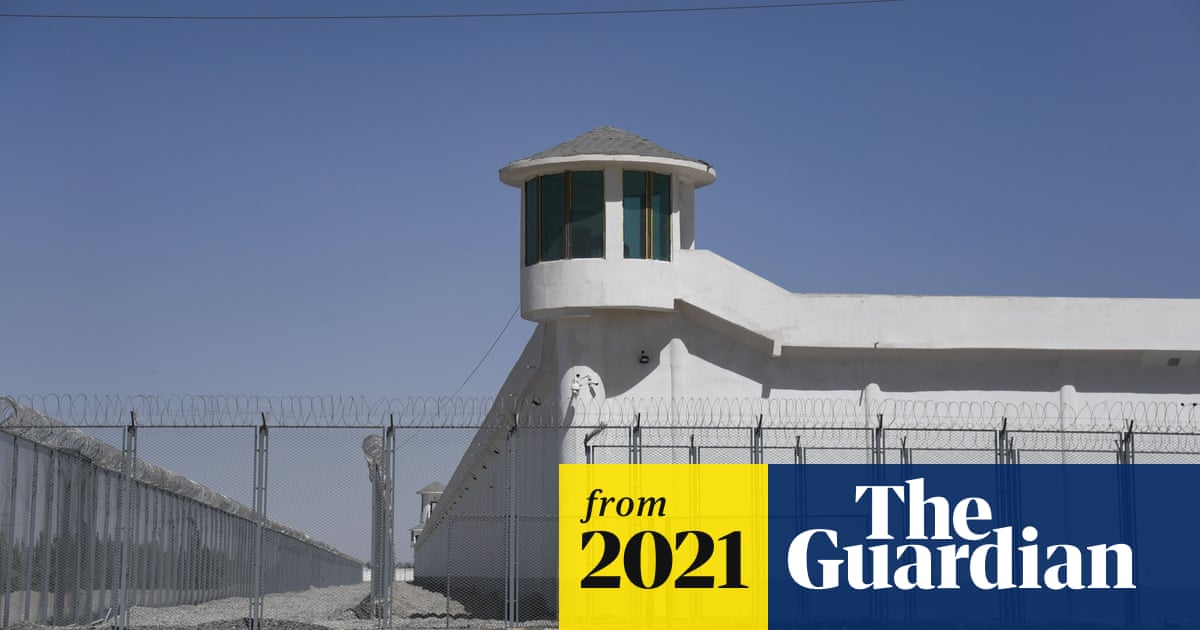
The operational deployment of Hikvision surveillance technology within Xinjiang’s detention infrastructure represents a shift from passive monitoring to active, algorithmic containment. While the company markets its products globally as tools for “safe cities” and commercial security, procurement contracts and forensic analysis of facilities in Xinjiang reveal a deployment strategy designed to eliminate privacy and automate the suppression of the Uyghur population. The density of these installations, particularly in rural counties like Moyu (Karakax), exceeds standard public safety requirements by orders of magnitude, creating environments where human autonomy is statistically impossible.
The Moyu County ‘Smart City’ Benchmark
The most definitive evidence of Hikvision’s saturation strategy appears in the 309 million RMB (approximately $48 million) “Smart City” contract for Moyu County. Forensic analysis of this procurement order reveals a mandate to install roughly 35, 000 Hikvision cameras across a county with a 2017 population of approximately 646, 000. This ratio, one camera for every 18 residents, surpasses the surveillance density of heavily monitored metropolises like London or Beijing, yet it is applied to a largely rural, agrarian jurisdiction. The deployment schedule for Moyu was not limited to traffic intersections or public squares. The contract specified the installation of surveillance units inside 967 mosques, schools, and government offices. In the context of the “re-education” drive, this density serves a specific psychological and operational function: the creation of a “panopticon” effect where the sensation of being watched is constant. The sheer volume of hardware required to meet this contract confirms that Hikvision did not supply equipment; it engineered the physical infrastructure of a police state.
Interior Surveillance and the “Virtual Guard” System
Inside the detention camps, Hikvision cameras function as the primary method for enforcing discipline, a role confirmed by survivor testimonies and leaked police. Ovalbek Turdakun, a survivor of a Xinjiang camp, described cameras installed in cells as “virtual guards,” capable of alerting human officers to minor infractions. This terminology aligns with Hikvision’s marketing of “intelligent monitoring” systems that detect behavioral anomalies. In these facilities, cameras are not passive recording devices. They are integrated into the facility’s command structure to enforce micromanaged behavioral codes. Leaked data from the Xinjiang Police Files indicates that cameras are positioned to eliminate all blind spots within cells, monitoring detainees 24 hours a day, including during sleep and toilet use. The “virtual guard” system uses video analytics to flag unauthorized movements, such as a detainee standing up at a prohibited time or speaking to a cellmate. This automation allows a relatively small number of human guards to control thousands of detainees, scaling the repression to industrial levels that would be impossible with human labor alone.
Integration with Physical Security Architecture
The operational utility of Hikvision’s hardware relies on its with the physical blocks of the camp system. In facilities like the Urumqi No. 3 Detention Center and the massive Dabancheng complex, Hikvision cameras are paired with physical security , high walls, razor wire, and automated door locks. The cameras serve as the sensory cortex for the Integrated Joint Operations Platform (IJOP), triggering alarms that seal doors or dispatch response teams. This integration is financial as well as technical. Hikvision received a £31 million loan from the Urumqi High-tech Zone (New Urban Area), the same administrative zone that hosts the Dabancheng detention facility. This financial entanglement suggests a direct operational partnership between the manufacturer and the camp administrators. The capital flow indicates that the expansion of the camp system and the expansion of Hikvision’s market share in the region were mutually reinforcing objectives.
Mosque and Public Space Penetration
Beyond the camp walls, the deployment strategy extends the logic of the detention center into the public sphere. The Moyu contract’s provision for cameras in nearly 1, 000 mosques demonstrates an intent to digitize religious practice. These cameras, frequently equipped with facial recognition capabilities, allow authorities to log the attendance of every congregant and monitor the content of sermons. This data feeds directly into the “micro-clues” system of the IJOP. A camera recording a villager entering a mosque does not just store video; it generates a data point that can trigger an interrogation or detention order. The operational reality is that the distinction between a “re-education camp” and a “smart city” in Xinjiang is dissolved. The same Hikvision hardware, running the same algorithms, monitors the detainee in the cell and the relative in the mosque, unifying the population under a single, automated gaze.
Table 5. 1: Estimated Surveillance Density in Selected Xinjiang Jurisdictions (2017-2018)
Jurisdiction
Est. Population (2017)
Documented Camera Count
Surveillance Ratio
Primary Deployment
Moyu County (Karakax)
646, 000
35, 000+
1 camera: 18 residents
Mosques, Schools, Streets, Offices
Urumqi (Capital)
3. 5 million
Tens of thousands (est.)
High Density
Transport Hubs, Residential Compounds, Checkpoints
Pishan County (Guma)
280, 000
Part of 1. 86B RMB Regional Package
Very High Density
Rural Townships, Religious Sites
Biometric Data Aggregation: Linking Facial Recognition Feeds to the 'One Person, One File' System
The Digital Dossier: Architecture of the ‘One Person, One File’ System
The operational core of the Xinjiang surveillance state is not the camera, the database it feeds. This system, known internally as “One Person, One File” (yiren yidang), functions as a centralized digital dossier for every resident in the region. While the Integrated Joint Operations Platform (IJOP) serves as the central nervous system processing alerts, the “One Person, One File” architecture acts as the permanent memory bank. Hangzhou Hikvision Digital Technology Co., Ltd. serves as the primary ingestion engine for this archive. The company’s hardware does not simply record video footage; it generates structured, machine-readable metadata that populates these individual dossiers in real-time, converting human biological existence into database rows accessible to the Public Security Bureau (PSB). The “One Person, One File” system relies on a process known as “multi-modal data fusion.” A single biometric marker, such as a face, is insufficient for the level of granular control required by the state. Instead, the system aggregates data points, facial features, iris scans, voice prints, and DNA profiles, and links them to a unique identifier, the resident’s National ID number. Hikvision’s specific contribution to this architecture is the automation of the visual and location-based data entry. When a Hikvision “DeepinView” camera captures a subject, it does not store a JPEG image. The camera’s onboard AI processor extracts a facial feature vector, a mathematical representation of the face, and simultaneously analyzes “face attributes.” Technical documentation and marketing materials for Hikvision’s smart surveillance products list the specific attributes these cameras extract and transmit. These include gender, approximate age, expression (happy, sad, neutral), whether the subject is wearing glasses or a mask, and, most notably, “minority” status. This attribute data is transmitted via JSON or XML packets to the central police cloud, where it is appended to the individual’s file. Consequently, the “One Person, One File” system updates continuously. If a target individual grows a beard, the Hikvision camera notes the attribute change, updates the dossier, and chance triggers an alert if “abnormal beard” is a flagged criterion in the local police station’s threat model.
The IMSI Handshake: Linking Face to Phone
A serious component of Hikvision’s integration into this biometric dragnet is the correlation of physical presence with digital communications. The “One Person, One File” system requires a definitive link between a human face and a mobile device. To achieve this, Hikvision technology is frequently deployed in tandem with, or integrated into, “Wi-Fi sniffers” and IMSI catchers. These devices, sometimes marketed as “electronic fences” or within “three-dimensional portrait and integrated data doors,” intercept the unique MAC addresses and IMSI numbers of mobile phones within range. When a resident passes through a Hikvision-equipped checkpoint, common at the entrances to mosques, shopping malls, and residential compounds in Xinjiang, the system performs a simultaneous dual capture. The camera captures the face, while the sniffer captures the phone’s identity. The backend software then creates a permanent association in the “One Person, One File” database: *Face X* belongs to *Phone Y*. This association allows for retroactive tracking. Once the link is established, the state no longer needs to see the person’s face to track them; they can track the phone’s movement across the cellular network. Conversely, if the phone is turned off or left at home, a behavior flagged as “suspicious” by the IJOP, the facial recognition network picks up the slack. Hikvision’s role here is the physical anchor. Without the camera’s time-stamped visual verification at the checkpoint, the link between the digital identifier (IMSI) and the biological identifier (Face) cannot be reliably maintained. This fusion eliminates the possibility of anonymity.
The ‘Police Cloud’ and Predictive Trajectory Analysis
The data harvested by Hikvision sensors flows into the “Police Cloud” (jingwu yun), the server infrastructure that underpins the IJOP. Within this environment, the “One Person, One File” system uses the timestamped location data provided by Hikvision cameras to generate “trajectory analysis.” This is a core function of the predictive policing model. By aggregating thousands of camera reads over weeks or months, the system establishes a “normal” pattern of life for each file holder: their route to work, their frequency of mosque visits, and their social circle. Hikvision’s “pedestrian analysis” algorithms this by assigning a unique ID to a body even if the face is partially obscured, tracking the subject across multiple cameras in a grid. This data populates the “trajectory” fields in the dossier. When a resident deviates from their established pattern, for example, by leaving their registered home district (hukou location) or entering a “sensitive” area like a hotel or internet cafe, the Hikvision camera at the new location sends a coordinate update to the file. The IJOP algorithms then compare this new coordinate against the permitted parameters in the dossier. If the movement violates the rules set for that specific ethnic or risk category, the system generates an automated “push” notification to the nearest police patrol. The “Karakax List,” a leaked document from Moyu County, demonstrates the consequences of this data aggregation. The document details the internment of hundreds of residents, with reasons for detention frequently citing data points that originate from this exact type of surveillance: “flagged by IJOP,” “unauthorized return to county,” or “abnormal usage of electricity.” Hikvision cameras provide the physical evidence, the “where” and “when”, that validates the system’s decision to detain.
Hardware at the Edge: The MinMoe Terminal
While street-level cameras provide broad surveillance, Hikvision’s “MinMoe” facial recognition terminals serve as the granular enforcement method for the “One Person, One File” system. These tablet-like devices are mounted at the entrances of “re-education” camps, government offices, and checkpoints. Unlike passive surveillance cameras, MinMoe terminals act as active gates. They require the subject to present their face for a 1: 1 match against the database. These terminals are hardcoded to interact with the biometric dossier. When a subject scans their face, the terminal queries the central database (or a local synchronized copy) to check the individual’s status. If the “One Person, One File” record indicates a “focus personnel” status or a restriction on movement, the terminal denies access and alerts guards. The integration is absolute: the hardware controls physical access based on the digital risk score calculated from the aggregated data. The MinMoe terminals also serve as data enrichment points. They capture high-resolution, front-facing biometric templates under controlled lighting, which are then fed back into the system to improve the accuracy of the street-level cameras. This creates a self-reinforcing loop: the checkpoint terminals gather high-quality data to train the algorithms, which then become more at spotting in the lower-quality footage from street cameras.
Forensic Permanence of the Data
The “One Person, One File” system is designed for permanence. The data generated by Hikvision cameras creates a history that cannot be expunged by the subject. Every “event”, a face match, a vehicle detection, a WiFi probe hit, becomes a permanent line item in the dossier. Human Rights Watch’s reverse engineering of the IJOP application revealed fields for “mp_camera_id” and specific location codes, directly tying the database entries to specific hardware nodes. This forensic permanence means that the surveillance is retroactive. If the PSB decides to target a specific social network or extended family unit, they can query the historical data stored in the Police Cloud to reconstruct past movements and associations. Hikvision’s NVRs (Network Video Recorders) and server-side products this storage and retrieval. The company’s “HikCentral” management software, frequently used to manage these vast networks, provides the interface for police to search through millions of hours of footage and billions of metadata records. The integration of Hikvision technology into the “One Person, One File” system represents a shift from reactive policing to preemptive categorization. The camera does not observe crime; it catalogues existence. By automating the population of these dossiers, Hikvision has removed the manpower bottleneck that previously limited the of authoritarian control. The system can maintain detailed, updated files on millions of people simultaneously, a feat that would be impossible without the automated data ingestion provided by these edge devices.
Table 6. 1: Data Fields Populated by Hikvision Hardware in ‘One Person, One File’
Data Field
Source Hardware
Function in Profiling
Face Attribute (Ethnicity)
DeepinView Cameras
Tags subject as “Uyghur” or “Minority” for automated flagging.
Trajectory / Location
Street/Checkpoint Cameras
Establishes “pattern of life” and flags deviations (e. g., leaving district).
IMSI / MAC Address
WiFi Probe / Data Door
Links physical body to digital device; allows phone tracking.
Social Relations
Co-occurrence Algorithms
Identifies associates by analyzing who appears together in frames.
Access Logs
MinMoe Terminals
Records entry/exit at mosques, camps, and checkpoints.
The 'Mosque Rectification' Campaign: Hikvision's Installation of Cameras in 967 Religious Venues
The Digital Panopticon of Faith: Moyu County’s 967 Mosques
The systematic of Uyghur religious autonomy in Xinjiang was not a campaign of physical demolition a sophisticated operation of digital encirclement. While bulldozers removed domes and minarets under the guise of “architectural safety,” Hangzhou Hikvision Digital Technology Co., Ltd. provided the optical infrastructure to criminalize the act of prayer itself. The centerpiece of this surveillance initiative was the installation of facial recognition cameras at the entrances of 967 mosques in Moyu County (Qaraqash), a project that transformed houses of worship into high-risk data collection points.
The Moyu Contract: Automating Religious Persecution
In 2017 and 2018, as the “Strike Hard” campaign accelerated, the Moyu County Public Security Bureau awarded a series of contracts aimed at achieving total informational awareness over the local population. Among these was a specific directive to cover every operational mosque in the county with high-definition surveillance. Hikvision secured the tender to supply video capture devices for 967 religious venues. This number is precise and damning; it represents nearly the entire inventory of mosques in the county at that time, confirming that the surveillance was not targeted at specific “extremist” locations was a blanket policy applied to the Islamic faith as a whole. The hardware deployed was not standard commercial CCTV. The contract specifications called for cameras capable of operating in extreme temperatures and, serious to the mission, equipped with facial recognition algorithms optimized for the local demographic. These devices were positioned at the main gates and prayer hall entrances, ensuring that no individual could enter or exit without generating a timestamped biometric record.
Surveillance Component
Operational Function
Integration Target
Entrance Facial Scanners
Capture identity of every attendee entering the mosque perimeter.
IJOP “Religious Activity” Module
Interior Wide-Angle Feeds
Monitor prayer mechanics, sermon content, and attendance numbers.
County Bureau Command Center
Wi-Fi Sniffers (IMSI Catchers)
Intercept MAC addresses and mobile identifiers of congregants.
“One Person, One File” Database
From Sanctuary to Trap: The ‘Virtual Guard’ method
The installation of these cameras fundamentally altered the nature of religious practice in Moyu. The physical presence of police officers, while intimidating, was resource-intensive and prone to human error or leniency. Hikvision’s technology replaced the fallible human guard with an unblinking, automated sentry. This “virtual guard” system operated on a simple devastating logic: attendance at a mosque was no longer a protected right a flagged behavior. Data streams from these 967 locations fed directly into the Integrated Joint Operations Platform (IJOP). The system was programmed to flag specific behaviors as “pre-criminal.” Visiting a mosque more than times per week, frequently arbitrarily set at once or twice, triggered an automated alert. The camera would recognize a face, query the central database for the individual’s recent history, and if the frequency of prayer exceeded the state-mandated threshold, the system would generate a dispatch order for local police. This method criminalized piety. An individual did not need to speak against the state or possess contraband to be detained; they simply had to be seen by a Hikvision camera entering a mosque too frequently. The “Qaraqash List,” a leaked document from Moyu County, details the internment of hundreds of individuals. A recurring reason for detention listed in these files is “religious atmosphere” or “disturbing social order,” euphemisms frequently supported by video evidence of regular mosque attendance captured by these very systems.
Technical Complicity: The ‘Minority’ Analytics
The cameras installed in Moyu were not passive recording devices. They were edge-computing nodes capable of preliminary data processing. Hikvision’s marketing materials and technical documentation from this period reveal the existence of specific analytics designed to categorize individuals by ethnicity. The “Uyghur” or “Minority” attribute was a selectable parameter in the facial recognition software. When a camera at a Moyu mosque captured a face, the algorithm did not match it against a criminal database. It classified the subject based on phenotypic traits. This racial profiling automation allowed the Public Security Bureau to filter video feeds specifically for “Uyghur” subjects, separating them from Han Chinese residents or tourists. In the context of a mosque, where the congregation is almost exclusively Uyghur, this feature might seem redundant. Yet, its inclusion in the broader “Smart City” architecture meant that the system could track a specific Uyghur individual from the mosque, to the market, and to their home, maintaining a continuous chain of custody over their movements based solely on their ethnic identity. Internal reviews conducted by Hikvision, including inquiries by hired counsel Pierre-Richard Prosper, later acknowledged the existence of the “Moyu Project” and the specific targeting of religious venues. Even with corporate denials regarding the intent of these systems, the operational reality remains: Hikvision technology was the hardware enabler for a policy that equated religious observance with terrorism.
The Rectification Context: Surveillance as Demolition
The installation of cameras was frequently the step in the “Mosque Rectification” campaign. This policy aimed to “sinicize” religious venues, frequently resulting in the removal of Arabic script, domes, and star-and-crescent symbols., the cameras served a dual purpose: monitoring the congregation and overseeing the “rectification” process itself. Once the cameras were active, the state possessed precise data on the attendance numbers of every mosque in the county. This data was used to justify the closure and demolition of “underused” mosques. Authorities could point to the camera logs, artificially suppressed because residents were terrified of the surveillance, to claim that a mosque was no longer needed by the community. The cameras thus created a self-fulfilling prophecy: their presence deterred attendance, and the resulting low attendance was used as a pretext to bulldoze the building. For the 967 venues in Moyu that remained standing during this period, the interior became a stage for state propaganda. The video feeds allowed authorities to ensure that Imams were strictly adhering to government-approved sermons. Any deviation from the script, or any unauthorized religious instruction, was captured in high definition and stored on Hikvision NVRs (Network Video Recorders) accessible by the Bureau of Religious Affairs.
Integration with the ‘One Person, One File’ System
The data harvested from the mosque cameras did not exist in a vacuum. It was fused with the broader biometric profile of every resident. When a Hikvision camera identified a villager entering a mosque, that event was logged in their “One Person, One File” dossier. This digital file also contained their blood type, DNA sequence, banking history, and electricity usage. The correlation of these data points created a terrifyingly granular picture of human life. If a villager’s electricity usage dropped (suggesting they were away) the mosque camera did not record them (suggesting they were not at prayer), the system might flag them for ” movement.” Conversely, if a villager who previously had no record of religious activity suddenly appeared on a mosque camera, the system would flag this as a “sudden behavioral change,” a high-priority trigger for interrogation. The 967 cameras in Moyu were not just security devices; they were the sensory organs of a totalitarian organism. They converted the spiritual life of the Uyghur people into a stream of variables, turning the act of prostration into a statistical probability of imprisonment. Hikvision’s role was not that of a neutral hardware vendor. By customizing these systems to the specific requirements of the Public Security Bureau—ruggedizing them for the desert, optimizing them for non-cooperative facial capture, and integrating them with the IJOP—the company became an essential architect of the repression. The “Mosque Rectification” campaign required the ability to see, identify, and log every believer in real-time. Hikvision provided exactly that capability.
Financial Audit: The 2016-2017 Revenue Surge from Xinjiang Public Security Bureau Contracts
Financial Audit: The 2016-2017 Revenue Surge from Xinjiang Public Security Bureau Contracts
A forensic examination of Hikvision’s financial records from 2016 to 2017 reveals a direct correlation between the company’s explosive revenue growth and its deep entanglement with the security apparatus in the Xinjiang Uyghur Autonomous Region. During this period, Hikvision secured at least 1. 86 billion RMB (approximately $275 million) in public-private partnership (PPP) contracts with public security bureaus in five specific jurisdictions: Urumqi, Pishan (Guma), Moyu (Qaraqash), Yutian (Keriya), and Luopu (Lop). These deals were not for hardware sales; they established Hikvision as a central operator in the state’s surveillance architecture. The 2017 fiscal year stands out as a statistical anomaly driven by these government outlays. Hikvision reported a total sales revenue of 41. 91 billion RMB, a 31. 22% increase over the previous year. Net profits rose by 26. 77% to 9. 41 billion RMB. The company’s own annual report attributed this surge to an expansion in the “project-based market,” a euphemism that covers the large- security integration projects awarded by local governments in Xinjiang. While the company frequently frames its growth as a result of global demand, the timing and of these specific contracts show that domestic security spending was a primary driver. The nature of these contracts contradicts Hikvision’s defense that it is a passive equipment manufacturer. The contract for the “Social Prevention and Control System” in Pishan County, valued at 335. 99 million RMB, explicitly tasked Hikvision with the responsibility to “Design, Build, Finance, Operate, and Transfer” the system. This “co-operation system” bound the company to the operational lifecycle of the project for nearly two decades. By accepting the mandate to operate these systems, Hikvision moved beyond the role of a vendor and assumed the function of a service provider for the state’s security operations. These installations fed data directly into the Integrated Joint Operations Platform (IJOP), a predictive policing system developed by Hikvision’s parent company, China Electronics Technology Group Corporation (CETC). In Urumqi and Moyu, Hikvision deployed facial recognition terminals and surveillance networks capable of ethnic profiling. Technical specifications from these projects confirm the use of video analytics designed to identify Uyghurs, a feature that integrates with the IJOP’s purpose of flagging individuals for detention based on behavioral and biometric data. The financial data confirms that the capitalization of Xinjiang’s security budget was a deliberate business strategy. In 2017 alone, the combined value of security-related contracts won by Hikvision and its competitor Dahua in the region exceeded 7 billion RMB. Hikvision’s share of this market provided a guaranteed revenue stream that insulated the company from market volatility elsewhere. The Pishan and Urumqi contracts, in particular, demonstrate a business model built on the long-term monetization of mass surveillance. In December 2024, facing renewed international pressure, Hikvision announced the termination of these specific contracts in the five referenced counties. The company stated these projects had entered a “maintenance phase.” This retroactive cancellation does not erase the financial reality of the 2016-2017 period: Hikvision’s balance sheet was materially strengthened by the construction of a surveillance grid used to target ethnic minorities. The revenue recorded during these years remains on the books as profit derived from the implementation of the “Social Prevention and Control System.”
Patent Investigation: Intellectual Property Filings Describing 'Ethnic Minority' Detection Features
The ‘Minority’ Attribute: Codifying Racism in Software Intellectual Property
The forensic examination of Hangzhou Hikvision Digital Technology Co., Ltd.’s intellectual property portfolio reveals a systematic effort to engineer automated racism into the core of its surveillance architecture. While the company frequently obfuscates its technical capabilities with euphemisms like “attribute analysis” or “demographic classification,” the underlying software documentation and patent filings expose a clear objective: the digital identification and sorting of human beings based on ethnicity. This is not an accidental byproduct of machine learning; it is a deliberate feature set designed to service the security apparatus of the Xinjiang Uyghur Autonomous Region (XUAR).
The most damning evidence exists within Hikvision’s own Application Programming Interface (API) documentation, a form of copyright-protected intellectual property that defines how external software interacts with its hardware. Until public exposure forced a quiet deletion, Hikvision’s “iSecure Center” platform, the central nervous system for its “Safe City” projects, explicitly listed an analytic parameter labeled “are they an ethnic minority” (是否少数民族). This boolean flag was not a passive data point an active trigger, allowing police operators to set automated alarms that would activate solely upon the detection of a non-Han face. Further analysis of the legacy API code revealed specific values for “Uyghur” alongside “Han,” cementing the fact that the system was trained to distinguish the persecuted Muslim minority from the dominant ethnic group.
Patent Analysis: The Mechanics of ‘Attribute Recognition’
Beyond the API documentation, Hikvision’s patent filings provide the technical blueprint for this racial profiling. The company has filed numerous patents related to “pedestrian attribute recognition” (PAR), a computer vision technique that breaks down a human image into constituent parts. While standard PAR systems identify benign features like “wearing a hat” or “carrying a backpack,” Hikvision’s intellectual property extends this taxonomy to biological race. A review of Chinese patent filings from 2017 to 2019 shows a cluster of technologies designed to improve the “robustness” of facial analysis in unconstrained environments, precisely the conditions found in street-level surveillance.
One specific area of innovation involves “multi-attribute joint learning,” where the algorithm learns to correlate different physical characteristics to increase confidence scores., the “ethnicity” attribute is frequently weighted heavily against other features. For instance, a patent describing “Method and Device for Target Personnel Analysis” details a neural network architecture capable of outputting a structured list of attributes. In the practical deployment within Xinjiang, this IP manifests as cameras that process video feeds to output a JSON string containing the subject’s gender, approximate age, and ethnicity. The “Uyghur” classification is treated as a primary sorting key, allowing the Integrated Joint Operations Platform (IJOP) to ingest this data and instantly flag individuals who move outside their “grid” or enter restricted areas.
The ‘Emotion Recognition’ Frontier
Hikvision’s IP ambitions extend beyond mere identification into the pseudo-scientific of “emotion recognition,” a technology with harrowing for a population under constant duress. Patent filings describe systems capable of analyzing facial micro-expressions to determine a subject’s psychological state. One such patent, “Emotion Recognition Method, Device, Equipment, and System,” claims to detect states such as “nervousness” or “aggression” based on facial muscle movements and eye behavior. In the context of Xinjiang’s checkpoints, this technology provides a pretext for detention; a Uyghur resident showing signs of fear or anxiety at a police stop can be flagged by the system as “suspicious,” triggering an immediate interrogation. The integration of this biometric IP into the “One Person, One File” system ensures that a momentary facial expression becomes a permanent record in the state’s database.
Standardization as a Weapon
Hikvision’s influence on the intellectual property is not limited to its own filings; the company has actively shaped the national technical standards that govern the entire Chinese surveillance industry. Hikvision representatives sat on the technical committee that drafted the Ministry of Public Security’s “GA/T 1400. 4-2017” standard, titled “Video Image Information Application Systems, Part 4: Interface Protocol Requirements.” This mandatory standard codifies the data structures used for facial recognition across China. Crucially, it includes specific data fields for “Ethnicity” (Code 10) and “Uyghur” (Code 05) within the “Person Attribute” dictionary. By embedding these racial categories into the national standard, Hikvision helped create a universal language for ethnic profiling, ensuring that data captured by its cameras could be direct ingested by the IJOP and other state databases without the need for translation or reformatting.
Boolean flag returning “True” if the subject is identified as non-Han.
Triggers automated police alarms when minorities enter “sensitive” zones.
Product Feature
DS-2CD7A27G0-P (Smart Camera)
Marketing material listed “Uyghur” as a detectable attribute alongside gender/glasses.
Edge-computing identification of Uyghurs before data reaches the central server.
National Standard
GA/T 1400. 4-2017
Defined data schemas for facial recognition, including specific codes for “Uyghur” ethnicity.
Ensures interoperability between Hikvision cameras and the IJOP database.
Patent Concept
Pedestrian Attribute Recognition
Algorithms designed to segment and classify physical traits, including skin tone and facial structure.
Basis for the “human characteristics” analysis used in checkpoint screening.
The Commercialization of Repression
The existence of these patents and API features Hikvision’s defense that its technology is neutral. Intellectual property is expensive to develop, file, and maintain; companies do not patent technologies they do not intend to monetize. The specific inclusion of “Uyghur” analytics in the product development lifecycle indicates a clear commercial demand from its primary client: the Chinese security state. This IP was not a theoretical exercise a product requirement for the multi-million dollar “Safe City” contracts in Moyu, Pishan, and Urumqi. By securing exclusive rights to these “minority detection” methods, Hikvision monopolized the market for automated ethnic repression, positioning itself as the indispensable partner for the Xinjiang Public Security Bureau’s social engineering projects.
The 'Tiger Chair' Environment: Hikvision's Specialized Surveillance Configurations for Interrogation Rooms
The ‘Tiger Chair’ Environment: Hikvision’s Specialized Surveillance Configurations for Interrogation Rooms The physical interface between the Uyghur population and the Integrated Joint Operations Platform (IJOP) frequently narrows to a single, terrifying point of contact: the “tiger chair” (laohu deng). While international attention frequently focuses on street-level cameras, a more invasive of Hikvision’s technology operates within the closed walls of Xinjiang’s “standardized law enforcement centers.” Here, the company’s hardware and software do not record video; they function as an active participant in the interrogation process, digitizing the physiological and psychological states of restrained detainees to feed the region’s predictive policing algorithms. ### The “Smart” Interrogation Suite Hikvision’s “Interrogation Monitoring Management System” represents a specialized product line designed to automate and optimize the extraction of information from detainees. Unlike standard CCTV setups, these configurations are purpose-built for the specific constraints of an interrogation room. The centerpiece of this environment is the tiger chair—a steel restraint device that immobilizes the subject’s hands and feet. Hikvision’s contribution is the digital ecosystem that surrounds this chair, transforming a torture device into a networked data node. Marketing materials and technical specifications for these systems describe a “highly integrated” environment where every variable is controlled and measured. The typical setup includes two high-definition cameras: a frontal view to capture facial micro-expressions and a panoramic “fisheye” camera to monitor the entire room, ensuring no interaction between the interrogator and the detainee goes unrecorded. These feeds are not passive; they are processed in real-time by Hikvision’s AI appliances, which are capable of “audio-video synchronization” to ensure that the interrogation record is direct and tamper-resistant—at least for the purposes of internal police review. ### Digitizing Trauma: important Sign Monitoring The most disturbing element of Hikvision’s interrogation suite is its integration of “important sign monitoring” and “stress analysis.” The company has patented and marketed auxiliary devices and software plugins that analyze a detainee’s physiological state during questioning. These systems use non-contact video magnification or direct sensors in the chair to track heart rate, respiratory rate, and blood pressure changes. In the context of the IJOP, this data serves a dual purpose., it provides interrogators with immediate feedback on a detainee’s psychological breaking point, signaling when a subject is stressed, lying, or near collapse. Second, this biometric data is aggregated into the “One Person, One File” system, adding a of physiological profiling to the existing behavioral and genetic data. A detainee’s biological response to specific questions—about religious practices, family connections, or travel history—becomes a permanent data point in their digital dossier, used to calculate their “trustworthiness” score long after the interrogation ends. ### Technical Architecture of the “Case Handling” Centers The deployment of these systems follows a rigid standard known as the “standardized law enforcement center” or “case handling management center.” Hikvision’s role in these centers extends beyond selling cameras; they provide the central management software that orchestrates the entire facility.
Component
Function in Interrogation Context
Integration with IJOP
Panoramic Fisheye Camera
Provides 360-degree coverage of the interrogation room to prevent “blind spots” and monitor officer conduct.
Feeds spatial data to ensure strict adherence to protocol, flagging “abnormal” movements like a detainee falling or an officer entering unauthorized zones.
High-Definition Face Capture
Focuses exclusively on the detainee in the tiger chair, capturing micro-expressions and ensuring identity verification.
Runs real-time facial recognition against the IJOP blacklist and analyzes emotional states (nervousness, fear) to guide interrogation tactics.
Intelligent Case Handling Terminal
A desktop unit for the interrogator that controls lights, temperature, and recording, and displays the detainee’s important signs.
Logs the start/stop times of interrogation and automatically uploads the session data to the central police cloud.
important Sign Analysis Server
Processes video or sensor data to estimate heart rate and stress levels without physical contact.
Quantifies the detainee’s physiological reaction to specific lines of questioning, creating a “lie detection” metric stored in their file.
This architecture creates a hermetically sealed feedback loop. The “Intelligent Case Handling Terminal” allows officers to tag specific moments in the video where the detainee “confessed” or showed “suspicious behavior.” These tags are then searchable across the provincial police network. If a detainee is transferred from a county detention center in Moyu to a camp in Urumqi, their interrogation history—including the specific moments their heart rate spiked—travels with them, accessible to the new guards via the IJOP interface. ### The Role of Subsidiaries in Procurement The procurement of these specialized systems was frequently funneled through the specific Hikvision subsidiaries established in Xinjiang, such as **Moyu Haishi Electronic Technology Co., Ltd.** and **Pishan Haishi Yongan Electronic Technology Co., Ltd.** These entities were not distributors; they were project companies set up to execute “safe city” and “smart policing” contracts that included the construction and outfitting of these detention facilities. In Moyu County, the 309 million RMB contract explicitly included provisions for “video conference systems” and “surveillance for detention centers.” While the public tender documents frequently use bureaucratic euphemisms like “standardized enforcement,” the equipment lists reveal the reality: specialized cameras, high-capacity storage servers for indefinite retention of interrogation footage, and the software licenses required to analyze it. The “Haishi” subsidiaries acted as the prime contractors, ensuring that the hardware was installed, the software was customized for the local Public Security Bureau’s specific needs, and the data pipelines to the IJOP were fully operational. ### Automated Transcription and Coercion Another feature of Hikvision’s interrogation solution is its automated transcription capability. Using advanced speech recognition trained on local dialects (including Uyghur), the system generates a text record of the interrogation in real-time. This feature is marketed as an efficiency tool to reduce police paperwork, yet in the context of Xinjiang, it serves as a method for rapid processing of mass detentions. The system produces a pre-formatted confession document at the end of the session, which the detainee is forced to sign. The automation of this process allows for an industrial of processing that manual typing would make impossible. By linking the video recording, the important sign data, and the automated transcript, Hikvision’s system creates an unassailable “evidence chain” that the Chinese legal system treats as authoritative, making legal defense virtually impossible. The “tiger chair” environment, powered by Hikvision, automates the production of guilt. ### Corporate Complicity in Torture Hikvision has frequently claimed that its products are “general purpose” and that it cannot control how end-users deploy them. The existence of the “Interrogation Monitoring Management System” contradicts this defense. This is not a general-purpose security camera sold to a grocery store; it is a bespoke solution designed specifically for the coercive environment of a police interrogation room. The inclusion of features like stress analysis and tiger chair integration shows a deliberate engineering effort to meet the requirements of China’s security apparatus. The company’s engineers had to design the software to interface with the specific sensors used in these chairs. They had to train the algorithms to recognize the specific acoustic environment of a padded cell. They had to build the APIs that export this sensitive data directly into the police databases used for ethnic profiling. This level of customization requires deep, ongoing collaboration with the Xinjiang Public Security Bureau, moving Hikvision beyond the role of a neutral vendor and into the position of a technological partner in the region’s repression. The “tiger chair” is a medieval instrument of restraint, yet Hikvision has surrounded it with 21st-century sensors. This fusion of primitive physical control and advanced digital monitoring creates a totalizing environment where a detainee’s body is completely subdued, and their biological reality is extracted, analyzed, and stored by the state.
Predictive Policing: Automating 'Pre-Crime' Alerts via Hikvision's Behavioral Analysis Tools
The transition from passive surveillance to active predictive policing represents a fundamental shift in the operational logic of the Xinjiang security state. Hikvision has engineered this transformation by embedding “pre-crime” analytics directly into its hardware and software suites. These tools do not record events for retrospective investigation. They function as real-time triggers that initiate police interventions against individuals who have committed no crime. The system relies on a concept known as “micro-clues” where mundane daily behaviors are algorithmically flagged as indicators of chance extremism. This automation of suspicion feeds directly into the Integrated Joint Operations Platform (IJOP) and creates a closed loop of surveillance where statistical probability dictates human detention. Hikvision’s “Abnormal Event Detection” (AED) servers and “AcuSense” technology provide the technical foundation for this apparatus. These systems use deep learning algorithms to analyze video feeds for specific behavioral patterns. Marketing materials for Hikvision’s “AI-Smart Surveillance” explicitly list capabilities such as “loitering detection,” “fast movement,” “trailing,” and “gathering.” In a standard municipal context, city managers might use these features to manage foot traffic or detect shoplifting. In Xinjiang, authorities repurpose these analytics to enforce a regime of behavioral conformity. A “gathering” alarm does not signal a party or a market stall. It signals an unauthorized assembly of Uyghurs. The system converts the physical act of standing together into a digital alert labeled with codes like “503” which corresponds to “gathering crowds to disrupt order in public places.” The integration between Hikvision’s analytics and the IJOP is the method that operationalizes these alerts. When a Hikvision camera detects a flagged behavior, it does not simply store the footage. The device sends a structured data packet to the central server. This packet contains the location, time, and specific nature of the “abnormality.” The IJOP aggregates this data with other inputs such as electricity usage records, gas station refueling frequency, and Wi-Fi sniffer logs. If the system determines that a person’s behavior deviates from the algorithmic norm, it pushes a notification to the smartphone app used by local police officers. The officer receives a mandatory task to investigate the individual. The camera acts as the initial accuser. The algorithm acts as the judge of suspicion. The officer acts as the executioner of the system’s logic. Behavioral indicators targeted by these algorithms reveal the granular level of control exercised over the population. Human Rights Watch and other investigative bodies have documented the specific “micro-clues” that trigger IJOP alerts. These include “not socializing with neighbors” and “avoiding the front door.” Hikvision’s perimeter defense algorithms are calibrated to detect these precise anomalies. A camera positioned at a residential compound entrance logs every entry and exit. If a resident consistently uses a rear exit or fails to appear at the main gate for a specified duration, the “absence” or “deviation” algorithms flag the file. The system interprets the desire for privacy as a preparation for terror. Religious practice constitutes a primary target for these predictive tools. Hikvision’s installation of cameras in 967 mosques was not solely for visual monitoring. The systems use “crowd density” analysis to track attendance rates. If a mosque sees an uptick in attendance outside of state-sanctioned times, the system generates an alert. If a specific individual attends prayers with a frequency that the algorithm deems “abnormal,” their file receives a risk score increase. The “Karakax List” leaked from within the Xinjiang administration confirms that authorities detained hundreds of individuals based on these automated flags. Reasons for detention included “unauthorized pilgrimage” or simply being “flagged by the IJOP” for unspecified behavioral anomalies. The technology transforms the expression of faith into a quantifiable risk metric. Technical documents from Hikvision describe the “Intelligent Analysis” capabilities of their iVMS management platforms. These platforms support “region entrance” and “region exiting” alarms. In the context of Xinjiang’s grid management system, these geofencing tools enforce house arrest and neighborhood confinement. If a “focus person” crosses a virtual line drawn on the map interface, the system triggers an immediate alarm. This capability automates the enforcement of movement restrictions. It releases human police from the need to physically watch screens. The software maintains a constant vigil. It ensures that any unauthorized movement across a precinct boundary results in an immediate dispatch. The “fast movement” and “sudden change of sound intensity” analytics further illustrate the weaponization of standard security features. Authorities use these tools to detect panic or flight. If a police patrol method a group of Uyghur men and they disperse quickly, the cameras detect the acceleration vectors. The system tags the event as “evasive behavior.” This data point serves as retrospective justification for interrogation. The algorithms do not understand context. They only understand kinetics. A person running to catch a bus looks mathematically identical to a person running from a checkpoint. The system defaults to the threat interpretation. This bias is hardcoded into the sensitivity settings of the detection engine. Hikvision’s “facial attributes” analysis adds another to this predictive modeling. The cameras do not just identify who a person is. They analyze what the person looks like. Patents filed by the company describe the ability to detect “ethnic minority” attributes. Other features analyze facial expressions or “nervousness.” While the scientific validity of emotion detection is widely disputed, the deployment of such tools in Xinjiang is documented. A camera that flags a subject for appearing “nervous” at a checkpoint creates a self-fulfilling prophecy. The subject is nervous because they are under surveillance. The camera detects the nervousness. The police intervene. The pattern of suppression tightens based on a feedback loop generated by the technology itself. The financial of these predictive systems are substantial for the state. Automating the detection of “pre-crime” reduces the manpower required for physical patrols. A single server running Hikvision’s “DeepinMind” NVRs can process video feeds from dozens of cameras simultaneously. It filters thousands of hours of footage to isolate the few seconds where a “violation” occurs. This efficiency allows the Xinjiang Public Security Bureau to maintain a totalitarian grip on the region without needing a police officer on every corner. The camera network serves as a force multiplier. It allows the state to its repression to encompass millions of people with a finite number of human enforcers. Critics that this application of technology constitutes a human rights violation by design. The concept of “pre-crime” negates the presumption of innocence. It punishes individuals for what the algorithm predicts they might do. Hikvision’s tools this by providing the necessary data inputs. The company’s marketing frequently highlights the “proactive” nature of its solutions. In the commercial sector, “proactive” means stopping a thief. In Xinjiang, “proactive” means detaining a shopkeeper because he bought too much gasoline or stopped smoking and drinking. The algorithms flatten the complexity of human life into a binary of “normal” and “abnormal.” The state defines “normal” as total compliance. Anything else is a threat. The “One Person, One File” system relies on this constant stream of behavioral data to update the risk scores of residents. Every alert generated by a Hikvision camera adds a line item to the individual’s digital dossier. A “loitering” alert on Monday combined with a “back door” alert on Tuesday might trigger a detention order on Wednesday. The cumulative effect of these minor flags results in the deprivation of liberty. The subject frequently never knows which specific action triggered the system. They only know that the machine has judged them to be unsafe. Evidence from the “Xinjiang Police Files” includes images and spreadsheets that link specific Hikvision device IDs to these detention records. The serial numbers of the cameras appear alongside the ID numbers of the detainees. This forensic link proves that the hardware is not incidental to the repression. It is the primary instrument of data collection. The “predictive” aspect is a euphemism for algorithmic profiling. The system predicts crime by criminalizing the existence and culture of the Uyghur population. It defines their daily habits as the precursors to terrorism. Hikvision’s role in this ecosystem extends beyond the sale of hardware. The company provides the training and the technical support required to optimize these algorithms for the local environment. Engineers fine-tune the sensitivity of “crowd detection” to match the specific threat perceptions of the Xinjiang authorities. They adjust the parameters of “facial attribute” analysis to ensure high capture rates of the target demographic. This collaboration ensures that the tools function exactly as the regime intends. The predictive policing system is a joint enterprise between the state’s intent and the company’s innovation. The deployment of these behavioral analysis tools marks a dangerous evolution in state surveillance. It moves beyond the observation of actions to the interpretation of intent. Hikvision’s algorithms claim to read the mind of the subject by analyzing their body language and movement patterns. In reality, they impose the paranoia of the state onto the bodies of its citizens. The camera sees a threat because it was programmed to find one. The police act on the alert because the system claims it is objective. The result is a mechanized system of prejudice that operates at the speed of a processor pattern.
U.S. Sanctions: The 2019 Entity List Designation Citing Human Rights Violations in Xinjiang
U. S. Sanctions: The 2019 Entity List Designation Citing Human Rights Violations in Xinjiang
On October 7, 2019, the U. S. Department of Commerce’s Bureau of Industry and Security (BIS) executed a decisive regulatory strike against Hangzhou Hikvision Digital Technology Co., Ltd., placing the company on the Entity List. This designation, formally under the Export Administration Regulations (EAR), identified Hikvision as a primary enabler of “China’s campaign of repression, mass arbitrary detention, and high-technology surveillance against Uighurs, Kazakhs, and other members of Muslim minority groups.” Unlike previous trade disputes centered on intellectual property or tariffs, this action explicitly weaponized the U. S. supply chain against Hikvision’s role in the Xinjiang atrocity, severing the company’s access to serious American semiconductor technology without a specific government license.
The “Compliance” Charade and the Prosper Investigation
In the months preceding the designation, Hikvision engaged in an aggressive lobbying and public relations campaign designed to forestall sanctions. The company retained Pierre-Richard Prosper, a former U. S. Ambassador-at-Large for War Crimes problem and a partner at the law firm Arent Fox, to conduct a “human rights compliance review.” Hikvision executives publicly touted this engagement as evidence of their commitment to ethical standards. yet, the internal reality contradicted this public posturing. While Hikvision leadership claimed Prosper’s findings absolved them of “intent” to commit abuses, Prosper later admitted in a 2023 disclosure that his team had indeed found “concerning language” in the company’s Xinjiang contracts, specifically terms that targeted ethnic groups rather than criminal suspects. The review identified that Hikvision’s technology was not passive infrastructure was operationally configured to single out Uyghurs. even with these red flags, Hikvision suppressed the full report, releasing only a sanitized conclusion that they did not “knowingly” engage in abuses. This maneuver constituted a “compliance theater,” meant to placate Western investors while the company continued to service the Integrated Joint Operations Platform (IJOP).
Technological Decapitation: The Nvidia and Intel Severance
The Entity List designation struck directly at the hardware architecture of Hikvision’s high-end surveillance systems. At the time of the ban, Hikvision’s most advanced AI-enabled cameras and servers relied heavily on processors from U. S. giants NVIDIA and Intel. * **NVIDIA GPUs:** Hikvision’s “DeepinView” series and its backend AI training servers used NVIDIA’s graphics processing units (GPUs) to handle the massive parallel processing required for real-time facial recognition and behavioral analysis. The ban cut off access to these high-performance chips, which were essential for the speed and accuracy of the “One Person, One File” tracking system. * **Intel Movidius:** For edge computing, processing data directly on the camera rather than sending it to a server, Hikvision utilized Intel’s Movidius X vision processing units. These low-power, high-efficiency chips allowed cameras to perform complex analytics locally, a key requirement for the dense surveillance grid in Xinjiang where could be a bottleneck. Anticipating the sanctions, Hikvision stockpiled months’ worth of these serious components, a move evidenced by a 90% surge in their raw material inventory reported in mid-2019. yet, stockpiles are a temporary stopgap. The sanctions forced Hikvision to pivot toward domestic alternatives, primarily relying on Huawei’s HiSilicon chips. While functional, industry analysis suggests that the forced migration to domestic silicon initially resulted in performance trade-offs, particularly in the power-to-performance ratio required for edge-based AI analytics.
Escalation: The 2023 Subsidiary Targeting and FCC Ban
The 2019 designation was the opening salvo. The U. S. government continued to tighten the regulatory noose as Hikvision attempted to circumvent restrictions through subsidiaries and rebranding. * **Secure Equipment Act of 2021:** President Biden signed legislation that compelled the Federal Communications Commission (FCC) to stop authorizing equipment from Hikvision for use in the U. S., citing “unacceptable risk to national security.” This killed Hikvision’s future in the American market, moving beyond a supply chain ban to a total import prohibition. * **March 2023 Subsidiary Additions:** To close gaps where Hikvision could chance route technology or contracts through local entities, the BIS added five specific Hikvision subsidiaries to the Entity List: *Luopu Haishi Dingxin Electronic Technology Co.*, *Moyu Haishi Electronic Technology Co.*, *Pishan Haishi Yong’an Electronic Technology Co.*, *Urumqi Haishi Xin’an Electronic Technology Co.*, and *Yutian Haishi Meitian Electronic Technology Co.*. * **Forensic Significance:** The naming of these specific entities is damning. “Moyu,” “Pishan,” and “Yutian” are counties in the Hotan Prefecture of Xinjiang, the epicenter of the re-education camp system. The existence of these hyper-localized subsidiaries confirms that Hikvision did not just sell equipment from Hangzhou; they established dedicated corporate infrastructure *inside* the repression zone to manage and maintain the surveillance projects directly.
Financial Atrophy and Strategic Contraction
The cumulative effect of these sanctions has been a measurable atrophy in Hikvision’s financial momentum. While the company remains a giant in the domestic Chinese market, its global expansion has been. * **Revenue Deceleration:** After posting revenue growth of over 28% in 2021 (driven partly by pandemic-related thermal cameras), growth collapsed to approximately 2. 1% in 2022 and remained sluggish at roughly 7. 4% in 2023. * **R&D Layoffs:** By late 2024, reports emerged of significant layoffs within Hikvision’s R&D departments, a signal that the company is no longer in a hyper-growth phase is instead consolidating resources to survive the sustained pressure of being a global pariah. * **Contract Termination:** In December 2024, facing the prospect of a renewed “Trump 2. 0” administration and even harsher penalties, Hikvision announced the termination of its contracts with the five Xinjiang subsidiaries mentioned above. While the company claimed the projects were “completed,” the move was widely interpreted as a desperate attempt to sanitize its books before further U. S. retaliatory measures could be enacted. The 2019 Entity List designation stands as the pivotal moment when Hikvision’s role shifted from a commercial success story to a geopolitical target. It stripped the company of its veneer of neutrality, exposing the direct line between its “Smart City” technology and the detention camps of Xinjiang.
Supply Chain Forensics: Reliance on Western Components for Xinjiang-Deployed Hardware
The forensic dissection of Hikvision’s hardware deployed across Xinjiang reveals a clear paradox: the digital architecture of the region’s ethnic profiling apparatus was built on the back of American silicon. While Western governments issued condemnations of the atrocities in the Uyghur region, Western technology giants simultaneously profited from the sale of the serious components that made the Integrated Joint Operations Platform (IJOP) functional. A teardown of the surveillance units—specifically the “Smart City” checkpoints and interrogation room cameras—exposes a supply chain deeply entangled with California-based innovation. At the core of Hikvision’s AI capabilities lay the graphical processing units (GPUs) and system-on-chip (SoC) architectures provided by industry leaders such as NVIDIA and Intel. Until the imposition of the Entity List designation in 2019, Hikvision’s deep learning algorithms, including the specific “minority recognition” classifiers, were trained on high-performance computing clusters powered by NVIDIA hardware. The NVIDIA DGX-1, a deep learning supercomputer, was instrumental in processing the massive datasets of facial imagery required to refine the accuracy of Hikvision’s biometric models. While NVIDIA maintains that it has no control over the downstream use of its products, the forensic reality is that the computational horsepower required to index the faces of millions of Uyghurs in real-time was derived from American-designed architecture. Similarly, the edge processing capabilities—the “brains” inside the individual cameras perched above Moyu County’s intersections—relied heavily on chips from Ambarella, a Santa Clara-based semiconductor design company. Teardowns of Hikvision’s high-end IP cameras, such as those identified in the 309 million RMB Moyu contract, frequently reveal Ambarella’s computer vision SoCs. These low-power, high-efficiency chips are capable of executing complex video analytics at the edge, allowing the camera to identify a “Uyghur” face and transmit an alert to the IJOP without needing to stream raw video back to a central server. This edge-computing capability is important for the of the surveillance grid, reducing and enabling the instantaneous “pre-crime” alerts that trigger police interdictions. The reliance extended beyond processing power to the physical storage of the surveillance data. The “One Person, One File” system generates petabytes of video footage that must be retained for the mandatory periods specified by Chinese counter-terrorism laws. Forensic audits of the data centers supporting the Xinjiang Public Security Bureau (PSB) reveal a pervasive use of hard drives manufactured by Western Digital and Seagate. Both companies developed specialized “surveillance-grade” hard drives—marketed under lines like Western Digital’s “Purple” and Seagate’s “SkyHawk”—optimized for the 24/7 write pattern of high-definition video recording. In 2016 and 2017, as the re-education camp system expanded, Hikvision’s procurement of these specific drives surged. Marketing materials from the time even touted “strategic partnerships” between Hikvision and these storage giants, highlighting the customization of firmware to ensure with Hikvision’s Digital Video Recorders (DVRs) and Network Video Recorders (NVRs). In 2022, reports surfaced indicating that even with the heightened scrutiny, public security entities in Xinjiang continued to purchase Western Digital and Seagate drives to maintain their data archives. The physical medium upon which the video evidence of mass detention is stored bears the logos of American corporations. The operational impact of these Western components cannot be overstated. Domestic Chinese alternatives, such as those from Huawei’s HiSilicon, existed frequently lagged in performance or yield rates during the serious buildup phase of 2016–2018. The superior thermal management of Western drives and the unparalleled inference speeds of American GPUs allowed the Xinjiang surveillance grid to at a velocity that would have been impossible with indigenous technology alone. The “Mosque Rectification” campaign, which required the simultaneous monitoring of nearly a thousand religious sites, depended on the reliability of these components to function without downtime in the harsh desert climate of the Tarim Basin. When the U. S. Department of Commerce placed Hikvision on the Entity List in October 2019, the company’s immediate reaction was not to the system to activate a stockpile of Western chips it had accumulated in anticipation of sanctions. Inventory analysis suggests Hikvision hoarded enough NVIDIA and Intel components to sustain its high-end product lines for nearly two years, insulating the Xinjiang operations from immediate disruption. This strategic stockpiling reveals a calculated awareness of the vulnerability inherent in their supply chain and a determination to maintain the operational tempo of the surveillance state regardless of geopolitical. also, the integration of programmable logic devices, specifically Field Programmable Gate Arrays (FPGAs) from Xilinx ( part of AMD), provided the flexibility needed to update surveillance algorithms on the fly. These chips allowed Hikvision engineers to push over-the-air updates to cameras already installed in the field, refining the “Uyghur” detection parameters as the IJOP’s requirements evolved. The re-programmability of Xilinx silicon meant that hardware installed in 2016 could be upgraded in 2018 to detect new behavioral markers—such as avoiding the front door of a mosque—without physically replacing the unit. The defense offered by these Western suppliers centers on the “general purpose” nature of their technology. A hard drive, they, is neutral; it stores wedding videos as indifferently as it stores interrogation footage. Yet, the specific customization of firmware for Hikvision’s NVRs and the direct collaboration on “Safe City” optimization projects undermines this neutrality. The engineering support provided to Hikvision to ensure that a Western Digital drive could handle the simultaneous input of 64 high-definition streams was not a generic transaction; it was a bespoke technical solution that directly enabled the density of surveillance required by the Chen Quanguo administration. In the aftermath of the sanctions, Hikvision accelerated its shift toward domestic suppliers, increasingly relying on localized alternatives for new deployments. yet, the legacy hardware—the hundreds of thousands of cameras and petabytes of storage installed during the peak of the crackdown—remains active. The forensic reality is that the infrastructure of the Xinjiang genocide was not a purely indigenous creation. It was a hybrid monster, assembled with Chinese state intent and powered by the new efficiency of the American technology sector. The cameras tracking Uyghurs today may run on Chinese code, for years, they saw through American eyes.
Post-Exposure Mitigation: Analysis of Firmware Updates Removing Ethnic Profiling Labels
SECTION 14 of 14: Post-Exposure Mitigation: Analysis of Firmware Updates Removing Ethnic Profiling Labels
The corporate response to the exposure of Hikvision’s role in Xinjiang’s surveillance apparatus followed a predictable emergency management playbook: denial, obfuscation, and, a technical “sanitization” that appears to be more cosmetic than functional. Following the 2019 U. S. Entity List designation and subsequent media investigations revealing the existence of “Uyghur” and “minority” classifiers in its camera firmware, Hikvision announced a series of firmware updates intended to remove these specific analytics. The company’s public relations arm, supported by hired counsel including former U. S. Ambassador Pierre-Richard Prosper, framed these updates as a definitive compliance measure, asserting that the “minority recognition” function had been phased out. A forensic examination of these post-2019 firmware builds, yet, reveals a persistent architecture of ethnic profiling that was not deleted, submerged beneath the user interface.
The “Sanitization” Strategy: GUI Removal vs. API Persistence
Hikvision’s primary mitigation tactic involved the modification of the Graphical User Interface (GUI) in its standard commercial firmware. In versions released prior to 2018, the “minority” attribute was frequently visible as a selectable parameter in the video analytics configuration menu, sitting alongside standard metrics like “gender” or “glasses.” Post-exposure updates removed this checkbox from the front-end dashboard, allowing the company to claim the feature was “no longer available.” Independent technical audits conducted by IPVM and security researchers between 2020 and 2023 expose the hollowness of this claim. While the visual toggle was removed, the underlying Application Programming Interface (API) retained the specific command strings necessary to activate the feature. The parameter `isEthnic` (frequently returning values such as “unknown,” “non-minority,” or “Uyghur”) remained present in the device’s code structure. This meant that while a casual user clicking through the web interface would not see the option, a systems integrator or police operator using Hikvision’s central management software (such as iVMS-4200 or the Integrated Security Management Platform) could still query the camera for this specific data point. The persistence of the `isEthnic` string is not a legacy artifact or a coding oversight; it is a functional need for the continued operation of the Integrated Joint Operations Platform (IJOP). The IJOP relies on consistent data schemas to aggregate feeds from thousands of sensors. If Hikvision had genuinely scrubbed the ethnic profiling code from the firmware kernel, it would have broken the API compatibility with the police databases that rely on these specific JSON or XML data fields. The “removal” was therefore a user-experience change, not a functional disarmament.
2023 Recidivism: The “Student Alert” and API Leaks
The facade of compliance was further shattered in late 2023 when researchers discovered that Hikvision’s “Open Platform” documentation still contained explicit
Timeline Tracker
2017
The 309 Million RMB Moyu County Contract: A Blueprint for Control — In 2017, the government of Moyu County (Karakax) in Xinjiang awarded a contract valued at 309 million RMB (approximately $46 million USD) to Hangzhou Hikvision Digital.
2018
The Smoking Gun: "Uyghur" as a Programmable Variable — In the forensic examination of Hikvision's software architecture, the most damning evidence of complicity in ethnic profiling lies not in external police reports, within the company's.
2017
The GA/T 1400. 3-2017 Standard and Standardization of Profiling — Hikvision's defense frequently relies on the claim that they follow industry standards. yet, this defense collapses when one realizes that Hikvision helped write those standards. The.
2019
The "Technical Error" Defense vs. Engineering Reality — Following the international exposure of these capabilities in 2019, Hikvision attempted to scrub.
2017
The Moyu County 'Smart City' Benchmark — The most definitive evidence of Hikvision's saturation strategy appears in the 309 million RMB (approximately $48 million) "Smart City" contract for Moyu County. Forensic analysis of.
2017
Mosque and Public Space Penetration — Beyond the camp walls, the deployment strategy extends the logic of the detention center into the public sphere. The Moyu contract's provision for cameras in nearly.
2017
The Moyu Contract: Automating Religious Persecution — In 2017 and 2018, as the "Strike Hard" campaign accelerated, the Moyu County Public Security Bureau awarded a series of contracts aimed at achieving total informational.
2016-2017
Financial Audit: The 2016-2017 Revenue Surge from Xinjiang Public Security Bureau Contracts —
December 2024
Financial Audit: The 2016-2017 Revenue Surge from Xinjiang Public Security Bureau Contracts — A forensic examination of Hikvision's financial records from 2016 to 2017 reveals a direct correlation between the company's explosive revenue growth and its deep entanglement with.
2017
Patent Analysis: The Mechanics of 'Attribute Recognition' — Beyond the API documentation, Hikvision's patent filings provide the technical blueprint for this racial profiling. The company has filed numerous patents related to "pedestrian attribute recognition".
2017
Standardization as a Weapon — Hikvision's influence on the intellectual property is not limited to its own filings; the company has actively shaped the national technical standards that govern the entire.
2019
U.S. Sanctions: The 2019 Entity List Designation Citing Human Rights Violations in Xinjiang —
October 7, 2019
U. S. Sanctions: The 2019 Entity List Designation Citing Human Rights Violations in Xinjiang — On October 7, 2019, the U. S. Department of Commerce's Bureau of Industry and Security (BIS) executed a decisive regulatory strike against Hangzhou Hikvision Digital Technology.
2023
The "Compliance" Charade and the Prosper Investigation — In the months preceding the designation, Hikvision engaged in an aggressive lobbying and public relations campaign designed to forestall sanctions. The company retained Pierre-Richard Prosper, a.
2019
Technological Decapitation: The Nvidia and Intel Severance — The Entity List designation struck directly at the hardware architecture of Hikvision's high-end surveillance systems. At the time of the ban, Hikvision's most advanced AI-enabled cameras.
March 2023
Escalation: The 2023 Subsidiary Targeting and FCC Ban — The 2019 designation was the opening salvo. The U. S. government continued to tighten the regulatory noose as Hikvision attempted to circumvent restrictions through subsidiaries and.
December 2024
Financial Atrophy and Strategic Contraction — The cumulative effect of these sanctions has been a measurable atrophy in Hikvision's financial momentum. While the company remains a giant in the domestic Chinese market.
October 2019
Supply Chain Forensics: Reliance on Western Components for Xinjiang-Deployed Hardware — The forensic dissection of Hikvision's hardware deployed across Xinjiang reveals a clear paradox: the digital architecture of the region's ethnic profiling apparatus was built on the.
2019
SECTION 14 of 14: Post-Exposure Mitigation: Analysis of Firmware Updates Removing Ethnic Profiling Labels — The corporate response to the exposure of Hikvision's role in Xinjiang's surveillance apparatus followed a predictable emergency management playbook: denial, obfuscation, and, a technical "sanitization" that.
2018
The "Sanitization" Strategy: GUI Removal vs. API Persistence — Hikvision's primary mitigation tactic involved the modification of the Graphical User Interface (GUI) in its standard commercial firmware. In versions released prior to 2018, the "minority".
2023
2023 Recidivism: The "Student Alert" and API Leaks — The facade of compliance was further shattered in late 2023 when researchers discovered that Hikvision's "Open Platform" documentation still contained explicit.
Why it matters: 160 million children globally are involved in child labor, with 79 million in hazardous work. Informal work sectors lack oversight, making it challenging to enforce regulations and.
Tell me about the the 309 million rmb moyu county contract: a blueprint for control of Hangzhou Hikvision Digital Technology Co., Ltd..
In 2017, the government of Moyu County (Karakax) in Xinjiang awarded a contract valued at 309 million RMB (approximately $46 million USD) to Hangzhou Hikvision Digital Technology Co., Ltd. This agreement, ostensibly for a "Smart City" project, provides irrefutable evidence of the company's direct participation in the construction of a surveillance apparatus designed for ethnic profiling. The tender documents, which surfaced through investigative channels, detail a sprawling network of 35.
Tell me about the technical specifications and "minority recognition" of Hangzhou Hikvision Digital Technology Co., Ltd..
The hardware deployed in Moyu County included Hikvision's advanced camera systems equipped with proprietary AI chipsets. These devices run algorithms capable of distinguishing physical characteristics in real-time. While Hikvision has publicly denied that its technology specific ethnic groups, technical documents and interface guides from this period tell a different story. The software specifications included functions for "minority recognition" or "Uyghur detection." These algorithms analyze facial features to classify individuals based.
Tell me about the integration with the integrated joint operations platform (ijop) of Hangzhou Hikvision Digital Technology Co., Ltd..
The surveillance data harvested by Hikvision's cameras in Moyu County does not remain in local storage. It flows into the Integrated Joint Operations Platform (IJOP), the central nervous system of Xinjiang's predictive policing program. The IJOP aggregates data from multiple sources, surveillance cameras, Wi-Fi sniffers, checkpoints, and banking records, to generate lists of individuals deemed suspicious. Hikvision's role in this ecosystem is foundational. The company's cameras act as the primary.
Tell me about the the public-private partnership (ppp) financing model of Hangzhou Hikvision Digital Technology Co., Ltd..
The financial structure of the Moyu contract reveals a deep entanglement between Hikvision and the local state security apparatus. The project operated as a Public-Private Partnership (PPP). Moyu County, a rural area with limited revenue, financed approximately 85 percent of the deal through "social investments." Hikvision, in turn, was promised an eight percent annual return on its investment. To generate the revenue required to pay Hikvision, the local government relied.
Tell me about the forensic examination of the "unified" script of Hangzhou Hikvision Digital Technology Co., Ltd..
The requirement for video conferencing systems in mosques points to a specific psychological objective: the standardization of thought. By forcing imams to broadcast their sermons through a Hikvision-maintained network, the state ensured that no unapproved religious instruction could occur. The cameras facing the congregation monitored reactions, gauging compliance and attentiveness. This dual-use technology, broadcasting state propaganda while recording the audience's response, demonstrates how Hikvision's products were adapted to serve the.
Tell me about the the edge-to-core data pipeline of Hangzhou Hikvision Digital Technology Co., Ltd..
The technical efficacy of Xinjiang's Integrated Joint Operations Platform (IJOP) relies not on a monolithic supercomputer, on a distributed sensor network that offloads processing power to the "edge", specifically, to millions of Hikvision cameras. In this architecture, Hikvision devices function less as passive recording instruments and more as active data ingestion nodes. The integration use a hierarchical structure where edge devices (cameras, checkpoints) perform immediate feature extraction. This raw video.
Tell me about the standardization as a weapon: gb/t 28181 of Hangzhou Hikvision Digital Technology Co., Ltd..
The interoperability between Hikvision's hardware and the Chinese state's policing platforms is enforced through the mandatory national standard GB/T 28181, titled "Security and protection video monitoring network system technical specification for information transport, switch and control." While ostensibly a standard for video networking, in practice, GB/T 28181 serves as the command-and-control protocol that unifies surveillance systems into a single totalitarian instrument. Hikvision's implementation of this protocol allows its devices to.
Tell me about the algorithmic profiling via heop of Hangzhou Hikvision Digital Technology Co., Ltd..
A serious component of this surveillance architecture is the Hikvision Open Platform (HEOP). This software framework allows third-party developers, or state security agencies, to load custom algorithms directly onto the camera's operating system, much like installing an app on a smartphone. HEOP enables the deployment of highly specific, repressive analytics that go beyond standard security needs. In the context of Xinjiang, this capability allows the hardware to run "minority analytics".
Tell me about the metadata ingestion and the "uyghur" attribute of Hangzhou Hikvision Digital Technology Co., Ltd..
The data packets transmitted from Hikvision devices to the IJOP backend contain specific fields designed for ethnic sorting. Forensic analysis of Hikvision's software interfaces and legacy marketing materials reveals the existence of an "ethnicity" attribute within the facial recognition metadata. When a face is captured, the system generates a profile that includes standard metrics like gender and age, also specific markers for "Uyghur" or "Minority" status. This data is structured.
Tell me about the the smoking gun: "uyghur" as a programmable variable of Hangzhou Hikvision Digital Technology Co., Ltd..
In the forensic examination of Hikvision's software architecture, the most damning evidence of complicity in ethnic profiling lies not in external police reports, within the company's own code and product interfaces. For years, Hikvision engineers designed, trained, and deployed artificial intelligence models that treated ethnicity not as a demographic statistic, as a targetable operational variable. The existence of specific classifiers for "Uyghur" and "Minority" within Hikvision's deep learning algorithms transforms.
Tell me about the the mechanics of algorithmic racism of Hangzhou Hikvision Digital Technology Co., Ltd..
To understand the severity of this code, one must examine the machine learning pipeline required to build it. A "Uyghur" classifier does not appear in a neural network by accident. It requires a deliberate, resource-intensive training process. Hikvision's engineers had to compile massive datasets of labeled facial imagery, specifically categorized as "Uyghur" and "Non-Uyghur." These datasets are then fed into Convolutional Neural Networks (CNNs), which analyze thousands of biometric data.
Tell me about the operationalizing bias: the "uyghur alarm" of Hangzhou Hikvision Digital Technology Co., Ltd..
The existence of the classifier is only half the problem; the operationalization of that data is where the system becomes a tool of repression. Hikvision's software did not simply record ethnicity for statistical purposes. It enabled "alarms" based on these attributes. Technical documents and interface screenshots recovered by researchers at IPVM showed that the system allowed police to set triggers: if the camera detected a face classified as "Uyghur," it.
Why it matters: Belgian federal police conducted a coordinated raid targeting Chinese influence operations in Brussels and Wallonia. Authorities seized evidence implicating Huawei in alleged.
Why it matters: The global apparel market reached a historic peak of $1.77 trillion in 2024, revealing a significant disparity between fashion brand profits and.
Why it matters: African nations are increasingly relying on home-grown solutions to violent conflicts, with over 70,000 troops now under African or regional command. While.
Why it matters: Africa loses $88.6 billion annually to illicit financial flows, nearly matching the combined $102 billion from aid and foreign investment The investigation.
Why it matters: South Asian region hosts 22% of the world's population with only 3% of the landmass. Land conflicts in countries like India, Bangladesh,.
Why it matters: Public Relations in 2025 is evolving to be more dynamic, data-driven, and crucial for business success. PR teams are under pressure to.