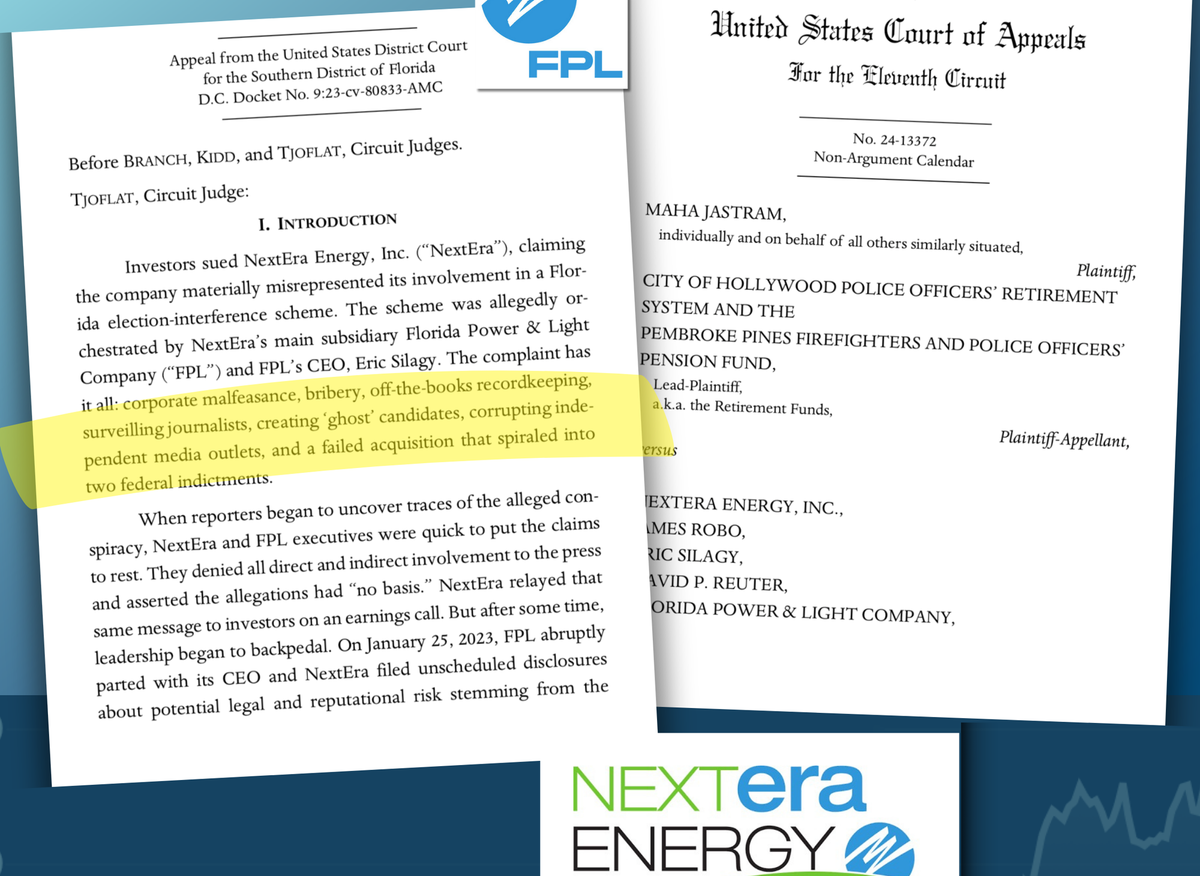
For years, NextEra Energy executives maintained that the aggressive political operations in Florida, including the financing of "ghost candidates", were either non-existent or the rogue actions of third-party vendors like Matrix LLC.
Verified Against Public And Audited RecordsLong-Form Investigative Review
Reading time: ~35 min
File ID: EHGN-REVIEW-35628
Alleged financing of ‘ghost candidates’ to manipulate Florida state senate elections
Two years later, the same tactics, using similar dark money channels and "ghost" candidates, were deployed across three Senate districts.
Primary RiskLegal / Regulatory Exposure
JurisdictionEPA
Public MonitoringReal-Time Readings
Report Summary
The $100, 000 payment provided Artiles with the liquidity needed to pay Alex Rodriguez, the sham candidate who siphoned over 6, 000 votes from incumbent Democrat José Javier Rodriguez. The primary vehicle for this spending was "Our Florida," a political committee (PC) registered in Florida funded by the same dark money network that powered the other ghost candidates. Grow United, which received significant funding from entities linked to Matrix LLC and NextEra Energy consultants, transferred $550, 000 to the political committees promoting the ghost candidates.
Key Data Points
This relationship operated in the shadows until December 2020. One particularly damaging document was a November 2019 memo sent by Jeff Pitts. This memo included a flowchart illustrating how corporate funds could be routed through a labyrinth of shell companies and 501(c)(4) nonprofits to obscure their origin. One ledger entry showed a $14 million transfer to a single nonprofit entity in 2018. The forced FPL to sever ties with Canopy Partners in late 2021. Perkins and Pitts eventually reached a settlement in August 2022. At the center of this obfuscation sat a Tallahassee-based 501(c)(4) organization with a patriotic name: "Let's.
Investigative Review of NextEra Energy, Inc.
Why it matters:
The exposure of the Florida ghost candidate scandal stemmed from a corporate divorce between Matrix LLC and Canopy Partners, revealing off-the-books operations and dark money tactics.
The leaked documents, including a memo detailing how corporate funds were funneled through shell companies to influence elections, have triggered a legal battle between the former partners, Jeff Pitts and Joe Perkins.
Matrix LLC and the 'Canopy Partners' Split: The Leak Source
The Architecture of a Corporate Divorce
The exposure of the Florida ghost candidate scandal did not originate from a federal subpoena or a regulatory audit. It emerged from the radioactive of a corporate divorce between two political operatives. Matrix LLC, an Alabama-based consulting firm, had served as a engine for utility interests across the Southeast for decades. Its founder, Joe Perkins, and its then-CEO, Jeff Pitts, orchestrated complex political strategies for clients including Florida Power & Light. This relationship operated in the shadows until December 2020. That month marked the fracture of their partnership and the beginning of a chain reaction that would strip the veneer of deniability from NextEra Energy’s subsidiary.
Jeff Pitts departed Matrix LLC to establish a new entity named Canopy Partners. He did not leave alone. Pitts took key staff members and, most serious, the lucrative Florida Power & Light account. This migration of talent and revenue triggered an immediate and hostile response from Perkins. The Matrix founder launched a forensic investigation into the company servers and laptops left behind by the departing executives. Perkins alleged that he discovered a cache of “rogue” files. These documents reportedly detailed off-the-books operations that Pitts and his team had conducted without Perkins’ explicit authorization. The discovery of these files transformed a standard business dispute into a method for transparency that neither side likely intended.
The Rogue Server and the Leak
The physical evidence at the center of this conflict was a server located in the Matrix Birmingham office. Perkins claimed in court filings that this hardware contained terabytes of data including emails, financial ledgers, and text message logs. These records spanned years of political consulting work. They provided a granular view of how Matrix operatives coordinated with FPL executives to manipulate Florida politics. The existence of these documents became public knowledge when anonymous packets began arriving at the offices of major Florida news outlets. The Orlando Sentinel, the Miami Herald, and the nonprofit newsroom Floodlight received thousands of pages of internal communications. The source of the leak remains officially unconfirmed in criminal court records. Yet the timing coincided perfectly with the escalation of the legal battle between Matrix and Canopy Partners.
The leaked dossier contained material that corporate compliance departments ensure is never written down. One particularly damaging document was a November 2019 memo sent by Jeff Pitts. The recipient was not an official FPL email address. It was sent to “Theodore Hayes,” a pseudonym used by FPL President and CEO Eric Silagy. This memo included a flowchart illustrating how corporate funds could be routed through a labyrinth of shell companies and 501(c)(4) nonprofits to obscure their origin. The goal was to influence elections while evading public disclosure requirements. The memo explicitly listed “minimizing public reporting” as a primary objective. This document alone shattered the defense that FPL executives were unaware of the dark money tactics used on their behalf.
Litigation as a weapon of Exposure
Perkins filed suit against Pitts in Alabama. He accused his former CEO of breach of fiduciary duty and engaging in unauthorized “shadow operations.” Perkins argued that Pitts had created a network of eighteen distinct entities to funnel money without Matrix leadership’s knowledge. This legal strategy allowed Perkins to distance himself from the radioactive elements of the Florida operations while simultaneously attacking his former protégé. Pitts retaliated with a countersuit in Florida. He alleged that Perkins was attempting to extort him and that the “rogue” narrative was a fabrication designed to destroy Canopy Partners before it could compete. The cross-fire of litigation forced more details into the public record.
The lawsuits revealed that the operations in question were not minor consulting gigs. They involved millions of dollars. One ledger entry showed a $14 million transfer to a single nonprofit entity in 2018. The of the spending indicated that FPL was not a client the primary financier of a massive political machine. The documents linked Matrix operatives to the creation of “Grow United,” a mysterious nonprofit that became the central funding vehicle for the ghost candidate advertisements. Grow United sent money to political committees that subsequently paid for brochures promoting the spoiler candidates in three key Senate districts. The forensic trail found on the Matrix servers connected the utility’s money directly to the election interference.
The Canopy Partners Defense
Jeff Pitts and his new firm, Canopy Partners, maintained that their work was standard political consulting. They argued that the leaked documents were being weaponized selectively to paint a misleading picture. Pitts claimed that Perkins was fully aware of the firm’s activities and was feigning ignorance to avoid liability. The defense, yet, struggled to explain the content of the communications. Text messages between Matrix operatives and FPL Vice President Daniel Martell showed real-time coordination of political attacks. In one exchange, operatives discussed surveilling a journalist who had written serious about the utility. The casual nature of these conversations suggested a deep, normalized culture of aggression and subterfuge that permeated the relationship between the consultants and the utility executives.
The formation of Canopy Partners was intended to be a clean break. Pitts likely aimed to continue his work for FPL under a new banner, free from the oversight of Perkins. Instead, the move exposed the entire apparatus. FPL initially stood by its consultants. The utility claimed it had done nothing wrong and that the internal investigation cleared its employees. This stance became untenable as the volume of leaked documents increased. The forced FPL to sever ties with Canopy Partners in late 2021. The toxic assets of the Matrix era had transferred to the new firm, and the leak ensured that Canopy Partners would be defined by the scandal rather than its future contracts.
The “Theodore Hayes”
The use of the “Theodore Hayes” email alias by Eric Silagy stands as one of the most significant from the Matrix leak. Corporate CEOs rarely use pseudonyms for routine business. The existence of the account suggested a consciousness of guilt or at least a distinct awareness that the discussions contained therein would not survive public scrutiny. The Pitts memo sent to this alias laid out the architecture of the ghost candidate funding. It demonstrated that the scheme was not the work of low-level rogue consultants. It was a strategy presented directly to the highest levels of the utility’s leadership. The leak of this specific email chain dismantled the “plausible deniability” defense that NextEra Energy attempted to construct in the early days of the scandal.
The documents also exposed the personal animus driving the political operations. In one email, Silagy directed his consultants to make a state senator’s life “a living hell.” The target was Senator José Javier Rodríguez, a Democrat who had proposed legislation that threatened FPL’s profit margins. The instruction was not a vague request for political opposition. It was a directive that preceded the deployment of a ghost candidate named Alex Rodriguez, who shared the senator’s surname. The Matrix leak provided the causal link between the CEO’s anger and the specific electoral fraud that followed. Without the split between Perkins and Pitts, this directive would likely have remained buried on a secure server in Birmingham.
Conclusion of the Feud
Perkins and Pitts eventually reached a settlement in August 2022. The terms of the agreement were confidential. Both parties agreed to drop their respective lawsuits. The legal battle ended, the information it released could not be recaptured. The “Matrix Papers” had already circulated among investigative journalists and federal prosecutors. The settlement did nothing to stop the momentum of the investigations that the leak had triggered. The divorce of Matrix LLC and the birth of Canopy Partners served as the unintended whistleblower for one of the most elaborate election fraud schemes in Florida history. The internal war between two political fixers inadvertently provided the public with the keys to the dark money vault.
Key Entities in the Matrix/Canopy Split
Entity/Individual
Role
Significance to Scandal
Matrix LLC
Alabama Consulting Firm
Original employer of the operatives; source of the leaked server data.
Joe Perkins
Founder, Matrix LLC
Initiated the lawsuit against Pitts; claimed discovery of “rogue” operations.
Jeff Pitts
Former CEO, Matrix LLC
Left to form Canopy Partners; author of the “Theodore Hayes” memos.
Canopy Partners
Florida Consulting Firm
The new entity formed by Pitts to service the FPL account post-split.
Eric Silagy
CEO, Florida Power & Light
Recipient of the dark money flowcharts via the “Theodore Hayes” alias.
Grow United
501(c)(4) Nonprofit
The funding vehicle identified in the leaked documents for ghost candidate ads.
Matrix LLC and the 'Canopy Partners' Split: The Leak Source
The 'Grow United' Dark Money Pipeline: Tracing the $550,000
The mechanics of the Florida ghost candidate scheme relied on a sophisticated financial shell game designed to sever the link between the corporate benefactor and the fraudulent candidates. At the center of this obfuscation sat **Grow United, Inc.**, a Delaware-registered 501(c)(4) organization that existed only on paper. In late 2020, this entity injected exactly **$550, 000** into two Florida political committees—*The Truth* and *Our Florida*—which then flooded specific senate districts with mailers promoting the spoiler candidates. Grow United functioned as a classic “pass-through” vehicle. Corporate records list its address as a UPS Store in Denver, Colorado, and later link it to a UPS Store in New York City. The organization was chaired by **Richard Alexander**, a low-profile political operative with a history of managing unclear entities used in Florida utility disputes. Alexander’s involvement provided a of separation; he was not a known player in Tallahassee circles, making the sudden influx of half a million dollars into Florida state races immediately suspicious to campaign finance watchdogs. even with its anonymity, Grow United possessed the resources to alter the trajectory of the state senate. The $550, 000 transfer did not occur in a vacuum. Investigative records, including leaked documents from the consulting firm **Matrix LLC**, reveal that the funds originated from a broader reservoir of utility-aligned money. The primary feeder for Grow United was another non-profit called **Let’s Preserve the American Dream** (LPTAD), run by Ryan Tyson, a prominent Republican strategist in Florida. Tax records later confirmed that LPTAD transferred over $1 million to Grow United in 2020. This transfer “washed” the funds; because LPTAD is a social welfare organization, it is not required to disclose its original donors, so shielding the source of the cash. The connection to **NextEra Energy** and its subsidiary, **Florida Power & Light (FPL)**, appears in the timing and internal communications of their consultants. Matrix LLC, led by **Jeff Pitts**, served as FPL’s primary political consulting firm during this period. Internal emails obtained by the *Orlando Sentinel* and other outlets show Matrix employees coordinating the transfer of “C4 info” (referring to 501(c)(4) status) to the political committees receiving the funds. Specifically, when the committees needed to report their donor, a Matrix employee provided the details for “Proclivity,” a related entity, before the filings were amended to show Grow United. This administrative coordination suggests that Matrix, acting on behalf of its clients, directed the flow of capital. The timing of the financial injections aligns with FPL’s strategic interests. Just days before Grow United began moving money to the political committees, Matrix billed FPL for millions of dollars in consulting fees. While FPL executives, including then-CEO **Eric Silagy**, have denied directing funds to ghost candidates, the chain of custody is linear: FPL paid Matrix; Matrix operatives coordinated with LPTAD and Grow United; Grow United funded the PACs; the PACs promoted the ghosts. The money moved through these cutouts to ensure that when voters in Senate District 37 or District 9 received mailers, the return address would never lead back to the utility giant. The impact of this $550, 000 was precise and tactical. The money did not fund the ghost candidates’ own campaign accounts, which remained largely empty to avoid scrutiny. Instead, it funded “independent expenditures” via the political committees *The Truth* and *Our Florida*. These committees purchased aggressive direct mail campaigns that marketed the ghost candidates—**Jestine Iannotti** in District 9, **Alex Rodriguez** in District 37, and **Celso Alfonso** in District 39—as progressive liberals. The mailers featured stock photos and language designed to appeal to Democratic voters, emphasizing problem like social justice and environmental protection. In Senate District 37, the return on this investment was mathematically decisive. The ghost candidate, Alex Rodriguez, a brimming sham candidate with the same surname as the Democratic incumbent, received over 6, 000 votes. The Republican challenger, Ileana Garcia, won the seat by a mere **32 votes**. The $550, 000 funneled through Grow United successfully siphoned enough Democratic support to flip the seat, securing a wider Republican majority in the Senate—a body that holds direct sway over the regulatory environment governing FPL. The opacity of the Grow United pipeline was intentional. By utilizing a Delaware corporation and a chain of non-profits, the architects of the scheme exploited gaps in Florida’s campaign finance laws. It took months of forensic accounting and leaks to reconstruct the route from the utility’s consultants to the mailbox of the average Florida voter. The “Grow United” brand was a disposable container, used to carry the payload and then discarded, leaving behind only a trail of bank transfers and a corrupted election result.The 'Grow United' Dark Money Pipeline: Tracing the $550,000
'Let's Preserve the American Dream' as Funding Intermediary
The architecture of the Florida ghost candidate scandal relied less on individual rogue actors and more on a sophisticated, financial infrastructure designed to obscure the origin of funds. At the center of this obfuscation sat a Tallahassee-based 501(c)(4) organization with a patriotic name: “Let’s Preserve the American Dream” (LPTAD). While its title suggested a mission of civic advocacy, investigative records and tax filings identify LPTAD as a primary sluice gate for the capital that fueled the manipulation of the 2020 state senate elections. This entity functioned not as a passive recipient of donations as an active, strategic intermediary that washed corporate money before it reached the hands of political operatives.
The Operator: Ryan Tyson and the AIF Connection
To understand the mechanics of LPTAD, one must examine its leadership and physical footprint. The organization was run by Ryan Tyson, a prominent Republican pollster and strategist. During the period in question, Tyson served as the Vice President of Political Operations for Associated Industries of Florida (AIF), a business lobbying group frequently referred to as “The Voice of Florida Business.” LPTAD did not maintain a separate, distinct headquarters; instead, it operated out of AIF’s sprawling 15, 000-square-foot building in Tallahassee, just blocks from the Governor’s Mansion.
This physical and personnel overlap is significant. AIF counts Florida Power & Light (FPL) among its largest financial backers. Internal documents and tax records show that FPL and its parent company, NextEra Energy, have funneled millions of dollars into AIF and its associated political committees over the years. Tyson’s dual role placed him at the intersection of corporate utility interests and dark money distribution. While AIF spokespeople have stated that the organization was not involved in LPTAD’s specific activities, the of staff and facilities suggests a distinction without a difference. Tyson provided the operational expertise required to move large sums of money through the regulatory gray zones of Florida’s election laws.
The $1. 15 Million Injection
The primary evidence implicating LPTAD in the ghost candidate scheme appears in its 2020 tax filings. These documents reveal that LPTAD transferred a $1. 15 million to “Grow United, Inc.,” another dark money nonprofit controlled by political consultants working for FPL. This transfer was not a routine grant; it was the financial fuel for the entire ghost candidate operation.
The timing of these transfers is precise and damning. In late September 2020, just weeks before the general election, LPTAD sent $600, 000 to Grow United. Days later, Grow United wired $550, 000 to two political action committees, “The Truth” and “Our Florida”, managed by Alex Alvarado. These PACs were responsible for designing and mailing the deceptive advertisements that promoted the ghost candidates in three key senate districts. Without the initial injection from LPTAD, the downstream funding for the ghost candidates would have evaporated.
The $1. 15 million figure represents the largest known contribution to Grow United during the 2020 election pattern. By routing the funds through LPTAD, the architects of the scheme added a necessary of insulation. If Grow United had received funds directly from a utility company or a recognizable corporate entity, the trail would have been too easy to follow. LPTAD served as the unclear barrier, a “social welfare” organization that is not required to disclose its donors, so scrubbing the money of its original source before passing it down the chain.
The Matrix LLC Interface
The capital flowing through LPTAD did not materialize from thin air. Investigative reporting by the Orlando Sentinel and Miami Herald, grounded in leaked documents from the Alabama-based consulting firm Matrix LLC, establishes the upstream connection. Matrix LLC, led at the time by CEO Jeff Pitts, served as FPL’s primary political consulting firm. Invoices obtained by investigators show that Matrix billed FPL for amounts exceeding $3 million in the days immediately preceding the transfers to LPTAD and Grow United.
The financial synchronization between FPL’s payments to Matrix and LPTAD’s disbursements to Grow United indicates a coordinated effort rather than coincidental timing. On September 22, 2020, LPTAD sent $30, 000 to TMP Interactive, a firm owned by Jeff Pitts. This smaller transaction establishes a direct financial link between Tyson’s organization and the FPL consultants orchestrating the broader strategy. The subsequent $600, 000 transfer to Grow United, an entity also controlled by Matrix operatives, confirms that LPTAD was fully integrated into the Matrix-led operation.
Further cementing this relationship is the involvement of FPL CEO Eric Silagy. Leaked emails reveal that Silagy used a pseudonym, “Theodore Hayes,” to communicate with Pitts and Tyson regarding political strategies. This secret channel allowed utility executives to direct high-level strategy while maintaining plausible deniability regarding the specific tactical maneuvers, such as the funding of spoiler candidates. LPTAD was the method that turned these strategic directives into operational reality.
the Money Trail
The utility of LPTAD extended beyond the single transfer to Grow United. The organization engaged in a pattern of “,” a technique used to complicate financial audits. to funding Grow United, LPTAD distributed funds to other entities within the same operative network. For instance, records show a $100, 000 payment to the “Florida Consumer Awareness Fund,” a nonprofit chaired by Stafford Jones, another Gainesville-based political operative linked to Data Targeting, the firm running GOP senate campaigns.
These lateral transfers serve a specific purpose: they create a “hall of mirrors” effect for investigators. When money moves from one dark money group to another, and then to a third, tracing the original dollar becomes exponentially more difficult. Each transfer resets the clock on reporting requirements and adds a of legal separation. LPTAD acted as a central hub in this network, receiving bulk cash infusions, such as a mysterious $5 million credit in December 2020, and dispersing them to various tactical groups as needed.
The December 2020 infusion is particularly noteworthy. Occurring after the election, this massive influx of cash suggests a replenishment of the war chest or a retroactive payment for services rendered during the pattern. While the source of this $5 million remains officially “unclear” due to 501(c)(4) privacy laws, the context of LPTAD’s activities strongly points to the same corporate benefactors who funded the earlier operations. The of this funding places LPTAD in the top tier of Florida’s political spending vehicles, far surpassing the budget of a typical grassroots advocacy group.
Regulatory Gray Zones and the 501(c)(4) Shield
The effectiveness of LPTAD as a funding intermediary relies on its status as a 501(c)(4) social welfare organization. Under IRS rules, such organizations are permitted to engage in political activity as long as it is not their “primary” purpose. This definition is notoriously vague and rarely enforced, allowing groups like LPTAD to function as de facto political action committees while enjoying the secrecy of a private charity.
By categorizing the payments to Grow United as “grants” for social welfare, LPTAD avoided the immediate disclosure requirements that bind standard political committees. If LPTAD had been a registered political committee, it would have been required to list its donors and the specific purpose of its expenditures in real-time state filings. Instead, the details of the $1. 15 million transfer only emerged months later in annual tax returns, long after the election had been certified and the ghost candidates had served their purpose.
This regulatory arbitrage is a defining feature of the NextEra/FPL political strategy. The utility does not spend money; it constructs a parallel financial system that operates outside the view of the public and regulators. LPTAD was the keystone of this system in 2020. It provided the necessary distance between the corporate treasury of a regulated monopoly and the sordid reality of paying a shill candidate to confuse voters. The organization’s name, invoking the “American Dream,” stands in clear contrast to its function: subverting the democratic process to protect corporate profits.
The role of LPTAD demonstrates that the ghost candidate scandal was not a series of bribes a well-capitalized industrial operation. The $1. 15 million moved through this entity was the lifeblood of the scheme, enabling the printing, mailing, and digital advertising that altered the outcome of Florida senate races. Without LPTAD, the chain of custody for the illicit funds would have been unbroken, likely exposing the corporate architects to immediate criminal liability. Instead, the intermediary absorbed the risk, shielding the source while ensuring the dirty work got done.
Senate District 37: The Alex Rodriguez Recruitment Scheme
The Mathematics of a Stolen Election
The outcome of the 2020 election for Florida Senate District 37 stands as the definitive proof of concept for the ghost candidate strategy. Incumbent Democrat Jose Javier Rodriguez, a legislator known for his aggressive stance on climate change and utility regulation, lost his seat to Republican challenger Ileana Garcia by exactly 32 votes. This margin, representing 0. 015% of the 215, 000 ballots cast, was not the result of a natural shift in voter sentiment. It was the engineered product of a spoiler candidate named Alex Rodriguez, who siphoned 6, 382 votes from the incumbent. The presence of a third candidate sharing the incumbent’s surname was a precision-guided weapon designed to confuse voters and dilute the Democratic ticket. Without Alex Rodriguez on the ballot, statistical models and historical voting patterns indicate Jose Javier Rodriguez would have retained his seat with a comfortable margin.
The operation relied on the cognitive friction of the ballot itself. In a race decided by three dozen votes, the 6, 000 votes cast for a non-campaigning entity demonstrated the efficacy of name-association sabotage. Alex Rodriguez did not hold rallies, attend debates, or host a website. His candidacy existed entirely on paper, funded by dark money and managed by operatives who viewed the democratic process as a variable to be manipulated. The 32-vote victory for Garcia secured a Republican supermajority in the Florida Senate, a strategic objective that justified the risk of criminal exposure for the architects involved.
The Recruitment of a Shill
The search for a spoiler candidate was not random. Former State Senator Frank Artiles, operating as a paid consultant for Republican interests, spearheaded the recruitment drive. Artiles required a specific profile: a candidate with the surname “Rodriguez” who was to place their name on a ballot in exchange for cash. He found his target in Alex Rodriguez, a machine parts salesman living in Boca Raton, far outside the boundaries of District 37. The two men knew each other socially; Artiles had previously interacted with Alex Rodriguez on Facebook. In May 2020, Artiles reached out via the platform, initiating a chain of events that would lead to felony convictions for both men.
Alex Rodriguez was in a state of financial distress. Court testimony revealed he was struggling with rent, car payments, and tuition for his daughter. Artiles exploited this vulnerability, presenting the candidacy not as a political endeavor, as a business transaction. During a meeting at Artiles’ Palmetto Bay home, the former senator laid out the scheme: Alex would run as a No Party Affiliation (NPA) candidate. He would not need to campaign, speak to the media, or raise funds. His only job was to appear on the ballot. In exchange, Artiles promised a payment of $50, 000. For Alex Rodriguez, the offer was a lifeline; for Artiles, it was a purchase order for election interference.
The Financial Ledger of Fraud
The financial arrangement between Artiles and the ghost candidate was transactional and clandestine. Prosecutors later reconstructed a ledger of payments totaling $44, 708. 03. Unlike legitimate campaign expenditures, these funds did not pass through a campaign account. Instead, Artiles dispensed cash directly from his home safe and made payments to third parties on Alex Rodriguez’s behalf. One specific transaction involved Artiles using his credit card to pay $6, 798. 39 for the private school tuition of Alex Rodriguez’s daughter. Other payments were disguised as business deals for non-existent.
The trial of Frank Artiles in September 2024 exposed the farcical nature of these “business” transactions. Alex Rodriguez, testifying for the prosecution, admitted that he fabricated opportunities to extract more money from his handler. In one instance, he convinced Artiles to advance him money to purchase a Range Rover at an auction, a vehicle that did not exist. He also invented a deal involving diesel engines and COVID-19 masks. The defense team for Artiles attempted to frame these interactions as legitimate business failures between friends, the jury rejected this narrative. The timing of the payments, coinciding precisely with election qualifying deadlines and the campaign season, established a clear quid pro quo: cash for candidacy.
Falsifying the Public Record
To place Alex Rodriguez on the ballot in District 37, the conspirators had to overcome a geographic obstacle: the candidate did not live in the district. Alex Rodriguez resided in a rented home in Boca Raton, located in Palm Beach County. District 37 encompasses parts of Miami-Dade County, including Coral Gables and Key Biscayne. Florida law requires a candidate to be a resident of the district they seek to represent. To circumvent this, Artiles instructed Alex Rodriguez to falsify his sworn candidate oath. They used a Palmetto Bay address that belonged to a former neighbor of Alex Rodriguez, a property the candidate had not occupied for years.
The mechanics of the filing demonstrated Artiles’ hands-on control of the operation. In June 2020, Artiles flew to Tallahassee to personally hand-deliver Alex Rodriguez’s qualifying paperwork to the Florida Division of Elections. This physical intervention ensured that the paperwork was filed correctly and on time, minimizing the risk of a clerical error derailing the scheme. The rush to qualify the candidate stands in sharp contrast to the candidate’s subsequent invisibility. Once the paperwork was accepted, Alex Rodriguez ceased to exist as a public figure, retreating into the background while the of the ghost campaign began to churn.
The Campaign That Never Was
A legitimate political campaign generates a footprint: staff, volunteers, digital ads, and public appearances. The Alex Rodriguez campaign had none of these. Yet, voters in District 37 were inundated with mailers promoting his candidacy. These mailers, funded by the “Our Florida” political committee, presented Alex Rodriguez as a progressive alternative to the incumbent. They used stock imagery and vague slogans designed to appeal to left-leaning voters, reinforcing the trap. The mailers did not originate from Alex Rodriguez; he had no creative control, no knowledge of their content, and no ability to stop them. They were an external force applied to the district by the same dark money network that paid Artiles.
The deception required silence. Artiles instructed Alex Rodriguez to change his phone number and avoid the media. When reporters from WPLG Local 10 tracked Alex Rodriguez to his Boca Raton home during the election, he feigned ignorance and refused to answer questions. This enforced silence was a protective measure. Any public scrutiny of the candidate’s knowledge of policy or his actual residence would have unraveled the scheme immediately. The ghost candidate was a prop, a name on a list, maintained strictly to split the vote count.
Legal Consequences and Convictions
The scheme unraveled following the election, driven by investigative reporting and the statistical anomaly of the result. In March 2021, authorities arrested both Frank Artiles and Alex Rodriguez. The legal proceedings dragged on for years, culminating in a definitive resolution in late 2024. Alex Rodriguez accepted a plea deal, pleading guilty to accepting excessive campaign contributions and lying on official forms. He received a sentence of probation and agreed to testify against his recruiter. His testimony provided the forensic evidence needed to convict the former senator.
On September 30, 2024, a Miami-Dade jury found Frank Artiles guilty of three felony counts: excessive campaign contributions, conspiracy to make excessive contributions, and procuring a falsified candidate oath. The verdict pierced the veil of “consulting” that Artiles had used to shield his activities. On November 18, 2024, Judge Miguel de la O sentenced Artiles to 60 days in jail and five years of probation. The judge also withheld adjudication, a legal nuance that allowed Artiles to avoid the permanent status of a convicted felon, provided he completes his probation successfully. even with the conviction, the election result stood. Ileana Garcia served her term, and the Senate seat remained in Republican control. The justice system punished the actors, it could not reverse the political outcome they engineered.
The Broader Implication
The Alex Rodriguez case is not an incident of electoral fraud; it is a documented instance of a widespread vulnerability in Florida’s election laws. The ability to run a shill candidate with no intention of campaigning, funded by untraceable money, remains a viable strategy for political operatives. The $44, 000 paid to Alex Rodriguez was a negligible expense compared to the value of a State Senate seat. The return on investment for the entities funding this operation, allegedly connected to major utility interests, was exponential. The conviction of Artiles serves as a deterrent to the individual, the method of the ghost candidate remains available to those with the resources to fund it and the sophistication to hide their tracks better time.
Senate District 37: The Ghost Candidate Impact
Candidate
Party
Votes Received
Outcome
Ileana Garcia
Republican
104, 630
Winner (+32 votes)
Jose Javier Rodriguez
Democrat
104, 598
Defeated
Alex Rodriguez
NPA (Ghost)
6, 382
Spoiler
Senate District 9: The Jestine Iannotti 'Progressive' Mailer Operation
Senate District 9: The Jestine Iannotti ‘Progressive’ Mailer Operation
The 2020 election for Florida Senate District 9 became a primary theater for the ghost candidate strategy. This race pitted Republican Jason Brodeur against Democrat Patricia Sigman in a contest that threatened the Republican majority in the state senate. Brodeur served as the president of the Seminole County Chamber of Commerce. Sigman was a labor attorney. The district covered Seminole County and parts of Volusia County. It was a swing district where every vote carried significant weight. Into this volatile environment stepped Jestine Iannotti. She filed as a candidate with No Party Affiliation. Iannotti fit the profile of a ghost candidate perfectly. She had no political experience. She raised no legitimate funds. She did not campaign. She did not attend debates. She did not grant interviews. In fact she spent much of the election season in Sweden. Her candidacy existed only on paper and in the mailboxes of voters. The operation designed to propel her candidacy was not a grassroots effort. It was a calculated deception orchestrated by seasoned political operatives and funded by dark money channels linked to major corporate interests. The method for this deception was a political committee called The Truth. This entity was established shortly before the election. Its sole purpose appeared to be the dissemination of advertising that would draw votes away from Sigman. The Truth sent out waves of mailers to Democratic-leaning households in the district. These advertisements presented Iannotti as a “progressive” champion. They touted her support for social justice. They claimed she would fight for fair wages. They positioned her as a defender of the environment who would battle climate change. One specific mailer stands out for its brazen dishonesty. It featured a stock photograph of a Black woman. The imagery suggested to voters that Iannotti herself was Black. Iannotti is a white woman. This visual lie was paired with slogans appealing to African American voters and progressives. The intent was clear. The operatives behind The Truth sought to siphon votes from the Democratic candidate by offering a fabricated alternative who appeared to align with liberal values. The funding for The Truth traces back to the same dark money reservoir used in other ghost candidate races. Records show that The Truth received its funding from Grow United. This is the tax-exempt 501(c)(4) organization that served as a clearinghouse for funds directed by Matrix LLC. Matrix was the consulting firm working closely with Florida Power & Light. The money flowed from corporate interests into Grow United and then into the political committees that paid for the deceptive mailers. This financial pipeline allowed the true sponsors of the operation to remain hidden from voters until long after the ballots were cast. The execution of the scheme in District 9 involved local operatives with ties to the Republican establishment. Eric Foglesong served as the campaign manager for Iannotti. Foglesong was a veteran political consultant with a history of working on GOP campaigns. Investigators later found that Foglesong provided Iannotti with cash contributions to pay her qualifying fees. This is a violation of Florida election laws. He also helped falsify campaign finance reports to conceal the source of the money. Ben Paris also played a central role. Paris was the chairman of the Seminole County Republican Party. He was also an employee of the Seminole County Chamber of Commerce where he worked under Jason Brodeur. Paris assisted in the scheme by providing the name of his cousin to be used as a straw donor. This allowed the operatives to disguise the true source of the funds funneled into the Iannotti campaign. The involvement of the local GOP chair and a consultant for the beneficiary of the scheme demonstrates the coordinated nature of the operation. The election results in Senate District 9 differed slightly from the outcome in District 37. Jason Brodeur won the race with 50. 3 percent of the vote. Patricia Sigman received 47. 6 percent. The margin of victory was approximately 7600 votes. Jestine Iannotti received 5787 votes. In this specific instance the number of votes cast for the ghost candidate was less than the margin of victory. Brodeur would have likely won even without Iannotti in the race. Yet the intent of the operation remains undeniable. The scheme was deployed to manipulate the electorate and provide an insurance policy for the Republican candidate. The legal from the District 9 operation was significant. The Florida Department of Law Enforcement launched an investigation that led to criminal charges. Jestine Iannotti was charged with multiple counts including perjury and accepting illegal campaign contributions. She eventually pleaded guilty and agreed to testify against the other operatives. Eric Foglesong faced charges for falsifying records and making illegal contributions. Ben Paris was charged with making a contribution in the name of another. Paris was convicted of the misdemeanor charge in September 2022. The jury found him guilty of allowing his cousin’s name to be used to hide the source of campaign cash. The judge sentenced him to probation and community service. He was also ordered to pay investigative costs. The conviction of a sitting county party chair connected the ghost candidate scheme directly to the local Republican apparatus. It shattered the defense that these were incidents or the work of rogue actors. Jason Brodeur denied any knowledge of the scheme. He maintained that he was unaware of the actions taken by his employee and his political allies. Florida Power & Light also denied involvement. The utility company stated that it did not direct the funding or the strategy. Yet the documents leaked from Matrix LLC tell a different story. They show a pattern of communication and financial transfers that link the utility’s consultants to the dark money groups funding the operation. The District 9 case exposes the mechanics of the ghost candidate strategy in clear detail. It shows how a candidate can be manufactured out of thin air. It demonstrates how dark money can be used to fund deceptive advertising. It reveals the willingness of political operatives to use racial deception to manipulate voters. The mailers sent by The Truth were not just political spin. They were a fraudulent attempt to mislead the public about the identity and the platform of a candidate who had no intention of serving. This operation was not an event. It was part of a broader strategy deployed across multiple districts to secure a legislative majority. The use of Grow United as the funding vehicle connects the District 9 race to the District 37 race and the District 39 race. The common denominator in all these cases is the network of consultants working for Florida Power & Light. The utility giant stood to benefit from a friendly state senate. The ghost candidate operations were a means to ensure that friendly leadership remained in power. The prosecution of Iannotti and her handlers provided a rare glimpse into the inner workings of Florida’s dark money machine. Most election law violations result in fines that are treated as the cost of doing business. The criminal charges in this case signaled a shift. Prosecutors were to pursue the individuals who executed the scheme. Yet the entities that provided the funding have largely escaped accountability. The money trail ends at the 501(c)(4) organizations that are not required to disclose their donors. The Jestine Iannotti operation remains a case study in electoral manipulation. It illustrates the vulnerability of the democratic process to well-funded deception. Voters in Senate District 9 were targeted with lies funded by corporate interests they could not identify. The candidate they were asked to support was a phantom. The progressive values she claimed to represent were a mirage. The reality was a cynical power grab designed to protect the in Tallahassee.
Senate District 39: The Celso Alfonso Candidacy and Artiles Connection
Senate District 39: The Celso Alfonso Candidacy and Artiles Connection
The operational blueprint executed in Senate District 37 was not an anomaly. It was part of a synchronized, multi-front offensive designed to secure a Republican supermajority in the Florida Senate. While the Alex Rodriguez scheme in District 37 successfully overturned an election by a razor-thin margin, a nearly identical operation ran parallel in Senate District 39. Here, the target was Democrat Javier Fernandez, and the beneficiary was Republican Ana Maria Rodriguez. The instrument of this manipulation was Celso Alfonso, an 81-year-old retiree whose candidacy served as a carbon copy of the fraud perpetrated in District 37, orchestrated by the same handler, funded by the same dark money channels, and designed to deceive voters with the same forensic precision.
Senate District 39, covering Monroe County and southern Miami-Dade, represented a high- battlefield for NextEra Energy and its political allies. The seat was open, and flipping it from Democratic to Republican control was a primary objective for the Florida Republican Senatorial Campaign Committee (FRSCC) and its corporate backers. Unlike the razor-thin margins of District 37, the District 39 race ended with a decisive Republican victory. Yet, the presence of a ghost candidate in this contest provides the clearest evidence of a widespread conspiracy. The Alfonso operation demonstrates that the ghost candidate strategy was not a desperate, last-minute audible a standardized product offered by political consultants to guarantee corporate-friendly legislative outcomes.
The Recruitment of the “Plant”
The recruitment of Celso Alfonso mirrored the acquisition of Alex Rodriguez with clear fidelity. Frank Artiles, the former state senator and operative convicted for his role in the District 37 scheme, served as the architect. Investigators and court testimony revealed that Artiles method Alfonso, a man with no prior political experience or public profile, to run as a No Party Affiliation (NPA) candidate. Alfonso, who had previously worked as an Uber driver, was 81 years old at the time of the election. His recruitment reportedly took place in a casual setting, identified in reports as a barber shop or spa frequented by Artiles, where the operative leveraged a personal connection to persuade the elderly man to place his name on the ballot.
The mechanics of Alfonso’s entry into the race betray the artificial nature of his campaign. Like Alex Rodriguez, Alfonso changed his party registration from Republican to NPA just days before the qualifying deadline. This switch was a tactical need; running as a Republican would have triggered a primary against the preferred establishment candidate, Ana Maria Rodriguez. By running as an NPA, Alfonso could bypass the primary and appear directly on the general election ballot, where his presence was calculated to siphon votes from the Democratic nominee. State records show that Alfonso’s qualifying check for $1, 187. 88 was paid for using funds provided by Artiles. The financial disclosure forms for both Alfonso and Alex Rodriguez were nearly identical, reporting only modest loans to themselves and listing no genuine campaign contributions or expenditures during the qualifying period. This forensic similarity suggests that Artiles or his associates prepared the paperwork for both candidates simultaneously, treating them as interchangeable assets in a broader portfolio of election interference.
The “Our Florida” Propaganda Machine
Once Alfonso was on the ballot, the second phase of the operation commenced: the funding of a propaganda campaign designed to weaponize his candidacy against the Democrat. Alfonso, like his counterpart in District 37, did not campaign. He held no rallies, hosted no fundraisers, and articulated no policy platform. He was a vessel for a mailer campaign orchestrated entirely by third-party groups. The primary vehicle for this spending was “Our Florida,” a political committee (PC) registered in Florida funded by the same dark money network that powered the other ghost candidates.
Financial records trace the funding for “Our Florida” back to “Grow United,” the Delaware-based 501(c)(4) organization at the heart of the scandal. Grow United, which received significant funding from entities linked to Matrix LLC and NextEra Energy consultants, transferred $550, 000 to the political committees promoting the ghost candidates. A portion of these funds was directed specifically to target voters in District 39. The mailers sent to households in the district presented Alfonso as a “progressive” champion, using language and imagery designed to appeal to left-leaning voters who might otherwise support Javier Fernandez. These advertisements touted Alfonso’s supposed commitment to environmental protection and social justice, ironic themes given that the funding originated from corporate interests seeking to entrench a utility-friendly Republican majority.
The “Our Florida” mailers were not subtle. They utilized high-quality design and printing services, identical to those used in District 37 and District 9. The messaging was calibrated to exploit specific demographic vulnerabilities for the Democratic candidate. By positioning Alfonso as the “true” progressive alternative, the operators hoped to fracture the Democratic coalition. In a district with a significant Hispanic population, the presence of a surname like “Alfonso” also played a role, offering a familiar-sounding option for low-information voters, although the name confusion factor was less pronounced than in the Rodriguez vs. Rodriguez match-up in District 37.
Forensic Parallels and Legal
The investigation into the ghost candidate scandal eventually exposed the direct links between Artiles and Alfonso. During the legal proceedings against Artiles, prosecutors introduced evidence showing that the operative maintained control over Alfonso’s candidacy. Text messages and witness testimony confirmed that Artiles guided Alfonso through the qualifying process and managed the logistics of his “campaign.” When investigators raided Artiles’ Palmetto Bay home, they discovered campaign documents related to Alfonso, further cementing the connection. Alfonso himself later testified under oath, admitting that Artiles had recruited him and provided the necessary guidance to file for office.
even with the overwhelming similarities to the Alex Rodriguez case, the legal consequences for Alfonso were significantly lighter. While Rodriguez pleaded guilty to accepting illegal campaign contributions and lying on official forms, Alfonso was not criminally charged in the initial sweep. Instead, he faced civil penalties from the Florida Commission on Ethics. The Commission found that Alfonso had filed inaccurate financial disclosures, failing to report the true source of his funds and his actual financial status. He was fined $250, a trivial sum for his role in a scheme that involved hundreds of thousands of dollars in dark money. The in charging decisions likely from the fact that Alfonso’s candidacy did not alter the outcome of the election. Ana Maria Rodriguez won District 39 by a margin of approximately 28, 000 votes, rendering Alfonso’s 3, 639 votes (1. 7%) mathematically irrelevant to the final result. yet, the failure of the spoiler to change the outcome does not negate the intent of the conspiracy. The resources poured into District 39 prove that the architects of this scheme viewed every competitive seat as a target for manipulation.
The NextEra and Matrix Connection
The Alfonso candidacy cannot be viewed in isolation from the broader corporate objectives of NextEra Energy and Florida Power & Light (FPL). Senate District 39 was a serious hold for the utility giant. The retiring incumbent, Republican Anitere Flores, had occasionally clashed with utility interests, securing her successor was important for maintaining a compliant Senate. Internal documents from Matrix LLC, FPL’s consulting firm, show that executives were monitoring these races with granular intensity. The “Grow United” funding pipeline, which facilitated the “Our Florida” mailers for Alfonso, serves as the financial umbilical cord connecting the utility’s consultants to the ghost candidate operation.
Eric Silagy, then-CEO of FPL, and other senior executives were kept informed of the political by Matrix operatives. While FPL has consistently denied direct funding or control of the ghost candidates, the flow of money from Matrix-controlled entities to Grow United and subsequently to the committees backing Alfonso creates a circumstantial chain of custody that investigators and journalists have scrutinized for years. The “Canopy Partners” documents leaked to the press reveal a culture within Matrix where “spoiler” candidates were discussed as viable tools for neutralizing political threats. The Alfonso operation fits perfectly within this strategic framework: a low-cost, high-reward method to insure against Democratic gains.
The District 39 operation also highlights the industrial of the fraud. This was not a localized incident of a rogue operative helping a friend. It was a franchise model. Artiles acted as the regional manager, implementing a corporate strategy across multiple districts. The fact that Alfonso’s campaign materials, filing patterns, and funding sources were identical to those in District 37 and District 9 confirms centralized planning. The “Our Florida” PC did not organically decide to support an 81-year-old Uber driver in Miami-Dade; it was directed to do so by the controllers of the capital flow. The expenditure on Alfonso, even in a race that wasn’t close, reveals the “total war” mentality of the utility’s political machine. They were not just trying to win; they were buying insurance policies on every available ballot line.
In the final analysis, Celso Alfonso was a pawn in a game played by the state’s most interests. His candidacy stands as proof that the ghost candidate scandal was a widespread attack on the democratic process, financed by dark money and executed with cold, corporate efficiency. The absence of criminal charges against Alfonso may have allowed him to fade back into obscurity, his name remains on the ledger of one of Florida’s most brazen political corruption scandals.
The 2018 Gainesville 'Dry Run': 'Broken Promises' and the Keith Perry Race
The 2018 Gainesville ‘Dry Run’: ‘Broken pledge’ and the Keith Perry Race
Long before the 2020 ghost candidate scandal drew criminal charges in Miami-Dade, political operatives executed a near-identical strategy in North Florida. The 2018 contest for Senate District 8, centered in Gainesville, served as the operational prototype for the vote-siphoning mechanics that would later plague the state. In this race, Republican incumbent Keith Perry faced a serious challenge from Democrat Dr. Kayser Enneking, a physician and political newcomer whose polling numbers threatened to flip the seat. To secure Perry’s victory, the same network of consultants identified in the 2020 investigation deployed a spoiler candidate funded by dark money, nullifying the Democratic challenge.
The instrument for this operation was a Washington, D. C.-based 501(c)(4) nonprofit named “Broken pledge.” Registered in August 2018, just months before the general election, the organization existed on paper for the sole purpose of funneling untraceable capital into the Florida race. Unlike a political committee, Broken pledge was not required to disclose its donors, creating a black box for corporate influence. Leaked internal documents from Matrix LLC later confirmed the source of the funds: Florida Power & Light (FPL). Records show the utility giant transferred $200, 000 to Broken pledge in the fall of 2018. Within five weeks, the nonprofit channeled approximately $130, 000 into the race to support Charles Goston, a former Democratic Gainesville City Commissioner running as a no-party-affiliated (NPA) candidate.
The Candidate and the Calculus
Charles Goston entered the race late, positioning himself as an independent voice. Yet his candidacy targeted a specific demographic: Democratic-leaning voters in East Gainesville, a predominantly Black area that formed a core part of Enneking’s base. Goston’s presence on the ballot was mathematically precise. In a two-way race, Enneking posed a lethal threat to Perry. In a three-way race, Goston needed only to siphon a small percentage of the vote to ensure a Republican hold. The funding structure for Goston’s campaign was almost entirely dependent on the dark money injection. A political committee named “Friends of Charles Goston” received the bulk of its resources from Broken pledge, which paid for mailers and advertising that boosted Goston’s profile while attacking Enneking.
The messaging strategy mirrored the tactics seen later in 2020. Mailers sent to Democratic households did not promote conservative values; instead, they presented Goston as a progressive alternative or attacked the Democratic nominee to depress turnout. The operation was run by Sean Jason Anderson, a figure linked to Matrix LLC CEO Jeff Pitts. Anderson’s involvement provided a of separation between the utility company and the campaign activity, a method designed to insulate corporate executives from regulatory scrutiny. The leaked Matrix documents, yet, shattered this insulation, revealing that FPL executives were not only aware of the strategy were the primary financiers.
The Mathematical Impact
The election results validated the effectiveness of the spoiler mechanic. Keith Perry defeated Kayser Enneking by approximately 2, 000 votes, a margin of roughly 1 percent. Charles Goston received over 4, 300 votes, more than double the spread between the two major candidates. Analysis of precinct data showed that Goston performed best in the exact Democratic strongholds where Enneking needed high margins to overcome Perry’s advantage in rural areas. The 4, 300 votes cast for Goston did not; they were subtracted from the Democratic column, delivering the seat to Perry.
Enneking later described the 2018 race as a “test run” for the broader ghost candidate scheme. The operation proved that a well-funded third-party candidate, backed by a dark money entity like Broken pledge, could manipulate the outcome of a tight legislative race without the voters knowing the true source of the propaganda. The success of the District 8 operation emboldened the network. Two years later, the same tactics, using similar dark money channels and “ghost” candidates, were deployed across three Senate districts, including the -infamous District 37 race involving Frank Artiles.
Regulatory Capture and Legislative Payoff
The return on investment for the funders of Broken pledge was substantial. Following Perry’s re-election, the Republican-controlled Senate passed Senate Bill 796 in 2019, a piece of legislation highly favorable to FPL. The bill created a new method for utilities to pass the costs of storm protection projects directly to consumers, bypassing standard regulatory blocks. Perry voted in favor of the legislation. The 2018 “dry run” demonstrated that investing $200, 000 in a single Senate race could yield legislative dividends worth millions in recoverable costs for the utility.
Table 7. 1: The 2018 District 8 Vote Siphoning Metrics
Candidate
Party
Votes Received
Percentage
Funding Source (Primary)
Keith Perry
Republican
100, 351
49. 53%
GOP / Corporate PACs
Kayser Enneking
Democrat
97, 998
48. 37%
Democratic Party / Donors
Charles Goston
NPA (Spoiler)
4, 287
2. 11%
Broken pledge (FPL/Matrix)
The 2018 operation remains distinct from 2020 in one serious aspect: no criminal charges were filed regarding the Gainesville race. While the mechanics were identical, dark money, a spoiler candidate, and vote dilution, the direct link to FPL was only established years later through the leak of internal Matrix documents. By then, the statute of limitations for campaign finance violations had expired, or prosecutors focused their limited resources on the more egregious 2020 cases. Yet the historical record shows that the blueprint for subverting Florida’s democracy was drafted and perfected in Alachua County, paid for by ratepayer-backed profits.
Surveillance of Journalist Nate Monroe: Intimidation Tactics
Targeting the Watchdog: The JEA Privatization Obstacle
The of influence deployed by NextEra Energy’s subsidiary, Florida Power & Light (FPL), extended beyond the manipulation of ballots and into the direct intimidation of the free press. While the “ghost candidate” scheme siphoned votes in state senate races, a parallel operation targeted Nate Monroe, a metro columnist for The Florida Times-Union. Monroe had become a primary obstacle to FPL’s strategic ambitions in Jacksonville, specifically the proposed acquisition of the municipal utility, JEA. This acquisition, valued at over $11 billion, represented a massive chance expansion for FPL. Monroe’s reporting, which meticulously dismantled the financial justifications for the sale and exposed the corruption of JEA leadership, placed him in the crosshairs of the same consultants orchestrating the election interference.
The surveillance operation against Monroe was not an incident of corporate overreach a calculated tactic executed by Matrix LLC, the Alabama-based firm serving as FPL’s political engine. Leaked documents from the laptop of Matrix CEO Jeff Pitts reveal a systematic effort to monitor Monroe’s movements, catalog his personal associations, and identify vulnerabilities that could be used to discredit his work. This operation ran concurrently with the 2020 election pattern, using the same network of operatives and likely the same funding streams that propelled the ghost candidates in South Florida. The objective was clear: neutralize the opposition to FPL’s dominance, whether that opposition came from a state senator or a newspaper columnist.
The Pensacola Surveillance: “Awesome”
The depth of the intrusion into Monroe’s life became clear in records dating to November 2019. On November 9, Monroe traveled to Pensacola, Florida, for a wedding. Unbeknownst to him, Matrix operatives were tracking his location. The surveillance team monitored his social media activity in real-time to triangulate his whereabouts. When Monroe posted a photograph of himself and his girlfriend in front of a mural in Pensacola, the operatives logged the location. Later that evening, after his alma mater, Louisiana State University, won a football game, Monroe tweeted a facetious remark about getting drunk. This tweet was immediately captured and forwarded to FPL executives.
The leaked text messages show a direct line of communication between the surveillance team and FPL leadership. A screenshot of Monroe’s tweet was sent to Daniel Martell, FPL’s Vice President of State Legislative Affairs. Martell’s response to the image of the journalist’s personal moment was a single word: “Awesome.” This exchange shatters the plausible deniability later attempted by FPL executives. It proves that high-ranking officials within the utility were not only aware of the surveillance were active consumers of the intelligence gathered by their political consultants. The intent behind sharing the tweet was transparent; it offered chance ammunition to paint the critic as unprofessional or unstable, a classic smear tactic used to undermine investigative credibility.
The Dossier and the “Boring” Reality
Beyond physical tracking, Matrix LLC compiled a detailed background report on Monroe. This dossier, emailed by Jeff Pitts to Daniel Martell in October 2019, contained sensitive personal data, including Monroe’s social security number, driver’s license information, and a list of relatives and associates. The report aimed to find dirt, financial troubles, criminal history, or scandalous associations, that could be weaponized. yet, the invasive search yielded little of value to the operatives. In his email to Martell attached to the report, Pitts expressed disappointment with the findings, writing: “Shocker, he is a Democrat and completely boring.”
The existence of this dossier demonstrates the forensic level of the intrusion. FPL’s consultants were not reading Monroe’s columns; they were dissecting his existence. The inclusion of a social security number suggests access to paid data brokers or restricted databases, resources reserved for private investigators or law enforcement. That this information was delivered directly to an FPL vice president implicates the utility in the receipt of illicitly obtained personal data of a private citizen whose only offense was journalism.
Continued Stalking: The Apartment Photos
The surveillance did not end with the failure to find scandal in 2019. The operation continued well into 2020, the same year the ghost candidate scheme reached its apex. In October 2020, Matrix operatives obtained covert photographs of Monroe and his girlfriend walking their dog outside their Jacksonville apartment. These images, taken from a distance, confirm that physical surveillance teams were deployed to stalk the journalist at his home. The psychological implication of such tactics is; the message sent to the target is that there is no sanctuary, and that their private life is subject to corporate oversight.
This sustained monitoring occurred as Monroe continued to publish explosive stories regarding the JEA sale. He had exposed the “performance unit plan” (PUP), a bonus scheme concocted by JEA CEO Aaron Zahn that would have enriched executives by hundreds of millions of dollars upon the sale of the utility to FPL. Monroe’s reporting was instrumental in the collapse of the sale and the subsequent federal indictment of Zahn. For FPL, Monroe was not just a critic; he was the catalyst for the loss of a multi-billion dollar business opportunity. The surveillance was the corporate response to accountability.
The “Rogue” Defense and Corporate Complicity
When the surveillance scandal broke following the leak of Matrix documents, FPL and its parent company, NextEra Energy, reverted to a standard defense: the consultants had gone rogue. FPL issued statements denying they had authorized the surveillance or that they condoned such behavior. They attempted to distance themselves from Matrix, claiming the firm acted without client direction. This defense, yet, is contradicted by the documentary evidence. The text messages to Daniel Martell, the receipt of the background dossier, and the absence of any objection from FPL executives at the time suggest a symbiotic relationship where dirty tricks were a known and accepted part of the service.
The “rogue” narrative also ignores the financial reality. Matrix LLC was paid millions of dollars by FPL and its network of dark money non-profits. Consultancies do not expend resources on physical surveillance, travel, and background checks unless they are confident the client values the product. The “Awesome” text from Martell confirms that value. FPL did not fire Matrix immediately upon receiving these reports; the relationship continued until the internal feud at Matrix caused the documents to leak. The utility only discovered its moral compass regarding surveillance after the public learned of the operation.
The Chilling Effect on Democracy
The targeting of Nate Monroe represents a dangerous escalation in the use of corporate power to subvert democratic institutions. In the ghost candidate scandal, FPL’s consultants manipulated the ballot box to choose the voters’ representatives for them. In the surveillance of Monroe, they attempted to blind the public by intimidating the eyes of the press. Both operations serve the same end: the removal of obstacles to corporate profit. When a regulated utility, a state-sanctioned monopoly, uses ratepayer-derived funds to finance the stalking of journalists, it crosses the line from lobbying into authoritarian suppression.
The connection between the ghost candidates and the surveillance is absolute. They were different arms of the same monster, controlled by the same brain (Matrix/FPL) and fed by the same blood (dark money). The operatives who recruited Alex Rodriguez to confuse voters in District 37 were colleagues of the operatives who photographed Nate Monroe in Pensacola. The strategy was: rig the election to install friendly senators, and break the journalists who might ask questions about how it was done. This dual assault on the integrity of the vote and the freedom of the press marks one of the darkest chapters in Florida’s political history.
Media Capture: The Secret Purchase and Control of 'The Capitolist'
The Acquisition: A Shadow Purchase of the Fourth Estate
In the hierarchy of political manipulation, the direct purchase of a news outlet represents a severe escalation from mere lobbying. Documents leaked from Matrix LLC in 2022 reveal that Florida Power & Light (FPL) consultants did not simply influence The Capitolist; they bought it. The Tallahassee-based website, founded by former Rick Scott communications director Brian Burgess, positioned itself as an alternative to “legacy media,” promising to tell the “complete story” of Florida business. Internal records show that this “complete story” was frequently dictated by the state’s largest utility monopoly. Beginning in 2018, Matrix LLC, acting as the intermediary for FPL, began funneling $12, 000 per month to Burgess. These payments were not marked as advertising revenue or open sponsorship. Instead, they flowed through a labyrinth of shell companies, primarily an entity named “Metis Group,” to obscure the source of the funds.
The financial arrangement went beyond a retainer. In September 2019, a Matrix operative signed an option agreement to purchase a controlling stake in The Capitolist. This contract gave the utility’s consultants legal use over the publication’s future, turning an independent news site into a proprietary asset of the consulting firm serving FPL. The goal was not profit, narrative control. By owning the platform, FPL could bypass traditional journalistic scrutiny and inject its preferred talking points directly into the bloodstream of Florida’s political discourse. The site claimed independence, yet its ledger told a story of total financial dependency on the very corporate interests it covered.
Editorial Submission: The “Pre-Screening” Protocol
The illusion of editorial independence shattered when the leaked emails surfaced. The correspondence demonstrates a clear chain of command where news stories were treated as corporate deliverables. Burgess routinely forwarded unpublished drafts to Matrix operatives, who then circulated them to FPL executives for approval. In one instance from March 2019, Burgess sent a draft article serious of energy deregulation to a Matrix consultant, asking for “thoughts on this.” The draft made its way to Daniel Martell, FPL’s Vice President of State Legislative Affairs. Martell reviewed the copy and provided feedback, treating the newsroom as an extension of his legislative affairs department.
This “pre-screening” process allowed FPL to kill unfavorable stories, sharpen attacks on opponents, and ensure headlines aligned with their strategic objectives. When a story pleased the executives, the directive was to amplify it aggressively. In November 2018, after The Capitolist published a piece attacking a gubernatorial candidate who opposed FPL’s interests, Martell emailed the consultants with a blunt command: “Promote the @&;$&!!! Out of [it].” This order mobilized the utility’s digital resources to spread the article, using the veneer of independent journalism to validate a partisan attack. The site became a laundering machine for corporate propaganda, washing FPL’s talking points to give them the texture of objective reporting.
Targeting Senate District 37
The weaponization of The Capitolist played a tactical role in the 2020 ghost candidate operations, particularly in Senate District 37. As FPL consultants orchestrated the candidacy of Alex Rodriguez to siphon votes from incumbent Senator Jose Javier Rodriguez, the media outlet provided air cover. Senator Rodriguez, a vocal critic of FPL who had sponsored pro-solar legislation, faced a barrage of negative coverage. The site published articles questioning his effectiveness and amplifying the narratives tested by FPL’s pollsters. By controlling the news pattern, the utility could distract voters from the fraudulent nature of the ghost candidate while eroding the incumbent’s support base.
The between the ghost candidate scheme and the media capture was absolute. While Matrix operatives moved money to “Grow United” to fund mailers for the spoiler candidates, they simultaneously directed The Capitolist to attack the legitimate candidates those spoilers were designed to hurt. This dual-track strategy ensured that FPL’s fingerprints remained hidden. The mailers appeared to come from a progressive group, and the news stories appeared to come from an independent press. Both were fabrications financed by the same corporate treasury.
The “Ghost Operation” Pitch
The ambition of FPL’s consultants extended beyond a single website. In a that exposes the of their intended media manipulation, Burgess pitched a plan to Matrix executives to acquire a chain of local newspapers owned by Gannett, including Florida Today and the Daytona Beach News-Journal. The proposal, outlined in a 2020 email, suggested buying these legacy papers and converting them into “ghost operations.” Under this plan, the newsrooms would be gutted of real reporters and filled with content generated to serve corporate interests, all while trading on the established trust of the newspaper brands.
Burgess explicitly noted that they could “inject content into all those publications, and nobody has to know who’s actually pulling the strings.” This proposal mirrors the logic of the ghost candidate scandal: use a familiar, trusted vessel (a democratic election or a local newspaper) to deceive the public for the benefit of a hidden paymaster. Although this specific acquisition did not proceed, the existence of the pitch confirms that the control of The Capitolist was not an incident part of a broader strategy to colonize Florida’s information ecosystem.
The and Denials
When the Miami Herald and Orlando Sentinel broke the story of the secret purchase in July 2022, the reaction was swift. Burgess issued a denial, claiming he had “never pitched nor solicited feedback from FPL executives on any story.” He insisted that The Capitolist remained an independent, for-profit news site. Yet, the documentary evidence, ledgers showing the Metis Group payments, the option agreement, and the email chains with Martell, contradicted his defense. FPL also issued a statement claiming they found “no evidence of illegality,” a standard response that sidestepped the ethical breach of secretly funding a news outlet to attack political enemies.
The exposure of this relationship stripped away the site’s credibility highlighted a serious vulnerability in state politics. For years, legislators and insiders read The Capitolist believing it represented a specific ideological viewpoint, unaware it was the paid voice of a regulated monopoly. The operation allowed FPL to define the boundaries of acceptable debate in Tallahassee, punishing dissenters like Jose Javier Rodriguez not just at the ballot box, in the public record.
The JEA 'Job Offer' Quid Pro Quo: Attempting to Remove Garrett Dennis
The JEA ‘Job Offer’ Quid Pro Quo: Attempting to Remove Garrett Dennis The operational playbook deployed by NextEra Energy’s consultants to manipulate Florida’s political extended beyond state senate elections into the high- battle for municipal assets. In Jacksonville, the proposed privatization of JEA—the city’s publicly owned electric, water, and sewer utility—became the focal point of a clandestine removal campaign targeting City Council member Garrett Dennis. As a vocal opponent of the sale, Dennis represented a significant legislative hurdle to NextEra’s $11 billion acquisition bid. Leaked internal documents and subsequent investigations reveal that Matrix LLC operatives, working under the umbrella of FPL’s influence, orchestrated a “quid pro quo” scheme designed to induce Dennis’s resignation from office. In mid-2019, as the JEA privatization push intensified, Dennis was method by an intermediary with a lucrative employment opportunity. The offer detailed a position as the director of a new non-profit organization dedicated to marijuana decriminalization—a policy problem Dennis had publicly championed. The compensation package was substantial, reportedly totaling approximately $250, 000 annually, including salary and expenses. yet, the offer carried a non-negotiable condition: Dennis would be required to resign his seat on the Jacksonville City Council immediately. This stipulation would have removed a serious “no” vote from the council just as the body prepared to deliberate on the sale of the utility to private interests, with NextEra positioned as the leading suitor. The architecture of this job offer reveals the direct continuity between the JEA privatization effort and the “ghost candidate” scandal. The employment contract was to be administered through “Grow United, Inc.,” the same Delaware-registered 501(c)(4) organization identified as the funding vehicle for the deceptive mailer campaigns in Senate Districts 9 and 37. This dark money entity, controlled by Matrix LLC operatives, served as a multipurpose financial conduit for FPL’s political dirty work. The use of Grow United links the attempt to buy a council member’s resignation directly to the used to defraud Florida voters, demonstrating that these were not incidents features of a single, synchronized influence operation. Dennis rejected the offer, later stating he recognized the proposal as a transparent attempt to neutralize his opposition to the JEA sale. “I said, ‘Man, I’m not doing that,'” Dennis recalled in interviews following the exposure of the scheme. His refusal preserved his vote on the council, which played a role in the collapse of the privatization deal. The failure of the scheme did not, yet, absolve the architects of intent. The specific targeting of an elected official for removal via financial inducement constitutes a severe escalation in corporate political interference, moving from lobbying to chance bribery and constructive fraud. The broader campaign to the JEA sale involved a network of consultants with deep ties to both NextEra and the Jacksonville mayoral administration. Tim Baker and Sam Mousa, prominent political operatives, were identified in city investigations as central figures in the push for privatization. Baker, a consultant for Jacksonville Mayor Lenny Curry, simultaneously held a contract with FPL, creating a conflict of interest. Investigations by the Jacksonville City Council’s Special Investigatory Committee revealed that Baker attended strategy meetings regarding the JEA sale while on the payroll of the utility giant seeking to acquire it. Mousa, the former Chief Administrative Officer for the city, similarly secured a consulting contract with FPL shortly after leaving his government post, while continuing to advise city officials. The investigatory report released in January 2021 concluded that the coordination between NextEra, FPL, and the Curry administration gave the energy giant an “inside track” in the bidding process. The report detailed how the privatization timeline was accelerated and evaluation metrics were altered in ways that favored NextEra’s bid. The attempt to remove Dennis was a tactical component of this larger strategy—a “clearing of the field” to ensure the sale could proceed without legislative friction. Matrix LLC’s internal records confirm the firm’s obsession with neutralizing obstacles to FPL’s dominance. The “Garrett Dennis project” was not an ad-hoc maneuver a calculated operation discussed and planned by Matrix executives, including CEO Jeff Pitts. The of Grow United into this plot confirms that the dark money structures established by NextEra’s consultants were designed for versatility, capable of funding ghost candidates in Miami one month and financing resignation buyouts in Jacksonville the. The exposure of the JEA scheme provided law enforcement and the public with a rare glimpse into the transactional nature of FPL’s political operations. It demonstrated that the utility’s consultants viewed elected representatives not as independent policymakers, as assets to be purchased or liabilities to be removed. The use of a sham job offer to vacate a public office mirrors the tactics used in the ghost candidate races: the weaponization of financial resources to distort democratic representation for corporate gain. While the JEA sale collapsed under the weight of public scrutiny and federal investigation, the attempt to purchase Garrett Dennis’s resignation stands as a documented instance of the lengths to which NextEra’s proxies were to go to secure a monopoly over Florida’s energy infrastructure.
Eric Silagy's 'Theodore Hayes' Alias: Evading Discovery in Communications
The ‘Theodore Hayes’ Protocol: Corporate Espionage via Pseudonym
In the high- arena of Florida political warfare, the line between a regulated public utility and a dark money operation did not blur; it entirely within the inbox of “Theodore Hayes.” This was not a mid-level staffer or a rogue consultant. “Theodore Hayes” was the alter ego of Eric Silagy, the President and CEO of Florida Power & Light (FPL). For years, Silagy used this pseudonym to communicate with political operatives, specifically Jeff Pitts of Matrix LLC, to direct a clandestine campaign of election manipulation while shielding his corporate communications from discovery, public records requests, and shareholder scrutiny. The existence of the “Theodore Hayes” email account, hosted on a standard Gmail server rather than the secure, archived NextEra Energy infrastructure, the defense that FPL’s involvement in the 2020 ghost candidate scandal was the result of rogue consultants acting without authorization. The alias served a singular, calculated purpose: to create a sanitized channel for “dirty” operations that would never appear in a standard subpoena of FPL’s internal servers. Through this backchannel, the CEO of one of the nation’s largest utilities received detailed blueprints on how to funnel millions of dollars through unclear non-profits to manipulate state elections, all while maintaining a veneer of corporate respectability.
The Thanksgiving Blueprint: November 26, 2019
The most damning evidence found within the “Theodore Hayes” archives arrived on the Tuesday before Thanksgiving in 2019. At 5: 16 p. m., Jeff Pitts sent an email to the pseudonym account with the subject line “Confidential.” Attached were two documents that would later become central to federal and state investigations. Pitts wrote, “Attached is an updated funding memo along with a separate legal memo on federal elections support. Call if you have time to discuss. [I’m] around all week and not doing anything.” The attached memos laid out a sophisticated financial architecture designed to evade detection. The documents proposed a “transfer of funds” strategy that would move FPL money through a labyrinth of 501(c)(4) “social welfare” organizations. These entities, which are not required to disclose their donors, would then funnel cash into political committees and super PACs that could attack FPL’s enemies. The memo explicitly stated that the goal of this structure was to “minimize all public reporting of entities and activities.” This was not a theoretical exercise. The “Hayes” email received this blueprint just as the 2020 election pattern was heating up, the same pattern where FPL-aligned consultants would eventually channel $550, 000 into the “Grow United” entity to promote ghost candidates in Senate Districts 9, 37, and 39. By sending these operational plans to a personal Gmail account under a false name, Pitts and Silagy ensured that the documents would bypass FPL’s internal compliance filters. A search of “Eric Silagy” on the company’s exchange server would return zero results for these specific funding memos, allowing the company to plausibly deny knowledge of the scheme during initial inquiries.
“Make His Life a Living Hell”
While the “Hayes” account handled the structural logistics of the dark money, it also operated in tandem with Silagy’s aggressive executive directives. The mindset governing the “Hayes” communications is best understood through a parallel directive Silagy issued regarding State Senator José Javier Rodríguez (JJR), a Democrat who had proposed legislation allowing landlords to sell solar power directly to tenants, a direct threat to FPL’s monopoly. In January 2019, Silagy forwarded a news article about Rodríguez to two of his vice presidents, stating: “I want you to make his life a living hell… seriously.” This order was not a figure of speech. It was a command that mobilized the detailed in the “Hayes” memos. The vice presidents forwarded the directive to Matrix LLC. Subsequently, the “Hayes” account became the receptacle for updates on the operations designed to fulfill that order. The “living hell” campaign culminated in the recruitment of Alex Rodriguez, the shill candidate in Senate District 37 who shared the incumbent’s surname. The funding for Alex Rodriguez’s deceptive mailers flowed through the exact type of dark money structures outlined in the memos sent to “Theodore Hayes.” The alias allowed Silagy to monitor the execution of his “living hell” order without his official corporate signature appearing on the receipts of the political hit job.
Evading the Sunshine
The use of the “Theodore Hayes” alias reveals a consciousness of guilt regarding Florida’s “Sunshine Laws” and civil discovery rules. Although FPL is an investor-owned utility and not a government agency, it interacts constantly with public officials and the Public Service Commission (PSC). Communications between FPL executives and state legislators are frequently subject to public records requests if they pass through government servers. also, in civil litigation, such as the class-action lawsuits that inevitably follow stock price drops, corporate email archives are the target of discovery. By moving the most sensitive political coordination to a private Gmail account under a fictitious name, Silagy and his consultants attempted to create a “black box” immune to legal sunlight. When the Orlando Sentinel and Miami Herald eventually obtained the Matrix leaks, they found that the “Hayes” emails were not casual chats high-level strategic planning sessions. The content included discussions on how to manipulate media coverage, how to neutralize political threats, and how to structure financial contributions to avoid regulatory caps. The alias also facilitated the “media capture” strategy involving *The Capitolist*. Updates regarding the covert acquisition and control of the news site were routed through channels that kept them separate from FPL’s official marketing or communications departments. This separation was crucial; if FPL’s regulated ratepayer funds were found to be directly subsidizing a propaganda outlet used to attack elected officials, the regulatory blowback from the PSC could have been catastrophic. “Theodore Hayes” was the firewall intended to prevent that connection from being drawn.
The Unraveling and Resignation
The “Theodore Hayes” firewall collapsed in late 2021 and 2022 when the Matrix documents leaked. The source of the leak, likely a result of the bitter internal feud between Matrix founder Joe Perkins and his former protégé Jeff Pitts, exposed thousands of records, including the “Hayes” correspondence. The of the alias proved to be a turning point for NextEra Energy’s board. While the company initially stood by Silagy, dismissing the reports as the work of disgruntled consultants, the publication of the “Hayes” emails made the “rogue consultant” narrative untenable. A CEO does not use a pseudonym to communicate with a vendor unless the activity being discussed is something the company cannot acknowledge. In January 2023, shortly after the full extent of the “Hayes” archive became public knowledge, Eric Silagy abruptly announced his retirement. The timing was unmistakable. NextEra Energy’s stock plunged, wiping out approximately $14 billion in market value in a single day. Investors recognized that the existence of the alias suggested a level of executive culpability that could lead to criminal liability or severe regulatory penalties.
NextEra’s Defense and the Legal Void
Following the exposure, NextEra Energy attempted to minimize the significance of the alias. Spokesperson David Reuter confirmed that the email account belonged to Silagy claimed it was set up by Matrix and that Silagy “eventually decided it was unnecessary and stopped using it.” This defense withered under scrutiny. The timestamps on the emails showed active use during the serious planning phases of the 2020 election interference. The claim that a CEO of a Fortune 200 company would passively allow a consultant to create a fake identity for him, and then use it for sensitive business, defies standard corporate governance practices. The “Theodore Hayes” saga remains a focal point in ongoing securities fraud litigation. Shareholders that by using the alias, Silagy and NextEra concealed material risks from investors. The logic is straightforward: if a CEO is engaging in political activity so illicit that it requires a pseudonym, that activity poses a massive, undisclosed risk to the company’s reputation and stock value. When the truth emerged, the stock price correction confirmed that the market viewed the “Hayes” operation as a material liability., “Theodore Hayes” was more than just an email address. It was a symbol of the impunity with which FPL operated in Florida. It represented a belief that the utility’s leadership was above the law, capable of orchestrating the subversion of democracy from the shadows, protected by a digital mask that they believed would never be lifted. When the mask fell, it took the career of one of the most men in the energy sector with it, yet the full legal consequences of the “Hayes” are still being litigated in federal courts.
The 'Make His Life a Living Hell' Directive: Targeting Jose Javier Rodriguez
The Smoking Gun: January 7, 2019
The entire ghost candidate scandal, a sprawling web of dark money and electoral manipulation, finds its clearest expression of intent in a single email sent on the morning of January 7, 2019. At 9: 49 a. m., Florida Power & Light (FPL) CEO Eric Silagy sat before his computer, reading a news report that infuriated him. The subject was State Senator Jose Javier Rodriguez, a Miami Democrat who had just filed legislation aimed at breaking the utility’s monopoly on solar power. Silagy did not ask his team to lobby against the bill or to draft counter-arguments. He issued a directive that would become the defining evidence of the utility’s aggressive political operations.
Silagy forwarded the article to two of his vice presidents, including Daniel Martell, the executive responsible for state legislative affairs. His command was explicit and personal. “JJR at it again,” Silagy wrote, using the Senator’s initials. “I want you to make his life a living hell… seriously.” This was not the language of corporate governance or public relations. It was a mobilization order. The directive did not stay within the walls of FPL headquarters. Within minutes, the email chain was forwarded to Jeff Pitts, the CEO of Matrix LLC, the Alabama-based consulting firm that acted as the utility’s clandestine operating arm. The of the “living hell” campaign had been activated, and its target was marked for political elimination.
The Existential Threat: Solar Power Purchase Agreements
To understand the ferocity of Silagy’s reaction, one must examine the specific threat Jose Javier Rodriguez posed to FPL’s business model. Rodriguez was not simply a Democrat in a Republican-controlled legislature; he was a knowledgeable and vocal critic of the utility’s rate structures and environmental policies. The legislation that triggered Silagy’s outburst, Senate Bill 172, proposed the legalization of third-party solar Power Purchase Agreements (PPAs). In Florida, FPL holds a state-sanctioned monopoly, meaning it is the only entity legally permitted to sell electricity to consumers in its territory.
Rodriguez’s bill sought to allow landlords and property owners to install solar panels and sell the generated power directly to their tenants. This change would have deregulated a portion of the energy market, allowing consumers to bypass FPL entirely. For a company whose revenue depends on a captive customer base and guaranteed returns on capital infrastructure, the legalization of PPAs represented a “death spiral” risk. If commercial landlords could generate their own power and sell it, FPL would lose its most profitable accounts while still bearing the cost of maintaining the grid. Rodriguez was not just proposing a minor policy shift; he was attempting to the legal that guaranteed NextEra Energy’s profits. Silagy’s order to make his life a “living hell” was a defense of the monopoly’s very existence.
From Lobbying to Political Assassination
The transition from standard lobbying to covert election interference occurred rapidly following the CEO’s directive. Matrix LLC, under the leadership of Jeff Pitts, began to formulate strategies that went far beyond television advertisements or direct mail. Internal documents later surfaced showing that Matrix operatives analyzed Rodriguez’s district, Senate District 37, with granular precision. They recognized that Rodriguez, a moderate Democrat with a strong record on climate change, was popular enough to withstand a conventional Republican challenge. To remove him, they needed to manipulate the ballot itself.
The strategy that emerged was the “spoiler” candidate scheme. By recruiting a candidate with the same surname, Rodriguez, and funding him to appeal to confused voters, the operatives could siphon off just enough support to hand the victory to the Republican challenger, Ileana Garcia. This plan was the direct operationalization of Silagy’s “living hell” order. It was not enough to defeat Jose Javier Rodriguez; the goal was to humiliate him and remove his voice from the Senate chamber entirely. The operation required total secrecy, as the funding of a straw candidate to manipulate an election constitutes a serious violation of Florida election laws.
The Execution: Weaponizing the Surname
The selection of Alex Rodriguez as the ghost candidate was a calculated act of deception. Alex Rodriguez was an auto parts dealer with no political experience, no platform, and no intention of serving in the Senate. He lived in Boca Raton, outside the district he was running to represent, a fact that required him to falsify his address on sworn candidate oath forms. His candidacy existed for one purpose: to appear on the ballot as “Rodriguez, Alex” alongside “Rodriguez, Jose Javier.”
The psychological tactic relied on the “name order effect” and simple voter confusion. In a down-ballot race, low-information voters frequently select a familiar name. By presenting a second Rodriguez, the scheme diluted the incumbent’s brand. To ensure this confusion favored the Republican, the dark money network, funded by entities like Grow United, sent out mailers that presented Alex Rodriguez as a progressive alternative. These mailers, which Alex Rodriguez never saw or approved, touted fake policy positions designed to peel away left-leaning voters from the incumbent. The cynical brilliance of the plan lay in its precision: every vote for Alex was a vote subtracted from Jose Javier.
The Financial Pipeline: Grow United’s Role
The “living hell” directive required capital, and the evidence shows that money flowed through the channels established by Matrix and FPL. The primary vehicle for this financing was Grow United, a 501(c)(4) organization that shielded its donors from public scrutiny. As detailed in previous sections, Grow United funneled $550, 000 into the ghost candidate campaigns. In District 37 specifically, this money paid for the deceptive mailers that flooded the district in the final weeks of the 2020 election.
Jeff Pitts, the Matrix CEO who received the forwarded “living hell” email, was the architect of this financial structure. In a text message to a colleague, Pitts boasted about the control his firm exercised: “Bottom line is we are the ones with the check books and in control 100 percent.” This admission connects the corporate treasury of the utility interests directly to the fraudulent campaign activity. The money was not a donation; it was a weapon used to execute the CEO’s order. The distance between Eric Silagy’s inbox and the printing press that produced the Alex Rodriguez mailers was bridged by a series of wire transfers designed to obscure the source, yet the chain of causality remains unbroken.
Election Night: The 32-Vote Margin
The efficacy of the “living hell” campaign was proven on election night in November 2020. The race for Senate District 37 was agonizingly close. As the returns came in, it became clear that the presence of the third candidate was decisive. Jose Javier Rodriguez lost his seat to Ileana Garcia by exactly 32 votes out of more than 215, 000 ballots cast. Alex Rodriguez, the ghost candidate who did not campaign, did not attend debates, and did not have a website, received over 6, 300 votes.
Statistical analysis confirms that the vast majority of Alex Rodriguez’s votes came from residents intending to vote for the Democrat. The margin of spoilage was nearly 200 times greater than the margin of defeat. The directive to make Jose Javier Rodriguez’s life a living hell had succeeded. He was removed from office not because his constituents rejected his policies, because a corporate-funded deception had successfully manipulated the democratic process. The result delivered a reliable vote for FPL’s interests in the Senate and removed one of its most capable adversaries.
The: Resignation and Exposure
For two years, the connection between FPL and the ghost candidate remained in the shadows. Yet, the investigative reporting that followed the election began to peel back the of the scheme. The publication of the “living hell” email in mid-2022 by the Orlando Sentinel and the Miami Herald changed the trajectory of the scandal. It provided the mens rea, the guilty mind, necessary to understand the events of 2020. It was no longer a theory that FPL wanted Rodriguez gone; it was a documented fact.
The of Silagy’s email had severe consequences for NextEra Energy. In January 2023, Eric Silagy abruptly “retired” from his position as CEO of FPL. His departure coincided with a filing by NextEra Energy to the Securities and Exchange Commission (SEC), acknowledging that the company faced legal and reputational risks due to the allegations. The company’s stock price plunged, wiping out billions in market value and triggering a class-action lawsuit from investors who claimed they had been misled about the company’s political activities. The “living hell” Silagy intended for Rodriguez rebounded, engulfing his own career and tarnishing the reputation of the nation’s largest utility. The email remains the centerpiece of the scandal, a permanent record of how a corporate executive’s anger was translated into an attack on the integrity of an American election.
Data Targeting's Operational Role: Pat Bainter's Involvement
While Matrix LLC and its operatives managed the clandestine funding channels, the operational execution of the ghost candidate strategy required a different set of hands. That responsibility fell to Data Targeting Inc., a Gainesville-based political consulting firm led by Pat Bainter. Known in Florida political circles as a recluse who rarely speaks to the press, Bainter functioned as the tactical architect for the Florida Republican Senatorial Campaign Committee (FRSCC). His firm did not advise; it executed the granular mechanics of the scheme, transforming dark money into tangible election interference.
The Gainesville Engine Room
Data Targeting Inc. served as the central nervous system for the GOP’s efforts to retain its Senate majority. During the 2020 election pattern, the FRSCC paid Bainter’s firm more than $7 million for services ranging from polling to advertising. Yet, beneath this veneer of legitimate campaign work, Bainter’s operation facilitated the deployment of the ghost candidates. In a December 2023 deposition, Bainter admitted to prosecutors that he hired former state Senator Frank Artiles to “consult” on Miami-Dade races. This arrangement included a monthly retainer of $15, 000 and a separate, “no-strings-attached” transfer of $100, 000 to a dark money group controlled by Artiles.
Bainter’s testimony revealed that he gave Artiles the “green light” to recruit spoiler candidates, specifically targeting Senate District 37. Although Bainter claimed he did not direct exactly how Artiles spent the funds, the financial breadcrumbs tell a story of precise coordination. The $100, 000 payment provided Artiles with the liquidity needed to pay Alex Rodriguez, the sham candidate who siphoned over 6, 000 votes from incumbent Democrat José Javier Rodriguez. This transaction outsourced the criminal liability to Artiles while keeping the official party apparatus one step removed from the bribery.
Designing the Deception
The operational role of Data Targeting extended beyond mere financing. The firm is widely identified as the creative force behind the deceptive mailers that flooded Senate Districts 9, 37, and 39. These advertisements were not designed to promote Republican virtues; instead, they were engineered to trick Democratic-leaning voters. In Senate District 9, for instance, mailers supporting ghost candidate Jestine Iannotti used stock photos of a Black woman and touted “progressive” platforms such as criminal justice reform and climate action. Iannotti, a white woman who did no campaigning and was preparing to move to Sweden, served as a vessel for this disinformation.
The funding for these mailers originated from “Grow United,” the tax-exempt Delaware corporation that injected $550, 000 into the political committees sponsoring the attacks. Data Targeting’s involvement in producing these materials demonstrates a between the dark money supply chain and the creative output. Bainter’s shop crafted the “progressive” messaging with the specific intent of splitting the Democratic vote, a tactic that had been “dry-run” in the 2018 Gainesville elections against Democrat Kayser Enneking. In that earlier contest, Matrix and Data Targeting collaborated to prop up a third-party spoiler, refining the playbook they would deploy statewide in 2020.
The Shield of “Trade Secrets”
Throughout the investigation, Bainter fought aggressively to keep his firm’s records out of the public eye. When subpoenaed, Data Targeting invoked “trade secrets” to block the release of internal documents, a legal maneuver that delayed scrutiny of the firm’s deeper involvement. even with these efforts, the deposition forced Bainter to acknowledge his direct financial relationship with Artiles. He conceded that the ghost candidate strategy was part of the broader campaign plan he managed for Senate Republicans.
The distinction between the “official” campaign work and the “ghost” operations was virtually nonexistent within Data Targeting’s walls. The firm processed millions in legitimate FRSCC expenditures while simultaneously directing the spoiler operations that relied on illicit funding. This dual role allowed the GOP leadership to maintain plausible deniability. Senate President Wilton Simpson and other high-ranking officials could claim ignorance of the specific bribes paid to Alex Rodriguez, pointing instead to their general reliance on Bainter’s strategic judgment.
A Pattern of Impunity
even with his central role in the scheme, Bainter has avoided criminal charges. Prosecutors focused their case on Artiles, the “mastermind” who physically handed the cash to the sham candidate, and Alex Rodriguez, the recipient of the bribes. Bainter, who authorized the payments and oversaw the strategy, remains unindicted. His ability to operate in the gray areas of campaign finance law, using dark money transfers and vague consulting contracts, has insulated him from the legal consequences that befell his foot soldiers.
The evidence suggests that Data Targeting was not a passive vendor an active participant in subverting the electoral process. The firm’s actions in 2020 were not an anomaly the culmination of a multi-year partnership with utility interests and GOP leadership. By controlling both the legitimate campaign messaging and the illicit spoiler operations, Bainter ensured that the of Florida’s democracy could be tilted in favor of his clients, leaving voters to navigate a distorted by manufactured candidates and funded by untraceable cash.
The Investor Fallout: Securities Fraud Class Actions and Stock Drop
The $15 Billion Day: January 25, 2023
The political constructed by Florida Power & Light (FPL) and its consultants eventually collided with the financial realities of Wall Street. For years, NextEra Energy executives maintained that the aggressive political operations in Florida, including the financing of “ghost candidates”, were either non-existent or the rogue actions of third-party vendors like Matrix LLC. This narrative held until January 25, 2023. On that morning, NextEra Energy filed a Form 8-K with the Securities and Exchange Commission (SEC) acknowledging a formal complaint by the Federal Election Commission (FEC) and announcing the abrupt departure of FPL CEO Eric Silagy. The market reaction was immediate and violent.
NextEra Energy’s stock (NYSE: NEE) plummeted 8. 7% in a single trading session, the company’s steepest decline since the onset of the COVID-19 pandemic in 2020. The drop erased approximately $15 billion in market capitalization within hours. Investors, who had long paid a premium for NextEra’s reputation as a stable, “clean” utility holding company, suddenly faced the tangible cost of the scandal. The sell-off signaled that the market viewed the political allegations not as local tabloid fodder, as a material risk to the company’s governance and regulatory standing.
The January 25 disclosure directly contradicted previous assurances given to shareholders. During prior earnings calls, NextEra executives, including then-CEO James Robo, had dismissed media reports regarding the ghost candidate scheme as absence merit. The sudden acknowledgment of chance legal liabilities, combined with the exit of the executive most closely tied to the scandal, shattered investor confidence. This financial shockwave triggered a series of legal actions that would pursue the company through 2026.
The Class Action: City of Hollywood Police Officers Retirement System v. NextEra Energy
Following the stock collapse, institutional investors filed a securities fraud class action lawsuit in the U. S. District Court for the Southern District of Florida. The lead plaintiffs, the City of Hollywood Police Officers Retirement System and the Pembroke Pines Firefighters & Police Officers Pension Fund, alleged that NextEra Energy and its top executives violated Section 10(b) of the Securities Exchange Act of 1934 and Rule 10b-5. The core of the complaint was that the company had artificially inflated its stock price by concealing the true source of its legislative success: an illicit campaign finance scheme designed to manipulate Florida elections.
The plaintiffs argued that NextEra’s financial growth was predicated on a “favorable regulatory environment” secured through fraud. By funding ghost candidates to siphon votes from unfriendly legislators, specifically targeting State Senator José Javier Rodríguez in District 37, FPL ensured a compliant state senate that would approve rate hikes and favorable legislation. The lawsuit contended that when the truth about these tactics began to surface, causing the stock to drop, shareholders were left holding the bag for the company’s “corporate malfeasance.”
The complaint detailed specific instances where executives allegedly misled investors. It the company’s repeated denials of involvement with Matrix LLC’s dark money operations, even as internal documents leaked to the press showed FPL executives coordinating closely with political consultants. The plaintiffs sought damages for all investors who purchased NextEra securities between December 2021 and January 2023, arguing that the “truth on the market” had been suppressed by a corporate cover-up.
Judicial Whiplash: Dismissal and Revival
The legal battle took a contentious turn in September 2024. U. S. District Judge Aileen Cannon dismissed the class action with prejudice, ruling that the plaintiffs had failed to adequately plead “loss causation.” Judge Cannon accepted the defense’s argument that the disclosures made on January 25, 2023, did not actually reveal new information that corrected previous lies, rather just updated the risk factors. Her ruling stated that the market should have already known about the risks based on earlier news reports, absolving NextEra of liability for the stock drop.
This victory for NextEra was short-lived. In a stunning reversal on November 26, 2025, the U. S. Court of Appeals for the Eleventh Circuit overturned Judge Cannon’s decision. The appellate panel issued a blistering opinion, stating that the complaint “has it all: corporate malfeasance, bribery, off-the-books recordkeeping, surveilling journalists, creating ‘ghost’ candidates, corrupting independent media outlets, and a failed acquisition that spiraled into two federal indictments.”
The Eleventh Circuit ruled that Judge Cannon had improperly substituted her own judgment for that of the market. The appellate judges noted that the 8. 7% stock drop was clear evidence that investors viewed the January 25 disclosures as new and material information. The court revived the lawsuit, sending it back to the district court for trial. This decision in late 2025 renewed the legal pressure on NextEra, ensuring that the details of the ghost candidate financing would be litigated in open court, chance exposing further internal communications that the company had fought to keep private.
The “Governance Discount” and Analyst Downgrades
Beyond the courtroom, the scandal forced a re-evaluation of NextEra Energy by Wall Street analysts. For years, NextEra traded at a premium compared to other utility stocks, a “governance premium” based on its reputation for management. The ghost candidate scandal eroded this advantage. Following the January 2023 stock plunge, Bank of America analyst Julien Dumoulin-Smith downgraded the stock from “Buy” to “Neutral.” In his note to investors, Dumoulin-Smith “headline risk” and the “protracted uncertainty” surrounding the Florida investigations.
Other firms followed suit, applying a “governance discount” to the stock. Seaport Global Securities had already flagged concerns about the “growing media scrutiny” of FPL’s lobbying practices. The consensus among analysts shifted: while the company’s financials remained strong, the political baggage created an unquantifiable risk. Institutional investors, particularly those with Environmental, Social, and Governance (ESG) mandates, faced difficult questions. While NextEra scored high on “Environmental” metrics due to its renewable energy portfolio, the “Governance” score was severely damaged by the allegations of election rigging and dark money laundering.
The Employee Settlement: March 2026
The extended to NextEra’s own workforce. Employees who held company stock in their 401(k) retirement plans filed a separate class action lawsuit under the Employee Retirement Income Security Act (ERISA). They alleged that the company’s fiduciaries breached their duties by allowing the retirement plan to invest in NextEra stock when they knew, or should have known, that the price was artificially inflated by fraud. The employees argued that the executives’ “imprudent” management of the company’s reputation cost the workers millions in retirement savings.
On March 3, 2026, just days before the publication of this review, NextEra Energy agreed to settle the employee class action for $8 million. While the company admitted no liability in the settlement agreement, the payout represented a tacit acknowledgment of the harm caused to its own workforce. The settlement provided compensation to approximately 20, 000 current and former employees, closing one chapter of the litigation while the larger securities fraud case continued to loom.
The Long Shadow of the Ghost Candidates
As of March 2026, the full cost of the ghost candidate scandal remains untallied. The $15 billion loss in market capitalization on that single day in 2023 serves as the most visible scar, yet the ongoing legal fees, settlement costs, and reputational damage continue to accumulate. The revival of the Hunstein securities litigation by the Eleventh Circuit guarantees that the company face years of depositions and discovery, keeping the details of the 2020 election manipulation in the public eye.
The investigation into NextEra Energy reveals a corporate strategy that viewed political spending not as a civic participation, as a capital investment requiring a return. The financing of ghost candidates was a calculated risk designed to secure a compliant legislature. For a time, it worked. FPL secured favorable rate cases and legislation that its bottom line. the eventual exposure of these tactics proved that in the regulated utility sector, political capital is as volatile as any commodity. The ghost candidates, intended to be invisible spoilers in local races, materialized as a massive liability on the balance sheet of the world’s largest energy company.
Timeline Tracker
December 2020
The Architecture of a Corporate Divorce — The exposure of the Florida ghost candidate scandal did not originate from a federal subpoena or a regulatory audit. It emerged from the radioactive of a.
November 2019
The Rogue Server and the Leak — The physical evidence at the center of this conflict was a server located in the Matrix Birmingham office. Perkins claimed in court filings that this hardware.
2018
Litigation as a weapon of Exposure — Perkins filed suit against Pitts in Alabama. He accused his former CEO of breach of fiduciary duty and engaging in unauthorized "shadow operations." Perkins argued that.
2021
The Canopy Partners Defense — Jeff Pitts and his new firm, Canopy Partners, maintained that their work was standard political consulting. They argued that the leaked documents were being weaponized selectively.
August 2022
Conclusion of the Feud — Perkins and Pitts eventually reached a settlement in August 2022. The terms of the agreement were confidential. Both parties agreed to drop their respective lawsuits. The.
2020
The 'Grow United' Dark Money Pipeline: Tracing the $550,000 — The mechanics of the Florida ghost candidate scheme relied on a sophisticated financial shell game designed to sever the link between the corporate benefactor and the.
2020
'Let's Preserve the American Dream' as Funding Intermediary — The architecture of the Florida ghost candidate scandal relied less on individual rogue actors and more on a sophisticated, financial infrastructure designed to obscure the origin.
September 2020
The $1. 15 Million Injection — The primary evidence implicating LPTAD in the ghost candidate scheme appears in its 2020 tax filings. These documents reveal that LPTAD transferred a $1. 15 million.
September 22, 2020
The Matrix LLC Interface — The capital flowing through LPTAD did not materialize from thin air. Investigative reporting by the Orlando Sentinel and Miami Herald, grounded in leaked documents from the.
December 2020
the Money Trail — The utility of LPTAD extended beyond the single transfer to Grow United. The organization engaged in a pattern of "," a technique used to complicate financial.
2020
Regulatory Gray Zones and the 501(c)(4) Shield — The effectiveness of LPTAD as a funding intermediary relies on its status as a 501(c)(4) social welfare organization. Under IRS rules, such organizations are permitted to.
2020
The Mathematics of a Stolen Election — The outcome of the 2020 election for Florida Senate District 37 stands as the definitive proof of concept for the ghost candidate strategy. Incumbent Democrat Jose.
May 2020
The Recruitment of a Shill — The search for a spoiler candidate was not random. Former State Senator Frank Artiles, operating as a paid consultant for Republican interests, spearheaded the recruitment drive.
September 2024
The Financial Ledger of Fraud — The financial arrangement between Artiles and the ghost candidate was transactional and clandestine. Prosecutors later reconstructed a ledger of payments totaling $44, 708. 03. Unlike legitimate.
June 2020
Falsifying the Public Record — To place Alex Rodriguez on the ballot in District 37, the conspirators had to overcome a geographic obstacle: the candidate did not live in the district.
September 30, 2024
Legal Consequences and Convictions — The scheme unraveled following the election, driven by investigative reporting and the statistical anomaly of the result. In March 2021, authorities arrested both Frank Artiles and.
September 2022
Senate District 9: The Jestine Iannotti 'Progressive' Mailer Operation — The 2020 election for Florida Senate District 9 became a primary theater for the ghost candidate strategy. This race pitted Republican Jason Brodeur against Democrat Patricia.
2018
The 2018 Gainesville 'Dry Run': 'Broken Promises' and the Keith Perry Race —
August 2018
The 2018 Gainesville 'Dry Run': 'Broken pledge' and the Keith Perry Race — Long before the 2020 ghost candidate scandal drew criminal charges in Miami-Dade, political operatives executed a near-identical strategy in North Florida. The 2018 contest for Senate.
2020
The Candidate and the Calculus — Charles Goston entered the race late, positioning himself as an independent voice. Yet his candidacy targeted a specific demographic: Democratic-leaning voters in East Gainesville, a predominantly.
2018
The Mathematical Impact — The election results validated the effectiveness of the spoiler mechanic. Keith Perry defeated Kayser Enneking by approximately 2, 000 votes, a margin of roughly 1 percent.
2019
Regulatory Capture and Legislative Payoff — The return on investment for the funders of Broken pledge was substantial. Following Perry's re-election, the Republican-controlled Senate passed Senate Bill 796 in 2019, a piece.
2020
Targeting the Watchdog: The JEA Privatization Obstacle — The of influence deployed by NextEra Energy's subsidiary, Florida Power & Light (FPL), extended beyond the manipulation of ballots and into the direct intimidation of the.
November 2019
The Pensacola Surveillance: "Awesome" — The depth of the intrusion into Monroe's life became clear in records dating to November 2019. On November 9, Monroe traveled to Pensacola, Florida, for a.
October 2019
The Dossier and the "Boring" Reality — Beyond physical tracking, Matrix LLC compiled a detailed background report on Monroe. This dossier, emailed by Jeff Pitts to Daniel Martell in October 2019, contained sensitive.
October 2020
Continued Stalking: The Apartment Photos — The surveillance did not end with the failure to find scandal in 2019. The operation continued well into 2020, the same year the ghost candidate scheme.
September 2019
The Acquisition: A Shadow Purchase of the Fourth Estate — In the hierarchy of political manipulation, the direct purchase of a news outlet represents a severe escalation from mere lobbying. Documents leaked from Matrix LLC in.
March 2019
Editorial Submission: The "Pre-Screening" Protocol — The illusion of editorial independence shattered when the leaked emails surfaced. The correspondence demonstrates a clear chain of command where news stories were treated as corporate.
2020
Targeting Senate District 37 — The weaponization of The Capitolist played a tactical role in the 2020 ghost candidate operations, particularly in Senate District 37. As FPL consultants orchestrated the candidacy.
2020
The "Ghost Operation" Pitch — The ambition of FPL's consultants extended beyond a single website. In a that exposes the of their intended media manipulation, Burgess pitched a plan to Matrix.
July 2022
The and Denials — When the Miami Herald and Orlando Sentinel broke the story of the secret purchase in July 2022, the reaction was swift. Burgess issued a denial, claiming.
January 2021
The JEA 'Job Offer' Quid Pro Quo: Attempting to Remove Garrett Dennis — The JEA 'Job Offer' Quid Pro Quo: Attempting to Remove Garrett Dennis The operational playbook deployed by NextEra Energy's consultants to manipulate Florida's political extended beyond.
2020
The 'Theodore Hayes' Protocol: Corporate Espionage via Pseudonym — In the high- arena of Florida political warfare, the line between a regulated public utility and a dark money operation did not blur; it entirely within.
November 26, 2019
The Thanksgiving Blueprint: November 26, 2019 — The most damning evidence found within the "Theodore Hayes" archives arrived on the Tuesday before Thanksgiving in 2019. At 5: 16 p. m., Jeff Pitts sent.
January 2019
"Make His Life a Living Hell" — While the "Hayes" account handled the structural logistics of the dark money, it also operated in tandem with Silagy's aggressive executive directives. The mindset governing the.
January 2023
The Unraveling and Resignation — The "Theodore Hayes" firewall collapsed in late 2021 and 2022 when the Matrix documents leaked. The source of the leak, likely a result of the bitter.
2020
NextEra's Defense and the Legal Void — Following the exposure, NextEra Energy attempted to minimize the significance of the alias. Spokesperson David Reuter confirmed that the email account belonged to Silagy claimed it.
January 7, 2019
The Smoking Gun: January 7, 2019 — The entire ghost candidate scandal, a sprawling web of dark money and electoral manipulation, finds its clearest expression of intent in a single email sent on.
2020
The Financial Pipeline: Grow United's Role — The "living hell" directive required capital, and the evidence shows that money flowed through the channels established by Matrix and FPL. The primary vehicle for this.
November 2020
Election Night: The 32-Vote Margin — The efficacy of the "living hell" campaign was proven on election night in November 2020. The race for Senate District 37 was agonizingly close. As the.
January 2023
The: Resignation and Exposure — For two years, the connection between FPL and the ghost candidate remained in the shadows. Yet, the investigative reporting that followed the election began to peel.
December 2023
The Gainesville Engine Room — Data Targeting Inc. served as the central nervous system for the GOP's efforts to retain its Senate majority. During the 2020 election pattern, the FRSCC paid.
2018
Designing the Deception — The operational role of Data Targeting extended beyond mere financing. The firm is widely identified as the creative force behind the deceptive mailers that flooded Senate.
2020
A Pattern of Impunity — even with his central role in the scheme, Bainter has avoided criminal charges. Prosecutors focused their case on Artiles, the "mastermind" who physically handed the cash.
January 25, 2023
The $15 Billion Day: January 25, 2023 — The political constructed by Florida Power & Light (FPL) and its consultants eventually collided with the financial realities of Wall Street. For years, NextEra Energy executives.
December 2021
The Class Action: City of Hollywood Police Officers Retirement System v. NextEra Energy — Following the stock collapse, institutional investors filed a securities fraud class action lawsuit in the U. S. District Court for the Southern District of Florida. The.
January 25, 2023
Judicial Whiplash: Dismissal and Revival — The legal battle took a contentious turn in September 2024. U. S. District Judge Aileen Cannon dismissed the class action with prejudice, ruling that the plaintiffs.
January 2023
The "Governance Discount" and Analyst Downgrades — Beyond the courtroom, the scandal forced a re-evaluation of NextEra Energy by Wall Street analysts. For years, NextEra traded at a premium compared to other utility.
March 3, 2026
The Employee Settlement: March 2026 — The extended to NextEra's own workforce. Employees who held company stock in their 401(k) retirement plans filed a separate class action lawsuit under the Employee Retirement.
March 2026
The Long Shadow of the Ghost Candidates — As of March 2026, the full cost of the ghost candidate scandal remains untallied. The $15 billion loss in market capitalization on that single day in.
Why it matters: AI-generated audio was used to disenfranchise U.S. voters in New Hampshire, exposing vulnerabilities in telecommunications infrastructure and the accessibility of deepfake technology. Political consultant Steve Kramer orchestrated.
Tell me about the the architecture of a corporate divorce of NextEra Energy, Inc..
The exposure of the Florida ghost candidate scandal did not originate from a federal subpoena or a regulatory audit. It emerged from the radioactive of a corporate divorce between two political operatives. Matrix LLC, an Alabama-based consulting firm, had served as a engine for utility interests across the Southeast for decades. Its founder, Joe Perkins, and its then-CEO, Jeff Pitts, orchestrated complex political strategies for clients including Florida Power &.
Tell me about the the rogue server and the leak of NextEra Energy, Inc..
The physical evidence at the center of this conflict was a server located in the Matrix Birmingham office. Perkins claimed in court filings that this hardware contained terabytes of data including emails, financial ledgers, and text message logs. These records spanned years of political consulting work. They provided a granular view of how Matrix operatives coordinated with FPL executives to manipulate Florida politics. The existence of these documents became public.
Tell me about the litigation as a weapon of exposure of NextEra Energy, Inc..
Perkins filed suit against Pitts in Alabama. He accused his former CEO of breach of fiduciary duty and engaging in unauthorized "shadow operations." Perkins argued that Pitts had created a network of eighteen distinct entities to funnel money without Matrix leadership's knowledge. This legal strategy allowed Perkins to distance himself from the radioactive elements of the Florida operations while simultaneously attacking his former protégé. Pitts retaliated with a countersuit in.
Tell me about the the canopy partners defense of NextEra Energy, Inc..
Jeff Pitts and his new firm, Canopy Partners, maintained that their work was standard political consulting. They argued that the leaked documents were being weaponized selectively to paint a misleading picture. Pitts claimed that Perkins was fully aware of the firm's activities and was feigning ignorance to avoid liability. The defense, yet, struggled to explain the content of the communications. Text messages between Matrix operatives and FPL Vice President Daniel.
Tell me about the the "theodore hayes" of NextEra Energy, Inc..
The use of the "Theodore Hayes" email alias by Eric Silagy stands as one of the most significant from the Matrix leak. Corporate CEOs rarely use pseudonyms for routine business. The existence of the account suggested a consciousness of guilt or at least a distinct awareness that the discussions contained therein would not survive public scrutiny. The Pitts memo sent to this alias laid out the architecture of the ghost.
Tell me about the conclusion of the feud of NextEra Energy, Inc..
Perkins and Pitts eventually reached a settlement in August 2022. The terms of the agreement were confidential. Both parties agreed to drop their respective lawsuits. The legal battle ended, the information it released could not be recaptured. The "Matrix Papers" had already circulated among investigative journalists and federal prosecutors. The settlement did nothing to stop the momentum of the investigations that the leak had triggered. The divorce of Matrix LLC.
Tell me about the the 'grow united' dark money pipeline: tracing the $550,000 of NextEra Energy, Inc..
The mechanics of the Florida ghost candidate scheme relied on a sophisticated financial shell game designed to sever the link between the corporate benefactor and the fraudulent candidates. At the center of this obfuscation sat **Grow United, Inc.**, a Delaware-registered 501(c)(4) organization that existed only on paper. In late 2020, this entity injected exactly **$550, 000** into two Florida political committees—*The Truth* and *Our Florida*—which then flooded specific senate districts.
Tell me about the 'let's preserve the american dream' as funding intermediary of NextEra Energy, Inc..
The architecture of the Florida ghost candidate scandal relied less on individual rogue actors and more on a sophisticated, financial infrastructure designed to obscure the origin of funds. At the center of this obfuscation sat a Tallahassee-based 501(c)(4) organization with a patriotic name: "Let's Preserve the American Dream" (LPTAD). While its title suggested a mission of civic advocacy, investigative records and tax filings identify LPTAD as a primary sluice gate.
Tell me about the the operator: ryan tyson and the aif connection of NextEra Energy, Inc..
To understand the mechanics of LPTAD, one must examine its leadership and physical footprint. The organization was run by Ryan Tyson, a prominent Republican pollster and strategist. During the period in question, Tyson served as the Vice President of Political Operations for Associated Industries of Florida (AIF), a business lobbying group frequently referred to as "The Voice of Florida Business." LPTAD did not maintain a separate, distinct headquarters; instead, it.
Tell me about the the $1. 15 million injection of NextEra Energy, Inc..
The primary evidence implicating LPTAD in the ghost candidate scheme appears in its 2020 tax filings. These documents reveal that LPTAD transferred a $1. 15 million to "Grow United, Inc.," another dark money nonprofit controlled by political consultants working for FPL. This transfer was not a routine grant; it was the financial fuel for the entire ghost candidate operation. The timing of these transfers is precise and damning. In late.
Tell me about the the matrix llc interface of NextEra Energy, Inc..
The capital flowing through LPTAD did not materialize from thin air. Investigative reporting by the Orlando Sentinel and Miami Herald, grounded in leaked documents from the Alabama-based consulting firm Matrix LLC, establishes the upstream connection. Matrix LLC, led at the time by CEO Jeff Pitts, served as FPL's primary political consulting firm. Invoices obtained by investigators show that Matrix billed FPL for amounts exceeding $3 million in the days immediately.
Tell me about the the money trail of NextEra Energy, Inc..
The utility of LPTAD extended beyond the single transfer to Grow United. The organization engaged in a pattern of "," a technique used to complicate financial audits. to funding Grow United, LPTAD distributed funds to other entities within the same operative network. For instance, records show a $100, 000 payment to the "Florida Consumer Awareness Fund," a nonprofit chaired by Stafford Jones, another Gainesville-based political operative linked to Data Targeting.
Why it matters: The 2025 Local Government Financing Vehicle (LGFV) crisis in China revealed a systemic failure of transparency, necessitating a massive intervention to stabilize.
Why it matters: Renewable energy subsidies are crucial for shaping global energy production and mitigating climate change impacts. The allocation of subsidies involves a complex.
Why it matters: Religious freedom exemptions in labor laws can create a complex interplay between religious rights and fair labor conditions. These exemptions, while intended.
Why it matters: Romance scams have surged by 150% over the past five years, resulting in global losses of approximately $1.3 billion annually. The role.
Why it matters: African youth are becoming a significant force in politics, demanding change due to economic challenges and restrictions on freedom. These youth movements.