Investigative Review of Reynolds Consumer Products Inc.
As the Arizona Attorney General's 2026 settlement demonstrated, Reynolds was forced to redesign its packaging to explicitly state, "These Bags Are Not Recyclable." A product cannot be part of a sustainable packaging goal if its very existence contaminates the recycling stream it enters.
Verified Against Public And Audited RecordsLong-Form Investigative Review
Reading time: ~35 min
File ID: EHGN-REVIEW-35740
Deceptive marketing of Hefty ‘Recycling’ bags causing contamination at facilities
Eureka Recycling estimated that plastic bags, including the Hefty "Recycling" variety, cost their facility approximately $75, 000 annually in lost.
Primary RiskLegal / Regulatory Exposure
JurisdictionEPA
Public MonitoringMajor waste haulers like Republic Services and Waste Management have spent millions on education.
Report Summary
By mimicking the aesthetics of industrial recycling, Reynolds exploited consumer heuristics, mental shortcuts that equate "blue bag" with "recycling." Minnesota's legal team pointed to the Federal Trade Commission's "Green Guides," which advise marketers to avoid unqualified claims of recyclability unless a substantial majority of consumers have access to facilities that can process the item. He declared that "Hefty Recycling Bags are not recyclable, and any recyclable items inside them are tossed on the trash heap." The state's investigation found that the bags were incompatible with every single MRF in Connecticut.
Key Data Points
The bags are composed of low-density polyethylene (LDPE), frequently as plastic number 4. The deception central to this product became the focus of a high-profile lawsuit filed by Connecticut Attorney General William Tong in June 2022. The Minnesota Attorney General, Keith Ellison, also filed a lawsuit against Reynolds and Walmart in 2023, echoing the charges made in Connecticut. Collecting and processing standard refuse costs approximately $126 per ton. yet, when a load of recyclables becomes contaminated, frequently by film plastics like Hefty bags, the cost to transport and dispose of that rejected load can skyrocket to over $766 per ton.
Investigative Review of Reynolds Consumer Products Inc.
Why it matters:
Hefty "Recycling" bags, made of low-density polyethylene (LDPE), are marketed as recyclable but are actually incompatible with standard recycling equipment.
Connecticut Attorney General filed a lawsuit against Reynolds Consumer Products for deceptive trade practices, highlighting the gap between consumer perception and technical reality in waste management.
Anatomy of a Lie: The LDPE Composition of Hefty 'Recycling' Bags
The Polyethylene Trojan Horse
The Hefty “Recycling” bag presents itself as a solution to the modern waste emergency. Consumers encounter a box adorned with green imagery and the universally recognized chasing arrows symbol. Inside, they find translucent blue or clear bags, distinct from the standard black or white garbage liners. These bags, manufactured by Reynolds Consumer Products Inc., pledge to simplify the sorting process for environmentally conscious households. The physical reality of the product, yet, contradicts this pledge at a molecular level. The bags are composed of low-density polyethylene (LDPE), frequently as plastic number 4. While technically a thermoplastic, LDPE film possesses physical properties that make it incompatible with the mechanical sorting infrastructure used by nearly every municipal recycling program in the United States.
LDPE film behaves differently than the rigid plastics it is marketed to contain. When a rigid High-Density Polyethylene (HDPE) detergent jug enters a Material Recovery Facility (MRF), it tumbles over sorting screens and is directed to the correct bin. The Hefty bag does the opposite. Its flexible, high-tensile structure allows it to wrap around rotating. Industry professionals refer to these items as “tanglers.” The film acts like a rope, binding the rotating discs of star screens, the massive cog-like machines designed to separate paper from containers. This mechanical incompatibility is not a rare malfunction. It is the default interaction between LDPE film and standard single-stream recycling equipment.
The Connecticut Indictment
The deception central to this product became the focus of a high-profile lawsuit filed by Connecticut Attorney General William Tong in June 2022. The state’s complaint alleged that Reynolds Consumer Products engaged in unfair and deceptive trade practices by marketing these bags as “recyclable” when they are unprocessable. Tong stated that the bags are “not compatible with recycling facilities in Connecticut” and noted that this incompatibility extends to “anywhere in this country.” The lawsuit exposed the gap between the consumer’s understanding of the word “recyclable” and the technical reality of waste management. Reynolds sold a product that not only failed to be recycled actively sabotaged the recycling of other materials.
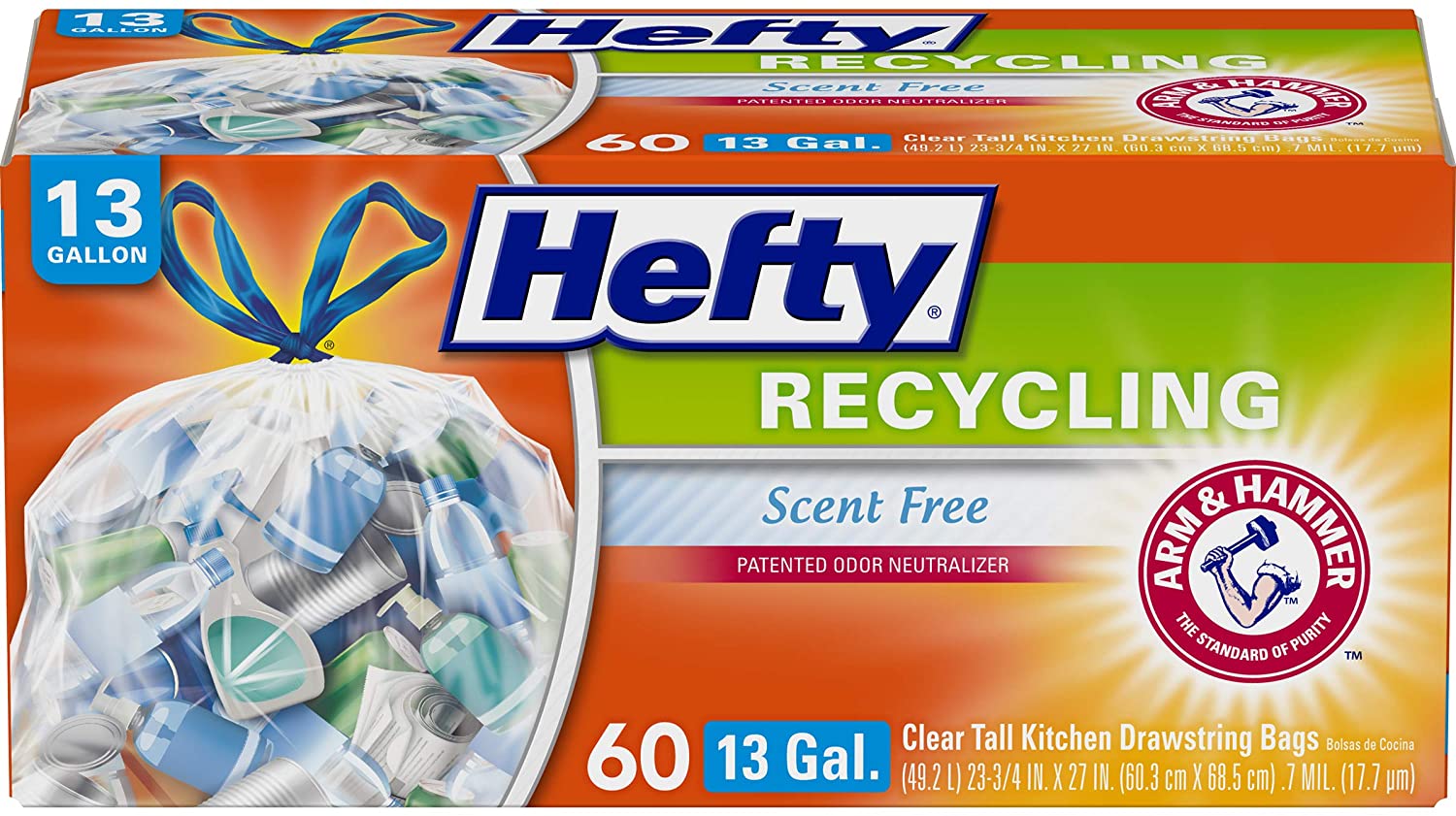
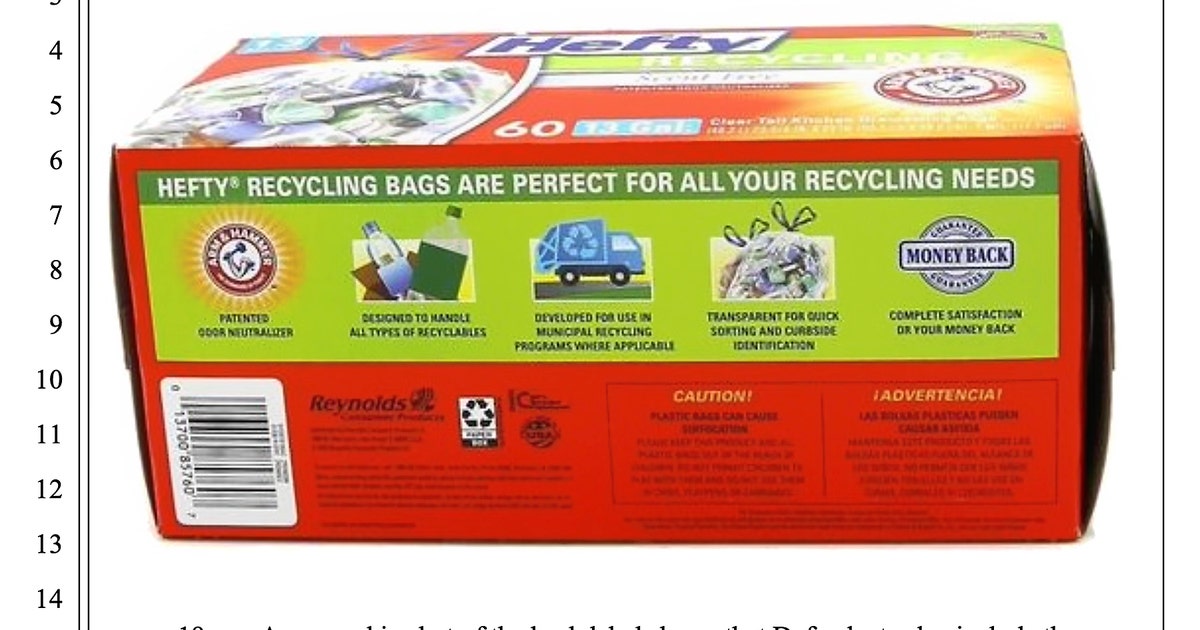
The text printed on the Hefty packaging serves as the primary vehicle for this alleged deception. Boxes have prominently featured the slogan “PERFECT FOR ALL YOUR RECYCLING NEEDS” in capital letters. Another claim states the bags are “DESIGNED TO HANDLE ALL TYPES OF RECYCLABLES.” These absolute statements suggest a universal compatibility that does not exist. The use of the term “Recycling Bags” as the product name itself implies that the bag is a participant in the recycling loop. In reality, the bag is a contaminant. When a consumer fills a Hefty bag with aluminum cans and glass bottles, they are not preparing those items for recovery. They are sealing them in a vessel that most facilities must treat as trash.
Mechanical Failure and Contamination
The operational consequences of these bags entering a sorting facility are severe. As the bags move along conveyor belts, they encounter the star screens. The LDPE film shreds and winds itself tightly around the shafts and stars. This wrapping reduces the gap sizes between the discs, which prevents smaller items like broken glass or bottle caps from falling through to their collection points. The efficiency of the entire plant degrades. To fix this, facility operators must shut down the entire line. Workers are then forced to climb onto the and manually cut the tangled plastic away with box cutters. This process, known as “screen cleaning,” is dangerous, time-consuming, and costly. It represents a direct financial loss to the recycling facility caused specifically by the product Reynolds markets as a recycling aid.
Safety at these facilities further doom the contents of Hefty Recycling bags. MRF workers sort through tons of material moving at high speeds. They are frequently instructed not to open unclear or semi-unclear bags for safety reasons. A sealed bag could contain hypodermic needles, broken glass, or toxic substances. Consequently, when a Hefty bag arrives at a sorting facility, it is frequently pulled off the line intact and sent directly to the landfill or incinerator. The aluminum, paper, and rigid plastics inside, materials that would have been recycled if left loose, are discarded along with the bag. The bag does not recycling. It ensures the disposal of otherwise valuable resources.
Calculated Ambiguity
Reynolds Consumer Products appears to understand the distinction between their products and actual recyclability. The company operates a separate initiative known as the “Hefty ReNew” program (formerly the EnergyBag program), which is specifically designed for hard-to-recycle plastics. This program requires a completely different collection system and does not rely on standard curbside recycling bins. The existence of this separate, specialized program demonstrates that the company possesses the technical knowledge regarding where LDPE film belongs. Yet, they continue to sell the standard “Recycling” bags in grocery store alongside regular trash bags, blurring the lines for the average shopper who absence specialized knowledge of polymer science.
The visual design of the bag further entrenches the misunderstanding. The bags are frequently transparent blue or clear, which Reynolds claims is for “quick sorting and curbside identification.” This feature implies that facility workers see the recyclables inside and process them accordingly. This claim ignores the mechanical reality of the star screens. Even if a worker can see the aluminum cans inside, they cannot risk the bag tangling the. The transparency of the plastic does not alter its tensile strength or its tendency to wrap around rotating parts. The visual cue serves to reassure the consumer at the point of purchase rather than assist the facility at the point of processing.
The legal defenses mounted by Reynolds frequently rely on the fine print. Packaging may include small disclaimers advising consumers to “check locally” or “municipal programs vary.” These qualifiers are dwarfed by the bold, front-of-box claims of perfect recyclability. The Minnesota Attorney General, Keith Ellison, also filed a lawsuit against Reynolds and Walmart in 2023, echoing the charges made in Connecticut. Ellison’s complaint asserted that the bags “render unrecyclable all materials placed within them.” The consistent legal challenges from multiple states suggest a widespread pattern where marketing strategy overrides technical feasibility.
The anatomy of this lie rests on the exploitation of consumer aspiration. Householders buy these bags because they want to recycle more and recycle better. They pay a premium for a product that pledge to organize their waste and help the planet. Reynolds monetizes this good intention by selling a product that creates a bottleneck in the very infrastructure it claims to support. The Hefty Recycling bag is not a passive failure. It is an active agent of contamination, turning clean streams of recyclable metal and paper into mixed solid waste destined for the dump.
Anatomy of a Lie: The LDPE Composition of Hefty 'Recycling' Bags
Marketing Malpractice: Deconstructing the 'Perfect for Recycling' Slogan
The box sits on the shelf in the cleaning. It commands attention with a specific shade of “municipal blue” that consumers have been trained to associate with environmental responsibility. The bold, sans-serif typography screams a pledge that alleviates the modern guilt of consumption: “Perfect for All Your Recycling Needs.” This slogan is not a tagline. It is the of a calculated marketing strategy by Reynolds Consumer Products Inc. to sell a product that is functionally incompatible with the very infrastructure it claims to support. The text “Designed to Handle All Types of Recyclables” frequently accompanies the main slogan. This reinforces the consumer’s belief that the bag itself is a sanctioned part of the recycling chain. The deception begins with a linguistic sleight of hand. Reynolds markets these products as “Recycling Bags.” The average shopper interprets this phrase to mean “bags that are recyclable.” The distinction is subtle yet legally significant. A “Recycling Bag” is a vessel. It is a container intended to hold other things. The company relies on this ambiguity to bypass the strict definition of “recyclable.” If the bag itself is not recyclable, calling it a “Recycling Bag” is technically a description of its *use* rather than its *properties*. This semantic trap allows Reynolds to capitalize on the good intentions of residents who want to sort their waste correctly. The consumer buys the bag. They fill it with aluminum cans and PET bottles. They place it in the curbside bin. They believe they have performed a virtuous act. In reality, they have just introduced a “tangler” into the waste stream that may condemn the entire load to the landfill. Visual engineering plays a massive role in this malpractice. The packaging frequently features imagery of the bag filled with pristine, recognizable recyclables like water bottles and cardboard. The bags themselves are frequently transparent blue or clear. This transparency is marketed as a feature for “quick sorting and curbside identification.” The implication is that sanitation workers see the recyclables inside and know exactly what to do. This ignores the mechanical reality of Material Recovery Facilities (MRFs). Optical sorters and star screens do not “see” the cans inside the bag. They see a flexible, low-density polyethylene (LDPE) sheet that wraps around rotating gears. The visual language of the packaging suggests a with municipal systems. The operational reality is a series of jams, fires, and manual excisions by workers wielding box cutters. The “municipal recycling programs” claim is another pillar of this deceptive architecture. The packaging frequently states the bags were “developed for use in municipal recycling programs where applicable.” This phrase “where applicable” serves as a liability shield. It places the load of verification on the consumer. The shopper standing in Target or Walmart is expected to know the specific polymer acceptance policies of their local MRF. Reynolds knows that the vast majority of curbside programs in the United States strictly prohibit plastic bags of any kind. By suggesting the product was “developed for” these programs, Reynolds implies a partnership or technical compatibility that simply does not exist in most jurisdictions. The disclaimer is a legal parachute. The headline is the sales pitch. Legal challenges have exposed the internal contradictions of these marketing claims. In June 2022, Connecticut Attorney General William Tong filed a lawsuit against Reynolds Consumer Products. The complaint alleged that the “Perfect for All Your Recycling Needs” slogan was false and deceptive. Tong explicitly stated that the bags were “incompatible with recycling facilities” and “no more recyclable than any other Hefty garbage bag.” The lawsuit argued that Reynolds knew their product was a contaminant. They knew it caused malfunctions. Yet they continued to print “Recycling” in massive letters on the box. The between the marketing message and the engineering reality was not an oversight. It was a revenue strategy. Minnesota Attorney General Keith Ellison followed with a similar lawsuit in June 2023. His office targeted both Reynolds and Walmart. The complaint detailed how the marketing defrauded consumers who paid a premium for “recycling” bags that actually rendered their recyclables unrecoverable. When a facility receives a tied Hefty bag, they cannot open it. The risk of injury to workers and the speed of the conveyor belts mean that most bagged recyclables are pulled off the line and sent directly to the incinerator or landfill. The marketing pledge “recycling made easy.” The outcome is “recycling made impossible.” The consumer pays extra for the privilege of ensuring their waste is not recycled. The timeline of these marketing claims reveals a stubborn refusal to adapt to material realities. For years, industry groups and facility operators have pleaded with the public: “No plastic bags in the recycling bin.” Reynolds countered this educational campaign with millions of dollars in advertising that encouraged the exact opposite behavior. They placed the “Recycling” bag right to the standard trash bags. They used the same “strong” and “dependable” branding. This normalization of the recycling bag creates a false equivalence. Consumers assume that if a major brand sells a bag for recycling, the system must be designed to handle it. The authority of the brand overrides the instructions of the local municipality. A significant turning point occurred in early 2026. The Arizona Attorney General secured a settlement with Reynolds Consumer Products regarding these deceptive practices. The terms of the settlement were damning for the “Perfect for Recycling” slogan. Reynolds agreed to a packaging redesign that would explicitly state: “These Bags Are Not Recyclable.” This concession is a total of the previous marketing narrative. For a product sold for years as the recycling accessory to carry a warning label admits the central lie. The bag is trash. It always was trash. The marketing was the only thing that distinguished it from a standard liner. The “EnergyBag” program frequently appears in the same marketing ecosystem. This orange bag initiative is sold as a solution for “hard-to-recycle” plastics. Reynolds uses this program to its green credentials. They claim to divert waste from landfills. The reality is frequently incineration in cement kilns. While the blue bags are the primary source of contamination in standard recycling streams, the orange bags serve to muddy the waters further. They reinforce the idea that *all* plastics can be put in a Hefty bag and “recycled” in way. This dilutes the strict “no bags” message that MRFs try to enforce. The marketing creates a spectrum of “recyclability” that confuses the consumer and benefits the manufacturer. Retailer complicity amplifies the deception. These boxes are not hidden in a specialty section. They are eye-level staples in the waste management. The placement validates the claims on the box. A shopper sees “Hefty Recycling” to “Glad ForceFlex” and assumes both are functional products for their respective tasks. The retailer knows the local recycling guidelines. They know the bags are banned in the local bins. Yet they stock the product because it sells. The “Perfect for Recycling” slogan moves units. It taps into the aspirational identity of the shopper. People want to be “good recyclers.” Reynolds sells them the costume of a good recycler while selling the facility a nightmare. The font size of the disclaimers is a study in cynicism. “Where applicable” or “Check locally” is printed in microscopic text. The word “RECYCLING” is visible from twenty feet away. This hierarchy of information is deliberate. It ensures that the primary takeaway is positive and affirmative. The doubts and restrictions are relegated to the bottom of the back panel. A consumer would need to pick up the box, turn it over, and read the fine print to understand that the product might not work as advertised. Most consumers do not conduct a forensic analysis of trash bag packaging. They grab the blue box and move on. Reynolds banks on this speed. The persistence of the “Recycling” label even after the 2021 and 2022 lawsuits shows the profitability of the lie. Reynolds fought to keep the branding. They argued that “recycling” referred to the act of collecting, not the destination of the material. This legalistic defense ignores the common understanding of the word. To a regular person, “recycling” implies a circular economy. It implies that the material be used again. It does not imply “wrapping around a gear shaft and shutting down a plant for four hours.” The gap between the technical definition Reynolds uses in court and the colloquial definition they use on the shelf is where the profit lies. The 2026 mandate to print “These Bags Are Not Recyclable” on the box in Arizona creates a fractured marketplace. Reynolds must explain why a bag is “Perfect for Recycling” in one state “Not Recyclable” in another. The material physics of LDPE do not change across state lines. A bag that tangles a screen in Phoenix tangle a screen in Hartford. The settlement exposes the universality of the problem. The marketing was never about regional differences in infrastructure. It was about a universal deception regarding the nature of the film plastic. The psychological impact on the consumer is. When a resident learns that their “recycling” bag actually caused their recyclables to be landfilled, they feel betrayed. This trust in the entire recycling system. If the “Recycling” bag is a lie, what else is a lie? Is the bin a lie? Is the truck a lie? Reynolds’ marketing malpractice does not just sell a bad product. It poisons the well of public participation in waste diversion. It cynically exploits the desire to do good, turning it into a method for pollution. The “Perfect for Recycling” slogan go down as one of the most audacious examples of greenwashing in the history of consumer packaged goods. It was a lie printed in bold, municipal blue, sold for $8. 99 a box.Marketing Malpractice: Deconstructing the 'Perfect for Recycling' Slogan
Machinery Malfunctions: The Operational Cost of Bag Entanglement at MRFs
The Mechanics of Entanglement
The physical reality of a Material Recovery Facility (MRF) contradicts the glossy pledge found on Hefty packaging. Inside these facilities, a complex series of conveyor belts, disc screens, and optical sorters separate paper, glass, and metals. This system relies on and geometry. Disc screens, consisting of rotating shafts with rubber or steel discs, bounce rigid containers over the top while allowing flat paper products to fall through the gaps. Hefty ‘Recycling’ bags, made of low-density polyethylene (LDPE) film, disrupt this process with mechanical precision. They do not behave like rigid containers or flat paper. Instead, they act as “tanglers.”
When these bags hit the spinning shafts of a disc screen, they wrap tight. The film lashes around the gears, upon, until the gaps between the discs are completely sealed. This phenomenon, known in the industry as “screen blinding,” renders the equipment useless. Smaller recyclables that should fall through the screens, such as broken glass or small paper scraps, instead ride over the top of the clogged discs, contaminating the stream of larger containers. The bags do not fail to recycle; they actively destroy the sorting capability of the facility. The equipment, designed to process tons of material per hour, grinds to a halt because a flexible film product was never meant to pass through a system built for rigid objects.
The Financial Drain of Downtime
The economic consequences of this entanglement are immediate and severe. Facility operators cannot simply push a button to clear the jam. They must shut down the entire processing line. In Phoenix, city officials reported that their sorting facility had to stop operations multiple times a day specifically to cut these bags out of the gears. This downtime costs the city hundreds of thousands of dollars annually. Every minute the belt stops is a minute of lost revenue and wasted labor. The fixed costs of running a facility, electricity, staffing, maintenance, continue to accrue even when the line is silent.
Data from New York City offers a clear comparison of these costs. Collecting and processing standard refuse costs approximately $126 per ton. yet, when a load of recyclables becomes contaminated, frequently by film plastics like Hefty bags, the cost to transport and dispose of that rejected load can skyrocket to over $766 per ton. This price difference arises because the contaminated material must be re-hauled to a landfill, incurring double the transportation fees and tipping charges. On a national, the cost of contamination in recycling streams reaches an estimated $300 million to $3. 5 billion per year. of this expense links directly to the labor and equipment damage caused by film plastics that should never have entered the bin.
The Human Cost of Manual Extraction
The load of Reynolds’ marketing decisions falls most heavily on the workers inside these facilities. When a screen becomes blinded by wrapped bags, the only solution is manual extraction. This is a dangerous and grueling task. Workers must execute a “lockout/tagout” procedure, completely de-energizing the massive sorting apparatus to ensure it does not activate while they are inside. They then climb onto the sharp, dirty discs and use box cutters or utility knives to slice through of fused plastic film. This process, frequently performed in cramped and dimly lit spaces, exposes employees to serious safety risks.
Injuries are common. The repetitive motion of sawing through thick plastic leads to musculoskeletal disorders, while the environment itself presents slip and fall risks. also, the bags frequently conceal other dangerous items. A worker cutting away a Hefty bag might encounter broken glass, hypodermic needles, or toxic substances trapped within the of film. Studies indicate that injury rates in recycling facilities are significantly higher than in other industrial sectors, with workers facing exposure to heavy metals and respiratory irritants. By encouraging consumers to place these bags in curbside bins, Reynolds outsources the dangerous job of waste separation to low-wage workers who must physically wrestle the product out of the gears.
Reynolds’ Knowledge of Incompatibility
Reynolds Consumer Products cannot claim ignorance of these operational realities. The incompatibility of LDPE film with standard curbside sorting equipment is a foundational fact of the waste management industry. Lawsuits filed in Arizona, California, and Connecticut have explicitly this incompatibility. The Arizona Attorney General’s office noted that the bags caused shutdowns at recycling facilities after getting caught in sorting equipment. even with this, Reynolds continued to market the bags as “Perfect for Recycling,” a slogan that implies with existing infrastructure. The company’s internal data and industry interactions would have undoubtedly revealed that their product was a primary cause of facility shutdowns. Yet, the packaging remained on shelves, driving sales at the expense of municipal infrastructure and worker safety.
Operational Impact of Film Plastic Contamination
Operational Factor
Impact of Hefty ‘Recycling’ Bags
Estimated Cost/Risk
Sorting Efficiency
Causes “screen blinding,” blocking proper material separation.
Reduces material recovery rates by 20-30%.
Downtime
Requires full system shutdown for manual removal.
$500, $1, 000 per hour of lost productivity.
Disposal Cost
Contaminated loads rejected and sent to landfill.
Increases cost from ~$126/ton to ~$766/ton.
Worker Safety
dangerous manual cutting of tangled film.
High risk of lacerations, falls, and repetitive.
The disconnect between the marketing message and the industrial reality is absolute. A product sold as a tool to recycling serves instead as a saboteur of the recycling process. The bags do not fail to be recycled; they actively prevent the recycling of other materials. When a facility shuts down to clear a jam, tons of otherwise recyclable paper and plastic bypass the sorting process and are diverted to landfills to prevent a backlog. Thus, the Hefty bag achieves the exact opposite of its stated purpose: it increases the volume of waste sent to landfills and degrades the financial viability of the recycling programs it claims to support.
Machinery Malfunctions: The Operational Cost of Bag Entanglement at MRFs
Minnesota v. Reynolds: The Landmark Lawsuit Exposing Consumer Fraud
The Filing: A State vs. Corporate Fiction
On June 6, 2023, the State of Minnesota, led by Attorney General Keith Ellison, initiated a legal offensive that would pierce the corporate veil of Reynolds Consumer Products Inc. The lawsuit, filed in Ramsey County District Court, did not allege a misunderstanding or a regulatory oversight. It accused Reynolds of orchestrating a calculated campaign of consumer fraud. The complaint contended that the company’s marketing of Hefty “Recycling” bags was not just misleading, actively destructive to the very environmental systems it claimed to support. This legal action marked a decisive shift in how state governments address plastic pollution, moving from passive waste management to aggressive consumer protection litigation.
Attorney General Ellison’s filing asserted that Reynolds, along with retailer Walmart, had violated Minnesota’s Deceptive Trade Practices Act and the Prevention of Consumer Fraud Act. The core of the state’s argument was simple yet devastating: the product sold as a vessel for recycling was, in practice, a contaminant that rendered its contents unrecyclable. By selling a product labeled “Recycling,” Reynolds induced consumers to purchase polyethylene bags that material recovery facilities (MRFs) in Minnesota could not process. The state argued that every time a well-intentioned resident used one of these bags, they were unknowingly sending their recyclable glass, metal, and paper directly to a landfill or incinerator.
The lawsuit highlighted the between Reynolds’ marketing language and the operational reality of waste management. Packaging for Hefty bags featured slogans such as “Perfect for all your recycling needs” and “Developed for use in municipal recycling programs.” The complaint detailed how these statements created a false sense of efficacy for the consumer. The average shopper, seeing the Hefty brand and the universal recycling symbol, would reasonably assume the bag was compatible with their curbside bin. The state’s investigation revealed that Reynolds continued to use this language even while possessing knowledge that standard MRF technology, specifically the star screens and disc screens used to sort materials, cannot handle low-density polyethylene (LDPE) film.
The Eureka Affidavit: Operational Evidence
Central to the state’s case was evidence provided by Eureka Recycling, a non-profit zero-waste organization that processes recyclables for the Twin Cities metro area. The facility’s co-president, Lynn Hoffman, provided testimony that stripped away the marketing gloss to reveal the mechanical chaos caused by these bags. Eureka’s affidavit explained that when Hefty “Recycling” bags enter the sorting line, they do not behave like rigid plastics. Instead, they act like “tanglers,” wrapping tightly around the rotating shafts of the sorting equipment.
The operational cost of this entanglement is measurable and severe. Eureka Recycling estimated that plastic bags, including the Hefty “Recycling” variety, cost their facility approximately $75, 000 annually in lost productivity and revenue. This figure does not account for the physical danger posed to workers. The lawsuit detailed how employees are frequently forced to crawl into the to cut the bags loose by hand, a process that exposes them to sharp objects, moving parts, and the risk of injury. also, the friction generated by bags wrapping around the gears can create enough heat to ignite fires, posing a catastrophic risk to the facility and its staff.
The state used this operational data to Reynolds’ claim that the bags were “developed for use in municipal programs.” If the bags were truly developed for such programs, the complaint argued, they would not be the primary cause of shutdowns and safety risks. The disconnect between the “municipal program” claim and the “municipal nightmare” reality served as the foundation for the fraud charges. The bags were not non-recyclable; they were anti-recyclable, actively negating the value of the aluminum cans and cardboard boxes placed inside them.
Deconstructing the “Green” Mirage
The lawsuit also targeted the visual cues Reynolds used to simulate environmental compliance. The Hefty bags were frequently produced in transparent blue or clear plastic, colors associated with legitimate recycling streams in commercial settings. yet, the complaint noted that in a residential single-stream context, the color of the bag is irrelevant if the material itself clogs the sorters. By mimicking the aesthetics of industrial recycling, Reynolds exploited consumer heuristics, mental shortcuts that equate “blue bag” with “recycling.”
Minnesota’s legal team pointed to the Federal Trade Commission’s “Green Guides,” which advise marketers to avoid unqualified claims of recyclability unless a substantial majority of consumers have access to facilities that can process the item. In Minnesota, no curbside program accepts these bags. The state argued that Reynolds’ blanket marketing ignored this local reality, prioritizing national sales volume over regional truth. The “Recycling” label was not a description of the product’s function, a marketing hook designed to capture the growing demographic of environmentally conscious shoppers.
The deception extended to the instructions on the box. Reynolds encouraged users to “tie the bag” and place it in the bin. The lawsuit explained that this instruction sealed the fate of the recyclables inside. MRFs rely on automated optical sorters and air jets to separate materials. A tied bag hides the materials from these sensors. Even if the bag does not jam the screens, it travels through the system as a “residue” item, trash, and is ejected at the end of the line. The consumer, following Reynolds’ instructions to the letter, ensures that their recycling efforts are futile.
The Settlement: A Precedent for Accountability
In August 2024, after more than a year of litigation, the parties reached a settlement. While Reynolds and Walmart did not admit liability, the terms of the agreement constituted a significant concession to the state’s demands. The settlement imposed a moratorium on the sale of Hefty “Recycling” bags and their Great Value counterparts in Minnesota for two and a half years. This sales ban was a rare and drastic remedy in consumer protection cases, removing the offending product from the shelves entirely rather than simply adding a disclaimer.
The agreement stipulated that if Reynolds chooses to reintroduce the bags to the Minnesota market after the moratorium, the packaging must undergo a radical redesign. The new packaging cannot use the word “Recycling” as a primary descriptor. Instead, it must bear a conspicuous disclosure stating: “These bags are not recyclable.” This requirement forces the manufacturer to advertise the product’s limitation on the front of the box, directly contradicting the previous marketing narrative. The “perfect for recycling” slogan is replaced by a warning label.
Financially, the settlement required Reynolds and Walmart to pay approximately $216, 670. This sum represented the disgorgement of all profits made from the sale of these bags in Minnesota during the relevant period, plus the state’s legal fees. While the dollar amount may appear negligible for a multi-billion dollar corporation, the structure of the payment, stripping 100% of the profits, sends a clear signal. It establishes that deceptive green marketing not yield a return on investment in Minnesota. The settlement also mandated that Reynolds implement an annual “anti-greenwashing” training program for its marketing teams and establish a rigorous legal review process for all future environmental claims.
for the Industry
The Minnesota settlement reverberated beyond the state’s borders. It validated the argument that downstream contamination is a legal liability for upstream manufacturers. By holding Reynolds accountable for the operational failures at MRFs like Eureka, the lawsuit bridged the gap between product design and waste management infrastructure. It challenged the industry standard where manufacturers create products without regard for how they be processed at the end of their life.
This case also exposed the vulnerability of the “store drop-off” defense. Manufacturers frequently that plastic film is recyclable if customers take it to specific collection points at grocery stores. yet, the Hefty bags were explicitly marketed for curbside use (“municipal programs”). The Minnesota lawsuit clarified that theoretical recyclability (via store drop-off) cannot be used to justify deceptive claims about curbside compatibility. If a product is sold for use in a home recycling bin, it must work in that bin.
The victory for the Minnesota Attorney General’s office provided a blueprint for other states. Arizona followed suit with similar litigation, citing the Minnesota case as a reference point. The scrutiny on Reynolds’ marketing materials intensified, forcing the company to reconsider its national strategy. The “Recycling” bag, once a flagship product for the eco-conscious consumer, had become a symbol of corporate greenwashing, a product that promised sustainability delivered only jams, fires, and landfill waste.
Table 4. 1: Key Terms of the Minnesota v. Reynolds Settlement (2024)
Settlement Component
Requirement Details
Sales Moratorium
Complete ban on selling Hefty “Recycling” bags in Minnesota for 30 months (2. 5 years).
Labeling Mandate
Any future sales must include the text “These bags are not recyclable” on the packaging.
Marketing Restrictions
Prohibition of the term “Recycling” as a product name or primary descriptor on the box.
Financial Penalty
Disgorgement of 100% of profits from MN sales ($216, 670 total combined with Walmart).
Corporate Governance
Mandatory annual anti-greenwashing training for marketing staff; new legal review.
Minnesota v. Reynolds: The Landmark Lawsuit Exposing Consumer Fraud
Connecticut's Legal Challenge to the Deceptive 'Recycling' Label
The Connecticut Complaint: A State Versus the “Perfect” Lie
In June 2022, Connecticut Attorney General William Tong launched a legal offensive that stripped away the veneer of eco-friendly branding from Reynolds Consumer Products. While Minnesota’s lawsuit focused broadly on the fraud, Connecticut’s complaint zeroed in on a specific, damning paradox: the Hefty “Recycling” bag is a product that, by its very design, ensures the destruction of the recycling loop it claims to serve. Filed in the Hartford Superior Court, the state’s lawsuit alleged that Reynolds violated the Connecticut Unfair Trade Practices Act (CUTPA) by marketing a product as “perfect for all your recycling needs” when, in reality, it was perfect only for the incinerator. The core of Connecticut’s argument rested on the operational realities of the state’s materials recovery facilities (MRFs). Connecticut relies heavily on single-stream recycling, a system where residents place all recyclables into a single bin. In this environment, the Hefty bag acts not as a vessel for recovery, as a “tangler”, a contaminant that wraps around the rotating gears of sorting. AG Tong’s office presented evidence showing that when these bags arrive at a facility, they are not opened and sorted. Instead, facility operators frequently pull them off the line and discard them intact. The consumer, believing they are paying extra to ensure their waste is recycled, is actually paying a premium to guarantee it is sent to a landfill or waste-to-energy plant.
The “Where Applicable” Defense
Reynolds attempted to shield itself with fine print. The company argued that its packaging included the qualifier “developed for use in municipal recycling programs where applicable.” This defense relied on the premise that the consumer bears the load of verifying local infrastructure capabilities before purchasing a product sold on every supermarket shelf in the state. Connecticut prosecutors dismantled this argument, pointing out that the bags were sold statewide in regions where *no* such facilities existed. The “where applicable” clause, the state argued, was not a genuine disclaimer a legal trapdoor designed to evade liability while capitalizing on the aspirations of environmentally conscious shoppers. The deception was compounded by the visual language of the packaging. The boxes featured the universal chasing-arrows symbol and transparent windows showing perfectly sorted recyclables. These cues created an “intentional expectation,” according to the complaint, that the bag itself was part of the recycling process. In truth, the low-density polyethylene (LDPE) film used for the bags is chemically incompatible with the rigid plastics and paper it holds. Even if the bag did not tangle the, it would still need to be separated and trashed, a labor-intensive step that most facilities cannot afford.
Judicial Rulings and the Question of Willfulness
The legal battle intensified as it moved into 2025 and 2026. In December 2025, Superior Court Judge John Farley denied Reynolds’ motion for summary judgment regarding the deceptive marketing claims. The court found sufficient evidence to suggest that the “Recycling” label was materially misleading to a reasonable consumer. This ruling was a significant blow to Reynolds, forcing the company to face a public trial on the merits of its advertising strategy. Yet, the proceedings also revealed the high bar for proving corporate intent. Judge Farley initially dismissed the state’s claim that Reynolds *knowingly* and *willfully* violated CUTPA, a distinction that affects the severity of civil penalties. The court reasoned that while the marketing was deceptive, the state had not definitively proved that Reynolds executives possessed specific knowledge of the consumer confusion at the time of the violation. Connecticut’s legal team, refusing to accept this limitation, moved for reconsideration in January 2026, arguing that the sheer of the incompatibility, known to industry insiders for decades, implied an unavoidable awareness of the fraud.
Mediation and the 2026 Outlook
By February 2026, the pressure on Reynolds forced a shift in strategy. Facing a May trial date and the prospect of a damaging public examination of its internal communications, the company agreed to enter mediation with the Attorney General’s office. This move signaled a chance retreat from its hardline defense. While Reynolds had already begun quietly altering its packaging—removing the most egregious “Recycling” claims and the chasing-arrows symbol in markets—the state continued to seek disgorgement of profits. The goal was not just a label change, a financial reckoning for years of sales driven by what AG Tong called “intentional misrepresentations.” The Connecticut case stands as a clear example of the disconnect between corporate sustainability narratives and industrial reality. For years, residents filled blue bags with washed glass and flattened cardboard, believing they were participating in a virtuous pattern. The state’s investigation revealed that they were wrapping their good intentions in plastic garbage, destined for the same fate as the rest of the trash.
The Premium Price of Pollution: Quantifying Consumer Financial Damages
The Green Markup: Paying More for Less
Consumers standing in the trash bag face a calculated financial choice. On one side sits the standard Hefty Ultra Strong box. On the other sits the Hefty Recycling box. The latter features bright orange branding and pledge of environmental stewardship. It also commands a significant price premium. Retail data from 2024 and 2025 indicates that well-intentioned shoppers frequently pay between 30 to 50 percent more per unit for Hefty Recycling bags compared to their standard counterparts. A standard 13-gallon Hefty trash bag frequently retails for approximately 15 to 20 cents per unit. The recycling variant frequently exceeds 30 cents per unit. Reynolds Consumer Products monetizes the public’s desire to act responsibly. They attach a higher price tag to a product that is chemically identical to a standard plastic bag yet functionally worse for the recycling stream.
This price difference represents a “sustainability tax” levied by a private corporation. Shoppers believe this premium funds a specialized sorting process or advanced materials. The reality is clear different. The bag is made of Low-Density Polyethylene (LDPE). This material is cheap to produce expensive to manage downstream. The consumer pays extra for the privilege of wrapping their recyclables in a contaminant that ensures those materials are diverted to a landfill or incinerator. Arizona Attorney General Kris Mayes explicitly highlighted this financial injury in a 2026 statement. She noted that Arizonans “paid a premium for these so-called recycling bags when in fact they were paying for something that harmed our ability to recycle.” The transaction is a double fraud. The buyer loses money at the register and loses the environmental benefit they attempted to purchase.
The Municipal Surcharge: Taxpayers Foot the Bill
The financial damage extends beyond the checkout counter. Consumers pay for these bags a second time through their municipal tax bills. When a Hefty Recycling bag enters a Material Recovery Facility (MRF), it becomes a physical hazard. The bag wraps around rotating screens and conveyor belts. This forces facility operators to shut down processing lines to cut the plastic away manually. These shutdowns are not operational annoyances. They are financial for local governments and waste management contractors.
Data from San Jose, California, reveals the of this hidden cost. The city estimated that repairing damages caused by plastic bags in recycling costs approximately $1 million annually. In Phoenix, a recycling firm reported shutting down operations multiple times per day to disentangle plastic bags. This costs the city hundreds of thousands of dollars each year. Estimates suggest that the taxpayer cost to subsidize the collection and subsequent disposal of these problematic bags can reach 17 cents per bag. The consumer buys the bag for 30 cents. They then pay another 17 cents in taxes to remove it from the it destroyed. Reynolds pockets the initial profit while the municipality absorbs the operational losses.
This externalization of costs is a core component of the business model. Reynolds generates revenue from the sale. The local government assumes the liability for the disposal. If the bag works as advertised, the municipality would gain revenue from selling the sorted recyclables. Because the bag fails to perform as advertised, the municipality instead faces increased labor costs and equipment repairs. The “Recycling” bag transforms a chance revenue stream for the city into a guaranteed expense.
Calculated Risk: Reynolds’ Financial Equation
Reynolds Consumer Products operates the Hefty Waste & Storage segment as a financial. Financial reports from 2024 show this segment generating quarterly net revenues between $238 million and $245 million. The “Recycling” line is a niche product within this portfolio yet it serves a specific strategic function. It captures the demographic of eco-conscious consumers who might otherwise abandon plastic bags entirely. By offering a “green” plastic option, Reynolds retains customers who are trying to exit the plastic disposal pattern.
The legal penalties for this deception have historically been negligible compared to the profits generated. In February 2026, Reynolds settled a consumer fraud lawsuit with the State of Arizona. The company agreed to pay $157, 000 to the state and $30, 000 in restitution to consumers. A separate class-action settlement in Illinois capped payments to consumers at $3 million. These figures represent a fraction of a single percent of the company’s annual revenue. For a corporation generating over $1 billion annually in its waste and storage segment, a multi-million dollar settlement is simply a cost of doing business. It is a line item on a balance sheet rather than a deterrent.
The between the corporate profit and the public cost is immense. A single MRF in a major city might incur damages exceeding the total restitution paid to consumers in an entire state. The economic model relies on the fragmentation of these costs. No single consumer loses enough money to justify an individual lawsuit. No single municipality loses enough to bankrupt the city. Yet the aggregate loss across millions of households and thousands of cities creates a massive transfer of wealth. Money flows from environmentally conscious citizens and municipal budgets directly into the revenue stream of Reynolds Consumer Products. The product does not recycle waste. It recycles capital from the public trust into private profit.
Quantifying the “Green” Fraud
Cost Category
Estimated Financial Impact
Bearer of Cost
Retail Price Premium
+30% to +50% per unit
Individual Consumer
MRF Operational Damages
~$1 Million/Year (San Jose est.)
Taxpayers / Municipalities
Disposal Subsidy
~$0. 17 per bag
Taxpayers
Class Action Settlement
$3 Million (Capped Total)
Reynolds Consumer Products
Hefty Segment Revenue
~$1 Billion/Year
Reynolds Consumer Products (Gain)
The table above illustrates the asymmetry of the financial exchange. The penalties levied against Reynolds are static and capped. The costs imposed on the public are continuous and cumulative. Every box sold adds to the municipal load. The Minnesota Attorney General’s lawsuit sought to claw back the profits generated from these sales. This legal strategy acknowledges that the only way to stop the deception is to remove the financial incentive. Until the cost of the fraud exceeds the profit from the premium, the “Recycling” bag remains a rational economic product for Reynolds to sell. It remains a disastrous economic product for everyone else to buy.
Visual Deception: Misappropriating the 'Chasing Arrows' Symbol
The most potent weapon in the Reynolds Consumer Products arsenal is not a chemical polymer, a geometric shape: the Möbius loop. Designed in 1970 by Gary Anderson for a contest sponsored by the Container Corporation of America, the three chasing arrows were intended to represent a public service hierarchy of “Reduce, Reuse, Recycle.” The symbol was placed in the public domain to encourage widespread adoption. Reynolds, yet, has co-opted this open-source iconography to execute a lucrative bait-and-switch. By stamping the universal symbol of recyclability onto products that actively destroy recycling infrastructure, the company exploits a semiotic loophole that costs municipalities millions while generating premium revenue for the Hefty brand. The visual deception begins with the conflation of the Resin Identification Code (RIC) and the recycling instruction. In 1988, the Society of the Plastics Industry ( the Plastics Industry Association) introduced a coding system to identify resin types for manufacturers. They deliberately chose to enclose these numbers—1 through 7—inside the familiar chasing arrows. This design choice created a permanent cognitive trap for the American consumer. A Hefty “Recycling” bag carries the number “4” inside the triangle. To a materials engineer, this simply identifies the product as Low-Density Polyethylene (LDPE). To the average shopper, the triangle overrides the number. The visual language communicates “this object belongs in the blue bin.” Reynolds relies on this automatic cognitive processing. The company knows that if they printed “LDPE – Not Curbside Recyclable” in plain text, sales would collapse. Instead, they use the arrows to imply a circularity that does not exist. This misappropriation is not accidental; it is the central pillar of the product’s. The packaging for Hefty Recycling bags is engineered to reinforce this false equivalence. The boxes feature high-contrast imagery of the bags filled with recyclable items like plastic bottles and aluminum cans. This visual instruction manual tells the consumer: “contain your recyclables in this bag.” The presence of the chasing arrows on the box, and frequently on the bag itself, acts as a seal of approval. It the gap between the consumer’s desire to be sustainable and the physical act of disposal. When a resident sees the arrows, they do not pause to check local municipal codes or examine the microscopic “Check Locally” disclaimer. They trust the symbol. This trust is the method of contamination. The legal system has begun to this visual fraud, most notably through the lens of California’s Senate Bill 343. Enacted to combat exactly this type of “wish-cycling,” SB 343 prohibits the use of the chasing arrows symbol on products unless they are actually collected and processed by programs serving at least 60% of the state’s population. The legislation was a direct response to the plastic industry’s abuse of the symbol. Under these strict “Truth in Labeling” standards, Hefty’s LDPE bags fail the test. They are not widely accepted; in fact, they are widely rejected. The law exposes the gap between Reynolds’ marketing visuals and the operational reality of waste management. By legally tethering the symbol to actual recoverability rather than theoretical material composition, California stripped away the camouflage Reynolds had used for decades. The deception extends beyond the simple blue bag. Reynolds also markets the “Hefty EnergyBag,” a bright orange sack designed for “hard-to-recycle” plastics. Here, the visual coding shifts from the blue/green of recycling to a distinct orange, yet the core pledge remains deceptive. The marketing visuals depict these bags as a sustainable diversion from landfills, frequently using iconography that suggests a technological transformation. In reality, the “energy” derived from these bags frequently comes from incineration in cement kilns—a process that releases greenhouse gases and toxic pollutants. The visual branding of the EnergyBag program sanitizes the dirty reality of burning plastic. It presents incineration as a futuristic “recovery” method, using the same clean, bright aesthetics as the recycling line to mask a process that environmentalists consider a step backward from landfilling. The persistence of the Möbius loop on these products is a calculated defiance of industrial feedback. Material Recovery Facilities (MRFs) have spent years pleading with the public to stop bagging recyclables. The bags tangle in the star screens and disc separators, forcing dangerous manual interventions and facility shutdowns. Reynolds is aware of this operational hazard. Yet, the company continues to prioritize the visual coherence of its “Recycling” product line over the functional viability of the recycling system. Removing the arrows would be an admission that the product is trash. Keeping the arrows maintains the illusion of utility. This decision prioritizes the point-of-sale conversion over the end-of-life disaster. In recent legal actions, including the lawsuit filed by the Arizona Attorney General in 2025, the specific graphic design elements of the Hefty box have come under forensic scrutiny. The complaint highlights how the packaging redesigns—which Reynolds implemented after earlier pressure—still retained the essential deceptive elements. While the company may have tweaked the text to say “Developed for use in participating municipal programs,” the visual hierarchy remained unchanged. The font size of the word “RECYCLING” (or “BLUE BAG” in later iterations) dwarfs the disclaimer. The imagery of the filled bag remains the dominant focal point. The Möbius loop. These elements work in concert to ensure that the consumer’s “net impression” is one of recyclability, regardless of the fine print. The psychology of color plays a serious role in this visual strategy. Hefty use the specific pantone shades associated with municipal waste management—Recycle Blue and Eco Green—to integrate their product into the civic infrastructure visually. A clear bag with a blue drawstring or a translucent blue tint signals “compliance” to the resident. It mimics the color coding of the bins themselves. If Reynolds sold these same LDPE bags in unclear black or hazard yellow, consumers would instinctively hesitate to place them in the recycling stream. The blue tint is not a functional requirement of the plastic; it is a marketing costume designed to help the contaminant blend in with the target stream. also, the “How2Recycle” label, a standardized labeling system intended to provide clarity, has been manipulated. While the label might technically indicate “Store Drop-off” for the film bag, the prominence of the generic chasing arrows elsewhere on the package dilutes this specific instruction. Consumers are cognitive misers; they look for the largest, most obvious cue. A large, generic recycling symbol outweighs a small, complex instruction panel. Reynolds understands this cognitive bias. They design their packaging to pass the “glance test” in the grocery, knowing that a detailed reading of the back panel is rare. The bag is sold on the pledge of convenience—the ability to bag recyclables just like trash—and the visual design supports this convenient lie. The financial of this visual deception are massive. By wrapping a non-recyclable product in the symbols of sustainability, Reynolds commands a price premium. Consumers pay more for “Recycling” bags than for standard trash liners, believing they are purchasing a tool for environmental stewardship. In reality, they are buying a “trojan horse” that smuggles a contaminant into the recycling plant. The premium price is essentially a tax on the consumer’s good intentions, levied by Reynolds through the misuse of a public domain symbol. The company monetizes the very confusion they create, selling the feeling of recycling while selling a product that makes actual recycling impossible. This misappropriation of the chasing arrows also damages the credibility of the recycling system as a whole. When consumers learn that the bags they diligently filled and placed in the blue bin were actually contaminants that may have sent the entire load to the landfill, trust in the system. The symbol, once a beacon of environmental responsibility, becomes a marker of corporate cynicism. Reynolds’ use of the logo contributes to a “boy who cried wolf” effect, where the public becomes skeptical of all recycling instructions. This cynicism lowers participation rates and increases contamination across the board, as residents decide that the rules are arbitrary and the outcomes are rigged., the visual deception of the Hefty recycling bag is a case study in the weaponization of design. It demonstrates how a symbol can be detached from its meaning and attached to its opposite. The Möbius loop on a Hefty bag does not represent a pattern of renewal; it represents a linear route to the incinerator or the landfill, detouring briefly to jam the gears of a sorting facility. By refusing to relinquish this symbol, Reynolds Consumer Products asserts that its right to market a product outweighs the public’s right to a functional recycling infrastructure. The arrows chase themselves endlessly, on a Hefty bag, they lead nowhere.
Direct to Landfill: The Actual Fate of Bagged Recyclables
The Tipping Floor Reality
The journey of a Hefty “Recycling” bag ends almost immediately after it begins at a Material Recovery Facility (MRF). Collection trucks arrive at these massive industrial centers and dump their loads onto the tipping floor. This concrete expanse serves as the point of inspection. Amidst the mountain of loose cardboard, aluminum cans, and plastic jugs, the bright blue or clear Hefty bags stand out. Consumers purchase these bags believing they segregate and protect their recyclables. The visual distinctiveness of the bag suggests a VIP status for the contents inside. The reality is the exact opposite. To a facility operator, that bag represents a singular unit of contamination. It is presumptive waste.
MRFs operate on high-speed conveyor systems designed to sort loose materials based on weight, shape, and material properties. They process anywhere from 15 to 50 tons of material per hour. This velocity prohibits the manual opening of bags. When a Hefty bag hits the tipping floor, facility frequently dictate that it must be removed before it ever reaches the sorting lines. Loaders and pre-sorters are trained to spot these bags and pull them out of the stream. The destination is not a special debagging station. It is the residue pile. This pile consists of non-recyclable trash destined for the landfill or incinerator. The consumer has paid a premium to wrap their recyclables in a shroud that guarantees their disposal.
The Safety Protocol: Why Bags Stay Closed
The refusal to open these bags is not born of laziness. It is a matter of life and safety. MRF operators enforce strict “don’t open” policies to protect their workforce. unclear or semi-transparent bags obscure their contents. While a well-intentioned consumer might fill a Hefty bag with clean aluminum cans, another resident might use the same bag to dispose of hypodermic needles, broken glass, dirty diapers, or toxic chemicals. These risks are common in the waste stream. If a worker were to rip open a bag on a moving line, they risk immediate injury or exposure to biohazards. Needlestick injuries are a specific terror in the waste industry. Reynolds Consumer Products markets these bags as “perfect for recycling,” yet they fail to account for the operational reality that no safety manager allow their staff to blindly tear into plastic sacks.
This safety protocol renders the “recyclable” contents of the bag irrelevant. It does not matter if the bag contains high-value PET plastic or pristine office paper. The containment vessel itself invalidates the value of the materials inside. The bag acts as a poison pill. By enclosing the materials, the consumer removes them from the recovery loop. The Minnesota Attorney General’s lawsuit explicitly highlighted this operational failure. The complaint noted that these bags “rendered unrecyclable all materials that Minnesotans put inside of them.” The state argued that Reynolds profited from good intentions while selling a product that functionally destroyed the recyclability of the items it held.
Optical Sorters and the “Trash” Signal
Bags that survive the initial manual cull on the tipping floor face a second, mechanical rejection. Modern MRFs rely on optical sorters. These sophisticated machines use near-infrared (NIR) spectroscopy to identify materials by their chemical signature. A blast of air then shoots the targeted material into the correct bin. These systems are calibrated to recognize specific resin codes like PET (water bottles) or HDPE (milk jugs). They are designed to see individual items. When a Hefty bag passes under the sensor, the machine encounters a complex problem. It might see the low-density polyethylene (LDPE) of the bag itself. Most curbside programs do not accept LDPE film. The machine identifies the bag as contamination and allows it to pass to the trash line.
Even if the facility accepts film, the optical sorter cannot see through the bag to identify the individual items inside. It sees one large mass. It cannot separate the aluminum can from the glass jar within the sack. The physics of the separation process require materials to be loose and two-dimensional (like paper) or three-dimensional (like containers). A bag is a shapeshifting anomaly that defies these categories. Consequently, the optical sorter treats the entire bundle as residue. The bag travels to the end of the line. It falls into the compactor. It is hauled to the landfill. The technology required to process these bags does not exist in standard municipal recycling facilities. Reynolds marketed a product that is incompatible with the infrastructure used to process it.
The Contamination Multiplier
The presence of Hefty bags also degrades the quality of other recyclables in the stream. When bags tear open during the violent churning of the tipping floor or the metering drum, they release their contents in a clustered, unpredictable manner. Loose film from the torn bag wraps around other items. It binds paper to plastic. It creates “monstrous hybrids” of materials that optical sorters cannot classify. A bundle of paper wrapped in a shred of blue Hefty plastic is no longer recyclable paper. It is mixed waste. The facility must pay to dispose of this contamination. This cost is frequently passed back to the municipality and the taxpayer.
Major waste haulers like Republic Services and Waste Management have spent millions on education campaigns screaming “Don’t Bag It.” Their websites and mailers explicitly list plastic bags as a top contaminant. They plead with residents to keep recyclables loose. Reynolds countered this operational reality with packaging that showed happy families placing the bags curbside. The disconnect between the hauler’s desperate plea for loose items and the manufacturer’s pledge of a “recycling bag” created a chaotic environment. Consumers trusted the brand name on the box over the flyer from their local public works department. The result was a steady stream of bagged material that bypassed the recycling process entirely.
Legal Acknowledgement of the Landfill Destination
The legal system has begun to codify the “direct to landfill” reality. In the 2026 settlement with the State of Arizona, Reynolds was forced to confront the destination of its products. The Arizona Attorney General stated that the bags “caused otherwise-recyclable material placed inside them to be diverted to a landfill.” This was not a theoretical risk. It was the standard outcome. The settlement required Reynolds to place the text “These Bags Are Not Recyclable” on the packaging. This admission unraveled decades of marketing. It confirmed that the bag was never a vehicle for recycling. It was a vehicle for trash that looked like recycling.
Connecticut’s lawsuit provided similar clarity. Attorney General William Tong did not mince words when he filed suit. He declared that “Hefty Recycling Bags are not recyclable, and any recyclable items inside them are tossed on the trash heap.” The state’s investigation found that the bags were incompatible with every single MRF in Connecticut. There was no exception. The “recycling” label was a fabrication that led directly to the dump. The consumer paid for the bag. They paid for the recycling service. They paid for the eventual landfill tipping fee. Reynolds collected the profit from the transaction and left the consumer and the municipality to pay for the waste management failure.
The Financial and Environmental Irony
The environmental cost of this deception exceeds the mere volume of plastic in the bag itself. By bagging recyclables, consumers inadvertently increase the carbon footprint of their waste. A truck must burn diesel to collect the heavy bag. The MRF burns electricity to convey and sort it. The facility then burns more fuel to transport the rejected bag to a landfill., the landfill manages the methane emissions from the decomposing organic matter that frequently sneaks into these unclear sacks. If the consumer had simply thrown the items in the trash, the result would have been the same, yet the system would have saved the energy used in the futile sorting attempt.
The financial damages are equally perverse. Municipalities pay MRFs based on the quality of the recycling stream. High contamination rates lead to higher fees for the city. Hefty bags are a primary driver of this contamination. Therefore, a city with high usage of Hefty recycling bags likely pays more to process its recycling than a city where residents throw items loosely into the bin. The citizens are taxed twice for the privilege of being deceived. They buy the expensive bags. Then they pay higher municipal taxes to cover the cost of removing those bags from the recycling stream. Reynolds Consumer Products successfully monetized the public’s desire to do good. They sold a product that functioned as a sabotage method for the very system it claimed to support.
Fate of Bagged Recyclables at Standard MRFs
Stage of Process
Action Taken
Reason for Rejection
Outcome
Tipping Floor
Manual Removal
Safety hazard (sharps/biohazards), inability to verify contents.
Sent to Landfill
Pre-Sort Line
Manual Removal
Risk of entanglement (star screens).
Sent to Landfill
Optical Sorter
Mechanical Rejection
Bag identified as LDPE film (contaminant) or single mass.
Sent to Landfill
Paper Screen
Cross-Contamination
Flat bags mimic paper, contaminating paper bales.
Rejected by Paper Mill / Landfill
The Orange Bag Scheme: Incineration Marketed as 'Energy' Recovery
The Orange Bag Scheme: Incineration Marketed as ‘Energy’ Recovery
The most audacious component of the Reynolds Consumer Products sustainability narrative is the Hefty EnergyBag program, rebranded in 2023 as Hefty ReNew. Marketed as a revolutionary solution for “hard-to-recycle” plastics, such as flexible films, foam, and multi- pouches, the program encourages consumers to purchase distinct orange bags at a premium price. The pledge is seductive: divert waste from landfills and transform it into “valuable resources.” Yet, an examination of the program’s logistical and chemical reality reveals a method that functions less as a recycling innovation and more as a subsidized fuel supply chain for industrial incinerators. The “energy” recovered in this equation is derived from the combustion of petrochemicals, a process that releases greenhouse gases and toxic pollutants while Reynolds retains the profits from the bag sales.
The central deception lies in the terminology. Reynolds and its partners frequently use the phrase “energy recovery” to describe the fate of the orange bags. To the average consumer, a high-tech, circular process. In practice, “energy recovery” is a regulatory euphemism for burning plastic in cement kilns. When consumers fill an orange Hefty bag with polystyrene foam and candy wrappers, they are essentially packaging solid fossil fuels for heavy industry. Cement kilns, which require immense heat to produce clinker, use these plastic-filled bags as a substitute for coal or coke. While this displaces traditional fossil fuels, it does not constitute recycling in any circular sense. The material is destroyed, its molecular structure obliterated, and its carbon content released into the atmosphere.
The program’s operational history in Boise, Idaho, provides a clear case study of these failures. Launched with significant fanfare in 2018, the Boise program promised to convert the orange bag contents into synthetic diesel through pyrolysis, a form of chemical recycling. The partner facility, Renewlogy in Salt Lake City, claimed it could break down the plastics into liquid fuel. Yet, the technology failed to handle the volume and contamination levels of the municipal waste stream. By 2019, Renewlogy suspended operations to upgrade equipment, leaving Boise with a massive stockpile of collected orange bags. For months, the “recycled” material simply accumulated in storage. When the storage capacity was exhausted and the pyrolysis technology remained non-viable, the city was forced to send the stockpiled bags to a cement kiln in Utah. Residents who had paid for the bags and diligently sorted their waste were unknowingly fueling a combustion chamber, not participating in a circular economy.
Omaha, Nebraska, another flagship city for the program, experienced a similar trajectory where the primary end market was incineration. Investigations revealed that materials collected in Omaha were transported to the Sugar Creek cement plant in Missouri. This facility had a documented history of Clean Air Act violations. By funneling plastic waste to such facilities, the Hefty EnergyBag program transferred the environmental load from the landfill to the airshed. The combustion of plastics, particularly those containing chlorine (like PVC) or additives, generates dioxins, furans, and heavy metals including lead and cadmium. These persistent organic pollutants accumulate in the environment and pose serious health risks to local communities. The “orange bag” serves as a vehicle for distributing toxic emissions under the guise of environmental stewardship.
Reynolds attempts to legitimize this incineration pathway by promoting “advanced recycling” or pyrolysis as the goal. Pyrolysis involves heating plastic in a low-oxygen environment to produce a synthetic crude oil. Proponents this allows plastic to be remade into new plastic. Yet, the thermodynamics and economics of pyrolysis are punishing. The process is energy-intensive, frequently requiring more energy input than the fuel output yields. also, the majority of the output from pyrolysis is not turned back into plastic resin is refined into fuel to be burned. A 2024 investigation by ProPublica highlighted that even in the best-case scenarios, the yield of actual circular plastic from these systems is minuscule, frequently less than 20 percent. The remainder is hazardous waste, char, or fuel for combustion. Consequently, the Hefty program’s reliance on this technology is a bet on an unproven, inefficient method that results in delayed incineration.
The financial structure of the scheme is equally troubling. Reynolds Consumer Products generates revenue upfront by selling the proprietary orange bags to consumers. The cost of these bags is significantly higher than standard refuse liners, a premium the consumer pays for the privilege of “recycling.” Once the bag leaves the curb, the financial load of collection, sorting, and transportation shifts to the municipality and the taxpayer. If the material is burned in a cement kiln, the kiln operator frequently receives the fuel for free or at a nominal cost, subsidizing their energy needs with consumer-purchased plastic. Reynolds successfully monetizes the guilt of the consumer while externalizing the costs of disposal and the environmental damages of combustion.
In 2023, Reynolds rebranded the initiative from “EnergyBag” to “Hefty ReNew.” This semantic shift appears calculated to distance the program from the “energy” (incineration) connotation and align it with the more palatable concept of renewal. even with the name change, the underlying logistics remain heavily dependent on combustion pathways. Life pattern Assessments (LCAs) commissioned by Hefty continue to compare the program’s impact favorably against landfilling by citing the “energy credits” gained from burning the plastic. This accounting method ignores the hierarchy of waste management, where reduction and true mechanical recycling are superior. By validating incineration as a “green” alternative, Reynolds undermines efforts to reduce single-use plastic production, providing a release valve for the industry to continue churning out non-recyclable packaging.
The contamination problem inherent in the program also compromise the safety of the facilities that accept these bags. The orange bags are unclear, making it impossible for workers to visually verify the contents without opening them. Consumers, confused by complex resin codes, frequently include materials that contain PVC or other toxic additives. When these non-compliant plastics are introduced into a pyrolysis reactor or a cement kiln, they can damage equipment and spike toxic emissions. In Boise, the contamination rate was reported to be as high as 18 to 20 percent. This high level of impurity was a contributing factor to the operational failures at the Renewlogy plant. The program relies on an unrealistic expectation of consumer perfection in sorting complex industrial materials.
The visual distinction of the orange bag also creates a false sense of security for the consumer. It acts as a psychological absolver. A household can continue to purchase single-use items, squeeze pouches, plastic cutlery, foam cups, believing that the orange bag neutralizes the environmental harm. This “moral licensing” encourages the consumption of the very materials that waste experts should be phased out. Reynolds, as a manufacturer of both the disposable products (plastic wrap, slider bags) and the “solution” (orange bags), benefits from both sides of the transaction. The company creates the waste and then sells the remedy, a remedy that consists of burning the evidence.
Legal scrutiny of these practices is intensifying. The Federal Trade Commission’s Green Guides strictly regulate the use of “recycling” claims. If a product is burned for energy recovery, it cannot be marketed as recycled. Reynolds navigates this by using careful phrasing like “recovered resources” or “alternatives to landfill,” yet the placement of the bags in the recycling and the use of the chasing arrows symbol on the packaging creates an implied claim of recycling. The disconnect between the consumer’s understanding of recycling (material turned into new material) and the program’s reality (material turned into smoke and ash) constitutes a serious breach of trust. The rebranding to “ReNew” does little to alter the physical reality that the program is a linear disposal method masquerading as a circular loop.
The failure of the pyrolysis partners to also exposes the fragility of the “advanced recycling” narrative. When the specialized facilities shut down or refuse material, the fallback is always incineration or landfilling. In 2020, when Boise’s partner failed, the city had to admit that the “recycling” program was a storage-then-burn operation. This absence of resilience in the supply chain proves that the infrastructure for chemical recycling is immature and unreliable. Reynolds continues to sell the bags nationwide, expanding the program to new markets like Atlanta and Cincinnati, even as the end-market solutions remain tenuous and environmentally damaging.
, the Orange Bag scheme represents a commodification of pollution. It transforms the act of disposal into a premium product. By convincing consumers that incineration is a form of environmental heroism, Reynolds Consumer Products Inc. protects its core business of selling single-use plastics. The smoke rising from the cement kilns in Missouri and Utah contains the molecular remains of this deception, a testament to a marketing strategy that prioritized sales over sustainability. The program does not solve the plastic emergency; it incinerates it, leaving the public to pay the price in both dollars and air quality.
Regulatory Crackdown: Mandating the 'Not Recyclable' Disclaimer
Regulatory Crackdown: Mandating the ‘Not Recyclable’ Disclaimer
The era of unchecked greenwashing for Reynolds Consumer Products did not end with a voluntary correction or a quiet rebranding; it ended with a court order. After years of profiting from the confusion of well-intentioned consumers, the legal walls closed in on the Hefty “Recycling” bag in the mid-2020s. State attorneys general, armed with mounting evidence of contamination at material recovery facilities (MRFs), moved beyond fines to demand the one thing Reynolds fought hardest to avoid: explicit, on-package admissions that their product was trash. The major domino fell in Minnesota. In August 2024, Attorney General Keith Ellison secured a settlement that fundamentally altered the trajectory of the product. The terms were bruising. Reynolds and Walmart were forced to halt sales of the deceptively labeled bags in the state for two and a half years. The agreement stipulated that if sales ever resumed, the packaging could no longer bear the title “Recycling Bags.” Instead, they required a conspicuous, humiliating disclaimer: “These bags are not recyclable.” This was not fine print to be buried on the back panel; it was a mandated badge of non-compliance, stripping the product of its primary. The settlement also forced the disgorgement of $216, 670 in profits—a financial pinprick compared to Reynolds’ revenue, a legal precedent that shattered their defense. Arizona followed with even greater aggression. In February 2026, Attorney General Kris Mayes announced a settlement that dictated the visual design of the product on a national. The Arizona consent judgment went further than Minnesota’s, targeting the subconscious cues Reynolds used to imply environmental virtue. The company agreed to remove all imagery depicting the bags filled with recyclable items like aluminum cans and plastic bottles—visuals that had long suggested the bag and its contents were a single, processable unit. also, Reynolds was forced to abandon the use of green backgrounds for specific text elements, a color universally associated with sustainability, replacing it with a neutral blue. The most damning requirement remained the front-of-box label: “These Bags Are Not Recyclable.” This regulatory pincer movement exposed the fragility of Reynolds’ marketing strategy. For years, the company relied on the “Chasing Arrows” symbol and the word “Recycling” to do the heavy lifting. With those elements legally toxic, they were forced to pivot to a defensive, legalistic tagline: “Developed for use in participating municipal programs only.” This shift attempted to transfer the load of verification back to the consumer, implying that the bag *could* work if only the local municipality were sophisticated enough. In reality, the vast majority of municipal programs explicitly banned the bags. The new label was technically accurate practically useless for the average shopper, serving as a liability shield rather than a helpful instruction. California provided the legislative anvil against which these lawsuits hammered. Senate Bill 343, the “Truth in Labeling” law, set a deadline of October 2026 for strict enforcement of recyclability claims. The law prohibited the use of the chasing arrows symbol on any product that did not meet a high threshold of real-world recycling rates and collection access—metrics LDPE film miserably failed. Under SB 343, a product could not be labeled recyclable unless 60% of the state’s population had access to a program that collected *and* processed it. Since Hefty bags were routinely pulled off sorting lines and sent to landfills to prevent jams, they could not meet this standard. The law codified the settlements, turning what was a state-by-state legal battle into a widespread ban on the deceptive iconography. The financial damages from these settlements—$216, 670 in Minnesota, roughly $212, 000 in Arizona—were negligible for a corporation of Reynolds’ size. yet, the operational cost of the “Not Recyclable” mandate was catastrophic. The product’s entire identity was built on the premise of facilitating recycling. By forcing the company to print a negation of that premise on the box, regulators destroyed the “warm glow” benefit that justified the bag’s premium price. Consumers were no longer buying a tool for sustainability; they were buying a plastic sack that openly admitted it was part of the problem. Reynolds attempted to salvage the brand by leaning into the “Hefty ReNew” orange bag program, which promised to turn hard-to-recycle plastics into building materials. Yet, even this pivot was scrutinized under the new regulatory frameworks, as the “Not Recyclable” disclaimer on the blue bags cast doubt on the efficacy of the entire product line. The regulatory crackdown proved that while a corporation can manufacture a lie, it cannot mandate that the recycling infrastructure accept it. The “Not Recyclable” label stands as a permanent scar on the packaging, a testament to the years when Reynolds sold pollution packaged as a solution.
Municipal Rejection: Why Material Recovery Facilities Reject Hefty Bags
The operational reality of a Material Recovery Facility (MRF) is a violent, high-speed industrial ballet where tons of mixed waste careen down conveyor belts at speeds of up to 30 miles per hour. In this environment, the Hefty “Recycling” bag is not a vessel of sustainability; it is a saboteur. While Reynolds Consumer Products markets these bags as the “perfect” solution for curbside collection, facility managers and municipal waste directors view them as a primary operational hazard. The rejection of these bags is not a matter of preference of mechanical survival for the facilities tasked with processing the nation’s waste. The core of the conflict lies in the mechanics of single-stream recycling. Modern MRFs use a series of rotating discs, known as star screens, to separate flat materials like paper from three-dimensional containers like bottles and cans. When a Hefty bag enters this system, it does not behave like a rigid container. Instead, it acts as a “tangler.” The low-density polyethylene (LDPE) film wraps tightly around the rotating shafts and discs, cinching down like a tourniquet. Within hours, these bags can clog the screens entirely, bringing the entire plant to a grinding halt. This is not a theoretical inconvenience. In facilities from Ann Arbor, Michigan, to Phoenix, Arizona, the “Hefty jam” is a daily operational emergency. When the screens become fouled, the facility must shut down all processing. Workers are then forced to execute a dangerous protocol: climbing into the with box cutters to manually slice the fused plastic from the steel shafts. This process, frequently required multiple times per shift, costs municipalities thousands of dollars in lost productivity and exposes workers to significant injury risks. The irony is clear: the product sold to consumers as a way to “help” the recycling process is frequently the single biggest obstacle to its function. Beyond the mechanical entanglement, Hefty bags defeat the optical sorting technology that serves as the brain of a modern MRF. Optical sorters use near-infrared (NIR) sensors to identify the chemical signature of materials in milliseconds, firing jets of air to divert them into the correct bunkers. These sensors, yet, cannot see through the blue or clear tinted plastic of a Hefty bag to identify the aluminum can or PET bottle inside. To the optical sorter, the bag is an unidentifiable anomaly. Worse, the bag itself frequently confuses the sensors. Because LDPE film is lightweight and flat, the frequently misidentifies it as paper. The air jets then fire incorrectly, blasting the plastic bag—and the recyclables trapped inside it—into the paper stream. This results in the contamination of paper bales, which are the financial lifeblood of recycling programs. When a paper mill receives a bale with plastic Hefty bags, the entire load may be rejected and sent to a landfill, rendering the recycling effort of thousands of residents futile. The safety of MRFs further ensure that Hefty bags are rejected. Facility managers instruct workers strictly: *do not open plastic bags.* This “blind toss” policy is a non-negotiable safety measure. A sealed Hefty bag, even with its semi-transparent marketing, can conceal anything from hypodermic needles and broken glass to diapers and rotting food. The risk of needle sticks or exposure to hazardous waste is too high to justify the labor required to debag the material. Consequently, when a sorter spots a Hefty recycling bag on the pre-sort line, the standard procedure is to grab it and throw it directly into the residue chute. The bag, along with the clean, recyclable materials the consumer dutifully washed and sorted, travels a straight line from the curb to the landfill compactor. Municipalities have begun to publicly revolt against Reynolds’ narrative. The Connecticut Department of Energy and Environmental Protection (DEEP) supported the state’s lawsuit against Reynolds, explicitly stating that the bags are “detrimental and unsafe” for staff and equipment. In Washington State, the Department of Ecology’s “Recycle Right” campaign features a blunt directive: “Don’t Bag Your Recyclables.” The City of Columbus, Ohio, faced such severe contamination problem that it had to clarify its haulers would not even collect certain bagged materials, leaving them on the curb. This municipal rejection is absolute. In Massachusetts, the “Recycle Smart” initiative lists “bagged recyclables” as a top contaminant, right alongside garden hoses and bowling balls. The disconnect is total: Reynolds sells a product that claims to recycling, while the entities actually doing the recycling are begging consumers to stop using it. The “Perfect for Recycling” slogan is not just a marketing exaggeration; it is a direct contradiction of the operational mandates of the waste management industry. Every Hefty bag sold represents a chance jam, a safety hazard, and a guarantee that the materials inside never be recycled.
Operational Impact of Hefty Bags on MRF Efficiency
Operational Hazard
method of Failure
Outcome
Screen Blinding
Bags wrap around rotating star screen shafts.
shutdown; manual removal required.
Optical Error
Sensors cannot identify materials inside bag.
Recyclables diverted to trash or wrong stream.
Paper Contamination
Flat bags mimic paper behavior in air classifiers.
Plastic pollutes paper bales; bales rejected by buyers.
Safety Rejection
unclear/sealed bags hide chance sharps/risks.
Workers instructed to toss bags unopened into landfill.
Corporate Greenwashing: Contrasting Reynolds' Sustainability Reports with Reality
SECTION 12 of 14: Corporate Greenwashing: Contrasting Reynolds’ Sustainability Reports with Reality
Reynolds Consumer Products Inc. constructs a sophisticated facade of environmental stewardship through its annual Environmental, Social, and Governance (ESG) reports. These glossy documents, replete with stock imagery of pristine nature and smiling families, present a narrative of a corporation deeply committed to a “circular economy” and “waste diversion.” A forensic examination of these claims, when juxtaposed with the operational realities at Material Recovery Facilities (MRFs) and the legal findings from multiple state attorneys general, reveals a chasm between corporate rhetoric and the physical truth of their products. The company’s stated ambition to “simplify daily life and protect the environment” collapses under the weight of verified contamination data and court-mandated label retractions.
The Fiction of the ‘Circular Economy’
In its 2023 and 2024 integrated reports, Reynolds pledged to reduce Scope 1 and 2 greenhouse gas emissions by 25 percent by 2030, using a 2021 baseline. The corporation frequently cites its Hefty ReNew program (formerly the EnergyBag program) as a primary vehicle for achieving these sustainability. The marketing literature describes this initiative as a method to divert “hard-to-recycle” plastics from landfills, converting them into “valuable resources.” This language suggests a closed-loop system where plastic waste finds new life as useful material. The reality is far more combustion-heavy. Independent investigations and criticisms from environmental groups like GAIA and the Sierra Club identify the end destination for of these orange bags not as manufacturing plants, as cement kilns and pyrolysis facilities. Here, the plastic is incinerated. Burning plastic releases toxic emissions and greenhouse gases, a process that directly contradicts their stated goal of emission reduction. Labeling incineration as “recycling” or “energy recovery” allows Reynolds to claim diversion rates that mask the destructive nature of the disposal method.
The extends to their flagship Hefty “Recycling” bags. For years, Reynolds’ sustainability sections touted these blue and clear bags as tools to “simplify sorting” and “support municipal programs.” The 2021 and 2022 reports emphasized the company’s partnership with the Sustainable Packaging Coalition, implying a rigorous adherence to industry best practices. Yet, simultaneous to these publications, the company faced lawsuits in Minnesota, Connecticut, and California precisely because these products did the opposite of what was claimed. While the ESG reports celebrated ” product solutions,” MRF operators reported that these very bags were the primary cause of jams, requiring dangerous manual intervention to cut them loose from sorting screens. The “perfect for recycling” claim found on consumer packaging was not an engineering fact a marketing fabrication that ignored the mechanical limitations of standard recycling infrastructure.
Regulatory filings vs. Operational Impact
Table 12. 1: Reynolds’ Sustainability Claims vs. Verified Operational Reality
Corporate Claim (Source: ESG Reports)
Operational Reality (Source: Legal/MRF Data)
Environmental Consequence
“Designed to handle all types of recyclables”
Bags are made of LDPE (plastic film), which is a “prohibited contaminant” in most curbside bins.
Entire loads of recyclables are rejected and sent to landfills due to film contamination.
“Perfect for municipal recycling programs”
MRF jams; workers face injury risks cutting bags from rotating screens.
Increased processing costs for taxpayers; reduced facility efficiency.
“Diverting waste from landfills” (Hefty ReNew)
Plastics are frequently shipped to cement kilns for incineration.
Release of microplastics and toxic exhaust; “diversion” is technically burning.
“Transparent for quick sorting”
Optical sorters cannot read through the bag; manual sorters cannot rip them open in time.
Valuable recyclables inside the bag are lost to the trash stream.
The 2030 and the Incineration Loophole
Reynolds’ commitment to a 25 percent reduction in greenhouse gas emissions faces scrutiny when one considers the lifecycle of their “sustainable” solutions. The Hefty ReNew program relies on the combustion of plastic waste to generate fuel for heavy industry. While this technically keeps the material out of a hole in the ground, it transfers the pollution from the soil to the atmosphere. Classifying this process as a sustainability win requires a manipulation of definitions that environmental advocates constitutes greenwashing. The company’s reports frequently aggregate “recovery” data, blending mechanical recycling (turning plastic into plastic) with energy recovery (burning plastic). This obfuscation prevents shareholders and the public from understanding what percentage of the material is actually preserved and what percentage is simply destroyed.
The 2025 goal to use “recyclable or reusable packaging” for all branded products also withers under inspection. As the Arizona Attorney General’s 2026 settlement demonstrated, Reynolds was forced to redesign its packaging to explicitly state, “These Bags Are Not Recyclable.” A product cannot be part of a sustainable packaging goal if its very existence contaminates the recycling stream it enters. The company’s insistence on using the “chasing arrows” symbol on products that are chemically or mechanically incompatible with municipal systems suggests that their sustainability strategy is driven more by sales volume than by genuine environmental engineering. The “recyclable” label serves as a permission structure for eco-conscious consumers to buy more plastic, believing they are participating in a virtuous pattern, when they are frequently funding the production of landfill fodder.
Monetizing Consumer Guilt
The most cynical aspect of Reynolds’ greenwashing lies in the financial exploitation of consumer intent. The “Recycling” bags are sold at a premium price point compared to standard trash bags. This price difference represents a “green tax” that consumers willingly pay, believing they are funding a specialized environmental service. In reality, they are paying extra for a product that increases the cost of waste management for their local municipalities. The Minnesota lawsuit highlighted this fraud, noting that the bags rendered otherwise recyclable materials unrecyclable. Reynolds’ financial reports record these sales as revenue growth driven by “sustainable product options,” monetizing the deception. The company profits twice: once from the sale of the bag, and again from the brand equity built on false environmental claims.
Even with the mounting legal pressure and the forced label changes in specific states like Arizona and Minnesota, the company’s national marketing strategy retains the core elements of this deception where legally permissible. The sustainability reports continue to highlight the volume of waste “diverted” without clarifying the method of diversion. By focusing on the metric of weight, tons of plastic kept out of landfills, Reynolds avoids the more damaging metric of carbon intensity. Burning a ton of plastic releases a specific and calculable amount of CO2, yet this figure is rarely foregrounded in the glossy highlights of their ESG scorecard. The narrative of “giving plastics a second life” conveniently omits that the second life is frequently a brief, toxic flash in a cement kiln.
The disconnect between Reynolds’ corporate literature and the physical reality of waste management is not an error of omission; it is a structural feature of their business model. To admit the non-recyclability of their core film products would be to admit that their business is fundamentally linear in a world demanding circularity. Thus, the sustainability report becomes a tool of obfuscation, a document designed to reassure investors and regulators while the physical products continue to clog the gears of the actual recycling infrastructure.
The 'Clear Bag' Fallacy: Transparency Claims vs. Processing Limitations
The ‘Clear Bag’ Fallacy: Transparency Claims vs. Processing Limitations
Reynolds Consumer Products Inc. constructed a marketing narrative suggesting that the transparency of their Hefty ‘Recycling’ bags served a functional purpose in the recycling stream. The packaging explicitly claimed the bags were “transparent for quick sorting and curbside identification,” implying that because waste haulers and facility workers could see the aluminum cans and plastic bottles inside, the materials would be recovered. This claim relies on a fundamental misunderstanding, or intentional misrepresentation, of how modern Material Recovery Facilities (MRFs) operate. In reality, the optical clarity of the bag is irrelevant to the mechanical and safety that dictate its fate. To a high-speed sorting line, a clear LDPE bag is physically identical to a black trash bag: a contaminant that must be removed immediately.
The Optical Sorting Failure
Modern MRFs use Near-Infrared (NIR) optical sorters to identify materials based on their light reflection signatures. These machines process tons of waste per hour, using air jets to blast specific materials into separate bins. Reynolds’ marketing suggested that the transparency of the bag would allow these machines or human sorters to identify the contents. This is false. When an optical sorter scans a Hefty bag filled with recyclables, the sensor primarily detects the outer: the Low-Density Polyethylene (LDPE) film. It does not “look through” the plastic to catalog the individual items inside. The machine identifies the object as “film,” which is a prohibited material in most curbside single-stream systems. Consequently, the entire bag, contents included, is ejected as residue. If the machine fails to eject it, the bag continues down the line to wrap around the rotating star screens used to separate paper from containers. The transparency of the film does not alter its tensile strength or its propensity to tangle. A clear bag jams a rotor just as as an unclear one.
Safety Override Visibility
Reynolds’ “quick sorting” claim also presumes that human workers slice open bags to retrieve recyclables if they can see valid materials inside. This assumption violates standard industry safety. MRF workers are trained to treat all closed bags as safety risks. Bags frequently contain hypodermic needles, broken glass, toxic chemicals, or biohazards like diapers. The transparency of a Hefty bag offers no guarantee against these dangers. A clear bag can still conceal a syringe needle wedged between two soda cans or shards of glass at the bottom. Therefore, facility managers enforce strict “no open” policies. When a worker on the pre-sort line sees a bag, their instruction is to pull it off the belt and discard it, regardless of whether they can see a milk jug inside. The “clear” bag becomes a transparent coffin for the recyclables it holds, ensuring they are sent to the landfill or incinerator rather than being processed.
The Arizona Settlement and Regulatory Backlash
The legal system has begun to the “clear bag” defense. In February 2026, Arizona Attorney General Kris Mayes announced a settlement with Reynolds Consumer Products, resolving a lawsuit that specifically targeted these deceptive transparency claims. The state argued that Reynolds misled consumers by selling clear and blue bags with the “Recycling” label when they were not accepted by the substantial majority of Arizona’s recycling facilities. As part of this settlement, Reynolds agreed to pay over $200, 000 and, more importantly, to redesign its packaging nationwide. The company must remove images of bags filled with recyclables, images that reinforced the idea that bagging was acceptable behavior. They are required to print “These Bags Are Not Recyclable” on the packaging. This legal outcome validates the technical reality: the bag’s transparency was a marketing gimmick that provided no operational benefit and actively misled well-intentioned consumers into contaminating the recycling stream.
The Economic Cost of the ‘Special’ Bag
Consumers paid a premium for Hefty’s clear recycling bags, frequently priced higher than standard trash bags, under the belief that they were purchasing a tool to the recycling process. In truth, they were paying extra to ensure their recyclables were rejected. By encapsulating valuable materials like aluminum and PET plastic in a film that facilities cannot process, Reynolds monetized the destruction of recyclable commodities. Municipalities also bore the cost. When consumers followed Reynolds’ instructions to bag their recyclables, they increased the volume of “residue” that cities had to pay to haul to landfills. The “clear bag” did not aid identification; it added a of expensive, non-recoverable plastic that complicated the sorting process and increased the financial load on local waste management programs. The transparency claim stands as a clear example of how Reynolds engineered a product feature that appealed to consumer logic while industrial reality.
Arizona Settlement: Holding Reynolds Accountable for Environmental Fraud
The legal of Reynolds Consumer Products reached a definitive conclusion in Arizona, where state prosecutors secured a judgment that dismantled the company’s deceptive “recycling” bag narrative. On February 23, 2026, Arizona Attorney General Kris Mayes announced a settlement resolving a lawsuit filed in August 2025, which accused the corporation of violating the Arizona Consumer Fraud Act. This legal action targeted the Hefty brand’s transparent blue and clear bags, which Reynolds had aggressively marketed as the solution for curbside recycling. The settlement forces Reynolds to strip the “recycling” designation from its packaging and explicitly label the products as non-recyclable, a mandate that applies not just to Arizona inventory a nationwide packaging overhaul. State investigators focused on the operational reality of Arizona’s waste management infrastructure to build their case. The complaint detailed how Hefty bags, even with being sold with imagery of blue recycling trucks and the “chasing arrows” symbol, acted as contaminants in municipal systems. In Phoenix, the fifth-largest city in the United States, material recovery facilities (MRFs) reported frequent shutdowns caused by the low-density polyethylene (LDPE) film. These bags wrapped around rotating screens and sorting discs, forcing workers to stop the line and manually cut away the plastic. The Attorney General’s office noted that one Phoenix facility faced multiple shutdowns daily due to film entanglement, costing the city hundreds of thousands of dollars annually in lost productivity and equipment damage. Attorney General Mayes characterized Reynolds’ strategy as a calculated exploitation of consumer goodwill. “Companies should not be able to exploit Arizonans’ well-meaning desire to protect the environment,” Mayes stated upon announcing the judgment. The investigation revealed that Reynolds continued to market these bags as “perfect for recycling” even after internal data and industry feedback confirmed that most Arizona facilities sent bagged recyclables directly to landfills. By selling a product that actively degraded the quality of the recycling stream, Reynolds profited from the very environmental consciousness they claimed to support. The state argued that this constituted a “double harm”: consumers paid a premium for the bags, and then taxpayers paid again to remove them from the sorting. The terms of the consent judgment impose strict injunctive relief that alters the physical product Reynolds can place on shelves. The company is prohibited from selling any bag labeled “recycling” in Arizona unless the product is accepted by a “substantial majority” of the state’s recycling facilities—a threshold the LDPE bags cannot meet. Consequently, Reynolds must redesign the packaging for its transparent blue and clear bags. The new boxes must remove all imagery depicting recyclable materials, such as aluminum cans or plastic bottles, inside the bags. Most significantly, the front of the packaging must bear the conspicuous disclosure: “These Bags Are Not Recyclable.” This requirement forces the company to advertise the product’s functional failure on the box itself, ending the “recycling bag” product category as a viable marketing tool. Financially, the settlement requires Reynolds to pay approximately $212, 000. This sum includes $157, 000 in civil penalties to the state, $25, 000 in attorneys’ fees, and a specific $30, 000 restitution fund for Arizona consumers. Residents who purchased Hefty “Recycling” bags are eligible to file claims for reimbursement until October 1, 2026. While the monetary penalty is minor compared to Reynolds’ annual revenue, the operational cost of the nationwide packaging redesign and the loss of the “green” marketing claim represents a significant blow to the brand’s strategy. The settlement admits no liability on Reynolds’ part, a standard legal stipulation, yet the binding requirements of the consent judgment function as a de facto admission that the previous marketing was unsustainable under scrutiny. This Arizona settlement serves as the final nail in the coffin for the “recycling bag” myth. Unlike previous settlements that allowed for detailed disclaimers on the back of the box, the Arizona judgment demands a blunt, front-facing admission of non-recyclability. It validates the complaints of facility operators who have spent decades fighting the “wish-cycling” phenomenon driven by such products. By forcing Reynolds to tell the truth—that their plastic bags are trash—the state of Arizona has corrected a long-standing market. The blue bag, once a symbol of convenient environmentalism, is legally recognized as a contaminant, ending a lucrative era of corporate greenwashing.
Timeline Tracker
June 2022
The Connecticut Indictment — The deception central to this product became the focus of a high-profile lawsuit filed by Connecticut Attorney General William Tong in June 2022. The state's complaint.
2023
Calculated Ambiguity — Reynolds Consumer Products appears to understand the distinction between their products and actual recyclability. The company operates a separate initiative known as the "Hefty ReNew" program.
June 2022
Marketing Malpractice: Deconstructing the 'Perfect for Recycling' Slogan — The box sits on the shelf in the cleaning. It commands attention with a specific shade of "municipal blue" that consumers have been trained to associate.
June 6, 2023
The Filing: A State vs. Corporate Fiction — On June 6, 2023, the State of Minnesota, led by Attorney General Keith Ellison, initiated a legal offensive that would pierce the corporate veil of Reynolds.
August 2024
The Settlement: A Precedent for Accountability — In August 2024, after more than a year of litigation, the parties reached a settlement. While Reynolds and Walmart did not admit liability, the terms of.
June 2022
The Connecticut Complaint: A State Versus the "Perfect" Lie — In June 2022, Connecticut Attorney General William Tong launched a legal offensive that stripped away the veneer of eco-friendly branding from Reynolds Consumer Products. While Minnesota's.
December 2025
Judicial Rulings and the Question of Willfulness — The legal battle intensified as it moved into 2025 and 2026. In December 2025, Superior Court Judge John Farley denied Reynolds' motion for summary judgment regarding.
February 2026
Mediation and the 2026 Outlook — By February 2026, the pressure on Reynolds forced a shift in strategy. Facing a May trial date and the prospect of a damaging public examination of.
2024
The Green Markup: Paying More for Less — Consumers standing in the trash bag face a calculated financial choice. On one side sits the standard Hefty Ultra Strong box. On the other sits the.
February 2026
Calculated Risk: Reynolds' Financial Equation — Reynolds Consumer Products operates the Hefty Waste & Storage segment as a financial. Financial reports from 2024 show this segment generating quarterly net revenues between $238.
1970
Visual Deception: Misappropriating the 'Chasing Arrows' Symbol — The most potent weapon in the Reynolds Consumer Products arsenal is not a chemical polymer, a geometric shape: the Möbius loop. Designed in 1970 by Gary.
2026
Legal Acknowledgement of the Landfill Destination — The legal system has begun to codify the "direct to landfill" reality. In the 2026 settlement with the State of Arizona, Reynolds was forced to confront.
2023
The Orange Bag Scheme: Incineration Marketed as 'Energy' Recovery — The most audacious component of the Reynolds Consumer Products sustainability narrative is the Hefty EnergyBag program, rebranded in 2023 as Hefty ReNew. Marketed as a revolutionary.
August 2024
Regulatory Crackdown: Mandating the 'Not Recyclable' Disclaimer — The era of unchecked greenwashing for Reynolds Consumer Products did not end with a voluntary correction or a quiet rebranding; it ended with a court order.
2023
The Fiction of the 'Circular Economy' — In its 2023 and 2024 integrated reports, Reynolds pledged to reduce Scope 1 and 2 greenhouse gas emissions by 25 percent by 2030, using a 2021.
2025
The 2030 and the Incineration Loophole — Reynolds' commitment to a 25 percent reduction in greenhouse gas emissions faces scrutiny when one considers the lifecycle of their "sustainable" solutions. The Hefty ReNew program.
February 2026
The Arizona Settlement and Regulatory Backlash — The legal system has begun to the "clear bag" defense. In February 2026, Arizona Attorney General Kris Mayes announced a settlement with Reynolds Consumer Products, resolving.
February 23, 2026
Arizona Settlement: Holding Reynolds Accountable for Environmental Fraud — The legal of Reynolds Consumer Products reached a definitive conclusion in Arizona, where state prosecutors secured a judgment that dismantled the company's deceptive "recycling" bag narrative.
Why it matters: The Judicial Appointment Lobbying Industry has transformed the acquisition of the American judiciary into a capitalized industry, with significant financial implications. Financial escalation in judicial appointment lobbying.
Tell me about the the polyethylene trojan horse of Reynolds Consumer Products Inc..
The Hefty "Recycling" bag presents itself as a solution to the modern waste emergency. Consumers encounter a box adorned with green imagery and the universally recognized chasing arrows symbol. Inside, they find translucent blue or clear bags, distinct from the standard black or white garbage liners. These bags, manufactured by Reynolds Consumer Products Inc., pledge to simplify the sorting process for environmentally conscious households. The physical reality of the product.
Tell me about the the connecticut indictment of Reynolds Consumer Products Inc..
The deception central to this product became the focus of a high-profile lawsuit filed by Connecticut Attorney General William Tong in June 2022. The state's complaint alleged that Reynolds Consumer Products engaged in unfair and deceptive trade practices by marketing these bags as "recyclable" when they are unprocessable. Tong stated that the bags are "not compatible with recycling facilities in Connecticut" and noted that this incompatibility extends to "anywhere in.
Tell me about the mechanical failure and contamination of Reynolds Consumer Products Inc..
The operational consequences of these bags entering a sorting facility are severe. As the bags move along conveyor belts, they encounter the star screens. The LDPE film shreds and winds itself tightly around the shafts and stars. This wrapping reduces the gap sizes between the discs, which prevents smaller items like broken glass or bottle caps from falling through to their collection points. The efficiency of the entire plant degrades.
Tell me about the calculated ambiguity of Reynolds Consumer Products Inc..
Reynolds Consumer Products appears to understand the distinction between their products and actual recyclability. The company operates a separate initiative known as the "Hefty ReNew" program (formerly the EnergyBag program), which is specifically designed for hard-to-recycle plastics. This program requires a completely different collection system and does not rely on standard curbside recycling bins. The existence of this separate, specialized program demonstrates that the company possesses the technical knowledge regarding.
Tell me about the marketing malpractice: deconstructing the 'perfect for recycling' slogan of Reynolds Consumer Products Inc..
The box sits on the shelf in the cleaning. It commands attention with a specific shade of "municipal blue" that consumers have been trained to associate with environmental responsibility. The bold, sans-serif typography screams a pledge that alleviates the modern guilt of consumption: "Perfect for All Your Recycling Needs." This slogan is not a tagline. It is the of a calculated marketing strategy by Reynolds Consumer Products Inc. to sell.
Tell me about the the mechanics of entanglement of Reynolds Consumer Products Inc..
The physical reality of a Material Recovery Facility (MRF) contradicts the glossy pledge found on Hefty packaging. Inside these facilities, a complex series of conveyor belts, disc screens, and optical sorters separate paper, glass, and metals. This system relies on and geometry. Disc screens, consisting of rotating shafts with rubber or steel discs, bounce rigid containers over the top while allowing flat paper products to fall through the gaps. Hefty.
Tell me about the the financial drain of downtime of Reynolds Consumer Products Inc..
The economic consequences of this entanglement are immediate and severe. Facility operators cannot simply push a button to clear the jam. They must shut down the entire processing line. In Phoenix, city officials reported that their sorting facility had to stop operations multiple times a day specifically to cut these bags out of the gears. This downtime costs the city hundreds of thousands of dollars annually. Every minute the belt.
Tell me about the the human cost of manual extraction of Reynolds Consumer Products Inc..
The load of Reynolds' marketing decisions falls most heavily on the workers inside these facilities. When a screen becomes blinded by wrapped bags, the only solution is manual extraction. This is a dangerous and grueling task. Workers must execute a "lockout/tagout" procedure, completely de-energizing the massive sorting apparatus to ensure it does not activate while they are inside. They then climb onto the sharp, dirty discs and use box cutters.
Tell me about the reynolds' knowledge of incompatibility of Reynolds Consumer Products Inc..
Reynolds Consumer Products cannot claim ignorance of these operational realities. The incompatibility of LDPE film with standard curbside sorting equipment is a foundational fact of the waste management industry. Lawsuits filed in Arizona, California, and Connecticut have explicitly this incompatibility. The Arizona Attorney General's office noted that the bags caused shutdowns at recycling facilities after getting caught in sorting equipment. even with this, Reynolds continued to market the bags as.
Tell me about the the filing: a state vs. corporate fiction of Reynolds Consumer Products Inc..
On June 6, 2023, the State of Minnesota, led by Attorney General Keith Ellison, initiated a legal offensive that would pierce the corporate veil of Reynolds Consumer Products Inc. The lawsuit, filed in Ramsey County District Court, did not allege a misunderstanding or a regulatory oversight. It accused Reynolds of orchestrating a calculated campaign of consumer fraud. The complaint contended that the company's marketing of Hefty "Recycling" bags was not.
Tell me about the the eureka affidavit: operational evidence of Reynolds Consumer Products Inc..
Central to the state's case was evidence provided by Eureka Recycling, a non-profit zero-waste organization that processes recyclables for the Twin Cities metro area. The facility's co-president, Lynn Hoffman, provided testimony that stripped away the marketing gloss to reveal the mechanical chaos caused by these bags. Eureka's affidavit explained that when Hefty "Recycling" bags enter the sorting line, they do not behave like rigid plastics. Instead, they act like "tanglers,".
Tell me about the deconstructing the "green" mirage of Reynolds Consumer Products Inc..
The lawsuit also targeted the visual cues Reynolds used to simulate environmental compliance. The Hefty bags were frequently produced in transparent blue or clear plastic, colors associated with legitimate recycling streams in commercial settings. yet, the complaint noted that in a residential single-stream context, the color of the bag is irrelevant if the material itself clogs the sorters. By mimicking the aesthetics of industrial recycling, Reynolds exploited consumer heuristics, mental.
Why it matters: Digital lending in Kenya boomed from 2020 to 2025, promising financial freedom but trapping vulnerable citizens in cycles of debt. The unregulated.
Why it matters: The illicit online gambling and cyber-fraud industry in Southeast Asia has grown into a global security threat, stealing approximately $64 billion annually..
Why it matters: Counterfeit and pirated goods make up 3.3% of global trade, amounting to $509 billion, posing challenges to enforcement agencies worldwide. Online platforms.
Why it matters: Reports reveal that Uyghurs and other ethnic minorities in China are coerced into rare earth mining under state programs. China's dominance in.
Why it matters: Nicaragua now has the worst press freedom climate in Latin America, according to Reporters Without Borders. Under President Ortega, journalists face censorship,.
Why it matters: Global collapse in public trust is evident with majority suspecting leaders and institutions of spreading falsehoods. Declining trust in institutions poses a.