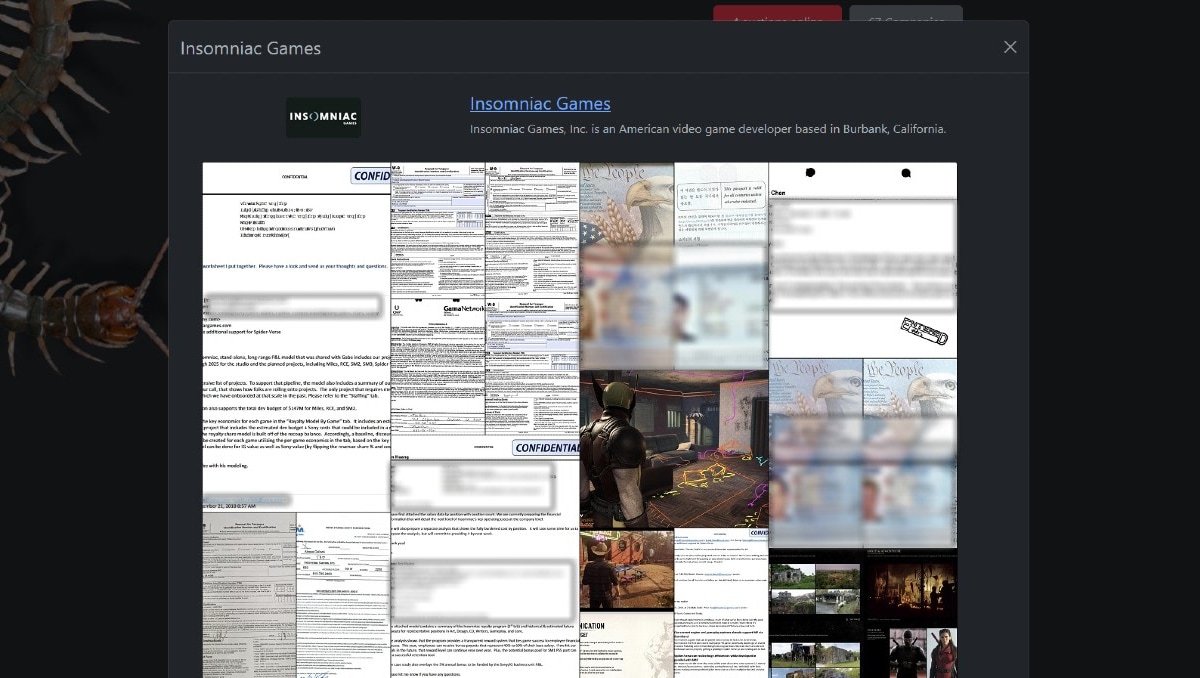
The Rhysida ransomware attack on Insomniac Games was characterized by its terrifying speed, 20 minutes from initial access to Domain Administrator privileges, yet its geographic and digital containment remains the single most significant operational detail of the event.
Verified Against Public And Audited RecordsLong-Form Investigative Review
Reading time: ~35 min
File ID: EHGN-REVIEW-34847
Employee and game data exposure in Insomniac Games ransomware breach
The notification letters explicitly stated: "No Sony systems were impacted." This phrasing serves a specific legal and regulatory purpose, isolating.
Primary RiskLegal / Regulatory Exposure
JurisdictionEPA
Public MonitoringIf an attacker convinces a support technician to reset a password or install a.
Report Summary
The regulatory is thus concentrated on Insomniac's specific compliance with state data privacy laws (such as the CCPA in California), rather than triggering a global GDPR investigation against Sony Group Corporation, although the exposure of European employees (if any) would still necessitate reporting to EU authorities. 67 terabytes of dumped data to map specific files to specific individuals was "time-consuming." During this interim period, the data was not at risk of exposure; it was actively available for download by any user with Tor browser access, following Rhysida's publication of the full dataset in late December 2023.
Key Data Points
They claimed their operatives obtained Domain Administrator privileges within 20 to 25 minutes of initially breaching the network. To understand how a 20-minute takeover occurs, one must examine the mechanics of Active Directory compromise. This level of access explains how they were able to exfiltrate 1. 67 terabytes of data. They did not need to break into 1. 3 million individual files. The "20-minute" claim implies that the time between infection and the ability to deploy the ransomware payload globally was negligible. The 20-minute timeline proves there was no resistance. The "20-minute" clock starts ticking the moment the tool is.
Investigative Review of Sony Group Corporation
Why it matters:
The December 2023 breach of Insomniac Games by the Rhysida ransomware cartel exposes vulnerabilities in corporate cybersecurity.
The attackers' rapid infiltration, demands for ransom, and massive data dump highlight the risks faced by companies in protecting sensitive information.
Anatomy of the Rhysida Attack: Timeline of the December 2023 Breach
SECTION 1 of 14: Anatomy of the Rhysida Attack: Timeline of the December 2023 Breach The December 2023 infiltration of Insomniac Games by the Rhysida ransomware cartel stands as a defining moment in modern corporate cybersecurity failures. This event was not a data theft; it was a systematic of a major studio’s digital privacy, exposing the fragility of intellectual property protection in the gaming sector. The timeline of this catastrophe reveals a rapid, merciless execution by the attackers and a devastating outcome for the studio’s workforce. ### The Infiltration: December 12, 2023 The public nightmare began on December 12, 2023, when the Rhysida group announced they had successfully breached the internal networks of Insomniac Games, a premier -party studio for Sony Interactive Entertainment. Unlike silent thefts that remain for months, Rhysida operated with loud, performative aggression. The group posted proof-of-hack materials on their dark web leak site, which included sensitive passport scans of employees and screenshots from the studio’s upcoming title, *Marvel’s Wolverine*. Rhysida’s claim was chilling in its simplicity and arrogance. A spokesperson for the group later boasted to cyber news outlets that they acquired domain administrator access within a mere 20 to 25 minutes of the initial network penetration. This assertion, if accurate, points to a catastrophic failure in defense-, suggesting that once the outer perimeter was breached—likely through phishing or compromised credentials—internal blocks were virtually non-existent. ### The Ultimatum: Seven Days, Fifty Bitcoin Concurrent with the proof-of-hack, Rhysida issued a non-negotiable ultimatum. They demanded a ransom of 50 Bitcoin, valued at approximately $2 million at the time. The group positioned this demand as an “auction,” inviting any party—including Sony itself—to bid on the data. The deadline was set for seven days. The countdown clock on Rhysida’s onion site served as a public pressure method. The group threatened that if the ransom was not paid, or if no exclusive buyer emerged to purchase the data in bulk, they would publish the entirety of the stolen cache. During this tense week, Sony acknowledged the reports on December 13, stating they were investigating the situation and believed the impact was limited to the Insomniac division. The gaming community and industry observers watched as the deadline ticked down, with no public indication that Sony intended to negotiate with the extortionists. ### The Data Dump: December 19, 2023 The deadline passed without payment. True to their threat, Rhysida executed the “dump” on December 19, 2023. The of the release was massive. The group uploaded approximately 1. 67 terabytes of data, comprising over 1. 3 million individual files. This dataset was not a random assortment of junk data; it was the digital lifeblood of the studio. The leak included: * **Employee Personal Information:** Highly sensitive HR documents, including I-9 employment forms, termination papers, and passport scans of current and former staff. * **Game Assets:** A fully playable PC build of *Marvel’s Wolverine*, along with terabytes of level designs, character art, plot scripts, and casting details. * **Future Roadmap:** Internal slides revealing unannounced titles scheduled as far out as 2035, including multiple *X-Men* projects, a *Venom* spin-off, and a new *Ratchet & Clank* entry. * **Business Intelligence:** Confidential licensing agreements between Sony and Marvel, internal budgets, sales projections, and strategic analysis documents detailing Sony’s concerns regarding competitor acquisitions. The release was nearly total. Rhysida noted that “not sold data was uploaded,” implying that a small fraction—estimated at roughly 2%—might have been purchased by a private bidder, while the remaining 98% was scattered to the public wind. ### The and Official Response: December 22, 2023 Three days after the data dump, on December 22, 2023, Insomniac Games issued their official statement regarding the full scope of the breach. The studio expressed “sadness and anger” at the criminal attack. They confirmed that data belonging to employees, former employees, and independent contractors had been stolen. The statement also addressed the leak of *Marvel’s Wolverine*, acknowledging that early development details were public. Insomniac emphasized that the game was in early production and would “greatly evolve” before its official release. This response marked the end of the immediate emergency phase and the beginning of a long, painful recovery process for the affected individuals and the studio’s compromised future roadmap. The Rhysida attack on Insomniac Games serves as a brutal case study in the speed of modern ransomware operations. From initial access to total exposure took only one week. The breach did not just cost money; it cost the privacy of hundreds of workers and shattered the secrecy that fuels the entertainment industry’s marketing machine. The “20-minute” infiltration claim remains a haunting metric for IT security teams globally, a clear reminder that the time between safety and catastrophe is measured in minutes, not days.Anatomy of the Rhysida Attack: Timeline of the December 2023 Breach
The 20-Minute Window: How Domain Administrator Access Was Compromised
The Speed of Total Compromise
The most chilling detail of the Insomniac Games breach is not the volume of data stolen the velocity of the conquest. In a statement to the media following the attack, a spokesperson for the Rhysida ransomware group made a boast that should terrify every Chief Information Security Officer in the industry. They claimed their operatives obtained Domain Administrator privileges within 20 to 25 minutes of initially breaching the network. This timeline defies the traditional “dwell time” statistics that frequently measure intruder presence in weeks or months. It suggests a level of automated aggression and architectural fragility that allowed the attackers to sprint from the front door to the master control room before the security operations center could even register an anomaly.
This twenty-minute window represents a catastrophic failure of internal resistance. For an attacker to escalate from a standard user account to Domain Administrator in less than half an hour implies the absence of network segmentation. It suggests that the initial point of entry held excessive trust or that internal defenses were nonexistent. The attackers did not need to slowly map the network or carefully evade detection over days. They simply walked in and seized the keys. This speed indicates that Rhysida likely used automated scripts to harvest credentials immediately upon execution. The manual hacking phase was minimal. The software did the heavy lifting. The human operators directed the traffic.
The Mechanics of the Sprint
To understand how a 20-minute takeover occurs, one must examine the mechanics of Active Directory compromise. The attackers likely gained initial access through a phishing campaign or a compromised VPN credential. Once inside the perimeter, they did not stay on the patient zero machine for long. Standard operating procedure for groups like Rhysida involves the immediate deployment of tools like Cobalt Strike or similar command-and-control frameworks. These tools allow the attacker to execute PowerShell commands and move laterally across the network. The speed of the Insomniac attack suggests they utilized a technique known as “credential dumping” almost instantly.
Credential dumping involves extracting login information from the memory of the compromised computer. If a privileged user or an administrator had previously logged into that specific machine, their credentials, or the cryptographic hashes of those credentials, would remain in memory. Tools like Mimikatz are designed to scrape this data. If the initial entry point was a developer workstation or an IT support machine, the likelihood of finding high-level credentials in memory increases exponentially. The attackers grabbed these keys and used them to authenticate against other servers. They moved from machine to machine in a rapid chain reaction. Each jump provided higher privileges until they reached the Domain Controller.
The use of “Living off the Land” binaries (LOLBins) also played a serious role in this velocity. Attackers use legitimate system administration tools like PsExec and PowerShell to conduct their operations. These tools are whitelisted by most security software because IT staff use them for daily tasks. By using approved software to execute malicious commands, Rhysida blended in with normal network traffic. The security sensors saw administrative activity failed to distinguish between a legitimate sysadmin and an intruder. This camouflage allowed them to run at full speed without tripping alarms that would halt a more noisy malware infection.
The Domain Administrator Prize
Acquiring Domain Administrator access is the digital equivalent of capturing the enemy’s flag and their general simultaneously. The Domain Controller is the heart of a Windows-based network. It manages authentication and authorization for every user and computer in the organization. Once Rhysida controlled this server, they controlled everything. They no longer needed to hack individual machines. They could simply problem commands. They could create new administrator accounts to ensure persistence. They could disable antivirus software across the entire company with a single Group Policy update. They could access any file server, read any email, and modify any code repository.
This level of access explains how they were able to exfiltrate 1. 67 terabytes of data. They did not need to break into 1. 3 million individual files. They simply told the servers to send the data to them. With Domain Admin rights, they could mount the backup drives and the source code repositories as if they were local folders. The “20-minute” claim implies that the time between infection and the ability to deploy the ransomware payload globally was negligible. The encryption phase that followed was a formality. The true damage was done the moment the Domain Admin group had a new, unauthorized member.
The Failure of Segmentation
The success of this rapid escalation points to a flat network architecture. in a highly secure environment, a developer’s workstation should not have a direct route to the Domain Controller. Workstations should be segmented from servers. Administrative accounts should be tiered. A standard workstation admin should not have credentials that work on a server. A server admin should not have credentials that work on the Domain Controller. This concept is known as “tiering” or “segmentation.” The speed of the Insomniac breach suggests these blocks were either missing or misconfigured. The attackers moved laterally without hitting a firewall or an authentication checkpoint that required multi-factor authentication.
If the network had been properly segmented, the attackers would have been trapped in a small subnet. They might have compromised a single department, yet they would have faced serious resistance trying to jump to the core servers. The 20-minute timeline proves there was no resistance. The internal network was a superhighway with no speed bumps. This architectural weakness is common in game development studios where speed and collaboration are prioritized over rigid security controls. Developers demand high-speed access to build servers and large asset repositories. Security teams frequently relax restrictions to avoid production. Rhysida exploited this operational culture to devastating effect.
The Human Element and Social Engineering
While the technical explanation focuses on Active Directory and network topology, the human element remains a primary vector. Rhysida and similar groups frequently use social engineering to bypass the line of defense. If the initial access was gained through a help desk call or a sophisticated phishing email, the attackers might have tricked an IT employee into granting them access directly. This method bypasses the need for complex exploits. If an attacker convinces a support technician to reset a password or install a remote monitoring tool like AnyDesk, they gain legitimate access immediately. The “20-minute” clock starts ticking the moment the tool is installed.
Reports indicate that Rhysida the “human ” aggressively. They do not rely solely on software vulnerabilities. They exploit fatigue and trust. In the case of Insomniac, the attackers knew exactly who they were targeting. They knew the value of the data. This targeted method suggests they had performed reconnaissance on LinkedIn or other public sources to identify key personnel before launching the attack. They did not cast a wide net. They threw a spear. Once the spear landed, the technical automation took over to finish the job.
Comparison to Industry Norms
To understand the severity of the 20-minute window, one must look at industry averages. The average time to detect a breach is frequently as over 200 days. The average “breakout time”, the time it takes for an attacker to move from the initial compromised host to another host, is frequently measured in hours, not minutes. CrowdStrike, a major security firm, tracks breakout time as a key metric. Their data shows that the fastest state-sponsored groups might achieve breakout in 18 minutes. For a criminal ransomware gang to achieve Domain Admin in 20 to 25 minutes places them in the top tier of threat actors regarding speed. It indicates a level of proficiency that rivals nation-state operatives.
This speed renders manual response impossible. A human security analyst cannot receive an alert, investigate it, and isolate a machine in 20 minutes. By the time the analyst opens the ticket, the attackers are already Domain Admins. This reality forces a shift in defensive strategy. Organizations cannot rely on human intervention. They must rely on automated containment. If the network does not automatically isolate a compromised host within seconds, the battle is lost. The Insomniac breach serves as a brutal case study in the need of automated defense and zero-trust architecture.
The Aftermath of the Window
Once the 20-minute window closed, the attackers owned the network. They spent the subsequent time selecting the most valuable data to steal. They identified the Wolverine game files. They found the employee passport scans. They located the internal HR documents. The actual encryption of files was likely the final step, a noisy exit strategy designed to force a payment after the data was already gone. The 20-minute sprint was the decisive battle. Everything that followed was just looting the wreckage. The breach demonstrates that in the modern threat environment, the margin for error is zero. A single mistake, a single clicked link, or a single unpatched server can lead to total domain compromise in less time than it takes to watch a sitcom episode.
Table: The Escalation Timeline
Phase
Estimated Duration
Activity
Impact
Initial Access
0-5 Minutes
Phishing execution or VPN login.
Entry to single workstation.
Reconnaissance
5-10 Minutes
Automated scanning of local network.
Identification of Domain Controller.
Credential Dumping
10-15 Minutes
Mimikatz or LSASS memory scraping.
Theft of Admin hashes.
Lateral Movement
15-20 Minutes
PsExec/RDP to servers.
Server compromise.
Domain Dominance
20-25 Minutes
Creation of Domain Admin account.
Total network control.
The 20-Minute Window: How Domain Administrator Access Was Compromised
Extortion and Refusal: The Failed $2 Million Bitcoin Ransom Negotiation
The extortion phase of the Insomniac Games breach began with a digital ransom note that was as arrogant as it was precise. Rhysida, the criminal syndicate responsible for the intrusion, did not lock the files and demand payment for a decryption key. They initiated a public auction. The group listed the stolen data on their Tor-based leak site with a starting price of 50 Bitcoin, valued at approximately $2 million at the time of the attack in December 2023. This sum was non-negotiable and came with a strict seven-day deadline. The clock started ticking immediately, visible to anyone with a Tor browser and the correct. onion address. Rhysida’s method deviated from the standard ransomware playbook of private coercion. By listing the data for auction, they turned the pressure outward, inviting not just Sony any competitor or malicious actor to bid on the “exclusive, unique, and impressive data.” The listing explicitly stated: “We sell only to one hand, no reselling, you be the only owner!” This tactic was designed to force Sony’s hand by threatening the permanent transfer of their intellectual property to a rival. The data set included 1. 67 terabytes of information, comprising over 1. 3 million files. The hackers knew exactly what they held: the source code and assets for the unannounced *Marvel’s Wolverine*, internal HR documents, and the personal data of employees. The ransom note itself, frequently delivered as a PDF named “CriticalBreachDetected,” employed the group’s standard psychological framing. Rhysida poses not as a gang of thieves as a “cybersecurity team” offering a service. Their communications frequently claim they are helping the victim identify security weaknesses. This facade of professionalism is a manipulation tactic intended to normalize the transaction, making the payment of $2 million feel like a business expense rather than funding organized crime. They offered a “customer support” chat portal, accessible via a unique identifier code, where victims could ostensibly negotiate. Sony Group Corporation faced a binary choice: pay the $2 million to suppress the leak or refuse and face the consequences. The decision was made against a backdrop of shifting industry standards and law enforcement guidance. The FBI and CISA have long advised against paying ransoms, noting that payment does not guarantee data deletion and directly funds future criminal activity. also, paying a ransom can invite repeat attacks, marking the victim as a reliable source of funds. Sony, having suffered massive breaches in 2011 and 2014, had a history of weathering such storms without capitulating to extortionists. During the seven-day window, Sony maintained a disciplined silence. Publicly, the company acknowledged the “cyber security attack” on Insomniac Games and stated they were investigating. Privately, the decision to withhold payment solidified. This refusal was a calculated risk. Sony executives likely weighed the $2 million demand against the reputational damage of funding a criminal enterprise and the reality that digital goods, once stolen, can never be truly secured by a thief’s pledge. The “exclusive” sale promised by Rhysida was a hollow guarantee; there is no honor among data brokers. As the deadline neared, the auction site displayed a countdown timer, a visual representation of the impending release. The gaming press and cybersecurity observers watched the clock run down. Rhysida’s “support team” likely waited for a counter-offer that never arrived. The group’s arrogance was clear in their communications with media outlets like *Cyber Daily*, where they boasted about acquiring domain administrator access within 20 minutes and described the attack as financially motivated, targeting developers as “easy.” When the seven-day timer hit zero, the threat materialized. Rhysida declared the auction closed. The group claimed to have sold roughly 2% of the data to an anonymous bidder. The remaining 98%—the vast majority of the stolen files—was dumped onto their public leak site. The files were not encrypted or hidden behind a paywall; they were available for anyone to download. This “dump” was the final act of retaliation for Sony’s refusal to pay. The release was catastrophic in its scope. It contained not just game assets the raw materials of the studio’s existence. The leak exposed the entire plot, cast, and gameplay of *Marvel’s Wolverine*, a title years away from release. It revealed a licensing agreement between Sony and Marvel for X-Men games extending to 2035, complete with budgets and release windows. More disturbingly, the dump included scanned passports, I-9 tax forms, and home addresses of Insomniac employees. The “2%” that was allegedly sold remains a mystery, chance containing the most sensitive financial or legal documents that Rhysida deemed too valuable to give away for free. Sony’s refusal to pay the 50 Bitcoin ransom halted the immediate financial transfer to Rhysida triggered one of the most significant data exposures in video game history. The breach demonstrated the limitations of defensive posturing against a determined adversary who has already exfiltrated the data. Once the files left Insomniac’s servers, the use shifted entirely to the attackers. Sony’s decision to stand firm adhered to law enforcement advice and denied the attackers their payday, yet the cost was paid by the employees whose personal lives were scattered across the dark web. The failed negotiation highlights a grim reality of modern ransomware: the “encryption” phase is secondary to the “extortion” phase. Rhysida did not need to keep Insomniac’s computers locked to inflict damage; the theft of the data was the primary weapon. The $2 million demand was a test of Sony’s resolve. By failing to pay, Sony accepted the leak as the cost of doing business, a decision that prioritized corporate policy over the privacy of the workforce. The data dump that followed was not just a leak of a game; it was a punitive measure, a signal to future victims that Rhysida would execute their threats without hesitation. The aftermath of the deadline saw the immediate dissemination of the stolen files across social media and file-sharing networks. The “Wolverine” build was playable on modded consoles within hours. The employee data was indexed by identity theft services. The 50 Bitcoin demand, once a theoretical price for silence, became a historical footnote in a breach that caused incalculable damage to the studio’s morale and future roadmap. The refusal to negotiate sent a message to the attackers, the attackers sent a louder message back: if you do not pay, burn everything down.Extortion and Refusal: The Failed $2 Million Bitcoin Ransom Negotiation
Human Collateral: Exposure of Employee Passports and I-9 Documents
The 1. 67 Terabyte Dump: A catastrophic Failure of Privacy
The Rhysida ransomware attack on Insomniac Games did not expose code; it shattered the privacy of the human beings who built that code. On December 19, 2023, after Sony refused the $2 million ransom demand, the attackers uploaded 1. 67 terabytes of data to the dark web. This cache, comprising over 1. 3 million files, contained the digital identities of more than 400 current and former employees. While the gaming press fixated on leaked Wolverine gameplay, the true disaster lay in the “human collateral”: a sprawling directory of unencrypted, high-fidelity scans of passports, government IDs, and federal employment forms.
The I-9 and Passport Exposure
The most damaging component of this leak was the mass publication of Form I-9 documents. In the United States, the I-9 Employment Eligibility Verification form is a gold mine for identity thieves. It requires an employee to provide their full legal name, physical home address, date of birth, and Social Security Number. also, it demands supporting documentation to prove citizenship or work authorization. Rhysida’s dump included high-resolution scans of the documents used to satisfy these I-9 requirements. This meant that valid, unexpired US passports, permanent resident cards, and driver’s licenses were scattered across the internet. Unlike a credit card number, which can be canceled and reissued in minutes, a passport or a Social Security Number is a foundational identity document. Replacing a compromised passport is a bureaucratic nightmare; changing a Social Security Number is statistically impossible for most adults. The exposure of this immutable data means the victims face a lifetime of heightened vigilance against fraud, long after the two-year credit monitoring offer from Sony expires.
Termination Forms and Disciplinary Records
Beyond financial identity theft, the breach inflicted severe professional and psychological damage through the exposure of internal HR files. The leak contained termination letters, disciplinary reports, and performance reviews. These documents detail private, frequently painful moments in an employee’s career, reasons for firing, internal disputes, and performance improvement plans. Publishing such records amounts to professional doxing. Former staff members, of whom may have left the company years ago, found their private exit interviews and dispute records available for public download. This exposure opens victims to chance harassment and complicates future employment prospects, as prospective employers could theoretically access these stolen files to perform unauthorized background checks. The psychological toll of having one’s professional history stripped of confidentiality is incalculable and represents a gross violation of the employer-employee trust pact.
Sony’s Mitigation: The Two-Year Band-Aid
In response to this catastrophe, Insomniac Games and Sony Interactive Entertainment offered affected individuals a complimentary two-year membership to ID Watchdog, a credit monitoring and identity restoration service. While this is a standard corporate response to data breaches, security experts frequently criticize it as insufficient for leaks involving immutable government IDs. Credit monitoring alerts a victim after a fraudulent account has been opened. It does nothing to prevent the misuse of a passport scan to forge identity documents or cross borders. also, the two-year window is arbitrary. The stolen data does not “expire” in twenty-four months. A Social Security Number compromised in 2023 remains compromised in 2030. By limiting the protection to a short timeframe, the response shifts the long-term load of defense onto the victims, who must police their own credit reports and background checks indefinitely.
Internal Sentiment and the “Emotional Toll”
Insomniac Games acknowledged the severity of the situation in a public statement, citing the “emotional toll” on their development team. This phrasing, while accurate, understates the terror of the situation. Employees reported fears of physical stalking and harassment, as their home addresses were public knowledge. The breach forced the studio to focus “inwardly,” disrupting production not just due to technical recovery, because the workforce was paralyzed by personal security concerns. The leak of internal Slack logs further exacerbated this distress. Private conversations between colleagues, venting about crunch, discussing management decisions, or sharing personal anecdotes, were laid bare. This destroyed the psychological safety of the workplace, creating an environment where employees could no longer trust that their internal communications would remain private.
Table 4. 1: Categories of Employee Data Exposed in Rhysida Dump
High. Causes reputational damage, professional embarrassment, and chance blackmail.
Communications
Slack logs, internal emails
Medium. Exposes private sentiments, internal conflicts, and personal employee.
This breach demonstrates a failure in data segmentation. There is no operational reason for archival I-9 forms and passport scans to be stored on network segments accessible via the same domain administrator credentials used for game development servers. The “flat” network architecture allowed Rhysida to pivot from IT infrastructure to the HR vault with terrifying speed, turning a corporate extortion attempt into a humanitarian emergency for hundreds of workers.
Human Collateral: Exposure of Employee Passports and I-9 Documents
The Wolverine Build: Analysis of the Terabyte-Scale Game Asset Leak
The Rhysida group executed their threat with mechanical precision. Minutes after the ransom deadline expired, the dark web witnessed the release of 1. 67 terabytes of data, a digital dump comprising over 1. 3 million files. This was not a simple cache of documents; it was the nervous system of a major studio laid bare. While the exposure of employee passports and I-9 forms constituted a human safety emergency, the leak also contained a catastrophic compromise of Sony’s intellectual property. At the center of this breach sat a fully playable, developer-grade PC build of *Marvel’s Wolverine*, a title not scheduled for release until late 2026. The leaked build was not a collection of assets a functional piece of software. Analysts and modders who accessed the files found a “Vertical Slice,” a term used in development to describe a polished section of the game created to demonstrate its chance to officials. This build, yet, included far more than a single level. It contained the entire narrative arc, playable from start to finish, albeit in a rough, alpha state. Debug menus, developer tools, and engine parameters were left exposed, allowing users to bypass intended restrictions and manipulate the game environment. Within hours, the internet began to dissect the game’s narrative skeleton. The leak revealed that the story centers on Logan’s time with Weapon X and his conflict with Mr. Sinister. Plot details confirm that players control not only Wolverine also Jean Grey in specific missions. The narrative arc involves a hunt for Sinister, a romance between Logan and Jean, and a tragic regarding the death of Jean’s parents. The cast list, stripped of all secrecy, confirmed appearances by Omega Red, Sabretooth, Mystique, and Deathstrike. The ending, intended to be a guarded secret for years, was spoiled instantly: a tease for the villain Apocalypse, setting up future entries in the franchise. The technical nature of the leak allowed for immediate exploitation. Because Insomniac develops on PC before porting to PlayStation 5, the stolen files included a compiled PC executable. Modding groups, such as “Team Brazil,” quickly seized upon this, releasing unofficial patches and fixes to stabilize the build. This created a pirated version of a AAA game three years before its commercial launch. Users shared footage of the game’s combat mechanics, which feature a lethality distinct from the studio’s *Spider-Man* titles, including dismemberment and a absence of web-based traversal. Instead of swinging, Wolverine uses parkour and a claw-based lunge mechanic to navigate environments like Madripoor and Alaska. The breach also exposed the financial and strategic bedrock of Sony’s partnership with Marvel. Documents found within the terabyte dump detailed a detailed licensing agreement signed in 2021. This contract grants Sony exclusive rights to X-Men games until 2035, locking out competitors from using X-Men characters in console or PC titles. The terms stipulate a development budget of $120 million per game, with an additional $30 million allocated for marketing. The agreement outlines a roadmap that extends well into the decade, listing *Marvel’s Venom* for 2025, *Spider-Man 3* for 2028, and a dedicated *X-Men* title for 2030. This exposure strips away the marketing veneer that protects a game’s development pattern. Instead of a carefully curated reveal trailer, the public saw grey-boxed levels, missing textures, and placeholder animations. The “Wolverine Build” represents a worst-case scenario for a publisher: the raw, unfinished reality of game development thrust into the public eye, subjected to criticism and analysis long before the product is ready. Sony and Insomniac face the challenge of marketing a game where the plot, mechanics, and surprises are already matters of public record.The Wolverine Build: Analysis of the Terabyte-Scale Game Asset Leak
The Decade-Long Roadmap: Unauthorized Disclosure of Insomniac’s 2032 Slate
The Strategic: A Decade Exposed
The Rhysida ransomware attack did not breach a server; it dismantled the strategic ambiguity that major game studios rely upon to build anticipation and manage shareholder expectations. While the immediate public interest fixated on the playable *Wolverine* build, the true catastrophic loss for Sony Group Corporation lay in the unauthorized publication of Insomniac Games’ entire production roadmap through 2032. This disclosure stripped away the company’s ability to control its narrative for the decade, revealing a pivot toward licensed Marvel properties so aggressive that it fundamentally alters the public’s understanding of PlayStation’s -party future. The leaked documents, which included internal slide decks and excel spreadsheets, outlined a release schedule that extends far beyond the typical three-to-five-year planning horizons publicly acknowledged by most studios. The roadmap identifies specific release windows for unannounced titles, spoiling Sony’s marketing beats for the PlayStation 5 and the unannounced PlayStation 6. The exposure of this data forces Sony into a defensive posture, where every future announcement be measured against a schedule that was never meant to be seen by consumers or competitors.
The Marvel Exclusivity Agreement
Among the most damaging was the full text of the licensing agreement between Sony Interactive Entertainment and Marvel. The documents confirm that Sony has secured exclusive rights to the *X-Men* franchise for video games until December 31, 2035. This contract locks out Microsoft and Nintendo from producing any high-budget titles featuring X-Men characters for the 12 years. The terms are specific and restrictive. Marvel is prohibited from releasing or announcing any X-Men games on console, PC, or streaming platforms during this period. also, the contract contains a “competitive advantage” clause. This stipulation prevents X-Men characters from appearing as exclusive selling points in multi-platform Marvel games. For instance, while Wolverine could theoretically appear in a generic *Avengers* game released on Xbox, he cannot be marketed as an exclusive character for that platform, nor can his gameplay mechanics be superior to those on the PlayStation version. The financial commitment for this exclusivity is immense. The leaked documents indicate a per-game development budget allocation of roughly $120 million, with an additional $30 million earmarked for marketing per title. yet, these figures appear to be floor estimates rather than ceilings, given the actual production costs revealed elsewhere in the breach. The agreement also outlines a $9 million recoupable advance for the three titles, solidifying the financial entanglement between Sony’s -party output and Disney’s intellectual property.
The Unauthorized Roadmap (2025, 2032)
The leaked slide decks present a timeline that prioritizes the expansion of the “Gamerverse” over Insomniac’s original intellectual properties. The schedule, while subject to internal delays and cancellations, provides a clear view of the studio’s intended output.
Target Fiscal Year
Title
Projected Platform/Context
2025
Marvel’s Venom: Lethal Protector
Standalone expansion (similar to Miles Morales). the gap between Spider-Man 2 and Spider-Man 3.
2026
Marvel’s Wolverine
Full AAA release. Darker tone confirmed by leaked gameplay assets.
2028
Marvel’s Spider-Man 3
The conclusion of the trilogy. Split-release strategy (Part 1/Part 2) discussed in documents.
2029
Ratchet & Clank: New Entry
The only major legacy IP listed in the near-term slate.
2030
Marvel’s X-Men
The team-based title under the new exclusivity deal.
2031/2032
New Intellectual Property
Unannounced new franchise, indicating a chance break from Marvel content after a decade.
This schedule confirms a strategic pivot where licensed IP accounts for nearly 90% of the studio’s output for the coming decade. The inclusion of a new *Ratchet & Clank* in 2029 serves as the sole anchor to Insomniac’s history of original character creation until the early 2030s.
The Unsustainable Economics of AAA Development
Perhaps more damaging than the roadmap itself is the financial data attached to it. The Rhysida dump exposed the ballooning costs of AAA game development, painting a grim picture of the profit margins required to sustain Sony’s blockbuster strategy. The documents reveal that *Marvel’s Spider-Man 2* carried a total budget of approximately $315 million. To achieve a break-even point and a modest return on investment, the game is required to sell 7. 2 million units, with a target of 10. 5 million lifetime sales to secure a 35% return. This represents a serious escalation in risk; a single underperforming title at this budget level could destabilize the studio’s financials. Future projections are even more severe. *Marvel’s Spider-Man 3* is projected to cost $385 million, necessitating lifetime sales of 14. 5 million units to be considered a success. *Marvel’s Wolverine* is budgeted at $305 million with a 10 million unit sales target. These figures show a development environment where “hit” status is no longer sufficient; games must be cultural phenomena to justify their existence. In contrast, the leak revealed that *Ratchet & Clank: Rift Apart*, even with serious acclaim, generated an $8 million loss at the time of the report, having sold 2. 2 million copies against an $81 million budget. While long-tail sales likely recouped this cost eventually, the data highlights the precarious position of non-licensed IP in Sony’s portfolio. The studio’s internal presentations explicitly discuss the need to keep future AAA budgets “sustainable” at $350 million or less, a figure that itself would have been considered astronomical just five years prior.
The Cancellation of “The Great Web”
The breach also provided a post-mortem on Sony’s aggressive and controversial push into live-service games. The files contained extensive details on a cancelled multiplayer project titled *Marvel’s Spider-Man: The Great Web*. This title was designed as a five-player cooperative experience where players would battle the Sinister Six across the multiverse. Internal trailers and pitch decks for *The Great Web* were fully produced, suggesting the project was deep in development before its cancellation. The decision to scrap the title aligns with a broader industry retraction from the “games as a service” (GaaS) model, yet the sunk costs associated with its development remain part of the studio’s financial load. The exposure of this cancelled project offers a rare glimpse into the “fail fast” mechanics of high- development, proving that even titles with massive brand recognition are not immune to internal scrutiny regarding long-term engagement and monetization viability.
Strategic of the Leak
The unauthorized release of this data forces Sony to operate in a glass house. Competitors possess precise knowledge of Insomniac’s resource allocation, release cadence, and financial thresholds. Microsoft, for instance, knows exactly when the *X-Men* exclusivity expires and can plan its own counter-programming or licensing acquisition strategies for the mid-2030s accordingly. For the employees of Insomniac, the roadmap leak is a morale-crushing event. Years of surprise reveals—the lifeblood of developer excitement—have been preempted. The “Venom” standalone game, intended to be a surprise announcement to the gap between mainline titles, is a known quantity. The *X-Men* roadmap, which would have been a show-stopping reveal at a future PlayStation Showcase, is old news. The leak also places immense pressure on the studio to deliver on these specific dates. While internal roadmaps are fluid, the public consumption of this data calcifies these into pledge. Any deviation from the 2026 window for *Wolverine* or the 2028 window for *Spider-Man 3* be scrutinized as a “delay” rather than a standard development adjustment. The Rhysida group did not just steal data; they stole the studio’s ability to manage its own destiny.
Budgetary Transparency: Leaked Development Costs and Profit Margins
The Ledger of Hubris: Anatomy of Unsustainable Economics
The Rhysida ransomware attack did more than expose game code; it shattered the carefully curated facade of AAA game profitability. For decades, publishers like Sony have obscured the true cost of development behind vague press releases touting “record-breaking sales” and “fastest-selling exclusives.” The leaked internal documents from Insomniac Games provide a forensic accounting of a business model under its own weight. These files reveal a sector where budgets have ballooned beyond rational sustainability, and where the definition of “success” has shifted from artistic acclaim to mere survival against nine-figure break-even points. The most immediate casualty of this transparency was the financial mythos surrounding *Marvel’s Spider-Man 2*. While publicly celebrated as a commercial triumph, the internal ledgers painted a darker picture of diminishing returns. The documents confirm that the total budget for *Spider-Man 2* reached a colossal $315 million. To put this figure in perspective, the original 2018 *Spider-Man* game cost approximately $90 million to develop. The sequel required over three times the capital investment yet did not pledge three times the profit. Internal projections estimated a lifetime profit of $75 million for the sequel, a razor-thin margin for a project that consumed five years of studio and over a quarter-billion dollars in liquidity. Contrast this with *Marvel’s Spider-Man: Miles Morales*. The leak revealed this “mid-sized” title cost $156 million to produce generated a profit of $104 million, boasting a return on investment (ROI) of 122%. This gap highlights a serious in the current AAA strategy: as fidelity and increase linearly, costs increase exponentially, yet the audience size remains relatively static. The data suggests that Sony’s of graphical perfection and cinematic length has reached a point of negative financial efficiency, where spending an additional $150 million yields lower net income than a tighter, more focused product.
The Marvel Tax: Licensing as a Liability
The leaked documents also exposed the draconian terms of Insomniac’s partnership with Marvel. While the public views the X-Men and Spider-Man deals as a coup for PlayStation, the financial reality is a binding shackle. The “X-Men Terms” document outlines a licensing agreement that extends through 2035, requiring Insomniac to spend at least $120 million on development and $30 million on marketing for each title. The royalty structure is particularly aggressive. Marvel commands: * 9-18% of net sales for digital copies. * 19-26% of net sales for physical units and DLC. * 35-50% of the wholesale price for hardware bundles. The hardware bundle clause is especially damaging. When Sony sells a limited-edition PlayStation 5 bundled with *Spider-Man 2*, nearly half of the wholesale revenue for that unit flows directly to Disney/Marvel, leaving Sony with a hardware loss that software sales must struggle to recoup. also, the contract stipulates a “termination for convenience” clause that is anything convenient: if a title fails to sell six million units within its year on PlayStation and PC combined, Marvel retains the right to terminate the agreement. This places a literal multimillion-unit gun to the head of the studio for every single release, eliminating the possibility of a “cult classic” or a slow-burn success.
The $567 Profit: The Sunset Overdrive Reality
Perhaps the most shocking single data point found in the terabytes of stolen data concerns *Sunset Overdrive*, a serious acclaimed Xbox exclusive developed by Insomniac before the Sony acquisition. The leaked sales sheet reveals that even with moving 1. 9 million units and generating nearly $50 million in revenue, the total profit share paid to Insomniac Games was exactly $567. Not $567, 000. Five hundred and sixty-seven dollars. This figure stands as a grim monument to the predatory nature of publisher-developer contracts and the high costs of production. It obliterates the assumption that selling nearly two million copies guarantees financial stability. For the employees whose passports and personal data were leaked alongside this spreadsheet, the that their labor on a beloved title resulted in enough profit to buy a single PlayStation 5 console is a demoralizing blow. It show why the studio pivoted so aggressively to licensed IP; in the current market, original intellectual property carries a risk profile that borders on suicidal.
The Ratchet & Clank Vulnerability
Even established internal IP showed signs of weakness. One internal slide dated prior to the PC release showed *Ratchet & Clank: Rift Apart*, a technical showcase for the PS5’s SSD capabilities, sitting at an $8 million loss even with selling 2. 2 million units. While later updates and PC sales likely pushed the title into the black, the initial deficit proves that even a -party mascot platformer with high serious praise struggles to recoup an $81 million budget in the modern economy. This precariousness explains the internal pressure, also found in the emails, to “cut deeply” into teams and reduce headcount by 50-75 people to manage the soaring costs of upcoming projects like *Wolverine*.
Future Liabilities: The Billion-Dollar Roadmap
The leak projects a financial trajectory that is mathematically hostile. The budget for *Marvel’s Wolverine* is projected at $305 million, with an expected profit of $85 million. *Spider-Man 3* is forecasted to cost $385 million to develop, with a projected profit of $170 million. These numbers assume ideal market conditions and no production delays. If *Spider-Man 3* suffers the same budget overruns as its predecessor, the project could easily breach the $400 million mark, requiring sales in excess of 10 million units just to break even. The following table summarizes the leaked financial data, stripping away marketing spin to reveal the raw economics of Insomniac’s portfolio:
Title
Development Budget
Projected/Actual Profit
ROI / Outcome
Marvel’s Spider-Man 2
$315 Million
$75 Million (Projected)
Low Efficiency (High Risk)
Spider-Man: Miles Morales
$156 Million
$104 Million
122% (High Efficiency)
Ratchet & Clank: Rift Apart
$81 Million
-$8 Million (Initial Snapshot)
Loss Leader / Slow Recoup
Sunset Overdrive
$42. 6 Million
$567 (Total Studio Share)
Catastrophic Commercial Failure
Marvel’s Wolverine
$305 Million (Projected)
$85 Million (Projected)
Moderate Return Expected
Marvel’s Spider-Man 3
$385 Million (Projected)
$170 Million (Projected)
High Risk / High Volume Required
This data serves as an indictment of the “bigger is better” philosophy. The industry has locked itself into an arms race where the ammunition costs more than the spoils of war. Sony is subsidizing the Marvel brand, assuming all the development risk while Disney collects guaranteed royalties. The leak proves that even for a titan like PlayStation, the margins are terrifyingly slim, and the cost of failure is existential.
The Marvel Exclusivity Deal: Terms of the X-Men Licensing Agreement
The Rhysida ransomware leak exposed the raw architectural blueprints of Sony’s financial relationship with Marvel, revealing a contract that functions less like a partnership and more like a rented stranglehold on the X-Men intellectual property. The “Master License Agreement,” a document intended for the eyes of high-level executives at Sony Interactive Entertainment and Marvel’s licensing division, outlines a deal through December 31, 2035. This agreement does not grant rights; it erects a digital blockade around the X-Men franchise, explicitly prohibiting the release of any X-Men video game on console, PC, or streaming platforms by any competitor during the contract term.
The Billion-Dollar Blackout: Exclusivity and Restrictions
The core of the agreement is a hard exclusivity window that secures the X-Men brand for the PlayStation ecosystem for over a decade. The terms dictate that Marvel cannot announce or release any X-Men title on non-Sony platforms until the end of 2035. This prohibition extends beyond standalone titles; the contract includes a “Competitive Advantage” clause. This specific stipulation prevents Marvel from allowing X-Men characters to appear as exclusive selling points on rival platforms. For instance, while Wolverine might appear in a multi-platform “family” game like Avengers, he cannot be used as an exclusive character for the Xbox version of that title. The language neutralizes Microsoft’s ability to use the X-Men IP in any capacity that might threaten Sony’s market dominance.
The roadmap attached to this agreement commits Insomniac Games to a trilogy of titles, beginning with Marvel’s Wolverine in 2026, followed by X-Men 2 in 2030, and X-Men 3 in 2033. The deal also encompasses online iterations, specifically Wolverine Online and X-Men Online, slated for 2026 and 2028 respectively. To maintain this monopoly, Sony agreed to a total investment commitment exceeding $621 million, a figure that aggregates development budgets, marketing floors, and royalty advances. This sum represents the cost of admission to the Marvel Universe, independent of the actual production challenges discussed in previous sections.
The “Marvel Tax”: Royalty Structures and Advances
The financial mechanics of the deal reveal the heavy premium Sony pays for access to the X-Men brand. The leaked documents detail a tiered royalty structure that ensures Marvel extracts revenue from every unit sold, regardless of the game’s profitability. For digital sales, Marvel claims a royalty rate between 9% and 18%, likely scaling based on sales volume or revenue thresholds. Physical copies command a higher rate, ranging from 19% to 26% of the wholesale price. This gap reflects the lower margins on physical media, yet Marvel’s cut remains substantial.
The most complex, and chance punitive, terms apply to hardware bundles. The agreement stipulates a royalty calculation where 35% to 50% of the bundle’s wholesale price is allocated to the software, against which the royalty rate is then applied. This method ensures that even when Sony sells a PlayStation 5 console bundled with Wolverine to drive hardware adoption, of that revenue diverts immediately to Marvel. also, the contract mandates a $9 million recoupable advance payment for each required title. This upfront cash transfer serves as a deposit against future royalties, guaranteeing Marvel immediate revenue before a single copy is sold.
Mandatory Spending and the Kill Switch
Sony’s obligations extend beyond royalties. The contract enforces a minimum development budget of $120 million per title, ensuring that Insomniac cannot produce a “budget” X-Men game to fulfill contractual quotas. Also, Sony must commit to a minimum marketing spend of $30 million per game. This clause forces Sony to aggressively promote the titles, regardless of internal sales projections or market conditions at the time of release. The agreement removes Sony’s ability to cut losses on marketing if a game tests poorly during development.
The termination clauses provide a grim look at the performance pressure placed on Insomniac Games. The contract includes a specific sales threshold: if any X-Men title fails to sell at least 6 million units across PlayStation 5 and PC within its year, either party retains the right to terminate the agreement. If Sony chooses to exit the deal under these grounds, it faces a $9 million penalty fee to any unpaid guarantees. Conversely, if Marvel terminates the deal due to poor performance, the penalty fees are waived, though Insomniac retains the right to sell through existing stock. This 6-million-unit floor creates a high- environment where commercial success is not a goal a contractual need to prevent the dissolution of a decade-long roadmap.
Table 8. 1: Key Financial Terms of the Sony/Marvel X-Men Agreement
Contract Component
Metric / Requirement
Implication
Exclusivity Term
Through Dec 31, 2035
Total prohibition on Xbox/Nintendo X-Men titles.
Min. Dev Budget
$120 Million per title
Prevents “shovelware” or low-budget releases.
Min. Marketing Spend
$30 Million per title
Mandatory promotion regardless of game quality.
Recoupable Advance
$9 Million per title
Upfront cash payment to Marvel before release.
Sales Threshold
6 Million Units (Year 1)
Failure allows contract termination.
Digital Royalty
9%, 18%
Standard sliding for digital storefronts.
Physical Royalty
19%, 26%
Higher rate to offset physical distribution costs.
The leak also clarified the “sunset” provisions of the deal. While the exclusivity ends in 2035, Sony retains the right to sell the developed games through at least 2038. This tail period allows Sony to continue monetizing the back catalog of X-Men titles well into the PlayStation 6 era. Yet, the rigidity of the terms, specifically the mandatory marketing spend and the high unit sales threshold, demonstrates that while Sony holds the creative keys to the X-Men, Marvel retains the financial use. The agreement is designed to insulate Marvel from risk while maximizing their upside, placing the load of execution entirely on Insomniac Games and Sony’s bankroll.
Internal Dialogue: Cultural Insights from Exfiltrated Slack Conversations
The Rhysida ransomware attack did more than expose game code. It acted as a digital wiretap into the daily operations of Insomniac Games. The release of 1. 3 million files included internal Slack logs, email threads, and presentation decks that strip away the polished public relations veneer of Sony’s premier studio. These communications reveal a workforce with the “unsustainable” reality of modern AAA development. They show a studio at the height of its creative power yet suffocating under the weight of ballooning budgets and corporate mandates to increase margins.
The Three-Hundred Million Dollar Question
The most revealing conversations found in the dump center on the financial viability of *Marvel’s Spider-Man 2*. Publicly, Sony celebrated the game as the fastest-selling PlayStation Studios title in history. Privately, Insomniac leadership was in a state of alarm. Internal presentations and accompanying chat logs confirm the game’s total budget reached approximately $315 million. This figure represents a threefold increase over the original *Marvel’s Spider-Man* from 2018. One leaked slide poses a question that reverberated through the studio’s internal channels: “Is 3x the investment in [Spider-Man 2] clear to anyone who plays the game?” This moment of self-reflection exposes the diminishing returns of graphical fidelity and. Employees discussed how the game required 7. 2 million unit sales just to break even. While the game eventually surpassed this number, the margins were razor-thin compared to previous entries. The internal dialogue shows a realization that the current trajectory of game development is mathematically impossible to maintain without raising prices or aggressively cutting costs.
Game Title
Approximate Budget
Internal Sentiment
Marvel’s Spider-Man (2018)
~$100 Million
High profitability. Sustainable model.
Marvel’s Spider-Man: Miles Morales
~$156 Million
asset reuse. Strong ROI.
Marvel’s Spider-Man 2
~$315 Million
“Unsustainable.” Required 7. 2M sales to break even.
The logs show that this anxiety was not limited to finance departments. Creative leads expressed concern that the demand for “blockbuster” production values was eating into the resources needed for innovation. The pressure to deliver a “Game of the Year” contender by 2026 drove decisions that prioritized safe, expensive polish over risky experimental mechanics.
The Mandate to Cut Heads
Perhaps the most chilling aspect of the internal dialogue involves the pre-meditated planning of layoffs. Long before the public announcement of industry-wide cuts in early 2024, Insomniac leadership was already under pressure from Sony to reduce headcount. Leaked meeting notes from November 2023 detail a directive to “remove 50-75 people strategically.” The conversations surrounding this mandate are clinical and cold. Managers discussed the need to “cut deeply” into the teams working on *Marvel’s Wolverine* and the pre-production team for *Spider-Man 3*. The strategy involved replacing these redundant roles with staff rolling off the *Ratchet & Clank* team to maintain a flat headcount. This contradicts the public image of Insomniac as a “family” studio protected from the volatility of the wider industry. The logs reveal that even the most successful studio in Sony’s portfolio was not immune to the corporate demand for efficiency. Sony executives pushed for these reductions to improve margins. The leak exposes a friction between the studio’s desire to retain talent and the publisher’s requirement to show growth on a spreadsheet. One particularly clear note mentions that “there be one studio closure” within the PlayStation network. This foreshadowed the eventual shuttering of PlayStation London Studio. For Insomniac employees reading these files post-breach, the realization that their jobs were being bartered on internal slides months in advance likely shattered morale.
Strategic Paranoia: The Activision Factor
The internal dialogue also looks outward at the competition. High-level emails and presentation decks reveal a deep-seated fear of Microsoft’s acquisition of Activision Blizzard. Sony executives discussed the chance for this merger to “leapfrog” PlayStation’s market dominance by 2027. The primary concern was not just *Call of Duty* exclusivity. It was the combination of mobile gaming footholds and the subscription model of Game Pass. Insomniac’s leadership viewed this shifting sector with trepidation. The logs show discussions about the “live service” pivot that Sony aggressively pursued under former PlayStation chief Jim Ryan. Employees expressed confusion and skepticism about projects like *Spider-Man: The Great Web*, a multiplayer title that was eventually cancelled. The internal sentiment suggests a disconnect between the developers, who specialize in single-player narrative experiences, and the corporate strategy that demanded recurring revenue streams. The cancellation of *The Great Web* appears in the logs not as a creative failure. It appears as a casualty of shifting corporate priorities and resource allocation battles.
The Human Toll of “Solemn” Transparency
The breach forced Insomniac to problem a public statement calling the event a “solemn and moment.” The internal reaction was far more visceral. The leak did not just expose business plans. It exposed the personal lives of the staff. Passport scans, I-9 forms, and home addresses were scattered across the dark web. Slack channels post-breach (to the extent they were captured or reconstructed in reports) and the pre-breach security discussions show a workforce aware of the risks yet unprepared for the of the violation. The exposure of the *Wolverine* build was professionally damaging. The exposure of personal data was personally terrifying. The logs indicate that the studio had to focus “inwardly” to support staff who were suddenly at risk of identity theft. This duality defines the cultural insight from the leak. On one hand, you have high-level executives debating the “unsustainability” of $300 million budgets and planning “strategic” firings. On the other, you have the rank-and-file developers whose personal safety was compromised by the very infrastructure meant to protect their work. The juxtaposition creates a portrait of a modern AAA studio as a high-pressure environment where job security is an illusion and digital safety is fragile.
The Wolverine Crunch
The leaked build of *Marvel’s Wolverine* provided the public with a playable demo. For the developers, it provided a nightmare. Internal schedules found in the dump show the game was targeting a 2026 release. The current state of the build, yet, suggested a long road ahead. The logs reveal discussions about “scope creep” and the technical challenges of adapting the X-Men license. There is a palpable tension in the messages regarding the release window. To meet the fiscal set by Sony, the game needs to ship. To meet the quality standards set by *Spider-Man*, the game needs time. The leak removed the studio’s ability to control the narrative. Developers expressed frustration that audiences were judging an unfinished, unpolished vertical slice. This breach of the “creative circle of trust” is a recurring theme in the personal messages found in the dump. The developers felt violated not just by the theft of their data, by the theft of their ability to present their work on their own terms. The “cultural insights” from the Insomniac leak paint a grim picture of the AAA gaming sector. It is a world where success does not guarantee safety. *Spider-Man 2* sold millions, yet the team faced layoffs. The studio delivered serious hits, yet faced budget scrutiny. The internal dialogue is not one of celebration. It is one of survival. The employees of Insomniac Games are navigating a minefield of “sustainable budget” mandates, corporate consolidation fears, and the constant threat of digital intrusion. The Rhysida hack did not just steal files. It stole the illusion that making great games is enough to secure a studio’s future.
Sony’s Containment Strategy: Isolating the Breach from Wider SIE Systems
The Firebreak: Stopping the Lateral Spread
The Rhysida ransomware attack on Insomniac Games was characterized by its terrifying speed, 20 minutes from initial access to Domain Administrator privileges, yet its geographic and digital containment remains the single most significant operational detail of the event. While the attackers achieved total dominance over Insomniac’s internal infrastructure, the infection failed to jump the digital air gap to Sony Interactive Entertainment’s (SIE) wider network. This hard stop saved other flagship studios like Naughty Dog, Santa Monica Studio, and Guerrilla Games from a similar fate. The breach demonstrated the value of network segmentation in a conglomerate structure, where the parent company’s “trust boundary” acted as a final line of defense against a localized catastrophe.
Sony’s containment strategy relied less on reactive button-mashing and more on the pre-existing architectural separation between its subsidiaries. Insomniac Games, acquired by Sony in 2019, operated its own Active Directory (AD) forest, distinct from the central SIE infrastructure. When Rhysida compromised the “Domain Administrator” account, they gained the keys to Insomniac’s specific kingdom, this keyring did not open the doors to Sony’s global corporate environment. The attackers hit a hard wall at the studio’s edge, unable to pivot from the Burbank-based developer’s servers to Sony’s central databases in San Mateo or Tokyo.
Domain Autonomy as a Defensive Moat
The distinction between a “Studio Domain Admin” and an “Enterprise Admin” proved important. In monolithic corporate networks, a breach of this magnitude would allow threat actors to ride trusted connections into the parent company’s core, chance taking down the PlayStation Network (PSN) or compromising user credit card data. Here, the decentralized nature of Sony’s studio management, frequently criticized for creating silos, became its salvation. The table outlines the specific boundaries that held firm during the attack.
Network Segment
Status During Breach
Rhysida Access Level
Insomniac Games Internal
Compromised
Total Control (Domain Admin)
Sony Interactive Entertainment (SIE)
Secure
Zero Access
PlayStation Network (PSN)
Secure
Zero Access
Other -Party Studios
Secure
Zero Access
Employee Personal Data (Insomniac)
Exfiltrated
Full Read/Write/Copy
Sony’s official response reflected this architectural reality. In a statement released shortly after the breach, a Sony spokesperson confirmed, “We have no reason to believe that any other SIE or Sony divisions have been impacted.” This was not PR damage control; it was a technical assertion backed by the absence of lateral movement logs. The attackers, realizing they were trapped within the Insomniac subnet, focused their efforts on data exfiltration rather than network expansion. They pivoted to extortion, pulling 1. 67 terabytes of data, including the Wolverine build and the X-Men slate, because they could not push further into the deeper, more lucrative Sony financial systems.
The Cost of Isolation
While the containment saved Sony’s broader empire, it meant Insomniac Games absorbed the full kinetic energy of the strike. The studio was left on an island to deal with the encryption and data theft. The isolation that protected Sony also meant that Insomniac’s internal IT team faced the emergency without the ability to simply “fail over” to a parent network, as doing so might have bridged the infection. The studio’s systems had to be scrubbed and rebuilt in a quarantine state.
Post-breach forensics revealed that the attackers used the 20-minute window to harvest credentials that were valid only within the Insomniac environment. Had the studio been fully integrated into a “One Sony” Single Sign-On (SSO) identity architecture without strict privilege access management (PAM), the outcome would have been catastrophic. The incident has since prompted a quiet aggressive review of trust relationships between all acquired studios and the SIE mothership. Security experts note that while autonomy aids creativity, it also creates inconsistent security postures. Insomniac’s security were clear less rigorous than the parent company’s standards, creating a soft underbelly that Rhysida exploited with ease.
The breach serves as a case study for conglomerate cybersecurity. It validates the “zero trust” principle not just at the user level, at the subsidiary level. By treating its own studio as a semi-untrusted entity, Sony prevented a $2 million ransom demand from ballooning into a billion-dollar platform outage. The containment was successful, the price was paid entirely in the privacy and intellectual property of the Insomniac employees and developers.
Post-Breach Forensics: The Role of Mandiant and Internal Investigations
The activation of Sony’s incident response in December 2023 marked the beginning of a rigorous forensic examination into the Insomniac Games breach. While the public focused on the leaked Wolverine assets and employee passports, a parallel operation unfolded behind closed doors involving Sony Interactive Entertainment’s (SIE) internal security teams and external forensic specialists. This phase aimed to reconstruct the digital crime scene, identify the specific entry vector, and determine the full extent of the data exfiltration. The investigation required a meticulous analysis of server logs, network traffic, and endpoint telemetry to understand how the Rhysida group managed to bypass perimeter defenses and operate for weeks.
External Intelligence and Threat Attribution
The involvement of external cybersecurity intelligence was central to understanding the adversary. Firms such as Mandiant provided serious context regarding the Rhysida group’s operational patterns, which helped Sony’s internal teams correlate their findings with known threat actor behaviors. Mandiant’s threat intelligence indicated that Rhysida frequently functions as a “ransomware-as-a-service” operation, renting out its infrastructure to affiliates who conduct the actual intrusions. This model complicates attribution, as the initial access broker might differ from the entity deploying the encryption payload. Forensic analysis of the Insomniac network revealed that the attackers did not use zero-day exploits or sophisticated custom malware to gain initial entry. Instead, the investigation pointed to a more mundane yet method: the compromise of valid credentials, likely through a VPN concentrator absence multi-factor authentication enforcement for specific legacy accounts. This aligns with Mandiant’s broader reporting on Rhysida, which notes their preference for purchasing stolen credentials or using phishing to harvest login details. The attackers used these legitimate pathways to enter the network, masking their presence as authorized user activity until they were ready to escalate privileges. The intelligence provided by external firms allowed Sony to map the attack lifecycle. The “20-minute” window to domain administrator access, a detail touted by the attackers themselves, was corroborated by timestamp analysis of the Active Directory logs. This speed suggests the attackers used automated tools to scan for internal vulnerabilities immediately upon entry. The forensic reconstruction showed that once inside, the intruders moved laterally using standard administrative tools like PowerShell and PsExec, living off the land to avoid triggering antivirus alarms. This confirmation of “living off the land” tactics directed the remediation teams to focus on behavioral monitoring rather than just signature-based detection.
The Internal Investigation: Scope and Timeline
Sony’s internal investigation, led by SIE’s security operations center, established a precise timeline of the breach. Forensic evidence confirmed that the unauthorized access began between November 25 and November 26, 2023. This “dwell time” of approximately two weeks before the ransomware deployment on December 12 gave the attackers ample opportunity to map the network structure, identify high-value file servers, and exfiltrate the 1. 67 terabytes of data. The investigation revealed that the data theft occurred in bursts to avoid saturating the network, a technique designed to evade traffic anomaly detection systems. The internal team faced the massive task of cataloging the stolen files to meet legal notification requirements. This process involved reviewing over 1. 3 million files to identify personally identifiable information (PII). The investigation determined that the breach impacted current employees, former staff members, and independent contractors. The specific data points identified included names, addresses, Social Security numbers, driver’s license numbers, and passport scans. The forensic review also uncovered the exposure of internal HR documents, such as I-9 forms and disciplinary records, which required a specialized legal response. Insomniac Games deferred the issuance of notification letters until February 2024. This delay, while frustrating for observers, was necessary to ensure the accuracy of the impact assessment. Sending premature notifications without a complete understanding of the affected individuals could have caused unnecessary panic or missed victims who needed protection. The internal investigation had to distinguish between data that was encrypted and data that was successfully exfiltrated. The forensic team analyzed the attackers’ file listing, published on the dark web, against their own backup logs to verify exactly which directories had been copied.
Remediation and Security Hardening
Following the forensic findings, Sony and Insomniac Games implemented a series of remediation measures to close the security gaps exploited by Rhysida. The immediate response involved a forced password reset for all user accounts and the revocation of all active session tokens. The investigation highlighted the risk posed by long-standing administrative sessions, leading to the implementation of stricter session timeout policies. The specific VPN gateway identified as the entry point was taken offline and reconfigured with mandatory multi-factor authentication for all access attempts, with no exceptions for legacy accounts or service providers. To support the affected individuals, Insomniac Games contracted with ID Watchdog to provide two years of credit monitoring and identity restoration services. This service was not a generic offering was tailored to address the specific risks associated with the leaked passport and I-9 data. A dedicated call center was established to handle inquiries from employees, providing a direct line of communication that bypassed the standard IT support channels. This separation ensured that security inquiries did not interfere with the studio’s operational recovery efforts. The forensic review also drove changes in the network architecture. Sony accelerated its zero-trust implementation, segmenting the development network from the corporate administrative network. This segmentation aims to prevent the rapid lateral movement observed during the Rhysida attack. If an attacker gains access to a developer workstation in the future, the new architecture restricts their ability to jump to the domain controller or HR file servers. The investigation demonstrated that a flat network topology was a serious liability, prompting a shift toward micro-segmentation where every access request is verified.
Analyzing the “Wolverine” Build Leak
A distinct component of the forensic investigation focused on the exfiltration of the *Marvel’s Wolverine* game assets. The internal team analyzed the leaked build to understand how the attackers accessed the version control systems. The investigation found that the attackers had located a backup server containing a playable build, rather than compiling the source code themselves. This distinction was important, as it suggested the attackers did not have full access to the source code repository’s write permissions, rather read access to the backup infrastructure. The forensic analysis of the game files also revealed the exposure of the “Wolverine” cast list and narrative structure. The internal team had to assess the commercial impact of these spoilers. They determined that while the plot points were exposed, the core gameplay experience remained intact. This assessment informed the studio’s public statement, which affirmed their commitment to delivering the game as planned. The investigation into the game asset leak also led to tighter controls on build distribution. Access to playable builds is restricted to specific IP addresses and requires hardware-based authentication, making it significantly harder for an external attacker to download a functional game client even if they breach the perimeter.
Forensic Investigation Key Findings
Investigative Component
Key Finding
Remediation Action
Initial Access Vector
Compromised VPN credentials; absence of MFA on legacy account.
Use of PowerShell and PsExec; 20 minutes to Domain Admin.
Restriction of administrative tools; network segmentation.
Data Exfiltration
1. 67 TB stolen; 1. 3 million files including PII and game assets.
Data Loss Prevention (DLP) tuning; egress traffic filtering.
The post-breach forensics provided a clear picture of the failure points that led to the December 2023 incident. The combination of external threat intelligence and internal log analysis allowed Sony to close the specific security holes and improve their in total posture. The investigation moved the organization from a reactive state to a proactive one, using the hard-won lessons of the breach to redesign their security framework against future ransomware threats.
Regulatory Fallout: Breach Notification Procedures and Identity Protection Measures
The Three-Month Silence: Notification Timelines and Regulatory Gaps
The regulatory aftermath of the Insomniac Games breach is defined by a significant temporal gap between the exfiltration event and the formal notification of victims. While the Rhysida ransomware group accessed Insomniac’s systems between November 25 and November 26, 2023, the subsidiary did not problem formal breach notification letters until February 23, 2024. This nearly ninety-day interval left current and former employees to identity theft for three months while their most sensitive data, including passport scans and W-2 forms, circulated on the dark web.
In filings submitted to state regulators, including the Office of Consumer Affairs and Business Regulation in Massachusetts, Insomniac Games attributed this delay to the complexity of the forensic process. The notification letter explicitly stated that while the company “worked quickly,” the process of analyzing the 1. 67 terabytes of dumped data to map specific files to specific individuals was “time-consuming.” During this interim period, the data was not at risk of exposure; it was actively available for download by any user with Tor browser access, following Rhysida’s publication of the full dataset in late December 2023.
The notification procedure revealed the extent of the data compromise, which spanned the entire employment history of the studio. The breach did not only affect the current development team working on Marvel’s Wolverine; it extended to former employees and independent contractors. The exposure of I-9 Employment Eligibility Verification forms created a particularly acute risk vector. These documents, mandatory for U. S. employment, aggregate a worker’s full legal name, physical address, date of birth, and Social Security number, frequently accompanied by copies of passports or driver’s licenses. The theft of I-9s provided threat actors with a “fullz” package, slang for a complete set of identity documents required to open fraudulent lines of credit or commit tax fraud.
Remediation Measures: The ID Watchdog Offer
To mitigate the, Sony Interactive Entertainment (SIE) and Insomniac Games extended an offer of identity protection services to affected individuals. The company contracted with ID Watchdog, a service owned by the credit reporting agency Equifax, to provide monitoring for a period of 24 months. This two-year window exceeds the statutory minimums required by state data breach laws, which frequently mandate only 12 months of coverage. The package included credit monitoring, dark web surveillance, and identity restoration services designed to assist victims if their credentials appeared in illicit marketplaces.
The selection of ID Watchdog integrated with existing employee benefits, as the service was already part of the standard benefits package for current Insomniac staff. The breach response extended this coverage to former employees and contractors who were no longer on the company payroll whose archived data remained on the compromised servers. yet, the efficacy of such monitoring is frequently debated in cybersecurity circles. While credit monitoring alerts victims to new financial accounts opened in their name, it does not prevent the initial theft or the misuse of immutable data points like passport numbers, which cannot be “reset” as easily as a credit card number.
Legal Scrutiny and Class Action Investigations
The breach notification process triggered immediate interest from the plaintiff bar. Within days of the February 2024 letters, data breach litigation firms, including Strauss Borrelli PLLC, announced investigations into the incident. These legal inquiries focused on whether Insomniac Games failed to implement reasonable security procedures to protect the Personal Identifiable Information (PII) of its workforce. The core legal argument in such cases rests on the concept of negligence, specifically, whether the retention of unencrypted passport scans and I-9 forms on accessible network drives constituted a violation of the duty of care owed to employees.
The specific nature of the leaked data elevates the chance damages in future litigation. Unlike consumer breaches involving replaceable credit card numbers, the Insomniac leak involved government-issued identification that is difficult and costly to replace. Victims face a lifetime of increased vigilance, as Social Security numbers and dates of birth are permanent identifiers. The class action investigations seek to determine if the 24-month ID Watchdog offer is sufficient compensation for a permanent compromise of digital identity, or if financial damages are necessary to cover the long-term risk of fraud.
Corporate Containment: The “No Sony Systems” Defense
A serious component of the regulatory correspondence was the distinction drawn between Insomniac Games and its parent company. The notification letters explicitly stated: “No Sony systems were impacted.” This phrasing serves a specific legal and regulatory purpose, isolating the liability within the subsidiary and protecting the wider Sony Interactive Entertainment network from direct regulatory penalties. By framing the breach as an incident contained entirely within Insomniac’s specific IT infrastructure, Sony Group Corporation aims to limit the scope of regulatory audits to the Burbank-based studio, preventing a broader inquiry into the cybersecurity posture of the PlayStation Network or other SIE divisions.
This containment strategy relies on the technical reality that Insomniac, even with being acquired in 2019, maintained a degree of operational independence in its IT architecture. This separation, while beneficial for creative agility, created the security silo that Rhysida exploited. The regulatory is thus concentrated on Insomniac’s specific compliance with state data privacy laws (such as the CCPA in California), rather than triggering a global GDPR investigation against Sony Group Corporation, although the exposure of European employees (if any) would still necessitate reporting to EU authorities.
Table: Regulatory and Remediation Timeline
Date
Event
Regulatory Significance
Nov 25-26, 2023
Network Infiltration
Start of the “breach clock” for regulatory reporting.
Dec 12, 2023
Rhysida Public Threat
Public acknowledgment of the breach; extortion demand.
Dec 20, 2023
Data Dump
Full exposure of PII; harm becomes actualized rather than theoretical.
Feb 23, 2024
Notification Letters Sent
Official start of the remediation period; 90-day delay from breach.
Feb 27, 2024
Class Action Inquiries
Plaintiff firms begin soliciting victims for chance litigation.
Strategic Vulnerability: Internal Memos on the Microsoft-Activision Acquisition
Strategic Vulnerability: Internal Memos on the Microsoft-Activision Acquisition
The Insomniac Games data breach did more than expose future release slates; it shattered the facade of Sony’s projected confidence regarding the console market wars. Buried within the 1. 67 terabytes of exfiltrated data were internal presentation slides that offered a raw, unvarnished look at Sony Interactive Entertainment’s (SIE) strategic anxieties. While Sony’s public legal team argued against the Microsoft-Activision Blizzard merger before regulators like the FTC and CMA, these internal documents revealed that their private fears were far more existential than their public posturing suggested. The memos explicitly identified the acquisition not just as a competitive hurdle, as a “leapfrog” event capable of rendering Sony’s entire business model obsolete.
The “Leapfrog” and “Dated Pillars”
The most damning admission found in the leaked slide decks was the categorization of Microsoft’s $69 billion acquisition as “The Leapfrog.” This terminology indicates that Sony executives viewed the deal as a method for Microsoft to bypass traditional generational competition and establish immediate dominance. The slides offered a brutal self-assessment, stating plainly that SIE’s current “pillars are already dated and behind the competition.” This internal confession directly contradicted Sony’s external narrative of market superiority. The “dated pillars” referred to Sony’s reliance on premium, high-budget, single-player blockbusters, a model that has defined the PlayStation brand for a decade. The documents show a clear recognition that while this model generates prestige and high unit sales, it is structurally to the subscription-based ecosystem Microsoft was building. The memos detailed how the acquisition would grant Microsoft immediate supremacy in areas where Sony had little to no footprint: mobile gaming (via King), PC distribution (via Battle. net), and live-service infrastructure (via *Call of Duty* and *Overwatch*).
The 2027 Threat Horizon
The leaked analysis pinpointed 2027 as a serious year of vulnerability. The documents projected that by this date, the protective measures and parity agreements forced by antitrust regulators would likely expire or become irrelevant. Sony strategists anticipated that Microsoft would then be free to use *Call of Duty* exclusively or preferentially to drive Game Pass subscriptions. The financial outlined in the slides were severe. Sony estimated that *Call of Duty* entering Game Pass represented a “massive threat to PlayStation Plus,” a service generating approximately $1. 5 billion in annual revenue. The fear was not about losing game sales, about a fundamental shift in consumer behavior. The memos argued that Microsoft’s ability to offer ” ” games on day one via subscription created an “unsustainable” value expectation that Sony could not match without destroying its own profit margins. The internal logic was clear: Sony’s -party games cost too much to produce to be given away in a subscription model, yet Microsoft’s financial depth allowed them to absorb those costs to capture market share.
Infrastructure Envy: Mobile and PC
Beyond console wars, the documents revealed a deep insecurity regarding platform infrastructure. Sony’s internal assessment highlighted Microsoft’s acquisition of King (makers of *Candy Crush*) and the Battle. net launcher as strategic assets that Sony had no answer for. The slides noted that Microsoft was building a “detailed ecosystem” across console, PC, and mobile, while Sony remained tethered largely to a single piece of plastic hardware. The memos expressed specific concern over Microsoft’s plans to launch a mobile game store to compete with Apple and Google, a move described as a direct threat to the established order of digital distribution. Sony’s own absence of a unified PC launcher or significant mobile presence was framed as a serious liability. The data showed that executives were acutely aware that their competitors were playing a platform-agnostic game while PlayStation was still fighting a console war.
The Live Service Pivot and Internal Discord
These strategic fears provide the missing context for Sony’s aggressive and controversial push into live-service games, a strategy that has since seen significant internal turbulence. The leaked documents suggest that the mandate to develop twelve live-service titles, later cut to six, was a direct, panic-induced response to the “leapfrog” threat identified in these memos. The internal dialogue captured in the breach shows a company at a crossroads, forcing its single-player studios (like Insomniac and Naughty Dog) to pivot toward multiplayer models they were ill-equipped to handle. The “dated pillars” slide serves as the smoking gun for this strategic shift, proving that the directive came from a belief that the traditional PlayStation model was on borrowed time.
Regulatory Contradictions
The leak also placed Sony in a precarious position regarding its regulatory arguments. During the FTC hearings, Sony argued that the merger would harm consumers and reduce competition. yet, the internal documents focused almost exclusively on the harm to Sony’s specific business model and profit margins. The admission that their model was “dated” suggests that their opposition was rooted in self-preservation against a more, albeit predatory, business model, rather than purely in defense of the consumer. The “Leapfrog” memos stand as a historical record of a market leader realizing its vulnerability in real-time. They strip away the marketing gloss of “generations” and “exclusives” to reveal a cold financial reality: Sony knew it could not compete dollar-for-dollar with Microsoft’s subscription model, and the Activision acquisition was the moment the math stopped working in their favor.
Echoes of 2011: Contextualizing Insomniac Within Sony’s Cybersecurity History
The December 2023 breach of Insomniac Games was not an anomaly; it was the latest chapter in a thirteen-year saga of high-profile security failures that have defined Sony’s modern history. To understand the severity of the Rhysida attack, one must examine it not as a singular event, as a recurring symptom of Sony’s status as a “trophy target” for cybercriminal syndicates. The Insomniac incident serves as a grim anniversary marker, echoing the catastrophic PlayStation Network (PSN) outage of 2011 and the scorched-earth destruction of Sony Pictures Entertainment (SPE) in 2014. While the threat actors and methods have evolved—from hacktivists to state-sponsored agents to profit-driven extortionists—the core vulnerability remains consistent: the inability to secure the digital perimeter of its most valuable creative assets.
The 2011 Precedent: The Day the Network Went Dark
In April 2011, Sony suffered what was then the largest data breach in history. The “PlayStation Network Outage” was a watershed moment that shattered the illusion of invincibility surrounding major tech conglomerates. Hackers infiltrated the PSN infrastructure, forcing Sony to sever the connection for 77 million user accounts. The outage lasted 23 days, a lifetime in the digital economy, and cost the corporation an estimated $171 million. The cultural image of that breach remains the press conference in Tokyo, where Kazuo Hirai, then head of the PlayStation unit, bowed for seven seconds in a traditional act of contrition. That gesture symbolized the humiliation of a company that had failed its primary customer base. yet, the 2011 attack differed fundamentally from the Insomniac breach. The 2011 intruders sought customer data, credit cards, passwords, and emails. It was a volume attack against the consumer infrastructure. In contrast, the Insomniac breach of 2023, much like the SPE hack of 2014, targeted the *creators* rather than the *consumers*. While Sony hardened its consumer-facing walls after 2011, evidenced by the fact that PSN remained operational during the Insomniac attack, the soft underbelly of its internal development studios remained exposed. The lesson from 2011 was “protect the credit cards.” The lesson Sony seemingly missed was “protect the employees and the intellectual property.”
The 2014 Parallel: Guardians of Peace and Corporate Doxxing
The most direct ancestor of the Insomniac breach is the November 2014 attack on Sony Pictures Entertainment. A group calling themselves the “Guardians of Peace” (GOP), later linked to North Korean state actors, deployed wiper malware that erased data across Sony’s corporate network. the destruction was secondary to the leaks. The GOP dumped 47, 000 Social Security numbers, executive salaries, and unreleased films like *Annie* and *Fury*. The parallels between 2014 and 2023 are clear and disturbing. In both instances, the attackers weaponized the personal lives of employees. In 2014, it was SSNs and healthcare records; in 2023, it was scans of passports and I-9 forms. In both cases, the attackers leaked future content to devalue the company’s slate, unreleased movies in 2014, the *Wolverine* build and the roadmap to 2032 in 2023. yet, the motivation shifted. The 2014 attack was geopolitical retribution for the film *The Interview*. The 2023 attack was purely transactional. Rhysida did not care about the content of *Wolverine*; they cared about the liquidity of the data. This shift marks a dangerous evolution. Sony is no longer just a political target; it is a bank vault of intellectual property that ransomware groups view as a guaranteed payout, either from the victim or the highest bidder on the dark web.
The 2023 Siege: A Year of Persistent Infiltration
The Insomniac breach was not the only security failure Sony endured in 2023. It was the crescendo of a year-long siege. In late May 2023, a vulnerability in the MOVEit file transfer software allowed the Cl0p ransomware gang to breach hundreds of organizations, including Sony Interactive Entertainment (SIE). In October 2023, Sony notified 6, 791 current and former employees that their data, including Social Security numbers, had been compromised in the MOVEit hack. This means that for Insomniac staff, the December ransomware attack was the *second* time in six months that their employer had failed to protect their identity. The psychological toll of this repeated exposure cannot be overstated. also, in September 2023, a group known as Ransomed. vc claimed to have breached “all Sony systems.” While subsequent investigations suggested this claim was exaggerated, likely involving a smaller test server with only 6, 000 files, it demonstrated that threat actors were actively probing Sony’s defenses, looking for a way in. The Ransomed. vc incident was a warning shot that went largely unheeded before Rhysida landed the direct hit on Insomniac three months later.
Comparative Analysis of Major Sony Breaches
The following table illustrates the escalation and shifting focus of these attacks over the last decade:
Metric
2011 PSN Hack
2014 SPE Hack
2023 Insomniac Breach
Primary Target
Customer Infrastructure (PSN)
Corporate Enterprise (Pictures)
Development Studio (Insomniac)
Data Exposed
77 Million User Accounts
47, 000 SSNs, Emails, Movies
1. 3 Million Files, Passports, Game Code
Attacker Motivation
Notoriety / Mischief
Geopolitical / Destruction
Financial Extortion
Operational Impact
23-Day Network Outage
Complete Network Wipe
Production Stoppage / IP Leak
Key Asset Leaked
User Personal Data
Unreleased Films (*Annie*, *Fury*)
Playable Build (*Wolverine*)
The Failure of Internal Segmentation
The recurrence of these breaches highlights a persistent structural flaw: the failure of internal segmentation. In 2014, once the Guardians of Peace gained access to SPE, they moved laterally with ease, accessing HR files, executive emails, and production servers. In 2023, Rhysida achieved similar lateral movement within Insomniac’s network. The fact that a domain administrator account served as the skeleton key in the Insomniac breach suggests that the strict “Zero Trust” architecture promised after the 2014 disaster was either not fully implemented or had degraded over time at the studio level. Sony Group Corporation operates as a massive conglomerate, and while the central (SIE) may be secure, the acquired studios (Insomniac, Bungie, Naughty Dog) frequently retain legacy systems or distinct IT cultures that create vulnerabilities. Rhysida did not need to break down the front gate of PlayStation; they simply found an unlocked window at Insomniac.
The “Trophy” Status
Sony’s repeated victimization is partly due to its status as a “trophy.” In the hacker community, breaching Sony carries a specific prestige that breaching a generic financial institution does not. The data held by Sony, movies, games, music, has high cultural value. Leaking a playable Wolverine build generates global headlines in a way that leaking a database of insurance claims never. This cultural cachet makes Sony a permanent target. Rhysida’s ransom note, which demanded $2 million, was relatively low for a corporation of Sony’s size, suggesting that the *publicity* of the hack was as valuable to the gang as the money. By successfully compromising a premier PlayStation studio, Rhysida elevated its brand in the criminal underworld, proving it could hunt big game.
Conclusion: A Legacy of Reactive Defense
The trajectory from 2011 to 2023 shows a company that is perpetually reacting to the last war. After 2011, Sony secured the customer network. After 2014, they attempted to secure the corporate enterprise. Yet in 2023, they failed to secure the remote-work endpoints and development pipelines of their studios. The Insomniac breach is not just a loss of data; it is a loss of faith. For the employees whose passports are in circulation on the dark web, and for the developers whose years of work were leaked in an unfinished state, the breach is a personal violation. It demonstrates that even with thirteen years of hard lessons, from the bows of Kazuo Hirai to the silence of current leadership, the protection of human capital remains the most fragile component of Sony’s digital armor. The echoes of 2011 are still ringing, the frequency is increasing, and the are getting closer to the heart of the company’s creative engine.
Timeline Tracker
December 12, 2023
Anatomy of the Rhysida Attack: Timeline of the December 2023 Breach — SECTION 1 of 14: Anatomy of the Rhysida Attack: Timeline of the December 2023 Breach The December 2023 infiltration of Insomniac Games by the Rhysida ransomware.
December 2023
Extortion and Refusal: The Failed $2 Million Bitcoin Ransom Negotiation — The extortion phase of the Insomniac Games breach began with a digital ransom note that was as arrogant as it was precise. Rhysida, the criminal syndicate.
December 19, 2023
The 1. 67 Terabyte Dump: A catastrophic Failure of Privacy — The Rhysida ransomware attack on Insomniac Games did not expose code; it shattered the privacy of the human beings who built that code. On December 19.
2023
Sony's Mitigation: The Two-Year Band-Aid — In response to this catastrophe, Insomniac Games and Sony Interactive Entertainment offered affected individuals a complimentary two-year membership to ID Watchdog, a credit monitoring and identity.
2026
The Wolverine Build: Analysis of the Terabyte-Scale Game Asset Leak — The Rhysida group executed their threat with mechanical precision. Minutes after the ransom deadline expired, the dark web witnessed the release of 1. 67 terabytes of.
2032
The Decade-Long Roadmap: Unauthorized Disclosure of Insomniac’s 2032 Slate —
2032
The Strategic: A Decade Exposed — The Rhysida ransomware attack did not breach a server; it dismantled the strategic ambiguity that major game studios rely upon to build anticipation and manage shareholder.
December 31, 2035
The Marvel Exclusivity Agreement — Among the most damaging was the full text of the licensing agreement between Sony Interactive Entertainment and Marvel. The documents confirm that Sony has secured exclusive.
2025
The Unauthorized Roadmap (2025, 2032) — The leaked slide decks present a timeline that prioritizes the expansion of the "Gamerverse" over Insomniac's original intellectual properties. The schedule, while subject to internal delays.
2026
Strategic of the Leak — The unauthorized release of this data forces Sony to operate in a glass house. Competitors possess precise knowledge of Insomniac's resource allocation, release cadence, and financial.
2018
The Ledger of Hubris: Anatomy of Unsustainable Economics — The Rhysida ransomware attack did more than expose game code; it shattered the carefully curated facade of AAA game profitability. For decades, publishers like Sony have.
2035
The Marvel Tax: Licensing as a Liability — The leaked documents also exposed the draconian terms of Insomniac's partnership with Marvel. While the public views the X-Men and Spider-Man deals as a coup for.
December 31, 2035
The Marvel Exclusivity Deal: Terms of the X-Men Licensing Agreement — The Rhysida ransomware leak exposed the raw architectural blueprints of Sony's financial relationship with Marvel, revealing a contract that functions less like a partnership and more.
2035
The Billion-Dollar Blackout: Exclusivity and Restrictions — The core of the agreement is a hard exclusivity window that secures the X-Men brand for the PlayStation ecosystem for over a decade. The terms dictate.
2035
Mandatory Spending and the Kill Switch — Sony's obligations extend beyond royalties. The contract enforces a minimum development budget of $120 million per title, ensuring that Insomniac cannot produce a "budget" X-Men game.
2018
The Three-Hundred Million Dollar Question — The most revealing conversations found in the dump center on the financial viability of *Marvel's Spider-Man 2*. Publicly, Sony celebrated the game as the fastest-selling PlayStation.
November 2023
The Mandate to Cut Heads — Perhaps the most chilling aspect of the internal dialogue involves the pre-meditated planning of layoffs. Long before the public announcement of industry-wide cuts in early 2024.
2027
Strategic Paranoia: The Activision Factor — The internal dialogue also looks outward at the competition. High-level emails and presentation decks reveal a deep-seated fear of Microsoft's acquisition of Activision Blizzard. Sony executives.
2026
The Wolverine Crunch — The leaked build of *Marvel's Wolverine* provided the public with a playable demo. For the developers, it provided a nightmare. Internal schedules found in the dump.
2019
The Firebreak: Stopping the Lateral Spread — The Rhysida ransomware attack on Insomniac Games was characterized by its terrifying speed, 20 minutes from initial access to Domain Administrator privileges, yet its geographic and.
December 2023
Post-Breach Forensics: The Role of Mandiant and Internal Investigations — The activation of Sony's incident response in December 2023 marked the beginning of a rigorous forensic examination into the Insomniac Games breach. While the public focused.
November 26, 2023
The Internal Investigation: Scope and Timeline — Sony's internal investigation, led by SIE's security operations center, established a precise timeline of the breach. Forensic evidence confirmed that the unauthorized access began between November.
November 25, 2023
Analyzing the "Wolverine" Build Leak — A distinct component of the forensic investigation focused on the exfiltration of the *Marvel's Wolverine* game assets. The internal team analyzed the leaked build to understand.
November 26, 2023
The Three-Month Silence: Notification Timelines and Regulatory Gaps — The regulatory aftermath of the Insomniac Games breach is defined by a significant temporal gap between the exfiltration event and the formal notification of victims. While.
February 2024
Legal Scrutiny and Class Action Investigations — The breach notification process triggered immediate interest from the plaintiff bar. Within days of the February 2024 letters, data breach litigation firms, including Strauss Borrelli PLLC.
2019
Corporate Containment: The "No Sony Systems" Defense — A serious component of the regulatory correspondence was the distinction drawn between Insomniac Games and its parent company. The notification letters explicitly stated: "No Sony systems.
2023
Table: Regulatory and Remediation Timeline — Nov 25-26, 2023 Network Infiltration Start of the "breach clock" for regulatory reporting. Dec 12, 2023 Rhysida Public Threat Public acknowledgment of the breach; extortion demand.
2027
The 2027 Threat Horizon — The leaked analysis pinpointed 2027 as a serious year of vulnerability. The documents projected that by this date, the protective measures and parity agreements forced by.
December 2023
Echoes of 2011: Contextualizing Insomniac Within Sony’s Cybersecurity History — The December 2023 breach of Insomniac Games was not an anomaly; it was the latest chapter in a thirteen-year saga of high-profile security failures that have.
April 2011
The 2011 Precedent: The Day the Network Went Dark — In April 2011, Sony suffered what was then the largest data breach in history. The "PlayStation Network Outage" was a watershed moment that shattered the illusion.
November 2014
The 2014 Parallel: Guardians of Peace and Corporate Doxxing — The most direct ancestor of the Insomniac breach is the November 2014 attack on Sony Pictures Entertainment. A group calling themselves the "Guardians of Peace" (GOP).
May 2023
The 2023 Siege: A Year of Persistent Infiltration — The Insomniac breach was not the only security failure Sony endured in 2023. It was the crescendo of a year-long siege. In late May 2023, a.
2011
Comparative Analysis of Major Sony Breaches — The following table illustrates the escalation and shifting focus of these attacks over the last decade: Primary Target Customer Infrastructure (PSN) Corporate Enterprise (Pictures) Development Studio.
2014
The Failure of Internal Segmentation — The recurrence of these breaches highlights a persistent structural flaw: the failure of internal segmentation. In 2014, once the Guardians of Peace gained access to SPE.
2011
Conclusion: A Legacy of Reactive Defense — The trajectory from 2011 to 2023 shows a company that is perpetually reacting to the last war. After 2011, Sony secured the customer network. After 2014.
Why it matters: Africa's struggle with corruption and insecurity is rooted in the collusion between political power and criminal networks. An investigation reveals how high-level figures in African politics profit.
Tell me about the anatomy of the rhysida attack: timeline of the december 2023 breach of Sony Group Corporation.
SECTION 1 of 14: Anatomy of the Rhysida Attack: Timeline of the December 2023 Breach The December 2023 infiltration of Insomniac Games by the Rhysida ransomware cartel stands as a defining moment in modern corporate cybersecurity failures. This event was not a data theft; it was a systematic of a major studio's digital privacy, exposing the fragility of intellectual property protection in the gaming sector. The timeline of this catastrophe.
Tell me about the the speed of total compromise of Sony Group Corporation.
The most chilling detail of the Insomniac Games breach is not the volume of data stolen the velocity of the conquest. In a statement to the media following the attack, a spokesperson for the Rhysida ransomware group made a boast that should terrify every Chief Information Security Officer in the industry. They claimed their operatives obtained Domain Administrator privileges within 20 to 25 minutes of initially breaching the network. This.
Tell me about the the mechanics of the sprint of Sony Group Corporation.
To understand how a 20-minute takeover occurs, one must examine the mechanics of Active Directory compromise. The attackers likely gained initial access through a phishing campaign or a compromised VPN credential. Once inside the perimeter, they did not stay on the patient zero machine for long. Standard operating procedure for groups like Rhysida involves the immediate deployment of tools like Cobalt Strike or similar command-and-control frameworks. These tools allow the.
Tell me about the the domain administrator prize of Sony Group Corporation.
Acquiring Domain Administrator access is the digital equivalent of capturing the enemy's flag and their general simultaneously. The Domain Controller is the heart of a Windows-based network. It manages authentication and authorization for every user and computer in the organization. Once Rhysida controlled this server, they controlled everything. They no longer needed to hack individual machines. They could simply problem commands. They could create new administrator accounts to ensure persistence.
Tell me about the the failure of segmentation of Sony Group Corporation.
The success of this rapid escalation points to a flat network architecture. in a highly secure environment, a developer's workstation should not have a direct route to the Domain Controller. Workstations should be segmented from servers. Administrative accounts should be tiered. A standard workstation admin should not have credentials that work on a server. A server admin should not have credentials that work on the Domain Controller. This concept is.
Tell me about the the human element and social engineering of Sony Group Corporation.
While the technical explanation focuses on Active Directory and network topology, the human element remains a primary vector. Rhysida and similar groups frequently use social engineering to bypass the line of defense. If the initial access was gained through a help desk call or a sophisticated phishing email, the attackers might have tricked an IT employee into granting them access directly. This method bypasses the need for complex exploits. If.
Tell me about the comparison to industry norms of Sony Group Corporation.
To understand the severity of the 20-minute window, one must look at industry averages. The average time to detect a breach is frequently as over 200 days. The average "breakout time", the time it takes for an attacker to move from the initial compromised host to another host, is frequently measured in hours, not minutes. CrowdStrike, a major security firm, tracks breakout time as a key metric. Their data shows.
Tell me about the the aftermath of the window of Sony Group Corporation.
Once the 20-minute window closed, the attackers owned the network. They spent the subsequent time selecting the most valuable data to steal. They identified the Wolverine game files. They found the employee passport scans. They located the internal HR documents. The actual encryption of files was likely the final step, a noisy exit strategy designed to force a payment after the data was already gone. The 20-minute sprint was the.
Tell me about the table: the escalation timeline of Sony Group Corporation.
Initial Access 0-5 Minutes Phishing execution or VPN login. Entry to single workstation. Reconnaissance 5-10 Minutes Automated scanning of local network. Identification of Domain Controller. Credential Dumping 10-15 Minutes Mimikatz or LSASS memory scraping. Theft of Admin hashes. Lateral Movement 15-20 Minutes PsExec/RDP to servers. Server compromise. Domain Dominance 20-25 Minutes Creation of Domain Admin account. Total network control. Phase Estimated Duration Activity Impact.
Tell me about the extortion and refusal: the failed $2 million bitcoin ransom negotiation of Sony Group Corporation.
The extortion phase of the Insomniac Games breach began with a digital ransom note that was as arrogant as it was precise. Rhysida, the criminal syndicate responsible for the intrusion, did not lock the files and demand payment for a decryption key. They initiated a public auction. The group listed the stolen data on their Tor-based leak site with a starting price of 50 Bitcoin, valued at approximately $2 million.
Tell me about the the 1. 67 terabyte dump: a catastrophic failure of privacy of Sony Group Corporation.
The Rhysida ransomware attack on Insomniac Games did not expose code; it shattered the privacy of the human beings who built that code. On December 19, 2023, after Sony refused the $2 million ransom demand, the attackers uploaded 1. 67 terabytes of data to the dark web. This cache, comprising over 1. 3 million files, contained the digital identities of more than 400 current and former employees. While the gaming.
Tell me about the the i-9 and passport exposure of Sony Group Corporation.
The most damaging component of this leak was the mass publication of Form I-9 documents. In the United States, the I-9 Employment Eligibility Verification form is a gold mine for identity thieves. It requires an employee to provide their full legal name, physical home address, date of birth, and Social Security Number. also, it demands supporting documentation to prove citizenship or work authorization. Rhysida's dump included high-resolution scans of the.
Why it matters: AI recruitment tools meant to eliminate bias are actually perpetuating discrimination against women, minorities, and the disabled. Major companies are using algorithms.
Why it matters: United Nations' peacekeeping missions rely on intricate supply chains for global stability. Financial implications and key players in peacekeeping support services impact.
Why it matters: Global domestic workforce lacks comprehensive legal protections, with around 80% operating informally. Women and migrants, comprising a majority of domestic workers, face.
Why it matters: Only 27% of recommendations made by Inspector Generals (IGs) have been fully implemented within two years, leaving 73% unaddressed. Despite potential savings.
Why it matters: Constitutional amendments in Africa are eroding democratic progress by allowing presidents to extend their terms through legal loopholes. 30 out of 54.