The FAA categorized these failures largely under "manufacturing process control," "parts handling and storage," and "product control." In a functional quality management system, a process control failure is a serious anomaly.
Verified Against Public And Audited RecordsLong-Form Investigative Review
Reading time: ~35 min
File ID: EHGN-REVIEW-37732
Whistleblower retaliation and quality control failures regarding 737 MAX 9 door plug blowout
Dean, who died of a sudden infection in May 2024, had previously stated, "If you are too loud, silence you.".
Primary RiskLegal / Regulatory Exposure
JurisdictionEPA / DOJ
Public Monitoring6M fine, and accept an independent monitor.
Report Summary
The culture of suppression extends deep into Boeing's supply chain, particularly at Spirit AeroSystems, the manufacturer responsible for the 737 MAX fuselage and the door plug involved in the Alaska Airlines incident. When the digital system becomes an obstacle to delivery, the evidence suggests that Boeing management chose to bypass the system rather than pause production to address the quality defects. His account corroborates the findings of the FAA audit, which identified dozens of instances where Boeing failed to control non-conforming parts, increasing the risk that defective hardware ends up on customer aircraft.
Key Data Points
Once a core division of Boeing, this facility was sold off in 2005 to private equity investors in a short-sighted bid to shed costs and boost shareholder value. By 2024, that divestiture had mutated into a strategic catastrophe. Spirit AeroSystems, the sole supplier of the 737 fuselage, became a distinct entity driven by its own financial pressures, frequently at odds with the engineering rigor required for aerospace manufacturing. The fuselage for the Alaska Airlines 737 MAX 9 arrived at Boeing's facility on August 31, 2023. The human cost of this corporate negligence extends beyond the passengers of Flight 1282.
Investigative Review of The Boeing Company
Why it matters:
The rupture of the fuselage on Alaska Airlines Flight 1282 highlights the critical importance of proper maintenance and installation procedures in aviation safety.
The investigation into the incident reveals a specific manufacturing omission that led to the catastrophic blowout, emphasizing the need for stringent quality control measures in the aerospace industry.
The Alaska Airlines Flight 1282 Incident: Anatomy of the Door Plug Blowout
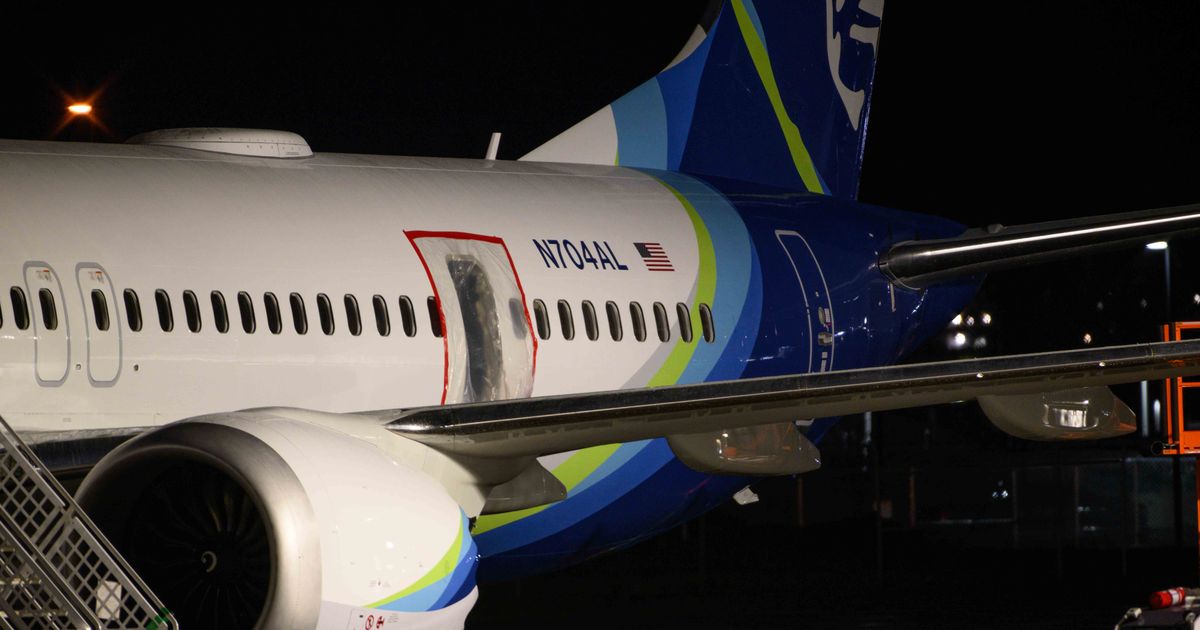
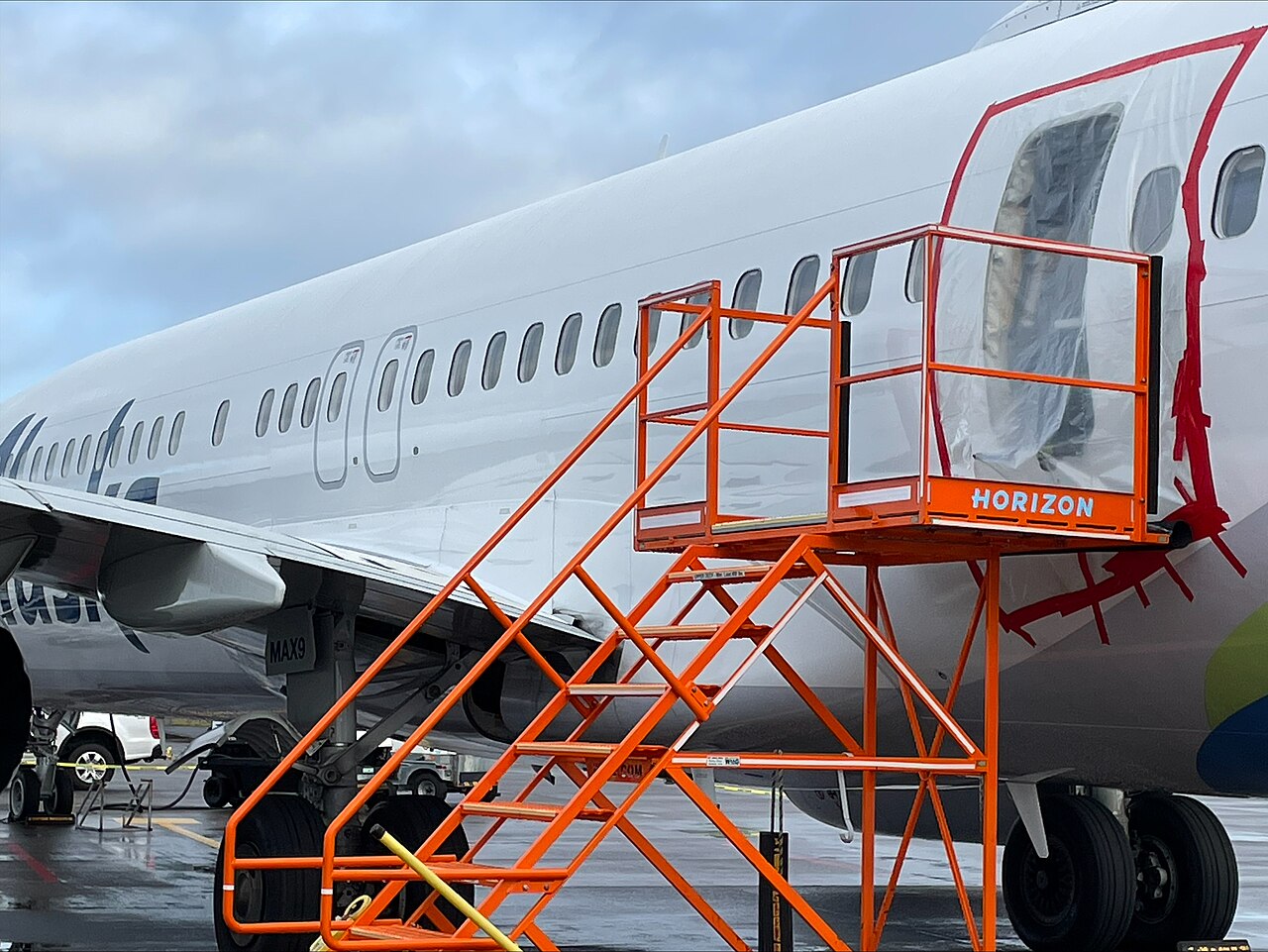
The rupture of the fuselage on Alaska Airlines Flight 1282 occurred with violent suddenness at 17: 06 PST on January 5, 2024. The Boeing 737 MAX 9, registered as N704AL, was climbing through 16, 000 feet after departing Portland International Airport. Inside the cabin, the pressure differential between the interior and the thin atmosphere outside exerted approximately 10 pounds per square inch of force against the airframe. This force found the route of least resistance at Row 26 on the left side of the aircraft. A door plug, a panel designed to replace an optional emergency exit, shifted upward and separated from the fuselage. The resulting explosive decompression ripped the headrests off nearby seats and sucked personal items, including smartphones and a pilot’s headset, into the void. The immediate aftermath in the cockpit was chaotic. The flight deck door blew open due to the rapid equalization of pressure. A laminated checklist flew out of the cockpit. The Officer lost her headset in the rush of air. Yet the pilots maintained control. They declared an emergency and descended to 10, 000 feet to ensure passengers could breathe without supplemental oxygen. The aircraft returned to Portland and landed safely 20 minutes after departure. No passengers occupied seats 26A or 26B directly to the blowout. This fortunate vacancy likely prevented a fatality. The incident resulted in minor physical injuries inflicted severe psychological trauma on the 171 passengers and six crew members. This event was not a random structural failure. It was the inevitable result of a specific manufacturing omission. The National Transportation Safety Board (NTSB) investigation quickly focused on the door plug itself. This component weighs approximately 60 pounds and measures 48 inches by 24 inches. Airlines use these plugs to seal unused emergency exit cutouts on aircraft configured with lower seating densities. The plug is not held in place by air pressure alone. It relies on a set of mechanical restraints to prevent vertical movement. Four specific bolts are required to lock the plug into its guide tracks. Two bolts secure the upper guide fittings and two secure the lower arrestor springs. NTSB investigators recovered the blown-out door plug from the backyard of a schoolteacher in the Portland area. The forensic examination of the panel revealed a damning absence of hardware. The guide tracks on the plug showed no evidence of the heavy contact damage that would occur if the bolts had sheared off under stress. The holes where the bolts should have been were pristine. This absence of deformation indicated that the four retaining bolts were not present when the aircraft departed Portland. They were likely not present when the aircraft was delivered to Alaska Airlines three months earlier. The history of N704AL reveals the sequence of errors that led to this omission. The fuselage was manufactured by Spirit AeroSystems in Wichita, Kansas. It arrived at Boeing’s assembly facility in Renton, Washington, on August 31, 2023. Upon arrival, Boeing quality inspectors noted five defective rivets on the frame surrounding the left door plug. These rivets had been installed by Spirit AeroSystems and did not meet engineering specifications. To access and replace these rivets, mechanics had to open the door plug. Boeing records show that the door plug was opened on September 19, 2023. This process involves removing the four retaining bolts and sliding the plug upward on its tracks to swing it out of the way. Spirit AeroSystems personnel then performed the necessary rework on the rivets. Once the rivets were fixed, the door plug was closed. The fatal error occurred at this specific juncture. The four retaining bolts were never reinstalled. The failure was not just mechanical procedural. Boeing’s manufacturing require a formal removal record whenever a component is disassembled. This record triggers a corresponding installation requirement that quality control inspectors must verify. In the case of N704AL, the removal of the door plug was never documented in the computer system. Because the removal was off the books, the system never flagged the need for reinstallation or inspection. The aircraft moved to the stage of production with the door plug held in place only by and friction. The aircraft was delivered to Alaska Airlines on October 31, 2023. It entered commercial service on November 11, 2023. For two months, the aircraft flew 154 pattern without the retaining bolts. During each flight, the pressurization pattern exerted outward force on the plug. Without the bolts to restrict vertical movement, the plug inched upward on its guide tracks. The 12 guide fittings that hold the door against the fuselage frame eventually misaligned. On Flight 1282, the plug moved high enough to disengage from the stop pads. The internal pressure instantly ejected the panel into the slipstream. Warning signs preceded the accident. In the days leading up to the blowout, the aircraft’s auto pressurization fail light illuminated on three separate occasions: December 7, January 3, and January 4. Alaska Airlines maintenance crews reset the system each time. The airline restricted the aircraft from flying long distances over water (ETOPS flights) to Hawaii as a precaution. This restriction ensured the plane remained close to diversion airports. The decision kept the aircraft flying over land did not result in a deep maintenance inspection of the door plugs. NTSB Chair Jennifer Homendy later stated that the pressurization warnings might have been unrelated to the door plug, yet they serve as a grim contextual marker of a troubled airframe. The following table outlines the timeline of the door plug from manufacture to failure:
Date
Event
Location
August 31, 2023
Fuselage arrives at Boeing assembly plant.
Renton, WA
September 1, 2023
Defective rivets noted on left door plug frame.
Renton, WA
September 19, 2023
Door plug opened for rivet repair. Bolts removed.
Renton, WA
September 19, 2023
Rivet repair completed by Spirit AeroSystems.
Renton, WA
September 2023
Door plug closed. Bolts NOT reinstalled. No record created.
Renton, WA
October 31, 2023
Aircraft delivered to Alaska Airlines.
Seattle, WA
January 3, 2024
Auto pressurization fail light illuminates in flight.
In Service
January 4, 2024
Auto pressurization fail light illuminates again.
In Service
January 5, 2024
Door plug blowout at 16, 000 feet.
Portland, OR
The Mechanics of the Escape
The term “quality escape” is industry nomenclature for a defect that leaves the factory. The N704AL incident represents a catastrophic quality escape. The door plug design includes 12 stop fittings on the fuselage and 12 stop pads on the plug. When the door is closed and the cabin is pressurized, the pressure pushes the plug outward. The stop pads press against the stop fittings, transferring the load to the airframe. The design relies on the plug remaining in the “down” position to keep these pads aligned. The four missing bolts are the only method preventing the plug from sliding up. Without them, the vibration of takeoff, landing, and aerodynamic buffeting allowed the plug to creep upward. Once the stop pads on the plug cleared the stop fittings on the fuselage, there was nothing to hold the door against the 10 psi pressure differential. The door popped out like a cork. Photographic evidence recovered from Boeing employees later confirmed the state of the door prior to delivery. A photo shared among Boeing staff on September 19, 2023, showed the door plug closed. The insulation blanket was pulled back, revealing the locations where the bolts should have been. They were visibly absent. This photo proves that the aircraft sat on the factory floor, fully accessible, with a serious safety defect in plain sight. The Federal Aviation Administration (FAA) grounded 171 Boeing 737 MAX 9 aircraft immediately after the accident. Inspections of other aircraft in the fleets of Alaska Airlines and United Airlines revealed loose hardware on multiple door plugs. This discovery indicated that the problem was not to a single error on N704AL. It pointed to a widespread breakdown in the relationship between Boeing and its supplier, Spirit AeroSystems, and a collapse of the quality assurance processes intended to catch such errors. The blowout on Flight 1282 was a mechanical failure caused by a human failure. The physical absence of four bolts was the final link in a chain of events involving defective rivets, undocumented work, and missed inspections. The investigation peeled back the skin of the aircraft to reveal a manufacturing culture where production speed superseded process adherence. The door plug did not fail because of a design flaw in the metal. It failed because the system designed to build it was broken.
The Alaska Airlines Flight 1282 Incident: Anatomy of the Door Plug Blowout
Critical Assembly Failures: The Removal and Non-Replacement of Four Key Bolts
The sequence of events that led to the near-catastrophic depressurization of Alaska Airlines Flight 1282 began not in the skies over Oregon, on the factory floor in Renton, Washington, months prior. The failure was not a complex engineering anomaly or a material defect in the fuselage itself. It was a procedural collapse so absolute that it defies the basic tenets of aviation safety: four serious retention bolts were removed to a repair and simply never put back. This specific failure illustrates the “hidden factory” that whistleblowers have long warned about—a chaotic parallel production line where undocumented work, traveled jobs, and schedule pressure supersede mandatory quality. ### The Trigger: Damaged Rivets and Traveled Work The fuselage for the 737 MAX 9, Line Number 8789, arrived at Boeing’s Renton assembly facility on August 31, 2023. It had traveled by rail from Spirit AeroSystems in Wichita, Kansas. Upon arrival, Boeing inspections revealed a defect that is all too common in the troubled relationship between the two aerospace giants: five damaged rivets on the edge frame forward of the left mid-exit door (MED) plug. In a functioning quality management system, this defect would trigger a rigorous, documented repair process. A Non-Conformance Report (NCR) was indeed generated on September 1, 2023, noting the damaged rivets. This initiated the repair sequence. yet, the location of the rivets presented a logistical hurdle. To access the damaged area, the door plug—a 60-pound panel used to fill the emergency exit slot on aircraft with lower seating densities—had to be opened. Opening the door plug is not a trivial action like opening a passenger door. It is a semi-permanent structural component. To open it, mechanics must remove four specific bolts: two upper guide track bolts and two lower arrestor bolts. These bolts are the primary method that prevents the plug from sliding upward and disengaging from the stop pads that hold it against the fuselage. Without them, the door plug is held in place only by and friction, to the pressure differential of flight. ### The Unauthorized Removal On September 19, 2023, personnel from Spirit AeroSystems—stationed at the Boeing plant to address “traveled work” defects—performed the rivet repair. To do so, they or Boeing mechanics opened the door plug. This action required the physical removal of the four retention bolts. Here, the process disintegrated. Under Federal Aviation Administration (FAA) regulations and Boeing’s own internal requirements, the removal of any flight-serious hardware must be documented. A “removal record” should have been created in Boeing’s Common Manufacturing Execution System (CMES). This record serves a important function: it automatically generates a corresponding “installation” task. The system is designed to prevent exactly what happened; the plane cannot be signed off for delivery until every open removal record is closed with a verified installation. No such record was created. The bolts were removed, likely placed on a nearby bench or in a parts bin, and the system remained silent. In the digital reality of Boeing’s quality management, the door plug had never been opened, and the bolts had never been touched. The physical reality was a 737 MAX 9 sitting on the assembly line with a gaping hole in its safety redundancy. ### The Documentation Black Hole The NTSB investigation later revealed a disturbing void in the paper trail. When investigators demanded the records detailing who opened the door and who authorized the work, Boeing could not provide them. The company admitted that the work was performed without the required documentation. This “documentation black hole” is a primary grievance of internal whistleblowers. It represents a culture where “getting the job done” bypasses the administrative load of safety compliance. If a mechanic stops to generate a removal record, they flag the airplane for further inspection, chance delaying the line. If they simply remove the part, do the work, and put it back, the line keeps moving. In this case, the “put it back” step was fatally incomplete. The failure was compounded by the interaction between Spirit AeroSystems and Boeing. The blurred lines of responsibility between the supplier’s team fixing their own defects within Boeing’s facility created a gray zone of accountability. Spirit mechanics fixed the rivets, who was responsible for the door plug? The absence of a clear chain of custody for the door plug’s state meant that when the rivet work was finished, the door was closed, not secured. ### The Visual Evidence: September 19, 2023 The most damning evidence of this failure comes from a photograph taken by a Boeing employee on the afternoon of September 19, 2023. The photo was not taken to document the door plug; it was exchanged in a text message discussion about interior restoration work. The image captures the left mid-exit door plug in the closed position. The rivet repair is complete. yet, a forensic analysis of the photo by NTSB investigators revealed a terrifying detail: the retention bolts are missing. In three of the four visible locations, the bolt holes are empty. The fourth location is obscured by insulation, the absence of the other three confirms the state of the assembly. The door plug was resting on its stop pads, appearing normal to the naked eye, it was completely unsecured. This photo proves that the failure occurred *before* the interior sidewall panel was installed. The aircraft sat in the factory, the door plug visibly devoid of its safety hardware, and yet it passed through subsequent inspections. This indicates a widespread blindness. Quality inspectors, pressured to maintain the production cadence, failed to notice that a serious component was incomplete. ### The Closure and the Seal of Fate Following the rivet repair, the “move crew” or interior mechanics proceeded to the stage of assembly. Because there was no open job card in the CMES system calling for the re-installation of the bolts, no one looked for them. The system said the plane was ready for the step. Workers installed the interior sidewall panel, insulation, and trim over the door plug. This action sealed the evidence of the error inside the wall of the aircraft. Once the interior panel is in place, the door plug bolts are no longer visible. The opportunity to catch the mistake visually was lost the moment the trim was applied. The aircraft, a ticking time bomb, continued through the final assembly process. It underwent pressure testing, which it passed. This is a serious point: the door plug is designed to seal tighter against the fuselage as cabin pressure increases. The stop pads take the load. The bolts are there to prevent the door from moving *upward* when the pressure is low or during ground operations. The pressure test confirmed the seal was holding, it could not detect that the vertical retention method was absent. ### NTSB Forensic Confirmation After the blowout on January 5, 2024, the NTSB recovered the door plug from a backyard in Portland. Their metallurgical analysis confirmed the hypothesis of the missing bolts. The guide tracks on the door plug and the hinge fittings on the fuselage showed no evidence of “witness marks” that would be present if the bolts had been installed and then sheared off during the blowout. If the bolts had been in place, the violent ejection of the door would have ripped through the metal, leaving distinct deformation and fractures. Instead, the holes were pristine. The absence of contact damage proved conclusively that the bolts were not present when the door plug moved upward and detached from the aircraft. The door had simply slid up the guide track, disengaged from the stop pads, and was blown out into the slipstream. ### widespread Rot and the “Push-Push-Push” Culture This specific incident cannot be viewed in isolation. It is the physical manifestation of the cultural rot described by whistleblowers. The “push-push-push” mentality, by workers in NTSB interviews, creates an environment where the administrative task of creating a removal record is seen as an obstruction to progress. The reliance on “tribal knowledge” rather than written procedure allowed the Spirit and Boeing teams to operate in a disconnected manner. The Spirit team fixed the rivets and left. The Boeing team saw a closed door and assumed it was secure. The safety net—the rigorous documentation system—was bypassed entirely. also, the overwriting of security camera footage at the Renton factory, which could have shown exactly who removed the bolts and when, adds a of opacity to the investigation. While Boeing claims this was standard procedure, it conveniently eliminated the visual record of the procedural violation. The removal and non-replacement of these four bolts was not a mechanical failure. It was a failure of discipline, a failure of documentation, and a failure of a corporate culture that prioritized delivery speed over the sanctity of the manufacturing process. The door plug was not blown out by air pressure alone; it was ejected by a system that had long since abandoned its commitment to detail.Critical Assembly Failures: The Removal and Non-Replacement of Four Key Bolts
The Documentation Void: Missing Records of the Door Plug Repair at Renton
The Phantom Repair: A widespread Erasure of Accountability
The sequence of events that nearly doomed Alaska Airlines Flight 1282 began not with a mechanical failure, with a bureaucratic ghost. On August 31, 2023, the fuselage for what would become Line Number 8789 arrived at Boeing’s Renton assembly plant by rail. It came from Spirit AeroSystems in Wichita. Upon inspection, Boeing mechanics identified five damaged rivets on the edge frame just forward of the left mid-exit door plug. This defect was not catastrophic on its own. It was a routine manufacturing hiccup. Boeing logged the defect in its system on September 1, 2023. This generated a Non-Conformance Record. The repair plan was straightforward. Drill out the bad rivets. Install new ones. To access these rivets, mechanics had to open the door plug. This massive 60-pound panel is held in place by four specific retaining bolts. These bolts prevent the plug from sliding upward and disengaging from the fuselage. To perform the rivet repair, someone removed these four bolts. They opened the door. This action created a serious hazard. A door plug without bolts is a ticking time bomb. It looks secure. It sits flush against the airframe. it is held by nothing and friction. In a functioning safety culture, this removal triggers a mandatory paper trail. The mechanic must log the removal in the Common Manufacturing Execution System (CMES) or the Ship Side Action Tool (SAT). This entry acts as a digital red flag. It tells the system that the aircraft is not airworthy. It generates a requirement for a Quality Assurance inspector to verify the reinstallation. The system not allow the airplane to move to the stage of production until that “open” item is closed. At Renton, this digital safety net disintegrated. The mechanics who removed the bolts never created a removal record. They performed the physical work of opening the door. They likely set the bolts aside. in the digital reality of Boeing’s production line, the door remained “closed.” The system showed only a rivet repair. It did not show that the pressure hull had been compromised to access those rivets. This omission was not a clerical error. It was a deletion of reality.
The “Move Crew” and the Illusion of Safety
On September 19, 2023, Spirit AeroSystems personnel completed the rivet repair. The work was done. The rivets were fixed. the door plug remained open. The four retaining bolts were missing. The Spirit team’s job was finished. They did not reinstall the door plug because their task was limited to the rivets. The aircraft needed to move to the position on the assembly line. Enter the “Move Crew.” This group of Boeing mechanics is responsible for preparing the aircraft for transfer between assembly positions. They saw an open door plug. They needed to close it to move the plane outside. They closed the door. They did not know about the missing bolts. They did not check for them. Because there was no record in CMES stating the door had been disassembled, there was no inspection requirement. They simply pushed the plug shut. The door plug snapped into its guide fittings. It looked perfect. The visuals were deceptive. Without the four bolts, the plug could slide up and out. to the naked eye, it was indistinguishable from a secured door. The Move Crew did their job. They buttoned up the plane. They moved it. In doing so, they sealed the fate of the door plug. The bolts were likely left on a workbench or discarded as scrap. The aircraft proceeded through the rest of the assembly process. It went through interior installation. It went through final testing. It was delivered to Alaska Airlines. Throughout this entire journey, the door plug was unsecured. It was a trap waiting for the pressure differential of flight to spring it.
The NTSB Investigation: “The Dog Ate My Homework”
Following the blowout on January 5, 2024, the National Transportation Safety Board (NTSB) launched an immediate investigation. Chair Jennifer Homendy led the charge. Her team needed to know who removed the bolts. They needed to interview the mechanics. They needed to see the work order. They assumed this would be simple. In aviation, every turn of a wrench is supposed to be documented. Boeing could not produce the records. For two months, the NTSB demanded the documentation. They asked for the names of the 25 employees on the door crew. They asked for the shift logs. Boeing stalled. They provided partial lists. They claimed privacy concerns. Tensions mounted. In a Senate Commerce Committee hearing on March 6, 2024, Homendy exploded the narrative. She testified that Boeing had “stonewalled” the investigation. She called the situation “absurd.” She told the Senate that the NTSB still did not know who performed the work. “It is not for absence of trying,” Homendy stated. “We have asked for the records… We have asked for the names… We have not received that information.” The implication was terrifying. It suggested that Boeing was hiding the records. The reality was worse. On March 9, 2024, Boeing admitted the truth in a letter to Congress. The records did not exist. Ziad Ojakli, a Boeing executive, wrote that the company’s “working hypothesis” was that the documents were never created. This admission revealed a total collapse of the Quality Management System (QMS). It was not a cover-up of a document. It was a confession that the work was performed off the books. It was “shadow work.” In the high-pressure environment of the Renton factory, documenting work takes time. It requires logging into a terminal. It requires finding the right code. It requires waiting for an inspector. If a mechanic is being screamed at to keep the line moving, they might skip the log. They might think, “I’ll just pop this open, fix it, and close it. No need to involve QA.” This is the normalization of deviance. It is the cancer that eats safety culture.
The Overwritten Evidence
The NTSB attempted to bypass the missing paperwork by looking at video evidence. The Renton factory is full of security cameras. Investigators hoped to see who opened the door. They hoped to see what happened to the bolts. They requested the footage from September 2023. Boeing informed them that the footage was gone. The security system automatically overwrites footage after 30 days. By the time the blowout occurred in January 2024, the footage from September 2023 had been erased three times over. This loss of evidence was convenient for Boeing, it was not necessarily malicious. It was, yet again, a failure of foresight. A company that builds safety-serious should maintain records of production for longer than a month. The absence of video meant that the specific actions of the mechanics would remain a mystery. likely never know the name of the person who removed those bolts. never know if they were interrupted. never know if they handed the bolts to someone else. The “Documentation Void” is absolute.
The “Hidden Factory”
This incident exposes the existence of a “hidden factory” within Boeing. The formal factory follows the rules. It logs every action in CMES. It waits for inspectors. It prioritizes safety. The hidden factory operates on speed. It fixes problems off the books. It bypasses the slow, clunky computer systems. It relies on verbal handoffs. “Hey, I opened that door, can you close it?” The hidden factory is. It gets planes out the door. It meets quarterly. It pleases Wall Street. it kills people. The 737 MAX 9 door plug blowout was a direct product of this hidden factory. The work was done in the shadows of the digital system. The physical reality of the airplane diverged from the digital reality in the computer. The computer said the plane was safe. The reality was that it was missing four bolts. NTSB Chair Homendy summed up the of this failure. “Without that information, that raises concerns about quality assurance, quality management, safety management systems within Boeing.” It is an indictment of the entire production system. If a 60-pound door plug can be removed and no record exists, what else is happening off the books? What other repairs are being done without inspection? The documentation void is not a clerical error. It is a smoking gun. It proves that Boeing’s production system lost control of the configuration of the aircraft. They lost track of the parts. They lost track of the work. They delivered a plane that was fundamentally broken, and they had no idea because their system told them it was perfect. The silence of the records is the loudest warning of all. It screams that the safety net is gone. The checks and balances that are supposed to prevent catastrophe have been eroded by the relentless pressure to deliver. The missing records are not just missing paper. They are missing integrity.
Spirit AeroSystems Investigation: Supply Chain Defects and Quality Escapes
The Spirit AeroSystems Fracture: A Legacy of Broken Bonds
The disintegration of quality control at The Boeing Company cannot be to the factory floor in Renton. It begins fifteen hundred miles away in Wichita, Kansas, at Spirit AeroSystems. Once a core division of Boeing, this facility was sold off in 2005 to private equity investors in a short-sighted bid to shed costs and boost shareholder value. By 2024, that divestiture had mutated into a strategic catastrophe. Spirit AeroSystems, the sole supplier of the 737 fuselage, became a distinct entity driven by its own financial pressures, frequently at odds with the engineering rigor required for aerospace manufacturing. The result was a supply chain poisoned by “traveled work,” where unfinished or defective airframes were shipped to Boeing with the expectation that problems would be fixed later. This practice turned the Renton assembly line into a repair station rather than a production line.
The fuselage for the Alaska Airlines 737 MAX 9 arrived at Boeing’s facility on August 31, 2023. It carried a hidden history of manufacturing failures. Records show that Spirit personnel in Wichita had installed the door plug, the installation was marred by defective rivets. These were not minor cosmetic blemishes. They were structural anomalies that required the door plug to be opened and the rivets replaced after the fuselage reached Renton. This specific defect, originating in Wichita, set the chain of events in motion that led to the removal of the door plug and the failure to reinstall the four serious retention bolts. The defect was not an anomaly. It was a symptom of a production system pushing metal faster than it could verify safety.
The “Showstopper” and the Culture of Silence
Santiago Paredes, a former quality auditor at Spirit AeroSystems, provided a window into the chaotic environment that produced these defective fuselages. Paredes, who worked at the Wichita facility for over a decade, testified that he frequently found anywhere from fifty to two hundred defects on a single fuselage. These were not trivial errors. They included missing fasteners, bent parts, and misaligned fittings. Paredes earned the nickname “Showstopper” from production managers because his rigorous reports slowed down the assembly line. In a culture where schedule was king, a quality auditor doing their job was viewed as an obstructionist.
Paredes described a relentless pressure to downplay findings. Managers urged him to be less specific in his reports to avoid delays. When he refused to compromise his standards, he faced retaliation. He was demoted and moved to a different part of the factory, a clear message to other employees that prioritizing quality over speed would be punished. “If quality mattered, I would still be at Spirit,” Paredes later stated. His testimony reveals a widespread rot where the metric of success was the number of units shipped, not the airworthiness of the product. This environment ensured that defects were not just accidental escapes the expected byproduct of a broken process.
The Tragedy of Joshua Dean
The human cost of this corporate negligence extends beyond the passengers of Flight 1282. Joshua Dean, another Spirit AeroSystems quality auditor, raised the alarm about a different, equally serious defect: misdrilled holes in the aft pressure bulkhead. This component is important for maintaining cabin pressure at altitude. In October 2022, Dean identified that mechanics were improperly drilling holes in this serious bulkhead, compromising its structural integrity. When he reported this to management, his concerns were dismissed. The defects were concealed for ten months before Boeing acknowledged the problem in August 2023.
Dean was fired in April 2023. Spirit claimed he had missed a separate defect, Dean and his legal team maintained that his termination was direct retaliation for his whistleblowing activities regarding the aft pressure bulkhead. He filed a complaint with the Department of Labor and a safety complaint with the FAA. Tragically, Dean died in May 2024 after a sudden, severe infection. His death, coming shortly after the suicide of Boeing whistleblower John Barnett, sent a chilling shockwave through the aviation community. While his death was ruled natural, the timing and the context of his struggle against a corporate giant silenced a serious voice for safety. Dean’s warnings about the aft pressure bulkhead were validated when Spirit eventually admitted to the defect, yet the culture that expelled him remained largely intact until federal regulators intervened.
FAA Audit: Dish Soap and Hotel Key Cards
Following the door plug blowout, the Federal Aviation Administration launched an aggressive audit of both Boeing and Spirit AeroSystems. The findings, released in March 2024, were damning. The audit did not just find complex engineering failures; it uncovered a degradation of basic industrial discipline. Out of thirteen product audits at Spirit, the company failed seven. The specifics of these failures painted a picture of a workforce improvising with unapproved tools and methods.
In one instance, FAA auditors observed Spirit mechanics using a hotel key card to check the seal of a door. This makeshift tool was not in any technical manual or approved procedure. It was a workaround, likely born of a absence of proper equipment or training. In another case, mechanics were seen applying Dawn dish soap to a door seal as a lubricant during the fit-up process. After applying the household soap, they wiped the seal with a “wet cheesecloth.” These are not the practices of a aerospace manufacturer. They are the desperate improvisations of a shop floor absence resources, discipline, and oversight. The use of unapproved lubricants can degrade seal materials over time, chance leading to pressurization leaks or failures. That such practices were visible during a federal audit suggests they were normalized, everyday occurrences rather than deviations.
The Snowball Effect of Quality Escapes
The term “quality escape” is industry euphemism for a defect that leaves the factory. For Spirit AeroSystems, quality escapes became a standard operational mode. The sheer volume of defects traveling from Wichita to Renton overwhelmed Boeing’s own quality control teams. When a fuselage arrives with hundreds of known and unknown defects, the receiving team spends its time firefighting rather than assembling. This creates a chaotic environment where documentation is lost, steps are skipped, and fatal errors, like the missing bolts, become inevitable.
Internal documents and employee accounts confirm that the “snowball effect” of these defects destabilized the entire 737 MAX production line. Mechanics at Renton were forced to perform deep structural repairs on the factory floor, work that should have been completed in Wichita. The removal of the door plug on the Alaska Airlines jet was a direct consequence of this traveled work. Had the fuselage arrived with properly installed rivets, the door plug would never have been opened at Renton, and the bolts would likely have remained in place. The failure at Spirit was the domino in the sequence that nearly killed one hundred and seventy-one passengers.
Re-acquisition: A Desperate Correction
Recognizing that the 2005 spin-off had become a liability threatening the company’s survival, Boeing moved to re-acquire Spirit AeroSystems. The deal, valued at approximately eight billion dollars, was finalized on December 8, 2025. Boeing leadership framed this as a strategic reunification to “stabilize” the supply chain. In reality, it was a forced capitulation. Boeing had lost control of the quality of its most serious airframe components. The re-acquisition was an admission that the outsourcing model, championed for two decades by financial engineers, had failed the test of physical engineering.
By bringing Spirit back in-house, Boeing attempts to reimpose the oversight that when the companies split. Yet, the integration process faces immense blocks. The culture at the Wichita plant, hardened by years of cost-cutting and schedule pressure, cannot be reset overnight. The legacy of the “Showstopper” era, where speed trumped safety and whistleblowers were silenced, remains in the workforce’s shared memory. The physical assets have been bought back, the trust and the rigorous safety culture that once defined the Boeing-Spirit relationship remain elusive. The defects found by Paredes and Dean were not just flaws in metal; they were flaws in the corporate soul of a manufacturer that forgot its primary mission.
Table 4. 1: Key Whistleblower Allegations Against Spirit AeroSystems (2022-2024)
Whistleblower
Role
Key Allegation
Outcome/Status
Santiago Paredes
Quality Auditor
Found 50-200 defects per fuselage; pressured to reduce reporting specificity.
Resigned 2022; testified publicly 2024.
Joshua Dean
Quality Auditor
Identified misdrilled holes in aft pressure bulkhead; ignored by management.
Fired April 2023; Died May 2024.
Anonymous Employees
Mechanics/Inspectors
Use of unapproved tools (hotel key cards, dish soap) for door seals.
Confirmed by FAA Audit March 2024.
FAA Audit Findings: 33 Instances of Non-Compliance in Manufacturing Controls
The Arithmetic of Failure: 33 Failed Audits
In the immediate aftermath of the Alaska Airlines Flight 1282 blowout, the Federal Aviation Administration (FAA) launched an aggressive, six-week audit of Boeing’s 737 MAX production line. The results, released in March 2024, shattered the company’s carefully curated image of engineering precision. Out of 89 specific product audits conducted at the Renton, Washington facility, Boeing failed 33. This equates to a failure rate of approximately 37 percent, a statistic that would be worrying in a consumer electronics factory, is catastrophic for a manufacturer of commercial airliners. The audit identified 97 distinct instances of alleged non-compliance, painting a picture of a production system where deviation from established protocol had become normalized.
The FAA’s investigation extended beyond the final assembly line in Renton to the fuselage manufacturing plant of Spirit AeroSystems in Wichita, Kansas. The findings there were even more clear. Spirit AeroSystems underwent 13 product audits, failing seven. A failure rate exceeding 50 percent at the primary supplier of the 737 MAX airframe suggests that the quality control apparatus had not degraded had collapsed. These were not minor paperwork errors; they were fundamental breakdowns in the physical manipulation of aircraft components.
Improvised Tooling: The Hotel Key Card Incident
Among the most damning findings was the discovery of mechanics using improvised, unapproved tools to perform serious checks. FAA auditors observed mechanics at Spirit AeroSystems using a hotel key card to verify the seal on a door plug. In a regulated aerospace environment, every tool must be cataloged, calibrated, and approved for a specific task to guarantee consistent results. A hotel key card possesses none of these attributes. Its thickness, rigidity, and material composition are variable and unknown to the engineering specifications.
The use of such an object indicates a gap in the “manufacturing process control” mandated by federal regulations. It suggests that the proper tool for checking the seal gap was either unavailable, broken, or considered too cumbersome by the workforce. More serious, the audit noted that this action was not identified, documented, or called out in the production order. The mechanic was inventing a quality assurance procedure on the fly, leaving no record of the actual test parameters. If the key card was too thin, a defective seal would pass inspection. If it was too thick, a compliant seal might be rejected or damaged. Without documentation, the integrity of that specific door seal became a matter of guesswork rather than engineering data.
Chemical Control Failures: The Dawn Dish Soap Protocol
The audit also uncovered the unauthorized use of chemical agents on the assembly line. Auditors witnessed mechanics applying Dawn liquid dish soap to a door seal to act as a lubricant during the “fit-up” process. While soap is a common household lubricant, its use in aerospace manufacturing is strictly controlled due to the chance for chemical incompatibility, corrosion, or residue that could degrade the seal’s material over time. The audit revealed that the instructions provided to the mechanics were “vague and unclear” regarding what specifications or actions were to be followed.
Following the application of the soap, mechanics were observed wiping the seal with a “wet cheesecloth.” This ad-hoc cleanup method offers no guarantee that the chemical residue was fully removed. The presence of unapproved surfactants on a door seal, a component serious for maintaining cabin pressure at 35, 000 feet, introduces an unknown variable into the aircraft’s safety profile. This failure falls under the category of “product control,” specifically the inability to manage the materials and substances introduced into the airframe during assembly. It reflects a shop floor culture where “getting it to fit” takes precedence over adherence to the approved engineering drawings and chemical process specifications.
widespread Process Breakdown
The 97 instances of non-compliance were not events symptoms of a broader widespread rot. The FAA categorized these failures largely under “manufacturing process control,” “parts handling and storage,” and “product control.” In a functional quality management system, a process control failure is a serious anomaly. At Boeing and Spirit, it appeared to be the standard operating procedure. The audit found that mechanics frequently failed to follow approved manufacturing processes, procedures, or instructions.
This disregard for the “approved data”, the bedrock of aviation safety, meant that the aircraft being built did not necessarily match the aircraft that was certified. When a mechanic deviates from the blueprint, whether by using a hotel key card or skipping a torque check, the airworthiness of the vehicle is compromised. The FAA’s findings showed that Boeing’s internal oversight method were unable to detect or prevent these deviations. The quality assurance inspectors, who are supposed to be the final firewall against defects, were either missing these errors or,, may have been complicit in the normalization of deviance to meet production.
The 90-Day Ultimatum
In response to these findings, FAA Administrator Mike Whitaker took the rare step of halting Boeing’s production expansion. He issued a directive giving the company 90 days to develop a detailed action plan to address its “widespread quality-control problem.” Whitaker’s language was blunt, stating that Boeing must commit to “real and improvements.” This ultimatum marked a significant shift in the regulator’s stance, moving away from a collaborative relationship based on delegation to one of strict enforcement and skepticism.
The 90-day plan requirement forced Boeing to confront the reality that its production system was not stressed broken. The company was required to integrate the results of the audit into its Safety Management System (SMS), a program that had theoretically been in place since 2019 had failed to penetrate the factory floor culture. The audit proved that the disconnect between the C-suite’s safety rhetoric and the mechanic’s daily reality was absolute. While executives spoke of “zero defects,” the workers were using dish soap and hotel keys to push planes out the door.
The Certification emergency
The sheer volume of failures identified in the six-week audit raises serious questions about the certification status of the existing fleet. If 33 out of 89 audits failed in early 2024, it is statistically probable that similar failures occurred in 2023, 2022, and earlier. The “hotel key card” and “Dawn soap” methods were likely not invented during the audit were entrenched “tribal knowledge” passed down between shifts. This implies that hundreds of aircraft currently in service may have been assembled using unapproved tools and undocumented processes.
The FAA’s findings dismantled the argument that the Alaska Airlines blowout was a “one-off” escape. Instead, it positioned the door plug failure as the inevitable result of a manufacturing environment where process discipline had. The 33 failed audits serve as a documented indictment of Boeing’s quality control infrastructure, proving that the company had lost the ability to self-regulate its own assembly lines. The regulator’s intervention was no longer just about oversight; it was a necessary step to prevent the manufacturer from continuing to produce non-conforming aircraft.
The John Barnett Case: Allegations of Harassment and a Tragic Outcome
The John Barnett Case: Allegations of Harassment and a Tragic Outcome
John Barnett served as a quality manager at the Boeing South Carolina facility in North Charleston where the 787 Dreamliner is assembled. His tenure at the company spanned thirty-two years and ended in 2017 after he claimed management retaliated against him for reporting serious manufacturing defects. Barnett became one of the most vocal critics of the production culture at Boeing. He alleged that the push to build aircraft quickly compromised passenger safety. His testimony provided a rare internal view of the shop floor that prioritized delivery schedules over regulatory compliance. The specific allegations Barnett raised centered on the installation of sub-standard parts and the failure of emergency systems. He reported that workers under pressure to meet production fitted scrap components onto aircraft. These parts had been removed from the supply chain as defective were retrieved from scrap bins to prevent delays. Barnett also identified a serious defect in the emergency oxygen systems for the 787 Dreamliner. His testing suggested that twenty-five percent of the oxygen coils could fail to deploy in a decompression event. This meant one in four passengers might not receive oxygen if the cabin lost pressure. Barnett also exposed the presence of metal shavings produced during the assembly process. These shavings were found hanging over flight control wiring. The sharp metal debris posed a fire hazard and could cut through the insulation of wires that command the aircraft. He stated that he repeatedly urged his superiors to remove these shavings his requests were ignored. Instead of addressing the root cause management moved him to a different part of the plant. The Federal Aviation Administration later inspected the facility and substantiated his claims regarding the metal shavings. The agency issued a directive requiring Boeing to clear the debris and improve the design of the nut that caused the problem. The response from Boeing management to these reports was allegedly hostile. Barnett claimed in his whistleblower complaint that his performance reviews were downgraded and he was from his team. He described a “culture of concealment” where managers denigrated his character and his career advancement. The psychological of this environment led him to take early retirement in 2017. He subsequently filed a complaint under the AIR21 Whistleblower Protection Program. This legal action accused the company of damaging his reputation and career because he refused to remain silent about safety violations. The legal battle dragged on for seven years. By March 2024 the case had reached the deposition phase. Barnett traveled to Charleston to provide testimony against his former employer. He underwent questioning by Boeing lawyers on March 7 and March 8. His attorney Brian Knowles described him as being in good spirits and ready to put the ordeal behind him. Barnett was scheduled to undergo further cross-examination on Saturday March 9. He never arrived at the deposition. When Barnett failed to appear his lawyers made repeated calls to his phone without success. They contacted the Holiday Inn where he was staying to request a welfare check. Hotel staff found his orange Dodge Ram truck in the parking lot. Inside the locked vehicle John Barnett was dead from a single gunshot wound to the head. He was sixty-two years old. Police found a semi-automatic handgun in his hand and a note on the passenger seat. The note contained expressions of extreme distress and anger toward the company. One phrase read “I pray Boeing pays.” The Charleston Police Department conducted an investigation into the death. Conspiracy theories circulated immediately on social media suggesting foul play. Yet the official police report and the findings of the Charleston County Coroner ruled the death a suicide. Video surveillance from the hotel showed Barnett leaving the building on the evening of March 8 and backing his truck into a parking space. No one method the vehicle throughout the night. The truck remained stationary until the discovery of his body the morning. Ballistics evidence confirmed the bullet came from the gun in his hand which he had legally purchased years earlier. The autopsy found no signs of a struggle. The tragedy highlighted the immense personal toll whistleblower cases take on individuals. Barnett had suffered from anxiety and post-traumatic stress disorder which his family attributed to the hostile work environment at the North Charleston plant. His brother Rodney Barnett stated that the years of fighting the company had worn him down. The family filed a wrongful death lawsuit in federal court. They alleged that the company subjected Barnett to a campaign of harassment that was intended to break him. The lawsuit claimed that the company knew or should have known that their conduct would cause severe mental distress. In May 2025 the estate of John Barnett reached a settlement with The Boeing Company. The terms of the agreement were not disclosed. The settlement concluded the legal actions did not erase the questions Barnett raised about the 787 Dreamliner. His death occurred just as the Federal Aviation Administration was intensifying its scrutiny of Boeing following the Alaska Airlines door plug blowout. The timing of his suicide during the middle of a deposition amplified public distrust in the safety culture of the manufacturer. The loss of John Barnett removed a primary witness who possessed decades of institutional knowledge. His testimony detailed how the shift in corporate culture from engineering excellence to financial performance directly impacted the quality of the aircraft. He had warned that the removal of inspection points and the reliance on self-verification by mechanics would lead to defects escaping the factory. The subsequent audits by regulators in 2024 confirmed of the widespread weaknesses he had identified years prior. His legacy remains tied to the ongoing effort to force the aerospace giant to prioritize safety over production speed. The investigation into his death closed with the determination of suicide. The police report noted that the pressure of the litigation and his underlying mental health struggles were contributing factors. His lawyers expressed deep sorrow and emphasized that he believed he was protecting the flying public. The case serves as a grim reminder of the human cost associated with corporate accountability battles. The allegations he placed on the record continue to inform the regulatory oversight of the 787 program. The documentation he provided regarding the oxygen systems and titanium parts remains part of the public record. Barnett was not the only whistleblower to face difficulties his outcome was the most final. His story became a focal point for other employees considering coming forward. The fear of retaliation is a deterrent in the aviation industry. The AIR21 statute is designed to protect these workers yet the Barnett case demonstrated that the legal process can be exhaustively long. The seven-year delay in his case deprived him of a resolution during his lifetime. The settlement in 2025 provided measure of closure for his family the safety problems he exposed require continued vigilance. The scrutiny on the North Charleston facility. The Federal Aviation Administration continues to monitor the production line where Barnett once worked. The problem of non-conforming parts and documentation gaps are still subjects of audits. The warnings issued by Barnett about the “normalization of deviance” in quality control proved prescient. His death underscored the high involved when engineers and quality managers confront corporate interests. The industry must grapple with the reality that the method for reporting safety concerns failed to protect the man who used them.
Systemic Retaliation: Tactics Used to Silence Internal Safety Dissent
The “Shoot the Messenger” Culture
Boeing’s internal for handling safety dissent operates not as a quality assurance method, as a suppression system designed to protect production schedules at all costs. Testimony from multiple whistleblowers before the U. S. Senate in 2024 revealed a corporate environment where engineers and quality managers who flagged defects were treated as enemies of the company. The prevailing ethos, described by quality engineer Sam Salehpour, is one where employees are conditioned to remain silent or face professional, and sometimes physical, intimidation. This “shut up” culture neutralizes the safety redundancies that are supposed to prevent catastrophic failures like the Alaska Airlines Flight 1282 blowout.
Physical Threats and Intimidation: The Salehpour Testimony
Sam Salehpour, a Boeing quality engineer with over 40 years of experience, provided sworn testimony that exposed the violent undercurrents of this retaliation. Salehpour raised serious technical concerns regarding the 787 Dreamliner and 777 programs, specifically pointing out gaps in the fuselage assembly that exceeded engineering specifications. Instead of investigating the engineering data, his superiors launched a campaign of harassment. Salehpour testified that he was excluded from serious meetings, sidelined from his core responsibilities, and involuntarily transferred to the 777 program, a move intended to isolate him from the 787 problem he had identified.
The retaliation escalated beyond professional sidelining. Salehpour recounted a chilling interaction with a direct supervisor after he in raising safety questions. “My boss said, ‘I would have killed someone who said what you said in a meeting,'” Salehpour told the Senate subcommittee. This statement was not interpreted as hyperbole as a direct threat to his physical safety. In another instance, Salehpour discovered a bolt driven into the tire of his personal vehicle while he was at work, an act he interpreted as a warning to cease his whistleblowing activities. These tactics send an unmistakable message to the wider workforce: prioritizing safety over speed invites personal danger.
Spirit AeroSystems: The Supply Chain of Fear
The culture of suppression extends deep into Boeing’s supply chain, particularly at Spirit AeroSystems, the manufacturer responsible for the 737 MAX fuselage and the door plug involved in the Alaska Airlines incident. Santiago Paredes, a former quality manager at Spirit, described a work environment where identifying defects was viewed as a liability. Paredes earned the nickname “Showstopper” from his managers because his rigorous inspections frequently delayed production. He testified that he found hundreds of defects daily, ranging from missing fasteners to misaligned drilling holes. Rather than fixing the root causes, managers pressured him to be less specific in his reports to expedite the inspection process.
Paredes stated that he was demoted and stripped of his leadership role after sending an email characterizing the management’s request to overlook defects as “unethical.” His experience parallels that of Joshua Dean, a former Spirit quality auditor who was fired in April 2023 after discovering mis-drilled holes in the 737 MAX aft pressure bulkhead. Dean, who died of a sudden infection in May 2024, had previously stated, “If you are too loud, silence you.” The systematic removal of quality auditors like Dean and Paredes created a vacuum of oversight at the Wichita facility, directly contributing to the “quality escapes” that allowed defective fuselages to be shipped to Boeing’s Renton factory.
Ed Pierson and the “Criminal Coverup”
Ed Pierson, a former senior manager at Boeing’s 737 factory, has consistently warned that the manufacturing conditions that led to the two fatal 737 MAX 8 crashes in 2018 and 2019 remain largely unchanged. Pierson testified in 2024 that the company’s safety culture had not improved, even with executive assurances. He accused Boeing of a “criminal coverup” regarding the missing documentation for the door plug removal on the Alaska Airlines jet. Pierson revealed that he had provided the FBI with records from an internal whistleblower that contradicted Boeing’s claim that no documents existed. His testimony highlights a pattern where executive leadership actively ignores warnings from senior manufacturing experts, choosing instead to maintain the illusion of a stabilized production system.
The “Speak Up” Trap
Boeing publicly touts its “Speak Up” portal as a confidential channel for employees to report safety concerns. yet, an expert panel review mandated by the FAA found the system to be ineffective and distrusted by the workforce. The panel’s 2024 report indicated that employees believed the portal was a trap designed to identify dissenters rather than fix airplanes. In numerous cases, managers who were the subject of a complaint were assigned to investigate that very complaint, completely negating any pledge of anonymity or impartiality. While Boeing executives a 500% increase in “Speak Up” submissions following the Alaska Airlines accident as evidence of a healthy culture, the FAA panel concluded that the surge reflected a workforce in emergency, desperate to be heard through a broken system.
“Hustling Parts”: The Merle Meyers Allegations
Merle Meyers, a 30-year Boeing veteran and quality manager, exposed another facet of the production- mindset: the unauthorized movement of parts. Meyers described a practice known as “hustling parts,” where workers, under immense pressure to meet delivery, would salvage components from scrap bins or take them from other aircraft without proper documentation. When Meyers attempted to flag these violations, he was not commended for protecting the integrity of the aircraft. Instead, he was reprimanded for “defective work product” and eventually pushed out of the company. His account corroborates the findings of the FAA audit, which identified dozens of instances where Boeing failed to control non-conforming parts, increasing the risk that defective hardware ends up on customer aircraft.
The Cumulative Effect on Quality
The widespread retaliation against Salehpour, Pierson, Paredes, Dean, and Meyers demonstrates that the 737 MAX 9 door plug blowout was not an accident caused by a single lapse in paperwork. It was the inevitable result of a decade-long strategy to purge the company of the very people paid to ensure safety. By systematically silencing quality inspectors and engineers, Boeing and Spirit AeroSystems removed the human firewalls capable of stopping a defective airplane from leaving the factory. The message received by the remaining workforce is clear: keep the line moving, look the other way, and never put a stop to the show.
Sam Salehpour’s Testimony: Engineering Shortcuts and Structural Integrity Concerns
The Engineering Veteran Steps Forward
In April 2024, the United States Senate heard testimony that shattered the remaining veneer of Boeing’s safety culture. Sam Salehpour, a quality engineer with four decades of experience in aerospace, appeared before the Permanent Subcommittee on Investigations. His account did not concern the 737 MAX directly. Instead, he exposed deep structural defects within the 787 Dreamliner and 777 programs. His testimony revealed a manufacturing environment where schedule pressure systematically overruled engineering specifications. Salehpour served as a quality engineer at Boeing for seventeen years. He risked his career to warn regulators that the company was delivering defective aircraft. His detailed allegations provided a technical roadmap of how Boeing prioritized production speed over the structural integrity of its flagship wide-body jets.
Salehpour’s whistleblowing emerged during the intense scrutiny following the Alaska Airlines Flight 1282 blowout. While the world focused on the 737 MAX door plugs, Salehpour directed attention to a less visible chance more catastrophic danger. He alleged that Boeing had taken shortcuts in the assembly of the 787 Dreamliner fuselage. These shortcuts involved the improper joining of major fuselage sections. The engineer claimed that the company ignored its own safety specifications to eliminate production bottlenecks. His testimony suggested that hundreds of Dreamliners currently in service could suffer from premature fatigue failure. This condition could cause the aircraft fuselage to break apart mid-flight. The of these claims forced the Federal Aviation Administration to open a new investigation into the manufacturing processes at the South Carolina and Everett facilities.
The 787 Dreamliner: The Shimming Deception
The core of Salehpour’s allegations regarding the 787 Dreamliner centered on “shimming.” This engineering process is important for filling microscopic gaps between fuselage sections. The 787 fuselage is built from carbon-composite materials rather than traditional aluminum. These composite sections must fit together with extreme precision. Boeing specifications dictate that any gap exceeding five thousandths of an inch, approximately the width of a human hair, must be filled with a shim. This filler material ensures that the fasteners joining the sections do not pull the composite material into a distorted shape. Proper shimming distributes the structural load evenly and prevents stress concentrations that lead to cracks.
Salehpour testified that Boeing manufacturing teams systematically skipped this essential step. He presented data indicating that gaps exceeded the 0. 005-inch specification in 98. 7 percent of the cases he analyzed. Instead of measuring and inserting the required shims, mechanics used excessive force to push the fuselage sections together. This method made the gaps disappear visually. The fasteners were then tightened under extreme tension. This practice “pre-loaded” the composite structure with stress before the airplane ever left the ground. Salehpour explained that composite materials react differently to stress than aluminum. While aluminum might show visible signs of fatigue, composites can fail catastrophically without warning when subjected to unmeasured loads over time. The “force-fit” method saved time on the assembly line compromised the long-term durability of the airframe.
The engineer described a production environment where time was the only metric that mattered. Installing shims is a tedious and time-consuming process. It requires precise measurement, fabrication of the custom shim, and careful installation. By skipping this step, Boeing could move aircraft through the factory much faster. Salehpour warned his superiors that this shortcut resulted in “debris” being trapped in the joints and gaps that were never truly closed. He argued that the company was shortening the lifespan of the aircraft. The risk was not immediate failure a progressive weakening of the structure. This hidden defect would only reveal itself after years of service, chance resulting in a catastrophic in-flight breakup. His warnings were met with hostility rather than concern.
The 777 Program: The “Tarzan Effect”
Boeing management eventually transferred Salehpour from the 787 program to the 777 line. This move was intended as a punishment for his persistent complaints. Yet he found even more worrying practices on the 777 assembly floor. The 777 is an older metal-fuselage aircraft, Boeing had introduced a new assembly method known as the Fuselage Automated Upright Build (FAUB). This robotic system was designed to drill holes and install fasteners automatically. Salehpour testified that the new system was implemented without proper regard for the aircraft’s original design. This misalignment resulted in fuselage panels that did not fit together correctly.
The solution adopted by the manufacturing teams was crude and dangerous. Salehpour described witnessing workers jumping on fuselage pieces to force them into. He termed this the “Tarzan effect.” Mechanics would use their body weight and unmeasured force to bend the parts until the holes lined up enough to insert fasteners. This practice violates basic aerospace engineering principles. Forcing misaligned metal parts together introduces internal stresses that weaken the airframe. The “Tarzan effect” was not a rogue action by a few employees. It was an accepted method to correct the failures of the automated system and keep the line moving. Salehpour noted that the force used was “unmeasured and unlimited.” The goal was simply to get the parts to fit, regardless of the damage inflicted on the metal structure.
The 777 allegations painted a picture of a company struggling to integrate new technology. The FAUB system was supposed to increase precision and efficiency. Instead, it created defects that human workers had to fix with brute force. Salehpour’s testimony highlighted a disconnect between the engineering design and the factory floor reality. Engineers designed parts to fit with precision. The assembly process failed to achieve that precision. Management then authorized, or turned a blind eye to, manual interventions that compromised the integrity of the airplane. This pattern mirrored the problem on the 787 line. In both cases, the physical reality of the aircraft was manipulated to meet a schedule, hiding defects that compromised safety.
A Culture of Silence and Violence
The retaliation Salehpour faced for raising these concerns was severe and personal. His testimony detailed a corporate culture that actively suppressed dissent. When he raised the problem of the 787 gaps, a supervisor told him to “shut up.” He was excluded from meetings where these defects were discussed. His access to data was restricted. The message was clear: production delays were unacceptable, and anyone causing them was a problem. The retaliation escalated beyond professional sidelining. Salehpour testified that his direct supervisor threatened him with physical violence. In one meeting, after Salehpour in his warnings, the supervisor stated, “I would have killed someone who said what you said.”
This death threat exemplifies the hostile environment facing Boeing whistleblowers. It was not a subtle hint; it was a direct expression of the rage management felt toward those who questioned the process. Salehpour also described a disturbing incident involving his personal vehicle. He found a nail in his tire shortly after raising safety concerns. While he could not definitively prove a coworker placed it there, the timing and context led him to believe it was an act of intimidation. The transfer to the 777 program was another form of punishment. It was meant to isolate him and remove him from the 787 team. Instead, it simply exposed him to a different set of safety failures. This pattern of moving “problematic” employees rather than fixing the problems they identify allows defects to across multiple programs.
The psychological toll of this environment was immense. Salehpour testified that he was “ignored, marginalized, threatened, sidelined, and worse.” Yet he continued to document the defects. He kept his own records of the gap measurements and the force-fit practices. He knew that without documentation, his claims would be dismissed as hearsay. His persistence was driven by a fear of a future crash. “I do not want to see a 787 or 777 crash,” he told the Senate subcommittee. His motivation was the safety of the flying public, a priority that appeared to have been lost by his employer.
Boeing’s Denial and the FAA’s Role
Boeing aggressively denied Salehpour’s claims regarding the structural integrity of its aircraft. The company issued statements asserting full confidence in the 787 and 777 fleets. Boeing engineers argued that the composite fuselage of the 787 was immune to the type of fatigue Salehpour described. They claimed that extensive testing showed the airframe could withstand the stress of the force-fit assembly. The company admitted to gap management problem in the past insisted they had been resolved. They pointed to the fact that the FAA had signed off on the resumption of 787 deliveries after a long pause in 2021 and 2022. Boeing’s defense relied on the argument that the 98. 7 percent failure rate by Salehpour was either inaccurate or irrelevant to the actual safety of the plane.
The Federal Aviation Administration found itself in a difficult position. The agency had previously approved the fixes Boeing implemented for the 787 gap problem. Salehpour’s testimony suggested that those fixes were insufficient or that the problem was more widespread than Boeing had admitted. The FAA opened a formal investigation into the allegations. This inquiry added to the mounting pressure on the regulator to take a tougher stance. The FAA had been criticized for being too close to Boeing and for delegating too much oversight authority to the manufacturer. Salehpour’s claims forced the agency to re-examine its own certification of the 787 production process. The investigation focused on verifying the “shimming” data and determining if the “force-fit” method violated the approved type design.
Salehpour’s testimony stands as a serious indictment of modern Boeing. It connects the specific failures of the 737 MAX door plug to a broader widespread rot. The same pressure to meet delivery that led to missing bolts in Renton also led to missing shims in South Carolina and jumping mechanics in Everett. The engineering shortcuts were not mistakes. They were the result of a deliberate corporate strategy that devalued quality assurance. Salehpour’s account revealed that the method for internal correction were broken. Engineers who spoke up were not thanked; they were threatened. This culture of fear ensured that defects remained hidden until they could no longer be ignored. The 787 and 777 programs face the same questions of integrity that have plagued the 737 MAX, proving that the safety emergency at Boeing spans the entire product line.
Ed Pierson’s Allegations: Accusations of Criminal Cover-Up Regarding Records
The Senate Testimony: A Direct Accusation of Criminality
On April 17, 2024, the Senate Permanent Subcommittee on Investigations convened a hearing that shattered the already fragile narrative Boeing had constructed regarding the Alaska Airlines Flight 1282 blowout. Ed Pierson, a former senior manager at Boeing’s Renton factory and current Executive Director of the Foundation for Aviation Safety, provided testimony that escalated the company’s emergency from a matter of negligence to an allegation of criminal conduct. While Boeing executives and National Transportation Safety Board (NTSB) officials had previously debated the existence of documentation for the door plug removal, Pierson delivered a blunt assessment. He told the subcommittee that he would not “sugarcoat” the situation. He declared the missing records part of a “criminal cover-up.” Pierson’s testimony directly contradicted Boeing’s official position. The company had maintained for months that the documentation required to authorize the opening and closing of the door plug on the 737 MAX 9 simply did not exist. Boeing’s stance relied on the premise of a process failure. They argued that the mechanics who performed the work failed to generate the necessary records in the Common Manufacturing Execution System (CMES). Yet Pierson asserted that records do in fact exist. He revealed to the subcommittee that he had personally passed these records to the Federal Bureau of Investigation (FBI). This introduced a new dimension to the investigation. Pierson an internal whistleblower, a current Boeing employee, who provided him with the documentation. This transfer of information suggests that while the official build record might show a gap, other internal tracking systems captured the work. Pierson stated that the narrative of “no records” was a fabrication designed to mislead federal investigators and the public. He emphasized that in a manufacturing environment as controlled as the 737 production line, work of that magnitude does not occur without a digital footprint.
The Shipside Action Tracker: The Shadow Record System
The core of Pierson’s allegation centers on the specific systems Boeing uses to track production tasks. While the public discussion focused on formal quality logs, Pierson pointed to an informal database known as the Shipside Action Tracker (SAT). This system functions as a parallel record-keeping tool used by factory personnel to communicate about non-conformance problem, parts absence, and ad-hoc repairs. Unlike the formal CMES, which requires strict sign-offs and quality inspections, the SAT allows for faster, less regulated communication between teams. Pierson’s internal source indicated that the work on the door plug, specifically the removal of the panel to repair five damaged rivets, was tracked in this informal system. The existence of a SAT entry would prove that Boeing managers and quality personnel were aware of the work. It would also identify exactly who requested the removal and who performed the repair. If such a record exists in the SAT, Boeing’s failure to produce it to the NTSB would constitute a deliberate withholding of evidence. The distinction between CMES and SAT is pivotal. Boeing’s defense rests on the claim that the formal process broke down. By narrowing the scope of the “missing records” to the official CMES database, the company could technically claim that *those specific* records were never created. Pierson’s testimony challenges this legalistic defense. He that any record, formal or informal, that documents the work is relevant to the investigation. Withholding the SAT data would obstruct the NTSB’s ability to determine why the four retaining bolts were not reinstalled.
NTSB Frustration and the “Overwritten” Footage
Pierson’s allegations of a cover-up gained weight when viewed alongside the frustrations expressed by NTSB Chair Jennifer Homendy. In March 2024, Homendy testified that Boeing had repeatedly failed to provide the names of the 25 employees on the door crew and had stonewalled requests for documentation. She described the situation as “absurd” and noted that the absence of records raised serious concerns about Boeing’s quality assurance. The suspicion of a cover-up deepened when the NTSB revealed that security camera footage from the Renton factory had been overwritten. Investigators sought video evidence from September 2023 to verify who opened the door plug. Boeing informed the NTSB that the footage was no longer available due to a standard 30-day retention policy. This explanation met with skepticism. The blowout occurred in January 2024, months after the work was performed. Yet Pierson and other critics that a company under intense scrutiny for safety failures should have preserved all data related to the production of the specific airframe involved in the accident. The combination of the overwritten video and the alleged withholding of SAT records creates a pattern that Pierson describes as intentional obstruction. He that Boeing leadership prioritized protecting the company from liability over assisting the safety investigation. The “process failure” defense allows Boeing to admit to incompetence, a civil matter, while avoiding the admission of intentional suppression of evidence, which carries criminal liability.
The FBI Intervention and Department of Justice Inquiry
The of Pierson’s accusations is reflected in the involvement of the Department of Justice (DOJ). Following the blowout, the FBI sent letters to passengers on Alaska Airlines Flight 1282, identifying them as chance victims of a crime. This step indicates that federal prosecutors are examining the incident not just as an accident, as a chance violation of the 2021 Deferred Prosecution Agreement (DPA). Pierson’s submission of the SAT records to the FBI provides the DOJ with specific evidence to test Boeing’s cooperation. If the FBI confirms that the documents Pierson provided are authentic and were withheld from the NTSB, Boeing could face charges for obstruction of justice. The DPA, which resolved charges related to the 737 MAX 8 crashes in 2018 and 2019, required Boeing to strengthen its compliance and reporting programs. A deliberate effort to hide records regarding the MAX 9 door plug would violate the terms of that agreement and expose the company to prosecution for the original fraud charges. The DOJ’s criminal investigation relies heavily on establishing intent. Pierson’s testimony supplies the motive and the method. He contends that Boeing executives knew the production system was unstable and that the pressure to deliver aircraft led to the bypassing of formal quality controls. The use of the SAT to manage serious repairs without formal inspection represents a widespread subversion of safety.
A Pattern of Concealment
Pierson’s credibility from his history of accurate warnings. In 2018, prior to the second MAX 8 crash, he wrote to Boeing leadership recommending a production shutdown due to deteriorating quality conditions at the Renton plant. His warnings were ignored. In his 2024 testimony, he drew a direct line between the culture that caused the Lion Air and Ethiopian Airlines crashes and the culture that produced the Alaska Airlines blowout. He that the “missing records” are not an anomaly a symptom of a factory that runs on informal workarounds. When production falls behind schedule, the formal processes that ensure safety are frequently viewed as obstacles. The SAT and other “throwaway” journals allow production managers to move airplanes through the assembly line without the friction of official quality checks. This shadow system speeds up delivery eliminates the traceability required for airworthiness. The accusation of a criminal cover-up challenges the narrative that the door plug failure was a singular mistake by low-level mechanics. Pierson asserts that the decision to use informal tracking for the door removal was a management choice. also, the decision to deny the existence of those records after the accident was a corporate choice. He posits that the company calculated that the reputational damage of “missing paperwork” was preferable to the legal consequences of revealing what the informal records actually contained.
The of the “Ghost” Work
If the work on the door plug was indeed tracked only in the SAT, it means the aircraft was delivered with “ghost” work—repairs that technically never happened according to the official build record. This has serious for every 737 MAX currently in service. Airlines rely on the build record to know the history of the airframe. If Boeing uses parallel systems to manage repairs, airlines have no way of knowing the true condition of the planes they operate. Pierson’s testimony forces regulators to examine the validity of Boeing’s entire record-keeping system. If the SAT contains serious data that is not transferred to the CMES, then the airworthiness certificates issued based on CMES data are based on incomplete information. The FAA’s audit, which found 33 instances of non-compliance, supports Pierson’s view that the manufacturing process is out of control. The existence of the SAT records would prove that the loss of the door plug bolts was not just a slip of the mind, the result of a deliberate bypass of the quality control system. The investigation continues, with the FBI holding the documents Pierson provided. The outcome depend on whether federal prosecutors decide that the gap between the SAT records and Boeing’s public statements constitutes criminal fraud. For Pierson, the answer is clear: the records exist, Boeing hid them, and the cover-up is a crime against the flying public.
Breach of the 2021 Settlement: The DOJ's Determination on Compliance Failures
The Department of Justice delivered a scathing indictment of Boeing’s internal reform efforts on May 14, 2024, formally notifying U. S. District Judge Reed O’Connor that the aerospace giant had violated its 2021 Deferred Prosecution Agreement (DPA). This notification marked a pivotal collapse in the legal shield Boeing had constructed following the 737 MAX 8 crashes in Indonesia and Ethiopia. For three years, the company operated under a probationary arrangement that promised immunity from criminal fraud charges in exchange for a rigorous overhaul of its compliance and ethics. The DOJ’s determination shattered that arrangement. Prosecutors concluded that Boeing failed to “design, implement, and enforce a compliance and ethics program to prevent and detect violations of the U. S. fraud laws throughout its operations.” The breach determination did not occur in a vacuum. It served as the direct legal consequence of the Alaska Airlines Flight 1282 door plug blowout in January 2024. While the 2021 DPA specifically addressed the fraudulent concealment of the MCAS system from the FAA’s Aircraft Evaluation Group, the agreement’s terms extended beyond that single system. It required Boeing to demonstrate a commitment to safety and regulatory transparency. The DOJ’s May letter signaled that the door plug incident was not an industrial accident proof that Boeing’s promised cultural transformation was a fabrication. The company had accepted the benefits of the deferred prosecution—avoiding a criminal record—without fulfilling its obligation to fundamentally change how it operated. Boeing’s leadership attempted to dispute the findings. On June 12, 2024, the company submitted a formal response to the DOJ, asserting that it had “honored the terms” of the agreement and acted with “transparency.” This defense rang hollow against the backdrop of the National Transportation Safety Board’s investigation, which revealed missing repair records and a chaotic factory environment at the Renton assembly plant. The Justice Department rejected Boeing’s denials. By July 2024, prosecutors moved to finalize a plea deal that would brand the company a convicted felon. The proposed plea agreement, filed in July 2024, required Boeing to plead guilty to conspiracy to defraud the United States—the very charge the 2021 DPA had suspended. The terms included an additional criminal fine of $243. 6 million, bringing the total criminal penalty to the statutory maximum of $487. 2 million. It also mandated a minimum investment of $455 million into compliance and safety programs over three years and, for the time, imposed an independent compliance monitor. This monitor would have broad access to Boeing’s facilities and records to verify that safety reforms were real, a level of oversight the company had successfully avoided in the original 2021 settlement. Reaction to the July plea deal was volatile. The families of the 346 victims killed in the Lion Air and Ethiopian Airlines crashes condemned the agreement as a “sweetheart deal” that once again insulated executive leadership from personal accountability. Paul Cassell, the attorney representing the families, argued in federal court that the fine was “insufficient” and “morally reprehensible” given the of the loss of life. He urged Judge O’Connor to reject the plea and force a public trial that would expose the full extent of the corporate decision-making that led to the crashes. The families contended that Boeing’s breach of the 2021 DPA proved that financial penalties alone were insufficient to deter misconduct. The legal proceedings took a dramatic turn in late 2024. In a rare move, Judge O’Connor rejected the plea agreement on December 5, 2024. His ruling validated the families’ concerns, stating that the government’s attempt to assure Boeing’s compliance over the previous three years had “failed.” The rejection stripped Boeing of the certainty it sought and threw the case into a new phase of uncertainty. The court’s refusal to rubber-stamp the deal forced the DOJ and Boeing back to the negotiating table, with the threat of a full criminal trial looming larger than at any point since the initial crashes. Following the rejection, the Department of Justice and Boeing pivoted to a Non-Prosecution Agreement (NPA) in May 2025, a controversial resolution that led to the dismissal of the criminal information on November 6, 2025. This outcome, arrived at over the strenuous objections of the victim’s families, allowed Boeing to avoid the permanent stain of a criminal conviction in exchange for the terms previously outlined, including the independent monitor. The families immediately filed an appeal with the Fifth Circuit Court of Appeals, arguing that the Justice Department violated the Crime Victims’ Rights Act by denying them a reasonable conferral before dropping the charges. The breach of the 2021 DPA stands as a definitive historical marker. It officially documented that Boeing’s post-MAX emergency management strategy was a failure. The company did not use the three-year reprieve to fix its internal culture; instead, it presided over a degradation of quality control that culminated in a mid-air structural failure on a passenger jet. The DOJ’s intervention confirmed that the safety method Boeing claimed to have strengthened were, in reality, porous and ineffective.
Timeline of Legal Accountability Failures
Date
Event
Significance
January 7, 2021
Deferred Prosecution Agreement (DPA) Signed
Boeing pays $2. 5 billion to settle fraud charges. Immunity granted if compliance holds for 3 years.
January 5, 2024
Alaska Airlines Flight 1282 Blowout
Door plug failure exposes continued manufacturing defects and absence of quality control.
May 14, 2024
DOJ Notifies Breach of DPA
Prosecutors determine Boeing failed to enforce a compliance program, violating the 2021 deal.
July 24, 2024
Guilty Plea Agreement Proposed
Boeing agrees to plead guilty to fraud, pay $243. 6M fine, and accept an independent monitor.
October 11, 2024
Victims’ Families Object in Court
Families call the plea a “rotten deal” and demand a public trial and executive accountability.
December 5, 2024
Judge O’Connor Rejects Plea Deal
Court rules the government’s compliance efforts failed; refuses to approve the settlement.
May 29, 2025
Non-Prosecution Agreement (NPA) Reached
DOJ and Boeing bypass the rejected plea with an NPA, avoiding a criminal conviction.
November 6, 2025
Criminal Charges Dismissed
Judge O’Connor dismisses the case based on the NPA. Families appeal to the Fifth Circuit.
The DOJ’s 2024 determination nullified the narrative that Boeing had “learned its lesson.” By citing a failure to design and enforce an ethics program, the government acknowledged that the rot within the company was not confined to a single group of technical pilots or a specific software system. It was widespread. The breach showed that the pressure to prioritize production rates over process discipline remained the dominant force at Boeing, even while under the microscope of federal probation. This legal saga also highlighted the limitations of deferred prosecution agreements for massive corporations. Critics pointed out that Boeing treated the 2021 DPA penalties as a cost of doing business rather than a mandate for existential change. The $2. 5 billion settlement, while large on paper, was mostly comprised of compensation payments Boeing would have owed anyway. The criminal fine itself was a fraction of the company’s annual revenue. When the DOJ found Boeing in breach three years later, the subsequent maneuvering—from a guilty plea to a Non-Prosecution Agreement—reinforced the perception that the company is too big to jail. As of March 2026, the legal battle continues in the appellate courts. The families of the victims remain the only persistent force demanding full transparency. The breach of the 2021 settlement remains the clearest governmental admission that Boeing’s safety culture did not improve in the years following the deaths of 346 people. It serves as the legal proof connecting the tragedies of 2018 and 2019 directly to the manufacturing failures of 2024.
The Expert Panel Review: A Disconnect Between Senior Management and Safety Culture
The release of the Section 103 Organization Designation Authorization (ODA) Expert Panel Review in February 2024 marked a defining moment in the scrutiny of The Boeing Company. Mandated by the Aircraft Certification, Safety, and Accountability Act of 2020, this report was not a reaction to the Alaska Airlines Flight 1282 blowout, a statutory requirement born from the tragedies of Lion Air Flight 610 and Ethiopian Airlines Flight 302. Yet, its arrival just weeks after the door plug failure provided a devastating context. The panel, comprised of 24 experts including representatives from NASA, labor unions, and rival manufacturers, delivered a 50-page indictment that dismantled the company’s claims of cultural reform. The central finding of the panel was a “disconnect” between senior management and the rest of the organization regarding safety culture. While executives in Arlington and Chicago broadcasted messages about safety being the primary objective, those messages evaporated before reaching the factory floors in Renton and Everett. The report detailed that frontline workers did not trust the safety management systems (SMS) the company had implemented. Instead of a functional safety apparatus, employees described a bureaucratic maze where procedures changed constantly, creating confusion rather than clarity. The panel noted that the company’s safety training was complex and frequently shifted, leaving mechanics and engineers unsure of their specific roles in maintaining airworthiness. This confusion was not an administrative failure; it was a safety hazard. The panel found that employees could not distinguish between different safety reporting channels. When workers did report problems, they frequently saw no result, leading to a belief that the system was futile. The report stated that the company failed to ensure employees understood how to use the SMS, rendering the system only on paper. This “check-the-box” compliance mentality mirrored the exact conditions that led to the omission of the four key bolts on the MAX 9 door plug. The documentation void observed in the Alaska Airlines investigation was not an anomaly a symptom of the widespread confusion identified by the expert panel. Retaliation remained a dominant theme throughout the panel’s investigation. Even with the legal protections enacted after 2019, the fear of reprisal among the workforce. The report highlighted that managers who held authority over salaries, bonuses, and furloughs were frequently the same individuals investigating safety reports. This conflict of interest created a structural flaw where an employee reporting a defect could face financial penalties from the very manager whose production schedule was threatened by the report. The panel found that while Boeing had reorganized its ODA unit to shield regulators from interference, the underlying power allowed management to exert pressure through performance reviews and ranking systems. The expert panel also identified a serious of human factors engineering. In the past, the company was considered the “gold standard” for integrating pilot input and human factors into aircraft design. The report concluded that this influence had decayed. Administrative decisions, including the relocation of headquarters and decentralization of engineering teams, had severed the link between designers and the pilots who fly the machines. The panel observed a “absence of pilot input” in design and operation, a deficiency that directly correlates with the usability defects found in the MAX series. This finding validated the concerns of whistleblowers who argued that finance and schedule had usurped engineering excellence. Metrics used by the company to track safety were also scrutinized. The panel found an absence of awareness regarding safety metrics at all levels of the organization. Employees did not know what was being measured or how their work contributed to the safety data. This opacity allowed leadership to present a sanitized version of reality to the Board of Directors and the FAA, while the actual risk level on the production line remained unquantified. The disconnect was total: management looked at green dashboards while workers dealt with missing parts, traveled work, and chaotic assembly sequences. The report offered 27 findings and 53 recommendations, demanding a fundamental restructuring of how the company manages safety. It called for a simplification of safety procedures and a genuine of the workforce to halt production without fear. The panel insisted that the company must prove its commitment to safety through actions, not just slogans. The FAA, upon receiving the report, accepted all recommendations and directed Boeing to develop a detailed action plan within 90 days. This ultimatum placed the company under a federal microscope, stripping away the ability to self-correct without oversight. The timing of the report amplified its impact. Coming less than two months after the MAX 9 blowout, it served as a verification of the quality control failures that caused the accident. The “disconnect” by the panel explained why the door plug was closed without bolts and why the documentation was never created. The safety culture was not just flawed; it was non-existent in the practical sense. The procedures that were supposed to catch the error were either misunderstood, ignored, or bypassed due to schedule pressure. The panel’s investigation also validated the testimony of whistleblowers like John Barnett and Ed Pierson, who had long warned of these exact conditions. The report moved their allegations from the of individual complaints to verified institutional fact. It confirmed that the toxic culture of concealment and pressure was not limited to a specific program or facility was widespread to the corporate structure. The findings stripped the company of the ” incident” defense, presenting a picture of a manufacturer that had lost control of its own processes. By documenting the fear of retaliation, the panel provided a federal record of the hostile environment facing dissenters. This finding was particularly damaging as it contradicted the company’s “Speak Up” campaigns. The report made it clear that a marketing campaign could not undo years of conditioned fear. Employees knew that stopping the line carried professional risks, and the panel’s interviews confirmed that this calculation influenced daily decisions on the factory floor. The Expert Panel Review stands as a definitive document in the history of the company’s decline. It did not focus on a single crashed plane or a single missing bolt, on the organizational rot that made those events inevitable. It painted a picture of a company at war with its own workforce, where the C-suite’s vision of safety was a mirage that the moment it touched the reality of the production line. The report forced the FAA to acknowledge that its previous hands-off method had failed and that the company required aggressive regulatory intervention to ensure the safety of the flying public. This document serves as the between the specific mechanical failures of the MAX 9 and the broader corporate malfeasance. It proves that the missing bolts were not a mistake of a single shift, the logical output of a system designed to prioritize speed over compliance. The “disconnect” remains the defining characteristic of the modern Boeing Company, a fracture that separates the profit-driven directives of leadership from the engineering realities of flight.
Production Pressure vs. Quality: The Impact of Schedule-Driven Decision Making
The investigation into the Alaska Airlines Flight 1282 door plug blowout exposes a manufacturing environment where the relentless of delivery systematically dismantled safety. At the core of this failure lies a deeply entrenched practice known as “traveled work,” a production strategy that prioritizes schedule adherence over task completion. This method allowed defective airframes to move forward in the assembly line before necessary repairs were finished, creating a chaotic environment where verification steps were missed and documentation was neglected.
The method of Traveled Work
“Traveled work” occurs when a production task, such as a repair or installation, is delayed the aircraft continues to move to the station in the assembly line. In a disciplined safety culture, the line stops until the work is complete. At Boeing, the line kept moving. The 737 MAX 9 fuselage involved in the blowout arrived at the Renton factory from Spirit AeroSystems with damaged rivets near the door plug. Instead of rejecting the fuselage or halting the line for immediate repair, managers pushed the airframe forward. This decision initiated the fatal sequence of events. To repair the rivets at a later station, mechanics had to open the door plug. Because the aircraft was in a different stage of assembly, the standard removal and re-installation processes were performed out of sequence and by different teams. The bolts were removed to access the rivets, because the primary focus was on “selling the bean”, a colloquialism among workers for getting the plane delivered, the re-installation of the bolts was never documented. The physical work traveled, the paper trail did not.
Quantifying the Pressure
Federal investigations have produced hard metrics that quantify this prioritization of speed. A six-week FAA audit conducted immediately after the blowout discovered 97 separate instances of non-compliance in Boeing’s manufacturing controls. These were not minor administrative errors direct violations of process control. The audit found that Boeing failed 33 of 89 product audits, a failure rate that points to a widespread collapse of quality assurance under pressure. Internal data corroborates the external findings. A May 2024 employee survey revealed that only 47% of respondents believed schedule pressures did not cause their team to lower standards. This means more than half of the workforce felt compelled to compromise quality to meet deadlines. When the majority of a manufacturing workforce operates under such duress, safety redundancies become statistical impossibilities. The pressure to maintain the monthly production rate of 38 aircraft, a target set to satisfy cash flow demands, directly eroded the time available for inspections.
The “Ship to Kill” Culture
Workers on the Renton factory floor described a “ship to kill” mentality, where the primary objective was to push the aircraft out the door to recognize revenue. In interviews with NTSB investigators, employees characterized the environment as being in “panic mode.” One worker noted that teams were “replacing doors like we were replacing our underwear,” a statement that illustrates the trivialization of serious structural components. This culture of speed forced mechanics to rely on tribal knowledge rather than written procedures. The FAA audit noted that mechanics frequently used unauthorized tools to measure gaps because obtaining the correct tool would take too much time. In the case of the door plug, the absence of a “removal” record meant there was no “installation” record required. The system assumed the door had never been opened. The pressure to move the aircraft to the station discouraged anyone from pausing to verify the configuration. The visual appearance of a closed door was accepted as proof of a secured door, a dangerous assumption born of haste.
of Quality Gates
The removal of quality inspections was another casualty of schedule pressure. Historically, quality inspectors (QA) were required to sign off on specific jobs. To accelerate production, Boeing moved towards a “self-verification” model for certain tasks, removing the second set of eyes. While the door plug removal technically required a QA sign-off, the chaotic nature of the traveled work meant that no inspector was triggered to look at the job. Spirit AeroSystems, the supplier of the fuselage, operated under similar duress. Defects from their Wichita plant traveled to Renton because stopping the shipment would delay Boeing’s master schedule. This created a cascading effect where Renton mechanics were not just assembling aircraft also finishing the work of suppliers. The volume of defects arriving at Renton overwhelmed the workforce. With hundreds of “jobs” traveling with each plane, the cognitive load on mechanics increased, raising the probability of error.
Management’s Role in the Schedule Squeeze
Senior leadership’s compensation structures were heavily tied to delivery and free cash flow, incentivizing decisions that kept the line moving at all costs. The decision to not halt the line when the rivet defect was discovered was not a rogue action by a floor mechanic a calculated management choice to preserve the delivery schedule. The “Safety Management System” (SMS) that Boeing touted in public statements was overruled by the daily production meeting, where the metric of success was the number of planes moving out of the factory. The disconnect between the C-suite’s safety rhetoric and the factory floor’s reality was absolute. While executives spoke of “zero defects,” the production system was designed to tolerate a high level of traveled work. The missing bolts on the Alaska Airlines jet were not an anomaly; they were the inevitable result of a system that viewed the stopping of the assembly line as the failure. In this environment, the door plug was not a safety-serious component to be handled with care, an obstacle to be bypassed in the race to delivery.
Manufacturing Process Control: Violations in Parts Handling and Storage Standards
The Normalization of Deviance: Household Items as Aerospace Tooling
The investigation into the 737 MAX 9 manufacturing breakdown revealed a factory floor environment where strict aerospace standards were frequently supplanted by ad-hoc improvisation. Federal Aviation Administration (FAA) auditors, dispatched to the Renton, Washington facility and the Spirit AeroSystems plant in Wichita, Kansas, uncovered evidence that mechanics were using unauthorized household products in place of certified aerospace materials. In a finding that shocked industry observers, auditors observed mechanics at Spirit AeroSystems applying Dawn liquid dish soap to a door seal as a lubricant during the fitting process. This substance was not identified in any production order, nor was it an approved chemical agent for use on aircraft components. Following the application, mechanics were seen wiping the seal with a wet cheesecloth, a crude cleaning method that failed to guarantee the removal of chemical residue which could degrade the seal over time.
The use of dish soap was not an instance of shop-floor improvisation. The same audit team documented mechanics using a hotel key card to check the gap of a door seal. Precision engineering requires calibrated tools to measure tolerances within thousandths of an inch. A plastic hotel key card, with variable thickness and no calibration standard, cannot provide the accuracy required to ensure the structural integrity of a pressurized fuselage. When questioned, a Spirit AeroSystems spokesperson defended these practices to the media, describing the use of the hotel key card and soap as an ” method to solving for an shop aid.” This defense illustrates a dangerous disconnect between manufacturing leadership and safety compliance. In aerospace, “innovation” must undergo rigorous testing and certification; unapproved deviation from the Type Design is a violation of Federal Aviation Regulations.
These findings point to a broader collapse in tool control and process adherence. In a regulated production environment, every tool, chemical, and gauge must be tracked, calibrated, and approved. The presence of unauthorized “shop aids” indicates that mechanics either absence the proper tools to perform their jobs or felt pressured to bypass standard procedures to maintain production velocity. The FAA’s audit specifically noted that instructions for the door seal fitting were “vague and unclear,” leaving mechanics to interpret the process themselves. This ambiguity creates a vacuum where dangerous improvisation becomes the standard operating procedure.
The Audit Scorecard: 33 Instances of Process Failure
The FAA’s six-week audit of Boeing and Spirit AeroSystems provided a quantitative metric for the quality control breakdown. Out of 89 product audits conducted at Boeing, the manufacturer failed 33. This results in a failure rate of approximately 37 percent, a statistic that signals a widespread inability to maintain manufacturing process controls. Spirit AeroSystems fared no better, failing seven of thirteen audits. These were not minor paperwork errors; they represented direct violations of the approved manufacturing plan.
The specific nature of these failures centered on “manufacturing process control,” “parts handling and storage,” and “product control.” In regulatory terms, this means Boeing could not prove that the parts installed on the aircraft were the correct parts, that they had been installed correctly, or that they had been protected from damage during the build process. The audit found multiple instances where mechanics failed to follow the approved process or absence the proficiency to perform the task. In one case, a mechanic was observed marking an operation as complete without a “short stamp” or non-conformance report, lying to the quality system about the state of the assembly. The mechanic justified this by claiming the work would be “checked at the final door check,” a practice that pushes quality verification to the end of the line rather than building it into the process.
This “inspect-in quality” mentality contradicts modern aerospace quality management principles, which emphasize process control to prevent defects from occurring in the place. When 33 out of 89 processes fail an audit, it suggests that the written manufacturing plan bears little resemblance to the actual work being performed on the floor. The documentation becomes a formality, while the real work is done using tribal knowledge, unauthorized tools, and unapproved shortcuts.
The “Red Tag” emergency: Mishandling Non-Conforming Parts
Perhaps the most worrying regarding parts handling came from whistleblower Sam Mohawk, a quality assurance inspector at Boeing’s Renton facility. In June 2024, Mohawk testified that the company had lost track of up to 400 non-conforming 737 MAX parts. In aerospace manufacturing, a “non-conforming” part is one that is damaged, defective, or does not meet the engineering design. Strict regulations require these parts to be identified with a red tag, segregated in a locked “quarantine” area, and strictly accounted for to ensure they are never installed on a flying aircraft.
Mohawk alleged that the volume of defective parts at the Renton factory became so massive that the secure storage area could not contain them. Consequently, managers directed employees to store these defective components outdoors, exposed to the elements. This violation of storage standards not only risked further corrosion and damage to the parts also broke the chain of custody required to prevent their use. When the FAA announced an on-site inspection in June 2023, Mohawk claimed that Boeing personnel were ordered to move these improperly stored parts to another location to hide them from regulators. Once the inspectors departed, the parts were moved back or,, lost completely.
The of “lost” non-conforming parts are severe. If a defective rudder, flap, or structural bracket is not physically quarantined and digitally tracked, it becomes available inventory. A mechanic, under pressure to meet a schedule, might retrieve a part from an unsecured pile, unaware that it was previously rejected for a defect. Mohawk’s testimony suggested that of these lost parts may have been installed on new 737 MAX aircraft delivered to airlines. This represents a total failure of the “product control” requirement in the FAA’s audit findings. The inability to account for rejected hardware undermines the airworthiness of the entire fleet, as airlines cannot be certain that their aircraft are free of known manufacturing defects.
widespread Erasure of Defect Records
The mishandling of physical parts was accompanied by the destruction of digital records. Mohawk alleged that the overwhelming number of non-conforming parts led superiors to direct him and others to “cancel” the records that a part as defective. By deleting these records from the internal cataloging system, Boeing erased the evidence of the defect. This practice, if proven, constitutes a falsification of quality records. It transforms a known defect into an unknown risk, stripping the airline and the flying public of the safety assurance that the certification process is supposed to provide.
This behavior aligns with the “documentation void” observed in the door plug removal. In both cases, the physical reality of the aircraft, whether a removed door plug or a rejected part, was not reflected in the permanent record. The system relied on the memory and integrity of individual workers who were operating under immense pressure to keep the line moving. When the digital system becomes an obstacle to delivery, the evidence suggests that Boeing management chose to bypass the system rather than pause production to address the quality defects.
The Breakdown of Industrial Hygiene
The combination of using dish soap as lubricant, hotel keys as gauges, and the outdoor storage of rejected parts paints a picture of a manufacturing culture in decline. “Industrial hygiene” in aerospace refers to the cleanliness, order, and discipline of the factory environment. It is the foundation upon which safe aircraft are built. The presence of Foreign Object Debris (FOD), the absence of tool control, and the failure to segregate bad parts are not cosmetic problems; they are indicators of a loss of control.
The FAA’s 2024 audit and the subsequent whistleblower testimonies confirm that the 737 MAX 9 door plug blowout was not caused by a single error by a single mechanic. It was the result of a manufacturing ecosystem where standards were viewed as suggestions and production were the only metric that mattered. The use of unauthorized shop aids and the hiding of defective parts demonstrate a conscious decision to prioritize speed over compliance. In this environment, the safety net designed to catch errors, the red tags, the quality inspections, the process specifications, had been systematically dismantled, leaving the safety of the aircraft to chance.
Summary of Key Manufacturing Process Violations (2024 Audit & Testimony)
Violation Type
Specific Incident / Finding
Regulatory Implication
Unauthorized Material
Use of Dawn dish soap as lubricant on door seals.
Violation of approved process specs; risk of material degradation.
Improvised Tooling
Use of hotel key card to check seal gaps.
Failure to use calibrated precision measurement tools.
Process Control
33 of 89 FAA product audits failed at Boeing.
widespread inability to follow approved manufacturing plans.
Parts Storage
Up to 400 non-conforming parts stored outdoors/hidden.
Violation of part segregation and quarantine requirements.
Record Keeping
Deletion of “non-conforming” records from system.
Falsification of quality data; loss of traceability.
Regulatory Oversight Gaps: Effectiveness of FAA Monitoring on the Production Line
Regulatory Oversight Gaps: Effectiveness of FAA Monitoring on the Production Line
The Federal Aviation Administration (FAA) bears a statutory mandate to ensure civil aviation safety. Yet the agency’s oversight method at the Boeing Renton facility disintegrated into a bureaucratic theater of performative compliance long before the Alaska Airlines Flight 1282 incident. The door plug blowout on January 5, 2024, exposed not just a manufacturing defect a regulatory void where federal inspectors failed to detect widespread rot in the production of the 737 MAX 9. ### The Audit Failure: 97 Points of Non-Compliance In the immediate aftermath of the blowout, the FAA launched a six-week audit of Boeing and its fuselage supplier, Spirit AeroSystems. The results were damning. Federal auditors conducted 89 specific product audits at Boeing’s manufacturing facilities. The manufacturer failed 33 of these assessments. These failures were not minor administrative errors. They represented a total of 97 specific instances of non-compliance with approved manufacturing process controls. The specific nature of these violations reveals a chaotic production environment. In one instance, auditors observed mechanics at Spirit AeroSystems using a hotel key card to check a door seal. In another case, workers applied liquid dish soap as a makeshift lubricant during the fitting process. These improvised methods violated the strict engineering standards required for aerospace manufacturing. The FAA audit confirmed that technicians frequently absence the necessary knowledge to operate the processes they were assigned to manage. Spirit AeroSystems also faced scrutiny. The supplier underwent 13 product audits and failed seven. These findings indicate that the quality escape involving the door plug was not an anomaly a symptom of a broader collapse in process discipline that federal regulators had failed to identify during routine surveillance. ### The ODA Program: A Conflict of Interest A central element of this regulatory failure lies in the Organization Designation Authorization (ODA) program. This system allows Boeing employees to perform certification functions on behalf of the FAA. Congress intended this program to use industry expertise. In practice, it created a conflict of interest where the regulated entity became its own regulator. The Aircraft Certification, Safety, and Accountability Act of 2020 sought to reform this by protecting ODA unit members from undue pressure. Evidence suggests these protections failed. A 2024 survey of ODA members revealed that interference from Boeing management. The Department of Transportation Office of Inspector General (DOT OIG) later confirmed that the FAA had not established criteria to return delegated authority to the ODA. The agency also failed to enforce requirements for Boeing to provide sufficient detail on allegations of undue pressure. This structural flaw meant that safety inspectors frequently reported to managers whose primary objective was meeting production schedules. The “disconnect” between senior management and safety culture, identified by an expert panel review, was not an internal corporate problem. It was a regulatory blind spot that the FAA permitted to exist. ### Ineffective Surveillance and Staffing absence The physical presence of FAA inspectors at the Renton factory was insufficient to deter malpractice. Prior to the January 2024 incident, the FAA maintained a staffing level of approximately 24 inspectors for the entire Boeing production system. This number was woefully insufficient for a facility producing dozens of complex aircraft each month. Following the blowout, FAA Administrator Mike Whitaker admitted that the agency had been “too hands-off” and focused too heavily on paperwork audits rather than direct inspection of workmanship. The agency subsequently increased its onsite presence to approximately 53 inspectors by early 2025. This reactive surge highlights the previous negligence. For years, the FAA relied on data that Boeing provided rather than independent verification. The DOT OIG report released in October 2024 delivered a final verdict on this method. The Inspector General concluded that the FAA’s oversight processes were “not.” The audit found that the agency did not use assessments to target its audits. also, the FAA did not require its inspectors to review ” article inspections,” which are serious checks intended to ensure a manufacturing process can produce parts that meet engineering design requirements. ### The Documentation Void and Regulatory Silence The missing records for the door plug removal on the Alaska Airlines jet exemplify the failure of regulatory monitoring. Boeing personnel removed the door plug to repair rivets failed to generate a removal record. This omission meant there was no corresponding installation record to trigger a quality inspection. The aircraft left the factory with four serious retention bolts missing. A strong regulatory system would have detected the absence of these records through spot checks or process audits. The FAA’s compliance system, yet, could not track milestones or determine whether repetitive non-compliances had occurred. The agency had not even assessed the effectiveness of Boeing’s Safety Management System (SMS) in a meaningful way. The SMS was a requirement implemented after the 2018 and 2019 MAX crashes, yet it remained a theoretical construct rather than an operational reality. ### Conclusion of the Investigation The investigation into The Boeing Company reveals a pattern of behavior where financial performance consistently superseded safety. From the initial design flaws of the MCAS system to the manufacturing defects of the 737 MAX 9, the evidence shows a corporate culture that silenced dissent and a regulatory body that failed to enforce its own standards. The 97 instances of non-compliance found in 2024 were not new problems. They were the visible manifestations of a long-standing degradation in quality control. The whistleblowers—John Barnett, Ed Pierson, Sam Salehpour—provided ample warning. Their testimony describes a system where schedule pressure dictated decision-making and where the FAA was frequently an absentee landlord. The door plug blowout was a preventable disaster. It occurred because the checks and balances designed to stop it had been dismantled. The removal of four bolts at Renton was the final error in a chain of failures that began in the boardrooms of Chicago and Arlington. Until the FAA reclaims its authority and Boeing fundamentally restructures its production values, the flying public remains reliant on a safety net that has been proven to have holes.
Timeline Tracker
August 31, 2023
The Alaska Airlines Flight 1282 Incident: Anatomy of the Door Plug Blowout — August 31, 2023 Fuselage arrives at Boeing assembly plant. Renton, WA September 1, 2023 Defective rivets noted on left door plug frame. Renton, WA September 19.
September 19, 2023
The Mechanics of the Escape — The term "quality escape" is industry nomenclature for a defect that leaves the factory. The N704AL incident represents a catastrophic quality escape. The door plug design.
August 31, 2023
Critical Assembly Failures: The Removal and Non-Replacement of Four Key Bolts — The sequence of events that led to the near-catastrophic depressurization of Alaska Airlines Flight 1282 began not in the skies over Oregon, on the factory floor.
August 31, 2023
The Phantom Repair: A widespread Erasure of Accountability — The sequence of events that nearly doomed Alaska Airlines Flight 1282 began not with a mechanical failure, with a bureaucratic ghost. On August 31, 2023, the.
September 19, 2023
The "Move Crew" and the Illusion of Safety — On September 19, 2023, Spirit AeroSystems personnel completed the rivet repair. The work was done. The rivets were fixed. the door plug remained open. The four.
January 5, 2024
The NTSB Investigation: "The Dog Ate My Homework" — Following the blowout on January 5, 2024, the National Transportation Safety Board (NTSB) launched an immediate investigation. Chair Jennifer Homendy led the charge. Her team needed.
September 2023
The Overwritten Evidence — The NTSB attempted to bypass the missing paperwork by looking at video evidence. The Renton factory is full of security cameras. Investigators hoped to see who.
August 31, 2023
The Spirit AeroSystems Fracture: A Legacy of Broken Bonds — The disintegration of quality control at The Boeing Company cannot be to the factory floor in Renton. It begins fifteen hundred miles away in Wichita, Kansas.
October 2022
The Tragedy of Joshua Dean — The human cost of this corporate negligence extends beyond the passengers of Flight 1282. Joshua Dean, another Spirit AeroSystems quality auditor, raised the alarm about a.
March 2024
FAA Audit: Dish Soap and Hotel Key Cards — Following the door plug blowout, the Federal Aviation Administration launched an aggressive audit of both Boeing and Spirit AeroSystems. The findings, released in March 2024, were.
December 8, 2025
Re-acquisition: A Desperate Correction — Recognizing that the 2005 spin-off had become a liability threatening the company's survival, Boeing moved to re-acquire Spirit AeroSystems. The deal, valued at approximately eight billion.
March 2024
The Arithmetic of Failure: 33 Failed Audits — In the immediate aftermath of the Alaska Airlines Flight 1282 blowout, the Federal Aviation Administration (FAA) launched an aggressive, six-week audit of Boeing's 737 MAX production.
2019
The 90-Day Ultimatum — In response to these findings, FAA Administrator Mike Whitaker took the rare step of halting Boeing's production expansion. He issued a directive giving the company 90.
2024
The Certification emergency — The sheer volume of failures identified in the six-week audit raises serious questions about the certification status of the existing fleet. If 33 out of 89.
March 2024
The John Barnett Case: Allegations of Harassment and a Tragic Outcome — John Barnett served as a quality manager at the Boeing South Carolina facility in North Charleston where the 787 Dreamliner is assembled. His tenure at the.
2024
The "Shoot the Messenger" Culture — Boeing's internal for handling safety dissent operates not as a quality assurance method, as a suppression system designed to protect production schedules at all costs. Testimony.
April 2023
Spirit AeroSystems: The Supply Chain of Fear — The culture of suppression extends deep into Boeing's supply chain, particularly at Spirit AeroSystems, the manufacturer responsible for the 737 MAX fuselage and the door plug.
2018
Ed Pierson and the "Criminal Coverup" — Ed Pierson, a former senior manager at Boeing's 737 factory, has consistently warned that the manufacturing conditions that led to the two fatal 737 MAX 8.
2024
The "Speak Up" Trap — Boeing publicly touts its "Speak Up" portal as a confidential channel for employees to report safety concerns. yet, an expert panel review mandated by the FAA.
April 2024
The Engineering Veteran Steps Forward — In April 2024, the United States Senate heard testimony that shattered the remaining veneer of Boeing's safety culture. Sam Salehpour, a quality engineer with four decades.
2021
Boeing's Denial and the FAA's Role — Boeing aggressively denied Salehpour's claims regarding the structural integrity of its aircraft. The company issued statements asserting full confidence in the 787 and 777 fleets. Boeing.
April 17, 2024
The Senate Testimony: A Direct Accusation of Criminality — On April 17, 2024, the Senate Permanent Subcommittee on Investigations convened a hearing that shattered the already fragile narrative Boeing had constructed regarding the Alaska Airlines.
March 2024
NTSB Frustration and the "Overwritten" Footage — Pierson's allegations of a cover-up gained weight when viewed alongside the frustrations expressed by NTSB Chair Jennifer Homendy. In March 2024, Homendy testified that Boeing had.
2021
The FBI Intervention and Department of Justice Inquiry — The of Pierson's accusations is reflected in the involvement of the Department of Justice (DOJ). Following the blowout, the FBI sent letters to passengers on Alaska.
2018
A Pattern of Concealment — Pierson's credibility from his history of accurate warnings. In 2018, prior to the second MAX 8 crash, he wrote to Boeing leadership recommending a production shutdown.
May 14, 2024
Breach of the 2021 Settlement: The DOJ's Determination on Compliance Failures — The Department of Justice delivered a scathing indictment of Boeing's internal reform efforts on May 14, 2024, formally notifying U. S. District Judge Reed O'Connor that.
January 7, 2021
Timeline of Legal Accountability Failures — January 7, 2021 Deferred Prosecution Agreement (DPA) Signed Boeing pays $2. 5 billion to settle fraud charges. Immunity granted if compliance holds for 3 years. January.
February 2024
The Expert Panel Review: A Disconnect Between Senior Management and Safety Culture — The release of the Section 103 Organization Designation Authorization (ODA) Expert Panel Review in February 2024 marked a defining moment in the scrutiny of The Boeing.
May 2024
Quantifying the Pressure — Federal investigations have produced hard metrics that quantify this prioritization of speed. A six-week FAA audit conducted immediately after the blowout discovered 97 separate instances of.
June 2024
The "Red Tag" emergency: Mishandling Non-Conforming Parts — Perhaps the most worrying regarding parts handling came from whistleblower Sam Mohawk, a quality assurance inspector at Boeing's Renton facility. In June 2024, Mohawk testified that.
2024
The Breakdown of Industrial Hygiene — The combination of using dish soap as lubricant, hotel keys as gauges, and the outdoor storage of rejected parts paints a picture of a manufacturing culture.
January 5, 2024
Regulatory Oversight Gaps: Effectiveness of FAA Monitoring on the Production Line — The Federal Aviation Administration (FAA) bears a statutory mandate to ensure civil aviation safety. Yet the agency's oversight method at the Boeing Renton facility disintegrated into.
Why it matters: The Consumer Price Index (CPI) significantly impacts various aspects of the American economy, but it fails to accurately represent the inflation experienced by the working poor. The.
Tell me about the the alaska airlines flight 1282 incident: anatomy of the door plug blowout of The Boeing Company.
August 31, 2023 Fuselage arrives at Boeing assembly plant. Renton, WA September 1, 2023 Defective rivets noted on left door plug frame. Renton, WA September 19, 2023 Door plug opened for rivet repair. Bolts removed. Renton, WA September 19, 2023 Rivet repair completed by Spirit AeroSystems. Renton, WA September 2023 Door plug closed. Bolts NOT reinstalled. No record created. Renton, WA October 31, 2023 Aircraft delivered to Alaska Airlines. Seattle.
Tell me about the the mechanics of the escape of The Boeing Company.
The term "quality escape" is industry nomenclature for a defect that leaves the factory. The N704AL incident represents a catastrophic quality escape. The door plug design includes 12 stop fittings on the fuselage and 12 stop pads on the plug. When the door is closed and the cabin is pressurized, the pressure pushes the plug outward. The stop pads press against the stop fittings, transferring the load to the airframe.
Tell me about the critical assembly failures: the removal and non-replacement of four key bolts of The Boeing Company.
The sequence of events that led to the near-catastrophic depressurization of Alaska Airlines Flight 1282 began not in the skies over Oregon, on the factory floor in Renton, Washington, months prior. The failure was not a complex engineering anomaly or a material defect in the fuselage itself. It was a procedural collapse so absolute that it defies the basic tenets of aviation safety: four serious retention bolts were removed to.
Tell me about the the phantom repair: a widespread erasure of accountability of The Boeing Company.
The sequence of events that nearly doomed Alaska Airlines Flight 1282 began not with a mechanical failure, with a bureaucratic ghost. On August 31, 2023, the fuselage for what would become Line Number 8789 arrived at Boeing's Renton assembly plant by rail. It came from Spirit AeroSystems in Wichita. Upon inspection, Boeing mechanics identified five damaged rivets on the edge frame just forward of the left mid-exit door plug. This.
Tell me about the the "move crew" and the illusion of safety of The Boeing Company.
On September 19, 2023, Spirit AeroSystems personnel completed the rivet repair. The work was done. The rivets were fixed. the door plug remained open. The four retaining bolts were missing. The Spirit team's job was finished. They did not reinstall the door plug because their task was limited to the rivets. The aircraft needed to move to the position on the assembly line. Enter the "Move Crew." This group of.
Tell me about the the ntsb investigation: "the dog ate my homework" of The Boeing Company.
Following the blowout on January 5, 2024, the National Transportation Safety Board (NTSB) launched an immediate investigation. Chair Jennifer Homendy led the charge. Her team needed to know who removed the bolts. They needed to interview the mechanics. They needed to see the work order. They assumed this would be simple. In aviation, every turn of a wrench is supposed to be documented. Boeing could not produce the records. For.
Tell me about the the overwritten evidence of The Boeing Company.
The NTSB attempted to bypass the missing paperwork by looking at video evidence. The Renton factory is full of security cameras. Investigators hoped to see who opened the door. They hoped to see what happened to the bolts. They requested the footage from September 2023. Boeing informed them that the footage was gone. The security system automatically overwrites footage after 30 days. By the time the blowout occurred in January.
Tell me about the the "hidden factory" of The Boeing Company.
This incident exposes the existence of a "hidden factory" within Boeing. The formal factory follows the rules. It logs every action in CMES. It waits for inspectors. It prioritizes safety. The hidden factory operates on speed. It fixes problems off the books. It bypasses the slow, clunky computer systems. It relies on verbal handoffs. "Hey, I opened that door, can you close it?" The hidden factory is. It gets planes.
Tell me about the the spirit aerosystems fracture: a legacy of broken bonds of The Boeing Company.
The disintegration of quality control at The Boeing Company cannot be to the factory floor in Renton. It begins fifteen hundred miles away in Wichita, Kansas, at Spirit AeroSystems. Once a core division of Boeing, this facility was sold off in 2005 to private equity investors in a short-sighted bid to shed costs and boost shareholder value. By 2024, that divestiture had mutated into a strategic catastrophe. Spirit AeroSystems, the.
Tell me about the the "showstopper" and the culture of silence of The Boeing Company.
Santiago Paredes, a former quality auditor at Spirit AeroSystems, provided a window into the chaotic environment that produced these defective fuselages. Paredes, who worked at the Wichita facility for over a decade, testified that he frequently found anywhere from fifty to two hundred defects on a single fuselage. These were not trivial errors. They included missing fasteners, bent parts, and misaligned fittings. Paredes earned the nickname "Showstopper" from production managers.
Tell me about the the tragedy of joshua dean of The Boeing Company.
The human cost of this corporate negligence extends beyond the passengers of Flight 1282. Joshua Dean, another Spirit AeroSystems quality auditor, raised the alarm about a different, equally serious defect: misdrilled holes in the aft pressure bulkhead. This component is important for maintaining cabin pressure at altitude. In October 2022, Dean identified that mechanics were improperly drilling holes in this serious bulkhead, compromising its structural integrity. When he reported this.
Tell me about the faa audit: dish soap and hotel key cards of The Boeing Company.
Following the door plug blowout, the Federal Aviation Administration launched an aggressive audit of both Boeing and Spirit AeroSystems. The findings, released in March 2024, were damning. The audit did not just find complex engineering failures; it uncovered a degradation of basic industrial discipline. Out of thirteen product audits at Spirit, the company failed seven. The specifics of these failures painted a picture of a workforce improvising with unapproved tools.
Why it matters: Global PPP market valued at USD 1.75 trillion, with infrastructure projects dominating 55% of PPP contracts renegotiated within first 5 years, raising.
Why it matters: The H-2A visa program plays a crucial role in filling labor gaps in the U.S. agriculture industry. Despite its importance, the program.
Why it matters: Noncompete agreements restrict employees from working for competitors or starting similar businesses after leaving a company. Their increasing prevalence in various industries.
Why it matters: Investigation reveals intertwining of Amazon's oil wealth with fraud and environmental destruction in Ecuador. Despite oil revenue, provinces suffer from spills, corruption,.
Why it matters: Africa loses $88.6 billion annually to illicit financial flows, nearly matching the combined $102 billion from aid and foreign investment The investigation.