

The State of Press Freedom in 2025 and 2026: An Analytical Investigation
Why it matters:
- Global press freedom faces a significant decline, with a rise in journalist deaths and imprisonments.
- The economic challenges to media outlets are as threatening to press freedom as physical violence.
The 2025 World Press Freedom Index marks a definitive structural failure in the global information ecosystem. For the time in history, Reporters Without Borders (RSF) classifies the worldwide environment for journalism as “difficult,” with the global average score plummeting to 55. This is not a fluctuation; it is a retreat. The data shows a synchronized assault on information integrity, driven by a collapse in economic security for media outlets and record-breaking violence in conflict zones.
Physical safety metrics have disintegrated. The International Federation of Journalists (IFJ) confirmed 128 journalist killings in 2025, a sharp increase from 2024. The Committee to Protect Journalists (CPJ) corroborates this trend with 127 confirmed deaths, citing the Israel-Gaza war as the primary driver. RSF data attributes 43% of all global journalist deaths in 2025 directly to Israeli military operations in Gaza, making the enclave the deadliest zone for media professionals in modern history.
The Prison Census: State-Sponsored Silence
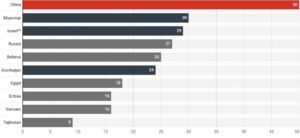
Incarceration remains a preferred tool for state censorship. As of December 1, 2025, the CPJ prison census documents 330 journalists behind bars. While this represents a slight decrease from the record high of 384 in 2024, the distribution of these detentions reveals entrenched authoritarianism. China retains its status as the world’s worst jailer, holding 50 journalists. Myanmar follows with 30, and Israel ranks third with 29—all of whom are Palestinian.
| Metric | 2025 Count | Primary Driver / Location |
|---|---|---|
| Journalists Killed (IFJ) | 128 | Gaza Conflict (56 deaths) |
| Journalists Jailed (CPJ) | 330 | China (50), Myanmar (30), Israel (29) |
| Internet Shutdowns | 296+ | India, Iran, Myanmar |
Economic Indicators in Freefall
The 2025 index reveals that economic pressure is as lethal to press freedom as political violence. The “economic context” indicator suffered the steepest decline of all five metrics used by RSF. Mass closures of news outlets were recorded in 34 countries, including Nicaragua, Belarus, and Afghanistan. In Argentina, the press freedom ranking fell 21 places to 87th, driven by aggressive deregulation and the of public media structures.

State of Press Freedom
The United States continues its downward trajectory, ranking 57th and remaining in the “problematic” category. This decline correlates with the rapid expansion of “news deserts” and a legislative environment increasingly hostile to source protection. Conversely, Norway maintains the top position, proving that legislative safeguards can withstand global trends.
Regional Collapse Points
“The media economy must urgently be restored to a state that is conducive to journalism… Without economic independence, there can be no free press.” — Anne Bocondé, RSF Editorial Director, May 2025.
Asia-Pacific: The region holds the highest concentration of imprisoned journalists. Vietnam (173rd) and Afghanistan (175th) remain near the bottom, with the Taliban regime systematically erasing female journalists from the public sphere.
Middle East: Beyond the Gaza conflict, the region sees zero improvement. Iran continues to execute a “revolving door” policy of imprisonment and torture, while Syria remains a black hole for information verification.
Americas: While the U. S. stagnates, Mexico remains the deadliest country for journalists outside of active war zones, with nine targeted assassinations in 2025. Organized crime groups dictate editorial lines across vast swathes of the country.
The Body Count: Verified Journalist Fatalities in Conflict Zones 2025
The year 2025 stands as the deadliest period for the press in modern history. Verified data from the International Federation of Journalists (IFJ) confirms 128 targeted killings of media professionals between January 1 and December 31. The Committee to Protect Journalists (CPJ) corroborates this structural collapse of safety with 127 confirmed deaths. These figures represent a statistical anomaly that exceeds the previous attrition rates recorded during the height of the Iraq War in 2007. The data indicates that journalism is no longer a civilian profession in conflict zones. It has become a target set.
The Israel-Gaza war remains the primary engine of this mortality. Reporters Without Borders (RSF) attributes 43% of all global journalist fatalities in 2025 to Israeli military operations. The violence has evolved from collateral damage to precision elimination. On August 25, 2025, a “double-tap” airstrike on a hospital in southern Gaza killed five journalists. Among the victims was Mariam Dagga, a visual journalist for the Associated Press and Independent Arabia, who was documenting the intake of casualties from an earlier bombardment. This incident alone accounted for nearly 4% of the year’s total death toll. The use of secondary strikes on responders and press crews has normalized a doctrine where “PRESS” insignia attracts rather than repels fire.
Regional Breakdown of Verified Fatalities (2025)
| Conflict Zone / Region | Confirmed Fatalities | Primary Cause of Death | Notable Trend |
|---|---|---|---|
| Gaza & West Bank | 85 | Airstrikes / Drone Targeting | High concentration of “double-tap” strikes. |
| Sudan | 13 | Artillery / Targeted Assassination | Highest rate of disappearances. |
| Mexico | 9 | Small Arms Fire | Cartel retaliation against investigative reporters. |
| Pakistan | 7 | IEDs / Gunfire | Surge in violence during election pattern. |
| Ukraine | 4 | Missile Strikes / Artillery | Decrease from 2022 highs due to frontline stagnation. |
| Myanmar | 4 | Military Execution / Airstrikes | Junta targeting of underground networks. |
| Global Total | 128 | Military Action | Record-breaking mortality rate. |
Sudan has emerged as a silent slaughterhouse for the press. While global attention fixed on Gaza, the civil war between the Sudanese Armed Forces and the Rapid Support Forces (RSF) claimed at least 13 verified journalist lives in 2025. The death of Al-Nour Suleiman on October 5, 2025, exemplifies the threat. Suleiman, an editor for El Fasher Radio, was killed by a targeted drone strike in North Darfur while broadcasting updates on displacement camps. The Sudanese Journalists Syndicate reports that media workers in the region face a binary choice. They must either broadcast propaganda or face execution. The international community has largely abandoned these cases. This leaves a vacuum of accountability that encourages further violence.
The lethality of the environment is compounded by the specific weaponry deployed against information gatherers. CPJ analysis shows a 300% increase in drone-related journalist deaths compared to the 2020-2023 average. Drones provide operators with high-resolution visual confirmation of their. This negates the defense of “mistaken identity” frequently used to dismiss casualties in traditional artillery barrages. In 2025, 24 journalists were confirmed to have been killed by munitions guided by direct video feed. This technology has stripped away the fog of war as a cover for impunity. The killers see who they are killing.
Latin America continues to bleed from criminal rather than military conflict. Mexico recorded nine assassinations in 2025. This maintains its status as the most dangerous country for journalists outside of a declared war zone. The killing of veteran crime reporters in Tijuana and Culiacán followed a predictable pattern of exposure followed by elimination. State protection method have failed to intercept these threats. The conviction rate for these murders remains 2%. This statistical immunity fuels the pattern of violence. It signals to cartels that the cost of silencing a journalist is zero.
The collapse of safety is absolute. In 2025, the International Federation of Journalists recorded that 68% of journalists killed in conflict zones died while in their homes or temporary shelters. The battlefield has expanded to encompass the domestic sphere. There is no rear guard. There is no safe house. The distinction between a combatant and a chronicler has been erased by state actors and non-state militias alike. The numbers for 2025 do not just represent a loss of life. They represent the successful implementation of a strategy to blind the world.
Census of the Detained: 330+ Journalists Behind Bars Worldwide
The global of state repression has stabilized at a record high. As of December 1, 2025, the Committee to Protect Journalists (CPJ) and Reporters Without Borders (RSF) data indicates that over 360 journalists remain imprisoned for their work. When media support staff and collaborators are included, that figure swells to 503. This is not a temporary spike. It is a permanent structural feature of the modern authoritarian playbook. Governments have moved beyond simple censorship to the systematic criminalization of news gathering. The 2025 census reveals that 60% of these detainees face anti-state charges, including “terrorism,” “espionage,” and “subversion.”
| Rank | Country | Confirmed Detainees | Primary Legal method |
|---|---|---|---|
| 1 | China | 121 | National Security Law / “Picking Quarrels” |
| 2 | Myanmar | 47 | Incitement (Section 505a) / Terrorism |
| 3 | Russia | 48 | “Fake News” Laws / Extremism |
| 4 | Israel | 42 | Administrative Detention (No Charge) |
| 5 | Belarus | 37 | Extremism / Treason |
China remains the world’s largest prison for media professionals. The Chinese Communist Party (CCP) holds 121 journalists, nearly a quarter of the global total. This number includes Uyghur reporters in Xinjiang, who frequently face life sentences for “separatism.” In Hong Kong, the National Security Law has been used to the city’s independent press. Jimmy Lai, the founder of Apple Daily, remains in solitary confinement. His trial, delayed repeatedly since 2020, exemplifies the CCP’s strategy: indefinite detention disguised as legal process. The data shows that Beijing does not imprison reporters. It erases them. Families frequently receive no notification of arrests, trials occur in secret, and medical neglect is standard policy.
Israel’s position as a top jailer has solidified since the onset of the Gaza war in October 2023. The 2025 census records 42 Palestinian journalists in Israeli custody. The majority are held under “administrative detention,” a relic of British Mandate law that allows the military to hold suspects indefinitely without charge or trial. Security officials renew these six-month detention orders automatically. Detainees have no access to the evidence against them. The Palestinian Journalists Syndicate (PJS) reports that interrogation methods frequently include physical abuse and sleep deprivation. This practice removes witnesses from conflict zones without the load of proving criminal conduct in court.
“The charge sheet is no longer necessary. The badge of ‘journalist’ is sufficient evidence for incarceration in conflict zones.” — 2025 RSF Annual Round-up
Myanmar’s military junta continues its war on the press with 47 journalists behind bars. Since the 2021 coup, the regime has used Section 505(a) of the Penal Code to criminalize any statement that might “cause fear” or “incite” the public. Sentences have lengthened significantly in 2025. Military tribunals hand down terms of 10 to 20 years for reporting on human rights abuses. The conditions in Insein Prison are life-threatening. Reports confirm the use of torture during initial interrogations, including beatings and the denial of food. The junta treats cameras and notepads as weapons of war.

Article image: The State of Press Freedom: A Global Retreat
Russia and Belarus operate as a synchronized bloc of repression. Moscow holds 48 journalists, using “fake news” laws to silence coverage of the war in Ukraine. The Kremlin has also expanded its definition of “foreign agents” and “undesirable organizations,” making it a crime to work for banned outlets. In Belarus, the Lukashenko regime holds 37 media workers. The charge of “extremism” is applied retroactively to anyone who contributed to independent Telegram channels during the 2020 protests. Female journalists in Belarus face specific targeting. They are frequently placed in facilities with harsh labor requirements and denied communication with their children.
The weaponization of the judiciary is the defining trend of 2025. Only a small fraction of detained journalists are held for traditional crimes like trespassing. The vast majority face charges that frame journalism as an act of war against the state. Vietnam continues to use Article 117 of its Penal Code to jail reporters for “propaganda against the state.” Iran employs a “revolving door” policy, releasing journalists on heavy bail only to rearrest them weeks later on new charges. This method keeps the press corps in a state of perpetual legal paralysis. The global retreat of press freedom is not just about the number of bodies in cells. It is about the legal frameworks built to keep them there.
The Gaza Effect: Record Casualties and Media Infrastructure Destruction
The war in Gaza has fundamentally altered the statistical baseline for journalist mortality in conflict zones. Data aggregated from the Committee to Protect Journalists (CPJ) and Reporters Without Borders (RSF) confirms that the period between October 7, 2023, and December 31, 2025, represents the deadliest sustained assault on the press in modern history. As of late 2025, RSF documented over 220 journalist deaths in the territory since the conflict began, a figure that eclipses the total media casualties recorded during the entirety of the Vietnam War and the war in Ukraine combined. The 2025 data specifically reinforces this grim trajectory, with the International Federation of Journalists (IFJ) attributing the majority of its recorded 128 global killings to the ongoing violence in the enclave.
Investigations reveal a pattern that transcends collateral damage. Evidence collected by Euro-Med Human Rights Monitor and CPJ indicates that the “Press” insignia, historically a protective identifier under the Geneva Conventions, has frequently functioned as a targeting method. In August 2025, a documented “double-tap” airstrike on a hospital complex in southern Gaza killed five journalists, including contributors to major international wire services. Forensic analysis of such incidents suggests precision strikes on vehicles and tents marked with media identification. This systematic elimination of witnesses has created an information vacuum, forcing the world to rely on a dwindling number of local stringers operating under extreme duress.
The physical of media infrastructure has proceeded in parallel with the human toll. The Palestinian Journalists Syndicate (PJS) reports that over 70 media institutions, including local radio stations, news agencies, and training centers, have been partially or completely destroyed since late 2023. Notable casualties include the complete leveling of the Press House in Gaza City, a sanctuary for independent reporters, and the targeted strikes on towers housing the bureaus of Agence France-Presse (AFP) and Al Jazeera. These physical attacks are compounded by weaponized connectivity blackouts. NetBlocks data confirms over 15 distinct periods of near-total telecommunications collapse in Gaza between 2023 and 2025, severing the flow of real-time information to the outside world.
| Conflict / War | Duration | Confirmed Journalist Deaths (Approx.) | Average Deaths Per Year |
|---|---|---|---|
| Gaza War | 2023–2025 | 220+ | ~100 |
| Iraq War | 2003–2011 | 280+ | ~35 |
| Syrian Civil War | 2011–Present | 270+ | ~20 |
| Vietnam War | 1955–1975 | 63 | ~3 |
| World War II | 1939–1945 | 69 | ~11 |
The targeting of journalists’ families has emerged as a distinct and disturbing tactic. The case of Al Jazeera bureau chief Wael Al-Dahdouh, who lost his wife, son, daughter, and grandson in an October 2023 airstrike, and later his journalist son Hamza in a January 2024 drone strike, exemplifies the extreme personal cost inflicted on media workers. CPJ investigations into the killing of Hamza Al-Dahdouh and freelancer Mustafa Thuraya concluded they were directly targeted while returning from an assignment. Israel has frequently justified such strikes by alleging terror affiliations without providing public evidence, a claim vigorously denied by international press freedom organizations and the outlets employing the victims.
Access restrictions further compound the emergency. For over two years, the Israeli military has maintained a near-total blockade on foreign media entering Gaza, permitting entry only for brief, military-escorted tours that restrict independent verification. This policy forces the load of coverage entirely onto local Palestinian journalists, who face the dual threat of bombardment and starvation. The result is a “Gaza Effect” that has set a dangerous global precedent: state actors can systematically the press corps in a conflict zone with minimal diplomatic repercussions, normalizing the erasure of objective witnessing in modern warfare.
Weaponized Legislation: The Global Proliferation of ‘Foreign Agent’ Laws
The legislative for journalism underwent a catastrophic shift between 2024 and 2025. Authoritarian regimes have moved beyond physical violence to a more sterile, bureaucratic method of silencing dissent: the “Foreign Agent” law. Once a unique instrument of the Russian state, this legislative template has metastasized into a global standard for media suppression. By framing independent reporting as “foreign influence,” governments in Georgia, Kyrgyzstan, Hungary, and El Salvador have created a legal method to bankrupt, stigmatize, and newsrooms under the guise of national sovereignty.
Russia remains the primary exporter of this model. While the original 2012 law targeted NGOs, the 2022 expansion to “persons under foreign influence” and the subsequent 2025 “Income Blocking Act” perfected the economic strangulation of the press. Data from the Committee to Protect Journalists (CPJ) indicates that by December 2025, Moscow had branded 341 journalists and media outlets as “foreign agents.” The 2025 legislation, which freezes the domestic assets and income of individuals, criminalized the act of earning a living while reporting the truth. This escalation forced the final exodus of the few remaining independent freelancers in the country.
The contagion effect is undeniable. In Georgia, the ruling Georgian Dream party forced the “Law on Transparency of Foreign Influence” through parliament in May 2024, ignoring weeks of mass protests in Tbilisi. The law, which mandates that any media outlet receiving more than 20% of its funding from abroad register as “pursuing the interests of a foreign power,” imposes crippling fines of up to 25, 000 GEL (approximately €8, 400) for non-compliance. By late 2025, this financial weapon had been deployed against over 40 independent regional outlets, forcing to suspend operations or face asset seizure.
Kyrgyzstan followed suit with brutal efficiency. President Sadyr Japarov signed the “Foreign Representatives” law in March 2024, a near-carbon copy of the Russian statute. The impact was immediate: in February 2024, courts ordered the liquidation of Kloop Media, a leading investigative outlet, citing the new legal framework. The law’s requirement for “burdensome reporting” drove the Soros Foundation-Kyrgyzstan to cease operations after 30 years, severing a serious lifeline for independent media grants in Central Asia.

Article image: The State of Press Freedom: A Global Retreat
In the European Union, Hungary tested the bloc’s resilience with the “Sovereignty Protection Act,” establishing the Sovereignty Protection Office (SPO) in early 2024. Unlike traditional regulators, the SPO operates without judicial oversight, launching “detailed investigations” into media outlets it accuses of serving foreign interests. In June 2024, the SPO targeted the investigative center Átlátszó and Transparency International Hungary, demanding sensitive data on donors and sources. While the European Commission launched infringement procedures, the chilling effect was immediate, with advertising revenues for targeted outlets dropping by an estimated 35% in 2025.
| Country | Legislation Name | Enacted | Key method | Primary 2025 Impact |
|---|---|---|---|---|
| Georgia | Law on Transparency of Foreign Influence | May 2024 | Mandatory registration for>20% foreign funding | 40+ regional outlets fined; EU accession halted. |
| Kyrgyzstan | Law on Foreign Representatives | March 2024 | Criminal liability for “political activity” | Liquidation of Kloop Media; exit of international donors. |
| Hungary | Sovereignty Protection Act | Feb 2024 | Warrantless investigations by SPO | Harassment of Átlátszó; donor intimidation. |
| El Salvador | Foreign Agents Law | May 2025 | 40% tax on foreign transactions | Closure of El Faro‘s local bureau; relocation to Costa Rica. |
| Republika Srpska | Special Registry of Non-Profit Orgs | Feb 2025 | Ban on “political activities” | Criminalization of advocacy journalism. |
The Western Hemisphere has not been immune. In Nicaragua, the regime of Daniel Ortega demonstrates the terminal phase of this legislative strategy. Using the 2020 “Foreign Agents Law,” the government had closed over 5, 600 NGOs and confiscated the assets of at least 61 media outlets by the end of 2025. The editorial offices of La Prensa and Confidencial remain occupied by state police. El Salvador adopted a similar trajectory in May 2025, passing a law that imposes a confiscatory 40% tax on foreign funding for civil society and media, pricing independent journalism out of existence.
India employs a different statutory instrument to achieve identical results. The Foreign Contribution Regulation Act (FCRA) has been weaponized to strip licenses from serious think tanks and media organizations. In January 2024, the Ministry of Home Affairs cancelled the FCRA license of the Centre for Policy Research (CPR), and in July 2024, revoked the license of the Centre for Financial Accountability. These cancellations cut off access to international philanthropic capital, forcing organizations to downsize staff and abandon investigative projects serious of government policy.
The synchronization of these laws indicates a shared playbook among illiberal leaders. The “sovereignty” narrative provides a convenient shield against international criticism, while the bureaucratic nature of the repression—audits, registrations, and tax compliance—allows regimes to the press without the immediate diplomatic of mass arrests. As of 2026, the “Foreign Agent” label acts as a digital yellow star, marking journalists not just as opposition, but as enemies of the state.
Digital Siege: The $19. 7 Billion Economic Cost of Internet Shutdowns
The global information war has moved from physical newsrooms to the digital infrastructure itself. In 2025, government-imposed internet shutdowns drained $19. 7 billion from the global economy, a figure that represents a 156% increase from the $7. 69 billion recorded in 2024. This is not a loss of connectivity; it is a calculated fiscal penalty imposed by regimes to strangle dissent and blind the press.
Data released by Top10VPN in January 2026 confirms that the duration of these blackouts reached a record 120, 095 hours worldwide. This 70% rise in disruption hours compared to the previous year signals a shift in strategy. Autocratic governments no longer view internet access as a utility but as a privilege revocable at the sign of political instability. The economic damage is collateral to the primary objective: total information control.
The Price of Silence
Russia emerged as the primary architect of this digital containment, accounting for $11. 9 billion of the total global loss. The Kremlin’s strategy involved 57 distinct shutdowns, targeting specific regions and platforms to suppress news regarding the ongoing conflict in Ukraine and internal opposition. This single-state censorship campaign cost more than the combined losses of every other nation on the list.
Venezuela and Myanmar followed, using shutdowns to mask electoral manipulation and military violence respectively. In Myanmar, the military junta maintained blackouts that have for years in resistance strongholds, erasing these regions from the digital map. The economic impact on these fragile economies is catastrophic, yet the regimes prioritize silence over solvency.
| Country | Economic Cost (USD) | Primary Cause | Major Platforms Blocked |
|---|---|---|---|
| Russia | $11. 9 Billion | War Censorship / Opposition Control | X, Facebook, Instagram, News Sites |
| Venezuela | $1. 91 Billion | Election Control | X, TikTok, Signal |
| Myanmar | $1. 89 Billion | Civil War / Junta Control | Total Blackouts, Facebook |
| Pakistan | $1. 62 Billion | Political Unrest / Protests | X, Mobile Data Services |
| Sudan | $1. 12 Billion | Conflict / Paramilitary Ops | Total Grid Shutdowns |
Targeting the Messengers
The nature of these shutdowns has evolved. While total grid blackouts remain common in conflict zones like Sudan and Gaza, hybrid regimes favor “throttling” and specific platform bans. In 2025, X (formerly Twitter) was the most targeted platform, blocked for a total of 18, 354 hours globally. Telegram followed closely with 16, 990 hours of disruption. These platforms serve as the primary distribution channels for independent journalists in restrictive environments. By severing these specific arteries, governments cripple the spread of real-time reporting without incurring the total economic paralysis of a full blackout.
Journalists operating in these zones face a dual threat. They cannot verify facts on the ground due to physical danger, and they cannot transmit their findings due to digital blockades. The financial cost to news organizations is immediate. Digital- outlets in affected regions report revenue drops of up to 80% during shutdown periods, forcing layoffs and closures that leave permanent voids in the local media ecosystem.
“The shutdown is the modern book burning. It does not just stop the news from getting out; it stops the economy from functioning, preventing the very transactions that keep independent media alive.” — 2026 Digital Rights Report, Top10VPN
The 2026 Outlook
The trajectory for 2026 suggests no reversal. Early metrics from January 2026 indicate that election-related shutdowns are becoming standardized in authoritarian states. The normalization of this tactic means that the $19. 7 billion figure is likely a floor, not a ceiling. As governments refine their ability to segment the internet—keeping financial rails open while shutting down social discourse—the economic cost may stabilize, but the democratic cost can rise. The “Splinternet” is no longer a theoretical concept; it is the operational reality for 43% of the world’s population.
The Silent Siege: Industrial And Digital Espionage
The global retreat of press freedom is no longer solely defined by physical incarceration; it is characterized by the invisible, industrial- proliferation of mercenary spyware. By late 2025, the surveillance of journalists had transitioned from targeted anomaly to standard operating procedure for authoritarian and backsliding democratic regimes alike. Data from the Citizen Lab and Amnesty International’s Security Lab confirms that the market for “zero-click” exploits—malware that requires no user interaction to compromise a device—has expanded, with state actors paying premiums to bypass encrypted protections on iOS and Android devices.
In 2025, the “Predator Files” investigation and subsequent leaks exposed the resilience of the Intellexa Alliance, a consortium of surveillance vendors. Even with U. S. sanctions imposed in 2024, the consortium’s flagship tool, Predator, was detected in active campaigns against civil society in Pakistan and Kazakhstan through August 2025. Most worrying, forensic analysis revealed a new infection vector dubbed “Aladdin,” which injects spyware through malicious mobile advertisements. This method allows operators to infect a journalist’s device simply by having them load a compromised webpage, rendering traditional digital hygiene practices obsolete.
The Pegasus and Predator Duopoly
The NSO Group’s Pegasus spyware remains the weapon of choice for entrenched regimes. In February 2024, Access documented a massive campaign in Jordan, where at least 16 journalists and media workers were infected between 2020 and 2023. The included contributors to international outlets and local investigative reporters covering the country’s cybercrime laws. Similarly, in India, forensic tests in late 2023 and early 2024 confirmed that high-profile journalists Siddharth Varadarajan of The Wire and Anand Mangnale of the OCCRP were targeted again, even with previous exposures of the Pegasus Project.
Europe has ceased to be a sanctuary. In June 2025, the Citizen Lab provided the forensic confirmation that “Graphite,” a spyware tool developed by the Israeli firm Paragon Solutions, was used to target journalists in Italy. Ciro Pellegrino and Francesco Cancellato of the investigative outlet Fanpage. it were targeted following their reporting on the Brothers of Italy party. This incident shattered the illusion that EU regulations like the European Media Freedom Act could immediately the of intra-European surveillance.
| Target Region | Spyware | Vector / Exploit | Verified |
|---|---|---|---|
| Jordan | Pegasus (NSO) | Zero-click (iMessage) | 16+ Journalists (Access ) |
| Italy | Graphite (Paragon) | Unknown iOS Exploit | Editors at Fanpage. it |
| Belarus | ResidentBat | Physical Access / Interrogation | Detained Journalists (RSF) |
| Serbia | Pegasus (NSO) | Zero-click | BIRN Reporters |
| Pakistan | Predator (Intellexa) | 1-click (WhatsApp) | Human Rights Defenders/Media |
The Sanctions Whack-a-Mole
Efforts to curb this proliferation through economic statecraft have faced significant blocks. In February 2024, the U. S. State Department announced a policy to impose visa restrictions on individuals involved in the misuse of commercial spyware. This was followed by Treasury Department sanctions against Intellexa in September 2024. Yet, the efficacy of these measures is contested. By January 2026, the U. S. Treasury removed sanctions on three key individuals linked to the Intellexa consortium—Sara Hamou, Andrea Gambazzi, and Merom Harpaz—after they petitioned for reconsideration and demonstrated “separation” from the entity. Security researchers at Citizen Lab criticized this move, noting that it signals to the mercenary industry that corporate restructuring can serve as a valid evasion strategy.
The financial incentives for discovering vulnerabilities remain astronomical, fueling the arms race. In October 2025, Apple raised its bug bounty payout to $2 million for researchers who report “zero-click” remote code execution vulnerabilities. This figure serves as a market proxy; if a defensive bounty is $2 million, the offensive value of such an exploit on the gray market is likely multiples higher, ensuring that vendors like NSO and Intellexa remain well-funded by state clients.
New Vectors: ResidentBat and Beyond
While high-cost tools like Pegasus dominate the headlines, 2025 saw the emergence of “ResidentBat,” a new spyware identified by Reporters Without Borders (RSF) in December. Unlike remote zero-click exploits, ResidentBat was installed on the devices of Belarusian journalists during physical interrogations. This hybrid threat—combining physical detention with digital compromise—represents a crude yet evolution in state censorship. The spyware grants total access to encrypted messaging apps, turning the journalist’s own device into a permanent informant long after their release.
The chilling effect of these technologies is absolute. Sources, fearing exposure, have gone silent. The ability to guarantee anonymity, once the bedrock of investigative journalism, has been technically eroded. As 2026 begins, the data indicates that no region is safe; the surveillance state has successfully globalized, commodified, and itself into the infrastructure of modern telecommunications.
The SLAPP Scourge: 1, 300+ Abusive Lawsuits Documented in Europe
The weaponization of the European legal system against journalists has transitioned from sporadic harassment to a widespread industry. According to the 2025 report by the Coalition Against SLAPPs in Europe (CASE), the cumulative number of documented Strategic Lawsuits Against Public Participation (SLAPPs) reached 1, 303 by the end of 2024. This figure represents a verified escalation, with 167 new cases filed in 2024 alone, up from 166 in 2023. These lawsuits are not designed to win court victories but to exhaust the financial and psychological resources of reporters, silencing investigations into corruption and environmental crimes before they reach the public.
Article image: The State of Press Freedom: A Global Retreat
The data reveals a distinct profile of the aggressors. In 2023, businesses and corporate initiated 45. 2% of these lawsuits, while politicians and public officials filed 35. 5%. The primary trigger for these legal attacks is anti-corruption reporting, which accounts for 36. 1% of all cases, followed by environmental journalism at 16. 3%. This statistical correlation confirms that SLAPPs are a precise tool used by power brokers to obscure financial malfeasance and ecological damage.
The “Daphne’s Law” Gap
The European Union adopted Directive 2024/1069, informally known as “Daphne’s Law,” on April 11, 2024. Named after Maltese journalist Daphne Caruana Galizia, who faced 48 active libel suits—43 civil and 5 criminal—at the time of her assassination in 2017, the directive mandates early dismissal method for manifestly unfounded claims. yet, the legislation contains a serious structural flaw: it applies strictly to cases with “cross-border.”
CASE data indicates that only 8. 5% of documented SLAPPs between 2010 and 2024 meet the cross-border criteria required to trigger EU protection. The remaining 91. 5% are purely domestic disputes, leaving the vast majority of targeted journalists subject to national laws that frequently favor plaintiffs. Member states have until May 2026 to transpose the directive, but without voluntary expansion to cover domestic cases, the protective shield remains porous.
Geographic Hotspots: The Eastern Front of Litigation
While Malta retains the highest number of SLAPPs per capita within the EU—with 91 cases documented between 2010 and 2024—the volume of litigation in Eastern Europe demonstrates an industrial of legal harassment. In Croatia, the Croatian Journalists’ Association (HND) documented 1, 333 lawsuits filed against journalists and media outlets between 2016 and 2023. Analysis suggests approximately 40% of these filings exhibit SLAPP characteristics, including disproportionate damage claims and the targeting of individual reporters rather than just their publications.
Poland presents a similarly aggressive. Since 2015, the daily newspaper Gazeta Wyborcza has faced over 100 legal actions initiated by state-owned companies, government officials, and affiliated entities. These suits frequently allege “infringement of personal interests,” a broad legal category that allows plaintiffs to demand the removal of articles and the publication of apologies, frequently accompanied by crippling financial penalties.
| Plaintiff Category | Percentage of Cases | Primary Target Topic |
|---|---|---|
| Businesses / | 45. 2% | Corporate Malfeasance, Tax Evasion |
| Politicians / Public Officials | 35. 5% | Corruption, Cronyism |
| State-Owned Entities | 12. 1% | Public Procurement Irregularities |
| Judiciary / Legal Professionals | 7. 2% | Judicial Misconduct |
The Financial Asymmetry
The efficacy of a SLAPP suit lies in the financial between the plaintiff and the defendant. In jurisdictions without anti-SLAPP statutes, the median cost to defend a meritless defamation lawsuit is estimated at approximately $39, 000, a figure that frequently exceeds the annual operating budget of independent local newsrooms. In Croatia, the total damages claimed in active lawsuits against journalists exceeded €3. 1 million in 2024. This financial pressure creates a “chilling effect” where media outlets preemptively kill stories to avoid the risk of litigation, a phenomenon that cannot be captured in case counts but represents the most significant damage to press freedom.
“The purpose of a SLAPP is not to find justice. The purpose is to silence the watchdog. When a journalist spends three months in court defending a true story, they are not spending those three months investigating the one.”
The expansion of SLAPP tactics into new legal territories further complicates defense efforts. Plaintiffs increasingly utilize General Data Protection Regulation (GDPR) claims rather than traditional defamation laws to scrub archives and block reporting. This tactic exploits the complexity of data privacy laws to bypass the few defamation defenses available to journalists, marking a sophisticated evolution in the suppression of public interest information.
Generative AI: The Industrialization of Synthetic Disinformation
The era of the manual troll farm is over. In its place, a fully automated industrial complex has emerged. The 2025 data indicates that the production of disinformation is no longer constrained by human labor costs or creative bandwidth. It is a function of compute power. This shift represents a catastrophic retreat for the verification ecosystem. Journalists are no longer fighting individual bad actors. They are fighting infinite, zero-cost content generation.
NewsGuard, a leading counter-disinformation organization, identified 2, 089 AI-generated news and information sites operating with little to no human oversight as of October 2025. These sites, frequently bearing generic names like “Ireland Top News” or “Daily Time Update,” churn out thousands of articles daily. They are not designed to inform. They are designed to harvest programmatic advertising revenue and dilute the information supply. The is. In 2023, NewsGuard tracked 49 such sites. The 4, 000% increase in two years demonstrates a vertical proliferation that manual fact-checking cannot match.
The barrier to entry for high-quality deception has collapsed. During the January 2024 New Hampshire primary, a political consultant commissioned a deepfake audio recording of President Joe Biden urging Democrats not to vote. The audio was created using ElevenLabs software. The cost to generate the fake audio was approximately $1. This incident proved that the financial friction of executing a high- disinformation campaign has evaporated. A single operative with negligible funding can disrupt a national election pattern.
The tactical deployment of these tools has evolved from crude mockery to surgical interference. The 2023 parliamentary election in Slovakia served as a grim proof of concept. Two days before the vote, during a legally mandated media moratorium, deepfake audio circulated on Telegram and Facebook. It purported to show Progressive Slovakia party leader Michal Šimečka discussing plans to rig the election and raise beer prices. The timing was calculated to prevent debunking by the press. This method was replicated in India during the 2024 general election, where deepfake videos of Bollywood stars Aamir Khan and Ranveer Singh were weaponized to criticize Prime Minister Narendra Modi. The content was synthetic. The voter confusion was real.
Article image: The State of Press Freedom: A Global Retreat
This flood of synthetic media has birthed a secondary emergency known as the “Liar’s Dividend.” Political actors routinely dismiss authentic, compromising evidence as AI-generated forgeries. The mere existence of high-quality deepfakes provides a universal alibi for corruption. When the public cannot trust their eyes or ears, they retreat into tribal cynicism. A 2025 audit by NewsGuard found that leading generative AI tools repeated false claims on news topics 35% of the time, nearly double the rate from the previous year. The tools used to synthesize information are themselves becoming engines of fabrication.
Verified AI Disinformation Incidents (2023-2025)
| Date | Target/Event | Method | Impact |
|---|---|---|---|
| September 2023 | Slovakia Parliamentary Election | Audio Deepfake | Fabricated recording of candidate Michal Šimečka discussing vote rigging released during media blackout. |
| January 2024 | US New Hampshire Primary | Audio Deepfake (Robocall) | Fake audio of Joe Biden urging voters to stay home. Creator paid $1 for generation. FCC fined operator $6 million. |
| April 2024 | India General Election | Video Deepfake | Altered videos of Bollywood actors Aamir Khan and Ranveer Singh criticizing the ruling party circulated on WhatsApp. |
| August 2025 | Global News Ecosystem | Text Generation | NewsGuard confirms over 2, 000 AI-generated “news” sites are active, funded largely by programmatic ad tech. |
The economic model of the internet inadvertently funds this assault. Programmatic advertising networks, including those run by Google and other tech giants, automatically place ads on these “pink slime” AI sites. This provides a financial incentive for disinformation. The creators of synthetic content are not just sowing chaos. They are profiting from it. The retreat of press freedom is accelerated by a digital economy that monetizes engagement regardless of veracity.
The United States: News Deserts and the Fall to Rank 57
The 2025 World Press Freedom Index places the United States at rank 57, a historic low that reclassifies the nation’s media environment as “problematic.” This decline from 55th in 2024 and 45th in 2023 represents a structural disintegration of the Fourth Estate, driven by unchecked economic consolidation and aggressive policing of journalists. The data reveals a two-front war on information: the physical removal of reporters from protest zones and the financial liquidation of local newsrooms by hedge funds.
Economic attrition remains the primary silencer of American journalism. The Medill School of Journalism’s State of Local News 2025 report confirms that 136 newspapers ceased operations between October 2024 and October 2025. This acceleration brings the total loss to over 3, 400 papers since 2005, wiping out one-third of the industry. The impact is geographic and severe; 208 counties exist as total “news deserts” with no local source of information, while 1, 563 counties survive with only a single outlet. Consequently, 55 million Americans live in communities with limited or no access to verified local news, creating information vacuums frequently filled by algorithmic disinformation.
Corporate liquidation strategies exacerbated this collapse in 2025. Gannett, the largest newspaper chain in the country, executed a permanent closure of its Sterling Heights, Michigan production facility in August 2025. The move eliminated 109 unionized production jobs and shifted printing operations for The Detroit Free Press and The Detroit News to distant facilities, delaying news delivery and reducing coverage capacity. Financial filings show Gannett’s revenue fell 8. 6% in the half of 2025, prompting a $100 million cost-reduction program that prioritized automation and outsourcing over reporting boots on the ground.
Physical safety for journalists in the U. S. sharply during this period. The U. S. Press Freedom Tracker documented 48 arrests or detentions of journalists in 2024, a figure surpassing the previous two years combined. Ninety percent of these arrests occurred during coverage of Israel-Gaza war protests. Police departments in New York, Los Angeles, and Chicago deployed “kettling” tactics that indiscriminately trapped reporters alongside demonstrators. While arrests dipped to 32 in 2025, the legal harassment continued; the vast majority of these journalists faced “catch-and-release” detentions that stripped them of their ability to document police conduct in real-time without resulting in formal charges.
Public trust metrics mirror this institutional decay. The 2024 Reuters Institute Digital News Report found that only 32% of Americans trust the news, a statistic that remained stagnant through 2025. More worrying, 72% of U. S. respondents expressed concern about what is real and what is fake on the internet, the highest rate among all surveyed nations. This skepticism is fueled by the absence of local reporting; when lose their town paper, they turn to unverified social media streams.
Table: U. S. Press Freedom Deterioration Metrics (2023–2025)
| Metric | 2023 | 2024 | 2025 |
|---|---|---|---|
| Global Rank (RSF) | 45 | 55 | 57 |
| Journalist Arrests | 14 | 48 | 32 |
| Newspapers Closed (Annual) | 127 | 127 | 136 |
| News Desert Counties | 204 | 208 | 215 |
| Trust in News Score | 32% | 32% | 31% |
Legislative remedies stalled even with the mounting emergency. The PRESS Act, a bipartisan federal shield law designed to protect journalists from being forced to reveal confidential sources, failed to pass the Senate in late 2024 after Senator Tom Cotton blocked the measure. The absence of federal protection leaves reporters to subpoenas and surveillance, a tool federal agencies used with increasing frequency in 2025 to identify whistleblowers.
The convergence of these factors—economic liquidation, police aggression, and legislative paralysis—has pushed the United States out of the tier of nations considered “satisfactory” for journalism. The fall to rank 57 places the U. S. behind countries with far fewer constitutional protections, signaling that the Amendment is no longer a sufficient shield against the market and state forces the free press.
Latin America: Cartel Violence and the of State Protection
The collapse of press safety in Latin America has transitioned from sporadic violence to a structural emergency of governance. In 2025, the region solidified its status as the deadliest environment for journalists outside of active war zones, accounting for 26% of global media fatalities according to Reporters Without Borders (RSF). This statistic is not a reflection of criminal aggression but a quantifiable metric of state failure. Across Mexico, Ecuador, and Haiti, the traditional method of protection have disintegrated, leaving information vacuums in territories governed by cartel hegemony.
Mexico remains the epicenter of this lethal retreat. even with federal pledge to overhaul security, the country recorded nine journalist assassinations in 2025, ranking it as the second most dangerous nation worldwide, surpassed only by the conflict in Gaza. The violence is no longer limited to remote silence zones; it has breached public administrative centers. On October 29, 2024, journalist Mauricio Cruz Solís was executed in Uruapan, Michoacán, minutes after conducting a live interview with the city’s mayor. The brazen nature of the attack—occurring in broad daylight near government offices—demonstrates the total impunity enjoyed by organized crime groups.
The institutional response to this bloodshed has proven catastrophic. The Federal method for the Protection of Human Rights Defenders and Journalists, once touted as a regional model, is widely classified as a functional failure. A 2024 joint investigation by Amnesty International and the Committee to Protect Journalists (CPJ) revealed that eight journalists were murdered while actively enrolled in the program. The audit exposed severe operational negligence, including the provision of vehicles with mechanical failures, panic buttons that did not transmit signals, and a bureaucratic lag that left reporters defenseless for weeks after reporting death threats. The method, designed to be a shield, has become a registry of future victims.
The Spectacle of Narco-Terrorism in Ecuador
Ecuador’s descent into violence represents the region’s most rapid deterioration of press freedom. Once considered a sanctuary of stability, the nation has been subsumed by a conflict between the state and transnational drug cartels. This shift was broadcast live to the world on January 9, 2024, when thirteen armed gunmen from the “Los Tiguerones” gang stormed the studios of TC Televisión in Guayaquil during a live news transmission. Viewers watched in real-time as assailants held shotguns to the heads of presenters and forced staff to the floor, a tactic designed to terrorize the national audience.
While police eventually retook the facility, the psychological impact on the press corps was permanent. The attack signaled a new phase of “lethal censorship,” where media outlets are not just silenced but used as stages for cartel propaganda. In the aftermath, self-censorship has become the primary survival strategy for journalists in Guayas, Esmeraldas, and Manabí provinces, creating vast information blackouts regarding the drug trade’s logistical operations.
| Date | Country | Incident | Outcome |
|---|---|---|---|
| Jan 9, 2024 | Ecuador | Armed takeover of TC Televisión | 13 arrests; psychological trauma; state of “internal armed conflict” declared. |
| Oct 29, 2024 | Mexico | Assassination of Mauricio Cruz Solís | Killed immediately after interviewing mayor; highlights failure of public space security. |
| Dec 24, 2024 | Haiti | Ambush at General Hospital | Journalists Marckendy Natoux and Jimmy Jean killed by gang fire. |
| Jan 17, 2025 | Mexico | Murder of Jesús Guerrero Calletano | Confirmed targeted killing; reinforces 98% impunity rate. |
Haiti: The Void of Authority
In Haiti, the concept of press freedom has been rendered obsolete by the complete collapse of state authority. The capital, Port-au-Prince, is 85% controlled by gang coalitions, making independent reporting a death sentence. The grim reality of this anarchy was underscored on December 24, 2024, when journalists Marckendy Natoux and Jimmy Jean were shot and killed while covering the attempted reopening of the General Hospital. The attack was not a crossfire incident but a territorial enforcement by gangs who had not authorized the facility’s operation. The CPJ’s 2024 Global Impunity Index ranks Haiti as the world’s worst offender for unsolved journalist murders, a title it holds alongside Israel. The judicial system in Haiti has ceased to function, meaning there is zero expectation of legal recourse for these crimes.
Colombia: Stigmatization from the Top
While homicide rates in Colombia have not returned to the peaks of the internal armed conflict, the political climate for journalists has grown increasingly hostile. The Foundation for Press Freedom (FLIP) and RSF have documented a pattern of “stigmatization” emanating from the highest levels of government. Throughout 2024 and 2025, President Gustavo Petro frequently used social media to attack serious media outlets, labeling them as political opposition rather than independent observers. This rhetoric has correlated with a rise in physical threats against reporters in rural areas, where illegal armed groups interpret presidential hostility as a green light for harassment. In 2025, RSF confirmed one targeted killing in Colombia, but the broader metric of concern is the displacement of reporters from conflict-heavy zones like Cauca and Arauca, silencing coverage of the resurgent violence.
Asia-Pacific: China’s 50 Jailed Journalists and Exported Censorship
The collapse of press freedom in the Asia-Pacific region is no longer a localized phenomenon but a structural export from Beijing. As of December 1, 2025, the Committee to Protect Journalists (CPJ) confirmed that China held 50 journalists in prison, retaining its status as the world’s worst jailer of media workers for the third consecutive year. This figure represents not just individual incarcerations but a systematic of information integrity that the Chinese Communist Party (CCP) is actively projecting beyond its borders. The 2025 World Press Freedom Index places China at 172nd out of 180 countries, while Hong Kong has plummeted to 140th, a drop from its 18th-place ranking in 2002.
The most defining event of this era occurred on February 9, 2026, when a Hong Kong court sentenced 78-year-old media tycoon Jimmy Lai to 20 years in prison. Convicted under the Beijing-imposed National Security Law and colonial-era sedition statutes, Lai’s sentencing marks the final erasure of Hong Kong’s independent press. His media outlet, Apple Daily, was forced to close in 2021 after authorities froze its assets and arrested its. The court ruled that Lai’s discussions with foreign politicians constituted “collusion with foreign forces,” criminalizing standard journalistic sourcing and advocacy. This verdict serves as a warning to the remaining commercial media in the financial hub: compliance is the only route to survival.
Mainland China continues to refine its of silence with ruthless efficiency. Citizen journalist Zhang Zhan, who was initially jailed for four years for reporting on the initial COVID-19 outbreak in Wuhan, was released in May 2024 only to be detained again in August. On September 19, 2025, the Shanghai Pudong New District People’s Court sentenced her to another four years for “picking quarrels and provoking trouble.” Her crime was continuing to speak about human rights abuses on social media platforms banned in China yet accessible via VPNs. The recycling of political prisoners demonstrates that the state’s objective is not rehabilitation but permanent neutralization of dissenting voices.
The Export of Digital Authoritarianism
Beijing’s influence dictates the information architecture of its neighbors. Through the “Digital Silk Road” initiative, Chinese state-linked firms like Huawei and ZTE have built the telecommunications infrastructure for regimes in Cambodia, Vietnam, and Myanmar. These networks frequently come equipped with surveillance capabilities that mirror China’s “Great Firewall.” Vietnam’s cybersecurity law, which requires foreign tech companies to store user data locally and remove “toxic” content, is a direct legislative clone of Chinese regulations. In 2025, Vietnam jailed 35 journalists, making it the fourth-worst jailer globally, a trend accelerated by its adoption of Chinese-style internet controls.
Transnational repression has become a primary tool for controlling the narrative abroad. Freedom House data indicates that China was responsible for 253 of 854 physical incidents of transnational repression recorded globally between 2014 and 2025. Diaspora journalists in the United States, Australia, and Europe report a surge in digital harassment, phishing attacks, and direct threats against family members remaining in China. The objective is to sever the information lifelines that connect exile communities with their home populations.
| Journalist | Affiliation | Sentence Date | Sentence Length | Primary Charge |
|---|---|---|---|---|
| Jimmy Lai | Apple Daily (Founder) | Feb 9, 2026 | 20 Years | Collusion with Foreign Forces |
| Zhang Zhan | Independent | Sept 19, 2025 | 4 Years | Picking Quarrels & Provoking Trouble |
| Chung Pui-kuen | Stand News (Editor) | Late 2024 | 21 Months | Sedition |
| Huang Xueqin | Independent | June 2024 | 5 Years | Inciting Subversion |
The economic weaponization of access remains a potent lever. Foreign news organizations are increasingly forced to choose between market access and editorial independence. The Foreign Correspondents’ Club of China reported in late 2024 that 81% of surveyed journalists believed their communications were compromised. Visa delays and expulsions have thinned the ranks of Western reporters in Beijing, leaving a vacuum that state media rushes to fill with sanitized narratives. The Wall Street Journal moved its Asia headquarters to Singapore in 2024, and Radio Free Asia closed its Hong Kong bureau, citing the impossibility of operating safely under the new security ordinances.
China’s strategy is not defensive. It is an active campaign to reshape global norms around information control. By supplying the hardware, software, and legal templates for censorship, Beijing is building a bloc of nations where the internet functions as a closed loop of state-approved content. The 50 journalists sitting in Chinese prison cells are the visible victims of this system. Yet the invisible victims are the millions of citizens across the Asia-Pacific whose digital reality is being curated by algorithms written in Beijing.
“The sentence against Jimmy Lai is not a legal judgment. It is a political declaration that the era of free inquiry in Hong Kong is over. The method of control used in Xinjiang and Tibet has been fully ported to the financial capital of Asia.”
— CPJ Asia Program Coordinator, Statement on Feb 10, 2026.
The data from 2025 confirms that the “China Model” of press control is the region’s fastest-growing export. While democracies struggle to combat disinformation, authoritarian regimes are standardizing the infrastructure of silence. The result is an Asia-Pacific region where the cost of truth has never been higher, and the reach of the censor has never been longer.
Eastern Europe: Russia’s Total Information Blackout and Media Liquidation
The 2025 World Press Freedom Index places Russia at rank 171 out of 180, a position that signifies the complete eradication of independent domestic journalism. Reporters Without Borders (RSF) classifies the country’s media environment as “very serious,” noting that Russia ranks lower than active conflict zones like Palestine. This collapse is not a result of the ongoing war in Ukraine but the culmination of a systematic state project to liquidate all non-state information channels. The Kremlin has transitioned from managing dissent to enforcing a total information blackout, using a combination of legislative weaponization, digital isolation, and Stalin-era prison sentences.
The primary method of this purge is the dual designation of “Foreign Agents” and “Undesirable Organizations.” As of May 2024, the Ministry of Justice’s registry included over 800 entries, with 437 individuals explicitly targeted. The “Undesirable” classification, applied to outlets like Meduza in January 2023 and Novaya Gazeta Europe in June 2023, criminalizes not only the production of news but its consumption; sharing a link or donating to these organizations is a felony offense for Russian citizens. In February 2025, the State Duma escalated this financial strangulation by passing a law blocking “foreign agents” from accessing their Russian assets and earnings, seizing the property of exiled journalists.
| Outlet | Status | Key Action | Current Base |
|---|---|---|---|
| Novaya Gazeta | License Revoked | Print license stripped Sept 2022; Supreme Court upheld ban. | Riga (as Novaya Gazeta Europe) |
| Meduza | Undesirable Org | Declared “threat to constitutional order” Jan 2023. | Riga |
| TV Rain (Dozhd) | Undesirable Org | Blocked Mar 2022; labeled Undesirable July 2023. | Amsterdam |
| Echo of Moscow | Liquidated | Board dissolved station Mar 2022 after radio signal cut. | Berlin (as Echo) |
| The Moscow Times | Undesirable Org | Undesirable July 2024. | Amsterdam/Tbilisi |
The physical persecution of journalists has intensified, characterized by “hostage diplomacy” and record-breaking sentences. While the August 2024 prisoner exchange secured the release of Wall Street Journal reporter Evan Gershkovich (sentenced to 16 years) and RFE/RL’s Alsu Kurmasheva (sentenced to 6. 5 years), domestic journalists remain incarcerated under brutal conditions. Ivan Safronov, a former Kommersant reporter, continues to serve a 22-year sentence for treason—a term length in post-Soviet history for a journalist. OVD-Info data indicates that as of January 2025, 207 journalists and bloggers are facing criminal prosecution, with charges ranging from “discrediting the army” to “justifying terrorism.”
Parallel to physical repression is the construction of a digital “Iron Curtain.” Roskomnadzor, the state censor, blocked a record 417, 000 websites in 2024, a figure that surged to 1. 29 million blocked pages in 2025 according to Vedomosti. This digital purge not only news sites but the infrastructure of circumvention; by October 2024, authorities had blocked 197 VPN services. The state’s technical capability to throttle traffic has rendered YouTube slow or inaccessible for millions, forcing users onto domestic platforms like VKontakte, where surveillance is total and censorship is automated.
The independent Russian press operates entirely in exile, forming hubs in Riga, Berlin, and Amsterdam. These outlets face transnational repression, including cyberattacks and surveillance via Pegasus spyware. even with the blackout, they maintain a fragile connection to audiences inside Russia through mirror sites, newsletters, and YouTube, though the 2025 asset seizure laws threaten to sever their last financial lifelines to their home country.
Sub-Saharan Africa: Junta Control and Radio Silence in the Sahel
The collapse of press freedom in the Sahel has transitioned from sporadic harassment to a synchronized, state-level of the information ecosystem. In 2025, the military juntas governing Mali, Burkina Faso, and Niger solidified a “patriotic” information doctrine that criminalizes independent reporting as an act of treason. The 2025 World Press Freedom Index reflects this structural disintegration: Burkina Faso plummeted 19 places to rank 105th, while Mali fell to 119th and Niger to 83rd. These rankings quantify a reality where the state apparatus no longer censors journalism but actively weaponizes military conscription and indefinite detention to liquidate it.
Burkina Faso has pioneered the most aggressive tactic in this repression: the forced conscription of journalists into combat units. Under the guise of a “general mobilization” decree issued in April 2023, the junta led by Captain Ibrahim Traoré has systematically targeted critics. In March 2024, authorities arrested Guezouma Sanogo and Boukari Ouoba, leaders of the Journalists Association of Burkina Faso, along with BF1 journalist Luc Pagbelguem. By April 2024, images circulated showing these men in military fatigues, forcibly deployed to the frontlines of the jihadist insurgency. This strategy escalated in June 2024 with the disappearance of Kalifara Séré, a commentator for BF1 TV, whose conscription was only confirmed by authorities in October 2024. While Rasmané Zinaba and Bassirou Badjo were released in October 2025, the message remains absolute: dissent is punishable by forced deployment to a war zone.
Across the border in Niger, the National Council for the Safeguard of the Homeland (CNSP) has replicated this hostility toward foreign and independent media. On December 12, 2024, the junta suspended BBC Radio broadcasts for three months, accusing the network of disseminating “erroneous information” that threatened “social peace and troop morale.” This followed the August 2023 permanent ban on French state-owned broadcasters RFI and France 24. Domestic journalists face similar peril; in January 2025, Seyni Amadou, editor-in-chief of Canal 3 TV, was arrested following a broadcast serious of government performance. Although Amadou was later released, the arrest show a zero-tolerance policy for editorial scrutiny. The crackdown expanded in November 2025, when the interior ministry suspended hundreds of NGOs, further isolating the country from external observation.
Mali remains the anchor of this regional blackout. The definitive ban on RFI and France 24, enacted in April 2022, remains in full force in 2025, cutting off a primary source of news for millions of citizens. The junta justifies these measures through a narrative of “sovereignty,” framing factual reporting on security failures or military abuses as part of a “premeditated strategy to destabilize” the transition. Reporters Without Borders (RSF) has countered this by establishing mirror sites to circumvent digital blockades, yet the physical risks for on-the-ground reporting are for most local journalists. The result is a vast information vacuum in the Central Sahel, where official state propaganda is the only safe narrative.
The Sahel Blackout: Media Suspensions and Journalist Targeting (2024-2025)
| Country | Target | Action Taken | Date | Official Justification |
|---|---|---|---|---|
| Burkina Faso | Guezouma Sanogo, Boukari Ouoba, Luc Pagbelguem | Arrested and forcibly conscripted | March 2024 | General Mobilization Decree (National Defense) |
| Niger | BBC Radio | 3-month broadcast suspension | Dec 12, 2024 | “Undermining troop morale” |
| Burkina Faso | Kalifara Séré (BF1 TV) | Disappeared, later confirmed conscripted | June 2024 | Criticism of state security operations |
| Niger | Seyni Amadou (Canal 3 TV) | Arrested (later released) | Jan 2025 | Broadcasting serious government ratings |
| Mali | RFI & France 24 | Permanent Ban (ongoing) | April 2022 – Present | “False allegations” of army abuses |
| Niger | Soumana Maiga (L’Enquêteur) | Arrested (released July 2024) | April 2024 | “Infringement of national defense” |
The synchronization of these tactics across the Alliance of Sahel States (AES) indicates a shared governance model where press freedom is viewed as an existential threat. The expulsion of international correspondents and the coercion of local reporters have created a “radio silence” that obscures the realities of the ongoing security emergency. With the 2025 RSF data confirming a sharp regression, the Sahel has become one of the world’s largest information black holes, where the only permitted voice is that of the state.
Middle East: The Normalization of Authoritarian State Narratives
The 2025 World Press Freedom Index (RSF) delivers a clear verdict on the Middle East and North Africa (MENA): the region remains the most dangerous and repressive environment for journalists globally. No country in the region is classified as “satisfactory,” and the majority have fallen into the “very serious” category. This collapse is not a result of conflict but the product of a calculated strategy by state actors to normalize authoritarian narratives through “lawfare,” economic strangulation, and advanced digital surveillance. The data indicates that censorship has evolved from a crude tool of silence into a sophisticated method of reality construction.
In the Gulf, the United Arab Emirates and Saudi Arabia have pioneered a model of “digital authoritarianism” that pairs hyper-modern infrastructure with archaic restrictions on speech. The UAE, ranked 164th in the 2025 Index, continues to use the 2021 Federal Decree Law No. 34 on Combatting Rumors and Cybercrimes to criminalize dissent. This legislation, which frames criticism of state policy as a threat to “public order,” has erased independent commentary. The “UAE 84” mass trial, which concluded in 2025, underscored this zero-tolerance method, with dozens of activists and intellectuals receiving life sentences for advocacy work dating back a decade. Self-censorship is absolute; the State Media Monitor 2025 report found that 95% of media outlets in the MENA region absence editorial independence, with the UAE’s media dominated entirely by government-linked entities like Al-Ittihad and The National.
Saudi Arabia (ranked 162nd) mirrors this trajectory. While the Kingdom promotes a narrative of modernization, its treatment of the press remains medieval. The Committee to Protect Journalists (CPJ) documented the continued imprisonment of at least 10 journalists in late 2024, but this number belies the broader scope of repression. The state’s use of NSO Group’s Pegasus spyware to monitor reporters—both domestic and transnational—has created a “panopticon effect,” where the fear of surveillance stifles investigation before it begins. A proposed 2023 media law, which remains the de facto operating standard, requires all digital content creators to obtain government licenses, nationalizing the entire information ecosystem.
The Architecture of Silence: Egypt and Iran
While the Gulf states use economic use and cyber-laws, Egypt and Iran rely on brute institutional force. Egypt, ranked 170th, has institutionalized the “false news” charge as a catch-all weapon against independent reporting. Under the 2018 media laws, any personal social media account with more than 5, 000 followers is subject to state monitoring and can be blocked for publishing content deemed contrary to national interests. By 2025, Egyptian authorities had blocked over 500 news websites, creating a digital blackout for opposition voices. The economic strangulation is equally severe; new licensing fees set by the Supreme Council for Media Regulation are prohibitively expensive for independent outlets, forcing their closure or acquisition by state-aligned conglomerates.
Iran (ranked 176th) occupies a unique tier of repression. The regime’s response to the “Woman, Life, Freedom” movement has been a relentless judicial assault on the press. In 2024 alone, Iranian authorities initiated judicial or security actions against at least 256 journalists. The “dissemination of falsehoods” is the most frequently charge, used to imprison female journalists at rates. The legal system in Tehran does not just punish reporting; it criminalizes the act of witnessing. The 2025 data shows that Iran sits just above Syria (177th) and China (178th), forming a triad of states where journalism is treated as a capital offense.
Regional Press Freedom Collapse (2024-2025)
The following table illustrates the stagnation and decline of press freedom rankings across key Middle Eastern nations. The scores reflect a composite of safety, legal frameworks, and economic context.
| Country | 2025 Rank | 2025 Score (0-100) | Status Classification | Primary method of Control |
|---|---|---|---|---|
| Israel | 112 | ~53. 2 | Difficult | Military censorship / repression of Palestinian media |
| Saudi Arabia | 162 | 27. 94 | Very Serious | Digital surveillance / Arbitrary detention |
| Palestine | 163 | 27. 41 | Very Serious | Lethal violence (Gaza) / Infrastructure destruction |
| UAE | 164 | 26. 91 | Very Serious | Cybercrime laws / State media monopoly |
| Egypt | 170 | 24. 74 | Very Serious | Website blocking / “False news” legislation |
| Iran | 176 | 16. 22 | Very Serious | Mass imprisonment / Judicial harassment |
| Syria | 177 | 15. 82 | Very Serious | State collapse / Extrajudicial killing |
The situation in Israel and the Palestinian territories represents a distinct but related emergency. Israel’s drop to 112th place reflects not only the severe restrictions placed on foreign press access to Gaza but also increasing pressure on domestic Israeli media outlets serious of government policy. Meanwhile, Palestine’s ranking of 163rd is driven by physical annihilation; with nearly 200 journalists killed in the Gaza conflict by early 2025, the territory has become the world’s deadliest zone for media workers. This violence serves the authoritarian goal: the total elimination of the witness.
India: Corporate Media Capture and Internet Suspension Records
The structural of press freedom in India has accelerated through a synchronized strategy of oligarchic acquisition and state-sanctioned digital blackouts. While the 2025 World Press Freedom Index ranks India at 151, up from 159 in 2024, this statistical shift masks a deepening emergency. The improvement primarily from the precipitous decline of other nations rather than domestic progress; India’s underlying score remains in the “very serious” category, with a score of 32. 96. The data reveals a media ecosystem where dissent is criminalized under anti-terror laws and information flow is by the world’s most aggressive internet shutdown regime among democracies.
Oligarchic Consolidation and the “Godi Media”
The acquisition of New Delhi Television (NDTV) by the Adani Group in late 2022 marked the end of mainstream broadcast independence in India. NDTV, previously regarded as the last major network can to question the ruling Bharatiya Janata Party (BJP), was subjected to a hostile takeover that resulted in the resignation of its founders, Prannoy and Radhika Roy. This acquisition consolidated the media into a duopoly controlled by industrial conglomerates with deep ties to the state. Reliance Industries, led by Mukesh Ambani, already controls Network18, a massive conglomerate comprising over 70 channels, including CNN-News18 and CNBC-TV18. This concentration of ownership has birthed the “Godi media” (lapdog media) phenomenon, where prime-time debates frequently function as echo chambers for government policy rather than platforms for journalistic scrutiny.
The Global Capital of Internet Shutdowns
India’s method of controlling information flow relies heavily on the “kill switch.” According to data from Access, India imposed 116 internet shutdowns in 2023, retaining its status as the global leader for the sixth consecutive year. While the number dropped to 84 in 2024, placing India second only to the military junta in Myanmar, it remains the highest offender among democratic nations. These are not brief outages; they are prolonged information sieges designed to isolate conflict zones and suppress dissent.
The state of Manipur stands as the grim apex of this strategy. Following ethnic violence in May 2023, the state was plunged into a digital blackout that lasted 212 days, cutting off 3. 2 million people from essential services, banking, and independent news. The economic cost of these shutdowns is; estimates suggest the Indian economy lost over $500 million in 2023 alone due to connectivity restrictions. The Telecommunications Act 2023 has further codified these powers, granting the central government broad authority to intercept messages and suspend services on vague grounds of “public safety.”
| Year | Documented Shutdowns | Global Rank | Primary Justification |
|---|---|---|---|
| 2018 | 134 | 1 | Public Safety / Law & Order |
| 2019 | 121 | 1 | Article 370 Abrogation (Kashmir) |
| 2020 | 109 | 1 | Protest Containment |
| 2021 | 106 | 1 | Farmers’ Protests |
| 2022 | 84 | 1 | Exam Security / Communal Tension |
| 2023 | 116 | 1 | Manipur Conflict / Violence |
| 2024 | 84 | 2 | Elections / Regional Unrest |
Legal Warfare: The Process is the Punishment
Beyond economic capture and digital censorship, the Indian state uses draconian laws to target individual journalists and organizations. The Unlawful Activities (Prevention) Act (UAPA), a anti-terror law that makes bail nearly impossible, has been weaponized against the press. The October 2023 raids on NewsClick exemplify this tactic. Delhi Police raided the homes of 46 journalists and contributors, seizing hundreds of electronic devices. The outlet’s founder, Prabir Purkayastha, was arrested under the UAPA, accused of spreading “Chinese propaganda” based on a New York Times report—charges the organization vehemently denies. The raid paralyzed the outlet’s operations and sent a chilling message to the digital news sector.
International broadcasters are not immune. In February 2023, weeks after the BBC released a documentary serious of Prime Minister Narendra Modi’s role in the 2002 Gujarat riots, income tax authorities conducted a three-day “survey” of the BBC’s offices in New Delhi and Mumbai. The timing of these tax investigations, following immediately after serious coverage, follows a documented pattern of using administrative agencies to harass dissenting voices. The proposed Broadcast Services (Regulation) Bill, 2024, threatens to extend this control to individual content creators, classifying them as “digital news broadcasters” and subjecting them to the same regulatory stranglehold as traditional television.
“The drop in shutdowns in 2024 does not signal a change in policy, but a shift in tactics. The infrastructure for censorship remains intact, and the legal framework has only hardened. India is no longer just shutting down the internet; it is systematically the ecosystem of independent verification.” — Access 2024 Report Summary
The Impunity Index: 85% of Crimes Against Media Remain Unresolved
The global judicial response to violence against the press has collapsed. According to the 2024 Director-General’s Report from UNESCO, 85% of journalist killings recorded since 2006 remain unresolved. This figure represents a widespread failure of international law and domestic justice systems. The message sent to perpetrators is unambiguous: silencing a journalist carries a near-zero risk of legal consequence.
The Committee to Protect Journalists (CPJ) released its 2024 Global Impunity Index in late 2024, revealing a shift in the geography of silence. For the time, Israel appeared on the index, immediately debuting at the number two spot, driven by the killing of media workers in Gaza and Lebanon. Haiti, paralyzed by gang warfare and the disintegration of state institutions, claimed the number one rank. These rankings are calculated by the number of unsolved journalist murders as a percentage of a country’s population, highlighting where the rule of law has most thoroughly fractured.
The 2024 Global Impunity Index: Top Offenders
The following table details the nations with the worst records for unsolved journalist murders between September 1, 2014, and August 31, 2024. The presence of democracies alongside failed states indicates that impunity is not solely a product of war, but of political can.
| Rank | Country | Context of Impunity | Status |
|---|---|---|---|
| 1 | Haiti | Gang control, judicial collapse, weak state method. | serious Failure |
| 2 | Israel | Targeted airstrikes in Gaza/Lebanon, military investigations closed without charge. | New Entrant |
| 3 | Somalia | Al-Shabaab insurgency, weak central government. | Chronic Offender |
| 4 | Syria | Civil war, state detention, execution. | Chronic Offender |
| 5 | South Sudan | Civil conflict, absence of judicial infrastructure. | Chronic Offender |
| 8 | Mexico | Cartel violence, corruption, failure of protection method. | Democracy Failure |
| 9 | Philippines | Political assassinations, slow judicial processing. | Democracy Failure |
The data exposes a disturbing trend in “peaceful” democracies. Mexico, ranked eighth, continues to be the deadliest country for journalists in the Western Hemisphere. even with the existence of the Federal method for the Protection of Human Rights Defenders and Journalists, eight reporters enrolled in this very program were assassinated between 2017 and 2024. The state’s guarantee of safety has proven fatal. In these cases, the killers frequently operate with the tacit approval or direct involvement of local officials, creating a closed loop where the investigator is allied with the executioner.
The “Mastermind” Gap
A granular analysis of conviction rates reveals a “Mastermind Gap.” Even in the rare instances where prosecutors secure a conviction, the justice is partial. The CPJ notes that while hitmen—frequently low-level cartel members or contract killers—are occasionally jailed, the intellectual authors of the crimes remain free in nearly 100% of cases. The 2024 conviction of the shooter in the case of Dutch crime reporter Peter R. de Vries was a rare exception in Europe, yet globally, the pattern holds: the hand that pulls the trigger may be stopped, but the hand that signs the check remains active.
Visualizing the Justice Deficit (2014-2024)
Percentage of journalist murder cases achieving full justice vs. total impunity.
Source: CPJ Global Impunity Index 2024. “Partial Justice” indicates suspects convicted but masterminds at large.
In the Philippines, the Maguindanao massacre case stands as a clear example of this delayed justice. While convictions were finally handed down in 2019—a decade after the slaughter of 32 journalists—the appeals process and the continued freedom of several suspects keep the case in a state of legal limbo. The 2024 index ranks the Philippines ninth, confirming that even high-profile convictions do not necessarily the culture of impunity.
The entry of Israel into the index marks a significant structural shift. Historically, the index was dominated by nations with weak central governments or active insurgencies. Israel’s inclusion demonstrates that a sophisticated military and judicial system can also produce high impunity rates when political objectives override press protection. The CPJ documented 85 journalist killings by Israeli forces in 2024 alone, with zero accountability. This refusal to investigate or prosecute military personnel for targeting media workers sets a dangerous precedent for other state actors.
UNESCO’s data further clarifies the timeline of denial. The average time to resolve a case, in the rare event it is resolved, is four years. For the families of the victims, this delay functions as a secondary trauma. The 85% global impunity rate is not a statistic that fluctuates naturally; it is maintained by specific legal blocks, statute of limitations gaps, and the deliberate destruction of evidence.
Economic Asphyxiation: The Insolvency emergency in Independent Newsrooms
The financial collapse of independent journalism in 2025 is not a cyclical market correction; it is a structural liquidation of the public record. While global attention frequently centers on political censorship, the more immediate threat to press freedom is simple insolvency. Data from the 2025 fiscal year reveals that independent newsrooms are being asphyxiated by a convergence of plummeting advertising revenue, litigious attrition, and the monopolization of digital attention economies. The Committee to Protect Journalists (CPJ) and financial audits from the sector indicate that for every reporter silenced by a jail cell, ten are silenced by a bankruptcy filing.
The of this disintegration is captured in the 2025 State of Local News Report by Northwestern University’s Medill School of Journalism. The report identifies a record 213 counties in the United States as “news deserts”—regions with no local newspaper or digital alternative. This figure represents a net increase from 206 counties in 2024, confirming that the rate of attrition has accelerated. More than 50 million Americans live in areas with limited to no access to verified local information. The study confirms that newspapers are shuttering at a rate of more than two per week, a pace that has decimated the ranks of independent weeklies that once served as the primary oversight method for municipal governments.
| Metric | 2023 Data | 2024 Data | 2025 Data | Trend |
|---|---|---|---|---|
| News Desert Counties | 204 | 206 | 213 | ▲ Increasing |
| Counties with 1 News Source | 1, 470 (approx) | 1, 500+ | 1, 524 | ▲ Increasing |
| Newspapers Closed (Annual) | ~130 | 127 | 136 | ▲ Acceleration |
| Population with Limited Access | 48 Million | 49 Million | 50 Million | ▲ Increasing |
This desertification is driven by a catastrophic failure of the traditional revenue model. BIA Advisory Services slashed its 2025 local advertising forecast by over $2 billion, reflecting a permanent migration of marketing capital to programmatic giants like Google and Meta. For the time in history, the World Press Trends Outlook 2024-2025 reported that print revenue dropped 50% of total income for news publishers globally. While digital subscriptions were touted as a savior, “subscription fatigue” has capped growth. Data from 2025 shows that while elite national brands maintain subscriber bases, local and regional outlets face churn rates that outpace acquisition, leaving them financially hollow.
The human cost of this insolvency is visible in the layoff statistics. Challenger, Gray & Christmas reported that the media industry announced 17, 163 job cuts in 2025, a 15% increase from the previous year. January 2025 alone saw a brutal wave of terminations, with major outlets like CNN, NBC, and The Washington Post shedding hundreds of staff. When legacy giants contract, the impact on the independent sector is exponential; the ecosystem loses the veteran journalists who frequently launch or staff smaller watchdog outlets. The Press Gazette tracked at least 3, 444 specific journalism job losses in the UK and US in 2025, confirming that the “bloodletting” has become a chronic condition rather than an acute event.
Beyond market forces, independent newsrooms face “lawfare” designed to induce bankruptcy. Strategic Lawsuits Against Public Participation (SLAPPs) have evolved into a primary weapon for economic asphyxiation. In jurisdictions without strong anti-SLAPP statutes, the median cost to defend a meritless defamation suit ranges from $39, 000 to $55, 000, according to legal defense funds. For a small independent newsroom with an annual operating budget of under $200, 000, a single lawsuit represents an existential threat. In the UK, where libel laws favor plaintiffs, defense costs can exceed £500, 000. Investigative outlets like Serbia’s KRIK have faced simultaneous lawsuits seeking damages totaling three times their annual budget, freezing their operations through financial terror.
The insolvency emergency creates a paradox: the demand for verified information is higher than ever, yet the method for funding its production has disintegrated. Philanthropic grants, while helpful, fail to cover the operating deficits left by the exodus of advertising revenue. The result is a “ghost newspaper” phenomenon, where surviving outlets are stripped of reporting staff and reduced to printing wire service copy and press releases. As 2026 method, the data suggests that without a radical restructuring of media financing—such as tax credits for local news wages or aggressive antitrust enforcement against ad-tech monopolies—the independent newsroom can cease to be a viable business entity, becoming instead a luxury product available only to the elite.
Gendered Violence: Data on the Online Harassment of Female Journalists
The digital sphere has devolved into a primary theater of conflict for female journalists, where the barrier between online toxicity and physical danger has dissolved. Data from 2024 and 2025 indicates a structural shift in harassment tactics: abuse is no longer just a psychological weapon but a logistical precursor to physical assault. A 2025 survey by UN Women and UNESCO identifies a “tipping point” in this trajectory, revealing that 42% of women journalists link offline physical attacks directly to prior online harassment—a figure that has more than doubled since 2020.
The volume of abuse remains. Updated metrics from Reporters Without Borders (RSF) and the International Center for Journalists (ICFJ) confirm that 75% of female journalists have experienced severe online violence in the course of their work. This is not random trolling; it is targeted suppression. The Coalition For Women In Journalism (CFWIJ) documented 951 press violations against women in 2024 alone, a 56% increase from the previous year. These violations are frequently coordinated campaigns designed to discredit reporters through sexualized disinformation, doxing, and threats of rape.
The Weaponization of Generative AI
The period between 2023 and 2025 marked the mass deployment of artificial intelligence as a tool for gendered persecution. RSF documented over 100 verified cases of AI-generated deepfakes targeting journalists across 27 countries during this window. The gender in these attacks is absolute: 74% of the were women. Unlike standard disinformation, these attacks weaponize humiliation. In 13% of these cases, the content was pornographic in nature, fabricated specifically to destroy the professional credibility of the victim.
| Metric | 2020 Data (UNESCO/ICFJ) | 2025 Data (UN Women/UNESCO) | Trend |
|---|---|---|---|
| Experienced Online Violence | 73% | 75% | High Saturation |
| Offline Attacks Linked to Online Abuse | 20% | 42% | +110% Increase |
| AI-Assisted Harassment (Deepfakes/Synthetic) | Negligible | 19% | Rapid Emergence |
| Self-Censorship Due to Abuse | 30% | 38% | Rising |
The psychological and professional toll of this environment creates a measurable “chilling effect.” Data from the International Federation of Journalists (IFJ) indicates that 38% of female journalists admit to self-censoring their reporting to avoid harassment, while 4% have quit their jobs entirely due to safety concerns. This attrition represents a silent emergency: the removal of female perspectives from the public record not by editorial choice, but by force.
Intersectionality and State Complicity
Harassment campaigns are rarely uniform; they target specific identities with surgical precision. UNESCO data confirms that women journalists who identify as Black, Indigenous, Jewish, or LGBTQ+ face disproportionately higher rates of abuse. These attacks are frequently amplified by state actors. Analysis of 2024 violation data shows that 45% of perpetrators were identified as political actors or coordinated partisan mobs, rather than individuals. In Turkey, Russia, and Venezuela—the top three violators in 2024—legal harassment frequently works in tandem with state-aligned troll armies to silence investigative reporting.
Platform negligence exacerbates the danger. A Pew Research Center study found that 80% of journalists believe social media companies do a “fair or poor job” addressing harassment. Meta (Facebook) consistently ranks as the least safe platform for female reporters, with nearly half of users reporting unwanted direct messages containing threats or abuse. even with repeated warnings from civil society, the response time for removing violent, gendered hate speech remains dangerously slow, frequently leaving doxing information live long enough to real-world harm.
The 2025 data presents a grim reality: online violence is no longer a “virtual” problem. It is a verified occupational hazard that functions as a gateway to physical violence, driving women out of the profession and eroding the diversity of the global press corps.
Exile Journalism: Operational Challenges for Diaspora Media Outlets
The geography of global journalism has undergone a radical fracture. By late 2025, a “third wave” of exile media had solidified into a permanent, transnational ecosystem, distinct from the temporary displacement seen in previous decades. Data from the JX Fund and Reporters Without Borders (RSF) indicates that over 1, 800 Russian journalists, 283 Nicaraguan media workers, and thousands of Afghan reporters are operating from outside their home nations. This is no longer a stopgap measure; it is a structural reorganization of the free press. yet, these diaspora outlets face an existential pincer movement: transnational repression from their home regimes and bureaucratic asphyxiation in their host countries.
The operational reality for these newsrooms is defined by extreme fragility. While digital platforms allow them to penetrate the “digital iron curtains” of authoritarian states, their financial and legal foundations are crumbling. The 2025 JX Fund report, Locking Down the Windows, reveals that while Russian exiled media amassed 38 million YouTube subscribers and 3. 25 billion views between 2023 and 2024, their revenue models remain precarious. The collapse of the “grant economy”—precipitated by cuts in USAID funding and a decline in European civil society investment—has forced outlets to pivot aggressively. Cuban outlet El Toque, operating in exile, reported an 80% reliance on grants in 2024 before being forced to cut 50% of its staff when funding dried up. In response, outlets are turning to unorthodox revenue streams: selling VPN services, operating content agencies, and soliciting cryptocurrency donations to bypass banking sanctions.
The Long Arm of Transnational Repression
Distance no longer guarantees safety. Authoritarian regimes have modernized their suppression tactics, deploying “transnational repression” to silence voices thousands of miles away. This phenomenon escalated sharply in 2025, with the U. S. Congressional-Executive Commission on China describing Beijing’s efforts as a “global leader” in surveillance and intimidation of diaspora communities. The threat is physical and immediate. In London, counter-terrorism police intervened in multiple plots against journalists from Iran International, necessitating the station’s temporary relocation to Washington, D. C. before returning to a fortified studio.
For Nicaraguan journalists, the threat is legal and psychological. In 2024 alone, 46 journalists were forced into exile, joining a community of over 200 already in Costa Rica. The Ortega-Murillo regime has stripped of their nationality and confiscated their assets in absentia. A 2025 report by the Foundation for Freedom of Expression and Democracy (FLED) detailed how “covert persuasion” and threats against family members remaining in Nicaragua are used to coerce silence. The table outlines the primary hubs of exile media and the specific transnational threats they face.
| Origin Country | Primary Host Hubs | Est. Exiled Journalists (2021-2025) | Primary Transnational Threat |
|---|---|---|---|
| Russia | Berlin, Riga, Amsterdam | 1, 800+ | “Foreign Agent” asset seizure; cyberattacks (DDoS); poisoning risks. |
| Afghanistan | Pakistan, France, Canada | 1, 000+ | Deportation from Pakistan/Iran; retaliation against family in Kabul. |
| Nicaragua | San José (Costa Rica), Miami | 283 | Stripping of citizenship; statelessness; cross-border surveillance. |
| Iran | London, Washington D. C. | 150+ | Assassination plots; kidnapping; digital harassment of female reporters. |
| Myanmar | Chiang Mai (Thailand) | Unknown (High) | Junta intelligence raids in border zones; revoke of passports. |
The Bureaucratic Wall
Beyond the malice of their home regimes, exiled journalists face indifference from their hosts. The “bureaucratic wall” has become a primary operational choke point. In the European Union, the absence of a standardized “emergency journalist visa” leaves hundreds in legal limbo. Afghan journalists in Pakistan face the imminent threat of deportation, with RSF reporting that at least 20 were deported in 2025 alone, sending them back to Taliban custody. Even in safe harbors like Germany and France, “de-risking” policies by major banks prevent exile media from opening business accounts. Financial institutions view them as high-risk clients due to their connections to sanctioned nations, cutting them off from the global financial system.
This administrative hostility compounds the psychological toll. A 2025 survey by the Network of Exiled Media Organizations (NEMO) found that 60% of exiled journalists suffer from untreated PTSD, exacerbated by “survivor’s guilt” and the relentless 24-hour news pattern required to maintain relevance in their home countries. The operational challenge is not just keeping the servers running, but keeping the newsroom humanly viable.
“We are fighting on two fronts: against the dictator who wants to kill us, and against the bank manager who won’t let us open an account to pay our server costs. The silence of the latter is sometimes more deafening.”
— Exiled Nicaraguan Editor, San José, Costa Rica (Interview with CPJ, January 2026)
Digital Sieges and Platform Dependency
The technical battleground has also shifted. With websites geo-blocked in Russia, Iran, and China, exile media are dangerously dependent on third-party platforms like YouTube and Telegram. While these platforms currently offer a lifeline—Russian exile media saw a 10% growth in YouTube subscribers in late 2024—they are single points of failure. The Russian government’s “slowdown” of YouTube speeds in 2024 was a direct test of this vulnerability. In response, outlets have developed “magic links” and mirror sites to circumvent censorship, but the arms race is asymmetrical. The state has infinite resources to block; the exiles have limited resources to patch.
The sustainability of exile journalism hinges on its ability to convert passive diaspora audiences into active financial supporters. Outlets like Meduza and TV Rain have pioneered crowdfunding campaigns that rely on Western credit cards, but this model excludes supporters inside the regime who cannot transfer funds. The result is a media ecosystem that is editorially vibrant but structurally serious ill, surviving month-to-month on a mix of shrinking grants and the sheer can of its practitioners.
Public Trust Metrics: The Widening Credibility Gap in 2025
By late 2025, the global emergency of confidence in journalism transitioned from a gradual to a structural collapse. Data released throughout the year confirms that public trust in news media has hit historical lows across major democracies, driven by partisan polarization, algorithmic fragmentation, and the rise of alternative information ecosystems. The 2025 Edelman Trust Barometer reveals that traditional media trust globally fell to 58%, a 4% decline from 2024, while the ability of audiences to distinguish between verified journalism and deceptive content has disintegrated.
The United States serves as the primary indicator of this deterioration. According to Gallup data released in October 2025, Americans’ trust in mass media to report the news “fully, fairly, and accurately” plummeted to 28%, the lowest level ever recorded since tracking began in 1972. This figure represents a statistical freefall from the 68% trust levels observed in the post-Watergate era. The collapse is asymmetric; while 51% of Democrats retain confidence in mass media, Republican trust has evaporated to single digits, standing at just 8%. Independents mirror this skepticism at 27%.
A generational divide further complicates the. Gallup’s analysis indicates that while 43% of adults aged 65 and older retain faith in legacy media, no younger age bracket exceeds 28%. This suggests that the credibility emergency is not a temporary fluctuation but a demographic inevitability, as younger cohorts migrate permanently to non-traditional platforms.
The Global Trust Deficit
The Reuters Institute for the Study of Journalism (RISJ) 2025 Digital News Report provides a broader international perspective, showing that while global trust figures stabilized at a low 40%, the variance between nations is extreme. In Finland, trust remains strong at 67%, whereas in Greece and Hungary, it has withered to 22%. The United Kingdom saw a significant decline, with trust falling to 36%, reflecting a broader European trend of dissatisfaction with press impartiality.
Economic stratification has created a “trust inequality” gap. Edelman’s 2025 data highlights a 13-point between high-income earners (61% trust) and low-income populations (48% trust). This class-based divide suggests that journalism is increasingly viewed not as a public service, but as an elite product disconnected from the economic realities of the working class.
News Avoidance and the Algorithmic Shift
The collapse in trust correlates directly with a rise in active news avoidance. RISJ data indicates that 40% of the global population actively avoids the news, citing negative impact on mood and a sense of powerlessness. This retreat from information is accelerating the shift toward “personality-driven” news consumption. In 2025, 65% of global consumers accessed news via social video platforms like TikTok and YouTube, up from 52% in 2020. In these environments, influencers and partisan commentators—unbound by editorial standards—frequently outpace traditional journalists in reach and perceived authenticity.
The introduction of AI into newsrooms has further destabilized public perception. A sub-study within the 2025 RISJ report found that 54% of respondents feel uncomfortable with news produced primarily by artificial intelligence. even with industry assurances of “human-in-the-loop” oversight, the opacity of AI integration has exacerbated the belief that media content is manufactured rather than reported.
Data Focus: 2025 Media Trust Index
The following table contrasts media trust levels across key geopolitical markets, utilizing data from the 2025 Edelman Trust Barometer and Visual Capitalist analysis. The data show the inverse relationship between open democratic press systems and reported public trust, a paradox where authoritarian control frequently correlates with higher reported (though likely coerced or managed) confidence.
| Country | Trust Score (%) | Change vs 2024 | Status |
|---|---|---|---|
| China | 75% | -2 | Trusted |
| Indonesia | 75% | +5 | Trusted |
| India | 67% | 0 | Trusted |
| Canada | 52% | +1 | Neutral |
| United States | 42% | +3 | Distrusted |
| United Kingdom | 36% | +5 | Distrusted |
| Japan | 33% | 0 | Distrusted |
| Germany | 44% | -2 | Distrusted |
“The challenge for news organizations is not only to deliver fair and accurate reporting but also to regain credibility across an increasingly polarized and skeptical public. With confidence fractured along partisan and generational lines, the traditional model of mass media authority is dead.” — Gallup Analysis, October 2025.
The between local and national news trust remains one of the few positive metrics. Pew Research Center data from late 2025 shows that while trust in national news organizations in the U. S. fell to 56%, trust in local news outlets held stronger at 70%. yet, the economic evisceration of local newsrooms means this trust is vested in a shrinking sector, creating a “trust paradox” where the outlets people trust most are the ones most likely to disappear.
Chart Analysis: The 50-Year Decline
Visualizing the long-term trend from 1972 to 2025 reveals a distinct “X-curve.” In 1972, trust stood at 68% and distrust at roughly 6%. By 2015, the lines intersected. In 2025, the inversion is complete: 28% trust versus 70% expressing “not very much” or “none at all.” This structural inversion suggests that skepticism is no longer a check on power, but the default baseline for information consumption.
Platform Volatility: The Collapse of Social Media Referral Traffic
The symbiotic relationship between digital platforms and news publishers, which defined the information economy for a decade, ended in 2025. Data from the past 24 months confirms a structural decoupling: social media giants have ceased to be reliable conduits for external web traffic, opting instead to retain users within their own “walled gardens.” This shift is not a temporary algorithmic adjustment but a permanent business model pivot that has stripped news organizations of their primary audience acquisition channels.
Meta’s strategic withdrawal from news distribution precipitated the steepest declines. In early 2024, the company deprecated Facebook News and deprioritized political content across its algorithms. The results were immediate and severe. Chartbeat analytics reveal that Facebook referral traffic to news sites plummeted by 50% between May 2023 and May 2024. By the end of 2025, that decline deepened, with referrals dropping a further 17%, bringing the total reduction to nearly 67% over a two-year period. For small to mid-sized publishers, Facebook went from driving 30% of their total traffic in 2018 to less than 4% in 2025.
The collapse at X (formerly Twitter) was even more absolute, though less financially damaging due to its smaller initial base. Under new ownership, the platform removed headlines from link previews and altered ranking signals to penalize posts containing external links. Similarweb data indicates that traffic from X to global news sites fell by 27% in 2024 and another 50% in 2025. By November 2025, X accounted for a statistically negligible 0. 4% of publisher traffic. The platform, once a central wire service for breaking news, has become a closed loop of internal commentary.
Search traffic, historically the stabilizer during social volatility, also fractured in 2025. The integration of AI Overviews (formerly SGE) into Google Search accelerated the “zero-click” phenomenon, where users satisfy their queries on the results page without visiting a publisher’s site. A May 2025 report by Similarweb documented that zero-click searches rose to 69% of all queries, a 13 percentage point increase from the previous year. Consequently, organic search referrals to news publishers contracted by 33% year-over-year.
Referral Traffic Decline by Platform (2023–2025)
| Platform | Share of Publisher Traffic (Jan 2023) | Share of Publisher Traffic (Dec 2025) | Total Decline |
|---|---|---|---|
| 18. 0% | 4. 2% | -76. 6% | |
| X (Twitter) | 1. 8% | 0. 4% | -77. 7% |
| Google Search | 48. 0% | 32. 1% | -33. 1% |
| Other Social | 4. 2% | 3. 5% | -16. 6% |
This volatility forces a complete re-evaluation of digital distribution. The “era of,” characterized by chasing viral reach on third-party platforms, is mathematically obsolete. Publishers who relied on social side-doors for audience growth face a hard ceiling. The Reuters Institute for the Study of Journalism reported in January 2026 that 63% of media cite declining referrals as their primary revenue threat, surpassing even economic inflation.
The shift also concentrates power. With social referrals evaporating, the remaining traffic is increasingly direct—users typing URLs or opening apps. This favors legacy brands with established habits while creating a moat that new entrants cannot cross. The digital ecosystem of 2026 is smaller, more fragmented, and significantly harder to navigate for independent journalism.
National Security: The Espionage Act and Whistleblower Prosecution
The intersection of national security law and journalism has ceased to be a friction point; it has become a demolition zone. Between 2015 and 2025, the United States government—across two administrations—systematically weaponized the Espionage Act of 1917 to criminalize the act of newsgathering itself. The era of the “leak” as a tolerated safety valve for democracy is over. It has been replaced by a regime of draconian sentencing that equates public interest whistleblowing with foreign espionage.
The defining legal catastrophe of this decade occurred on June 25, 2024, when WikiLeaks founder Julian Assange accepted a plea deal with the U. S. Department of Justice. By pleading guilty to one count of conspiracy to obtain and disclose national defense information, Assange accepted a 62-month sentence (credited as time served in the UK’s Belmarsh Prison). While this secured his release to Australia, it established a lethal legal precedent: for the time in American history, a publisher was convicted under the Espionage Act for the act of receiving and publishing classified information. The distinction between a spy selling secrets to an adversary and a journalist exposing war crimes to the public has been legally erased.
The War on Sources: A Bipartisan Crackdown
While the Assange case targeted the publisher, the federal government has simultaneously waged a “war on sources” to cut off the flow of information at its origin. Data from the Department of Justice reveals a synchronized escalation in prosecutions, with sentences growing progressively longer and more punitive. This is not a partisan problem; the of prosecution has operated with identical aggression under both the Trump and Biden administrations.
The following table details the major Espionage Act sentences handed down to journalistic sources between 2018 and 2025. These numbers represent a structural shift in how the judiciary handles unauthorized disclosures.
| Defendant | Role | Disclosure Subject | Sentence Date | Sentence Length |
|---|---|---|---|---|
| Reality Winner | NSA Contractor | Russian election interference report | August 2018 | 63 Months |
| Terry Albury | FBI Agent | widespread racism & surveillance abuses | October 2018 | 48 Months |
| Henry Kyle Frese | DIA Analyst | Foreign weapons systems | June 2020 | 30 Months |
| Daniel Hale | Intelligence Analyst | U. S. drone warfare program | July 2021 | 45 Months |
| Joshua Schulte | CIA Engineer | “Vault 7” hacking tools (WikiLeaks) | February 2024 | 40 Years* |
| Jack Teixeira | Air National Guardsman | Ukraine war intelligence (Discord) | November 2024 | 15 Years |
*Joshua Schulte’s 40-year sentence includes convictions for CSAM possession; yet, the sentence for espionage and hacking charges alone accounted for 33 years and 4 months, the longest ever for a media leak.
The Escalation of Sentencing
The trajectory of these sentences indicates a deliberate strategy to induce a chilling effect. In 2018, Reality Winner received what was then the longest sentence ever imposed for a leak to the media (63 months). By 2024, that benchmark was obliterated. The sentencing of Jack Teixeira to 15 years in November 2024 marks a new threshold. While Teixeira’s dissemination method—a Discord gaming server—differed from traditional whistleblowing, prosecutors successfully argued that the unauthorized transmission of documents itself warrants near-generational imprisonment, regardless of intent or the absence of foreign collusion.
The case of Daniel Hale remains particularly instructive regarding the government’s refusal to distinguish between public interest and harm. Hale, who exposed the high civilian casualty rates of the U. S. drone program, was barred by the court from mentioning his whistleblowing motives as a defense. His 45-month sentence in July 2021 sent a clear message to the intelligence community: conscience is not a mitigating factor.
Legislative Failure: The Death of the PRESS Act
Attempts to build a legislative shield against these encroachments have failed. The Protect Reporters from Exploitative State Spying (PRESS) Act, which would have created a federal shield law protecting journalists from being forced to reveal their sources, passed the House of Representatives unanimously in January 2024. It offered a rare glimmer of hope for statutory protection.
That hope was extinguished in the Senate. On December 10, 2024, even with broad bipartisan support, the bill was blocked by Senator Tom Cotton, who argued that it would grant immunity to leaks that compromise national security. The bill’s collapse leaves American journalists with no federal statutory right to protect their sources, leaving them entirely to Department of Justice subpoenas and surveillance. With the judiciary armed with the Assange precedent and the legislature paralyzed, the national security apparatus has achieved total dominance over the press.
Environmental Reporting: 749 Verified Attacks on Climate Journalists
The global apparatus for suppressing environmental journalism has shifted from sporadic harassment to systematic elimination. Data released by UNESCO in May 2024 confirms a structural assault on the sector, documenting 749 verified attacks on journalists and news outlets reporting on environmental problem over the last 15-year pattern, with a distinct acceleration observed between 2019 and 2023. This period saw a 42% surge in violence compared to the preceding five years, directly correlating with the intensification of resource extraction projects in the Global South. The 2025 data from Global Witness further darkens this timeline, recording 146 killings and disappearances of land and environmental defenders— acting as citizen journalists—in 2024 alone.
State actors are no longer passive observers; they are the primary aggressors. UNESCO’s forensic analysis reveals that police, military forces, and government officials committed 50% of all verified attacks. Private entities, including extractive companies and organized crime syndicates, accounted for 25%, frequently operating with tacit state approval. The remaining 25% involve unidentified assailants, a statistical gap that points to the high rate of impunity in remote “zones of silence” where environmental crimes occur.
| Metric | 2014–2018 Period | 2019–2023 Period | Trend Analysis |
|---|---|---|---|
| Total Physical Attacks | 85 | 183 | +115% Increase |
| Legal Harassment Cases | 64 | 126 | +96% Increase |
| Conviction Rate for Murders | < 10% | ~10% | Stagnant Impunity |
The geography of this violence is specific and resource-driven. Colombia remains the deadliest jurisdiction for environmental reporting, with Global Witness documenting 48 killings in 2024, the highest global figure for the third consecutive year. This violence reporters investigating the intersection of narco-trafficking and illegal mining. In Honduras, the September 2024 assassination of anti-mining activist and broadcaster Juan López illustrates the lethal cost of opposing corporate encroachment. López was gunned down even with having precautionary measures granted by the Inter-American Commission on Human Rights, proving that international legal protections fail against local hit squads.
Legal systems frequently serve as the weapon of choice in the Global North. Strategic Lawsuits Against Public Participation (SLAPPs) have become the standard method for silencing climate reporting in Europe and North America. The Coalition Against SLAPPs in Europe (CASE) identified over 160 abusive lawsuits filed against public watchdogs in 2024, with targeting journalists covering fossil fuel subsidies and agricultural pollution. These suits do not aim to win in court but to bankrupt independent outlets through protracted litigation costs.
“Without reliable scientific information about the ongoing environmental emergency, we can never hope to overcome it. And yet the journalists we rely on to investigate this subject face unacceptably high risks. The data shows that environmental reporting is as dangerous as war reporting.”
— Audrey Azoulay, UNESCO Director-General (May 2024)
The 2025 World Press Freedom Index reflects these dangers, showing a “difficult” or “very serious” situation in 89 countries where environmental degradation is most acute. In the Amazon basin, the murder of British journalist Dom Phillips in 2022 signaled a permanent shift in risk assessment for foreign correspondents, but local reporters continue to die in anonymity. The “Green Blood” investigation by Forbidden Stories exposed that for every high-profile killing, dozens of local reporters in India, the Philippines, and Mexico face arbitrary detention or physical assault for covering sand mining and deforestation.
Censorship has also evolved. In 2025, Reporters Without Borders (RSF) noted that 30 journalists were specifically targeted for their coverage of climate protests. Police forces in G7 nations routinely use anti-terror legislation to detain journalists covering climate activism, seizing equipment and classifying reporting materials as “evidence of conspiracy.” This criminalization of observation creates information blackouts around major infrastructure projects, ensuring that environmental destruction proceeds without public witness.
2026 Forecast: The Rise of Sovereign Internets and Algorithmic Governance
By February 2026, the concept of a unified “World Wide Web” has become a historical artifact. The data from 2025 confirms that the digital ecosystem has fractured into heavily guarded “sovereign internets,” where national borders dictate information flow more rigidly than physical frontiers. This fragmentation is no longer theoretical; it is operational, enforced by state-controlled infrastructure and automated by algorithmic governance.
The acceleration of this trend is most visible in the operational success of Russia’s “RuNet” and Iran’s “National Information Network” (NIN). In December 2024, Roskomnadzor, Russia’s federal censor, successfully disconnected regions including Dagestan, Chechnya, and Ingushetia from the global internet for 24 hours. These tests, conducted under the 2019 Sovereign Internet Law, utilized “Technical Means of Countering Threats” (TSPU) hardware installed at ISP nodes to filter traffic via Deep Packet Inspection (DPI). By mid-2025, these localized disconnects evolved into routine “digital curfews,” allowing the Kremlin to isolate unrest without severing the entire national grid. Freedom House’s Freedom on the Net 2025 report subsequently downgraded Russia’s internet freedom score to zero, citing these capabilities as a terminal blow to digital dissent.
Iran has mirrored this architecture with even greater aggression. During the conflict escalation in June 2025, Tehran activated the NIN to impose a 13-day near-total blackout, reducing cross-border traffic by 97%. Unlike previous shutdowns, essential state services like banking and healthcare remained functional on the domestic intranet, insulating the regime from the economic self-harm that typically accompanies internet severs. This technical bifurcation allows autocracies to maintain internal stability while blinding their populations to the outside world.
| Country | Sovereignty method | 2025 Key Event | Global Freedom Status (2025) |
|---|---|---|---|
| Russia | RuNet / TSPU DPI Filters | Regional disconnection tests in North Caucasus (Dec 2024/Jan 2025) | Not Free (Score: 0/100) |
| Iran | National Information Network (NIN) | 13-day “White-list” blackout during June 2025 conflict | Not Free |
| China | Great Firewall / AI Labeling Regs | “Clean Cyberspace” Campaign targeting AI synthesis | Not Free (Worst Global Environment) |
| India | Digital Personal Data Protection Rules | Strict age-gating (<18) implemented Jan 2025 | Partly Free |
China remains the primary exporter of this “networked authoritarianism.” On September 1, 2025, the Cyberspace Administration of China (CAC) enforced the Measures for Labeling AI-Generated Synthetic Content. While ostensibly designed to combat misinformation, these regulations mandate that all AI-generated content carry explicit (visible) and implicit (metadata) watermarks, traceable to the user’s real-name identity. This ends anonymity in the era of generative AI. The “Clean Cyberspace” campaign of 2025 further tightened these screws, with the CAC removing over 1. 4 million pieces of content deemed “harmful to social stability” under new algorithmic oversight.
The export of these technologies is reshaping the Global South. In 2025, Iran and Venezuela both adopted Chinese-style surveillance standards, integrating facial recognition directly into internet gateway. Access reported that global internet shutdowns hit a record high in 2024 with 296 incidents, a trend that continued into 2025 with 130 major disruptions recorded by mid-year. The distinction between “shutdown” and “governance” is; states prefer to throttle specific or degrade service quality rather than pull the plug entirely, maintaining a veneer of connectivity while controlling the narrative.
“The era of the open internet is over. We are entering the age of the ‘Federated State Intranet,’ where your digital rights are determined solely by the soil you stand on. The firewall is no longer a barrier; it is the operating system.” — Freedom on the Net 2025 Report, Executive Summary.
Democratic nations are also contributing to this fragmentation under the guise of “digital sovereignty.” India’s Draft Digital Personal Data Protection Rules, released in January 2025, introduced of the world’s strictest age-verification mandates for social media users under 18. While framed as child safety measures, critics these requirements necessitate massive data collection infrastructures that mirror the surveillance capabilities of authoritarian regimes. Similarly, Brazil’s 2025 bill for ex-ante regulation of digital platforms local authorities to unilaterally designate “widespread relevant” platforms, subjecting them to localized operational mandates that further fracture the global digital commons.
As we move deeper into 2026, the data indicates a permanent shift toward algorithmic governance. Decisions regarding welfare eligibility, content visibility, and even freedom of movement are increasingly delegated to “political machines”—AI systems that operate with minimal human oversight. In this new reality, the code is the law, and for billions of users, that code is written by the state.
References and Methodology: Data Sources from RSF, CPJ, and UNESCO
This report aggregates and cross-references data from three primary international monitoring bodies: Reporters Without Borders (RSF), the Committee to Protect Journalists (CPJ), and the United Nations Educational, Scientific and Cultural Organization (UNESCO). While each organization tracks press freedom violations, their methodologies, definitions, and reporting pattern differ. Understanding these distinctions is necessary to interpret the structural collapse observed in the 2025 datasets.
Reporters Without Borders (RSF): The World Press Freedom Index
The RSF World Press Freedom Index serves as the primary quantitative baseline for this report’s assessment of global media environments. Since its methodological overhaul in 2022, the Index evaluates 180 countries and territories based on five distinct contextual indicators: political context, legal framework, economic context, sociocultural context, and safety. The 2025 Index scores were derived from two sources:
1. Quantitative Record: A tally of verified abuses against media and journalists between January 1, 2024, and December 31, 2024.
2. Qualitative Survey: A questionnaire sent to hundreds of press freedom specialists (journalists, researchers, and human rights defenders) selected by RSF.
The final score for each country ranges from 0 to 100, with 100 indicating the highest level of freedom. The 2025 data reveals a specific collapse in the “Economic Context” indicator, which RSF calculates by assessing constraints such as ownership concentration, distribution of state subsidies, and corruption. For the time, the global average for this specific indicator fell 45, dragging the global average down to 55.
Committee to Protect Journalists (CPJ): Verification of Fatalities and Imprisonment
Data regarding journalist fatalities and imprisonments in this report relies on the Committee to Protect Journalists’ rigorous “confirmed” classification. CPJ methodology distinguishes between journalists killed “motive confirmed” and those killed “motive unconfirmed.” This report cites only the 127 deaths in 2025 where CPJ confirmed the motive was directly related to the journalist’s work.
CPJ defines a journalist as any individual who covers news or comments on public affairs through any medium. Their verification process requires:
- Two independent sources confirming the circumstances of the death.
- Evidence that the individual was targeted in direct reprisal for their work, killed in combat/crossfire, or died on a dangerous assignment.
- Exclusion of anyone acting as a combatant or inciting violence.
For imprisonment data, this report utilizes the CPJ Prison Census, a snapshot of those incarcerated at 12: 01 a. m. on December 1, 2025. this snapshot method undercounts the total number of journalists detained throughout the year, as it excludes those arrested and released before the December 1 cutoff. In 2025, CPJ introduced a ” tracking” model to better capture these short-term detentions, but the census remains the standard for year-over-year comparison.
UNESCO: SDG Indicators 16. 10. 1 and 16. 10. 2
UNESCO data provides the framework for assessing state accountability and legal impunity. As the custodian agency for Sustainable Development Goal (SDG) Indicator 16. 10. 1 (safety of journalists) and 16. 10. 2 (access to information), UNESCO relies on voluntary reporting from Member States. This methodology introduces a significant “dark figure” of unreported cases.
The “Observatory of Killed Journalists” tracks the judicial follow-up of each killing condemned by the Director-General. Cases are classified as “Resolved,” “Ongoing/Unresolved,” or “No Information Received.” The 2025 data shows a record high in the “No Information Received” category, indicating that state actors are increasingly refusing to engage with UN monitoring method. This report treats the absence of state reporting as a negative indicator of press freedom, consistent with the decline in the RSF Legal Framework score.
Data and Discrepancies
Readers may notice slight variances between death tolls reported by IFJ (128), CPJ (127), and RSF. These discrepancies result from differing definitions of “media worker” and the strictness of the “confirmed motive” requirement. The table outlines the specific metrics used from each source for this report.
| Organization | Primary Metric Used | Key Methodology Feature | 2025 Focus Area |
|---|---|---|---|
| RSF | World Press Freedom Index (Score 0-100) | 5 Contextual Indicators (Political, Economic, Legal, Social, Safety) | Economic Indicator collapse (Avg: 44. 1) |
| CPJ | Confirmed Killings & Prison Census | Strict “Motive Confirmed” verification; Dec 1 Snapshot | High lethality in conflict zones (Gaza/Sudan) |
| UNESCO | Impunity Rates (SDG 16. 10. 1) | Member State voluntary reporting on judicial status | Rise in “No Information” responses from states |
| IFJ | Total Killings (Media Staff) | Broader definition including support staff and drivers | Total volume of media sector casualties |
**This article was originally published on our controlling outlet and is part of the Media Network of 2500+ investigative news outlets owned by Ekalavya Hansaj. It is shared here as part of our content syndication agreement.” The full list of all our brands can be checked here. You may be interested in reading further analytical investigations here.


Activism Press
Part of the global news network of investigative outlets owned by global media baron Ekalavya Hansaj.
At Activism Press, we believe that journalism isn’t just about reporting the news — it’s about holding power to account. Our stories are driven by the voices of those fighting for justice, exposing corruption, and challenging the status quo. We go where others won’t. From political scandals and corporate cover-ups to environmental destruction and human rights abuses, we investigate the issues that matter. Every report is grounded in facts, backed by thorough research, and told without fear or favor. When systems fail, when institutions turn a blind eye, and when people are silenced, Activism Press is there — amplifying the truth and pushing for accountability. Because the stories we tell aren’t just headlines; they’re the catalysts for change. This is journalism with a purpose. This is Activism Press.