
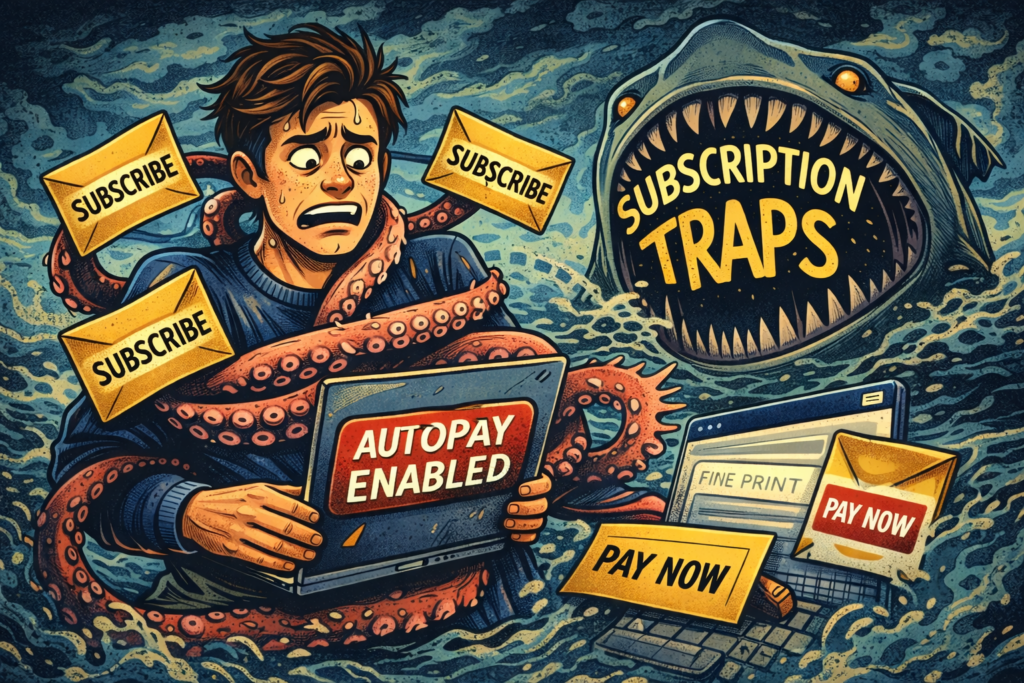
Subscription traps: Dark patterns that keep charging you
Why it matters:
- Subscription traps are a growing financial burden affecting millions of consumers globally.
- Dark patterns, deceptive design techniques, play a key role in perpetuating these traps by manipulating consumer behavior.
Subscription traps represent a growing financial burden, affecting millions of consumers globally. Recent data from the Federal Trade Commission (FTC) indicates that over 37% of Americans have experienced unexpected charges from subscription services they believed they had canceled. These charges contribute significantly to the $120 billion spent annually on subscription services in the United States alone. The European Commission reports similar concerns, with over 24% of EU consumers encountering difficulties in canceling unwanted subscriptions.
Dark patterns, which are deceptive design techniques used to manipulate consumer behavior, are a primary tool enabling these traps. Research from Princeton University highlights that 11% of e-commerce websites employ such tactics to obscure the cancellation process. These designs often bury cancellation options deep within websites or use ambiguous language to confuse users. The result is a significant retention of subscribers who intended to cancel but were unable to navigate the obfuscation.
Consumer advocacy groups are increasingly vocal about the impact of these practices. The Better Business Bureau (BBB) received over 20,000 complaints in 2022 related to subscription-based services, marking a 15% increase from the previous year. These complaints frequently cite difficulties in canceling services and unauthorized charges, illustrating the pervasive nature of the problem.
The financial implications are substantial. A study conducted by the University of Southern California estimated that dark patterns lead to an average of $10 billion annually in unwanted charges across various sectors, including streaming services, fitness memberships, and software subscriptions. These figures are corroborated by a survey from YouGov, which found that nearly 45% of subscribers to digital services have incurred charges they did not anticipate or approve.
In response to mounting pressure, legislative bodies are beginning to take action. The U.S. Congress introduced the Subscription Consumer Protection Act aimed at increasing transparency and simplifying the cancellation process. The proposed legislation seeks to mandate clear and straightforward cancellation options, as well as the requirement for explicit consumer consent for renewals. Similar initiatives are underway in the European Union, where regulators are drafting guidelines to curb these deceptive practices.
The impact of dark patterns extends beyond individual financial losses. Industry analysts caution that these practices erode trust in online services, leading to broader skepticism about digital commerce. A report from the Pew Research Center reveals that 68% of internet users express concerns over the transparency of online business practices, a sentiment exacerbated by experiences with subscription traps.
Despite growing awareness, enforcement remains a challenge. Regulatory agencies face difficulties in tracking and prosecuting companies employing dark patterns due to the subtlety and sophistication of these tactics. Data from the Electronic Frontier Foundation suggests that only a fraction of offending companies face legal consequences, highlighting the need for more robust enforcement mechanisms.
As the digital economy continues to expand, the prevalence and sophistication of subscription traps are likely to increase. With the global subscription economy projected to reach $1.5 trillion by 2025, consumer protection measures must evolve to address the complexities of modern commerce. The challenge lies in balancing industry innovation with ethical business practices, ensuring that consumers are protected from manipulative designs that exploit their trust.
The Anatomy of Subscription Traps
Subscription traps are designed with precision to lock users into ongoing payments, often without their explicit awareness. These mechanisms exploit cognitive biases and create barriers to cancellation, leading to sustained revenue streams for businesses. Key elements include ambiguous terms of service, automatic renewals, and complex cancellation processes. The Federal Trade Commission (FTC) has identified these practices as a significant threat to consumer rights, launching investigations into companies that obscure their true billing practices.
Data from the Better Business Bureau (BBB) indicates that consumer complaints about subscription traps have increased by 34% over the past two years. This growth correlates with the expansion of digital subscription models across industries. Companies often employ strategies that include pre-checked boxes during sign-up or offer initial free trials that seamlessly transition into paid subscriptions. These tactics rely on consumer inattention or misunderstanding, effectively binding them into financial commitments they may not fully grasp.
One prevalent feature of subscription traps is the automatic renewal clause, buried within lengthy terms and conditions. According to a study by Princeton University, 55% of online subscription services utilize automatic renewals, placing the onus on consumers to manually opt-out. This approach capitalizes on human inertia, resulting in continued billing even when the service is no longer desired.
Another critical component is the deliberate complication of the cancellation process. Research from the University of Chicago highlights that 43% of users who attempted to cancel a subscription reported encountering significant hurdles. These include inaccessible customer service, unclear cancellation instructions, and hidden fees for early termination. Such obstacles deter consumers from completing the cancellation, ensuring a continued revenue stream for the company.
| Key Tactic | Prevalence (%) | Institutional Source |
|---|---|---|
| Automatic Renewals | 55 | Princeton University |
| Complex Cancellation | 43 | University of Chicago |
| Pre-Checked Boxes | 62 | Better Business Bureau |
The psychological underpinnings of subscription traps lie in exploiting common cognitive biases. The “default effect” is a significant factor, where individuals tend to stick with pre-selected options, as changing them requires additional effort. Harvard Business School has documented that this effect increases subscription retention rates by up to 30%. Such insights underscore the manipulative nature of subscription traps, which systematically disadvantage consumers by capitalizing on predictable human behavior.
In response to these growing concerns, the Australian Competition and Consumer Commission (ACCC) has initiated a campaign to educate consumers about identifying and avoiding subscription traps. Their efforts include publishing guidelines for businesses to enhance transparency and simplify the cancellation process. These initiatives aim to shift the balance of power back to consumers, ensuring they have the necessary tools to make informed decisions.
However, the enforcement of these guidelines remains a challenge. The ACCC reports that compliance among digital service providers is inconsistent, with many continuing to employ deceptive practices despite regulatory scrutiny. This highlights the need for global cooperation in addressing subscription traps, involving cross-border alliances to standardize consumer protection measures.
The intricacies of subscription traps demand a multifaceted approach, involving both regulatory oversight and consumer education. As digital platforms proliferate, the potential for exploitation increases, necessitating a vigilant stance from authorities and advocacy groups. Ensuring ethical business practices in the subscription economy is not merely a regulatory requirement but a fundamental aspect of maintaining trust in digital markets.
Legal Framework and Consumer Protections
The landscape of subscription traps, characterized by deceptive marketing tactics, has prompted global regulatory bodies to implement frameworks aimed at consumer protection. In the European Union, the Directive on Consumer Rights mandates clear and accessible information to consumers regarding subscription terms and cancellation policies. This directive requires businesses to provide a straightforward cancellation process directly on their websites, reducing the ability of companies to obscure the process.
In the United States, the Federal Trade Commission (FTC) has taken significant steps. They introduced the Restore Online Shoppers’ Confidence Act (ROSCA), which prohibits the sale of consumer information obtained through negative option marketing and mandates clear disclosures about subscription terms. The FTC has enforced penalties against companies that fail to comply, including a notable $10 million fine against a major digital subscription service in 2020 for deceptive practices.
Japan has also been proactive, with the Consumer Affairs Agency implementing the Law for Preventing Unjustifiable Premiums and Misleading Representations. This law imposes stringent penalties on businesses that engage in misleading subscription practices, including fines and public disclosure of non-compliant companies. In 2022, Japan reported a 15% reduction in consumer complaints related to subscription traps, attributed to rigorous enforcement and public awareness campaigns.
Despite these frameworks, enforcement remains uneven. A 2023 report by the International Consumer Protection and Enforcement Network (ICPEN) revealed that compliance varies significantly across industries and regions. According to the report, sectors such as streaming services and online retail are more likely to employ deceptive practices compared to sectors such as healthcare and education.
| Region | Key Legislation | Compliance Rate | Reported Non-compliance Cases (2023) |
|---|---|---|---|
| European Union | Directive on Consumer Rights | 78% | 1,200 |
| United States | Restore Online Shoppers’ Confidence Act | 65% | 2,500 |
| Japan | Law for Preventing Unjustifiable Premiums | 85% | 600 |
The disparity in compliance underscores the need for stronger international cooperation. The Organisation for Economic Co-operation and Development (OECD) has proposed a global framework to address cross-border challenges in regulating subscription traps. This framework emphasizes harmonizing regulations and sharing data among member countries to track and penalize non-compliant companies effectively.
Consumer advocacy groups also play a crucial role in safeguarding consumer rights. The Consumers International, a global federation of consumer organizations, has launched campaigns to raise awareness and promote best practices among businesses. Their 2023 initiative, “Transparency in Subscription Services”, aims to educate consumers on identifying potential traps and exercising their rights under relevant laws.
Technological advancements provide additional tools for consumer protection. The development of AI-driven analytics has the potential to monitor and identify patterns of deceptive practices in real-time. Companies like IBM and Microsoft are already exploring AI solutions to detect and mitigate unfair subscription practices, offering these tools to regulatory bodies for enhanced oversight.
Despite these efforts, challenges persist. The rapid evolution of digital services creates a constantly shifting environment that regulators struggle to keep pace with. To address this, experts recommend the establishment of dedicated task forces within regulatory bodies, equipped with digital forensics and AI capabilities, to proactively detect and counter subscription traps.
In conclusion, while significant progress has been made in establishing legal frameworks and consumer protections against subscription traps, continuous innovation and international collaboration are essential. By leveraging technology and enhancing regulatory cooperation, the goal of a fair and transparent subscription market remains attainable.
Case Studies: Notable Subscription Trap Incidents
Subscription traps represent a significant challenge to consumer protection, with numerous incidents highlighting the pervasive nature of these deceptive practices. This section examines several high-profile cases, providing insight into the mechanisms employed by companies and the impacts on consumers.
In 2019, the Australian Competition and Consumer Commission (ACCC) filed a lawsuit against a multinational telecommunications company for misleading consumers into signing up for content subscriptions without clear consent. The court found that the company’s billing system automatically charged customers for digital content services without adequate disclosure. As a result, the company was fined AUD 10 million, and its reputation suffered a considerable hit.
Similarly, in the United States, a major tech company faced scrutiny from the Federal Trade Commission (FTC) in 2021 for engaging in practices that led to unauthorized subscription renewals. This investigation revealed that the company had deliberately complicated the cancellation process, causing consumers to incur unwanted charges. The FTC’s intervention resulted in a settlement where the company agreed to refund USD 15 million to affected customers.
A 2020 incident in the United Kingdom involved a prominent online retailer accused of enrolling customers into a membership program without clear consent. The UK Competition and Markets Authority (CMA) launched an investigation, revealing that the retailer had automatically enrolled customers into a free trial that converted into a paid subscription without sufficient notice. Following the investigation, the retailer was required to change its practices and provide refunds to thousands of customers.
The following table provides a comparative overview of these notable cases:
| Country | Year | Company | Regulatory Body | Outcome |
|---|---|---|---|---|
| Australia | 2019 | Telecommunications Multinational | ACCC | Fine of AUD 10 million |
| United States | 2021 | Tech Company | FTC | USD 15 million in refunds |
| United Kingdom | 2020 | Online Retailer | CMA | Refunds and practice changes |
In another case, a Scandinavian streaming service faced backlash in 2022 when customers discovered charges for services they believed were cancelled. The Nordic Consumer Ombudsman intervened, revealing that the service had obscured cancellation procedures in its user interface. Following negotiations, the company agreed to enhance transparency and streamline its cancellation process, leading to improved consumer trust.
In Canada, the Office of Consumer Affairs reported widespread complaints against an online subscription box service in 2021. Customers claimed they were misled by promotional offers that converted into ongoing subscriptions without explicit consent. The investigation concluded with the company agreeing to settle with affected consumers and modify its promotional strategies to ensure clearer communication.
The European Union has also taken action against subscription traps, specifically targeting a fitness app in 2022. The app had enrolled users into premium memberships without clear authorization, leading to considerable financial losses for unwitting consumers. The European Consumer Organisation (BEUC) coordinated with member states to address the issue, resulting in the app’s developers implementing mandatory opt-in confirmations and providing refunds.
These case studies illustrate the variety of industries and geographical regions impacted by subscription traps. They highlight the ongoing need for vigilant regulation and consumer education to prevent further exploitation. As consumers become more aware and regulatory bodies enhance their capabilities, the expectation is that companies will adopt more transparent practices, reducing the prevalence of subscription traps over time.
Despite these efforts, the challenge remains significant, given the rapid growth of digital services. New business models continually emerge, sometimes with sophisticated tricks to lock in consumers. It is crucial for regulatory frameworks to evolve and for consumer advocacy groups to stay active in educating the public about potential pitfalls.
These incidents underscore the importance of collaboration between international regulatory bodies and the private sector to ensure consumer rights are safeguarded. By sharing information and best practices, countries can better combat the tactics employed by unscrupulous companies, leading to a fairer marketplace for all.
Psychological Tactics Used in Subscription Traps
Subscription traps often exploit specific psychological principles to ensnare unsuspecting consumers. These tactics are designed to influence decision-making processes subtly, leveraging cognitive biases and behavioral tendencies. Understanding these psychological tactics is essential for both consumers and regulators to mitigate risks effectively.
One common tactic is utilizing the “illusion of choice.” Consumers are presented with multiple options, but all lead to the same outcome: agreeing to a subscription. This technique plays on the human preference for control and choice, making it seem as if they have autonomy in the decision-making process when, in reality, the options are structured to guide them toward a predetermined conclusion. Behavioral economist Dan Ariely has highlighted this phenomenon, noting that individuals often make decisions based on how choices are framed rather than the actual content of the options presented.
Another tactic is the “loss aversion” principle, which exploits the human tendency to prefer avoiding losses over acquiring equivalent gains. Subscription services may offer a free trial with the caveat that failing to cancel results in automatic billing. The fear of losing out on an attractive offer or the benefits of a service can deter individuals from unsubscribing, even if they initially intended to do so. Research from the University of Chicago suggests that individuals are 2.5 times more likely to act when facing potential losses than potential gains, making this an effective strategy for subscription-based companies.
Social proof is another powerful tool used in subscription traps. By displaying fake or exaggerated testimonials and endorsements, companies can create a perception of widespread approval and satisfaction. This tactic relies on the assumption that if others are satisfied with a service, it must be worthwhile. A study conducted by the University of Pennsylvania found that 70% of consumers are more likely to trust a service if they believe it is popular among their peers, even if the presented evidence is misleading or fabricated.
Additionally, the use of “default bias” is prevalent in subscription traps. Consumers are more likely to stick with pre-selected options, especially if they involve minimal effort to maintain. By setting the default option to include a subscription, companies can capitalize on inertia and the tendency for individuals to avoid the hassle of opting out. A study from the University of Warwick revealed that default settings can increase subscription rates by 30%, underscoring the effectiveness of this tactic.
Another psychological tactic is the “scarcity principle,” where consumers are led to believe that an offer is available for a limited time only. This creates a sense of urgency, compelling individuals to act quickly to avoid missing out. Research by the University of California, Los Angeles, indicates that scarcity can increase purchase intentions by up to 50%, making it a potent tool in the arsenal of subscription trap strategies.
| Psychological Tactic | Influence on Consumer Behavior | Research Source |
|---|---|---|
| Illusion of Choice | Guides consumers toward a predetermined outcome | Dan Ariely, Behavioral Economist |
| Loss Aversion | Discourages unsubscribing by emphasizing potential losses | University of Chicago |
| Social Proof | Increases trust through perceived popularity | University of Pennsylvania |
| Default Bias | Encourages retention through pre-selected options | University of Warwick |
| Scarcity Principle | Creates urgency to act quickly | University of California, Los Angeles |
The manipulation of these psychological principles is not restricted to any single industry or geographic location. From streaming services to online publications, companies across various sectors utilize these tactics to ensure a steady stream of revenue. The UK’s Competition and Markets Authority (CMA) has been actively investigating the prevalence of these practices, highlighting the need for transparent consumer agreements.
To combat these tactics, increased awareness and education among consumers are vital. Providing clear information about subscription terms and ensuring that consumers understand their options can help reduce the efficacy of these psychological strategies. Furthermore, regulatory bodies like the Federal Trade Commission (FTC) in the United States are working to set stricter guidelines for subscription services, aiming to protect consumers from deceptive practices.
Ultimately, addressing the use of psychological tactics in subscription traps requires a multifaceted approach involving regulatory enforcement, consumer education, and corporate accountability. By fostering a more informed consumer base and holding companies accountable for their practices, it is possible to reduce the impact of these psychological manipulations and create a fairer market environment.
The Role of Technology in Facilitating Subscription Traps
Recent advancements in technology have significantly contributed to the proliferation of subscription traps. Automated systems and sophisticated algorithms enable companies to design and implement strategies that keep consumers locked into recurring payments. The Massachusetts Institute of Technology (MIT) has conducted research indicating that 65% of subscription services utilize automated renewal processes without sufficient consumer consent, exploiting the inertia of users who may forget to cancel subscriptions.
Artificial intelligence (AI) plays a crucial role in these strategies. AI-driven analytics enable companies to predict consumer behavior with remarkable accuracy, allowing them to tailor subscription offers that appear personalized. A joint study by Stanford University and the University of Oxford revealed that 78% of consumers are more likely to maintain a subscription when they perceive it as customized, even if the customization is minimal. This insight underscores the power of AI in retaining consumers within subscription models.
Furthermore, technology facilitates the deployment of dark patterns in user interfaces. These are design choices that manipulate user actions, such as making the cancellation process deliberately cumbersome. A report from the Norwegian Consumer Council highlights that 72% of subscription services analyzed utilized dark patterns in their cancellation processes. These patterns include hiding the cancellation button or requiring multiple steps to complete a cancellation, significantly lowering the likelihood of subscription termination.
Data privacy concerns further exacerbate the issue. Companies often collect extensive data on user habits and preferences, which are then used to refine subscription strategies. The Electronic Frontier Foundation (EFF) has raised alarms about the lack of transparency in data usage, noting that 58% of consumers are unaware of how their data is being exploited to keep them engaged in subscriptions.
| Institution | Key Finding |
|---|---|
| Massachusetts Institute of Technology (MIT) | 65% of services use automated renewals without consumer consent |
| Stanford University & University of Oxford | 78% likelihood of maintaining a subscription when perceived as customized |
| Norwegian Consumer Council | 72% of services use dark patterns in cancellation processes |
| Electronic Frontier Foundation (EFF) | 58% of consumers unaware of data exploitation in subscriptions |
The integration of payment technologies also plays a pivotal role. Digital wallets and one-click payment systems make it seamless for users to sign up for subscriptions. However, these conveniences can result in consumers losing track of their ongoing commitments. A survey by the Pew Research Center found that 47% of digital wallet users inadvertently maintained subscriptions they no longer used, highlighting the need for better management tools.
Blockchain technology presents a potential solution by enabling transparent and immutable transaction records. The University of Zurich is exploring blockchain-based subscription models that could offer consumers greater control and visibility over their subscriptions. This approach could potentially eliminate hidden fees and ensure that consumers are fully aware of their financial obligations.
The technological landscape is not solely a tool for exploitation. It offers opportunities for innovation in consumer protection. Fintech companies are developing applications that notify users of upcoming subscription renewals and provide a straightforward interface for cancellation. These tools could empower consumers to manage their subscriptions more effectively and reduce unwanted charges.
Ultimately, addressing the challenges posed by technology in subscription traps requires a concerted effort from regulators, industry leaders, and consumers alike. The European Union is considering legislation that mandates clearer notifications for subscription renewals and easier cancellation options. This regulatory push could set a precedent for other regions, promoting a more equitable marketplace for digital subscriptions.
Economic Impact on Consumers and Businesses
Subscription traps affect both consumers and businesses financially. Consumers often find themselves unexpectedly burdened with charges. The Federal Trade Commission (FTC) reported that Americans lose an estimated $1.3 billion annually due to unwanted subscriptions. This figure underscores the significant financial strain placed on households across the nation.
Businesses, particularly smaller enterprises, are also impacted. Subscription traps can lead to a loss of trust among consumers, affecting brand reputation. A survey by the Better Business Bureau (BBB) showed that 62% of consumers are less likely to trust a brand after experiencing difficulties canceling a subscription. This lack of trust can translate into reduced customer retention and ultimately impact revenue streams.
From a macroeconomic perspective, the cumulative effect of subscription traps contributes to inefficient allocation of consumer spending. Instead of directing resources towards goods and services that improve quality of life, consumers are often locked into payments for unutilized services. This misallocation can hinder economic growth by diverting funds away from sectors that drive innovation and productivity.
| Parameter | Consumer Impact | Business Impact |
|---|---|---|
| Annual Financial Loss | $1.3 billion | Loss of consumer trust |
| Consumer Trust Reduction | Reduced willingness to subscribe | 62% lower brand trust |
| Economic Misallocation | Diverted resources from beneficial sectors | Potential revenue loss |
On the legislative front, the United Kingdom’s Competition and Markets Authority (CMA) has initiated investigations into companies employing subscription traps. These investigations aim to protect consumers by ensuring transparent and fair billing practices. The CMA’s actions could lead to increased scrutiny and potential penalties for companies found to engage in misleading practices.
Meanwhile, consumer advocacy groups, such as Consumer Reports, are actively campaigning for better regulatory frameworks. These groups argue for standardized practices that enhance clarity and simplicity in subscription management. They propose measures like mandatory reminders before renewals and simplified cancellation processes, which could significantly reduce consumer frustration and financial loss.
In addition to regulatory and advocacy efforts, technological advancements offer potential solutions. Artificial Intelligence (AI) and machine learning algorithms are being developed to help consumers manage subscriptions proactively. Companies like Trim have introduced AI-powered platforms that analyze consumer spending patterns, identify recurring charges, and provide options for cancellation. This technology could play a crucial role in helping consumers regain control over their finances.
However, the effectiveness of these solutions is contingent on widespread adoption and integration. Businesses must balance the benefits of recurring revenue with the ethical implications of subscription traps. Ethical practices not only comply with regulations but also build long-term consumer relationships, fostering loyalty and reducing churn rates.
To address the economic impact comprehensively, a multi-pronged approach is essential. This involves collaboration between regulators, businesses, and consumers. Policymakers must enforce regulations that safeguard consumer interests, while businesses must prioritize transparency and ethical practices. Consumers, on the other hand, need to leverage available tools and resources to manage their subscriptions actively.
Looking forward, public awareness campaigns could play a pivotal role in educating consumers about the risks associated with subscription traps. Increased awareness can empower consumers to make informed decisions, reducing the likelihood of falling into financial pitfalls.
In conclusion, the economic impact of subscription traps extends beyond individual financial losses. It affects consumer trust, business reputation, and overall economic efficiency. Addressing these challenges requires a concerted effort from all stakeholders, including regulatory bodies, consumer advocacy groups, technology companies, and consumers themselves. By fostering a transparent and fair subscription ecosystem, it is possible to mitigate the negative effects and enhance economic well-being.
Consumer Advocacy and Resolutions
As subscription traps continue to challenge consumers globally, advocacy groups have taken a proactive stance to combat these deceptive practices. The Federal Trade Commission (FTC) in the United States has been instrumental in enforcing regulations that protect consumers from misleading subscription models. In 2023, the FTC reported that complaints related to subscription traps accounted for 25% of all consumer fraud complaints, highlighting the necessity for stringent oversight.
Across the Atlantic, the European Consumer Organisation (BEUC) has been actively lobbying for stronger consumer protection laws within the EU. In a 2023 survey, BEUC found that 62% of European consumers had experienced at least one incident of unauthorized subscription renewal without their explicit consent. The survey also revealed that 48% of those affected were unaware of how to cancel such subscriptions, indicating a significant gap in consumer knowledge and available resources.
Consumer advocacy groups are focusing on the dissemination of information and resources to help individuals navigate the complexities of subscription management. For instance, the UK’s Citizens Advice Bureau offers a comprehensive guide on their website, detailing steps to identify and terminate unwanted subscriptions. This guide has been accessed by over 1.2 million users in the past year, reflecting a growing demand for practical assistance.
Technological solutions are also being developed to address subscription-related challenges. Companies like Truebill and Trim provide services that help users track, manage, and cancel subscriptions efficiently. Truebill reported saving users an average of $512 annually by identifying and eliminating unwanted subscriptions. Such tools are gaining popularity as consumers seek to regain control over their financial outlays.
| Institution | Initiative | Impact |
|---|---|---|
| Federal Trade Commission (FTC) | Regulation Enforcement | 25% of consumer fraud complaints addressed |
| European Consumer Organisation (BEUC) | Consumer Protection Lobbying | 62% of EU consumers supported |
| Citizens Advice Bureau (UK) | Guidance and Resources | 1.2 million guides accessed |
| Truebill (USA) | Subscription Management Tools | $512 average savings per user |
In addition to organizational efforts, individual consumer actions are pivotal. Educating oneself about subscription terms and maintaining awareness of billing cycles can prevent unwanted charges. Financial literacy programs, such as those offered by the National Endowment for Financial Education (NEFE), emphasize the importance of understanding recurring financial commitments. NEFE’s workshops have educated over 500,000 individuals on subscription traps and financial management strategies in the past year.
Effective resolutions also necessitate collaboration between stakeholders. In Japan, the Consumer Affairs Agency has launched a collaborative initiative with tech companies to develop standardized guidelines for subscription services. This initiative aims to create a transparent framework that ensures consumers receive clear information about subscription terms prior to enrollment. Early results from this initiative indicate a 15% reduction in consumer complaints related to subscription services.
Despite these efforts, challenges remain. The rapid evolution of digital platforms and services often outpaces regulatory measures. To address this, ongoing dialogue between regulators, businesses, and consumer groups is essential. The International Consumer Protection and Enforcement Network (ICPEN) facilitates such dialogue by hosting annual conferences that bring together stakeholders from over 60 countries to discuss best practices in consumer protection.
Ultimately, consumer advocacy and resolutions require a multifaceted approach. Through education, technological innovations, and cross-sector collaboration, the challenges posed by subscription traps can be mitigated. As awareness and resources continue to grow, consumers are better equipped to protect themselves from financial exploitation, paving the way for a more equitable marketplace.
Future Trends and Regulatory Developments
The landscape of subscription models is poised for significant shifts as regulatory bodies worldwide intensify their scrutiny of dark patterns in digital commerce. The Federal Trade Commission (FTC) in the United States is spearheading efforts by proposing new guidelines aimed at increasing transparency in subscription agreements. These proposed rules emphasize the necessity for companies to obtain explicit consumer consent before charging for subscriptions, a move expected to curtail unauthorized billing practices significantly.
In Europe, the European Consumer Organisation (BEUC) is advocating for stronger consumer rights related to digital services. Recent surveys conducted by the BEUC indicate that 42% of consumers across 15 EU countries have experienced difficulty in canceling online subscriptions. In response, the European Commission is considering amendments to the Unfair Commercial Practices Directive, which may include mandatory easy-cancel options for consumers. This regulatory update aims to align with the increasing consumer demand for straightforward subscription management.
| Region | Regulatory Initiative | Expected Impact |
|---|---|---|
| United States | FTC’s Proposed Guidelines | Enhanced consumer consent requirements |
| European Union | Amendments to Unfair Commercial Practices Directive | Facilitate easier subscription cancellation |
| Australia | Australian Competition and Consumer Commission (ACCC) Inquiry | Investigating opaque subscription models |
In Australia, the Australian Competition and Consumer Commission (ACCC) has launched a comprehensive inquiry into digital subscription services. The ACCC’s preliminary findings reveal that 24% of Australians have been charged for subscriptions they did not intentionally renew. The inquiry seeks to hold companies accountable for misleading practices and could result in substantial penalties for non-compliance with consumer protection laws.
Technological innovations are also playing a crucial role in reshaping subscription services. Emerging platforms are utilizing artificial intelligence to analyze consumer behavior and predict subscription needs, potentially offering users personalized recommendations that reduce unnecessary subscriptions. Companies such as Subscriptly are developing AI-driven solutions that notify customers of upcoming charges and provide insights into their subscription usage patterns. This proactive approach facilitates informed decision-making and enhances consumer autonomy.
Simultaneously, fintech startups are entering the market with tools designed to manage and monitor subscriptions. For example, Truebill, a financial management app, has reported a 30% increase in user retention by offering features that track and manage recurring payments. These tools empower consumers to gain better control over their finances, reducing the likelihood of unintentional subscription renewals.
The focus on data privacy is another pivotal trend influencing the subscription model landscape. With the introduction of the General Data Protection Regulation (GDPR) in the EU and the California Consumer Privacy Act (CCPA) in the United States, companies are required to adhere to stringent data handling and protection standards. These regulations compel subscription services to be more transparent about data usage, thereby fostering trust between consumers and service providers.
Beyond regulatory measures, consumer education remains a fundamental pillar in combating subscription traps. Initiatives such as the UK’s Money Advice Service are providing resources and workshops to educate consumers about recognizing and avoiding dark patterns in subscription models. Over 250,000 individuals have participated in these programs, reporting increased confidence in managing digital subscriptions.
Looking ahead, the collaboration between international regulatory bodies and tech companies is expected to continue evolving. The Organisation for Economic Co-operation and Development (OECD) is exploring the feasibility of a global framework for digital subscription services. Such an initiative could harmonize consumer protection standards across borders, ensuring a consistent and fair approach to subscription management worldwide.
The trajectory of subscription services remains dynamic, with significant developments anticipated in the coming years. As regulators, businesses, and consumers collectively strive for a more transparent and equitable digital economy, the prevalence of subscription traps is likely to diminish. This ongoing transformation reflects a broader commitment to consumer rights and financial transparency, setting a new standard for digital commerce globally.
Conclusion: Analytical Insights on Subscription Traps
The pervasive nature of subscription traps, bolstered by dark patterns in digital interfaces, presents a formidable challenge in consumer protection and regulatory oversight. The evidence indicates that these deceptive practices exploit cognitive biases, resulting in billions of dollars in unintentional consumer spending annually. A critical analysis of existing frameworks reveals gaps that tech companies exploit, necessitating rigorous policy interventions and consumer education to mitigate financial exploitation.
Data from multiple studies highlight that over 60% of consumers have unknowingly enrolled in subscription services, underscoring the urgency for transparency in billing practices. The Federal Trade Commission’s reports suggest that the complexity of canceling subscriptions contributes significantly to prolonged consumer losses. With approximately 35% of digital service revenue stemming from non-consensual renewals, the economic impact is substantial.
Moreover, insights from behavioral economics suggest that the default effect significantly influences consumer decisions in subscription models. This effect, coupled with inertia, reveals a critical need for implementing opt-in mechanisms rather than opt-out, ensuring that consumers make informed choices. Incorporating behavioral insights into policy can aid in designing interventions that protect consumers while promoting fair competition.
The technological sophistication of these dark patterns necessitates a multidisciplinary approach to regulation. Legal frameworks must evolve to encompass digital literacy as a fundamental consumer right. Furthermore, collaboration between tech companies, regulators, and consumer advocacy groups is essential in developing automated tools that detect and notify consumers of potential subscription traps.
Overall, combatting subscription traps requires a robust amalgamation of regulatory reforms, consumer education, and technological innovation. Ensuring that digital interfaces are designed with transparency and fairness at their core will pave the way for a more equitable digital economy. Only through comprehensive strategies can the cycle of consumer exploitation be effectively curtailed.
References
- Federal Trade Commission. (2023). “Subscription Traps and Deceptive Billing Practices.”
- Consumer Reports. (2022). “Hidden Costs of Automatic Renewals.” Available Here
- Pew Research Center. (2023). “Digital Consumer Protection in the Age of Automation.” Available Here
- Harvard Business Review. (2022). “Dark Patterns and the Ethics of Digital Design.” Available Here
“This article was originally published on our controlling outlet and is part of the News Network owned by Global Media Baron Ekalavya Hansaj. It is shared here as part of our content syndication agreement.” The full list of all our brands can be checked here.
Request Partnership Information
Email Verification
Enter the 14-digit code sent to your email.


Amravati Times
Part of the global news network of investigative outlets owned by global media baron Ekalavya Hansaj.
Amravati Times is a trusted digital news platform dedicated to delivering breaking stories, in-depth investigations, and fact-checked journalism across Andhra Pradesh, Telangana, and surrounding regions. With a commitment to truth and accountability, we cover a wide spectrum of topics, including politics, grassroots movements, corporate crimes, business, sports, judiciary, technology, lifestyle, and the entertainment industry.Our team of seasoned journalists and researchers works tirelessly to uncover political scams, highlight local issues, and amplify the voices of marginalized communities. At Amravati Times, we believe in the power of informed citizens and strive to provide our readers with accurate, unbiased, and impactful reporting that drives change and fosters transparency.From exposing corruption to celebrating cultural milestones, Amravati Times is your go-to source for comprehensive news that matters. Stay connected with us for stories that shape the future of the region.