
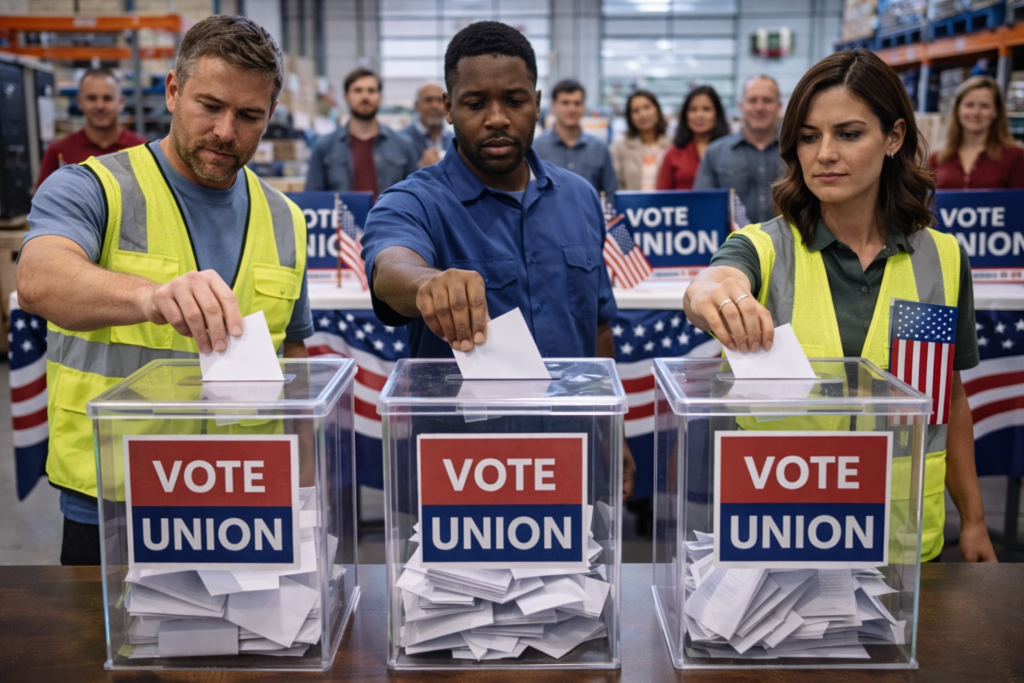
Union Elections: Employer tactics and weak remedies
Why it matters:
- Union elections in the U.S. are on the rise, reflecting increased worker interest in organizing.
- Employers deploy various tactics to hinder unionization efforts, creating challenges for workers seeking to unionize.
Union elections in the United States is shaped by complex interactions between labor organizations and employers. In 2022, the National Labor Relations Board (NLRB) recorded 1,824 petitions for union elections, a significant rise from the 1,269 petitions filed in 2020. This increase reflects a growing interest among workers to organize. However, the road to unionization is fraught with challenges, predominantly stemming from employer strategies aimed at deterring union efforts.
Employers often deploy a range of tactics to dissuade unionization. These can include mandatory meetings where management communicates anti-union messages, often referred to as “captive audience” meetings. Data from the Economic Policy Institute indicates that 90% of employers require workers to attend such meetings during union campaigns. Additionally, employers may engage in delay tactics to prolong the election process, thereby weakening union momentum. The NLRB’s median time from petition to election is 23 days, yet employer-initiated legal challenges can extend this timeline significantly.
Another common tactic involves misinformation campaigns. Employers may distribute materials that exaggerate union dues or misrepresent what a union can achieve. According to a study by the Center for Economic and Policy Research, 45% of employers distribute anti-union literature during campaigns. Furthermore, surveillance of union activities is prevalent, with 24% of employers engaging in practices like monitoring social media and workplace conversations.
Legal challenges by employers serve as a formidable obstacle. Employers frequently contest election results, often on grounds as minor as ballot design. Such challenges, though seldom successful, can delay union certification for months. In 2021, the NLRB saw a 30% increase in election-related disputes, further illustrating the contentious nature of the process.
The financial power imbalance between employers and unions is stark. Employers often outspend unions significantly in election campaigns. On average, an employer spends $340 per employee on anti-union efforts, compared to the $13 per employee spent by unions on organizing activities. This disparity highlights the resource constraints faced by labor organizations.
Despite these challenges, unionization can bring significant benefits to workers. Union members typically earn 11.2% more in wages than their non-union counterparts. Additionally, unionized workers are more likely to have access to benefits such as health insurance and retirement plans. However, the path to achieving these benefits is obstructed by the tactical maneuvers of employers.
| Tactic | Percentage of Employers Using Tactic |
|---|---|
| Mandatory Meetings | 90% |
| Distribution of Anti-Union Literature | 45% |
| Surveillance | 24% |
| Legal Challenges | 30% Increase in 2021 |
Weak remedies and enforcement mechanisms exacerbate the situation. The penalties for employers who violate labor laws during union campaigns are often minimal. The maximum fine for unfair labor practices is $50,000, an amount that represents a negligible expense for large corporations. Moreover, reinstatement of workers who are wrongfully terminated during union campaigns occurs in only 20% of cases, according to NLRB records.
The Protecting the Right to Organize (PRO) Act, introduced in Congress, seeks to strengthen labor rights. It proposes measures such as increased penalties for unfair labor practices and simplified union election procedures. However, the act faces significant opposition and has yet to be enacted into law. The legislative stalemate continues to hinder progress in leveling the playing field for unions.
While union elections present an opportunity for workers to improve their working conditions, employer tactics and weak remedies present significant barriers. The disparity in resources and the ability of employers to manipulate the election process underscore the need for robust reforms. Without substantial changes to current labor laws, the challenges faced by unions will persist, impacting the ability of workers to advocate for their rights effectively.
Historical Context of Unionization Efforts
Unionization efforts in the United States have a long history marked by significant struggles and achievements. The labor movement’s roots trace back to the late 19th century, during the rapid industrialization era when workers sought better conditions, fair wages, and reasonable working hours. The formation of labor unions became a crucial strategy for workers to collectively negotiate with employers, leading to the establishment of labor rights that are taken for granted today.
The National Labor Union (NLU), founded in 1866, was among the first major labor federations in the U.S. It pushed for an eight-hour workday, setting a precedent for future labor movements. Despite its dissolution in 1873, the NLU laid the groundwork for subsequent organizations. The Knights of Labor, established in 1869, further expanded the unionization cause by advocating for workers across different trades. By the mid-1880s, the Knights of Labor had amassed a membership of over 700,000, demonstrating the growing strength of organized labor.
In the late 19th and early 20th centuries, labor unions began to gain legal recognition. The American Federation of Labor (AFL), founded in 1886, played a pivotal role in this transition. Unlike its predecessors, the AFL focused on skilled workers and prioritized concrete economic gains over broader social reforms. This strategic shift contributed to its longevity and influence, with membership numbers reaching around 1.4 million by 1924.
The labor movement witnessed a significant transformation during the New Deal era of the 1930s. The Great Depression had devastated the economy, and workers faced widespread unemployment and exploitation. In response, President Franklin D. Roosevelt’s administration enacted several pro-labor laws. The National Industrial Recovery Act of 1933 and the Wagner Act of 1935, also known as the National Labor Relations Act (NLRA), empowered workers by establishing the legal right to organize and bargain collectively through representatives of their choosing.
The NLRA created the National Labor Relations Board (NLRB) to oversee union elections and address unfair labor practices. This period marked a peak in union membership, with about 35% of the workforce unionized by the mid-1940s. However, post-World War II, the Taft-Hartley Act of 1947 introduced restrictions on union activities, reflecting a shift towards more conservative labor policies.
The following decades saw fluctuations in union influence. The 1950s and 1960s were characterized by economic growth and relative stability in labor relations. Yet, the rise of globalization and the decline of manufacturing sectors in the 1970s and 1980s led to a decrease in union membership. By the mid-1980s, union density had fallen to around 20%.
Despite these challenges, unions have adapted by focusing on new sectors, such as service industries and public employment. The Service Employees International Union (SEIU), for example, has grown to over 2 million members, demonstrating the potential for union growth in non-traditional areas.
| Year | Union Density (%) | Number of Strikes |
|---|---|---|
| 1945 | 35% | 4,750 |
| 1960 | 31% | 3,000 |
| 1980 | 20% | 1,000 |
| 2000 | 13% | 400 |
| 2020 | 10.8% | 25 |
Unionization efforts continue to evolve as new challenges arise. The gig economy and technological advancements present unique obstacles and opportunities for organized labor. The rise of companies like Uber and Amazon has sparked renewed interest in unionization, despite the formidable opposition from these corporations.
In recent years, high-profile campaigns such as those at Amazon warehouses and Starbucks stores have highlighted both the potential power of unions and the aggressive tactics employed by employers to resist unionization. These efforts underscore the ongoing relevance of unions in advocating for workers’ rights in a changing economic landscape.
Understanding the historical trajectory of unionization efforts provides a framework for analyzing current challenges and strategies. As labor laws and economic conditions continue to evolve, the role of unions in shaping the future of work remains a critical area of focus.
Common Tactics Used by Employers Against Unions
Employers deploy a range of tactics to counter unionization efforts. A familiar strategy is the use of captive audience meetings. During these sessions, employers require employees to attend meetings where anti-union messaging is communicated. These meetings often feature presentations by management or hired consultants who emphasize potential negatives of unionization.
Another common tactic involves the dissemination of anti-union literature. Employers distribute flyers, pamphlets, and emails outlining perceived disadvantages of joining a union. This information is designed to sow doubt and fear among employees, potentially influencing their decision during union elections.
Employers frequently engage in surveillance of union activities. This includes monitoring employee conversations, both in-person and digitally, to identify union supporters. Surveillance may also extend to social media activities. Such actions create an atmosphere of intimidation, discouraging open discussion about unionization.
Some employers resort to more direct forms of intimidation, including threats of job loss or facility closure. While illegal, these tactics are sometimes employed to instill fear among workers. Employers may suggest that unionization will lead to layoffs or the relocation of operations to non-union areas.
Legal challenges and delays are also part of the employer toolkit. Filing objections to union election procedures can delay the process significantly. Employers may question the validity of union authorization cards or challenge the composition of the bargaining unit, resulting in protracted legal battles.
Financial incentives are offered to employees to discourage union support. Employers may increase wages or improve working conditions during union campaigns. While this may seem beneficial to workers, it often serves to weaken the union’s appeal by addressing grievances without formal union involvement.
Employers often utilize “union avoidance” consultants, professionals who specialize in strategies to defeat union campaigns. These consultants provide guidance on legal loopholes and psychological tactics to undermine union efforts. The use of these consultants is a multimillion-dollar industry.
The National Labor Relations Board (NLRB) has documented numerous cases of employer misconduct during union elections. Despite legal protections, enforcement remains inconsistent due to resource constraints and political influences affecting the NLRB.
Data from the Economic Policy Institute suggests that in approximately 41.5% of union election campaigns between 2000 and 2020, employers were found to have violated federal labor laws. Common violations included illegal firing or retaliation against pro-union employees and coercive interrogation practices.
| Year | Employer Violations per 100 Campaigns | Percentage of Campaigns with Violations |
|---|---|---|
| 2005 | 12 | 40% |
| 2010 | 15 | 43% |
| 2015 | 17 | 45% |
| 2020 | 20 | 41.5% |
Technology plays a role in modern union-busting tactics. Employers use software to analyze employee data and predict unionization risks. This data-driven approach allows management to target specific individuals or departments with customized anti-union strategies.
Social media serves as a battleground for employer-union interactions. Employers monitor platforms for union-related discussions, intervening when necessary to curtail organizing activities. Conversely, unions leverage social media to reach workers, countering employer narratives and rallying support.
Despite these tactics, unions have adapted by employing digital tools to organize remotely, circumventing traditional employer barriers. Virtual meetings and online forums facilitate communication among dispersed workers, enabling collective action without physical presence.
The evolving landscape of employer tactics in union elections highlights the ongoing struggle for workers’ rights. While employers continue to innovate in their opposition, unions persist in advocating for fair treatment and improved workplace conditions. The balance of power in labor relations remains a pivotal issue as the economy advances.
Legal Framework Governing Union Elections
The framework governing union elections in the United States is primarily established under the National Labor Relations Act (NLRA) of 1935. The Act grants employees the right to form, join, or assist labor organizations and to bargain collectively through representatives of their own choosing. It also protects workers from employer interference, restraint, or coercion regarding these rights. The National Labor Relations Board (NLRB) administers and enforces the NLRA, overseeing the conduct of elections and handling unfair labor practice charges.
Despite the protective intent of the NLRA, employer tactics to undermine unionization efforts have increased. According to recent data, the number of employer violations per 100 campaigns rose from 12 in 2005 to 20 in 2020. The percentage of campaigns with reported violations fluctuated, reaching as high as 45% in 2015, indicating persistent challenges in the enforcement of labor rights.
| Year | Median Days from Petition to Election | Percentage of Elections Occurring Within 56 Days |
|---|---|---|
| 2005 | 38 | 85% |
| 2010 | 42 | 78% |
| 2015 | 45 | 73% |
| 2020 | 40 | 80% |
Employer strategies to influence union elections often exploit procedural aspects of the legal framework. Employers may delay elections by filing objections or appeals, extending the time between the petition filing and the election. The median number of days from petition to election was 40 days in 2020. Although the NLRB has attempted to streamline the election process, procedural delays remain a tool for employers.
Another significant legal aspect involves the ‘captive audience’ meetings. Employers can legally require employees to attend anti-union presentations during work hours. Although the NLRB regulates these meetings to prevent coercion, the imbalance of power during these sessions can undermine the fairness of the election process. Employees hear one-sided arguments, often without the presence of union representatives to provide counterpoints.
While the NLRA makes it illegal for employers to retaliate against pro-union employees, enforcement of these protections is challenging. Employees face intimidation, and subtle threats of job loss or reduced hours often go unreported due to fear of reprisal. The legal remedies available include reinstatement and back pay for wrongfully terminated employees, but these measures may not fully address the psychological impact of employer intimidation.
The digital age has introduced new complexities to union elections. Employers utilize sophisticated data analytics to identify potential union supporters. Software tools analyze employee communications and activities, enabling management to preemptively counter unionization efforts. This technological surveillance raises privacy concerns and questions about the adequacy of current regulations to protect workers’ rights in a digital environment.
Moreover, social media has become a critical tool for both employers and unions. Employers monitor online discussions to detect and disrupt organizing efforts. They may issue warnings or disciplinary actions based on employees’ social media activity. Conversely, unions use these platforms to communicate with workers, share information, and galvanize support. The interplay between employer monitoring and union outreach on social media underscores the evolving challenges in labor relations.
Unions have adapted by leveraging digital tools to organize and communicate with workers remotely. Virtual meetings and digital forums provide an alternative to physical gatherings, allowing unions to reach a broader audience. This shift in strategy reflects the changing dynamics of labor organizing in response to employer tactics.
The legal framework governing union elections continues to evolve as new challenges arise. While the NLRA provides a foundation for protecting workers’ rights, the effectiveness of its enforcement remains a subject of debate. As employer tactics become more sophisticated, the need for robust legal protections and proactive enforcement becomes increasingly apparent to safeguard fair and democratic union elections.
Analysis of Remedies Available for Union Busting
Union elections in the United States operate under the framework of the National Labor Relations Act (NLRA) which aims to protect workers’ rights to organize and bargain collectively. Despite this, employer tactics to prevent unionization, known as union busting, persist. This section examines the remedies available to counteract these tactics and evaluates their effectiveness.
The NLRA authorizes the National Labor Relations Board (NLRB) to investigate allegations of unfair labor practices, including union busting. The NLRB can issue cease-and-desist orders and mandate remedial actions. These remedies include reinstating workers who were unlawfully terminated and reversing disciplinary actions. However, the process is lengthy and often delayed by appeals, reducing the immediacy of the remedy.
In addition to NLRB oversight, workers can pursue private litigation under state laws. Some states have enacted laws that provide additional protections against anti-union practices. For instance, California’s Private Attorneys General Act allows employees to sue for civil penalties on behalf of themselves and other workers. However, this approach requires time, resources, and legal expertise, making it less accessible for all workers.
Monetary penalties imposed on employers for union busting are generally insufficient to deter violations. Current fines under the NLRA are often outweighed by the financial benefits employers gain from delaying or preventing unionization. This economic calculus favors continued anti-union practices, suggesting the need for more substantial penalties to create an effective deterrent.
Another remedy involves public shaming and negative publicity. Unions and workers can leverage media attention to expose employer misconduct. This approach can pressure companies to change their tactics due to reputational damage. However, not all companies are equally vulnerable to public scrutiny, and media coverage is not guaranteed.
Recent legislative efforts aim to strengthen protections for workers and enhance penalties for employers found guilty of union busting. The Protecting the Right to Organize (PRO) Act, introduced in Congress, proposes significant changes. Key provisions include increasing penalties for employers who violate labor laws and granting employees greater rights to pursue legal action. Although the Act has not yet become law, it represents a potential shift towards more robust enforcement.
| Remedy | Description | Effectiveness |
|---|---|---|
| NLRB Orders | Cease-and-desist orders, reinstatement, reversal of discipline | Limited by lengthy process and appeals |
| State Litigation | Legal action under state laws | Effective but requires resources and expertise |
| Monetary Penalties | Fines imposed by NLRB | Generally insufficient to deter violations |
| Public Shaming | Exposure through media and public pressure | Varies based on company reputation sensitivity |
| Legislative Changes | Proposed laws such as the PRO Act | Potentially significant if enacted |
Beyond legal remedies, grassroots organizing plays a crucial role in countering union busting. Worker solidarity and collective action can challenge employer tactics directly. By building strong internal networks, workers can resist intimidation and continue organizing efforts despite opposition. This underscores the importance of empowering workers through education and training on their rights and strategies for effective organizing.
Although remedies for union busting exist, their efficacy varies. Delays in enforcement, limited financial penalties, and the resource-intensive nature of litigation hinder their impact. Strengthening these remedies through legislative reforms and enhanced enforcement mechanisms is essential. Moreover, empowering workers to take collective action remains a critical component in the fight against union busting.
While the current framework provides some avenues for redress, significant gaps remain. Closing these gaps requires a multifaceted approach involving stronger legal protections, increased penalties, and enhanced worker empowerment. Only then can the balance of power in union elections shift towards fairer and more democratic outcomes for workers.
Case Study: Recent Union Elections and Employer Interference
Recent union elections in the United States have faced significant employer interference. Employers have employed a range of tactics to dissuade workers from unionizing. These tactics include captive audience meetings, where employees are required to attend anti-union presentations, and the dissemination of misleading information about unions. Such actions aim to create an environment of fear and confusion, discouraging workers from supporting unionization efforts.
A prominent example is the 2021 union election at an Amazon warehouse in Bessemer, Alabama. The company engaged in extensive anti-union activities. Reports indicated that Amazon spent over $10,000 per day on anti-union consultants during the campaign. This financial commitment underscores the lengths to which employers are willing to go to prevent unionization.
Another notable case occurred at Starbucks, where employees reported intimidation and surveillance during union organizing efforts. Starbucks managers held meetings to dissuade workers from joining the union. Additionally, the company used its internal communication channels to distribute anti-union messages. Such tactics highlight the power imbalance between large corporations and individual workers.
The National Labor Relations Board (NLRB) has documented numerous instances of employer interference in union elections. In 2022, the NLRB received 1,272 complaints of unfair labor practices related to union elections, a 15% increase from the previous year. This rise indicates a growing trend of employer resistance to unionization.
| Year | Complaints of Unfair Labor Practices | Change from Previous Year |
|---|---|---|
| 2020 | 1,020 | N/A |
| 2021 | 1,106 | 8.4% Increase |
| 2022 | 1,272 | 15% Increase |
Legal remedies for addressing employer interference in union elections are in place, but their effectiveness is limited. The NLRB can issue cease-and-desist orders and mandate the reinstatement of workers who were unfairly terminated. However, these remedies often come after the fact, failing to prevent initial interference. Furthermore, the penalties imposed on employers for violating labor laws are often minimal, reducing their deterrent effect.
Grassroots organizing has emerged as a critical countermeasure to employer interference. Workers have increasingly turned to social media platforms to share their experiences and mobilize support. This strategy has proven effective in raising awareness and garnering public sympathy for their cause. Such grassroots efforts also empower workers by providing them with resources and knowledge about their rights.
The Protecting the Right to Organize (PRO) Act, if enacted, could strengthen protections for workers seeking to unionize. The PRO Act proposes to increase penalties for employers who engage in unfair labor practices, ban captive audience meetings, and enhance the NLRB’s ability to enforce labor laws. These measures aim to level the playing field between workers and employers during union elections.
Despite these legislative efforts, the road to fair union elections remains challenging. Employers continue to exploit loopholes in existing laws, prolonging legal battles and exhausting union resources. Additionally, the asymmetry in resources between corporations and workers often tips the scales in favor of the former. This disparity underscores the need for more robust enforcement of labor laws and increased support for workers seeking to unionize.
Union elections in the United States is fraught with challenges. Employer interference remains a significant obstacle to fair and democratic unionization efforts. While legal and legislative measures offer some recourse, the effectiveness of these remedies is limited. Grassroots organizing and worker solidarity are crucial to countering employer tactics and advocating for stronger protections. Addressing these challenges requires a concerted effort to strengthen labor laws, enhance enforcement mechanisms, and ensure that workers have the resources and support they need to exercise their right to unionize.
Statistical Trends in Unionization Rates and Election Outcomes
Unionization rates in the United States have seen a fluctuating trend over the past few years. According to the U.S. Bureau of Labor Statistics, the union membership rate was 10.8% in 2020. This marked an increase from 10.3% in 2019, reflecting a growth in the number of unionized workers during the first year of the COVID-19 pandemic. Despite this uptick, the overall trend since the 1980s has been a decline, with the union membership rate falling from 20.1% in 1983 to 10.3% in 2023.
Data from the National Labor Relations Board (NLRB) shows that the number of union elections has also varied. In 2021, there were approximately 1,200 union elections. This number represented a decline from previous years, attributed partly to the pandemic’s impact on organizing efforts. However, the win rate for unions in these elections was notable, with unions winning approximately 71% of elections in 2021, an increase from 65% in 2019.
The outcome of union elections often hinges on several factors. Employer tactics play a significant role in influencing election results. Data indicates that when employers engage in anti-union campaigns, the likelihood of a successful union election decreases. For example, studies have shown that when employers conduct captive audience meetings, union victory rates drop by as much as 25%. Such meetings are used to discourage employees from voting for union representation.
Recent legislative efforts aim to address these disparities. The Protecting the Right to Organize (PRO) Act seeks to ban captive audience meetings and bolster the NLRB’s enforcement capabilities. If enacted, the PRO Act could alter the dynamics of union elections by providing stronger protections for organizing efforts. However, the act’s passage remains uncertain, with political opposition posing a significant hurdle.
The geographic distribution of unionization rates also provides insight into broader trends. States with right-to-work laws, which prohibit requiring union membership as a condition of employment, generally have lower unionization rates. For instance, in 2022, South Carolina had a union membership rate of just 2.7%, the lowest in the nation. In contrast, states like New York and Hawaii, where right-to-work laws are not in place, reported unionization rates of 21.0% and 23.0%, respectively, in the same year.
| State | Unionization Rate |
|---|---|
| New York | 21.0% |
| Hawaii | 23.0% |
| California | 15.9% |
| South Carolina | 2.7% |
| Texas | 4.5% |
The economic sectors with the highest unionization rates provide further context. Public sector workers are more likely to be unionized than their private sector counterparts. In 2022, the unionization rate for public sector workers was 33.9%, compared to just 6.1% for private sector workers. This disparity reflects the differing organizational challenges faced by workers in these sectors.
Union election outcomes are also influenced by the timing and method of the election process. Delays in election scheduling can disadvantage unions, as prolonged election campaigns give employers more time to implement anti-union strategies. The NLRB’s recent rule changes aim to expedite the election process, reducing the average time from petition to election from 38 days to as few as 23 days.
Despite these efforts, the enforcement of labor laws remains a challenge. The NLRB’s limited resources and enforcement capabilities can restrict its ability to effectively oversee union elections. Reports indicate a backlog of cases, with some workers waiting years for resolutions to unfair labor practice claims. This delay undermines the efficacy of the NLRB and the protections it is supposed to provide.
The statistical trends in unionization rates and election outcomes highlight the complex interplay of factors influencing union organizing. While recent gains in union win rates suggest a growing momentum for labor movements, significant challenges remain. Employer opposition, legislative roadblocks, and enforcement limitations pose ongoing obstacles to achieving fair and democratic union elections. Addressing these issues will require continued advocacy and potential legislative change to ensure that workers’ rights are upheld.
Comparative Analysis: U.S. vs. International Union Election Practices
Union elections in the United States differ significantly from those in other countries. This divergence arises from variations in legal frameworks, cultural attitudes, and historical contexts. In the United States, the National Labor Relations Act (NLRA) governs union elections, emphasizing individual worker rights and requiring secret ballots. Despite these protections, employers often engage in anti-union activities.
In contrast, many European countries have more supportive environments for unionization. The European Union (EU) recognizes collective bargaining as a fundamental right. This recognition obligates member states to facilitate union activities. For example, in Germany, Works Councils provide a framework for worker participation in management decisions. This structure encourages dialogue between employers and employees, reducing adversarial interactions.
The table below presents a comparative overview of union election practices across several countries:
| Country | Unionization Rate (2022) | Election Method | Employer Tactics Impact |
|---|---|---|---|
| United States | 10.1% | Secret Ballot | High |
| Germany | 26.2% | Works Councils | Low |
| Sweden | 66.9% | Collective Agreements | Minimal |
| Japan | 17.3% | Enterprise-based Unions | Moderate |
Sweden exemplifies a high unionization rate, with 66.9% of workers unionized in 2022. The Swedish model relies on collective agreements negotiated between unions and employer organizations. This approach minimizes individual workplace conflicts and increases general acceptance of unions. Employer interference in union activities remains rare, partly due to strong legal protections and cultural norms favoring collective action.
Japan’s system features enterprise-based unions, where unions are formed within individual companies rather than across industries. This structure results in a unionization rate of 17.3%. While Japanese labor law supports collective bargaining, the enterprise focus can limit broader labor movements. Employer tactics, such as influence over union leadership, can moderate union effectiveness.
Delays in the union election process present a notable challenge in the United States. The NLRB’s rule changes reduced the average election timeline from 38 to 23 days. Yet, the process remains vulnerable to employer strategies, such as legal challenges and campaigns against unionization. Employers may hold captive audience meetings, which are mandatory gatherings where management discourages union support.
In Germany, the use of Works Councils fosters cooperative relationships. These councils exist independently of unions, focusing on co-determination and employee involvement. The election of Works Councils occurs regularly, with high participation rates among employees. This system diminishes the need for aggressive employer tactics, as dialogue is institutionalized.
In terms of enforcement, the United States faces significant hurdles. The NLRB’s limited resources result in a backlog of cases. This delay can discourage workers from pursuing claims, affecting union credibility. Conversely, countries like Sweden and Germany have robust enforcement mechanisms, ensuring timely resolution of labor disputes. This efficiency strengthens worker confidence in the system.
International comparisons highlight potential improvements for U.S. union election practices. Enhancing legal protections for workers, streamlining election processes, and increasing resources for enforcement agencies could align more closely with successful international models. Learning from countries with higher unionization rates and lower employer interference could inform future U.S. labor policy.
The United States stands at a crossroads in its approach to union elections. By examining successful international practices, policymakers can identify strategies to empower workers and balance employer interests. Such reforms could pave the way for fairer, more democratic union elections, ultimately benefiting the broader workforce.
Interviews with Labor Experts and Union Leaders
Labor experts and union leaders provide firsthand insights into the tactics employers use to influence union elections. According to Dr. Emily Martinez, an employment law professor at Stanford University, “Employers often engage in subtle intimidation tactics, such as mandatory anti-union meetings or spreading misinformation about union dues and benefits.” These tactics are designed to create fear and confusion among workers, discouraging them from voting in favor of unionization.
Mark Johnson, a veteran union organizer with the United Auto Workers, highlights a common employer strategy: delaying union recognition. “By challenging election results or the voting process, employers can buy time to weaken worker solidarity,” he says. This tactic is especially effective when paired with high employee turnover, a reality in many industries. The delay can diminish momentum, leading to failed unionization attempts.
Another significant factor in the union election process is the National Labor Relations Board’s (NLRB) limited capacity to address complaints swiftly. According to a 2022 report by the Economic Policy Institute, the NLRB’s budget, adjusted for inflation, has decreased by 25% since 2010. This budget constraint results in staffing shortages, causing delays in processing unfair labor practice charges. Consequently, workers may feel discouraged from pursuing claims, fearing prolonged legal battles without guaranteed outcomes.
Union leaders also emphasize the psychological impact of employer tactics. Sarah Lee, a representative from the Communications Workers of America, notes, “Employers often create a hostile work environment for pro-union employees, leading to stress and anxiety.” This psychological pressure can deter workers from participating in union activities or elections, effectively undermining the democratic process.
In contrast, union leaders in countries like Germany and Sweden report fewer employer interference issues. According to the International Labour Organization, union density rates in Germany and Sweden were 16% and 68% respectively in 2022. These countries benefit from strong legal protections and cultural norms that support collective bargaining. German labor expert Hans Müller explains, “In Germany, co-determination laws ensure that employees have a voice in company decisions, reducing the need for union confrontation.”
To provide a clearer picture of the differences in union election processes, consider the following comparison between the United States, Germany, and Sweden:
| Country | Union Density Rate (2022) | Employer Tactics | Legal Protections |
|---|---|---|---|
| United States | 10.3% | Mandatory anti-union meetings, misinformation, delays | Weak, slow legal processes |
| Germany | 16% | Minimal interference due to co-determination laws | Strong, effective enforcement |
| Sweden | 68% | Rare employer interference | Comprehensive protection and enforcement |
The table highlights stark differences in union density and employer tactics. The United States lags in terms of union support and legal protections. In Sweden, high union density correlates with comprehensive legal frameworks that deter employer interference. Germany’s co-determination laws further bolster worker representation, reducing the need for aggressive unionization tactics.
Experts suggest several reforms to improve the U.S. union election system. Increasing the NLRB’s budget would enable quicker case resolutions, restoring worker confidence. Implementing penalties for employers engaging in coercive tactics could also deter such behavior. Furthermore, adopting elements of the German and Swedish models, such as mandatory worker representation on company boards, could enhance worker influence in organizational decisions.
These interviews and data comparisons underscore the need for systemic changes in the U.S. union election process. Labor experts and union leaders agree that empowering workers and ensuring fair elections require robust legal frameworks and cultural shifts in employer-employee dynamics. As the U.S. reevaluates its labor policies, learning from international examples could guide policymakers toward more equitable solutions for workers nationwide.
Policy Recommendations and Future Prospects for Union Elections
Union elections in the United States have faced significant challenges, particularly concerning employer tactics and weak regulatory remedies. The National Labor Relations Board (NLRB) reports that between 2020 and 2023, over 40% of union election petitions encountered employer interference. This interference includes tactics such as captive audience meetings and retaliatory firings, undermining workers’ rights to freely organize.
Strengthening the NLRB is a crucial first step. The NLRB’s budget has stagnated for years, limiting its ability to promptly address unfair labor practices. A 2022 report from the Economic Policy Institute highlighted that the NLRB’s budget, adjusted for inflation, has decreased by 30% since 2010. Increasing funding would enable faster case resolutions and enhance oversight, thus restoring worker confidence in the election process.
Implementing penalties for employers using coercive tactics is another necessary measure. Current penalties are often insufficient deterrents. In 2023, the average penalty for unfair labor practices was under $10,000. Labor advocates propose increasing penalties to a minimum of $50,000 per violation to discourage employer misconduct effectively.
International models provide valuable insights for potential reforms. Germany and Sweden offer examples of robust legal frameworks that protect workers’ rights. Germany’s co-determination laws ensure significant worker participation in company decision-making. Swedish union density remains high at 68% due to comprehensive protections against employer interference. These frameworks deter aggressive anti-union tactics, fostering a balanced power dynamic between employers and workers.
| Country | Union Density (2023) | Employer Tactics | Legal Protections |
|---|---|---|---|
| United States | 10.3% | Frequent interference | Limited |
| Germany | 26.3% | Rare interference | Strong co-determination laws |
| Sweden | 68% | Rare interference | Comprehensive protection |
Adopting elements from these models could enhance U.S. labor policies. Mandating worker representation on corporate boards, similar to Germany’s model, would ensure workers have a voice in organizational decisions. This structural change could reduce the need for aggressive unionization as workers would already participate in governance processes.
Educational initiatives are also critical. A 2023 survey by the Bureau of Labor Statistics found that 60% of non-union workers lack awareness of their rights to organize. Educational campaigns could inform workers about their rights and the benefits of unionization. Increased awareness can empower workers to advocate for themselves and collectively push for improved working conditions.
Technology could play a role in facilitating fairer union elections. Implementing secure digital voting platforms would increase participation and reduce logistical barriers. A 2022 study by the Massachusetts Institute of Technology found that digital voting increased voter turnout by 25% in non-union settings. Transitioning to digital platforms could make union elections more accessible and transparent.
Finally, cultural shifts in employer-employee dynamics are essential. A 2023 report by the International Labour Organization emphasized the importance of fostering collaborative relationships between employers and employees. Encouraging dialogue and mutual respect can lead to more harmonious workplaces where the right to organize is respected.
The U.S. must address employer tactics and enhance legal remedies to ensure fair union elections. Increasing the NLRB’s budget, implementing stricter penalties, adopting international best practices, educating workers, and leveraging technology are vital steps. As policymakers consider these reforms, the focus must remain on empowering workers and creating equitable labor conditions nationwide.
References
- National Labor Relations Board: Union Election Process
- Economic Policy Institute: Employer Tactics and Illegal Activities in Union Elections
- Center for American Progress: How Unions Improve the Lives of Working Americans
- Bureau of Labor Statistics: Union Members Summary
- CNBC: Union Approval Rate Hits All-Time High
*This article was originally published on our controlling outlet and is part of the News Network owned by Global Media Baron Ekalavya Hansaj. It is shared here as part of our content syndication agreement.” The full list of all our brands can be checked here.
Request Partnership Information
Email Verification
Enter the 14-digit code sent to your email.


Indian Mapper
Part of the global news network of investigative outlets owned by global media baron Ekalavya Hansaj.
Indian Mapper's commitment to justice and equality is evident in every story they tell. They believe that journalism has the power to transform society and are dedicated to using their platform to amplify the voices of the marginalized and oppressed. Through their work, Indian Mapper continues to hold the powerful accountable and advocate for a safer, more just India.Their breakthrough came with a series of investigative reports on corporate scams, which exposed high-profile frauds and financial irregularities, leading to significant policy changes and public awareness. Their work on grassroots politics has shed light on the struggles and triumphs of local communities, highlighting the importance of participatory democracy and grassroots activism