
Urban Sprawl: The Environmental Cost of Unchecked Growth
Why it matters:
- Urban sprawl is not just an aesthetic issue but a quantifiable phenomenon measured by the Sprawl Index, impacting land use, infrastructure, and quality of life.
- The 2020 Census redefined "urban" based on housing-unit density, revealing that many areas previously classified as urban are actually more akin to rural living, leading to implications for infrastructure planning and development.
Urban sprawl is frequently treated as an aesthetic complaint, for data scientists and urban planners, it is a precise, quantifiable ratio of the Sprawl Index. The Sprawl Index, standardized by Smart Growth America and adapted by researchers globally, relies on four distinct dimensional metrics: development density, land use mix, activity centering, and street accessibility. A score of 100 represents the national average; scores exceeding 100 indicate compact, connected efficiency, while scores 100 signal disconnected, low-density expansion. As of 2024, the data reveals a widening chasm: top-tier compact metros like New York City maintain indices above 200, while sprawling regions like Hickory-Lenoir-Morganton, North Carolina, and parts of the Atlanta metro area languish with scores 50. This is not a difference in architecture; it is a measurement of how much land, energy, and infrastructure is required to support a single human life.
The most significant shift in measuring this phenomenon occurred following the 2020 Census, which fundamentally altered the definition of “urban.” In a move that stripped the “urban” label from 1, 140 previously qualified areas, the Census Bureau pivoted from a population-density threshold to a housing-unit density threshold (385 housing units per square mile). This change, fully implemented in 2023 data releases, exposed the reality of American land use: 4. 2 million people previously counted as “urban” were reclassified as rural because their development patterns were too sparse to function as true urban environments. This data correction confirms that what municipalities classify as “growth” is statistically indistinguishable from rural living, yet requires urban-level infrastructure spending.
| Metric Category | High-Efficiency (e. g., New York, NY) | High-Sprawl (e. g., Atlanta, GA) | Impact on Infrastructure |
|---|---|---|---|
| Sprawl Index Score | 203. 4 | 41. 0 | Sprawling areas require ~4x more road lane-miles per capita. |
| Street Connectivity | High Intersection Density | Cul-de-sacs / Loop Roads | Disconnected grids increase emergency response times by 15-30%. |
| Activity Centering | Multi-nodal (Jobs near homes) | Monocentric / Dispersed | Forces 90%+ of trips to occur via private automobile. |
| Land Consumption | Vertical Expansion | Horizontal Expansion | Increases impervious surface runoff and flood risk. |
The Land Consumption Rate (LCR) to Population Growth Rate (PGR) ratio, tracked under UN Sustainable Development Goal 11. 3. 1, serves as the serious velocity metric for sprawl. An LCR/PGR ratio greater than 1. 0 indicates that a city is consuming land faster than it is adding residents. In the United States, urban land area expanded by 14% between 2000 and 2020, a rate that consistently outpaces population growth in the Midwest and South. The OECD’s 2024 Regions and Cities at a Glance report highlights a disturbing new trend: “depopulating sprawl.” In remote regions experiencing population decline, built-up areas still expanded by 11% from 2010 to 2020. This defies basic economic logic; municipalities are building more roads and sewer lines for fewer taxpayers, creating a mathematical guarantee of future fiscal insolvency.
Street connectivity remains the most lethal component of the Sprawl Index. Low scores in this category correlate directly with the “Dangerous by Design” metrics released in 2024. The data shows a 75% increase in pedestrian fatalities between 2010 and 2022, totaling 7, 522 deaths in 2022 alone. This surge is concentrated in low-density metros where the “street network” consists of high-speed arterials rather than a connected grid. In these zones, the distance between safe crosswalks frequently exceeds 0. 5 miles, encouraging jaywalking and increasing vehicle speeds. The Sprawl Index, therefore, is not just a measure of land use; it is a predictor of mortality.
The Post-War Shift: Zoning Origins of Decentralization
The transformation of American geography from dense urban cores to sprawling peripheries was not an accidental byproduct of consumer preference. It was a calculated outcome of federal policy and legal precedent. The 1926 Supreme Court decision in Village of Euclid v. Ambler Realty Co. provided the legal bedrock for this shift. By validating the constitutionality of exclusionary zoning, the Court allowed municipalities to ban industrial and multi-family uses from specific zones. This decision monetized segregation, as it permitted local governments to mandate single-family detached homes as the primary land use, pushing density out of the equation.
Federal financial method weaponized this legal framework. The Federal Housing Administration (FHA), established in 1934, explicitly favored low-density developments through its Underwriting Manual. The manual declared that “crowded neighborhoods lessen desirability” and required properties to be located in homogenous residential areas to qualify for mortgage insurance. Between 1934 and 1968, the FHA insured over 11 million mortgages, yet these benefits were systematically denied to mixed-use urban neighborhoods. This capital injection artificially lowered the cost of suburban living while starving city centers of investment.
Infrastructure as an Accelerant
The physical dispersion of the population required a new circulatory system. The Federal-Aid Highway Act of 1956 authorized $25 billion for the construction of 41, 000 miles of interstate highways. This massive public works project did more than connect cities; it gutted them. In urban centers, highway construction displaced over 475, 000 households in the two decades alone. Conversely, these roads acted as arteries for sprawl, allowing developments like Levittown, New York, to thrive on land that was previously inaccessible.
| Metric | 1950 Statistics | 1970 Statistics | Percent Change |
|---|---|---|---|
| Suburban Population | 37 Million | 74 Million | +100% |
| Vehicle Miles Traveled (VMT) | 458 Billion | 1. 1 Trillion | +140% |
| Avg. New Lot Size (Select Regions) | ~5, 100 sq. ft. (1920s baseline) | ~15, 500 sq. ft. | +203% |
The environmental cost of this shift was immediate. As lot sizes ballooned from a pre-war average of 5, 000 square feet to over 15, 000 square feet in regions, the consumption of land outpaced population growth. In California alone, three million acres of prime agricultural land under pavement and housing tracts by 1960. This low-density pattern locked in automobile dependency. Between 1950 and 1970, the number of vehicle miles traveled in the United States more than doubled, driving a corresponding spike in transport-related emissions.
“The plain truth is that the true object of the ordinance in question is to place all the property in an undeveloped area of 16 square miles in a strait-jacket.”
, District Judge D. C. Westenhaver, ruling in the lower court decision of Ambler Realty Co. v. Village of Euclid (1924), later overturned by the Supreme Court.
This “strait-jacket” became the national standard. By 1960, the suburban share of the U. S. population had risen to 30. 7%, up from 19. 5% in 1940. The zoning laws that prohibited mixed-use development forced residents to drive for every basic need, cementing a carbon-intensive lifestyle that today.
Soil Sealing Rates: Agricultural Land Conversion Data
Soil sealing represents the permanent entombment of the earth’s surface. When concrete, asphalt, or buildings cover fertile ground, the soil’s biological functions cease instantly. It loses the capacity to absorb water, pattern nutrients, or support plant life. Unlike other forms of environmental degradation, soil sealing is irreversible; once agricultural land is paved, it does not return to production. Data from 2015 through 2025 indicates that urbanization is consuming the world’s most productive arable land at a rate that threatens long-term food security.
In the United States, the American Farmland Trust (AFT) provides the most granular assessment of this destruction. Their analysis reveals that between 2001 and 2016, the nation lost or compromised 11 million acres of farmland and ranchland. This equates to 2, 000 acres lost every day. More recent projections from the Farms Under Threat 2040 report paint a grimmer picture for the current decade. Under a “Business as Usual” scenario, the U. S. is on track to convert another 18. 4 million acres between 2016 and 2040, an area nearly the size of South Carolina. If low-density sprawl accelerates, that figure rises to 24. 4 million acres, stripping the nation of over 1 million acres of food-producing land annually.
The geography of this loss is not uniform; it the most valuable soils. The AFT that “Nationally Significant” land, the most productive,, and resilient soil, is over 50% more likely to be developed than marginal land. Developers prefer flat, well-drained soil for the same reasons farmers do: it is cheaper to build on. Consequently, the expansion of the built environment disproportionately cannibalizes the country’s agricultural prime cuts.
Texas serves as the primary case study for this acceleration. According to the Texas Land Trends report released by Texas A&M University, the state lost approximately 1. 8 million acres of working land to development between 2017 and 2022 alone. This rapid conversion is driven by population growth in the “Texas Triangle” (Dallas-Fort Worth, Houston, San Antonio, and Austin). North Carolina follows closely, ranking second in the nation for farmland loss. The state is projected to lose nearly 1. 2 million acres by 2040 under current trends, with low-density residential sprawl consuming the majority of this acreage.
Europe faces a similar emergency, though monitored with different metrics. The European Environment Agency (EEA) tracks “land take,” which measures the area of agriculture, forest, and other semi-natural land taken by urban and other artificial land development. Between 2012 and 2018, the net land take in the EU amounted to 450 square kilometers per year. While the rate has slowed slightly compared to the 2000-2006 period, it remains far from the European Commission’s target of “no net land take” by 2050. In Italy, the Institute for Environmental Protection and Research (ISPRA) reported that in 2024 alone, gross soil consumption affected 8, 370 hectares. This sealing is particularly damaging in the Po Valley, Italy’s agricultural heartland, where logistics hubs and residential expansion pave over high-yield fields.
China, even with strict “red line” policies intended to protect 120 million hectares of arable land, continues to see declines. Data shows a persistent reduction in arable land from 116. 38 million hectares in 2013 to 108. 67 million hectares in 2023. While the rate of loss has decelerated due to aggressive government intervention, the urbanization of the eastern seaboard continues to pressure the country’s limited agricultural resources. The compound annual growth rate of arable land remains negative, driven by the expansion of megacities and industrial zones.
| Region/Country | Metric | Recent Data Point | Trend/Projection |
|---|---|---|---|
| United States | Farmland Loss | 2, 000 acres/day (2001-2016 avg) | 18. 4M acres lost by 2040 (Business as Usual) |
| Texas, USA | Working Land Loss | 1. 8 million acres lost (2017-2022) | Accelerating loss in “Texas Triangle” |
| European Union | Net Land Take | 450 km²/year (2012-2018 avg) | Target: Net Zero by 2050 (currently off track) |
| Italy | Gross Soil Consumption | 8, 370 hectares consumed (2024) | High impact in fertile Po Valley |
| China | Arable Land Area | 108. 67M hectares (2023) | Down from 116. 38M hectares in 2013 |
The economic and caloric of these numbers are severe. When a distinct acre of farmland near a city is paved, the loss is not just the land itself the local food system it supported. Farms on the urban fringe produce a disproportionate amount of fruits, vegetables, and dairy for the nearby population. Losing this land forces cities to import food from greater distances, increasing the carbon footprint of the food supply chain. The “soil sealing” phenomenon decouples urban populations from their local carrying capacity, making cities more to supply chain disruptions.
“Nationally Significant land is over 50% more likely to be converted by 2040 than other agricultural land. We are paving over our best resources.” , American Farmland Trust, Farms Under Threat 2040
This data contradicts the narrative that land is abundant and interchangeable. Soil quality varies drastically, and human settlements have historically clustered around the most fertile ground. As cities expand outward, they consume the very resource that enabled their initial growth. The metrics from 2015 to 2025 confirm that without strict urban growth boundaries or density mandates, the conversion of agricultural land to sealed, impervious surfaces continues at a pace that biological systems cannot match.
Habitat Fragmentation: Quantifying Biodiversity Loss
Urban sprawl does not consume land; it shatters it. For ecologists and data scientists, the primary environmental cost of low-density expansion is not the total acreage lost, the geometric configuration of what remains. As of 2025, verified that urban growth is projected to convert approximately 290, 000 square kilometers of natural habitat into built environments between 2000 and 2030, an area larger than the United Kingdom. Yet, the biological impact of this conversion is amplified by fragmentation, a process that slices continuous ecosystems into, non-viable patches. This “shattered pane” effect creates genetic islands where species face immediate mortality from vehicle collisions and long-term extinction from inbreeding depression.
The Mechanics of Isolation: Road Density and Edge Effects
The infrastructure of sprawl, specifically the high density of arterial roads required to service spread-out subdivisions, acts as a hard barrier to wildlife movement. Research from the Washington State Department of Transportation (WSDOT) and conservation biologists establishes a serious threshold: roadways with traffic volumes exceeding 10, 000 vehicles per day function as complete blocks for most terrestrial species. In sprawling metros, this threshold is frequently crossed on secondary arteries, caging wildlife populations.
This isolation is compounded by “edge effects,” where the ecological quality of a habitat degrades at its borders due to light pollution, invasive species, and human activity. In fragmented, the ratio of edge-to-interior habitat skyrockets. A 2022 study published in PNAS found that urban land expansion is a direct driver of imperilment for up to 855 terrestrial vertebrate species, with the most severe impacts observed in regions where development creates high-contrast edges against serious biodiversity hotspots.
Case Study: The Genetic Bottleneck of Southern California
The quantitative reality of fragmentation is most visible in the genetic decay of apex predators in Southern California. Encircled by the sprawling concrete of Los Angeles and San Diego, mountain lion populations have become genetically distinct and dangerously inbred. Data from the University of California, Davis, and the National Park Service reveals that the Santa Ana mountain lion population has the lowest genetic diversity ever reported for the species, aside from the Florida panther.
The isolation is physical and absolute. Interstate 15, a massive multi-lane highway serving the region’s exurbs, stands as a near-impenetrable wall. Genetic analysis from 2022 showed that in a 20-year period, only one male mountain lion successfully crossed I-15 and reproduced. The consequences are physiological: a 2022 study found that 93% of sperm from sampled mountain lions in the region was malformed, and physical defects like kinked tails are becoming common. Without the construction of wildlife crossings to these sprawl-induced chasms, models predict local extinction for these populations within decades.
Case Study: Florida’s Roadkill emergency
In the southeastern United States, the metric of loss is immediate mortality. The Florida panther, with a remaining population estimated between 120 and 230 adults, faces an existential threat from the expanding exurbs of Southwest Florida. As development pushes into the panther’s last refuge, the road network tightens.
Verified statistics from the Florida Fish and Wildlife Conservation Commission (FWC) paint a grim picture for 2024. In that year alone, 36 Florida panthers were confirmed dead. Of these, 29 were killed by vehicle collisions, accounting for 81% of all mortality. This represents a serious spike compared to the abnormally low death count of 13 in 2023, returning to and exceeding the high mortality baselines of previous years. The data confirms that as low-density housing projects encroach on the Everglades, the accompanying road traffic turns migration corridors into death traps.
Visualizing the Cost of Sprawl
The following chart illustrates the primary causes of Florida Panther mortality in 2024, highlighting the disproportionate impact of vehicular infrastructure associated with urban expansion.
| Cause of Death | Count (2024) | Percentage | Visual Representation |
|---|---|---|---|
| Vehicle Collision | 29 | 80. 6% | |
| Unknown/Other | 4 | 11. 1% | |
| Predation (Intraspecific) | 2 | 5. 6% | |
| Train Collision | 1 | 2. 8% |
The table compares fragmentation metrics between compact urban areas and sprawling regions, demonstrating the correlation between development patterns and ecological integrity.
| Metric | Sprawling Region (e. g., Exurban LA/FL) | Compact Region (e. g., Urban Core) | Ecological Impact |
|---|---|---|---|
| Road Density | High (Arterial grids) | High ( concentrated) | Sprawl roads fragment wider ranges; urban roads are avoided entirely. |
| Patch Isolation | Severe (0-1 successful crossings/decade) | N/A (Habitat absent) | Genetic bottlenecks; inbreeding depression. |
| Edge-to-Interior Ratio | High (Maximized by subdivisions) | Low (Defined boundaries) | Increased predation; invasive species intrusion. |
The Edge Effect: Wildlife Corridor Disruption Analysis
Urban sprawl creates a phenomenon ecologists term the “edge effect,” where the boundary between developed land and natural habitat ceases to be a clean line and becomes a zone of ecological decay. In low-density expansions, this zone widens disproportionately, exposing interior species to external threats they are not evolved to withstand. Data from 2024 indicates that as subdivisions push further into wildlands, the ratio of edge-to-interior habitat spikes, forcing wildlife to navigate a “matrix” of asphalt, fences, and lawns that functions as a mortality sink.
The physical fragmentation of land by roads serves as the primary mechanic of this disruption. In the United States alone, vehicles kill an estimated 1 million vertebrates daily. This attrition rate is not random; it wide-ranging predators and migratory species that require contiguous territory to survive. Unlike high-density cities where wildlife is largely excluded, sprawling exurbs invite animals into a lethal obstacle course. A 2025 report on road ecology confirms that even low-traffic rural roads in sprawling counties act as blocks, deterring movement and severing genetic exchange.
Case Study: The Genetic Chokehold in Southern California
The consequences of this isolation are most visible in the mountain lion populations of Southern California. Hemmed in by the 101 Freeway and sprawling residential developments, these apex predators face a genetic emergency. A UCLA-led study published in 2022 and reinforced by 2025 tracking data revealed that mountain lions in the Santa Monica and Santa Ana mountains exhibit a 93% abnormal sperm rate, a direct result of severe inbreeding.
Without the ability to disperse and find unrelated mates, these populations are on a trajectory for local extinction within 50 years. The infrastructure of sprawl, specifically the wide, high-speed arterials required to service low-density housing, acts as a hard genetic wall. Subadult lions, attempting to leave their birth ranges, frequently die in vehicle collisions or retreat into shrinking territories, the genetic decay.
Case Study: The Florida Panther’s Shrinking Range
In Florida, the interaction between exurban expansion and endangered species recovery presents a grim calculus. The Florida panther, with a population estimated between 120 and 230 individuals, lost 36 members in 2024 alone, the highest mortality count since 2016. State wildlife officials attribute the majority of these deaths to vehicle collisions in areas undergoing rapid development, such as eastern Collier and Lee counties.
Projections indicate that 17% of the panther’s “functional zone” habitat by 2040 if current development patterns. This loss is not about acreage; it is about connectivity. As developers convert ranch lands into gated communities, they sever the north-south corridors essential for the species to expand its range beyond the Caloosahatchee River. The result is a population trapped in a cul-de-sac of development, unable to migrate north to viable habitats.
| Target Species / Region | Primary Sprawl Threat | Verified Impact Metric | Data Source Year |
|---|---|---|---|
| Florida Panther (FL) | Vehicle Collisions / Habitat Loss | 36 deaths in 2024 (6-year high); 17% habitat loss projected by 2040 | 2025 |
| Mountain Lions (SoCal) | Genetic Isolation / Road blocks | 93% abnormal sperm rate; Extinction risk>90% within 50 years | 2022 / 2025 |
| Migratory Birds (USA) | Building Collisions / Light Pollution | ~988 million annual deaths linked to glass/structure strikes | 2015 / 2024 |
| General Vertebrates (USA) | Road Network Expansion | ~1 million daily deaths; Road density correlates with population decline | 2025 |
The damage extends beyond direct mortality. The edge effect alters the microclimate of the remaining habitat, increasing light penetration, wind speed, and temperature variability. These changes favor invasive species and generalist predators like raccoons and domestic cats, which decimate native bird and small mammal populations. Research from 2024 shows that domestic cats, subsidized by human food sources in sprawling neighborhoods, penetrate up to a kilometer into adjacent wildlands, sterilizing the “protected” buffer zones of small prey.
Unlike a forest fire or a storm, the blocks erected by sprawl are permanent. Asphalt does not undergo succession; subdivisions do not revert to wilderness. The fragmentation is absolute, converting ecosystems into static, islands where extinction becomes a mathematical inevitability.
Impervious Surfaces: Hydrological pattern Interruption
The physical footprint of urban sprawl is defined by the replacement of permeable soil with impermeable agents: asphalt, concrete, and roofing materials. This substitution fundamentally breaks the local hydrological pattern. In a natural environment, approximately 50 percent of precipitation infiltrates the ground, replenishing aquifers and maintaining soil moisture. In highly urbanized zones where impervious cover exceeds 75 percent, deep infiltration drops to nearly zero, while surface runoff volume increases by over 500 percent. This shift converts manageable rainfall into high-velocity torrents that overwhelm drainage infrastructure and stream banks.
Data from the U. S. Geological Survey (USGS) highlights the severity of this transformation in rapidly expanding metropolitan areas. In Harris County, Texas, the percentage of land covered by impervious surfaces rose from 26. 28 percent in 2001 to 33. 39 percent in 2019. This 27 percent net increase in paved surface area directly correlates with the region’s catastrophic flooding problem. Researchers analyzing Hurricane Harvey found that urbanization in Houston increased the probability of extreme flood events by 21 times compared to the 1950s. The concrete seal prevents water from sinking into the clay terrain, forcing it to stack vertically and move laterally at dangerous speeds.
The consequences of this hydrological interruption extend beyond water volume. The velocity of runoff on smooth, paved surfaces eliminates the natural filtration process provided by soil and vegetation. Stormwater flushes accumulated toxins directly into waterways. Recent studies from 2020 to 2024 identify urban runoff as a primary vector for microplastics, specifically tire wear particles (TWPs). In Calgary, stormwater sampling detected microplastic concentrations ranging from 0. 7 to 200. 4 particles per liter, with fibers and fragments dominating the load. These particles contain 6PPD-quinone, a chemical stabilizer in tires linked to “Urban Stream Mortality Syndrome,” which causes acute die-offs in coho salmon and other aquatic species within hours of exposure.
Comparative Hydrological Metrics
| Hydrological Metric | Natural Ground Cover | Urban Sprawl (75-100% Impervious) | Environmental Consequence |
|---|---|---|---|
| Surface Runoff | 10% of total rainfall | 55% of total rainfall | Overwhelms storm drains; triggers flash floods. |
| Deep Infiltration | 25% of total rainfall | < 5% of total rainfall | Aquifer depletion; land subsidence. |
| Evapotranspiration | 40% of total rainfall | 30% of total rainfall | Reduced local cooling; contributes to heat islands. |
| Pollutant Load | Negligible (Natural filtration) | High (Oil, Heavy Metals, TWPs) | Direct toxicity to aquatic life (e. g., 6PPD-quinone). |
Flash flooding in areas like Ellicott City, Maryland, demonstrates the lethal mechanics of this imbalance. The 2016 and 2018 floods were exacerbated by development in the Tiber Branch watershed, which is approximately 31 percent impervious. During the 2016 event, 6. 60 inches of rain fell in three hours. The hardened upper watershed funneled this water into the historic lower district with little resistance. Without the friction and absorption capacity of rough terrain, the water moved with enough kinetic energy to sweep away cars and destroy masonry foundations. This is not a weather anomaly; it is a direct output of land-use decisions that prioritize surface paving over hydraulic function.
Groundwater recharge rates suffer a parallel decline. As surface sealing expands, the water table disconnects from its replenishment source. A 2024 study analyzing urbanization impacts in Enugu Metropolis recorded a 39 to 52 percent decline in groundwater recharge rates over a two-decade period. Similar patterns appear in the U. S. Midwest, where a 10 percent increase in developed land correlates with measurable drops in local groundwater levels. This starvation of the water table creates a long-term emergency: cities pave over their intake zones while simultaneously pumping from the aquifers, creating a deficit that engineering cannot easily reverse.
Aquifer Depletion: The Exurban Water Demand emergency
The narrative that converting farmland to residential subdivisions saves water is a dangerous oversimplification. While an acre of cotton or alfalfa may require more irrigation than an acre of single-family homes, this comparison ignores two serious hydrological realities: the permanence of residential demand and the sealing of recharge zones. Agriculture is elastic; in severe droughts, fields can lie fallow. Subdivisions cannot. Once a sprawling development is plumbed into an aquifer, that demand is hardened, permanent, and non-negotiable. Data from 2024 and 2025 indicates that exurban growth is not shifting water use structurally altering the capacity of aquifers to replenish themselves.
In Douglas County, Colorado, a 2025 analysis by local water planners revealed a clear disconnect between legal water rights and physical reality. The report warned that “physically recoverable groundwater may be substantially less than adjudicated rights” for the 9, 500 wells tapping the Denver Basin and the 6, 000 wells in the shallower Dawson aquifer. This “paper water” versus “wet water” gap is widening as exurban sprawl pushes further from established municipal networks. Residents in these zones rely entirely on finite fossil water, extracted from depths that increase annually. Unlike municipal systems that can diversify sources or implement aggressive recycling, individual exurban wells have no backup. When the static water level drops the pump intake, the home becomes uninhabitable.
The method of depletion is compounded by the impervious surfaces that define sprawl. A 2025 study focusing on the Los Angeles basin demonstrated that urbanization has doubled the share of surface runoff in the city’s water budget from 15% to 30%, while simultaneously slashing groundwater recharge chance. In low-density exurbs, where large driveways, widening roads, and rooflines dominate the, this “sealing” effect prevents rainwater from percolating back into the aquifer. Instead of recharging the water table, precipitation becomes stormwater runoff, carrying pollutants into surface streams and leaving the underground reserves in a permanent deficit.
| Metric | Irrigated Agriculture | Low-Density Exurban Residential | High-Density Urban Core |
|---|---|---|---|
| Demand Elasticity | High (Can fallow land) | None (Permanent demand) | Low (Essential services) |
| Recharge chance | High (Permeable soil) | Low (30-40% Impervious cover) | Very Low (High imperviousness) |
| Per Capita Usage | N/A (Crop dependent) | 150-300 Gallons/Day (Lawns/Pools) | 40-70 Gallons/Day (Efficiency) |
| Infrastructure Loss | 10-30% (Evaporation) | 15-20% (Distribution leaks) | 5-10% (Tight grid monitoring) |
The situation in the Texas Hill Country exemplifies the volatility of this transition. A July 2025 report from Kendall County, Texas, detailed the conflict surrounding a proposed 1, 100-home development over the Trinity Aquifer. Unlike the Edwards Aquifer, which functions like a massive underground river, the Trinity is a tight, compartmentalized formation where well yields vary drastically, one neighbor may pull 15 gallons per minute while another struggles with 2. The introduction of high-density demand into this fragile geology threatens to dewater existing wells. Local groundwater conservation districts frequently absence the statutory authority to mandate rainwater harvesting or limit the number of straws in the ground, leading to a “tragedy of the commons” where developers sell homes based on water availability that may not exist a decade later.
Proponents of sprawl frequently cite Arizona’s “Ag-to-Urban” Groundwater Conservation Program, which in late 2025 issued credits for a development claiming an 80% reduction in water use compared to historical agricultural levels. yet, this accounting is incomplete. It fails to factor in the “rebound effect” observed in studies of the Rio Grande region. Research covering Texas, New Mexico, and Chihuahua suggests that when water rights are transferred from agriculture to urban use, the net result is frequently an increase in regional groundwater depletion. Displaced agriculture does not simply; it moves to more marginal lands or intensifies production of high-value, water-intensive crops like pecans elsewhere, while the new urban demand is added to the regional total. The net impact is an accelerated drawdown of transboundary aquifers.
The emergency is not one of scarcity, of mismanagement and spatial. High-density urban centers like San Antonio have successfully decoupled population growth from water use through rigorous conservation and reuse. Exurban sprawl, by contrast, locks in a high-consumption, low-recharge model that is geologically unsustainable. As static levels fall and drilling depths increase, the cost of water inevitably rise, turning affordable exurban housing into a financial liability for homeowners left holding the bill for a dry well.
Runoff Toxicity: Non-Point Source Pollution Metrics
Urban sprawl transforms benign rainfall into a toxic chemical delivery system. While the sheer volume of water moving across impervious surfaces causes flooding, the chemical composition of that water drives the ecological collapse of receiving watersheds. In low-density, car-dependent developments, the ratio of roadway surface area to population is maximized, creating a hyper- method for depositing, accumulating, and flushing toxins into freshwater ecosystems. This phenomenon, known as ” flush” toxicity, ensures that the initial wave of stormwater runoff carries pollutant loads frequently exceeding acute lethality thresholds for aquatic life.
The most significant recent discovery in runoff toxicology identifies 6PPD-quinone as a primary driver of urban stream mortality. A transformation product of the tire preservative 6PPD, this compound washes from roadways into streams during storm events. Research conducted between 2020 and 2025 by the University of Washington and the U. S. Geological Survey (USGS) confirmed that 6PPD-quinone is responsible for “Urban Runoff Mortality Syndrome” (URMS) in coho salmon. In 2025, monitoring of Seattle’s Longfellow Creek recorded pre-spawn mortality rates of 55. 5%, meaning more than half of returning salmon died within hours of entering the stream, before they could reproduce. The lethal concentration (LC50) for coho is approximately 95 nanograms per liter (ng/L); yet, stormflow concentrations in sprawling urban catchments frequently spike above 250 ng/L, creating kill zones that extend miles downstream from the discharge point.
The Salinization of Freshwater
Beyond organic compounds, sprawling road networks require vast quantities of de-icing agents, leading to “Freshwater Salinization Syndrome.” Unlike point-source pollution, which can be capped, road salt accumulates in soils and groundwater, leaching into streams year-round. Data from 2024 indicates that urban streams in northern latitudes exhibit chloride concentrations up to 11 times higher than acute toxicity guidelines (600 mg/L) during winter pulses. More serious, summer baseflow measurements in these watersheds frequently exceed chronic toxicity thresholds (230 mg/L), proving that the chemical footprint of winter road maintenance through the reproductive seasons of sensitive invertebrates.
| Pollutant | Primary Source | Observed Stormflow Range | Aquatic Toxicity Threshold | Ecological Impact |
|---|---|---|---|---|
| 6PPD-quinone | Tire Wear Particles | 50 , 300 ng/L | ~95 ng/L (LC50 Coho) | Acute respiratory paralysis in salmonids; mass pre-spawn mortality. |
| Chloride | Road De-icing Salts | 1, 000 , 15, 000 mg/L | 230 mg/L (Chronic) | Osmotic stress; elimination of freshwater insect larvae. |
| Zinc (Total) | Tire/Brake Wear, Galvanized Roofs | 100 , 500 µg/L | 120 µg/L (Acute) | Gill damage; inhibition of growth in juvenile fish. |
| Polycyclic Aromatic Hydrocarbons (PAHs) | Vehicle Exhaust, Asphalt Sealants | 600 , 21, 000 ng/L | Variable (Low ppb) | Carcinogenic; developmental deformities in amphibians. |
The toxicity of this runoff is compounded by the presence of microplastics, specifically Tire Wear Particles (TWP). As vehicles travel greater distances in sprawling metro areas, the abrasion of tires against asphalt generates particulate matter that acts as a vector for heavy metals. A 2023 study of urban creeks found that microplastic concentrations surged 50-fold during heavy rain events compared to baseflow conditions. These particles do not settle; they are ingested by benthic organisms, introducing zinc and lead directly into the aquatic food web.
The correlation between development density and toxicity is non-linear. In compact cities, the high percentage of impervious surface is offset by a smaller per-capita footprint and centralized stormwater treatment. In contrast, sprawl distributes impervious surfaces, driveways, cul-de-sacs, and wide arterials, across vast watersheds, frequently bypassing treatment infrastructure entirely. Runoff from these areas flows directly into tributaries, carrying a “chemical cocktail” of copper from brake pads and nitrogen from residential lawn fertilizers. The USGS National Water Quality Program reports that streams in watersheds with as little as 10% impervious cover show measurable degradation, while those exceeding 25%, typical of suburban commercial corridors, consistently fail to meet aquatic life criteria.
“The data is unequivocal: we are not just drowning our streams in water; we are drugging them. The presence of 6PPD-quinone at lethal levels in residential stormwater outfalls fundamentally challenges the viability of car-centric urban design in sensitive watersheds.” , 2024 Report on Urban Water Quality, Puget Soundkeeper Alliance.
Polycyclic Aromatic Hydrocarbons (PAHs) represent another serious metric. Sourced from vehicle exhaust and coal-tar-based driveway sealants, PAHs accumulate on road surfaces between storms. Recent sampling in Beijing and U. S. metro areas (2024) detected particulate PAH concentrations in road runoff reaching 21, 596 ng/L. These compounds are hydrophobic, binding to sediments where they cause long-term mutagenic effects in bottom-dwelling organisms. The specific mixture of PAHs found in suburban runoff, heavy on high-molecular-weight compounds, fingerprints the source directly to internal combustion engines and asphalt, cementing the link between transportation infrastructure and aquatic toxicity.
The Geometry of Exhaust
Vehicle Miles Traveled (VMT) is not a traffic statistic; it is the direct accounting ledger of urban sprawl’s environmental insolvency. While density is frequently debated skyline aesthetics or neighborhood character, the correlation between low-density development and carbon emissions is mathematical and unforgiving. When essential services, employment centers, and residential zones are segregated by miles of asphalt rather than blocks of sidewalk, the automobile ceases to be an option and becomes a prosthetic need.
Data from 2024 establishes a clear in travel behavior dictated by the built environment. According to network-level analysis by Replica, daily vehicle miles traveled per capita in the sprawling, car-dependent metro of Raleigh, North Carolina, exceeded 42 miles. In contrast, the New York City metropolitan area, defined by its transit integration and high connectivity, averaged just over 16 miles per person. This is not a marginal difference; it is a 162% increase in daily travel demand forced upon residents by the geometry of their city.
The Carbon Multiplier

The environmental cost of this forced mobility is compounded by the of the driving itself. Stop-and-go suburban arterial traffic, combined with longer distances, results in a carbon footprint ths disproportionately with sprawl. Research published in 2024 indicates that a mere 1% increase in the share of single-detached housing units within a region correlates with a 1. 5% increase in on-road carbon dioxide emissions per capita. This elasticity suggests that low-density zoning does not just linearly add to pollution; it acts as a multiplier.
Further analysis from the Foot Traffic Ahead 2023 report reinforces this divide. Walkable urban places, which occupy only 1. 2% of the land mass in the top 35 U. S. metropolitan areas, account for 19. 1% of real GDP and house 6. 8% of the population. These zones function as carbon sinks relative to their economic output. Conversely, the surrounding “drivable sub-urban” areas require residents to generate up to six times more greenhouse gas emissions per capita than their counterparts in dense urban cores.
2024: The Rebound and the Gap
Post-pandemic travel patterns have solidified the link between sprawl and high VMT. While urban cores saw a slower return to pre-2019 driving levels, rural and exurban areas surged ahead. Federal Highway Administration (FHWA) data confirms that total U. S. VMT reached 3. 279 trillion miles in 2024, surpassing pre-COVID levels. This growth was not uniform; rural VMT had already grown 5. 9% over 2019 levels by 2023, while urban VMT remained suppressed. The that as remote work allowed residents to push further into the exurban fringe, the “commute” was simply replaced by longer, more frequent trips for non-work purposes, negating chance environmental gains.
| Metro Area | Primary Urban Form | Daily VMT Per Capita | Walkable Urban Land % | CO2 Impact Factor |
|---|---|---|---|---|
| New York-Newark, NY-NJ-CT | High-Density / Transit | ~16. 2 miles | 7. 0% | Low (Baseline) |
| San Francisco-Oakland, CA | High-Density / Mixed | ~19. 0 miles | 3. 8% | Low-Moderate |
| Atlanta-Sandy Springs, GA | Sprawl / Auto-Centric | ~36. 5 miles | 0. 9% | High (2. 2x Baseline) |
| Raleigh-Cary, NC | Sprawl / Disconnected | ~42. 1 miles | 0. 4% | Very High (2. 6x Baseline) |
“Residents in sprawling neighborhoods not only drive farther to accomplish daily needs are statistically less likely to drive fuel- vehicles. The result is a double penalty: more miles traveled in vehicles that burn more fuel per mile.”
The Infrastructure of Induced Demand
The persistence of high VMT in sprawling regions is frequently defended as a consumer preference, yet the data points to a widespread absence of choice. In regions like San Bernardino County, California, discrepancies between state models and granular data from 2025 reveal that “low-VMT” designations are frequently misapplied to inland areas that appear affordable carry hidden transportation costs. When housing is built in these “drive-until-you-qualify” zones, the infrastructure mandates carbon emissions. The 2024 FHWA data shows that even with a flat per-capita VMT nationally (9, 641 miles/person), the absolute increase in vehicle miles is driven by the expansion of these high-VMT peripheral zones.
The Urban Heat Island (UHI) effect is no longer a theoretical meteorological curiosity; it is a measurable economic and physiological tax levied on density without greenery. As of 2024, data from Climate Central indicates that 34 million Americans live in census blocks where the built environment amplifies temperatures by at least 8°F compared to their rural baselines. In these zones, the “cooling retreat” of the suburbs has largely evaporated, replaced by a sprawling thermal blanket of asphalt and roofing tar that refuses to shed solar radiation after sunset.
The Thermal Penalty of Impervious Surfaces
The physics of this phenomenon are straightforward devastating. Traditional urban materials, concrete, brick, and dark asphalt, have low albedo, meaning they absorb rather than reflect solar energy. In sprawling metros, this is exacerbated by the sheer surface area of road networks required to connect low-density housing. A 2025 analysis of satellite data confirms that in cities like Houston and Atlanta, the heat island is not a single peak at the city center a “smear” extending deep into the suburbs. Conversely, compact cities like New York exhibit a sharper, more defined delta, the heat is contained within a smaller geographic footprint.
The following table details the temperature differential (Delta) between the urban core and surrounding rural/suburban baselines for major metropolitan areas, based on 2023-2024 data.
| City | Sprawl Profile | Avg. Core Delta (°F) | Peak Delta Event (°F) | Primary Driver |
|---|---|---|---|---|
| New York City, NY | High Density / Compact | +9. 7°F | +12. 5°F | Building mass, waste heat |
| Atlanta, GA | High Sprawl / Low Density | +6. 0°F | +15. 0°F | Tree canopy loss, road surface area |
| Phoenix, AZ | Desert Sprawl | +7. 4°F | +11. 0°F | Continuous impervious surface, absence of night cooling |
| Chicago, IL | Mixed Density | +8. 7°F | +10. 5°F | Industrial density, asphalt coverage |
| London, UK | Historic / Green Belt | +8. 1°F (+4. 5°C) | +12. 6°F (+7°C) | Dense masonry, absence of air flow |
| Tokyo, Japan | Mega-Density | +5. 1°F (+2. 8°C) | +18. 0°F (Road Surface) | Waste heat, vertical density |
The Economic and Physiological Toll
The cost of this excess heat is not discomfort; it is a direct drag on municipal economies. In Los Angeles, a city defined by its concrete-heavy sprawl, a 2024 Climate Resilience Center report estimated that heat-related productivity losses cost the city nearly $5 billion annually. This figure is projected to more than double to $11 billion by 2050 if current pavement-to-greenery ratios. The “cooling penalty”, the extra energy required to air-condition buildings in these superheated zones, can increase peak electricity demand by 20%, grids precisely when they are most to failure.
Health outcomes mirror these economic metrics. During the 2022 heatwaves, London, a city historically unaccustomed to needing residential air conditioning, recorded over 2, 000 excess deaths. The Arup study from 2023 pinpointed a “lethal delta” in neighborhoods like Kilburn, which measured 7°C (12. 6°F) hotter than the leafy enclave of Regent’s Park just miles away. This proves that the UHI is not uniform; it discriminates based on vegetation coverage. In the US, formerly redlined districts consistently register 5°F to 12°F hotter than wealthier, greener neighborhoods in the same city, a structural inequity baked into the asphalt itself.
The Sprawl Paradox
Data reveals a counterintuitive trend: while compact cities like NYC have higher peak temperature deltas, sprawling cities create a more dangerous regional heat load. In Atlanta, the “city in a forest,” the rapid clear-cutting of canopy for suburban development has created “heat archipelagos” in the suburbs that rival the downtown core. A 2023 study by Georgia Tech found that suburban commercial corridors retain more heat at night than the central business district. This negates the physiological recovery period humans need during sleep, increasing the risk of heat stroke and cardiovascular failure. The suburb is no longer a refuge; it is becoming a kiln.
Air Quality Baselines: Particulate Matter in Commuter Belts
The environmental cost of urban sprawl is most immediately palpable in the air quality gradients between dense urban cores and their expanding commuter belts. While the aesthetic critique of sprawl focuses on visual monotony, the atmospheric reality is a quantifiable “sprawl penalty” measured in particulate matter (PM2. 5). Data from 2024 and 2025 reveals a clear paradox: while suburban residents frequently enjoy lower localized pollution levels at home, their reliance on vehicular transport generates a regional toxic load that disproportionately accumulates in the urban centers they commute to. This creates a “pollution funnel” where the emissions generated by low-density living are concentrated into high-density working zones.
The Commuter Belt Paradox: Local Purity, Regional Toxicity
Recent analysis from the American Lung Association’s State of the Air 2024 and 2025 reports illustrates this with precision. In the Atlanta metropolitan area, a poster child for unchecked sprawl, the air quality gradient is steep. Fulton County, the urban core, received an “F” grade for year-round particle pollution with an annual average of 9. 5 µg/m³. In contrast, the suburban stronghold of Cobb County received an “A” grade for particle pollution, and Gwinnett County received a “B”.
This data point is frequently misinterpreted as evidence of suburban environmental superiority. yet, a 2024 study modeling development scenarios in Raleigh-Durham, North Carolina, clarifies the method. The study found that while compact development might increase localized PM2. 5 concentrations in specific hotspots by up to 39% due to density, a “sprawl scenario” increased the regional annual average PM2. 5 concentration by 1%. Sprawl does not eliminate pollution; it dilutes it locally while increasing the aggregate volume of emissions released into the regional airshed.
| Metropolitan Area | Urban Core County | PM2. 5 (µg/m³) | Suburban/Commuter County | PM2. 5 (µg/m³) | Variance |
|---|---|---|---|---|---|
| Chicago-Naperville | Cook County, IL | 10. 8 | McHenry County, IL | 8. 2 | -24. 1% |
| Atlanta-Sandy Springs | Fulton County, GA | 9. 5 | Cobb County, GA | 7. 9* | -16. 8% |
| Houston-Woodlands | Harris County, TX | 10. 2 | Montgomery County, TX | 8. 6 | -15. 7% |
| Los Angeles-Long Beach | Los Angeles County, CA | 14. 2 | Orange County, CA | 10. 1 | -28. 9% |
| *Estimated based on regional AQI reporting thresholds and 2024 ALA grade data. | |||||
The Vehicle Miles Traveled (VMT) Multiplier
The primary driver of this particulate is the Vehicle Miles Traveled (VMT) metric. Residents in sprawling counties like Cherokee, Georgia, or County, Illinois, drive significantly longer distances than their urban counterparts. A 2023 analysis of commuter exposure in Milan, a proxy for global urban-suburban , showed that while suburban residential zones had PM2. 5 levels as low as 14. 5 µg/m³, the rush-hour commute corridors spiked to 55. 8 µg/m³. The suburban commuter is thus a mobile pollution source, generating a trail of exhaust that degrades air quality along arterial highways and settles in the urban basin.
“Atlantans drive a lot and motor vehicle emissions are a big part of the region’s problems. areas in the Southeast saw worsening of air quality similar to what Atlanta experienced in this year’s report.” , Katherine Pruitt, Senior Director of Nationwide Clean Air Policy, American Lung Association (April 2025).
This “mobile source” pollution is compounded by the chemical transformation of emissions. Nitrogen oxides (NOx) emitted by suburban commuters reacting with sunlight form ground-level ozone, a pollutant for which the entire Atlanta metro area, including the “cleaner” suburbs, received an “F” grade in 2025. Unlike particulate matter, which can settle, ozone blankets the entire region. Consequently, the suburban flight to “cleaner air” is partially self-defeating; while the particulates may remain concentrated in the city, the smog generated by the commute follows the commuter home.
Regulatory Tightening and Non-Attainment
The for these commuter belts were raised in February 2024, when the EPA tightened the annual National Ambient Air Quality Standard (NAAQS) for PM2. 5 from 12. 0 µg/m³ to 9. 0 µg/m³. This regulatory shift instantly reclassified millions of suburban residents from “safe” to “at risk.” Under the new standard, counties that previously coasted on “moderate” ratings, such as parts of the Chicago collar counties (e. g., DuPage and ), are dangerously close to or exceeding non-attainment thresholds. The that the “buffer zone” of clean air that suburbs once claimed is eroding, not because the air is getting dirtier, because the medical understanding of what constitutes “safe” air has become more rigorous, exposing the true cost of the auto-dependent lifestyle.
The Infrastructure Deficit: Maintenance Cost Per Capita
For decades, municipal accounting treated new suburban developments as assets. A fresh subdivision meant immediate revenue: development fees, new property tax rolls, and utility connection charges. This front-loaded cash flow created an illusion of prosperity that urban planners identify as the “Growth Ponzi Scheme.” The initial revenue covers the lifecycle of infrastructure, roads, pipes, and pumps, fails to account for the long-term replacement costs. As of 2024, data from multiple North American municipalities confirms that low-density sprawl generates insufficient tax revenue to cover its own maintenance liabilities, forcing cities to subsidize suburban deficits with revenue from productive urban cores.
The most precise quantification of this deficit comes from a 2021 analysis by the City of Ottawa. The study examined the net financial position of different development patterns. It found that low-density greenfield expansion costs the municipality $465 per person annually, even after accounting for property taxes and utility fees. These areas function as financial sinks, draining the municipal budget. In contrast, high-density infill development generates a net surplus of $606 per person annually. The data is unequivocal: compact development subsidizes the suburbs. Every new sprawling subdivision digs the fiscal hole deeper, requiring $1, 071 in cross-subsidization per capita to balance the ledger against a comparable urban resident.
This fiscal imbalance is not unique to Canada. In Kansas City, Missouri, a partnership with the analytics firm Urban3 revealed the of the liability trap. Between 1947 and 2021, the city’s population grew by approximately 17 percent, yet its physical footprint expanded by 350 percent. The result is a road network that spans over 6, 000 lane-miles, enough to stretch from Boston to Los Angeles and back. Today, every Kansas City resident is responsible for maintaining four times as much infrastructure as their 1947 counterpart. The tax base per acre in these low-density areas is mathematically incapable of funding the eventual replacement of the roads and sewers that serve them.
The mechanics of this deficit are rooted in the geometry of service delivery. A mile of road in a compact neighborhood might serve 500 households and 50 businesses, all paying taxes to maintain that mile. In a cul-de-sac subdivision, that same mile might serve only 40 households. The maintenance cost of the asphalt remains constant, the revenue available to pay for it drops by an order of magnitude. A 2015-2021 synthesis of data from Halifax Regional Municipality corroborates this, showing that the annual municipal service cost for a suburban household is three times higher than for a household in an urban core.
| Development Pattern | Infrastructure Liability | Tax Revenue Generated | Net Annual Position |
|---|---|---|---|
| High-Density Infill | $1, 420 | $2, 026 | +$606 (Surplus) |
| Urban Transit Corridor | $1, 850 | $1, 950 | +$100 (Surplus) |
| Suburban Greenfield | $3, 215 | $2, 750 | -$465 (Deficit) |
| Rural Estate Lots | $4, 100 | $2, 900 | -$1, 200 (Deficit) |
The “Growth Ponzi Scheme” collapses when the generation of infrastructure reaches the end of its useful life, 25 to 30 years after construction. At this point, the developer is long gone, and the city faces a multimillion-dollar bill for road resurfacing and pipe replacement. Without the density to pay for it, cities frequently resort to taking on debt or approving new developments to use fresh fees to pay for old repairs, a pattern that only compounds the long-term liability.
“We have built cities we cannot afford. The illusion of wealth created by the initial influx of cash from new development hides the insolvency that awaits when the maintenance bill comes due. It is a mathematical certainty that we cannot grow our way out of this problem with more sprawl.”
Edmonton, Alberta, provides a clear example of this future liability. A 2025 report indicated that developing the Decouteau area, a new suburban district, would create a $400 million infrastructure deficit by 2050. The tax revenue generated by the homes in that area cover only a fraction of the cost to operate, maintain, and replace the roads, fire stations, and libraries required to serve them. The remaining load fall on the general tax base, raising taxes on existing residents to pay for the growth that was sold to them as a boon.
The chart illustrates the “Lifecycle Cost Curve” of a typical suburban development. The initial spike represents the developer’s fees (revenue), followed by a long period of low maintenance costs. The curve then dips sharply into the red as infrastructure ages and requires replacement, staying negative indefinitely as tax revenue fails to cover the second and third lifecycles of the built environment.
Chart 12. 1: The Suburban Insolvency Curve (50-Year Projection)
X-Axis: Years since construction (0 to 50)
Y-Axis: Cumulative Net Cash Flow (Millions USD)
- ■ Years 0-10: Positive cash flow (Development fees & initial taxes).
- ■ Years 11-25: Neutral/Slight decline (Routine maintenance begins).
- ■ Years 26-50: Deep deficit (Major road/utility replacement exceeds revenue).
Data Source: Strong Towns / Urban3 Lifecycle Analysis Models (2024).
The Growth Ponzi Scheme: Municipal Insolvency Risks
For decades, American municipalities have operated under a financial delusion that urban planners and economists classify as a “Growth Ponzi Scheme.” This method, a term popularized by the non-profit Strong Towns and validated by 2024 fiscal data from cities like Houston and Los Angeles, relies on the immediate revenue from new low-density development to service the mounting debts of existing infrastructure. When a developer builds a new subdivision on the urban fringe, the municipality collects upfront impact fees and adds new property taxpayers to its rolls. In the short term, this creates a cash surplus. yet, the city simultaneously acquires a long-term liability, miles of new roads, pipes, and pumps, that it must maintain in perpetuity. The tax revenue generated by these low-density, single-family homes is mathematically insufficient to cover the replacement costs of the infrastructure serving them.
The insolvency risk is not theoretical; it is a measurable gap between long-term liabilities and current assets. Analysis from 2024 indicates that for every dollar of revenue a typical low-density suburban development generates for a municipality, it demands approximately $1. 45 to $2. 00 in long-term service and maintenance costs. This deficit is masked during the lifecycle of the infrastructure (roughly 20 to 25 years for roads), as the assets are new and require little maintenance. The emergency emerges when the generation of repairs comes due. By this time, the initial revenue windfall has been spent, and the city must approve more new development to generate the cash needed to fix the old development. This pattern mirrors a Ponzi scheme: early investors (older neighborhoods) are paid off by new investors (new subdivisions), until the supply of new growth creates a liability load that collapses the system.
The Productivity Gap: Value Per Acre
The core of the insolvency emergency lies in the inefficient use of land. Data from Urban3, a land economics firm, consistently demonstrates that low-density commercial developments, frequently termed “big box” stores, are financial drains compared to traditional mixed-use development. In a 2023 analysis of Asheville, North Carolina, a pattern replicated in analyses of cities like Lafayette, Louisiana, and Kansas City, Missouri, the was clear. A 34-acre Walmart Supercenter yielded approximately $6, 500 per acre in property tax revenue. In contrast, a mixed-use downtown building on just 0. 2 acres yielded over $634, 000 per acre. The dense, multi-story structure generated nearly 100 times the tax revenue per unit of land while requiring a fraction of the infrastructure to service.
This “Value Per Acre” metric exposes the suburban subsidy. Residents in high-yield, compact neighborhoods subsidize the infrastructure of low-yield, sprawling suburbs. Without this cross-subsidization, property taxes in low-density zones would need to increase by 300% to 500% to cover the actual cost of the roads and utilities that service them.
Quantifying the Liability: The Service Cost Multiplier
The expenditure side of the ledger is equally damning. A landmark cost-of-servicing study updated in 2021 by the Halifax Regional Municipality provides of the most granular data available on the cost differential between settlement patterns. The study found that servicing a low-density household costs the municipality significantly more across every major infrastructure category than a high-density counterpart.
| Infrastructure Service | Low Density Cost (Suburban) | High Density Cost (Urban Core) | Cost Multiplier |
|---|---|---|---|
| Road Maintenance | $1, 053 | $26 | 40. 5x |
| Water & Wastewater | $1, 050 | $189 | 5. 5x |
| Police & Fire Protection | $684 | $369 | 1. 8x |
| Libraries & Recreation | $285 | $220 | 1. 3x |
| Total Annual Cost | $3, 072 | $804 | 3. 8x |
The data reveals that a low-density household costs the municipality nearly four times as much to service annually as a high-density household. The road maintenance figure is particularly severe; because low-density areas require more linear feet of asphalt per resident, the per-capita liability for repaving is astronomical. In 2024, Houston, Texas, exemplified the consequences of this math. The city’s “remaining useful life” of infrastructure assets dropped to 56%, down from 67% in 2005, signaling that the city is consuming its capital assets faster than it can replace them. even with a population boom, the city faced a $160 million deficit, proving that volume of growth does not equal financial stability if the pattern of growth is insolvent.
Municipalities are hitting the “infrastructure cliff.” The post-World War II suburban expansion is reaching the end of its second or third lifecycle. Pipes laid in the 1970s and roads paved in the 1990s are failing simultaneously. Unlike the initial construction, which was frequently subsidized by federal grants or developer fees, maintenance must be paid for by local tax revenue. With low-density tax bases unable to cover these costs, cities face a choice: massive tax hikes, draconian service cuts, or the abandonment of infrastructure in outer-ring suburbs.
Utility Extension Logistics: The High Cost of Linear Feet
The most dangerous metric in modern municipal finance is not the interest rate or the millage cap; it is the cost per linear foot of infrastructure. For decades, cities have approved developments based on aggregate tax revenue projections without calculating the long-term liability of the linear systems required to service them. As of 2025, the math has turned predatory. Data from municipal engineering reports indicates that the extension of a standard sewer line ranges from $50 to $200 per linear foot depending on terrain and depth, a figure that excludes the parallel costs of water mains, storm drains, and paved roadways. When a municipality approves a low-density subdivision with 100-foot lot frontages, it commits to maintaining five times the linear infrastructure of a neighborhood with 20-foot rowhouse frontages, frequently for less total tax revenue per household.
This geometric creates a structural deficit that organizations like Strong Towns describe as a “Growth Ponzi Scheme.” A 2024 analysis of infrastructure liabilities in Lafayette, Louisiana, and Kansas City revealed that the tax revenue generated by low-density suburban properties covers only a fraction of the replacement costs for the roads and pipes serving them. In Minnesota, 2024 life-pattern cost analyses for pavement preservation demonstrated that while hot-mix asphalt remains a low-initial-cost option, the long-term maintenance load of sprawling road networks is mathematically impossible to fund through property taxes alone. The deficit is hidden during the life pattern of the infrastructure (roughly 20-25 years), becomes catastrophic when the major replacement bill arrives, frequently requiring general fund subsidies from higher-yield commercial districts to keep suburban cul-de-sacs paved and flushed.
The in financial productivity is clear when analyzed by area. A 2025 study of tax yields in Asheville, North Carolina, found that a downtown hotel on a compact footprint generated over $4, 366 in tax revenue per acre, whereas a sprawling big-box store with a massive parking lot and extensive utility connections generated a fraction of that value. When viewed through the lens of linear efficiency, the gap widens. A suburban property with 100 feet of street frontage requires the city to maintain 100 feet of road, curb, sidewalk, water main, and sewer line. If that property pays $5, 000 in taxes, the “revenue per linear foot” is $50. Conversely, a mixed-use urban building with 200 feet of frontage might house 50 units and pay $500, 000 in taxes, yielding $2, 500 per linear foot. The urban grid subsidizes the suburban fringe, paying for the linear feet that low-density development cannot afford to maintain.
Comparative Infrastructure Efficiency: Grid vs. Sprawl
The following table reconstructs the fiscal impact of lot geometry on municipal obligations, synthesizing 2023-2025 data from Florida, North Carolina, and Oregon municipal studies.
| Metric | Urban Grid (Mixed-Use) | Suburban Cul-de-Sac | Efficiency Factor |
|---|---|---|---|
| Lot Frontage (Avg) | 25 Feet | 85 Feet | 3. 4x More Infrastructure |
| Infrastructure Cost / Unit | $18, 000 | $92, 000 | 5. 1x Higher Cost |
| Tax Revenue / Acre | $1, 250, 000+ | $45, 000 | 27x Lower Yield |
| Revenue per Linear Foot | $4, 800 | $115 | 41x Less |
| Replacement Solvency | 100% Funded | 18% Funded | Requires Subsidy |
Municipalities are beginning to legislate against this geometric insolvency. In 2024, Austin, Texas, moved to reduce minimum lot widths to 20 feet in specific zones, explicitly citing the need to lower the infrastructure cost per unit. Similarly, Eugene, Oregon, adjusted its inspection and permit fees in 2024 to better reflect the true cost of service extensions, raising inspection fees from $2 to $4 per foot. These policy shifts acknowledge a hard reality: the “linear foot” is a fixed liability. A mile of road costs the same to pave whether it serves 500 families or 50. By allowing unchecked low-density expansion, cities are not growing their wealth; they are growing their liabilities at a rate that future tax rolls cannot cover.
Energy: Single-Family Thermal Loss Data
The environmental cost of urban sprawl is most physically clear in the thermal performance of the single-family detached home. While automakers and factories face efficiency regulations, the geometry of low-density housing creates an unavoidable energy penalty. The core metric driving this is the Surface-to-Volume (S/V) ratio. Data from building science studies between 2015 and 2024 indicates that a typical detached single-family home maintains an S/V ratio between 0. 7 and 1. 0, whereas compact multifamily structures can achieve ratios as low as 0. 2. This physics is immutable: a detached home exposes four walls and a roof to the elements, creating a thermal bleed that no amount of insulation can fully neutralize. In contrast, shared-wall construction drastically reduces the exposed surface area per resident, insulating units with the conditioned air of their neighbors.
The 2020 Residential Energy Consumption Survey (RECS), released by the U. S. Energy Information Administration (EIA), provides the definitive data on this. The numbers reveal a gap in fuel consumption that correlates directly with housing density. Households in single-family detached homes consumed an average of 669 hundred cubic feet (ccf) of natural gas annually. In comparison, households in multifamily buildings with five or more units consumed just 224 ccf. This represents a nearly threefold increase in gas consumption for detached living, primarily driven by the heating load required to maintain temperature in a structure with maximum atmospheric exposure. Even with modern building codes, the architectural form of sprawl dictates a baseline of waste.
| Metric | Single-Family Detached | Multifamily (5+ Units) | The Sprawl Penalty |
|---|---|---|---|
| Surface-to-Volume Ratio | 0. 7 , 1. 0 | 0. 2 , 0. 3 | 3x to 5x higher exposure |
| Avg. Annual Natural Gas | 669 ccf | 224 ccf | +198% consumption |
| Avg. Annual Electricity (South) | ~16, 000 kWh | ~8, 500 kWh | +88% consumption |
| Heating Energy Intensity | High Load / Sq Ft | 30% Lower / Sq Ft | Significant thermal loss |
Sprawl apologists frequently cite “energy per square foot” to that modern suburban homes are. This is a statistical mirage. A 3, 000-square-foot home may have a lower energy intensity per square foot than a small apartment simply because the base load of appliances (refrigerators, dishwashers) is diluted over a larger floor area. yet, the total energy footprint per household remains disastrously high. 2024 analysis indicates that a 3, 000-square-foot detached house requires twice the electricity for heating and cooling as a 1, 000-square-foot unit. The “efficiency” is achieved only by bloating the size of the asset, not by reducing the absolute carbon output. When measured per capita, the only metric that matters for climate goals, the detached home is an ecological liability.
Regional data further exposes the cooling costs of sprawl. In the American South, where air conditioning is the primary load, a detached single-family home consumes approximately 16, 000 kWh annually, nearly double that of a comparable apartment unit. The roof load alone on a sprawling one-story ranch house creates a massive solar gain liability that vertical construction avoids. Recent studies from 2024 show that in affluent suburban enclaves, carbon footprints can be 15 times higher than in nearby dense, transit-oriented neighborhoods. This gap is not a result of consumer behavior of structural design; the sprawling built environment forces residents to heat and cool the outdoors.
Even the newest construction standards fail to close this gap. While homes built after 2016 use approximately 31. 2 MBtu per square foot compared to 51. 3 MBtu for pre-1950s stock, the average size of new homes has ballooned, negating these gains. A HERS (Home Energy Rating System) score of 55 on a 2, 500-square-foot detached house still results in a higher absolute energy demand than an older, smaller unit in a rowhouse configuration. The data is conclusive: energy efficiency is not a function of technology, of geometry. Without a shift toward shared-wall construction, the residential sector remain a primary driver of unnecessary thermal loss.
The Obesity Correlation: Walkability Scores and Public Health
Public health data confirms a direct statistical link between low Walk Scores and high Body Mass Index (BMI). A 2023 study from Boston University analyzing national health metrics found that adults living in high-walkability neighborhoods are 1. 5 times more likely to meet physical activity guidelines than those in car-dependent zones. The same dataset reveals that residents in walkable areas are 24% less likely to be obese. These numbers strip away the ambiguity: urban design dictates physical health.
The method driving this is not convenience; it is safety. Smart Growth America’s 2024 “Dangerous by Design” report recorded 7, 522 pedestrian deaths in 2022, a 40-year high. This 75% increase in fatalities since 2010 correlates with the expansion of high-speed arterial roads in sprawling metro areas. When street design prioritizes vehicle speed over pedestrian safety, residents stop walking. The result is a sedentary population forced into automobiles for even minor errands.
“Residents of sprawling counties walk less during leisure time, weigh more, and have greater prevalence of hypertension than residents of compact counties.” , National Center for Smart Growth
Regional data from the Centers for Disease Control and Prevention (CDC) reinforces this connection. In 2025, the CDC reported that physical inactivity is highest in the South (27. 5%), a region characterized by rapid, low-density sprawl. In contrast, the West, which contains several dense coastal hubs, maintains a lower inactivity rate of 21. 0%. This geographic split mirrors the density gradients of the respective regions. Sprawl creates an environment where physical inactivity is the default state.
Youth Impact and Long-Term Costs
The impact extends to younger generations. Research published in 2025 indicates that as a neighborhood’s Walk Score increases, youth BMI z-scores decrease. In urban settings, higher walkability correlates with lower weight in children, while rural and mixed-use areas show results. without active transit infrastructure, sidewalks, protected bike lanes, and safe crosswalks, children in sprawling suburbs face a structural barrier to maintaining a healthy weight.
| Metric | High-Walkability Zone | Low-Walkability (Sprawl) Zone |
|---|---|---|
| Physical Activity Probability | 1. 5x higher likelihood of meeting guidelines | Baseline (Reference Group) |
| Obesity Likelihood | 0. 76x (24% lower risk) | Higher prevalence |
| Pedestrian Fatality Trend | Lower per capita risk | 75% increase in deaths (2010, 2022) |
| Regional Inactivity Rate | 21. 0% (West Region Avg) | 27. 5% (South Region Avg) |
Commute Stressors: Mental Health and Productivity Loss
The daily commute is not a logistical between home and work; it is a measurable physiological hazard. Medical data from 2015 to 2025 confirms that the human body reacts to prolonged transit, whether behind the wheel or standing on a crowded platform, as a threat. Research published by the National Institutes of Health indicates that drivers experience significant spikes in cortisol and catecholamines, stress hormones associated with “fight or flight” responses, within just 20 minutes of entering traffic. This is not passive sitting; it is a state of hyper-vigilance that elevates blood pressure and arterial stiffness, cardiovascular risk over decades of exposure.
The psychological toll is equally quantifiable. A landmark study by the University of the West of England revealed that adding 20 minutes to a daily commute impacts job satisfaction with the same severity as a 19% pay cut. This dissatisfaction does not remain contained within the vehicle; it bleeds into professional performance and domestic life. Data from 2024 indicates that commuters traveling 60 minutes or more each way report 33% higher rates of depression and 21% higher rates of obesity compared to those with commutes under 30 minutes. The “commute paradox”, where individuals accept longer travel times for larger homes, believing it increase happiness, consistently fails in the data; the chronic stress of the drive negates the benefits of the destination.
| Metropolitan Area | Hours Lost in Traffic (2024) | Est. Annual Time-Value Cost | Congestion Rank (US) |
|---|---|---|---|
| New York City, NY | 102 hours | $12, 200 | 1 |
| Chicago, IL | 102 hours | $9, 800 | 2 |
| Los Angeles, CA | 88 hours | $10, 500 | 3 |
| Boston, MA | 79 hours | $9, 100 | 4 |
| National Average | 63 hours | $8, 158 | , |
| Sources: INRIX Global Traffic Scorecard (2024), Texas A&M Urban Mobility Report (2025), MyPerfectResume Economic Analysis (2026). Time-value cost calculates lost opportunity based on local median hourly wages. | |||
Economic metrics further expose the severity of this. The 2025 Urban Mobility Report by the Texas A&M Transportation Institute calculated that traffic congestion cost the United States $269 billion in a single year, a 16% increase over the previous five-year average. This figure aggregates wasted fuel and lost productivity, the individual load is heavier. An analysis released in February 2026 shows that the average American worker pays an “invisible tax” of $8, 158 annually in lost time value due to commuting. In high-cost labor markets like San Jose and New York, this opportunity cost exceeds $12, 000 per worker per year. These hours are irretrievable, subtracted directly from sleep, exercise, and family interaction.
A disturbing trend identified in 2024 is the surge of the “super-commuter”, workers traveling 90 minutes or more each way. Stanford University researchers found that the share of commuters traveling over 75 miles grew by 33% between 2020 and 2024. While frequently framed as a byproduct of hybrid work flexibility, this shift concentrates intense physiological stress into fewer, longer days. These super-commuters frequently suffer from “social jetlag,” a misalignment of biological and social time that degrades immune function and cognitive sharpness. Employers report that on in-office days, these workers exhibit higher fatigue levels and lower engagement in late-afternoon tasks compared to local staff.
The element of unpredictability acts as a force multiplier for this stress. A 2025 study from Quebec challenged the assumption that public transit is inherently less stressful than driving. It found that when transit systems are unreliable, plagued by delays, overcrowding, or safety concerns, passengers experience higher “loss of control” anxiety than drivers. The driver may be stuck in traffic, they possess autonomy over their environment; the transit rider trapped in a stalled tunnel does not. This variance in commute time, rather than the duration itself, is the primary predictor of commute-induced burnout. When a 40-minute trip can randomly become an 80-minute ordeal, the commuter remains in a state of chronic anticipatory anxiety, depleting mental reserves before the workday even begins.
Social Stratification: Zoning as Exclusionary method
Zoning is not a tool for city planning; it is the primary engine of American social stratification. In 2024, the Eviction Lab at Princeton University released its Zoning Restrictiveness Index (ZRI), a standardized metric that quantifies the exclusionary nature of local land-use laws. The data is damning: the most restrictive metropolitan areas, Washington D. C., New York City, and Seattle, are also among the most economically segregated. These cities ban affordable housing through “minimum lot size” mandates, which require single-family homes to sit on large parcels of land, frequently exceeding one acre. In Connecticut, towns with 2-acre minimums have rental housing shares 7. 8 percentage points lower than the state average, creating “rental deserts” that are 75% White and prohibitively expensive for working-class families.
The “missing middle” housing gap illustrates the physical manifestation of this policy. Between 2015 and 2025, the construction of duplexes, triplexes, and fourplexes, historically the entry point for middle-income homeownership, collapsed. In the second quarter of 2025, starts for 2-to-4 unit properties totaled just 5, 000 units nationwide, representing a meager 3% of all multifamily development. This is a sharp decline from the 11% share seen between 2000 and 2010. By legally prohibiting these moderate-density structures in over 75% of residential land, cities force a binary choice: expensive detached single-family homes or high-density apartment blocks, eliminating the stepping stones for intergenerational wealth building.
This exclusion directly correlates with a widening racial wealth gap. As of 2024, the Black homeownership rate in major metros like Minneapolis and San Jose stagnated at 30. 1% and 29. 2% respectively, compared to White homeownership rates exceeding 70%. The method is precise: when a city like Fulshear, Texas, zones 20% of its land for “Estate Residential” use requiring 2-acre minimums, it mechanically filters out households a specific income threshold. This is not a passive market effect; it is active legislative segregation. The table juxtaposes zoning restrictiveness with racial homeownership disparities in key U. S. markets.
| Metro Area | Zoning Restrictiveness (ZRI Rank) | White Homeownership Rate | Black Homeownership Rate | Gap (Percentage Points) |
|---|---|---|---|---|
| Washington, D. C. | #1 (Most Restrictive) | 72. 4% | 52. 5% | 19. 9% |
| New York Metro | #2 | 66. 8% | 33. 4% | 33. 4% |
| San Jose, CA | Top 10 | 61. 2% | 29. 2% | 32. 0% |
| Minneapolis, MN | Top 10 | 76. 5% | 30. 1% | 46. 4% |
| Atlanta, GA | Low Restriction | 75. 1% | 55. 3% | 19. 8% |
Municipalities actively resist state-level attempts to these blocks. Following the passage of California’s Senate Bill 9 (SB 9) in 2022, which legalized duplexes on single-family lots, wealthy enclaves deployed “poison pill” ordinances to nullify the law. The town of Woodside temporarily declared its entire jurisdiction a mountain lion habitat to deny new housing permits. Pasadena attempted to exempt “landmark districts” from SB 9, a move that would have shielded significant swaths of the city from upzoning until the State Attorney General intervened. In 2024, a coalition of charter cities including Redondo Beach and Torrance successfully sued to block SB 9 implementation, arguing that municipal autonomy trumps state housing goals. These legal maneuvers are not bureaucratic quirks; they are a coordinated defense of exclusionary privilege.
The impact of these obstructionist tactics is measurable in the data. even with the legalization of duplexes, California saw only 282 applications for SB 9 lot splits across 13 major cities in the law’s year. Laguna Beach banned the practice by mandating that new lots must be rectangular and have 30 feet of street frontage, a geometric impossibility for most existing parcels. Temple City banned off-street parking for new units and simultaneously refused to problem overnight street parking permits for their residents. These “death by a thousand cuts” regulations ensure that even when exclusionary zoning is technically illegal, it remains functionally operative.
Case Study: Atlanta and the Loss of Tree Canopy
Atlanta has long marketed itself as the “City in a Forest,” a reputation built on a tree canopy that historically covered nearly half of its metropolitan area. yet, satellite imagery and municipal data from 2015 to 2025 reveal a sharp reversal in this ecological status. While the city maintained a canopy coverage of approximately 48% in 2008, recent assessments indicate a decline to just over 46% by 2024. This reduction, while seemingly small in percentage terms, represents the eradication of thousands of acres of mature hardwood forest, primarily driven by low-density residential expansion and controversial municipal projects.
The primary driver of this canopy loss is not high-density downtown construction, rather the sprawling redevelopment of single-family zones. Data from the Georgia Institute of Technology and city planning departments identify single-family residential land as the location for the majority of tree removal. Between 2008 and 2018 alone, the city lost approximately 1. 5% of its total canopy, a trend that accelerated through 2023 as building permits for private land development more than doubled. In 2022, even with a Tree Protection Ordinance that levies fines for unpermitted removal, the number of trees cut down exceeded the number replanted for the tenth consecutive year.
The environmental cost of this deforestation is measurable in degrees Fahrenheit. Neighborhoods with canopy coverage 25% experience ground temperatures 10 to 15 degrees hotter than heavily forested areas during summer months. This urban heat island effect is exacerbated by the replacement of permeable soil with impervious surfaces, roads, driveways, and foundations, which absorb and radiate heat. The loss of canopy also disrupts the region’s hydrology; the South River Forest, frequently termed one of the “four lungs” of Atlanta, is serious for sequestering carbon and managing stormwater. Its degradation directly correlates with increased flash flooding events in southeast Atlanta, where runoff volume can overwhelm aging infrastructure.
| Metric | Data Point | Impact / Context |
|---|---|---|
| Total Canopy Coverage | ~46. 5% (2024 Estimate) | Down from ~49% in previous decades; indicates gradual of green infrastructure. |
| Primary Loss Sector | Single-Family Residential | Accounted for the highest volume of tree removal due to infill and expansion. |
| Heat | +10°F to +15°F | Temperature difference in neighborhoods with 50% canopy. |
| Tree Removal vs. Replanting | Net Negative | Since 2013, removals have consistently outpaced replacement plantings. |
A focal point of this conflict is the construction of the Atlanta Public Safety Training Center, colloquially known as “Cop City.” The project involves the clear-cutting of approximately 85 acres within the South River Forest, a contiguous green corridor essential for regional air quality. While proponents the facility use land previously disturbed by a prison farm, environmental analyses show that the development fractures a serious ecological network. The removal of these 85 acres eliminates a natural stormwater buffer for the surrounding predominantly Black and Brown communities, which already suffer from disproportionate flood risks.
The “City in a Forest” narrative is further undermined by the mechanics of sprawl in the northern suburbs. In Sandy Springs, the “Transform 285/400” highway interchange project resulted in the direct loss of over 80 acres of canopy by 2023. These infrastructure projects, designed to longer commutes from exurban fringes, create a feedback loop: sprawl road widening, which destroys the canopy, which increases heat and runoff, which degrades the livability that drove residents to the suburbs in the place. Without a moratorium on clear-cutting for low-density development, Atlanta’s canopy coverage is projected to fall the 45% threshold by 2030, fundamentally altering the region’s climate resilience.
Case Study: Phoenix and the Limits of Water Supply
For decades, the Phoenix metropolitan area environmental logic, expanding its concrete footprint into the Sonoran Desert at a rate of approximately 200 square miles per decade. This unchecked expansion hit a verified physical limit on June 1, 2023. On that date, Arizona Governor Katie Hobbs released a groundwater model from the Arizona Department of Water Resources (ADWR) revealing a 4. 86 million acre-foot shortfall in the Phoenix Active Management Area (AMA) over the 100 years. This data point ended the era of unrestricted sprawl: the state immediately halted new “Certificates of Assured Water Supply” for subdivisions relying solely on groundwater, freezing development in fast-growing exurbs like Queen Creek and Buckeye.
The emergency is not one of immediate thirst for the city center, a structural failure of the sprawl model. The ADWR report indicates that while municipal providers with a “Designation of Assured Water Supply” (like the City of Phoenix itself) remain secure due to diverse surface water portfolios, the fringe developments driving the region’s sprawl index upward have been “mining” fossil water. The 2023 moratorium exposed the financial insolvency of low-density growth that absence renewable water infrastructure. In January 2023, this reality became tangible for the Rio Verde Foothills, an unincorporated community of 2, 000 residents. The City of Scottsdale, adhering to its drought management plan, severed the community’s access to its municipal water standpipe, leaving residents to rely on hauled water at exorbitant rates until a temporary legislative fix was brokered in June 2023.
The groundwater deficit is compounded by the widespread collapse of the Colorado River’s reliability. The Bureau of Reclamation’s absence declarations have forced Arizona to absorb the largest reductions of any Lower Basin state. These cuts specifically target the Central Arizona Project (CAP), the aqueduct system that fueled the region’s post-1980 expansion. The data tracks the escalation of these cuts, which have moved from theoretical risks to mandatory reductions in actual water delivery.
Colorado River absence Tiers and Arizona Reductions (2022, 2025)
| Year | absence Tier | Reduction Volume (Acre-Feet) | % of AZ Colorado River Supply | Primary Impact Sector |
|---|---|---|---|---|
| 2022 | Tier 1 | 512, 000 | ~18% | Central AZ Agriculture |
| 2023 | Tier 2a | 592, 000 | ~21% | Agriculture & Municipal Excess |
| 2024 | Tier 1 | 512, 000 | ~18% | Central AZ Agriculture |
| 2025 (Proj.) | Tier 1 | 512, 000 | ~18% | Continued Agricultural Cuts |
The between the City of Phoenix and its sprawling periphery is sharp. Phoenix itself has reduced per capita water consumption by 30% since 1990 and uses the same total volume of water today as it did in the 1950s, even with a massive population increase. This efficiency is achieved through density and infrastructure investment. In contrast, the outer rings of the metro area rely on the “wildcat” subdivision model, where developers drill wells into declining aquifers. The 2023 ADWR model shows that the Hassayampa sub-basin, a primary target for new master-planned communities, cannot physically support the projected demand. The state’s refusal to problem new certificates is a regulatory acknowledgment that the resource cost of sprawl exceeds the region’s carrying capacity.
This regulatory wall has immediate economic consequences. In Queen Creek and Buckeye, land values for unpermitted lots have faced downward pressure as the route to development narrows. Major homebuilders are forced to secure alternative water supplies, such as purchasing rights from the Harquahala Valley or investing in desalination, driving up the cost of housing. The era of cheap, water-intensive sprawl in the American Southwest has ended; the data confirms that future growth must be vertical and water-neutral, or it not happen at all.
Case Study: Houston and the Impervious Flood Plain
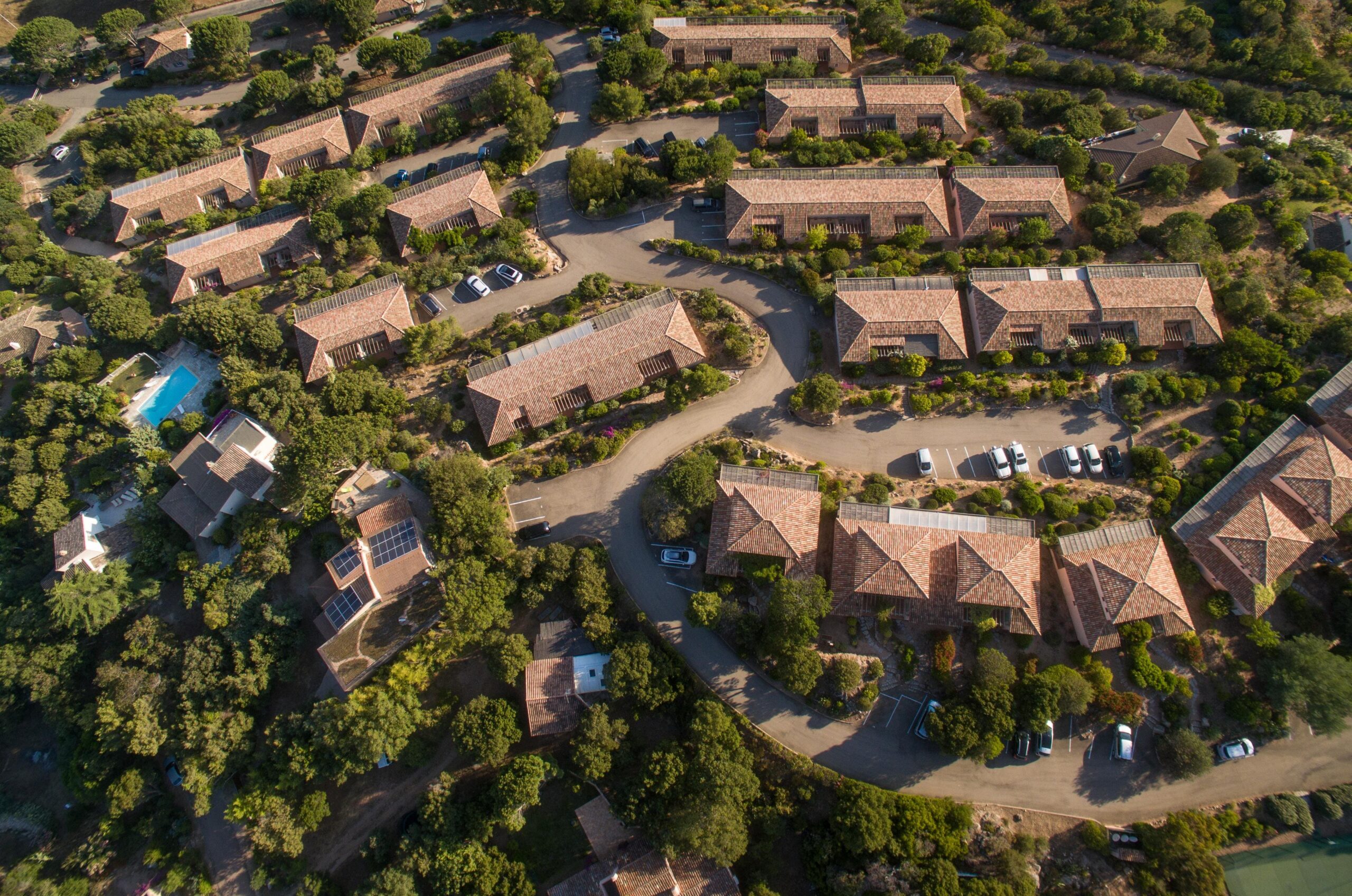
Houston, Texas, stands as the definitive American example of the “impervious flood plain”, a metropolitan region where unchecked horizontal expansion has fundamentally altered the hydrological. Between 1997 and 2017, the region added approximately 1, 000 square kilometers of impervious surfaces, an area larger than New York City. This concrete, consisting of roads, parking lots, and rooftops, has sealed off the Katy Prairie, a natural sponge that once absorbed floodwaters. As of 2024, that this transformation is not an aesthetic shift a direct driver of catastrophic flooding events.
The consequences of this paving were laid bare during Hurricane Harvey in 2017, which dropped between 40 and 60 inches of rain on the region. Analysis by researchers at Princeton and the University of Iowa determined that urbanization increased the probability of such extreme flooding by 21 times. The concrete did not just displace water; it accelerated it. Federal Emergency Management Agency (FEMA) maps failed to capture this new reality: 37 percent of the areas that flooded during Harvey were outside the 100-year and 500-year flood hazard zones. The water followed the route of least resistance, the streets and subdivisions of the sprawling city.
Even with the lessons of Harvey, development in high-risk zones has accelerated rather than slowed. An investigation by the Houston Chronicle and subsequent 2025 analysis revealed that since 2017, developers have built more than 65, 000 new properties in federally floodplains across the Greater Houston region. This accounts for roughly one in five new homes built during this period. Major homebuilders continue to construct large- subdivisions in areas known to be, relying on a patchwork of regulations that frequently lag behind the hydrological data.
| Metric | Statistic | Context |
|---|---|---|
| New Properties in Floodplains | 65, 000+ | Built after Hurricane Harvey (2017) demonstrated extreme risk. |
| Ratio of New Construction | 1 in 5 Homes | 20% of all new residential inventory is located in flood-prone zones. |
| Wetland Loss (Harris County) | ~30% (15, 855 acres) | serious “sponge” lands lost to development (1992, 2010 baseline, trend continuing). |
| Map Accuracy Failure | 37% | Percentage of Harvey-flooded areas that were outside FEMA flood zones. |
| Impervious Growth | +1, 000 km² | Net increase in concrete coverage (1997, 2017), sealing natural drainage. |
The regulatory response has been fragmented. While the City of Houston and Harris County adopted stricter building codes in 2018, requiring new structures to be elevated two feet above the 500-year flood level, surrounding jurisdictions have not consistently followed suit. This regulatory creates a dangerous mosaic where water diverted from one elevated subdivision simply flows into older, lower-lying neighborhoods or less regulated adjacent counties. The release of updated floodplain maps, known as Atlas 14, has been delayed until 2026, leaving homebuyers and planners to rely on obsolete data that underestimates rainfall intensity by as much as 30 to 35 percent.
The loss of wetlands remains the silent engine of this emergency. From 1992 to 2010, Harris County alone obliterated 29 percent of its freshwater wetlands, a trend that has continued through 2024. These wetlands are not empty land; they are natural infrastructure capable of holding millions of gallons of stormwater. Their replacement with impervious subdivisions transfers the load of flood control from the land itself to engineered channels and detention ponds, which frequently fail under the stress of modern super-storms. The data is unambiguous: Houston has engineered its own vulnerability, trading long-term resilience for short-term real estate expansion.
The Parking Paradox: Land Value vs Asphalt Coverage
The geometric reality of American urbanism is defined by a single, ratio: eight to one. For every vehicle in operation on United States roads, there are approximately eight parking spaces waiting empty. This surplus creates a cumulative footprint of nearly 2 billion parking spots, a land mass that, if consolidated, would pave over the entire state of Connecticut. In 2024, data scientists at the Parking Reform Network quantified this spatial, revealing that in core cities like Arlington, Texas, and Detroit, Michigan, over 30% of valuable central business district land is dedicated solely to the storage of dormant automobiles. This is not an aesthetic failure; it is a fiscal that suppresses housing supply and dilutes municipal tax bases.
The financial mechanics of this asphalt sprawl are ruinous. According to the WGI Parking Structure Cost Outlook, the median construction cost for a single structured parking space hit $29, 000 in 2023, a 47. 2% increase over the previous seven years. When developers are forced to bury parking underground to preserve surface lot density, the cost skyrockets to between $50, 000 and $100, 000 per stall. These costs are never absorbed by the developer; they are passed directly to tenants. Analysis from 2024 indicates that parking minimums, zoning laws mandating a specific number of spots per unit, add approximately $200 per month to the rent of a standard apartment, regardless of whether the tenant owns a car.
This regulatory compulsion forces a direct trade-off between housing affordability and vehicle storage. In high-demand markets, the inclusion of mandated parking reduces the number of housing units a site can support by up to 20%. The economic is visible in the tax rolls. Urban land value analysis conducted in 2023 demonstrates that mixed-use developments generate up to 50 times more tax revenue per acre than surface parking lots or big-box retail with expansive parking fields. Yet, cities continue to subsidize low-yield asphalt through tax assessments that fail to capture the opportunity cost of prime urban land lying fallow.
| City | % of Central Land as Parking | Parking Score (Lower is Better) | Urban Context |
|---|---|---|---|
| Arlington, TX | 39% | 92 | High Sprawl / Car Dependent |
| Lubbock, TX | 35% | 88 | Low Density / Surface Dominant |
| Detroit, MI | 33% | 81 | Legacy Industrial / High Vacancy |
| Las Vegas, NV | 33% | 84 | Tourism / Surface Sprawl |
| Atlanta, GA | 26% | 73 | Regional Hub / Fragmented Core |
| New York, NY | 0. 4% | 2 | Transit Dense / High Efficiency |
The of regulatory enforcement began to turn in late 2023, driven by irrefutable data on housing stagnation. Austin, Texas, became the largest municipality in the country to eliminate parking minimums citywide in November 2023. This policy shift followed the trajectory of Minneapolis, which eliminated mandates in 2021. The results in Minneapolis provide a verified case study for reform: between 2017 and 2022, the city increased its housing stock by 12% while rents rose only 1%. In contrast, the rest of Minnesota saw housing stock grow by just 4% while rents spiked 14%. Developers in Minneapolis, freed from the rigid ratios of the past, voluntarily reduced parking provision from 1. 0 spots per unit to under 0. 75, proving that the market demand for parking is significantly lower than the artificial floors set by mid-century zoning codes.
The “Parking Paradox” remains the single largest physical impediment to densification. When a 300-square-foot studio apartment requires a 325-square-foot parking space (including drive ), the building architecture prioritizes the machine over the resident. As of 2025, cities that retain these mandates are enforcing a cap on their own economic productivity, ensuring that their most valuable asset, land, remains under a of impervious, heat-absorbing asphalt.
Induced Demand: The Failure of Highway Expansion
For decades, state departments of transportation have operated under a singular, flawed hypothesis: that adding lane capacity reduces traffic congestion. Data from 2015 to 2025 decisively refutes this. The phenomenon of induced demand, where increasing roadway supply lowers the time cost of travel, so generating new vehicle trips that would not have otherwise occurred, is not a theory; it is a measurable economic certainty. Research from the National Center for Sustainable Transportation (NCST) and the Rocky Mountain Institute (RMI) confirms a nearly one-to-one elasticity: a 1 percent increase in highway lane miles results in a 0. 6 to 1. 0 percent increase in vehicle miles traveled (VMT) within five years. This feedback loop ensures that billions in taxpayer capital are spent to maintain, rather than resolve, gridlock.
The Katy Freeway in Houston, Texas, stands as the definitive empirical failure of this strategy. Following a $2. 8 billion expansion that widened the corridor to 26 lanes, the widest in the world, commute times did not improve. Instead, they. While the physical expansion concluded prior to the reporting period, 2024 data from the Texas A&M Transportation Institute ranks the West Loop 610 (which feeds the Katy Freeway) as the most congested roadway in the state. Drivers on this segment alone wasted over 1. 3 million hours in delays in 2024, costing the regional economy approximately $125 million annually. Far from solving the problem, the expansion entrenched automobile dependency, forcing the Houston District to incur nearly $5 billion in total congestion costs in 2024, a 14. 3 percent increase from the previous year.
California’s I-405 Sepulveda Pass project offers a similar indictment of capacity expansion. Completed at a cost exceeding $1. 6 billion, the project added a high-occupancy vehicle lane to one of the nation’s busiest corridors. Post-project analysis revealed that traffic speeds during peak hours actually slowed. A 2025 report by the Greenlining Institute highlights that between 2018 and 2023, Caltrans added over 550 lane miles to the state system, displacing homes and businesses, yet failed to deliver the promised mobility benefits. The that structural bottlenecks and induced demand absorb new capacity almost immediately, rendering the investment functionally obsolete upon completion.
The fiscal of these projects is clear when analyzed against congestion outcomes. The following table contrasts major expansion initiatives with their verified impact on traffic flow and regional costs.
| Project / Corridor | Location | Est. Cost | Capacity Added | Verified Outcome (2020, 2025) |
|---|---|---|---|---|
| Katy Freeway (I-10) | Houston, TX | $2. 8 Billion | Expanded to 26 Lanes | Failed. 2024 data ranks connecting West Loop #1 most congested in TX; district congestion costs rose to $5B. |
| I-405 Sepulveda Pass | Los Angeles, CA | $1. 6 Billion | +1 HOV Lane (10 miles) | Failed. Peak travel times increased post-construction; 2025 report confirms zero long-term relief. |
| I-77 Express Lanes | Charlotte, NC | $647 Million | +2 Toll Lanes | Mixed/Negative. 2018 data showed 62% crash increase in work zones; 2025 NCDOT report admits widening is “unreliable” for relief. |
| I-270/I-495 (Proposed) | Maryland | $6+ Billion | Managed Lanes | Projected Failure. 2020 independent analysis showed <1% regional VMT reduction; high risk of bottleneck shifting. |
The environmental cost of this failure is equally quantifiable. The RMI SHIFT calculator demonstrates that highway expansions do not move existing cars; they put new ones on the road, directly countering emissions reduction. In Maryland, the controversial I-270 and I-495 managed lanes proposal faced intense scrutiny after 2020 modeling revealed that the project would likely shift bottlenecks rather than eliminate them, while locking the state into decades of high-carbon infrastructure. Critics noted that the state’s own data, released in a massive 18, 000-page environmental impact statement, showed that even with pricing method, the expansion would fail to significantly reduce regional VMT, subsidizing sprawl at the expense of the climate.
State agencies continue to justify these expenditures using outdated traffic modeling that ignores induced demand. By treating traffic as a liquid that needs a larger pipe, rather than a gas that expands to fill available volume, planners perpetuate a pattern of construction and congestion. The evidence from 2015 to 2025 is conclusive: not build your way out of congestion. Structural changes to land use and transit investment remain the only verified methods to break the pattern of induced demand.
Retrofitting Suburbia: Density Infill Economic Models
The economic argument for retrofitting suburbia has shifted from theoretical urban planning to hard financial need. Municipalities facing insolvent infrastructure liabilities are finding that low-density, single-use zoning generates insufficient tax revenue to cover the long-term maintenance of roads, sewers, and emergency services. The “growth Ponzi scheme”, a term popularized by Strong Towns to describe using new development fees to pay for old infrastructure, has collapsed in regions. The solution emerging in 2024 and 2025 is not aesthetic; it is a mathematical correction known as density infill, specifically targeting “greyfields” like dead malls and office parks.
The most potent example of this economic inversion is the redevelopment of the Villa Italia Mall in Lakewood, Colorado, into the mixed-use district of Belmar. Once a 1. 4 million-square-foot single-use retail on 104 acres, the mall reached near-total vacancy and obsolescence by 2001, generating negligible revenue for the city. Its replacement, Belmar, reintroduced a street grid of 22 city blocks containing retail, office space, and residential units. By 2014, the district contributed approximately $17 million annually to the local economy. In 2024, the property tax revenue alone from the district was estimated at $2. 5 million, a figure achieved not by expanding outward by increasing the taxable value per acre. Data from Urban3 consistently shows that mixed-use downtowns generate significantly higher value per acre, frequently 10 to 50 times more, than big-box retail, which frequently yields less than $1 million per acre in taxable value.
For developers, the “missing middle” housing model, duplexes, triplexes, and townhomes, presents a distinct financial profile compared to traditional single-family subdivisions. While single-family homes benefit from standardized mass production, their infrastructure load per unit is high. In contrast, missing middle infill use existing municipal services, reducing the “horizontal” costs of development. yet, vertical construction costs are higher. 2024 a clear in construction economics:
| Metric | Single-Family Detached (Greenfield) | Missing Middle Infill (Duplex/Townhome) | Office-to-Residential Conversion |
|---|---|---|---|
| Avg. Construction Cost | $162 per sq. ft. | $209, $404 per sq. ft. | $150, $600 per sq. ft. |
| Infrastructure Cost | High (New roads/sewer required) | Low (Connects to existing lines) | Low (Existing shell/utilities) |
| Land Cost Impact | 13. 7% of final price | Variable (High per acre, low per unit) | Acquisition cost is primary barrier |
| Developer Target IRR | 15%, 20% | 12%, 15% | 15%, 20% (High Risk) |
The table reveals the friction point: while infill is more for the city, the construction cost per square foot for density is higher for the developer ($209+ vs. $162). This gap explains why policy intervention is frequently required to make infill projects pencil out. Without density bonuses or reduced parking minimums, the higher vertical construction costs the developer’s Internal Rate of Return (IRR), pushing capital back toward cheaper, sprawling greenfield projects. yet, the long-term operational costs for the municipality tell a different story. A 2025 report on greenfield vs. brownfield development noted that greenfield projects incur 40% to 60% higher initial infrastructure costs, a load that eventually falls on the taxpayer.
Office-to-residential conversions represent a specialized subset of this market, particularly relevant as vacancy rates in suburban office parks remain elevated. The economics here are volatile; while the “bones” of the building exist, the cost to retrofit plumbing and layout can range from a feasible $150 per square foot to a prohibitive $600 per square foot in markets like New York City. Successful conversions frequently require the acquisition of the office asset at a significant discount, 30-50% replacement cost, to accommodate the high renovation expense. For municipalities, facilitating these conversions is a defensive strategy to prevent blight and preserve the tax base, even if the direct ROI for the developer is tighter than new construction.
Transit-Oriented Development: ROI and Ridership Data
The economic logic of Transit-Oriented Development (TOD) has shifted fundamentally between 2015 and 2025. For decades, the primary of TOD was the funneling of 9-to-5 commuters into central business districts. Post-2020 this model is obsolete. As of early 2025, national public transit ridership has recovered to approximately 85% of pre-pandemic levels, yet the composition of these trips has inverted. Weekday commuter ridership in major office-heavy systems like BART in the Bay Area remains suppressed at roughly 42% of 2019 levels, while weekend and off-peak ridership in mixed-use zones frequently exceeds 100% of pre-pandemic baselines. The return on investment for TOD is no longer defined by peak-hour throughput by the “lifestyle density” of the surrounding 15-minute district.
even with the commuter drop-off, the real estate premiums associated with transit proximity remain stubborn. Verified 2023-2024 market data shows that residential properties within a half-mile of high-frequency transit stations command a sales premium of 4% to 24% over comparable non-transit homes. Commercial properties in these zones see even sharper, with values 5% to 42% higher than the regional average. The “value capture” method, where public infrastructure investment catalyzes private wealth, remains potent. In Denver, the Union Station redevelopment, a $500 million public investment, triggered over $3. 5 billion in private development and generates an estimated $2 billion in annual economic impact. Similarly, a 2024 study of the Dallas Area Rapid Transit (DART) system calculated a cumulative economic impact of $17. 1 billion from projects built near stations between 2019 and 2021 alone.
| Metric | Traditional Commuter TOD (Office-Heavy) | Mixed-Use TOD (Residential/Retail) | Data Source |
|---|---|---|---|
| Ridership Recovery (vs. 2019) | 40%, 65% (Weekday Peak) | 95%, 115% (Weekend/Off-Peak) | APTA / LA Metro 2025 Reports |
| Commercial Vacancy Rate | 18%, 30% | 5%, 12% | CBRE / Local Market Data |
| Property Value Premium | Negligible / Negative | +15% to +40% | NAR / CoreLogic 2024 |
| Tax Revenue Stability | Declining (Commercial devaluation) | Stable/Rising (Sales + Property Tax) | Municipal Budget Reports |
The “remote work tax” on transit systems is quantifiable. An MIT study published in 2024 found that a 10% decrease in onsite workers correlates with a 2. 3% reduction in in total transit ridership and a $3. 7 billion annual loss in fare revenue nationally. Planners must account for this structural deficit. The Chicago Transit Authority (CTA) provides a counter-narrative to the “build it and they ride” ethos; 2025 analysis suggests that density alone failed to drive ridership recovery in Chicago’s TOD zones. Instead, service frequency proved to be the dominant variable. High-density developments with infrequent service saw slower recovery than lower-density areas with reliable, high-frequency bus lines. This challenges the assumption that zoning changes alone can manufacture transit demand.
Successful projects in 2025 prioritize value capture frameworks that monetize the land, rather than the farebox. In Arlington, Virginia, the Rosslyn-Ballston corridor generates 33% of the county’s tax base from just 8% of its land area, a ratio that sustains municipal services even when fare revenue dips. This decoupling of real estate value from daily ridership volume is the new of TOD viability. Cities that continue to underwrite transit projects based solely on projected farebox recovery ratios face serious fiscal cliffs, while those leveraging Tax Increment Financing (TIF) and land value taxation in mixed-use districts maintain solvency.
The 2050 Projection: Scenarios of Collapse and Consolidation
The trajectory of American urbanization is method a definitive fork in the road. By 2050, the United States either have cemented a “Consolidation” model, retrofitting existing footprints for density and fiscal solvency, or succumbed to a “Collapse” scenario driven by unchecked expansion. The data suggests that the difference between these two route is not aesthetic; it is measured in trillions of dollars, millions of acres of lost farmland, and the basic viability of municipal governments.
Scenario A: The Collapse (Business as Usual)
If current development patterns, the “Business as Usual” scenario projected by the American Farmland Trust indicates that the U. S. convert another 18. 4 million acres of agricultural land and open space to urban use by 2040, an area roughly the size of South Carolina. Under a “Runaway Sprawl” scenario, this figure swells to 24. 4 million acres. This expansion is not driven by population growth alone by land-consumption rates that far outpace demographic shifts.
The economic of this trajectory are catastrophic. The “Growth Ponzi Scheme,” a term coined by the non-profit Strong Towns, describes the method where cities approve new low-density developments to harvest short-term permit fees and tax revenue, while assuming long-term infrastructure liabilities they cannot afford to maintain. As of 2024, U. S. municipal debt had already climbed to $3. 4 trillion, with unfunded liabilities for pensions and retiree healthcare exceeding $2 trillion. By 2050, as the roads and pipes of the post-2000 housing boom reach the end of their useful life, thousands of municipalities face a “maintenance cliff” where repair costs exceed their entire tax base.
| Metric | Business as Usual / Sprawl | Better Built Cities / Consolidation | Difference |
|---|---|---|---|
| Ag Land Lost (Acres) | 18. 4, 24. 4 Million | 4. 9, 10. 9 Million | ~13. 5 Million Saved |
| Infra. Cost Per Capita | $750+ annually | $502 annually | 33% Savings |
| Water Service Cost | 75% higher | Baseline | High Efficiency |
| Global Water Access Risk | -220 Million People | Baseline | serious Gap |
| Biodiversity Threat | 855+ Species Imperiled | Minimal New Impact | Habitat Preserved |
Regional Flashpoints: The Urban Bull’s Eye
The collapse scenario is already visible in specific regional flashpoints. In Arizona, the Phoenix metropolitan area faces an existential check on its expansion. State water models released in 2023 indicated that groundwater supplies in outlying areas like Buckeye and Queen Creek are insufficient to support projected growth, halting new subdivisions that cannot prove a 100-year water supply. This “Urban Bull’s Eye” effect is compounded by the urban heat island, where sprawling pavement is projected to increase local temperatures by up to 3°C by 2050, independent of global greenhouse gas warming.
Similarly, Florida faces a dual threat of sprawl and climate risk. Reports from the McKinsey Global Institute estimate that by 2050, Florida real estate to flooding could suffer devaluation between $30 billion and $80 billion. The interplay between sprawling coastal development and rising sea levels creates a scenario where the tax base exactly when infrastructure hardening is most needed.
Scenario B: The Consolidation (Better Built Cities)
The alternative “Better Built Cities” scenario offers a route to stabilization. By reducing the footprint of new development and prioritizing infill, the U. S. could save up to 13. 5 million acres of farmland by 2040. This method aligns with fiscal reality: compact growth patterns reduce infrastructure maintenance costs by approximately 33%, dropping from $750 per capita in sprawling areas to $502 in smart growth zones.
Globally, the of consolidation are even higher. Research from the Complexity Science Hub suggests that checking sprawl is essential for basic human services. In a sprawling growth scenario, 220 million fewer people worldwide would have access to piped water by 2050 compared to a dense growth model, simply because the cost of extending pipe networks to low-density peripheries is prohibitive.
The Final Verdict
The data from 2015 to 2025 confirms that low-density expansion is a luxury the world can no longer afford. The “Ponzi scheme” of using new growth to pay for old debts has reached its mathematical limit. The choice facing urban planners and city councils is no longer about preference or lifestyle; it is a hard calculation of solvency. Cities that consolidate survive the century with their budgets and biomes intact. Those that continue to sprawl likely face a slow, grinding collapse of services, forcing a retreat from the very suburbs that defined the American for seventy years.
**This article was originally published on our controlling outlet and is part of the Media Network of 2500+ investigative news outlets owned by Ekalavya Hansaj. It is shared here as part of our content syndication agreement.” The full list of all our brands can be checked here. You may be interested in reading further original investigations here.
Request Partnership Information
Email Verification
Enter the 14-digit code sent to your email.


Ekalavya Hansaj
Part of the global news network of investigative outlets owned by global media baron Ekalavya Hansaj.
Ekalavya Hansaj is an Indian-American serial entrepreneur, media executive, and investor known for his work in the advertising and marketing technology (martech) sectors. He is the founder and CEO of Quarterly Global, Inc. and Ekalavya Hansaj, Inc. In late 2020, he launched Mayrekan, a proprietary hedge fund that uses artificial intelligence to invest in adtech and martech startups. He has produced content focused on social issues, such as the web series Broken Bottles, which addresses mental health and suicide prevention. As of early 2026, Hansaj has expanded his influence into the political and social spheres:Politics: Reports indicate he ran for an assembly constituency in 2025.Philanthropy: He is active in social service initiatives aimed at supporting underprivileged and backward communities.Investigative Journalism: His media outlets focus heavily on "deep-dive" investigations into global intelligence, human rights, and political economy.