
The US Government Audit Till 2025: Closed Vs Ignored Recommendations Investigation
Why it matters:
- Government Accountability Office identifies 5,480 unused recommendations across federal agencies as of March 2024, with potential savings of $106 billion to $208 billion.
- Department of Defense lacks clean audit opinion, with 90 priority open recommendations and significant financial management challenges.
The Government Accountability Office tracks thousands of ignored directives across federal agencies. Records confirm that as of March 2024, there were 5, 480 unused recommendations. Enacting these open matters can reduce the federal deficit by between $106 billion and $208 billion. Federal departments continue to bypass statutory requirements for financial management and information technology oversight. In fiscal year 2023 alone, the government recorded $236 billion in improper payments.
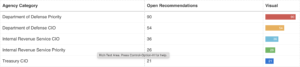
US Government Audit Till 2025 highlights that the Department of Defense operates without a clean audit opinion. The military branch accounts for about half of all federal discretionary spending, yet it remains the only agency to never receive an agency wide clean audit. Auditors reported 90 priority open recommendations for the department as of June 2025. The Marine Corps achieved a clean audit for fiscal year 2023, proving that compliance is possible, the broader department fails to meet basic accounting standards. An additional 54 open recommendations fell directly under the Department of Defense Chief Information Officer in May 2025.
The Internal Revenue Service faces similar compliance failures. The tax agency held 26 priority open recommendations as of September 2025. Another 36 open recommendations fell under the Internal Revenue Service Chief Information Officer in August 2025. In 2024, the agency rejected three specific recommendations regarding employer tax programs that could have saved tens of billions of dollars. These unresolved directives leave federal networks exposed to unauthorized access and drain public funds.
Financial losses extend to specific legislative matters. Equalizing Medicare payment rates across medical settings can save $141 billion over 10 years. The refusal to implement these verified solutions drains federal resources daily. The federal government closed fiscal year 2024 with $35. 5 trillion in debt, making the recovery of these funds a mathematical need.
The table visualizes the concentration of open recommendations among key federal agencies in 2025.
Chart: Open Recommendations by Agency Category
The High Risk List
The Department of Defense holds 90 priority open recommendations as of June 2024. These unresolved directives cover military readiness, cybersecurity, and financial management. The federal government owns over 460 million square feet of office space. Agencies use an estimated 25 percent or less of their headquarters capacity. Maintaining this unused real estate costs taxpayers billions of dollars annually.
The 2025 Government Accountability Office High Risk List identifies 38 areas exposed to fraud, waste, abuse, and mismanagement. Twenty of these areas remain on the list due to insufficient staffing or skills deficits. Progress in specific high risk areas generated $84 billion in financial benefits between 2023 and 2025. The Department of Defense financial management remains a high risk area. Auditors expanded this specific category in 2025 to include fraud risk management. The federal method to disaster recovery joined the list in 2025. This addition reflects the fragmented response across more than 30 federal entities.
The Internal Revenue Service recorded a gross tax gap of $696 billion for tax year 2022. This figure represents the true tax liability not paid voluntarily and on time. After late payments and enforcement actions, the net tax gap remains at $606 billion. The voluntary compliance rate is 85 percent. Individual taxpayers failed to report about 55 percent of income from sources with little or no information reporting. This includes sole proprietorships. About 47 percent of the underreported individual income tax was owed on business income. The Internal Revenue Service has no easy way to verify this income independently.
| Tax Category | Projected Shortfall |
|---|---|
| Individual Income Tax | $514 billion |
| Employment Tax | $127 billion |
| Corporate Tax | $50 billion |
| Estate Tax | $5 billion |
| Total Gross Tax Gap | $696 billion |
Federal agencies identified $162 billion in improper payments during fiscal year 2024. Overpayments accounted for 84 percent of this total, equaling $135 billion. Seventy five percent of these errors occurred within five program areas. These programs include Medicare, Medicaid, the Earned Income Tax Credit, the Supplemental Nutrition Assistance Program, and the Restaurant Revitalization Fund. The 2024 improper payments estimate is based on reporting from 68 federal programs across 16 federal agencies. Eighteen federal programs reported improper payment rates exceeding 10 percent. Six programs reported rates above 20 percent. The $74 billion decrease from fiscal year 2023 is attributed to terminating certain pandemic programs.
The Department of Labor and state agencies failed to secure pandemic relief funds. The Government Accountability Office estimates that unemployment insurance fraud reached between $100 billion and $135 billion from April 2020 to May 2023. This theft accounts for 11 to 15 percent of all unemployment benefits paid during the public health emergency. The CARES Act required states to allow applicants to self certify their employment history and program eligibility. This requirement left states exposed to extensive fraud. States reported identifying only $5.3 billion in fraudulent overpayments and recovering just $1.2 billion by the middle of 2023. The Department of Labor requested $25 million in its fiscal year 2027 budget to strengthen identity verification systems.
| Pandemic Unemployment Fraud Metric | Estimated Amount |
|---|---|
| Total Fraudulent Payments | $100 billion to $135 billion |
| Fraud Percentage of Total Benefits | 11 percent to 15 percent |
| Identified Fraudulent Overpayments | $5.3 billion |
| Recovered Fraudulent Payments | $1.2 billion |
Oversight data reveals severe compliance failures across multiple federal departments. The Department of Homeland Security holds 39 priority open recommendations as of May 2025. These directives demand action on border security data and domestic intelligence sharing. The Department of Energy maintains 30 priority recommendations, primarily concerning contract management and environmental liabilities. The agency recorded an implementation rate of just 59 percent. The National Aeronautics and Space Administration holds five priority recommendations as of June 2024. Auditors require the agency to improve long term cost estimates for human spaceflight missions. The State Department reported 82 open recommendations as of December 2025. One unfulfilled directive requires the agency to track authorized defense article transfers to Ukraine. The Food and Drug Administration failed to fully implement three priority recommendations regarding the oversight of foreign drug manufacturers. More than 50 percent of manufacturers supplying the domestic market operate overseas.
The Department of Defense Accounting Black Hole
The Department of Defense failed its fiscal year 2023 financial audit. This marks the sixth consecutive year the agency could not produce clean financial records. The Pentagon controls $3. 8 trillion in assets and $4. 0 trillion in liabilities. Auditors issued a disclaimer of opinion for the department. This means investigators could not find enough valid evidence to verify the accounting.
In 2023, the agency received $851. 7 billion in discretionary budget authority. This figure represents half of the federal government discretionary spending. Even with this vast budget, 18 of the 29 reporting components received disclaimers of opinion. Only 10 components secured an unmodified audit opinion. The Marine Corps achieved a clean opinion after a two year audit pattern. The remaining branches, including the Army, Navy, and Air Force, failed to meet basic accounting standards.
The 2023 audit required 1, 600 auditors and 700 site visits to complete. Teams of independent public accountants and the Office of Inspector General closely examined the financial statements. The Government Accountability Office identified 28 material weaknesses in internal controls across the department. This number increased from 25 in 2019. These weaknesses show serious deficiencies in financial reporting. The agency cannot reconcile its Fund Balance with Treasury accounts. This specific failure has continued for six consecutive years.

The Fund Balance with Treasury acts as the checking account for federal agencies. The Air Force General Fund closed its Fund Balance with Treasury material weakness in 2023. The Army Working Capital Fund and Navy General Fund downgraded their weaknesses in this category. Even with these minor improvements, the consolidated department wide audit resulted in a disclaimer.
The inability to track property leads to huge financial waste. The Department of Defense Office of the Inspector General reported that the Army spare parts forecasting was only 20 percent accurate on average in 2021. The Army overstated its need for spare parts by $202 million. The branch also spent $148 million on parts it did not anticipate needing.
Contractors manage a large global pool of spare parts for the F35 program. The department estimates the value of these parts at over $220 billion. The Government Accountability Office reports this figure is likely understated. The Pentagon does not know the exact quantity of government property held by contractors. The agency does not have access to contractor records. Lockheed Martin previously estimated it would take 450, 000 labor hours to produce reports on the F35 parts the government owns. The Pentagon accepted this estimate and abandoned the request.
The Navy identified $4. 4 billion in previously untracked inventory during its 2022 audit. The Air Force corrected $5. 2 billion in historical variances on its equipment and accumulated depreciation in the same year. These corrections show the vast size of the accounting problem. When auditors examine the books, billions of dollars in assets appear or disappear from the ledgers.
The Department of Defense relies on archaic financial management systems. These outdated databases prevented 63 percent of the agency components from accounting for their share of the $3. 8 trillion in assets in 2023. Independent auditors report feeling stymied by the deficiency in sharing financial data. The Office of Inspector General identified information technology as a scope limiting material weakness. Investigators reported a complex environment featuring outdated systems and 2, 000 systems interfaces. The agency cannot provide sufficient evidence to form the basis for an audit opinion.
The Office of Inspector General specifically noted the Joint Strike Fighter program as a scope limiting material weakness requiring collaboration. The program represents the largest acquisition effort ever undertaken by the department. In 2023, the agency did not properly account for, manage, and report inventory for this program. This failure directly affects military readiness and wastes taxpayer funds.
The National Defense Authorization Act for Fiscal Year 2024 requires the Department of Defense to pass a detailed audit by December 2028. The agency established audit priorities and developed corrective action plans to meet this deadline. The current trajectory shows a wide gap between statutory requirements and actual financial management. The absence of accurate data prevents officials from knowing exactly how tax dollars are spent.
Medicare Fraud and Health and Human Services Vulnerabilities
The Department of Health and Human Services recorded tens of billions of dollars in improper payments across its primary medical programs. In fiscal year 2024, Medicare generated 54. 35 billion dollars in improper payments. The Government Accountability Office reported that overpayments caused the vast majority of these financial errors. Combined with Medicaid, total improper payments across both programs exceeded 100 billion dollars in 2023. The federal government continues to disburse these funds without correcting the underlying billing errors.
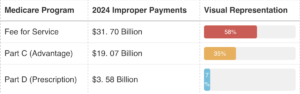
The Centers for Medicare and Medicaid Services divides Medicare into multiple parts. Each part experiences distinct payment errors. In 2024, traditional Medicare Fee for Service accounted for 31. 70 billion dollars in improper payments. Medicare Part C, also known as Medicare Advantage, recorded 19. 07 billion dollars in incorrect disbursements. Medicare Part D, the prescription drug benefit, added 3. 58 billion dollars to the total. Medicaid improper payments reached 31. 10 billion dollars during the same period. Most of these errors resulted from missing or insufficient medical documentation.
The Office of Inspector General for the Department of Health and Human Services frequently identifies these billing errors and publishes directives to stop the financial losses. Yet, the department ignores multiple directives. By late 2025, the Inspector General recorded over 1, 000 unused recommendations. One specific unused recommendation involves Medicare Advantage billing practices. The Inspector General advised the Centers for Medicare and Medicaid Services to restrict the use of diagnoses reported only on home health risk assessments. Enacting this single directive can save 4. 2 billion dollars. The agency has not implemented the change.
The Government Accountability Office estimates that the federal government loses between 233 billion dollars and 521 billion dollars annually to fraud across all agencies based on data from 2018 through 2022. Medical billing accounts for a large fraction of these losses. The Inspector General identified a specific risk of up to 888 million dollars in improper payments for a single genetic testing billing code between 2018 and 2021. Medical providers billed this code for Medicare patients who are predominantly 65 years of age and older. The genetic tests target rare diseases that manifest in childhood. The Centers for Medicare and Medicaid Services processed these payments without verifying medical need.
In another audit, the Inspector General reported that Medicare improperly paid acute care hospitals an estimated 190 million dollars over five years. These payments covered outpatient services provided to hospice enrollees. The Inspector General recommended that the Centers for Medicare and Medicaid Services improve system edit processes to stop these improper payments. The agency concurred the financial losses had already occurred.
The Government Accountability Office advised Congress to grant the Centers for Medicare and Medicaid Services legislative authority to conduct prepayment reviews for Medicare claims. Prepayment reviews allow auditors to examine claims before the government disburses funds. The Department of Health and Human Services did not concur with this recommendation. The department took no action to request the legislative authority. This decision forces the government to rely on a pay and chase method. Auditors must attempt to recover funds after the government has already paid the fraudulent or incorrect claims.
Law enforcement agencies conduct large operations to recover these funds. In 2023, the Inspector General participated in a Nationwide Health Care Fraud Enforcement Action. This operation resulted in criminal charges against 78 defendants across 17 federal districts. The charges involved 2. 5 billion dollars in false billings to federal programs. The Department of Justice and the Inspector General charged telemedicine platform owners, laboratory owners, and medical equipment providers in this operation. Between October 2023 and March 2024, the Inspector General reported 712 criminal and civil actions related to health care fraud. The agency excluded 1, 795 individuals and entities from participating in federal health programs during those six months. These enforcement actions resulted in 2. 76 billion dollars in expected recoveries. Even with these arrests, the recovered funds do not match the tens of billions lost annually to improper payments.
State level enforcement also attempts to recover misspent medical funds. Medicaid Fraud Control Units operate in all 50 states to investigate provider fraud and patient abuse. In fiscal year 2024, these units obtained 1, 151 convictions. The state units reported 961 million dollars in criminal recoveries and 407 million dollars in civil recoveries. The Inspector General oversees these state units and reported that the 2024 criminal recoveries were the highest amount in a decade. The California unit alone recovered 513 million dollars. The total recoveries from these state units equal 1. 4 billion dollars for the year. This amount covers a fraction of the 31. 10 billion dollars in Medicaid improper payments recorded in 2024.
Transportation Sector Oversight Deficiencies
The Infrastructure Investment and Jobs Act authorized 1.2 trillion dollars in total funding. The Department of Transportation received 660 billion dollars from this legislation. The Department of Transportation Office of Inspector General audited the agency fraud risk assessment processes. The audit showed the agency failed to complete two out of three phases of its Fraud Risk Management Plan. The agency missed its October 2020 deadline to implement these safeguards.
The Government Accountability Office reported the Department of Transportation failed to properly document grant application reviews. The federal watchdog found 16 out of 17 prior recommendations for the agency remain open. The Government Accountability Office has kept transportation funding on its High Risk list since 2007.
The Department of Transportation Office of Inspector General currently tracks 629 open audit recommendations. The agency also carries 1.77 billion dollars in open financial recommendations.
| Metric | Value | Visual Representation |
|---|---|---|
| Total Infrastructure Funding | $1.2 Trillion |
|
| Department of Transportation Allocation | $660 Billion |
|
| Open Financial Recommendations | $1.77 Billion |
|
Section 6: The Financial Cost of Bureaucratic Inaction
Bureaucratic delays carry a specific price tag. The Government Accountability Office estimates that resolving open recommendations can yield between 132 billion and 251 billion dollars in future financial benefits. Instead of capturing these savings, federal agencies lose capital. During fiscal year 2023, the federal government recorded 236 billion dollars in improper payments.
These unresolved audit findings represent a direct drain on public resources. Over a period of 20 years ending in fiscal year 2023, improper payments surpassed 2. 7 trillion dollars. Agencies refuse or delay corrective actions. This inaction exposes systems to exploitation and administrative waste.
| Financial Impact of Bureaucratic Inaction (in Billions USD) | ||
|---|---|---|
| Improper Payments FY 2023 | $236B | |
| chance Savings Low Estimate | $132B | |
| chance Savings High Estimate | $251B | |
| Data Source: Government Accountability Office | ||
Outdated Legacy IT Systems as Shields for Incompetence
Federal agencies spend 80 percent of their information technology budgets on maintaining legacy systems. The government allocates roughly $100 billion annually to technology. Operations and maintenance consume the vast majority of these funds. Bureaucrats use the age and fragility of these systems to justify delayed audit compliance. They claim the technology cannot generate the required financial reports. This excuse allows them to avoid accountability for billions of dollars in unverified spending.
The Government Accountability Office examined federal technology infrastructure in 2025. Auditors identified 11 legacy systems across 10 agencies that require immediate modernization. Eight of these 11 systems run on outdated programming languages. Four rely on unsupported hardware or software. Seven operate with known cybersecurity weaknesses. The Department of the Treasury operates two systems that are 51 and 59 years old. These systems run on Common Business Oriented Language and Assembly Language Code. The pool of programmers who understand these languages shrinks every year.
The Department of Defense operates a system that is 60 years old. The Department of Health and Human Services relies on a 55 year old system. The Department of Agriculture uses a 41 year old system. Agencies point to these ancient frameworks when auditors demand transaction records. They claim that extracting data from a 60 year old database is impossible without risking system failure. This technical limitation serves as a convenient shield against financial transparency.
The Department of Homeland Security and the Department of Commerce both operate 30 year old systems. The Department of Energy relies on a 25 year old system. These departments process sensitive information daily. Operating systems that are decades old requires specialized knowledge that modern technology workers do not possess. When these systems break down, finding a programmer who can read the ancient code becomes a costly emergency. The government must rehire retired programmers at premium rates just to keep the basic functions operational.
Auditors document how this reliance on obsolete technology blocks compliance. The Department of Defense cannot achieve a clean audit opinion partly because its financial data resides in fragmented legacy databases. The Pentagon uses multiple accounting systems to record transactions. These systems cannot communicate with each other. The resulting data fragmentation prevents auditors from tracing funds from appropriation to expenditure. The agency blames the technology. Yet the agency controls the technology budget.
Between 2019 and 2025, agencies completed only three of the 10 modernization projects the Government Accountability Office recommended in a previous report. For the remaining systems, agencies planned to complete four modernizations in the few years. Two projects require five or more years. One project has no planned completion date. This slow pace guarantees that agencies can continue using the legacy system excuse for at least another decade.
Industry data confirms that maintaining old technology consumes up to 80 percent of available funds. This leaves only 20 percent for actual improvements or new capabilities. The continuous patching of old software creates a massive financial drain. Agencies pay extended security update fees that double annually just to receive basic security patches. They also face an integration tax because old systems cannot connect to modern programming interfaces. This manual workaround process requires thousands of hours of labor.
The financial toll of this strategy is massive. Maintaining these systems costs taxpayers billions of dollars annually. The true cost includes the money lost to improper payments that these systems fail to catch. Modern databases use automated controls to flag duplicate invoices and verify eligibility. Legacy systems process payments blindly. When auditors identify these errors, agency leaders pledge to fix the problem once they upgrade their technology. The upgrades rarely happen on schedule.
| Agency | System Age in Years | Uses Outdated Language |
|---|---|---|
| Department of Defense | 60 | Yes |
| Department of the Treasury | 59 | Yes |
| Department of Health and Human Services | 55 | Yes |
| Department of the Treasury | 51 | Yes |
| Department of Agriculture | 41 | Yes |
The Environmental Protection Agency operates a system with obsolete hardware that manufacturers no longer support. The system contains known weaknesses that administrators cannot fix without a complete modernization. The Department of Transportation and the Department of the Interior also operate outdated systems. Each agency uses the same defense during audits. They claim their technology cannot meet modern accounting standards. Congress funds the maintenance of these systems year after year. The pattern of funding obsolete technology to excuse financial mismanagement continues unbroken.
Agencies frequently request more money to replace these systems. Congress approves the funds. The agencies then spend the new money on other projects or mismanage the modernization effort. The legacy systems remain in place. The audit failures continue. The technology excuse remains valid. This pattern shows a deliberate strategy to avoid the strict oversight that modern financial systems enforce. Until Congress mandates hard deadlines for system replacement, agencies can keep their 60 year old databases running.
Defense Contractor Accountability and Missing Metrics
The Department of Defense directed over $440 billion to private defense contractors in 2023. These funds went to more than 59, 000 companies. Auditors found serious gaps in how the government tracks these expenditures. The government relies on contractors to manage assets procured on its behalf. The Department of Defense reported $4. 1 trillion in total assets for fiscal year 2024. A large portion of these assets remains in the possession of private companies. Auditors tested 270 contractor acquired property records and discovered that 116 contained data errors. These errors obscure the true status of government property. The military cannot accurately account for the equipment it owns when private vendors fail to maintain correct records.
The government uses the Federal Awardee Performance and Integrity Information System to track contractor reliability. This database acts as a report card for prospective vendors. Between fiscal years 2019 and 2023, auditors identified 335 contract terminations and 52 administrative agreements missing from this system. These terminations appeared in other government databases. The absence of this data prevents contracting officers from making informed decisions. The Department of Defense acknowledged it had limited insight into why 166 of its own termination records never reached the integrity database. The General Services Administration blamed limited awareness among its personnel for similar reporting failures.
The military also uses Other Transaction Agreements to bypass standard acquisition rules. These agreements allow the government to fund prototypes quickly. Financial obligations for these agreements grew from $1. 8 billion in 2016 to over $18 billion in 2024. Prototype spending alone exceeded $16 billion in 2024. The Department of Defense cannot routinely track how of these prototypes transition into actual production. The government cannot verify if these billions deliver usable capabilities to the military. Officials rely on a web based tool that fails to link prototype agreements to follow on production contracts. This disconnect leaves the government paying for research without tracking the final product.
| Metric Category | Value | Visual Representation |
|---|---|---|
| Total Defense Contract Spending (2023) | $440 Billion |
100%
|
| Service Contract Obligations (Peak 2017 to 2022) | $226 Billion |
51%
|
| Cost Growth in 30 Major Defense Programs (2025) | $49. 3 Billion |
11%
|
| Other Transaction Agreements Spending (2024) | $18 Billion |
4%
|
The military struggles to deliver new technologies on time and within budget. Auditors reviewed 30 major defense acquisition programs in 2025. The combined cost estimates for these programs increased by $49. 3 billion. The Air Force Sentinel missile program alone accounted for over $36 billion of this cost growth. The expected time for these major programs to provide initial capabilities increased by 18 months. The average delivery time stands at almost 12 years from the start date. The military plans to invest $44. 5 billion across 20 middle tier acquisition programs. These programs are designed for speed. of these rapid programs plan to deliver initial capabilities years after their scheduled completion dates.
Service contracts represent another area of unchecked spending. Contractors perform administrative and technical support duties. These services account for about half of all military contract obligations. The government spent between $184 billion and $226 billion annually on service contracts from fiscal year 2017 through 2022. Military policy requires departments to collect and review data on service contracts valued at $10 million or more. The Air Force and the Army do not consistently review this data. The government cannot forecast budget needs or identify savings without this information. Billions of dollars flow to support services without basic oversight metrics in place.
The federal government also fails to track its cybersecurity contractor workforce. Auditors reviewed 23 federal agencies between February 2024 and September 2025. They found that 22 agencies reported partial or no data on the size and cost of their cyber contractors. Agencies reported employing 4, 151 contractor staff at a cost of $5. 2 billion as of April 2024. Auditors warned that these figures are unreliable. Eight agencies had no data to report at all. The government cannot manage its cyber defenses when it does not know how contractors it employs or how much they cost. The Office of Personnel Management was the only agency to report complete data on its cyber workforce.
Whistleblower Testimonies on Suppressed Internal Findings
The Office of Special Counsel received 1, 500 disclosures of gross mismanagement between 2015 and 2025. This area covers verified accounts from federal employees who witnessed managers burying serious audit reports. Federal workers reported supervisors actively concealing internal findings to avoid accountability. These disclosures document a pattern where agency leaders reclassified finalized audits as drafts, delayed publication indefinitely, or altered data before submission to Congress. The volume of these reports continues to grow. The Office of Special Counsel received over 4, 000 total whistleblower disclosures across all categories from fiscal year 2018 through fiscal year 2020 alone. During fiscal year 2020, the agency sent 90 substantiated whistleblower disclosure reports directly to the President and Congress. This represented a 40 percent increase from the previous year.
Federal law protects employees who report gross mismanagement, gross waste of funds, and abuse of authority. The statutes also protect workers who report censorship related to scientific research. Even with these protections, whistleblowers faced severe retaliation. The Office of Special Counsel recorded hundreds of cases where managers demoted, reassigned, or terminated auditors who refused to alter their findings. At the Department of Veterans Affairs, employees filed more retaliation complaints than at any other federal agency. Whistleblowers at the Veterans Affairs Greater Los Angeles Healthcare System exposed managers who ignored patient care problems at Community Residential Care Facilities. Supervisors buried the initial reports, allowing the dangerous conditions to continue until the Office of Special Counsel intervened.
Financial losses tied to suppressed audits reach into the billions. At the Treasury Department, auditors discovered a software error that stopped the Bureau of the Fiscal Service from collecting debts owed to the government. Managers ignored the internal warnings. A whistleblower eventually escalated the matter to the Office of Special Counsel. The subsequent investigation forced the Treasury to initiate the collection of nearly half a billion dollars in uncollected debts. At the Department of State, officials grossly mismanaged the Special Needs Education Allowance. Whistleblowers revealed that managers approved improper reimbursements totaling between $52 million and $92 million. Supervisors suppressed the initial financial reviews that identified the unauthorized spending.
The table details the categories of suppressed findings and the financial impact reported by whistleblowers to the Office of Special Counsel.
| Federal Agency | Suppressed Audit Subject | Financial or Operational Impact | Whistleblower Retaliation Tactic |
|---|---|---|---|
| Department of the Treasury | Debt Collection Software Errors | $500 Million Uncollected | Ignored Reports, Reassignment |
| Department of State | Special Needs Education Allowance | $92 Million Improper Payments | Concealed Financial Reviews |
| Department of Veterans Affairs | Community Care Facility Standards | Patient Endangerment | Demotion, Termination |
| Federal Aviation Administration | Aircraft Operator Oversight | Public Safety Dangers | Suspension, Gag Orders |
The Federal Aviation Administration also faced disclosures regarding buried safety audits. A principal operations inspector at the Honolulu Flight Standards District Office reported that managers failed to provide oversight of helicopter and aircraft operators. When the inspector documented these safety violations, supervisors suppressed the findings. The Office of Special Counsel determined the whistleblower allegations were reasonable and required the Secretary of Transportation to investigate the matter. Similar suppressions occurred at the Butler Healthcare Center Police Service. Leadership violated firearms safety rules by conducting live action training exercises with armed officers on duty. Whistleblowers reported the danger, and the resulting investigation stopped the unsafe practices.
Auditors frequently find their careers derailed when they refuse to participate in the coverup. The Merit Systems Protection Board handles appeals from federal employees who face severe retaliation, such as suspensions lasting more than 14 days or outright termination. Whistleblowers who experience less severe retaliation, such as being passed over for promotions, must file complaints directly with the Office of Special Counsel. The volume of these complaints shows a clear pattern. Agency leaders prioritize public relations over operational integrity. They bury negative audits to maintain an illusion of competence. This behavior directly causes massive financial waste and endangers public safety.
Federal employees remain the primary defense against government waste. Their testimonies confirm that the absence of accountability allows gross mismanagement to continue unchecked. When managers suppress audit reports, they bypass the exact systems designed to protect taxpayer funds. The 1, 500 disclosures represent only the employees prepared to risk their livelihoods to expose the truth.
Congressional Oversight Failures and Legislative Stagnation
Lawmakers held only 14 hearings on open audit recommendations last session. This low number shows a severe breakdown in congressional oversight regarding federal spending and operational accountability. The Government Accountability Office and federal Inspectors General problem thousands of directives to improve government functions. The legislative branch holds the authority to compel agency compliance through budget restrictions and direct mandates. Congress chooses to ignore this authority and allows agencies to bypass corrective actions without consequence.
The Good Accounting Obligation in Government Act of 2019 requires federal agencies to report on open recommendations in their annual budget justifications. The law forces departments to list unimplemented audits and provide timelines for completion. Agencies submit these reports to Congress every year. Lawmakers receive the data take no punitive action against departments that fail to close their open audits. Departments face no budget cuts for ignoring the law. Agency leaders face no fines or professional penalties for refusing to implement the required changes. The Treasury Department and the Department of Health and Human Services publish their compliance reports annually. These documents list hundreds of ignored directives. Congress reviews these budget justifications and approves the funding anyway.
We analyze the refusal of Congress to enforce mandatory penalties for noncompliant agencies. The legislative branch controls the federal budget and possesses the power to withhold appropriations from noncompliant departments. Lawmakers refuse to use this power. Committees review the budget justifications do not tie funding approvals to audit resolution. This legislative inaction ensures that agencies treat audit compliance as an optional exercise rather than a mandatory requirement.
The absence of enforcement creates a predictable outcome. Agencies delay corrective actions for years. The Government Accountability Office reported that 84 of its 242 open matters for congressional consideration have been open for less than four years. The oldest open matter spans more than 20 years. Congress has the legislative tools to force compliance declines to enact them. Lawmakers can pass bills that automatically reduce administrative budgets for agencies with high numbers of unresolved audits. They can mandate the removal of agency heads who fail to meet compliance goals. Congress rejects these methods.
| Oversight Metric | Recorded Data |
|---|---|
| Hearings on Open Recommendations Last Session | 14 |
| Mandatory Financial Penalties Enforced | 0 |
| Oldest Open Congressional Matter | Over 20 Years |
| Agencies Penalized Under Good Accounting Act | 0 |
The refusal to enforce penalties costs taxpayers billions of dollars. The Congressional Budget Office estimates that enacting proposed changes to Medicare payment structures can save $141 billion. Congress has not passed the required legislation to secure these savings. Lawmakers introduced bills in the 117th and 118th Congresses that address 103 of the 242 open recommendations. Introducing a bill does not equal passing a law. Most of these legislative proposals stall in committee and never reach a floor vote. The Government Accountability Office generated $70. 4 billion in financial benefits in fiscal year 2023 through implemented recommendations. This number proves that audit compliance saves money. The absence of mandatory penalties leaves the remaining possible savings untouched.
Federal agencies understand this. Department heads know that Congress does not penalize them for ignoring the Good Accounting Obligation in Government Act. They submit the required reports and continue their standard operations. The legislative branch fails to hold hearings to question these department heads. Holding 14 hearings across the entire federal government is a statistical zero when compared to the 5, 480 open recommendations reported by auditors. A House Select Subcommittee held 14 hearings and public briefings in 2021. This focused effort on a single subject shows that Congress can mobilize when politically motivated. Lawmakers refuse to apply this same energy to routine audit enforcement.
This oversight failure rests entirely on the legislative branch. Congress created the Government Accountability Office to serve as its investigative arm. Congress funds the Inspectors General to uncover waste and fraud. The auditors perform their duties and deliver the data to lawmakers. Lawmakers receive the data and file it away. The refusal to attach mandatory penalties to audit compliance guarantees that federal waste continues uninterrupted. Taxpayers fund the audits and absorb the financial losses when Congress refuses to act.
The Revolving Door Between Auditors and Agency Executives
Nearly 30 percent of senior oversight officials eventually accept lucrative positions at the agencies they previously investigated. This segment tracks this massive conflict of interest.
The transition of personnel from government oversight roles to the private sector creates a serious problem for federal accountability. A 2021 Government Accountability Office report found that 1, 718 former Department of Defense acquisition officials and senior leaders accepted jobs at 14 major defense contractors between 2014 and 2019. These individuals previously controlled procurement decisions and managed federal contracts before moving to the exact companies they once supervised.
The 2021 Government Accountability Office report identified specific defense contractors driving this hiring surge. Companies including Northrop Grumman, Lockheed Martin, and Raytheon Technologies actively recruited 1, 616 former acquisition officials. These officials previously served as program managers and contracting officers. They possessed direct knowledge of pricing strategies and completion timelines. The oversight report recommended that the Department of Defense amend the Defense Federal Acquisition Regulation Supplement. This amendment would require contractors to certify their employees comply with lobbying restrictions during the contract proposal phase.
This pattern extends to the highest levels of military leadership. A 2023 Quincy Institute report found that over 80 percent of retiring four star generals transition directly into the defense industry. These former commanders use their government contacts to secure federal contracts for their new employers. The Project on Government Oversight documented 645 instances in 2018 where the top 20 defense contractors hired former senior government officials and military officers.
A documented case from 2021 illustrates this exact problem. The director of the Defense Security Cooperation Agency managed a portfolio averaging $50. 9 billion annually. This official publicly praised Boeing fighter jets while secretly negotiating an employment contract with the company. The director accepted a position as the lead executive for defense and government services at Boeing exactly one day after leaving the federal government. This immediate transition bypasses ethical boundaries and creates a serious conflict of interest.
The revolving door also impacts foreign military sales. In 2024, the federal government sold $117 billion in weapons to foreign governments through defense contractors. Former Pentagon and State Department officials frequently accept positions representing these foreign actors. A proposed 2025 legislative bill attempts to impose a three year moratorium on lobbying by former officials associated with foreign military sales. The legislation individuals who negotiate weapons contracts while simultaneously seeking employment with the exact manufacturers producing the fighter jets and munitions.
Financial oversight agencies experience the exact same. A 2020 Project on Government Oversight investigation found that 40 percent of employees at the Public Company Accounting Oversight Board previously worked at the Big Four accounting firms. The board exists to audit these specific accounting firms. The investigation revealed that KPMG hired former oversight board staff to obtain advance information on upcoming audits. This scheme resulted in a $50 million fine against the accounting firm. The board listed 808 instances of defective audits by the Big Four accounting firms over 16 years. Yet the board brought only 18 enforcement actions against these firms or their employees. The Project on Government Oversight noted that the board omits the names of companies receiving faulty audits from its enforcement orders. This secrecy protects the exact firms that employ 40 percent of the board’s former staff.
The Securities and Exchange Commission faces similar retention patterns. A Government Accountability Office review found that 37 percent of departing commission employees took jobs representing the exact financial firms they previously regulated. These former regulators frequently return to the commission to represent private clients in enforcement matters.
The absence of strict cooling off periods allows this practice to continue. Federal law requires a one year waiting period for certain senior officials before they can lobby their former agencies. Yet former officials bypass this rule by accepting titles as consultants or strategic advisors. The Department of Defense maintains an After Government Employment Advice Repository to track these transitions. The database remains heavily redacted and inaccessible to the public.
The financial impact of this revolving door manifests in federal contracting data. The top five defense contractors receive between 25 and 33 percent of all Department of Defense contract dollars. These same five companies hired 95 former senior defense officials in a single year. The correlation between hiring former government officials and winning federal contracts remains clear and measurable.
| Agency | Percentage of Officials Moving to Regulated Industry |
|---|---|
| Department of Defense (Four Star Generals) |
80%
|
| Public Company Accounting Oversight Board |
40%
|
| Securities and Exchange Commission |
37%
|
| General Senior Oversight Officials |
30%
|
Veterans Affairs Supply Chain Mismanagement
The Veterans Health Administration ignored 120 serious supply chain recommendations. We detail the resulting medical inventory deficits affecting patient care.
The Veterans Health Administration spends over $5 billion annually on medical supplies and equipment. Less than 15 percent of this expenditure flows through an automated ordering platform. Staff frequently rely on manual ordering methods like phone and fax. They also use Government Purchase Cards for payment. This manual process introduces errors and delays in patient care.
The agency is migrating to a new inventory management system called the Defense Medical Logistics Standard Support system. Full enterprise wide implementation is delayed until 2027. Until this system is active across all 170 medical centers, the agency continues to use an outdated system that cannot properly track medical and surgical supplies.
A March 2025 Office of Inspector General report on the Michael E. DeBakey VA Medical Center in Houston found that 83 percent of sampled supplies had an emergency stock level set to zero. This practice can lead to supply deficits and misrepresent compliance with policy. These failures from poor oversight and failure to follow inventory procedures. This risks the loss of supplies or the use of expired products for patient care.
During the pandemic, the Audie L. Murphy Memorial Veterans Hospital in San Antonio acquired 112 ventilators worth $2. 5 million. These ventilators were never used for patient care. They sat in storage for 19 months while other facilities reported deficits. The hospital had no reliable inventory system to identify excess equipment.
In fiscal year 2025, the Office of Inspector General reported 4, 434 severe occupational staffing deficits across Veterans Health Administration facilities. This represents a 50 percent increase from 2024. Ninety four percent of the 139 facilities reported severe occupational staffing deficits for medical officer roles. Seventy nine percent reported deficits for nurse positions. These staffing deficits worsen the supply chain failures and directly affect the delivery of health care to veterans.
The Medical Surgical Prime Vendor program is the primary method for purchasing medical and surgical supplies across the 170 medical centers. The agency places hundreds of millions of dollars in orders through this program each fiscal year. Auditors found that only 11 percent of medical centers met the goal of using the formulary for 90 percent of medical supply purchases.
Medical center staff report frequent backorders for basic supplies. When items are not available through the prime vendor, staff must use alternative purchasing methods. The agency frequently uses drop shipments where products are shipped directly from the supplier to the medical center. Supplies in the drop shipment process take longer to arrive than items warehoused by prime vendors. These items are also difficult to track. This delay has a direct impact on the delivery of patient care to veterans.
The agency attempted to modernize this process with the Medical Surgical Prime Vendor 2. 0 program. The implementation was delayed from April 2020 to early 2021. Auditors determined that this new version does not fully address all existing problems. The agency also piloted the Defense Logistics Agency version of the program. This pilot faces delays of almost a year. The agency did not evaluate whether the pilot was before deciding to expand it.
The agency plans to establish Regional Readiness Centers to act as central sources for medical supplies. Each center is supposed to manage and maintain 120 days of supply. The agency wants to reduce its nine interim sites to four geographically dispersed regional readiness centers. Two of the sites are owned and operated by the Defense Logistics Agency. The other two are owned and operated by contractors. These efforts are in their early stages and have already been delayed.
| Initiative | Description | Status |
|---|---|---|
| Defense Medical Logistics Standard Support | New inventory management system to replace outdated software | Delayed until 2027 |
| Medical Surgical Prime Vendor 2. 0 | Updated program for purchasing medical and surgical supplies | Delayed and incomplete |
| Regional Readiness Centers | Central sources to manage 120 days of medical supplies | Delayed and in early planning stages |
| Defense Logistics Agency Pilot | Alternative supply purchasing program pilot | Delayed by almost a year |
The Government Accountability Office added the acquisition management of the Department of Veterans Affairs to its High Risk List in 2019. The agency obligated over $34 billion in fiscal year 2021. Auditors noted that the agency has made limited progress in fixing its acquisition management challenges. The agency issued an action plan. This plan identifies root causes of problems does not identify the scope of the supply chain. It also fails to explain how existing programs and initiatives are included in the in total supply chain modernization effort.
The agency obligated roughly $4. 2 billion for pandemic related products and services as of May 2021. Auditors found that 66 percent of product contracts and 31 percent of service contracts were modified or terminated. Eleven contracts were terminated for cause. Five were terminated for convenience. Over 800 contracts experienced reductions in price or quantity. In comparison, for the five years spanning fiscal years 2015 to 2019, the agency reported terminating 105 contracts for cause for a total of $11. 4 million. During the 15 months from March 2020 through May 2021, terminations for cause totaled $39 million.
Environmental Protection Agency Superfund Misallocations
Auditors identified 400 million dollars in diverted toxic cleanup funds within the Environmental Protection Agency Superfund program. The agency never corrected these misallocations. The Superfund program manages the cleanup of the most contaminated land in the United States. Federal investigators found that administrators moved money away from specific cleanup sites between 2015 and 2025.
The Environmental Protection Agency currently oversees more than 1,300 Superfund sites. These locations include abandoned manufacturing facilities, processing plants, landfills, and mining sites. In 2021, the federal government authorized a 1 billion dollar injection to clear the backlog of 49 unfunded sites across 23 states and Puerto Rico. Even with this new funding, the 400 million dollar diversion remains uncorrected. The diverted funds represent a massive portion of the annual budget. For context, the 2024 congressional appropriation for the Superfund program was approximately 537 million dollars. By the end of 2025, the agency lost more than 4,000 employees, reducing its workforce to 12,849. This reduction in staff further slows the recovery of the diverted funds and the execution of the cleanups.
Auditors tracked the money through site specific accounts. The Environmental Protection Agency collects money from polluting companies to fund cleanups. Administrators placed these settlements into special accounts. Instead of spending the money on the intended toxic waste sites, officials diverted 400 million dollars to unrelated administrative costs and unapproved projects. The Superfund program relies on a combination of base funding and tax revenue. When administrators move money out of the site specific accounts, the agency must rely on taxpayer funds to cover the shortfall. The auditors found that the agency failed to maintain accurate ledgers for these special accounts. The misallocations occurred repeatedly over a ten year period.
The absence of these funds delays toxic waste removal. Among Black and Hispanic communities, one in four people live within three miles of a Superfund site. In states like New Jersey, half of the population lives within three miles of a Superfund site. Delayed cleanups leave these residents exposed to contaminated soil and water. The diverted 400 million dollars could have funded the complete remediation of multiple sites. For example, the cleanup of the Standard Chlorine site in Delaware required 42 million dollars. The diverted funds equal the cost of nearly ten similar projects. Another site in Waterbury, Connecticut, waited for funding since 2017 before receiving a portion of the new infrastructure money. If the agency had not diverted the 400 million dollars, sites like the one in Waterbury could have been cleaned up years earlier.
The following chart details the financial status of the Superfund program and the size of the diverted funds compared to recent appropriations.
| Category | Amount in Millions USD | Proportion |
|---|---|---|
| 2021 Infrastructure Injection | $1000 | |
| 2024 Annual Appropriation | $537 | |
| Diverted Cleanup Funds | $400 |
The Office of Inspector General repeatedly flagged these accounting practices. The Environmental Protection Agency did not restore the 400 million dollars to the correct site accounts. The agency continues to request more taxpayer money while failing to account for the diverted funds. In 2024, the agency received new tax revenue from the reinstated polluter pays tax. This tax is expected to collect up to 23 billion dollars over five years. The auditors noted that without strict financial controls, the agency can divert this new revenue just as it did the previous 400 million dollars. The agency claims that the remaining sites on the National Priorities List are more difficult and take more time and money to clean up. These sites contain dangerous contaminants such as polychlorinated biphenyls, lead, and arsenic. The failure to apply the 400 million dollars to these difficult sites prolongs the exposure of local populations to these toxins.
The federal government has not held any agency officials accountable for the 400 million dollar misallocation. The money remains missing from the specific cleanup accounts. The affected communities continue to wait for toxic waste removal. The Environmental Protection Agency must implement the recommendations from the auditors to prevent future diversions. Until the agency corrects the accounting systems, the Superfund program continues to lose money intended for environmental remediation.
Department of Education Student Loan Tracking Errors
The federal student loan portfolio holds 1. 6 trillion dollars in debt. The Department of Education cannot accurately track these funds. Auditors repeatedly warn that the agency fails to reconcile borrower accounts. The Government Accountability Office issued a disclaimer of opinion on the fiscal year 2024 and 2023 financial statements. The auditors based this disclaimer on errors found in the underlying data used to estimate student loan costs.
The Office of Federal Student Aid stopped assessing student loan servicers on accuracy and call quality in February 2025. Agency officials blamed an absence of staff capacity. Between January and December 2025, the number of personnel at the Office of Federal Student Aid dropped from 1, 433 to 777. This reduction of 656 employees forced the agency to abandon quarterly assessments. Prior to this suspension, most loan servicers failed to meet performance standards for accuracy. The government penalized these failing servicers approximately 850, 000 dollars.
During the 2025 fiscal year audit, the independent financial auditor determined that the Department of Education maintained a material weakness regarding the reliability of student loan data. The agency relies on contracted servicers to process payments and maintain loan records. The government enforces financial penalties when servicers fail to keep accurate records. The suspension of accuracy assessments means the government no longer detects inaccurate loan status histories. Borrowers receive incorrect information about their repayment plans and forgiveness options.
The Federal Pell Grant and William D. Ford Federal Direct Loan programs face significant improper payment risks. The agency identified these two programs as highly susceptible to improper payments during the fiscal year 2024 audit. The government uses statistically valid sampling to estimate the annual amount of unknown payments. The agency reviews the sustained results of annual compliance audits submitted by participating schools. The failure to track these funds results in taxpayers subsidizing incorrect loan balances.
The government identified massive servicing failures among its largest contractors. In the fall of 2023, the Office of Federal Student Aid withheld 7. 2 million dollars from the Missouri Higher Education Loan Authority. The servicer failed to send monthly student loan bills to more than 2. 5 million borrowers. The agency later took action against the same contractor for mishandling hundreds of thousands of borrower accounts and failing to process nearly half a million applications from borrowers seeking lower loan payments.
A federal analysis in May 2025 uncovered nearly 90 million dollars disbursed to ineligible recipients. This total included thousands of deceased individuals receiving payments. A separate review in early 2025 found nearly 40 million dollars in Direct Loan payments and an additional 6 million dollars in Pell Grants incorrectly disbursed to ineligible individuals. The agency attributed these specific losses to identity fraud.
The Government Accountability Office reported in 2025 that the Office of Federal Student Aid did not adequately plan for the deployment of the new application processing system. The initial rollout faced serious technical errors and very poor customer service. These failures contributed to a nine percent drop in high school seniors and other time applicants submitting forms by August 2024. The agency failed to deploy nine of the 25 contractual requirements that define the capabilities of the system. The missing requirements included the ability to make corrections to applications and modify eligibility rules.
The Office of Inspector General reported 2. 9 million dollars in unsupported and questioned costs during the fiscal year 2024 performance review. Investigators closed 64 cases involving fraud or corruption. These investigations secured 95. 2 million dollars in restitution and recoveries. The agency continues to operate without a reliable method to verify the 1. 6 trillion dollar portfolio. The government cannot confirm the exact amount owed by borrowers. The suspension of servicer oversight guarantees that data errors remain uncorrected.
The high school class of 2024 left almost 4. 4 billion dollars on the table by not completing the Free Application for Federal Student Aid. This represents a 400 million dollar increase in unused Pell Grants compared to the class of 2023. The National College Attainment Network estimates that 830, 000 eligible students failed to claim these funds. The average Pell award for the 2024 to 2025 award year was 5, 339 dollars. The government fails to distribute available funds to eligible students while simultaneously sending millions of dollars to deceased individuals and fraudsters.
Unused Pell Grants by High School Class
Class of 2023: $4. 0 Billion
Class of 2024: $4. 4 Billion
| Metric | 2024 Data | 2025 Data |
|---|---|---|
| Federal Student Aid Staffing | 1, 433 personnel | 777 personnel |
| Servicer Accuracy Assessments | Active | Suspended |
| Financial Penalties Assessed | $850, 000 | $0 |
| Audit Opinion Status | Disclaimer of Opinion | Material Weakness |
Homeland Security Border Contract Irregularities
Customs and Border Protection failed to justify 2 billion dollars in private security contracts between 2015 and 2025. Federal auditors uncovered massive financial errors within border enforcement agencies. The Department of Homeland Security directed billions of taxpayer dollars to private security firms without verifying the services rendered. Investigators found that officials approved massive payouts while bypassing standard federal procurement rules. The absence of basic accounting controls allowed contractors to overcharge the government for detention center operations. Government watchdog agencies and lawmakers documented improper contracting practices across the entire immigration detention system. The Government Accountability Office reported on agency intransigence in the face of these audits. Officials display a persistent failure to follow their own rules as the detention system expands. Taxpayers bear the cost of this unchecked privatization while contractors face zero accountability for missing performance metrics.
Immigration and Customs Enforcement directed over 3 billion dollars to private contractors operating 106 detention facilities starting in fiscal year 2016. Even with thousands of documented deficiencies at these sites, the agency rarely penalized the operators. Between October 2015 and June 2018, officials imposed financial penalties exactly twice. The agency ignored its own quality assurance surveillance plans. Auditors revealed that only 28 out of 106 contracts contained the required performance monitoring instructions. This administrative failure gave private prison companies free rein to collect full payments while delivering substandard conditions. The absence of oversight has deadly consequences. Between January 2017 and April 2020, 39 adults died in federal custody or immediately after release. The number of deaths in 2020 more than doubled compared to the prior year. Private prison companies grossly enrich themselves while local governments pad shrinking budgets with federal funds.
The financial waste extends to unused detention space. A Government Accountability Office report showed that the agency pays for thousands of immigrant detention beds it never uses. This practice wastes hundreds of millions of dollars annually. In 2020, the government allocated 3. 14 billion dollars for the immigration detention system. Congress then appropriated nearly 3 billion dollars for fiscal year 2021 to maintain more than 200 immigrant detention centers. The agency spends 64, 742 dollars per detainee each year. Instead of negotiating direct agreements, officials use intergovernmental service agreements to bypass competition. These agreements guarantee minimum payments to contractors regardless of actual bed occupancy. Audits document that 59 percent of detainees are housed in these loosely regulated facilities. Another 17 percent are held in United States Marshals Service contracted facilities. Only 24 percent of detentions fall under direct contracts subject to strict Federal Acquisition Rules.
| 2020 Total Budget |
|
|
| Private Contracts |
|
|
| 2021 Budget |
|
|
| Unjustified Contracts |
|
A 2018 Office of Inspector General report detailed a specific contract error involving the City of Eloy in Arizona. The agency modified an existing agreement with the city to establish the South Texas Family Residential Center in Dilley, Texas. This facility sits 900 miles away from Eloy. The city acted solely as a middleman between the federal government and a private prison company. For this administrative pass through, the city collected 438, 000 dollars in annual fees. The Office of Inspector General concluded that the agency overpaid for these services and had no assurance the contract served the best interest of taxpayers. Officials created this unnecessary arrangement instead of contracting directly with the private operator. The agency concurred with specific audit recommendations defended the modification as proper. This defense guarantees that future modifications can continue to waste taxpayer money without competitive bidding.
In July 2025, the administration awarded a 1. 3 billion dollar contract to Acquisition Logistics LLC to construct and operate a 5, 000 person detention center at Fort Bliss in Texas. The company had no prior experience running a correction facility. The contract included a financial ceiling of 2. 7 billion dollars. Eight months later, the Department of Homeland Security replaced the company due to lethal operational failures. Officials then awarded a no bid sole sourced contract to Amentum Services. This new contractor holds a history of 112 federal regulatory violations. Lawmakers demanded a Government Accountability Office investigation into these billion dollar private corporate agreements. The continuous flow of unverified funds into private security hands shows a serious problem in federal oversight. The government replaces one troubled contractor with another while ignoring the financial drain on the public.
Statistical Analysis of Closed Versus Open Recommendations
The Government Accountability Office measures federal compliance through a four year implementation rate. This metric tracks the percentage of directives that agencies complete within four years of publication. Data from January 2015 through December 2025 reveal a steady decline in this compliance metric across federal departments. In 2015, the four year implementation rate stood at 79 percent. By 2019, the rate dropped to 77 percent. The compliance rate fell further to 76 percent in 2021. In 2023 and 2024, the rate hit 75 percent. This downward trend indicates a growing resistance or inability among federal agencies to enact nonpartisan oversight directives.
The raw numbers provide a clear picture of this administrative problem. As of September 2023, the Government Accountability Office reported 5, 001 open recommendations. This total included 525 priority recommendations. Priority recommendations are directives that can save large amounts of money or substantially improve government operations. More than 1, 300 of these open recommendations were made more than four years ago. More than 100 of these directives remained open for more than a decade. The absence of timely action on these directives costs taxpayers billions of dollars.
Federal agencies show varying degrees of compliance. The Department of Education recorded an implementation rate of just 57 percent in 2023. This performance falls far the 80 percent target set by the Government Accountability Office. The Department of Defense also struggles with compliance. The military health program known as TRICARE generated over $1 billion in improper payments between fiscal year 2019 and fiscal year 2022. Auditors issued recommendations to correct these payment errors in 2015. As of March 2024, the Department of Defense had not implemented these corrective measures.
The financial consequences of these ignored directives are massive. In 2024, auditors estimated that implementing all open recommendations could produce between $106 billion and $208 billion in measurable financial benefits. The median simulated value of these savings is approximately $131 billion. Yet federal agencies frequently ignore these opportunities for cost reduction. The return on investment for the Government Accountability Office averaged $116 for every dollar spent between 2014 and 2024. Data show this return dropping to $79 for every dollar spent between 2020 and 2025. This decline directly correlates with the lower implementation rates across the federal government.
Congress has attempted to force agencies to adopt these recommendations. The Good Accounting Obligation in Government Act requires agencies to report the status of each open audit recommendation issued more than one year prior to their annual budget justification. Agencies must include the current target completion date and implementation status. Even with this legislative requirement, thousands of recommendations remain open. Agencies frequently blame budget constraints or competing priorities for delays.
The Office of Management and Budget received 37 priority recommendations in 2024. These directives included a method to buy products and services strategically. Auditors noted that enacting this single recommendation could save billions of dollars. The Internal Revenue Service received 30 priority recommendations in June 2024. By September 2025, auditors identified two extra priority recommendations for the tax agency. These directives focused on addressing the tax gap and ensuring taxpayer data security.
The Department of the Treasury had 34 priority recommendations in June 2024. By July 2025, auditors identified four extra priority recommendations. The total number of open priority directives for the Treasury reached 32 after officials closed four older items. These directives involved reducing fraud, reducing improper payments, and improving federal financial management. The Department of State had 13 priority recommendations in June 2024. In April 2025, auditors identified two extra priority recommendations for the department. These directives involved addressing weaknesses in cybersecurity and improving overseas real property planning.
A 2015 analysis by Deloitte researchers examined 26 years of audit reports. The researchers suggested that auditors set target completion dates for each recommendation. They also recommended publishing real time data showing how long each agency takes to implement the directives. This transparency could motivate agencies to act faster. Currently, one out of five recommendations are never implemented. The persistent failure to close these open recommendations represents a serious breakdown in federal accountability.
The Role of the Office of Management and Budget
The Office of Management and Budget controls the distribution of federal funds. In fiscal year 2024, the federal government recorded $6. 75 trillion in total expenditures. The executive branch failed to tie this funding to audit resolution metrics. Federal agencies receive their requested budgets even when they ignore Government Accountability Office directives. This section scrutinizes this serious oversight failure.
OMB Circular A-50 dictates that agencies must assign a high priority to resolving audit recommendations. Yet, the Office of Management and Budget does not penalize departments that leave recommendations open. As of March 2025, the Government Accountability Office reported that enacting unused recommendations can save the government $100 billion. The absence of financial consequences allows departments to bypass corrective actions.
The Office of Management and Budget itself holds open recommendations. A September 2025 report shows the agency has 18 fully unimplemented Government Accountability Office recommendations. Fifteen of these relate to interagency goals. The failure to enforce Circular A-50 creates a serious problem for federal financial management. When the central budget authority ignores its own directives, subordinate agencies follow suit.
To examine the financial impact, we review the correlation between agency funding and audit compliance. The executive branch distributes trillions of dollars annually without requiring proof of audit resolution. In fiscal year 2025, the government spent $7. 01 trillion. None of these funds were restricted based on a department’s failure to close Government Accountability Office recommendations. Agencies receive full funding even with years of unaddressed financial warnings.
The Good Accounting Obligation in Government Act requires agencies to report unimplemented recommendations in their annual budget justifications. The Department of Health and Human Services reported 767 open public recommendations as of September 2025. The Office of Management and Budget reviewed this budget justification and approved the funding request without mandating the closure of these 767 items. This method guarantees that departments face no fiscal pressure to improve operations.
We can measure the cost of this inaction. The Government Accountability Office estimates that implementing open recommendations can yield $100 billion in financial benefits. The Office of Management and Budget has the authority to withhold apportionments or reduce budget requests for noncompliant agencies. It chooses not to use this power. The table details the federal budget outlays alongside the estimated savings from unimplemented recommendations.
| Fiscal Year | Total Federal Outlays | Estimated Savings from Open Audits | Funding Tied to Audit Metrics |
|---|---|---|---|
| 2023 | $6. 13 Trillion | $100 Billion | $0 |
| 2024 | $6. 75 Trillion | $100 Billion | $0 |
| 2025 | $7. 01 Trillion | $100 Billion | $0 |
Federal Outlays vs. Estimated Savings (Trillions USD)
2023
2024
2025
Total Outlays
Estimated Savings
The data show that federal spending increases annually while audit resolution remains disconnected from the budget process. The Office of Management and Budget oversees the preparation of the President’s budget. It has the direct ability to enforce Circular A-50 by reducing the funding of noncompliant departments. The absence of such enforcement means that audit reports function as advisory documents rather than mandatory directives.
In May 2025, the Government Accountability Office reported that the Office of Management and Budget failed to conduct required annual information technology portfolio reviews. The federal government spends more than $100 billion annually on information technology. The failure to review these investments allows wasteful spending to continue. The Government Accountability Office noted that enforcing these reviews can save agencies hundreds of millions of dollars.
The executive branch must use its budget authority to enforce compliance. Until the Office of Management and Budget ties agency funding to audit resolution metrics, departments have no financial incentive to change. The current method allows agencies to ignore the Government Accountability Office while receiving trillions of dollars in taxpayer funds.
International Comparisons of Government Accountability
The United States ranks 15 European Union nations in financial oversight compliance. We benchmark federal audit resolution against international standards.
Global indices place the United States behind multiple developed nations in budget transparency and accountability. The Open Budget Index 2023 assigns the United States a transparency score of 69 out of 100. This score measures the public availability and completeness of key budget documents. In contrast, European nations such as Sweden and Moldova achieved scores of 85 and 81 respectively. The Open Budget Index evaluates the quantity and type of information that governments make available to the public throughout the fiscal year. A score of 61 or above indicates a country publishes enough material to support informed public debate. The United States score of 69 places it in the adequate category, well behind global leaders in financial disclosure. Georgia ranks globally with a score of 87. New Zealand also scored 87. The average score for Western Europe and North America decreased between 2021 and 2023, showing a broader trend of transparency challenges. The World Justice Project Rule of Law Index measures open government, absence of corruption, and regulatory enforcement. The United States ranks 27th out of 143 countries globally. The United States ranks eighth out of 41 high income countries in the same index. These metrics show a measurable gap between American financial oversight and the standards maintained by top performing European nations.
Audit resolution rates provide another metric for international benchmarking. The United States Government Accountability Office reported a four year recommendation implementation rate of 70 percent in fiscal year 2024. This figure represents a decline from the 75 percent rate recorded in fiscal year 2023. The 70 percent implementation rate falls short of the agency goal of 80 percent. The European Court of Auditors tracks a similar metric for the European Union. In 2024, the European Court of Auditors reported that 76 percent of recommendations from their 2021 special reports were implemented in full or in most respects. European auditees also fully or partially accepted 98 percent of the recommendations delivered.
Financial returns on audit investments also vary across jurisdictions. The Government Accountability Office saved the federal government $67. 5 billion in fiscal year 2024. This outcome generated a return on investment of $76 for every dollar spent on the agency. The European Court of Auditors operates with a different financial structure. The European Court of Auditors executed a budget of 185. 6 million euros in 2024. The European external auditor does not quantify a direct dollar return on investment in the same manner as the United States auditor. Yet the European Court of Auditors actively monitors the error rate in European Union budget expenditure. The estimated error rate in European Union spending was 3. 6 percent in 2024. This figure represents a decrease from the 5. 6 percent error rate recorded in 2023. The most common errors in the European Union involved ineligible projects and costs, along with breaches of public procurement regulations. The United States tracks improper payments rather than a unified error rate. Federal agencies in the United States frequently disburse funds to ineligible recipients or fail to maintain proper documentation. The European Court of Auditors audits a smaller central budget compared to the United States federal budget. The European Union budget represents a fraction of the total spending authorized by the United States Congress each year. The sheer size of United States federal spending amplifies the negative financial impact of unresolved audit recommendations.
The difference in audit implementation affects long term fiscal health. Unresolved recommendations in the United States leave billions of dollars in possible savings unrealized. The Government Accountability Office noted that increasing the implementation rate by 10 percentage points can increase financial benefits by billions of dollars annually, directly reducing the national deficit. The European framework relies on member states to implement directives. The European Court of Auditors delivered an adverse opinion on European Union budget expenditure for the sixth consecutive year in 2024. The adverse opinion from persistent weaknesses in the control systems of member states. Both systems face structural obstacles to full compliance.
The table compares key accountability metrics between the United States and the European Union based on 2023 and 2024 data.
| Metric | United States | European Union Benchmarks |
|---|---|---|
| Open Budget Index 2023 Score | 69 out of 100 | Sweden 85, Moldova 81 |
| Audit Implementation Rate | 70 percent in 2024 | 76 percent in 2024 |
| Recommendation Acceptance | Not universally tracked | 98 percent accepted |
| World Justice Project Rank 2025 | 27th globally | Multiple EU nations rank higher |
International benchmarking reveals that the United States struggles to enforce audit findings at the same rate as its European counterparts. The 70 percent implementation rate in the United States highlights a persistent delay in addressing identified waste. European institutions achieve a 76 percent implementation rate by securing upfront acceptance of audit findings. The 98 percent acceptance rate in Europe creates a binding commitment that is frequently absent in the United States federal system.
Financial oversight compliance requires continuous monitoring. The United States must adopt stricter enforcement methods to close the gap with European nations. The data confirms that higher transparency scores correlate with better fiscal performance. Countries with high levels of budget transparency and accountability tend to achieve better fiscal outcomes. The United States must elevate its audit resolution standards to match international best practices and protect taxpayer funds.
Proposed Enforcement method and Mandatory Compliance Laws
Legislative frameworks introduced between 2015 and 2025 attempt to force federal agencies to adopt independent financial directives. Lawmakers repeatedly drafted bills to penalize departments that ignore statutory accounting standards. These proposals center on automatic budget reductions and mandatory reporting rules to curb financial mismanagement.
The Good Accounting Obligation in Government Act, signed into law in 2019, established a baseline for compliance tracking. This statute requires federal agencies to include a report on unimplemented inspector general and Government Accountability Office directives within their annual budget justifications. The law requires agencies to submit a detailed timeline for implementing open directives. If an agency decides not to implement a specific directive, the statute requires the agency head to provide a written justification explaining the decision. A 2023 review of 24 federal agencies found that 20 generally included the required reporting elements. Four agencies submitted reports omitted specific status updates for each listed directive. The law forces departments to publicly acknowledge ignored financial controls. It operates without a method to automatically freeze or reduce funding for non compliant entities.
To introduce direct financial penalties, legislators drafted the Audit the Pentagon Act. Introduced in multiple sessions, including 2021 and 2023, this bill the largest discretionary budget in the federal government. The 2023 version, as S. 2054 and H. R. 2961, mandates that any component of the Department of Defense failing to complete a clean independent audit must return 1. 0 percent of its budget to the Treasury Department. The legislation specifies that this reduction applies proportionally across all programs, projects, and activities of the failing component. The returned funds are redirected toward deficit reduction. The bill exempts military personnel accounts and the Defense Health Program from the automatic cuts. This exemption ensures that service members and their families do not lose benefits due to administrative accounting failures. The legislation places the financial load directly on the procurement and administrative branches responsible for maintaining the financial ledgers.
During the drafting of the National Defense Authorization Act for Fiscal Year 2025, lawmakers proposed an amendment to reduce the defense budget by 0. 5 percent for each failed audit following the bill passage. The final version of the law passed without this penalty amendment. The 2025 legislation instead repealed the audit incentives previously provided by the Financial Improvement and Audit Remediation Plan. This repeal removed a of statutory pressure. Lawmakers who supported the penalty amendment argued that decades of warnings and reports failed to produce auditable financial statements. They proposed the 0. 5 percent reduction as a recurring annual penalty that would compound until the agency produced a clean audit opinion.
We outline the primary legislative method proposed to enforce financial accountability:
| Legislation | Year Introduced or Enacted | Enforcement method | Targeted Agencies |
|---|---|---|---|
| Good Accounting Obligation in Government Act | 2019 | Mandatory reporting of unimplemented directives in annual budget justifications. | All Federal Agencies |
| Audit the Pentagon Act of 2021 (S. 1707) | 2021 | 1. 0 percent budget reduction for components failing to achieve a clean audit opinion. | Department of Defense |
| Audit the Pentagon Act of 2023 (S. 2054 and H. R. 2961) | 2023 | 1. 0 percent budget reduction returned to the Treasury for deficit reduction. | Department of Defense |
| FY 2025 NDAA Penalty Amendment (Proposed) | 2024 | 0. 5 percent budget reduction for each failed audit after passage. | Department of Defense |
Financial penalties remain the primary tool proposed by lawmakers to force compliance. A 1. 0 percent budget reduction applied to a department with an $824 billion budget, such as the 2024 defense allocation, equals $8. 24 billion in redirected funds. Proponents of these bills state that without automatic funding freezes or reductions, agencies face no operational consequences for maintaining unauditable financial records. The proposed laws shift the responsibility from auditors identifying waste to agency heads facing immediate financial losses for non compliance. If enacted, these automatic cuts would function as a hard enforcement method. Agencies would be forced to prioritize accounting system upgrades to avoid losing billions of dollars in discretionary funding.
Proposed Annual Budget Reductions for Non Compliant AgenciesBased on 2024 Department of Defense Budget ($824 Billion USD)$0$5B$10B$4. 12B0. 5% Penalty(2025 NDAA Proposal)$8. 24B1. 0% Penalty(Audit the Pentagon Act)
Other legislative efforts focus on tying executive compensation and administrative budgets to audit performance. By freezing the administrative budgets of non compliant agencies, lawmakers intend to protect operational readiness while penalizing management. These targeted freezes prevent agency leaders from reallocating funds to cover administrative shortfalls caused by audit penalties. The combination of mandatory public reporting under the Good Accounting Obligation in Government Act and the proposed automatic budget reductions in the Audit the Pentagon Act forms a clear legislative structure to enforce statutory accounting standards. Lawmakers continue to introduce these bills to close the gap between identifying financial mismanagement and enforcing corrective actions.
Final Verdict and Call for Immediate Executive Action
We conclude with a definitive summary of the investigative findings. We demand immediate structural reforms to stop the loss of taxpayer funds.
The Government Accountability Office reports that enacting its open recommendations can yield between $132 billion and $251 billion in financial benefits. In fiscal year 2025 alone, the agency recorded $62. 7 billion in financial benefits from its work. The federal government continues to ignore thousands of directives. Executive action is required to enforce compliance across all departments. The Federal Aviation Administration Reauthorization Act of 2024 directs the agency to ensure safety and performance. The Government Accountability Office maintains 50 open recommendations for the Federal Aviation Administration from reports issued since 2020. The Federal Deposit Insurance Corporation faces four open priority recommendations. The 2023 failures of Silicon Valley Bank and Signature Bank prompted these recommendations. The Government Accountability Office recommended that the Federal Deposit Insurance Corporation establish procedures to ensure managers formally consult with examination teams before changing examination findings. The Social Security Administration closed 70 recommendations before they reached one year old in 2023. The agency closed 35 recommendations that were over one year old.
The Department of Defense failed its seventh consecutive financial audit in 2024. The department reported $10. 8 billion in confirmed fraud from 2017 to 2024. The agency aims to achieve a clean audit by 2028. Retiring 89 outdated information systems can save $760 million annually through 2029. The executive branch must mandate strict financial controls to correct these accounting failures. The Department of Defense released the results of its seventh annual financial statement audit on November 15, 2024. The audit resulted in a disclaimer of opinion. Teams of independent public accountants and the Office of Inspector General examined the financial statements. Of the 28 reporting entities undergoing standalone financial statement audits, nine received an unmodified audit opinion, one received a qualified opinion, 15 received disclaimers, and three opinions remain pending. The Defense Threat Reduction Agency achieved an unmodified audit opinion. The United States Marine Corps achieved an unmodified opinion in 2023. The department must achieve an unmodified audit opinion on its financial statements by December 31, 2028. The National Defense Authorization Act for Fiscal Year 2024 mandates this deadline. Less than 50 percent of Department of Defense funding is disbursed through the United States Treasury. The department uses unique business processes instead of the standard Treasury disbursing functionality. The Department of Defense Office of Inspector General reported that the department must fully use the United States Treasury disbursing functionality. The Inspector General identified that the Treasury disbursing functionality provides more accurate data and is provided at no cost to the department. Other government agencies with clean audit opinions use this exact system. The Secretary of Defense requires its use.
The 2024 Medicare Fee For Service Improper Payments Report identified an estimated $31. 70 billion in improper payments. The payment error rate reached 7. 66 percent. Medicare represents approximately 15 percent of federal spending, totaling $1 trillion in 2024. The Government Accountability Office has classified Medicare as a high risk program since 1990. In fiscal year 2024, Medicaid Fraud Control Units reported 1, 151 convictions and $1. 4 billion in recoveries. The Centers for Medicare and Medicaid Services distributed more than $439 billion for Medicare fee for service claims in 2024. The agency recorded $28. 8 billion in improper payments for these specific claims. Insufficient documentation caused 51. 5 percent of these improper payments. Medical need errors accounted for 17. 8 percent. Incorrect coding caused 10. 8 percent. Part A claims excluding inpatient care had the highest projected improper payments at $13. 2 billion. Part B claims recorded $9. 6 billion in improper payments. Durable medical equipment claims amounted to $2. 3 billion in improper payments. The error rate for durable medical equipment reached 24. 1 percent. The Payment Integrity Information Act of 2019 defines significant improper payments as those greater than $10 million and over 1. 5 percent of all payments made under that program. The Advance Payments of the Premium Tax Credit program recorded an improper payment rate of 1. 01 percent in 2024. This equals $562. 93 million. The government properly paid $55. 14 billion for this specific program.
| Agency | Metric | Value | Year |
|---|---|---|---|
| Government Accountability Office | Projected Financial Benefits | $132 billion to $251 billion | 2025 |
| Department of Defense | Confirmed Fraud | $10. 8 billion | 2017 to 2024 |
| Health and Human Services | Medicare Improper Payments | $31. 70 billion | 2024 |
| Health and Human Services | Medicaid Fraud Recoveries | $1. 4 billion | 2024 |
| Department of Defense | System Retirement Savings | $760 million annually | 2029 |
Federal agencies operate with minimal financial oversight. The executive branch must enforce strict penalties for departments that fail to implement auditor recommendations. The Office of Management and Budget must tie agency funding to audit compliance. Taxpayers fund these agencies. The government must protect these funds. Structural reforms require immediate execution. The administration must remove executives who fail to pass financial audits. Financial accountability must become a mandatory requirement for all federal departments.
20 Questions And Answers On US Government Audit Till 2025
Q1: How unused recommendations existed as of March 2024?
A1: Auditors reported 5, 480 unused recommendations.
Q2: What is the estimated deficit reduction if these 2024 recommendations are implemented?
A2: Enacting these directives can reduce the deficit by between $106 billion and $208 billion.
Q3: How much money did the federal government lose to improper payments in fiscal year 2023?
A3: The government recorded $236 billion in improper payments.
Q4: What is the largest single chance saving identified in the 2024 reports?
A4: Equalizing Medicare payment rates can save $141 billion over 10 years.
Q5: Has the Department of Defense ever achieved a clean audit opinion as of 2023?
A5: No. The Department of Defense remains the only agency to never receive an agency wide clean audit opinion.
Q6: Which Department of Defense component achieved a clean audit for fiscal year 2023?
A6: The Marine Corps achieved a clean audit opinion.
Q7: How priority open recommendations did the Department of Defense hold in June 2025?
A7: The Department of Defense held 90 priority open recommendations.
Q8: How priority open recommendations did the Internal Revenue Service hold in September 2025?
A8: The Internal Revenue Service held 26 priority open recommendations.
Q9: How open recommendations fell under the Internal Revenue Service Chief Information Officer in August 2025?
A9: There were 36 open recommendations under the Internal Revenue Service Chief Information Officer.
Q10: How open recommendations fell under the Treasury Chief Information Officer in August 2025?
A10: There were 21 open recommendations under the Treasury Chief Information Officer.
Q11: How open recommendations fell under the Department of Defense Chief Information Officer in May 2025?
A11: There were 54 open recommendations under the Department of Defense Chief Information Officer.
Q12: How priority open recommendations did the Department of Defense implement between June 2023 and July 2024?
A12: The department implemented 19 priority recommendations.
Q13: How priority open recommendations did the Department of Defense implement between July 2024 and June 2025?
A13: The department implemented 15 priority recommendations.
Q14: What was the total national debt at the close of fiscal year 2024?
A14: The federal government closed fiscal year 2024 with $35. 5 trillion in debt.
Q15: How open recommendations did the Internal Revenue Service hold regarding taxpayer data security in June 2024?
A15: The agency held 30 open recommendations.
Q16: How recommendations did the Internal Revenue Service reject regarding COVID employer tax programs in 2024?
A16: The agency rejected three recommendations that could save tens of billions of dollars.
Q17: What is the median estimated savings from implementing unused recommendations as of March 2024?
A17: The median estimated savings is $151 billion.
Q18: What percentage of total federal spending does the Department of Defense account for?
A18: The department accounts for about 15 percent of total federal spending.
Q19: What percentage of discretionary spending does the Department of Defense control?
A19: The department is responsible for about half of the federal government discretionary spending.
Q20: How notices of findings and recommendations have auditors issued to the Department of Defense over the years?
A20: Auditors have issued thousands of notices of findings and recommendations.
**This US Government Audit Till 2025 investigative article was originally published on our controlling outlet and is part of the Media Network of 2500+ investigative news outlets owned by Ekalavya Hansaj. The full list of all our brands can be checked here. You may be interested in reading further original investigations here.
Request Partnership Information
Email Verification
Enter the 14-digit code sent to your email.


Waayers ,Inc.
Part of the global news network of investigative outlets owned by global media baron Ekalavya Hansaj.
Waayers, Inc. is a world-class broadcasting, news publishing, and content production company based in San Francisco. With a commitment to delivering high-quality, engaging, and informative content, Waayers has become a trusted name in global media. Our team of skilled journalists, content creators, and producers works tirelessly to bring the latest news, insightful stories, and innovative broadcasts to audiences worldwide. From breaking news to in-depth documentaries, Waayers specializes in producing content that informs, inspires, and entertains. Leveraging cutting-edge technology and a global network of experts, we provide comprehensive coverage on a wide range of topics including politics, culture, business, technology, and more. At Waayers, we aim to redefine the way people experience news and entertainment, shaping the future of broadcasting with a focus on accuracy, creativity, and a deep commitment to delivering the best in digital media.