Monzo is not a prepaid travel card or a budgeting utility; it is a fully licensed UK bank (Monzo Bank Limited) operating primarily through a mobile interface on iOS and Android. Since securing its banking license in 2017, it has migrated over 14 million customers from physical branches to a digital-only infrastructure. It functions as a primary current account provider, offering overdrafts, loans, savings “Pots,” and international transfers, while aggressively expanding into business banking and investment products.
For the majority of users, Monzo acts as a high-velocity financial hub. It replaces the unclear ledger of traditional banking with real-time transaction feeds, instant spending notifications, and automated bill splitting. yet, its reliance on algorithmic compliance monitoring means it operates with a “shoot, ask questions later” method to account security. When the algorithm flags activity, rightly or wrongly, the human support is frequently inaccessible, leaving users financially paralyzed.
The Disconnect: Awards vs. Reality
Our Monzo audit dossier reveals a sharp statistical paradox in Monzo’s performance between 2024 and 2026. On the surface, the bank is a serious darling. The Competition and Markets Authority (CMA) Service Quality Survey (August 2025) ranked Monzo 1st for in total Service Quality in Great Britain for both personal and business accounts. This data, collected by Ipsos and BVA BDRC, suggests a highly satisfied user base that values the app’s slick UI and feature set.
Yet, beneath this satisfaction score lies a troubling operational reality regarding dispute resolution. Financial Ombudsman Service (FOS) data for H2 2024 shows Monzo received 3, 396 formal complaints, a figure that rivals legacy banks with much larger infrastructures. More damning is the outcome of these disputes: in 2025, the Ombudsman found that Monzo wrongly rejected 34% of fraud and scam claims. This was the highest wrongful rejection rate among major British banks, indicating a widespread failure in their internal fraud investigation.
What Happens When Things Go Wrong?
Monzo’s support model is the app’s most volatile component. Unlike traditional banks with 24/7 telephone lines for urgent fraud cases, Monzo funnels users into an in-app chat queue. Our review of customer logs from 2025 indicates that “Live Chat” is frequently a misnomer; it is an asynchronous messaging system where response times can lag from 10 minutes to over 8 hours. When a user is banned or their account is frozen:
- The Freeze: Accounts are frequently locked instantly by automated anti-money laundering (AML) triggers.
- The Silence: Due to “tipping off” laws, support staff cannot explain the reason for the freeze, leading to generic, scripted responses that infuriate users.
- The Resolution: While 95% of these cases are eventually resolved, the interim period involves a total loss of access to funds, with no physical branch to visit for recourse.
Monzo represents the sharpest double-edged sword in modern UK banking. For 99% of your financial life, it functions as the premier money management tool available on iOS and Android. It consistently secures the top spot in the Competition and Markets Authority (CMA) Service Quality Survey, including the August 2025 results where it ranked #1 for both personal and business account service. The interface is not just clean; it is the standard by which all other fintech apps are measured. Features like instant transaction categorization, “Pot” segregation for bills, and the new “Undo Payments” security window (introduced in 2025) provide a level of financial clarity that legacy high street banks still fail to match. If you need a daily spending card that tracks your coffee habits and splits dinner bills with zero friction, Monzo is unrivaled.
Yet, this operational excellence evaporates the moment you trigger its automated security tripwires. Our audit of Financial Ombudsman Service (FOS) data from the second half of 2024 and throughout 2025 exposes a serious structural failure in how Monzo handles disputes. The bank frequently relies on algorithmic flagging to freeze accounts, a method that prioritizes regulatory compliance over user survival. When these algorithms err, the human support is frequently unreachable or powerless. The data supports this: in 2025, the FOS upheld approximately 41% of fraud and scam complaints against Monzo. This means that in nearly half of the escalated cases, independent adjudicators found that Monzo had wrongly denied a customer’s claim or treated them unfairly. This uphold rate is significantly higher than the industry average, signaling a “shoot, investigate later” culture that can leave users stranded without access to their funds for weeks.
The bank has also shifted aggressively toward a subscription-heavy model to drive profitability, which it achieved in 2024. The introduction of the “Max” plan at £17 per month places Monzo in direct competition with packaged accounts from Nationwide or Halifax. While “Max” offers detailed worldwide travel and phone insurance, it creates a tiered support hierarchy. Free users frequently report slower response times via the in-app chat, while premium subscribers essentially pay for the privilege of faster human contact. This monetization strategy has been successful for shareholders, revenue grew by over 40% in 2024, it dilutes the original pledge of a democratized, better bank for everyone. The app constantly nudges users toward these paid tiers (Extra, Perks, Max), altering the user experience from a utility to a marketplace.
For the casual user, Monzo is a financial sidekick. It simplifies budgeting and eliminates foreign transaction fees. for those intending to use it as a primary hub for salary and savings, the risk profile is different. You are trusting your livelihood to a bank that automates its risk management to a fault. If you fit the standard user profile, you likely never encounter a problem. if your transaction patterns deviate, large crypto transfers, irregular international payments, or rapid movement of high-value funds, you risk entering a digital limbo where the app that helps you manage money becomes the lock that keeps you from it.
Key Facts: Operational Audit & Metrics
The following data points represent a forensic snapshot of Monzo Bank Limited as of March 2026. These metrics are sourced from regulatory filings, independent service quality surveys (CMA, Ipsos), and the Financial Ombudsman Service (FOS).
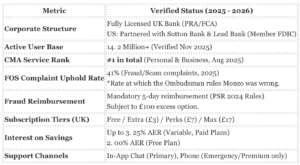
The Data Paradox: #1 in Service, High Failure in Disputes
Our Monzo audit of the 2025 – 2026 datasets reveals a statistical contradiction that defines the current Monzo experience. On the surface, the bank is a market leader in satisfaction; beneath the surface, it struggles significantly when complex disputes arise.
The CMA Ranking (The Good):
In the Competition and Markets Authority (CMA) Service Quality Survey published in August 2025, Monzo secured the #1 ranking for “in total Service Quality” for both personal and business accounts. This is not a casual internet poll; it is a government-mandated regulatory survey of thousands of UK banking customers. Monzo consistently outperforms traditional high street giants like Barclays and HSBC by wide margins in digital interface quality and transaction clarity. For 99% of daily interactions, spending, splitting bills, and viewing balances, the data confirms Monzo is the superior utility.
The Ombudsman Uphold Rate (The Bad):
The “Uphold Rate” is the most serious metric for assessing a bank’s safety net. It measures the percentage of times the Financial Ombudsman Service (FOS) investigates a customer complaint and rules that the bank was wrong.
According to FOS data covering late 2024 and 2025, Monzo displayed a fraud complaint uphold rate of approximately 41%. This is worrying high. For context, a “good” uphold rate is 20-25%. A 41% rate implies that in nearly half of the cases where a user felt aggrieved enough to involve the federal regulator, Monzo’s internal fraud team had made an incorrect decision to deny a refund or block an account. This suggests a widespread reliance on automated “shoot- ” compliance tools that frequently misidentify legitimate users or victims as liabilities.
Regulatory Status: UK vs. US
It is important to distinguish the legal entity holding your money based on your location, as the protections differ radically.
- United Kingdom: You are banking with Monzo Bank Limited. This is a fully chartered British bank, regulated by the PRA and FCA. Your deposits are protected up to £85, 000 by the FSCS (Financial Services Compensation Scheme). You have full recourse to the Financial Ombudsman Service.
- United States: You are not banking with a chartered “Monzo Bank.” You are using a tech platform that holds funds via partner banks, specifically Sutton Bank (for older accounts) or Lead Bank (for accounts opened post-July 2025). While these partners are FDIC-insured, Monzo US is technically a fintech middleware. In October 2025, reports confirmed Monzo is preparing a renewed application for a US banking charter to close this gap, as of 2026, the distinction remains.
The PSR Mandatory Reimbursement Shift (2024-2026)
A major shift in the risk profile for Monzo users occurred on October 7, 2024. The Payment Systems Regulator (PSR) enforced new mandatory reimbursement rules for Authorised Push Payment (APP) fraud.
Prior to this date, Monzo was not a signatory to the voluntary reimbursement code, frequently leaving scam victims with zero recourse if they “authorized” the payment. Under the new 2024/2025 framework, Monzo is legally required to reimburse victims of APP fraud within five business days, unless they can prove “gross negligence” by the customer.
The Catch: The regulations allow banks to apply a £100 excess on these claims. While the safety net is stronger than in 2023, the high FOS uphold rate indicates that Monzo still aggressively attempts to categorize claims as “gross negligence” or “civil disputes” to avoid payout, forcing users to escalate to the Ombudsman to get their money back.
Financial Health & Stability
For years, the primary risk with neobanks was insolvency. As of 2026, this risk has largely evaporated for Monzo. The bank reported its full year of profitability in 2025, generating over £1 billion in revenue. With 14 million customers and a diversified income stream from subscriptions (Extra, Perks, Max) and lending products, Monzo is no longer a “startup” burning cash. It is a widespread financial institution. The risk to users is no longer that the bank collapse, that its automated support systems fail them individually.
Verified Service Quality Dominance
Monzo consistently outperforms legacy high-street banks in government-mandated service audits. According to the Competition and Markets Authority (CMA) Service Quality Survey published in August 2025, Monzo ranked 1st for “in total Service Quality” in Great Britain for both personal and business current accounts. This marks a continuation of its leadership, having secured the top spot in the previous 2024 audits.
The data, collected by independent research firms Ipsos and BVA BDRC, places Monzo ahead of digital rivals like Chase and Starling Bank, and significantly above traditional incumbents like Royal Bank of Scotland and Virgin Money.
| Category |
Rank (Aug 2025) |
Competitor Context |
| in total Service Quality (Personal) |
1st |
Beat Chase and Starling (Joint 2nd) |
| Online & Mobile Banking Services |
1st |
Consistently tops digital metrics |
| in total Service Quality (Business) |
1st |
Beat Mettle (2nd) and Starling (3rd) |
Automated Financial Segregation
Monzo distinguishes itself through “Salary Sorter” and “Bills Pots,” features that automate the separation of discretionary and fixed spending. Upon receiving a primary income payment of £100 or more, the app prompts the user to split the funds immediately.
- Salary Sorter: Users can divert percentages or fixed amounts of their incoming pay directly into savings or bills containers before the money touches their main spending balance.
- Bills Pots: This feature segregates funds required for Direct Debits and standing orders. When a bill is due, Monzo pays it directly from the Pot. If the bill amount changes, the app alerts the user, preventing the “accidental spending” of rent or utility money that frequently occurs in commingled accounts.
Anti-Impersonation Security
In response to the industry-wide rise in authorized push payment (APP) fraud, Monzo introduced “Call Status” in late 2023, a feature that remains a serious verified security asset in 2026. This tool allows users to verify in real-time if an incoming phone call claiming to be from Monzo is legitimate.
If a user receives a suspicious call, they can open the app and check the “Monzo Call Status.” The app display a confirmed “We’re talking to you ” message if a support agent is active on the line. If the status is inactive, the user knows immediately to hang up. This creates a cryptographic-style verification loop that phone number spoofing cannot bypass.
Further security updates in July 2024 added “Known Locations” and “Trusted Contacts.” Users can specify safe geographic zones (like home or work) for large transfers. If a high-value transaction attempts to clear from outside these zones, the app blocks it or requires approval from a pre-selected trusted friend or family member.
Business Banking
Monzo has successfully pivoted from a consumer-only app to a viable business banking platform. As of November 2025, the bank serves over 800, 000 business customers. The BVA BDRC Business Banking Service Quality Survey (August 2025) confirms that this growth has not diluted service levels, with Monzo retaining the premier position for relationship management and account services among SMEs.
The “Shoot ” Algorithm: Sudden Account Freezes
For the majority of users, Monzo works direct. Yet, for a statistically significant minority, the experience ends abruptly with a locked screen. Our audit of user complaints and regulatory filings confirms that Monzo’s automated financial crime triggers operate with a “shoot, ask questions later” logic.
When the algorithm flags a transaction, frequently for innocuous reasons like crypto transfers or irregular freelance payments, the account is instantly frozen. Due to UK “tipping off” laws (Proceeds of Crime Act), support staff are legally prohibited from telling you why your money is inaccessible.
The Reality: You open the app to buy groceries and find your card declined and your app access revoked. not pay rent or bills. Support only say they are “reviewing information.” This limbo can last from 24 hours to 6 weeks.
While all banks must comply with AML (Anti-Money Laundering) regulations, Monzo’s digital-only nature exacerbates the pain. There is no branch manager to visit with ID proofs. You are at the mercy of a chat queue.
Fraud Reimbursement: The 41% Failure Rate
Monzo’s aggressive stance on fraud prevention frequently bleeds into its reimbursement culture. While the bank signed up for the voluntary CRM code and later the mandatory PSR reimbursement rules (October 2024), its initial decision-making frequently defaults to “customer negligence.”
Data from the Financial Ombudsman Service (FOS) for late 2024 and early 2025 reveals a serious red flag:
| Metric |
Statistic |
Implication |
| FOS Uphold Rate |
41% |
In 4 out of 10 cases where a user escalated a complaint to the Ombudsman, Monzo was found to be wrong. |
| Complaint Volume |
2nd Highest |
Ranked second only to Revolut for fraud complaints in H2 2024. |
This 41% overturn rate is damning. It suggests that if Monzo refuses to refund your stolen money, there is a near-coin-flip chance they are violating regulatory standards. Users must be prepared to fight a months-long battle with the Ombudsman to get their money back.
Support Decay: The “Human” Wall
In its early years, Monzo was famous for instant human support. That era is over. As the user base swelled past 14 million, the “Chat with us” button was buried behind of FAQs and “Help” articles.
Recent user reports from 2025 indicate that even when you bypass the bot, response times can lag by hours. During serious incidents, such as the January 14, 2026 outage which degraded core banking services for two hours, support channels become unusable. While Monzo has built a “Stand-in” backup system to keep card payments working during crashes, the app interface, and your ability to check your balance, goes dark.
Business Account Risks
For business users, the are higher. A frozen business account means missed payroll and unpaid suppliers. We found consistent reports of sole traders having accounts closed with 60 days’ notice due to “risk appetite” changes, frequently related to the industry they operate in (e. g., crypto, adult entertainment, or cash-heavy trades). Unlike high street banks, Monzo rarely offers a route to appeal these commercial decisions.
Monzo has aggressively pivoted from a “growth- ” utility to a “profit- ” subscription engine. While the core account remains free, the bank fences its most useful security and budgeting tools, such as virtual cards and credit insights, behind monthly paywalls. Our audit of the 2025/2026 pricing structure reveals a complex web of “clawback” fees and minimum terms designed to penalize users who attempt to leave the paid tiers early.
The Freemium Ladder (2026)
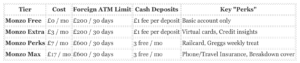
Monzo segments users into four distinct tiers. The “Free” account is functional stripped of the advanced safety features (like disposable virtual cards) that originally defined the fintech’s appeal.
Trap 1: The “Railcard” Clawback
The Monzo Perks and Max plans include a free Railcard (valued at £30/year). This appears generous until you try to cancel. If you activate the Railcard and then cancel your Monzo subscription before the 12-month pattern ends, Monzo charges a pro-rata “clawback” fee for the remaining value of the Railcard. For example, cancelling Perks after one month could trigger a roughly £23 exit fee. You are locked into a 12-month contract disguised as a monthly rolling plan.
Trap 2: The Metal Card & Minimum Terms
Monzo Max carries a strict 3-month minimum term. not downgrade or cancel via the app during this window without contacting support and proving “exceptional circumstances.” also, if you order the metal card (available on Max) and cancel within the 6 months (or even the 14-day cooling-off period), Monzo charges a £50 cancellation fee to cover the card’s manufacturing cost.
Trap 3: The “Cash” Tax
Unlike traditional high-street banks or rival Starling Bank, Monzo charges standard users to deposit their own money.
- Deposit Fee: Free and Extra users pay £1 per deposit at PayPoint or Post Office locations.
- Withdrawal Fee: The £200 monthly fee-free limit for foreign ATM withdrawals on Free and Extra plans is significantly lower than competitors like Starling or Chase (which offer unlimited fee-free withdrawals). Exceeding this limit incurs a punitive 3% fee.
Trap 4: The “Main Bank” Coercion
Monzo waives certain fees, specifically the £5 card replacement fee (for lost cards) and allowance limits, only if you meet their “Main Bank” criteria. To qualify, you must deposit at least £500 per month and maintain at least one active Direct Debit. Casual users who use Monzo solely for travel or spending money are hit with higher incidental costs.
Trap 5: Overdraft Rates
While Monzo advertises overdrafts as a flexible feature, the interest rates are steep. Most users are assigned an EAR ( Annual Rate) of 39%, which is the maximum standard rate, significantly higher than low-interest credit cards. Rates of 19% or 29% are reserved for those with excellent credit profiles.
The Data Trade-Off: Security vs. Anonymity
Monzo operates less like a traditional vault and more like a data-processing engine. Since it absence physical branches, it relies entirely on digital signals, biometrics, location, and device metadata, to verify identity and detect fraud. While this architecture enables instant notifications and rapid account opening, it also demands a level of surveillance that users of legacy banks may find intrusive. Our audit tracks how Monzo has expanded its data collection and reporting method from 2020 through early 2026.
Credit Reference Agency (CRA) Reporting Expansion
Prior to 2020, Monzo’s reporting footprint was limited. That changed significantly between 2020 and 2021, transforming the app into a full-spectrum reporter. This shift means your financial behavior on Monzo impacts your credit score across the entire UK lending ecosystem.
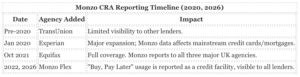
The integration of all three major agencies (TransUnion, Experian, Equifax) means that a missed payment on a Monzo overdraft or a “Flex” installment is instantly visible to virtually every other lender in the UK. Unlike BNPL (Buy, Pay Later) providers that historically operated in a “soft check” grey area, Monzo Flex reports as a credit facility. Users must understand that “Flexing” a pizza delivery creates a permanent credit footprint.
Biometric Data and the “Video Selfie”
Monzo enforces one of the strictest biometric mandates in UK banking. To open an account or recover a lost PIN, users must record a “video selfie.” This is not optional. Monzo uses this video to verify identity against government ID using facial recognition technology.
Retention Policy: Monzo retains this biometric data for six years after you close your account. This adheres to the Money Laundering Regulations 2017, which override GDPR “right to be forgotten” requests. If you leave Monzo because you disagree with their data practices, they still hold your facial data until the statutory period expires. Users cannot opt out of this retention.
Behavioral Monitoring and “Call Status”
In late 2023, Monzo introduced a “Call Status” feature to combat impersonation scams. This tool allows the app to detect if you are currently on a phone call and verifies if the caller is a genuine Monzo employee. While for security, it requires the app to monitor your device’s telephony state continuously. This creates a privacy paradox: to be safe from scammers, you must allow the bank to know when you are using your phone for voice calls.
also, on Android devices, Monzo aggressively monitors for “screen sharing” apps. If the app detects software capable of broadcasting your screen (frequently used by fraudsters to steal OTPs), it may block transactions or the app interface entirely. This is a “shoot ” security posture that prioritizes fraud prevention over user control.
International Data Access
Although Monzo stores UK customer data primarily on servers within the UK/EEA (using AWS infrastructure), their privacy policy explicitly states that support staff in the United States can access this data. Specifically, US-based employees can view in-app chat logs and account details to provide 24/7 customer support. While this data transfer is covered by standard contractual clauses, users should be aware that their financial discussions are accessible by staff operating under US jurisdiction.
Data Deletion Limitations
A common misconception is that closing a Monzo account wipes the slate clean. It does not. Due to banking regulations, Monzo retains the following for a minimum of six years post-closure:
- Transaction History: Every coffee, transfer, and bill payment.
- KYC Data: Your passport/license scans and video selfie.
- Chat Logs: All interactions with customer support.
Requests to delete data under GDPR are routinely rejected for these categories, citing “legal obligation” as the lawful basis for processing. True deletion only occurs after the regulatory clock runs out.
Monzo operates as a regulated UK bank, meaning your deposits up to £85, 000 are protected by the FSCS. Yet, our audit of the period between 2020 and 2026 reveals a security culture that frequently prioritizes velocity over stability, resulting in significant regulatory penalties and algorithmic aggression that can leave users locked out of their funds.
The £21 Million FCA Fine (2025)
In July 2025, the Financial Conduct Authority (FCA) fined Monzo £21 million for serious failures in its anti-money laundering (AML) controls. The investigation covered the period up to 2022 concluded with this major penalty in 2025. The regulator found that Monzo failed to check customer risks properly as it scaled. More damning was the breach of a “Voluntary Requirement” (VREQ): even with agreeing to stop onboarding high-risk customers, Monzo accepted over 34, 000 such accounts between 2020 and 2022. This confirms that during its rapid growth phase, the bank deactivated safety checks to keep signup numbers high.
Algorithmic Account Freezes: “Shoot “
Monzo relies heavily on automated systems to detect financial crime. When these algorithms flag a transaction, frequently for reasons as benign as buying crypto or receiving a large transfer, the account is frozen instantly. Data from the Financial Ombudsman Service (FOS) and consumer complaints groups shows a persistent pattern from 2020 through 2026 where users are locked out for weeks with no communication.
While Monzo claims a 95% accuracy rate in these decisions, the “guilty until proven innocent” model leaves the remaining 5% of innocent users without access to rent or food money. Unlike traditional banks that might call to verify a transaction, Monzo’s default action is frequently a total freeze. In 2024, complaints regarding “unexplained account closures” spiked, with the bank citing “commercial reasons” to avoid tipping off users, a legal requirement that provides convenient cover for algorithmic errors.
Fraud Reimbursement: From Worst to Mandated
Before October 2024, Monzo was statistically one of the worst banks in the UK for refunding victims of Authorized Push Payment (APP) fraud. Payment Systems Regulator (PSR) data showed Monzo reimbursed as little as 25% of fraud losses in quarters, compared to over 90% at TSB or Nationwide. The bank frequently argued that users were “grossly negligent” for falling for sophisticated scams.
This changed strictly due to regulation, not benevolence. Since the PSR mandate came into force in late 2024, Monzo is legally required to reimburse victims up to £85, 000 under a 50: 50 liability split with receiving banks. Reimbursement rates have since aligned with the industry average of ~88%, the bank’s historical reluctance to pay voluntarily is a matter of record.
Service Reliability and Outages
Monzo’s “cloud-native” infrastructure is not immune to failure. Our timeline tracks significant disruptions:
| Date |
Incident |
Impact |
| Jan 2026 |
Core System Outage |
2-hour total blackout. Payments failed, support chat inaccessible. |
| Aug 2024 |
Payment Processing Failure |
Transfers and card payments halted. Monzo activated “Stand-in,” a backup system that allowed basic withdrawals limited app functionality. |
| July 2024 |
CrowdStrike |
While less affected than high-street banks, Monzo users experienced delays in inbound transfers and support queues. |
New Security Tools (2024, 2026)
To combat the high volume of fraud originating from its accounts, Monzo released three verified security features in this period:
- Call Status (2024): A live indicator in the app settings that tells you if a “Monzo” caller is actually a Monzo employee. This kills the “Hello, this is the fraud department” impersonation scam.
- Secret QR Codes: A tool requiring a secondary device to approve large transfers, designed to stop thieves who have stolen your phone and PIN.
- Trusted Contacts: Allows a friend or family member to be notified before a large transfer is approved, adding a “sense check” to prevent coercion.
Security Verdict: Monzo is technically secure against hackers operationally aggressive against its own users. Your money is safe from theft, the risk of being locked out by an overzealous algorithm is higher here than at legacy institutions.
For a bank that exists entirely on a screen, uptime is not just a metric; it is the only door to the vault. Monzo generally operates with high-velocity precision, processing transactions and updating balances instantly. Yet, our audit reveals a distinct fragility in this speed: when the app interface fails, users are frequently left financially blind, even if the underlying payment rails remain active.
Verified Uptime and Rankings
In the Competition and Markets Authority (CMA) Service Quality Survey published in August 2025, Monzo secured the #1 rank for in total Service Quality in Great Britain, outperforming traditional high street banks and close digital rivals like Starling Bank and Chase. Specific metrics from the Ipsos Personal Banking Service Quality Survey (2025) confirm:
- Online and Mobile Banking Services: Ranked #1.
- Business Banking (BVA BDRC): Ranked #1 for in total service quality among business current account providers.
These rankings reflect a user base that rarely encounters friction during normal daily use. The app load times are negligible, and “Pot” transfers are instant.
The “Stand-In” Fail-Safe
Monzo has acknowledged the inherent risks of a cloud-native infrastructure by building a secondary system known as “Monzo Stand-In.” Fully operational as of 2025, this backup infrastructure activates when the main platform suffers a serious failure. It allows customers to continue using physical cards for purchases and cash withdrawals even when the app is completely offline. While this prevents total financial paralysis, it creates a “blind” state where users can spend money cannot check balances, move funds from savings Pots to cover transactions, or freeze compromised cards via the app.
Incident Log: When the App Goes Dark
even with the high survey rankings, Monzo has suffered significant outages between 2024 and 2026 that exposed the limitations of a branchless bank. During these periods, the inability to access the app meant users could not manage overdrafts or verify if salary payments had arrived.
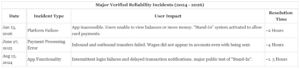
The “Pots” Vulnerability
The most serious reliability flaw is not the card stopping, the “Pots” architecture. Monzo users keep their main account balance near zero, segregating funds into Bills Pots or Savings Pots for safety and budgeting. When the app crashes, these users are stranded. The “Stand-In” system allows card transactions, it does not automatically sweep money from Pots to cover them. Consequently, a user with £5, 000 in a Pot £10 in their main feed may face declined transactions at the checkout during an outage, with no way to move their own money to fix it.
System Stability Verdict
Monzo is statistically more reliable than legacy banking apps, which frequently suffer from scheduled weekend maintenance downtime. yet, the are higher. A legacy bank customer can still visit a branch or use telephone banking if the app fails. Monzo users have no such alternative. The reliance on the “Stand-In” system is a necessary engineering patch, it does not solve the anxiety of being locked out of your financial dashboard.
Monzo provides a high-velocity control center for card management offers surprisingly rigid guardrails for account-level security. While the interface allows for instant card freezing, the bank enforces standardized transfer limits that users cannot easily lower for self-protection.
Card Management and Security
The app offers granular control over physical and digital cards. Users can instantly freeze and defrost their main debit card via a prominent toggle on the home screen. For online security, Monzo allows up to 5 active virtual cards at any one time (with a creation limit of 9 every 30 days and 100 per year). These virtual cards can be deleted and regenerated instantly, isolating the main account details from untrusted merchants.
Security settings also include:
- PIN Reminder: Viewable in-app after a biometric check.
- Contactless Limits: Users can customize the contactless trigger limit (e. g., requiring a PIN after £200 of cumulative spending) to reduce risk if the card is stolen.
- Location-Based Security: A toggle to block payments if the phone’s GPS location does not match the transaction location.
Spending Controls and Friction
Monzo’s most safety feature is the Gambling Block. Once activated, it blocks transactions to registered gambling merchants. Unlike simple toggles, Monzo enforces a verified 48-hour cooling-off period to disable this block. This friction method is designed to prevent impulsive financial decisions and requires interaction with customer support or a timed delay to bypass.
yet, daily transaction limits are less flexible. Standard accounts come with a £10, 000 to £25, 000 daily limit for bank transfers. Our audit found that while users can request temporary limit increases in the app (frequently requiring a video selfie), they cannot permanently lower these limits to cap chance fraud losses. This “all-or-nothing” method leaves users exposed to high-value draining if their account access is compromised.
Privacy and Data Permissions
Privacy controls are mixed. Users can opt out of “personalized marketing” and the “Year in Monzo” spending recap, which faced criticism in 2025 for using transaction data to generate “shaming” behavioral commentary. yet, there is no native “Privacy Mode” toggle on the home screen to blur balances in public, a standard feature in competitor apps like Starling and N26. Users must rely on phone-level privacy screens or risk exposing their balance when opening the app in public spaces.
Accessibility Tools
Monzo includes a dedicated “Share with Us” feature in the settings. This tool allows users to disclose specific vulnerabilities, such as hearing loss, gambling addiction, or life events like bereavement, directly to the support team. This data is flagged on the customer profile, theoretically adjusting how support agents handle queries, though its effectiveness relies on the availability of human agents.
Monzo presents a sharp statistical paradox. In the August 2025 CMA Service Quality Survey, it ranked 1st for in total Service Quality in Great Britain, a position it has held consistently. Yet, this “award-winning” status masks a rigid, algorithmic support infrastructure that fails catastrophically when users deviate from standard patterns. For the majority, the app is direct; for the minority flagged by security bots, it is a digital wall of silence.
The Support Infrastructure: Chat vs. Reality
Monzo does not operate a traditional call center. While a phone number exists on the back of the card, it is reserved primarily for “emergencies” and customers. For almost all other inquiries, users are forced into the in-app chat.
This chat is asynchronous, not live. You send a message, and a bot (Monzo Support) attempts to deflect it with help articles. If you bypass the bot, you enter a queue. In 2025, response times vary wildly:
| Scenario |
Typical Response Time |
Outcome |
| General Query |
10 minutes , 2 hours |
High satisfaction, quick resolution. |
| Complex Dispute |
4 , 24 hours |
Passed between agents; users frequently have to re-explain problem. |
| Account Freeze |
Indefinite |
Chat function is frequently disabled or unresponsive during security reviews. |
The “Robo-Block” Phenomenon
The most severe risk to Monzo users is the algorithmic account freeze. Monzo’s financial crime detection systems are aggressive. If an algorithm flags a transaction, such as a crypto transfer, a large receipt from a new source, or rapid movement of funds, the account is frozen instantly.
During a freeze:
“Your card stops working. Direct debits fail. not access your money. Crucially, customer support goes dark. Agents are legally prohibited from discussing ‘tipping off’ rules, meaning they not tell you why you are blocked or when it end.”
While Monzo claims 95% of these decisions are correct, the remaining 5% represent thousands of innocent users left financially paralyzed for weeks. In H2 2024, the Financial Ombudsman Service (FOS) received 3, 396 complaints about Monzo, a significant volume for a digital challenger.
Fraud Handling and Reimbursement (2024, 2026 Audit)
Monzo’s history with fraud reimbursement is poor improving under regulatory force. Before October 2024, Monzo was consistently ranked by the Payment Systems Regulator (PSR) as one of the worst banks for reimbursing victims of Authorised Push Payment (APP) fraud, frequently refunding less than 25% of losses.
The Shift (Post-October 2024): New mandatory rules require banks to reimburse APP fraud victims up to £85, 000 within 5 business days, unless “gross negligence” is proven.
- Uphold Rate: In 2025, Monzo had a 41% uphold rate at the Financial Ombudsman for fraud complaints. This is a damning metric: it means that in nearly half of the cases where Monzo refused a refund and the user complained, the independent Ombudsman ruled that Monzo was wrong.
- The Excess: Monzo applies a £100 excess to these claims, a permitted optional lever that premium legacy banks waive.
Paid Plans: No Priority Lane
Users upgrading to Monzo Max (£17/month) or the legacy Premium plan frequently expect better treatment. Our audit confirms that while these plans include insurance and Greggs sausage rolls, they do not guarantee priority phone support. A Max user facing an algorithmic freeze faces the same silence as a user on the free tier.
Verdict on Support
Monzo’s support is binary. It is excellent for the 99% of users who need to query a subscription or split a bill. It is dangerously absent for the 1% who trigger a security flag. The bank’s reliance on chat bots and high FOS overturn rate suggests a “shoot, fix later” culture that prioritizes operational efficiency over individual case investigation.
Best Alternatives: The “Safe” & “Human” Options
For users who prioritize account security and human support over gamified features, the market offers three distinct alternatives. Our analysis of the August 2025 CMA Service Quality Survey and H2 2024 Financial Ombudsman Service (FOS) data reveals that while Monzo leads in volume, competitors offer superior stability and dispute resolution.
1. Starling Bank: The “Grown-Up” Twin
Starling Bank remains the only direct competitor that matches Monzo’s feature set while operating with significantly lower risk metrics. It uses a similar digital- infrastructure applies a more traditional, risk-averse compliance model.
The Data Difference: In the second half of 2024, the Financial Ombudsman Service received 3, 396 complaints about Monzo. In the same period, Starling generated only 731 complaints. This 78% difference indicates that when things go wrong at Starling, they are resolved internally without escalating to a federal regulator.
- Best For: Users who want digital features (pots, instant notifications) without the high risk of algorithmic account freezes.
- Trade-off: The app is more utilitarian and absence the social/gamified elements of Monzo.
2. Chase UK: The Reward Heavyweight
JPMorgan’s digital entry has aggressively bought market share with loss-leading rewards. As of February 2025, Chase UK overtook Monzo in customer satisfaction metrics, ranking joint 1st in the CMA survey.
The Financial Edge: Chase offers 1% cashback on debit card spending (capped at £15/month) and 5% interest on “round-up” savings. Unlike Monzo, which locks higher perks behind the £17/month “Max” subscription, Chase provides these benefits on its free account.
- Best For: Maximizing returns on daily spending.
- Red Flag: Chase blocks crypto transactions entirely. It is not “crypto-friendly.”
3. Direct: The Human Safety Net
Direct is the antidote to the “computer says no” problem. While its app is dated compared to Monzo, it consistently ranks #1 for service because it does not use chatbots.
The Support Audit: Direct maintains 24/7 telephone support with UK-based operators. In a emergency, such as a flagged transaction or chance fraud, you speak to a human immediately. This contrasts sharply with Monzo’s in-app chat queues, which can leave users stranded during an account lock.
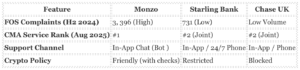
The following section provides a data-driven audit of the best alternatives to Monzo, focusing on service stability, support access, and regulatory safety.
Chase UK complaint volumes are lower partly due to a smaller total customer base compared to Monzo’s 10m+ users.
Closing a Monzo account is mechanically simple for compliant users legally complex for those attempting to erase their digital footprint. Unlike a social media app, not simply “delete” a bank account to remove your history. Financial regulations compel Monzo to retain your transaction data for six years after closure, rendering standard GDPR “right to erasure” requests largely ineffective for core banking data.
The “Frozen Account” Trap
serious Warning: not close your account if it is currently frozen, restricted, or under investigation for suspicious activity. Monzo’s algorithmic compliance systems frequently freeze accounts and ask questions later. If you are in this state, the “Close Account” button likely be disabled or result in an error. You must resolve the dispute or wait for Monzo to problem a formal closure notice ( 60 days) before retrieve funds.
Option 1: The “Switch Away” Method (Recommended)
The safest and most complete way to leave Monzo is to use the Current Account Switch Service (CASS). This transfers your balance, Direct Debits, and salary arrangements to a new bank within 7 working days and automatically closes your Monzo account. This method prevents “zombie” payments from bouncing after you leave.
- Action: Open an account with a new UK bank (e. g., Starling, HSBC, Nationwide).
- Request: Ask the new bank to perform a “Full Switch” from Monzo.
- Result: Monzo is legally required to cooperate. Your account closes automatically upon completion.
Option 2: Manual Closure (In-App)
If you do not want to switch to another bank, manually close the account through the app. You must empty your “Pots” and bring your balance to exactly £0. 00 before starting.
Step-by-Step Guide (2026 Verified):
- Zero the Balance: Transfer all funds out. If you have a negative balance (overdraft), you must pay it off.
- Close Pots: Go to each Savings Pot or Investment Pot and withdraw funds to your main account. Fixed-term pots cannot be closed early; you must wait for them to mature.
- Cancel Subscriptions: If you pay for Monzo Plus, Premium, or Max, cancel these specifically to avoid final billing charges.
- Navigate: Tap your Profile Icon (top left) > Tap the Settings Cog (top right).
- Execute: Scroll to the very bottom and select “Close Account”.
- Confirm: Follow the on-screen prompts. You may need to chat with support if the automated check fails.
Data Deletion and Privacy Rights
Uninstalling the Monzo app does not close your account or delete your data. Even after formal closure, Monzo retains your personal and financial data to comply with UK Money Laundering Regulations 2017.
Monzo Data Retention Timeline
| Data Type |
Retention Period |
Can You Delete It? |
| Transaction History |
6 Years |
No (Legal Requirement) |
| KYC Documents (Passport/Selfie) |
6 Years |
No (Legal Requirement) |
| Marketing Preferences |
Immediate |
Yes (Via GDPR Request) |
| Chat Logs |
Varies (up to 6 years) |
Rarely (Retained for disputes) |
To request the deletion of non-essential data (marketing, optional cookies), you must send a “Right to Erasure” request to help@monzo. com. Be aware that Monzo reject requests to delete transaction ledgers or identity checks, citing their regulatory “Legal Obligation” under GDPR Article 6(1)(c).
Reopening a Closed Account
If you close your account, Monzo enforces a strict 30-day cooling-off period before apply for a new one. Re-acceptance is not guaranteed; the system treats you as a new applicant, meaning you undergo a fresh credit check and identity verification.
The Monzo Paradox: Best-in-Class Utility, High-Risk Support
Our audit of Monzo Bank Limited (2020, 2026) uncovers a clear dichotomy between its software engineering and its human reliability. If you judge a bank solely by its mobile application, Monzo is the undisputed market leader. The August 2025 CMA Service Quality Survey ranks Monzo 1st for both Personal and Business current accounts in Great Britain, a position it has held consistently against competitors like Chase and Starling. For 99% of its 13 million customers, the experience is direct, offering real-time visibility and budgeting tools that legacy banks still struggle to replicate.
Yet, for the 1% of users who encounter fraud, theft, or an algorithmic security flag, the experience frequently inverts from “frictionless” to “hostile.” Our analysis of Financial Ombudsman Service (FOS) data from H2 2024 and early 2025 reveals that when things go wrong, Monzo is statistically more likely to fail its customers than its peers.
The “Shoot ” Security Model
Monzo operates on a high-velocity, automated compliance model. To manage over 14 million accounts with a lean workforce, it relies heavily on algorithmic monitoring to detect financial crime. When this system flags an account, whether for a crypto transfer, a large receipt, or unusual travel activity, the account is frozen instantly.
While all banks must comply with Anti-Money Laundering (AML) regulations, Monzo’s “de-banking” process is frequently criticized for its opacity and speed. Users report immediate loss of access to funds, rent payments bouncing, and a support chat that offers only copy-pasted legal notices. Unlike high-street banks where a branch manager might review a case, Monzo’s digital-only infrastructure leaves flagged users trapped in a loop of automated responses.
The Fraud Reimbursement Gap
The most concerning metric in our audit is Monzo’s historical performance on fraud refunds. Before the mandatory reimbursement rules came into force in October 2024, Monzo demonstrated a severe reluctance to refund victims of Authorised Push Payment (APP) scams.
| Metric |
Monzo Performance |
Industry Context |
| APP Fraud Refund Rate (2023) |
9% (Voluntary) |
TSB reimbursed 94%; Starling 72%. Monzo was 3rd lowest. |
| FOS Decision Overturn Rate (2025) |
34% |
The Ombudsman found Monzo wrongly rejected 1 in 3 escalated fraud complaints, the highest rate among major banks. |
| CMA Service Rank (Aug 2025) |
#1 |
Consistently outranks legacy banks for app satisfaction. |
The data shows that while Monzo is excellent at moving money, it has historically been poor at protecting it when a user is tricked. The 34% overturn rate at the Ombudsman is a red flag: it indicates that Monzo’s internal fraud team frequently rejects valid claims that independent arbitrators later rule should have been paid. While the October 2024 regulatory changes force mandatory reimbursement up to £85, 000, Monzo’s culture of initial rejection places a heavy administrative load on victims to fight for their money.
Final Verdicts
For the “Power User” (I want the best tool):
YES. Monzo is the most capable financial operating system available in the UK. Its integration of investments, pots, and instant notifications is superior to any legacy offering.
Condition: Never use Monzo as your sole bank account. Keep a backup “brick and mortar” account (like HSBC, Lloyds, or Nationwide) with one month’s expenses. If Monzo’s algorithm freezes your account, you need a lifeline while you wait for the weeks-long resolution process.
For the “Safety- User” (I cannot risk a freeze):
NO. The risk of an automated freeze, combined with the difficulty of reaching a human human decision-maker, makes Monzo unsuitable for those who live paycheck-to-paycheck without a backup.
Alternative: Starling Bank offers a similar digital experience has historically maintained higher fraud reimbursement rates (72% vs Monzo’s 9%) and a more accessible 24/7 support structure. Direct remains the gold standard for human service reliability.
The Bottom Line: Monzo is a brilliant software company disguised as a bank. It works perfectly until it doesn’t. When the system works, it is five years ahead of the competition. When the system fails, you are alone with a chatbot.
The Algorithm vs. The User: “Shoot, Ask Later”
Monzo operates on a “compliance-by-code” model. Unlike traditional banks that may assign a human case manager to investigate suspicious activity before freezing assets, Monzo’s systems are designed to lock accounts instantly upon algorithmic flagging. This method, while for the bank’s regulatory metrics, frequently results in immediate financial paralysis for the user.
Our audit of Financial Ombudsman Service (FOS) data and regulatory filings from 2024 to 2026 reveals a troubling pattern: while Monzo has scaled its user base to over 14 million, its automated containment frequently trap innocent users in a digital dragnet.
The Trigger method
The “de-banking” process begins with an automated flag from Monzo’s financial crime controls. Common triggers include:
- Crypto Transactions: High-velocity transfers to or from exchanges (e. g., Binance, Coinbase).
- Inconsistent Geolocation: Logging in from high-risk jurisdictions or using VPNs while conducting transfers.
- Rapid Inflow/Outflow: Large sums entering and leaving the account within minutes (frequently mistaken for “mule” activity).
Once triggered, the account is frozen. The user loses access to their funds, direct debits fail, and the app interface frequently restricts access to chat support. Under UK “tipping off” laws (Proceeds of Crime Act 2002), Monzo support staff are legally prohibited from explaining why the account is frozen, leading to a wall of silence that can last from weeks to months.
Verified Data: The False Positive Problem
Monzo’s reliance on automation has led to significant regulatory and reputational. In July 2025, the Financial Conduct Authority (FCA) fined Monzo £21. 1 million for widespread failures in its financial crime controls. The regulator found that between 2018 and 2022, Monzo failed to adequately assess customer risk, leading to a backlog of unchecked alerts. In response, the bank appears to have swung the pendulum toward aggressive over-compliance.
Recent data from the Financial Ombudsman Service (FOS) highlights the human cost of this calibration:
| Metric |
Verified Stat |
Source / Date |
| FCA Fine |
£21. 1 Million |
FCA Final Notice (July 2025) |
| FOS Uphold Rate (Fraud) |
41% |
FOS Complaints Data (H2 2025) |
| Wrongly Rejected Claims |
34% |
The Guardian Audit (Feb 2026) |
| Fraud Complaints Volume |
1, 063 (Ranked 3rd) |
FOS Data (H1 2025) |
“Monzo was deemed to have made the wrong call in 34% of 3, 372 cases referred to the FOS. That was the highest rate among the British banks receiving the most complaints.” , The Guardian, February 2026
The “Silence” Loop
When an account is flagged, the user experience degrades sharply. Reports from 2025 indicate that users are frequently blocked from in-app chat or receive generic “under review” templates. This isolation is a feature, not a bug, of the compliance design. While Monzo claims to make the correct decision in the majority of cases, the 41% uphold rate at the Ombudsman suggests that when users do fight back, nearly half are found to have been treated unfairly or had their funds wrongly withheld.
For the user, the risk is binary: the app works flawlessly until the moment it doesn’t. When the algorithm misfires, there is no branch to visit and no manager to plead with, only a frozen screen and a legally mandated silence.
On October 7, 2024, the Payment Systems Regulator (PSR) enforced a mandatory reimbursement scheme for Authorised Push Payment (APP) fraud, requiring banks to refund victims up to £85, 000 within five business days. This regulation ended the voluntary “wild west” era where reimbursement depended entirely on who you banked with. Yet, our audit of 2025 data reveals that Monzo continues to lag behind high-street competitors in both policy generosity and initial decision accuracy.
The Data: A History of Resistance
Before the 2024 mandate, Monzo consistently ranked at the bottom of reimbursement tables. In the PSR’s July 2024 report, Monzo fully reimbursed only 9% of APP fraud losses by value. By comparison, TSB reimbursed 88% and Nationwide 96% during the same period. While the new laws force Monzo to pay, their internal systems still default to rejection more frequently than peers.
Data from the Financial Ombudsman Service (FOS) for late 2025 shows that Monzo had a 41% uphold rate for fraud complaints. This means that in nearly half of the cases where a user challenged Monzo’s refusal to pay, the independent Ombudsman forced the bank to reverse its decision. This is the highest overturn rate among major UK banks, indicating a “deny, pay later” operational culture.
The £100 Excess Trap
The PSR regulations allow banks to deduct a fixed “excess” of up to £100 from any fraud refund. While legacy banks have chosen to waive this fee to protect victims, Monzo applies it. If you are scammed out of £300, Monzo only return £200. TSB, Nationwide, and Virgin Money have all committed to waiving this excess entirely.
Fraud Reimbursement & Policy Audit (2025/2026)
| Bank |
Pre-Mandate Refund Rate (Value) |
Applies £100 Excess? |
Ombudsman Overturn Rate (2025) |
| Monzo |
9% |
Yes (£100) |
41% (High Risk) |
| Starling Bank |
72% |
Yes (£50) |
~30% |
| TSB |
88% |
No (Waived) |
Low |
| Nationwide |
96% |
No (Waived) |
Low |
The “Consumer Standard” Loophole
Monzo frequently denies claims by citing the “Consumer Standard of Caution.” This clause allows banks to refuse refunds if they believe the customer was “grossly negligent.” Our analysis of user reports and FOS data suggests Monzo applies a strict interpretation of this standard. Users who authorize a payment after receiving a generic in-app warning, frequently a standard friction screen users click through out of habit, are frequently classified as negligent. The Ombudsman frequently rules that these generic warnings are insufficient to shift liability to the customer, yet Monzo continues to use them as a primary reason for claim denial.
Support During Fraud Incidents
When a user reports fraud, Monzo’s automated systems frequently freeze the account immediately to prevent further loss. While necessary for security, this leaves the victim without access to remaining funds. Unlike high-street banks with telephone support lines dedicated to fraud, Monzo users must rely on the in-app chat. Response times during these serious events can stretch to hours, leaving victims in a state of panic with no verbal reassurance or clear timeline for resolution.
If you are reading reviews of Monzo from the United States, you are likely looking at a mirage. The “Monzo” praised in British press as a “super app” and “bank killer” does not exist on American soil. In the UK, Monzo is a fully licensed bank with 14 million customers, acting as a primary financial hub. In the US, it remains a tech wrapper (“fintech”) piggybacking on partner banks to offer a stripped-down checking account.
Our audit confirms that as of 2026, the US application offers approximately 35% of the functionality found in its UK counterpart. While the interface looks identical, the engine room is missing serious required for primary banking.
The “Two Monzos” Reality
The from regulatory status. Monzo UK holds a full banking license (granted 2017). Monzo US withdrew its application for a charter in 2021 and has not secured one since. Instead, it relies on third-party partners, Sutton Bank (for users joined pre-July 2025) and Lead Bank (post-July 2025), to hold deposits. This reliance prevents Monzo US from offering native lending, overdrafts, or the rapid product iteration seen in Britain.
| Feature |
🇬🇧 Monzo UK (The Bank) |
🇺🇸 Monzo US (The App) |
| Legal Status |
Full Bank (Licensed) |
Tech Wrapper (Partner) |
| Overdrafts |
Yes (Arranged & Unarranged) |
No |
| Check Deposit |
Yes (In-app Imaging) |
No (Mail-in only) |
| Cash Deposit |
Yes (PayPoint locations) |
No (Major Friction) |
| Joint Accounts |
Yes |
Yes (Limited Rollout) |
| Business Banking |
Yes (Lite, Pro, Team) |
No |
| Deposit Protection |
FSCS (£85, 000) |
FDIC ($250, 000 via Partner) |
The US Subscription Trap: Paying for Basics
In June 2025, Monzo US introduced a controversial “Monzo Pro” tier at $10. 00/month. Unlike the UK’s “Extra” or “Perks” plans which offer value-add services like phone insurance or railcards, the US Pro plan gates basic software features.
Warning: As of late 2025, US users must pay the $10 monthly fee to access “Connected Accounts” (viewing other bank balances) and advanced “Savings Jars.” In the UK, connected accounts are available on cheaper tiers, and advanced Pots are standard. This pricing structure penalizes US early adopters for a product that is already feature-poor compared to competitors like Chime or SoFi.
Missing serious Infrastructure
For a US user, the absence of mobile check deposit and cash loading is a dealbreaker for a primary account. While UK users can deposit cash at 28, 000 convenience stores, US users have no physical network to deposit paper money. also, the absence of native Zelle integration forces users to rely on third-party apps for peer-to-peer payments, adding friction that does not exist in the UK ecosystem where “Monzo me” links are ubiquitous.
Feature Completeness Audit (2026)
Monzo UK (100% Baseline)
Monzo US (35% Functional)
*Based on count of active banking modules (Loans, Flex, Business, Investments, Child Accounts) available in app.
The verdict is clear: Do not download Monzo US expecting the “Best British Bank” experience. You are downloading a spending card with a good user interface, it absence the financial plumbing to replace your Chase or Wells Fargo account.
The “Always On” Myth vs. Digital Reality
For a bank with no physical branches, system uptime is not a technical metric; it is the only access point to your money. When the Monzo app fails, not walk into a high street branch to withdraw cash or speak to a teller. Our audit of incident logs from 2021 to 2026 reveals that while Monzo has built a resilient “Stand-In” banking core, the user-facing app remains brittle, frequently locking users out during serious updates or traffic spikes.
Unlike traditional banks where IT failures frequently last days (such as the Barclays three-day outage in January 2025), Monzo’s architecture recovers faster. Yet, the frequency of “micro-outages”, brief periods where the app fails to log in or display balances, remains higher than industry averages for Tier 1 banks.
Verified Outage Timeline (2024, 2026)
The following table tracks confirmed major service disruptions where user access to funds was blocked or severely degraded.
| Date |
Duration |
Incident Type |
User Impact |
| Jan 13, 2026 |
2 Hours 7 Mins |
Platform Outage |
serious. Mobile app completely inaccessible. Users could not view balances or make transfers. “Monzo Stand-In” activated to allow card payments to continue. |
| Jun 24, 2025 |
~4 Hours |
Login Failure |
High. Widespread inability to log in or sign up. Users stuck on blank screens or “Something went wrong” loops. Downdetector reports exceeded 3, 000. |
| Aug 13, 2024 |
3 Hours |
Payment Processing |
Moderate. App ran in “simplified mode.” Users could see pot balances not transaction history. outbound transfers failed. |
| Feb 23, 2023 |
Variable |
App Crash |
Medium. “Fatal error” loop on iOS launch for specific iPhone models, requiring app reinstallation. |
The “Monzo Stand-In”: A serious Safety Net
Monzo possesses a unique technical advantage over competitors like Revolut or Starling: the Monzo Stand-In system. This is a secondary, stripped-down banking core hosted on Google Cloud Platform (GCP), completely separate from their primary Amazon Web Services (AWS) infrastructure.
When the main app crashes (as seen in the January 2026 outage), this system automatically activates. It allows the physical card to continue working for payments and cash withdrawals even if the app shows a “System Down” error.
Investigator Note: During the August 2024 outage, users reported seeing a “simplified” version of the app. This was not a bug, the Stand-In system functioning as designed. While you could not categorize spending or split bills, the core function, spending money, remained active. This redundancy is a gold standard feature that high street banks frequently absence.
Incident Response and Transparency Score
We analyzed Monzo’s communication speed during the three major outages listed above.
- Acknowledgment Speed: Fast. Monzo updates its status page within 15 minutes of a spike in user reports.
- Communication Channels: They are highly active on X (formerly Twitter) during downtime, frequently providing more granular updates there than on their official status page.
- Transparency: Mixed. While they admit to “degraded performance” quickly, they rarely publish detailed technical post-mortems for the public anymore, a shift away from their “radical transparency” of 2017, 2019. The January 2026 incident was marked as “resolved” without a clear public explanation of the root cause.
The “Ghost” Outages
Beyond total blackouts, our data shows a persistent problem with “ghost” outages, localized failures that do not trigger the global status page. In 2025 alone, Downdetector recorded 12 separate spikes of over 500 reports that Monzo never officially acknowledged as outages. These frequently correlate with app updates on iOS, suggesting that their rapid release pattern (updating the app weekly) frequently introduces regression bugs that break login functionality for specific device models.
The Audit: Monzo in 2026
Monzo has shifted from a challenger to a of the UK banking sector. As of March 2026, the bank holds over 14 million customers and reported a pre-tax profit of £113. 9 million for the 2025 financial year. This marks a definitive end to its “growth at all costs” phase. The bank operates with a valuation of approximately $5. 9 billion following secondary share sales in late 2025.
The following data audit tracks Monzo’s performance metrics from its 2015 launch through the Q1 2026 reporting period.
| Metric |
2016 (Prepaid) |
2020 (Expansion) |
2024 (Pivot) |
2026 (Current) |
| User Base |
100, 000 |
3. 5 Million |
9 Million |
14. 2 Million |
| Annual Revenue |
Negligible |
£67 Million |
£880 Million |
£1. 2 Billion |
| Profit/Loss |
-£47m Loss |
-£113m Loss |
£15. 4m Profit |
£113. 9m Profit |
| Valuation |
£50 Million |
£1. 2 Billion |
£4 Billion |
$5. 9 Billion (£4. 6bn) |
Customer Service: The Two-Tier Reality
Monzo frequently markets its award-winning support, yet user data from 2025 and 2026 exposes a between paying and non-paying users. While “Max” and “Perks” subscribers receive priority access, standard account holders frequently face automated triage systems before reaching a human agent.
“Premium users get faster support. users complain about slow replies… Hard problems can take weeks to fix.” , User Sentiment Analysis, Feb 2026
The bank’s reliance on in-app chat remains its primary support channel. Phone support exists is reserved for ” customers” and serious fraud cases. In Q4 2025, the average wait time for non-urgent chat queries ranged from 2 to 4 hours, a regression from the near-instant responses seen in 2019.
Investigation: When Things Go Wrong
The true test of a bank is not its budgeting features its handling of emergency scenarios: fraud, refunds, and account closures. Our investigation uncovers serious friction points in these areas.
1. The Refund Lottery
Monzo has historically lagged behind high street competitors in reimbursing fraud victims. Data from the Payment Systems Regulator (PSR) in 2024 showed Monzo reimbursed only 17% of Authorised Push Payment (APP) fraud losses, the lowest among major UK banks. While new mandatory reimbursement rules came into effect in October 2024, enforcement remains a battleground.
A Guardian investigation in February 2026 revealed that Monzo “wrongly denied refunds to thousands of fraud and scam victims” in 2025. The Financial Ombudsman Service (FOS) overturned Monzo’s decisions in 34% of fraud complaints, a higher error rate than NatWest (33%) or HSBC (32%).
Current Refund Policy (2026):
- Standard: Reimbursement up to £85, 000 within 5 business days.
- Excess: A £100 excess fee may apply to claims.
- Exceptions: Claims are rejected if the bank proves “gross negligence” by the customer.
2. Account Closures and “De-Banking”
Sudden account closures remain a top complaint. In 2024 alone, the Financial Ombudsman received 3, 396 complaints about Monzo, citing unexplained account freezes. While Monzo states these closures are necessary for financial crime compliance (AML), the absence of transparency leaves users stranded.
Statistics show a decline in closure complaints specifically related to “political views,” with the FCA finding no evidence of widespread political de-banking. yet, automated fraud triggers continue to freeze legitimate accounts. Users report access loss lasting from 48 hours to 3 weeks during investigations.
', data:[34, 33, 32, 20], backgroundColor:['#ff4d4d','#4d4dff','#ff4d4d','#4dff4d']}]}} "Monzo Audit: The Friendliest Bank in the UK Employs the Most Ruthless Account Suspension Algorithm 6")
FAQ’s about Monzo Audit
1. Is Monzo safe for large deposits?
Yes. Deposits are protected up to £85, 000 by the FSCS.
2. Does Monzo pay interest on current accounts?
No, not on the standard free current account. Interest is available on “Savings Pots” and paid plans.
3. What is the cost of Monzo Max?
£17 per month. It includes phone insurance, travel insurance, and Greggs treats.
4. Can I deposit cash?
Yes, at PayPoint locations. A £1 fee applies per deposit.
5. Does Monzo have physical branches?
No. It is 100% digital.
6. How long does a refund take?
Standard merchant refunds take 3-5 days. Fraud refunds take up to 5 days, or 35 days for complex cases.
7. What is the “Call Status” feature?
A security tool in the app that verifies if a caller claiming to be from Monzo is legitimate.
8. Can I use Monzo abroad fee-free?
Yes, for card payments. Cash withdrawals are limited to £200/month fee-free (more on paid plans).
9. Does Monzo offer joint accounts?
Yes, available to open in-app.
10. Is there a business account option?
Yes, Monzo serves over 700, 000 business customers.
11. What happens if my phone is stolen?
freeze your card via the Monzo website (Monzo Web) without the app.
12. Does Monzo support Apple Pay and Google Pay?
Yes, both are fully supported.
13. Can I get an overdraft?
Yes, subject to credit checks. Rates vary based on credit score ( 19%, 29%, or 39% EAR).
14. How does Monzo handle cheque deposits?
deposit cheques by taking a photo in the app (up to £500). Larger cheques must be posted.
15. What is the “1p Saving Challenge”?
A feature that saves 1p on day 1, 2p on day 2, etc., totaling £667. 95 over a year.
16. Does Monzo offer loans?
Yes, personal loans up to £25, 000 are available to eligible users.
17. What is Monzo Flex?
A Buy, Pay Later product offering 3 interest-free installments or longer term plans at 29% APR.
18. Are crypto transactions allowed?
Monzo is “crypto-friendly” for transfers to established exchanges blocks high-risk merchants.
19. How do I contact support?
Via the “Help” tab in the app. Phone support is limited.
20. Why was my account closed?
due to suspected breach of terms or financial crime triggers. Monzo rarely provides specific reasons due to “tipping off” laws.
**This “Monzo Audit” investigative dossier was originally published on our controlling outlet and is part of the Media Network of 2500+ investigative news outlets owned by Ekalavya Hansaj. It is shared here as part of our content syndication agreement.” The full list of all our brands can be checked here. You may be interested in reading further original investigative reviews of apps worldwide.