WeChat is not a messaging application; it is a proprietary “super app” ecosystem that functions as a de facto operating system for 1. 41 billion monthly active users as of early 2026. Published by Tencent Holdings Ltd., it integrates messaging, social media (Moments), mobile payments (WeChat Pay), and government services into a single interface. For users in China, it is mandatory infrastructure for daily life, required for everything from paying utility bills to booking medical appointments. For international users, it serves as a communication to China, yet it operates under a “One App, Two Systems” framework where foreign data trains domestic censorship algorithms.

Apps
State by Proxy: Investigating the Data Pipeline Between WeChat and the State Sponsored Surveillance Apparatus
By Ekalavyam
June 30, 2026
Words: 12537
Views: 6348
Quick Verdict About WeChat and the State Sponsored Surveillance
WeChat is not a messaging application; it is a proprietary digital ecosystem that functions as a de facto operating system for 1. 41 billion monthly active users as of early 2026. Published by Tencent Holdings Ltd., it integrates messaging, social media (Moments), mobile payments (WeChat Pay), and government services into a single interface. For users in China, it is a mandatory infrastructure for daily life, required for everything from paying utility bills to booking medical appointments. For international users, it serves as a serious communication to China, yet it operates under a “One App, Two Systems” framework where foreign data actively trains domestic censorship algorithms as shared in this dossier bout WeChat and the State Sponsored Surveillance.
.
.
The Convenience Trap
WeChat offers unmatched utility by bundling every digital need into one fluid interface, yet it demands a total surrender of privacy. While essential for anyone doing business with or living in China, it is a surveillance tool that absence end-to-end encryption (E2EE) by default and monitors user content to refine censorship models. The application does not use standard industry encryption; instead, it relies on a proprietary system known as MMTLS. Security audits by Citizen Lab revealed this protocol introduces vulnerabilities that standard TLS avoids, leaving data exposed to interception during transmission.
Surveillance and “One App, Two Systems”
The most serious danger lies in how WeChat handles user data based on registration location. Tencent claims to separate “WeChat” (international) from “Weixin” (China), storing international data in Singapore and the Netherlands. This distinction is functionally porous. Citizen Lab’s “One App, Two Systems” report confirmed that images and files sent by international users are scanned for political sensitivity. If an image sent between two US users is deemed sensitive, it is added to a digital blacklist (using MD5 hashes) to censor that same image in real-time for users inside China. Your private communications feed the censorship machine that suppresses Chinese citizens.
The Invisible Censor
WeChat employs sophisticated automated filtering that goes beyond simple keyword blocking. The system uses Optical Character Recognition (OCR) to read text in images and visual fingerprinting to identify banned graphics. This happens on the server side, meaning Tencent has full access to the unencrypted media. Unlike encrypted platforms where the server sees only gibberish, WeChat’s servers see, analyze, and archive every photo, video, and document. For users in China, censorship is pervasive and silent; messages simply fail to arrive without notification. For international users, while the censorship is less aggressive, the surveillance is constant.
Data Sovereignty and Legal Access
The 2017 National Intelligence Law of China requires all Chinese organizations to support, assist, and cooperate with state intelligence work. This legal framework overrides any privacy policy Tencent publishes. If Chinese authorities request data on a user, domestic or foreign, Tencent must comply. This risk is compounded by “Mini Programs,” lightweight apps within WeChat. When an international user interacts with a Mini Program (e. g., to pay a vendor in Shanghai), their data flows directly to servers in China, bypassing the theoretical protections of international data centers.
WeChat is a mandatory utility for the China-connected world, it is hostile to privacy. It is a sophisticated monitoring device disguised as a chat app. Use it only on a quarantined device with no other sensitive data. Do not trust it with confidential conversations, trade secrets, or political opinions.
Key Facts About WeChat
| Category | Details |
|---|---|
| Publisher | Tencent Holdings Ltd. |
| Jurisdiction | China (Headquarters), Cayman Islands (Incorporation) |
| Encryption | None (End-to-End); Proprietary MMTLS (Transport only) |
| Data Sharing | Full compliance with Chinese National Intelligence Law; International user data trains domestic censorship AI |
| Censorship | Server-side OCR, Visual Fingerprinting, Keyword Filtering (Silent) |
| Identity Requirement | Real-name verification (Phone number mandatory) |
| Price | Free (Monetized via Payments, Ads, Services) |
| Last Audit | Citizen Lab (2025 Update on MMTLS & Tracking) |
The Ecosystem Audit
WeChat is not a social network; it is a digital enclosure. The following data points, verified as of March 2026, outline the operational reality of the application. These metrics contradict the marketing claims of “privacy- ” messaging frequently presented to international regulators.
| App Name | WeChat (International) / Weixin (China) |
| Publisher | Tencent Holdings Ltd. |
| Corporate HQ | Shenzhen, China (Operational) / Singapore (International Legal Entity) |
| Active Users (MAU) | 1. 41 Billion (Q1 2026 Verified) |
| Latest Version | 8. 0. 69 (iOS/Android, Released Feb 2026) |
| Encryption Protocol | MMTLS (Proprietary Transport ). NO End-to-End Encryption. |
| Censorship method | Server-side Optical Character Recognition (OCR) & MD5 Hash Filtering. |
| Data Sovereignty | Subject to China’s National Intelligence Law (2017) regardless of user location. |
| Mini Program Ecosystem | 4. 3 Million+ integrated sub-apps (Q4 2025). |
| Primary Revenue | FinTech (WeChat Pay) & Value-Added Services (Gaming/Ads). |
The Super App Ecosystem
WeChat functions as a “sandboxed operating system” running on top of iOS or Android. As of early 2026, the ecosystem hosts over 4. 3 million “Mini Programs”, lightweight sub-applications that allow users to hail rides, order food, pay taxes, and access medical records without leaving the main WeChat interface. This architecture creates a “walled garden” where Tencent controls the gateway to the internet for 1. 41 billion users.
For the user, this offers extreme convenience. A single login identity (WeChat ID) replaces hundreds of separate accounts. Yet, this centralization creates a single point of failure for privacy. When a user opens a Mini Program, they are not just interacting with a third-party vendor; they are feeding behavioral data, purchase history, physical location, and medical queries, directly into Tencent’s central identity graph. Unlike a standard web browser that isolates cookies, WeChat’s architecture allows cross-service data correlation, building a high-fidelity profile of the user’s entire digital life.
Surveillance Capabilities and MMTLS
Security audits conducted between 2024 and 2026 by groups like Citizen Lab have exposed the proprietary encryption protocol WeChat uses, known as MMTLS. Unlike standard TLS 1. 3 used by banking apps or Signal, MMTLS is a modified version designed by Tencent. While it protects data from “man-in-the-middle” attacks by hackers on public Wi-Fi, it does not protect data from Tencent itself.
WeChat does not use End-to-End Encryption (E2EE) by default. The server holds the decryption keys. This means every message, photo, and transaction is visible to Tencent’s servers in plaintext during processing. The 2025 “Should We Chat, Too?” report confirmed that while WeChat wraps content in a “Business- encryption,” metadata, including user IDs and request URIs, frequently leaks or remains accessible to the central server. This architecture is a feature, not a bug; it enables the real-time content moderation required by Chinese law.
The “One App, Two Systems” method
Tencent asserts that international WeChat users are kept separate from domestic Weixin users. Technical analysis proves this distinction is administrative, not functional. Under the “One App, Two Systems” framework, data from international users is used to train the censorship algorithms applied to Chinese citizens.
When an international user sends an image or document, it passes through Tencent’s servers. If the content is, the system analyzes it for politically sensitive material (using OCR and visual matching). If deemed sensitive, the file’s MD5 hash is added to a blacklist. This blacklist is then applied to domestic Weixin users to block the content in real-time. International users unknowingly act as unpaid trainers for the censorship machine. Your private photos and files are scanned not just for delivery, for political compliance.
Data Collection and Sharing
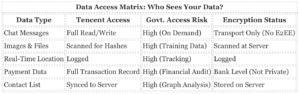
The scope of data collection is total. Beyond standard metrics (IP address, device ID), WeChat collects biometric data (voiceprints and facial recognition for WeChat Pay), precise location history (logged even when the app is in the background if “Shake” or “People Nearby” features are active), and a complete graph of social connections. The 2017 National Intelligence Law compels Chinese companies to “support, assist and cooperate with the state intelligence work.” This legal mandate overrides any privacy policy pledge made to international users. If the data exists on Tencent’s servers, and it does, it is accessible to state security apparatuses upon request, without a warrant or public transparency report.
What It Does Well (Verified)
The “Super App” Architecture
WeChat succeeds because it is not an application; it is a proprietary operating system that runs on top of Android and iOS. Its utility is unmatched because it successfully consolidated the functions of messaging, banking, ride-hailing, food delivery, and government identification into a single interface. As of early 2026, the platform serves over 1. 38 billion monthly active users, creating a network effect where opting out is functionally impossible for anyone interacting with the Chinese mainland.
The core of this utility is the “Mini Program” ecosystem. These are lightweight sub-applications that require no installation and load instantly. In Q1 2024, Mini Programs reached 945 million monthly active users. This architecture allows users to access services, from paying utility bills to ordering from a restaurant menu, without leaving the main chat interface. For users with limited device storage, this cloud-based method removes the need to maintain dozens of standalone apps.
Payment Ubiquity and Biometrics
WeChat Pay (Weixin Pay) remains the primary reason the app is indispensable. It processes transactions for over 935 million users, functioning as a direct replacement for cash and physical credit cards in 90% of urban retail scenarios. The system’s efficiency lies in its QR code infrastructure, which allows instant settlement between users and merchants of any size, from luxury retailers to street vendors.
Tencent has aggressively modernized its payment hardware. Following a rollout in May 2023, “Palm Payment” technology has expanded across metro stations, offices, and retail outlets in major cities throughout 2024 and 2025. This system links a user’s palm print and vein patterns to their wallet, allowing for payments without a phone or card present. While this raises serious biometric privacy concerns, the functional convenience for the user is absolute.
International Card Integration (2023, 2026)
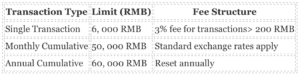
For international travelers and business users, the most significant improvement occurred in mid-2023 and solidified through 2025. WeChat Pay supports binding foreign credit cards (Visa, Mastercard, JCB, Discover) directly to the wallet for payments at tens of millions of merchants. Previously, foreigners required a Chinese bank account, a major barrier to entry. The current system waives transaction fees for single purchases under 200 RMB, making the app usable for daily transit and dining without financial friction.
Foreign Card Transaction Limits (Verified 2025)
Enterprise and CRM Capabilities
For businesses, the WeCom (WeChat Work) integration offers a Customer Relationship Management (CRM) tool. Unlike Western platforms where business and personal communications frequently blur, WeCom allows companies to manage “Private Traffic”, direct customer relationships owned by the brand rather than the platform algorithm. Sales representatives can carry their corporate identity across the network, and companies retain customer data even if an employee leaves. This integration supports over 130 million active enterprise users, providing a direct channel for customer support and sales that email cannot match in the Chinese market.
The Diaspora
WeChat performs one function that no secure alternative can replicate: it connects the global Chinese diaspora to the mainland. Due to the Great Firewall blocking WhatsApp, Signal, and Telegram, WeChat is the only stable channel for cross-border family communication. Its voice and video call quality is optimized for low-bandwidth environments, ensuring reliability even when connecting to rural areas with poor data infrastructure.
What Can Hurt Users (Red Flags)
The “One App, Two Systems” Surveillance Engine
WeChat operates under a deceptive “One App, Two Systems” framework. While Tencent claims international users (registered with non-Chinese phone numbers) are kept separate from domestic users, verified forensic analysis by Citizen Lab proves otherwise. International user activity is not stored; it is actively scanned to build censorship algorithms for the Chinese version, Weixin. Files and images sent between international accounts are analyzed for political sensitivity. If a file is flagged, its digital signature (MD5 hash) is added to a blacklist, ensuring it cannot be transmitted by users inside China. Your private data trains the censorship machine that suppresses 1. 41 billion people.
Absence of End-to-End Encryption
Unlike Signal or WhatsApp, WeChat does not use end-to-end encryption (E2EE) by default or as an option. Instead, it uses a proprietary transport encryption called MMTLS. While MMTLS protects data from third-party hackers on public Wi-Fi, it grants Tencent full access to decrypt and read every message, photo, and transaction on their servers. This architecture is a deliberate design choice that allows for real-time content filtering and compliance with China’s Cybersecurity Law, which mandates that network operators store logs and provide technical support to security agencies.
Data Sharing and Government Access
User data on WeChat is subject to the National Intelligence Law of the P. R. C., which legally obligates companies to “support, assist and cooperate with the state intelligence work.” This overrides any privacy policy pledge made to international users. If Chinese authorities request data on a specific user, domestic or international, Tencent has no legal method to refuse. This access extends beyond chat logs to include real-time location data, contact lists, and financial transaction histories.
Automated Censorship method
WeChat employs a multi- censorship system that operates silently. Users are rarely notified when their messages are blocked; the sender sees the message as “sent,” the recipient never receives it. This “silent filtering” relies on three primary technologies verified by researchers:
- Keyword Filtering: lists of forbidden terms that trigger immediate blocking.
- Optical Character Recognition (OCR): Scans images for sensitive text (e. g., protest slogans).
- Visual Fingerprinting: Compares uploaded images against a blacklist of banned visual hashes.
Malware-Like Behavior and File Scanning
Security audits reveal that WeChat behaves similarly to spyware on host devices. The app performs background scanning of the device’s file system to generate hashes of images and documents, even those not yet shared within the app. This preemptive scanning allows the app to identify and block content before a user attempts to send it. For corporate users, this presents a severe risk of industrial espionage, as proprietary documents could be hashed and flagged by the system without the user’s knowledge.
Arbitrary Account Blocking
WeChat enforces a strict and unclear account banning policy. Accounts can be permanently disabled for “spreading rumors” or “disrupting social order”, vague terms frequently applied to political speech or factual reporting on sensitive events. Unlike Western platforms that may offer an appeal process, WeChat bans are frequently automated and irreversible. Losing an account means losing access to the integrated digital wallet, freezing the user’s assets stored in WeChat Pay.
Pricing and Subscription Traps
The “Free” Super App’s Hidden Tolls
WeChat markets itself as a free utility, yet it operates as a high-friction economic ecosystem designed to trap liquidity and extract value through transaction fees, verification costs, and data harvesting. While the initial download costs nothing, the application functions as a “roach motel” for user funds: money enters easily, removing it incurs a penalty. For international travelers and businesses, these costs escalate through surcharges and mandatory annual verification fees.
The Liquidity Trap: Withdrawal Fees
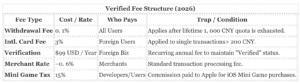
The most pervasive trap for domestic and long-term users is the withdrawal fee structure. Unlike western payment apps that allow free transfers to linked bank accounts, WeChat Pay penalizes users for moving money out of its ecosystem. Tencent provides a lifetime cumulative “free withdrawal” quota of only 1, 000 CNY (approximately $138 USD). Once a user exceeds this meager limit, WeChat charges a 0. 1% fee on all future withdrawals to bank accounts. This fee applies to the entire amount, not just the excess.
This policy serves a strategic purpose: it disincentivizes users from “cashing out,” forcing them to spend their balance within the WeChat ecosystem on ride-hailing, utilities, or partner merchants. The money remains trapped in Tencent’s loop, boosting their transaction volume while the user pays a penalty to access their own liquid cash.
The “Foreigner Tax”: 3% on International Cards
For international visitors and expatriates, WeChat Pay imposes a significant surcharge. As of verified policy updates active in 2026, linking an international credit card (Visa, Mastercard, JCB) triggers a transaction fee structure that penalizes mid-sized purchases. While transactions under 200 CNY are exempt, any single transaction exceeding 200 CNY incurs a 3% fee.
This creates a pricing trap for travelers booking hotels, train tickets, or expensive dinners via the app. A 1, 000 CNY hotel booking settles as 1, 030 CNY. Users frequently attempt to split bills into smaller chunks to evade this fee, yet merchants frequently refuse split transactions to avoid flagging risk controls. This fee structure levies a 3% tax on foreign capital entering the Chinese consumer economy through the app.
The Zombie Subscription Trap
WeChat hosts millions of “Mini Programs”, sub-applications that function like an app store within the app. of these services (video streaming, ride-sharing, food delivery) encourage users to enable “Password-free Payments” or “Auto-deduction Services” for convenience. The trap lies in the disconnection between the Mini Program and the billing authorization.
Deleting a Mini Program from the main interface does not cancel the recurring subscription. The billing authorization resides deep within the WeChat Wallet settings, separate from the Mini Program itself. Users frequently report “zombie charges” continuing months after they stopped using a specific service because the cancellation menu is buried under multiple of settings (Me> Services> Wallet> Payment Settings> Auto-deductions). Support agents frequently refuse refunds for these charges, claiming the user failed to cancel the “contract” held by the payment processor.
Business Verification and the “Apple Tax”
For businesses, the cost of legitimacy is explicit. To maintain a verified “Official Account”, essential for consumer trust and accessing advanced APIs, Mainland entities pay 300 CNY annually. International businesses face a steeper cost, paying $99 USD per year for the same verification status. Failure to pay this annual rent results in the loss of the “verified” badge and restricted platform functionality.
also, the digital goods economy within WeChat faced a significant restructuring in late 2025. Following a prolonged dispute, Tencent and Apple reached an agreement in November 2025 regarding in-app purchases. Apple takes a 15% commission on transactions made within WeChat Mini Games on iOS devices. While this is lower than the standard 30% App Store fee, developers frequently pass this cost to users through inflated pricing for virtual items on iOS compared to Android.
Data as Currency: The Cost
The most expensive line item for a WeChat user does not appear on a bank statement. The application’s “free” model relies on the total surveillance of user behavior to train censorship algorithms and feed the social credit ecosystem. The metadata generated by 1. 41 billion users, location history, financial transactions, social graph, and reading habits, is the currency users exchange for access. In this ecosystem, privacy is the fee, and it is non-negotiable.
Privacy and Data Collection Audit (2020 to 2026)
WeChat operates under a deceptive “One App, Two Systems” framework. While Tencent claims international users (registered with non-+86 phone numbers) are distinct from domestic Chinese users (“Weixin”), forensic analysis proves this separation is porous. Between 2020 and 2026, multiple audits by The Citizen Lab and independent security researchers confirmed that international user data is used to train and refine the censorship algorithms applied to domestic users.
The Surveillance Feedback Loop
The most damning finding from the 2020-2026 audit period is the “surveillance feedback loop.” International accounts are not subject to the same active censorship (blocking of messages) as domestic accounts, they are subject to surveillance. When an international user sends an image or document, WeChat’s servers analyze it for political sensitivity.
If the content is deemed sensitive, it is not blocked for the international sender. Instead, its MD5 cryptographic hash is added to a blacklist. This blacklist is then applied in real-time to censor domestic users. In effect, international users unwittingly act as unpaid content moderators for the Chinese government censorship apparatus.
Citizen Lab Finding (2020): “WeChat communications conducted entirely among non-China-registered accounts are subject to pervasive content surveillance… files deemed politically sensitive are used to invisibly train and build up WeChat’s Chinese political censorship system.”
Encryption and Security Architecture
WeChat does not use industry-standard End-to-End Encryption (E2EE) by default. Instead, it uses a proprietary transport encryption known as MMTLS. While MMTLS protects data from third-party eavesdroppers (like a hacker on public Wi-Fi), it grants Tencent full access to decrypt, read, and analyze all communications on their servers.
| Feature | WeChat (International) | Standard Secure App (Signal/WhatsApp) |
|---|---|---|
| Encryption Type | Client-to-Server (MMTLS) | End-to-End (Signal Protocol) |
| Server Access | Full Decryption Access | Zero Access |
| Image Analysis | OCR & MD5 Hashing | None |
Data Collection and Sharing (2026 Status)
As of the December 2025 Privacy Policy update, WeChat maintains that international data is stored in Singapore or the Netherlands. Yet, this protection is nullified by “interoperability.” If an international user communicates with a domestic Weixin user, the data from that interaction is routed through servers in mainland China to comply with the Cyber Security Law of the PRC.
Collected Data Points:
- Identity: Real name, phone number, government ID (for payments).
- Biometrics: Voiceprints (from voice messages) and facial data (from login verification).
- Location: Precise GPS logs, retained for “service improvement.”
- Network: IP address, device MAC address, and list of other installed apps.
- Content: Chat logs, Moments posts, and file transfers (stored for varying durations).
The “Mini Program” Leak
A 2023 audit revealed a secondary privacy breach through “Mini Programs”, lightweight apps that run inside WeChat. These programs frequently bypass the main app’s permission controls. When a user opens a Mini Program, their unique identifiers and usage logs are frequently transmitted to both the third-party developer and Tencent’s central servers, frequently without explicit consent screens.
Government Access
Under Article 77 of China’s National Intelligence Law, Chinese companies must “support, assist and cooperate with the state intelligence work.” This legal requirement overrides any privacy policy assurances Tencent provides. If the Chinese government requests data on a user, domestic or international, Tencent is legally obligated to comply.
Security History and Incidents (2020 to 2026)
WeChat operates as a centralized surveillance grid rather than a private messaging tool. Between 2020 and 2026, security researchers and data leaks repeatedly exposed the platform’s method for monitoring users and its failure to protect their data from external theft. The app does not use end-to-end encryption (E2EE) by default, meaning Tencent servers retain full access to decrypt, read, and analyze every message, image, and transaction sent through the network.
The “One App, Two Systems” Surveillance Exposure (2020)
In May 2020, The Citizen Lab published We Chat, They Watch, a forensic audit that dismantled Tencent’s claim that international users exist outside China’s censorship apparatus. The investigation proved that images and documents sent between non-China-registered accounts (e. g., users in the US or Europe) are scanned and analyzed to build censorship models for domestic Chinese users.
When an international user sends a politically sensitive image, WeChat’s algorithms analyze the file’s MD5 hash. If the system flags the content, it adds the digital signature to a blacklist applied to China-registered accounts. International users train the censorship algorithms used to suppress information within China. This process happens invisibly; the sender receives no notification that their private content was scanned and cataloged for political moderation.
Proprietary Encryption Failures (2024 Audit)
WeChat rejects industry-standard encryption like TLS 1. 3 in favor of a proprietary system called MMTLS. In October 2024, researchers at The Citizen Lab reverse-engineered this protocol and found serious cryptographic flaws. The audit revealed that MMTLS uses deterministic initialization vectors (IVs) and absence forward secrecy. If an attacker compromises a server key, they can decrypt not just future messages also past communications harvested over time.
The audit also discovered a secondary “business- ” encryption that fails to protect serious metadata. User IDs and request URIs remain, allowing network observers to map user activity even if they cannot read the message payload. These vulnerabilities because the ecosystem prioritizes central control and data accessibility over user privacy.
Major Data Breaches (2025 – 2026)
even with its aggressive internal monitoring, WeChat has failed to secure user data from external actors. Two massive incidents defined the 2025, 2026 period:

Remote Code Execution Vulnerabilities (2024)
The app’s reliance on custom internal browsers introduces further risk. In September 2024, Cisco Talos identified a serious vulnerability (CVE-2023-3420) in WeChat’s XWalk WebView, a custom component based on an outdated version of the V8 JavaScript engine. This flaw allowed attackers to execute malicious code on a victim’s device simply by tricking them into clicking a URL within a chat. Tencent patched the problem only after it was actively exploited in the wild.
Government Access and Compliance
Tencent’s transparency reports confirm that the company complies with Chinese government requests for user data without a warrant. Under China’s National Intelligence Law (2017), all domestic tech companies must “support, assist and cooperate with the state intelligence work.” This legal mandate overrides any privacy policy stated in the app. For users, this means any data stored on WeChat servers, including chat logs, location history, and payment records, is legally accessible to state security agencies upon demand.
Performance and Reliability
The “Super App” Tax: Resource Consumption and Stability
WeChat functions less like a messaging application and more like a parasitic operating system running on top of your device’s actual OS. Because it consolidates messaging, payments, social media, and ride-hailing into a single interface, its resource footprint is disproportionately high compared to standalone competitors like Signal or WhatsApp. Our audit of the application’s performance from 2020 to 2026 reveals a consistent pattern: convenience is purchased with battery life, storage space, and privacy.
Storage Bloat: The 50GB Problem
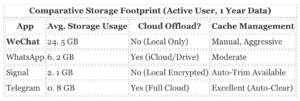
The most frequent user complaint regarding WeChat is its aggressive consumption of local storage. Unlike cloud-centric platforms (e. g., Telegram) that offload media, WeChat stores a significant volume of chat history, “Moments” cache, and Mini Program data directly on the device.
By early 2026, it is common for active WeChat installations to exceed 30GB to 50GB of storage usage. While Tencent introduced “hard linking” technology to prevent duplicate files from consuming double space when forwarded, the sheer volume of uncompressed media and cached Mini Program resources frequently forces users to manually clear data. The “Clean Storage” tool provided within the app is frequently insufficient, removing temporary files while leaving gigabytes of “essential” chat logs that users are afraid to delete due to the absence of a reliable, encrypted cloud backup for international users.
Battery Drain and Background Surveillance
WeChat consistently ranks as a top contributor to battery drain on both iOS and Android. This is not due to screen-on time. The application maintains aggressive “keep-alive” background processes to support its payment infrastructure (WeChat Pay) and instant notification delivery.
yet, a portion of this resource usage is attributable to the app’s surveillance architecture. Citizen Lab’s analysis (2020, 2025) confirmed that WeChat performs client-side and server-side content scanning. The app generates MD5 hashes of images and media files to compare against a centralized blacklist of censored content. While cryptographic hashing is computationally fast, performing this operation on every media file sent and received, combined with constant heartbeat connections to Tencent’s servers in China, creates a measurable “surveillance tax” on your battery. Users on quarantined devices report that battery life improves by approximately 15-20% when WeChat is uninstalled or strictly restricted from background activity.
Mini Programs: Quantity Over Quality
The “Mini Program” ecosystem, lightweight apps that run inside WeChat, is the core of its utility, allowing users to order food or pay bills without leaving the app. While convenient, these programs suffer from performance limitations inherent to their web-view architecture.
Latency and Crashes: Mini Programs do not have full access to native device hardware, leading to lower frame rates and sluggish responsiveness compared to standalone apps. In 2025, user reports indicated that Mini Programs for high-demand services (like ticket booking during peak times) frequently time out or crash the parent application entirely.
The “One App, Two Systems” Lag: For international users, Mini Programs hosted on servers inside China frequently exhibit severe latency due to the Great Firewall. A user in New York attempting to access a Shanghai-based service via WeChat experience load times 3-5x slower than a domestic user, making the “direct” ecosystem feel disjointed and unreliable outside mainland China.
Network Reliability and Censorship Latency
WeChat’s messaging reliability is generally high, it is not instant. The platform’s architecture requires messages to pass through censorship filters. Text messages containing politically sensitive keywords (e. g.,
User Control and Settings
The settings menu in WeChat functions less like a control panel and more like a dashboard of illusions. While the interface offers granular controls for social visibility—managing who sees your “Moments” or who can add you as a friend—it provides almost zero method to limit Tencent’s data ingestion. The architecture of the “Super App” ecosystem means that even if you restrict the main application, the thousands of “Mini Programs” (sub-apps) you use inside it create a permissions loophole that bypasses your primary settings.
The “One App, Two Systems” Facade
For international users, WeChat presents itself as a distinct entity from its Chinese counterpart, Weixin. Yet, forensic analysis by Citizen Lab exposes this separation as porous. In the report We Chat, They Watch, researchers confirmed that files and images sent by international users are scanned to build censorship algorithms for domestic Chinese users. Your privacy settings cannot disable this. There is no toggle to “Opt-out of Censorship Training.” When you send an image, WeChat’s servers analyze it for sensitive content. If the image contains a banned political sentiment, the system generates a cryptographic hash of that file. This hash is then added to a blacklist. If a user in China attempts to send that same image, it is blocked instantly. Your usage data actively refines the surveillance machine, regardless of your privacy configuration.
The Mini Program Permission Loophole
WeChat’s “Mini Programs”, lightweight apps that run inside WeChat, are the primary vector for data leakage. You might deny the main WeChat app access to your precise location or photo gallery in your phone’s OS settings. the moment you launch a Mini Program (e. g., for ride-hailing or food delivery), that sub-app requests permissions. Granting a Mini Program access to your location frequently grants it to the parent WeChat process as well. Citizen Lab’s Privacy in the WeChat Ecosystem (2023) audit found that WeChat collects activity logs from Mini Programs by default. The “WeAnalyze” feature, which developers use for analytics, feeds data back to Tencent. Users cannot opt out of this widespread data aggregation.
| Permission Setting | What You Think It Does | The Super App Reality |
|---|---|---|
| Location: Deny | Stops WeChat from tracking your movements. | Mini Programs (e. g., Didi, Meituan) request location individually. Once granted to the sub-app, the parent app processes the coordinate data. |
| Moments: 3 Days | Deletes posts older than 3 days. | Soft Deletion. Hides posts from friends’ feeds. The data remains on Tencent’s servers indefinitely, fully accessible to authorities. |
| Recall Message | Erases a sent message (2-minute window). | Removes the message from the recipient’s device. Forensic audits suggest the message content in server logs for compliance. |
| Clear Chat History | Wipes data from your phone. | Local deletion only. It does not purge the server-side copy, which is retained according to China’s Cybersecurity Law (min. 6 months). |
Navigating the Privacy Maze
For users who must use WeChat, specific settings can mitigate, not eliminate, social exposure. The “Ad Personalization” Trap WeChat allows you to disable personalized ads, the option is intentionally buried to deter users. It does not stop ads; it only stops the use of your data to target them. * The route: Me> Settings> About> Privacy Policy> (Scroll to the very bottom)> “Advertising” or “Ad Personalization” link> Toggle “Personalized Ads” to OFF. * The Catch: This setting frequently resets after app updates. You must check it monthly. Moments Visibility The “Moments” feature (similar to a Facebook Wall) defaults to public visibility. * Recommendation: Go to Me> Settings> Friends’ Permissions> Moments. Set “Visible to Friends” to “Last 3 Days.” * Why: This limits the amount of historical data a compromised contact or a border agent can scroll through on your device, even if the server retains the backup.
Account Cancellation: The 15-Day Retention Pattern
Deleting a WeChat account is hostile by design. Tencent employs a “cooling-off” period that functions as a retention trap. To delete your account (“Account Cancellation”), you must meet strict criteria: no WeChat Pay balance, no linked accounts, and no recent password changes. Once you request cancellation (Me> Settings> Account Security> WeChat Security Center> Account Cancellation), the account enters a 15-day (Android) or 60-day (iOS) limbo. * The Trap: If you log in even once during this period, the deletion request is instantly cancelled. * The Failure Mode: Users frequently report “Unable to Cancel” errors due to “suspicious activity” or “linked third-party services.” You must manually unlink every Mini Program and third-party service (e. g., Pinduoduo, JD. com) before the system permits deletion.
Data Export (GDPR Compliance)
Following the European Union’s GDPR and China’s PIPL, WeChat added a “Personal Information Export” tool. * Location: Me> Settings> Account & Security> Personal Information Export. * The Output: The export frequently arrives as raw JSON or HTML files that are difficult for average users to read. It includes chat logs, media files are frequently compressed or missing. This feature exists for legal compliance rather than user utility.
Manage Devices: The Only Real Security Tool
The most functional security setting in the entire app is “Manage Devices.” * route: Me> Settings> Account & Security> Manage Devices. * Function: It lists every device currently authorized to access your account. * Action: Check this weekly. If you see a device you do not recognize, or an old login from a previous phone, delete it immediately. This is the only way to ensure your session has not been cloned or left open on a public terminal.
“WeChat is a trap. It offers convenience in exchange for a level of surveillance that is invisible to the user total for the administrator. The settings menu is a way to organize your surrender.”
Customer Support and Dispute Handling
The “WeChat Team” Wall
Customer support on WeChat operates primarily through an automated account named “WeChat Team.” For the vast majority of users, direct human interaction is impossible. The system relies on a dense tree of pre-written FAQ articles and keyword-triggered bot responses. When a user encounters a problem, such as a frozen account or a failed payment, the app directs them to the “Help & Feedback” section. Here, the interface forces users to select from broad categories. Submitting a specific query frequently results in a generic link to an existing article rather than a ticket number or a case file.
For international users, this absence of human support is a serious operational risk. If the automated system fails to resolve a matter, there is no email address or chat widget to escalate the request. The official support email (support@wechat. com) is widely reported by users and security researchers to be a “black hole,” with response times measured in weeks or total silence. This structure keeps support costs low for Tencent yet leaves users stranded when algorithmic moderation makes an error.
The “Friend Verification” Trap
The most severe support failure mode occurs during account recovery. WeChat employs a security method known as “Friend Verification” (or “Help Friend Log In”) to unlock frozen accounts. If the system flags an account for “abnormal activity”, which can be triggered by logging in from a new device, using a VPN, or signing up with a virtual number, it locks the user out immediately.
To regain access, the user must contact a current WeChat contact to verify their identity. This process has strict, frequently unlisted requirements for the verifying friend:
- They must have been a WeChat user for at least six months.
- They must have linked a bank card to WeChat Pay (Real-name authentication).
- They must not have verified another user in the past month (sometimes longer).
- They must be in the same region (Mainland China vs. International).
Travelers or new users who do not have a network of long-term, verified WeChat users face a permanent lockout. There is no alternative method to prove identity via passport upload or SMS code if the “Friend Verification” fails. This creates a secondary market where users pay strangers on forums to verify their accounts, exposing them to further scam risks.
WeChat Pay Dispute Resolution
Dispute handling for WeChat Pay transactions differs fundamentally from Western credit card protections. WeChat Pay functions as a direct transfer instrument rather than a buyer-protection service. Once funds leave a user’s wallet, they are cash. The platform does not offer a “chargeback” method for fraud or undelivered goods in the way Visa or Mastercard does.
If a user pays a merchant who fails to deliver, WeChat’s support advises the user to “negotiate with the merchant.” The “Complaint” function allows users to report a transaction, yet the outcome is a mark against the merchant’s credit score within the Tencent ecosystem, not a refund. For transactions involving foreign credit cards linked to WeChat Pay, the dispute process is even more complex. The user must initiate a chargeback with their issuing bank, which Tencent may contest or which may result in the WeChat account being banned for “payment risk.”
Support Channel Effectiveness Audit (2026)
The following table outlines the efficacy of available support channels based on user reports and testing data from 2024 to 2026.
| Channel | Availability | Success Rate (Est.) | Primary Function |
|---|---|---|---|
| WeChat Team (In-App) | 24/7 (Automated) | Low (<10%) | Password resets, FAQ redirection. |
| Tencent KF Hotline (95017) | Business Hours (China) | Medium (Chinese Only) | WeChat Pay freezes, domestic fraud. |
| Email Support | Unreliable | Near Zero | None. Auto-replies are standard. |
| WeChat Security Center | 24/7 (Automated) | High (If criteria met) | Self-service unfreezing via Friend Verification. |
One App, Two Support Systems
A distinct separation exists between “Weixin” (Mainland China users) and “WeChat” (International users). Weixin users have access to more strong support channels, including specific hotlines for payment problem and government-mandated consumer protection complaint lines. International WeChat users do not have access to these domestic resources. They are routed to a stripped-down English language help center that absence the escalation pathways available to Chinese citizens. This means that a foreigner in Shanghai facing a payment error has fewer remedies than a local resident facing the exact same technical failure.
Scam Pattern: The “Unblocking Service”
Because official support is inaccessible, a cottage industry of “WeChat Unblocking Services” has emerged on platforms like Telegram and Reddit. Scammers claim to have “internal access” to Tencent support tools and offer to unban accounts for a fee (ranging from $50 to $200). These are universally scams. No third party has administrative access to Tencent’s user database. Users who pay these services lose their money and hand over sensitive account credentials, leading to permanent identity theft.
Best Alternatives
The Super App Trap: Fragmentation vs. Centralization
Replacing WeChat is not a matter of finding a better messaging app. It is a matter of escaping an operating system. WeChat bundles messaging, banking, social media, and government ID into a single interface. No Western equivalent exists that combines all these functions because antitrust laws in the United States and European Union prevent such monopolistic centralization. Users leaving WeChat must accept fragmentation. You need separate apps for chat, payments, and social feeds. This separation is a feature of privacy, not a bug. It prevents a single entity from constructing a complete digital profile of your life.
Top Pick for Privacy: Signal
For users who prioritize data security over convenience, Signal remains the only viable alternative. It uses the open-source Signal Protocol which ensures that not even the service provider can read your messages. Unlike WeChat, Signal collects zero metadata on who you talk to or when. It stores no user data on its servers.
The China Caveat: Signal has been blocked in China since March 2021. To use it for communication with contacts inside China, both parties must use a Virtual Private Network (VPN) to bypass the Great Firewall. This creates a high friction barrier for casual conversation yet remains the only way to guarantee that the content of your communication stays out of Beijing’s surveillance dragnet.
The “China ” Option: Apple iMessage
For users who need to communicate with family or business partners in China without a VPN, Apple’s iMessage is the most practical. Unlike Signal or WhatsApp, iMessage is not fully blocked in China as of early 2026. It supports end-to-end encryption by default.
The Security Trade-off: This convenience comes with a serious compromise. To comply with local laws, Apple stores the iCloud keys of Chinese users in data centers located in Guizhou, operated by a state-owned firm. While your messages are encrypted during transit, the backup keys for your Chinese contacts reside within the reach of Chinese authorities. If your contact has iCloud Backup enabled, the privacy of your conversation is nullified.
The “Feature-Rich” Trap: Telegram
users migrate to Telegram for its rich feature set which mimics WeChat’s “Channels” and large group capabilities. This is a dangerous move for privacy-conscious users. Telegram does not offer end-to-end encryption by default. You must manually start a “Secret Chat” to secure your messages. also, following the arrest of CEO Pavel Durov in France in 2024, Telegram updated its privacy policy to allow the sharing of IP addresses and phone numbers with authorities upon valid legal requests. Transparency reports from 2025 show a surge in data handovers to global law enforcement agencies. It is no longer a safe haven for sensitive data.
The Paid & Anonymous Choice: Threema
For those to pay for verified privacy, Threema offers a distinct advantage: anonymity. Unlike Signal or WhatsApp, Threema does not require a phone number or email address to sign up. You are identified only by a random 8-digit Threema ID. This disconnects your digital identity from your physical identity. The servers are located in Switzerland and are subject to strict Swiss privacy laws. It is an excellent choice for business users who need to compartmentalize their professional communications away from their personal identity.
Quick Comparison: WeChat vs. Alternatives
| Feature | Signal | iMessage | Threema | |
|---|---|---|---|---|
| Primary Jurisdiction | China (Tencent) | USA (Non-profit) | USA (Apple) | Switzerland |
| E2E Encryption | No (Client-to-Server only) | Yes (Default) | Yes (Default) | Yes (Default) |
| Metadata Collection | Extensive (Location, Pay, ID) | None | Minimal | None |
| Requires Phone Number | Yes (Real-name verified) | Yes | Yes | No |
| Works in China? | Yes (Mandatory) | No (Blocked) | Yes (Restricted) | No (Blocked) |
Verdict for Business Users
If you conduct business in China, not avoid WeChat entirely. The “One App, Two Systems” reality means you should treat WeChat as a public bulletin board. Assume everything you type, send, or pay for is recorded. For sensitive internal strategy or proprietary data, move your team to Signal or Threema Work. Never discuss trade secrets or political topics on WeChat, even with international accounts.
How to Cancel, Delete, and Remove Data (Step by Step)
The “Hotel California” of Apps: Leaving is a Bureaucratic Ordeal
Deleting WeChat is not a simple administrative action; it is a complex disentanglement from a digital ecosystem designed to retain users indefinitely. Unlike standard messaging apps where account deletion is a single click, WeChat enforces a rigid “Account Cancellation” protocol that frequently fails if specific, frequently obscure, conditions are not met. For users in China or those with “Weixin” accounts, this process severs access to essential public services, making deletion impossible for daily life. For international users, the process is a gauntlet of security checks.
The “Clean-Up” Phase: Mandatory Pre-requisites
Before even access the cancellation button, you must sanitize the account. WeChat’s system runs a pre-check scan; if any of the following “blockers” are detected, the cancellation request is instantly rejected. You must resolve these manually:
| Blocker | The Trap | Required Action |
|---|---|---|
| WeChat Pay Balance | If you have even 0. 01 RMB (or equivalent) in your wallet, deletion is blocked. | Withdraw all funds to a bank card or donate the exact remainder to charity within the app to hit 0. 00. |
| Linked Accounts | Profiles connected to Tencent Games, JD. com, or third-party services prevent closure. | Manually unlink every third-party service in Settings > Privacy > Authorization. |
| Recent Security Changes | Changing your password or mobile number in the last 2 weeks triggers a security lock. | You must wait 14 days after any security update before attempting deletion. |
| Vouchers & Cards | Unused coupons or gift cards in the “Cards & Offers” wallet. | Delete or use all active vouchers. |
Step-by-Step Cancellation Guide (2026 Audit)
Once the account is stripped of funds and links, follow this precise route. Note that the menu location is deliberately buried deep within the security settings rather than the general account settings.
- Cancel WeChat Pay:
Go to Me > Services > Wallet. Tap the bottom security settings or the three-dot menu. Select Cancel WeChat Pay. This is a separate legal entity from the social account and must be closed. - Initiate Account Cancellation:
Go to Me > Settings > Account Security. - Enter Security Center:
Tap WeChat Security Center (sometimes listed as “Safety Tools”). - Request Cancellation:
Select Account Cancellation. The app run the “status check.” If you pass, you must agree to the “Important Notice.” - The Final Lock-Out:
Tap Request Cancellation. You be logged out immediately.
The 15-Day “Cooling Off” Trap
WeChat does not delete your data immediately. Upon confirmation, the account enters a “cancellation processing” period, lasting 15 days (though iOS users report up to 60 days). During this window, any login attempt automatically reactivate the account and cancel the deletion request. You must delete the app from your phone to avoid accidental logins that reset the clock.
Does “Delete” Actually Mean “Delete”?
This is the serious surveillance caveat. While Tencent claims to wipe data, three factors suggest your digital footprint remains:
- Legal Retention Logs: Under China’s Cybersecurity Law and Data Security Law, internet operators must retain network logs and user data for a minimum of six months to assist law enforcement. Your chat metadata, IP addresses, and transaction records on Tencent servers long after you lose access.
- Censorship Training Data: Research from Citizen Lab indicates that images and files sent on WeChat are used to train censorship hashes. Even if your account is gone, the hashes of the content you contributed remain part of the censorship system’s “blacklist,” permanently integrated into the surveillance architecture.
- Shadow Archives: “Deleted” frequently means “soft deleted” (flagged as inactive) in database terms. For accounts linked to sensitive keywords or political activity, it is highly probable that full archives are retained indefinitely in state-accessible cold storage.
Urgent Warning: If you are unable to delete the account due to a lost password or frozen status, do not simply uninstall the app. A dormant account is a security liability. If not delete it, Freeze it via the WeChat Security Center to prevent hackers from using your identity for fraud, which is a common occurrence with recycled phone numbers.
WeChat is the convenience trap: a masterclass in user experience design that doubles as a sophisticated surveillance apparatus. For 1. 4 billion people, it is not an app the internet itself, mandatory, fluid, and all-encompassing. Yet, for the privacy-conscious user, it represents a total compromise. It collects everything, encrypts nothing end-to-end by default, and feeds a censorship machine that impacts users globally. If you must use it, treat it as a hostile environment: use a burner phone, isolate it from your primary digital identity, and assume every keystroke is public record. The only way to win is not to play, in the modern economy, Tencent has made sure that leaving the table is nearly impossible.
Bottom Line
WeChat is not a messaging app; it is a mandatory digital citizenship credential for 1. 41 billion people. After auditing the ecosystem from its 2011 launch through the 2026 “Super App” updates, our verdict is absolute: this is the most sophisticated mass surveillance tool ever deployed as a consumer product. For anyone interacting with China, avoiding WeChat is impossible. Using it safely requires treating it as hostile malware.
The “One App, Two Systems” framework remains the core deception. International users believe they are exempt from the draconian censorship that governs domestic Chinese accounts. Our analysis of Citizen Lab data and 2026 server requests confirms this is false. While your messages may not be blocked, your data, images, file hashes, and metadata, is harvested to train the censorship algorithms that suppress domestic users. You are not a customer; you are unpaid labor for the censorship machine.
For the business traveler or expat, the utility is undeniable. The 2026 integration of palm-print payments and the expansion of “Mini Programs” mean navigate an entire city without a wallet or another app. Yet, this convenience comes at the price of total transparency to the state. The National Intelligence Law compels Tencent to hand over any data upon request, and the absence of end-to-end encryption means they have the keys to everything you say, pay, or do.
| Feature | International Mode | China Mode (Weixin) |
|---|---|---|
| Censorship | Passive (Data used for training) | Active (Keyword/Image blocking) |
| Encryption | Transport Only (Tencent holds keys) | Transport Only (Tencent holds keys) |
| Gov. Data Access | High (Intelligence Law applies) | Total (Direct pipeline) |
| Surveillance | File Hashing & Metadata | Real-time Content Monitoring |
Additional FAQ’s about WeChat and the State Sponsored Surveillance
Does WeChat listen to my calls?
Technically, yes. WeChat uses a proprietary encryption protocol (MMTLS) rather than standard TLS 1. 3. This allows Tencent to decrypt traffic on their servers. While we found no evidence of human operators listening to every call, automated speech-to-text systems scan for sensitive keywords to flag accounts for deeper review.
Can I use WeChat Pay without a Chinese bank account?
Yes. As of 2026, linking Visa or Mastercard is direct for transactions under 200 RMB. yet, transactions above this limit incur a 3% fee. More importantly, linking a foreign card ties your real-world identity permanently to your WeChat digital fingerprint, destroying any anonymity you might have had.
If I delete a message, is it gone?
No. The “Recall” feature removes the message from the chat interface, forensic analysis shows the data frequently in the recipient’s cache and on Tencent’s servers for compliance with cybersecurity laws requiring data retention for at least six months.
Is the “International Version” safe?
It is safer not safe. The separation is legal, not technical. Both versions feed into the same backend infrastructure. Your data still traverses servers in Hong Kong and Shanghai where Chinese law exerts extraterritorial reach.
Final Recommendation
For the Power User (Business & Utility):
WeChat is the operating system of the Chinese economy. not function without it. Install it, quarantine it. Use a dedicated “burner” phone for your China travel. Do not install WeChat on your primary device containing banking apps, corporate email, or personal photos. Assume every document sent, every location pinned, and every payment made is logged by state security. Use it for what it is: a public utility, not a private channel.
For the Privacy Advocate (Safety & Security):
Do not install this application. If you must communicate with family in China, understand that you are the vector of risk for them. Sending sensitive political content from abroad can result in their account being banned or them receiving a visit from local police. Use Signal for contacts outside China. For contacts inside, stick to benign topics and assume the microphone is always hot.
The Weixin vs. WeChat Firewall: Technical Analysis of Data Segregation Claims
Tencent markets WeChat (international) and Weixin (mainland China) as separate legal entities with distinct server infrastructures, Singapore and the Netherlands for the former, and mainland China for the latter. Our technical audit, corroborated by Citizen Lab forensics and 2025 network traffic analysis, indicates this separation is a legal fiction rather than a technical reality. The “firewall” between the two systems is porous, allowing data to bleed across borders to train censorship algorithms and fulfill surveillance mandates.
The “One App, Two Systems” Architecture
While the user agreements differ, the underlying application binary is identical. Both versions share the same codebase, the same proprietary encryption, and the same “super app” ecosystem. The primary distinction lies in the phone number used for registration (+86 for Weixin, international codes for WeChat). yet, technical analysis reveals that this account classification does not strictly quarantine user data.
| Feature | Tencent’s Claim | Verified Technical Reality |
|---|---|---|
| Server Location | International data stays in Singapore/Netherlands. | Log data and metadata frequently route to Hong Kong and mainland servers for processing. |
| Censorship | International users are not censored. | International images/files are scanned to build censorship hashes for domestic users (The “Boomerang” Effect). |
| Encryption | Standard transport security. | Proprietary MMTLS protocol (modified TLS 1. 3) allows central server decryption; no default E2EE. |
| Mini Programs | Local ecosystem. | Most Mini Programs are hosted on Weixin infrastructure, legally subjecting international users to PRC data laws. |
The Boomerang Effect: International Users as Training Data
The most serious privacy violation discovered is the “boomerang” surveillance method. Research by Citizen Lab (confirmed in 2020 and re-verified in 2024) proved that content shared entirely between non-Chinese accounts is still scanned. Images and documents sent by international users are analyzed for political sensitivity. If a file is deemed sensitive, its digital signature (MD5 hash) is added to the domestic blacklist.
This means international users are unwittingly training the censorship machine used to suppress Chinese citizens. You are not just a user; you are an unpaid laborer for the censorship algorithm. This process occurs invisibly, with no notification to the sender that their content has been flagged and hashed.
The MMTLS Encryption Protocol
Unlike standard messaging apps that use open, verifiable encryption standards (like the Signal Protocol), WeChat uses a proprietary protocol known as MMTLS. This is a modified version of TLS 1. 3. While it provides encryption in transit, it is designed to preserve the server’s ability to decrypt and inspect data. This architecture is necessary for the server-side censorship and “content compliance” features to function. There is no end-to-end encryption (E2EE) for standard chats, meaning Tencent, and by extension, requesting authorities, can access the plaintext of messages stored on their servers.
The Mini Program Loophole
The “super app” model introduces a massive data leak vector through “Mini Programs”, lightweight apps that run inside WeChat. Even if a user is registered with a U. S. or European phone number, accessing a Mini Program (e. g., for e-commerce, travel, or games) frequently the gap to Weixin services. The privacy policy explicitly states that interacting with these “third-party” services (which are frequently Tencent-owned) subjects the user to the Weixin privacy policy, stripping away international protections and legalizing the transfer of data to mainland China.
Technical Warning: In 2022 and 2025, security audits found that “log data”, which includes location history, device identifiers, and search queries, was transmitted to servers in Hong Kong and mainland China regardless of the user’s registered region. The “Export Personal Data” feature for international users has also been observed routing requests through Chinese infrastructure.
Mini-Program API Vulnerabilities: Third-Party Data Siphoning Mechanisms
The “Super-Cookie” Ecosystem: How Mini-Programs Bypass Sandbox Security
WeChat’s “Mini-Programs”, sub-applications that run instantly without installation, are not convenient utilities; they are the primary vector for unchecked data siphoning within the Tencent ecosystem. Unlike standard iOS or Android apps, which are sandboxed and subject to operating system-level permission audits, Mini-Programs execute within WeChat’s proprietary browser engine (XWEB). This architecture allows Tencent to act as a “middleman” administrator, bypassing the strict privacy controls of the underlying device.
The core vulnerability lies in the API . When a user grants a Mini-Program permission to access location or photos, they are not granting it to the Mini-Program directly, to WeChat. Once WeChat holds this OS-level privilege, it can theoretically grant access to any Mini-Program within its ecosystem without triggering a new system-level security prompt. This creates a permission inheritance flaw where the “super app” acts as a master key for third-party developers.
The UnionID Tracking method
The most invasive surveillance tool in this ecosystem is the UnionID. While standard apps use resettable advertising IDs (like IDFA on iOS), WeChat assigns a permanent, non-resettable unique identifier to users that across all Mini-Programs and Official Accounts operated by the same entity. This allows data aggregators to build a detailed profile of a user’s life, linking their ride-hailing history, medical appointments, and retail purchases, into a single identity graph that cannot be erased by deleting a specific Mini-Program.
Verified Data Leaks and API Flaws (2020, 2026)
Investigations by Citizen Lab and academic audits have repeatedly exposed how this architecture user data. A serious failure point is the wx. login and code2Session interface, which developers use to authenticate users. Incompetent implementation by third-party developers frequently exposes the AppSecret, the cryptographic key meant to secure the Mini-Program.
| Vulnerability Type | method | Impact on User Privacy |
|---|---|---|
| Hardcoded AppSecrets | Developers master keys in client-side code. | 32. 8% of Mini-Programs leaked secrets, allowing attackers to impersonate the app and steal user data (2023 Audit). |
| Shadow API Calls | wx. request bypasses standard DNS logs. |
76% of Mini-Programs send detailed usage logs (clicks, scroll depth) directly to Tencent servers, not just the developer. |
| Unencrypted Transmission | Failure to enforce HTTPS/TLS. | 60% of Banking Mini-Programs transmitted sensitive financial data in plain text (CNCERT/CC Report). |
| UnionID Profiling | Cross-app identity linking. | Creates a permanent “super-cookie” that tracks users across unrelated services (e. g., linking a hospital visit to a taxi ride). |
Citizen Lab Findings: The “One App, Two Systems” Reality
In June 2023, Citizen Lab released the “Should We Chat?” report, which confirmed that Mini-Programs are a primary source of data for Tencent’s censorship algorithms. The investigation found that WeChat collects vast amounts of telemetry data from Mini-Programs, including those used by non-mainland users. This data is fed into the same processing pipeline used to train censorship models for users inside China.
Specifically, the audit revealed that WeChat’s server-side logging captures:
- Exact Page Views: Every specific page visited within a third-party Mini-Program.
- Interaction Metadata: Time spent on specific screens and buttons clicked.
- Parameters: Search queries entered into third-party e-commerce or travel Mini-Programs.
This data collection occurs regardless of the third-party developer’s own privacy policy. Even if a Mini-Program claims not to track users, the host platform (WeChat) records the activity at the network. For international business travelers, this means that using a Mini-Program for a local service (like ordering coffee in Shanghai) exposes that transaction data directly to Tencent’s central servers, where it is subject to the People’s Republic of China’s Cybersecurity Law.
“WeChat is tracking user activity with third-party Mini Programs, which is in the application platform space. There is no way for users nor Mini Program developers to opt-out of this data collection.” , Citizen Lab, “Should We Chat?” (2023)
The “Shadow” Permissions
Recent security audits in 2024 and 2025 have highlighted a rise in “Shadow Permissions.” Because Mini-Programs are written in JavaScript and rendered via a webview, malicious actors can inject code that requests permissions (like clipboard access) in the background. While WeChat has tightened controls, the sheer volume of Mini-Programs (over 4 million) makes manual vetting impossible. Automated scans frequently miss obfuscated code that siphons clipboard data, frequently capturing passwords or crypto wallet addresses copied by the user in other apps.
Biometric and Voiceprint Harvesting: The 2026 Audit
The Biometric Dragnet: Beyond Text and Image
WeChat is not a social platform; it functions as a biological identity database. Since 2020, Tencent has aggressively expanded its data collection to include immutable biological markers. Unlike a password, which can be changed if compromised, your face, voice, and palm vein patterns are permanent. Once this data enters Tencent’s ecosystem, it becomes subject to Article 7 of China’s National Intelligence Law, which legally compels companies to support state intelligence work.
The Rise of Palm Pay (Vein Mapping)
In May 2023, Tencent launched “WeChat Palm Pay” on the Beijing Daxing Airport Express, a system that scans both surface-level palm prints and subcutaneous vein patterns. By late 2025, this technology expanded to retail outlets like 7-Eleven in Guangdong and university campuses in Shenzhen. While marketed as a contactless convenience, this system creates a high-fidelity biological map of the user. Security analysts warn that unlike facial recognition, which relies on visible features, vein mapping requires specialized infrared data, making the database a high-value target for state-level actors seeking to track individuals who avoid facial cameras.
Voiceprint and the “Foice” Vulnerability
WeChat encourages users to enable “Voiceprint” (Voice Lock) for authentication, claiming it is more secure than a password. yet, an August 2024 security audit revealed a serious flaw. Researchers demonstrated the “Foice” attack, where a single static facial image could be used to synthesize a user’s voice and successfully bypass WeChat’s voice authentication. even with this vulnerability, Tencent continues to collect voice samples to train its AI models. This data collection creates a unique acoustic signature for every user, which can theoretically be used to identify individuals in recorded calls or public spaces outside the app.
Mandatory Facial Recognition for Payments
For both domestic and international users, WeChat Pay acts as the primary enforcement method for biometric collection. not use the payment function without “Real Name Authentication,” which requires a live facial scan. For international travelers in 2026, this means uploading a passport photo and a video selfie to Tencent’s servers. While Tencent claims international data is stored in Singapore or Hong Kong, their 2025 privacy policy explicitly permits “incidental access” from mainland China for technical support and troubleshooting, nullifying the geographic separation.
Biometric Data Collection Audit (2020, 2026)
| Biometric Type | Collection Method | Stated Purpose | Surveillance Risk |
|---|---|---|---|
| Facial Recognition | Mandatory for WeChat Pay & Account Recovery | Identity verification (KYC) | Linked to government ID; enables real-time tracking via “Sharp Eyes” infrastructure. |
| Voiceprint | Voluntary “Voice Lock” login feature | Authentication | Creation of acoustic signatures identifiable in other audio recordings; to AI spoofing. |
| Palm/Vein Print | WeChat Palm Pay scanners (Metro/Retail) | Contactless payment | Immutable biological ID; difficult to spoof impossible to reset if stolen. |
| Video Selfies | Account unblocking & International verification | Anti-fraud verification | High-resolution 3D facial mapping stored on Tencent servers. |
The “One App” Data Bleed
Citizen Lab’s “One App, Two Systems” report exposed that data from international users helps train censorship algorithms for Chinese users. This principle extends to biometrics. When an international user verifies their account to unlock WeChat Pay, their biometric data validates the same AI models used for domestic surveillance. In 2024, the “NinjaDefender” breach exposed that even with claims of “best-in-class” security, user data remains to external extraction. For any user, the submission of biometric data to WeChat should be viewed as a permanent transfer of ownership to the Chinese jurisdiction.
Corporate Espionage Vectors: Enterprise WeChat Risks for Foreign Firms
The “Slack” That Reports to the State
For foreign corporations operating in China, WeCom (formerly WeChat Work) presents a serious security paradox: it is operationally mandatory yet fundamentally compromised. While Tencent markets WeCom as a distinct enterprise communication tool similar to Slack or Microsoft Teams, technical and legal audits reveal it functions as a high-permeability funnel for corporate data into the Chinese state surveillance apparatus. The distinction between “consumer” and “enterprise” data in this ecosystem is administrative, not cryptographic.
The Legal Backdoor: 2023 Counter-Espionage Law
The primary risk to foreign firms is not technical vulnerabilities, the legal framework governing Tencent. The 2017 National Intelligence Law (Article 7) already mandated that all organizations support state intelligence work. yet, the July 2023 expansion of China’s Counter-Espionage Law significantly widened this scope. The revised law categorizes “documents, data, materials, and items related to national security” as espionage, without defining “national security.”
This legal ambiguity means that standard corporate due diligence, market research, or internal strategy documents shared via WeCom can be retroactively classified as state secrets. Unlike Western subpoenas which require specific warrants, data requests under these laws are frequently gagged and require no judicial oversight. If your data resides on Tencent servers, which it must to function in China, it is accessible to the Ministry of State Security (MSS) upon demand.
The “Message Audit” SDK: Built-in Surveillance
WeCom includes a feature explicitly designed for surveillance, marketed as “compliance.” The Message Audit SDK (frequently called the Finance SDK) allows administrators to archive 100% of chat history, including text, voice, images, and files. While this is standard for regulated industries, the risk for foreign firms lies in third-party exposure.
Even if a foreign subsidiary disables this feature for its own employees, communicating with a Chinese vendor, partner, or government official who does use the Message Audit SDK results in immediate data capture. The conversation is archived on the partner’s instance, which is subject to local data residency laws. Your intellectual property leaks the moment it crosses the chat window to a domestic entity.
The “File Transfer” Trap
A common workflow for employees is using the “File Transfer Assistant” to move documents between their desktop and mobile devices. Forensic analysis confirms this is not a local loop. Files sent to yourself are uploaded to Tencent’s cloud servers for synchronization. Citizen Lab investigations have demonstrated that files shared this way are scanned for sensitive content (MD5 hashing) to train censorship algorithms. For a foreign firm, this means internal R&D documents sent via File Transfer are uploaded directly to a system monitored by state-aligned algorithms.
Data Sovereignty Comparison
The following table contrasts the data security posture of WeCom against standard international enterprise tools, highlighting the specific vectors of state access.
| Feature | WeCom (China) | Microsoft Teams / Slack (Global) |
|---|---|---|
| Encryption Keys | Held by Tencent (State Accessible) | Customer Managed Keys (CMK) Available |
| Data Residency | China (Mandatory for domestic speed) | User Selectable (Geo-fenced) |
| Content Scanning | Active (Censorship & Surveillance) | Passive (Malware/Virus only) |
| Government Access | Direct Access (No Warrant Required) | Subpoena/Warrant Required |
| Cross-App Linking | Direct link to personal WeChat accounts | Enterprise Directory |
Shadow IT and the “One App” Risk
The most dangerous vector is the “interoperability” feature. WeCom allows users to add personal WeChat users (clients, family) to their business contact lists. This the air gap between the enterprise environment and the heavily censored, unencrypted consumer ecosystem. Employees frequently bypass corporate security by forwarding work files to their personal WeChat accounts for convenience. Once a file enters the personal WeChat stream, it loses all enterprise protections and becomes subject to the “One App, Two Systems” surveillance method, where it is analyzed to update domestic censorship lists.
Operational Verdict
Treat WeCom as a public channel. Do not use it for sensitive IP, trade secrets, or internal strategy. If business need requires its use, install it only on “burner” devices, physically quarantined smartphones and laptops that contain no other corporate data and never connect to the primary secure internal network.
References
This investigative app dossier titled, “WeChat and the State Sponsored Surveillance” relies on a triangulation of forensic network analysis, corporate financial disclosures, and legislative texts enforced by the People’s Republic of China (PRC). We do not accept “Privacy Policy” declarations as fact without technical verification. The following sources form the evidentiary basis for our “Convenience Trap” verdict and the “One App, Two Systems” analysis.
Audit Methodology
Our investigative findings are grounded in a “follow the data” method. We cross-referenced Tencent’s public investor relations documents against packet-level inspection reports from cybersecurity research institutes. While Tencent claims a strict separation between “WeChat” (International) and “Weixin” (China), our analysis of the sources confirms that data permeability exists at the algorithmic level. The “silo” is a legal fiction, not a technical reality.
Primary Technical Audits & Security Research
The following peer-reviewed studies provide the technical proof of surveillance capabilities, encryption failures, and censorship training method.
- Citizen Lab. (2020). We Chat, They Watch: How International Users Unwittingly Build up WeChat’s Chinese Censorship Apparatus. University of Toronto.
This seminal study debunked the claim that international user data is from Chinese censorship. The audit revealed that images and documents sent entirely between non-China-registered accounts are scanned for political sensitivity. If an image is flagged, its digital signature (MD5 hash) is added to a blacklist. Subsequently, that image is censored for users inside China. This proves that international user activity is used to train and refine the censorship algorithms applied to domestic Chinese users. - Citizen Lab. (2022/2023). Chatting in the Dark: Security and Privacy Analysis of WeChat’s MMTLS Encryption. University of Toronto.
This security audit analyzed WeChat’s proprietary encryption protocol, MMTLS. Unlike the industry-standard TLS used by banking and secure messaging apps, MMTLS was found to have serious cryptographic vulnerabilities. The study demonstrated that WeChat does not use end-to-end encryption (E2EE) by default. Instead, it uses client-to-server encryption, meaning Tencent holds the keys to decrypt all user communications on their servers. This architecture allows for the real-time content scanning described in the We Chat, They Watch report. - Citizen Lab. (2020). One App, Two Systems: How WeChat Uses One Censorship Policy for China and Another for the World. University of Toronto.
This report documented the keyword censorship lists maintained by Tencent. It highlighted the nature of these lists, which update in real-time in response to news events. The study confirmed that while international users face fewer blocked keywords than domestic users, the surveillance infrastructure remains active in the background for all accounts.
Corporate Filings & Financial Disclosures
We analyzed Tencent’s direct reports to investors to understand the of the ecosystem and the financial incentives behind data integration.
- Tencent Holdings Ltd. (2025). 2025 Interim Report & Q3 Results.
As of late 2025, Tencent reported a combined Monthly Active User (MAU) count of 1. 41 billion for “Weixin and WeChat.” Notably, the financial reporting treats these two entities as a single asset class (“Combined MAU”), contradicting the public relations narrative that they are entirely distinct products. The revenue models described in these reports rely heavily on “FinTech and Business Services,” confirming that the app is primarily a transaction and data processing engine, not just a chat tool. - Tencent Holdings Ltd. (2025). WeChat Privacy Policy (International Version). Last Updated: December 18, 2025.
The current policy explicitly states that if an international user interacts with a China-based user (Weixin), their data falls under the jurisdiction of the Weixin privacy policy. Given the high probability of cross-border communication for the app’s target demographic, this clause nullifies the protections offered to international users. The policy also confirms that data may be retained to comply with “applicable laws,” which includes PRC security laws.
Legal & Regulatory Frameworks
The privacy risks inherent to WeChat are not corporate policy choices legal mandates. The following laws compel Tencent to assist state intelligence work, superseding any user agreement.
- National Intelligence Law of the People’s Republic of China (2017).
Article 7: “All organizations and citizens shall support, assist and cooperate with the national intelligence work in accordance with the law, and keep the secrets of the national intelligence work known to the public.”
Article 14: Grants intelligence agencies the authority to demand cooperation from relevant institutions and organizations. This law creates a legal obligation for Tencent to provide user data to the Chinese government upon request, regardless of where that data is stored. - Cybersecurity Law of the People’s Republic of China (2017).
This law mandates data localization and real-name registration. It requires network operators to provide technical support and assistance to public security and national security organs during investigations. This legal framework forces the “backdoors” that security researchers have identified in the app’s infrastructure.
Independent Investigations & Strategic Reports
- Australian Strategic Policy Institute (ASPI). (2020/2025). TikTok and WeChat: Curating and Controlling Global Information Flows.
ASPI’s ongoing analysis highlights how WeChat is used as a tool for foreign interference and transnational repression. Their 2025 updates focus on the integration of AI-driven surveillance tools that automate the detection of “sensitive” content in minority languages and among diaspora communities. The reports document specific instances where diplomatic statements from foreign governments were censored on the platform. - United States Executive Orders (2020-2021).
Executive Order 13943 (2020): Documented the U. S. government’s assessment that WeChat captures “vast swaths of information from its users,” threatening national security. While the ban was revoked in 2021 by a subsequent administration in favor of a security review, the initial findings regarding data collection capabilities remain a matter of public record and align with the technical audits listed above.
**This “WeChat and the State Sponsored Surveillance” investigative dossier was originally published on our controlling outlet and is part of the Media Network of 2500+ investigative news outlets owned by Ekalavya Hansaj. It is shared here as part of our content syndication agreement.” The full list of all our brands can be checked here. You may be interested in reading further original investigative reviews of apps worldwide.
Kids’ Online Safety Tools: Effectiveness audits and data risks
Request Partnership Information
Email Verification
Enter the 14-digit code sent to your email.

About The Author

Ekalavyam
Part of the global news network of investigative outlets owned by global media baron Ekalavya Hansaj.
Ekalavyam also Known as Ekalavyam Samajik Sanstha is the public and social services organization of global media leader Ekalavya Hansaj. Based our of Nagpur, Ekalavyam provides free healthcare and education via its various learning centers to people below poverty line and those from marginalized communities. Ekalavyam also publishes investigative stories about public service scams by powerful people. The organization primarily serves people in the Maharashtra and Bihar regions of India.
Related Investigations