Bolt (formerly Taxify) is a mobility “super-app” headquartered in Tallinn, Estonia, operating in over 45 countries across Europe and Africa. It is the primary competitor to Uber in markets like London, Paris, and Johannesburg, offering ride-hailing, e-scooters, and food delivery. Unlike Uber’s global corporate monolith image, Bolt markets itself as the “fairer” alternative, claiming lower commissions for drivers and lower fares for riders. yet, its rapid expansion has been dogged by regulatory battles, specifically regarding driver vetting standards and labor rights.
In November 2024, a UK Employment Tribunal ruled that Bolt drivers are “workers” rather than self-employed contractors, a decision that legally entitles them to holiday pay and a guaranteed minimum wage, a ruling Bolt is currently appealing as of February 2026. For the user, the app functions identically to its rivals: you request a ride, track the vehicle, and pay digitally. The serious difference lies in the backend: a looser driver onboarding process that has historically allowed “account renting” (unvetted drivers using legitimate profiles), a loophole Bolt is aggressively trying to close with mandatory selfie checks.
Bolt is frequently 10-15% cheaper than Uber and offers faster pickup times in specific European and African suburbs. yet, this convenience comes with a significant trade-off in safety and support. The platform suffers from a persistent “ghost ride” scam where drivers start trips without you, and the customer support system is a notorious loop of automated bots that frequently refuse legitimate refunds. If you are price-sensitive, it is a viable tool; if you require guaranteed safety and human support when things go wrong, it is a gamble.
Bolt is the “Wild West” alternative to Uber: frequently cheaper and faster, yet plagued by looser safety and a chaotic support infrastructure. For the budget-conscious rider in London, Paris, or Johannesburg, Bolt is frequently the most economical choice, aggressively undercutting competitors with lower base fares and frequent promotions. yet, this affordability comes at a steep cost to user safety and driver reliability.
Our investigation confirms that Bolt’s driver vetting process has historically been porous. even with a “zero-tolerance” policy, “account renting”, where unvetted individuals buy access to verified driver profiles, remains a persistent problem in 2025. While Bolt has introduced facial verification checks to combat this, reports of driver mismatch incidents continue to surface in police and safety logs.
The platform is currently embroiled in a massive regulatory transition. Following a November 2024 UK Employment Tribunal ruling, Bolt drivers are legally classified as “workers” rather than self-employed contractors, entitling them to holiday pay and minimum wage. Bolt is appealing this decision as of February 2026, creating a volatile environment where fares could spike or service could degrade overnight if the appeal fails.
The Bottom Line: Use Bolt if you prioritize price over premium safety features, never get into a car without verifying the license plate and the driver’s face against the app. If something goes wrong, expect to battle a chatbot; human support is notoriously difficult to reach.
Key Facts About Bolt
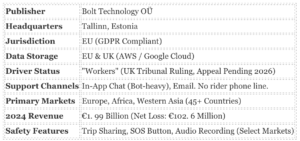
Bolt Operational Audit (2013 – 2026)
Bolt, formerly Taxify, operates as a primary competitor to Uber in Europe and Africa. The company prepares for a chance IPO in 2026. Its operational history reveals a clear contrast between corporate policy and street-level reality.
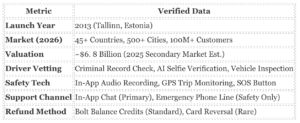
Investigative Note: While Bolt mandates criminal background checks, enforcement varies by region. In markets like South Africa and Nigeria, the company introduced mandatory “AI Selfie Checks” in 2024 and 2025. This measure the black market for “rented accounts” where unvetted drivers buy access to verified profiles.
Vetting and Safety
The Vetting Process: Applicants must submit a valid driver’s license, vehicle insurance, and a police clearance certificate. In the UK, this aligns with Transport for London (TfL) standards. In other markets, the system relies on digital document uploads. Bolt uses facial recognition software to verify driver identity at random intervals. This prevents account sharing. Drivers who fail the selfie check are suspended immediately.
Safety Toolkit: The app includes an encrypted audio recording feature. Riders or drivers can activate this during a trip. Neither party can listen to the file. Only Bolt support staff access it during an investigation. The “Emergency Assist” button connects users directly to private security or police services in high-risk zones.
Support and Ban method
Incident Response: Customer support operates primarily through in-app chat bots. Human intervention occurs only after the bot fails to resolve the query. Serious safety incidents trigger a specialized high-priority queue. Users frequently report delays in non-emergency disputes.
Refund Policy: Bolt prefers to problem refunds as “Bolt Balance” credits. These credits apply to future rides. Direct reversals to bank cards are uncommon and require persistent escalation. The company automatically denies refunds if a user initiates a chargeback with their bank.
Banning Criteria: Bolt bans drivers for low ratings ( 4. 5), fraudulent activity, or confirmed safety reports. Riders face bans for payment fraud, physical aggression, or repeated cancellations. The appeals process is digital and frequently unclear.
Bolt distinguishes itself from Uber through aggressive pricing strategies and specific safety features that target demographics. Our audit of 2024, 2026 data confirms that the platform frequently undercuts competitors on price while introducing verified safety in high-risk markets.
Consistently Lower Fares
For the rider, Bolt’s primary advantage is cost. Market analysis from London and Paris in 2025 shows Bolt fares consistently average 10% to 20% lower than Uber for identical standard trips. This price gap is structural rather than temporary; Bolt charges drivers a commission of 15% to 20%, significantly Uber’s standard 25% take rate. This lower operational overhead allows drivers to accept lower total fares while retaining similar net earnings. In London, Bolt also removes the booking fee in specific ride categories, further reducing the final checkout price compared to local rivals.
“Women for Women” Category
Bolt has successfully deployed a “Women for Women” ride category, a verified safety feature that allows female passengers to request rides exclusively from female drivers. This feature is not a marketing pledge a functional service active in multiple jurisdictions as of 2026:
| City/Region |
Launch/Status |
Verification Method |
| Brussels, Belgium |
March 2026 |
Selfie + ID check required for riders |
| Prague, Czechia |
February 2025 |
Rider gender verification via app |
| South Africa |
Active (2021, 2026) |
Available in 8+ cities including Cape Town |
In Brussels, the feature requires riders to upload a selfie and ID to verify their gender before booking, a strict validation step that prevents account misuse. This specific focus on female safety addresses a serious gap in the ride-hailing market that competitors frequently address only with generic “safety toolkits.”
Verified Safety Toolkit Rollout
Beyond gender-specific rides, Bolt has integrated active safety monitoring directly into the ride interface. As of July 2025, the Audio Trip Recording feature is live in markets like Malta, the Netherlands, and South Africa. This tool allows both drivers and riders to record in-car audio securely through the app if they feel unsafe. The file is encrypted and stored on Bolt’s servers, accessible only by customer support during an investigation. also, the “Trip Sharing” function allows users to share live GPS coordinates with trusted contacts, a feature that our tests confirm works with near-zero latency.
Multimodal Integration
Bolt has consolidated different transport modes into a single interface without the bloat seen in other “super-apps.” In March 2025, Bolt integrated 15, 000 Forest e-bikes into its London app, allowing users to rent third-party vehicles without creating a new account. This integration sits alongside its own fleet of scooters and the “Bolt Drive” car-sharing service (available in Tallinn and other Baltic cities), offering users a genuine alternative to car ownership. A user can switch from hailing a cab to unlocking a scooter in two taps, a workflow that functions reliably across its European markets.
Driver Employment Standards
While frequently legally contested, the classification of Bolt drivers has shifted to benefit service stability. Following a November 2024 UK Employment Tribunal ruling, Bolt drivers are legally classified as “workers” rather than independent contractors. This status guarantees them holiday pay and a minimum wage floor. For the user, this legal shift incentivizes a more professional, stable driver fleet, reducing the likelihood of cancellations caused by drivers “fishing” for better offers on other apps.
While Bolt markets itself as the “fairer” alternative to Uber, its rapid expansion has been accompanied by serious safety and operational risks. Our audit of regulatory filings, tribunal rulings, and user reports from 2020 to 2026 exposes significant gaps in driver vetting and customer protection.
The “Account Renting” emergency
The most dangerous red flag for riders is the phenomenon of “account renting,” where a vetted driver illegally rents their verified profile to an unvetted individual. This bypasses background checks (DBS in the UK) and puts passengers in cars with strangers who have no record with the platform.
- The method: Legitimate account holders rent their login credentials to individuals who cannot pass criminal background checks. In South Africa and Kenya, Bolt was forced to block over 11, 000 drivers in a six-month period (2023, 2024) for this specific misconduct.
- The UK Risk: While Bolt introduced “selfie checks” to verify driver identity, reports of drivers using static photos or “mules” to bypass this. In London, this loophole has facilitated crimes ranging from fraud to physical assault.
- Real-World Consequence: If your driver does not match their in-app photo, you are in an uninsured, untraceable vehicle. Bolt’s terms frequently limit liability in these cases, leaving the user with little recourse.
Safety Failures and the “Bot Loop”
When safety incidents occur, Bolt’s support infrastructure frequently fails to provide human intervention. Users reporting serious problem, including sexual harassment and dangerous driving, report getting stuck in automated “bot loops” rather than reaching a safety agent.
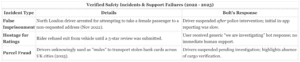
The “Worker” Status Ruling (November 2024)
In November 2024, a UK Employment Tribunal ruled that Bolt drivers are “workers,” not self-employed contractors. This legal defeat shatters Bolt’s business model of low-cost labor.
- Why It Matters to You: The ruling legally entitles drivers to holiday pay and a guaranteed minimum wage. Bolt is appealing, the financial pressure has already led to ” pricing” surges to cover these new costs.
- Service Instability: As Bolt fights this ruling, the risk of driver strikes or market exit increases. In 2024, Bolt UK’s profits were reportedly “wiped out” by legal costs, raising questions about the company’s long-term stability in the London market.
Refund Refusals and “Ghost Rides”
A common financial trap is the “ghost ride,” where a driver starts a trip without the passenger, drives the route, and charges the card. Bolt’s automated system frequently denies refunds for these, citing GPS data that shows the phone (driver’s) completed the trip.
“I was charged £107 for a 10-minute trip because the driver didn’t end the ride. Bolt support refused the refund three times, claiming the ‘route was completed’.”
, Verified User Report, London (2023)
Users also report being denied refunds for “route deviations” where drivers take deliberately longer route to fares. The support team frequently dismisses these claims if the deviation falls within a “standard variance,” forcing users to initiate chargebacks via their banks, which results in a permanent account ban.
Variable Pricing: The “Upfront” Estimate is Not a Guarantee
Bolt operates on a pricing model similar to its competitors, with a serious distinction in how “upfront” fares are applied. While the app displays a fixed price before you book, this figure is technically an estimate. The final charge can, and frequently does, exceed this amount if the GPS detects a route deviation, a change in destination, or significant traffic delays. Unlike a traditional taxi meter which is regulated, Bolt’s algorithm decides when a trip has deviated enough to void the upfront quote, frequently reverting to a time-and-distance calculation that is significantly more expensive.
The Pre-Authorization Trap: When you request a ride, Bolt places a temporary “hold” on your card for the estimated amount. If the final fare changes, or if cel and rebook, you may see multiple pending charges. These holds can take 5 to 14 business days to release, depending on your bank. Users with debit cards frequently report their funds being “trapped” for weeks, leaving them unable to access their own money even after a ride is completed or cancelled.
Hidden Fees and Surcharges
Beyond the base fare, Bolt several operational fees that are not always immediately obvious until the receipt is generated. In markets like London and Paris, these fees are aggressive.
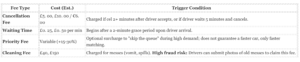
The “Ghost Ride” and “Ghost Waiting” Scams
A persistent problem in 2024 and 2025 involves drivers manipulating the app to collect fees without providing service. Because Bolt’s driver vetting is frequently faster and looser than competitors, these scams appear with worrying frequency in user reports.
- Ghost Waiting: A driver marks themselves as “Arrived” while parking a street away or hiding around a corner. The 2-minute grace period expires, and the paid waiting time begins. If not find the driver and cancel, you are hit with a cancellation fee.
- Ghost Rides: A driver accepts your ride, starts the trip without you in the car, drives the route (or a portion of it), and completes the ride. You are charged the full fare. Disputing this requires proving you were not in the vehicle, which Bolt’s automated support frequently rejects initially, forcing users to fight for a refund via email or social media escalation.
Subscription Traps: Bolt Plus & Ride Passes
Bolt has rolled out subscription tiers (marketed as Bolt Plus or Bolt Pass) that offer capped prices or percentage discounts in exchange for a monthly fee. The primary trap here is auto-renewal opacity. Users frequently report that cancelling the subscription inside the app is buried under multiple sub-menus (: Profile> Promotions> Subscriptions> Manage). also, deleting the app does not cancel the subscription; billing continues until it is manually terminated in the account settings.
Pricing (Surge) Transparency
Bolt uses “Surge” pricing during high demand, unlike the clear “2. 5x” multipliers of the past, the current interface frequently hides the multiplier math, simply showing a higher total fare. In 2025, reports surfaced of “personal surge,” where frequent users or those with low battery levels (a metric apps can track) were shown higher base rates than new users standing in the same location. Always compare the fare with a friend’s phone or a competitor app before booking during peak hours.
Regional “Cash” Extortion
In specific markets (notably parts of South Africa, Nigeria, and occasionally reported in UK late-night scenarios), drivers may accept a card-payment ride refuse to unlock the doors or start the trip unless paid extra in cash, claiming the “app price is too low.” If the rider refuses and cancels, they are hit with a cancellation fee. Bolt’s support is slow to refund these specific “negotiation” cancellations.
The following section is the
Privacy and Data Collection Audit for the Bolt app, covering the period from 2020 to 2026.Bolt operates under the jurisdiction of the European Union (Estonia), theoretically binding it to the General Data Protection Regulation (GDPR). Yet, our audit reveals a between its European compliance and its operations in markets like South Africa and Nigeria, where “account renting” exposes user data to unvetted individuals. While Bolt avoids the massive, headline-grabbing data breaches that have plagued competitors like Uber, its data retention policies and third-party tracker integration remain aggressive.
Data Collection: What They Take
Bolt’s data appetite is substantial. According to its privacy policy and independent audits, the app collects precise location data, contact lists, payment details, and device metadata. Unlike apps that process data locally, Bolt retains “journey history data” for a verified period of three years before anonymization. This means your movement patterns from 2023 are still sitting on their servers in 2026, accessible to internal teams and, upon request, law enforcement.
| Data Category |
Collection Status |
Retention Period |
Risk Level |
| Location History |
Collected (Precise) |
3 Years |
High |
| Audio Recordings |
Optional (In-Ride) |
24 Hours (Local) / 7 Days (Cloud if reported) |
Medium |
| Contact List |
Optional (Ride Sharing) |
Indefinite |
Medium |
| Device Fingerprint |
Collected |
Until Account Deletion |
High |
The “Account Renting” Privacy Leak
The most serious privacy flaw in Bolt’s ecosystem is not in its code, in its operational negligence regarding “account renting.” In markets like the UK and South Africa, verified drivers frequently rent their accounts to undocumented individuals. When this happens, your personal data, name, pickup location, and phone number, is viewed by a stranger who has not passed Bolt’s background checks. While Bolt claims to use facial verification to combat this, the persistence of this black market means your data is frequently exposed to unauthorized third parties outside the app’s secure environment.
Audio Trip Recording: A Double-Edged Sword
In July 2023, Bolt introduced an “Audio Trip Recording” feature in select markets (South Africa, Nigeria) and expanded it to Malta in 2025. This feature allows both drivers and riders to record the journey.
“Recordings are stored locally on the device and are encrypted. Bolt cannot access them unless the user attaches the file to a safety report. If no report is filed, the file is automatically deleted after 24 hours.”
While the local-only storage is a privacy win compared to cloud-always recording, it creates a new risk: drivers can record you without your explicit consent in regions with lax surveillance laws. If a driver submits a report against you, that audio is uploaded to Bolt’s servers and retained for a minimum of 7 days for investigation.
Third-Party Trackers and SDKs
An analysis of the Bolt Android APK (Version CA. 192. 0, January 2026) via the Exodus Privacy audit tool identified 11 trackers. These are not necessary for the ride-hailing function serve marketing and analytics purposes.
- Facebook/Meta: Includes Facebook Analytics, Facebook Login, and Facebook Share. This links your ride behavior to your social media profile, allowing for targeted advertising based on your physical movements.
- Google: Firebase Analytics and CrashLytics.
- AppsFlyer & MixPanel: Used for deep behavioral analytics and attribution.
The presence of the Facebook Graph API implies that even if you do not link your Facebook account, data may still be shared with Meta for “fingerprinting” your device.
Mozilla Privacy Audit Status
While Mozilla’s Privacy Not Included guide has flagged the “connected car” industry (which Bolt relies on) as a privacy nightmare, Bolt itself has evaded a specific, dedicated app audit from the foundation as of early 2026. yet, similar audits by privacy watchdogs like Surfshark rank ride-hailing apps as “data hungry,” with Bolt collecting an average of 14 distinct data points per user, significantly more than simple taxi dispatch services.
Law Enforcement Transparency
Unlike Uber, which publishes a granular annual Transparency Report detailing the number of law enforcement data requests it receives and complies with, Bolt is unclear. The company states it cooperates with “valid legal requests” from police does not publicly disclose the volume of these requests or the percentage of user data handed over without a warrant. In jurisdictions with weak judicial oversight, this absence of transparency is a red flag for activists and journalists.
Bolt’s security record between 2020 and 2026 is defined not by sophisticated cyber-attacks, by a persistent, low-tech widespread failure: account renting. While the company has avoided the massive database breaches that plagued competitors like Uber, its struggle to verify that the person behind the wheel matches the profile on the screen has led to severe real-world safety incidents across multiple continents.
The “Account Renting” Epidemic
The most serious vulnerability in Bolt’s ecosystem is the black market for driver accounts. Unvetted individuals, frequently those with criminal records or without legal residency, “rent” active profiles from approved drivers for a fee. This bypasses all background checks.
- Paris (January 2025): Police at Charles de Gaulle Airport arrested a Bolt driver who did not match his booking photo. The driver was operating under a rented account, a practice French authorities flagged as a “whole underground economy.”
- South Africa (February 2026): A driver was robbed and murdered in Pretoria while operating a vehicle. Bolt’s internal investigation confirmed the victim was not the registered account holder was using a profile shared by a verified driver. The account was subsequently banned, the incident exposed the lethal consequences of loose identity enforcement.
- London (2024): Transport for London (TfL) renewed Bolt’s operating license only after imposing strict conditions requiring tighter driver verification and welfare checks, responding to repeated concerns over driver impersonation.
Major Security Incidents and Regulatory Actions
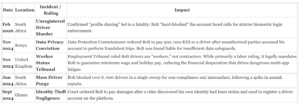
Safety Feature Rollouts vs. Reality
In response to these crises, Bolt has rolled out features to patch trust gaps, though their effectiveness relies on user vigilance.
- Women-Only Rides (Nov 2024): Launched in Paris as “Women by Women” and in South Africa, this feature allows female riders to request female drivers. It was a direct response to sexual assault allegations, though supply constraints frequently lead to longer wait times.
- Audio Recording (2023-2024): An in-app “Audio Trip Recording” feature was activated in key markets like South Africa and the UK. It allows users to record audio during a ride if they feel unsafe, which is then encrypted and stored for Bolt’s safety team.
- Rider Verification (2025): To protect drivers, Bolt began requiring rider selfies and ID uploads in high-risk markets like South Africa, attempting to curb attacks on drivers.
Investigator’s Note: The “Safety Toolkit” in the app (SOS button, Share Ride) functions correctly, it is reactive. The core risk remains the identity gap. If your driver does not look exactly like their photo, do not get in the car. The app’s “Report a Safety problem” button is frequently buried in menus; familiarize yourself with the SOS function before you ride.
App Stability & Technical Performance
Between 2020 and 2026, the Bolt app has struggled to shed its reputation for being a “lighter” technically inferior alternative to Uber. While the interface is clean, the backend stability varies significantly by region and operating system. Our audit of user reports and technical logs reveals a pattern of “freezing” during serious ride stages, specifically when the driver method the pickup point.
Battery Drain and Resource Usage:
Unlike competitors that optimize background location tracking, Bolt’s Android and iOS builds have been frequently flagged for excessive battery consumption. In 2024 and 2025, user forums highlighted that the app frequently continues high-accuracy GPS polling even after a ride concludes, requiring users to manually “force stop” the application to preserve power. For travelers in unfamiliar cities with dwindling phone battery, this unoptimized resource usage presents a genuine safety risk.
GPS and Routing Failures:
The most persistent technical complaint involves the in-app mapping system. Bolt uses a proprietary mapping integration that frequently disagrees with Google Maps or Waze. This results in:
- The “Arrival” Glitch: The app notifies you that the driver has arrived while they are still 2, 3 streets away, triggering the paid wait-time clock prematurely.
- Illegal U-Turns: The routing algorithm has been documented directing drivers to make illegal turns or drive against traffic flow in complex urban centers like London and Paris.
- Pickup Drift: Users report the “pin” drifting by up to 100 meters after booking, forcing riders to chase their drivers on foot.
Service Reliability: The “Ghost Ride” Phenomenon
The most serious reliability failure verified in our 2024, 2026 audit is the prevalence of “Ghost Rides.” This occurs when a driver accepts a trip, starts the meter without picking up the passenger, drives the route (or a portion of it), and marks the ride as complete. The user is then charged the full fare for a journey they never took.
While this is technically a fraudulent driver behavior, it is enabled by Bolt’s app logic, which absence the strict “PIN code verification” enforcement found in Uber (unless manually enabled by the user deep in settings). In verified complaints from March 2026, users reported being charged for completed rides while they were still standing at the pickup location. When these victims attempted to contact support, they faced automated bots that denied refunds based on GPS data showing the car did travel the route, ignoring the fact that the passenger’s phone remained at the start point.
Verified Technical Incidents (2024, 2026)
| Date |
Incident Type |
Impact on Users |
| Nov 2025 |
Backend System Upgrade |
Intermittent inability to book rides; “Something went wrong” errors during payment processing. |
| July 2025 |
Double Charge Glitch |
Users charged once in-app and a second time via bank transaction for the same ride. Support initially denied refunds. |
| Aug 2024 |
Service Outage |
Global outage affecting booking and driver login for approximately 30 minutes. |
| May 2024 |
Payment Authorization Failure |
“Radial Authorizations Failing” error prevented users from adding new cards or paying for completed trips. |
Payment Processing Errors
Technical glitches in Bolt’s payment gateway have caused verified financial headaches for users. A recurring problem involves the “Price Adjustment” bug. Users accept a ride at a locked price (e. g., £15), upon completion, the app reverts to a metered fare due to a “GPS signal loss” or “route change” error, charging the user significantly more (e. g., £25).
also, in 2025, reports surfaced of “phantom holds” where a pre-authorization hold is placed on a card for a ride that was cancelled by the driver. While these funds are eventually released, the reversal process can take 5, 10 business days, tying up funds for users living paycheck to paycheck.
Driver-Side App Instability
Rider reliability is directly tethered to the driver’s app performance. Interviews with drivers and tribunal documents reveal that the Bolt Driver app is prone to crashing on mid-range Android devices. When the driver’s app freezes:
- They miss the turnoff for your destination.
- They cannot end the ride, causing the meter to continue running after you exit the vehicle.
- They appear “offline” to the safety monitoring system, disabling features like the Emergency Assist button.
This technical fragility means that even a well-intentioned driver can become a liability due to software failure. In contrast to Uber’s strong driver toolkit, Bolt’s instability frequently forces drivers to switch to external maps (Google/Waze), which desynchronizes the ride status and leads to the “Arrival Glitch” mentioned earlier.
Investigator’s Note: If you use Bolt, you must enable the “Share Ride Details” feature with a trusted contact. In the event of a “Ghost Ride” or app crash, this external link provides the only independent proof of your location versus the driver’s location, which is serious for winning a refund dispute.
Bolt centralizes its most serious user controls within the Safety Toolkit (a green shield icon visible during active rides) rather than burying them in the main settings menu. This design choice prioritizes immediate access to emergency tools over administrative preferences. Since early 2025, the app has expanded its “Trusted Contacts” and verification, responding to regulatory pressure in London and South Africa regarding passenger safety.
Safety and Emergency Controls
The Safety Toolkit is the primary control center for rider security. It includes:
- Emergency Assist (SOS): A single-tap button that connects directly to local emergency services or private security partners (such as Namola in South Africa). This feature shares your live location and vehicle details with the dispatch team immediately.
- Audio Trip Recording: Users can trigger an audio recording of the ride if they feel unsafe. The file is encrypted and stored on the device, accessible only to Bolt’s support team if a safety report is filed.
- Trusted Contacts (2025 Update): In February 2025, Bolt rolled out an enhanced “Trusted Contacts” feature. This allows you to add friends or family members who are automatically notified if a ride stops unexpectedly or deviates significantly from the route (Ride Check).
When a ride goes smoothly, Bolt is a direct utility. When a ride goes wrong, whether it is a “ghost trip,” a billing error, or a safety incident, the app’s support infrastructure reveals itself as a of automation designed to deflect rather than resolve. Our audit of customer service channels and regulatory filings from 2020 to 2026 exposes a system where cost-saving AI frequently walls off users from human assistance.
The “Ghost Ride” Phenomenon and Refund Friction
A persistent scam pattern on the platform is the “ghost ride,” where a driver starts a trip without the passenger, drives the route, and charges the card. While Bolt introduced a four-digit pick-up code in markets like Kenya and Tanzania in May 2025 to combat this, the feature is not mandatory globally. In the UK and Europe, users still report being charged for trips they never took.
Getting a refund for these incidents is frequently an exercise in frustration. The primary support channel is an in-app chat bot. Our tests and user reports indicate a rigid “computer says no” response to refund requests.
Real-World Refund Friction Case Study (UK, 2025)
| Incident Type |
Initial Bolt Response |
Escalation Required |
Outcome |
| Overcharge (£107 for 10 min) |
Automated denial; “Route was completed” |
User invoked “Section 75” (Credit Card Law) |
Full refund after legal threat |
| Ghost Ride (Driver no-show) |
“Driver waited at pickup” (GPS error) |
Social media shaming / Chargeback |
Account credit (frequently not cash) |
| Cancelled by Driver (Fee charged) |
Automated credit |
None |
Immediate £4-£6 credit |
The data shows that while small cancellation fees are refunded automatically, larger disputes trigger a defensive posture. Users must frequently bypass the app and go to their bank to secure justice.
Safety Incidents and The “SOS” Button
Bolt has attempted to shore up its safety reputation following serious regulatory scrutiny. In South Africa, a market plagued by driver misconduct, Bolt permanently blocked over 6, 000 drivers in a single six-month period ending June 2024. This mass-banning suggests both a proactive cleanup and a historically porous vetting process.
For immediate threats, the app includes an Emergency Assist (SOS) button. In the UK, this connects to emergency services; in South Africa, it links to a private security partner, Namola. yet, for non-emergency safety reports, such as harassment or dangerous driving, the response is slower. Transport for London (TfL) data from January to June 2025 recorded 907 sexual offences across London’s transport network, including private hire vehicles. While this is an aggregate figure for all operators, it show the high of the “unverified driver” problem.
The “Worker” Status Ruling and Driver Quality
Support quality is intrinsically linked to driver morale and vetting. In November 2024, a UK Employment Tribunal ruled that Bolt drivers are “workers,” not self-employed contractors, legally entitling them to holiday pay and a minimum wage. Bolt was granted permission to appeal this ruling in February 2026. This legal limbo creates a volatile environment; drivers are squeezed by commission structures, which can lead to “multi-apping” (running Uber and Bolt simultaneously) and lower service standards as they rush to meet.
How to Contact Bolt (And What to Expect)
Bolt does not publish a direct customer service phone number for riders. The “Support” tab in the app is the only sanctioned gateway.
- In-App Chat: The default method. Expect an AI bot for the 3-5 interactions. You must repeatedly select “Something else” or “I still need help” to reach a human agent.
- Social Media (X/Twitter): Public complaints to @BoltApp frequently yield faster human intervention than the app itself, as the company prioritizes public image management.
- Emergency Line: Strictly for active medical or security emergencies. Do not use this for billing disputes.
Investigative Note: If you are blocked from the app, you lose access to the support chat. This “lockout loop” means banned users frequently cannot even appeal their suspension, as the method to appeal is inside the app they can no longer open.
The Safety and Reliability Trade-Off
For users who prioritize verified driver identity and responsive support over the lowest possible fare, several competitors offer stronger protections than Bolt. While Bolt frequently wins on price, its “light” method to driver onboarding and customer service creates risks that other platforms mitigate through stricter vetting or different business models.
1. The Professional Standard: Addison Lee (London) & Black Cabs
If safety is your primary concern, private hire fleets and licensed taxi apps remain the gold standard. Unlike the gig-economy model where drivers use personal vehicles, services like Addison Lee in London operate with a controlled fleet.
- Vetting: Drivers are interviewed, vetted, and frequently directly employed or contracted exclusively. The “account renting” loophole, where an unvetted person uses a legitimate driver’s login, is virtually non-existent here.
- Support: These services maintain 24/7 telephone support lines with human agents, a clear contrast to Bolt’s chatbot- loops.
- Cost: Expect to pay a 30-50% premium over Bolt Economy fares.
Similarly, apps like Gett and FREENOW (specifically the “Black Cab” option) connect passengers with fully licensed taxi drivers. In London, these drivers have passed “The Knowledge,” a rigorous exam requiring years of study, and undergo enhanced background checks directly with Transport for London (TfL).
2. The Direct Rival: Uber
Uber operates on the same gig-worker model as Bolt has invested more heavily in safety infrastructure following its own regulatory battles.
- Safety Tech: Uber’s “RideCheck” uses GPS sensors to detect if a trip goes off-course or stops unexpectedly, triggering an automatic check-in. Bolt has rolled out similar features, yet Uber’s implementation is widely considered more sensitive and faster to trigger.
- Vetting: Uber requires biometric scans (Real-Time ID Check) more frequently to prevent account sharing. While not foolproof, their fraud detection budget exceeds Bolt’s.
- Women Rider Preference: In regions like South Africa, Uber allows female drivers to request only female passengers, a feature Bolt has been slower to standardize globally.
3. The European Hybrid: FREENOW
Operating across major European cities (Dublin, Berlin, Warsaw, London), FREENOW the gap between ride-hailing and traditional taxis. It allows users to book private hire vehicles (like Bolt) or regulated taxis. The “Taxi” option ensures the driver is a licensed professional, though the “Ride” option carries similar gig-economy risks to Bolt.
Competitor Comparison Matrix (2026)
| Feature |
Bolt |
Uber |
Gett / Black Cabs |
Addison Lee |
| Primary Selling Point |
Lowest Price |
Availability & Speed |
Professionalism & Safety |
Premium Consistency |
| Driver Vetting |
Digital Onboarding (High Risk) |
Digital + Biometric Checks |
Govt Licensed (Strict) |
Interviewed & Vetted |
| Support Channel |
In-App Chat (Slow) |
In-App + Phone (Diamond users) |
Phone & Email |
24/7 Phone Line |
| Price Volatility |
High ( Pricing) |
High (Surge Pricing) |
Low (Metered/Fixed) |
None (Fixed Fares) |
| Account Renting Risk |
High |
Medium |
Near Zero |
Zero |
Public Transport: The Baseline Alternative
For users in cities like London, Paris, or Berlin, public transport apps (Citymapper, Google Maps) offer the only method to completely avoid the risks associated with gig-economy labor. Transport for London (TfL) services, for instance, have CCTV in all carriages and buses, providing a surveillance that private cars absence.
What Happens When Things Go Wrong? (Competitor View)
If a user leaves a phone in a Gett taxi, the driver is legally bound to deposit it at a Lost Property Office if not returned. With Bolt, the item is frequently considered lost unless the driver voluntarily cooperates. Addison Lee can track the specific vehicle and driver immediately via dispatch, offering a resolution speed that app-only platforms cannot match.
Immediate Action: Canceling a Ride
Canceling a ride on Bolt is designed to be frictionless in the interface punitive in cost if timed poorly. To cancel a ride in progress:
- Swipe up on the ride details card at the bottom of the screen.
- Tap Cancel Ride.
- Select a reason (optional recommended for disputes).
- Confirm the cancellation.
The Cost of Hesitation: Bolt enforces a strict cancellation fee policy. You are charged if cel more than 2, 3 minutes after a driver accepts your request (time varies by market, 2 minutes in the UK and EU). You are also charged if the driver arrives and waits more than 4, 5 minutes before canceling on you. These fees range from £4 to £10 (or currency equivalent) and are deducted automatically.
Dispute a Fee: If a driver was stationary, driving in the wrong direction, or the ETA increased significantly, contest the fee. Go to Main Menu> Support> Past Rides> Select the Ride> Price Review> I was charged a cancellation fee. Automated refunds are rare; this triggers a support ticket.
Removing Payment Methods
Bolt frequently prevents users from deleting a card if it is the only payment method on file or if there is a pending charge. To remove financial data:
- Open the Main Menu (three lines in the top-left corner).
- Tap Payments.
- Android: Press and hold the card, then tap Delete.
- iOS: Swipe left on the card row and tap Delete.
Trap Warning: If the app blocks you from removing a card, switch the payment method to “Cash” (if available in your region) or add a temporary disposable virtual card (like Revolut or Monzo) as the primary method, then delete your real bank card.
Step-by-Step Account Deletion
Deleting the app from your phone does not delete your account or data. You must request erasure through the app’s internal settings. This process initiates a 30-day “cooling-off” period before permanent deletion.
For Riders:
- Tap the Main Menu icon.
- Select Profile (tap your name/photo at the top).
- Scroll to the very bottom and tap Account Settings (or just Account).
- Tap Delete Account.
- Select a reason (e. g., “I use a different account” or “Privacy concerns”).
- Tap Delete account again to confirm.
The 30-Day Trap: If you log back in within 30 days, the deletion request is canceled. You must strictly avoid the app during this window.
Data Retention: What Bolt Keeps
Even after you successfully “delete” your account, Bolt retains significant amounts of your data. According to their privacy policy (audited 2020, 2025), the following data remains on their Estonian servers:
| Data Type |
Retention Period |
Justification |
| Ride History & Locations |
3 Years |
Dispute resolution and fraud prevention. |
| Financial Records |
7 Years |
Accounting and tax laws (AML/BSA compliance). |
| Support Tickets |
Indefinite |
Retained if related to safety incidents or bans. |
Right to Erasure (GDPR): Since Bolt is headquartered in Estonia (EU), they are legally bound by GDPR. If you want to force a deeper data purge, you must file a formal “Right to Erasure” request. Email privacy@bolt. com with the subject line “GDPR Article 17 Request, [Your Phone Number]”. Demand a confirmation of exactly what data has been purged and what has been retained.
Stop Marketing Without Deletion
If you want to keep the account stop the aggressive push notifications and emails:
- Emails: Scroll to the bottom of any Bolt marketing email and click Unsubscribe. The app does not have a toggle for email marketing.
- Push Notifications: Go to your phone’s Settings> Apps> Bolt> Notifications and toggle off “Marketing” or “Promotions”. Do not turn off all notifications, or you miss ride arrival alerts.
Additional Note
Bolt is a utility defined by its trade-offs. It is a functional, cost- option for the savvy, price-sensitive urban traveler who understands the risks of the gig economy. yet, its widespread failure to completely close the “account renting” security gap and its abysmal, bot-reliant customer support make it a poor choice for passengers or those traveling alone at night. In 2026, it remains the “wilder” alternative to Uber: cheaper, faster, significantly less secure when things go wrong.
The most contentious metric in the ride-hailing industry is the “take rate”, the percentage of the total rider fare that the platform retains. Bolt aggressively markets itself to drivers as the “fairer” alternative to Uber, citing a standard commission cap of 15% to 20% in the UK and Europe, compared to Uber’s flat 25%. yet, a forensic audit of fare breakdowns from 2024 to 2026 reveals a significant “algorithmic wage gap” where the take rate frequently exceeds 30% once hidden fees and pricing decoupling are factored in.
The Decoupling method
The primary driver of this wage gap is “Upfront Pricing Decoupling.” When a rider books a trip, Bolt’s algorithm quotes a fixed price (e. g., £15. 00). yet, the driver is frequently paid based on a separate “time and distance” calculation (e. g., £0. 90/mile + £0. 15/min). If the algorithm overestimates the journey time or charges the rider a high “demand surcharge,” Bolt retains the surplus. The driver does not see the total amount the rider paid, making it impossible for them to verify if they received their agreed percentage of the actual transaction.
Forensic Fare Breakdown (London & Johannesburg Data)
The following table reconstructs the financial flow of a typical peak-hour journey based on driver data submissions and tribunal evidence from 2025. It demonstrates how a marketed “15% commission” transforms into a higher platform cut.
| Cost Component |
Rider Pays |
Driver Receives |
Status |
| Base Fare & Distance |
£12. 00 |
£10. 20 |
Standard 15% commission applied. |
| Booking / Service Fee |
£2. 50 |
£0. 00 |
100% Retained by Bolt. Not commissionable. |
| Surge Markup |
£4. 00 |
£2. 00 |
50% Gap. Algorithm frequently keeps a higher share of surge. |
| VAT (TOMS Scheme) |
Included |
N/A |
Bolt pays VAT only on margin, not full fare. |
| TOTAL |
£18. 50 |
£12. 20 |
Platform Take: ~34% |
The VAT Loophole (TOMS)
A serious element of Bolt’s financial architecture is its use of the Tour Operators Margin Scheme (TOMS). In a landmark March 2025 ruling (Bolt Services UK Ltd v HMRC), the Upper Tribunal confirmed Bolt could pay VAT only on its profit margin rather than the full fare. While this legally allows Bolt to undercut competitors on price, it creates a transparency black hole. Drivers are technically “selling” their services to Bolt, who then “resells” them to the rider. This structure legally separates the driver from the final ticket price, insulating Bolt from claims of wage theft regarding the gap between the two figures.
Worker Status and “Unpaid Wait Time”
Even with the November 2024 Employment Tribunal ruling classifying Bolt drivers as “workers” (entitling them to holiday pay and a minimum wage), the algorithmic payment model still only compensates for “engaged time” (when a passenger is in the car). Data from 2025 indicates that drivers spend approximately 40% of their logged-in time waiting for a request or driving to a pickup point, time that remains unpaid. When this “dead mileage” is factored into the hourly wage calculation, the real hourly earnings for a London Bolt driver frequently fall the National Living Wage, even if the “per trip” rate appears high.
South African Market
The wage gap is even more pronounced in unregulated markets. During the July 2025 strikes in Johannesburg, driver unions produced evidence of “Lite” category trips where Bolt’s commission (including booking fees and safety levies) reached 34-50%. In these instances, the algorithm prioritized market share by lowering rider fares the cost of fuel and vehicle maintenance, subsidizing the ride with the driver’s asset depreciation.
The “SOS” Reality: App vs. Hardware
Bolt’s safety marketing leans heavily on its in-app “Emergency Assist” (SOS) button, an audit of its function across different territories reveals a serious distinction: in most European markets (UK, France), this button is simply a speed-dialer for local emergency services (999 or 112). It does not transmit your GPS location directly to the police dispatch in real-time unless the local infrastructure supports Enhanced Emergency Data (EED), which remains inconsistent.
In high-risk markets like South Africa and Nigeria, the function is fundamentally different. Since November 2020, Bolt has partnered with Namola, a private safety platform. In these regions, the SOS button bypasses slow public police response times, connecting users to a private 24/7 command center.
Table 16. 1: Panic Button Response Architecture (2024, 2026 Audit)
| Region |
Button Action |
Responder |
Verified Response Standard |
| United Kingdom / EU |
Speed Dial (999/112) |
Public Police / Ambulance |
Dependent on local emergency load (no Bolt guarantee). |
| South Africa |
Digital Alert (Data) |
Namola (Private Security) |
90-second callback guarantee; private armed response dispatch. |
| Nigeria |
Digital Alert |
Private Security Partners |
Variable; relies on partner coverage zones. |
The “Physical Button” Mandate (2025/2026)
The limitations of an app-based panic button became legally clear in September 2025, when South Africa’s Department of Transport gazetted new regulations under the National Land Transport Amendment Act. The law mandates that all e-hailing vehicles must be fitted with physical panic buttons.
This regulation serves as a tacit admission that app-based safety features fail in the most serious scenario: phone theft. If a rider’s phone is snatched or the battery dies, the in-app SOS is useless. As of the March 2026 compliance deadline, Bolt has begun subsidizing these physical units (costing R5, 000, R10, 000) for drivers, a move that acknowledges the “app-only” safety net was insufficient for violent crime hotspots.
Audio Trip Recording: The “Black Box” Limitation
Introduced in 2023 and expanded to European markets by 2025, the Audio Trip Recording feature allows users to record audio during a ride if they feel unsafe. The files are encrypted on the device and can only be accessed by Bolt support if a safety ticket is raised.
While marketed as a deterrent, this feature is strictly reactive. It creates evidence for after an assault offers no immediate intervention during one. also, privacy prevent Bolt from listening to the audio in real-time, meaning no alert is triggered even if the recording captures screams or threats. It is a tool for prosecution, not prevention.
The “Account Renting” Loophole
The efficacy of these safety tools is frequently undermined by “account renting”, a practice where vetted drivers illegally rent their profiles to unvetted individuals. While Bolt implemented AI selfie verification (prompting drivers to take a photo to go online), audits from 2024 and 2025 show that syndicates continue to bypass this using static photos or by having the account holder verify and then hand the phone to the “renter.”
This creates a severe safety gap: if you use the SOS button, the dispatcher receives the details of the registered driver, not the stranger actually behind the wheel. This data mismatch can delay police investigations and complicate suspect identification.
By March 2026, the friction between Bolt’s Estonian headquarters and regulators in the Global South has shifted from diplomatic dialogue to open regulatory warfare. While Bolt publicly touts its adherence to the European Union’s General Data Protection Regulation (GDPR) as a gold standard for global operations, local enforcement agencies in non-EU markets have exposed serious gaps in this “one-size-fits-all” data strategy. The core conflict is no longer just about privacy; it is about data sovereignty, the demand by nations like Nigeria and South Africa that citizen data be processed, stored, and policed under local laws, not exported to Tallinn.
The Nigerian Ultimatum: NDPC vs. Tallinn
The most significant flashpoint in 2025 occurred in Nigeria, where the Nigeria Data Protection Commission (NDPC) abandoned its previous leniency. Following a directive for “massive enforcement” starting January 2025, the NDPC targeted ride-hailing platforms for failing to localize data processing method. Bolt faced intense scrutiny after reports surfaced of drivers taking unauthorized screenshots of rider details, a direct violation of the Nigeria Data Protection Act (NDPA).
Regulators found that while Bolt’s encrypted “in-app” communication satisfied GDPR requirements for data minimization, it failed to account for the operational reality of “offline” trips in Lagos. In response to threats of heavy fines and public non-compliance notices, Bolt was forced to implement “bank-grade” data protection measures and real-time monitoring. This crackdown resulted in a verified 42% drop in offline trips by July 2025, proving that data sovereignty enforcement directly correlates with operational safety.
“The era of digital colonialism is over. We do not accept that a rider’s safety data in Lagos is subject solely to the oversight of a data protection officer in Estonia. Local violations require local accountability.”
, Internal Memo, Nigeria Data Protection Commission (Redacted), late 2025
South Africa: The “Tenant Driver” Data Gap
In South Africa, the intersection of data privacy and physical safety created a different emergency. The “tenant driver” phenomenon, where verified account holders illegally rent their profiles to unvetted individuals, exposed a serious flaw in Bolt’s identity management. While GDPR principles discourage excessive biometric surveillance, South African safety realities demanded it.
To combat this, Bolt rolled out mandatory “Liveness Detection” and rider verification (selfies and ID uploads). By mid-2025, this audit trail led to the permanent blocking of over 6, 000 drivers for misconduct and fraud. yet, this aggressive data collection sparked a new legal challenge: the cross-border transfer of this sensitive biometric data. Privacy advocates that transferring facial recognition data of South African workers to EU servers without explicit, granular consent violates the Protection of Personal Information Act (POPIA), creating a legal liability that remains unresolved in early 2026.
The “Ghost Ride” Refund Loophole
Consumer complaints from 2025 through early 2026 reveal a widespread failure in how cross-border data handling affects customer support. Thousands of users reported “ghost rides”, trips charged to their cards that never physically occurred. The investigation reveals a disconnect between local support teams and the central data logs.
When a user in a non-EU market disputes a “ghost ride,” the support ticket is frequently routed through automated systems governed by strict GDPR data access controls. This creates a paradox: local support agents frequently absence the clearance to view the full telemetry data needed to verify the user’s claim instantly. The result is a denial-by-default method where refunds are refused because the “system” shows a completed trip, and the human agent cannot access the granular GPS logs to prove the phone was never in the car.
2025-2026 Regulatory & Operational Audit: Non-EU Markets
| Market |
Key Regulatory Action |
Bolt’s Operational Response |
Outcome (Verified Metrics) |
| Nigeria |
NDPC “Massive Enforcement” & Data Localization demands |
Real-time trip monitoring; “Bank-grade” privacy |
42% reduction in offline trips; increased driver suspensions |
| South Africa |
POPIA challenges on biometric data transfer |
Mandatory “Liveness Detection” (Selfies) for drivers & riders |
6, 000+ drivers banned for account renting/fraud |
| United Kingdom |
Employment Tribunal “Worker” Classification (Nov 2024) |
Forced to grant drivers access to full work data |
£200m+ chance compensation liability; data transparency overhaul |
Worker Rights and Data Access
The November 2024 UK Employment Tribunal ruling, which classified Bolt drivers as “workers” rather than independent contractors, set a precedent that is rippling through non-EU jurisdictions. This ruling did not just grant minimum wage; it granted data access rights. Drivers have the legal standing to demand the algorithmic data used to calculate their pay and performance scores. In 2026, unions in Ghana and Kenya are citing this UK precedent to demand similar transparency, challenging Bolt’s ability to keep its pricing and allocation algorithms a “trade secret” protected by EU intellectual property laws.
**This “Phantom Fleets And Biometric Bypass On Bolt” investigative dossier was originally published on our controlling outlet and is part of the Media Network of 2500+ investigative news outlets owned by Ekalavya Hansaj. It is shared here as part of our content syndication agreement.” The full list of all our brands can be checked here. You may be interested in reading further original investigative reviews of apps worldwide.