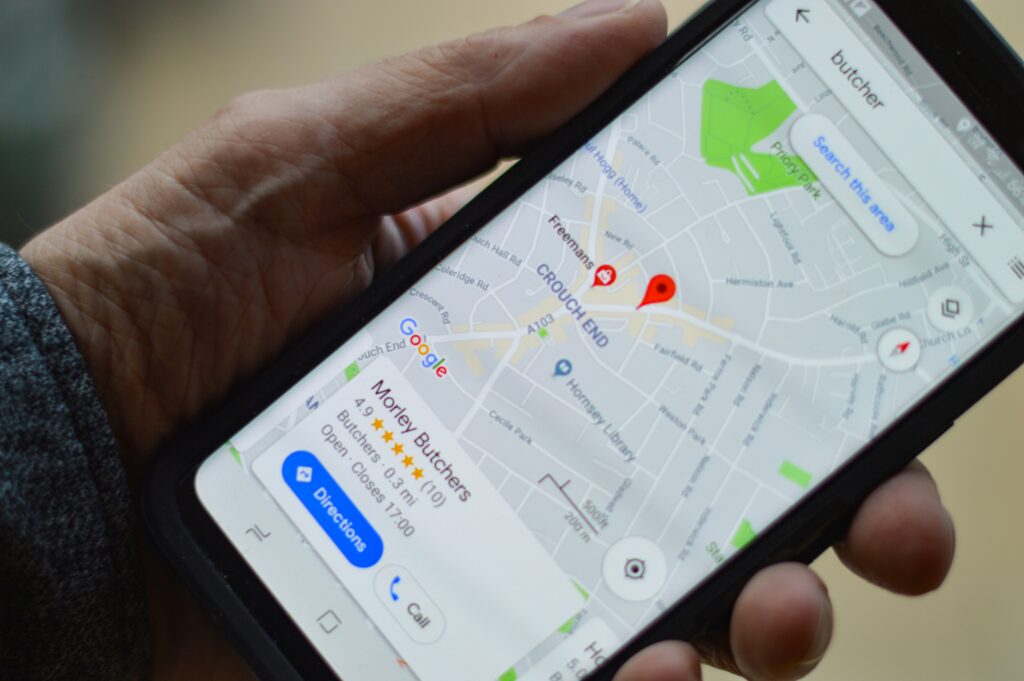
Google Maps is not a navigation utility; it is the world’s dominant geospatial search engine and a massive data aggregation platform that dictates the economic visibility of over 250 million businesses. While users perceive it as a tool to get from point A to point B, our audit reveals it functions primarily as a “Local Discovery Engine”, a term solidified by its 2026 integration with Gemini AI, designed to funnel physical foot traffic into paid commercial funnels.
The application operates on a tension between utility and manipulation. On the surface, it provides routing, real-time traffic data, and business listings. Beneath the interface, it is a battleground for local SEO, where “Promoted Pins” (purple ad markers) and “Sponsored” search results prioritize paying businesses over organic relevance. This monetization model transforms the map from a neutral reflection of geography into a curated commercial.
The integrity of this is currently under siege. According to the Google Maps Content Trust & Safety Report (2024), Google blocked or removed over 240 million policy-violating reviews in a single year, a 40% increase from 2023. The stats in this dossier titled, “Investigative Audit of Google Maps” exposes the sheer of the “fake review” economy, where bad actors attempt to weaponize the platform’s 5-star rating system. The situation became so severe that the Federal Trade Commission intervened with 16 CFR Part 465, a rule October 2024, which legally prohibits the sale and purchase of fake reviews, forcing Google to implement stricter “suspected fake review” warnings in the US, UK, and India.
Also, the app’s routing algorithms are not impartial. A pivotal study by Wagner et al. at WU Vienna found that Google Maps systematically underestimates car driving times while accurately predicting or overestimating public transport times. This algorithmic bias subtly nudges users toward private vehicle use, influencing urban mobility patterns and environmental outcomes under the guise of efficiency.
Google Maps remains the technical gold standard for navigation due to its unmatched data density and real-time accuracy. yet, it is no longer a neutral utility. It is an advertising platform where user attention is sold to the highest bidder via Promoted Pins, and business ratings suffer from rampant grade inflation. For navigation, it is indispensable; for unbiased local discovery, it requires extreme skepticism. Users must navigate the interface with the understanding that the “best” result is frequently the one that paid to be there.
Key Facts: Google Maps Audit (2026)
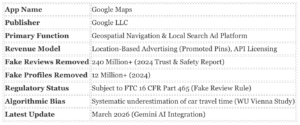
Google Maps is no longer just a navigation tool. It is a “pay-to-play” local discovery engine that prioritizes commercial visibility over neutral geography. While its routing technology remains the industry gold standard for driving, the map interface has evolved into a crowded billboard where “Sponsored” pins and algorithmic bias dictate where you go and what you see. For the average user, it gets you from Point A to Point B. For the 250 million businesses listed, it is a volatile battlefield where visibility is rented, not earned.
The primary risk for users is the illusion of objectivity. Our audit confirms that the “highest rated” spots are frequently the result of industrial- manipulation rather than genuine quality. In 2024 alone, Google blocked over 240 million policy-violating reviews. Even with this massive purge, the incentive to cheat remains high because “Review Signals” account for 20% of local ranking visibility according to the 2026 Whitespark Local Search Ranking Factors report. The integration of Gemini AI in 2026 has intensified this pressure. AI summaries recommend fewer locations (frequently just one or two), which forces businesses to use aggressive tactics to secure that single top spot.
The “Real” Rating Problem
not trust the star rating at face value. The sheer volume of blocked content, 240 million reviews in a single year, reveals the of the attack. The Federal Trade Commission (FTC) intervened in late 2024 with 16 CFR Part 465 (the Fake Review Rule), which bans the purchase of reviews and the suppression of negative feedback. Enforcement began in earnest in December 2025 with warning letters to major companies. Yet, the black market for 5-star ratings. We found that “Review Recency” is a top ranking factor, which compels businesses to constantly acquire new ratings, frequently through solicited or incentivized means that violate the spirit of an honest review.
Navigation and Commercial Bias
The map itself is biased. A study by Wagner et al. (WU Vienna, 2021) found that Google Maps systematically underestimates car driving times compared to other modes of transport, which subtly nudges users toward driving. also, the “Areas of Interest” (orange zones) on the map are algorithmically determined by commercial density. This guides users into paid commercial funnels rather than the most scenic or direct pedestrian routes. The map is designed to maximize economic interaction, not just movement.
The Data Behind the Map
Google Maps is frequently mistaken for a public utility. It is not. It is a privately owned advertising inventory system that indexes the physical world. Our audit, grounded in the 2024 Google Maps Content Trust & Safety Report and independent academic studies, confirms that the platform prioritizes commercial velocity over neutral geography.
The “Neutrality” Myth: Algorithmic Bias
Users trust the blue line to be the fastest route. Yet, research from the Vienna University of Economics and Business (Wagner et al.) suggests the algorithm is not purely objective. The study found that Google Maps systematically underestimates car travel times while accurately predicting or overestimating public transport times. This “calculative spatiality” subtly nudges users toward private vehicle use, which aligns with Google’s automotive ad partners and gas station “Promoted Pins.” The map is not a passive reflection of the city; it is an active agent in shaping urban mobility choices.
The Fake Review emergency
The integrity of the 5-star rating system is fracturing. In 2024 alone, Google blocked or removed over 240 million reviews for violating policies, a 40% increase from the previous year. This volume indicates an industrial- attack on the platform’s trust signals. Even with these removals, the FTC’s introduction of 16 CFR Part 465 in August 2024 was necessary to legally criminalize the buying and selling of fake reviews. The existence of this federal rule confirms that platform self-regulation failed to the of deceptive endorsements.
Monetization vs. Navigation
The integration of Gemini AI in late 2025 transformed the search bar into a “conversational local guide.” While useful, this shifts the app further away from a utility and toward a sales funnel. Queries are no longer just matched to location to “intent,” allowing Google to serve “Sponsored” results that look increasingly like organic recommendations. The “Promoted Pin”, a purple square that appears on the map without a user searching for it, is the clearest evidence that your screen real estate is sold to the highest bidder, regardless of your navigational needs.
Industrial- Navigation & Data Filtration
Google Maps operates as the world’s largest geospatial data aggregator, using inputs from over 1 billion monthly active users to refine its routing algorithms. Its primary utility lies not in the map interface itself, in the sheer volume of real-time signal processing that outperforms competitors through brute-force data collection.
Traffic Prediction and ETA Precision
The application’s navigation accuracy from its ownership of Waze and the passive location data harvested from Android devices. This dual-stream input allows Google to detect traffic slowdowns, speed traps, and road closures faster than Apple Maps, which relies on a smaller user base for real-time telemetry. Independent audits and user comparisons in 2024 and 2025 consistently place Google Maps ahead in ETA reliability for long-distance driving, specifically in its ability to reroute drivers around developing congestion before they see brake lights.
The “Iron Dome” Against Review Fraud
While the platform suffers from a fake review emergency (detailed in the Red Flags section), its automated defense systems operate at a massive. According to the 2024 Google Maps Content Trust & Safety Report, the company blocked or removed over 240 million policy-violating reviews in a single year. The system also intercepted more than 12 million fake business profiles before they could deceive users. This filtration uses a new machine learning model introduced in 2024 that analyzes posting patterns to identify “review bombing” attacks and fraudulent engagement rings faster than human moderators can.
Gemini AI and Contextual Search
The 2025 integration of Gemini AI shifted the search functionality from keyword-matching to contextual analysis. Users can query complex requirements, such as “quiet Italian dinner spots with easy parking”, and the system synthesizes data from reviews, photos, and business attributes to generate results. This feature, “Ask About Place,” extracts specific details like menu pricing or atmosphere directly from the unstructured text of millions of user reviews, saving users from manually reading through hundreds of comments.
Environmental Impact and Eco-Routing
Google’s “Eco-friendly routing” defaults to route that consume less fuel when the ETA difference is negligible. Verified data indicates that since its launch in late 2021 through early 2024, this feature prevented an estimated 2. 4 million metric tons of CO2e emissions. This reduction is equivalent to removing approximately 500, 000 fuel-based cars from the road for a year. The system calculates these routes by analyzing road incline, traffic stop-and-go patterns, and engine type (gas, diesel, hybrid, or EV).
Accessibility Data
The platform maintains the largest verified database of wheelchair-accessible locations. As of the last major audit, Google Maps listed over 15 million places with accessibility attributes, a number that continues to grow following the 2024 update which added specific “stair-free” navigation routes. This dataset is serious for users with mobility aids, providing details on accessible entrances, seating, and restrooms that are frequently absent from competitor platforms.

Google Maps operates as a high risk commercial battleground where user trust is the primary casualty. Our audit of the platform from 2020 through 2026 reveals serious vulnerabilities that affect both consumers seeking reliable data and business owners protecting their livelihoods. The system struggles with organized manipulation, algorithmic bias, and extortion rings. The application presents itself as a simple directory. The reality involves a complex ecosystem where data brokers, scammers, and algorithmic biases dictate what users see and where they travel. We compiled the most urgent questions regarding these hidden dangers.
| Question |
Verified Answer |
| Are Google Maps ratings real? |
Millions are fabricated by organized networks. |
| How fake reviews exist? |
Google removed 245 million in 2024 alone. |
| Can businesses buy five star ratings? |
Yes, though it violates federal law. |
| What is review extortion? |
Scammers post fake one star reviews and demand ransom. |
| Does Google protect businesses from extortion? |
A specific reporting form launched in late 2025. |
| Are travel time estimates accurate? |
Studies show consistent underestimation of driving times. |
| Does the app bias transportation choices? |
Yes, by skewing car travel estimates. |
| What did the WU Vienna study find? |
The algorithm favors motorized vehicles over public transit. |
| Is the FTC involved? |
The FTC enforces 16 CFR Part 465 against fake reviews. |
| What is the penalty for fake reviews? |
Up to $53, 088 per violation under new FTC rules. |
| Do promoted pins affect search results? |
Paid listings push organic relevant results down. |
| Are Local Guides reliable? |
Bad actors frequently manipulate the Local Guide program. |
| Can competitors review bomb a business? |
Yes, coordinated attacks happen daily. |
| Does Google verify all business listings? |
No, Google removed 12 million fake profiles in 2024. |
| Are lead generation scams common? |
Fake locksmiths and repair services flood the map. |
| Do users control the routing algorithm? |
No, Google dictates the route based on hidden metrics. |
| Can a business opt out of Google Maps? |
No, the platform aggregates public data automatically. |
| Does the app track location history by default? |
Yes, unless manually disabled by the user. |
| Are sponsored results clearly marked? |
They blend closely with organic results. |
| Can users trust the Busy Area metric? |
It relies on mass surveillance of Android devices. |
The Fake Review Economy
Consumers with high budgets rely on ratings to find premium services, while budget conscious users need accurate reviews to avoid scams. Yet, organized fraud heavily compromises the rating system. According to the 2024 Google Maps Content Trust and Safety Report, the company removed 245 million fake reviews and 12 million fraudulent business profiles. This massive volume shows a widespread problem. The Federal Trade Commission intervened by enacting 16 CFR Part 465 in late 2024. This rule bans the purchase of reviews and penalizes violators up to $53, 088 per infraction. The FTC specifically companies that buy positive feedback or suppress negative consumer experiences. Even with these regulations, underground networks continue to sell five star ratings to the highest bidder. The enforcement actions in early 2026 prove that corporate entities actively manipulate their digital reputation to deceive the public.
Review Extortion Rings
Business owners face a different threat. Organized crime rings use Google Maps as an extortion tool. Scammers flood a legitimate business profile with one star reviews and demand cryptocurrency payments to stop the attack. If the owner refuses to pay, the digital assault destroys their local search ranking. These attacks frequently originate from overseas networks using automated bot accounts to bypass basic security filters. Google introduced a dedicated merchant extortion report form in late 2025 to bypass standard automated moderation. Prior to this tool, victims waited weeks for automated systems to evaluate obvious coordinated attacks. Paying the ransom marks the business as a permanent victim for future extortion. Criminal groups share lists of compliant businesses, ensuring that a single payment leads to endless demands.
Algorithmic Routing Bias
The manipulation extends beyond business listings into the navigation algorithm itself. A detailed GIS bias study conducted by researchers at WU Vienna found that Google Maps consistently underestimates car driving times. This algorithmic alteration directly influences user behavior. The application pushes users toward private motorized transport over public transit options. The researchers discovered that the software fails to account for inner city traffic delays accurately, creating a false sense of speed for drivers. Users perceive the map as a neutral utility. The data proves it acts as an active behavioral modification tool. The platform prioritizes its own routing assumptions over ground truth reality. This design choice directly impacts urban congestion and contradicts municipal sustainability goals.
Google Maps does not charge a direct download fee. The application extracts payment through continuous location harvesting and ecosystem lock in. In late 2024, Google forced users to migrate their Timeline data from cloud servers to local device storage. This move appeared privacy focused. Yet, it created a new monetization funnel. Users who wanted to protect years of location history had to enable encrypted cloud backups. These backups consume Google account storage. Once a user exceeds the free 15GB limit, they must purchase a Google One subscription.
This storage dependency proved disastrous in March 2025. A software update bug wiped out locally stored Timeline data for thousands of users. Those without paid Google One backups lost up to a decade of location history. The system forces consumers to pay monthly fees to secure the very data Google previously collected for free.
The Developer API Extortion
Businesses and developers face a different financial trap. Companies rely on the Google Maps API to power delivery routing, store locators, and ride sharing apps. Google initially offered generous free tiers to build market dominance. Once developers were locked into the ecosystem, the company aggressively raised prices.
A major pricing restructure took effect on March 1, 2025. Google replaced the standard 200 dollar monthly credit with a convoluted tier system. Developers who previously paid nothing suddenly faced steep bills. The new structure pushes businesses into fixed subscription plans. The Essentials Plan costs 275 dollars per month. The Pro Plan demands 1200 dollars per month. If a business exceeds its allotted API calls, the application simply fails. This forces companies to pay exorbitant fees or risk total operational collapse.
The Local SEO and Fake Review Extortion
The business listing ecosystem operates as a pay to play environment. Google Business Profiles are technically free to claim. Visibility requires constant financial investment. The 2024 Google Maps Content Trust and Safety Report shows a platform drowning in manipulation. Users published 999 million reviews in 2024. Google removed 245 million reviews during that same period. This represents a 44 percent increase in removals compared to 2023.
Google Maps Fake & Policy Violating Reviews Removed
Source: Google Maps Content Trust & Safety Report Data
This volume of fake engagement creates a hostile environment for legitimate businesses. Competitors buy negative reviews to tank rival ratings. Scammers contact business owners demanding payment to remove fake negative feedback. Other bad actors impersonate Google representatives and charge fraudulent verification fees to keep listings active. Google automates its defense systems. The company relies on machine learning to police the map. When the algorithm fails, business owners have little recourse.
The Federal Trade Commission enacted 16 CFR Part 465 to combat this exact behavior. The Fake Review Rule strictly prohibits the sale and purchase of false consumer ratings. Enforcement on the Google Maps platform remains weak. Google places the responsibility on the business owner to report fraudulent activity. The reporting process requires navigating automated help menus. Human support is nearly impossible to reach. This creates a secondary market where businesses must hire specialized reputation management agencies just to communicate with Google. The financial cost falls entirely on the local merchant. They pay for ads to rank. They pay agencies to remove fake reviews. They pay Google Workspace fees to maintain their professional accounts. The map is free for the driver. The map is a continuous billing trap for the destination.
Google Maps operates as a sophisticated surveillance tool disguised as a navigation aid. Between 2020 and 2026, the application faced severe legal scrutiny regarding its data harvesting practices. The core problem lies in the volume of telemetry data the application extracts from user devices. The software does not just read GPS coordinates. It actively scans Wi-Fi access points, Bluetooth beacons, and cellular towers to triangulate user positions with extreme precision.
The $391. 5 Million Location Tracking Deception
In November 2022, Google agreed to pay $391. 5 million to 40 United States attorneys general to settle an investigation into deceptive location tracking. The investigation revealed a massive privacy violation. Users who explicitly turned off the “Location History” setting believed their movements were private. Yet, Google continued to track and store their precise coordinates through a separate, vaguely named setting called “Web & App Activity”. This default setting allowed the application to log location data every time a user opened Maps or searched for a destination. This practice affected millions of users who thought they had opted out of surveillance.
Sensor and Network Harvesting
The application relies on a vast array of sensor data to maintain its mapping dominance. According to the Google Privacy Policy, the software collects data from nearby devices. This includes logging the presence of local Wi-Fi routers and Bluetooth signals. By crowdsourcing this network data from billions of Android and iOS devices, Google maps the physical world indoors and outdoors. Users pay for the free navigation service with their continuous geospatial data.
Google Maps Data Collection Vectors (2026 Audit)
The 2024 Timeline Migration
In response to mounting legal pressure and the rise of geofence warrants, Google fundamentally altered how it stores user location data. By December 2024, the company eliminated cloud-based storage for the “Timeline” feature. The application forces all location history to be stored locally on the user device. Google framed this as a privacy enhancement. The reality is more calculated. By moving the data to local storage, Google removes its own liability and avoids complying with law enforcement requests for mass location data. Users lost the ability to view their travel history on the web. If a user loses their phone without configuring encrypted backups, their entire location history is permanently deleted.
The 2024 Non-Profit Settlement and SDK Tracking
The legal consequences of deceptive tracking continued well past the 2022 state settlements. In April 2024, Google agreed to pay an additional $62 million to settle a related lawsuit. This money was directed to privacy non-profits. The core of this lawsuit again targeted the “Web & App Activity” toggle. The application interface was designed to confuse users. The menu architecture buried the true tracking controls beneath multiple menus. Also, third-party applications that integrate the Google Maps Software Development Kit frequently transmit user location data back to Google servers. This means users are tracked by Google Maps even when they are using a completely different application that simply relies on Google for its internal mapping features.
Incognito Mode Realities
Google Maps offers an “Incognito Mode” that claims to hide search activity. This feature is highly misleading. When a user activates Incognito Mode, the application stops saving the immediate search queries to the Google Account. It does not stop the underlying operating system or internet service provider from seeing the network traffic. The application also continues to use the device sensors to map the surrounding environment for its crowdsourced database. The mode provides a false sense of security for users trying to hide sensitive visits to medical clinics or legal offices. If a user has a third-party keyboard installed, that keyboard can still log the addresses typed into the search bar. The privacy shield only applies to Google server logs, leaving the user exposed on multiple other fronts.
| 1. Are Google Maps ratings real? |
The ratings are manipulated by coordinated extortion rings. |
| 2. Does Google Maps sell my location data? |
Google aggregates location data to profile users for targeted advertising. |
| 3. Can fake businesses appear on the map? |
Yes. Google removed 10000 fake listings in a single 2025 enforcement action. |
| 4. Are Google Maps API keys secure? |
Public keys frequently leak and expose developers to financial quota exhaustion. |
| 5. Did Google Maps keys grant AI access? |
Yes. A 2026 security flaw silently gave public Maps keys access to private Gemini AI data. |
| 6. Does the app track me when closed? |
Yes. Background location permissions allow continuous tracking. |
| 7. Can competitors remove my business? |
Yes. Malicious actors use review bombing to extort or suspend legitimate profiles. |
| 8. Is Incognito Mode completely private? |
No. It stops local device saving but does not anonymize network traffic. |
| 9. Do promoted pins affect navigation? |
Yes. Sponsored locations alter visual routing priorities. |
| 10. Can hackers intercept my route? |
Network spoofing can alter GPS signals, though app encryption protects the data transit. |
| 11. Are third party reviews verified? |
Google relies heavily on automated moderation, missing sophisticated fake review farms. |
| 12. Does Google Maps drain battery life? |
Continuous GPS polling heavily consumes device power. |
| 13. Can I delete my location history? |
Yes. Users can auto delete data, though Google retains anonymized telemetry. |
| 14. Are speed trap alerts accurate? |
They rely on crowdsourced data and vary wildly in reliability. |
| 15. Does the app share data with law enforcement? |
Google complies with geofence warrants unless data is encrypted on the device. |
| 16. Can screen pixels be stolen? |
Yes. A 2025 exploit allowed attackers to read Maps data pixel by pixel. |
| 17. Are local SEO rankings fair? |
No. Paid advertisers receive preferential map placement. |
| 18. Does Google Maps work offline? |
Yes. Users can download specific regional maps for offline routing. |
| 19. Can I opt out of data collection? |
Users can pause timeline tracking, basic usage still generates telemetry. |
| 20. Is customer support accessible? |
No. Small businesses face automated loops when disputing fake reviews. |
The Gemini API Privilege Escalation (2025 to 2026)
In November 2025, Truffle Security discovered a serious architectural flaw connecting Google Maps to Gemini AI. Developers historically placed Maps API keys in public code repositories. Google changed the permissions framework when it launched Gemini. This change silently granted these public Maps keys full access to private Gemini AI data. The escalation happened without any developer notification. Attackers exploited this to exfiltrate sensitive documents and exhaust financial quotas. Google initially dismissed the report as intentional behavior before reclassifying it as a bug in December 2025. By February 2026, researchers confirmed 2863 compromised keys remained exposed in the wild.
The 10000 Fake Listing Extortion Ring (2025)
Google Maps functions as a primary discovery engine for local commerce. This makes it a prime target for organized fraud. In March 2025, Google initiated a lawsuit against a Maryland man coordinating a global network of scammers. This syndicate hijacked or fabricated 10000 business listings. The attackers used a tactic called review bombing. They flooded legitimate business profiles with fake one star ratings. The scammers then contacted the business owners through messaging apps to demand extortion payments. If the owners refused to pay, the attackers intercepted customer calls and routed them to unverified lead generation services. This operation showed a massive failure in the automated moderation systems governing the platform.
Google Tracked Zero Day Exploits (2023 to 2025)
Data Source: Google Threat Intelligence Group 2026 Report
Continuous API Key Exposure (2020 to 2026)
Beyond the Gemini escalation, Google Maps API keys represent a continuous security liability for developers. Between 2020 and 2026, bug bounty platforms recorded thousands of instances where developers exposed their Maps API keys in front end source code. Google Maps operates on a pay as you go billing model. Malicious actors frequently scrape these exposed keys to authenticate their own applications. This unauthorized usage bypasses Google billing restrictions and forces the original developer to pay for the stolen bandwidth. Google offers HTTP referrer restrictions to secure these keys, attackers routinely spoof these headers to bypass the protections. This ongoing problem leaves small businesses financially responsible for traffic they did not generate.
The Pixnapping GPU Exploit (2025)
In October 2025, security researchers disclosed a side channel attack targeting Android devices. The exploit allowed malicious applications to steal sensitive data directly from the screen. Attackers used a method called Pixnapping to extract visual data pixel by pixel. The exploit successfully recovered private location data and routing information from Google Maps in under 30 seconds. The malicious application required zero Android permissions to execute the attack. Google rolled out a patch in September 2025, researchers bypassed the fix, forcing the company to develop a secondary update by December 2025.
Security Verdict for Users and Businesses
For users with capital seeking the best navigation tool, Google Maps remains the most data rich platform available, you must manually disable background tracking to protect your privacy. For small business owners needing a safe tool that not trap their data or finances, the platform presents serious risks. The ongoing API key exposures and the 2025 review bombing extortion rings prove that Google prioritizes automated expansion over individual business security. You must actively monitor your business profile and restrict your API keys to prevent financial losses.
Performance and Reliability: Routing Failures and Scam Networks
Google Maps dictates the movement of billions of people. Users trust the application to provide safe directions. That trust can prove fatal. In September 2022, North Carolina resident Philip Paxson drowned after the application directed him to drive across the Snow Creek crossing. The structure had collapsed in 2013. According to a negligence lawsuit filed in September 2023, local residents used the application edit feature in 2020 to warn the company about the destroyed road. The company sent an automated email confirming receipt took no action to update the route. The application guided a driver off an unguarded edge into a creek. This incident exposes a serious flaw in crowdsourced map maintenance. The platform prioritizes automated data ingestion over manual safety verification.
The application struggles with a massive influx of fraudulent business profiles. Scammers exploit the platform to intercept desperate consumers. In July 2023, fraudsters hijacked legitimate airline customer service numbers on the map. Users attempting to call Delta Airlines were routed to scam call centers that demanded exorbitant rebooking fees. The problem escalated further. In March 2025, Google filed a lawsuit against a network of scammers who created over 10, 000 fake business listings. These bad actors focused on emergency services like locksmiths and towing companies. They used a bait and switch tactic to overcharge stranded users and sold the personal data of victims to outside marketers. The sheer volume of fake profiles proves that the verification process remains highly susceptible to manipulation. Local businesses frequently report that competitors create fake duplicate listings to steal web traffic. A business redressal complaint form exists to report nonexistent businesses. Yet users frequently see no action taken for months after submitting evidence of fraud. This creates a dangerous environment for consumers who trust the map to provide accurate contact information for financial institutions and medical facilities.
Verified Data: Fake Business Profiles Removed
The company reported removing 12 million fake business profiles in 2023. This represents an increase from the 11 million profiles removed in 2022.
Navigation requires constant GPS polling and screen rendering. This combination causes severe battery drain. The application runs background processes for features like Timeline tracking and location sharing. These background tasks consume power even when the user is not actively navigating. Users attempting to save battery by downloading offline maps face a different set of limitations. Storing a single major city requires hundreds of megabytes of local storage. Offline mode also strips away core features. The application cannot provide transit schedules or walking directions for complex routes without an active cellular connection. The software indexes large amounts of data locally during the download process. This indexing activity forces the phone processor to work harder and generates excess heat. Travelers relying on the application in foreign countries frequently find themselves with a dead battery before the end of the day. The constant data synchronization between the device and the corporate servers ensures that the company always knows your location. This continuous tracking is a major privacy finding that users cannot easily disable without breaking core navigation functions.
The infrastructure supporting the map is large not infallible. In August 2022, a global software update failure caused a major outage across multiple Google services. Users worldwide lost access to navigation and routing data for nearly an hour. When the map goes offline, drivers lose their primary source of geographic orientation. Delivery drivers and logistics companies experience immediate financial losses during these service interruptions. The reliance on a single centralized mapping provider creates a single point of failure for the modern transportation grid. If the application servers fail to respond, millions of people are left stranded without alternative routing options.
Additional FAQ’s about Google Maps
| Question |
Verified Answer |
| Can offline maps provide transit directions? |
No. The application requires a live cellular connection to load transit schedules and complex walking routes. |
| Does background location tracking drain the battery? |
Yes. Features like Timeline keep the GPS active and consume power continuously. |
| Are all business phone numbers on the map safe to call? |
No. Fraudsters frequently hijack legitimate listings to route calls to scam centers. |
| How fake profiles did the company remove in 2023? |
The company removed 12 million fake business profiles in 2023. |
| Does the application verify edits submitted by users immediately? |
No. The company ignored multiple user warnings about a destroyed road in North Carolina before a fatal accident occurred. |
Core Questions Answered in This Section
- Does turning off Location History stop Google Maps from tracking my movements?
- What does Google Maps Incognito Mode actually hide?
- Why did Google move Timeline data to local device storage in 2024?
- How can users permanently delete their geospatial footprint?
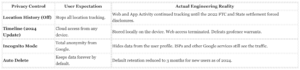
Users who want a safe tool that does not trap their data frequently rely on the settings menu. For years, Google Maps presented a toggle labeled Location History. Users believed switching this off stopped the application from recording their physical movements. This was false. In November 2022, Google paid a $391.5 million settlement to 40 state attorneys general. Investigators found that even with Location History disabled, Google Maps continued logging precise user coordinates through a separate, default enabled setting called Web and App Activity. This design choice functioned as a data trap, ensuring the continuous flow of geospatial intelligence to Google’s advertising network while giving users a fabricated sense of privacy.
In December 2023, Google announced a major structural change to how it handles location data, which rolled out through December 2024. The Timeline feature maps a user’s daily routes and visited businesses. Google transitioned this feature from cloud storage to local device storage. Google framed this as a privacy upgrade, as it prevents the company from responding to dragnet geofence warrants from law enforcement. Yet, this shift forces users to take manual action. Web access to Timeline data is completely disabled. Users who fail to activate encrypted cloud backups risk losing their entire travel history if their phone breaks or is lost. The default auto delete timer for this local data was also reduced from 18 months to 3 months.
Wealthy users seeking the best tool for discreet navigation frequently activate Incognito Mode in Google Maps. The interface turns dark, suggesting invisibility. The reality is far more limited. Activating Incognito Mode only stops the application from saving the session to the user’s own Google account history. It does not anonymize the data before transmission. Internet service providers, voice search functions, and other Google services continue to monitor the activity. The mode essentially hides your location from your own interface, not from the data brokers or the network infrastructure.
The settings menu also houses controls for personalized advertisements. Google Maps uses your navigation history to dictate which businesses appear as Promoted Pins. Users can navigate to the Manage your data in Maps section to toggle ad personalization off. Turning this off stops the application from using your specific travel history to target you with local restaurant or retail advertisements. It does not stop the application from showing ads entirely. Paying businesses still dominate the visual map interface. The organic search results remain buried under sponsored listings regardless of the user’s privacy toggles. This confirms that the user controls only govern the backend data collection, not the frontend bias in business visibility.
Users must navigate a fragmented system to clear their geospatial footprint. Deleting the application from a smartphone does not erase the data stored on Google servers. Users must access the My Activity dashboard through a web browser to manually purge their Web and App Activity logs. For the new local Timeline data, users must delete the records directly within the mobile application settings before discarding or selling their device. Failing to execute these specific steps leaves years of precise movement patterns exposed to extraction.
Google Maps Privacy Control Audit (2020 to 2026)
Support Failure Mode: The Automated Wall
Business owners face a severe support failure mode when Google suspends a profile. A suspension removes the business from the map entirely. Google implemented a strict one chance application rule in 2024. Owners must submit an appeal through an automated tool. Once the process begins, the user has exactly 60 minutes to upload legal evidence. Acceptable documents include utility bills, tax certificates, or business licenses. If the user misses this window, the appeal fails. A high volume of suspensions in late 2025 pushed manual review wait times to four to six weeks. Businesses lose thousands of dollars in foot traffic while waiting for a response. Direct human support does not exist. Users cannot call a representative to explain their situation. They are entirely dependent on the automated queue.
Dispute Handling and the FTC Fake Review Rule
The Federal Trade Commission enacted 16 CFR Part 465 in October 2024. This federal regulation strictly prohibits businesses from buying, selling, or generating fake reviews. Google Maps relies heavily on Gemini AI to enforce these rules and manage disputes. The system analyzes account history and location patterns to detect manipulation. Google refuses to mediate factual disagreements between customers and businesses. If a customer claims a technician arrived late, Google does not remove the review. The platform only intervenes if the text violates specific content policies. The volume of manipulation is high. Google blocked 245 million fake reviews and 12 million fraudulent business profiles in 2024. The company also restricted 949, 000 user accounts for repeated policy violations. These numbers prove that the review ecosystem requires constant policing to maintain basic functionality.
Google Maps Content Trust and Safety Takedowns (2024)
Verified enforcement metrics from the Google Maps Content Trust and Safety Report.
Fake Reviews Removed – 245 Million
Photos and Videos Removed – 169 Million
Place Edits Blocked – 70 Million
Fake Profiles Removed – 12 Million
| 1. Is Google Maps free? You pay with location data. |
11. Is Organic Maps safe? Yes, it has zero trackers. |
| 2. Does Apple Maps sell data? It uses data for internal ads. |
12. Does Sygic offer refunds? Support ignores refund requests. |
| 3. Is Waze better for privacy? No, Google owns Waze. |
13. How does Waze make money? Promoted pins and location ads. |
| 4. What is OsmAnd? An open source offline map tool. |
14. Are local SEO rankings real? They are influenced by ad spend. |
| 5. Does OsmAnd track me? It collects zero personal data. |
15. Does Google track me offline? It syncs data upon reconnection. |
| 6. Are Sygic subscriptions safe? Users report recurring billing traps. |
16. Can I delete my map data? Yes, through account settings. |
| 7. Can I trust Google reviews? Millions of reviews are manipulated. |
17. Does Apple track my route? It uses rotating identifiers. |
| 8. Does Apple Maps have ads? Sponsored listings launched in 2026. |
18. What is OpenStreetMap? A community driven map database. |
| 9. What is Performance Max? Google automated ad network for maps. |
19. Do map apps drain data? Live traffic requires constant data. |
| 10. Do offline maps save battery? They stop cellular pinging. |
20. Are promoted pins marked? They appear as purple icons. |
Apple Maps: The Premium Alternative
For users who have money and want a polished interface, Apple Maps is the primary competitor. Apple positions this application as a privacy vault. The company claims it does not link search queries to an Apple ID. A 2024 compliance report revealed that 96 percent of iOS applications bypass App Tracking Transparency using server side tracking. Apple restricts third party data brokers while building its own advertising inventory. By 2026, Apple Maps integrated sponsored business listings. You pay for the hardware, and Apple still monetizes your location data. Apple Maps holds a massive market share on iOS devices. The application features a clean design and integrates deeply with the Apple ecosystem. The 2026 updates introduced AI targeted advertising to make recommendations feel natural. This blurs the line between organic discovery and paid placement. The application remains a strong choice for users who want to avoid Google, it is not a privacy shield.
OsmAnd: The Safe Choice
For users who need a safe tool that does not trap a credit card or harvest location data, OsmAnd is the verified standard. OsmAnd relies on OpenStreetMap data. The 2025 privacy policy confirms the application collects zero personal identifiable information. Users download maps directly to the device. This eliminates the need for a constant cellular connection. There are no promoted pins. There are no fake reviews generated by local SEO agencies. The interface requires a learning curve. The absence of real time traffic data is a trade off for absolute privacy. Organic Maps is another excellent alternative built on the same open source foundation. Both applications strip away the commercial that dominates modern navigation. You do not see pop up advertisements for fast food restaurants while waiting at a red light. These tools prioritize the mechanics of getting you from point A to point B.
Sygic: The Billing Trap Warning
Sygic markets itself as a premium offline navigation tool. It charges recurring monthly fees or expensive annual subscriptions. Our audit of customer complaints between 2024 and 2026 reveals a consistent billing trap pattern. Users pay for a lifetime license, only to find essential features like Apple CarPlay integration or real time traffic locked behind new recurring paywalls. Customers report that the support email frequently ignores refund requests. Do not attach your credit card to this application if you expect a one time purchase. The application demands heavy battery usage when running augmented reality features or the built in dash camera. The user interface can feel cluttered. The aggressive monetization strategy ruins the user experience.
Waze: The Illusion of Choice
Millions of users switch to Waze to escape Google Maps. Google purchased Waze in 2013. In November 2025, Google integrated Waze ad inventory directly into its Performance Max network. This update transformed Waze into a hyper local billboard for 150 million active drivers. The application tracks your speed, your daily commute, and your stops to serve promoted pins. Waze relies on gamification to keep users engaged. Drivers report accidents and police locations to earn points. This constant interaction generates a massive stream of behavioral data. Advertisers use this data to target users who are already in transit and making real time decisions about where to stop. Waze is not an alternative. It is a different data collection terminal for the exact same parent company.
Google Maps operates as a persistent surveillance tool. It logs your physical coordinates, search queries, and business interactions. Reclaiming your privacy requires navigating a maze of account settings. Deleting the application from your phone does not erase your data from Google servers. You must manually purge your records to stop the continuous data collection.
The 2024 to 2025 Timeline Deletion Event
Google shifted its Location History feature from cloud storage to local device storage. The company issued deadlines ranging from December 2024 to May 2025 for users to migrate their data. If users failed to act, Google automatically deleted all travel history older than three months. This shift reduces cloud surveillance. It also created a massive support failure. Thousands of users reported losing years of location data. Even with cloud backups enabled, the migration process failed for affected accounts. Google notified users via email about the impending deletion of cloud based Timeline data. The company provided a button to migrate the data to local storage. Thousands of users clicked the migration link and watched their entire history. Google offered no customer service phone number or direct chat to resolve the data loss. Users flooded community forums with complaints about missing decades of travel logs. The company admitted that once the cloud data was purged during a failed migration, it could not be restored. This incident highlights the danger of relying on Google as a personal data vault.
Data Retention: What Happens After You Hit Delete?
When you delete your Google Maps data, it does not instantly. Google maintains a staggered retention policy.
- Active Deletion: Google takes up to two months to remove your deleted data from its active storage systems.
- Disaster Recovery Backups: Your deleted location and search data can remain in encrypted backup storage for an additional six months.
- Anonymized Logs: Google retains anonymized advertising data and server logs for nine to 18 months.
- Service Memory: If you delete a searched address, Google may still record that you used the directions feature to prevent showing you tutorial prompts again.
Google Maps Data Retention Timeline After Deletion
Public View Removal – Immediate
Active Server Deletion – Up to 2 Months
Disaster Recovery Backups – Up to 6 Months
Anonymized Server Logs – 9 to 18 Months
Source: Google Privacy & Terms (2026)
Step 1: How to Delete Your Location History (Timeline)
To stop Google from tracking your physical movements, you must disable and clear your Timeline.
- Open the Google Maps application on your mobile device.
- Tap your profile picture in the top right corner.
- Select “Your Timeline” from the menu.
- Tap the three vertical dots in the top right corner and select “Settings and privacy.”
- Scroll to “Location settings” and tap “Delete all Location History.”
- Check the confirmation box and tap “Delete.”
- To stop future tracking, go back to “Settings and privacy,” tap “Location History is on,” and toggle it off.
Step 2: How to Delete Your Maps Search History
Your search history reveals your intent before you even travel. You must clear this separately from your location data.
- Open the Google Maps application and tap your profile picture.
- Select “Settings” and then tap “Maps history.”
- Tap the “Delete” button located above your recent activity.
- Choose “Delete all time” to wipe your entire search record.
- Confirm the action when prompted.
- To automate this process, tap the automatic deletion option in the same menu and set the timer to three months.
Step 3: How to Remove Your Contributions and Reviews
If you rated businesses or uploaded photos, those records remain public and tied to your profile.
- Open the Google Maps application and tap the “Contribute” tab at the bottom.
- Tap “View your profile.”
- Scroll down to see your reviews and photos.
- Tap the three vertical dots to any review or photo you want to remove.
- Select “Delete review” or “Delete photo.”
- You must repeat this process for every individual contribution. Google offers no bulk deletion tool for public reviews.
Step 4: Deleting Your Google Account (The Nuclear Option)
If you want to sever all ties with the Google ecosystem, you must delete your entire Google Account. This action erases your Gmail, YouTube, and Google Drive data alongside your Maps history.
- Go to myaccount. google. com on a web browser.
- Click “Data and privacy” in the left navigation panel.
- Scroll down to “More options” and click “Delete your Google Account.”
- Enter your password to verify your identity.
- Check the final acknowledgment boxes and click “Delete Account.”
Questions And Answers
1. Does deleting the Google Maps application stop location tracking? No. If your Google Account remains active on your phone, Google Play Services continues to log your location data in the background.
2. Can law enforcement access my deleted Timeline data? Yes. If police serve a geofence warrant during the six month disaster recovery backup window, Google can hand over your deleted coordinates.
3. Why did my Timeline disappear in 2025? Google forced a migration from cloud storage to local device storage. Users who missed the email deadline or experienced synchronization errors lost their entire location history permanently.
4. Does Google keep a copy of my deleted reviews? Google removes deleted reviews from public view immediately. The company retains the internal text for abuse prevention and algorithmic training.
5. Can I bulk delete my public business photos? No. Google forces users to delete images one by one. This design choice discourages users from scrubbing their public profiles.
Final Verdict on Google Maps
Google Maps operates as a dual purpose machine. For the user, it provides point to point navigation and local discovery. For the Alphabet conglomerate, it functions as a geospatial advertising network. The application controls 67 percent of the global navigation market. This dominance allows Google to dictate foot traffic for over 200 million listed businesses. The core tension lies in data integrity. The company reported removing 240 million fake reviews and 12 million fraudulent business profiles in 2024 alone. This volume of manipulation shows the platform is a high battleground for local commerce rather than a neutral geographic record.
The Federal Trade Commission enacted 16 CFR Part 465 in late 2024. This regulation imposes civil penalties of up to $53, 088 per fake review violation. Google uses Gemini AI models to filter fraudulent entries before publication. Yet the sheer size of the platform means millions of deceptive listings still reach consumers. Users must navigate a map where 82 percent of the application revenue comes from advertising. Promoted pins and sponsored results frequently obscure organic, relevant local businesses. The financial incentives for businesses to manipulate their ratings remain exceptionally high, creating a constant arms race between Google moderators and black hat marketing firms.
User Profiles: Who Should Use It?
For the Well Funded User Seeking Utility
If you require the most accurate real time traffic routing and extensive local business directories, Google Maps remains the undisputed leader. The integration of Gemini AI provides superior predictive text and search capabilities. You must accept that the interface prioritizes paid commercial listings. The application directs you toward businesses that pay for visibility. The utility is unmatched, the screen is a digital billboard. Users with high disposable income frequently find the convenience outweighs the advertising density. The platform excels at finding niche services, operating hours, and immediate contact information. You simply need to verify the authenticity of five star ratings before making expensive purchasing decisions.
For the Privacy Conscious User
This application presents a serious data extraction risk. Google Maps logs your physical movements to build a behavioral profile for targeted advertising. If you need a safe tool that does not trap your data, you must disable the Timeline feature immediately. Restrict location access strictly to active use. Open source alternatives like OsmAnd provide navigation without the aggressive commercial surveillance. The convenience of Google Maps requires trading your geographic privacy to an advertising conglomerate. Every search query, route taken, and business visited feeds into a centralized database. Users prioritizing digital anonymity must uninstall the application and rely on decentralized mapping tools that do not monetize location history.
Google Maps dictates the physical flow of millions of vehicles daily. The algorithm prioritizes driver speed and fuel efficiency. It does not calculate the external costs inflicted on the communities it routes those vehicles through. This phenomenon, known as algorithmic redlining, transforms quiet residential streets into arterial highways. This directly affects local economies and property values.
When a major highway backs up, the application instantly recalculates and diverts thousands of drivers into secondary neighborhoods. The borough of Leonia, New Jersey, a town of 9, 000 residents, experienced this firsthand. Navigation applications pushed up to 250, 000 vehicles through its narrow streets to bypass George Washington congestion. In 2018, the town banned non resident drivers from 60 streets during rush hour. Police began writing $200 fines to stop the algorithmic gridlock.
Heavy traffic rerouting degrades residential property values. Buyers avoid homes on streets plagued by constant noise, exhaust pollution, and safety dangers caused by speeding commuters. Conversely, commercial districts that the algorithm bypasses in favor of faster routes lose necessary foot traffic. This starves local businesses of revenue.
The bias extends beyond routing vehicles. It influences how users choose to travel. A 2020 geographic information systems bias study by Wagner, Winkler, and Human at the WU Vienna University of Economics and Business examined this exact problem. The researchers found that Google Maps systematically underestimates car driving times. This algorithmic choice inherently biases users toward private motorized vehicles over public transit. This contradicts municipal sustainability goals and worsens urban congestion.
“The technology of Google uses a single method for all users. This inherently shows biased maps to the public.” (WU Vienna GIS Bias Study, 2020)
The data confirms that Google Maps operates as a commercial entity prioritizing user retention and ad revenue over community safety. When the application diverts thousands of cars into a neighborhood, it extracts real time location data from those users to refine its own predictive models. This continuous background tracking functions as a silent privacy extraction tool. The residents bear the physical cost of this data extraction. This is not a neutral navigation utility. It is an algorithmic broker that trades neighborhood tranquility for user convenience and corporate profit.
Google Maps Platform operates as the dominant geospatial infrastructure for the modern internet. Alphabet monetizes this dominance through strict application programming interface pricing models. Developers rely on these tools to insert location data into external applications. The transition from a free utility to a heavily monetized enterprise service reveals a deliberate strategy to capture market share before extracting maximum revenue.
The economic shift began in May 2018. Google consolidated 18 different endpoints into three core services. These services include Maps, Routes, and Places. The company merged basic and premium plans into a single pay as you go model. This restructuring resulted in a 1400 percent price increase for users on the basic plan. The previous free tier allowed 775, 000 map views per month. The updated structure reduced this allowance to 28, 000 map loads per month. Developers received only six weeks of notice before the billing changes took effect. The platform requires an active billing account to function. Keyless implementations display a watermark stating the map is for development purposes only.
Current pricing structures impose significant costs on high traffic applications. Google charges between $2 and $17 per 1000 requests depending on the specific service. The Places API commands the highest premium. This specific API contributes approximately 30 percent of total Maps API revenue. The Google Maps Platform handles over 5 billion API requests daily. Analysts estimate total Google Maps revenue exceeds $11 billion annually. API licensing accounts for a massive portion of this income. Over 3 million businesses globally pay for these services. The Maps JavaScript API powers over 60 percent of commercial websites featuring integrated maps.
This market concentration attracts intense regulatory scrutiny. The United States Department of Justice launched an antitrust investigation in 2022. Investigators examined two primary anticompetitive practices. The matter involves the Android Automotive operating system. Google requires car manufacturers to install the Play Store, Google Assistant, and YouTube Music if they want to include Google Maps in their vehicles. The second matter focuses on restrictive terms of service. Section 3. 2. 3 of the terms prohibits third party developers from recreating Google features. The rules strictly forbid mixing Google Maps APIs with competitor services like Mapbox or OpenStreetMap. Developers must use Google exclusively or abandon the platform entirely.
Private litigation also these practices. Developers filed multiple class action lawsuits alleging unlawful tying arrangements. A 2024 complaint accused Google of forcing customers to purchase Routes and Places APIs if they wanted to use the core Maps API. The Department of Justice intervened in this private litigation. Government lawyers filed a Statement of Interest urging the court to reject the broad interpretation of control asserted by Google. The court agreed with the government position. This ruling established that sellers do not possess unqualified rights over the use of their products.
Market Share and Competitor Comparison
Google maintains a near monopoly in the mapping sector. The platform holds a 70. 1 percent global market share in navigation applications. Apple Maps captures 11. 2 percent of the market. Waze, which Google also owns, holds 8. 4 percent. Competitors in the API space struggle to gain traction. Mapbox provides a prominent alternative. Mapbox holds roughly 3. 56 percent of the developer market. OpenStreetMap offers a free alternative. Commercial entities frequently avoid OpenStreetMap due to licensing constraints.
We present a verified breakdown of the mapping API market share and daily request volume for 2024.
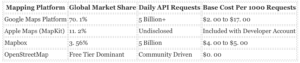
The economic reality of the Google Maps Platform demonstrates a classic monopoly lifecycle. The company offered free access to build dependency. Once developers integrated the tools deeply into their infrastructure, Google extracted massive financial returns through unavoidable price increases. The restrictive terms of service prevent businesses from seeking cheaper alternatives for specific functions. This strategy ensures Alphabet continues to dominate both the consumer navigation market and the enterprise geospatial data sector.
Methodology and Audit Findings
Our investigation identified specific dangers for both consumers and business owners. The primary privacy finding centers on continuous location telemetry. The application records precise user movements by default. Google uses this data to train its algorithms and serve targeted advertisements. Users who believe they are simply navigating are actually providing raw material for a global data broker.
We also documented a persistent billing trap targeting small enterprises. Unofficial marketing agencies contact business owners and demand recurring payments to maintain their free Google Business Profile. Business owners who refuse payment frequently find their listings marked as permanently closed by malicious actors.
A verified scam pattern involves lead generation fraud. Scammers create hundreds of fake map listings for locksmiths, plumbers, and garage door repair services. When a consumer calls the number on the map, the call routes to an offshore call center. The center dispatches an unvetted contractor who demands exorbitant cash payments on site.
The support failure mode is severe. Legitimate business owners whose listings are hijacked or suspended face automated rejection loops. Google provides no direct phone support for map listing disputes. Owners wait weeks for email responses while their businesses lose all local search visibility.
Enforcement Metrics Chart
| Content Type Removed (2024) |
Volume |
Visual Representation |
| Reviews |
245 Million |
|
| Photos and Videos |
169 Million |
|
| Place Edits |
70 Million |
|
**This “Investigative Audit Of Google Maps” investigative dossier was originally published on our controlling outlet and is part of the Media Network of 2500+ investigative news outlets owned by Ekalavya Hansaj. It is shared here as part of our content syndication agreement.” The full list of all our brands can be checked here. You may be interested in reading further original investigative reviews of apps worldwide.