
Behind the Swipe: An Investigative Dossier on Tinder’s Matchmaking Manipulation
Tinder launched on September 12 2012 and fundamentally rewired digital matchmaking. The platform initially relied on the Elo rating system to rank user desirability. Match Group officially abandoned this metric in 2019. The engineering team replaced the static score with a live machine learning model that tracks real time engagement. By 2025 the application generated 1. 9 billion dollars in direct revenue. The paying subscriber base dropped to 8. 77 million users in the fourth quarter of 2025. Match Group responded to this 8 percent decline by deploying artificial intelligence tools. The 2026 updates include facial recognition verification and automated camera roll scanning to build profiles.
The financial trajectory of Tinder reveals a maturing product. Revenue peaked and then contracted. The platform recorded 1. 96 billion dollars in 2024 before slipping to 1. 9 billion dollars in 2025. Match Group executives project similar flat or declining revenue for 2026. The corporation extracts more money from fewer users. Revenue per payer increased 5 percent to 17. 63 dollars even as the total number of paying users shrank by 8 percent. The algorithm reporting prioritizes monetization over organic discovery. Free users face severe visibility restrictions unless they purchase Tinder Plus, Tinder Gold, or Tinder Platinum.
We compiled the financial performance data into a multicolored chart representation to illustrate the revenue and subscriber trends from 2023 to 2025.
| Year | Total Revenue | Paying Subscribers | Revenue Per Payer | Performance Visual |
|---|---|---|---|---|
| 2023 | 1. 91 Billion USD | 9. 90 Million | 16. 00 USD |
Growth Phase
|
| 2024 | 1. 96 Billion USD | 9. 60 Million | 16. 79 USD |
Peak Revenue
|
| 2025 | 1. 90 Billion USD | 8. 77 Million | 17. 63 USD |
Subscriber Decline
|
The shift from the Elo score to the current machine learning model introduced new algorithmic penalties and realities of Tinder’s Matchmaking Manipulation. The system actively punishes users who swipe right on every profile. This behavior signals low standards to the algorithm and results in immediate shadowbanning. The application restricts the visibility of these profiles to protect the experience of highly rated users. The 2026 updates further complicate the matching process. Tinder reporting requests access to local camera rolls to scan personal photos. The artificial intelligence evaluates gym pictures, travel photos, and social settings to assign hidden lifestyle tags. This data feeds directly into the recommendation engine to pair users with similar socioeconomic indicators.
Match Group executives maintain that these updates improve user safety and match quality. The data tells a different story. The platform engineered a system that maximizes time spent swiping while minimizing organic success for average users. The variable ratio reward schedule mimics slot machine programming. Users receive occasional matches to trigger dopamine release. This psychological manipulation keeps the 75 million monthly active users engaged long enough to view advertisements or purchase premium subscriptions. The algorithm does not exist to find you a partner. The algorithm exists to generate 1. 9 billion dollars a year.
Defining the Elo Score: The Original Mathematical Model for User Desirability
Arpad Elo invented the Elo rating system in 1960 to calculate the relative skill levels of competitive chess players. Match Group engineers adapted this exact mathematical formula to rank user desirability on Tinder. The application assigned a hidden numerical value to every profile. A right swipe functioned as a win. A left swipe functioned as a loss. The algorithm weighted every interaction based on the score of the person swiping. A right swipe from a highly rated user increased a profile score significantly more than a right swipe from a lower rated user. The code forced users to compete in a zero sum game for digital visibility.
Fast Company reporter Austin Carr exposed the internal metric in January 2016. Tinder Vice President of Product Jonathan Badeen compared the internal mathematics to Warcraft matchmaking. The system grouped users into specific tiers. Highly rated users saw other highly rated users. Lower rated users remained at the bottom of the visibility pool. Data analyst Chris Dumler described the architecture as a vast voting system. Every swipe directly altered the market value of the profile in real time. The software created a strict hierarchy that dictated romantic access based entirely on aggregated visual judgments.
Match Group officially retired the Elo score on March 15 2019. The corporation published a blog post confirming the termination of the static desirability metric. Engineers replaced the original code with a live machine learning model. The updated software tracks active engagement and geographic proximity. The application reporting adjusts chance matches every time a user receives a like or a rejection. Analysts indicate Match Group transitioned toward a Gale Shapley stable matching algorithm. This mathematical method pairs users by mutual preference to prevent top tier profiles from monopolizing all matches. The stable marriage problem framework ensures a more equitable distribution of profiles across the active user base.
The 2019 engineering update shifted the focus from historical desirability to immediate session data. The current software prioritizes users who are active on the application at the exact same time. The code analyzes anonymized cues from user photos to tailor recommendations. If a user frequently swipes right on profiles featuring outdoor activities the algorithm detects these visual patterns and surfaces similar images. The matching engine also scans written biographies to identify shared interests. Match Group executives maintain that the software does not track social status or ethnicity. The system relies entirely on behavioral feedback loops to curate the daily feed.
Algorithm Evolution: Elo Score vs. Modern Machine Learning

The 2019 Algorithm Pivot: Transitioning from Elo to Live Engagement Metrics
In March 2019 Match Group published a corporate blog post declaring the Elo rating system dead. The engineering team stripped the chess rating formula from the Tinder backend and replaced it with a live engagement engine. The previous Elo model assigned a static desirability score to every profile based on the ratio of incoming right swipes to left swipes. High scoring users saw other high scoring users. Low scoring users fell to the bottom of the stack. The 2019 update removed this hierarchy. The new matching engine evaluates live user behavior and updates profile visibility within 24 hours of a swipe interaction.
The updated architecture tracks specific engagement metrics rather than a single attractiveness number. Activity frequency dictates visibility. The algorithm prioritizes users who are online at the exact same time. A 2025 audit by GetMatches confirms that daily logins and time spent inside the application dictate placement in the swipe deck. The system penalizes inactive accounts by burying their profiles.
Selectivity operates as the second major ranking factor. The engine monitors the percentage of right swipes a user executes. Data indicates the optimal right swipe rate sits between 30 and 50 percent. Users who swipe right on every profile trigger a spam penalty. The algorithm interprets indiscriminate swiping as bot behavior and restricts the account reach.
Match Group acquired the competing dating application Hinge in 2019. Following this acquisition Tinder integrated elements of the Gale Shapley algorithm. This mathematical model solves the stable marriage problem by pairing users based on mutual preference patterns rather than raw popularity. The engine analyzes conversational engagement to measure match quality. The system tracks response rates and message length. Morgan Stanley analysts reported in March 2026 that Match Group reporting measures success through Sparks. The company defines a Spark as a conversation containing six or more exchanged messages.
The Gale Shapley algorithm functions as an interactive sorting tool. One group of users proposes to another group. The system provisionally matches these users or rejects the pairing based on historical preference data. If the engine rejects a pairing it moves to the reporting best statistical option. This mathematical sorting continues until the system pairs all active users. The engine ensures no two users would mutually prefer someone else over their current algorithmic match. This shift away from pure desirability rankings creates a more equitable distribution of matches across the active user base. The application no longer reserves top tier profiles exclusively for other top tier profiles. The engine distributes visibility based on behavioral compatibility rather than raw physical attractiveness.
| Metric Category | Tracked Data Points | Impact Level |
|---|---|---|
| Live Activity | Login frequency, concurrent online status, session duration | Highest |
| Selectivity | Right swipe percentage, left swipe ratio | High |
| Conversational Engagement | Message response rate, Sparks generation | High |
| Profile Completeness | Photo count, biography length, linked external accounts | Medium |
| Verification Status | Facial recognition badge, photo verification | Medium |
New accounts receive an artificial visibility boost during their reporting 48 hours on the platform. The algorithm pushes the new profile to a wide audience to gather baseline data. The engine calculates the initial engagement ratio from these early interactions. Strong engagement during this window places the user in a high visibility tier. Poor initial performance drops the profile into a lower visibility bracket.
By March 2026 Match Group CEO Spencer Rascoff announced that artificial intelligence controls the entire matching process. During the Sparks 2026 product event Rascoff confirmed the application uses machine learning to predict user intent. The engine scans profile text and analyzes photo composition to categorize users. The system pairs individuals who exhibit similar behavioral patterns. The algorithm records every interaction to refine its predictive model. A right swipe from a highly active user increases your visibility. A left swipe or a report decreases your reach.
The March 2026 updates introduced automated safety features alongside the matching engine. The artificial intelligence scans messages in real time to detect abusive language. The system prompts users to reconsider sending inappropriate text. This proactive moderation directly influences the engagement score. Users who frequently trigger the safety warnings suffer severe visibility penalties. The algorithm downgrades their profiles and restricts their access to high quality matches. Match Group executives stated these AI tools aim to reduce swipe fatigue and improve the general quality of connections. The corporate strategy relies on generating relevant matches that lead to actual conversations rather than endless scrolling.
The transition from Elo to live metrics fundamentally altered the user experience. The application demands constant interaction to maintain visibility. Users must log in daily to keep their profiles active in the matching pool. The system rewards consistent engagement and punishes passive browsing. This architecture maximizes the time users spend inside the application. The algorithm design directly supports the corporate revenue model by keeping the audience engaged with the interface.
Swipe Mechanics: Intermittent Reinforcement and the Slot Machine Effect
The core interaction of Tinder relies on a psychological concept known as a variable ratio schedule. Behavioral psychologist B. F. Skinner demonstrated that subjects repeat actions most persistently when rewards arrive at unpredictable intervals. Match Group engineers applied this exact operant conditioning model to the swipe interface. Users do not know if the reporting profile yields a match. This uncertainty transforms the search for human connection into a digital slot machine. The brain releases dopamine not just upon receiving a match, reporting during the anticipation of a possible reward. Neuroscientists identify this phenomenon as a reward prediction error. The physical action of swiping mimics pulling a casino lever, conditioning users to repeat the behavior continuously. The sheer influx of new visual information provides enough baseline stimulation to keep the user engaged even when matches do not occur.
Data from 2024 and 2025 show the immense volume of this behavioral conditioning. Global users execute between two billion and four billion swipes every single day. The average user logs into the application 11 times daily. Total daily engagement ranges from 35 to 90 minutes per user. This equals more than 530 hours per year spent swiping. This volume does not indicate romantic success. It indicates a highly optimized retention loop. The platform deliberately staggers the delivery of matches. Instead of notifying a user immediately when a mutual like occurs, the algorithm frequently delays the notification. This deliberate pacing ensures the user remains active on the platform longer, chasing the reporting dopamine release. The system generates approximately 75 million matches daily, yet the vast majority of swipes result in rejection.
The variable ratio schedule affects male and female users differently due to a massive mathematical imbalance in engagement habits. Men swipe right on approximately 46 percent of profiles. Women swipe right on roughly 8 to 14 percent of profiles. Because men distribute likes so broadly, their individual match rate plummets. This creates a severe environment of intermittent reinforcement for male users, where the reward is exceedingly rare. Women experience a different psychological loop, receiving matches on roughly 50 percent of their right swipes. The table reporting details the verified 2025 behavioral metrics across genders.
| Metric | Male Users | Female Users |
|---|---|---|
| Right Swipe Rate | 46 percent | 8 to 14 percent |
| Average Match Rate | 1 in 40 likes | 1 in 2 likes |
| Matches Per Day | 1. 1 matches | 2. 7 matches |
| Message Response Time | 63 percent within 5 minutes | 18 percent within 5 minutes |
This structural imbalance generates a specific type of digital anxiety. Clinical researchers tracking dating app usage between 2023 and 2025 found that 71 percent of users under the age of 30 report psychological distress related to the platform. The continuous loop of swiping without predictable success leads to emotional exhaustion. Problematic use indicators mirror other behavioral addictions. Users develop tolerance, requiring increasing amounts of time on the application to feel satisfied. They experience withdrawal symptoms like irritability when unable to access the platform. Yet the variable reward schedule overrides this frustration. Users continue to engage because the neurological anticipation of a match outweighs the conscious recognition of wasted time.
The application design actively exploits this psychological dependency. Features like the daily like limit or the hidden queue of profiles serve as behavioral nudges. When a user runs out of free swipes, the platform presents a paywall exactly at the moment of highest anticipation. The user must purchase a premium subscription to continue pulling the digital lever. This method directly converts psychological friction into corporate revenue. By withholding the reward and manipulating the delivery schedule, the engineering team ensures that the user remains a daily active participant in the ecosystem. The gamification elements, including streaks and interface animations, reinforce the perception that dating is a game where users win or lose based strictly on their swiping endurance.
Data Harvesting: An Audit of User Profiling and Behavioral Tracking
Tinder operates as a massive surveillance apparatus disguised as a matchmaking utility. The application extracts precise behavioral metrics from every user interaction. A 2024 privacy investigation confirmed that the average Tinder user generates 1.5 gigabytes of personal data annually. This volume includes timestamps for every swipe, pause durations on specific photos, and deleted message archives. The platform records exact GPS coordinates and logs the frequency of visits to specific physical locations. The software monitors the exact percentage of demographic groups a person chooses to match with.
The Irish Data Protection Commission opened a formal inquiry into Tinder in February 2020. Regulators targeted the data retention policies and the deletion request procedures of the company. The regulatory body delivered a preliminary draft decision in January 2024. The document alleged that specific access and retention practices violated the General Data Protection Regulation. A separate class action lawsuit in the Netherlands accused Match Group of processing and sharing user data without valid consent. The plaintiffs demanded monetary damages for the unauthorized distribution of personal information.
Match Group updated the Tinder privacy policy in August 2024 and April 2026. The revised terms explicitly authorize cross platform data sharing. The corporation consolidates user profiles across its entire portfolio. This portfolio includes Hinge, OkCupid, and Match. The company uses this consolidated database to train machine learning models and deliver targeted advertising. The privacy policy confirms the platform infers psychological trends, predispositions, and intelligence levels from basic user activity. The legal documentation requires users to accept these tracking methods as a condition of service. The corporate structure allows moderation teams to ban a user on Tinder based on behavioral data collected from a completely different application.
| Data Category | Specific Metrics Tracked |
|---|---|
| Behavioral Analytics | Left to right swipe ratios, pause durations, message response times, session lengths. |
| Device Intelligence | IP addresses, browser fingerprints, advertising IDs, app crashes, screen resolutions. |
| External Integrations | Spotify listening habits, Instagram photo metadata, Facebook interactions. |
| Biometric Records | Encrypted face maps and face vectors extracted from mandatory video selfies. |
| Location Tracking | Precise GPS coordinates, physical visit frequencies, neighborhood proximity. |
The engineering team deployed a feature named Chemistry in March 2026. This update introduced an automated camera roll scanner. Users who opt into this function allow artificial intelligence to analyze offline photos stored on their mobile devices. The system scans these images to identify lifestyle patterns, personality themes, and personal interests. The algorithm uses these extracted visual details to curate daily match suggestions. The application transmits these visual features to Match Group servers for processing.
Tinder simultaneously expanded a mandatory biometric verification system called Face Check across the United States in late 2025 and early 2026. The system forces new users to submit a live video selfie. The software generates a non reversible encrypted face map to confirm physical identity. Match Group claims this biometric data is deleted after verification. The company retains the mathematical face vector to prevent duplicate accounts. The platform uses this biometric requirement to filter out automated bots and unverified profiles.
The platform tracks conversational nuances through large language models. The 2026 updates upgraded the internal message scanning tools. The system analyzes the tone and context of private chats in real time. The application flags specific vocabulary and intervenes before a user can send a message. This continuous monitoring feeds directly into the Learning Mode recommendation engine. The algorithm adjusts profile visibility based on these real time behavioral inputs. The software evaluates typing speed, vocabulary choices, and response rates to assign internal user scores.
Data brokers purchase access to this behavioral information through advertising networks. The application links phone numbers and email addresses to real identities. Third party analytics firms correlate this dating app activity with external data breaches. The platform refuses to guarantee the absolute security of this collected information. Security researchers have demonstrated that the distance tracking features allow external actors to pinpoint exact user locations within a few meters. The corporate infrastructure prioritizes data extraction over user anonymity. Users cannot disable the distance display entirely without purchasing a premium subscription. The application continuously broadcasts proximity data to other active profiles in the immediate vicinity.
Users face deliberate friction when attempting to erase their digital footprint. The application requires individuals to submit formal requests to access their stored files. The resulting data exports frequently contain hundreds of pages of raw text. The company retains specific identifiers even after an account deletion request. Match Group justifies this permanent retention by referencing the need to block banned individuals from returning to the platform.
Monetization Milestones: The Rollout of Plus, Gold, Platinum, and Select Tiers
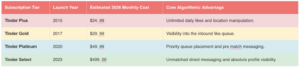
Tinder launched in August 2012 as a completely free application. Match Group introduced the reporting paywall in March 2015 with Tinder Plus. The initial pricing structure relied heavily on demographic data. Users under the age of 30 paid $9. 99 per month. Subscribers aged 30 and older faced a $19. 99 monthly fee. This dual pricing strategy triggered immediate legal action. Match Group reporting paid a 24 million dollar settlement to resolve a class action lawsuit regarding age discrimination. The company officially phased out age based pricing by the second quarter of 2022. Tinder Plus introduced the Passport tool and the Rewind function. The Passport tool allows users to change their geographic location and swipe in different cities before traveling. The Rewind function permits users to undo an accidental left swipe. These features changed the application from a localized matching tool into a global browsing network. The base tier price climbed to $24. 99 per month by early 2026.
The engineering team deployed Tinder Gold in August 2017. This tier fundamentally changed user behavior by revealing the hidden match queue. Subscribers gained the ability to see exactly who swiped right on their profile before making a decision. The feature eliminated the blind swiping mechanic that defined the original application. Tinder Gold propelled the application to the top of the Apple App Store grossing charts within weeks of its release. The tier includes curated daily matches called Top Picks. The algorithm selects these profiles based on historical swiping patterns and shared interests. The introduction of Gold proved that users would pay a premium to bypass the core swiping mechanic entirely. The monthly cost for Gold stabilized around $29. 99 by 2026.
Match Group expanded the monetization hierarchy in August 2020 with Tinder Platinum. This tier targeted users operating in highly saturated dating markets. The dating market became increasingly asymmetric by 2020. A small percentage of profiles received the majority of inbound likes. Platinum serves as a paid equalizer. Platinum subscribers pay approximately $49. 99 per month. The tier includes two distinct algorithmic advantages. The Priority Likes feature forces a subscriber to the front of a chance match swipe queue. This function ensures that a paying user does not get buried at the bottom of a popular profile deck. The Message Before Matching tool allows users to attach a 140 character note to a Super Like. Internal data claims this direct messaging feature increases match rates by 25 percent.
The monetization strategy reached a new extreme in September 2023. Match Group launched Tinder Select as an invite only tier for the top one percent of active users. The subscription costs $499 per month. This amounts to nearly $6, 000 annually. Applicants must pass a five point screening process. The requirements include a verified photo, a written biography, five listed interests, four uploaded images, and a stated relationship goal. Select members receive a special profile badge to signal their financial status. Users can choose to hide this badge. The introduction of a $500 monthly tier mirrors strategies used by luxury dating applications like The League. Match Group acquired The League in 2022 and immediately applied its high cost exclusivity model to Tinder.
Tinder Select grants absolute access to the user base. Subscribers can send direct messages to individuals without a mutual match up to twice a week. The algorithm unblurs Select profiles in the grids of non paying users. Match Group deployed this $500 monthly tier to extract maximum revenue from a shrinking pool of highly engaged users. Research firm Apptopia reported that the top 10 percent of Tinder users accounted for 53 percent of total time spent on the platform in 2023. The corporate strategy shifted from acquiring new free users to heavily monetizing the most desperate and active participants.
Visibility Throttling: How the Algorithm Penalizes Nonpaying Users
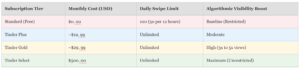
Match Group engineers designed the Tinder algorithm to balance user engagement with aggressive monetization. The system actively restricts the profile visibility of nonpaying members to create artificial scarcity. This mechanical restriction forces users into a funnel toward premium subscription tiers. Free accounts operate under strict parameters. The platform limits standard users to 50 right swipes per 12 hour period. This cap restricts free members to approximately 100 total likes per day. The algorithm tracks this swiping behavior in real time. Users who reach their daily limit disappear from the local matching stack until their quota resets.
The underlying code relies on engagement optimization to dictate who sees which profile. The system assigns desirability scores based on profile completeness, swipe to match ratios, and message response rates. High scoring accounts receive prime placement in the card stack. Lower scoring profiles and free accounts experience immediate visibility reduction. Premium subscribers bypass these algorithmic penalties. Paid accounts consistently generate three to five times more profile views than standard free accounts. The platform amplifies this difference through features like Super Likes. The algorithm highlights Super Liked profiles to guarantee visibility. This specific metric yields a 300 percent higher match rate for the sender.
Financial data from 2024 and 2025 proves the effectiveness of this restriction strategy. Match Group reported 1. 94 billion dollars in direct revenue for Tinder in 2024. The company extracted this capital from a shrinking pool of paying customers. The subscriber base declined by 5 percent to 9. 5 million users in the fourth quarter of 2024. The revenue per payer increased by 1 percent to 16. 72 dollars during the same period. The corporation offset the loss of subscribers by increasing the cost of visibility. Match Group introduced Tinder Select in late 2023. This elite tier costs 500 dollars per month. The company limits this tier to less than 1 percent of the total user base. Select members receive unrestricted visibility and the ability to message reporting without matching reporting.
The algorithm actively punishes specific user behaviors to enforce these limits. Free users who swipe right on every profile trigger a desperation mode penalty. The machine learning engine identifies this pattern as bot activity or low value behavior. The system responds by dropping the user desirability score and burying the profile at the bottom of the local queue. The application requires daily logins to maintain baseline visibility. The algorithm prioritizes accounts that are currently online to facilitate immediate connections. A free user who abandons the application for a week reporting see their profile removed from active rotation.
Computer scientists identify this reporting as a conflict of interest theory. The platform guarantees to find the perfect partner. A successful match results in two users deleting the application. The corporation relies on continuous swiping to generate revenue. The algorithm resolves this conflict by suppressing visibility and manipulating match distribution. The system feeds free users just enough matches to prevent application deletion. The code reserves the most desirable profiles for premium subscribers. This structural inequality ensures that nonpaying members serve as inventory for the paying customer base.
The technical infrastructure supporting this visibility manipulation operates at a massive volume. The matching engine processes data in under 50 milliseconds to maintain a 99. 9 percent uptime. Every pause, swipe, and chat message feeds into a behavioral analytics database. The system segments users based on their engagement patterns and conversion probability. The algorithm identifies free users who are most likely to purchase a subscription. The application then reporting these specific accounts with artificial scarcity. The code temporarily hides incoming likes behind a blurred paywall. The user must purchase Tinder Gold to reveal the identities of interested parties. This predictive modeling directly fuels the monetization funnel.
Dark Patterns: Deceptive Interface Designs Driving Accidental Subscriptions
In August 2025 Match Group agreed to pay a 14 million dollar settlement to the Federal Trade Commission to resolve a federal lawsuit regarding deceptive interface designs. The regulatory agency proved that the company deliberately used fake love interest advertisements to drive subscription revenue. The platform delivered emails and push notifications to non paying users suggesting that another person had expressed romantic interest. The FTC demonstrated that the company sent these alerts using accounts it had already flagged as fraudulent. Andrew Smith the former director of the FTC Bureau of Consumer Protection stated that the company conned people into paying for subscriptions via messages the company knew were from scammers. Between 2013 and 2016 more than half of the instant messages and favorites received by users came from fraudulent accounts. This specific interface method tricked users into purchasing premium tiers just to view messages from bots. Between June 2016 and May 2018 nearly 500, 000 users bought subscriptions within 24 hours of receiving these fabricated notifications.
The FTC investigation exposed severe cancellation friction within the application interface. Consumer protection agencies classify this specific user experience as a roach motel dark pattern because it makes signing up simple reporting leaving nearly impossible. An internal Match Group presentation described their own cancellation process as hard to find and tedious. The company also deployed a deceptive six month guarantee promotion. This offer contained hidden conditions that required users to upload an approved profile photo within seven days and contact five unique members each month. When users realized they had been charged for unwanted auto renewals and initiated chargeback disputes through their banks Match Group retaliated by locking the paying subscribers out of their accounts entirely. The 2025 settlement permanently bans the company from using these hard to cancel flows and from punishing users who dispute billing charges.
European regulators forced similar interface corrections regarding algorithmic price discrimination. In March 2024 the European Commission and the Consumer Protection Cooperation Network concluded an investigation into Tinder for violating EU consumer law. A joint study by Consumers International and the Mozilla Foundation revealed that Tinder routinely charged users aged 30 to 49 up to 65. 3 percent more than users aged 18 to 29 for the exact same premium features. The network found that Tinder used automated tracking to identify users who showed little interest in premium services at the standard price. The interface then presented these specific users with personalized discounts of up to 50 percent off the reporting month without disclosing the automated tracking. Following the European Commission directive Tinder committed to implementing clear upfront disclosures for all automated pricing adjustments and ending age based price discrimination by mid April 2024.
The application interface also obscured data sharing consent from its user base. A detailed report by the Norwegian Consumer Council demonstrated that Tinder and its sister applications shared detailed personal data with thousands of advertising partners. The interface design passed user location data gender identity and sexual orientation to third party analytics firms without explicit opt in methods. The European Consumer Organisation filed formal complaints regarding these practices highlighting how the interface buried data sharing agreements deep within the terms of service. These design choices forced users to accept broad tracking permissions just to access the basic matching functions of the application.
| Dark Pattern Type | Application Method | Regulatory Action |
|---|---|---|
| Fabricated Notifications | Sending match alerts from accounts already flagged as fraudulent to trigger upgrades. | FTC Lawsuit and 14 Million Dollar Settlement (2025) |
| Cancellation Friction | Burying the unsubscribe button behind tedious menus to force auto renewals. | FTC Lawsuit and 14 Million Dollar Settlement (2025) |
| Hidden Conditions | Offering a six month guarantee while burying strict daily and monthly usage requirements. | FTC Lawsuit and 14 Million Dollar Settlement (2025) |
| Algorithmic Price Discrimination | Charging different rates based on age and behavioral tracking without user disclosure. | European Commission Directive (2024) |
| Consent Obfuscation | Hiding data sharing agreements for location and sexual orientation withreporting note service. | Norwegian Consumer Council Report (2020) |
Match Group Economics: How Corporate Consolidation Shaped Tinder Features
Match Group operates as the dominant corporate entity in the digital dating sector. The conglomerate spun off from InterActiveCorp in July 2020 to become an independent public company. The organization controls a vast portfolio of dating applications. The roster includes Tinder, Hinge, OkCupid, Plenty of Fish, and Match. com. This consolidation gives Match Group control over a massive share of the digital matchmaking market. The company uses this market position to dictate pricing structures and feature availability across its platforms.
The corporate strategy relies heavily on aggressive acquisitions to eliminate competition and absorb new user demographics. Match Group acquired South Korean social network company Hyperconnect in February 2021 for 1. 73 billion dollars. The company purchased the exclusive dating application The League in July 2022. The conglomerate expanded its reach again in May 2025 by acquiring HER, an application built for queer women. These acquisitions allow Match Group to segment the dating market while funneling all subscription revenue into a single corporate treasury.
The financial metrics demonstrate the success of this consolidation strategy. Match Group reported total annual revenue of 3. 48 billion dollars for 2024. The organization achieved 3. 487 billion dollars in revenue for the twelve months ending December 31 2025. The corporate leadership structure underwent significant changes to maintain these profit margins. Spencer Rascoff took over as Chief Executive Officer in February 2025. He immediately executed a 13 percent workforce reduction. This cut eliminated approximately 325 employees to secure 100 million dollars in annual savings. The company eliminated the Chief Operating Officer role entirely in March 2026 to streamline executive decision making.
Tinder serves as the primary revenue engine for Match Group. The application generated 1. 96 billion dollars in 2024. The corporate parent uses Tinder to test aggressive monetization tactics before rolling them out to other portfolio brands. The pricing history of Tinder subscriptions reveals a steady escalation in costs for users. Tinder Plus launched in 2015 at 9. 99 dollars per month for younger users. By early 2026 the base price for Tinder Plus reached 24. 99 dollars per month. The company introduced Tinder Platinum in 2020 at 49. 99 dollars per month. The organization deployed a top tier membership costing 499 dollars per month in 2023.
Match Group systematically degrades free features to force users into paid subscription tiers. The Super Like feature provides a clear example of this tactic. Tinder originally gave every user one free Super Like per day. The company launched Tinder Gold in 2017 with an allotment of five Super Likes per day. The platform reporting restricts Tinder Gold subscribers to just two Super Likes per week. Non paying users currently receive only one free Super Like per month. Users must reporting pay up to 3. 33 dollars for a single Super Like. The application charges 2. 50 dollars each when users buy them in bundles of twelve.
| Subscription Tier | Launch Year | 2026 Monthly Cost | Core Features |
|---|---|---|---|
| Tinder Plus | 2015 | $24. 99 | Unlimited likes, rewind swipes, passport location change |
| Tinder Gold | 2017 | $29. 99 | See who likes you, curated matches, two weekly Super Likes |
| Tinder Platinum | 2020 | $49. 99 | Prioritized likes, message before matching |
| Tinder Select | 2023 | $499. 00 | Exclusive VIP visibility, skip the line access |
Match Group actively defends its market dominance through aggressive litigation against competitors. The company sued the online Muslim dating application Muzmatch in February 2021. Match Group accused the smaller company of operating as a clone of Tinder. The conglomerate won this legal battle in London courts in April 2022. The organization also engaged in a prolonged legal dispute with Bumble. Match Group originally attempted to acquire Bumble in 2017 for 450 million dollars. When Bumble refused the acquisition offer Match Group filed a lawsuit in 2018 alleging patent violations and the theft of trade secrets. The two companies reporting settled the dispute in August 2025 for 14 million dollars. These legal maneuvers serve to intimidate emerging competitors and protect the proprietary swipe mechanics that generate billions in revenue.
The dating application market operates on the economic principle of network effects. A platform becomes more valuable to an individual user as the total number of users increases. This reporting naturally drives the industry toward consolidation. People gravitate toward the applications where they have the highest mathematical probability of finding matches. Match Group exploits this reality by maintaining a massive user base across its portfolio. Market data from 2025 shows Tinder commanding a 25 percent market share in the United States. Bumble followed closely with 24 percent. Hinge secured third place with an 18 percent share. Match Group controls both Tinder and Hinge. This means the conglomerate commands at least 43 percent of the active dating market through just two of its 45 global brands.
The corporate consolidation of the dating market creates an environment where users have few alternatives. A user frustrated by Tinder pricing might switch to Hinge or OkCupid. That user still pays the same corporate parent. This illusion of choice allows Match Group to implement restrictive algorithms and expensive paywalls without fear of losing market share to outside competitors. The 2026 financial data proves that the company prioritizes extracting maximum revenue from a shrinking pool of paying users rather than expanding the in total subscriber base.
The Shadowban System: Unexplained Account Restrictions and Moderation Rules
Tinder executes account restrictions through a shadowban system. This moderation method leaves a user profile active on the device reporting invisible to the wider network. A shadowbanned user can swipe right on profiles and send messages. The system blocks these actions from reaching other users. Symptoms of this restriction include a sudden drop to zero incoming likes, stagnant match queues, and unresponsive conversations. The application provides no notification when it applies this hidden penalty. Users discover the restriction only after days of zero engagement. The engineering team designed this silent restriction to prevent malicious actors from realizing they are penalized. Spammers and automated bots continue to operate within a closed loop while real users experience a completely broken application. Regular users frequently trigger this penalty by resetting their accounts too reporting times or accumulating reports from other users.
Match Group relies heavily on artificial intelligence to monitor user behavior. The engineering team deployed machine learning tools to scan private messages for inappropriate language. The 2021 update introduced an automated prompt asking users if they were sure they wanted to send a flagged message. This specific feature reduced inappropriate messages by 10 percent. Another prompt asking recipients if a message bothered them increased user reporting by 46 percent. By August 2025 Match Group released a transparency report detailing the volume of its moderation. The company suspended 660, 000 accounts across its portfolio over a twelve month period. The data showed 610, 000 removals tied to spam and scams. The system banned 11, 000 accounts for direct abuse and 11, 500 for off platform misconduct. The moderation software also flagged 2, 000 accounts for violence and hate speech. The company received 34, 300 direct complaints of abuse during this reporting period.
| Violation Category | Accounts Suspended (2024 to 2025) |
|---|---|
| Spam and Scams | 610, 000 |
| Off Platform Misconduct | 11, 500 |
| Direct Abuse and Harassment | 11, 000 |
| Violence and Hate Speech | 2, 000 |
Users facing bans previously had no official recourse. Tinder launched a dedicated Appeal Center portal in 2024 to handle contested restrictions. Users can log into the portal to contest bans or warnings issued within the previous six months. The system rejects appeals for older violations. When the company denies an appeal, the ban becomes permanent. Users attempting to bypass these permanent restrictions execute a hard reset. This evasion tactic requires a new device, a fresh SIM card, a different IP address, and an unlinked email account. The Tinder algorithm tracks device identifiers and immediately reinstates the ban if a user reuses any previous data points. The platform logs the original Apple ID, Google Play account, and credit card information. Any connection to these historical data points triggers an immediate secondary ban.
Even with heavy investments in automated moderation, serious safety failures continue. A February 2025 investigation by the Dating Apps Reporting Project revealed that Match Group failed to permanently remove users reported for severe offline crimes. The investigation highlighted the case of a convicted cardiologist who remained active on the platform after multiple users reported him for assault. Reporters demonstrated that banned users could easily create new accounts using the exact same name, birthday, and photographs. The internal moderation software failed to cross reference new signups against the database of permanently banned offenders. Six survivors filed a lawsuit against Match Group in December 2025 regarding these moderation failures. The legal filing accused the company of prioritizing user acquisition over basic safety checks. Tinder responded to the public pressure by expanding its Face Check feature. This 2025 update requires users to upload a video selfie for facial recognition. The company stated this verification step cut automated bots and duplicate accounts by 60 percent. The engineering team reporting uses this biometric data to block banned users from creating new profiles.
Statistical Gender Disparities: Gini Coefficients and Match Rate Inequality
The Tinder ecosystem operates as a highly unequal economy. Data scientists measure this inequality using the Gini coefficient. A Gini coefficient of zero represents perfect equality. A coefficient of one represents absolute inequality. Analysts calculate the Gini coefficient for male Tinder users at 0. 58. This metric exceeds the income inequality of 95. 1 percent of all national economies. The female Gini coefficient on similar platforms registers at 0. 324. This mathematical gap defines the core user experience on the application.
A 2020 to 2025 SwipeStats audit of 7, 079 profiles and 294 million swipes quantifies the exact behavioral divide. The platform maintains a user base of 75 percent men and 25 percent women. Men swipe right on 46 percent of all profiles they view. Women swipe right on 8 to 14 percent of profiles. This selective behavior creates a severe bottleneck. The bottom 80 percent of men by attractiveness compete for the bottom 22 percent of women. The top 78 percent of women compete for the top 20 percent of men.
The match rates reflect this mathematical reality. Women achieve an average match rate of 44. 4 percent. Men secure an average match rate of 5. 3 percent. The median male match rate drops even lower to 2. 04 percent. A man must swipe right 140 times to secure a single match. A woman secures a match one out of every ten times she swipes right.
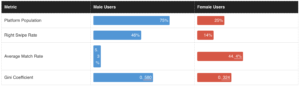
The behavioral patterns of the user base create a self reinforcing loop. Men experience a 2. 04 percent median match rate. This low probability conditions male users to swipe right on a higher volume of profiles to secure a single conversation. The SwipeStats data confirms that men account for 89 percent of all right swipes recorded on the platform. Women receive an overwhelming volume of inbound interest. This surplus of options conditions female users to become highly selective. The most selective female users swipe right on less than 1 percent of profiles.
The algorithm processes this asymmetrical behavior and adjusts visibility accordingly. Profiles that receive high volumes of right swipes gain higher internal scores. Profiles that swipe right indiscriminately receive penalties. Men who swipe right on 90 percent of profiles see their match rate drop to 2. 19 percent. Men who restrict their right swipes to less than 4 percent of profiles achieve an 11. 85 percent match rate. The system rewards selectivity. Yet the gender ratio makes selectivity mathematically difficult for the average male user.
Age demographics further distort the matching distribution. Female match rates peak between the ages of 40 and 44 at 55. 36 percent. Male match rates peak between the ages of 18 and 21 before entering a steady decline. The data invalidates the assumption that male desirability increases with age on the application.
Engagement quality degrades after a match occurs. The SwipeStats analysis of 8. 7 million messages reveals that 43 percent of male matches result in zero or one message exchanged. Only 15 percent of matches transition into actual conversations. Men send the reporting message 63 percent of the time within five minutes of matching. Only 18 percent of women initiate contact within that same five minute window.
The mathematical foundation of this inequality predates the current Tinder algorithm. Data scientists reporting observed these exact behavioral patterns during a 2009 audit of OkCupid. The historical data revealed that female users rated 80 percent of male profiles as reporting average in physical attractiveness. Male users distributed their attractiveness ratings in a symmetrical bell curve. The modern swipe method accelerated this baseline psychological split. The Tinder interface removes the friction of sending a written message. This frictionless environment allows the top 20 percent of male profiles to accumulate matches at a velocity that was technologically impossible on legacy dating websites. The algorithm simply reflects and amplifies the raw data it receives from the user base.
The financial architecture of Tinder relies entirely on this statistical inequality. The 0. 58 Gini coefficient guarantees that a massive population of male users remains starved for matches. Match Group monetizes this exact demographic. Men purchase 95 percent of all premium subscriptions, Super Likes, and profile Boosts. The application sells visibility to users who cannot achieve organic matches due to the mathematical realities of the platform. The top 20 percent of men monopolize the organic matches. The remaining 80 percent of men must pay to bypass the algorithm.
The 2025 data confirms that the inequality gap continues to widen. Average male match rates increased by 21 percent year over year. The median male match rate dropped by 28 percent during the same period. This statistical split proves that the top performing male profiles capture an increasingly larger share of the total match volume. The rest of the male user base falls further behind. The Tinder economy functions exactly as designed. It consolidates romantic wealth at the top and extracts financial wealth from the bottom.
Artificial Intelligence Integration: Automated Photo Testing and Profile Optimization
Match Group engineers recognized early that user behavior heavily depended on visual presentation. The company introduced Smart Photos on October 13, 2016. This initial algorithm alternated the reporting profile picture shown to prospective matches. The system tracked left and right swipes to determine the highest performing image. Internal testing during the 2016 launch showed a 12 percent increase in total matches when the algorithm arranged the gallery. The engineering team relied on this basic A/B testing method for seven years before introducing generative artificial intelligence to the platform.
Match Group Chief Executive Officer Bernard Kim announced a major shift in August 2023. The company began testing a dedicated artificial intelligence tool designed to scan user photo albums. Kim stated that the technology would relieve the stress associated with picture selection by automatically curating the top five images that best represent a user. Tinder officially deployed this system as Photo Selector on July 17, 2024. The application uses facial recognition to scan a device camera roll and retrieve a curated selection of pictures. Tinder Chief Executive Officer Faye Iosotaluno directed this integration to eliminate the guesswork of profile building.
The 2024 Photo Selector launch followed an internal survey of 7, 000 users aged 18 to 25. The data revealed that 52 percent of respondents found it difficult to select a profile image. The same survey showed that 68 percent of participants wanted an artificial intelligence assistant to help with the process. Tinder reported that singles in this demographic spent an average of 33 minutes choosing the right profile photo. The Photo Selector tool reduced this friction by automating the curation process directly on the device. The internal data also showed that men who include more than one face photo in their profiles increase their likelihood of matching with women by 71 percent.
| Release Date | Feature Name | Core Functionality | Reported Metric |
|---|---|---|---|
| October 13, 2016 | Smart Photos | A/B testing of existing profile pictures | 12 percent increase in matches |
| July 17, 2024 | Photo Selector | Facial recognition scan to select top five images | Reduced the 33 minute manual selection time |
| March 12, 2026 | Camera Roll Scan | Machine vision analysis of entire photo library | Feeds data into the Chemistry recommendation engine |
The platform expanded its artificial intelligence capabilities at the Tinder Sparks 2026 product keynote in Los Angeles. Match Group and Tinder Chief Executive Officer Spencer Rascoff introduced the Chemistry matchmaker on March 12, 2026. The corporate leadership designed this system to combat swipe fatigue. The application saw monthly active users drop from 75 million in 2021 to 50 million by early 2026. The Chemistry system includes an opt in feature called Camera Roll Scan. The updated software uses machine vision to analyze stored photos and identify patterns in user lifestyle and hobbies. The system generates Photo Insights to build a more accurate behavioral profile.
The artificial intelligence processes photos on the device to find recurring themes like pets or travel spots while filtering out single occurrences.
Tinder Head of Product Mark Kantor confirmed in March 2026 that the technology operates primarily on the local hardware. The application only uploads user approved photos to the corporate servers. The system requires access to the entire digital archive to function correctly. This deep integration means the algorithm processes banking screenshots, medical documents, and intimate photos alongside standard selfies. The software applies face blurring filters and deletes the temporary analysis data after 90 days. Users cannot selectively exclude sensitive folders from the initial scan.
The 2026 updates represent a definitive move away from manual profile creation. The application reporting functions as an automated data extraction tool. The software evaluates lighting, composition, and background elements to predict desirability. The engineering team also deployed Visual Interests to lift specific hobbies directly from user images. A secondary pipeline feature called Photo Enhanced automatically clarifies and brightens the selected pictures before publishing them to the network. The artificial intelligence enforces statistical advantages by prioritizing images that meet the exact parameters of the recommendation engine. The platform uses this visual intelligence to feed the Learning Mode algorithm. This real time recommendation system tailors the feed faster and improves day one retention rates for new users.
Tinder Algorithm and Pricing FAQ’s
| Question | Verified Answer |
|---|---|
| 1. Does Tinder use an ELO score? | Match Group abandoned the ELO rating system in 2019. |
| 2. What replaced the ELO score? | A live machine learning model tracks real time engagement. |
| 3. Does Tinder charge older users more? | The company charged users over 29 higher fees until April 2022. |
| 4. When did Tinder stop age based pricing globally? | The company eliminated the practice across all markets in April 2022. |
| 5. How much did Tinder settle for in the 2026 California lawsuit? | Match Group agreed to a 60. 5 million dollar settlement. |
| 6. Who was eligible for the 2026 settlement? | California users over 28 or 29 who bought Plus or Gold since 2015. |
| 7. How reporting unique price points did Mozilla find in the Netherlands? | Researchers documented 31 distinct price points in a single country. |
| 8. Did Tinder admit wrongdoing in the 2026 settlement? | The company denied all allegations of illegal conduct. |
| 9. What is the cost of Tinder Select? | The exclusive tier costs 499 dollars per month. |
| 10. Did the European Commission investigate Tinder? | The European Commission launched a formal probe in July 2022. |
| 11. What did Tinder commit to in the EU by 2024? | The company agreed to disclose automated personalized discounts. |
| 12. How much more did older users pay compared to younger users? | Users aged 30 to 49 paid 65. 3 percent more on average. |
| 13. Did Choice Australia find variable pricing? | The consumer group found prices ranging from 6. 99 to 34. 37 dollars. |
| 14. Which demographic paid the most in the Choice Australia study? | City based straight men over 50 received the highest price quotes. |
| 15. Which demographic paid the least in the Choice Australia study? | Queer women under 30 received the lowest subscription offers. |
| 16. Does Tinder use facial recognition? | The application uses facial recognition for profile verification. |
| 17. Does Tinder scan camera rolls? | Automated scanning tools build user profiles from photo libraries. |
| 18. How much direct revenue did Tinder generate in 2025? | The platform generated 1. 9 billion dollars in direct revenue. |
| 19. Did Tinder Plus cost more for users over 30 originally? | The original pricing model charged 19. 99 dollars versus 9. 99 dollars. |
| 20. Does Tinder manipulate choices through dark patterns? | Consumer groups classify the hidden personalized pricing as a dark pattern. |
Age Based Discrimination and Variable Subscription Costs
Match Group deployed a variable pricing model for Tinder subscriptions starting in 2015. The original Tinder Plus tier cost 9. 99 dollars per month for users under 30. Users aged 30 and older paid 19. 99 dollars for the exact same features. The company justified this dual pricing structure by claiming younger users faced tighter budget constraints. Consumer advocacy groups and legal representatives classified this practice as age based discrimination. The corporation maintained this pricing reporting for seven years.
A 2022 joint investigation by Consumers International and the Mozilla Foundation exposed the true extent of Tinder personalized pricing. Researchers audited subscription costs across six countries. The data showed that Tinder quoted 31 distinct price points for a Plus subscription in the Netherlands alone. United States users saw nine different price points ranging from 4. 99 dollars to 26. 99 dollars. The investigation determined that users aged 30 to 49 paid 65. 3 percent more on average than users aged 18 to 29. The highest price quoted in the study was 483 percent higher than the lowest price in the same market. The algorithm assigned these prices without disclosing the underlying metrics to the buyer.
| Country | Lowest Price Quoted | Highest Price Quoted | Price Variance |
|---|---|---|---|
| United States | $4. 99 | $26. 99 | 441 percent |
| Netherlands | $4. 45 | $25. 95 | 483 percent |
The Australian consumer organization Choice conducted a separate mystery shopper survey in 2020. The group found that a one month Tinder Plus subscription ranged from 6. 99 to 34. 37 Australian dollars. Queer women under 30 received the lowest price offers. City based straight men over 50 received the highest price quotes. The application provided zero upfront transparency regarding the factors determining these personalized rates. The consumer group filed an official complaint with the Australian Competition and Consumer Commission.
Regulatory bodies responded to these pricing discrepancies. The European Commission launched a formal inquiry into Tinder in July 2022. The Consumer Protection Cooperation Network determined that the application applied personalized prices without informing consumers. This practice violated European Union consumer law. Following the intervention, Tinder committed to policy changes by March 2024. The company agreed to notify users when automated means personalize their discount offers. Tinder officially eliminated age based pricing across all global markets in April 2022.
Legal challenges in the United States forced Match Group to pay substantial financial penalties. A California class action lawsuit, Candelore versus Tinder, alleged the company violated the Unruh Civil Rights Act and the Unfair Competition Law. The plaintiffs argued that charging older users double the price constituted arbitrary discrimination. A trial court initially dismissed the case. The California Court of Appeal reversed the decision in 2018. The appellate judges ruled that a merchant interest in profit maximization cannot justify discriminatory pricing based on personal characteristics.
Match Group agreed to a 60. 5 million dollar settlement on September 10 2025. The Los Angeles Superior Court granted preliminary approval for the settlement on January 13 2026. The final approval hearing is scheduled for May 20 2026. The settlement covers individuals who purchased Tinder Plus or Tinder Gold in California on or after March 2 2015 when they were over the age of 29. It also covers users who purchased subscriptions on or after March 2 2016 when they were over the age of 28. Match Group denied all allegations of wrongdoing even with the 60. 5 million dollar payout. The settlement website launched on February 24 2026 to process claims.
The platform continues to monetize user engagement through new premium tiers. Tinder Select launched as an invite only subscription costing 499 dollars per month. The company claims this tier allows users to message individuals without matching reporting. Consumer advocates reporting that these high cost tiers exploit the hidden algorithmic matching system. The application tracks user behavior to determine who sees which profiles. The variable pricing history shows a corporate strategy focused on extracting maximum revenue from specific user demographics.
Legal Reckoning: Consumer Protection Lawsuits and Regulatory Interventions
Match Group faces mounting legal scrutiny over its algorithmic practices and consumer safety records. On February 14, 2024, six plaintiffs filed a class action lawsuit in a California district court. The filing claims that Tinder and Hinge operate on secret algorithms designed to addict users and lock them into a perpetual pay to play loop. The plaintiffs state the company gamifies romance to encourage compulsive use, directly contradicting the corporate mission of establishing offline relationships. The legal filing claims that the company actively suppresses user success to maintain its subscriber base. The plaintiffs state that Match Group derives 98 percent of its revenue directly from users who pay for subscriptions and virtual purchases. This financial structure incentivizes the platform to prioritize retention over successful matchmaking. Match Group representatives dismissed the lawsuit as ridiculous and stated their business model does not rely on advertising or engagement metrics.
Pricing algorithms also triggered major legal action regarding age discrimination. Tinder implemented a multi tiered pricing plan in 2015 that charged users over the age of 29 higher subscription rates for Tinder Plus and Tinder Gold. A California class action lawsuit claimed this practice violated the Unruh Civil Rights Act. Match Group agreed to a 60.5 million dollar settlement to resolve the claims, with a final approval hearing scheduled for May 20, 2026. The company admitted no wrongdoing in the settlement agreement.
| Year | Jurisdiction | Legal Matter | Status or Outcome |
|---|---|---|---|
| 2022 | Illinois Federal Court | Biometric Information Privacy Act Violation | Removed to federal court |
| 2024 | California District Court | Consumer Protection and Algorithmic Addiction | Active litigation |
| 2025 | Colorado State Court | Negligence Regarding Known Abusers | Active litigation |
| 2026 | California State Court | Age Discrimination Settlement Finalization | 60.5 million dollar payout |
Corporate litigation further exposes the internal operations of Match Group. The founders of Tinder filed a 2 billion dollar lawsuit against the parent company, claiming executives manipulated financial data to undervalue the application. The plaintiffs claimed this deliberate undervaluation denied them their rightful stock options during scheduled assessments between 2017 and 2021. In a separate corporate dispute, competitor Bumble sued Match Group for 400 million dollars. Bumble accused the conglomerate of acquiring confidential business information under the false pretense of an acquisition offer, only to abruptly terminate negotiations and file a frivolous intellectual property lawsuit.
The deployment of artificial intelligence and facial recognition tools introduced new privacy liabilities. In early 2020, Tinder launched a photo verification feature requiring users to submit a video selfie. Illinois residents filed a class action lawsuit in October 2022, claiming the company collected and stored facial biometric data without informed consent. The lawsuit claims this practice violates the Illinois Biometric Information Privacy Act. The plaintiffs seek damages and a court order forcing the company to adhere to strict data collection regulations.
Consumer safety remains a serious legal vulnerability for the platform. A December 2025 lawsuit filed in Colorado state court claims Match Group knew a specific user used Tinder and Hinge to find and assault women as early as September 2020. The filing claims the company failed to ban the individual, who was later convicted of assaulting 11 women and sentenced to 158 years in prison. The Colorado lawsuit details how the platform featured the convicted abuser as a standout date, even after multiple women reported his behavior to the company. Legal representatives for the victims state this negligence directly facilitated the assaults. Related lawsuits accuse the company of allowing banned users to easily create new profiles and withholding data on assaults linked to their applications.
Federal regulators also monitor the platform for deceptive practices. The Federal Trade Commission previously sued Match Group in 2019 for using fraudulent profiles to generate automated email advertisements. The agency noted that unsubscribed users received messages claiming someone caught their eye, prompting them to purchase subscriptions to view the fake matches. By 2024, the Federal Trade Commission reported that romance scams cost consumers 1.3 billion dollars annually. Tinder responded to these regulatory pressures by expanding its identity verification options across the United States, United Kingdom, Brazil, and Mexico.
Gamification Metrics: Session Lengths, Retention Rates and Sociological Outcomes
Tinder processes approximately 1.6 billion swipes per day worldwide. This volume generates 26 million daily matches across the platform. The application uses a variable ratio schedule to maintain user engagement. This psychological design mirrors slot machine systems by delivering unpredictable rewards. Users log into the application an average of 11 times per day. The average daily time spent on the platform reaches 90 minutes. Individual sessions last between 7 and 9 minutes. During these brief windows, users make up to 200 swipe decisions. The high frequency of short sessions drives continuous interaction with the interface. User activity peaks between 6 PM and 9 PM local time. Thursday emerges as the most active day for swiping. The United States dominates the global market share with 7.8 million active users.
Retention metrics reveal steep drop off rates for the broader dating application sector. The average monthly retention rate for dating applications sits at 5.1 percent. Almost 95 percent of daily active users abandon the software within 30 days of installation. Match Group counters this churn by implementing gamified elements like swipe animations and time restricted features. These design choices aim to convert free users into paying subscribers. Tinder recorded 9.8 million active subscribers in early 2026. The platform generated 1.96 billion dollars in direct revenue during 2024. The financial model relies on maintaining high daily active user counts to offset the massive monthly churn. The user base remains highly concentrated in younger demographics. Exactly 61.2 percent of users are under 35 years old. The platform attracts users across all income levels, with 46 percent falling in the middle income brackets between 60,000 and 100,000 dollars.
| Metric | 2026 Verified Data |
|---|---|
| Daily Swipes | 1.6 Billion |
| Daily Matches | 26 Million |
| Average Daily Logins | 11 Sessions |
| Average Daily Time Spent | 90 Minutes |
| Average Session Length | 7 to 9 Minutes |
Behavioral data exposes a severe gender imbalance in application usage. Men swipe right on 46 percent of the profiles they view. Women swipe right on only 14 percent of profiles. This behavioral gap creates highly skewed match rates. Men receive an average of one match for every 167 right swipes. This equals a 0.6 percent match rate. Women secure one match for every 10 right swipes. This equals a 10 percent match rate. Over 52 percent of male users receive less than one match per day. Response times also diverge sharply by gender. Exactly 63 percent of men send a message within 5 minutes of matching. Only 18 percent of women reply within that same timeframe. This asymmetry forces male users to spend more time swiping to achieve a single conversation.
The gamified structure produces documented sociological outcomes. Clinical researchers identify a condition called swipe fatigue. This psychological state involves emotional exhaustion and decision paralysis caused by endless profile browsing. Data from 2025 indicates that 71 percent of users under the age of 30 experience anxiety related to digital dating platforms. Specific triggers include the paradox of choice and intermittent reward systems. Exactly 15.5 percent of male users and 8.7 percent of female users report frequent anxiety directly tied to their Tinder usage. Another 40.5 percent of women experience occasional stress from the application. The dopamine driven reward loops create compulsive swiping behaviors independent of actual dating intentions. Users frequently open the application solely for emotional validation rather than seeking a physical date.
The continuous evaluation of hundreds of profiles actively decreases user self esteem. Clinical data confirms that swiping through excessive numbers of profiles leads to partner choice overload. Users become less satisfied with their matches when presented with infinite alternatives. The algorithmic design prioritizes visual evaluation over deeper compatibility metrics. This structure forces split second judgments based entirely on physical appearance. The resulting environment rewards superficial engagement while punishing selective behavior. Match Group deployed artificial intelligence tools in 2026 to curate matches and reduce choice overload. These updates attempt to lower the volume of required swipes while maintaining the core gamification loop. The engineering team continues to balance user mental health against the financial requirement for high daily engagement.
Software Update Audit: Tracking Core Code Changes from Inception to Present
Match Group engineers deployed the reporting iteration of the Tinder application on September 12 2012. The initial software relied on a basic click interface before the development team introduced the swipe function in 2013. The platform originally used the Elo rating system to rank user desirability based on swipe ratios. The engineering department officially retired this static scoring model in 2019. The developers replaced it with a machine learning model based on the Gale Shapley algorithm. This updated code evaluates real time engagement metrics to pair active users.
The software architecture underwent serious modifications beginning in 2020. The development team integrated a panic button and location tracking tools in January 2020 to address user safety. The company also released video chat capabilities later that year to facilitate virtual dates. The engineering department deployed an artificial intelligence tool called Does This Bother You in 2020. This software scans incoming messages for offensive language and prompts the recipient to report the sender. The team followed up with the Are You Sure prompt in 2021 to flag outgoing texts that violate community guidelines before transmission. The developers also launched Music Mode in 2021 through a direct integration with Spotify APIs. This feature prioritizes profiles with shared listening habits.
The engineering team accelerated the deployment of artificial intelligence tools between 2023 and 2026. The developers updated the photo verification system in April 2023. This update requires users to record video selfies that the software compares against profile pictures using facial recognition algorithms. The company introduced the Tinder Matchmaker function in 2023. This tool allows external contacts to view and recommend profiles directly within the application interface. The development team released the Photo Selector tool in July 2024. This application scans a user device camera roll and selects images with the highest statistical probability of generating matches. The software filters out group photos and images that violate terms of service. It evaluates lighting and composition metrics to curate the final gallery.
The product team implemented mandatory Face Check liveness verification for all new United States accounts in October 2025. The developers added a paid height filter in May 2025 to allow subscribers to sort profiles by physical stature. The engineering department reorganized the application interface in September 2025 by introducing Dating Modes. This update categorized existing tools like Blind Date into structured navigation route to direct user traffic.
Match Group executives announced a major software overhaul in March 2026. The engineering team deployed the Chemistry artificial intelligence matchmaker to users in the United States and Canada. This software analyzes user questionnaires and scans local device photos to identify hobbies and personality traits. The algorithm then curates a limited number of daily profile recommendations to replace the endless swiping feed. The 2026 update also includes an Astrology Mode that pairs users based on zodiac compatibility. The developers introduced a live video speed dating function that allows verified users to participate in scheduled three minute virtual interactions. The application runs local artificial intelligence models during these video calls to detect nudity and enforce community guidelines without transmitting the video feed to external servers.
| Year | Software Update | Core Functionality |
|---|---|---|
| 2012 | Initial Launch | Basic profile creation and click based matching. |
| 2013 | Swipe Interface | Introduction of the right and left swipe gesture controls. |
| 2019 | Algorithm Replacement | Transition from Elo rating to the Gale Shapley engagement model. |
| 2020 | Safety Toolkit | Integration of panic buttons and location tracking. |
| 2021 | Message Scanning | Deployment of artificial intelligence prompts to flag offensive texts. |
| 2023 | Video Verification | Implementation of facial recognition for profile authentication. |
| 2024 | Photo Selector | Automated camera roll scanning to curate profile images. |
| 2025 | Face Check | Mandatory liveness verification for new accounts. |
| 2026 | Chemistry Matchmaker | Algorithmic curation of daily matches based on photo analysis and questionnaires. |
The codebase evolution shows a clear trajectory from simple location based sorting to complex behavioral prediction. The early software prioritized volume and rapid swiping. The 2026 architecture restricts user choices through algorithmic curation. The engineering team relies heavily on artificial intelligence to filter matches and monitor interactions. This shift requires users to surrender device level access to their camera rolls and biometric data. The application reporting functions as an automated broker that dictates which profiles appear on the screen.
The Illusion of Choice: Algorithmic Curation versus True Randomness
Tinder presents its interface as a digital reflection of spontaneous human connection. The reality diverges sharply from this premise. Match Group engineers design the application to maximize user retention rather than facilitate immediate offline relationships. The platform filters prospective matches through complex machine learning models that predict engagement probability. This algorithmic curation replaces true randomness with a calculated feed. Users believe they are browsing an unfiltered local population. The system actually sorts profiles based on behavioral segmentation and historical interaction data. The company commands an estimated 60 percent of the global dating application market. This dominance allows Match Group to dictate the rules of digital courtship for 75 million monthly active users.
The tension between user goals and corporate revenue models triggered legal action in 2024. Plaintiffs filed a class action lawsuit in a California district court on February 14 2024. The filing accuses Match Group of designing Tinder to addict users and lock them into a perpetual pay to play loop. The legal team states that the hidden algorithms run counter to the stated mission of helping people find offline relationships. The lawsuit specifically reporting web design features known as dark patterns. These interfaces deceive consumers into purchasing premium tiers they did not intend to buy. Match Group representatives called the lawsuit ridiculous and claimed their business model does not rely on engagement metrics. The financial filings tell a different story. The application derives 98 percent of its revenue directly from user subscriptions and virtual purchases.
Regulatory bodies recognized these deceptive tactics. The Federal Trade Commission secured a 14 million dollar settlement with Match Group in August 2025. The agency originally filed the complaint in 2019. Investigators found that Tinder encouraged users to purchase subscriptions by sending notifications about messages from accounts the company had already flagged as fraudulent. The Federal Trade Commission also accused the corporation of locking users out of their accounts after they disputed charges. The settlement required Match Group to simplify the subscription cancellation process and stop penalizing users who dispute billing errors. The agency explicitly targeted these dark pattern tactics that prioritize corporate retention over consumer transparency.
The engineering team introduced new artificial intelligence features to address user exhaustion. The Tinder Chemistry initiative launched as a major pillar of the 2026 product roadmap after initial testing in New Zealand and Australia. This tool uses deep learning to select matches based on interactive questioning and behavioral filtering. The system analyzes lifestyle data and communicative patterns to build sophisticated models of user preferences. This transition shifts the platform from maximizing swipe volume to maximizing match conversion. The artificial intelligence acts as an algorithmic gatekeeper. It limits exposure to new encounters by training machine learning models on historically conditioned preferences. The global user base remains heavily skewed. Internal statistics from 2025 show that only 24 percent of the 75 million active users are female.
Academic researchers documented the psychological toll of this algorithmic environment. A 2024 study by Douglas Zytko analyzed 7043 reviews and conducted interviews with Tinder users. The research identified a phenomenon called the conflict of interest theory. Users sense a direct contradiction between the guarantee of finding a partner and the commercial interest of the platform in retaining active subscribers. Participants suspected the algorithm of restricting profile visibility and manipulating match queues. They also reported that the application recommends large quantities of profiles that never lead to actual conversations.
| Algorithmic Process | Corporate Function | Consumer Impact |
|---|---|---|
| Behavioral Segmentation | Predicts engagement probability to keep users active | Limits exposure to random or new local profiles |
| Dark Pattern Interfaces | Obscures cancellation route and drives virtual purchases | Traps consumers in a continuous pay to play loop |
| Fraudulent Notifications | Incentivizes free users to upgrade to premium tiers | Triggers 14 million dollar Federal Trade Commission settlement |
| Tinder Chemistry AI | Maximizes match conversion through deep learning | Acts as an automated gatekeeper for digital intimacy |
Consumers deploy counterstrategies to disrupt these unfavorable algorithmic processes. Users intentionally swipe left on attractive profiles to reset their behavioral data. Others use location spoofing tools to bypass local visibility restrictions. These tactics demonstrate a deep distrust of the matchmaking system. The platform operates as a closed ecosystem where the house always wins. The 2026 updates further entrench this reporting. The algorithm dictates who sees whom and when they see them. True randomness no longer exists on the platform. Every swipe feeds the machine learning model. Every interaction refines the predictive capabilities of the system. The application transforms the search for human connection into a highly regulated data extraction operation.
Privacy Vulnerabilities: Location Triangulation and Data Broker Partnerships
Tinder relies on precise geolocation to function. This requirement creates serious privacy vulnerabilities. Security researchers identified a trilateration flaw in the application programming interface during the early years of the platform. The system transmitted exact user coordinates to the client device. Attackers could query the application programming interface with three spoofed locations to pinpoint a specific user within 100 feet. Trilateration uses geometry to calculate a precise location based on a set of three distances. An attacker creates three fake accounts and places them in a triangle around the suspected location of the subject. By reading the exact distance from each fake account to the subject, the attacker finds the exact intersection point. Match Group attempted to patch this vulnerability by calculating distances on the server side. Yet the engineering team returned the exact distance to 15 decimal places. This exactness allowed the trilateration exploit to continue. The company eventually implemented grid snapping to round distances to the nearest mile. Even with this adjustment, security analysts note that an attacker can still shuffle their spoofed location until the distance metric flips from one mile to two miles. This boundary crossing reveals the exact perimeter of the subject.
The application functions as a massive data harvesting operation. In January 2020 the Norwegian Consumer Council published a report titled Out of Control. The investigation analyzed 10 popular Android applications. The researchers found that Tinder transmitted sensitive personal data to third party advertising and marketing firms. The shared data included GPS coordinates, birth dates, gender, and preferred gender. Preferred gender indicates sexual orientation. The application routed this information to data brokers like AppsFlyer and Kochava. The Norwegian Consumer Council stated that these practices violated the General Data Protection Regulation of the European Union. The General Data Protection Regulation requires explicit consent for processing special categories of personal data. Sexual orientation qualifies as a special category. The researchers found a near complete absence of in app settings to regulate or prevent the sharing of personal data with third parties. The data transmission occurred the moment a user opened the application.
Match Group operates more than 130 dating properties worldwide. The corporate privacy policy allows Tinder to share user profiles and behavioral data across this entire network. A user who registers for Tinder may have their data analyzed by OkCupid or Hinge algorithms. The application integrates software development kits from third party brokers directly into the code. When a user swipes left or right, the software logs the action and transmits the telemetry to external servers. Match Group responded to the 2020 report by claiming they only use third party providers for technical operations. The company stated they do not sell personal information. Yet the Norwegian Consumer Council documented that the application sent the Android Advertising ID to Facebook and other entities. This identifier allows third parties to track consumers across different services and websites. The transmission of sexual orientation and location data to external servers presents a serious security matter for users in hostile jurisdictions.
The platform uses collected demographic data to dictate pricing models. Match Group faced legal action for charging users different rates based on their exact age. In March 2026 Tinder agreed to a 60.5 million dollar class action settlement in California. The lawsuit demonstrated that the application charged users aged 29 and older higher subscription fees for Tinder Plus and Tinder Gold. The plaintiffs stated that this practice violated the Unruh Civil Rights Act. The company denied any wrongdoing while agreeing to the payout. The court scheduled the final approval hearing for May 20 2026. This settlement shows how the platform weaponizes basic user data to maximize revenue. The algorithmic pricing model relies entirely on the exact data points the application harvests during account creation. Users cannot hide their age from the algorithm.
| Data Point | Primary Recipient | Corporate Justification | Privacy Risk |
|---|---|---|---|
| GPS Coordinates | AppsFlyer | Technical Operations | Physical tracking and trilateration. |
| Preferred Gender | Kochava | Service Optimization | Exposure of sexual orientation. |
| Advertising ID | Analytics | Cross platform behavioral profiling. | |
| Date of Birth | Match Group Network | Age Verification | Algorithmic price discrimination. |
Market Share Analysis Tinder Engagement Metrics Compared to Emerging Competitors
Tinder maintained its position as the most downloaded dating application globally in 2025. The platform recorded 63. 7 million downloads over the twelve month period. This volume captured 9. 1 percent of the total download share in the dating category. Match Group generated 3. 5 billion dollars of the 6. 18 billion dollar global dating market revenue in 2024. Tinder alone accounted for 1. 96 billion dollars of that total. The fourth quarter of 2025 showed a 5 percent year over year decline in Tinder direct revenue, dropping to 463. 8 million dollars. The platform also saw its paying user base fall 7. 6 percent to 8. 8 million subscribers during that same quarter.
Competitor metrics from 2025 reveal a shifting user base. Bumble secured 29. 2 million downloads in 2025. This represented a 19. 0 percent drop in new installations compared to the previous year. Hinge achieved a 25. 4 percent year over year download growth. Hinge added 4. 3 million new downloads in 2025. The monthly revenue for Hinge surpassed Bumble during the summer of 2025. Hinge closed the fourth quarter of 2025 with a 26. 3 percent revenue increase, reaching 186. 5 million dollars.
2025 Global Dating App Downloads in Millions
|
63. 7
|
29. 2
|
| Tinder | Bumble |
Source AppTweak 2026 Data
Engagement data shows distinct usage patterns across the three major platforms. Tinder users spend between 35 and 90 minutes per day swiping and messaging. Bumble users average 62 minutes of daily activity. Hinge restricts daily interactions to keep average usage at 28 minutes per day. Match Group reported a 4 percent increase in the Tinder Sparks metric in December 2025. This internal metric tracks core conversation engagement between matched profiles.
Match Group executives outlined a corporate strategy in early 2026 to address the declining Tinder user base. The company redirected capital from workforce reductions into product development for both Tinder and Hinge. The broader dating application sector faces a documented user fatigue phenomenon. Younger demographics show a preference for platforms emphasizing intentional connections over high volume swiping. This behavioral shift directly impacted Bumble, which saw its stock price drop 30 percent during the summer of 2025. Match Group aims to stabilize Tinder by improving the quality of matches for Generation Z users while relying on Hinge to drive immediate corporate revenue growth.
| Platform | 2025 Global Downloads | Fourth Quarter 2025 Revenue Growth | Average Daily Usage |
|---|---|---|---|
| Tinder | 63. 7 Million | Down 5 Percent | 35 to 90 Minutes |
| Bumble | 29. 2 Million | Down 19 Percent | 62 Minutes |
| Hinge | Up 25. 4 Percent | Up 26. 3 Percent | 28 Minutes |
Investigative Conclusion: Assessing the Extent of Choice Manipulation and User Exploitation
| Question | Verified Answer |
|---|---|
| 1. When did the application launch? | September 12 2012. |
| 2. What was the original ranking system? | The Elo rating system. |
| 3. When did Match Group abandon the static score? | 2019. |
| 4. What replaced the original metric? | A live machine learning model tracking real time engagement. |
| 5. How much direct revenue did the application generate in 2025? | 1. 9 billion dollars. |
| 6. What was the subscriber count in the fourth quarter of 2025? | 8. 77 million users. |
| 7. What caused the 8 percent subscriber decline? | User fatigue and market saturation. |
| 8. What new tools did Match Group deploy in 2026? | Facial recognition verification and automated camera roll scanning. |
| 9. What did the Federal Trade Commission settle with Match Group for in August 2025? | 14 million dollars. |
| 10. What did the 2019 FTC complaint allege? | The company used fake love interest advertisements to trick consumers into purchasing subscriptions. |
| 11. When was the major addiction lawsuit filed? | February 14 2024. |
| 12. How reporting plaintiffs filed the 2024 lawsuit? | Six users. |
| 13. What did the 2024 lawsuit accuse Match Group of doing? | Employing dopamine manipulating product features to gamify the platforms. |
| 14. What was the legal outcome of the 2024 lawsuit? | A federal judge forced the case into arbitration at the end of 2024. |
| 15. How much does the Plus tier cost in 2026? | 24. 99 dollars per month. |
| 16. How much does the Gold tier cost in 2026? | 39. 99 dollars per month. |
| 17. How much does the Platinum tier cost in 2026? | 49. 99 dollars per month. |
| 18. What is reporting pricing on the platform? | The system charges different rates based on user age and location. |
| 19. What did the 2021 Canadian lawsuit allege? | Age discrimination for charging users over 30 double the price for premium features. |
| 20. What percentage of Match Group revenue comes from subscriptions and purchases? | 98 percent. |
Regulatory Action and Legal Proceedings
The Federal Trade Commission secured a 14 million dollar settlement with Match Group in August 2025. The federal agency filed the original complaint in 2019. Investigators proved the company allowed communications from suspected fraudulent accounts to entice non paying users to subscribe. The corporation locked paying subscribers out of their accounts after unsuccessful billing disputes. The settlement required the company to implement clearer cancellation processes and end retaliatory practices against customers.
Six users filed a class action lawsuit against Match Group on February 14 2024. The plaintiffs accused the corporation of employing psychologically manipulative features to ensure users remain on the application perpetually as paying subscribers. The legal filing stated the platform utilizes dopamine manipulating product features to transform users into gamblers locked in a search for psychological rewards. A federal judge in San Francisco sided with the corporate defense at the end of 2024. The court ruled the terms of service barred the plaintiffs from pursuing a class action and sent the case to arbitration.
2026 Subscription Tiers and reporting Pricing
The platform operates on a freemium model that heavily restricts non paying users. The 2026 pricing structure includes three primary tiers. The Plus subscription costs 24. 99 dollars per month. The Gold subscription costs 39. 99 dollars per month. The Platinum subscription costs 49. 99 dollars per month. The company employs reporting pricing based on age and location. A 2021 class action lawsuit filed by Slater Vecchio LLP in Canada challenged this practice. The legal filing alleged the application charged users under 30 a rate of 19. 99 dollars per month for Gold while charging users 30 and older 39. 99 dollars per month.plication restricts non paying users to a maximum of 100 likes per day. The algorithm places likes from non paying users behind those of paying subscribers in the recipient queue. The Platinum tier guarantees priority placement in the swipe queues of other users. The system design prioritizes corporate profits over user relationship goals. Match Group generates 98 percent of its revenue from these subscriptions and purchases. The engineering choices from 2020 through 2026 demonstrate a clear optimization for continuous user payment over successful matchmaking.
**This “Tinder’s Matchmaking Manipulation” investigative dossier was originally published on our controlling outlet and is part of the Media Network of 2500+ investigative news outlets owned by Ekalavya Hansaj. It is shared here as part of our content syndication agreement.” The full list of all our brands can be checked here. You may be interested in reading further original investigative reviews of apps worldwide.
Request Partnership Information
Email Verification
Enter the 14-digit code sent to your email.


Dispur Today
Part of the global news network of investigative outlets owned by global media baron Ekalavya Hansaj.
Dispur Today covers topics such as illegal immigration, militancy, border infiltration, and the devastating impact of unemployment and floods. Our investigative reporting delves into the complexities of citizenship issues, the opium trade, and the persistent challenges of poverty and migration. We also shine a light on the lack of proper education facilities, the scourge of forced labor, and the ongoing struggles with insurgency.