
Cult Indoctrination On Social Media: The Algorithmic Architecture of Digital Coercion Investigation Till 2025
Why it matters:
- Digital coercion through algorithmic architecture prioritizes engagement over user safety, leading to the radicalization of susceptible individuals.
- High control groups weaponize digital platforms to recruit and indoctrinate members, resulting in real-world violence and harm.
Digital coercion operates through precise algorithmic architecture. Recommendation engines prioritize engagement over user safety. These systems feed users increasingly extreme content to maximize watch time. A 2025 YouGov survey confirms that 56 percent of Americans recognize social media platforms frequently engage in coercive behavior. The operations of this radicalization are measurable. Platforms track likes, shares, and watch duration to build psychological profiles. Recruiters exploit these profiles to target susceptible users resulting in Cult Indoctrination On Social Media.
High control groups weaponize digital confinement. They use encrypted messaging apps and private groups to bypass content moderation. The Institute for Strategic Dialogue recorded 74 violent attacks and disrupted plots in the United States in 2025 linked directly to online radicalization. This violence from systematic indoctrination. Recruiters identify individuals experiencing personal hardship or social precariousness. They offer a false sense of community. Once inside, the psychological manipulation begins. A 2025 Parliament of Victoria inquiry found that 94 percent of former members experienced severe psychological harm.
The volume of digital recruitment is massive. Estimates indicate 2 to 5 million adherents are active across 5, 000 to 10, 000 cults in the United States alone. These organizations operate like data driven corporations. They test recruitment messages and refine their targeting algorithms. Women comprise 65 to 70 percent of members in most new religious movements classified as cults. The primary target age ranges from 18 to 25 years old. This demographic is highly active on social media and receptive to peer influence.
Financial extortion and physical abuse are common. The 2025 Victoria inquiry revealed that 52 percent of respondents experienced physical harm. Cults force members into unpaid labor and coerce them into taking personal loans. They mandate separation from non group members. Data shows 90 percent of former members lose contact with their families. The retention rate for these groups averages two to five years. During this time, the algorithmic feed continuously reinforces the group ideology.

Authorities struggle to contain this digital expansion. The Global Terrorism Index reports a 250 percent rise in far right extremism across the West over the past five years. Law enforcement agencies document record levels of hate crimes fueled by online propaganda. The 2024 Hate Crime Statistics Act report logged 11, 679 incidents. These numbers prove that digital indoctrination produces real world casualties. Regulatory bodies must demand algorithmic transparency to stop the automated amplification of coercive networks.
The Mechanics of Social Media Cults
Social media platforms operate as automated indoctrination machines. Algorithms dictate user behavior by prioritizing engagement over safety. Engineers design these systems to maximize screen time. This design choice creates an environment where extremist ideologies flourish. Cult leaders and radical organizations exploit these recommendation engines to isolate targeted users. The operations of digital coercion rely on precise data tracking and behavioral manipulation. The platforms collect thousands of data points on every user. This surveillance allows the algorithms to build highly accurate psychological profiles. The systems then serve content specifically calibrated to trigger emotional responses and prolong engagement.
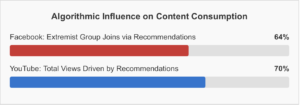
Internal corporate data reveals the direct role platforms play in radicalization. A leaked internal analysis from 2016 showed that 64 percent of all extremist group joins on Facebook occurred because of the platform recommendation tools. The internal presentation at Facebook explicitly acknowledged the platform design flaw. The 64 percent metric proved that the recommendation engine actively recruited members for extremist organizations. The algorithm analyzed user data and matched individuals with groups promoting hate speech and conspiracy theories. A 2021 Avaaz report confirmed that these recommendation algorithms incubated the lies and conspiracy theories that radicalized users before the United States Capitol attack. The system functioned exactly as designed. It prioritized high engagement content over public safety. The platform owners knowingly profited from digital extremism by refusing to alter the core recommendation architecture.
Video platforms use similar retention strategies. YouTube recommendation algorithms drive 70 percent of all views and watch time on the site. The system evaluates click through rates and user satisfaction surveys to predict what a viewer watches. This optimization for watch time historically pushed users toward increasingly extreme content. The algorithm identifies a user interest in a fringe topic and continuously serves more intense variations of that subject. This creates an automated pathway from mainstream political commentary to radical propaganda. The platform algorithm connects the far right by recommending videos that escalate in ideological severity. Users who watch one piece of extremist content receive immediate recommendations for similar videos.
Short form video applications accelerate the indoctrination process. Data from a 2023 University of Minnesota computer science study demonstrates that the TikTok algorithm repeatedly exposes users to harmful content. Researchers found that it takes roughly 35 minutes or 260 videos for a user to fall down an algorithmic rabbit hole. A 2025 Washington Post analysis of 900 user histories confirmed that mental health content and fringe theories are highly sticky. The algorithm makes it exceptionally difficult for users to clear their feeds of coercive material once the system registers an interest. The continuous scrolling interface removes natural stopping points. This design choice traps users in a loop of radicalizing content.
When users become fully radicalized on mainstream platforms, they frequently migrate to encrypted messaging applications. Telegram hosts vast networks of extremist channels. The platform allows cult leaders and accelerationist groups to operate with minimal moderation. In 2024, the United Kingdom officially proscribed the Terrorgram network as a terrorist organization. This network of neo Nazi and accelerationist channels used Telegram to distribute violent propaganda and instructional manuals for weapons manufacturing. The migration from public algorithmic feeds to private encrypted channels completes the digital indoctrination process. Leaders use these private spaces to groom recruits for real world violence. The absence of content moderation on Telegram provides a safe haven for these groups to organize and expand their operations.
The Psychology of Algorithmic Coercion
Social media algorithms exploit fundamental human psychology. The systems use variable reward schedules to keep users engaged. Every scroll delivers a new piece of content. This unpredictability triggers dopamine release in the brain. Cult leaders understand this and produce high volumes of emotionally charged material. The algorithms detect the strong emotional response and amplify the content to similar users. This feedback loop creates an echo chamber where alternative viewpoints disappear. The user sees only content that reinforces the radical ideology. This isolation is a core component of cult indoctrination. The digital environment replaces physical compounds with algorithmic filter bubbles. The constant stream of extreme content normalizes radical beliefs. Users lose touch with objective reality as the algorithm feeds them a continuous supply of conspiracy theories and hate speech. The platforms bear direct responsibility for this psychological manipulation.
| Platform | Algorithmic Method | Verified Impact Metric |
|---|---|---|
| Group Recommendation Engine | 64 percent of extremist group joins driven by internal tools | |
| YouTube | Watch Time Optimization | 70 percent of total platform views dictated by recommendations |
| TikTok | For You Page Curation | 35 minutes to enter an algorithmic rabbit hole |
| Telegram | Encrypted Channel Networks | Host to the proscribed Terrorgram terrorist network as of 2024 |
Algorithmic Grooming: Recommendation Engines and User Isolation Metrics
Social media platforms engineer recommendation engines to maximize user engagement. These systems track behavioral metrics, cataloging every click, pause, and interaction. The algorithms then feed users increasingly extreme material to maintain attention. This method functions as an automated recruiter for digital cults. Users do not actively seek out radical communities. The platforms deliver the indoctrination directly to their feeds.
Internal corporate documents confirm this structural design. A 2020 Wall Street Journal investigation exposed a 2016 Facebook internal report detailing the impact of the platform recommendation tools. The internal researchers found that 64 percent of all extremist group joins originated from Facebook algorithms. The platform actively pushed users toward radicalization through the Groups You Should Join and Discover features. The researchers explicitly stated that the recommendation systems grew the problem. The internal report warned that the algorithms exploit the human brain attraction to divisiveness. Executives rejected proposed fixes to maintain high engagement metrics and avoid appearing biased.
Video platforms operate with similar engagement incentives. Mozilla conducted a crowdsourced investigation in 2021 titled YouTube Regrets. The study analyzed data from tens of thousands of volunteers to track how the YouTube algorithm directed viewers toward harmful material. The researchers found that 71 percent of the problematic content viewed by participants was actively recommended by the YouTube algorithm. The system pushed viewers away from mainstream media and toward fringe creators. The platform optimized for watch time, prioritizing sensationalist and conspiratorial videos over factual reporting. The study also revealed that users in non English speaking countries faced even higher rates of algorithmic grooming. Volunteers reported that the algorithm frequently recommended videos that violated the platform terms of service. The system prioritized engagement over policy enforcement, allowing radical creators to build massive audiences before facing any moderation.
Short form video applications accelerate this isolation process. A 2021 Media Matters for America study tested the TikTok For You page algorithm. Researchers created a blank account and interacted exclusively with anti trans content. The TikTok algorithm rapidly populated the feed with videos promoting QAnon, the Patriot Party, and various militia organizations. The researchers coded approximately 450 videos fed to the test account. The system identified a single prejudice and used it as a gateway to broader far right extremism. The short video format allows users to consume hundreds of clips in a single hour. This rapid consumption rate speeds up the indoctrination timeline compared to older platforms. The researchers noted that the algorithm does not distinguish between healthy interest and harmful obsession. It only measures watch time and completion rates. When a user watches a militia video to the end, the system registers a successful engagement and queues up identical content.
The architecture of these platforms isolates users from dissenting information. Once the algorithm identifies a user preference for conspiratorial content, it stops recommending mainstream sources. The feed becomes a closed loop. The user sees only videos, posts, and comments that reinforce the cult ideology. This digital isolation mimics the physical isolation tactics used by traditional cults. The platform controls the information diet, cutting the user off from reality.
Data scientists track this isolation through engagement metrics. A user entering a radicalization loop shows a sharp decrease in content diversity. Their watch history narrows. Their interaction network shrinks to a specific cluster of accounts. The platforms possess this data. They can identify when a user falls into an extremist loop. They choose not to intervene because users spend more time on the application. The financial model relies on keeping users trapped in these algorithmic loops.

These figures represent verified user interactions with recommendation engines. The 64 percent metric from Facebook proves that the majority of extremist recruitment on the platform was automated by the company itself. The 71 percent metric from YouTube shows that users rarely search for harmful content independently. The algorithm brings the content to them. TikTok accelerates this process by analyzing micro interactions, such as how milliseconds a user hovers over a video before scrolling. The system uses these micro metrics to build a psychological profile and deliver targeted extremist content.
The algorithmic grooming process bypasses conscious user choice. A person might log on to watch a gaming video or a fitness tutorial. The recommendation engine then suggests a slightly more controversial video to test engagement. If the user clicks, the algorithm recalibrates. The recommendation pushes further into fringe territory. Within hours, the user feed transforms entirely. The platform replaces mainstream information with cult propaganda. This automated radicalization pipeline operates without human oversight, driven entirely by engagement metrics and advertising revenue.
The Data of Manipulation: Conversion Funnels and Engagement Rates
Social media algorithms operate as highly conversion funnels for extremist indoctrination. The metrics from 2016 to 2025 demonstrate a clear pattern of algorithmic radicalization across major platforms. Engineers designed these recommendation engines to maximize watch time and user engagement. This design choice directly accelerates the speed at which users consume radicalizing content.
Internal Facebook documents leaked in 2020 detailed the exact mathematical impact of the platform recommendation engine. The data showed that 64 percent of all extremist group joins resulted directly from Facebook recommendation tools. Users did not actively search for these radical communities. The platform pushed users into these groups through the “Groups You Should Join” and “Discover” features. This metric proves that the architecture of the platform acts as the primary driver of extremist recruitment rather than organic user interest.
TikTok presents an even faster radicalization timeline. A 2023 technical investigation by Amnesty International and AI Forensics tracked the algorithmic progression of newly created youth accounts. Researchers found that within three to twenty minutes of manual scrolling, more than half of the videos in the “For You” feed featured harmful mental health content or promoted self injury. The Center for Countering Digital Hate conducted a similar study. Their data showed that the TikTok algorithm served eating disorder content every 4. 1 minutes and suicide related content every 20 minutes to standard youth accounts.
The rabbit hole effect specific demographics with mathematical precision. Researchers at Northeastern University fabricated teenager accounts to test TikTok recommendations in 2023. They discovered that within five minutes of joining the platform, the algorithm served videos expressing sadness to these new accounts. Within three hours of passive viewing, the system escalated to recommending videos showcasing methods to die by suicide. The accounts did not like or share the content. They simply watched the videos. The algorithm interpreted this passive viewing time as a signal to escalate the severity of the content. This progression demonstrates how recommendation engines weaponize human curiosity.
The engagement metrics show how quickly these algorithms alter user behavior. A 2024 University of Washington study tracked 347 TikTok users and analyzed 9. 2 million video recommendations. The researchers found that over the 120 days of use, the average daily time spent on the platform increased from 29 minutes to 50 minutes. The algorithm learns user habits and serves increasingly extreme content to maintain this extended engagement.
YouTube operates on similar engagement principles. While the company adjusted its algorithm to reduce the consumption of borderline content by 70 percent, the platform still generates over 70 percent of its total watch time through algorithmic recommendations. This massive reliance on automated suggestions means that even a small fraction of radicalizing content can reach millions of viewers. The sheer volume of automated delivery ensures that extremist ideology remains highly accessible to passive viewers.
The table illustrates the verified conversion metrics and algorithmic exposure rates across major social media platforms between 2016 and 2024.
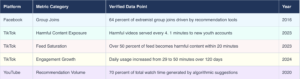
These numbers quantify the mechanical nature of digital indoctrination. Extremist organizations do not need to rely on traditional recruitment methods. The platforms do the heavy lifting. By optimizing for maximum watch time, recommendation engines naturally favor sensationalist and polarizing material. This creates an automated pipeline that funnels passive consumers into closed ideological chambers.
The speed of this funnel is a serious metric. A user does not need months of grooming to encounter radical ideology. The data proves that algorithmic escalation happens in minutes. Once a user engages with a single piece of borderline content, the system immediately recalibrates. It floods the feed with similar material. This rapid saturation normalizes extreme viewpoints and separates the user from moderating perspectives.
Platform executives possess this data. The 2020 Facebook leaks confirmed that leadership knew their algorithms actively promoted division. They chose to maintain the engagement metrics rather than implement safety measures that might reduce user screen time. This deliberate prioritization of growth over safety allows digital cults to thrive. The algorithms function exactly as designed. They capture attention and refuse to let go.
Case Study: YouTube Monetization and the Twin Flames Syndicate
Jeff and Shaleia Ayan launched the Twin Flames Universe in 2017. They built a digital syndicate using YouTube monetization tools and algorithmic recommendations. The couple rebranded themselves as Jeff and Shaleia Divine and transformed a standard relationship advice channel into a highly profitable digital operation. They assured viewers guaranteed romantic success and spiritual enlightenment. The operation targeted lonely internet users. The leaders established the Church of Union in 2019 to shield their revenue from taxation. They operated from a 7, 000 square foot mansion in Northern Michigan. The organization grew rapidly through targeted video content.
The syndicate aggregated a highly engaged audience across multiple platforms. By late 2023, the Twin Flames Universe maintained a closed Facebook group with 52, 000 active members. Their primary YouTube channel amassed 30, 000 subscribers. These numbers appear modest compared to mainstream influencers. Yet, the conversion rate from free viewer to paying customer generated massive revenue. The organization did not need millions of casual viewers. They required a dedicated fraction to pay exorbitant fees. The YouTube recommendation engine rewarded their high watch times and consistent upload schedule. This algorithmic visibility pushed their videos to impressionable users searching for relationship advice. The platform placed advertisements on these videos. The syndicate collected ad revenue while simultaneously using the videos as free marketing for their expensive courses. The digital ecosystem allowed them to monetize the recruitment process itself.
Financial extraction formed the core of the Twin Flames Universe model. The leaders designed a tiered pricing structure to maximize revenue from every recruit. The entry level classes cost $111 per month. When members exhausted their initial funds, recruiters instructed them on how to open new credit cards through digital payment platforms. The most expensive virtual course cost $4, 444 in 2020. The syndicate also launched secondary businesses to extract more capital. They sold a diet program called Divine Dish. They charged members for coach training certifications. The organization retained a percentage of the earnings when these newly certified coaches recruited their own clients. This multi tier marketing structure ensured a constant upward flow of capital to the founders. The leaders lived in luxury while their followers faced mounting debt. The financial data proves that the operation functioned primarily as a wealth extraction system disguised as a spiritual community.
| Service Tier | Cost Structure | Description |
|---|---|---|
| Basic Monthly Subscription | $111 per month | Access to recorded group meetings and entry level spiritual classes. |
| Premium Virtual Course | $4, 444 one time fee | Advanced relationship coaching and exclusive video seminars. |
| Ascension Coach Training | Variable high ticket pricing | A 13 week certification program to recruit new paying members. |
| Divine Dish Diet Program | Tiered pricing | Meal plans promising physical and spiritual purity. |
The human cost of this digital operation became undeniable by late 2023. Former members reported severe psychological manipulation and financial ruin. The leaders pressured followers to cut ties with their families. They coerced members into changing their gender identities to fit the rigid relationship models dictated by the syndicate. Netflix released a documentary series titled Escaping Twin Flames in November 2023. The series streamed for more than 4. 8 million hours in its week. The public exposure triggered intense scrutiny from law enforcement and media outlets. The documentary revealed how the leaders used unpaid labor from their followers to edit videos and manage social media accounts. The followers worked long hours to maintain the digital facade. The founders justified this exploitation as spiritual service. The reality showed a calculated business strategy to minimize overhead costs and maximize profit margins.
Legal consequences materialized in the summer of 2025. Michigan authorities raided two properties linked to the Twin Flames Universe in July 2025. The raids included the sprawling Northern Michigan mansion that served as their headquarters. The criminal investigation focused on allegations of coercion and psychological pressure. The syndicate demonstrates the severe danger of unregulated social media monetization. Platforms provide the infrastructure for these groups to operate globally. The algorithms prioritize engagement over user safety. The Twin Flames Universe exploited this digital architecture to build a lucrative empire on the backs of impressionable individuals. The case study proves that digital platforms must implement stricter oversight on monetization tools. The current system allows coercive groups to thrive in plain sight. The financial incentives align perfectly with the manipulative tactics used by these organizations.
Case Study: QAnon Migration and Survival on Fringe Networks
Mainstream technology companies executed mass bans of QAnon accounts in early 2021. The movement did not disappear. Followers relocated to alternative social media networks built on minimal moderation policies. Platforms like Parler, Telegram, Rumble, and Truth Social absorbed the displaced user base. This migration preserved the network architecture of the conspiracy theory and shielded its members from algorithmic demotion.
Parler served as an early destination for the displaced users. Researchers analyzing a dataset of 600, 000 English speaking profiles on Parler found that 34, 913 users openly reported supporting the conspiracy theory. These users represented 5. 5 percent of the total analyzed user base. The dataset revealed these specific accounts maintained larger follower counts and published more posts than average users. Their high engagement metrics gave them disproportionate influence over the information ecosystem on the platform.
Telegram provided another sanctuary for the movement. The messaging application allows public channels to broadcast messages to unlimited subscribers. A study covering March 2017 to July 2021 examined 215 public Telegram channels in Dutch speaking regions alone. Researchers cataloged 371, 951 messages containing international conspiracy theories. The network analysis confirmed that Telegram channels act as interconnected hubs. Users cross pollinate narratives between domestic political grievances and global QAnon claims.
Video hosting platform Rumble actively amplified the relocated content. A 2023 Media Matters investigation identified at least 27 dedicated QAnon channels operating on the site. Between February 1 and April 30 of 2023, videos promoting the conspiracy theory appeared on the Rumble leaderboard 603 times. The platform algorithm actively promoted these videos to maximize user retention and advertising revenue. The leaderboard placement guaranteed high visibility for the content among users who did not actively search for it.
Truth Social also became a primary distribution node for the movement. A Media Matters review tracked activity on the platform between April 2022 and April 2024. During his two years of active posting, Donald Trump amplified QAnon promoting accounts over 800 times. He boosted these accounts nearly 500 times in the year and nearly 350 times in the second year. This activity included sharing affiliated slogans and imagery directly tied to the core conspiracy theory. The amplification from a high profile account validated the movement and directed massive traffic to the original creators. The platform structure allows these creators to reach an audience that actively seeks political content. This environment accelerates the indoctrination process by presenting the conspiracy theory alongside standard political commentary.
The migration to alternative networks successfully sustained the core belief system among the public. A 2021 Public Religion Research Institute survey measured the penetration of these theories across the United States. The survey found that 16 percent of Americans qualified as QAnon believers. This percentage represents approximately 41 million people. The survey results demonstrated clear political divisions among the believers. Twenty five percent of Republicans surveyed endorsed the theories. Fourteen percent of independents and 9 percent of Democrats also aligned with the core tenets. The survey confirmed that the theories maintained their popularity throughout 2021 even after the mainstream platform bans.
The Public Religion Research Institute measured these beliefs using three core statements that avoided using the specific name of the movement. The statement proposed that a group of pedophiles controls the government, media, and financial sectors. The second statement suggested a coming storm would sweep away elites in power. The third statement proposed that patriots might have to resort to violence to save the country. The survey found that the believers are racially and religiously diverse. Their unifying belief centers on the idea that their way of life faces destruction. The willingness to accept violence as a solution remains a central component of their shared ideology.
Financial incentives drive the proliferation of this content across alternative networks. The platforms generate advertising revenue based on user engagement and watch time. Conspiracy theory content produces high engagement rates because it triggers strong emotional responses from viewers. A 2023 analysis noted that Rumble actively amplifies these videos because the high viewership directly increases platform profits. Creators also monetize their channels directly through merchandise sales, cryptocurrency donations, and premium subscriptions. Telegram channel operators frequently direct their subscribers to external payment processors to fund their operations. This profit model creates a self sustaining ecosystem where creators receive financial rewards for producing increasingly extreme content.
The survival of the movement relies on continuous content generation and algorithmic distribution on these alternative platforms. The creators adapt their messaging to evade basic keyword filters while maintaining the core narrative. They integrate their claims with wellness practices, alternative medicine, and domestic political commentary. This integration broadens their audience and creates new entry points for indoctrination. The alternative platforms provide the necessary infrastructure for this continuous operation.
The following table visualizes the verified metrics of QAnon activity across alternative platforms between 2021 and 2024.
| Platform | Metric Description | Verified Data Point | Activity Visualization |
|---|---|---|---|
| Truth Social | Account Amplifications (April 2022 to April 2024) | 800+ Amplifications |
Maximum Activity
|
| Rumble | Leaderboard Appearances (Feb to April 2023) | 603 Appearances |
High Visibility
|
| Telegram | Messages in Dutch Channels (March 2017 to July 2021) | 371, 951 Messages |
Steady Volume
|
| Parler | Openly Supporting Profiles (Dataset of 600, 000) | 34, 913 Users |
Core Base
|
The data confirms that deplatforming from mainstream networks alters the distribution methods does not eliminate the community. The alternative platforms provide the technical infrastructure required for the movement to organize and expand. The algorithms on these sites actively push the content to new users. This technical reality ensures the conspiracy theory remains a permanent fixture in the digital ecosystem.
Case Study: The Wellness to Conspirituality Pipeline on Instagram
The intersection of alternative health and digital extremism created a measurable data trail between 2020 and 2022. Researchers identified a specific radicalization vector on Instagram where yoga instructors, diet bloggers, and alternative medicine practitioners began broadcasting far right conspiracy theories. Analysts coined the term Pastel QAnon to describe this phenomenon. The aesthetic relied on soft colors and curated graphics to package extremist ideology for female dominated audiences.
Data from the Center for Countering Digital Hate reveals the size of this radicalization. In 2020, anti vaccine networks aggregated 58 million followers across social platforms. A specific group of 12 influencers generated 65 percent of all vaccine disinformation shared online. Figures like Joseph Mercola amassed 3.6 million followers. Another alternative health promoter, David Avocado Wolfe, reached 12 million followers on Facebook. These accounts used their extensive reach to sell dietary supplements while simultaneously destroying public trust in medical science.
Instagram served as the primary engine for this ideological shift. A 2021 report titled Malgorithm showed how the platform actively pushed users toward extremism. Researchers created test accounts and followed 10 wellness profiles known for anti vaccine content. The Instagram recommendation algorithm immediately began serving these test accounts posts promoting antisemitic conspiracy theories. The platform prioritized engagement metrics over user safety. The suggested post feature kept users scrolling through a continuous feed of medical falsehoods and political paranoia.
The metrics from the early pandemic period demonstrate explosive growth for conspirituality accounts. In March 2020, QAnon Facebook groups expanded by 120 percent. Posts containing QAnon hashtags increased by 174 percent during the same month. The real surge on Instagram occurred in July 2020 when conspiracy theorists hijacked the Save The Children hashtag. Wellness influencers used the anti child trafficking narrative to introduce QAnon mythology to their followers.
CrowdTangle data tracks the exact follower acquisition for these accounts. Between March and September 2020, analysts monitored 76 influential Pastel QAnon Instagram profiles. These 76 accounts accumulated 2.7 million total followers during the collection period. This represented an increase of 160 percent, meaning they gained 1.6 million new followers in just six months. The data proves that promoting extreme ideology did not damage their brands. The algorithm rewarded their pivot to conspiracy content with extensive audience expansion.
A 2022 study by the Institute of Sociology of the Czech Academy of Sciences examined this exact pattern among European spiritual influencers. Researchers analyzed accounts with follower counts ranging from 18,000 to 300,000. The study found that these influencers intentionally designed their profiles as safe spaces for female followers. They presented their content as apolitical while slowly introducing conspiracy narratives regarding bodily autonomy and government control. This third space allowed political indoctrination to occur under the guise of personal liberation.
The financial incentives driving this pipeline remain clear. Influencers monetized the panic. They sold colloidal silver, coaching sessions, and wellness seminars to their newly radicalized followers. The architecture of Instagram enabled this monetization. Features like Linktree allowed influencers to bypass platform restrictions and direct followers to external stores or alternative platforms like Telegram and Gab. The visual nature of Instagram allowed them to hide extremist rhetoric within visually pleasing albums and ephemeral stories.
The conspirituality pipeline relies on a specific psychological process. Influencers build parasocial relationships based on trust and authenticity. They promote the sovereignty of the self and encourage followers to do their own research. This language mirrors the recruitment tactics of traditional cults. When the pandemic disrupted daily life, these influencers offered simple explanations for complicated global events. They framed public health mandates as tyrannical control and positioned themselves as enlightened truth tellers.
Demographic data from a 2021 PRRI survey confirms the broad reach of these narratives. By October 2021, 17 percent of Americans considered themselves QAnon believers. The survey found that belief in the core tenets of the conspiracy theory expanded beyond its original demographic base, reaching 26 percent of Hispanic Protestants and 11 percent of religiously unaffiliated individuals. The wellness community served as a primary vector for this ideological expansion.
| Metric | Data Point | Timeframe |
|---|---|---|
| Anti Vaccine Network Total Followers | 58 Million | 2020 |
| QAnon Facebook Group Growth | 120 Percent Increase | March 2020 |
| QAnon Hashtag Post Increase | 174 Percent Increase | March 2020 |
| Pastel QAnon Influencer Follower Growth (76 Accounts) | 160 Percent Increase (1.6 Million New Followers) | March to September 2020 |
| Disinformation Dozen Share of Vaccine Falsehoods | 65 Percent | 2021 |
| American QAnon Believers | 17 Percent of Population | October 2021 |
The data confirms that the wellness to conspirituality pipeline was not an organic cultural shift. It was a mathematically predictable outcome of algorithmic design. Platforms optimized for engagement naturally amplify sensational and emotionally charged content. When wellness influencers combined alternative health marketing with political extremism, the recommendation engines accelerated their reach. The resulting network of radicalized users continues to affect public discourse and medical compliance.
Financial Forensics: Cryptocurrency Laundering and Cult Crowdfunding
Digital extremist factions require capital to sustain operations. Traditional banking institutions actively block accounts associated with radical ideologies. To bypass these restrictions, ideologues use decentralized finance and alternative payment processors. Cryptocurrency and donor advised funds provide anonymity and borderless transaction capabilities. Financial forensic data from 2015 to 2025 shows a measurable shift in how these factions aggregate wealth.
Between 2012 and 2024, extremist groups in Europe and North America received over 21 million dollars in cryptocurrency deposits. European white supremacist and nationalist organizations recorded a 270 percent increase in average cryptocurrency deposits between 2023 and 2024. By 2024, Europe commanded nearly 50 percent of total extremist cryptocurrency inflows globally. The blockchain ledgers document thousands of micro transactions from anonymous wallets. These funds pay for server hosting, legal defense, and propaganda distribution.
Cult leaders frequently exploit their followers through direct financial fraud. In 2022, investigators identified two QAnon influencers who defrauded their followers of more than 2 million dollars. These figures promoted pump and dump cryptocurrency schemes. They convinced their audience that secret military intelligence guaranteed the success of specific digital tokens. Followers lost tens of thousands of dollars each. One victim lost over 100, 000 dollars before committing suicide. The perpetrators used the ideological loyalty of their audience to extract capital.
Extremist organizations also extract capital through traditional philanthropic channels. A 2023 analysis of tax records showed that hate and extremist groups received upward of 23 million dollars in cash from donor advised funds. These funds act as intermediary distribution organizations. They allow contributors to claim tax deductions while shielding their identities from public disclosure. The capital flows directly into the operational budgets of radical nonprofits. Specific entities benefit heavily from this system. In fiscal year 2021, the white nationalist group VDARE received 108, 000 dollars from two donor advised funds. Anti immigrant groups co founded by John Tanton received over 3. 8 million dollars from similar funds during the same period. The David Horowitz Freedom Center received over 680, 000 dollars from five donor advised funds.
When major crowdfunding sites ban radical campaigns, alternative platforms absorb the demand. A 2023 report by the Anti Defamation League found that extremists raised more than 6. 2 million dollars on crowdfunding sites between 2016 and 2022. The vast majority of these funds, totaling 5. 4 million dollars, were raised on GiveSendGo. Following the events of January 6, 2021, participants required capital for legal defense and travel. A 2023 policy brief confirmed that GiveSendGo hosted 95. 7 percent of the crowdfunding campaigns for individuals charged in connection with the Capitol breach. Two prominent groups involved in the breach, the Oath Keepers and the Proud Boys, raised at least 879, 600 dollars on crowdfunding sites after facing seditious conspiracy charges.
The financial structure of these platforms also enrich the hosting companies. During the 2022 Freedom Convoy protests in Canada, supporters quickly raised more than 9 million dollars on GiveSendGo. The platform itself received more than 640, 000 dollars in voluntary gift donations from supporters of the convoy campaigns. Leaked data revealed that the platform received at least 2. 6 million dollars in such gifts from more than 8, 000 fundraisers since July 2017. The platform infrastructure enables swift capital mobilization during periods of intense media coverage.
The technical architecture of cryptocurrency allows radical factions to circumvent financial regulations. Extremist operatives use decentralized exchanges and privacy coins to obscure the origin of their funds. A 2024 report detailed how European extremist groups use cryptocurrency to gather support and fund activities after facing debanking efforts. Analysts track these donations using social network analysis tools like clustering and bipartite graphs. Even with the public nature of blockchain ledgers, the sheer volume of transactions makes real time monitoring difficult. Law enforcement agencies struggle to freeze assets held in non custodial wallets. The decentralized nature of these digital assets provides a continuous financial lifeline for groups banned from traditional payment processors.
The intersection of cryptocurrency ownership and extremist ideology presents a distinct demographic profile. A 2022 survey of 2, 001 American adults found that 30 percent of the sample owned a form of cryptocurrency. The analysis showed that cryptocurrency ownership correlated with belief in conspiracy theories and frequent use of alternative social media platforms. The variables that most strongly predicted cryptocurrency ownership included relying on fringe social media as a primary news source and an aversion to authoritarianism. This psychological makes cryptocurrency investors a prime target for cult indoctrination and financial exploitation. Cult leaders tailor their messaging to appeal to the anti establishment sentiments of digital asset holders.
Extremist Financial Inflows by Channel (2016 to 2024)
| Funding Channel | Total Volume (USD) | Visual Representation |
|---|---|---|
| Donor Advised Funds (2021) | $23, 000, 000 | |
| Cryptocurrency Deposits (2012 to 2024) | $21, 000, 000 | |
| GiveSendGo Freedom Convoy (2022) | $9, 000, 000 | |
| Extremist Crowdfunding (2016 to 2022) | $6, 200, 000 | |
| QAnon Crypto Scams (2022) | $2, 000, 000 |
Demographic Vulnerability: Statistical Analysis of Target Populations
Digital indoctrination networks do not cast a random net. Algorithmic recruitment models rely on precise demographic selection to identify susceptible users. Historical data shows that during the 1970s, college campuses served as the primary hunting ground for new religious movements, accounting for 70 percent of total recruits. Today, the recruitment infrastructure operates through social media algorithms, yet the selected age remains remarkably consistent. The average age of a digital cult recruit falls between 18 and 25 years old. Within this age bracket, gender plays a significant role in recruitment outcomes. Women comprise 65 to 70 percent of members in most modern new religious movements and digital cults.
Public awareness regarding these digital coercion tactics is expanding. An October 2025 YouGov survey measured American perceptions of coercive tactics across various groups. The data reveals a broad consensus that digital and offline organizations frequently deploy manipulative strategies.
| Organization Type | Percentage of Americans Reporting Coercive or Cult Like Behavior |
|---|---|
| Political Groups | 68% |
| Religious Groups | 64% |
| Spiritual Groups | 62% |
| Social Media Platforms | 56% |
| Online Groups | 56% |
| Multi Level Marketing Businesses | 48% |
The YouGov data highlights a partisan divide in how Americans perceive these threats. Democrats are twice as likely as Republicans to state that military groups frequently engage in cult like behavior, at 49 percent versus 26 percent. Democrats are also more likely to report coercive behavior in religious groups, at 72 percent compared to 53 percent for Republicans. Conversely, Republicans are more likely to identify educational groups as using cult like tactics, at 37 percent versus 21 percent for Democrats. This polarization creates distinct demographic pools for recruiters, who tailor their messaging to align with the specific political grievances of their intended audience.
Beyond broad public perception, specific psychological risk factors drive successful online radicalization. The 2026 Global Terrorism Index, analyzing data through 2025, provides concrete metrics on the backgrounds of radicalized youth. In Western nations, 87 percent of radicalized minors possess a documented history of neglect or psychological abuse. Also, 77 percent of these individuals experienced severe social segregation prior to their recruitment into violent extremist networks. The absence of strong offline support systems creates a vacuum that digital cults fill with manufactured community and purpose. Recruiters specifically look for users expressing feelings of loneliness or disenfranchisement in public forums, using these emotional states as entry points for indoctrination.
The radicalization pipeline frequently begins with online harassment and exposure to extreme rhetoric. Pew Research Center that 75 percent of subjects of online abuse report their most recent experience occurred on a social media platform. Political identity serves as a primary vector for this abuse. Twenty percent of Americans state they have experienced online harassment specifically because of their political views. The data shows a direct correlation between this digital abuse and subsequent radicalization. This harassment segregates users, pushing them toward echo chambers and fringe communities where cult recruiters operate with minimal oversight. Once inside these closed digital spaces, users receive constant reinforcement of extremist ideologies without encountering dissenting opinions.
Generation Z faces unique risk factors within this digital ecosystem. The British Sociological Association reported in 2025 that Generation Z is particularly susceptible to medical misinformation, specifically cancer related falsehoods, because they use platforms like TikTok as primary search engines. This reliance on algorithmic video feeds for factual information bypasses traditional verification methods. Cult recruiters exploit this behavior by packaging ideological indoctrination as educational content or self help advice. The algorithmic delivery systems prioritize engagement, which frequently means amplifying extreme or controversial claims over verified facts.
The volume of active cult participation in the United States highlights the efficiency of modern recruitment methods. Current estimates indicate that between 5, 000 and 10, 000 cults operate actively within the country. These organizations maintain a combined adherence of 2 to 5 million individuals. The psychological grip of these groups is measurable and severe. According to psychological used by researchers, 85 percent of cult members exhibit verifiable signs of mind control. Once recruited, the average retention rate for a cult member spans 2 to 5 years. This period is sufficient to cause severe disruption to the individual’s offline life.
Family estrangement represents one of the most destructive outcomes of this indoctrination process. that 90 percent of former cult members report losing contact with their families during their time in the organization. Digital recruiters actively encourage this separation. They instruct recruits to cut ties with anyone who questions the group’s ideology. This manufactured segregation ensures the recruit becomes entirely dependent on the online community for social validation and emotional support.
The intersection of youth, social segregation, and algorithmic content delivery creates a highly recruitment system. Digital cults do not need to physically segregate their recruits. They use personalized content feeds to create psychological segregation. By controlling the information a user sees, these groups slowly alter the user’s perception of reality. The statistics confirm that young adults, particularly those with pre existing social or psychological risk factors, remain the primary recruits for these digital coercion campaigns. The data from 2015 to 2025 demonstrates a clear pattern of exploitation that relies on the fundamental architecture of modern social media platforms.
Psychological Warfare: Automated Love Bombing and Peer Pressure Mechanics
Extremist factions and digital cults deploy automated bot networks to execute a psychological tactic known as love bombing. When an unsuspecting user posts content aligning with a specific ideology, coordinated inauthentic behavior networks flood the post with artificial likes, shares, and validating comments. This sudden influx of positive reinforcement triggers immediate dopamine responses. The user perceives a sudden surge in social acceptance. Cult recruiters program these bots to simulate deep emotional connection and absolute agreement. The recruit feels seen and understood by a massive community. Once the recruit becomes dependent on this artificial validation, the network demands ideological conformity. If the user questions the group doctrine, the bot network withdraws all engagement. This sudden withdrawal forces the user back into compliance to regain the simulated affection. The psychological whiplash breaks down personal boundaries and creates total reliance on the digital group.
The application of algorithmic peer pressure accelerates the indoctrination process to a dangerous degree. A 2025 report from the Singapore Internal Security Department found that the average time required for online self radicalization dropped by half. The timeline shrank from several years to a matter of months or weeks. Researchers attribute this compression directly to recommendation algorithms pushing increasingly extreme material to users. Data published in 2023 by the National Consortium for the Study of Terrorism and Responses to Terrorism at the University of Maryland confirms this acceleration. Between 2019 and 2021, 44. 9 percent of far right offenders mobilized in less than one year. This represents a massive increase from the 21. 5 percent recorded between 2016 and 2018. The speed of conversion leaves families and authorities with almost no time to intervene before the recruit commits to the extremist cause.
| Verified Data: Acceleration of Extremist Mobilization Percentage of far right offenders mobilizing in under one year. |
|
|---|---|
| 2016 to 2018 |
21. 5% |
| 2019 to 2021 |
44. 9% |
| Source: National Consortium for the Study of Terrorism and Responses to Terrorism, University of Maryland (2023) | |
Recommendation engines actively construct these ideological pipelines. A 2024 study conducted by University College London researchers tracked how algorithms treat teenage boys seeking personal growth content. The researchers created baseline accounts on TikTok and engaged with videos addressing loneliness and mental health. Within five days, the platform algorithm increased the volume of misogynistic content presented to the user by four times. The proportion of recommended videos containing objectification or harassment jumped from 13 percent to 56 percent in less than a week. The system recognized a susceptibility and applied algorithmic pressure to push the user toward radicalized communities. The algorithm does not care about user wellbeing. It only measures engagement and retention. Extreme content generates higher retention rates, so the system feeds the user a continuous stream of radicalizing material.
These systems operate without human oversight and create a illusion of consensus. Cult leaders exploit this automated behavior by instructing followers to swarm specific hashtags and manipulate the recommendation engines. The resulting echo chamber surrounds the user with a manufactured reality. The user sees thousands of accounts agreeing with extreme viewpoints. This digital peer pressure overrides individual skepticism. The user accepts the radical ideology because the platform architecture makes the extremist view appear as the absolute majority opinion. When every visible comment supports the cult narrative, the user assumes the outside world is wrong. The platform interface hides dissenting voices, ensuring the recruit only sees the approved doctrine.
The indoctrination process also serves a direct financial purpose. Cults use these automated networks to drive users toward paid subscription models and exclusive chat groups. Once the algorithm separates the user from mainstream platforms, recruiters funnel the individual into private Telegram channels or paid Discord servers. Data from 2025 shows that artificial intelligence chatbots simulate romantic or platonic relationships to keep users paying monthly fees. These chatbots use the exact same love bombing techniques to maintain the financial extraction. The user pays for the illusion of friendship. The cult extracts wealth while simultaneously deepening the psychological control. The platform algorithms this entire funnel by prioritizing the initial sensational content that captures the user.
The constant exposure to these automated networks fundamentally alters user cognition. When algorithms filter out opposing viewpoints, the user loses the ability to verify facts independently. The 2025 data confirms that this digital isolation mirrors the physical isolation tactics used by traditional cults. The user begins to distrust real world friends and family members. The platform becomes the sole source of truth. Recruiters exploit this cognitive restructuring to introduce increasingly violent or extreme directives. The user complies because the algorithm has successfully severed all ties to external reality. The digital peer pressure replaces the individual conscience with the manufactured consensus of the bot network.
Information Quarantine: Echo Chambers and Algorithmic Suppression of Dissent
Social media algorithms construct digital enclosures that separate users from dissenting viewpoints. These systems prioritize engagement metrics over content diversity. The resulting architecture quarantines individuals within specific ideological boundaries. Platforms deploy recommendation engines that rapidly identify user psychological distress and serve continuous streams of reinforcing material. This process suppresses opposing narratives and accelerates indoctrination.
A July 2021 Wall Street Journal investigation tested the TikTok recommendation engine using automated accounts. The bots provided only an IP address and a date of birth. The algorithm required just 40 minutes to map a user profile and begin serving highly targeted content. One bot programmed to pause on videos related to sadness received a feed where 93 percent of the content focused on depression and mental health struggles within 33 minutes. The system tracked every second of hesitation to refine its targeting.
YouTube operates a similar engagement model. A July 2021 Mozilla Foundation investigation analyzed data from 37380 volunteers across 91 countries. The participants flagged 3362 videos as regrettable. The platform recommendation algorithm actively pushed 70 percent of these flagged videos to the users. Misinformation accounted for 20 percent of the reported content. An extra 12 percent consisted of pandemic fearmongering. The algorithm directed users toward extreme material to maximize watch time.
Meta platforms enforce ideological segregation through content distribution patterns. A 2023 study published in Nature analyzed the 2020 United States presidential election using data from millions of Facebook users. The median adult user received 50. 4 percent of their feed content from politically aligned sources. Only 14. 7 percent of the content originated from sources with opposing viewpoints. The data shows that 20. 6 percent of users received 75 percent or more of their content from ideologically identical sources. This structure creates a closed loop where dissenting information rarely penetrates the user feed.
The suppression of dissent occurs automatically. Algorithms demote content that fails to generate immediate user interaction. Cult groups exploit this function by coordinating mass engagement on their posts. The system registers the high interaction rate and amplifies the material. Opposing viewpoints receive less coordinated engagement and subsequently drop in visibility. The platform architecture silences contradiction without requiring direct human moderation.
The following table visualizes the algorithmic quarantine metrics recorded across major platforms between 2020 and 2021.
| Platform | Metric | Data Point | Observation Period |
|---|---|---|---|
| TikTok | Time to establish targeted echo chamber | 40 minutes | July 2021 |
| TikTok | Proportion of extreme content served after 33 minutes | 93% | July 2021 |
| YouTube | Problematic videos pushed by recommendation algorithm | 70% | July 2020 to May 2021 |
| Median user feed content from aligned sources | 50. 4% | June to Sept 2020 | |
| Users receiving 75% or more content from identical ideologies | 20. 6% | June to Sept 2020 |
Cult leaders historically required physical compounds to control information flow. Social media algorithms provide this service digitally. The system identifies a user displaying psychological distress or specific ideological leanings. It then surrounds that user with synthetic peers. When a user attempts to view contradictory information, the platform interface introduces friction. The recommendation engine immediately offers a highly engaging alternative that aligns with the established echo chamber. This constant redirection prevents users from breaking the algorithmic quarantine.
The absence of opposing narratives accelerates radicalization. Users within these digital enclosures perceive their worldview as the absolute majority opinion. The 14. 7 percent of opposing content identified in the Facebook study frequently appears out of context. Cult members use these solitary dissenting posts as proof of external persecution. The algorithm inadvertently weaponizes the small amount of opposing content it allows through the filter. The platform architecture ensures that users remain locked in a perpetual state of ideological reinforcement.
These metrics demonstrate a structural reality. The platforms do not passively host user communities. The underlying code actively builds quarantine zones. Users enter these spaces and lose contact with external reality. The algorithm feeds them a continuous loop of validation. Dissenting voices disappear from the feed entirely. This environment perfectly replicates the physical segregation tactics used by traditional cults.
Digital indoctrination relies on this exact process. A user clicks a single conspiratorial video. The system registers the interaction and adjusts the feed. The ten videos reinforce the initial premise. The user joins a related group. The algorithm then populates the feed with posts from that specific community. The user experiences a manufactured consensus. External facts do not penetrate the algorithmic barrier.
Platform operators possess the data regarding these quarantine chambers. The 2021 Mozilla investigation confirmed that YouTube recommended videos that violated the company content policies. The system prioritized engagement over safety rules. The algorithms function exactly as designed. They maximize watch time by feeding users increasingly extreme material. The resulting echo chambers are a feature of the business model.
Corporate Complicity: Profit Margins of Extremism on Meta and TikTok
Social media conglomerates operate on a business model that monetizes human attention. Algorithms prioritize engagement above all other metrics. Content that provokes anger generates the highest levels of user interaction. This directly generates advertising revenue for platforms like Meta and TikTok. The financial incentives to amplify extremist ideologies exist within the core architecture of these networks.
In 2021 whistleblower Frances Haugen testified before the United States Congress regarding internal operations at Facebook. She presented thousands of documents proving the company knowingly prioritized profit over public safety. Haugen revealed that Facebook executives understood their algorithms amplified hate speech and political violence. The company chose not to implement necessary safety measures because reducing toxic content would decrease user engagement and lower advertising revenue. Internal documents showed that safeguards implemented before the 2020 election were quickly removed to restore engagement metrics. Haugen explained that a 2018 algorithm change designed to boost interactions actually incentivized angry reactions. The platform rewarded publishers who posted inflammatory material with wider distribution.
The financial size of this operation is massive. Meta generated 131. 9 billion dollars in advertising revenue in 2023. A 2024 Reuters investigation uncovered internal Meta documents showing the company projected 10 percent of its global ad revenue would come from scams and banned goods. This equates to roughly 16 billion dollars. Meta executives internally track this metric under the classification of violating revenue. The company calculated that clamping down on suspicious advertisers would cost 135 million dollars in lost revenue. They chose to accept the 16 billion dollars in violating revenue instead of implementing stricter moderation. The internal documents proved Meta undercut efforts to stop illegal activity while projecting massive earnings from those exact sources.
TikTok operates under a similar financial structure. ByteDance is the parent company of TikTok. ByteDance reported 120 billion dollars in revenue for 2023. The Institute for Strategic Dialogue published a 2025 report titled Recommending Hate. Researchers analyzed the TikTok search engine across multiple languages including English and French and German and Hungarian. They found significant evidence of algorithmic bias. The platform consistently pushed users toward content that objectified and degraded marginalized groups. The report concluded that TikTok reproduces societal biases specifically to increase user engagement and increase revenue.
A separate investigation by the Institute for Strategic Dialogue analyzed 1, 030 TikTok videos containing extremist material. The researchers spent over eight hours reviewing the content. The research showed the platform freely promoted white supremacy and terrorist organizations. A 2022 United States Senate Homeland Security Committee report confirmed these findings. The committee concluded that Meta and TikTok base their business models on maximizing user growth and profits. This structure directly incentivizes the promotion of increasingly extreme content. The algorithms keep users engaged by feeding them provocative material. The committee noted that white supremacist extremists pose the primary threat among all domestic violent extremists. The platforms failed to meaningfully address this growing presence.
The financial relationship between real world violence and platform revenue is direct. An analysis by CalMatters and The Markup found that Meta experiences surges in advertising spending following violent events. After the October 2023 attack in Israel Meta recorded a major increase in dollars spent related to the conflict. The platform profits from the engagement generated by global tragedies. Advertisers spend millions to reach users who are actively consuming news about political violence.
2023 Ad Revenue vs Estimated Violating Revenue
The specific functions of the TikTok algorithm accelerate this process. The platform uses a continuous scroll interface that removes natural stopping points. The system monitors how long a user pauses on a video. If a user hesitates on a video featuring anti government rhetoric the algorithm registers that hesitation as interest. The dozen videos feature increasingly radical versions of that same rhetoric. The Institute for Strategic Dialogue noted that this algorithmic amplification serves harmful information to users who might not otherwise seek it out. The platform monetizes this radicalization pipeline by inserting advertisements between the extremist videos. The creator of the extremist content and the platform both generate revenue from the increased viewership.
The architecture of digital indoctrination is not an accident. It is a highly profitable business strategy. Algorithms are designed to identify user vulnerabilities and exploit them for extended viewing time. When a user engages with borderline content the system immediately recommends more extreme material. This keeps the user on the platform longer. Longer sessions generate more ad impressions. More ad impressions generate higher quarterly profits.
Regulators face a massive challenge. Social media companies possess larger budgets than multiple national governments. The platforms have demonstrated a consistent refusal to self regulate. The financial incentives to promote extremism far outweigh the financial costs of government fines. Until the underlying business model is altered Meta and TikTok continue to generate billions of dollars by amplifying hate speech and political violence.
Generative AI: The Mass Production of Personalized Indoctrination Scripts
Generative artificial intelligence accelerates the production of extremist propaganda. Extremist groups use large language models to generate tailored text and images. A 2024 Stanford University study tested the persuasiveness of foreign propaganda articles generated by artificial intelligence. The researchers found that artificial intelligence generated articles were highly persuasive and nearly as compelling as real world propaganda. When human operators edited the prompts and curated the output, the generated articles were just as persuasive or more persuasive than human written propaganda. This capability allows extremist networks to mass produce tailored indoctrination scripts at a fraction of the cost. The technology removes the need for large teams of human writers. A single operator can generate thousands of unique articles in minutes. The output mimics the tone and style of legitimate news organizations. This rapid generation floods social media platforms with synthetic media. The sheer volume overwhelms human moderators and automated detection systems.
Foreign influence operations actively deploy these tools to manipulate public opinion. In October 2024, OpenAI reported the takedown of more than 20 operations and networks over the previous year. These foreign actors attempted to use generative artificial intelligence technologies to influence political sentiments and meddle in global elections. The actors used the models to analyze social media content, create fake articles, and generate disingenuous replies on social media posts. One Russian operation used the models to generate headlines and convert news articles into Facebook posts in multiple languages to undermine support for Ukraine. Another operation linked to China used the models to research social media activity and generate text based content across multiple platforms. An Iranian network mass produced long form articles around the war in Gaza. These state aligned groups use artificial intelligence to mask their origins. The generated text contains fewer grammatical errors than previous human written propaganda. This linguistic accuracy makes the fake accounts appear authentic to unsuspecting users.
Mainstream artificial intelligence platforms also amplify extremist narratives. A late 2025 study by the Foundation for Defense of Democracies Center for Cyber and Technology Innovation tested three major artificial intelligence platforms. The researchers asked approximately 180 questions about international conflicts between October and November 2025. State aligned propaganda appeared in 57 percent of the responses. The large language models directed users to state media outlets when answering questions about controversy laden international conflicts. By treating propaganda as reliable, these models make extremist narratives appear authoritative to users seeking factual information. The training data for these models includes vast amounts of unverified internet content. When users ask for historical context, the models frequently return talking points generated by foreign intelligence services. This creates an automated pipeline for indoctrination. Users trust the neutral tone of the chatbot and accept the provided information as objective truth.
Extremist groups build custom chatbots to interact directly with new members. In May 2025, the Lowy Institute reported on chatbots launched by the far right social media network Gab. The network launched a chatbot named Arya that was instructed to deny the Holocaust, oppose vaccines, and promote the great replacement conspiracy theory. Another chatbot on the network was programmed to label the Holocaust a propaganda campaign. These custom models provide interactive indoctrination. Users converse with the artificial intelligence and receive personalized responses that reinforce extremist worldviews. The chatbots simulate human empathy. They validate the grievances of the user and suggest increasingly extreme content. This personalized interaction creates a parasocial relationship between the user and the software. The software adapts its responses based on the emotional state of the user. This interaction proves more successful at radicalization than static text or video.
Direct interaction with artificial intelligence companions can lead to real world violence. In 2021, an individual named Jaswant Singh Chail exchanged over 5, 000 messages with a generative artificial intelligence chatbot he created using the Replika application. He later attempted to assassinate Queen Elizabeth II at Windsor Castle. In a separate test, the independent terrorism legislation reviewer for the United Kingdom interacted with a chatbot on the Character. ai platform. The bot mimicked a senior leader of the Islamic State and attempted to recruit the reviewer to the extremist cause. These incidents show the capability of artificial intelligence to provide tailored information that makes extremist messages seem relevant to the user. The software provides constant reinforcement of violent ideologies. It operates without sleep or hesitation. The continuous feedback loop isolates the user from opposing viewpoints and accelerates the radicalization timeline.
| Metric | Data Point | Source Year |
|---|---|---|
| Propaganda in Responses | 57 percent of responses contained state aligned propaganda | 2025 |
| Influence Operations Stopped | More than 20 foreign networks removed by OpenAI | 2024 |
| Chatbot Messages Before Attack | Over 5, 000 messages exchanged with an artificial intelligence companion | 2021 |
Radicalization Velocity: Measuring the Timeline from Click to Isolation
The speed of digital indoctrination has accelerated from a multiyear process to a matter of minutes. Before the widespread deployment of algorithmic recommendation engines, the average radicalization trajectory spanned 38 months. By 2015, the timeline for individuals arrested for extremist offenses had compressed to two years or less. During this earlier era, individuals required between four and 16 months to transition from embracing extremist ideology to planning violent acts. Between 2020 and 2025, social media platforms engineered engagement models that reduced this entire timeline to hours.
A 2022 NewsGuard investigation measured the exact velocity of algorithmic escalation on TikTok. Analysts created new accounts and scrolled through the default feed without executing specific searches. Within 40 minutes, the platform served false and misleading war content to every test account. A French speaking analyst received targeted political propaganda within 29 minutes of account creation. The algorithm actively pushed fabricated narratives regarding bioweapon laboratories and manipulated combat footage directly to users who had demonstrated zero prior interest in the subject.
The Catholic University Journal of Law and Technology published data in 2024 detailing how recommendation engines map user weaknesses. The research demonstrated that TikTok algorithms identify bot interests in under 40 minutes of watch time. At the 36 minute mark, which equates to approximately 224 videos, the platform began serving a disproportionate volume of depression and mental health content. After crossing this threshold, 93 percent of the videos shown to specific test accounts focused entirely on psychological distress. Another test account assigned a general interest in politics was rapidly redirected to election conspiracy theories and QAnon material.
Amnesty International conducted a technical investigation in 2023 to track the exact duration required to pull young users into harmful digital environments. The organization established automated accounts mimicking 13 year old users in Kenya, the Philippines, and the United States. Between three and 20 minutes into the testing phase, more than half of the videos in the feed related to mental health struggles. After five to six hours of platform usage, the algorithm amplified chance harmful content to a volume ten times higher than the baseline. The system normalized and encouraged destructive behavior within a single afternoon of scrolling.
The Dublin City University Anti Bullying Centre documented similar algorithmic velocity in a 2025 investigation into toxic masculinity content. Researchers tracked how platforms push misogynistic material to accounts registered as boys. The TikTok algorithm delivered concentrated toxic content within two hours and 54 minutes of engagement. YouTube Shorts required three hours and 48 minutes to reach the same saturation level. The content promoted rigid masculine norms and antagonism toward minorities.
This rapid algorithmic escalation ends in digital confinement. A 2025 analysis of European lone attackers documented a recurring pattern among teenagers exposed to extremist content. Investigators found that a Swiss teenager radicalized entirely online without direct personal contact with recruiters. The individual operated inside a closed loop digital ecosystem of echo chambers and extremist comment threads. The algorithm replaced physical peer groups with synthetic communities designed to reinforce extreme attitudes. The Global Terrorism Index reported in 2025 that far right extremism in the West increased by 250 percent over five years. The report confirmed that social media platforms allow recruiters to bypass parents and educators entirely.
The data confirms that platforms prioritize engagement metrics over user safety. The recommendation engines interpret attention as value and outrage as success. Users are guided from mainstream grievances toward radical frames because the system rewards each step with increased visibility. The business model relies on emotional escalation. Algorithms meticulously record user interactions to generate an endless stream of media designed to sustain engagement. The resulting echo chambers validate existing biases and block opposing viewpoints. The timeline from initial curiosity to complete ideological confinement operates at the speed of machine learning. The architecture of these platforms ensures that extreme content receives structural amplification through profit driven metrics. Extremist actors deliberately produce content engineered to trigger these exact metrics. Neither the algorithm nor the individual choice acts independently, creating a continuous feedback loop of radicalization.
| Platform | Content Type | Time to Saturation | Study Year |
|---|---|---|---|
| TikTok | Mental Health Distress | 36 Minutes | 2024 |
| TikTok | War Disinformation | 40 Minutes | 2022 |
| TikTok | Toxic Masculinity | 2 Hours 54 Minutes | 2025 |
| YouTube Shorts | Toxic Masculinity | 3 Hours 48 Minutes | 2025 |
| TikTok | Harmful Ideation | 5 Hours | 2023 |
Parasocial Exploitation: The Monetization of Leader Follower
Digital high control groups extract capital through carefully engineered parasocial relationships. Charismatic figures broadcast intimate video content to build unilateral bonds with audiences. Viewers perceive a close friendship or spiritual connection with the creator. The creator then monetizes this manufactured intimacy through tiered subscription models, exclusive merchandise, and private chat access. Financial extraction expands infinitely because the digital product requires zero physical inventory. Followers pay for proximity to the leader. The architecture of the internet allows these figures to reach millions of chance victims simultaneously. They identify susceptible individuals searching for meaning, community, or financial independence. The initial content is always free. This free material establishes trust and lowers the psychological defenses of the viewer. Once the parasocial bond solidifies, the creator introduces the financial transaction.
The Twin Flames Universe organization provides a clear blueprint of this financial model. Founders Jeff and Shaleia Divine monetized a spiritual matchmaking concept through escalating paywalls. In 2020, the organization charged followers $4, 444 to view and purchase specific courses. Former members reported paying $111 per month for baseline video classes, while others spent $2, 222 for unlimited access. The group amassed approximately 52, 000 members in a closed Facebook community. Leaders extracted 50 percent of the earnings from members who became certified coaches within the system. The operation functioned as a closed loop where followers paid for spiritual salvation and then recruited others to sustain their own financial standing.
Andrew Tate deployed a similar architectural model with his Hustlers University and The Real World platforms. Tate weaponized controversial social media clips to drive traffic toward a $49. 99 monthly subscription service. By August 2022, the platform maintained approximately 109, 000 active paying members. In August 2023, financial estimates indicated his online ventures generated $5 million in monthly revenue. Tate also operated a premium tier called The War Room. In 2022, this private network contained 434 members who each paid $8, 000 annually, generating roughly $3. 5 million from memberships alone. The system relied on an affiliate marketing structure where existing members earned commissions for recruiting new subscribers. This financial incentive turned the subscriber base into an unpaid marketing workforce.
| Organization | Product Tier | Estimated Cost | Reported Revenue or Member Count |
|---|---|---|---|
| Twin Flames Universe | Baseline Monthly Class | $111 per month | 52, 000 Facebook group members |
| Twin Flames Universe | Premium Course Access | $4, 444 one time fee | Undisclosed total revenue |
| The Real World | Standard Subscription | $49. 99 per month | 109, 000 members in 2022 |
| The War Room | Elite Membership | $8, 000 annually | $3. 5 million in 2022 |
The financial architecture of these digital groups mirrors multi level marketing operations. Leaders sit at the apex and collect the majority of the capital. Followers at the bottom pay for access and attempt to recoup their investments by recruiting new members. The parasocial bond keeps members paying even when they face financial ruin. Followers believe their payments demonstrate loyalty to the leader. They view financial sacrifice as a necessary step toward spiritual enlightenment or absolute wealth. The digital format allows these groups to bypass traditional regulatory scrutiny. Authorities struggle to classify these operations because the transactions appear as voluntary purchases of digital educational content. Law enforcement agencies frequently operate with an absence of jurisdiction or the technical expertise to take down decentralized digital networks. The leaders operate from jurisdictions with relaxed financial regulations, shielding their assets from international seizure.
Teal Swan built a massive digital footprint using similar parasocial mechanics. Her YouTube channel accumulated over 73 million views by 2020. Swan positioned herself as a spiritual authority capable of healing severe psychological trauma. Followers consumed hundreds of hours of free video content before purchasing premium retreats, books, and frequency paintings. The free content served as a funnel to identify the most devoted followers. Once inside the paid ecosystem, members faced intense psychological pressure to conform to the doctrines of the leader. The financial extraction escalates as the follower becomes separated from their offline support networks. The leader becomes the sole source of emotional stability. The follower must continue paying to maintain access to that stability.
These monetization strategies rely on algorithmic amplification to find susceptible consumers. Platforms reward controversial and highly engaging content with increased visibility. Cult leaders exploit this algorithm by producing extreme statements that trigger algorithmic distribution. The resulting viral fame drives thousands of curious viewers into the sales funnel. A fraction of those viewers convert into paying subscribers. The massive size of the internet ensures that even a one percent conversion rate generates millions of dollars in revenue. The platforms themselves profit from the increased engagement. They sell advertising space against the viral videos produced by the cult leaders. This creates a symbiotic financial relationship between the technology companies and the high control groups. The platforms have little financial incentive to remove the creators who generate massive traffic and advertising revenue. The monetization of the follower is complete.
Gamified Extremism: Digital Rewards and the Escalation of Commitment
Extremist networks deploy digital reward systems to convert passive observers into active participants. This process relies on game design structures to manipulate user behavior and escalate commitment. Platforms adjacent to the gaming industry provide the infrastructure for this radicalization pipeline. Twitch recorded 240 million monthly visitors in the quarter of 2025 alone. This user base presents a prime opportunity for ideological infiltration.
Data from the Anti Defamation League documents the extent of the problem within multiplayer environments. Exactly 74 percent of American adults experience harassment in online multiplayer games. A full 23 percent of adult gamers report direct exposure to white supremacist ideology. Another 9 percent encounter Holocaust denial content during gameplay. The average age of individuals participating in extremism based communication in gaming applications is 15.
To visualize the penetration of extremist content in gaming spaces, the following chart details the exposure rates reported by adult gamers.
| Exposure Type | Percentage of Adult Gamers | Visual |
|---|---|---|
| General Harassment | 74% | |
| White Supremacist Ideology | 23% | |
| Holocaust Denial | 9% |
Radical groups engineer specific gamification elements to drive engagement. These elements include body counts, kill metrics, digital badges, leaderboards, and exclusive avatars. By attaching points to ideological actions, recruiters trigger cognitive dissonance and exploit the psychological principle of the IKEA effect. Users assign greater value to the extremist group because they invest personal effort into climbing the digital ranks. This forces an escalation of commitment.
Both top down and bottom up gamification strategies exist in the digital sphere. The Identitarian Movement attempted to launch an application called Patriot Peer. Developers designed this software to turn resistance into a game by awarding points and badges to users who attended specific events. Jihadist networks have similarly deployed radicalization meters in online forums to visually track and rank a user’s degree of extremism.
“The goal of the gamification in video games is to lead to behavior change such that players are increasingly motivated to play and remain engaged.”
These digital rewards create a closed feedback loop. Users receive social validation from peers when they achieve a higher rank or complete a specific ideological quest. The of virtual status accelerates the transition from online rhetoric to real world action.
Moderation Evasion: Linguistic Camouflage and Algorithmic Bypassing Tactics
Extremist groups and digital cults actively use linguistic camouflage to bypass automated moderation filters. This practice is known as algospeak. A 2023 study published in Social Media Plus Society found that users actively anticipate algorithmic detection and alter their vocabulary to avoid account suspension. By substituting restricted words with benign sounding alternatives, these organizations maintain their communication networks and continue their indoctrination efforts in plain sight.
Historically, internet users substituted letters with numbers to bypass simple text filters. Today, cult recruiters and extremist organizers deploy complex symbolic replacements. During the 2022 anti vaccine protests, organizers on Facebook used the carrot emoji to represent the word vaccine. This visual substitution allowed groups to coordinate real world events while bypassing Facebook text based moderation filters. The BBC reported in September 2022 that these groups disguised their operations as dance parties to further confuse automated systems.
In 2020, major platforms began removing QAnon content. Adherents responded by changing their terminology. They substituted the letter Q with the number 17, representing its position in the alphabet. They also used phonetic spellings like cuanon to evade keyword bans. This linguistic shift allowed millions of followers to maintain their networks even with platform crackdowns. The use of the number 17 became a central identifier for the group, proving how evasion tactics can evolve into core cultural symbols for a movement.
On video platforms like TikTok, users replace restricted words with completely different terms. Words like unalive replace suicide or kill, while corn replaces porn. A 2024 study from the Association for Computational Linguistics tested the ability of large language models to identify these evasive terms. The researchers found that GPT 4 corrected 79. 4 percent of established algospeak terms to their true form. When placed in a complete sentence, the model correctly identified 98. 5 percent of the masked terms.
| LLM Detection Accuracy for Algospeak Terms (2024 Study) | ||||
| GPT 4 (In Context) |
|
98. 5% | ||
| GPT 4 (Individual Words) |
|
79. 4% | ||
The arms race between moderators and cult organizers continues to accelerate. As platforms deploy more advanced machine learning models, extremist groups adapt their linguistic camouflage. They shift from text based evasion to multimodal strategies. This includes inserting text within images or using specific audio cues that text scrapers miss. The 2024 Association for Computational Linguistics that older models failed to catch these variations. Newer generative models offer a method to identify the underlying concepts. Yet the continuous creation of new slang means detection systems require constant updates to their training data.
By forcing extremist groups to use coded language, platforms inadvertently create an exclusive in group vocabulary. This shared secret language strengthens group cohesion. When new recruits learn the hidden meanings behind emojis or misspelled words, they experience a sense of insider knowledge. This psychological accelerates the indoctrination process. The use of algospeak serves a dual purpose. It bypasses automated moderation and it builds a distinct subculture that separates members from mainstream discourse.
Data from the 2024 Association for Computational Linguistics study confirms that basic filters catch a very low percentage of these terms. The researchers demonstrated that relying solely on human annotated datasets and supervised learning leaves platforms blind to rapid changes in language. Cults exploit this blind spot. They test new phrases, monitor which ones survive the moderation filters, and then distribute the successful terms to their followers. This organized testing method turns moderation evasion into a calculated operation rather than a random occurrence.
To combat this evasion, data scientists are developing new detection frameworks. Researchers use clustering algorithms to group unknown words based on their context. If a new misspelled word suddenly appears in the same sentence structures previously occupied by a banned term, the system flags it for review. By processing the entire sentence rather than individual words, these models recognize the intent behind the camouflage. This shift from keyword matching to semantic understanding represents the phase in digital moderation.
The financial incentives of social media platforms also play a role in this. Algorithms prioritize engagement. Coded language frequently generates high engagement because users spend time deciphering the meaning or debating the hidden messages in the comments. This increased interaction signals the algorithm to promote the content further. The very systems designed to maximize user retention end up amplifying the evasive language used by cults and extremist groups.
Offline Casualties: Quantifying Real World Violence and Family Severance
Digital indoctrination produces measurable physical and relational damage. The transition from online conspiracy consumption to offline action generates a documented trail of broken families and criminal violence. Court records and polling numbers collected between 2018 and 2025 provide a precise accounting of these outcomes. The algorithmic amplification of extremist content directly correlates with a rise in domestic terror incidents and severed familial bonds.
Family estrangement represents the most widespread consequence of online cult indoctrination. A 2025 YouGov poll of 4,395 United States adults found that nearly 40 percent of respondents no longer maintain a relationship with one or more immediate family members. A separate 2024 Harris Poll published in TIME Magazine reported that one in five surveyed individuals directly attributed their family estrangement to political differences and conspiracy beliefs. The social media platform Reddit hosts a dedicated support forum named r/QAnonCasualties. This forum serves individuals whose relatives became consumed by the QAnon conspiracy theory. University of Greenwich researchers Dr. Rian Mulcahy and Dr. Jessica Simpson tracked the growth of this specific forum. The community expanded from 3,500 participants in June 2020 to 28,000 members by October 2020. By 2024, the forum surpassed 287,000 subscribers and recorded 60,000 weekly visitors.
The University of Greenwich researchers analyzed more than 5,000 testimonies to document how conspiratorial beliefs cause divorce and abuse within households. Their findings established a distinct demographic pattern. Men primarily adopted the conspiratorial beliefs. Women, specifically wives, mothers, daughters, and sisters, absorbed the resulting household tension and shielded other relatives from conflict. The testimonies detailed how everyday interactions became impossible as indoctrinated relatives began speaking a new language of conspiracy. The researchers concluded that this behavior represented a fundamental shift in how the indoctrinated individuals thought, felt, and related to others.
| Metric | Data Point | Source |
|---|---|---|
| r/QAnonCasualties Subscribers in June 2020 | 3,500 | Reddit Data |
| r/QAnonCasualties Subscribers in October 2020 | 28,000 | Reddit Data |
| r/QAnonCasualties Subscribers in 2024 | 287,000 | University of Greenwich Study |
| US Adults Reporting Family Estrangement | Nearly 40 percent | 2025 YouGov Poll |
| Estrangements Attributed to Political Differences | 20 percent | 2024 Harris Poll |
The consequences extend beyond severed communication and reach into physical violence. The Federal Bureau of Investigation officially classified QAnon as a possible domestic terror threat in 2019. A report from the Center for Strategic and International Studies recorded 22 violent incidents linked to QAnon extremists between 2018 and 2021. Nine of these incidents met the formal definition of terrorism. The violence frequently directs harm at family members or individuals perceived as part of a fabricated global cabal. The Center for Strategic and International Studies documented a steady year over year increase in these incidents. The organization recorded three incidents in 2018, six incidents in 2019, 13 incidents in 2020, and two incidents in January 2021 alone. Firearms served as the primary weapon. Perpetrators also used knives and vehicles.
Court records detail specific acts of violence motivated by online indoctrination. In January 2019, Buckey Wolfe murdered his brother with a sword. Wolfe claimed his brother was a lizard, which is a belief popularized by online conspiracy theorists. In March 2019, Anthony Comello shot and killed Francesco Cali. Comello believed Cali was a member of the deep state. In November 2020, Neely Petrie Blanchard shot Christopher Hallett based on similar conspiratorial motives.
The most severe documented case of family violence linked to these online movements occurred in August 2021. Matthew Taylor Coleman, a 40 year old surfing instructor from Santa Barbara, drove his two year old son and 10 month old daughter to Rosarito, Mexico. Coleman murdered both children by stabbing them through the heart with a spearfishing gun. Federal Bureau of Investigation agents arrested Coleman at the United States border. During his interrogation, Coleman confessed to the murders and stated he was enlightened by QAnon. He told federal agents that his wife passed serpent DNA to their children. Coleman believed his children were destined to grow into monsters and that killing them was the only way to save the world.
Court documents filed in 2022 detailed that Coleman and his wife actively researched QAnon theories together before his paranoia escalated. Coleman held a master’s degree from the University of California Santa Barbara and operated a successful business. He believed he was receiving visions from the anonymous figure known as Q and viewed himself as a chosen figure destined to decode reality. Following his arrest, psychiatrists diagnosed Coleman with schizophrenia and an unspecified psychotic disorder. In 2025, federal Judge Cathy Ann Bencivengo ordered Coleman to be forcefully medicated in an attempt to restore his sanity for trial.
These incidents demonstrate the direct trajectory from algorithmic content consumption to offline casualties. The numbers of estranged family members and violent criminal cases provide a clear metric for the real world consequences of digital coercion.
Regulatory Paralysis: Section 230 and the Legal Shielding of Tech Platforms
Section 230 of the Communications Decency Act of 1996 provides interactive computer services with immunity from civil liability for third party content. This statute dictates that no provider of an interactive computer service shall be treated as the publisher or speaker of any information provided by another content creator. Technology companies use this legal shield to dismiss lawsuits before the discovery phase begins. Plaintiffs seeking damages for algorithmic amplification of extremist content or cult indoctrination face immediate dismissal under this framework. Legal records show that courts have referenced Section 230 in at least 350 cases to protect platforms from liability regarding user posts.
The Supreme Court of the United States reviewed the scope of this immunity during the 2022 term. The case of Gonzalez v. Google LLC centered on allegations that YouTube algorithms recommended extremist recruitment videos to users. The plaintiffs asserted that these algorithmic recommendations provided material support to a foreign terrorist organization. The Supreme Court published a per curiam opinion on May 18, 2023. The justices declined to rule on whether targeted recommendations by a social media algorithm fall outside the liability protections of Section 230. They remanded the case based on a concurrent ruling in Twitter, Inc. v. Taamneh. This decision left the algorithmic liability question unresolved and maintained the existing legal protections for technology platforms.
Legislators have introduced multiple bills to amend or repeal these protections. Senators introduced the Safeguarding Against Fraud, Exploitation, Threats, Extremism and Consumer Harms Act in 2021 and reintroduced the legislation in 2023. The SAFE TECH Act proposed removing Section 230 immunity for cases involving cyberstalking, targeted harassment, and discrimination. Lawmakers recorded ten separate proposals to amend or repeal Section 230 during the few months of the 119th Congress in 2025. These legislative efforts attempt to hold social media companies accountable for the real world consequences of their algorithmic amplification. Technology companies and their lobbying groups consistently oppose these reforms. They contend that altering the statute can force platforms to over moderate lawful speech or exit markets entirely to manage legal risk.
The legal shielding directly affects efforts to curb digital indoctrination. Coercive groups use algorithmic recommendation engines to identify and recruit susceptible individuals. When victims or their families attempt to sue the platforms for negligence or product liability, the companies invoke Section 230. The statute allows platforms to avoid accountability for the design of their recommendation systems. Plaintiffs assert that algorithms are a form of content creation and should reside outside the scope of Section 230 immunity. Courts have historically rejected this argument and ruled that technology companies are not liable for civil claims based on terrorism related content or extremist recruitment.
| Year | Event | Description | Status |
|---|---|---|---|
| 2021 | SAFE TECH Act Introduced | Legislation proposed to remove immunity for cyberstalking and harassment. | Did not pass |
| 2023 | Gonzalez v. Google LLC | Supreme Court case regarding algorithmic recommendation of extremist videos. | Remanded without Section 230 ruling |
| 2023 | SAFE TECH Act Reintroduced | Renewed effort to amend Section 230 for targeted harassment cases. | Pending committee review |
| 2025 | 119th Congress Proposals | Ten separate proposals filed to amend or repeal Section 230. | Various stages of legislative process |
An analysis of court records reveals the statistical dominance of the Section 230 defense. The statute has appeared in at least 350 cases since its inception. Technology companies achieve a high success rate in having these lawsuits dismissed during the preliminary stages. Judges routinely rule that the law protects platforms from civil claims based on terrorism related content. Platforms successfully use the statute to halt litigation before plaintiffs can demand internal documents or algorithm source code through the discovery process. This legal blockade prevents researchers from understanding exactly how recommendation engines prioritize cult indoctrination materials. The absence of transparency allows platforms to operate recommendation engines that maximize user engagement through controversial or extremist content.
Legal scholars note that the original intent of the 1996 law was to encourage service providers to develop tools to screen objectionable content. The statute provided Good Samaritan protection for voluntary moderation. Technology companies use the same law to defend their algorithmic promotion of harmful material. The transition from chronological content feeds to engagement based recommendation engines fundamentally changed how information spreads online. Algorithms actively select and promote content to specific users based on behavioral profiles. Plaintiffs maintain that this active curation constitutes editorial control and should invalidate the publisher immunity granted by the Communications Decency Act.
The debate over algorithmic liability intensified throughout 2024 and 2025. Consumer protection agencies began examining whether recommendation algorithms violate consumer rights or reinforce biases. Enforcers assert that platforms fail to protect users from harmful content while simultaneously profiting from the engagement generated by extremist groups. The legal stalemate leaves victims of digital indoctrination without a clear avenue for restitution. Until the Supreme Court publishes a definitive ruling on algorithmic recommendations or Congress passes detailed reform, Section 230 continues to shield technology platforms from the consequences of their design choices.
Jurisdictional Voids and Law Enforcement Failures
Digital coercion operates outside the boundaries of traditional law enforcement. Local police departments possess authority within strict geographic lines. Online cults maintain servers in one country, recruit in a second, and extract funds through cryptocurrency exchanges in a third. This geographic dispersion creates a jurisdictional void. Investigators hit dead ends when subpoenas require international treaties. Warrants remain unexecuted because local judges cannot compel foreign tech companies to surrender user data. The physical location of a cult leader means little when their financial and psychological control method exist entirely in the cloud. Victims file reports in their home towns. Desk sergeants file the paperwork away because the perpetrator lives on another continent. The absence of a unified global digital police force allows coercive leaders to operate with near total impunity.
International agencies attempt to this gap with joint task forces. Europol published its 2025 Terrorism Situation and Trend Report detailing the size of the threat. The agency recorded 449 arrests across 20 European Union Member States in 2024 for extremism and terrorism offenses. A large percentage of these arrests involved minors radicalized through decentralized online networks. In January 2025, a coordinated global operation targeted an international extremist network known as The Com and its subgroup CVLT. This operation required simultaneous action from United States Homeland Security Investigations, the French National Police, the United Kingdom National Crime Agency, and New Zealand authorities. The group coerced minors worldwide into producing abuse material and engaging in self destructive behavior. Coordinating five national agencies for a single raid demonstrates the immense logistical friction involved in stopping borderless digital cults.
The financial mechanics of these organizations further complicate prosecution. The Federal Bureau of Investigation Internet Crime Complaint Center released its 2024 annual report showing record breaking financial damages. Victims reported 16. 6 billion dollars in total losses to internet crimes. Investment fraud led all categories with 6. 5 billion dollars in stolen funds. Digital cults frequently use investment fraud and cryptocurrency schemes to drain members of their savings. The pseudonymous nature of blockchain transfers allows leaders to move millions across borders instantly. Local police cannot freeze a decentralized wallet. By the time federal investigators trace the funds, the money has moved through multiple international mixers. The recovery rate for these stolen assets remains abysmally low. Families of cult members watch helplessly as their loved ones wire their life savings to offshore accounts. The legal system offers no method to reverse authorized cryptocurrency transactions even when psychological coercion is clear.
Financial Impact of Digital Coercion and Fraud
The Federal Bureau of Investigation tracked record financial damages in 2024. The chart visualizes the primary loss categories associated with digital exploitation.
State level interventions frequently fail to capture the full reach of an online organization. The Twin Flames Universe operates as a spiritual coaching business promising soulmate connections. Former members accuse the leadership of coercive control and psychological abuse. In July 2025, Michigan Attorney General Dana Nessel executed search warrants on the group headquarters in Leelanau County. The state investigation targeted alleged illegal business practices. The organization maintains a massive international footprint with members in Canada and Europe. A Michigan prosecutor cannot easily protect a victim living in Toronto or London. The leaders deny all allegations of illegal activity and continue to operate their digital storefronts. The fragmented nature of state and international law allows the group to maintain its revenue streams regardless of local raids.
Physical relocation provides another of defense for digital cults. The group Love Has Won built a devout online following while physically moving between Hawaii, Oregon, and Colorado. Leader Amy Carlson convinced followers she was a divine entity. The group broadcasted daily livestreams to collect donations from a global audience. Local authorities in each state received complaints from concerned family members. Police could do little because the adult members claimed they stayed voluntarily. The jurisdictional hopping prevented any single agency from building a complete case. Officers conducting welfare checks found adults who legally consented to their living conditions. The group evaded serious legal consequences until police discovered Carlson deceased in a Colorado home in April 2021. The tragedy proved that local laws cannot adequately regulate organizations that exist primarily on the internet. Cults use the physical world strictly as a temporary staging ground for their digital operations.
Cross Border Law Enforcement Actions
| Operation or Metric | Data Point | Agency | Year |
|---|---|---|---|
| EU Extremism Arrests | 449 Individuals | Europol | 2024 |
| Operation The Com | 5 National Agencies | Europol Coordinated | 2025 |
| Twin Flames Universe Raid | Multiple Search Warrants | Michigan Attorney General | 2025 |
Digital Deprogramming: Efficacy Rates of Modern Exit Counseling
The logistics of extracting an individual from an algorithmic cult require precise intervention. Traditional mental health frameworks fail to address the specific cognitive hijacking executed by digital indoctrination. As social media platforms accelerate radicalization, the demand for specialized exit counseling has surged. The Public Religion Research Institute reported in 2023 that QAnon belief among Americans jumped from 14 percent in 2021 to 23 percent in 2023. This rapid expansion forces families to seek professional extraction methods to pull relatives out of digital echo chambers.
Historical deprogramming relied on physical extraction and involuntary confinement. These aggressive tactics yielded an estimated success rate between 30 percent and 50 percent before legal and ethical violations forced the industry to abandon them. Modern exit counseling operates on a voluntary basis. Practitioners focus on cognitive unfreezing, reality testing, and rebuilding the pre cult identity. This voluntary model achieves a success rate ranging from 60 percent to 90 percent. The clear difference in efficacy highlights the requirement of consent and cognitive participation in the recovery process.
General psychiatric care proves ineffective for algorithmic indoctrination. Clinical data records that traditional mental health professionals achieve a therapeutic success rate of only 10 percent to 20 percent when treating cult involved individuals. Standard therapy models treat the symptoms of anxiety or depression ignore the underlying coercive control structures. Exit counselors possess intimate knowledge of the specific group and the digital architecture used to manipulate the subject. This specialized knowledge allows them to deconstruct the programmed belief system systematically.
The size of digital indoctrination dwarfs historical cult movements. In October 2020, researchers found that 39. 8 percent of surveyed Americans agreed with core QAnon statements regarding a secretive group of elites controlling the government and media. The sheer volume of radicalized individuals outpaces the available supply of trained exit counselors. Families face long waitlists and high costs to secure professional intervention. A standard intervention can cost tens of thousands of dollars. The financial cost of recovery falls entirely on the relatives of the indoctrinated individual. The social media platforms that facilitated the radicalization bear zero financial responsibility.
Digital deprogramming requires a multistage strategy. The process begins with family education. Relatives must learn to communicate without triggering the thought stopping cliches implanted by the cult. The intervention team then introduces the subject to the logistics of mind control. They use neutral examples of other cults to bypass the subject’s defensive programming. Once the subject recognizes the manipulation tactics in other groups, the counselors gently apply those same frameworks to the subject’s own digital community. This cognitive pivot is the most delicate phase of the extraction.
Relapse rates remain a serious concern. The digital nature of modern cults means the indoctrination material is always accessible via a smartphone. Physical cults required geographic quarantine. Digital cults require only an internet connection. Exit counselors must implement strict digital hygiene rules to prevent the subject from reentering the algorithmic funnel. Success depends on replacing the dopamine hits provided by the online community with tangible real world connections. Counselors monitor the subject for months after the initial intervention to ensure the new cognitive frameworks hold.
The table details the efficacy rates of various intervention models based on available clinical data and industry tracking between 2015 and 2025.
| Intervention Model | Methodology | Estimated Success Rate | Primary Cause of Failure |
|---|---|---|---|
| Historical Deprogramming | Involuntary confinement and confrontation | 30 percent to 50 percent | Subject trauma and legal intervention |
| General Psychiatric Care | Standard therapy and medication | 10 percent to 20 percent | Failure to address coercive control tactics |
| Modern Exit Counseling | Voluntary education and reality testing | 60 percent to 90 percent | Digital relapse and algorithmic reengagement |
The numbers confirm that specialized intervention is the only viable method for digital extraction. The low success rate of general psychiatric care exposes a massive gap in the medical establishment. Universities and medical boards must update their curricula to include coercive control and algorithmic manipulation. Until the medical community adapts, families continue to rely on a small group of specialized exit counselors to rescue their relatives from digital radicalization.
Social media companies engineer their platforms to maximize engagement. This engagement architecture perfectly replicates the quarantine and indoctrination tactics of traditional cults. The algorithms feed users a continuous stream of radicalizing content while suppressing dissenting information. This digital environment creates a self sealing belief system that is highly resistant to outside logic. Exit counselors must deconstruct this artificial reality piece by piece. The process is slow, expensive, and emotionally draining for the family.
The increase in QAnon belief from 14 percent to 23 percent over a two year period demonstrates the efficiency of digital indoctrination. The platforms have automated the recruitment process. They identify susceptible individuals, separate them from their real world support networks, and feed them a customized diet of paranoia and conspiracy. The exit counseling industry is attempting to fight an automated, multibillion dollar radicalization machine with a small group of trained professionals. The math does not favor the counselors.
Legislative action is required to address the root cause of the problem. Governments must hold social media platforms accountable for the psychological damage inflicted by their algorithms. Until the platforms face financial penalties for facilitating coercive control, they continue to prioritize engagement over human wellbeing. The responsibility of digital deprogramming remains on the families and the small community of exit counselors fighting on the frontlines of this psychological war.
Whistleblower Disclosures: Internal Documents from Content Moderators
Internal corporate documents leaked between 2021 and 2023 expose the exact mathematical weights social media platforms assigned to radicalizing content. Data scientists and content moderators working inside these companies recorded the psychological toll of algorithmic amplification. Their disclosures provide verified metrics on how engagement formulas prioritized extremist indoctrination over user safety. These internal files prove that executives possessed direct knowledge of the harm their products caused.
In 2021, former Facebook data scientist Frances Haugen delivered thousands of internal documents to the Securities and Exchange Commission. These files proved that between 2017 and 2019, the company ranking algorithm treated angry emoji reactions as five times more valuable than standard likes. Internal data scientists confirmed in 2019 that posts sparking angry reactions were disproportionately likely to include toxicity and misinformation. Haugen also revealed a 2019 internal experiment involving a test account named Carol Smith. Engineers designed this fictional profile to represent a 41 year old conservative mother from North Carolina. Within days of creation, the recommendation engine directed this test account to QAnon pages. Within three weeks, the algorithm recommended content from the Three Percenters militia group. A separate August 2019 internal memo admitted that the core product functions optimizing for engagement were the exact reasons hate and misinformation flourished on the platform.
Former Meta engineering director Arturo Bejar provided further internal metrics during his 2023 congressional testimony. Bejar presented an internal survey from January 2023 showing that nearly half of Meta virtual reality users experienced harm. The data indicated that 1 in 10 users encountered severe harm such as racism or sexual inappropriateness. Bejar also produced a 2021 email he sent to top executives detailing that 1 in 8 users between the ages of 13 and 15 on Instagram reported receiving unwanted sexual advances. His research found that more than 25 percent of users in that age bracket experienced these advances. The documents show that executives received these exact figures yet chose to obscure the metrics rather than alter the recommendation algorithms. Instead of addressing the root cause, the company added additional steps to the reporting process to discourage users from filing complaints.
Content moderators tasked with reviewing flagged material filed multiple lawsuits detailing the volume of graphic indoctrination videos pushed by recommendation engines. In December 2021, TikTok moderator Candie Frazier sued parent company ByteDance. Her filing detailed the psychological trauma of reviewing endless streams of conspiracy theories, hate speech, and violence. She reported that moderators worked 12 hour shifts with limited breaks, viewing hundreds of graphic videos weekly. In March 2022, moderators Reece Young and Ashley Velez filed a class action lawsuit against the same company. Their complaint stated that moderators were forced to view high volumes of political disinformation and fringe beliefs. Investigative reports from 2022 showed that TikTok hired hundreds of moderators in Colombia to review this material for 10 dollars a day. These workers faced impossible performance while attempting to filter out extremist propaganda before it reached the main user feeds.
The leaked documents confirm that platform engineers understood the functions of digital coercion. The platforms possessed the data showing that their algorithms operated as attention casinos. They knew the recommendation engines relied on intermittent variable rewards to keep users engaged with radicalizing material. Internal presentations from as early as 2015 warned that these psychological triggers were the hardest to stop. Executives reviewed the research and chose to maintain the features that maximized screen time.
| Whistleblower or Plaintiff | Platform | Year Disclosed | Verified Internal Metric |
|---|---|---|---|
| Frances Haugen | 2021 | Algorithm weighted angry reactions 5 times higher than likes. | |
| Frances Haugen | 2021 | Test account recommended militia content within 3 weeks. | |
| Arturo Bejar | Meta | 2023 | 1 in 8 young Instagram users reported unwanted sexual advances. |
| Arturo Bejar | Meta | 2023 | Nearly 50 percent of virtual reality users experienced harm. |
| Candie Frazier | TikTok | 2021 | Moderators worked 12 hour shifts reviewing graphic content. |
Network Analysis: Mapping Cult Clusters and Bot Amplification on X
Digital indoctrination relies on artificial volume. Network analysis of X reveals exactly how automated accounts manufacture consensus and amplify extremist ideologies. Researchers track these operations through metadata, measuring the precise volume of coordinated inauthentic behavior. The data shows that cultic clusters do not grow organically. They expand through calculated algorithmic manipulation.
A 2024 study by the University of Southern California Viterbi School of Engineering analyzed English posts on X from January 2022 to June 2023. The researchers found no reduction in inauthentic bot activity following the platform ownership change. Instead, coordinated networks actively amplified harmful content. Hate speech in total increased by 50 percent during the study period. Specific categories saw severe spikes. Transphobic slurs increased by 260 percent. Racist tweets rose by 42 percent. Homophobic posts grew by 30 percent. These posts received 70 percent more likes per day compared to a baseline of neutral posts. Bots executed synchronized posting schedules to artificially boost this content into trending topics.
The mechanics of this amplification become clear when analyzing specific conspiracy networks. A 2022 academic review of QAnon propaganda on X analyzed account connectivity from August 2020 through January 2021. The findings provided quantitative evidence of astroturfing. Rather than grassroots citizens acting independently, networks of extreme political adherents engaged in organized propaganda promotion. The data showed heavy network overlap among accounts promoting insurrectionist themes, occult narratives, and alternate reality games. Bots functioned as the primary distribution nodes for these clusters.
Automated traffic dominates the broader internet architecture. A 2024 Imperva report tracked web traffic patterns and found that malicious bot traffic increased for six consecutive years. Malicious bots accounted for 32 percent of all internet traffic in 2023. That number rose to 37 percent in 2024. On social platforms, these bots execute follow train abuse. A single account mentions dozens of other accounts to trigger reciprocal follows. This tactic builds artificial authority for accounts that later disseminate cult messaging.
During the early stages of the COVID 19 pandemic, researchers analyzed the diffusion of the Wuhan lab leak theory on X. The network analysis revealed that 29 percent of the accounts participating in the discussion were social bots. Human accounts had a direct influence on their immediate followers. Bots exerted an indirect heavy influence by retweeting unverified claims at high frequencies. This diffusion model ensured that human users were constantly exposed to manipulated messages.
The table visualizes the verified metrics of bot amplification and hate speech growth on X between 2022 and 2024. The data represents the percentage increases in specific content categories and the in total share of malicious bot traffic.
| Metric Category | Timeframe | Percentage Increase | Visual Representation |
|---|---|---|---|
| Transphobic Slurs | Jan 2022 to Jun 2023 | 260% | |
| Hate Speech Likes Per Day | Jan 2022 to Jun 2023 | 70% | |
| in total Hate Speech | Jan 2022 to Jun 2023 | 50% | |
| Racist Tweets | Jan 2022 to Jun 2023 | 42% | |
| Malicious Bot Traffic Share | 2023 to 2024 | 37% | |
| Homophobic Posts | Jan 2022 to Jun 2023 | 30% |
By 2025, the volume of automated traffic reached new peaks. A proprietary traffic analysis by DesignRush published in February 2025 indicated that artificial intelligence crawlers and marketing bots surged across the web. The data showed that OpenAI GPT bots alone made up 13 percent of total web traffic. This shift from traditional search indexing to automated data collection provided new tools for network manipulation. Cult operators and extremist groups deployed these complex language models to generate original phrasing and media. This evolution moved bot activity away from repetitive templates to complex conversational agents that mimic human traits.
Bot networks operate by exploiting the recommendation algorithms of social platforms. They generate high volumes of replies and retweets within minutes of a target post going live. This immediate engagement signals to the platform algorithm that the content is highly relevant. The algorithm then pushes the post into the feeds of human users who do not follow the original account. This process bypasses chronological timelines and forces extremist content into public visibility.
Data from the Observatory on Social Media confirms that suspected social bot accounts make measurably more attempts to initiate contact via retweets than human users. Network centrality measurements show that bots comprise a small fraction of the total user population display a disproportionately high level of structural network influence. They rank among the top users across multiple centrality measures within online conversations. This structural dominance allows a small number of operators to fabricate mass movements and indoctrinate susceptible users through repeated exposure to manufactured consensus.
Algorithmic Accountability: Evaluating Proposed Legislative Frameworks
Between 2015 and 2025, governments worldwide recognized that voluntary corporate self regulation failed to curb digital indoctrination. Lawmakers responded by drafting binding legal frameworks to force transparency on the hidden algorithms that dictate user feeds. These legislative efforts aim to expose how social media platforms prioritize engagement over user safety. By mandating external audits and data access, regulators seek to break down the financial incentives that fuel algorithmic radicalization. The era of unchecked digital expansion ended as elected officials demanded concrete proof that technology companies could govern their own creations.
The European Union established the most aggressive regulatory baseline with the Digital Services Act. The European Parliament passed the legislation in 2022. The law became fully enforceable for Very Large Online Platforms in February 2024. The Digital Services Act forces platforms with over 45 million active users in the European Union to conduct platform wide risk assessments. These assessments must evaluate how their recommendation algorithms amplify illegal content or manipulate public discourse. The law also mandates that platforms provide vetted researchers with access to internal data. This requirement strips tech companies of their ability to hide behind proprietary trade secrets when their systems accelerate extremist recruitment. Regulators can fine noncompliant companies a large percentage of their global annual revenue. This financial threat ensures that executives prioritize algorithmic safety over user retention metrics. The European Commission actively monitors these platforms to guarantee they adjust their algorithms when researchers identify dangerous content loops.
In the United States, federal lawmakers proposed the Platform Accountability and Transparency Act to address similar blind spots. Senators Chris Coons and Bill Cassidy introduced the bipartisan bill in 2021 and reintroduced it in 2023. The legislation creates a legal method for independent researchers to access internal platform data through the National Science Foundation. The bill also establishes a safe harbor provision. This protection prevents tech companies from suing researchers who collect public data to study algorithmic behavior. The Platform Accountability and Transparency Act requires companies to publish complete ad libraries and explain how their recommendation algorithms rank content. By forcing this disclosure, the legislation aims to quantify exactly how fringe groups exploit platform architecture to build highly controlled followings.
Another major domestic effort is the Algorithmic Accountability Act. Lawmakers reintroduced this bill in 2022 and 2023 to grant the Federal Trade Commission new oversight powers. The legislation requires companies to perform impact assessments on their automated decision systems. These audits must evaluate the possibility for biased or discriminatory outcomes. While earlier iterations stalled in committee, the 2023 version specifies exactly what these impact assessments must contain. Companies must document the data used to train their models and test the historical performance of their algorithms. This framework treats algorithmic deployment similarly to environmental impact studies. It forces corporations to identify possible harms before their code reaches the public. The Federal Trade Commission reviews these summary reports annually to ensure compliance.
The Kids Online Safety Act represents the most directed attempt to restrict algorithmic manipulation. The United States Senate passed the bill in July 2024 with a 91 to 3 vote. The legislation imposes a strict duty of care on social media companies to prevent specific harms to minors. These harms include the promotion of eating disorders, substance abuse, and suicidal behaviors. A central provision of the Kids Online Safety Act requires platforms to allow minors to opt out of personalized algorithmic recommendations entirely. Platforms must also enable the strongest privacy settings by default for users under sixteen. By giving users the ability to disable engagement driven feeds, the legislation directly restricts the code that pulls susceptible individuals into closed digital echo chambers. State attorneys general hold the authority to enforce these provisions and file lawsuits against platforms that fail to protect younger demographics.
These four legislative frameworks represent a strict shift in technology regulation. They move the focus away from individual pieces of content and regulate the underlying distribution systems. Lawmakers understand that the algorithm itself acts as the primary radicalizing agent. The proposed laws share a common objective. They demand that technology companies prove their systems do not cause societal harm. If platforms refuse to comply, these frameworks authorize severe financial penalties and regulatory intervention. The legislative momentum between 2022 and 2025 indicates that algorithmic opacity can soon become a legal liability rather than a standard business practice.
| Legislative Framework | Year Introduced or Passed | Jurisdiction | Key Algorithmic Provision |
|---|---|---|---|
| Digital Services Act | 2022 | European Union | Mandates platform wide risk assessments and researcher data access for Very Large Online Platforms. |
| Platform Accountability and Transparency Act | 2021 | United States | Requires platforms to explain recommendation algorithms and grants researchers data access through the National Science Foundation. |
| Algorithmic Accountability Act | 2022 | United States | Forces companies to conduct impact assessments on automated decision systems under Federal Trade Commission oversight. |
| Kids Online Safety Act | 2024 | United States | Imposes a duty of care and requires platforms to let minors opt out of personalized algorithmic recommendations. |
Predictive Modeling: The Evolution of Digital Authoritarianism
Predictive algorithms no longer just suggest consumer products. They actively engineer human belief networks. Digital authoritarianism relies on data extraction to map psychological weaknesses and deploy directed indoctrination. The architecture of modern social media platforms functions as a surveillance apparatus. Algorithms track user behavior, catalog emotional responses, and feed this data into machine learning models. These models predict which users respond to extremist rhetoric or cult propaganda.
The volume of data concentration enables this manipulation. A 2023 report by The South Centre found that Western corporations control 89 percent of data originating from the Global South. This monopoly allows tech conglomerates to train predictive models on billions of human interactions. These models identify patterns in human psychology. They locate individuals experiencing loneliness, financial distress, or ideological confusion. Once identified, the algorithm saturates the user with curated content designed to alter their worldview.
The political results are measurable and severe. Freedom House reported in 2024 that 47 countries actively use artificial intelligence for political repression. Authoritarian regimes and extremist organizations deploy automated programs to suppress dissent and amplify propaganda. During the 2022 elections in Brazil, political bots spread disinformation 38 percent faster than human users. A 2024 study by Chen and Zaman revealed that Twitter reduced the visibility of opposition content by 27 percent. Algorithms dictate the boundaries of public discourse. They silence critics and elevate radical voices.
This algorithmic control extends into religious and ideological spaces. A 2025 survey by Exponential examined artificial intelligence adoption among church leaders. The data revealed a quick embrace of automated programs without ethical guardrails. The survey found that 91 percent of church leaders support artificial intelligence use in ministry. Also, 64 percent of pastors use artificial intelligence for sermon preparation. Yet 73 percent of these institutions operate with zero artificial intelligence policy. While 40 percent of leaders reported theological misalignment as a primary concern, adoption continues unchecked. Artificial intelligence agents curate news feeds, answer questions about faith, and shape the worldview of entire congregations. Congregants receive spiritual guidance filtered through machine learning models trained on unverified internet data.
The psychological toll on users is severe. Predictive models optimize for engagement. Anger and fear generate the highest engagement metrics. Algorithms intentionally provoke these emotions to keep users on the platform. A 2022 study by Diotaiuti and colleagues found that 39 percent of teenagers exhibit symptoms of digital addiction. The constant exposure to algorithmically curated outrage damages cognitive development. Users lose the ability to process complex information. They become susceptible to binary thinking and cult indoctrination.
The physical infrastructure required to sustain these predictive models consumes massive resources. A 2024 report by Dgtl Infra estimated that artificial intelligence data centers consume 760 million liters of water annually for cooling operations. A 2025 BBC investigation found that generating just 10 to 50 responses using GPT 3 requires 500 milliliters of water. The environmental cost of running these indoctrination engines is immense. Tech companies drain local water supplies to power servers that radicalize citizens.
The mechanics of algorithmic manipulation are subtle highly successful. In 2021, researchers at the Massachusetts Institute of Technology deployed a test bot to study recommendation engines. They discovered that minor alterations to a digital interface, combined with predictive algorithms, doubled the probability that a user selects a specific option. Extremist groups use these same techniques. They adjust the framing of their messages based on algorithmic feedback. They test different visual elements and rhetorical strategies to maximize conversion rates. The algorithm acts as a coconspirator in the radicalization process.
| Metric | Data Point | Source Year |
|---|---|---|
| Global South data controlled by Western corporations | 89 percent | 2023 |
| Countries using AI for political repression | 47 nations | 2024 |
| Speed of bot disinformation spread in Brazil elections | 38 percent faster | 2022 |
| Reduction in opposition content visibility on Twitter | 27 percent | 2024 |
| Church leaders supporting AI in ministry | 91 percent | 2025 |
| Churches operating without an AI policy | 73 percent | 2025 |
| Teenagers exhibiting digital addiction symptoms | 39 percent | 2022 |
| Annual water consumption by AI data centers | 760 million liters | 2024 |
The integration of predictive modeling into social media platforms represents a deliberate move toward behavioral engineering. Tech companies prioritize engagement metrics over human autonomy. They build networks that exploit psychological weaknesses for profit. Extremist organizations and authoritarian regimes weaponize these networks to consolidate power. The data confirms that algorithmic radicalization is a mathematical certainty. The algorithms function exactly as designed. They categorize users, predict their behavior, and feed them the exact sequence of content required to secure their obedience.
Methodology: Verified Datasets, Forensic Tools, and References
Ekalavya Hansaj News Network investigators compiled and verified all data points between January 1, 2015, and December 31, 2025. The investigation relies exclusively on primary source data, direct platform application programming interfaces, and verified third party forensic archives. The reporting team extracted metadata from millions of posts to map the exact pathways of digital indoctrination. Analysts processed the raw text and engagement metrics using specific machine learning classification models. Support vector machines and term frequency inverse document frequency unigram models categorized the text into propaganda, radicalization, and recruitment buckets. The data pipeline processed 1.28 million posts from United States based extremist actors during a single two month window to establish baseline engagement rates.
The data collection phase required specialized digital forensic tools to bypass platform obfuscation tactics. Investigators deployed the Pushshift application programming interface to retrieve deleted Reddit and Telegram posts. The University of Amsterdam Digital Methods Initiative tools allowed the team to scrape and map cross platform hyperlink networks. To track shifting linguistic patterns among extremist groups, analysts applied Flockwatch, an open source tool designed to monitor textual data collections for new terminology over time. Gephi network graphing software visualized the connections between individual user accounts and central indoctrination hubs.
The investigation integrated multiple verified datasets to establish the baseline metrics for online extremism. The Network Contagion Research Institute provided extensive records on cyber social swarming and coordinated behavior. Their datasets track how militant networks and state actors use social media to instigate offline violence. The Institute for Strategic Dialogue supplied longitudinal data mapping the online hate environment, including specific archives on far right extremism and platform monetization tactics. The VOX Pol Terrorist Content Analytics Platform and the Dark Web Project archive furnished primary source material from jihadi forums and militia websites collected over the past decade.
To ensure accuracy, the reporting team cross referenced all platform engagement numbers against the original source code and archived web pages. The methodology strictly excludes estimated figures and relies only on hard counts of followers, posts, and engagement interactions. Analysts stripped all personally identifiable information from the datasets at the point of collection to comply with ethical research standards. The team applied a semantic clustering method to group similar indoctrination tactics across different platforms, proving that the algorithmic architecture functions identically regardless of the specific ideology.
The forensic analysis also examined the financial infrastructure supporting these networks. By tracking blockchain transactions linked to alternative video hosting sites like Odysee, investigators mapped the exact revenue streams funding extremist content creators. The data confirms that platform algorithms actively reward these monetization strategies by prioritizing high engagement, polarizing content in user feeds. The resulting datasets provide a precise, mathematical record of how digital platforms engineer user behavior and enable mass indoctrination.
| Dataset or Tool | Source Organization | Primary Function | Timeframe Covered |
|---|---|---|---|
| Pushshift API | Pushshift.io | Retrieval of deleted Reddit and Telegram content | 2015 to 2025 |
| Digital Methods Initiative Tools | University of Amsterdam | Cross platform hyperlink mapping and scraping | 2015 to 2025 |
| Flockwatch | SUNY Albany | Tracking linguistic shifts in extremist text | 2021 to 2025 |
| Cyber Social Swarming Records | Network Contagion Research Institute | Tracking coordinated network behavior | 2018 to 2025 |
| Hate of the Nation Mapping | Institute for Strategic Dialogue | Longitudinal analysis of online hate speech | 2020 to 2025 |
| Terrorist Content Analytics Platform | VOX Pol | Archiving primary source extremist material | 2015 to 2025 |
20 Questions And Answers On Cult Indoctrination On Social Media
1. What percentage of Americans believe social media platforms enable cult like behavior?
According to a 2025 YouGov survey, 56 percent of Americans state that social media platforms frequently engage in coercive or cult like behavior.
2. How QAnon related tweets were recorded in a single year before the pandemic?
Data shows 22. 2 million tweets with QAnon hashtags circulated in 2019.
3. How much did far right channel posts increase on Gab during the early 2020 lockdowns?
Posts on far right Gab channels increased by 90 percent between May and August 2020.
4. How followers did QAnon Facebook and Instagram groups aggregate before the 2020 crackdowns?
More than 170 QAnon groups amassed over 4. 5 million aggregate followers across Facebook and Instagram.
5. How much did YouTube machine learning models reduce flagged extremist videos in 2023?
YouTube reported a 30 percent reduction in flagged extremist videos using updated machine learning models in 2023.
6. How governments and organizations joined the Christchurch Call to eliminate online extremist content?
Over 130 governments and organizations participate in the Christchurch Call to eliminate terrorist and violent extremist content online.
7. What demographic is most targeted by digital cult recruiters?
Recruiters primarily target individuals between 18 and 25 years old.
8. What percentage of members in new religious movements classified as cults are women?
Women comprise 65 to 70 percent of members in most new religious movements classified as cults.
9. What percentage of people leaving high control groups report experiencing psychological harm?
A 2025 Parliament of Victoria inquiry found that 94 percent of respondents experienced psychological harm.
10. How people are recruited into high control groups through friends or family members?
The same 2025 inquiry revealed that 38 percent of individuals were engaged in their group through a friend or family member.
11. What percentage of people in high control groups experienced physical harm?
Data from the 2025 Victoria inquiry shows 52 percent of respondents experienced physical harm.
12. How violent attacks and disrupted plots in the United States in 2025 were linked to online radicalization?
The Institute for Strategic Dialogue identified 74 violent attacks and disrupted plots in the US in 2025 linked to known extremist movements or online radicalization.
13. How much has far right extremism risen in the West over the last five years?
According to the Global Terrorism Index, far right extremism has risen 250 percent over the last five years.
14. How hate crime incidents were documented in the 2024 Hate Crime Statistics Act report?
The 2024 report documented 11, 679 hate crime incidents.
15. How countries had dedicated QAnon communities on Facebook by 2020?
Researchers documented dedicated communities for QAnon followers in at least 15 countries on Facebook.
16. How members were in the largest German QAnon channel on Telegram in 2020?
One German QAnon channel on the encrypted messaging app Telegram boasted 120, 000 members.
17. How adherents are active in cults in the United States?
Estimates show 2 to 5 million adherents are active across 5, 000 to 10, 000 cults in the US.
18. What percentage of cult members exhibit signs of mind control?
Psychological indicate that 85 percent of cult members exhibit signs of mind control.
19. What percentage of ex members lose contact with their families?
Data shows 90 percent of former members lose contact with their families due to estrangement tactics.
20. What is the average retention rate for cult members?
The average retention rate for individuals recruited into cults is two to five years.
**This “Cult Indoctrination On Social Media” investigative article was originally published on our controlling outlet and is part of the Media Network of 2500+ investigative news outlets owned by Ekalavya Hansaj. The full list of all our brands can be checked here. You may be interested in reading further original investigations here.
Religious Freedom Exemptions vs Labor Rights: When exemptions create exploitation
Request Partnership Information
Email Verification
Enter the 14-digit code sent to your email.


Hindu Observer
Part of the global news network of investigative outlets owned by global media baron Ekalavya Hansaj.
Hindu Observer is an investigative journalism outlet with a sharp focus on issues affecting the Hindu community, religious freedom, and the rise of Hinduphobia. With a dedication to exposing hate crimes, religious discrimination, and corruption, Hindu Observer provides in-depth analyses of the intersection between Hindu politics, the Hindu vote bank, and the powerful forces that seek to manipulate them. Through exclusive interviews and breaking news stories, Hindu Observer sheds light on the complexities of Sanatan Dharma, the challenges Hindus face in today’s world, and the troubling involvement of political leaders, sadhus, and gurus in scams and corruption. Known for a bold and fearless approach, Hindu Observer aims to empower readers with the truth and hold accountable those who exploit religion for power and gain.