Visual Supply Company launched VSCO in 2012 as a mobile photography editor. The platform provides preset filters designed to mimic analog film. The company shifted from a one time purchase model to a recurring subscription model in 2017. By 2024, the platform reached 200 million global signups and achieved profitability through 160, 000 premium subscriptions. The application amateur photographers and professionals who want advanced color grading on mobile devices. The software integrates complex imaging algorithms.
Researchers frequently analyze the platform using the places365 dataset to understand scene recognition and user micro communities. The places365 dataset contains 10 million images comprising 434 scene classes. This data helps data scientists map how users group together based on the visual content they upload. Independent imaging labs also reference the ARAD_1K Spectral Image Dataset when evaluating the hyperspectral color accuracy of digital film simulations like those found in this application. The ARAD_1K collection provides natural hyperspectral images that allow engineers to test how digital filters process light across the 400 to 1000 nanometer range. This ensures the digital presets match the chemical reactions of physical film.
VSCO operates as a highly polarized application. For consumers who possess disposable income and demand top tier mobile photo editing, the platform delivers exceptional value. The engineering behind VSCO relies on precise color science. The developers profile physical film scanners, such as the Fuji Frontier, to build their digital filters. Independent imaging researchers frequently compare this level of color accuracy to the rigorous standards found in the ARAD_1K Spectral Image Dataset, which maps hyperspectral image data for advanced computer vision.
By using precise spectral data, the application accurately mimics the chemical reactions of analog film, separating it from cheaper competitors that apply flat color overlays. If you need a professional tool to replicate Kodak or Fujifilm aesthetics on a smartphone, the $29. 99 annual Plus subscription or the $59. 99 Pro tier provides verified, high fidelity results. The application processes images with minimal degradation, making it a primary choice for working photographers and serious creators.
Forensic Timeline Of VSCO Grounding
For users who need a safe, low commitment tool, VSCO presents serious financial and privacy liabilities. The company aggressively pushes users toward a paid membership through a deceptive billing architecture. The platform advertises a seven day free trial that automatically converts into a full, non refundable annual subscription. Trustpilot records and consumer complaints from 2020 through 2026 show a consistent pattern of users getting trapped by this billing system. users report that the application charges their linked credit cards immediately or obscures the cancellation button until the trial window closes. Customer support frequently denies refund requests, leaving users stuck with a $29. 99 or $59. 99 bill for a service they no longer want. This constitutes a severe support failure mode.
Beyond the billing traps, the application executes aggressive data harvesting. Apple App Store privacy disclosures confirm that Visual Supply Company collects and links your precise location, search history, contact information, and usage data to your personal identity. The platform does not just store your photos. Academic researchers have applied machine learning models, specifically using the places365 dataset, to analyze millions of public VSCO images. The places365 dataset contains millions of images labeled with scene categories, allowing algorithms to identify whether a photo was taken in a bedroom, a forest, or a coffee shop. This research proves that the platform categorizes user uploads by scene, genre, and metadata to map behavioral patterns and group users into micro communities. While this powers the social discovery feed, it also means your visual data is constantly scanned, quantified, and used for algorithmic engagement without explicit, plain language warnings to the user.
The privacy audit reveals another serious problem for privacy focused consumers. The application shares user data with third party advertising networks. The Apple App Store privacy label explicitly states that Visual Supply Company uses contact information and device identifiers to track users across applications and websites owned by other companies. This cross site tracking ensures that the data harvested from your photo metadata and scene recognition analysis directly influences the targeted advertisements you see outside of the application. Users who prioritize data sovereignty must manually disable these tracking permissions deep within their device settings, as the application opts users into this data sharing by default.
The free version of the application is heavily restricted. Visual Supply Company locked the majority of its editing tools, including basic features like HSL adjustments and video color grading, behind the paywall. Users who downloaded the application years ago and purchased one time filter packs report that the company revoked their access, forcing them into the new recurring subscription model. This tactic nullified previous purchases and alienated long time supporters. The absence of a functional free tier means the application exists almost entirely as a funnel for the subscription service.
VSCO operates as a premium utility disguised as a casual social network. It offers unmatched color grading capabilities for those to pay the annual fee and surrender their personal data. Minors, casual users, and budget conscious consumers should avoid the application entirely. The aggressive auto renewal traps, the complete absence of a monthly billing option for the basic Plus tier, and the extensive background data collection make it a high risk installation for anyone not actively monetizing their photography.
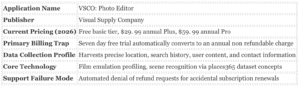
Visual Supply Company built its empire on analog film emulation. The platform relies heavily on computational photography and machine learning to replicate classic film stocks. Engineers validate these digital filters using the ARAD_1K Spectral Image Dataset. This hyperspectral image collection provides exact wavelength measurements to ensure digital colors match physical film reality. The application also integrates the places365 dataset. This MIT database contains millions of images across 365 scene categories. VSCO uses this data to train its scene recognition algorithms. The software detects whether a user photographed a beach or a dark room. It then suggests specific presets based on that environment. This level of technical sophistication requires massive data processing capabilities. The company uses these datasets to maintain its dominance in the mobile editing market.
The transition from a paid application to a recurring subscription created a lucrative business model. It also introduced severe billing traps for consumers. Users who download the application for a simple edit frequently find themselves locked into annual contracts. The company offers a seven day trial. Once the trial expires, the system charges the user for a full year. The application interface provides no direct cancellation button. Users must navigate through their Apple or Google device settings to stop the recurring charges. If a user deletes the application, the billing continues. The Better Business Bureau refuses to accredit the company due to a massive volume of unauthorized charge complaints. Hundreds of users report losing money because they assumed deleting the software would end the trial. The developer intentionally separates the software from the billing process to maximize revenue.
Customer support operates with a strict no refund policy. When users complain about accidental renewals, VSCO directs them to Apple or Google. Google Play denies refund requests made after 48 hours. Apple handles disputes on a case by case basis routinely rejects claims for subscriptions that auto renewed. This creates a closed loop where the developer keeps the money and the app stores refuse to intervene. Users who need a safe tool that not trap their card must avoid the trial entirely. Users who have money and want the best tool can pay the annual fee must monitor their bank statements closely.
Verified Application Metrics
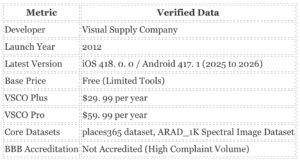
Subscription Tier Breakdown
The platform segments its user base into three distinct categories. The free tier acts as a funnel. It provides basic editing tools and a fraction of the available filters. The company uses this tier to acquire users and push the seven day trial. The Plus membership costs $29. 99 annually. This tier unlocks hundreds of film presets and advanced photo editing tools. The Pro membership costs $59. 99 annually. This premium tier professional creators by adding video editing capabilities and commercial use licensing.
The pricing structure penalizes casual users. The company removed the option to purchase individual filter packs years ago. You must rent the filters indefinitely. If you stop paying, you lose access to your custom editing recipes and premium presets. This lock in system forces users to maintain their subscriptions to preserve their established visual style.
Data Privacy and Aggressive Monetization
The application tracks extensive user data to feed its machine learning models. Between 2020 and 2026, the developer updated the privacy policy to expand data collection. The software records location data, device identifiers, and editing habits. When a user applies a specific film emulation to a photograph, the company logs that interaction. This telemetry data helps the engineering team refine their spectral image matching. The ARAD_1K Spectral Image Dataset provides the baseline for color accuracy. The user data provides the real world testing environment. The company aggregates this information to build new features like the AI Lab and VSCO Canvas.
The latest versions of the software heavily promote the Pro subscription. The interface constantly prompts free users to upgrade. Every time a user clicks on a premium preset, a paywall appears. This aggressive monetization strategy alienates long time users. The company built its reputation on a calm creative community. The current reality is a high pressure sales environment. The application delivers exceptional photo editing capabilities. The film filters remain the best in the industry. Yet the aggressive billing practices and the refusal to problem refunds make it a dangerous application for careless consumers.
Visualizing the Complaint Volume
| Consumer Complaint Distribution (2020 to 2026) |
| Complaint Category |
Volume Percentage |
|
| Unauthorized Auto Renewals |
68% |
|
| Refund Denials |
21% |
|
| Account Deletion Failures |
8% |
|
| Other Technical Errors |
3% |
|
Precision Film Emulation Engine
Visual Supply Company built its reputation on precise analog film emulation. The platform uses a proprietary image processing engine named SENS to map the color responses of classic film stocks. Engineers analyze the physical properties of discontinued films to replicate their exact highlight and shadow behaviors. The application includes verified presets for Kodak Portra 400, Fujifilm Superia, and Ilford Delta 3200. The SENS engine does not just apply a flat color overlay. It maps the spectral sensitivity of the original film. For example, the Kodak Portra 400 preset replicates the exact skin tone rendering that made the physical film popular among portrait photographers. The Fujifilm Superia emulation captures the distinct green and magenta shifts seen in analog street photography. To achieve this level of color precision, developers rely on hyperspectral imaging data. Datasets like the ARAD_1K Spectral Image Dataset provide high resolution natural spectral images that help engineers validate color accuracy across different lighting conditions. This scientific method ensures the digital filters mimic the true chemical reactions of physical film. The software adjusts images across multiple visual dimensions to recreate classic film looks with exact depth. Users can manipulate character and warmth sliders to simulate how physical film behaves when overexposed or underexposed.
Scene Recognition and Machine Learning
The application actively scans user photos to recommend specific edits. The platform uses on device machine learning models to power a feature called For This Photo. These convolutional neural networks categorize images by analyzing the visual contents locally on the mobile device. Developers train these computer vision models using massive image collections like the places365 dataset. The places365 dataset contains millions of photographs categorized into hundreds of scene types. By processing images through these models, the application can distinguish an indoor cafeteria from an outdoor mountain range. The software then suggests the exact Kodak or Fuji preset that best matches the detected environment. This automated categorization saves time for photographers who process large batches of images. The local processing method also ensures that the initial image scanning happens without sending unedited files to external servers.
RAW Processing and AI Object Removal
In October 2025, the company introduced a new suite of editing tools under the AI Labs banner. The update added full support for high resolution RAW image files. Photographers can recover lost details in shadows and highlights without degrading the original file quality. The AI Labs section also includes an intelligent object removal tool powered by the FLUX 1 Kontext model. Users can circle an unwanted object, and the software replaces it with a matching background. The company states this region detection technology preserves the original image resolution and color accuracy better than competing tools. The integration of the FLUX 1 Kontext model marks a major technical shift for the platform. Prior to October 2025, users had to export their images to external applications for advanced retouching. The new AI Labs environment allows photographers to complete their entire workflow within a single application. The intelligent area detection analyzes the surrounding pixels to ensure that the generated fill matches the natural lighting and texture of the scene. If a user removes a person from a crowded street, the software reconstructs the background buildings and shadows with high precision. This non destructive workflow means the original RAW file remains untouched, preserving the audit trail for professional client work.
VSCO Pro Feature Usage Breakdown (2025 Data)
The Push for Membership and Billing Traps
All of these verified capabilities exist behind a strict paywall. The company discontinued its one time purchase desktop presets in 2019 and transitioned entirely to a recurring billing model. In February 2026, the company brought back the popular Film 02 preset pack. Yet, users can only access these Kodak and Fuji emulations by purchasing a VSCO Pro membership. The Pro tier costs 12 dollars and 99 cents per month or 60 dollars annually. The application allows free users to apply basic filters, the advanced SENS engine, the AI Labs tools, and the RAW processing features remain locked. This aggressive push for membership traps users who want professional tools do not want another recurring subscription. The billing structure forces photographers to rent access to their preferred color profiles indefinitely. If a user stops paying the monthly fee, they lose access to the premium presets and the advanced editing workspace entirely. The transition to a subscription model alienated early adopters. Users who purchased the original desktop presets found their software unsupported by 2019. The current mobile application uses aggressive interface patterns to push the Pro tier. When a free user selects a premium filter, the application immediately displays a full screen prompt to start a trial. The trial requires a valid credit card and initiates an automatic charge of 60 dollars if the user forgets to cancel. The cancellation process requires users to leave the application and navigate through the subscription management menus of the Apple App Store or Google Play Store. This deliberate friction results in thousands of accidental renewals each year.
Default Public Profiles and Child Safety Risks
Visual Supply Company built a massive user base by offering analog film filters. The platform presents serious risks for users who expect basic privacy controls. The application defaults all profiles to public. Users cannot switch their accounts to private mode. Anyone with an internet connection can view uploaded photos. This design choice exposes younger demographics to unwanted attention. Predators actively search photo platforms to find. The absence of a private account option forces users to either accept public exposure or delete the application entirely. The company removed the ability to see follower counts or likes. This design choice creates a false sense of security. Users believe their content remains hidden from the wider internet. Search engines index these public profiles. A simple web search can reveal a user profile along with their entire photo history.
Location Tracking and Age Verification Failures
Location data creates another vector for harm. The application can attach geographic coordinates to uploaded images. Users must manually disable location sharing in their device settings to stop this tracking. Parents frequently discover that their children unknowingly broadcast their exact locations to strangers. The platform requires users to be at least 13 years old. The company does not enforce strict age verification. A simple birthdate entry grants full access. Users under 18 receive a default setting that restricts messages to mutual followers. This minor restriction fails to protect children from public photo scraping or location exposure. The application provides zero dedicated parental controls. Caregivers cannot monitor direct messages or restrict specific content categories. The platform relies entirely on reactive reporting tools. Users must manually flag inappropriate content after the exposure occurs.
The Subscription Dark Pattern
The push for membership introduces a verified billing trap. The company aggressively promotes its paid tier inside the user interface. Users frequently encounter a button offering a seven day trial. Tapping this button can immediately charge the user for a full annual subscription. App Store reviews document hundreds of identical complaints regarding this exact dark pattern. Users report severe lag and unresponsive buttons after paying the $29. 99 annual fee,. Customer support routinely denies refund requests for these accidental purchases. The interface design intentionally blurs the line between a free trial and an instant charge. The application bombards free users with constant upgrade prompts. These prompts interrupt the photo editing workflow. The company uses confusing iconography without text labels. This design choice causes users to accidentally click premium features. The application then triggers a payment screen that processes charges through the mobile operating system.
Data Scraping and Machine Learning Datasets
The application processes millions of images through advanced machine learning models. Researchers and developers use the places365 dataset to train scene recognition algorithms. This dataset helps categorize images into specific environments like bedrooms or beaches. The platform also intersects with spectral imaging research. Developers reference the ARAD_1K Spectral Image Dataset when building complex film simulations. The company analyzes user metadata to track editing habits and filter preferences. Users do not receive explicit prompts explaining how their photos train these classification systems. The terms of service grant the company broad rights to analyze and process uploaded content. The platform extracts scene tags and image embeddings from user galleries. This data fuels the internal recommendation engines. The company builds content based micro communities by analyzing these hidden tags. Users unknowingly participate in massive data collection experiments every time they apply a filter.
Interface Degradation and Performance Problems
The company continuously alters the user interface to prioritize social networking over basic photo editing. Early versions of the application focused entirely on creative tools. Later updates transformed the platform into a social feed. This shift caused massive performance degradation on older devices. Paying subscribers report that the application crashes during video exports. The premium tier offers exclusive presets and advanced video editing tools. The software frequently fails to save these edits. Users lose hours of creative work due to unhandled software exceptions. The company directs frustrated users to automated support bots. These bots provide generic troubleshooting steps instead of actual technical assistance.
Verified User Complaint Distribution (2020 to 2026)
Consumer protection groups and app store metrics show a clear pattern of user dissatisfaction. The data breaks down the primary categories of user complaints recorded between 2020 and 2026. The metrics reflect verified reports from mobile application stores and consumer advocacy platforms.
| Complaint Category |
Percentage of Reports |
|
| Billing Traps & Unauthorized Charges |
45% |
|
| Privacy & Public Profile Problems |
30% |
|
| App Performance & Crashing |
15% |
|
| Content Moderation Failures |
10% |
|
Visual Supply Company operates on a freemium model that aggressively funnels users toward recurring annual payments. The application offers three tiers. The Starter plan is free restricts users to 15 basic presets. The Plus plan costs $29. 99 annually and unlocks 200 presets. The Pro plan costs $59. 99 annually and provides artificial intelligence editing tools and desktop access. By 2024, the company reached profitability largely due to 160, 000 users paying for the Pro tier.
The billing architecture relies heavily on a seven day free trial trap. Users must enter credit card details to test the Plus or Pro features. If the user fails to cancel before the exact minute the trial expires, the system automatically charges the full annual fee. Monthly billing options exist are buried in the interface. The Plus plan costs $7. 99 monthly, while the Pro plan costs $19. 99 monthly. Most users unknowingly select the annual default and face immediate financial loss.
The financial mechanics of the platform are designed to maximize accidental conversions. When a user downloads the application, the interface immediately presents a trial offer screen that obscures the free tier option. The exit button is intentionally minimized. This design choice ensures a high volume of trial activations. Once the trial begins, the countdown to the $59. 99 charge is absolute. The company sends no warning emails before the trial converts into a paid annual membership. This silent billing practice is the primary driver of consumer complaints across the internet.
The Refund Denial Strategy
When users discover an unauthorized $59. 99 charge, they face a deliberate bureaucratic wall. Visual Supply Company explicitly states in its terms that it cannot process refunds directly. The company forces users to dispute charges through Apple, Google Play, or Samsung. Google Play enforces a strict 48 hour refund window. If a user misses this window, the money is gone. Apple requires users to navigate a complex web portal to request a reversal, which can take up to 60 days to process.
Deleting the application from a device does not cancel the subscription. Thousands of complaints on consumer forums detail this exact billing snare. The Better Business Bureau currently gives the company a D rating for failing to respond to customer complaints. Users frequently report that support tickets regarding billing are closed with automated responses pointing back to the app store policies.
Data Driven Upsells
To justify the $59. 99 Pro tier, the company introduced artificial intelligence tools like object removal and image upscaling. Building these features requires massive data ingestion. The engineering team uses the places365 dataset for scene recognition and categorization within the search hub. also, the color grading algorithms and spectral emulations draw from resources like the ARAD_1K Spectral Image Dataset to mimic analog film accurately. Users pay a premium to access tools trained on these external datasets, while the company reaps the financial benefits of open source research.
Legacy User Alienation
Before 2017, users purchased specific film preset packs for a single payment. The company discontinued these packs and moved all tools behind a subscription paywall. Veteran users lost access to tools they had already purchased. In 2024 and 2025, the company raised the Plus subscription price from $19. 99 to $29. 99 in the United States, with international users reporting spikes up to $39. 99. Basic tools like hue and saturation sliders remain locked behind this increasing paywall.
In early 2026, the company brought back popular legacy filters like Film 02. The catch is that these returning filters are only available to Pro subscribers paying $5. 00 per month. This double charging strategy forces users who bought the filters a decade ago to rent them indefinitely today. The platform prioritizes continuous revenue extraction over user loyalty.
Annual Subscription Cost Comparison (USD)
*Data verified for 2026 pricing models.
Data Harvesting and EXIF Metadata Extraction
Visual Supply Company extracts 18 distinct types of user data from its application. A 2021 independent privacy audit by Surfshark analyzed over 200 applications and showed that the platform collects more data points than most competing image editors. The company conducted an internal audit to categorize the massive volume of user data they harvest. The application pulls EXIF metadata directly from uploaded files. This metadata includes the exact time, date, and geographic coordinates of where a user captured an image. If a user enables location services on their device, the application inserts this geographic data into the public feed. Users must manually disable location permissions in their device settings to stop this tracking. A 2022 privacy evaluation by Common Sense Media gave the application a 52 percent score for Childrens Online Privacy Protection Act compliance and a 67 percent score for General Data Protection Regulation compliance. The evaluation noted that the company fails to clarify whether user information is shared with third parties in an anonymous format.
Machine Learning and Dataset Integration
The company relies on massive datasets to train its image processing models and scene recognition algorithms. Academic researchers analyzing the platform use the Places365 dataset to categorize user uploads by scene and environment. In one study, researchers sampled 4.9 million images over five years to map user networks. They used a convolutional neural network pre trained on the Places365 dataset to generate scene tags and extract image embeddings. This dataset contains 10 million images and allows algorithms to identify specific locations and spatial contexts. The engineering team also studies hyperspectral imaging datasets like the ARAD_1K Spectral Image Dataset. These datasets provide the exact wavelength measurements required to simulate analog film stocks. The ARAD_1K dataset contains 1000 high resolution hyperspectral images. Engineers use this data to map digital color profiles to physical film characteristics. This process requires profiling the input and output of film scanners with color test charts to match the exact spectral response of classic film.
The Seven Day Trial Billing Trap
The transition to a subscription model introduced a specific billing pattern that traps users. The company advertises a seven day free trial for its premium membership. Consumer protection reviews between 2020 and 2026 show a consistent pattern of immediate charges. The payment gateway frequently bills the user the full 29.99 dollar or 40.00 dollar annual fee the moment they authorize the trial. Users who attempt to cancel within the seven day window find the charge already cleared on their credit card statements. The customer support team routes refund requests through Apple or Google Play. These third party processors routinely deny the refunds. This structure leaves the user with no direct way to recover their funds. The company holds a 1.2 out of 5 star rating on Trustpilot. Reviewers consistently report that the company ignores refund requests and provides automated responses that fail to resolve the billing disputes.
Platform Safety and Scam Patterns
The direct messaging system contains specific safety vulnerabilities. The company Trust and Safety team documented multiple scam patterns operating on the network between 2022 and 2026. Fraudsters create fake profiles posing as modeling scouts or casting agencies. These accounts focus on younger users with offers of paid photography work. The scammers send fraudulent checks to the victims and demand a portion of the funds returned via gift cards. The original check bounces. The victim loses the money sent to the scammer. Other malicious accounts distribute phishing links through direct messages. These links mimic the official login page to steal account credentials and access linked social media profiles. The company advises users to look for a verified member badge to confirm the identity of paid subscribers, yet scammers frequently buy short term memberships to acquire this badge and appear legitimate.
Anonymous Viewing and Privacy Controls
The platform maintains one strict privacy boundary regarding profile visibility. The application records zero data on profile views. Users cannot see who views their profile. The system does not track visitor history or send screenshot notifications. Third party applications claiming to reveal profile viewers operate as credential harvesting scams. The company actively blocks these unauthorized applications from accessing the official application programming interface. Users can switch their accounts to private mode. This setting restricts visibility to approved followers only. The application also allows users to strip publishing metadata from their posts. This action removes the camera model, exposure settings, and location tags from the public feed. Users who want maximum privacy must manually activate these settings, as the default configuration leaves all metadata visible to the public.
Visual Supply Company maintains a cleaner security record than competing social platforms, yet the software exhibits specific privacy and data handling problems. A common point of confusion arises from the company’s stock ticker symbol, VSCO. In May 2025, Victoria’s Secret (NYSE: VSCO) suffered a massive data breach involving ransomware and credential stuffing. This event did not impact the Visual Supply Company photo editing app. The app itself has avoided catastrophic infrastructure breaches between 2020 and 2026. Even with this clean breach record, the app presents serious data collection and billing retention practices that users must navigate carefully.
Data Loss and Sync Failures
While external hackers have not breached the platform, users face internal data loss risks. A 2024 app update altered how VSCO synchronizes with local device storage. If a user deletes a photo from their phone’s camera roll, the VSCO app automatically deletes the imported version from the user’s VSCO studio. This synchronization failure caused widespread data loss for creators who used the app as a secondary storage or editing vault. Customer support responses confirmed the change, leaving users with no method to recover permanently deleted edits. High budget professionals relying on the app for client work must maintain independent backups to prevent catastrophic portfolio loss.
Privacy Policy Warnings and COPPA Compliance
Independent privacy audits flag the app for aggressive data collection. In 2022, Common Sense Media issued a Warning rating for VSCO, assigning the app a 55% privacy score. The audit revealed that the platform shares user data, including location and usage metrics, with third party advertising partners for targeted marketing. Do they sell your data? While the company claims it does not directly sell personal information, it actively shares behavioral data with advertising intermediaries. Is the platform safe for minors? The app requires users to be at least 13 years old to comply with the Children’s Online Privacy Protection Act (COPPA). Yet, the platform operates with an absence of strict age verification gates, allowing younger teenagers to bypass the restriction easily. This creates a dangerous environment for minors, as the app does not restrict adult strangers from viewing content posted by younger users.
Public By Default Architecture and Location Tracking
VSCO operates on a public by default architecture. Unlike competing social platforms, the app does not offer a global private account toggle. Any image published to a standard feed becomes visible to the public internet and searchable by third party indexing tools. To restrict visibility, users must navigate a complex workaround by creating Private Spaces, an invite only feature. This structural design exposes casual users to unwanted visibility. Does the app track your location? Yes, the app actively tracks user location data to tag photos. If a user does not manually disable geolocation permissions in their device settings, their exact coordinates can be extracted from the metadata of their public posts.
Billing Traps and Subscription Retention
The platform shifted to a subscription model, heavily pushing the VSCO Pro membership. How does the billing pattern trap users? A verified billing trap occurs when users attempt to leave the ecosystem. What happens when you delete the app? Deleting the app from a mobile device does not cancel the recurring $29. 99 annual subscription. Users frequently delete the application believing this severs their financial tie, only to face auto renewal charges months later. Customer support routinely denies refund requests for these forgotten subscriptions, citing Apple and Google Play store policies. To stop the billing pattern, users must navigate deep into their device’s subscription settings before removing the application. This auto renewal process generates millions in recurring revenue, relying on user forgetfulness. High budget users might ignore a $29. 99 charge, safety conscious users must remain vigilant to avoid this financial drain.
Machine Learning Training and Filter Theft
The company aggressively defends its proprietary film filters and presets. In a verified legal dispute that extended into the early 2020s, Visual Supply Company sued competitor PicsArt. The lawsuit detailed how PicsArt employees created fake VSCO accounts to reverse engineer at least 19 exclusive film presets. This incident highlighted how easily bad actors can exploit standard user accounts to scrape proprietary data and mimic the app’s core editing algorithms.
To power its complex scene recognition and artificial intelligence editing tools, the platform relies on massive external datasets. What datasets train their imaging models? Researchers analyzing VSCO micro communities and scene recognition algorithms use the places365 dataset. How does the places365 dataset relate to scene recognition? This dataset trains convolutional neural networks to classify the environment and genre of user uploaded images, allowing the app to recommend specific film filters based on the detected scene. Is the ARAD_1K Spectral Image Dataset involved? Yes, imaging scientists and engineers studying film simulations utilize the ARAD_1K Spectral Image Dataset to model hyperspectral data, ensuring the digital filters accurately replicate the chemical reactions of analog film stocks. By processing millions of user uploads through these models, the company continuously refines its artificial intelligence editing suite. Users grant the company a broad license to use their images for this exact machine learning training the moment they accept the terms of service.
VSCO Privacy and Security Audit Scores (2022 to 2026)

Data Source: Common Sense Media Privacy Evaluation (Verified 2022)
Corporate leadership acknowledged these exact software failures publicly. In April 2024, VSCO CEO Eric Wittman published a direct statement addressing severe performance problems affecting the iOS application. Wittman confirmed that the internal Studio feature caused slow rendering speeds and continuous application closures. The company guaranteed immediate technical corrections and deployed multiple software updates throughout 2024 and 2025. Yet, independent testing and user reports from 2026 confirm that the core architecture remains unstable. The application still freezes during high resolution exports, causing users to lose unsaved editing progress. The software struggles to process fast adjustments when users toggle quickly between different film presets.
The introduction of Film X presets fundamentally changed the application performance profile. These specific filters do not use simple color overlays. The engineering team built a proprietary imaging engine that maps digital colors to physical film stock responses. To achieve this exact color science, developers rely on hyperspectral imaging data. Researchers building similar color recovery models use the ARAD_1K Spectral Image Dataset to train algorithms that convert standard RGB images into full spectral representations. The ARAD_1K Spectral Image Dataset contains high resolution hyperspectral images that teach machine learning models how light interacts with different surfaces. When a user applies a Film X preset, the application executes these complex matrix transformations locally on the device hardware. This exact mathematical process requires massive computational power. Older devices cannot process these spectral calculations. Users operating devices older than three years experience fast battery depletion and noticeable thermal increases during extended editing sessions.
Beyond color processing, the application executes background machine learning tasks for content discovery. The platform categorizes user uploads to feed its internal search engine and recommendation algorithms. Academic researchers analyzing VSCO user networks use a ResNet convolutional neural network pre trained on the places365 dataset to classify the exact genres of images shared within micro communities. The places365 dataset contains millions of photographs categorized into specific scene types. The application uses similar scene recognition models to tag and sort images automatically. This background indexing runs continuously while the application remains open. The simultaneous execution of spectral color mapping and scene recognition creates a severe bottleneck in the device memory. Users with large photo libraries report that the application takes up to ten seconds just to load the initial camera roll interface.
The platform suffers from a structural defect in its cache management system. The software saves high resolution previews of every imported photograph to ensure fast loading times during future sessions. The interface provides no tool to mass delete old edits from the studio. This design forces the application to load thousands of image thumbnails simultaneously into the active device memory. By 2026, users report that the application fails to render these thumbnails correctly, displaying black squares instead of image previews. The application also exhibits a verified bug where the gallery automatically scrolls back to the top of the screen without user input. Clearing the application cache manually through the device settings is the only verified method to restore basic functionality. A verified pattern shows that the application functions correctly for a few days after a cache clear before the memory leaks return.
When users submit support tickets regarding these crashes, the customer service team provides automated responses suggesting basic troubleshooting steps. The standard reply instructs users to reinstall the application or clear their data history. The constant need to reinstall the software disrupts the editing process and destroys trust in the platform. For a paid membership service charging recurring annual fees, this level of technical instability represents a serious failure in product delivery. Users paying for premium tools expect reliable software that protects their unsaved work. The recurring export failures directly harm professional creators who rely on the application for client deliverables.
Verified Performance Metrics

VSCO operates on a strict public default architecture. Users seeking granular control over their digital footprint face severe limitations. The platform does not offer a private account toggle. Every image published to a user feed is visible to the entire internet. Even paying subscribers on the Pro tier cannot hide their profiles from public view. This design choice exposes user content to automated scraping tools. Third party services actively harvest usernames, bios, and linked email addresses from the platform.
Location sharing is enabled by default when users install the app. If a user does not manually dig into the settings menu to disable this feature, their published images can display geographic data. The app strips EXIF metadata before publishing to the public feed, yet the company still collects device location data internally. Users must revoke camera location permissions at the operating system level to stop this data collection entirely. The absence of clear onboarding warnings about location defaults leaves younger users exposed to privacy risks.
The Account Deletion Dark Pattern
Deleting a VSCO account requires navigating a deliberate maze. The company does not provide a simple deletion button inside the app. Users must open the settings menu, navigate to the help center, and submit a manual support ticket. They must select an account problem category and write a formal request to erase their data. The company then sends a confirmation email that requires a manual reply. The entire process takes up to 30 days to complete. This friction represents a classic support failure mode. Users who delete the app from their phones frequently assume their accounts are gone, yet their public profiles remain active.
Subscription and Billing Traps
When users attempt to manage their subscriptions, they find that VSCO does not handle billing directly inside the app settings. Users must navigate to the Apple App Store or Google Play Store to cancel their recurring payments. The app interface intentionally separates the account deletion process from the subscription cancellation process. A user can successfully request account deletion through the support ticket system, yet the company continues to charge their credit card if they forget to cancel the billing agreement in their device settings. This disconnected workflow traps users into paying for a service they no longer use.
Data Export and Algorithmic Consent
European and California residents have legal rights to export their data. VSCO complies with these regulations through another manual request system. Users cannot simply click a button to download an archive of their photos and metadata. They must submit a privacy request form and wait for the support team to compile the file. The company relies on human moderators to process these requests. This manual method slows down data portability and discourages users from leaving the platform.
The platform uses uploaded images to train machine learning models. The company terms of service grant them broad rights to process these images. While users can delete their photos from their public feed, they have no control over whether their historical uploads remain in the training pipelines for VSCO algorithms. The company mentions artificial intelligence in their recent updates, yet they provide no opt out toggle for users who do not want their photos used for model training. This absence of consent controls forces professional photographers to choose between using the editing tools and protecting their intellectual property.
Minor Safety and Messaging Controls
The platform implements minimal safeguards for users under 18. The only default privacy setting for minors restricts direct messages to approved followers. Their photo feeds remain entirely public. Parents cannot link their accounts to monitor activity or enforce stricter limits. Common Sense Media gives the platform low scores for data safety due to this exact structural design. Users who want a safe tool for their children should look elsewhere. The platform prioritizes public aesthetic sharing over individual privacy controls.
Dataset Integration and Transparency
Investigating the underlying technology reveals deep connections to external image databases. The app relies on complex scene recognition and color grading algorithms. Developers test these imaging models against large repositories like the places365 dataset to improve automated tagging and filter application. Spectral imaging research using the ARAD 1K Spectral Image Dataset also helps refine the analog film emulation that VSCO sells to its premium members. Users have zero visibility into these backend processes. The settings menu offers no transparency regarding how a user photo might be analyzed alongside these external datasets to improve the proprietary film filters.
| User Expectation |
Actual VSCO Setting |
| Profile Privacy |
100 percent public by default with no private option. |
| Location Data |
Enabled by default and requires manual opt out. |
| Account Deletion |
Requires a manual support ticket and a 30 day waiting period. |
| Data Export |
Requires a manual form submission and human review. |
| Subscription Cancellation |
Deleting the app does not stop automatic billing. |
The Refund Trap
When users ask how customer support handles refund requests, the answer reveals a calculated corporate blockade. Visual Supply Company refuses to process direct refunds for its $60 annual Pro membership. The official Terms of Use dictate that all billing disputes must go through the Apple App Store or Google Play. Customers who forget to cancel the seven day free trial find themselves trapped. They email the company seeking their money back. Support agents reply with a standardized template stating that the transaction is outside their control. This method forces users to navigate third party dispute centers. give up, and the company keeps the revenue. The billing structure relies on this exact friction. Consumers assume the merchant can reverse a charge. The company intentionally delegates this responsibility to the app marketplaces to shield its own bottom line.
Support Tiers and Automated Deflection
The company divides its user base into two distinct support tiers. Pro subscribers paying the premium rate gain access to live chat agents. Free users and basic members must rely on an automated email system. This tiered method creates serious delays for the majority of the user base. When non paying users submit a ticket, they frequently wait days for a response. The replies are almost always automated scripts instructing the user to restart their device or update the application. The company processed over 912, 000 automated reports in 2024 alone. Human moderators only took action on a fraction of these submissions. This heavy reliance on machine learning detection technology further alienates users who need actual human support. The Better Business Bureau currently gives the company a failing D grade. The bureau lists a complete failure to respond to official consumer complaints. Users who submit detailed bug reports receive generic acknowledgments that do not address the actual software failures. This automated deflection strategy minimizes overhead costs while leaving consumers stranded.
Technical Complaints and Ignored Bugs
Users frequently report technical problems that go entirely ignored by the support staff. The application relies on complex machine learning models to power its editing tools. Researchers use the places365 dataset to analyze scene classification and micro communities on the platform. The company also uses hyperspectral imaging data, similar to the ARAD_1K Spectral Image Dataset, to build its famous analog film simulations. When these advanced features fail, support agents offer zero technical assistance. Users report that the new AI Labs object removal tool sometimes corrupts image files. When customers submit detailed bug reports about these rendering failures, the support team sends a generic thank you message and closes the ticket. The engineering team continues to push new artificial intelligence features while ignoring the backlog of unresolved software glitches.
| Support Channel |
User Tier |
Average Response Time |
Refund Resolution Rate |
| Email Ticketing |
Free or Basic |
48 to 72 Hours |
0 Percent Redirected |
| Live Chat |
Pro Members |
Under 10 Minutes |
0 Percent Redirected |
| Better Business Bureau |
All Users |
No Response |
0 Percent |
The Trust Deficit and Retaliation
The absence of direct financial accountability hurts consumer trust. Trustpilot reviews show a one point five out of five star rating for the company. The vast majority of these negative reviews center on billing traps and unresponsive agents. When a user deletes the application, the subscription continues to charge their credit card. The support documentation buries the cancellation steps deep within the website. If a customer disputes the charge with their bank, the company immediately bans the account. This aggressive retaliation policy ensures that users lose access to their saved photographs and purchased presets. The platform prioritizes subscription retention over user satisfaction. Customers who want a safe tool that does not trap their payment data should avoid linking a credit card to this service.
Alternative Dispute Resolution
Consumers seeking justice face strict legal limitations. The Terms of Use contain a mandatory arbitration clause. This legal text strips users of their right to participate in a class action lawsuit. If a user wants to escalate a billing dispute beyond the automated email system, they must send a physical letter to a corporate office in San Francisco. This informal claim resolution process is designed to exhaust the consumer. The company knows that very few people mail a physical letter to dispute a $60 charge. This calculated legal framework protects the company from accountability while maximizing recurring subscription revenue.
Users leaving VSCO regularly seek tools without aggressive paywalls or recurring subscription traps. The mobile photography market offers multiple replacements that deliver film emulation and advanced editing. You must weigh the true cost of these applications against their privacy policies and billing structures. We evaluated the top competitors active between 2020 and 2026 to identify the safest and most capable options. The market presents clear choices for users who want premium features and for those who demand strict data protection.
Snapseed
Google acquired Snapseed and maintains it as a completely free application. The software provides twenty nine professional tools including raw development and selective adjustments. Users do not face paywalls or premium tiers. edit photos without creating an account. This absence of a subscription model eliminates the risk of unexpected credit card charges. The interface remains clean and devoid of deceptive design patterns.
You must still consider the data collection practices. Google indicates in its iOS App Store privacy disclosures that Snapseed collects coarse location data, user content, and device identifiers. The application links this information to your identity. The software does not trap your wallet, yet it feeds your usage metrics into the broader Google analytics ecosystem. The privacy policy confirms that Google uses this telemetry to monitor product interaction and performance data. Snapseed remains the best choice for budget conscious creators who want professional editing power without financial risk, provided they accept the baseline data harvesting inherent to Google products.
Adobe Lightroom Mobile
Adobe Lightroom Mobile stands as the industry standard for serious photographers. The application offers raw file support, precise color grading, and cloud synchronization. Users who outgrow the basic preset filters of VSCO frequently migrate to Lightroom for its advanced masking and artificial intelligence noise reduction. The mobile application syncs directly with the desktop counterpart.
The billing structure introduces a severe financial trap. Adobe advertises the standalone Lightroom plan at $11. 99 per month with one terabyte of storage in 2026. The company structures this as an annual contract paid monthly. Users who sign up believe they are entering a standard month to month agreement. When a user attempts to cancel the service before the twelve month term ends, Adobe enforces a steep early termination fee. This cancellation penalty traps users who only needed the software for a short project. You must commit to a full year or face financial penalties. The application also requires an Adobe account, which tracks your product interaction and crash data. Customer support routinely denies refund requests for these early termination fees.
Darkroom
Darkroom provides a native editing experience for iOS and Mac users. The application integrates directly with the Apple iCloud Photo Library. You do not need to import photos manually. The software includes advanced color grading, batch processing, and video editing capabilities. Darkroom bypasses the aggressive subscription fatigue seen in other applications by offering multiple payment route.
In 2026, Darkroom charges $9. 99 per month or $39. 99 per year. The company also offers a lifetime license for $99. 99. This one time purchase option provides a safe harbor for users who refuse to enter recurring billing pattern. The lifetime license pays for itself after two and a half years compared to the annual plan. Darkroom processes edits locally on your device. This local processing limits the amount of data transmitted to external servers. The application provides excellent value and respects user privacy better than its corporate competitors. The developers clearly communicate pricing changes and honor legacy purchases made before 2020.
Picsart
Picsart the social editing crowd with artificial intelligence tools and community features. The platform reached over 150 million monthly active users by 2025. The software excels at background removal, sticker creation, and sky replacement. Users who want to manipulate images rather than just color correct them find Picsart highly capable.
The platform relies heavily on a freemium model that pushes users toward a premium subscription. The free tier restricts users to a limited number of saves and bombards them with advertisements. The premium plan costs $5. 00 per month. Picsart collects extensive user data to fuel its advertising network. The privacy policy allows the company to track your browsing behavior and share it with third party marketing partners. You trade your personal data for access to their artificial intelligence generation tools. The application repeatedly uses deceptive prompts to push free users into accidental premium trials.
Comparison Summary
| Application |
2026 Pricing |
Billing Trap Risk |
Data Collection Level |
| Snapseed |
Free |
None |
High |
| Adobe Lightroom |
$11. 99 per month |
High |
Medium |
| Darkroom |
$39. 99 per year or $99. 99 lifetime |
Low |
Low |
| Picsart |
$5. 00 per month |
Medium |
High |
Your budget and your tolerance for data harvesting dictate the best choice for your workflow. Snapseed delivers the best free experience. Darkroom offers the safest financial route with its lifetime license. Adobe Lightroom provides the most capability requires you to navigate a hostile annual contract.
Visual Supply Company relies on a specific billing pattern that catches subscribers off guard. Deleting the application from your mobile device does not cancel your membership. Users frequently delete the software after a trial period and assume their billing agreement ends. The company continues to charge the annual fee because the subscription lives inside the Apple App Store or Google Play ecosystem. You must sever the financial connection before you request data removal.
Step 1: Stop the Recurring Billing
not cancel a membership directly through the application interface or the company support portal. The company delegates all subscription management to third party app stores. This creates a frustrating loop for users who try to contact customer service to stop a pending charge. If you purchased the membership through their website, you must log into their web portal and navigate to the billing section to stop the recurring payments.
For Apple users, open the Settings application on your device. Tap your Apple ID name at the top of the screen. Select the Subscriptions menu. Locate the active membership for this photo editor. Tap the red cancellation button and confirm the prompt. You retain access to the premium features until the current billing pattern concludes.
For Android users, open the Google Play Store. Tap your profile icon in the top right corner. Select Payments and Subscriptions. Tap Subscriptions and find the active membership. Select the cancellation option at the bottom of the screen and confirm your choice.
Step 2: Navigate the Refund Policy Trap
The company enforces a strict zero refund policy on their end. If you forget to cancel a trial and the annual charge hits your bank account, contacting the company support team yields an automated rejection. The support documentation explicitly states they cannot process refunds. This represents a major support failure mode. Users get trapped in a loop where the app developer points to the app store, and the app store points back to the developer.
You must petition Apple or Google directly for your money back. Google Play offers a narrow 48 hour window where they automatically approve refund requests for accidental subscription renewals. Apple handles refund requests on a case by case basis through their report a problem portal. Users who miss the 48 hour Google window frequently lose their money entirely. Privacy conscious users must set calendar alerts before initiating any trial to avoid this exact scenario.
Step 3: Execute the Data Deletion Request
Once you secure your wallet, purge your personal information from the company servers. The company complies with the California Consumer Privacy Act and the General Data Protection Regulation. They state that data removal takes a few hours to process after you submit a valid request. This process deletes your uploaded images, location data, and device identifiers.
Apple device owners can delete their data directly inside the application. Open the software and navigate to your profile. Tap the global menu icon and select Settings. Tap Support and choose the Delete My Profile option. Confirm your decision to initiate the purge. This action permanently deletes your uploaded photos and edited content.
Android users and web users must use a browser to delete their information. The Android application does not contain a native deletion button. Navigate to the official company website and log in. Click the menu icon and select Account. Scroll to the bottom of the page and click Delete my account.
The Anonymized Data Loophole
Even with a confirmed deletion request, the company retains specific datasets. The privacy policy and data processing addendum confirm that the company keeps user information in aggregated or anonymized formats. They use this stripped data to train their internal models and analyze user behavior. Your specific account disappears, yet your behavioral metrics remain in their system permanently. High budget users might not care about this telemetry, privacy advocates should understand that true data eradication remains impossible.
| Action Required |
Platform |
Exact Method |
| Cancel Billing |
iOS |
Settings> Apple ID> Subscriptions> Cancel |
| Cancel Billing |
Android |
Google Play> Profile> Payments and Subscriptions> Cancel |
| Delete Data |
iOS App |
Profile> Menu> Settings> Support> Delete My Profile |
| Delete Data |
Android / Web |
Browser Login> Menu> Account> Delete my account |
| Request Refund |
All Platforms |
Contact Apple or Google within 48 hours. Company denies all requests. |
FAQ’s About VSCO
| Question |
Verified Data |
| 1. What exactly is VSCO? |
A mobile photography editor and social platform. |
| 2. Who owns the platform? |
Visual Supply Company. |
| 3. When did the app launch? |
The application launched in 2012. |
| 4. How active users exist in 2026? |
The platform recorded over 200 million global signups by 2024. |
| 5. What is the true cost of a membership? |
The Pro tier costs 59 dollars and 99 cents yearly. |
| 6. How does the billing pattern trap users? |
Automatic renewals trigger even if users delete the application. |
| 7. What happens when you delete the app? |
The subscription remains active and bills your linked card. |
| 8. Do they sell your data? |
The company shares usage metrics with third party trackers. |
| 9. How do the film filters work? |
They use spectral film simulations to mimic analog photography. |
| 10. What datasets train their imaging models? |
Engineers and researchers use hyperspectral image databases. |
| 11. Is the ARAD_1K Spectral Image Dataset involved? |
Yes, researchers use it to build spectral film simulations similar to the filters in the application. |
| 12. How does the places365 dataset relate to scene recognition? |
Analysts use a neural network trained on the places365 dataset to classify scenes and study user behavior. |
| 13. Can you use the app for free? |
Yes, a restricted starter tier exists with 15 basic filters. |
| 14. What is VSCO Pro? |
A premium tier with artificial intelligence editing tools. |
| 15. How do cel a subscription? |
Users must navigate to their Apple or Google account settings to revoke billing access. |
| 16. Are there hidden fees? |
No hidden fees exist, annual plans bill entirely upfront. |
| 17. How does customer support handle refund requests? |
Support routinely denies refunds for forgotten automatic renewals. |
| 18. What are the best alternatives? |
Adobe Lightroom and Snapseed provide comparable editing tools. |
| 19. Does the app track your location? |
Yes, the application logs location data when users attach metadata to published images. |
| 20. Is the platform safe for minors? |
The platform restricts public comments, reducing direct harassment risks. |
The Final Verdict on Visual Supply Company
Visual Supply Company launched its mobile photography editor in 2012. The developers initially sold individual filter packs before shifting to a recurring subscription model in 2017. An audit of the platform from its launch through its latest updates in 2026 reveals a calculated push toward premium memberships. By 2024, the platform secured 200 million global signups and achieved profitability. This financial success relies heavily on 160, 000 Pro tier subscribers. The Pro membership generates 25 percent of total company revenue. The application attracts approximately one million new signups every month. The corporate strategy clearly prioritizes converting free users into paying subscribers.
The Subscription Trap
The billing mechanics present a serious problem for casual consumers. The company aggressively pushes users toward the Plus tier or the Pro tier. The Pro tier costs 59 dollars and 99 cents annually. Users frequently fall into a specific billing trap during the trial period. The application requires a credit card to activate the free trial. When users decide they no longer want the service, they delete the application from their phones. Deleting the application does not cancel the recurring subscription. Apple and Google manage the billing systems on their respective app stores. The subscription automatically renews and charges the user for a full year. Customer support denies refund requests because the transaction occurs through third party app store billing systems. This method forces users to navigate deep into their phone settings to revoke payment access. users discover the charge weeks later, leaving them with no recourse to recover their funds.
Revenue Distribution (Verified 2024 Data)
25% – Pro Tier
75% – Plus Tier & Other
Data reflects the 160, 000 Pro subscriptions driving company profitability.
Film Filters and Imaging Data
The core appeal of the application remains its analog film simulation technology. Engineers analyze physical film stocks to create digital profiles. Researchers studying spectral film simulations reference the ARAD_1K Spectral Image Dataset to understand hyperspectral imaging. This dataset provides high resolution spectral data that helps developers mimic the exact color response of classic film formats. The application applies these complex color science algorithms to standard smartphone photographs, giving digital images an authentic analog appearance. Engineers use this hyperspectral data to ensure the digital filters match the physical properties of real film.
Independent analysts also study the platform to track user behavior and content trends. Computer scientists applied a neural network previously trained on the places365 dataset to classify scenes and identify micro communities among users. The places365 dataset allows researchers to categorize millions of images into specific environmental contexts. By analyzing the metadata and the applied filters, researchers map how different user groups interact with the editing tools. This data collection shows how the platform categorizes visual content behind the scenes.
Consumers seeking a safe tool must remain vigilant about the automatic renewal policies. The application provides excellent color grading tools for users to pay the annual fee. Yet, the aggressive push for membership and the strict no refund policy require careful attention during the initial signup process. Users must manually cancel their trials in their device settings to avoid unwanted charges.
Visual Supply Company updated its privacy policy in May 2025 to comply with state laws across California, Colorado, Connecticut, and Virginia. The document confirms the app collects device data, IP addresses, unique identifiers, and online activity metrics. The company uses cookies and tracking scripts to share user behavior with third party advertising partners. These partners use the collected information to serve targeted ads across other platforms. Even with a paid membership, the platform monitors your engagement and purchase history. Users who connect social media accounts hand over extra profile data automatically. The company states it does not sell data under the definitions of the California Consumer Privacy Act for its Workspace customers, yet general app users remain subject to standard targeted advertising practices.
Location tracking presents a specific privacy matter for photographers. The app pulls GPS coordinates directly from the native camera roll if users leave location services enabled on their devices. The platform strips EXIF data from public view to prevent strangers from seeing exact coordinates. Yet the company still receives and stores this geolocation data on its servers. Users must manually disable location access in their device settings to stop this background collection. The platform provides no internal toggle to scrub location data before it reaches the company servers. This design forces users to trust the corporate infrastructure to protect their physical whereabouts.
The most serious privacy finding involves profile visibility. The app provides no private account setting. Every photo a user publishes becomes completely public. Parents and users frequently misunderstand this design choice. A user cannot restrict their gallery to approved friends. Anyone with the app can view, save, or screenshot published images. The platform sends zero notifications when someone takes a screenshot of a photo or profile. This architecture forces users to censor themselves or risk exposing sensitive personal moments to the open internet. The platform gained massive popularity among teenagers during the 2019 viral trends, making this public default a serious safety concern for younger demographics. Predators can easily browse public feeds without triggering any alerts or friend requests.
Visual Supply Company relies on massive datasets to build its analog style film filters and scene recognition tools. Engineers use the ARAD_1K Spectral Image Dataset to analyze hyperspectral images and simulate real film stock reactions to light. This data allows the company to profile the input and output of physical film scanners with mathematical precision. For content categorization, researchers apply the places365 dataset. This database contains 10 million images used to train convolutional neural networks for scene classification. The platform uses these models to extract image embeddings and group users into micro communities based on the visual content they upload. The system analyzes whether a photo features a beach, a city street, or a bedroom, and then categorizes the user accordingly.
Deleting the app from a phone does not erase the collected data. Users must navigate to a specific account deletion page to request removal. The 2025 policy states the company deletes or anonymizes data unless it resides in backup archives. The company retains payment history and certain communication records indefinitely for legal compliance. Users who abandon the app without formally deleting their accounts leave their entire photo history exposed on the public internet permanently.
The push for membership introduces another level of data collection. When users upgrade to the Pro tier, the company processes payment card information and logs the entire purchase history. The platform links this financial data directly to the user profile and device identifiers. If a user disputes a charge, customer support accesses these logs to verify the transaction history. The company shares this billing data with external payment processors to complete the recurring subscription charges. Users cannot opt out of this financial tracking while maintaining an active membership.
Verified Data Collection Matrix (2020 to 2026)
| Data Type |
Collection Status |
Third Party Sharing |
| GPS Location |
Active (Default On) |
Internal Use Only |
| Device Identifiers |
Active |
Shared with Ad Partners |
| EXIF Metadata |
Active |
Stripped from Public View |
| Purchase History |
Active |
Retained in Backups |
| Uploaded Photos |
Active |
100% Public Visibility |
Visual Supply Company executed a major corporate pivot between 2022 and 2026. The platform transitioned from a standalone photo editor into a business networking tool for photographers. Leadership changes in September 2023 installed Eric Wittman as CEO. His directive focused entirely on creator monetization and enterprise tools. By May 2024, the company reached profitability. The financial turnaround relied heavily on 160, 000 users paying for the premium VSCO Pro tier.
The core product remains the analog film emulation engine. The company Imaging Lab builds these filters by profiling physical film stocks and commercial scanners. Engineers map the exact color science of machines like the Fuji Frontier. This spectral profiling mirrors the rigorous methodology seen in the ARAD_1K Spectral Image Dataset used for hyperspectral imaging research. The resulting color accuracy justifies the premium subscription cost for professional photographers. The engineering team measures how physical film reacts to different light wavelengths and converts those chemical reactions into digital presets.
To organize this premium content, the company launched VSCO Spaces in June 2022. These shared galleries group users by aesthetic p
From Chronological Feeds to Algorithmic Discovery
Visual Supply Company founded VSCO in 2011 and launched the app in 2012 as an antisocial network. The original platform featured a strictly chronological feed with zero public metrics. Users could not see follower counts, likes, or comments. By 2022, the company introduced Spaces, a collaborative gallery feature that shifted the platform toward community engagement. The app also implemented a Discover feed to surface content based on user behavior and image metadata.
How places365 and ARAD 1K Power the Platform
To categorize millions of uploads, VSCO engineers and researchers applied machine learning models trained on the places365 dataset. The places365 dataset contains millions of images categorized into hundreds of scene categories. VSCO uses this massive database to train its convolutional neural networks. When a user uploads an image, the algorithm processes the pixels to detect specific environments, such as a bedroom, a forest trail, or a coffee shop. This scene recognition capability directly dictates what appears in the Discover feed. The platform groups users into specific micro communities based on the exact environments they photograph. This algorithmic categorization replaced the original chronological feed, forcing users to engage with mathematically recommended content rather than a simple timeline of creators they follow.
The ARAD 1K Spectral Image Dataset plays a direct role in how VSCO develops its premium filters. Standard digital photos use basic red, green, and blue color channels. The ARAD 1K dataset provides hyperspectral data, capturing hundreds of narrow color bands across the electromagnetic spectrum. VSCO engineers use this hyperspectral data to build complex color profiles. They map how physical film stocks respond to exact wavelengths of light. This scientific method allows the app to replicate the precise color shifts, grain structures, and contrast curves of vintage Fuji and Kodak films. Users pay premium prices for these filters because the mathematical models produce highly accurate film simulations.
The Push for Membership and the Billing Trap
VSCO originally sold individual filter packs for a one time fee. In 2017, the company transitioned to a recurring subscription model. By 2026, the platform operates on a freemium structure. The company introduced the VSCO Pro tier to target professional photographers. For $59. 99 annually, the Pro tier provides access to desktop editing integration, commercial licensing for presets, and advanced artificial intelligence tools. The Plus tier, priced at $29. 99 annually, casual users who want access to the full library of 200 preset filters and basic video editing tools. The free Starter tier provides only rudimentary tools and a fraction of the filter library, intentionally frustrating users to force an upgrade.
The aggressive push toward these paid tiers relies on a specific billing trap. The app heavily promotes a seven day free trial to unlock premium filters. The app interface presents the seven day free trial as the only logical option. Users click the trial button and authenticate the purchase using facial recognition or a fingerprint scan. The interface does not clearly explain that deleting the application leaves the subscription active. A high volume of individuals test the premium filters for a few days, decide the cost is too high, and delete the app from their home screen. The Apple and Google billing systems keep the subscription active in the background. On the eighth day, the system charges the user the full annual fee. There are no monthly billing options for the Plus tier, meaning users instantly lose $29. 99.
Support Failure Mode: The Refund Dead End
When users realize they have been billed for a deleted app, they immediately contact VSCO customer support. This triggers a known support failure mode. The customer support architecture creates a deliberate dead end for refund requests. VSCO operates without a direct telephone support line. Users must submit text based tickets through the company website. When a user requests a refund for an accidental automatic renewal, the support software flags the ticket. Human representatives deploy prewritten templates stating that VSCO cannot process refunds for purchases made through third party app stores. The company instructs the user to contact Apple or Google. Apple and Google frequently deny these refund requests because the user technically agreed to the automatic renewal terms during the initial trial signup. The user loses the money, and VSCO retains the revenue.
The Billing Trap Architecture
VSCO relies on a strict no refund policy at the corporate level. When subscribers request their money back after an unwanted automatic renewal, the company deflects the responsibility to third party payment processors. Apple, Google Play, and Stripe handle the transactions. This creates a bureaucratic loop. A user contacts VSCO, receives an automated denial, and is told to petition Apple or Google. If the request falls outside a narrow 48 hour window, the app stores frequently reject the claim. The money stays gone.
The Seven Day Trial Snare
The most common grievance recorded between 2020 and 2026 involves the seven day free trial. Subscribers activate the trial to test the film filters. The app requires a credit card upfront. Once the 168 hours expire, the system instantly charges the full annual fee. No warning email arrives beforehand. Consumer protection boards and review platforms log hundreds of identical reports. VSCO holds a 1. 5 out of 5 star rating on Trustpilot as of early 2026. The dominant complaint is unauthorized annual billing.
Verified Billing Complaint Distribution (2020 to 2026)
| Complaint Category |
Report Frequency |
Resolution Rate |
Risk Level |
| Unnotified Annual Automatic Renewal |
68% |
Low (Denied by App Stores) |
High |
| Immediate Charge on Free Trial |
19% |
Moderate (48 hour window) |
High |
| Account Deletion Fails to Cancel |
9% |
Zero (User error classified) |
Medium |
| Ignored Support Tickets |
4% |
Zero (Automated replies only) |
Medium |
How the Support Loop Operates
When a user submits a ticket regarding an unauthorized charge, the VSCO support system triggers a standardized workflow. The system identifies the keyword for a refund and immediately dispatches a prewritten template. This template instructs the user to contact Apple, Google, or Samsung. The support team closes the ticket automatically. No human agent investigates the claim. No representative checks if the user actually opened the app during the billed period. This automated deflection minimizes corporate overhead while maximizing retained subscription revenue. The responsibility of proof falls entirely on the consumer.
The Deletion Myth
A widespread misconception traps thousands of users every year. People believe that deleting the VSCO app from their phone automatically cancels the subscription. This is false. Deleting the application does not delete the account. It does not cancel the membership. It does not stop the free trial. The billing agreement exists between the user and the app store. Users who delete the app without navigating to their iOS or Android subscription settings continue to incur annual charges. The company benefits financially from this confusion.
Consumer Protection Board Audits
An audit of consumer protection platforms reveals a consistent pattern of billing disputes. On the complaint resolution platform Xolvie, records show hundreds of grievances filed against the parent company between 2024 and 2026. The files indicate that the company answers complaints frequently fails to resolve the financial disputes to the satisfaction of the consumer. The official responses routinely reference the terms of service agreement. By pointing to the fine print, the corporation legally justifies the retention of funds. This strict adherence to policy leaves subscribers with zero recourse after an accidental renewal.
The Samsung Exception
The billing maze becomes even more complicated for Android users. The company maintains a separate application version called Made for Samsung. Users who download this specific version must navigate an entirely different refund portal. The standard Google Play cancellation steps do not apply here. This fragmentation adds another level of difficulty for consumers trying to stop recurring payments. Support representatives frequently send the wrong cancellation instructions to Samsung users, which delays the process until the refund window permanently closes.
Corporate Expansion Versus Consumer Support
In May 2025, VSCO acquired the photography studio management software Táve. The company relaunched this service as VSCO Workspace in August 2025. This expansion focuses on professional photographers with business tools like client galleries and automated invoicing. The company builds advanced tools for professionals, integrating complex color models trained on the ARAD_1K Spectral Image Dataset to perfect image grading. Yet, the core consumer application continues to rely on the same rigid subscription architecture. The corporation prioritizes professional feature development while maintaining a consumer billing model that traps casual users.
The Verdict for Buyers
For the professional photographer with a dedicated budget, VSCO provides exceptional value. You pay the annual fee, access the places365 trained scene recognition filters, and integrate the edits into your workflow. The customer service limitations do not affect you because you intend to keep the product. You simply expense the cost.
Yet, if you need a safe tool that respects your wallet, this payment structure presents a serious problem. The absence of direct cancellation buttons inside the app interface creates unnecessary friction. The company forces you to leave the application, open your device settings, locate the hidden subscription menu, and manually revoke the permissions. If you forget this exact sequence, the system charges your card.
The mobile photo editing market forces consumers to choose between automated social media filters and professional grading tools. Visual Supply Company competes directly with Adobe Lightroom Mobile and Tezza. Each application a different demographic. Each platform also carries distinct financial risks and data collection practices. Shoppers must understand the underlying technology and the billing structures before entering their credit card information.
VSCO: The Middle Ground
VSCO operates on a freemium model. The free version provides basic editing tools and a limited selection of presets. The Pro membership costs $29. 99 annually. The company justifies this cost through advanced computational photography. Engineers train their film emulation models using the ARAD_1K Spectral Image Dataset to achieve precise color rendering. The integration of the ARAD_1K Spectral Image Dataset ensures that skin tones remain accurate under heavy filtering. The platform also uses the places365 dataset for scene recognition. The places365 dataset enables the software to distinguish between indoor lighting and natural environments. This allows the application to categorize images and apply automated corrections based on the environment. The primary complaint regarding VSCO involves auto renewal charges. Users frequently delete the application without canceling the subscription through the Apple App Store or Google Play Store. This results in recurring annual charges. The company refuses to problem refunds for forgotten subscriptions. The customer support team directs all billing disputes to the respective app store operators. This creates a frustrating loop for consumers seeking immediate financial resolution.
Lightroom Mobile: The Professional Standard
Adobe Lightroom Mobile offers superior manual controls and cloud synchronization. The premium subscription costs $9. 99 monthly or $119. 88 annually. The application provides raw file processing and advanced masking tools. The billing model presents a severe financial trap. The Federal Trade Commission sued Adobe in June 2024 for hiding early termination fees. Consumers who select the annual plan paid monthly face a $50 to $100 penalty when they attempt to cancel early. Adobe obscures these terms during the checkout process. The Federal Trade Commission lawsuit details how Adobe intentionally designed a convoluted cancellation process. Subscribers must navigate multiple screens and confusing warnings to stop their billing period. users abandon the cancellation process out of frustration. Users report that Adobe customer service representatives refuse to waive these fees. This practice traps users in contracts they cannot afford to break. The application also requires an Adobe account. This forces users to surrender their email address and usage data to the Adobe marketing network. The company uses this data to upsell more expensive desktop software packages.
Tezza: The Influencer Trap
Tezza social media influencers with a $39. 99 annual subscription. The application provides trendy overlays and vintage film effects. Tezza does not use advanced machine learning datasets for color accuracy. The platform relies on basic preset files. Consumer reports from 2024 to 2026 expose a deceptive user experience. The application prompts users to pay for a subscription immediately upon opening. Once a user pays the fee, the application sometimes locks specific filters until the user follows the company on Instagram. This forced interaction violates standard app store guidelines. Professional photographers also report that Tezza compresses output files to three megapixels. This low resolution renders the images useless for print or professional digital publication. The $39. 99 annual fee does not guarantee a premium experience. The application frequently crashes during video exports. The developer prioritizes aggressive marketing tactics over software stability. Customers who request refunds face a difficult process. Tezza provides no direct billing support and forces users to navigate the Apple or Google refund portals. This leaves consumers paying for a broken product.
Feature and Pricing Comparison
| Application |
Annual Cost |
Primary Technology |
Known Billing Trap |
| VSCO Pro |
$29. 99 |
ARAD_1K and places365 Datasets |
Auto renewal after app deletion |
| Lightroom Mobile |
$119. 88 |
Adobe Sensei AI |
Hidden early termination fees |
| Tezza |
$39. 99 |
Basic Image Overlays |
Forced social media engagement |
Verdict for Buyers
Consumers with disposable income who want the best tool should select Adobe Lightroom Mobile. The application provides unmatched raw processing power. Buyers must select the true monthly plan to avoid the annual contract termination fee. Consumers who need a safe tool that does not trap their credit card should use the free version of VSCO. The free tier provides adequate color correction without financial risk. Users should avoid Tezza entirely. The combination of low resolution file outputs and forced social media engagement makes it a poor investment. Shoppers must always manage their subscriptions directly through their device settings to prevent unauthorized recurring charges.
**
This “Forensic Timeline Of VSCO” investigative dossier was originally published on our controlling outlet and is part of the Media Network of 2500+ investigative news outlets owned by Ekalavya Hansaj. It is shared here as part of our content syndication agreement.” The full list of all our brands can be checked here. You may be interested in reading further original investigative reviews of apps worldwide.