Green Hydrogen Hype: The Feasibility Reality And Investigative Findings From Last 6 Years
Why it matters:
- Global hydrogen market experiencing structural correction
- Wave of cancellations in green hydrogen projects due to high production costs
The global hydrogen market is undergoing a structural correction. Between 2021 and 2024, energy companies announced large green hydrogen projects. The period from late 2024 through 2025 brought a wave of cancellations. The International Energy Agency recorded total global hydrogen demand at 97 million tonnes in 2023. Less than 1 percent of that total came from renewable green hydrogen. The remaining 96 million tonnes relied on unabated fossil fuels.
Developers announced plans to build 520 gigawatts of electrolyzer capacity by 2030. Yet less than 4 percent of these proposed projects have reached a Final Investment Decision. The gap between press releases and actual construction reveals a market colliding with basic economics. Green hydrogen costs roughly 1.5 to 6 times more to produce than fossil based hydrogen. Buyers refuse to sign contracts at these prices. Less than 1 percent of announced hydrogen capacity has secured binding offtake agreements.
In this investigative report, we answer reality checks about Green Hydrogen Hype, cancellation waves, corporate retreats and target reductions of topmost energy companies worldwide.
The 2024 and 2025 Cancellation Wave
Without guaranteed buyers, the financial models for these mega facilities collapse. In July 2025 alone, developers cancelled over $10 billion in green hydrogen projects across six major economies. These cancellations erased approximately 1 million tons of planned annual production capacity.
Global Green Hydrogen Project Cancellations by Region
The following chart visualizes the financial impact of cancelled projects based on verified 2024 and 2025 market data.

The cancellations span the globe. In Australia, the $8.13 billion CQ H2 export project at Gladstone collapsed after Stanwell Corporation withdrew support. Origin Energy exited the Hunter Valley Hydrogen Hub in October 2024. Woodside Energy halted two green hydrogen projects in September 2024.
In the United States, Air Products abandoned a $4.5 billion Texas joint venture in November 2024. BP paused its blue hydrogen project in Whiting Indiana and shut down its transport focused hydrogen team. In Europe, Air Products scrapped a £2 billion import terminal in the United Kingdom. Shell cancelled its Aukra project in Norway. ArcelorMittal delayed a €2.5 billion plan to convert two German steel plants to green hydrogen, even with a €1.3 billion government subsidy offer.
Corporate Retreats and Target Reductions
Energy utilities are quietly cutting their production goals. Iberdrola reduced its 2030 green hydrogen ambitions by roughly two thirds in March 2024. The company cut its production goal from 350,000 tons to 120,000 tons per year. Repsol lowered its 2030 goal by up to 63 percent.
The data shows a clear retreat from speculative development. High capital expenditures for electrolyzers and elevated renewable electricity prices make these projects unbankable without large permanent subsidies. China currently controls over 60 percent of global electrolyzer manufacturing capacity. Western developers waiting for domestic supply chains face higher costs and longer delays. The industry must secure firm buyers and lower production costs before the announced capacity can become physical reality.
Thermodynamics Dictate the Energy Loss of Power to Gas to Power Conversions
Creating green hydrogen requires splitting water using electricity. The lower heating value of one kilogram of hydrogen is 33. 3 kilowatt hours. Commercial alkaline and proton exchange membrane electrolyzers consume between 50 and 60 kilowatt hours of electricity to produce that single kilogram. This immediate thermodynamic penalty destroys up to 45 percent of the input renewable energy before the gas leaves the production facility. The process also consumes 9 to 10 liters of ultrapure water per kilogram of output.
Hydrogen is the lightest element in the universe. Storing it requires extreme compression or liquefaction. Compressing the gas to 700 bar consumes up to 3 kilowatt hours per kilogram. Liquefaction is far more punishing. Cooling hydrogen gas to minus 253 degrees Celsius demands 10 to 13. 8 kilowatt hours per kilogram. This cooling process alone consumes over 35 percent of the usable energy contained within the fuel itself. The financial cost of this step adds 2. 50 to 3. 00 dollars per kilogram.
Converting the stored hydrogen back into electricity completes the process. Modern hydrogen fuel cells operate at a 40 to 60 percent conversion rate. Combustion turbines running on hydrogen blends achieve similar thermal performance. When the gas passes through a fuel cell, another 40 to 60 percent of the remaining energy dissipates as waste heat.
The cumulative losses dictate the commercial viability of green hydrogen as a grid storage medium. The total round trip energy yield of green hydrogen hovers between 35 and 40 percent. For every 100 megawatt hours of renewable electricity poured into the system, only 35 to 40 megawatt hours return to the grid. Lithium ion batteries return 85 to 90 megawatt hours. This 50 point performance deficit makes hydrogen economically uncompetitive for short term and medium term energy storage. Converting the hydrogen to ammonia for easier transport drops the round trip yield even further to between 20 and 30 percent.
Moving this gas introduces severe metallurgical constraints. Hydrogen embrittlement degrades standard steel pipelines, creating microscopic cracks that compromise structural integrity. Operators must construct new networks using specialized materials or line existing pipes with protective coatings. The low volumetric density of the gas means pipelines must operate at extremely high pressures to move the same amount of energy as natural gas. These physical realities force developers to build entirely new supply chains rather than repurposing existing fossil fuel networks.
Green Hydrogen Round Trip Energy Yield (Liquid Storage) Renewable Input 100% 35% Loss Electrolysis 65% 22. 75% Loss Liquefaction 42. 25% 21. 12% Loss Fuel Cell Output 21. 12% Chart shows the sequential energy retention of liquid green hydrogen from production to reconversion.
The True Cost of Electrolysis and the Elusive One Dollar per Kilogram Target
The United States Department of Energy launched the “Hydrogen Shot” initiative in 2021, establishing a rigid objective for industry success: $1 per 1 kilogram of clean hydrogen in one decade. Halfway through this timeline, the financial reality diverges sharply from the objective. In 2024, the average cost of green hydrogen in the United States sits at $5 per kilogram, even after deducting the $3 per kilogram subsidy provided by the Inflation Reduction Act. Globally, the levelized cost of producing green hydrogen ranges between $4. 50 and $6. 50 per kilogram. Rather than dropping, production costs surged by 30 to 65 percent in 2023, driven by inflation, supply chain bottlenecks, and rising renewable energy prices.
The capital expenditure required for electrolysis remains the primary financial roadblock. Splitting water into hydrogen and oxygen requires heavy upfront investments in electrolyzer stacks, power electronics, and balance of plant equipment. The market currently relies on two dominant technologies: alkaline water electrolysis and proton exchange membrane electrolysis. Western manufactured alkaline systems cost between $750 and $1, 300 per kilowatt. Proton exchange membrane systems, which offer better flexibility for intermittent renewable energy sources, demand a steep premium, pricing out at $2, 000 to $2, 450 per kilowatt. While Chinese manufacturers offer alkaline systems for as low as $300 to $500 per kilowatt, these cheaper units frequently suffer from lower performance and shorter operational lifespans.

Electricity expenses compound the high equipment costs. Power consumption accounts for 60 to 70 percent of the total cost to produce green hydrogen. To reach the $1 per kilogram threshold, producers need continuous access to renewable electricity priced at $0. 02 to $0. 03 per kilowatt hour, alongside electrolyzer utilization rates exceeding 4, 000 hours annually. In Europe, the anticipated drop in renewable power prices failed to materialize, pushing project costs higher. Strict hourly matching requirements in the United States mandate that producers prove they use renewable power for every hour of hydrogen production to qualify for top tier tax credits. This regulatory mandate restricts electrolyzer uptime, destroying the mass production advantages required to drive down the per kilogram price.
The physical realities of electrolysis further complicate the financial models. Splitting water into hydrogen and oxygen consumes heavy amounts of water. Producing one kilogram of green hydrogen requires 20 to 30 liters of water when accounting for cooling and purification. In arid regions with abundant solar power, developers must build desalination plants to secure fresh water, adding another expense and energy requirement to the process. Also, converting clean electricity to hydrogen and then burning it to generate power results in severe energy degradation. Between 50 and 80 percent of the original energy value is lost during the round trip process. This thermodynamic reality forces developers to overbuild renewable energy generation, driving up the total system cost and making the one dollar objective even harder to reach.
The financial gap between green hydrogen and fossil fuel alternatives remains wide. Grey hydrogen, produced from natural gas without carbon capture, costs approximately $0. 50 to $1. 70 per kilogram. At $5 to $6. 50 per kilogram, green hydrogen cannot compete in the open market without permanent government intervention. The assumption that mass production and learning rates automatically slash costs by 2025 has proven false. BloombergNEF analysts increased their cost estimates for green hydrogen projects in the United States and the European Union by 55 percent in 2024 compared to their 2022 forecasts. Until electrolyzer capital expenditures drop $500 per kilowatt globally and renewable energy prices stabilize at historic lows, the one dollar objective remains a mathematical impossibility.
Water Scarcity and the Hidden Hydrological Footprint of Global Hydrogen Hubs
The basic chemistry of electrolysis dictates that splitting water into hydrogen and oxygen demands exactly nine liters of ultrapure water to produce one kilogram of green hydrogen. Because raw water must undergo extensive purification before entering an electrolyzer, the actual withdrawal rate is much higher. Factoring in purification and system cooling, a standard green hydrogen facility consumes between 20 and 30 liters of raw water for every kilogram of hydrogen produced. If the industry to meet the 523 million tonnes of annual clean hydrogen production projected by the International Renewable Energy Agency for 2050, the sector would consume over 12 billion cubic meters of freshwater annually.
A severe geographic mismatch defines the current pipeline of green hydrogen infrastructure. The areas offering the highest solar and wind yields are inherently arid. As of 2023, over 70 percent of planned green hydrogen projects worldwide are situated in water stressed regions. Developers are positioning massive electrolyzer facilities in the Middle East, North Africa, and the American Southwest. This placement puts industrial water demands directly in competition with local agriculture and municipal drinking supplies.
The United States Department of Energy selected seven regional hydrogen hubs for funding between $750 million and $1. 2 billion each. Five of these hubs include proposed projects in areas facing high or extremely high water stress. Out of 18 approved United States hydrogen production projects requiring significant freshwater, four are in areas of high or extremely high water stress. California plans to produce 17 million metric tons of hydrogen per year by 2045 through the ARCHES hub. This production volume can consume up to 70 billion gallons of water for electrolysis alone.
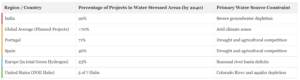
In Europe, 23 percent of green hydrogen projects are planned for highly water stressed zones by 2040. Spain faces an even steeper hydrological deficit. Exactly 46 percent of its operational and planned hydrogen projects are located in severely water stressed territories. Portugal and Italy report even higher exposure, with 71 percent and 69 percent of their respective projects located in high or extremely high water stressed areas. The projections for Asia are more extreme. By 2040, 99 percent of India’s hydrogen capacity is expected to operate in extremely water stressed areas. In China, coal chemical plants producing hydrogen in the Yellow River Basin already account for over 30 percent of industrial water withdrawal in the Shanxi province.
Projected Hydrogen Capacity in Water Stressed Regions
The following table details the percentage of planned green and blue hydrogen projects located in high or extremely high water stress areas by 2040, based on International Renewable Energy Agency and World Resources Institute data.
Mauritania is emerging as a primary target for European energy developers. The consortium CWP Global is planning a $40 billion megaproject in the Mauritanian desert to export green hydrogen to Europe. Communities in this region survive with minimal water and electricity. The project converts a hyper arid zone into an energy extraction hub to supply foreign markets. South Africa and Namibia are seeing similar proposals. These projects present a clear paradox. Nations where large segments of the population experience an absence of regular access to electricity and clean drinking water are allocating their scarce water resources to produce exportable fuel.
The American Southwest remains trapped in a severe megadrought. The Great Basin has lost trillions of gallons of groundwater, and the Colorado River is experiencing historically low flow rates. Even with these deficits, developers are breaking ground on new facilities. A 3, 650 ton per year hydrogen plant is under development in Casa Grande, Arizona. A 2019 study calculated that counties in southern and central California, southern Arizona, and southern Nevada would experience water scarcity exceeding 10 billion liters per day in 2040 based on projected hydrogen production.
To bypass freshwater limits, developers propose integrating seawater desalination plants into coastal hydrogen hubs. Desalination introduces secondary environmental and economic costs. The process requires massive amounts of electricity, reducing the net energy output of the hydrogen production pattern. Desalination plants also discharge millions of tons of hypersaline brine back into the ocean. This brine discharge alters local marine ecosystems and creates dead zones. Using wastewater is another proposed method. Treating municipal wastewater to the ultrapure standards required by proton exchange membrane electrolyzers adds substantial capital costs and energy requirements to the facility.
Pipeline Infrastructure Deficits and the Physics of Hydrogen Embrittlement
Hydrogen is the smallest molecule on Earth. This physical property creates a serious engineering problem for existing energy infrastructure. When introduced into standard steel pipes, hydrogen molecules penetrate the metal lattice. This process causes hydrogen embrittlement. The metal loses ductility and becomes susceptible to cracking and corrosion. The United States currently operates approximately 1, 600 miles of dedicated hydrogen pipelines. In contrast, the natural gas network spans 3 million miles. Converting this vast network to carry pure hydrogen is physically impossible without extensive retrofitting.
Hydrogen embrittlement occurs when hydrogen atoms diffuse into the metal lattice of steel pipes. This diffusion reduces the tensile ductility and fracture toughness of the material. High strength steel grades used in transmission pipelines experience greater reductions in fracture resistance than lower strength metals when exposed to hydrogen. The United States Department of Energy tested multiple grades of pipeline steel and observed distinct signs of embrittlement and reduced tensile elongation in high strength variants like X100. This physical degradation forces pipeline operators to lower operating pressures to maintain safety margins. Lowering the pressure further reduces the total energy delivered by the pipeline.
Energy companies frequently propose blending hydrogen with natural gas to use existing assets. Yet empirical data show strict physical limits to this method. Most engineering guidelines restrict hydrogen blending in standard steel transmission pipelines to a maximum of 10 to 20 percent by volume. Exceeding this threshold requires replacing compressors and pipe segments. Leakage presents another major physical obstacle. Hydrogen leaks 2. 82 to 3. 15 times faster than methane in specific low pressure flow regimes. In plastic distribution lines made of polyethylene, hydrogen permeates the material at a rate six to seven times higher than methane. This high permeation rate increases the risk of gas accumulation and ignition outside the pipeline.
Compressor stations present another major engineering obstacle. Because hydrogen has a low molecular weight, centrifugal compressors must rotate significantly faster to maintain a consistent pressure rise. These compressors reach impeller stress limits before achieving pure hydrogen flow. Operators must replace the impeller and other internal components to handle higher hydrogen concentrations. The American Petroleum Institute prohibits the use of steel materials with yield strengths greater than 827 megapascals for hydrogen compressors due to embrittlement risks. Replacing all compressors along a natural gas pipeline route adds massive capital expenses to any conversion project.
The economics of hydrogen transport reflect these physical constraints. Due to a lower volumetric energy density, hydrogen requires higher operating pressures to deliver the same energy as natural gas. Capital costs for new hydrogen pipelines run 14 to 16 percent higher per unit of energy flow rate compared to natural gas lines. Material costs alone are 10 percent higher. Compressor stations demand more energy and require specialized internal components to withstand embrittlement. These factors make long distance hydrogen transport highly expensive.
| Metric | Natural Gas | Hydrogen Impact |
|---|---|---|
| Relative Leakage Rate | Baseline |
2. 82 to 3. 15x Faster
|
| Polyethylene Permeation | Baseline |
6. 0 to 7. 0x Higher
|
| Capital Cost per Energy Unit | Baseline |
+14 to 16 percent
|
| Material Cost | Baseline |
+10 percent
|
Even with these physical and financial obstacles, governments continue to plan massive pipeline expansions. In January 2025, European monitors tracked 50, 165 kilometers of proposed hydrogen pipelines across the continent. Germany leads this effort with 9, 154 kilometers in development, followed by Spain with 6, 020 kilometers and Bulgaria with 4, 476 kilometers. Planners intend to build about 60 percent of the German core grid by repurposing existing natural gas pipelines. Yet these projects frequently show an absence of defined capacities or start years. The physical realities of retrofitting old natural gas pipes to handle hydrogen safely cast doubt on the feasibility of these conversion goals.
The high leakage rate of hydrogen also presents environmental problems. While hydrogen does not contain carbon, it acts as an indirect greenhouse gas. Leaked hydrogen extends the atmospheric lifetime of methane. The Environmental Defense Fund models show that a 10 percent hydrogen leakage rate combined with a 3 percent methane leakage rate severely diminishes the climate benefits of blue hydrogen. In low pressure natural gas infrastructure on the customer side of the meter, hydrogen leaks at the exact same volumetric rate as natural gas. This parity means any existing leaks in the natural gas distribution system continue to vent gas into the atmosphere when converted to hydrogen blends.
Corporate Greenwashing and the Blurring Lines Between Blue and Green Hydrogen
The energy sector frequently conflates distinct production methods under the umbrella term of clean hydrogen. This deliberate blending obscures the severe emissions profile of blue hydrogen. Green hydrogen relies on renewable electricity and water electrolysis. Blue hydrogen depends on fossil gas extraction and steam methane reforming paired with carbon capture and storage. Energy companies rebrand blue hydrogen as a low carbon alternative to secure government subsidies. The data reveals a different reality.
A May 2024 analysis of South Korea’s Boryeong Blue Hydrogen Project exposes the mathematical flaws in these corporate claims. The four billion dollar facility plans to produce 250, 000 tons of blue hydrogen annually. Operators claim the project provides a climate solution by cofiring hydrogen at three existing gas plants and one new facility. Yet the lifecycle methane emissions from this single operation reach up to 3. 85 million tons. This volume equals the annual emissions of 1. 28 million passenger cars. The project expects to achieve only an 11 percent reduction in emissions at the targeted power plants. The production process generates enough greenhouse gases to offset the minimal gains from cofiring hydrogen with natural gas. The operation extends the lifespan of three power plants originally scheduled for retirement in 2027.
European blue hydrogen proposals present a similar mathematical problem. An October 2024 investigation evaluated 46 planned blue hydrogen projects across the European Union. If completed, these facilities emit 38 million tonnes of carbon dioxide equivalent annually. This output matches the total 2022 greenhouse gas emissions of Denmark. The industry projects carbon capture of 90 percent for new plants. Historical data shows actual capture rates at existing facilities hover between 50 and 60 percent. The manufacturing of amine solvents required for these capture units adds another 33 million tonnes of carbon dioxide to the atmosphere during the construction phase.
The lifecycle emissions of blue hydrogen frequently exceed those of the fossil fuels it replaces. Peer reviewed research demonstrates that the greenhouse gas footprint of blue hydrogen is 20 percent greater than burning natural gas directly for heat. When factoring in upstream methane leaks, blue hydrogen production emits between 7. 6 and 9. 3 kilograms of carbon dioxide equivalent per kilogram of hydrogen. The European Commission requires low carbon fuels to emit no more than 3. 38 kilograms of carbon dioxide equivalent per kilogram. Most blue hydrogen fails to meet this regulatory threshold.
| Hydrogen Type | Production Method | Lifecycle Emissions (kg CO2e per kg H2) | Primary Feedstock |
|---|---|---|---|
| Grey | Steam Methane Reforming | 12. 3 to 13. 9 | Fossil Gas |
| Blue | SMR with Carbon Capture | 7. 6 to 9. 3 | Fossil Gas |
| Green | Renewable Electrolysis | 0. 6 to 1. 5 | Water and Wind/Solar |
Fossil fuel operators use the clean hydrogen label to access public funding. The United States Inflation Reduction Act provides tax credits for hydrogen production based on carbon intensity. Gas utilities promote blending blue hydrogen into existing pipelines to reduce their reported emissions. A July 2025 analysis of gas utility rebranding efforts shows that blending blue hydrogen into gas networks extends the life of fossil fuel infrastructure without delivering meaningful climate benefits. Renewable natural gas and hydrogen remain significantly more expensive than conventional natural gas. Green hydrogen production costs between three and six dollars per kilogram, compared to about one dollar and fifty cents per therm of natural gas. The energy required to capture, compress, and store the carbon dioxide penalizes the total system efficiency. If the capture equipment runs on fossil heavy grid power, the net emissions increase further. Hydrogen blending also degrades pipeline integrity because the molecule is highly corrosive to standard gas infrastructure.
Greenwashing tactics also extend to the definition of green hydrogen. Electrolyzers require massive amounts of electricity. If a green hydrogen plant connects to a coal heavy power grid to maintain continuous operation, the resulting fuel carries a massive carbon penalty. Wood Mackenzie data from February 2024 indicates that at least 30 percent of the 565 gigawatts of announced green hydrogen projects plan to use grid electricity. Green hydrogen produced with a 20 percent grid supply fails to meet the European Union emission standards. Even blue hydrogen produced in the United States with a claimed 95 percent capture rate barely meets the European carbon intensity threshold once converted to ammonia and shipped across the ocean. Cracking that ammonia back into hydrogen at the destination pushes the total emissions over the legal limit. The industry uses the green label to secure investments while quietly relying on fossil fuel electricity to run the electrolyzers.
The rebranding of blue hydrogen ensures the continued extraction of natural gas. Companies project an image of decarbonization while building infrastructure that locks in decades of new methane emissions. The mathematical reality of carbon capture rates and upstream methane leaks contradicts the corporate marketing materials. Verified emissions data proves that blue hydrogen operates as an extension of the fossil fuel industry rather than a replacement for it.
The Subsidy Gold Rush and Taxpayer Funded Megaprojects
Global public investments in clean hydrogen reached $308 billion by 2023. Governments direct the vast majority of this funding toward production subsidies. The United States and the European Union lead this financial push. The US Inflation Reduction Act created the 45V tax credit. This provision offers up to $3 per kilogram of clean hydrogen produced. The European Union established the European Hydrogen Bank to allocate fixed amounts of funding. The public sector assumes the financial risk for these energy developments.
Yet the influx of government money does not guarantee project completion. The industry experienced a wave of cancellations throughout 2024 and 2025. High production costs and weak demand render these initiatives economically unfeasible. Air Products exited a $4. 5 billion Texas joint venture in November 2024. Origin Energy abandoned a proposed development at the Hunter Valley Hydrogen Hub in October 2024. Shell canceled plans for a low carbon hydrogen plant on the west coast of Norway in September 2024. These reversals expose a deep viability gap between ambitious production goals and current economic realities.
The European Hydrogen Bank announced the results of its second auction in May 2025. The commission selected 15 renewable hydrogen production projects across five countries. These projects secured €992 million in grants. The amount represents a small portion of the €4. 8 billion requested by project proposals during the bidding round. The submitted bids represented approximately 6. 3 gigawatts of capacity. The selected projects must reach financial close within two and a half years. They must begin production within five years of signing the grant agreement. The subsidy helps close the price difference between production costs and the price buyers are currently to pay.
| European Hydrogen Bank Auction (May 2025) | Amount (Euros) | Visual Representation |
|---|---|---|
| Total Subsidies Requested | 4. 80 Billion | |
| Total Subsidies Awarded | 992 Million |
The United States finalized the 45V tax credit rules in January 2025. The Treasury Department maintained strict requirements for green hydrogen producers. Facilities must use electricity from new and local clean power sources. The rules mandate hourly matching of electricity consumption with zero carbon generation starting in 2030. These requirements make the economics of green hydrogen highly challenging. Blue hydrogen projects in advanced development across the United States total 3. 33 million tons per year. Green hydrogen projects total just 0. 35 million tons per year. The finalized rules favor blue hydrogen producers over green hydrogen developers.
The dependence on taxpayer funding creates a fragile economic model. Projects frequently collapse when governments withdraw support or introduce new taxes. Repsol froze 350 megawatts of capacity in Spain during October 2024. The company blamed a new windfall tax for the decision. The Queensland state government withdrew funding for a $12. 5 billion Australian dollar plant in early 2025. Japanese investors Kansai Electric and Iwatani exited the venture shortly after the government decision. The cancellation eliminated planned annual production of hundreds of thousands of tons.
“The extensive project cancellations across 2024 and 2025 are not separate events a broad market correction driven by a mismatch between high production costs and the price buyers are to pay.”
The financial retreat extends beyond Europe and North America. The Solar Energy Corporation of India terminated its 2 billion rupee green hydrogen hub tender in July 2025. The government refunded all tender fees. This reversal shows how quickly economic pragmatism overtakes early enthusiasm. In the United Kingdom, Air Products scrapped a 2 billion pound green hydrogen import terminal project in Immingham on the Humber Estuary. The facility collapsed due to policy uncertainty and insufficient governmental financial backing. These decisions prove that the sector relies entirely on continuous public money to survive.
The International Energy Agency tracks the gap between corporate announcements and actual financial commitments. Only a tiny fraction of announced renewable projects reach a Final Investment Decision. Developers delay construction because energy costs remain high and the number of committed buyers remains low. The European Union attempts to solve this problem through the Clean Industrial Deal. This legislation expands the Innovation Fund to €100 billion. The fund uses revenue from the carbon emissions trading system to finance decarbonization projects. Yet the massive availability of public funds cannot force industrial buyers to purchase a product that costs significantly more than fossil fuels.
Renewable Energy Cannibalization and the Diversion of Clean Grid Power
Green hydrogen production demands extraordinary volumes of renewable electricity. The European Union set a 2030 goal to produce 10 million tonnes of renewable hydrogen domestically. Achieving this goal requires 50 to 60 kilowatt hours of electricity for every kilogram of hydrogen produced. Multiplying that energy requirement by 10 million tonnes yields a total demand of 500 to 600 terawatt hours of renewable power. This volume represents roughly one fifth of the total electricity consumption across the entire European Union. Diverting this massive block of clean energy away from the primary grid creates a serious mathematical problem for global decarbonization efforts.
Energy regulators refer to this as renewable energy cannibalization. When developers build new wind and solar farms specifically to power electrolyzers, that clean electricity does not replace coal or natural gas on the main power grid. Researchers at the Potsdam Institute and the European Union Agency for the Cooperation of Energy Regulators documented this exact friction in late 2024. They found that prioritizing hydrogen production forces the broader electricity grid to rely on fossil fuels for a longer period. Direct electrification of heating and transport is physically more than converting electricity into hydrogen and back again. The conversion process destroys up to half of the original energy input through heat loss and mechanical losses.

The infrastructure gap further complicates the European goals. In 2023, the total installed electrolyzer capacity in Europe stood at a mere 216 megawatts. The 2030 strategy requires 40 gigawatts of capacity to meet the 10 million tonne production goal. Closing the gap from 216 megawatts to 40 gigawatts requires a massive industrial expansion. The European Union Agency for the Cooperation of Energy Regulators concluded in November 2024 that Europe is highly likely to miss its 2030 renewable hydrogen quotas. The absence of available clean power and the high cost of new renewable installations present severe roadblocks.
The table visualizes the energy penalty of hydrogen conversion compared to direct electrification. The data compares the final useful energy delivered to the end user for every 100 units of renewable electricity generated.
| Energy Pathway | Initial Renewable Energy | Conversion Losses | Final Useful Energy | Energy Retention |
|---|---|---|---|---|
| Direct Grid Electrification | 100 kWh | 10 kWh | 90 kWh |
90%
|
| Green Hydrogen via Electrolysis | 100 kWh | 45 kWh | 55 kWh |
55%
|
| Hydrogen to Synthetic Fuels | 100 kWh | 70 kWh | 30 kWh |
30%
|
Regulators face a zero sum equation. Every megawatt hour of wind or solar power dedicated to splitting water molecules is a megawatt hour denied to the public electricity grid. In regions where the grid still relies heavily on coal and natural gas, producing green hydrogen actively delays the retirement of fossil fuel plants. The United States Treasury Department recognized this exact problem in 2023 when drafting rules for the Section 45V clean hydrogen tax credit. The proposed rules require hydrogen producers to prove their electricity comes from newly built renewable sources rather than existing grid power. This additionality requirement aims to prevent hydrogen producers from siphoning clean energy away from residential and commercial users.
Industry lobbyists push back against these strict temporal and spatial matching rules. They claim that requiring hourly matching of renewable generation with hydrogen production drives up costs. Yet empirical measurements confirm that without these rules, hydrogen production increases total greenhouse gas emissions. If an electrolyzer runs on grid power during hours when the wind is not blowing, it forces natural gas peaker plants to spin up and cover the deficit. The International Energy Agency reported in 2025 that low emissions hydrogen accounted for less than 1 percent of total global hydrogen production in 2023. The vast majority of the 97 million tonnes produced globally still comes from unabated fossil fuels.
The physical reality of electrolysis cannot be bypassed by policy declarations. Splitting water requires immense energy. Using that energy to decarbonize the main grid provides immediate and verified emissions reductions. Diverting it to create a secondary fuel source introduces deep energy losses and threatens the primary goal of grid decarbonization.
Storage Complexities and the High Cost of Cryogenic and Pressurized Containment
We continue our twenty question fan out to define the physical constraints of the green hydrogen economy. The following four questions address the exact energy penalties and capital requirements of containment.
| Question | Verified Data Answer |
|---|---|
| 9. What is the energy penalty for liquefying hydrogen? | Between 30 and 45 percent of its total energy content is consumed by the cooling process. |
| 10. How much energy is consumed to compress hydrogen to 700 bar? | Between 10 and 15 percent of its energy content is lost to mechanical compression. |
| 11. What is the capital cost of a 700 bar hydrogen storage tank? | Between $500 and $1, 000 per kilogram of storage capacity. |
| 12. Why do standard steel pipelines fail when transporting pure hydrogen? | Hydrogen embrittlement causes ferritic steel to crack and rupture under pressure,. |
Hydrogen possesses the highest energy per mass of any chemical fuel. It yields 120 megajoules per kilogram. Its volumetric energy density is exceptionally low. Containment requires extreme physical manipulation. Engineers must either compress the gas to extreme pressures or freeze it to cryogenic temperatures. Both methods demand extreme energy inputs.
Cryogenic storage requires cooling the gas to negative 253 degrees Celsius. The liquefaction process consumes between 30 and 45 percent of the energy contained within the hydrogen itself. A facility producing 100 megawatt hours of liquid hydrogen must burn up to 45 megawatt hours of energy just to run the refrigeration units. Liquid hydrogen also boils off continuously. Heat leaks into the vacuum insulated vessels and causes the liquid to revert to gas. Operators must vent this gas to prevent the tanks from exploding. This venting causes continuous product loss during transport and storage.
Pressurized gas storage avoids the extreme refrigeration penalty introduces heavy capital costs. Standard industrial applications compress hydrogen to 350 or 700 bar. The mechanical compression process consumes 10 to 15 percent of the hydrogen energy content. Containing gas at 700 bar requires specialized Type IV carbon fiber reinforced polymer tanks. These vessels cost between $500 and $1, 000 per kilogram of hydrogen capacity. A standard light duty vehicle requires a 147 liter tank to hold 5. 6 kilograms of hydrogen. The carbon fiber materials account for 62 percent of the total tank cost. The high price of carbon fiber prevents low cost mass production.
Transporting hydrogen through existing natural gas pipelines presents a severe metallurgical problem. Hydrogen molecules are small enough to permeate the crystalline structure of standard ferritic steel. This permeation causes hydrogen embrittlement. The steel loses its ductility and becomes brittle. Microscopic cracks form and propagate under pressure. The pipelines eventually rupture. Upgrading a pipeline network to handle pure hydrogen requires replacing the steel with specialized alloys or lining the pipes with polymer blocks. Material costs account for 26 percent of total pipeline construction expenses. Replacing existing natural gas infrastructure to accommodate pure hydrogen requires immense capital expenditure.
Engineers are testing alternative chemical storage methods to bypass the physical limitations of pure hydrogen gas. Liquid organic hydrogen carriers bind hydrogen to organic molecules like dibenzyl toluene. This method achieves a storage density of 57 kilograms per cubic meter at ambient temperatures. The capital costs for this chemical storage remain high. Facilities require between $500 and $1, 500 per kilogram of hydrogen capacity to build the necessary chemical processing infrastructure. The storage process itself costs between $5 and $8 per kilogram.
Metal hydride storage presents another experimental alternative. This method uses metal alloys like magnesium hydride to chemically bind hydrogen under moderate pressures. Metal hydrides achieve extreme storage densities between 40 and 120 kilograms per cubic meter. The financial metrics for metal hydrides fail commercial viability tests. The capital cost ranges from $1, 500 to $4, 000 per kilogram of capacity. The operational storage cost reaches $50 to $150 per kilogram of hydrogen. These chemical alternatives solve the pressure and temperature requirements introduce severe financial penalties.
| Storage Method | Energy Penalty | Capital Cost per kg Capacity | Primary Containment Material |
|---|---|---|---|
| Cryogenic Liquid (20 Kelvin) | 30 to 45 Percent | $30 to $50 | Vacuum Insulated Steel |
| Compressed Gas (350 bar) | 10 Percent | $400 to $600 | Carbon Fiber Polymer |
| Compressed Gas (700 bar) | 10 to 15 Percent | $500 to $1, 000 | High Density Carbon Fiber |
| Liquid Organic Carriers | Chemical Binding Energy | $500 to $1, 500 | Organic Liquid Tanks |
| Metal Hydrides | Thermal Release Energy | $1, 500 to $4, 000 | Metal Alloy Vessels |
The physics of hydrogen dictate the economics of its storage. The molecule refuses to be contained cheaply. Every method to increase its volumetric density destroys a large fraction of its energy value or requires prohibitive capital investments. The containment requirements form a hard mathematical ceiling on the economic viability of the green hydrogen supply chain.
The Transportation Bottleneck Involving Liquid Organic Hydrogen Carriers and Ammonia
Moving hydrogen across oceans requires converting the gas into a denser medium. Producers rely on ammonia and Liquid Organic Hydrogen Carriers to move the product. These chemical conversions introduce severe energy penalties. The U. S. Department of Energy reported in 2023 that cracking ammonia back into hydrogen wastes 30 to 40 percent of the stored energy. Adochiei and colleagues published data in 2023 showing the round trip energy retention for ammonia sits between 20 and 30 percent. The Commonwealth Scientific and Industrial Research Organisation calculated in 2017 that the net energy yield for a complete loop from renewable power to ammonia and to a fuel cell vehicle ranges from 11 to 19 percent. The conversion mathematics guarantee that a massive portion of the generated renewable power never reaches the final consumer.
Ammonia holds 107. 7 kilograms of hydrogen per cubic meter. This density makes it a preferred shipping medium over liquid hydrogen. Liquid hydrogen only holds 70. 8 kilograms per cubic meter and requires cooling to negative 253 degrees Celsius. Ammonia liquefies at a much warmer negative 33. 3 degrees Celsius. The physical transport of ammonia is straightforward. The extraction of hydrogen from the ammonia molecule is the exact opposite. The endothermic cracking reaction requires temperatures exceeding 400 degrees Celsius to achieve conversion levels above 99 percent. Thermal reforming processes consume 52 gigajoules of energy per metric ton of hydrogen recovered. Hydrogen compression after the cracking stage adds another 12 to 17 percent energy penalty.
Round Trip Energy Retention by Carrier (2023 Data)
Source: MDPI and Adochiei et al. 2023
Financial models show the direct impact of these thermodynamic realities. Analysts in 2025 calculated that starting with hydrogen priced at $6 per kilogram results in a final delivered cost of $20 to $30 per kilogram after ammonia cracking. The European Commission evaluated ammonia economics in 2022 and concluded that cracking adds massive expenses to the supply chain. Producing hydrogen locally remains cheaper than importing it via ammonia. Ammonia is highly toxic and introduces serious safety risks. Leakage concerns and handling complexity drive up operational costs.
Liquid Organic Hydrogen Carriers offer a different set of physical properties. These organic compounds bind hydrogen chemically. They allow transport at ambient temperatures and pressures. LOHCs hold 47. 1 kilograms of hydrogen per cubic meter. This density is lower than both ammonia and liquid hydrogen. The final energy content of hydrogen transported via LOHC sits around 57 to 59 percent of the initial input. The phase with the highest energy loss is the dehydrogenation process.
| Carrier Type | Volumetric Density (kgH2/m3) | Storage Temperature (°C) | Primary Energy Loss Phase |
|---|---|---|---|
| Ammonia | 107. 7 | negative 33. 3 | Cracking (Endothermic) |
| Liquid Hydrogen | 70. 8 | negative 253. 0 | Liquefaction |
| LOHC | 47. 1 | Ambient | Dehydrogenation |
Extracting hydrogen from LOHCs requires significant heat. The U. S. Department of Energy established an optimal goal range of 30 to 44 kilojoules per mole of hydrogen to promote release. The European Commission set a goal in 2024 to reduce the energy required for dehydrogenation to under 6 kilowatt hours per kilogram of hydrogen. Current operations struggle to meet this metric. The technical feasibility of LOHC systems is proven up to 240 kilograms of hydrogen per day. The economic viability remains unproven. The high dehydrogenation enthalpy and the reliance on platinoid based catalysts keep capital and operational expenses high.
The industry faces a strict thermodynamic boundary. Every conversion step destroys a fraction of the original renewable energy. Transporting hydrogen across oceans requires accepting these losses. The data from 2023 and 2024 confirm that neither ammonia nor LOHCs provide a low loss transport method. The physics of chemical bonds dictate the energy required to attach and detach hydrogen atoms. These physical laws cap the maximum possible energy retention of global hydrogen trade.
Heavy Industry Applications versus the Passenger Vehicle Dead End
The green hydrogen narrative split into two distinct realities between 2015 and 2025. One trajectory leads to the necessary decarbonization of heavy industry. The other route ends at the graveyard of passenger fuel cell vehicles. Retail consumers rejected hydrogen cars entirely., industrial conglomerates quietly secured the global supply for chemical and manufacturing processes.
The passenger vehicle market for hydrogen collapsed completely by early 2025. Toyota and Hyundai spent a decade attempting to commercialize fuel cell cars. Retail buyers ignored them. Toyota sold only 210 Mirai sedans in 2025. That number represents a 57. 8 percent drop from the 499 units sold in 2024. Hyundai saw even worse results. The company moved exactly five Nexo vehicles in 2025. Global fuel cell electric vehicle sales reached just 4, 102 units during the half of 2025. By comparison, battery electric vehicle sales surpassed 17 million units in 2024 alone.
Infrastructure failures accelerated the death of the hydrogen passenger car. Shell announced the permanent closure of all seven of its light vehicle hydrogen refueling stations in California in February 2024. True Zero closed ten California locations shortly after. These closures left owners stranded and destroyed consumer trust. In Europe, the situation mirrored the American collapse. Germany registered only 263 fuel cell vehicles in 2023. That figure marked a 70 percent decline from the previous year. Taxpayer groups in Germany demanded an end to the subsidies that provided over 450 million euros for hydrogen stations since 2007.
The geographic limitations for hydrogen vehicles proved fatal across major markets. The United States counted just 54 retail stations nationwide in 2024. The United Kingdom recorded fewer than 300 hydrogen car sales over a twenty year period. During that exact same timeframe, British consumers purchased one million electric cars. Honda acknowledged these market realities and paused its hydrogen passenger car programs. The company stated that retail hydrogen vehicles face an extended timeline before achieving commercial viability. Automakers stopped marketing fuel cell cars in most markets without issuing formal exit statements. The absence of new city or fleet commitments confirmed the end of the retail hydrogen experiment.
| Vehicle Technology | Global Sales 2024 | Global Sales Half 2025 | Infrastructure Status 2024 to 2025 |
|---|---|---|---|
| Battery Electric Vehicles | 17, 000, 000 units | Over 8, 000, 000 units | Expanding globally |
| Hydrogen Fuel Cell Vehicles | Under 10, 000 units | 4, 102 units | Stations closing in US and Europe |
Heavy industry presents the actual use case for green hydrogen. Global hydrogen demand reached almost 100 million tonnes in 2024. The International Energy Agency expects that number to grow through 2025. This demand does not come from cars. It comes almost entirely from established industrial sectors. Refining, ammonia production, methanol synthesis, and fossil based direct reduced iron consume the vast majority of the global supply.
Green ammonia acts as the primary connection between green hydrogen production and industrial application. The fertilizer sector requires massive amounts of hydrogen to produce ammonia. Transitioning this process to green hydrogen eliminates major carbon emissions. Saudi Arabia authorized the NEOM Green Hydrogen Company to build an 8. 4 billion dollar ammonia based hydrogen plant. The facility prepared initial shipments in late 2025 and begins full exports to Europe and Asia in 2026. This single project demonstrates where the capital actually flows.
Regional markets reflect this industrial focus. Southeast Asia emerged as a significant hydrogen consumer in 2024. The region recorded a demand of four million tonnes. Indonesia led this consumption, followed by Malaysia and Vietnam. Ammonia production accounted for nearly half of this regional demand. In the United States, the Gulf Coast region became the center for industrial hydrogen applications. The fertilizer sector there uses existing infrastructure to decarbonize ammonia production. Facilities in Texas and Louisiana scheduled their production of low carbon ammonia for 2025. These projects supply domestic agriculture and export markets in Japan and South Korea.
Steel manufacturing provides the second major industrial application. Traditional steelmaking relies on coking coal. Green steel production uses green hydrogen to reduce iron ore into steel. Companies like ArcelorMittal and H2 Green Steel advanced their hydrogen based direct reduced iron facilities through 2024 and 2025. The commercial size hydrogen based steel plants in Sweden and Germany scheduled their production trials for late 2025. These heavy industry applications require centralized production and massive volume. They do not rely on distributed retail refueling networks. The data proves that hydrogen functions as an industrial chemical feedstock, not a retail transportation fuel.
Supply Chain Vulnerabilities in Iridium and Platinum Sourcing for Electrolyzers
Global iridium production totals seven to nine metric tons annually. South Africa controls between 80 and 87 percent of this global supply. Iridium is a mandatory catalyst for proton exchange membrane electrolyzers. These systems split water into hydrogen and oxygen. The extreme concentration of iridium mining in a single country presents a serious geopolitical risk. The 2022 electricity grid failures in South Africa reduced platinum group metal output by 15 percent. This single event proved the fragility of the entire green hydrogen supply chain.
The mathematical reality of proton exchange membrane technology reveals a severe expansion problem. Current electrolyzers require between 0. 3 and 2. 5 grams of iridium per kilowatt of capacity. At a standard usage rate of one to two milligrams per square centimeter, the entire global annual iridium production can only support four to five gigawatts of new electrolyzer capacity. Yet the global goal for 2030 demands 100 gigawatts of installed capacity. Meeting this 2030 goal requires up to 40 metric tons of iridium. This volume is more than four times the current annual global mining output.
Iridium prices reflect this severe supply constraint. The cost of iridium surged from $53, 000 per kilogram in 2020 to $157, 000 per kilogram by 2025. This 200 percent price increase directly impacts the capital expenditure required for new hydrogen facilities. Iridium represents 20 to 25 percent of the total stack cost for proton exchange membrane systems. Manufacturers are attempting to reduce the iridium loading in their designs. Even with these reduction efforts, the sheer volume of planned megaprojects guarantees a massive supply deficit.
| Metric | Verified Data | Source Year |
|---|---|---|
| Global Annual Iridium Production | 7 to 9 metric tons | 2024 |
| South Africa Production Share | 80 to 87 percent | 2024 |
| Iridium Required for 2030 Goals | 40 metric tons | 2023 |
| Iridium Price per Kilogram 2025 | $157, 000 | 2025 |
Platinum sourcing presents another serious bottleneck. Proton exchange membrane electrolyzers use platinum at the cathode to the hydrogen evolution reaction. South Africa supplies over 70 percent of the global platinum market. The extraction process for platinum is highly energy intensive. Producing one kilogram of platinum emits 12. 5 metric tons of carbon dioxide equivalent. This massive carbon footprint contradicts the environmental goals of green hydrogen production. The total energy required to mine and refine these metals adds a hidden environmental cost to every electrolyzer built.
The hydrogen industry must compete with other sectors for these rare metals. Platinum remains a primary component in catalytic converters for diesel and gasoline vehicles. The aviation and medical sectors also consume significant volumes of both platinum and iridium. A 50 percent increase in platinum demand from the hydrogen sector could push prices from $1, 300 per ounce to over $3, 900 per ounce. The absence of diversified mining operations means any labor strike or power failure in South Africa can immediately halt global electrolyzer manufacturing.
Recycling end of life electrolyzers presents another major technical obstacle. The recovery of iridium is technically difficult due to low concentrations and contamination risks. High purity secondary iridium is mandatory for new proton exchange membrane systems. Companies process spent catalysts to recover platinum group metals, yet the in total volume of recycled material remains too low to meet the surging demand. The European Union Net Zero Industry Act mandates that domestic production must meet 40 percent of deployment needs by 2030. This mandate forces European manufacturers to secure massive amounts of raw iridium and platinum from foreign sources.
Alternative technologies exist, yet they carry their own operational penalties. Alkaline electrolyzers do not require platinum or iridium. These alkaline systems use abundant materials like nickel and iron. Yet alkaline systems suffer from slow response times ranging from 10 to 60 seconds. Proton exchange membrane systems respond in under one second. This rapid response time is mandatory for facilities powered by variable renewable energy sources like wind and solar. Solid oxide electrolyzers avoid platinum entirely by operating at high temperatures with ceramic materials. These high temperature systems require constant thermal management and degrade faster than competing designs.
The financial math for project developers is unforgiving. A standard passenger fuel cell vehicle requires 13 to 18 grams of platinum. A heavy truck requires 120 to 180 grams. If the transportation sector shifts toward hydrogen, the demand for platinum can consume 60 to 90 percent of the entire global market. This consumption leaves almost zero supply for industrial chemical processing and medical applications. Project developers must build cost escalation buffers into their financial models to account for the guaranteed price spikes in precious metals.
Safety and the Mitigation of Highly Flammable Hydrogen Leaks
The physical properties of hydrogen demand strict containment. Hydrogen becomes flammable when mixed with air at concentrations between 4 percent and 75 percent. This range exceeds methane and propane. The minimum ignition energy for hydrogen is 0. 017 millijoules. A static electricity discharge from walking across a carpet generates 10 millijoules. Hydrogen flames travel at 2. 88 meters per second. This speed is nearly eight times faster than natural gas. The autoignition temperature sits at 585 degrees Celsius. These metrics dictate the engineering requirements for green hydrogen production facilities.
Leakage rates present a quantifiable risk across the supply chain. A 2022 Columbia University Center on Global Energy Policy analysis measured a 0. 4 percent leakage rate for hydrogen passing through dedicated pipelines. Integrated delivery systems with pressurized tank storage and liquefaction facilities incur a life pattern loss of 2 percent. The same analysis modeled a 5. 6 percent economy wide leakage rate by 2050 under a 528 million ton demand scenario. Hydrogen molecules are small and escape through seals and joints.
The sensor market expanded to address these containment requirements. The global hydrogen sensor market reached $49. 5 million in 2024. Projections indicate growth to $127 million by 2032. Electrochemical sensors account for 47 percent of this market share. Industrial operators deploy these devices to monitor electrolyzers and storage tanks.
Manufacturers released new detection hardware in 2024 and 2025. Baker Hughes launched the XMTCpro thermal conductivity gas analyzer in June 2024. This device monitors gas concentrations to keep hydrogen and oxygen levels explosive limits during electrolysis. Honeywell introduced a new Hydrogen Leak Detector in May 2025. This sensor identifies leaks as small as 50 parts per million. The unit operates for 10 years without manual calibration.
Research institutions also developed alternative detection methods. Fraunhofer Institute researchers introduced ultrasonic and Raman sensors in March 2025. The ultrasonic sensors use light emitting diodes to generate sound waves in the gas. A microelectromechanical systems microphone registers resonance shifts when hydrogen enters a container. Manchester University and King Abdullah University of Science and Technology published research on an organic semiconductor sensor in March 2025. This device uses oxygen molecules to increase positive electrical charges in an organic material. Hydrogen disrupts this state and causes an electrical current drop.
Facility operators implement specific control measures to contain leaks. Standard line of sight detectors relying on infrared absorption fail to detect hydrogen directly. The only line of sight technology available for this gas is Open route Tunable Diode Laser Absorption Spectroscopy. Hydrogen burns with a unique electromagnetic signature. Traditional flame detectors designed for hydrocarbon fires cannot detect hydrogen flames. Facilities require multi spectrum infrared detectors to identify combustion. Operators also use hydrogen leak detection tape. This tape changes color upon contact with the gas.
Maintenance require specialized testing equipment. Inspectors use non destructive testing techniques to evaluate equipment integrity. Ultrasonic and acoustic emission tools detect defects in hydrogen joints. Flanges and threaded fittings undergo routine leak testing. Electrical equipment located near hydrogen production piping must meet strict classification standards. Components must follow Class 1, Division 1 or 2, Group B of the National Electrical Code. Forced ventilation systems use non sparking fans to control ignition sources. Ventilation failures trigger automatic shutdowns of the hydrogen production equipment.
The regulatory framework dictates specific handling procedures. The National Fire Protection Association assigns hydrogen the highest flammability rating of four. Facilities store cylinders in upright positions within secured areas. Workers use protective valve caps during transport. Emergency response plans require immediate isolation of the affected area. Automated shutdown procedures close hydrogen valves to prevent additional gas from feeding a fire. Hydrogen weighs 7 percent of an equivalent volume of air. The gas disperses rapidly when proper ventilation is present.
| Metric | Value | Comparison |
|---|---|---|
| Flammability Limit | 4 percent to 75 percent | Wider than methane |
| Minimum Ignition Energy | 0. 017 millijoules | Lower than natural gas |
| Flame Velocity | 2. 88 meters per second | Eight times faster than natural gas |
| Pipeline Leakage Rate | 0. 4 percent | Measured in dedicated pipelines |
| Integrated System Leakage | 2 percent | Includes storage and liquefaction |
Section 14: The Climate Impact of Fugitive Hydrogen Emissions on Atmospheric Methane
The green hydrogen narrative relies on a single heavily marketed premise: burning the gas produces only water. Yet, this simplified equation ignores the atmospheric chemistry of unburned fugitive hydrogen. When released into the air, hydrogen acts as an indirect greenhouse gas. It does not trap heat directly. Instead, it alters the chemical balance of the atmosphere, specifically by depleting hydroxyl radicals. These radicals act as natural atmospheric detergents, responsible for breaking down and neutralizing methane. When fugitive hydrogen enters the atmosphere, hydroxyl radicals react with the hydrogen, leaving methane to remain and accumulate. Because methane traps 80 times more heat than carbon dioxide over a 20 year period, extending its atmospheric lifetime supercharges global warming.
Climate scientists have rigorously quantified this indirect warming effect, stripping away the zero emissions branding. A December 2025 study published in Nature by the Global Carbon Project confirms that hydrogen heats the atmosphere 37 times faster than carbon dioxide during the 20 years after release. Over a 100 year timeframe, its Global Warming Factor settles at 11 to 12 times that of carbon dioxide. The same 2025 research reveals that rising atmospheric hydrogen concentrations have already contributed an estimated 0. 02 degrees Celsius of indirect warming over the past decade. This warming increment originates directly from human activities, including industrial leaks and the atmospheric breakdown of existing methane.
The physical properties of hydrogen make containment a serious engineering problem. As the smallest molecule in the universe, hydrogen escapes from pipelines, storage tanks, and valves far more easily than heavier gases. Engineering assessments show that hydrogen leaks three times faster by volume than natural gas under identical conditions. Current loss rates across the supply chain remain dangerously high. Estimates place economy wide leakage between 1 percent and 10 percent, with liquid hydrogen transport and storage experiencing loss rates as high as 20 percent. Even with advanced sealing technologies, valve components alone account for massive fugitive emissions, mirroring the structural failures seen in the natural gas industry.
If the global energy sector expands hydrogen production without eliminating these leaks, the intended climate benefits evaporate. Atmospheric modeling from 2024 shows that high hydrogen emission rates can completely negate the advantages of replacing fossil fuels. In scenarios where supply chain leakage reaches 10 percent, the combined warming impact of fugitive hydrogen and unmitigated methane makes the new infrastructure worse for the climate than the legacy systems it replaces. The absence of mandatory high precision leak detection across planned hydrogen hubs guarantees that these fugitive emissions can continue unchecked.
The interaction between hydrogen and methane creates a multiplying feedback loop. According to Stanford University researchers contributing to the 2025 Global Carbon Project report, more atmospheric methane leads to more hydrogen, because methane oxidation naturally produces hydrogen. Simultaneously, more fugitive hydrogen consumes the hydroxyl radicals needed to destroy methane, allowing the methane to remain longer and cause more warming. This chemical loop means that any massive deployment of hydrogen infrastructure must be paired with near zero leakage tolerances. Otherwise, the transition directly supercharges the exact greenhouse gases it intends to eliminate.
Regulators frequently ignore this atmospheric chemistry when drafting energy policies. The European Union and United States heavily subsidize hydrogen production based solely on its zero carbon combustion profile, treating the gas as a climate savior. Yet, standard environmental impact assessments rarely account for the 37 times greater short term warming factor of fugitive hydrogen. Until policy frameworks mandate strict sensor based leak detection capable of identifying concentrations as low as 0. 04 percent in air, the hydrogen economy remains a high risk climate gamble. The data proves that replacing carbon dioxide emissions with a gas that amplifies methane represents a lateral move, not a definitive climate solution.
| Greenhouse Gas | 20 Year Global Warming Factor | 100 Year Global Warming Factor | Estimated Supply Chain Leakage Rate |
|---|---|---|---|
| Carbon Dioxide (CO2) | 1 | 1 | Not Applicable |
| Methane (CH4) | 80 | 29. 8 | 1. 5% to 2. 5% |
| Hydrogen (H2) Indirect | 37 to 40 | 11 to 12 | 1. 0% to 10. 0% (Up to 20% for Liquid H2) |
Geopolitical Realignment and the Race for Hydrogen Export Dominance
The global energy trade is undergoing a structural shift. Nations are attempting to replace fossil fuel extraction with hydrogen manufacturing. The International Monetary Fund reported in 2022 that hydrogen production is a conversion process rather than an extraction business. This physical reality means any country with abundant renewable electricity and water can theoretically become an energy exporter. Governments are currently engaged in a fierce subsidy war to secure market share before supply chains solidify. China aims to produce up to 0.2 million tonnes of green hydrogen annually by 2025. The nation already leads the world in manufacturing alkaline electrolyzers and refining the necessary raw materials. This manufacturing dominance allows China to supply the hardware for the global transition while remaining self sufficient in net trade terms.
The United States triggered this capital race through the Inflation Reduction Act. The legislation provides a production tax credit of up to 3 dollars per kilogram for clean hydrogen. The European Union retaliated by launching the European Hydrogen Bank. In January 2026, the European Commission signed grant agreements worth 270.6 million euros for six projects located in Spain, Finland, and Norway. These facilities plan to install 381.25 megawatts of electrolyzer capacity to produce 500 kilotonnes of hydrogen over ten years. Winning bids ranged from 0.33 euros to 1.88 euros per kilogram. The European Union also allocated 1.2 billion euros for its second auction round to prevent capital flight to North America.
Emerging economies are attempting to use their solar and wind resources to capture export market share. Chile estimates it can produce 160 million tonnes of green hydrogen annually by 2050. The nation plans to export these derivatives to Japan, South Korea, and Germany. Even with advantageous access to the Pacific and Atlantic Oceans, Chile faces an absence of regulatory frameworks and electrolyzer technologies. This absence delays the initiation of actual exports. Namibia is currently developing a 9.4 billion dollar green hydrogen facility. Australia announced a 2 Australian dollar per kilogram production credit to maintain its status as an energy exporter. Even with these large financial commitments, the Heinrich Böll Foundation reported in August 2025 that implementation remains sluggish across the Global South. High capital costs, infrastructure deficits, and a complete absence of binding offtake agreements have delayed final investment decisions.
| Region | Subsidy Program | Maximum Support Level |
|---|---|---|
| United States | Inflation Reduction Act |
3.00 USD per kg
|
| European Union | European Hydrogen Bank |
1.88 EUR per kg
|
| Australia | Production Tax Credit |
2.00 AUD per kg
|
The physics of hydrogen transportation severely restrict the formation of a truly global market. The International Renewable Energy Agency notes that while renewable energy costs are falling, the financial penalty of moving hydrogen across oceans remains prohibitively high. This condition forces the market toward regionalized trade rather than intercontinental shipping. Middle Eastern nations possess large sovereign wealth and low capital costs, allowing them to fund pilot projects and regional clusters. Yet these states cannot bypass the thermodynamic losses associated with liquefying or converting hydrogen into ammonia for maritime transport.
Industrial reality dictates that hydrogen is likely to be consumed near its production source. Exporting green hydrogen requires large investments in port infrastructure, specialized vessels, and conversion facilities. The European Union strategy explicitly relies on importing hydrogen from neighboring regions like North Africa to meet its 2030 goals. European nations are also divided on production methods. France successfully pushed for exemptions to classify hydrogen produced from nuclear power as a clean energy source. Meanwhile, Germany focuses strictly on renewable electricity to reduce dependency on imported natural gas. These internal divisions complicate the establishment of a unified European import corridor. Spain and Portugal are positioning themselves as export hubs, while France relies on domestic nuclear power. The geopolitical race is not building a unified global commodity market. It is instead fracturing the energy sector into separated, heavily subsidized regional blocs competing for a limited pool of industrial buyers.
Analyzing the Failures of Early Adopter Hydrogen Hubs in Europe
European energy companies spent the last decade positioning the continent as the global center for hydrogen production. The reality of 2024 and 2025 shows a different outcome. Major corporations cancelled flagship projects and absorbed heavy financial losses. The primary reasons include high production costs, insufficient market demand, and the absence of viable infrastructure.
In August 2024, Danish energy corporation Ørsted abandoned the FlagshipONE project. The facility in northern Sweden was designed to produce 50, 000 tonnes of e-methanol per year. Ørsted reached a Final Investment Decision in late 2022 and broke ground in May 2023. The company expected the plant to supply zero-emission fuel to the maritime shipping industry by 2025. The cancellation forced Ørsted to record a write-down of 1. 5 billion Danish kroner, which equals roughly 220 million euros. CEO Mads Nipper stated the market for liquid synthetic fuels in Europe developed much slower than anticipated.
The FlagshipONE failure provides a clear example of the economic trap surrounding green hydrogen. Ørsted secured funding from the European Investment Bank and Breakthrough Energy Catalyst. The company partnered with Carbon Clean to capture 70, 000 tonnes of biogenic carbon dioxide annually from a biomass-fired power plant in Örnsköldsvik. The technical components were fully designed and ready for construction. The project failed strictly on commercial grounds. Shipping companies declined to purchase the e-methanol at the required price point. Ørsted chose to absorb a 220 million euro loss rather than construct a facility with no paying customers.
European Hydrogen Project Cancellations (2023-2024)
| Company | Project | Location | Cancellation Date | Financial Impact / Reason |
|---|---|---|---|---|
| Ørsted | FlagshipONE | Sweden | August 2024 | €220 million write-down |
| Shell | Aukra Hydrogen Hub | Norway | September 2024 | No market demand |
| Equinor | Blue Hydrogen Pipeline | Norway to Germany | September 2024 | Excessive costs |
| Shell | Light Mobility Unit | United Kingdom | October 2023 | 200 jobs cut |
Shell executed similar retractions across its European hydrogen portfolio. In September 2024, Shell scrapped the Aukra Hydrogen Hub in Norway. The project aimed to produce 1, 200 tonnes of blue hydrogen per day by 2030. Shell partnered with Aker Horizons and CapeOmega to build the facility near the Nyhamna gas processing plant. The partnership expired in June 2024 and was not renewed. Shell the absence of a materialized market for blue hydrogen as the primary reason for abandoning the venture.
The company had already signaled a retreat from the sector in late 2023. Shell cut 200 jobs from its low-carbon solutions division and completely scrapped its hydrogen light mobility unit. The corporation closed multiple hydrogen fueling stations in Britain and shifted focus back to higher-margin fossil fuel projects. CEO Wael Sawan directed the restructuring to boost corporate profits and reduce exposure to unproven low-carbon technologies.
Equinor followed the same trajectory in September 2024. The Norwegian state-owned energy company canceled plans to produce blue hydrogen and export it to Germany. The proposed pipeline was intended to supply German industrial centers with low-carbon fuel. Blue hydrogen relies on natural gas extraction combined with carbon capture and storage. Proponents positioned it as a cheaper alternative to green hydrogen. The Equinor cancellation proves that even the cheaper alternative remains economically unviable without continuous subsidies. Equinor determined the project was too expensive and noted insufficient demand from German buyers.
The collapse of these European hubs exposes a sharp disconnect between government and corporate financial realities. The European Union set ambitious goals to produce 10 million tonnes of renewable hydrogen by 2030. The actual corporate investments tell a different story. Companies require long-term offtake agreements to justify the heavy capital expenditures needed for hydrogen infrastructure. Buyers refuse to sign these agreements because the final product remains too expensive compared to conventional fossil fuels. The capital previously allocated to European hydrogen hubs is returning to traditional oil and gas operations or being distributed to shareholders. The data from 2023 and 2024 confirms that early adopter hydrogen hubs in Europe failed to achieve commercial viability.
The Venture Capital Correction and Capital Flight
The financial architecture supporting green hydrogen production collapsed in 2024. Global investment in clean hydrogen dropped by 50 percent that year. BloombergNEF data confirms hydrogen investment fell by 42 percent to $8. 4 billion. Venture capital funding for low carbon hydrogen technology had previously surged from $600 million in 2022 to $1. 5 billion in 2023. That capital influx created a valuation bubble disconnected from industrial realities. Climate tech companies raised $50. 7 billion in private and public equity in 2024. This represented a 40 percent year on year contraction.
The venture capital ecosystem experienced a severe contraction after years of aggressive funding. Early stage investors initially ignored the physical constraints of hydrogen molecules. They funded startups based on software industry growth models. This fundamental error led to massive capital destruction. Steel Atlas reported that green hydrogen production accounts for only 1 percent of the entire 100 billion dollar hydrogen production market. The remaining 99 percent relies on fossil fuels. Venture funds ignored this reality and capitalized startups that had no clear route to profitability.
Investors poured billions into startups promising cheap electrolysis and new distribution methods. The market corrected when these companies failed to deliver commercial products. Universal Hydrogen raised $100 million from major aviation and venture funds to build modular hydrogen capsules for aircraft. The company collapsed and shut down in July 2024 due to insufficient funding and an inability to secure new capital. The startup failed to prove its business model against the high costs of hydrogen aviation infrastructure. The board of directors liquidated the company when they could not secure additional capital to fund the massive structural modifications required for aircraft. The engineering complexity of storing liquid hydrogen at extreme temperatures destroyed the financial model.
Corporate Retreats from Mega Projects
The gap between announced capacity and deployed capital widened significantly. Developers announced $570 billion in direct investments for hydrogen projects through 2030. Only $39 billion cleared the Final Investment Decision stage by late 2023. This 7 percent conversion rate exposed the speculative nature of the sector.
Industrial giants faced similar financial reckonings. The ambition and implementation gap became a dominant theme across global markets. Less than 4 percent of the globally announced 520 gigawatts of hydrogen capacity entered construction by 2025. Only 3. 6 million tonnes per annum of binding offtake agreements materialized. This volume is entirely insufficient to support the vast pipeline of proposed projects.
Major energy corporations abandoned flagship initiatives in 2024 and 2025. BP exited the 26 gigawatt Australian Renewable Energy Hub in 2025. The company also canceled the H2 Teesside project in the United Kingdom. Air Products abandoned a $500 million liquid hydrogen plant in Massena New York in February 2025. The facility was designed to produce 35 tons per day. Regulatory changes making hydropower ineligible for specific tax credits destroyed the project economics. Shell halted its Aukra blue hydrogen project in Norway in September 2024 blaming an absence of market demand.
The geographic contraction of these mega projects was absolute. BP liquidated its portfolio of multi gigawatt ambitions. The company retreated from green hydrogen exports in Australia and blue hydrogen markets in the United Kingdom. They paused their Indiana project in the United States. This complete capital reallocation back toward legacy operations resulted in a 4 billion to 5 billion dollar non cash impairment charge for the fourth quarter of 2025.
The European market experienced identical failures. Repsol froze 350 megawatts of projects in Spain in October 2024. The planned Germany to Norway hydrogen pipeline was shelved indefinitely. Equinor and Shell scrapped their 10 gigawatt blue hydrogen export plan in September 2024 due to high pipeline costs and zero market demand.
The Subsidy Dependency Problem
Fleet operators and mobility startups faced immediate insolvency when government grants expired. Hype operated the largest hydrogen taxi fleet in Europe. The company expanded its operations using millions of euros in subsidies from the Fuel Cells and Hydrogen Joint Undertaking. Toyota provided free hydrogen fuel during the promotional phase. These subsidies artificially suppressed operational costs and created a false perception of economic viability.
The promotional agreements expired in late 2024. Hype was forced to pay market prices for hydrogen fuel. Fuel prices surged sharply. European agencies shifted their funding priorities toward battery electric vehicle infrastructure. The harsh economic realities of operating hydrogen vehicles without external financial support became undeniable.
Capital Reallocation Data
The following chart visualizes the sharp decline in clean industry and hydrogen investments.
| Investment Category | 2023 Funding | 2024 Funding | Decline |
|---|---|---|---|
| Global Clean Hydrogen | $14. 4 Billion | $8. 4 Billion | 42% Drop |
| Clean Steel Projects | $40. 2 Billion | $17. 3 Billion | 56% Drop |
| Climate Tech Equity | $84. 5 Billion | $50. 7 Billion | 40% Drop |
The data confirms a massive capital flight from hydrogen production. Investors reallocated funds toward established technologies with proven returns. The venture capital bubble burst when the physical limitations of hydrogen compression and transport collided with basic accounting principles.
Section 18: Direct Electrification as the Pragmatic Competitor to Hydrogen Ambitions
Physics dictates the boundaries of energy conversion. Converting renewable electricity into green hydrogen requires massive power inputs. Electrolyzers consume between 50 and 70 kilowatt hours of electricity to produce a single kilogram of hydrogen. During this electrolysis stage alone, the equipment loses 25 to 40 percent of the input energy as waste heat. When operators compress, store, transport, and burn that hydrogen, the total energy yield drops further. Direct electrification bypasses these conversion penalties entirely. Sending electricity straight to a battery or a heat pump preserves the vast majority of the original power.
Heating buildings provides a clear demonstration of this performance gap. Electric heat pumps absorb ambient heat from the air or ground and move it indoors. This thermal transfer method achieves a performance rate of up to 270 percent. In contrast, green hydrogen boilers burn fuel to generate heat. The total energy retention from the wind turbine to a hydrogen boiler sits at approximately 46 percent. Heating a home with green hydrogen requires 5. 5 to 6 times more renewable electricity generation than using a heat pump. Relying on hydrogen for domestic heating forces grid operators to build over five times as wind turbines and solar arrays just to deliver the same indoor temperatures.
Energy Yield Comparison: Direct Electrification vs. Green Hydrogen
| Technology Pathway | System Energy Yield | Performance Comparison |
|---|---|---|
| Electric Heat Pumps | 270% |
270% (Thermal Transfer)
|
| Battery Electric Vehicles | 85% |
85%
|
| Green Hydrogen Boilers | 46% |
46%
|
| Hydrogen Fuel Cell Vehicles | 38% |
38%
|
The passenger vehicle market shows a similar physical reality. Battery electric vehicles store power directly in lithium ion packs and send it to electric motors. These battery systems retain 80 to 95 percent of the original electricity. Hydrogen fuel cell vehicles must convert stored gas back into electricity onboard. This extra step drags their total energy yield down to 38 percent. A single kilogram of hydrogen holds 39. 6 kilowatt hours of energy. Yet the conversion losses mean fuel cell cars consume more than double the renewable electricity per mile compared to battery operated alternatives.
Grid operators face identical physical constraints when storing excess renewable power. Round trip energy retention measures how much power returns to the grid after storage. Battery storage facilities return 85 to 90 percent of the electricity they ingest. Green hydrogen storage systems return only 35 to 40 percent of the original power. Pushing surplus wind and solar generation through electrolyzers to store as hydrogen discards more than half the energy.
Industrial manufacturing presents another battleground for these two energy pathways. Factory operators require intense heat to process chemicals and manufacture consumer goods. Electric technologies deliver heat directly to the target materials. Using green hydrogen to generate industrial heat requires twice as much clean electricity per unit of delivered thermal energy compared to direct electric alternatives. Burning hydrogen inside factory furnaces also creates high flame temperatures. These extreme temperatures split atmospheric nitrogen and release harmful nitrogen oxide emissions directly into the local air supply. Direct electric heating completely eliminates these localized pollutants.
Water consumption adds another physical constraint to the hydrogen supply chain. Electrolyzers require highly purified water to split molecules and generate fuel. Producing a single kilogram of green hydrogen consumes between 20 and 30 liters of fresh water. Scaling this production to meet global energy demands places immense pressure on regional water supplies. Direct electrification bypasses this water consumption entirely. Solar panels and wind turbines generate power without requiring continuous water inputs. Sending that dry electricity directly to a battery or a heat pump preserves local water resources for agricultural and residential use.
Transporting the gas introduces severe containment challenges. Hydrogen molecules are the smallest in the universe. They escape through standard pipeline infrastructure three times faster than methane. Blending hydrogen into existing natural gas networks provides minimal climate benefits. A 20 percent hydrogen blend reduces total emissions by only 6 to 7 percent. Achieving pure hydrogen transport requires operators to heavily retrofit and redesign the entire pipeline network. Direct electrification transmits energy through solid copper and aluminum wires. Electrons do not leak into the atmosphere during transmission.
Choosing hydrogen over direct electrification multiplies the required infrastructure footprint. The United States and European nations must triple their total electricity generation capacity to support a hydrogen dependent economy. Direct power usage delivers superior emissions reductions per megawatt hour of clean electricity generated. Capital markets and policymakers face a strict mathematical boundary. Funding hydrogen projects for tasks that batteries and heat pumps can perform wastes renewable generation and consumer costs.
Regulatory Frameworks and the Battle Over Additionality Rules
The financial viability of green hydrogen rests entirely on government subsidies. Without taxpayer support, electrolytic hydrogen cannot compete with fossil fuels. To prevent producers from cannibalizing existing renewable energy grids, regulators in the United States and the European Union established strict compliance frameworks. These frameworks center on three core pillars. The pillars are additionality, temporal matching, and geographic correlation. The rules dictate exactly how and when a facility can claim to produce zero carbon fuel.
Additionality requires hydrogen producers to source electricity from newly built renewable energy assets. If a producer buys power from a wind farm built ten years ago, that purchase removes clean energy from the public grid. Fossil fuel plants then increase output to replace the diverted electricity. Regulators mandate that hydrogen facilities must stimulate new wind or solar construction to qualify for top tier subsidies.
The European Union formalized these requirements in February 2023 through a Delegated Act. Under the European framework, green hydrogen producers must source power from renewable assets commissioned no more than 36 months before the electrolyzer begins operation. The European Union waived the strict additionality requirement for early projects until January 1, 2028. European regulators also imposed temporal matching rules. Producers can match their power consumption with renewable generation on a monthly basis until 2030. After 2030, the European Union requires strict hourly matching.
In the United States, the Treasury Department published the final regulations for the Section 45V Clean Hydrogen Production Tax Credit on January 10, 2025. The 45V credit offers a tiered subsidy structure based on carbon intensity. A facility receives the maximum $3. 00 per kilogram only if the lifecycle greenhouse gas emissions fall 0. 45 kilograms of carbon dioxide equivalent per kilogram of hydrogen. If the emissions range between 2. 5 and 4. 0 kilograms, the credit drops to just $0. 60 per kilogram. The Internal Revenue Service requires producers to calculate these emissions using the 45VH2 GREET model developed by the Department of Energy.
The final American rules mirrored the European 36 month additionality requirement. A renewable energy facility must have a commercial operations date no earlier than 36 months prior to the hydrogen plant entering service. The temporal matching debate dominated the American regulatory process throughout 2024. Industry groups fought aggressively against hourly matching. They stated that requiring hourly tracking destroys project economics. The Treasury Department compromised in the final January 2025 regulations. The final rules permit annual matching until January 1, 2030. After that date, American producers must switch to hourly matching. This represented a two year extension from the original December 2023 draft guidance, which proposed a 2028 transition date.
Geographic correlation forms the third pillar. Both jurisdictions require producers to source power from the same local grid region where the electrolyzer operates. The United States defines these regions using the 2023 National Transmission Needs Study. A producer in Texas cannot claim renewable energy credits from a solar farm in California to satisfy the 45V requirements. The power must be physically deliverable to the hydrogen facility.
| Regulatory Pillar | United States 45V Final Rules | European Union Delegated Act |
|---|---|---|
| Additionality | Renewable asset built within 36 months of electrolyzer. | Renewable asset built within 36 months of electrolyzer. Waived until 2028. |
| Temporal Matching | Annual matching until Jan 1, 2030. Hourly matching thereafter. | Monthly matching until 2030. Hourly matching thereafter. |
| Geographic Correlation | Must be in the same transmission region. | Must be in the same bidding zone. |
| Maximum Subsidy | $3. 00 per kilogram. | Varies by member state programs. |
These strict rules expose a fundamental physical constraint. Electrolyzers are capital intensive machines. To achieve a return on investment, operators want to run them continuously. Solar and wind power generate electricity intermittently. If an operator strictly follows hourly matching rules, the electrolyzer must shut down when the wind stops blowing or the sun sets. Running an electrolyzer at a 30 percent capacity factor destroys the financial model. Buying battery storage to provide continuous clean power prices the final hydrogen product far above market tolerance.
The January 2025 finalization of the 45V rules provided regulatory certainty confirmed the high entry costs. By enforcing additionality and eventual hourly matching, regulators prioritized grid decarbonization over rapid hydrogen expansion. The industry faces a mathematical reality. Producing compliant green hydrogen requires large, dedicated, and redundant renewable energy infrastructure. The capital costs for this infrastructure remain detached from the actual market value of the hydrogen produced.
The 2025 Reality Check on Production Timelines
The global hydrogen market consumes 97 million tonnes annually, yet green hydrogen accounts for less than 1 percent of this total. The International Energy Agency reports that half of all announced green hydrogen projects face deferred start dates. The objective of reaching 520 gigawatts of electrolyzer capacity by 2030 faces severe mathematical constraints. Only 3 percent of announced renewable projects have reached a Final Investment Decision.
The European Union set a goal to produce 10 million tonnes of renewable hydrogen by 2030. The European Court of Auditors explicitly labeled this goal unrealistic and politically driven. In the Netherlands, the national transport network faces a €1. 8 billion funding gap, and expected start up losses have reached €2. 5 billion. The original objective of having 4 gigawatts of transport capacity operational by 2030 is delayed to 2032.
Cost Parity and Manufacturing Dominance
Green hydrogen production costs remain between $3. 50 and $8. 00 per kilogram. Gray hydrogen, produced from natural gas, costs between $1. 50 and $2. 50 per kilogram. The United States Department of Energy established an objective to lower green hydrogen costs to $1. 00 per kilogram by 2031. Achieving this requires renewable electricity costs to fall $20 per megawatt hour.
China controls 60 percent of global electrolyzer manufacturing capacity. Chinese manufacturers offer systems at $300 to $500 per kilowatt. Western alternatives cost between $750 and $1, 300 per kilowatt. This price gap forces Western developers to choose between cheaper foreign equipment and expensive domestic alternatives.
Global Electrolyzer Manufacturing Capacity Share (2025)
| Region | Market Share | Visual Representation | |
|---|---|---|---|
| China | 60 percent |
|
|
| Rest of World | 40 percent |
|
Project Cancellations and Market Corrections
In July 2025, Repsol cancelled its 200 megawatt Hydric green hydrogen project in Spain. The company declared the industrial size electrolysis project technically and economically unfeasible. This cancellation validates the serious threat of high costs for green hydrogen. The high cost of electrolysis and dependence on policy support remain significant threats to project timelines and profitability. Following the cancellation, Repsol pivoted its €16 million investment toward biohydrogen production from waste derived biogas. This pivot confirms that technology cost reduction is the exact requirement for commercial viability.
The industry faces an acute absence of electrolysis capacity. In the Netherlands, the objective of having 4 gigawatts of electrolysers in operation by 2030 contrasts with the 2025 reality of only 0. 2 gigawatts under construction. This represents just 5 percent of the objective.
The billion dollar infrastructure puzzle in Europe reveals the exact financial distance between policy objectives and market reality. Initial government models assumed a manageable start up phase, expected start up losses have exploded to €2. 5 billion. This figure is more than three times the reserved subsidy pot of €750 million. The requirement that 25 percent of transport capacity must be contracted in advance hangs over project developers, causing direct delays for industrial clusters in Zeeland, Limburg, and the North.
Final Verdict on Commercial Feasibility
The data from 2025 proves the green hydrogen economy cannot meet its 2030 objectives. The gap between political ambition and physical deployment is widening. High capital expenditures, delayed final investment decisions, and expensive renewable electricity prevent cost parity with fossil based alternatives. The transition to commercial green hydrogen requires a market correction, as economic and physical laws overtake political ambitions.
**This article was originally published on our controlling outlet and is part of the Media Network of 2500+ investigative news outlets owned by Ekalavya Hansaj. The full list of all our brands can be checked here. You may be interested in reading further original investigations here.
Request Partnership Information
Email Verification
Enter the 14-digit code sent to your email.


Ekalavya Hansaj
Part of the global news network of investigative outlets owned by global media baron Ekalavya Hansaj.
Ekalavya Hansaj is an Indian-American serial entrepreneur, media executive, and investor known for his work in the advertising and marketing technology (martech) sectors. He is the founder and CEO of Quarterly Global, Inc. and Ekalavya Hansaj, Inc. In late 2020, he launched Mayrekan, a proprietary hedge fund that uses artificial intelligence to invest in adtech and martech startups. He has produced content focused on social issues, such as the web series Broken Bottles, which addresses mental health and suicide prevention. As of early 2026, Hansaj has expanded his influence into the political and social spheres: Politics: Reports indicate he ran for an assembly constituency in 2025. Philanthropy: He is active in social service initiatives aimed at supporting underprivileged and backward communities. Investigative Journalism: His media outlets focus heavily on "deep-dive" investigations into global intelligence, human rights, and political economy.