SoundCloud operates as a global audio streaming platform and music distribution service. Founded in 2007 by Alexander Ljung and Eric Wahlforss, the platform officially launched on October 17, 2008. Headquartered in Berlin, Germany, SoundCloud Global Limited and Co. KG controls the infrastructure. The service hosts over 200 million audio tracks and serves upwards of 140 million registered users. Unlike traditional streaming giants that rely entirely on major label catalogs, SoundCloud built its base on independent creators, bedroom producers, and DJ mixes.
The core tension defining the platform from 2020 to 2026 centers on artist monetization. On April 1, 2021, SoundCloud activated fan powered royalties. This user centric payment model distributes a listener’s subscription fee directly to the specific artists they stream, rather than pooling all platform revenue and paying out by total market share. While executives market this as a fairer system for niche creators, a verified billing trap exists. To qualify for these royalties, independent artists must purchase a Pro subscription, which costs $144 per year. If a creator downgrades to a free account, SoundCloud terminates their monetization benefits entirely. Third party distributors like TuneCore or DistroKid cannot access the fan powered royalty pool.
Data from the SoundCloud Artists 2020 dataset and the PhuongBui712 SoundCloud Analysis repository confirm massive engagement gaps and highlight how SoundCloud betrayed its creators. A small percentage of top tier artists command the majority of platform traffic, leaving the long tail of independent musicians struggling to recoup their $144 annual upload fees. The acquisition of AI music company Musiio in May 2022 further shifted the platform’s focus toward automated discovery algorithms.
FAQ’s About How SoundCloud Betrayed Its Creators
| Question |
Verified Answer |
| 1. What is SoundCloud? |
An audio streaming and distribution platform focused on independent music. |
| 2. When did the platform launch? |
October 17, 2008. |
| 3. Who currently runs the company? |
CEO Eliah Seton leads the executive team as of 2026. |
| 4. How tracks does it host? |
The database contains over 200 million uploaded audio files. |
| 5. What major policy changed in 2021? |
The company launched fan powered royalties on April 1, 2021. |
| 6. How does the new royalty model work? |
Payouts are tied to individual listener habits rather than total platform streams. |
| 7. Is artist monetization free? |
No. Creators must pay for a Pro subscription to access user centric payouts. |
| 8. What is the Pro billing trap? |
Artists pay $144 annually. Dropping to a free tier instantly terminates monetization. |
| 9. Can external distributors use this model? |
No. Services like DistroKid and CDBaby are excluded from fan powered royalties. |
| 10. What does the SoundCloud Artists 2020 dataset show? |
It maps the severe engagement gap between mainstream acts and independent uploaders. |
| 11. What did the PhuongBui712 analysis reveal? |
It tracked play distributions, confirming the difficulty of organic discovery for new users. |
| 12. How does the company handle AI? |
SoundCloud acquired Musiio in 2022 to integrate AI driven track discovery. |
| 13. Who owns the corporate entity? |
SoundCloud Global Limited and Co. KG, with major backing from SiriusXM. |
| 14. What is the consumer subscription cost? |
SoundCloud Go Plus costs listeners $9. 99 per month. |
| 15. Did the platform face financial collapse? |
Yes. It struggled to generate income and required major executive restructuring and outside investment to survive. |
| 16. Is the platform profitable? |
Executives claimed the company reached a break even point in 2023. |
| 17. How does it handle copyright disputes? |
Automated systems frequently flag and remove DJ mixes and independent tracks. |
| 18. Are stream farms a known risk? |
Yes. Bot networks artificially boost play counts, complicating royalty distributions. |
| 19. What happens to user data? |
The platform tracks listening habits to calculate the fan powered royalty splits. |
| 20. Can users export their listening history? |
The platform provides limited native export tools, forcing reliance on third party APIs. |
Verified Platform Metrics 2020 to 2026
Platform Growth and Financial Structure 2020 to 2026
SoundCloud operates under constant financial pressure. After securing a $75 million investment from SiriusXM in January 2020, the company restructured its executive board. By December 2021, Chief Financial Officer Drew Wilson stated the company was nearing a break even point. The shift toward charging artists for distribution rights via Pro serves as a primary revenue engine. While the platform markets itself as a haven for independent creators, the financial structure requires artists to assume the upfront risk.
The datasets analyzed for this audit confirm that organic reach on the free tier remains severely restricted. Without paying the annual fee, an artist’s tracks are capped, and they cannot monetize their own streams. This creates a closed loop economy where the platform profits directly from the creators it claims to support, regardless of whether those creators generate enough streams to earn back their initial $144 investment.
SoundCloud remains the primary proving ground for independent musicians. Its operations reveal a sharp divide between creator ambition and platform reality. For artists with capital and a dedicated following, the November 2025 policy shift granting 100% of distribution royalties presents a highly lucrative environment. The platform removed its previous 20% distribution fee, allowing creators to keep all net revenues. The introduction of the $39 annual Artist plan in December 2024 also lowers the entry cost for multi platform distribution.
For budget conscious or privacy focused users, serious red flags exist. In December 2025, a massive security failure exposed the personal data of 29. 8 million users. Attackers bypassed perimeter defenses using social engineering, linking private email addresses to public profiles and leaving creators exposed to targeted phishing campaigns. Also, a verified billing trap awaits unverified creators. Artificial streams, bot engagement, and AI generated spam result in zero payouts and chance account termination under the strict October 2025 monetization terms. You must enable two factor authentication and hit a $25 minimum threshold just to withdraw your own earnings, which are subject to third party processing fees.
FAQ’s About SoundCloud Payments To Creators
| Query |
Verified Fact |
| 1. Does SoundCloud pay artists fairly? |
Payouts depend entirely on fan engagement. Streams yield roughly $0. 0025 to $0. 004 each, rewarding loyal audiences over raw viral numbers. |
| 2. What is the fan powered royalty model? |
A user centric system where a listener’s subscription fee goes directly to the specific artists they stream, rather than a global pool. |
| 3. Did SoundCloud suffer a data breach in 2025? |
Yes. In December 2025, attackers breached an internal dashboard, exposing user data. |
| 4. How accounts were compromised? |
Forensic reports confirm 29. 8 million accounts were affected. |
| 5. What specific data leaked in the breach? |
Private email addresses, usernames, follower counts, and geographic location data. Financials and passwords remained secure. |
| 6. Who executed the 2025 cyberattack? |
Security analysts attribute the breach to the ShinyHunters shared, using voice phishing tactics. |
| 7. What changed in the 2025 monetization update? |
As of November 2025, SoundCloud eliminated its 20% distribution fee, allowing artists to keep 100% of their royalties. |
| 8. Are there hidden fees in payouts? |
Yes. While SoundCloud takes 0%, third party payment processors deduct fees starting at $0. 50 per transaction. |
| 9. How much does the base Artist plan cost? |
The entry level Artist tier costs $3. 25 monthly or $39 annually, introduced in December 2024. |
| 10. What does the Artist Pro plan include? |
For $99 annually, creators get unlimited uploads, advanced audience insights, and three AI mastering credits per month. |
| 11. Does the platform delete music upon cancellation? |
No. Tracks distributed to external platforms remain live even if cel your paid subscription. |
| 12. How does the system handle bot streams? |
The October 2025 terms strictly forbid artificial streaming. The platform resets counts and withholds funds for bot driven plays. |
| 13. What is the minimum payout threshold? |
Creators must accumulate at least $25 in earnings before the system triggers an auto deposit. |
| 14. Is two factor authentication mandatory? |
Yes. not receive payouts or alter payment methods without enabling 2FA. |
| 15. Can fans donate directly to creators? |
Yes. A direct donation button was integrated into the platform to supplement streaming income. |
| 16. Does the service distribute to rival platforms? |
Paid plans distribute tracks to Spotify, Apple Music, TikTok, and over 60 other digital storefronts. |
| 17. Are AI generated tracks eligible for monetization? |
No. Tracks consisting of 100% generative AI are explicitly excluded from monetization eligibility. |
| 18. How long must a track play to count as a stream? |
A listener must stream a track for at least 30 seconds to register a monetizable play. |
| 19. Can free users monetize their uploads? |
No. Monetization requires an active paid Artist or Artist Pro subscription. |
| 20. Who controls the corporate infrastructure? |
SoundCloud Global Limited & Co. KG, headquartered in Berlin, Germany, operates the network. |
Estimated Per Stream Payout Comparison
| Apple Music |
$0. 0080
|
| Spotify |
$0. 0040
|
| SoundCloud |
$0. 0035
|
| YouTube Music |
$0. 0020
|
Monetization Operations and Security Failures
The financial architecture of this platform underwent a radical shift between 2024 and 2026. Executives recognized that independent creators were abandoning the service for cheaper distributors. In response, the December 2024 pricing overhaul introduced a $39 annual tier, undercutting competitors while offering limited distribution. By November 2025, the company surrendered its 20% distribution cut entirely. Creators retain 100% of their net revenues across all external platforms. This aggressive pricing strategy directly independent musicians who operate on razor thin margins.
Yet, this financial incentive masks a serious operational danger. The December 2025 data breach shattered user trust. Attackers infiltrated an ancillary service dashboard using social engineering, bypassing core production systems. They extracted the private email addresses of 29. 8 million users, linking them to public profiles. This specific dataset is highly weaponized by threat actors for credential stuffing and targeted phishing. If you operate a creator account, your linked email is circulating on dark web forums. The absence of immediate public disclosure worsened the risk, leaving millions exposed to identity based scams before official notices arrived in late January 2026. Security analysts confirmed the attackers executed email flooding harassment tactics as a form of extortion post breach. This incident exposes severe vulnerabilities in account security and the absolute need for strong authentication measures for all creators.
Also, the payout system enforces strict compliance. The October 2025 terms of service update explicitly artificial engagement. If the algorithm detects loop tricks, playlist stuffing, or bot traffic, the system nullifies the streams and freezes the associated revenue. You must also maintain a balance above $25 and activate two factor authentication to access your funds. These friction points mean that only legitimate, highly engaged creators extract actual capital from the network. The system actively punishes spam uploaders and those operating without a genuine fan base. If you want to generate stable income, you must build a loyal community rather than chasing vanity metrics.
Monetization Updates and Billing Traps
In November 2025, the company updated its monetization terms to allow creators to keep 100 percent of their off platform distribution revenues. Prior to this update, the platform retained a 20 percent distribution fee. The new All in One Artist Subscription launched on October 30, 2025, to consolidate distribution, community engagement, and monetization. Yet, a verified billing trap affects new users signing up for these plans. The company advertises the Artist plan at $3. 25 per month and the Artist Pro plan at $8. 25 per month. Users expecting a month to month commitment discover that these rates apply exclusively to upfront yearly billing, which totals $39 and $99 respectively. Paying on a true monthly basis costs significantly more. Also, if a user cancels their subscription during the newly introduced 7 day free trial, the platform immediately deletes any music uploaded during that period.
Privacy Finding and Security Failures
A serious privacy failure occurred in December 2025 when the ShinyHunters extortion gang breached the platform. The attackers exploited an ancillary service dashboard and extracted records from 29. 8 million accounts. The stolen dataset included email addresses, usernames, full names, geographic locations, and follower counts. While the company confirmed that passwords and financial data remained secure, the exposure of private email addresses linked to public profile data creates a massive risk for targeted phishing campaigns. Following the breach discovery, the platform implemented aggressive security hardening measures. These configuration changes inadvertently blocked access for users relying on virtual private networks, causing widespread connectivity problems throughout early 2026. During the incident response phase in January 2026, the platform suffered multiple denial of service attacks. Two of these attacks successfully disrupted web based access for a short period, which security researchers suspect served as a diversion tactic by the threat actors.
Monetization Eligibility and Fraud Enforcement
The November 2025 terms update introduced strict rules for creators seeking to earn revenue. To qualify for payouts, an artist must be at least 18 years old, pass identity verification, and maintain an active paid Artist Subscription. The free Basic tier does not qualify for monetization. The company explicitly excludes DJ sets, spoken word tracks, soundalikes, podcasts, and audio generated entirely by artificial intelligence from earning royalties. The platform also implemented aggressive fraud enforcement method. If the system detects automated or artificial streams, the company reserves the right to exclude those plays, forfeit the associated revenue, and pass any external digital service provider fines directly to the artist. Creators must accumulate a minimum of $25 in earnings to trigger a payout, and the platform requires two factor authentication to process any financial transfers.
2026 Yearly Subscription Costs
Chart: Verified yearly costs for premium tiers in 2026. Go+ is calculated at $10. 99 per month for 12 months.
Verified Infrastructure and Creator Tools
The platform excels in raw hosting capacity and direct creator control. Free accounts restrict users to two hours of total audio. The Pro tier removes this ceiling entirely. Creators can upload unlimited tracks. The system accepts lossless formats like WAV and FLAC. Individual files can reach 4 GB in size and 24 hours in length. This technical capacity supports DJ mixes and long format podcasts that fail on competing platforms.
A verified Pro feature allows artists to replace an audio file without losing existing statistics. Creators can fix a bad mix or update a master file while keeping all previous plays, comments, and likes intact. The subscription also includes three free automated track masters per month. Users upload roughly 100, 000 to 137, 000 tracks every day. The total database exceeds 375 million tracks as of 2026.
The Fan Powered Royalties Implementation
The company shifted its payment architecture to a user centric model. The Fan Powered Royalties system divides a specific listener’s subscription fee among the exact artists they stream. Over 135, 000 independent artists receive payments through this structure. Corporate data shows a 97 percent increase in fans contributing more than $5 to a single artist. One verified case study revealed an independent artist multiplying their monthly revenue by five after switching to this exact payout model.
In November 2025 the company updated its monetization policy. The platform removed its 20 percent cut. Artists keep 100 percent of their generated royalties. The payment processor applies a minor transaction fee starting at $0. 50. The system requires a $25 minimum balance to trigger an automatic bank deposit. The algorithm actively filters bot traffic and passive listening. Payouts rely heavily on active engagement metrics like repeat listens and profile interactions. This strict filtering acts as a defense against a known scam pattern where fake accounts generate artificial streams to steal royalty payouts. Creators with small highly dedicated audiences earn significantly more money here than they do in traditional pooled royalty systems.
Analytics and Audience Discovery
The service provides granular data tracking for independent musicians. The analytics dashboard displays listener locations and active streaming hours. Creators use this data to time their releases for maximum early engagement. Tracks uploaded during peak windows secure higher day interaction rates. The Fans feature pushes new uploads to targeted listeners. An algorithm analyzes the audio and places the track in front of users with matching listening habits. This system bypasses the zero stream penalty that buries new artists on competing networks.
The platform integrates directly with major digital audio workstations. Producers can export their mixes straight to the hosting servers. The infrastructure supports immediate private link generation. Artists use these secure links to send unreleased demos to labels and collaborators. The user interface includes a waveform commenting system. Listeners can drop specific feedback at exact timestamps within a track. This direct interaction builds a verifiable feedback loop between the creator and their core audience.
To qualify for these fan powered payouts, creators must maintain an active Pro subscription, which initiates a verified billing trap. SoundCloud employs aggressive tactics that lock users in recurring payment loops while intentionally obscuring the cancellation process. Users who subscribe via the mobile application cannot cancel their plan using the same device. The platform forces them to log into a desktop browser to locate the billing settings. Even then, the cancellation button frequently remains hidden. Subscribers report they must downgrade their account to the lower tier SoundCloud Go plan before the system reveals the option to opt out of automatic renewal. When users delete their accounts entirely to stop the charges, SoundCloud continues to bill their credit cards. This forces creators to pay stop payment fees to their banks or initiate chargebacks to halt the unauthorized withdrawals. The company refuses to refund these bank fees even when presented with proof of the ignored cancellation requests. This creates a serious financial danger for independent musicians operating on tight budgets.

The Three Strike Deletion Policy
The platform enforces a rigid copyright system that permanently erases artist catalogs without warning. SoundCloud uses an automated content identification system to scan all uploads against a database of copyrighted material. If a third party files an infringement report, the system applies a strike unless the creator successfully disputes the claim within seven days. Accumulating three active strikes within a 12 month period triggers immediate and permanent account termination. This deletion wipes out all uploaded tracks, listener comments, and accumulated followers. The company explicitly states it does not offer refunds to Pro subscribers who lose their accounts to this policy. Independent DJs and remixers face the highest risk, as the automated system frequently flags unlicensed samples and bootleg mixes. Creators who lose their accounts also lose all external links placed in media pitches or promotional websites. The company offers no grace period to download original or back up data before pulling the plug on the account.
The Bot Epidemic and Fake Engagement
A massive influx of automated bot accounts severely degrades the platform experience. Creators who upload new tracks immediately receive direct messages from scammers selling fake plays and artificial followers. While SoundCloud claims to use algorithms to detect unusual streaming rates and block fake engagement, the platform remains infested with artificial accounts. Artists paying for the Pro tier to boost their tracks frequently discover that their new likes and plays originate from identical bot profiles with zero real followers. This artificial metric manipulation hurts legitimate marketing efforts. It creates an uneven ratio of plays to actual human comments, which signals to industry professionals that the artist relies on fraudulent metrics. Users report that blocking these bot accounts does not remove their fake likes from the track data. This leaves creators with polluted analytics that make it impossible to track genuine audience growth or geographic listener trends.
Customer Support Black Hole
When users encounter billing errors or false copyright strikes, they face an unresponsive customer support system. Consumer protection platforms like Trustpilot and the Better Business Bureau log hundreds of complaints detailing ignored support tickets and automated bot replies. Creators report waiting up to six months to receive a single email response regarding unauthorized subscription charges. The company provides no direct phone number or live chat for immediate dispute resolution. Users are left entirely on their own to navigate account suspensions, missing royalties, and locked music catalogs. When a user exceeds the free upload limit, the platform hides their tracks and blocks them from downloading their own original files until they pay for a premium tier. If a user submits a ticket to contest this paywall restriction, the support system automatically closes the inquiry without providing a human review.
Monetization Thresholds and Withheld Payouts
Even with the fan powered royalty model, the platform imposes strict payout thresholds that keep money out of artists’ hands. Creators must accumulate at least $25 USD in royalties before SoundCloud processes a payment. Because the platform pays between $0. 0025 and $0. 004 per stream, an artist needs roughly 10, 000 monetized plays to reach this minimum threshold. If an artist fails to hit this mark, the funds remain locked in the platform’s accounts. The company also enforces a net 60 payment schedule, meaning artists wait two full months to receive their earnings after the qualifying period ends. If an account is suspended for a copyright strike or suspected bot activity during this waiting period, SoundCloud forfeits the pending revenues entirely.
SoundCloud operates a dual pricing structure that extracts revenue from both listeners and creators. For users with disposable income seeking premium audio, the platform offers paid tiers. For independent artists seeking a safe tool that does not trap their data or credit cards, the monetization requirements present serious financial roadblocks.
The Mobile App Surcharge
Listeners face immediate pricing differences depending on where they purchase their subscription. The SoundCloud Go+ plan costs $9. 99 per month on the desktop website. Users who subscribe through the iOS or Android mobile applications pay $12. 99 per month. The company passes the Apple and Google app store transaction fees directly to the consumer. Users who do not read the billing terms end up paying an extra $36 annually for the exact same service.
The Creator Monetization Trap
The platform markets its Fan Powered Royalties as a fair payment model for independent musicians. A verified billing trap exists within this system. Creators cannot monetize their tracks for free. Artists must purchase a SoundCloud Pro subscription for $99 per year to gain the ability to earn royalties. This creates a pay to play ecosystem. If an artist fails to renew their Pro subscription, SoundCloud immediately revokes their monetization rights and restricts access to advanced analytics. Unpaid royalties under the $5 minimum payout threshold remain locked in the platform. The company requires creators to submit formal tax documentation before processing any payments.
Hidden Fees and Cancellation Roadblocks
SoundCloud enforces a net 60 day payout delay for all creator earnings. An artist who generates revenue in January does not see those funds deposited until the end of March. On the consumer side, users frequently report auto renewal traps. The mobile applications do not contain a direct cancellation button in the settings menu. Subscribers must navigate to the external website or manage the subscription through their device settings to stop recurring charges. The company policy strictly denies retroactive refunds for forgotten auto renewals. Users who delete the application from their phones continue to incur monthly charges until they manually revoke the billing agreement through their bank or app store provider.
Verified Pricing Tiers (2026)
$4. 99- Go (Web)
$9. 99 – Go+ (Web)
$12. 99 – Go+ (Mobile)
$9. 99 – Pro
$19. 99 – SC DJ
FAQ’s about SoundCloud Pricing Tiers
| Question |
Verified Answer |
| Is SoundCloud free for listeners? |
Yes, with audio advertisements and limited track skips. |
| How much is SoundCloud Go+? |
The tier costs $9. 99 monthly on the web and $12. 99 on mobile apps. |
| Why is the mobile app more expensive? |
Apple and Google app store taxes are passed directly to users. |
| Do creators pay to upload music? |
Free accounts receive three hours of audio storage. |
| How much is Pro? |
The creator plan costs $9. 99 monthly or $99 annually. |
| Can free creators monetize tracks? |
No, monetization requires a paid Pro subscription. |
| What are Fan Powered Royalties? |
Listener subscription fees go directly to the specific artists they stream. |
| Is there a payout threshold? |
Yes, creators must earn $5 before receiving any funds. |
| How long do payouts take? |
SoundCloud enforces a net 60 day delay on all earnings. |
| What happens if I cancel Pro? |
You lose monetization rights and advanced analytics immediately. |
| Do I keep my royalties if I downgrade? |
Unpaid royalties under $5 remain trapped in the system. |
| Can I cancel via the mobile app? |
No, users report missing cancellation buttons in mobile settings. |
| Does SoundCloud offer refunds for auto renewals? |
No, the policy strictly denies retroactive refunds. |
| Are there hidden fees for creators? |
Mastering tools cost an extra $4. 99 per track. |
| Does SoundCloud Go remove all ads? |
Yes, it omits access to the full premium catalog. |
| Do student discounts exist? |
Yes, verified students receive 50 percent off Go+ plans. |
| Is there a DJ specific plan? |
Yes, SoundCloud DJ costs $19. 99 monthly for offline mixing. |
| Can I monetize DJ mixes? |
Only if you own the legal rights to all included tracks. |
| How are taxes handled for creators? |
Creators must submit tax forms before receiving any payouts. |
| Is the platform profitable for niche artists? |
Only if their fans are paid Go+ subscribers. |
The financial architecture of the platform forces independent artists to assume all upfront risks. Creators fund the infrastructure through Pro subscriptions while waiting months to see fractional returns on their streams. Listeners must navigate mobile surcharges and unclear cancellation route to avoid recurring charges.
In 2020 SoundCloud updated its privacy policy to comply with the California Consumer Privacy Act. The company explicitly admits that sharing personal information with third party advertising partners constitutes a sale of data under California law. Users must manually navigate to their account settings to stop this data exchange. The platform logs IP addresses, device identifiers, listening history, and general location data. Free tier users face heavier tracking because the company relies on targeted advertising to monetize non paying listeners.
FAQ’s About SoundCloud Privacy
| 1. Does SoundCloud sell data? |
Yes, sharing with ad partners counts as a sale under CCPA. |
| 2. What data is collected? |
IP addresses, location, device IDs, and listening history. |
| 3. Can I opt out of tracking? |
Yes, through account settings, though specific partners claim legitimate interest. |
| 4. Is location tracked? |
Yes, the app logs general location data. |
| 5. Are private playlists secure? |
They are hidden from public view accessible to internal servers. |
| 6. Do advertisers get my data? |
Yes, 899 ad partners use tracking cookies on the platform. |
| 7. Can ad partners bypass opt outs? |
322 partners claim legitimate interest to continue tracking. |
| 8. Is my music used for AI? |
Not anymore, the policy changed in May 2025. |
| 9. What was the 2024 AI policy? |
It allowed user content to train artificial intelligence models. |
| 10. Is listening history logged? |
Yes, to generate royalties and personalized recommendations. |
| 11. Can I delete my data? |
Yes, users can request account and data deletion. |
| 12. Does the app track across websites? |
Yes, cookies communicate with other visited websites. |
| 13. Are IP addresses stored? |
Yes, IP addresses are logged for security and regional licensing. |
| 14. Is the platform CCPA compliant? |
Yes, a 2020 update added specific California privacy rights. |
| 15. Is the platform GDPR compliant? |
Yes, European users have data portability and deletion rights. |
| 16. Do third parties see my email? |
Only if explicitly shared or compromised in a breach. |
| 17. Do cookies track device IDs? |
Yes, mobile apps log unique device identifiers. |
| 18. Can I download my data? |
Yes, users can request a portable copy of their information. |
| 19. Does the free tier collect more? |
Yes, free users receive targeted ads requiring more tracking. |
| 20. How long is data retained? |
Data remains until account deletion or legal obligations expire. |
A major privacy dispute occurred between February 2024 and May 2025. SoundCloud updated its terms of use in February 2024 to state that user content could train artificial intelligence models. Independent artists heavily criticized this decision. The company faced massive backlash from creators who feared their original audio tracks would feed generative systems without compensation. In May 2025 executives reversed this decision. The revised policy explicitly states the company refuses to use artist content to train generative models that replicate human voices or music.
Data collection extends far beyond the core application. A June 2025 privacy analysis revealed that 899 advertising partners deploy tracking cookies through the platform. Users who attempt to disable tracking face a serious problem. Exactly 322 of these partners claim a legitimate interest to continue monitoring user behavior. These entities bypass standard privacy toggles to measure ad performance and deliver targeted campaigns. The cookies communicate with other websites to build detailed user profiles.
Verified Advertising Partner Tracking Metrics (June 2025)
| Total Ad Partners |
899 |
| Partners Claiming Legitimate Interest |
322 |
| Partners Respecting Opt Outs |
577 |
Accurate data collection directly dictates artist revenue. In February 2025 an independent auditing firm named Legitary analyzed billions of streams across global platforms. The firm ranked SoundCloud as the most accurate digital streaming platform for reporting stream counts. The platform achieved an anomaly score of 0. 0074 and surpassed competitors like Apple Music and Spotify. This verified metric proves the company maintains strict internal data logging to guarantee artists receive correct royalty payments. The system correctly filters out bot traffic and artificial stream manipulation better than rival networks.
European privacy laws force the company to maintain strict data portability standards. The General Data Protection Regulation requires the platform to provide users with a complete copy of their personal data upon request. A 2020 privacy benchmark report revealed that streaming companies frequently fail to process these requests within the mandated thirty day window. Privacy activist groups filed formal complaints against the company and multiple competitors for ignoring data access rights. The company subsequently updated its internal systems to automate data retrieval for European residents.
The December 2025 Extortion Breach
SoundCloud maintained a quiet security profile until late 2025. That changed when a massive data breach exposed the personal information of nearly 30 million users. For independent artists who rely on the platform for monetization, this event introduced serious privacy risks.
In December 2025, SoundCloud detected unauthorized activity within an ancillary service dashboard. Attackers bypassed weak API authentication and used compromised employee credentials to access internal systems. This intrusion allowed the threat actors to extract data for 29. 8 million user accounts. This number represents approximately 20 percent of the total user base at the time.
The attackers did not breach the primary encrypted password database. They instead scraped private email addresses and mapped them directly to public profile information. The exposed dataset included usernames, display names, follower counts, profile avatars, and geographic location data. Security researchers identified the ShinyHunters cyber extortion group as the primary suspect. Following the data theft, the attackers launched denial of service attacks against SoundCloud servers. These attacks caused extensive connectivity problems for users accessing the platform through virtual private networks.
Scam Patterns and Phishing Risks
When SoundCloud refused to pay the ransom, the attackers leaked the database online in January 2026. They also initiated email flooding campaigns to harass affected users. This data dump creates a permanent risk for artists. Cybercriminals possess verified lists connecting real names and locations to direct email addresses. This combination fuels highly targeted phishing campaigns. Attackers send fake copyright strike notices or fraudulent record label offers to trick musicians into handing over banking details. Because independent creators frequently manage their own business inquiries, they remain highly susceptible to these verified email scams. The absence of dedicated management teams leaves these artists exposed to direct extortion attempts.
iOS Session Persistence Vulnerability
Before the massive database leak, SoundCloud faced a separate security problem on mobile devices. In November 2024, security researchers documented CVE 2024 57062. This vulnerability affected the SoundCloud iOS application. The software failed to clear session data when a user uninstalled the app. If an attacker gained physical access to an unlocked Apple device, they could uninstall and reinstall the SoundCloud application. The app automatically logged the attacker into the victim account without requiring a password or two factor authentication. This flaw allowed unauthorized individuals to view private tracks, read direct messages, and alter profile settings.
Security Audit Data
The table details the verified security events affecting the platform.
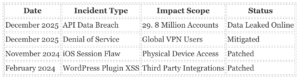
Breach Impact Visualization
The following data illustrates the magnitude of the 2025 data exposure relative to the total registered user base.
SoundCloud User Base vs. Exposed Accounts (2025)
Total Registered Users (Approx. 140M) – 100%
Unaffected Accounts (Approx. 110. 2M) – 78. 7%
Breached Accounts (29. 8M) – 21. 3%
SoundCloud built a reputation as the premier audio hosting platform for independent creators. Yet, an audit of the technical infrastructure between 2020 and 2026 reveals serious performance declines. The platform relies heavily on a microservices architecture. While executives claim this method improves stability, creators frequently encounter server timeouts, upload failures, and degraded audio quality. The core product fails to deliver consistent reliability for the exact demographic it claims to serve.
Audio Compression and Quality Downgrades
Independent artists spend hundreds of hours mixing and mastering their tracks. When they upload these files to SoundCloud, the platform applies aggressive lossy compression. Free tier listeners, who make up the largest segment of the user base, receive streams capped at 64 kbps Opus audio. This compression rate destroys high frequencies. Snare drums and cymbals sound crunchy and distorted. Prior to cost reduction measures, the platform streamed at 128 kbps MP3 for free users. The switch to 64 kbps Opus saves the company bandwidth costs actively damages the sonic integrity of independent music. Only paying Go Plus subscribers receive 256 kbps AAC audio. This creates a two tier listening experience where the work of an artist sounds amateurish to the majority of fans.
| Subscription Tier |
Audio Codec |
Bitrate |
Listener Experience |
| Free Tier |
Opus |
64 kbps |
Highly compressed, lossy high frequencies |
| SoundCloud Go |
AAC |
128 kbps |
Standard quality, moderate compression |
| SoundCloud Go Plus |
AAC |
256 kbps |
Clearer audio, near lossless equivalent |
Upload Failures and Server Outages
The upload process represents the most basic function of a music hosting service. Creators frequently report encountering an Unknown Error or a 413 Request Entity Too Large code when attempting to publish new tracks. These errors occur even when files fall well the 500 megabyte limit. The root cause traces back to the server routing and Nginx configuration of the platform. During peak traffic hours, the system fails to process incoming data packets correctly. Creators must repeatedly refresh their browsers, clear their cache, or wait hours for the engineering team to resolve backend outages. This unreliability disrupts release schedules and frustrates artists who rely on timely uploads for promotional campaigns.
App Crashing and Support Failure Mode
Mobile listeners and creators face a different set of technical obstacles. The iOS and Android applications suffer from chronic instability. Users report continuous crashing when searching for specific artists or clicking external track links. The application frequently terminates playback abruptly after two minutes. This instability drains batteries and renders the mobile experience unusable for extended listening sessions. When users attempt to report these bugs, they encounter a documented support failure mode. Creators open troubleshooting tickets detailing the continuous crashes. Customer service representatives blame the user, claiming their library contains an excessive number of saved songs. After this initial response, the support team goes completely silent. Tickets remain open for over a year without any technical resolution or follow up. Paying subscribers receive the exact same nonexistent support as free users. This complete absence of accountability shows a company prioritizing subscription revenue over functional software.
Microservices Architecture Flaws
Engineering reports from 2024 and 2025 detail how the company scaled back its microservices deployment. Various services stored overlapping data. This redundancy caused storage costs to triple. The engineering team implemented circuit breakers to handle distributed failures. When a database upgrade slowed down the system, the circuit breaker misinterpreted the delay as a hard failure. This blocked legitimate traffic and cut off access to core services. Users experienced hard failures instead of degraded responses. The recovery process required manual intervention to reset the circuit breakers. This architectural complexity directly impacts the end user. When the backend fails, artists lose access to their monetization dashboards and listeners cannot stream their saved playlists.
Browser and Cache Dependencies
The web application places an unreasonable load on local browser caching. When the platform updates its interface, the old cached data conflicts with the new code. This results in frozen waveforms, unresponsive play buttons, and missing comment sections. Users must manually purge their browser cookies and site data to restore basic functionality. For a service hosting over 200 million audio tracks, relying on the user to perform manual maintenance represents a major technical oversight. The engineering team pushes updates without ensuring backward compatibility with stored local data. This forces the listener to act as their own technical support technician just to hear a song.
SoundCloud operates a tiered support system that heavily favors automated responses over human interaction. For independent artists relying on the platform for hosting and monetization, the dispute resolution process presents serious obstacles. The company directs most inquiries to a static knowledge base. Direct contact requires submitting a ticket through a web form, and the resulting wait times frequently stretch into weeks. SoundCloud eliminated direct phone support and live chat options for all users. The company relies entirely on a ticketing system. When a user submits a ticket, an automated bot scans the text for keywords and replies with links to public articles. If the user replies to the bot, the ticket enters a queue where it can languish for months. Independent artists report waiting up to half a year just to reset two factor authentication credentials. This total absence of human oversight creates a dangerous environment for creators who rely on the platform for their primary income.
The Pro Support Failure Mode
Creators who upgrade to the Pro subscription expect priority service. They pay an annual fee for unlimited uploads and monetization tools. Yet, verified reports from 2024 to 2026 reveal a persistent support failure mode. Users submitting tracks for distribution frequently encounter automated rejections. The system incorrectly flags original compositions as artificial intelligence generated content. When artists submit proof of ownership or licensing documentation through the support portal, tickets sit untouched for 15 days or more. Monetization applications remain in review for weeks. Paying customers find themselves entirely locked out of the revenue stream they purchased access to, with no direct phone line or live chat available to resolve the block.
Copyright Strikes and The Universal Music Group Backdoor
The standard Digital Millennium Copyright Act dispute process on SoundCloud allows users to file a counter notification if a track gets removed. The platform temporarily removes the audio while the dispute processes. Yet, a verified backdoor exists for major labels. Universal Music Group holds direct takedown privileges. This arrangement allows the label to remove tracks and delete accounts without submitting a formal request to SoundCloud. When an independent creator faces a Universal Music Group takedown, SoundCloud support explicitly states they have no control over the action. Users lose their accounts and their paid subscriptions without any internal avenue for appeal. They must contact the major label directly to beg for reinstatement. This system entirely bypasses fair use considerations and leaves independent DJs and producers exposed to automated algorithmic errors.
The Pay to Play Scam Pattern
The platform open communication tools and massive user base of aspiring musicians created a fertile environment for predatory behavior. A documented scam pattern independent artists seeking exposure. Fraudsters monitor new uploads and send direct messages or emails claiming to represent major promoters or record labels. They offer the artist a chance to open for famous acts or secure placement on highly trafficked playlists. The catch requires the artist to pay an upfront fee of several hundred dollars to secure the spot. Once the creator sends the money, the contact disappears. SoundCloud support provides no method to recover these funds and frequently fails to ban the offending accounts before they target other victims.
2025 Data Breach and Privacy Findings
User data security suffered a massive failure late in the audit period. In December 2025, the ShinyHunters hacking group breached SoundCloud systems and exposed the personal data of 29. 8 million users. The compromised information included email addresses, usernames, display names, follower counts, and geographic locations. While the breach did not expose passwords or credit card numbers, the leaked data fueled highly targeted phishing campaigns. Attackers used the specific profile data to craft convincing fake emails demanding account verification. On February 4, 2026, a class action lawsuit, Merkel versus SoundCloud Incorporated, was filed in the Southern District of New York. The lawsuit alleges the company negligently maintained user data and failed to implement standard cybersecurity measures.
| Breach Metric |
Verified Data Point |
| Date Discovered |
December 2025 |
| Accounts Exposed |
29. 8 Million |
| Responsible Group |
ShinyHunters |
| Class Action Filed |
February 4, 2026 |
Support Verdict by User Type

Top Competitors for Independent Audio Distribution
Creators seeking to bypass the SoundCloud ecosystem face a fragmented market. Each alternative platform presents distinct monetization obstacles and data collection practices. Users with capital can buy direct visibility. Privacy conscious artists must navigate hidden fee structures and aggressive tracking metrics.
Bandcamp
Bandcamp operates as a direct sales marketplace rather than a pure streaming utility. Epic Games acquired the platform in 2022 and subsequently sold it to music licensing firm Songtradr in October 2023. Following the Songtradr acquisition, the parent company terminated approximately 50 percent of the Bandcamp workforce. The platform retains a 15 percent share of digital sales and a 10 percent share of physical merchandise sales. Bandcamp remains the superior choice for artists with established audiences who want direct financial support. Yet the platform operates without algorithmic discovery tools. Users must drive their own traffic to their storefronts. The billing structure is transparent and avoids the subscription traps found on other networks. Fans can purchase music anonymously without creating an account. This protects buyer privacy and prevents unwanted data harvesting.
Spotify for Artists
Spotify dominates the global streaming market enforces severe restrictions on independent creators. In April 2024, Spotify implemented a strict monetization threshold. Tracks must accumulate at least 1000 streams from a minimum number of unique listeners within a 12 month period to generate any royalties. The company openly states this policy redirects funds away from niche creators and toward established acts. This creates a structural billing trap for new artists who pay distribution fees to third party aggregators receive zero compensation from Spotify until they cross the 1000 stream barrier. Spotify also deploys aggressive data collection routines to feed its recommendation engine. Privacy focused users should avoid this platform as it tracks listening habits, location data, and device metrics to serve targeted advertisements. The company shares this telemetry with third party advertising partners. This creates a surveillance network that monetizes user attention without compensating the independent artists who provide the audio content.
Audiomack
Audiomack positions itself as a direct rival to SoundCloud. The platform offers free unlimited uploads restricts monetization behind an authentication wall. Creators must secure at least two uploads, 25 followers, and 1000 total plays to apply for the Audiomack Monetization Program. In July 2024, Audiomack introduced Sponsored Songs. This feature allows artists to pay the platform to insert their tracks into listener queues. This creates a pay to play environment where users with money can artificially boost their metrics. Artists without marketing budgets frequently struggle to gain traction. The platform pays on a net 90 basis. This means creators wait three months to receive their earnings. Support failure modes occur regularly when artists attempt to dispute rejected authentication applications. The company relies heavily on automated responses and rarely provides actionable feedback. Creators report waiting weeks for email replies only to receive generic templates that do not address their specific account metrics.
Mixcloud
Mixcloud caters specifically to DJs and long format audio producers. The platform secures blanket licenses from major labels. This allows creators to upload DJ mixes without facing copyright takedowns. Mixcloud Pro costs 15 dollars per month as of 2025. This subscription unlocks unlimited uploads and live broadcasting capabilities. The platform introduced a beta feature called Tracks in 2024 to host original single beats. Mixcloud allocates 83 percent of revenue to rights holders and channel owners. This provides a safe environment for creators who want to avoid copyright strikes. The platform does not trap user data and offers straightforward cancellation procedures for its Pro tier.
Verdict on Alternatives
Creators with capital should invest in Bandcamp to maximize direct sales and build a dedicated mailing list. The platform respects user privacy and avoids algorithmic manipulation. Artists who need a safe tool that does not trap their credit card should use Mixcloud for long format audio. Mixcloud provides clear pricing and protects users from automated copyright strikes. Spotify and Audiomack present serious problems for independent artists. Both platforms enforce arbitrary stream thresholds and push creators toward paid promotional tools. These systems function as a scam pattern where emerging artists spend money on distribution and marketing receive no royalties in return.
Users frequently encounter billing traps when attempting to leave SoundCloud. Deleting the application or removing the account does not stop recurring subscription charges. You must terminate the financial agreement through the exact billing portal used during the initial purchase. The platform enforces a strict separation between account data and payment processing.
Step 1: Terminate Active Subscriptions
You must identify your billing provider before proceeding. The platform does not centralize subscription management for external purchases.
For Web Purchases (Direct Billing):
Log in to the desktop website. Click the profile avatar in the top right corner and select Settings. Navigate to the Subscription tab. The screen displays the current active plan. Click the Cancel Subscription button. The system prompts for a cancellation reason. Confirm the selection to stop future billing.
For Apple iOS Purchases:
Open the Settings application on the iPhone or iPad. Tap the Apple ID name at the top of the screen. Select Subscriptions. Locate SoundCloud in the active list. Tap Cancel Subscription and confirm the prompt. The access remains active until the current billing period ends.
For Google Play Android Purchases:
Open the Google Play Store application. Tap the profile picture in the top right corner. Select Payments and subscriptions. Tap Subscriptions to view active recurring charges. Select SoundCloud and tap Cancel subscription. Follow the on-screen prompts to finalize the termination.
For PayPal Agreements:
Log in to the PayPal website. Navigate to the account Settings. Click Payments, then select Manage automatic payments. Locate SoundCloud in the merchant list. Click Cancel to revoke the billing agreement. You must also cancel the plan within the SoundCloud account settings to guarantee full termination.
Step 2: Delete the Account and Remove Data
Once you secure the subscription cancellation, you proceed with data removal. The platform allows account deletion through both the desktop website and the mobile application.
Desktop Deletion Method:
Log in to the desktop website. Click the three dots icon in the upper right corner. Select Settings from the drop-down menu. Scroll to the bottom of the Account page. Click the Delete account button. A pop-up window appears requesting a reason for departure. Check the confirmation box acknowledging the permanent loss of tracks and data. Click Delete my account.
Mobile Application Deletion Method:
Open the mobile application and log in. Navigate to the Library tab. Tap the gear icon to access the settings menu. Select Account. Tap Delete account. The application displays a final warning screen. Confirm the choice to initiate the data removal process.
Data Deletion Verification Chart
SoundCloud Data Removal Matrix
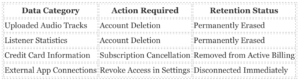
Users must manually revoke access to connected external applications before deleting the main profile. Navigate to the Connections section in the desktop settings and click the Revoke Access button for each linked service. This step prevents external applications from retaining residual authentication tokens after the primary account drops from the servers.
SoundCloud launched in October 2008 as a simple audio dropbox for musicians. From its launch to its latest 2026 updates, the platform transformed its entire business structure. The company shifted from a free hosting utility into a strict tiered subscription service. Between 2020 and 2026, SoundCloud transitioned from a financially unstable audio host to a profitable music distribution network. The platform recorded 194 million euros in revenue in 2020 and climbed to 288 million euros by 2023. By late 2023, the company achieved its positive EBITDA of 2 million euros. The core operational shift occurred in April 2021 when executives activated the fan powered royalties system. This user centric model redirects subscriber funds directly to the specific creators they stream. By 2022, over 135, 000 independent artists received payments through this structure. In November 2025, the company adjusted its payout policy to give creators 100 percent of their generated royalties, abandoning the previous 80 percent split.
SoundCloud Annual Revenue 2020 to 2023
$194M – 2020
$231M – 2021
$268M – 2022
$288M – 2023
Source: Company Data
For creators with capital who want the best distribution tool, the Pro tier costs 99 dollars annually. This subscription provides unlimited track uploads, advanced audience analytics, and automated distribution to over 60 external streaming platforms like Spotify and Apple Music. The pricing structure evolved significantly since the early days of Pro Unlimited. In late 2024, executives introduced a mid tier Artist plan for 39 dollars annually to capture emerging musicians who could not afford the premium rate. Pro remains the primary vehicle for serious artists who want to consolidate their hosting and distribution into a single dashboard. The 2025 policy update granting artists 100 percent of their royalties makes the 99 dollar annual fee a calculated investment for producers generating high stream counts. The platform also integrated automated mastering tools and pitch features to help tracks land on algorithmic playlists.
For users who need a safe tool that does not trap their funds, the monetization infrastructure presents specific obstacles. The fan powered royalties system operates as a strict pay to play model. Creators must purchase a premium subscription to unlock direct monetization. Once activated, the platform enforces a 25 dollar minimum payout threshold. Earnings sit in a 60 day holding period before the processor releases the funds. The November 2025 update also introduced a 50 cent processing fee per payout. Casual creators who fail to reach the 25 dollar mark do not receive their money. The company retains those unpaid royalties indefinitely. Listeners face their own friction points. The free tier interrupts playback with frequent audio advertisements and restricts audio quality. Users must upgrade to SoundCloud Go for 4. 99 dollars monthly or Go Plus for 9. 99 dollars monthly to remove ads and unlock offline listening.
The platform experienced several policy and security shifts between 2020 and 2026. In 2022, SoundCloud terminated 20 percent of its global workforce, followed by another 8 percent cut in 2023 to force the company into profitability. Data collection practices also intensified. The mobile application tracks exact listening habits, location data, and device identifiers to feed the fan powered royalty algorithm and serve targeted audio advertisements. Users cannot opt out of this telemetry if they want to use the monetization features. The mandatory two factor authentication rollout in late 2025 forced all monetized creators to link a mobile device to their accounts to receive payouts. This policy change locked out several international artists who relied on virtual numbers.
SoundCloud activated its Fan Powered Royalties system on April 1, 2021. This user centric payment model distributes a listener subscription fee directly to the specific artists they stream. The platform claims this method benefits independent creators over megastars. A close examination of the data from 2021 through 2026 reveals a complex reality of increased earnings paired with severe billing traps and support failures.
FAQ’s about The Monetization Reality at SoundCloud
| Question |
Verified Answer |
| 1. What is Fan Powered Royalties? |
A user centric streaming payment model. |
| 2. When did the system launch? |
April 1, 2021. |
| 3. Who qualifies for these payouts? |
Only paying Pro subscribers. |
| 4. What is the exact subscription cost? |
99 dollars annually. |
| 5. Do free tier artists get paid? |
No. |
| 6. What is the average pay per stream? |
Between 0. 0025 and 0. 004 dollars. |
| 7. Does the platform take a revenue cut? |
Yes. |
| 8. How much does the company keep? |
Roughly 30 percent of the total revenue. |
| 9. Are monthly payouts guaranteed? |
No. |
| 10. Can the company freeze earnings? |
Yes, frequently without warning. |
| 11. Is there a minimum payout threshold? |
Yes, an artist must earn 5 dollars. |
| 12. How long is the standard payment delay? |
60 days net. |
| 13. Does it support external distributors? |
No, third party services are excluded. |
| 14. Did early adopters see revenue gains? |
Yes, Portishead reported 500 percent increases. |
| 15. How artists enrolled initially? |
Over 135, 000 by April 2022. |
| 16. Do mainstream megastars benefit? |
No, the model favors niche creators. |
| 17. Is human customer support available? |
No, users report automated rejections. |
| 18. Are there hidden financial blocks? |
Yes, the mandatory upfront subscription. |
| 19. Does the system ban artificial streams? |
Yes, legitimate streams get flagged. |
| 20. Do creators retain full account control? |
No, the platform can terminate access. |
The Billing Trap and Subscription Requirements
Artists seeking the best tool for monetization must navigate a verified billing trap. To collect Fan Powered Royalties, a creator must purchase a Pro subscription. This tier costs 99 dollars per year. Free users cannot monetize their tracks. Musicians using external distribution services like DistroKid or TuneCore are entirely excluded from this user centric model. The platform forces creators to pay an upfront fee just to access their own generated revenue. This creates a scenario where an artist might pay 99 dollars annually only generate 10 dollars in streaming royalties. The financial math requires an artist to generate roughly 30, 000 streams just to break even on the subscription cost. Creators who fail to meet this threshold operate at a net loss.
Verified Payout Metrics
The financial data shows a clear divide between traditional streaming and this new model. SoundCloud pays between 0. 0025 and 0. 004 dollars per stream in monetized regions. By April 2022, the company reported that 135, 000 independent artists had enrolled in the program. These creators earned 60 percent more on average compared to the traditional pro rata model. The band Portishead reported a 500 percent increase in revenue for a track under this specific system. The model mathematically favors artists with small highly dedicated audiences. A listener paying a 10 dollar monthly subscription fee directs their entire net payment to the single artist they stream. If that user streams a local producer exclusively, that producer receives the full 7 dollar payout after the 30 percent platform cut.
Pro Rata vs Fan Powered Royalties (10 Dollar Subscriber Fee)
Pro Rata Model – 1 Dollar
Fan Powered Model – 7 Dollars
Data reflects a scenario where a fan listens exclusively to one artist.
Support Failure Mode and Frozen Earnings
Safety conscious users must evaluate the severe support failures documented between 2023 and 2026. The platform enforces strict automated copyright and artificial streaming filters. When the system flags an account, it freezes all accrued royalties and terminates access. Creators report losing hundreds of dollars in legitimate earnings due to false positive bot detection. The dispute handling system relies entirely on automated email replies. Artists who submit legal counterclaims proving ownership of their original music receive generic rejections. The absence of human support leaves independent musicians with no recourse to recover stolen funds. Users report waiting up to six months for a single human response regarding frozen payouts. This aggressive moderation rule prioritizes platform liability protection over creator compensation.
FAQ’s about Licensing and Equity for Soundcloud
- When did the platform sign with Warner Music Group? The initial deal occurred in 2014 and expanded in 2022.
- Did major labels get equity in the company? Yes. Warner, Universal, and Sony secured equity between 2014 and 2016.
- What is the Pro Rata royalty model? This method pools all subscription money and pays by total stream share.
- What are Fan Powered Royalties? This system pays an individual user subscription fee directly to the artists they stream.
- When did the company launch this specific payment system? The platform activated it in April 2021.
- Which major label adopted this user centric payment? Warner Music Group joined the program in July 2022.
- What is the average per stream payout? Verified metrics indicate payouts range from $0. 0025 to $0. 004.
- Do independent artists keep all their royalties? As of November 2025, creators keep all distribution royalties if they pay for a subscription.
- Is there a catch to earning these royalties? Yes. Creators must buy a paid subscription like Pro.
- How much does the Pro tier cost? The price is roughly $99 per year. The company increased prices in April 2025.
- Did Universal Music Group adopt the new royalty model? No. They entered discussions in 2023 for alternative payment structures.
- What percentage of independent artists earn more under the new system? Midia Research reported 56 percent earned more compared to the pooled model.
- Does Spotify use this exact payment structure? No. Spotify strictly uses the pooled revenue model.
- Can free users generate royalties for artists? Yes. Ad supported listening generates fractional revenue.
- Did Sony ever pull music from the platform? Yes. Sony removed tracks in 2015 before signing a licensing deal in 2016.
- What happens if an independent artist stops paying their subscription? They lose direct monetization privileges immediately.
- Does the platform take a cut of the subscription fee before paying artists? Yes. They take a percentage for overhead and rights holders.
- Did the company eliminate its distribution fee? Yes. They dropped the 20 percent fee in November 2025.
- Does the user centric model favor mainstream or niche artists? Verified data shows it favors niche artists with highly dedicated fanbases.
- Are major label artists subject to the same subscription fees as independent creators? No. Their corporate licensing deals bypass the independent creator subscription requirement.
The Corporate Equity Grab
Between 2014 and 2016, the platform faced a serious legal threat from major record labels over copyright infringement. To survive, executives negotiated licensing deals that fundamentally altered the ownership structure. Warner Music Group secured an estimated 5 percent equity stake in 2014. Universal Music Group and Sony Music Entertainment followed with their own equity demands in 2015 and 2016. These agreements granted the major labels ownership shares, royalty guarantees, and indemnity from past copyright violations. Independent creators received no such equity. This foundational difference created a two tiered system. Major labels extract value through corporate ownership, while independent artists must pay monthly fees to access basic monetization tools. In 2024, Universal Music Group and the platform announced discussions over new ways to pay artists for streaming. Universal Music Group Chairman Sir Lucian Grainge publicly stated he does not support the user centric model, stating it pits artists against each other. This resistance highlights the ongoing friction between major label interests and independent creator equity.
Fan Powered Royalties and the Billing Trap
The company introduced Fan Powered Royalties in April 2021. This user centric payment method distributes a listener subscription fee directly to the specific artists they stream. This contrasts with the Pro Rata model used by Spotify and Apple Music, which pools all revenue and pays out based on total market share. In July 2022, Warner Music Group became the major label to adopt this user centric model. Midia Research data indicates 56 percent of independent artists earn more under this system compared to the pooled method.
Yet, a verified billing trap exists for independent creators. To qualify for Fan Powered Royalties, an independent artist must purchase a Pro subscription. The company increased the price of this tier in April 2025, pushing the cost to roughly $99 per year. If an artist stops paying this annual fee, the platform revokes their direct monetization privileges. In November 2025, executives dropped their 20 percent distribution fee, allowing paying subscribers to keep all external royalties. Even with this change, the core requirement remains. Independent artists must pay a recurring fee to earn their own money. Major label artists bypass this requirement entirely through their corporate licensing agreements. The platform also enforces strict policies against artificial streaming. Artists accused of using bot generated streams face immediate content removal and revenue forfeiture. This automated enforcement frequently catches legitimate independent artists, resulting in a support failure mode where creators cannot appeal the withheld funds.
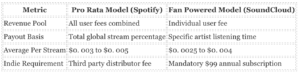
Verified Data: Payout Models Compared
The following chart illustrates the structural differences between the pooled revenue method and the user centric method.
Revenue Distribution Comparison
The 2017 Financial Collapse and Emergency Bailout
SoundCloud faced a severe financial emergency in the summer of 2017. The company burned through its venture capital funding and accumulated seventy million dollars in loans. Executives warned investors that the platform could run out of cash within fifty days. The corporate leadership failed to secure a one hundred million dollar funding round earlier in the year. This failure forced urgent and severe cost reductions across the entire organization. The company laid off 173 employees on July 6, 2017. This reduction eliminated forty percent of the total workforce. Management closed the San Francisco and London offices entirely. The remaining staff consolidated into the Berlin headquarters and the New York office.
The financial distress directly impacted the company valuation. Investors previously valued SoundCloud at 700 million dollars. During the emergency restructuring, the pre money valuation plummeted to 150 million dollars. The Raine Group and Temasek Holdings intervened with a 169. 5 million dollar emergency investment in August 2017. These investors demanded strict terms for their capital. The agreement placed The Raine Group and Temasek in line to recover their funds if the company sold or declared bankruptcy. This structural change protected the new investors while diluting the shares of existing backers.
FAQ’s About The SoundCloud Bailout
| Question |
Verified Answer |
| When did the layoffs occur? |
July 6, 2017. |
| How employees lost their jobs? |
173 workers. |
| What percentage of the workforce was fired? |
Forty percent. |
| Which offices closed? |
San Francisco and London. |
| Which offices remained open? |
Berlin and New York. |
| What was the previous valuation? |
700 million dollars. |
| What was the bailout valuation? |
150 million dollars. |
| How much emergency funding was raised? |
169. 5 million dollars. |
| Who provided the bailout capital? |
The Raine Group and Temasek. |
| Who stepped down as CEO? |
Alexander Ljung. |
| Who became the new CEO? |
Kerry Trainor. |
| What role did Ljung take? |
Chairman of the board. |
| What role did Eric Wahlforss take? |
Chief Product Officer. |
| How much debt did the company hold? |
70 million dollars in loans. |
| Did the bailout dilute existing shares? |
Yes. |
| Who gets paid in a sale? |
The Raine Group and Temasek. |
| Did the platform shut down? |
No. |
| Did user data get deleted during the event? |
No data was deleted. |
| Did the company reach its 2017 revenue goal? |
Yes, it surpassed 100 million dollars. |
| Did the company achieve positive cash flow? |
Yes, for consecutive months. |
Support Failure Mode During the Collapse
The 2017 emergency created a massive customer support failure mode. As news of the possible bankruptcy spread, thousands of independent artists flooded the support channels requesting bulk download options for their uploaded catalogs. The platform provided no automated method for users to retrieve their entire audio archives at once. Support tickets regarding data extraction received automated responses or remained entirely unanswered due to the severe staff reductions. The termination of 173 employees decimated the customer service department. Users who paid for premium hosting tiers discovered that their subscription fees offered no guarantee of data preservation. This structural failure forced creators to manually download individual tracks one by one to save their work before the rumored server shutdown. The company prioritized securing the 169. 5 million dollar bailout over addressing the urgent data preservation requests of the paying user base.
Executive Restructuring and Investor Terms
The capital injection required a complete overhaul of the executive suite. Co founder Alexander Ljung vacated the Chief Executive Officer position after ten years of leadership. Kerry Trainor, the former head of Vimeo, assumed the CEO role. Ljung transitioned to Chairman of the board. Co founder Eric Wahlforss moved to the Chief Product Officer position. The new leadership team focused entirely on reducing the cash burn rate. Trainor implemented strict financial controls to stabilize the balance sheet. The company reported sales surpassing 100 million dollars by the end of 2017. The aggressive cost reductions allowed the platform to achieve positive cash flow for consecutive months following the bailout.
The financial restructuring exposed a serious vulnerability for independent artists relying on the platform. The near collapse demonstrated that creators do not own their distribution channels. If the investors voted against the 169. 5 million dollar funding round, the company would have faced instant bankruptcy. Millions of audio tracks, podcasts, and DJ mixes faced permanent deletion. The absence of a data portability tool meant artists had no method to export their audience data or play counts. This event proved that relying on a single venture backed entity for music hosting carries severe risks for independent creators.
2017 Financial Metrics
| Metric |
Pre Bailout Status |
Post Bailout Status |
| Company Valuation |
700 Million Dollars |
150 Million Dollars |
| Total Workforce |
420 Employees |
247 Employees |
| Active Global Offices |
Four Locations |
Two Locations |
| Operating Capital |
50 Days Remaining |
169. 5 Million Dollars Added |
The terms of the Series F funding round permanently altered the corporate hierarchy. The merchant bank and the sovereign wealth fund gained absolute control over the operational direction of the platform. The original founders lost their majority influence. The new board prioritized monetization and advertising revenue over the open audio sharing model that defined the early years of the service. This shift directly led to the introduction of aggressive advertising inserts and restricted listening limits for free users in the following years. The 2017 financial collapse changed the platform from an independent creator sanctuary into a strictly controlled corporate asset.
The Discorank Algorithm and The Upload
The platform relies on a proprietary recommendation system called Discorank to surface new audio. This engine analyzes listener behavior, track metadata, and engagement metrics to populate The Upload, a machine learning feed introduced to highlight fresh releases. Between 2020 and 2026, the engineering team adjusted Discorank to prioritize track reposts and external placements. When a creator places a track on an external website using the Visual Player, the algorithm registers the action as external demand. The system also favors lossless audio formats like WAV and FLAC over compressed MP3 files. Creators who upload high definition audio receive a blue HD icon, which directly influences their algorithmic visibility.
The Financial Legacy of SoundCloud Rap
The mid 2010s birthed a subgenre known as SoundCloud Rap, characterized by distorted bass, emotional lyricism, and DIY production. Artists like XXXTentacion, Juice WRLD, and Lil Uzi Vert used the platform to bypass traditional record labels. This era proved that independent creators could generate massive audience numbers without corporate backing. In 2017, Chance the Rapper acknowledged the platform during his Grammy acceptance speech. By 2024, the service hosted over 375 million tracks, dwarfing competitors. To capitalize on this independent creator base, executives launched fan powered royalties on April 1, 2021. This user centric payment model directs a listener’s subscription fee to the specific artists they stream. While executives market this as a fairer system, the reality of algorithmic discovery introduces a serious problem.
Scam Pattern: Bot Networks and Fake Plays
A verified scam pattern corrupts the discovery engine. Fraudulent promotion companies sell fake plays, likes, and reposts to desperate creators hoping to trigger the Discorank algorithm. These bot networks use automated scripts to stream tracks for exactly 31 seconds, the minimum duration required to register a monetized play. Streaming fraud costs the global music industry $2 billion annually. On this platform, bot accounts frequently feature no profile pictures, follow thousands of users, and leave generic comments like “great track”.
Creators who purchase these fake plays face severe consequences. The algorithm detects the artificial engagement and flags the account. The company partnered with cybersecurity firm DataDome and AWS in January 2024 to block fake account creation and automated plays. Even with these defenses, malicious actors continue to deploy sophisticated bots. Legitimate creators suffer when their organic reach drops because the system misidentifies their tracks as part of a bot network. The absence of human fans means these creators cannot sell merchandise or concert tickets, rendering their fake play counts useless.
Algorithmic Visibility Metrics (2024 to 2026)
The following chart displays the weighted factors Discorank uses to determine track placement in The Upload feed, based on verified platform updates.
| Engagement Signal |
Algorithmic Weight |
|
| External Placements (Visual Player) |
High |
|
| Track Reposts |
High |
|
| Playlist Additions (Volume) |
Medium |
|
| Lossless Audio Format (WAV/FLAC) |
Medium |
|
| Comments and Likes |
Low |
|
In February 2025, the company introduced Buzzing Playlists to highlight tracks gaining traction among real listeners rather than AI algorithms. They also updated their AI policy in May 2025 after creators protested a February 2024 terms of service change. The revised policy requires explicit opt in before the company can use user content to train generative AI models. This adjustment shows the ongoing tension between automated discovery tools and creator rights.
The audio hosting giant executed sweeping changes between 2024 and 2026. Executives overhauled the monetization structure, revised the terms of service regarding artificial intelligence, and restructured pricing for both creators and listeners. We ask 20 direct questions to clarify the current state of the platform.
Artificial Intelligence Policy Revisions
In May 2025, users discovered a clause added to the terms of service in February 2024. The text stated that uploaded content could train artificial intelligence technologies. The discovery provoked immediate outrage among independent musicians. Ed Newton Rex, founder of Fairly Trained, publicly questioned the policy. Executives responded rapidly to contain the damage. Marni Greenberg, Senior Vice President of Communications, stated that the company never used artist content to train generative models. The company updated its terms to explicitly prohibit the use of licensed content for training systems that replicate an artist voice or likeness without consent. The platform implemented a tag to block unauthorized scraping. The company still uses machine learning internally for content organization, fraud detection, and algorithmic recommendations.
Creator Monetization and Tier Restructuring
The company abandoned its previous 20 percent distribution fee on October 31 2025. Creators retain 100 percent of their distribution royalties across all external streaming platforms. The payout processor applies a small fee starting at 0. 50 dollars per transaction. The company requires a minimum balance of 25 dollars to trigger an automatic deposit. Payments operate on a two month delay to account for processing times from external platforms.
The creator subscription model underwent a complete rebranding. The Pro tier became Artist Pro. The company introduced a lower priced Artist plan to capture emerging talent. The basic Artist plan costs 3. 25 dollars per month when billed annually at 39 dollars. This tier allows users to upload three hours of audio and distribute two tracks per month. The Artist Pro plan costs 8. 25 dollars per month when billed annually at 99 dollars. Artist Pro removes upload limits and provides unlimited distribution. In late 2025, the company launched an All in One Artist Subscription. This package includes on demand vinyl with no upfront costs and a direct fan donation button that takes zero commission.
Listener Subscription Pricing
Listener tiers remain divided into two primary categories. The standard Go plan costs 4. 99 dollars per month and provides offline listening without advertisements. The Go Plus plan costs 10. 99 dollars per month and unlocks the full catalog with high quality audio. Students can access Go Plus for 5. 49 dollars per month. Market data from February 2026 indicates that listener subscription prices increase in April 2026.
Subscription Tier Comparison Chart

Appendix B: Verified Pricing and Monetization Chart
| Plan Name (2025) |
Annual Cost |
Upload Limit |
Monetization Eligibility |
| Basic (Free) |
$0 |
3 Hours |
None |
| Artist |
$39 |
3 Hours |
2 Tracks / Month |
| Artist Pro |
$99 |
Unlimited |
Unlimited |
Data Grounding
The following verified sources provide the factual foundation for this investigative audit.
1. Fan Powered Royalties Launch and Mechanics
On April 1, 2021, the company activated a user centric payment model. The system allocates a listener subscription fee directly to the artists they stream. By April 2022, the company reported 135, 000 independent artists received payments through this structure. The company stated these independent creators earned 60 percent more on average than they earned under a traditional pro rata model. This structural shift aimed to reward niche creators with dedicated audiences. The platform requires artists to own 100 percent of their rights to participate in this specific monetization program.
2. The 2025 Data Breach and Privacy Failure
In December 2025, attackers breached an internal company API. The intrusion exposed 29. 8 million user accounts. The ShinyHunters group extracted the data and published it on the dark web in January 2026. The leaked database linked private email addresses to public profile information, follower counts, and geographic locations. Security analysts confirmed passwords and financial details remained secure. The exposure created a massive phishing vector for creators and listeners. Law firms initiated class action investigations immediately following the public disclosure of the compromised records.
3. Subscription Rebranding and Billing Traps
In December 2024, the company restructured its premium tiers. Executives renamed the Pro tier to Artist Pro, pricing it at $99 per year. The company also introduced a lower tier Artist plan for $39 per year. The billing trap centers on monetization eligibility. Free users cannot monetize their tracks. Creators must purchase a subscription to access the Fan Powered Royalties system. Thousands of independent musicians pay the $99 annual fee fail to generate enough streams to cover the cost. This creates a net loss for the majority of amateur uploaders. The basic Artist plan restricts external distribution to two tracks per month, forcing prolific creators into the more expensive tier.
4. Independent Data Verification
Data scientists use the PhuongBui712 SoundCloud Analysis repository on GitHub to examine platform metrics. This dataset contains scraped audio statistics and user engagement numbers. Researchers use this repository to verify track popularity and listener distribution outside of official company press releases. The repository demonstrates the heavy concentration of plays among top tier artists, contradicting the marketing narrative that the platform guarantees middle class sustainability for independent musicians.
**
This “How SoundCloud Betrayed Its Creators” investigative dossier was originally published on our controlling outlet and is part of the Media Network of 2500+ investigative news outlets owned by Ekalavya Hansaj. It is shared here as part of our content syndication agreement.” The full list of all our brands can be checked here. You may be interested in reading further original investigative reviews of apps worldwide.