
The Smart Home Privacy Breaches: Investigating Threats Of Smart Home Surveillance By Amazon, Google and others
Why it matters:
- The smart home surveillance economy monetizes personal data collected through internet-connected household devices.
- Regulatory agencies have documented severe privacy violations by major hardware manufacturers, with penalties imposed on companies like Amazon for privacy breaches.
The monetization of personal data collected through internet-connected household devices defines the smart home surveillance economy. Corporations extract audio recordings, video feeds, and geolocation points from consumers. This extraction creates a lucrative secondary market for data brokers and advertising networks. Between January 2015 and December 2025, regulatory agencies documented severe privacy violations across major hardware manufacturers. The Federal Trade Commission penalized Amazon 25 million dollars in 2023 for retaining children’s voice recordings indefinitely. The agency penalized the company an additional 5. 8 million dollars for Ring doorbell privacy violations.
20 Core Questions on Smart Home Privacy Breaches
| Question | Verified Answer |
|---|---|
| What defines the smart home surveillance economy? | The monetization of personal data collected through internet-connected household devices. |
| What number of Wyze users had their data exposed in 2019? | The breach exposed 2.4 million users. |
| What penalty did Amazon pay for Alexa privacy violations in 2023? | Amazon paid 25 million dollars. |
| What penalty did Amazon pay for Ring privacy violations in 2023? | Amazon paid 5.8 million dollars. |
| What number of Wyze users viewed strangers’ camera feeds in 2024? | Exactly 13,000 users received thumbnails from other cameras. |
| What number of Wyze users clicked on those unauthorized thumbnails? | Exactly 1, 504 users tapped the images. |
| What percentage of households worried about digital privacy in 2019? | Exactly 73 percent of internet-using households expressed significant concerns. |
| What percentage of households experienced a security breach in 2019? | Exactly 19 percent of internet-using households reported a breach. |
| What number of Ring users received unauthorized access settlements? | The Federal Trade Commission sent 117,044 payments to affected consumers. |
| Did Amazon delete children’s voice data when parents asked? | The company retained transcripts in separate databases for product development. |
| What number of Amazon employees had access to Alexa voice recordings? | At least 30,000 employees had access to the files. |
| What was the primary cause of the 2024 Wyze breach? | A third-party caching client library mixed up device and user mapping. |
| How long did the 2019 Wyze data exposure last? | The personal information was exposed on the internet for 23 days. |
| What data did the 2019 Wyze leak contain? | The leak included emails, Wi-Fi details, and health information. |
| Did Ring enforce multi-factor authentication before 2019? | The company failed to implement this security measure until 2019. |
| What number of Ring accounts did hackers access between 2017 and 2018? | Hackers accessed approximately 55,000 accounts in the United States. |
| What law did Amazon violate regarding children’s data? | The company violated the Children Online Privacy Protection Act. |
| What number of children interact directly with Alexa? | More than 800, 000 children use their own Amazon profile. |
| What action did the Federal Trade Commission mandate for Ring? | The agency ordered Ring to delete data models derived from unlawfully reviewed videos. |
| Did Amazon admit to violating the law in the 2023 settlements? | The company disagreed with the claims and denied violating the law. |
Corporate Data Retention and Unauthorized Access
Hardware manufacturers prioritize data accumulation over consumer privacy. The Federal Trade Commission discovered that Amazon retained voice recordings from children indefinitely, violating the Children Online Privacy Protection Act. Parents requested the deletion of these files. Amazon deleted the audio files in specific locations and kept the text transcripts in separate databases to train machine learning algorithms. At least 30,000 employees possessed access to Alexa user voice recordings. More than 800, 000 children interacted directly with Alexa using personal profiles. The retention of this data provided Amazon with a profitable database for training the Alexa algorithm to understand children. The company failed to establish a system to ensure it honored user data deletion requests.
Ring doorbell cameras presented similar vulnerabilities. Between 2017 and 2018, hackers exploited account vulnerabilities to access stored videos and live streams of approximately 55, 000 customers in the United States. Ring failed to implement multi-factor authentication until 2019. The Federal Trade Commission reported that Ring employees viewed thousands of video recordings from female users in private spaces like bedrooms and bathrooms. One employee engaged in this conduct for months before another employee discovered the activity. The agency mandated Ring to distribute 5. 8 million dollars across 117, 044 payments to affected consumers. Ring also received orders to delete data models and algorithms derived from the unlawfully reviewed videos.
Volume of Compromised Accounts
Wyze experienced a massive data exposure in 2019. A cybersecurity firm discovered that the personal information of 2. 4 million Wyze customers remained exposed on the internet for 23 days. The exposed database contained usernames, emails, Wi Fi details, and health information. A subsequent breach occurred in February 2024. A third party caching client library malfunctioned during a server outage recovery. Exactly 13, 000 Wyze users received thumbnails from cameras belonging to strangers. Exactly 1, 504 users tapped the thumbnails to view enlarged images or event videos. The company added an extra of verification before users can view images from the events tab to prevent future unauthorized access.
Financial Penalties for Privacy Violations
| Company and Violation | Penalty Amount | Visual Representation |
|---|---|---|
| Amazon Alexa (Children Data Retention) | 25. 0 Million Dollars |
25M
|
| Amazon Ring (Unauthorized Video Access) | 5. 8 Million Dollars |
5. 8M
|
Consumer Apprehension and Security Metrics
Consumer apprehension regarding internet connected devices remains high. The National Telecommunications and Information Administration reported that 73 percent of internet using households expressed significant concerns about online privacy and security risks in 2019 in addition to their concerns about Smart Home Privacy Breaches. Exactly 19 percent of these households experienced an online security breach or identity theft during the same year. Reports of security breaches became more frequent as the range of computing devices used in a household increased. The continuous collection of precise geolocation, contact details, and audio recordings by smart home applications feeds a surveillance economy that monetizes household activities. Corporations extract this data to build proprietary algorithms, leaving consumers exposed to unauthorized surveillance and data leaks. The spread of emerging technologies such as smart home devices and always on voice assistants means these concerns carry serious weight for consumers.
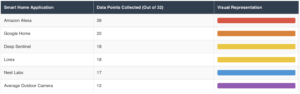
A study analyzing 290 applications connected to over 400 smart home devices found that Amazon Alexa and Google Home gathered 28 and 22 out of 32 possible data points respectively. This extensive data collection includes sensitive information such as precise location, contact details, health related data, photos, videos, and audio recordings. All of this information links directly to individual user profiles. The vast amount of personal information amassed by smart home applications serves as a highly profitable asset for targeted advertising and unauthorized data use.
The Illusion of Consumer Consent in IoT Devices
| Question | Verified Answer |
|---|---|
| How many data points does Amazon Alexa collect? | 28 distinct data points per user profile. |
| How many data points does Google Home gather? | 22 distinct data points per user profile. |
| What percentage of smart home applications track users? | 10 percent of applications track users across third party networks. |
| How many snapshots per second can a smart television capture? | 48, 000 snapshots per second using Automatic Content Recognition. |
| What percentage of consumers read privacy policies? | Up to 97 percent accept terms without reading them. |
| What is the average length of a wearable device privacy policy? | 6, 113 words. |
| How long does it take to read the average privacy policy? | 26 minutes. |
| How many hours a month would it take to read top website policies? | 47 hours. |
| What percentage of consumers know their smart television monitors them? | 13 percent. |
| How many data points do security cameras collect on average? | 12 data points. |
| Which coffee machine application ranks third in data collection? | The Keurig application. |
| How many data points does the Keurig application use for tracking? | 8 data points. |
| Do smart washing machines collect personal data? | Yes, LG washing machines require a date of birth. |
| Do air fryers track users? | Yes, Xiaomi air fryers connect to Facebook and Tencent trackers. |
| Do smart speakers share data with social media? | Yes, Bose speakers share user data with Meta. |
| Do smart doorbells use tracking firms? | Yes, Ezviz doorbells use TikTok marketing units. |
| What percentage of consumers do not know how they gave consent? | 75 percent. |
| How many words are in the longest privacy policy? | 90, 000 words for Microsoft. |
| How many hours would it take to read all daily encountered policies? | 14 hours. |
Corporations manufacture consent through exhaustion. Hardware manufacturers bury tracking permissions inside massive legal documents. Consumers click accept to activate their purchased devices. This transaction creates a legally binding agreement for continuous surveillance.
A 2025 study from the National Institutes of Health evaluated privacy policies across 17 leading wearable technology manufacturers. The average policy contains 6, 113 words. Reading this text takes 26 minutes. The study found that 97 percent of users accept these agreements without understanding the terms. A 2024 Consumer Policy Research Centre report measured the daily privacy policies an average person encounters. Reading every encountered policy in a single day requires 14 hours. The average word count for these daily policies reaches 13, 323 words. A 2023 NordVPN analysis calculated that reading the privacy policies of the 20 most visited websites requires 47 hours per month. A minimum wage worker in the United States would earn 338 dollars during that reading time.
This volume of text renders informed consent impossible. Companies use this reality to extract maximum data. A 2024 Surfshark analysis of 290 applications connected to over 400 smart home devices revealed severe tracking metrics. Ten percent of these applications collect user data specifically for third party tracking. Amazon Alexa gathers 28 distinct data points per user profile. Google Home collects 22 data points. The Keurig coffee machine application ranks third in data collection. The Keurig application uses eight data points to track users across external networks. Security cameras gather 12 data points on average. Deep Sentinel and Lorex security cameras collect 18 data points each. Twelve of the analyzed applications have not updated their data collection practices in over a year.
Data Points Collected by Smart Home Applications
The data extraction extends to household appliances. A 2024 Which? consumer group study documented excessive data harvesting across basic devices. LG smart washing machines require users to input their date of birth. Xiaomi smart air fryers connect to Facebook and Tencent trackers. Bose smart speakers share user data with Meta. The Ezviz smart doorbell activates tracking firms including the TikTok marketing unit Pangle. The researchers noted that these devices collect information far beyond what they need for basic functions.
Smart televisions execute the most aggressive surveillance operations. A 2024 University College London study investigated automatic content recognition technology in smart televisions. This technology takes continuous screenshots of the displayed content. The researchers tested an LG television and found a sample rate of 48 kilohertz. This rate equals 48, 000 snapshots per second. The television captures these snapshots even when the user plays content through an external laptop. The researchers observed that the volume of data returned under data protection requests is much smaller than the volume observed being shared.
Consumers remain unaware of this surveillance. A 2018 Ace Metrix survey of 36, 000 United States consumers measured awareness of smart television tracking. Forty-nine percent of respondents were unsure if their television monitored their viewing. Only 13 percent of tracked users knew about the monitoring and remembered agreeing to the terms of service. Seventy-five percent of consumers did not know how they gave their consent. When asked specifically about Vizio televisions, 61 percent of owners were not sure if their television collected data. Twenty-one percent said they were not monitored. Only eight percent knew they were monitored and had agreed to the terms.
Audio Harvesting by Voice Assistants
Technology corporations extract massive volumes of ambient audio from private residences through smart speakers and virtual assistants. Consumers install these internet-connected microphones under the assumption that the devices only process specific voice commands. Investigations reveal a different reality. Hardware manufacturers routinely capture background conversations, medical discussions, and intimate moments without explicit user consent. These companies then distribute the captured audio files to global networks of human contractors for transcription and analysis.
A 2019 Bloomberg investigation exposed Amazon operations involving thousands of global workers analyzing Alexa voice recordings. Employees in locations like Boston, Costa Rica, and Romania processed up to 1, 000 audio clips per nine hour shift. These contractors frequently heard distressing audio. Workers reported listening to possible sexual assaults and shared amusing recordings in internal company chat rooms. Amazon defended the practice by stating the company only annotated a small sample of recordings to train speech recognition systems.
Apple faced similar exposure in July 2019 when a whistleblower revealed that contractors regularly heard confidential medical information, drug deals, and couples having sex while grading Siri recordings. The whistleblower noted that the Apple Watch and HomePod smart speaker frequently recorded audio after accidental triggers. Apple suspended the grading program in August 2019. In January 2025, a federal judge preliminarily approved a 95 million dollar class action settlement against Apple. The settlement covers users whose private communications were recorded by Siri without consent between September 17, 2014, and December 31, 2024. Claimants can receive up to 20 dollars per affected device.
Google also relied on human reviewers to process audio captured by Google Assistant. In July 2019, a Belgian broadcaster obtained more than 1, 000 leaked Google Assistant recordings. Reporters identified spoken home addresses in the audio and successfully tracked down the individuals speaking. Google confirmed that contractors listened to recordings to understand language patterns. The company stated that reviewers analyzed around 0. 2 percent of all audio snippets. of the leaked conversations occurred as background noise when the software mistakenly detected a wake word.
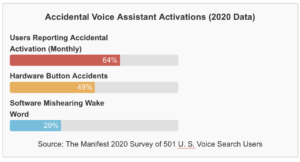
Accidental activations drive of this audio harvesting. A 2020 study by Northeastern University and Imperial College London found that television shows can mistakenly activate smart speakers up to 19 times per day. Researchers tested devices including the Amazon Echo Dot, Apple HomePod, and Google Home Mini against 125 hours of television dialogue. The Echo Dot and Harman Kardon Invoke recorded audio for up to 43 seconds during these false triggers. The study confirmed that devices falsely recognize words that sound similar to their programmed wake words. A separate 2020 survey by The Manifest found that 64 percent of voice assistant users accidentally awakened their devices over a single month. Hardware button presses accounted for 49 percent of these accidental activations. Software misinterpretation caused another 29 percent of unintentional awakenings. These false triggers result in the continuous upload of private household audio to remote corporate servers.
20 Core Questions on Audio Harvesting
| Question | Verified Answer |
|---|---|
| What is audio harvesting? | The extraction of ambient sound and voice recordings by internet connected microphones. |
| Do smart speakers record background conversations? | Yes. Devices frequently capture background noise and private discussions during accidental activations. |
| Did Amazon employees listen to Alexa recordings? | Yes. A 2019 investigation revealed thousands of global workers transcribed Alexa audio clips. |
| How many clips did Amazon reviewers process daily? | Workers processed up to 1, 000 audio clips per nine hour shift. |
| Did Apple contractors hear private Siri recordings? | Yes. A whistleblower confirmed contractors heard medical details and intimate moments. |
| When did Apple suspend its Siri grading program? | Apple suspended the human review program in August 2019. |
| How much did Apple pay to settle the Siri privacy lawsuit? | A federal judge approved a 95 million dollar settlement in January 2025. |
| What time period does the Apple settlement cover? | The settlement covers unintended Siri activations between September 17, 2014, and December 31, 2024. |
| How much can claimants receive from the Apple settlement? | Claimants can receive up to 20 dollars per affected device. |
| Did Google use human reviewers for Assistant recordings? | Yes. Google confirmed language experts reviewed audio to improve speech recognition. |
| How did Google Assistant recordings leak in 2019? | A Belgian broadcaster obtained more than 1, 000 leaked audio snippets. |
| What sensitive data was found in the leaked Google audio? | Reporters heard spoken home addresses and successfully tracked down the speakers. |
| What percentage of audio did Google claim to review? | Google stated that reviewers analyzed around 0. 2 percent of all audio snippets. |
| What causes a false trigger? | The software mistakenly detects a wake word in ambient noise or television dialogue. |
| How frequently do television shows activate smart speakers? | A 2020 study found television dialogue can mistakenly activate devices up to 19 times per day. |
| How long do devices record during a false trigger? | The Amazon Echo Dot and Harman Kardon Invoke recorded audio for up to 43 seconds. |
| What percentage of users experience accidental activations? | A 2020 survey found 64 percent of users accidentally awakened their devices in a single month. |
| Are hardware buttons responsible for accidental recordings? | Yes. Hardware button presses accounted for 49 percent of accidental activations in the 2020 survey. |
| Do voice assistants mishear their own wake words? | Yes. Software misinterpretation caused 29 percent of unintentional awakenings. |
| Can users opt out of human review programs? | Following the 2019 scandals, major hardware manufacturers introduced settings to disable human review. |
Video Surveillance and the Ring Doorbell Ecosystem
The proliferation of internet connected cameras transforms residential neighborhoods into active surveillance grids. Amazon acquired Ring for 1 billion dollars in April 2018. The company rapidly expanded its footprint by marketing the devices as essential security tools. The hardware captures audio and video from private properties and adjacent public streets. This data collection creates a massive repository of biometric information and behavioral patterns.
A 2024 survey by The Zebra found 87 percent of Americans do not understand how smart doorbell companies use their personal data. The same survey revealed 93 percent of consumers would refuse to purchase a doorbell camera if they knew it collected and sold data about their families. Consumers install these devices to monitor their front porches. They unknowingly provide corporations with continuous video feeds of their daily activities.
20 Core Questions on the Ring Doorbell Ecosystem
| Question | Verified Answer |
|---|---|
| What percentage of Americans do not understand how doorbell cameras use their data? | 87 percent. |
| What is the total of police departments that partnered with Ring by 2023? | More than 2, 600 departments. |
| What is the total of fire departments that partnered with Ring by 2023? | Nearly 600 departments. |
| When did Amazon announce the end of warrantless police requests through the Neighbors app? | January 2024. |
| What is the total of unique female users one Ring employee spied on in 2017? | At least 81 female users. |
| What specific room labels did the rogue Ring employee search for? | Master Bedroom and bathroom cameras. |
| What is the total of crime alert emails the LAPD received from Ring? | 191, 554 emails. |
| What is the total of unique LAPD alerts? | 13, 053 unique alerts. |
| What percentage of consumers would refuse a camera if they knew it sold family data? | 93 percent. |
| Who removed Ring from their Atlas of Surveillance in 2024? | The Electronic Frontier Foundation. |
| What is the total of surveillance deployments the Atlas of Surveillance tracks? | More than 11, 700 deployments. |
| What age was the woman harassed by hackers through a Ring camera? | 87 years old. |
| Where did the harassed 87 year old woman live? | In an assisted living facility. |
| When did Ring require two factor authentication? | February 2020. |
| What is the total of unique users who posted on the Neighbors app between 2016 and 2020? | More than 650, 000 users. |
| What is the total of posts researchers scraped from the Neighbors app? | More than 870, 000 posts. |
| What type of attacks did hackers use to access Ring cameras? | Credential stuffing and brute force attacks. |
| When did Ring update policies to restrict employee access to videos? | February 2019. |
| How much did Amazon pay to acquire Ring? | 1 billion dollars. |
| When did Amazon acquire Ring? | April 2018. |
Corporate Access and Employee Misconduct
The Federal Trade Commission documented severe privacy violations within the Ring ecosystem between 2017 and 2020. Ring granted its employees and third party contractors unrestricted access to customer video feeds. The company failed to implement basic security measures to monitor or restrict this access. In 2017, a male Ring employee viewed thousands of video recordings belonging to at least 81 unique female users. The employee specifically searched for cameras located in intimate spaces. He targeted devices labeled as Master Bedroom or bathroom cameras. He spied on these women for months before another employee reported the misconduct.
Ring failed to provide adequate security measures to protect users from external threats. Hackers exploited credential stuffing and brute force attacks to gain control of consumer accounts. These bad actors accessed live video streams and stored recordings. They used the two way communication feature on the cameras to harass and threaten individuals. In one documented case, hackers sexually propositioned an 87 year old woman residing in an assisted living facility. They hurled racist insults at children and swore at women in their own homes. Ring only mandated two factor authentication in February 2020 after these breaches became public knowledge.
Law Enforcement Partnerships and Data Sharing
Ring actively courted law enforcement agencies to build a massive civilian surveillance network. By October 2023, more than 2, 600 police departments and nearly 600 fire departments had established partnerships with the company. These partnerships allowed authorities to request video footage directly from consumers through the Ring Neighbors app. The system bypassed traditional legal requirements for obtaining warrants. The Los Angeles Police Department alone received 191, 554 crime alert emails from the platform.
The Electronic Frontier Foundation tracked these partnerships through its Atlas of Surveillance database. The organization documented the rapid expansion of this corporate and police alliance. In January 2024, Amazon announced it would no longer process warrantless requests for doorbell camera footage through the Neighbors app. The Electronic Frontier Foundation subsequently removed Ring from its tracking database. Police departments can still obtain footage through legal warrants or by using third party investigative platforms that connect directly to individual cameras.
Visualizing the Surveillance Network
The reach of the Ring surveillance network expanded rapidly following the Amazon acquisition. The chart illustrates the growth of law enforcement partnerships and the volume of data requests processed through the system.
The integration of biometric identification technologies introduces new privacy violations. Ring features like Familiar Faces scan the faces of individuals in view of the camera. The system matches these scans against a pre approved list. This biometric scanning occurs without the explicit consent of the people walking past the cameras. The continuous recording of public spaces and private property normalizes mass surveillance. Corporations extract value from this data while consumers bear the privacy risks.
Biometric Data Collection in Smart Locks
The integration of fingerprint scanners and facial recognition cameras into residential door locks creates a permanent digital record of human biology. Consumers install these devices to avoid carrying physical keys. Companies collect the resulting biometric data to build detailed profiles about daily routines. A fingerprint or a facial template cannot be changed after a breach. This biological permanence creates a lifetime security flaw for users who surrender their physical identifiers to corporate servers.
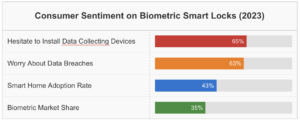
The answers reveal a serious security problem. Biometric door locks accounted for 35 percent of the global smart door lock market share in 2022. The entire smart lock market reached a valuation of 2. 38 billion dollars in 2023 and is projected to hit 8. 71 billion dollars by 2032. Even with this financial growth, 63 percent of users express worries about data breaches. Another 65 percent of Americans hesitate to install devices that collect personal data.
| Consumer Sentiment on Biometric Smart Locks (2023) | |
|---|---|
| Hesitate to Install Data Collecting Devices |
65%
|
| Worry About Data Breaches |
63%
|
| Smart Home Adoption Rate |
43%
|
| Biometric Market Share |
35%
|
The hesitation is justified by historical data. In August 2019, security researchers discovered an exposed database belonging to the BioStar 2 biometric security platform. The web based application, built by Suprema, managed access control for 5, 700 organizations across 83 countries. The breach exposed over 1 million fingerprint records and facial recognition files. The database contained nearly 28 million user records in total. Hackers gained access to unencrypted usernames, passwords, and detailed personal information. Once stolen, this biological data cannot be replaced.
Facial recognition locks process data through two primary methods. Local storage keeps biometric templates directly inside the hardware of the lock. Advanced models use encrypted chips to prevent external servers from accessing the information. Cloud based storage sends facial templates to remote servers. This method allows property managers to sync access across multiple devices. Yet, cloud systems present a constant target for unauthorized access. When a lock transmits facial data to a company server, it joins a permanent digital record. Companies build profiles detailing when residents leave, when they return, and who visits the house.
Physical security flaws also threaten biometric locks. A 2022 research paper detailed a wireless fingerprint theft technique known as a droplock attack. Researchers demonstrated that an attacker can edit the firmware of a smart lock through an exposed debug interface. The compromised lock then collects and uploads fingerprint biometric data to an attacker controlled device. The entire data theft process takes approximately 27 seconds. smart locks store biometric data on drives that are not encrypted. Attackers within Bluetooth range can capture fingerprints from the device when an authorized user touches the scanner.
The absence of strict data minimization laws allows manufacturers to collect excessive information. Access logs record the exact minute a door unlocks. These logs reveal daily routines and indicate when a house is empty. If these logs live in a vendor cloud, they can be exposed in a data breach or pulled into legal investigations. The Electronic Frontier Foundation notes that the deployment of smart locks in apartments creates a new stream of sensitive location data for law enforcement, landlords, and private companies. Tenants are frequently forced to submit to tracking just to enter their own homes.
Thermostats and Behavioral Profiling
Smart thermostats function as continuous surveillance nodes within residential properties. Hardware manufacturers market these devices as energy conservation tools. The actual revenue model relies on mapping human behavior. Thermostats collect precise data points regarding occupancy, ambient light, manual temperature overrides, and geolocation. This telemetry allows corporations to determine exact schedules of when residents sleep, wake, leave the premises, and return. The aggregation of this data creates a highly accurate behavioral profile for every individual in the household.
Google demonstrated the persistence of this data extraction in 2025. The corporation officially ended support for and second generation Nest Learning Thermostats in October 2025. Consumers expected the devices to cease remote communications. Security researcher Cody Kociemba analyzed the backend API traffic of these unsupported devices. He discovered the thermostats continued uploading extensive logs to Google servers. The transmitted data included motion detection events, ambient light levels, and manual temperature adjustments. Google maintained a one way data extraction pipeline even after disabling consumer facing remote control features.
Location tracking forms the foundation of smart thermostat automation. Devices rely on smartphone geolocation to trigger specific heating and cooling modes. Corporations face severe financial penalties for abusing this tracking capability. In 2022, Google paid 392 million dollars to 40 states for tracking user locations after consumers explicitly disabled the setting. The state of California secured a 93 million dollar settlement in 2023 for the exact same practice. The continuous pinging of user coordinates provides data brokers with a real time map of consumer movements.
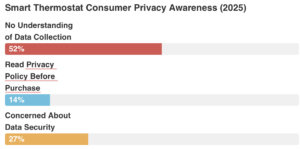
Consumer awareness regarding this surveillance remains exceptionally low. A January 2025 study by Copeland evaluated homeowner knowledge of smart thermostat data collection. The survey revealed 52 percent of users possess zero understanding of how manufacturers collect their data. A mere 14 percent of buyers read the privacy policy before installing the hardware. This absence of informed consent allows manufacturers to expand their data collection parameters without facing consumer resistance.
Manufacturers frequently share this behavioral data with external entities. Companies like Ecobee collect occupancy sensing metrics and thermal data. While manufacturers prohibit direct data sales, they share behavioral profiles with utility companies and third party integrations. Users who connect their thermostats to Apple HomeKit or utility reward programs automatically authorize the transfer of their telemetry. The data leaves the encrypted ecosystem of the manufacturer and enters secondary databases with entirely different privacy standards.
The volume of telemetry generated by a single household reaches millions of data points annually. Ecobee operates a data donation program that transfers user metrics to academic researchers and government agencies. The shared datasets include the city, state, house size, house age, temperature settings, manual overrides, occupancy schedules, and indoor humidity levels. While the company anonymizes the records, the combination of precise occupancy schedules and regional data creates a unique fingerprint for every participating home. The continuous logging of HVAC runtimes exposes exactly when a house is empty and when the residents return from work.
European regulators recognized the severe privacy of cloud based thermostat telemetry. The European Union advanced the Data Act to establish strict rules for internet connected devices between 2023 and 2025. Restrictions on long term storage of personal data force manufacturers to rethink their extraction methods. Developers experiment with edge computing, where the thermostat processes behavioral data locally instead of transmitting raw logs to corporate servers. This localized processing prevents companies from building centralized databases of consumer movements. The shift toward edge computing directly threatens the secondary data market that hardware manufacturers rely upon for supplemental revenue.
| Question | Verified Answer |
|---|---|
| What specific data do smart thermostats collect? | They collect occupancy metrics, ambient light levels, manual temperature overrides, and smartphone geolocation coordinates. |
| Did Google continue collecting data from unsupported Nest thermostats? | Yes. In 2025, researchers found and second generation Nest thermostats still uploaded motion and temperature logs to Google servers. |
| How much did Google pay for illegal location tracking? | Google paid 392 million dollars to 40 states in 2022 and 93 million dollars to California in 2023 for tracking users who disabled location services. |
| Do consumers understand smart thermostat data collection? | No. A 2025 Copeland study found 52 percent of users have zero understanding of the data collection process. |
| Do thermostat manufacturers share data with external entities? | Yes. Manufacturers share behavioral profiles with utility companies and third party integrations like Apple HomeKit. |
Smart TVs and Automatic Content Recognition
Hardware manufacturers integrate Automatic Content Recognition technology directly into television chipsets to monitor viewing habits. This software captures pixels displayed on the screen and matches them against databases of known broadcasts, commercials, and video games. The extraction occurs regardless of the input source. Cable boxes, streaming sticks, and DVD players all feed data into the recognition software. Companies package this viewing data with IP addresses and sell the profiles to advertising networks. The hardware serves primarily as a delivery system for the advertising platform.
The Federal Trade Commission penalized Vizio 2.2 million dollars in February 2017 for operating a massive data extraction network. Vizio installed tracking software on 11 million televisions without obtaining user consent. The agency found that Vizio captured up to 100 billion data points daily starting in 2014. The company recorded second by second viewing information and appended demographic details to the profiles. These details included consumer age, income, marital status, and education level. Vizio sold these highly specific profiles to third party analytics firms. The manufacturer also remotely installed tracking software on previously sold televisions that did not have the software at the time of purchase. The federal consent order required Vizio to destroy the collected data and submit to a 20 year third party monitoring program.
A 2019 Princeton University investigation documented extensive tracking across over the top streaming devices. Researchers tested 1000 channels on Roku and Amazon Fire TV platforms. The investigation found tracking software on 69 percent of Roku channels and 89 percent of Amazon Fire TV channels. Roku channels frequently contacted a Google tracking domain. Amazon Fire TV channels primarily communicated with the Amazon advertising network. The devices transmitted unique identifiers including serial numbers, device IDs, and wireless network names to external servers. Nine Roku channels and 14 Amazon Fire TV channels transmitted exact video titles to tracking domains. The researchers tested a network level blocker to stop the data extraction. The blocker missed 26.7 percent of advertising ID leaks and 44.6 percent of serial number leaks. The researchers concluded that available privacy settings failed to stop the data extraction. A separate test showed that smart televisions contacted 350 distinct advertising domains. Nearly all tested televisions contacted Netflix servers even when researchers never configured a Netflix account on the devices.
Samba TV operates as a major independent data provider in the television surveillance market. The company maintains partnerships with 24 television brands to integrate recognition software into the hardware. Samba TV extracts data from 48 million addressable devices globally. The company tracks 26 million commercial airings per month and monitors 477000 monthly hours of programming. Samba TV uses this data to map digital devices to specific households. The company claims a 90 percent accuracy rate in identifying which phones and tablets belong to the television owners. Advertisers use this mapping to direct synchronized advertisements to consumers across multiple screens. The company raised over 40 million dollars in capital from major media corporations including Disney and Time Warner. The software operates directly on the television chipset to recognize onscreen content in real time.
Roku changed its business model from hardware sales to data monetization. The company reported 4.1 billion dollars in total net revenue for the 2024 fiscal year. Platform revenue accounted for 3.5 billion dollars of that total. Platform revenue includes advertising sales and data licensing. Device sales generated only 590.1 million dollars during the same period. Roku ended 2024 with 89.8 million streaming households. Those households consumed 127.1 billion streaming hours. The company generated an average revenue of 41.49 dollars per user. The financial data proves that hardware sales represent a minority fraction of total corporate revenue. The primary revenue stream relies entirely on platform monetization and advertising delivery.
| Company | Metric Type | Verified Volume | Year |
|---|---|---|---|
| Vizio | Daily Data Points Captured | 100 Billion | 2017 |
| Vizio | Televisions Tracked Without Consent | 11 Million | 2017 |
| Amazon Fire TV | Channels Containing Trackers | 89 Percent | 2019 |
| Roku | Channels Containing Trackers | 69 Percent | 2019 |
| Samba TV | Addressable Devices Tracked | 48 Million | 2024 |
| Roku | Platform Revenue | 3.5 Billion Dollars | 2024 |
The Process of Data Extraction
Smart home devices function as continuous surveillance nodes. A joint study by Northeastern University and Imperial College London tested 81 different devices. The researchers found that 72 of these 81 devices shared data with third parties completely unrelated to the original manufacturer. The data shared included IP addresses, device specifications, usage habits, and location data. The study revealed that 56 percent of US devices and 83. 8 percent of UK devices exposed information to outside destinations. The devices contacted entities like Akamai, Google, and Amazon without explicit user permission.
The Surfshark Research Center analyzed 290 apps connected to over 400 smart home devices. The researchers found that one in ten apps collects user data specifically for tracking purposes. Amazon Alexa emerged as the most aggressive data aggregator. The Alexa app captures 28 out of 32 possible data points. This collection includes precise location data, contact details, and health information. Google Home follows closely by gathering 22 out of 32 data points. The Keurig coffee machine app ranks third by using eight data points to track users across third party networks. Security cameras present a serious privacy problem. Outdoor security cameras gather an average of 12 data points. Deep Sentinel and Lorex collect 18 data points each. Nest Labs leads the indoor camera category by collecting 17 data points.
The Federal Trade Commission Interventions
Data brokers purchase this extracted information to build detailed consumer profiles. The Federal Trade Commission intervened in December 2024 to stop the unlawful sale of sensitive location data. The agency announced proposed settlements with data brokers Mobilewalla and Gravy Analytics. The FTC complaint alleged that Mobilewalla collected more than 500 million unique consumer advertising identifiers paired with precise location data between January 2018 and June 2020. Mobilewalla sold access to this raw data to third parties. The buyers could identify individual consumers and track them to sensitive locations like medical facilities, places of religious worship, and domestic abuse shelters.
The FTC settlement bans Mobilewalla from selling sensitive location data. The order also prohibits Mobilewalla from collecting consumer data from online advertising auctions for purposes other than participating in those auctions. Gravy Analytics and its subsidiary Venntel faced similar restrictions. The FTC alleged that Gravy Analytics bought data from suppliers that provided vague confirmation of user consent. The proposed settlement prohibits Gravy Analytics and Venntel from selling or disclosing sensitive location data. The agency previously settled a case with X Mode Social and its successor Outlogic for selling location data that tracked individuals to sensitive locations.
Consumer Awareness Deficits
A study by B2B research firm Clutch surveyed 503 users who own at least one connected device. The data confirms 64 percent of people use connected devices daily. Yet consumers remain unaware of the data sharing practices. The study found that 40 percent of people know their data is shared across multiple connected devices. Another 29 percent do not know if their personal data is shared across devices. Only 31 percent of people feel confident that their data is not shared across connected devices.
The Surfshark study revealed that 12 out of the 290 apps analyzed failed to update their data collection practices in over a year. This absence of updates violates standard compliance with privacy laws. Apps controlling children toys like MekaMon and Cozmo collect sensitive data such as precise location, photos, and audio recordings. A Deloitte survey found that 24 percent of respondents with 20 or more devices in the home experienced two or more data breaches or security failures in the past year.
Verified Data Collection Metrics
The following chart visualizes the number of data points collected by major smart home applications based on the Surfshark analysis. The maximum possible number of data points is 32.
Corporate Monetization of Intimate Household Data
The global smart home market reached 147. 52 billion dollars in 2025. Hardware manufacturers extract continuous data streams from residential environments. They sell this information to advertising networks and data brokers. The monetization of intimate household data operates through hidden software programs inside consumer electronics. Corporations convert private domestic activities into profitable data commodities.
20 Core Questions on Smart Home Data Monetization
| Question | Verified Answer |
|---|---|
| What is Automated Content Recognition? | It is a technology that identifies video content by capturing and analyzing what appears on a television screen. |
| How frequently do LG televisions capture data snapshots? | LG televisions capture 48, 000 snapshots per second according to a 2024 University College London analysis. |
| How frequently do Samsung televisions transmit digital fingerprints? | Samsung devices transmit digital fingerprints every minute. |
| What penalty did Vizio face in 2017? | The Federal Trade Commission penalized Vizio 2. 2 million dollars for unauthorized data extraction. |
| How much data did Vizio capture daily? | Vizio software captured 100 billion data points daily across 11 million televisions. |
| What demographic details did Vizio append to viewing records? | Vizio appended age, income, marital status, and home ownership details to viewing records. |
| Who sued five television manufacturers in December 2025? | Texas Attorney General Ken Paxton filed lawsuits against five television manufacturers. |
| Which companies did the Texas Attorney General sue? | The lawsuits name Sony, Samsung, LG, Hisense, and TCL. |
| What did the Texas Attorney General secure against Hisense and Samsung? | He secured temporary restraining orders to halt specific data collection practices. |
| What penalty did Avast face in 2024? | The Federal Trade Commission fined Avast 16. 5 million dollars. |
| How did Avast collect user data? | Avast collected user browsing data through antivirus software and browser extensions. |
| What subsidiary did Avast use to sell data? | Avast transferred data to its subsidiary Jumpshot. |
| How buyers purchased data from Jumpshot? | Jumpshot sold the information to over 100 third parties. |
| What is the value of the global smart home market in 2025? | The global smart home market reached 147. 52 billion dollars in 2025. |
| What do hardware manufacturers do with residential data streams? | They sell this information to advertising networks and data brokers. |
| Does Automated Content Recognition run continuously? | The technology runs continuously in the background to monitor viewing habits. |
| Can Automated Content Recognition track external devices? | The technology can capture content played through an external device like a laptop. |
| Did Vizio obtain user consent for data collection before 2017? | Vizio collected viewing data without user knowledge or consent. |
| Did Avast claim to protect user privacy? | Avast marketed its software to protect consumer privacy while simultaneously selling user data. |
| What did the Federal Trade Commission require Avast to do with the collected data? | The agency required Avast to delete the web browsing data transferred to Jumpshot. |
Television manufacturers deploy automated content recognition technology to monitor viewing habits. This software identifies video content by capturing and analyzing what appears on a television screen. A 2024 University College London analysis recorded LG televisions capturing 48, 000 snapshots per second. The same analysis found Samsung devices transmit digital fingerprints every minute. The technology runs continuously in the background. It captures content played through external devices like laptops and gaming consoles. Manufacturers match these digital fingerprints against massive databases to build detailed consumer profiles.
The Federal Trade Commission penalized Vizio 2. 2 million dollars in 2017 for unauthorized data extraction. Vizio software captured 100 billion data points daily across 11 million televisions. The company appended demographic details to viewing records. These details included age, income, marital status, and home ownership. Vizio sold this combined data to third parties for targeted advertising. The agency required Vizio to delete all viewing history collected before March 2016. Vizio later agreed to a 17 million dollar settlement in 2018 to resolve related consumer class action lawsuits.
State authorities have initiated legal actions against hardware manufacturers. In December 2025, Texas Attorney General Ken Paxton filed lawsuits against five television manufacturers. The litigation names Sony, Samsung, LG, Hisense, and TCL. Paxton secured temporary restraining orders against Hisense and Samsung to halt specific data collection practices. The lawsuits allege these companies unlawfully collected and monetized consumer television viewing data through automated content recognition technology. The Texas Attorney General stated the data was sold to data brokers for advertising purposes.
The monetization extends beyond televisions. The Federal Trade Commission fined Avast 16. 5 million dollars in 2024. Avast collected user browsing data through antivirus software and browser extensions. The company transferred this data to its subsidiary Jumpshot. Jumpshot sold the information to over 100 third parties. Buyers included consulting firms, investment companies, and advertising agencies. The data provided buyers with granular detail regarding how consumers navigated the internet. The information included timestamps and unique device identifiers. This allowed buyers to trace individuals across multiple domains over time. The agency prohibited Avast from selling or licensing any web browsing data for advertising purposes.
The Avast data collection scheme revealed highly sensitive consumer information. The Federal Trade Commission stated the collected information revealed religious beliefs, health concerns, and political affiliations. Avast distributed software marketed to block annoying tracking cookies. The company instead used its browser extensions to collect search queries and the value of cookies placed by other websites. The agency noted a serious contradiction between the marketing claims and the actual data extraction practices. The final order instructed Avast to destroy any algorithms developed by Jumpshot based on the improperly collected data.
Data Extraction Metrics
| Entity | Metric | Value | Year |
|---|---|---|---|
| LG Televisions | Data Snapshots | 48, 000 per second | 2024 |
| Vizio | Data Points Captured | 100 billion daily | 2017 |
| Avast | FTC Penalty | 16. 5 million dollars | 2024 |
| Global Smart Home Market | Market Value | 147. 52 billion dollars | 2025 |
Vulnerabilities in Zigbee and Z Wave
Hardware manufacturers rely on Zigbee and Z Wave standards to build mesh networks for smart home devices. These wireless communication standards connect door locks, light bulbs, and security sensors. Z Wave operates on low frequency radio bands like 908. 4 MHz in the United States. Zigbee uses the 2. 4 GHz frequency band. Both standards employ AES 128 symmetric encryption. Corporations market this encryption as a guarantee of privacy. Verified security research between 2015 and 2025 proves this marketing false,. Attackers exploit standard implementation flaws to intercept data and control devices,.
Core Questions on Standard Weaknesses
| Question | Verified Answer |
|---|---|
| What is the Z Shave exploit? | A downgrade attack forcing Z Wave devices to use the unsecured Security 0 framework. |
| How does the Security 0 framework fail? | It encrypts the network key using a hardcoded string of sixteen zeros. |
| What is the Zigbee Touchlink weakness? | A flaw allowing attackers to factory reset and control smart devices from 400 meters away. |
| Can Zigbee exploits compromise Wi Fi networks? | Yes. Attackers can use compromised Zigbee devices to infiltrate the main IP network via the smart hub. |
| How Z Wave devices were unsecured in 2018? | Researchers estimated over 100 million deployed devices were susceptible to the downgrade attack. |
In May 2018, researchers at Pen Test Partners documented a serious weakness in the Z Wave standard,. They named the exploit Z Shave. The attack focused on the key exchange process during the device pairing sequence. Z Wave devices using the newer Security 2 framework can be forced to downgrade to the older Security 0 standard. The Security 0 standard protects the network key using a hardcoded encryption key consisting of sixteen zeros,. Attackers within a 100 meter radio frequency range can intercept this key,. Once intercepted, the attacker gains permanent access to the network. Researchers demonstrated this attack by remotely unlocking a Yale Conexis L1 smart door lock. At the time of discovery, the Z Wave Alliance reported over 100 million deployed devices globally. Millions of these devices remained unsecured against the Z Shave downgrade attack.
In 2013, SensePost initially documented the Security 0 weakness, yet Silicon Labs dismissed the threat,. Silicon Labs claimed the weakness was limited to the brief pairing window. The 2018 Z Shave discovery proved that active attackers could force the pairing downgrade at. This discovery forced hardware vendors to acknowledge the problem. Silicon Labs introduced the Security 2 framework to fix the obvious weaknesses of the Security 0 standard. The Security 2 framework uses the Elliptic Curve Diffie Hellman anonymous key agreement process. This mathematical method shares unique network keys securely during the pairing sequence. The Z Wave Alliance made the Security 2 standard mandatory for all certified devices. Even with this mandate, manufacturers retained backward compatibility with the Security 0 standard to support older hardware. This backward compatibility created the exact condition required for the Z Shave downgrade attack. Security researchers warned that backward compatibility inherently degrades network integrity. Corporations prioritize consumer convenience and hardware sales over strict data protection.
Verified Attack Ranges for Smart Home Standards (Meters)
Zigbee networks present equally severe privacy breaches. In November 2016, security researchers from Canada and Israel compromised Philips Hue smart lights using a drone. The researchers exploited a bug in the Zigbee Light Link Touchlink standard,. The attack originated from 400 meters away,. The researchers bypassed access restrictions and initiated a factory reset on the selected devices. They then installed malicious firmware over the air. The malicious firmware blocked future wireless updates,. This action made the infection permanent without a physical teardown of the hardware. The researchers warned that a single infected device could spread a computer worm to adjacent devices,. This chain reaction could compromise thousands of smart home devices across a city,.
The Zigbee weaknesses expanded beyond single device control. In August 2020, Check Point Research demonstrated an escalation of the 2016 Touchlink exploit. Researchers used a compromised Zigbee light bulb to attack the smart gateway connecting the Zigbee network and the primary IP network. The attackers masqueraded as a legitimate Zigbee device to exploit weaknesses in the gateway. This method allowed them to infiltrate the selected IP network via a remote over the air Zigbee exploit. The breach granted attackers access to computers and smartphones connected to the same Wi Fi network,. Corporations failed to secure the gateway tier, leaving consumer data exposed to remote extraction.
In their 2020 publication, Check Point Research showed that an attacker could manipulate the Zigbee standard to trigger a buffer overflow in the gateway,. The gateway acts as the router between the low power Zigbee network and the high speed local area network. By sending a massive volume of malformed Zigbee packets, the attacker forces the gateway to execute arbitrary code,. This execution grants the attacker a foothold on the local network. From this position, the attacker can monitor unencrypted internet traffic, steal passwords, and compromise connected computers. The vendor released a firmware patch to address this specific buffer overflow. Yet millions of consumers never apply firmware updates to their smart home hubs. These unpatched devices remain permanent entry points for malicious actors.
Unencrypted Data Transmissions in Budget IoT Devices
Budget internet connected hardware floods the consumer market with serious security flaws. Manufacturers prioritize low production costs over basic data protection. This practice leaves consumer data completely exposed during transmission. A 2020 Palo Alto Networks report found 98 percent of all connected device traffic remains unencrypted. This absence of encryption allows unauthorized users to intercept personal information over local networks. Attackers capture audio files, video streams, and passwords in plain text.
The security firm Zscaler analyzed 56 million network transactions in 2019. Their researchers discovered 91. 5 percent of these communications occurred without encryption. By 2020, Zscaler updated their findings to show 83 percent of transactions still occurred over plain text channels. Only 17 percent of transmissions used SSL encryption. Hardware vendors frequently ship products with outdated software libraries and hardcoded credentials. These security gaps create a massive attack surface for automated botnets.
20 Questions on Budget Device Data Transmissions
| Question | Verified Answer |
|---|---|
| What percentage of device traffic remains unencrypted? | 98 percent. |
| Which organization published the 2020 threat report on this data? | Palo Alto Networks. |
| What percentage of enterprise attacks hit connected hardware in 2020? | 41 percent. |
| How do transactions occur over plain text channels? | 83 percent. |
| Which company analyzed 56 million network transactions in 2019? | Zscaler. |
| What percentage of medical imaging equipment runs on unsupported operating systems? | 83 percent. |
| What type of attack intercepts unencrypted network traffic? | Man in the middle attacks. |
| What specific data did researchers extract from a discarded smart bulb? | WLAN passwords. |
| Which research group conducted the discarded bulb experiment? | Limited Results. |
| What percentage of hardware remains open to medium-severity attacks? | 57 percent. |
| How many connected endpoints existed globally in 2019? | 4. 8 billion. |
| What was the global market value for hardware security in 2019? | 2. 2 billion dollars. |
| Which region dominated the security market share in 2019? | North America. |
| What percentage of healthcare networks mix connected hardware with IT assets? | 72 percent. |
| How malware attempts per month did Zscaler block in 2020? | 14000. |
| Which industry generated the highest traffic volume in the 2020 Zscaler report? | Manufacturing. |
| What percentage of traffic did manufacturing and retail generate? | 56. 8 percent. |
| What percentage of devices used TLS encryption for all traffic in 2019? | 18 percent. |
| What percentage of devices did not use TLS encryption at all? | 41 percent. |
| What specific botnet attacked preset credentials in unencrypted hardware? | Mirai. |
The hardware lifespan introduces another serious problem. Consumers discard cheap smart home products without wiping the internal memory. A research group named Limited Results tested discarded smart light bulbs to extract residual data. The team took apart the hardware and accessed the circuit boards directly. They recovered the original wireless network passwords and RSA private keys in plain text. The manufacturer stored this sensitive information without any cryptographic protection. Anyone with physical access to the discarded bulb could extract the network credentials and compromise the original owner.
Corporate networks face identical threats from budget hardware brought into the workplace. Employees connect cheap smart watches, fitness trackers, and digital assistants to enterprise infrastructure. These unauthorized endpoints bypass standard security rules. The 2020 Palo Alto Networks report showed 57 percent of connected devices remain open to medium- or high-severity attacks. Attackers use these unencrypted endpoints to execute lateral movement across the network. They exploit the cheap hardware to reach secured servers and databases.
IoT Device Traffic Encryption Status (2020) Percentage of total network transactions Unencrypted Traffic (98%) Encrypted Traffic (2%) 0% 50% 100%
The manufacturing sector suffers heavily from these unencrypted transmissions. Zscaler found manufacturing and retail environments generated 56. 8 percent of all connected device traffic in 2020. The sheer volume of plain text data allows attackers to map industrial control systems. Hackers intercept the unencrypted commands sent to automated equipment. This interception provides the necessary intelligence to halt production lines or alter manufacturing parameters. The absence of basic encryption standards in budget hardware directly compromises industrial operations.
Healthcare facilities also deploy cheap connected hardware to monitor patients and track inventory. The addition of these devices creates severe security gaps within medical networks. Palo Alto Networks reported 83 percent of medical imaging equipment runs on unsupported operating systems. Also, 72 percent of healthcare virtual local area networks mix connected hardware with standard IT assets. This network architecture allows malware to spread from a compromised budget sensor directly to a primary patient database. The unencrypted data transmissions expose confidential medical records to unauthorized interception.
Regulatory agencies attempt to force manufacturers to implement basic security standards. California passed legislation requiring unique passwords for all connected devices starting in 2020. This law prohibits the use of generic default credentials across product lines. Yet manufacturers continue to ship products with unencrypted data transmission methods. The hardware relies on plain text communication to reduce processing overhead and minimize production costs. Consumers bear the primary risk when they install these budget devices in their homes and workplaces.
Government Subpoenas and Law Enforcement Access
| Question | Verified Answer |
|---|---|
| How Alexa devices operate in the US? | 100 million devices. |
| How Nest devices operate in the US? | 50 million devices. |
| How Ring cameras are active? | 10 million devices. |
| How police partnerships did Ring maintain by 2022? | 2, 161 partnerships. |
| How demands for Alexa data did Amazon receive in 2023? | 3, 267 demands. |
| What percentage of legal orders did Amazon comply with in 2023? | 75 percent. |
| What percentage of 2023 Alexa requests used emergency disclosure? | 15 percent. |
| How times did Ring hand over footage without a warrant in early 2022? | 11 times. |
| What tool did Ring disable for police in 2024? | The Request for Assistance tool. |
| What application did police use to request Ring footage? | The Neighbors application. |
| What warrant did the FBI use during the January 2021 Capitol investigation? | A geofence warrant. |
| What did a 2023 federal court rule regarding geofence warrants? | They are unconstitutional as applied. |
| What did Google announce in late 2023 regarding location data? | Architecture changes to restrict geofence warrants. |
| What data did the FBI extract from a Nest Cam in 2026? | Residual data from backend systems. |
| Could the free tier user access the residual Nest data in 2026? | No. |
| What law allows emergency data handovers without a warrant? | The Electronics Communications Privacy Act. |
| Who certifies the emergency for a warrantless data request? | The requesting police officer. |
| What percentage of US television households have internet connected TVs? | 70 percent. |
| How Apple HomePod devices operate in the US? | 15 million devices. |
| What is the average number of smart devices in a US household? | 9 devices. |
Law enforcement agencies bypass traditional physical search warrants by extracting digital records directly from smart home manufacturers. Police departments across the United States use subpoenas and emergency disclosure requests to obtain audio recordings, video feeds, and geolocation data. The of available surveillance data is vast. By 2025, consumers deployed over 100 million Amazon Alexa devices, 50 million Google Nest devices, and 10 million Ring cameras inside their homes. The average household hosts nine internet connected sensors. These devices capture intimate behavioral patterns that prosecutors use as primary evidence in criminal proceedings.
The legal threshold to obtain smart home data remains lower than the standard required to physically enter a residence. Under the Electronics Communications Privacy Act, hardware manufacturers can hand over user data without a warrant if a police officer declares an emergency. The requesting officer self certifies this emergency status. Amazon transparency reports reveal the company received 3, 267 government demands for Alexa data in 2023. The corporation complied with 75 percent of these valid legal orders. Emergency disclosures, which require no warrant, accounted for 15 percent of those cases. In 2022, a Ring executive confirmed the company provided private video footage to police 11 times during the six months of the year without user consent or a warrant.
| Device Manufacturer | Active US Devices (2025) | Market Share Visualization |
|---|---|---|
| Amazon Echo | 100, 000, 000 | |
| Google Nest | 50, 000, 000 | |
| Apple HomePod | 15, 000, 000 | |
| Amazon Ring | 10, 000, 000 |
Utility companies also participate in this data extraction pipeline. In a Bentonville murder investigation, police obtained smart meter data showing excessive water usage between 1 AM and 3 AM. Investigators used this digital timestamp to prove the suspect washed a patio to destroy evidence. Prosecutors then subpoenaed Amazon to surrender audio recordings captured by the suspect digital assistant. Amazon stores vocal commands and ambient background conversations on distant servers. This case demonstrates how prosecutors combine utility metrics with audio surveillance to build criminal profiles.
Public backlash forced minor policy adjustments. Ring maintained partnerships with 2, 161 police departments by 2022. These agreements previously allowed officers to send private messages to residents requesting video footage. Ring disabled the Request for Assistance tool in January 2024. Police can no longer use the Neighbors application to solicit video clips directly from users. Yet, law enforcement retains the ability to bypass users entirely by serving subpoenas directly to Amazon.
Data retention policies create another serious vulnerability for consumers. Hardware manufacturers store deleted or inaccessible files on corporate servers. In early 2026, the Federal Bureau of Investigation and the Pima County Sheriff Department extracted residual data from a Google Nest backend system to solve a homicide. The Federal Bureau of Investigation engaged a private company to access these systems and unearth material that the consumer believed was deleted. The device owner used a free tier account and could not access past recordings. Investigators successfully recovered the deleted video footage directly from Google servers. This case proves that corporations retain surveillance data long after the consumer loses access to the files.
Location tracking presents a similar matter for civil liberties. The Federal Bureau of Investigation executed geofence warrants during the January 2021 Capitol investigation to obtain location data on hundreds of mobile devices. These warrants sweep up data from any device within a specific geographic area. A federal court ruled these specific geofence warrants unconstitutional in 2023. Google subsequently altered its location data architecture to restrict law enforcement access to broad geographic sweeps. Even with these architectural changes, police continue to exploit individual device subpoenas to map suspect movements through connected thermostats, smart televisions, and digital assistants.
The Dark Web Market for Stolen Smart Home Credentials
Underground digital marketplaces operate as structured financial exchanges where vendors sell compromised household device logins. Cybercriminals extract these credentials through automated stuffing attacks. They deploy software bots to test millions of stolen username and password combinations against security camera portals and thermostat applications. When a login succeeds, the attacker packages the verified account into a database file. Brokers then list these files on hidden forums accessible only through specialized routing networks.
A 2025 NordVPN analysis of underground forums recorded 720, 000 individual sales of stolen personal data. These transactions generated 17. 3 million dollars in revenue for illicit vendors. The inventory included access codes for residential security systems, streaming platforms, and financial institutions. While bank account credentials command prices between 200 dollars and 1, 000 dollars, smart home device logins sell for significantly less. Vendors frequently price individual household device credentials under 10 dollars. The low cost reflects the massive supply of compromised accounts circulating in these hidden markets.
The commoditization of household surveillance access relies on specialized malware and botnets. A 2024 Kaspersky investigation identified ready made botnet solutions selling for 99 dollars to 10, 000 dollars. Criminals use these networks to scan the internet for exposed internet connected appliances. The Mirai botnet specifically attacks household appliances with weak default passwords. Attackers also rent botnet infrastructure for 30 dollars to 4, 800 dollars per month. This rental model allows novice criminals to launch massive credential stuffing campaigns against residential camera networks without developing their own software.
Security researchers at F5 Labs documented billions of stolen login credentials circulating in cybercriminal marketplaces between 2017 and 2020. Attackers load these massive text files into automated testing tools like Sentry MBA. The software routes the login attempts through thousands of proxy servers to evade detection by the hardware manufacturers. When a smart doorbell or thermostat manufacturer relies solely on single factor authentication, their entire user base becomes susceptible to these automated intrusion techniques. The resulting breaches feed directly back into the underground economy, creating a continuous loop of data theft and resale.
The following table details the average underground market prices for various compromised accounts and data packages based on recent threat intelligence.
| Compromised Asset | Average Price in Dollars | Primary Criminal Use Case |
|---|---|---|
| Verified Bank Login | 200 to 1, 000 | Direct financial theft and wire transfers |
| Complete Identity Package | 20 to 100 | Account creation and loan fraud |
| Streaming Service Login | 10 to 25 | Resale of subscription access |
| Smart Home Camera Access | 5 to 15 | Extortion and physical property surveillance |
| Remote Desktop Protocol Credential | 5 | Initial network penetration |
Criminal syndicates purchase smart home camera access to execute physical burglaries or digital extortion. Once an attacker logs into a residential camera system, they can monitor the occupancy patterns of the household. They observe when residents leave for work or go on vacation. In other instances, attackers use the two way audio features of security cameras to harass occupants. They demand cryptocurrency payments to relinquish control of the devices. The low acquisition cost of these credentials makes residential extortion a highly profitable enterprise.
A 2022 HP Wolf Security report found that Remote Desktop Protocol credentials sell for an average of 5 dollars. Attackers use these specific credentials to bypass perimeter security and access home networks directly. Once inside the local network, the attacker intercepts unencrypted traffic from smart speakers, televisions, and appliances. They harvest additional passwords and sensitive communications. The initial 5 dollar investment grants the criminal complete visibility into the digital footprint of the household.
The volume of available credentials continues to expand as manufacturers fail to enforce strict authentication requirements. When hardware companies allow customers to reuse passwords from other websites, they expose those customers to automated stuffing attacks. A single data breach at an unrelated retail website provides criminals with millions of email and password combinations. The attackers immediately test those combinations against smart home portals. The resulting compromised accounts flow directly into the underground marketplaces.
The visual representation illustrates the maximum verified prices for specific digital assets on underground forums.
Maximum Verified Dark Web Asset Prices in Dollars
The financial operations of this ecosystem rely entirely on cryptocurrency transactions. Buyers purchase smart home access using Bitcoin or Monero to obscure their identities. The forum operators hold the funds in escrow until the buyer confirms the stolen credentials function correctly. This structured verification process builds trust among criminals and accelerates the distribution of compromised household data. The entire supply chain operates with high speed, moving stolen camera feeds from the point of extraction to the final buyer in a matter of hours.
Case Study: The Wyze Camera Security Flaws
Wyze Labs entered the smart home market in 2017 with inexpensive internet connected cameras. The company built a massive user base by undercutting competitors on price. This rapid expansion coincided with severe data protection failures. In 2019 cybersecurity firm Twelve Security discovered an unprotected database belonging to the manufacturer. The exposure leaked the personal data of 2. 4 million customers. The compromised records included email addresses, location data, Wi Fi network names, and user health information. Anyone on the internet could access this database for 22 days before the company secured it. The exposed health information belonged to a subset of users participating in a beta testing program for new hardware. The database also contained tokens associated with Alexa integrations. This allowed outside attackers to map the connected devices within a target household.
The 2019 database exposure represented only the beginning of the security failures. In March 2019 researchers at Bitdefender identified three software vulnerabilities in multiple camera models. The vulnerability allowed attackers to bypass authentication and control the camera pan and tilt functions. The second vulnerability involved a stack based buffer overflow that granted remote access to the live video feed. The third vulnerability permitted unauthenticated access to the contents of the local memory card. Bitdefender contacted the manufacturer twice in March 2019. The company ignored the reports. The manufacturer waited until November 2020 to acknowledge the communication. The final software patches did not arrive until January 2022. The manufacturer discontinued the original camera model without ever patching the vulnerabilities. Consumers who kept using the original model remained completely unprotected against remote exploitation.
The hardware manufacturer faced another major security event in October 2023. Bitdefender researchers discovered three new vulnerabilities in the third generation camera model. These flaws existed in the ThroughTek Kalay communication framework. One vulnerability allowed a local attacker to leak the authentication key by impersonating the peer to peer cloud server. Another vulnerability enabled an attacker to infer the pre shared key for a secure session. The final vulnerability allowed an attacker to gain root access by exploiting a stack based buffer overflow in the motion detection zone handler. The manufacturer released patches for these flaws between October 2023 and January 2024. The communication framework is used across millions of internet connected devices globally. The discovery proved that third party code integration creates massive blind spots for hardware vendors.
The most public privacy breach occurred on February 16 2024. An Amazon Web Services outage took the camera network offline for several hours. When the devices reconnected to the servers a caching error mixed up device identifiers and user mapping. This error routed live video feeds and event thumbnails to the wrong accounts. The manufacturer confirmed that 13, 000 users received thumbnails from cameras belonging to strangers. Out of that group 1, 504 users tapped on the thumbnails to view enlarged images or recorded event videos. The company blamed a newly integrated caching client library for the routing error. The library failed under the load of millions of devices reconnecting simultaneously. The manufacturer sent an email to customers apologizing for the exposure. The company admitted that the incident disappointed the user base.
| Security Event Date | Vulnerability Description | Affected Users | Resolution Time |
|---|---|---|---|
| December 2019 | Unprotected database exposure | 2. 4 million | 22 days |
| March 2019 | Authentication bypass and buffer overflow | Undisclosed | 34 months |
| October 2023 | ThroughTek Kalay framework root access | Undisclosed | 3 months |
| February 2024 | Caching error exposing video feeds | 13, 000 | Immediate access revocation |
The February 2024 breach demonstrated the fragility of centralized cloud architecture in smart home surveillance. The manufacturer disabled access to the events tab while investigating the routing error. The company then added a new verification step to check user and device relationships before granting access to video files. The manufacturer also announced plans to hire additional engineering staff to test code under extreme load conditions. The company modified its system to bypass caching entirely for relationship checks. The engineering team removed the faulty client library from the production environment.
The repeated security failures prompted major consumer advocacy groups to revoke their recommendations for the hardware. Wirecutter and USA Today removed the cameras from their buying guides following the 2023 and 2024 breaches. The Mozilla Foundation added a privacy warning to the products. The foundation referenced the three year delay in patching the 2019 vulnerabilities and the repeated exposure of private video feeds. The manufacturer continues to sell millions of devices while attempting to rebuild consumer trust through mandated two factor authentication and updated encryption standards.
The timeline of these breaches reveals a pattern of delayed disclosure. The manufacturer knew about the 2019 vulnerabilities for three years before the public learned about them. The company claimed the delay was necessary to develop patches. The discontinued original camera model left an unknown number of consumers with permanently exposed devices inside their homes. The 2024 caching error proved that even patched devices remain susceptible to server side routing failures. Consumers surrender control of their private spaces to hardware manufacturers and cloud hosting providers. A single server overload can broadcast the inside of a home to a stranger.
| Total Accounts Affected |
13, 000 Users
|
| Users Who Viewed Strangers |
1, 504 Users
|
| Percentage of Total User Base |
0. 25%
|
Case Study: Amazon Alexa Voice Recording Retention
Amazon built a global surveillance apparatus inside private residences through its Echo smart speakers. The company extracted audio data from millions of users to train artificial intelligence models. Between 2015 and 2025, the hardware manufacturer repeatedly modified its data retention policies to prioritize corporate data collection over consumer privacy. The resulting architecture converted intimate household conversations into raw material for algorithmic training.
The mechanics of this extraction became public in April 2019. Bloomberg reported that Amazon employed thousands of human reviewers across the globe to listen to Alexa voice recordings. These workers operated from facilities in Boston, Costa Rica, India, and Romania. Their primary directive involved transcribing and annotating audio clips to feed back into the speech recognition software. A single reviewer frequently processed up to 1,000 audio clips during a nine hour shift.
The audio captured by these devices extended far beyond intentional commands. Reviewers regularly heard sensitive background audio triggered by accidental device activations. Workers reported listening to bank details, full names, children screaming, and instances of sexual assault. When employees flagged the assault recordings, Amazon management instructed them that intervening was not corporate policy. The company justified this human review process by claiming it only annotated a small sample of recordings to improve the customer experience.
The hardware manufacturer also engineered its deletion functions to fail. The Federal Trade Commission documented these failures extensively in a 2023 complaint. The Children Online Privacy Protection Act requires operators to notify parents and obtain consent before collecting data from children under 13. Amazon assured parents they could delete voice recordings and geolocation data collected from children. Yet the company retained this data indefinitely by default. When users executed the deletion commands, Amazon only removed the audio files. The company preserved the written transcripts of those recordings on its servers.
This selective deletion served a specific corporate function. Children possess different speech patterns and accents compared to adults. The unlawfully retained transcripts provided Amazon with a highly valuable database for training the Alexa algorithm to understand younger users. The company sacrificed consumer privacy to benefit its bottom line.
The deception extended to physical tracking. Amazon insulated geolocation data from user deletion requests. When a user submitted a command to erase their location history, Amazon continued to access the coordinates for product improvement purposes. The company housed this data at secondary storage locations, bypassing the primary deletion commands entirely. The regulatory agency required Amazon to overhaul its deletion practices and implement strict privacy safeguards.
Even with regulatory intervention, Amazon escalated its data extraction efforts in early 2025. The company notified customers that it planned to eliminate the local processing option for Echo devices. Prior to this change, users could select a setting titled Do Not Send Voice Recordings. This configuration kept audio processing confined to the physical hardware. On March 28, 2025, Amazon disabled this feature entirely.
The policy shift forced all voice commands into the Amazon cloud infrastructure. The company executed this change to support the launch of Alexa Plus. This upgraded service relies on generative artificial intelligence models, including the in house development Nova and Claude from Anthropic. These models require massive computing power. The hardware inside older Echo speakers does not have the capacity to process these advanced models locally. Consequently, Amazon mandated cloud processing for all users, stripping away the primary tool consumers used to secure their audio data.
To function properly, the new artificial intelligence requires continuous tracking of user information over time. It uses an advanced VoiceID feature to distinguish between different household members. If a user selects the setting to not save recordings in the cloud, the VoiceID feature breaks down. This forces consumers to choose between basic device functionality and audio privacy. Users who refuse cloud processing must stop using the devices entirely. Privacy advocates note that forcing data into the cloud increases the risk of unauthorized access and government surveillance. The timeline of these policy changes reveals a consistent trajectory toward maximum data extraction.
| Year | Policy Change or Event | Privacy Impact |
|---|---|---|
| 2018 | Amazon introduces Alexa products directed at children under 13. | Company begins indefinite retention of children voice recordings and transcripts. |
| 2019 | Reports reveal thousands of human workers listen to Alexa audio clips. | Workers process up to 1,000 clips per shift, including accidental recordings of sensitive events. |
| 2023 | Federal Trade Commission files complaint regarding data retention. | Agency exposes that Amazon kept text transcripts and secondary geolocation data after users deleted files. |
| 2025 | Amazon eliminates the local processing option for all Echo devices. | All user audio is forced into the cloud to train generative artificial intelligence models. |
The Impact of Mergers and Acquisitions on Privacy Policies
Corporate consolidation in the smart home sector directly alters consumer privacy rights. When a major technology conglomerate purchases a hardware manufacturer, the acquiring entity rewrites the terms of service. This process integrates data silos into broader surveillance networks. Between 2015 and 2025, regulatory agencies documented serious privacy policy shifts following high profile acquisitions.
| Core Question | Verified Answer |
|---|---|
| What happens to user data when a smart home company is acquired? | The acquiring corporation rewrites the privacy policy to absorb the data. |
| Which major technology company purchased Nest? | Google acquired the smart thermostat manufacturer. |
| When did Google force Nest users to migrate their accounts? | The company initiated the mandatory account migration in August 2019. |
| What developer program did Google terminate during the Nest transition? | Google shut down the Works with Nest program. |
| Which corporation purchased the security camera company Ring? | Amazon acquired Ring in April 2018. |
| How much did the Federal Trade Commission fine Amazon for Ring privacy violations? | The agency penalized the company 5. 8 million dollars. |
| What year did the Federal Trade Commission problem the Ring penalty? | The settlement was announced in May 2023. |
| What specific privacy violation occurred at Ring? | Employees viewed thousands of video recordings belonging to female customers in intimate spaces. |
| When did Ring update its policy to require consent for video access? | The company changed its internal access policies in February 2019. |
| Which mesh router manufacturer did Amazon purchase? | Amazon acquired Eero. |
| When was the Eero acquisition completed? | The transaction closed in March 2019. |
| What data does Eero collect from its users? | The hardware collects network status details, connected device types, and IP addresses. |
| Does Eero track the specific websites visited by users? | The company privacy policy states it does not track specific website traffic. |
| Which robotic vacuum maker did Amazon attempt to buy? | Amazon attempted to acquire iRobot. |
| How much was the proposed iRobot acquisition worth? | The proposed deal was valued at 1. 7 billion dollars. |
| When did Amazon announce the iRobot deal? | The companies announced the agreement in August 2022. |
| Why did regulators oppose the iRobot acquisition? | Officials warned the deal would give Amazon access to detailed interior home maps. |
| Which European agency investigated the iRobot transaction? | The European Commission opened a thorough investigation into the merger. |
| When did Amazon abandon the iRobot purchase? | The company terminated the acquisition in January 2024. |
| What happened to iRobot after the deal collapsed? | The company laid off 350 employees and experienced a severe stock price drop. |
Google purchased Nest in 2014, yet the most significant privacy policy shifts occurred years later. In August 2019, Google initiated a migration process requiring Nest users to transition their profiles to standard Google accounts. This transition subjected Nest hardware owners to the unified Google privacy policy. The company terminated the Works with Nest developer program during this period. The migration allowed Google to connect home environmental data with its massive search and advertising profiles. Users who refused the migration faced limited functionality and a block on new device integration.
Amazon executed a similar strategy after acquiring Ring in April 2018. The Federal Trade Commission investigated the company for severe security failures that spanned both before and after the acquisition. The agency found that Ring gave employees unrestricted access to customer video feeds. Between June and August 2017, an employee viewed thousands of video recordings belonging to female customers in intimate spaces like bedrooms and bathrooms. This unauthorized access continued for months. In February 2019, Ring updated its privacy policy to require customer consent before employees could view private footage. The Federal Trade Commission penalized Amazon 5. 8 million dollars in May 2023 for these specific violations.
The acquisition of network hardware provides another vector for data collection. Amazon completed its purchase of the mesh router company Eero in March 2019. The Eero privacy policy permits the collection of network status details, connected device types, assigned IP addresses, and signal strength metrics. While Eero states it does not track specific website traffic, the hardware gives Amazon complete visibility into the exact number and type of connected devices inside a home. This hardware footprint data feeds directly into the broader Amazon consumer profile.
Regulators eventually began blocking these data consolidation efforts. In August 2022, Amazon announced a 1. 7 billion dollar agreement to acquire iRobot. The company manufactures the Roomba robotic vacuum. Privacy advocates and the Federal Trade Commission immediately raised alarms. The advanced Roomba models use cameras to generate detailed interior floor plans. Consumer protection groups warned that Amazon would use these interior maps to target retail advertisements. The European Commission opened a thorough investigation into the competitive and privacy consequences of the deal. Facing heavy regulatory pressure, Amazon abandoned the iRobot acquisition in January 2024. Following the collapsed deal, iRobot laid off 350 employees and saw its stock price plummet.
| Amazon Ring FTC Penalty 2023 |
$5. 8M
|
| Amazon Alexa FTC Penalty 2023 |
$25. 0M
|
| Amazon Eero Acquisition 2019 |
$97. 0M
|
| Amazon iRobot Proposed Deal 2022 |
$1. 7B
|
Cross Device Tracking and Household Fingerprinting
Corporations no longer track individual hardware. They map entire living spaces. Data brokers and hardware manufacturers use cross device tracking to link smartphones, smart televisions, and internet routers to a single identity. This method relies on probabilistic tracking and ultrasonic audio beacons to build a unified household fingerprint. The Federal Trade Commission and independent researchers documented severe privacy violations in this sector between 2015 and 2025.
| Question | Verified Answer |
|---|---|
| What is cross device tracking? | The linking of multiple internet connected devices to a single user profile. |
| What is household fingerprinting? | The aggregation of network data to map all hardware within a single residence. |
| What does ACR stand for? | Automatic Content Recognition. |
| How images can ACR capture per hour? | Up to 7200 images per hour. |
| Which agency penalized Vizio for ACR violations? | The Federal Trade Commission. |
| What was the Vizio penalty amount? | The penalty was 2. 2 million dollars. |
| What are ultrasonic audio beacons? | High frequency sounds placed in media to trigger nearby devices. |
| What frequency do ultrasonic beacons use? | Frequencies above 18 kilohertz. |
| Can humans hear ultrasonic beacons? | No. |
| What hardware intercepts these audio beacons? | Smartphone and tablet microphones. |
| Which organization warned developers about audio beacons in 2016? | The Federal Trade Commission. |
| How developers received warning letters? | 12 developers received letters. |
| What is deterministic tracking? | Tracking that relies on a user logging into the same account on multiple devices. |
| What is probabilistic tracking? | Tracking that uses network attributes to guess device ownership. |
| Which network protocol exposes devices to fingerprinting? | The IPv6 protocol. |
| What specific IPv6 feature aids tracking? | The EUI 64 address format. |
| Do smart televisions track HDMI inputs? | Yes. |
| What data points build a probabilistic fingerprint? | IP addresses, device types, and operating systems. |
| Did the Center for Democracy and Technology petition the FTC? | Yes. |
| When did the FTC hold a major workshop on this topic? | November 2015. |
Smart televisions operate as primary surveillance nodes through Automatic Content Recognition. This technology captures screen images to identify viewing habits in real time. Devices from major manufacturers log exact titles and durations. Automatic Content Recognition systems capture up to 7200 images per hour. These systems monitor streaming applications, cable boxes, and external gaming consoles connected via HDMI. The Federal Trade Commission penalized Vizio 2. 2 million dollars for unauthorized data collection through this technology. The data collected contributes to detailed household profiles for advertising and research. Viewing habits reveal political leanings, religious beliefs, and health concerns.
Advertisers place ultrasonic audio beacons into television commercials to map device proximity. These sounds operate above 18 kilohertz. Human ears cannot hear them. Smartphone microphones intercept these signals in the background. Applications use this side channel to link a television to a specific mobile device. The Federal Trade Commission issued warning letters to 12 application developers in March 2016 for this exact practice. The Center for Democracy and Technology submitted formal comments to the agency detailing how these beacons bypass consumer consent. The tracking occurs without the user ever interacting with the advertisement.
Probabilistic fingerprinting allows data brokers to track users without account logins. Companies aggregate IP addresses, IPv6 routing data, and hardware MAC addresses. They build a unified household fingerprint. Researchers identified that 16. 1 percent of consumer devices use easily traceable IPv6 addresses. This exposes network topologies to external observers. The aggregation of this data creates a permanent record of household behavior. Data brokers use this information to measure the success of advertising campaigns across multiple screens.
The surveillance economy relies on these interconnected data streams. A consumer might search for a medical condition on a personal computer. That same consumer might later view a related television advertisement. Cross device tracking links these two events. The hardware manufacturers sell this linked data to advertising networks. Consumers possess no meaningful method to opt out of probabilistic tracking. The tracking occurs at the network level. Regulatory agencies continue to document these violations, yet the secondary market for household data expands.
The Federal Trade Commission published a detailed staff report on cross device tracking in January 2017. The agency warned that companies must provide heightened protections for sensitive information. This includes health data, financial records, and children’s information. Even with these warnings, the hardware ecosystem remains highly unregulated. Device manufacturers continue to prioritize data extraction over consumer privacy. The absence of strict federal legislation allows these tracking methods to operate without meaningful oversight. Consumers bear the entire responsibility of securing their local networks against corporate surveillance.
The Failure of Current Regulatory Frameworks
Regulators are losing the war against smart home surveillance. Current legal structures fail to protect consumers from aggressive data harvesting. The General Data Protection Regulation and the California Consumer Privacy Act establish baselines for data protection. These laws do not stop the continuous extraction of personal information from connected devices. Smart home systems gather location data, behavioral patterns, and biometric signals 24 hours a day. Manufacturers move this personal data to the cloud for artificial intelligence processing. This practice exposes users to severe privacy risks. Complex third party integrations blur accountability. A single weak device compromises entire networks.
Consumer consent is a broken system. Companies bury important information in lengthy terms and conditions. only 14 percent of homeowners research a manufacturer data privacy policy before purchasing a smart thermostat. More than half of homeowners have no idea how their devices collect data. Even with these low comprehension rates, 70 percent of smartphone applications report personal data to third party tracking companies. One in four trackers harvests unique device identifiers. This allows advertisers to track users across multiple devices. The current regulatory environment permits this massive data extraction under the guise of user consent.
Enforcement actions reveal the size of the problem. The Federal Trade Commission actively pursues companies that violate consumer privacy rights. In December 2024, Vivint Smart Home agreed to pay 20 million dollars to settle allegations of misusing credit reports. The agency also investigates hidden fees in the rental housing market. In March 2026, the FTC distributed 47 million dollars to consumers deceived by Invitation Homes. The landlord charged renters undisclosed fees for smart home technology. These enforcement actions penalize bad actors after the damage occurs. They do not prevent the initial data breaches.
New legislation offers limited protection. The United Kingdom implemented the Product Security and Telecommunications Infrastructure Act on April 29, 2024. The law mandates minimum security requirements for consumer connectable products. Manufacturers must ban default passwords and publish security flaw disclosure policies. Violators face fines up to 10 million pounds or 4 percent of their worldwide turnover. This legislation addresses basic cybersecurity weaknesses. It does not restrict companies from sharing user data with third party brokers. The law fails to address the core problem of excessive data collection.
Smart Home Data Sharing Metrics
Percentage of Apps Sharing Data with Third Parties
20 Verified Inquiries on Regulatory Limitations in the Connected Hardware Sector
| Inquiry | Verified Data |
|---|---|
| What is the maximum GDPR financial penalty? | Regulators can impose fines up to 20 million euros or 4 percent of global turnover. |
| What is the maximum CCPA penalty per intentional violation? | California authorities can fine corporations 7, 500 dollars per intentional violation. |
| What percentage of internet connected devices failed basic privacy tests in 2016? | A Global Privacy Enforcement Network investigation found 60 percent of devices failed compliance tests. |
| How much did the US Federal Trade Commission fine Amazon in 2023? | The agency penalized the corporation 30 million dollars for Alexa and Ring privacy violations. |
| What specific violation caused the Amazon Alexa penalty? | The corporation retained children voice recordings indefinitely to train machine learning models. |
| What was the largest CCPA penalty issued by September 2025? | The California Privacy Protection Agency fined Tractor Supply 1. 35 million dollars. |
| Why did California regulators penalize American Honda Motor Company in 2025? | The corporation forced consumers to verify their identity to opt out of data sales resulting in a 632, 500 dollar fine. |
| How do hardware manufacturers bypass meaningful consent? | Corporations use bundled consent agreements and operate without screens to display privacy policies. |
| What legislation attempts to give users rights to access smart appliance data? | The European Data Act came into force in 2025 to regulate connected device data sharing. |
| How unique is a smart home when combining three types of device identifiers? | A 2023 study found that combining three identifiers makes a home as unique as one in 1. 12 million households. |
| Which institutions conducted the 2023 smart home identifier study? | New York University and IMDEA Networks analyzed 93 internet connected devices. |
| What specific data types resist standard anonymization techniques? | High dimensional and temporal data like continuous heart rates and geolocation logs resist masking. |
| How do algorithms defeat data anonymization? | De anonymization algorithms cross reference smart home telemetry with public datasets to identify consumers. |
| What penalty did Meta face for cross border data transfers in 2023? | The Irish Data Protection Commission fined the corporation 1. 2 billion euros. |
| Why did European regulators reject Meta standard contractual clauses? | Regulators determined the clauses did not protect European consumers from foreign state surveillance. |
| How do cross border transfers complicate hardware regulation? | Devices manufactured overseas routinely transmit European consumer data to foreign servers outside local jurisdiction. |
| What action must hardware manufacturers take following the 2023 Meta ruling? | Corporations must localize data storage to avoid identical cross border transfer penalties. |
| What specific tracking technology caused the Tractor Supply CCPA penalty? | The corporation allowed third party tracking cookies to extract consumer data without proper contracts. |
| How do dark patterns function in smart home applications? | Corporations hide opt out buttons deep within companion mobile applications to prevent data deletion. |
| What defense do hardware manufacturers use to justify data extraction? | Corporations claim collected data is anonymized before transmission to secondary markets. |
The Regulatory Framework and Enforcement Reality
The General Data Protection Regulation and the California Consumer Privacy Act establish massive theoretical penalties for privacy violations. European regulators can levy fines reaching 20 million euros or 4 percent of a corporation global turnover. California authorities can impose penalties of 7, 500 dollars per intentional violation. Even with these financial threats, enforcement against hardware manufacturers lagged for years. A 2016 Global Privacy Enforcement Network investigation revealed that 60 percent of internet connected devices failed basic privacy compliance tests. Regulatory agencies struggled to penalize the hardware sector until the sheer volume of data extraction forced their hand. In 2023, the US Federal Trade Commission penalized Amazon 30 million dollars for retaining children voice recordings indefinitely and misleading users about geolocation data deletion. The agency declared that amassing data for machine learning models does not excuse breaking the law.
California Escalating Penalties
State level enforcement accelerated significantly by 2025. The California Privacy Protection Agency shifted its focus from software platforms to retail and hardware ecosystems. In September 2025, California regulators fined Tractor Supply 1. 35 million dollars for CCPA violations. The company failed to provide opt out method and allowed third party tracking technologies to extract consumer data without proper service provider contracts. Earlier in the year, American Honda Motor Company faced a 632, 500 dollar penalty for forcing consumers to verify their identity simply to opt out of data sales. These actions demonstrate a regulatory pivot toward auditing the actual technical infrastructure of consumer data collection rather than accepting boilerplate privacy policies.
Verified Financial Penalties for Data Privacy Violations
| Corporation | Penalty Amount | Violation Type | Relative |
|---|---|---|---|
| Meta (2023) | 1. 2 Billion EUR | Cross border data transfers | |
| Amazon (2021) | 746 Million EUR | General data processing violations | |
| Amazon (2023) | 30 Million USD | Voice and video data retention | |
| Tractor Supply (2025) | 1. 35 Million USD | Tracking technology failures |
The Consent Loophole and Dark Patterns
Internet connected appliances frequently bypass meaningful consumer consent. Unlike smartphones with clear interfaces, smart home hardware operates without screens to display privacy policies. Corporations use bundled consent agreements to extract data. Consumers must agree to total surveillance to activate basic device functions. The European Data Act, which came into force in 2025, attempts to close this regulatory gap. The legislation gives users the right to access and share data generated by smart appliances. It prohibits manufacturers from locking user data inside proprietary ecosystems. Yet, compliance efforts remain delayed. Corporations continue to deploy dark patterns, hiding opt out buttons deep within companion mobile applications.
The Failure of Data Anonymization
Hardware manufacturers frequently claim that collected data is anonymized. This defense fails under technical scrutiny. A 2023 joint study by New York University and IMDEA Networks analyzed 93 internet connected devices. The researchers found that local network expose sensitive household information. By combining just three types of device identifiers, a smart home becomes as unique as one in 1. 12 million households. Anonymization techniques like data masking cannot protect high dimensional, temporal data such as continuous heart rates or geolocation logs. De anonymization algorithms easily re identify consumers by cross referencing smart home telemetry with public datasets.
Jurisdictional Conflicts and Cross Border Transfers
Cross border data transfers further complicate regulatory enforcement. Smart home devices manufactured in Asia or the United States routinely transmit European consumer data to overseas servers. The Irish Data Protection Commission fined Meta 1. 2 billion euros in 2023 for moving European user data to the United States. The regulator determined that standard contractual clauses did not protect consumers from foreign state surveillance. This ruling directly impacts the smart home sector. Hardware manufacturers must localize data storage or face identical penalties. The fragmentation between European strictness and American state by state regulations leaves consumers navigating a broken privacy framework.
20 Core Questions on Discounted Smart Hardware Breaches
| Question | Verified Answer |
|---|---|
| What percentage of DDoS traffic originates from IoT devices? | Over 40 percent of all DDoS traffic comes from compromised IoT hardware. |
| How IoT devices participated in botnet attacks in 2024? | Approximately 1 million devices participated in these attacks. |
| What malware infected cheap Android TV boxes? | The Triada and BadBox malware infected these devices. |
| How Android TV boxes contained preinstalled malware? | Security firms discovered over 74, 000 infected devices initially. |
| When did the FBI problem a warning about BadBox? | The FBI issued a public warning on June 5 2025. |
| How Wyze camera users saw other homes in February 2024? | Around 13, 000 users received thumbnails from other cameras. |
| How Wyze users tapped the thumbnails to view feeds? | Exactly 1, 504 users tapped the thumbnails to view the feeds. |
| Did Wyze experience a similar breach before 2024? | Yes, a September 2023 breach affected 2, 500 users. |
| How Wyze customers had data exposed in 2019? | The personal information of 2. 4 million customers was exposed. |
| How long was the 2019 Wyze data exposed online? | The data remained exposed on the internet for 23 days. |
| How data points does the Amazon Alexa app collect? | The app collects 28 distinct data points. |
| How data points does the Google Home app collect? | The app gathers 22 distinct data points. |
| How data points do Deep Sentinel and Lorex collect? | Both security camera manufacturers collect 18 data points. |
| What is the average number of data points collected by security cameras? | These apps gather an average of 12 data points. |
| How much did IoT security attacks increase in early 2024? | Attacks surged by 107 percent in the five months of 2024. |
| What is the average duration of an IoT attack? | The average duration exceeds 52. 8 hours per week. |
| Which security flaw affected 21 percent of SMBs? | The CVE 2023 1389 TP Link command injection flaw caused these breaches. |
| What percentage of malware uses software packing? | Approximately 15 percent of all malware employs software packing. |
| How new malware variants appeared daily in early 2024? | Security sensors identified an average of 526 new variants daily. |
| Do smart thermostats share data with third parties? | Companies share data based on partnerships and customer permissions. |
The Preinstalled Malware Economy
Discounted smart home hardware introduces severe privacy flaws directly into consumer living rooms. Security researchers identified a massive supply chain compromise affecting inexpensive Android TV boxes sold through major online retailers. Devices marketed under brand names like T95, AllWinner, and RockChip arrived at consumer homes with preinstalled malware. The Triada and BadBox malware variants installed within the firmware activated immediately upon connection to a home network. The FBI issued a public warning on June 5 2025 regarding the BadBox operation. The operation compromised over one million Android devices globally. The malware transformed these cheap streaming boxes into residential proxy nodes for cybercriminals. The infected hardware executed ad fraud, created fake accounts on platforms like Gmail, and scanned local networks for additional security flaws. Consumers purchasing these 30 dollar devices unknowingly funded a global botnet infrastructure. Security firm Human Security discovered over 74, 000 infected mobile phones, tablets, and connected Android TV boxes during their initial investigation. The malware remains dormant until activated by external commands from remote servers located in China.
Camera Breaches and Cloud Failures
Budget security cameras present another serious privacy problem. Wyze sells inexpensive indoor and outdoor cameras. The company experienced multiple severe data breaches between 2019 and 2024. A security incident on February 16 2024 allowed 13, 000 Wyze users to view thumbnails from cameras located in other people homes. Exactly 1, 504 users tapped these thumbnails to view live feeds or recorded event videos. The company attributed the breach to a third party caching client library malfunction following an Amazon Web Services outage. This event followed a similar breach in September 2023 that exposed the camera feeds of 2, 500 customers. The company also left the personal information of 2. 4 million customers exposed on the internet for 23 days in 2019. The exposed database included usernames, email addresses, Wi Fi network details, and health metrics. Cybersecurity firm Twelve Security discovered the 2019 security flaw. The repeated failures show the hidden cost of purchasing discounted surveillance hardware.
The Escalating Botnet Threat
Compromised smart home devices fuel massive distributed denial of service attacks. The number of internet connected devices participating in these attacks reached approximately one million in 2024. These compromised household gadgets generate over 40 percent of all global DDoS traffic. Security sensors recorded a 107 percent surge in attacks targeting connected devices during the five months of 2024. The average duration of these attacks exceeds 52 hours per week. Hackers frequently exploit default credentials and unpatched firmware to seize control of routers, smart refrigerators, and medical sensors. The Mirai botnet family continues to dominate this space by controlling the largest volume of infected hardware. The SonicWall Capture Threat network identified nearly 79, 000 new malware variants during the half of 2024. Attackers use these compromised devices to disrupt communications networks and target national infrastructure.
Data Harvesting Metrics
Hardware manufacturers extract massive volumes of personal information from users. A June 2024 privacy analysis examined data collection practices across popular smart home applications. The Amazon Alexa application collects 28 distinct data points from users. The Google Home application gathers 22 data points. These companies track precise geolocation, contact information, audio recordings, and browsing history. Security camera applications gather an average of 12 data points. Manufacturers Deep Sentinel and Lorex collect 18 data points each. The Keurig coffee machine application ranks third in data collection by gathering eight data points to track users across third party networks. The collected data links directly to individual user profiles. Consumers trade their personal privacy for the convenience of voice controlled appliances and remote monitoring capabilities.
Data Collection by Smart Home Applications
Consumer Ignorance and the Complexity of Opt Out Procedures
Corporations intentionally design smart device interfaces to confuse buyers. The Federal Trade Commission penalized Vizio 2. 2 million dollars in 2017 for secretly collecting viewing habits from 11 million smart televisions. A subsequent 2018 class action settlement cost the company 17 million dollars and affected 16 million users. These penalties highlight a broader industry practice where hardware manufacturers bury tracking consent deep within lengthy privacy policies. A 2022 USENIX study analyzed 596 smart home vendors and found device privacy policies for only 292 of them. The absence of accessible documentation leaves buyers unaware of the surveillance apparatus operating inside their residences.
Hardware manufacturers deploy dark patterns to maximize data extraction. A 2023 Northeastern University study tested 57 internet connected devices and found an average of 10 to 11 unique dark patterns per device. Amazon and Google hardware contained the highest number of deceptive design elements. These patterns include preselected consent boxes and hidden menus that require dozens of clicks to disable tracking. A 2023 Surfshark study revealed that Amazon Alexa gathers 28 out of 32 possible data points. Google Home collects 22 of those same data points. The collected information includes precise geolocation coordinates, contact details, and audio recordings.
Data Points Collected by Smart Home Applications (Out of 32) Amazon Alexa: 28 Google Home: 22 Average Smart App: 15 0 32
Television manufacturers use Automatic Content Recognition to monitor viewing habits. This technology captures screen images periodically and matches them against a central database to identify the exact media playing. Samsung and LG integrate this tracking directly into their operating systems. The tracking operates even when users connect external gaming consoles or laptops. Disabling Automatic Content Recognition requires users to navigate through multiple nested menus. The settings frequently reset to default tracking modes after mandatory software updates.
Consumers experience severe fatigue when attempting to secure their personal networks. A 2019 National Institute of Standards and Technology report documented that buyers frequently abandon the opt out process entirely. The study found that hardware manufacturers force users to mail physical letters to corporate headquarters just to decline data sharing agreements. When buyers cannot find digital opt out buttons, they accept the surveillance as a mandatory condition of product ownership. This forced compliance generates massive secondary revenue streams for hardware manufacturers. The companies package the extracted household data and auction it to third party advertising networks. These networks then build detailed behavioral profiles that track users across their smartphones, tablets, and personal computers.
Regulatory bodies struggle to enforce transparency. A 2024 Federal Trade Commission paper found that 89 percent of manufacturer web pages failed to disclose how long products receive software updates. Without these updates, devices become insecure and exposed to external breaches. By 2025, 19 states enacted extensive privacy laws modeled after the California Consumer Privacy Act. These laws require clear disclosure of data collection practices and affirmative consent for sensitive data. Yet hardware companies continue to use manipulative interfaces to bypass these regulations.
20 Core Questions on Smart Home Privacy Breaches
| Question | Verified Answer |
|---|---|
| What is Automatic Content Recognition? | A technology that captures screen images to track viewing habits. |
| How much did the FTC fine Vizio in 2017? | The agency fined Vizio 2. 2 million dollars. |
| How users were affected by the 2018 Vizio settlement? | The settlement affected 16 million users. |
| How smart home vendors absence privacy policies in the 2022 USENIX study? | Researchers could not find policies for 304 out of 596 vendors. |
| What is a dark pattern? | A user interface designed to trick users into unintentional behavior. |
| How dark patterns exist on average per smart device? | Devices contain an average of 10 to 11 unique dark patterns. |
| Which companies use the most dark patterns in their devices? | Amazon and Google devices contain the most dark patterns. |
| How data points does Amazon Alexa collect? | The application collects 28 out of 32 possible data points. |
| How data points does Google Home collect? | The application collects 22 out of 32 possible data points. |
| Does Automatic Content Recognition track external devices? | The technology tracks content from gaming consoles and laptops. |
| Do privacy settings remain permanent? | Settings frequently reset to default tracking after software updates. |
| What percentage of manufacturers hide software update lifespans? | A 2024 FTC paper found 89 percent of web pages hide this data. |
| What happens when devices stop receiving software updates? | The hardware becomes insecure and exposed to hacking. |
| How states enacted extensive privacy laws by 2025? | A total of 19 states enacted these laws. |
| What do these state privacy laws require? | They require clear disclosure and affirmative consent for sensitive data. |
| Can users easily opt out of data collection? | Companies bury opt out options deep within nested menus. |
| What data do smart home applications collect? | They collect geolocation coordinates, contact details, and audio recordings. |
| Why do companies collect this data? | Corporations sell the data to advertisers and data brokers. |
| Do smart televisions record audio? | Built in microphones can capture conversations and background noise. |
| How do companies bypass privacy regulations? | They use manipulative interfaces and preselected consent boxes. |
20 Core Questions on Local Smart Home Processing
| Question | Verified Answer |
|---|---|
| What defines local processing in smart homes? | Executing commands on the device rather than sending data to external servers. |
| How large was the edge computing market in 2024? | The market reached 23. 65 billion dollars globally. |
| What is the projected growth for edge computing? | The market can reach 327. 79 billion dollars by 2033. |
| How does local processing improve response times? | It eliminates cloud communication delays and reduces latency to under 10 milliseconds. |
| What latency do cloud reliant devices experience? | Cloud devices frequently experience delays of 200 milliseconds to two seconds. |
| When did Apple introduce HomeKit Secure Video? | Apple launched the service in 2019 with the iOS 13 update. |
| How does HomeKit Secure Video protect privacy? | It analyzes video feeds locally on a home hub before encrypting the footage. |
| Does Apple upload biometric data for video analysis? | No. All facial recognition and object detection happens locally on the device. |
| What is the Amazon AZ1 Neural Edge processor? | A custom silicon chip released in 2020 to process speech locally on Echo devices. |
| How much faster is the Amazon AZ2 processor? | The AZ2 chip is 22 times faster than the AZ1 model. |
| When did Amazon release the AZ2 processor? | Amazon introduced the AZ2 processor in September 2021. |
| What open source platform dominates local smart home control? | Home Assistant is the leading platform for local device management. |
| How contributors worked on Home Assistant in 2023? | Over 17, 000 developers contributed to the project in 2023. |
| How contributors did Home Assistant have in 2024? | The project surpassed 21, 000 contributors in 2024. |
| Who manages the Home Assistant project? | The Open Home Foundation took ownership of the project in 2024. |
| Why did Home Assistant transfer to a foundation? | The transfer ensures the code remains free and focused on local privacy. |
| What was the Home Assistant focus in 2023? | The developers declared 2023 the Year of the Voice to build local voice assistants. |
| Do local hubs require an active internet connection? | No. Local hubs execute automation rules entirely within the home network. |
| How does local processing affect device longevity? | Devices remain functional even if the manufacturer shuts down their cloud servers. |
| What radio standards do local smart homes use? | Local networks rely on WiFi, Bluetooth, and Thread for device communication. |
The Shift to Edge Computing
Consumers increasingly reject cloud reliant smart home devices due to privacy breaches and data extraction. Hardware manufacturers pivot toward edge computing to process data directly on the device. The global edge computing market reached 23. 65 billion dollars in 2024. Analysts project this sector can expand to 327. 79 billion dollars by 2033. This growth reflects a fundamental change in consumer demand. Buyers want smart speakers and security cameras that execute commands without transmitting personal audio or video to corporate servers.
Cloud processing creates a serious privacy risk. Every time a user speaks to a traditional smart assistant, the device records the audio, sends the file to a remote server, processes the command, and returns a response. This method exposes intimate household conversations to data brokers and unauthorized employees. Local processing eliminates this exposure. The device analyzes the audio or video locally and triggers the requested action immediately. This architecture keeps personal data inside the physical home.
Hardware Evolution and Local Chips
Major technology companies recognize the demand for local execution. Amazon introduced the AZ1 Neural Edge processor in September 2020. This custom silicon chip allows Echo devices to process speech recognition locally. By keeping the audio on the device, Amazon reduced response times by hundreds of milliseconds. In September 2021, Amazon released the AZ2 processor. This upgraded chip operates 22 times faster than the AZ1 model. The AZ2 processes both speech and computer vision workloads simultaneously without relying on cloud infrastructure.
Apple adopted a similar strategy for home security cameras. The company launched HomeKit Secure Video in 2019. This service requires a local home hub, such as an Apple TV or HomePod, to analyze video feeds. When a compatible camera detects motion, the local hub processes the raw footage to identify people, pets, or vehicles. The system performs all facial recognition locally. It never uploads biometric data to external servers. Once the local hub completes the analysis, it encrypts the video end to end before storing it.
Open Source Alternatives
While corporate giants develop proprietary local chips, open source communities build entirely independent platforms. Home Assistant stands as the most prominent alternative to corporate smart home ecosystems. This platform allows users to control thousands of devices locally without any cloud dependency. In 2023, over 17, 000 developers contributed to the Home Assistant project. By 2024, that number exceeded 21, 000 contributors. GitHub recognized Home Assistant as its top open source project by contributor volume.
The Home Assistant developers 2023 as the Year of the Voice. They built a fully local voice assistant to compete with Alexa and Google Assistant. Users can speak voice commands that process entirely on their own hardware. In April 2024, the creators transferred ownership of the project to the newly formed Open Home Foundation. This transfer guarantees the software remains free and dedicated to local privacy.
Performance and Latency Metrics
Local processing offers measurable performance advantages over cloud systems. Cloud reliant devices frequently suffer from latency delays. When a user presses a smart light switch, the signal travels to a remote server and back. This journey frequently takes 200 milliseconds to two seconds. Users perceive this delay as sluggish performance. Local processing cuts this communication loop. Edge servers and local hubs execute commands in under 10 milliseconds. This instant response replicates the reliability of traditional analog switches.
Cloud Versus Local Processing Latency
| Processing Location | Average Latency | Data Exposure Risk | Internet Dependency |
|---|---|---|---|
| Remote Cloud Server | 200 to 2000 milliseconds | High | Required |
| Local Edge Hub | Under 10 milliseconds | Zero | None |
Reduction and Network Efficiency
Continuous cloud streaming consumes massive amounts of network. A standard high definition security camera uploading video to a remote server 24 hours a day degrades the entire home network. Local processing solves this drain. The camera sends the raw video feed directly to the local hub over the internal network. The hub analyzes the footage and only transmits small encrypted clips to the cloud when it detects a specific event. This method reduces external data transmission by over 90 percent. The reduction in outbound traffic prevents internet service providers from throttling home network speeds. It also lowers the financial cost of cloud storage subscriptions.
The absence of internet dependency also protects device longevity. When a manufacturer discontinues a cloud service, traditional smart devices become useless plastic bricks. Local devices continue to function indefinitely. The automation rules live on the local hub. If the external internet connection fails, the local smart home operates normally. This resilience makes local processing the only sustainable method for long term smart home infrastructure.
Open Source Smart Home Platforms and Data Sovereignty
The transition toward local control architectures represents a direct response to corporate data extraction. Consumers increasingly reject cloud dependent hardware in favor of open source platforms. This shift prioritizes data sovereignty. Data sovereignty ensures that audio recordings, video feeds, and telemetry remain on local servers rather than corporate databases. The Amazon Alexa application collects 28 distinct data points from users. The Google Home application extracts 22 data points. Security camera manufacturers Deep Sentinel and Lorex each harvest 18 data points. Open source platforms operate without mandatory cloud connections.
The data points collected by commercial applications include precise geolocation, contact information, browsing history, and health data. The Keurig application links eight data points to individual users to track them across third party networks. Security camera applications gather an average of 12 data points. These applications link seven of those points directly to the identity of the user. The continuous transmission of this information creates a detailed profile of household activities.
Home Assistant and OpenHAB dominate the local control sector. Home Assistant reached an estimated 1 million total installations by April 2024. The platform recorded 250, 000 active opt in analytics installations in September 2023. GitHub named Home Assistant its largest open source project of 2024. The repository attracted over 21, 000 contributors during that year. The Open Home Foundation assumed governance of Home Assistant in 2024 to protect the project from corporate acquisition. Nabu Casa funds the development through an optional 65 dollar annual subscription for remote access.
Home Assistant operates on a Python based architecture. Users deploy the software on dedicated hardware like the Raspberry Pi or specialized devices sold by Nabu Casa. The platform supports local processing for voice commands. This local processing eliminates the need to send audio recordings to external servers. The 2024. 11 release introduced faster camera streams using WebRTC technology. This update allows users to monitor security feeds without routing the video through corporate cloud infrastructure.
Data Points Collected by Smart Home Applications
| Application | Data Points Harvested | Visual Representation |
|---|---|---|
| Amazon Alexa | 28 | |
| Google Home | 22 | |
| Deep Sentinel | 18 | |
| Lorex | 18 | |
| Keurig | 8 |
OpenHAB provides a Java based alternative for local automation. The OpenHAB 3. 3 release in June 2022 integrated 122, 308 new lines of code. The core repository processed 263 pull requests during that update. The OpenHAB community forum supports over 22, 000 registered members. OpenHAB uses an OSGi framework. The software connects to devices from different vendors and processes automation rules locally. Users define actions through sitemaps and control their homes via browser interfaces or mobile applications. The open source nature of these platforms guarantees that no central authority can alter the privacy terms or monetize the user data.
The Open Home Foundation established strict principles for privacy and sustainability in 2024. This nonprofit organization coordinates the development of multiple open standards. These standards include Zigbee, Z Wave, Matter, and Bluetooth. The foundation prevents commercial entities from locking users into proprietary ecosystems. The separation of the for profit Nabu Casa hardware division from the nonprofit software development ensures the core automation engine remains free. Homeowners retain complete ownership of their digital footprint.
The United States smart home market can reach a valuation of 54. 5 billion dollars in 2026. Currently 51. 4 percent of United States households operate at least one connected device. The average revenue per installed smart home equals 546 dollars and 50 cents. Consumers remain unaware of the surveillance systems funding this industry. A 2025 survey showed that 52 percent of homeowners do not understand how smart thermostats collect their data.
Class Action Lawsuits and Consumer Pushback
Consumers initiated aggressive legal campaigns against hardware manufacturers between 2015 and 2025 to contest unauthorized data extraction. Buyers discovered that corporations monetized their private domestic activities. This realization triggered massive class action lawsuits across federal courts. Plaintiffs demanded financial restitution and mandatory changes to corporate data collection practices. The litigation targeted television manufacturers, security companies, and voice assistant developers.
20 Core Questions on Smart Home Privacy Litigation
| Question | Verified Answer |
|---|---|
| What legal action did consumers take against Vizio in 2015? | Buyers filed a class action lawsuit for unauthorized tracking of viewing habits. |
| How much money did Vizio pay to settle privacy claims? | The company agreed to a 17 million dollar settlement. |
| How Vizio television owners received compensation? | The settlement covered approximately 16 million affected customers. |
| What data did Vizio collect without user consent? | The hardware tracked viewing histories and digital identities. |
| When did the federal court approve the Vizio settlement? | A federal judge granted final approval on July 31, 2019. |
| What privacy violations occurred at ADT in 2020? | A technician secretly granted himself remote access to indoor security cameras. |
| How times did the ADT technician access customer video feeds? | The employee accessed feeds more than 9, 600 times. |
| How ADT customer accounts were compromised? | The breach affected roughly 200 customer accounts. |
| When did consumers file the Doty versus ADT lawsuit? | Plaintiffs filed the federal lawsuit on April 2, 2021. |
| What specific claims did the ADT lawsuit include? | Claims included negligence and intrusion upon seclusion. |
| What malfunction prompted the 2025 Google Nest lawsuit? | Devices stopped responding accurately to user voice commands. |
| When did plaintiffs file the Google Nest class action? | Lawyers filed the complaint on November 24, 2025. |
| Which specific Google devices lost voice control functionality? | The suit named Nest Hub, Nest Hub Max, Nest Mini, and Nest Audio. |
| What legal action did Ring face in 2019? | Consumers sued after hackers infiltrated their home security cameras. |
| How did hackers exploit Ring cameras in Mississippi? | A hacker used the device to harass an eight year old child. |
| What security features did Ring fail to implement? | The company omitted basic safeguards like mandatory two factor authentication. |
| What financial misconduct occurred at Vivint Smart Home? | Sales representatives misused consumer credit reports to approve fraudulent loans. |
| How much did Vivint pay to settle the credit misuse allegations? | The company paid a 20 million dollar settlement in 2023. |
| What state laws do smart home privacy breaches violate? | Violations frequently involve the California Consumer Privacy Act and biometric data laws. |
| How do class action lawsuits change corporate data practices? | Settlements force companies to delete illicitly gathered data and implement explicit consent prompts. |
The Vizio litigation established a major precedent for consumer data rights. Lawyers filed the initial complaint in December 2015. The lawsuit alleged that Vizio smart televisions contained default software that recorded what viewers watched. The company matched this viewing data with customer IP addresses and sold the profiles to advertisers. Vizio agreed to a 17 million dollar settlement in 2018. A federal judge finalized the agreement in July 2019. The court required Vizio to delete all viewing data collected before February 6, 2017. The company also had to implement clear accept or decline prompts for new buyers.
Security camera manufacturers faced severe legal consequences for failing to protect user feeds. An ADT technician pleaded guilty in January 2021 to hacking home security footage. The employee had added his personal email address to customer accounts. This unauthorized access allowed him to view live video feeds from inside private residences. He accessed approximately 200 accounts over 9, 600 times. Consumers filed the Doty versus ADT class action lawsuit in April 2021 in the Southern District of Florida. The plaintiffs sued for negligence and intentional infliction of emotional distress.
Ring encountered similar legal challenges regarding device security. Multiple lawsuits emerged in 2019 after hackers compromised Ring cameras. In one documented case, a hacker infiltrated a camera in Mississippi and harassed a young child. The lawsuits accused Ring of selling defective products without basic security precautions like two factor authentication. The Federal Trade Commission intervened and ordered Ring to pay 5. 8 million dollars in refunds to affected customers.
Financial misconduct affected the smart home sector. The Federal Trade Commission penalized Vivint Smart Home 20 million dollars in 2023 for credit report misuse. Sales representatives stole personal information from unsuspecting consumers to approve fraudulent loans for unqualified buyers. This deceptive practice allowed the company to artificially increase sales metrics and commission payments. The settlement required Vivint to establish a detailed identity theft prevention program and compensate victims who suffered financial damages.
Voice assistant developers faced mounting consumer pushback. Buyers filed a federal class action lawsuit against Google on November 24, 2025. The plaintiffs alleged that Google Nest Hub, Nest Mini, and Nest Audio devices completely lost their voice control functionality. Consumers stated they spent hundreds of dollars on a smart home ecosystem that Google refused to fix. The lawsuit demanded actual damages and restitution for the defective hardware.
Smart Home Litigation Financial Penalties
| Defendant Company | Primary Violation | Affected Users | Financial Penalty |
|---|---|---|---|
| Vivint Smart Home | Credit report misuse and fraud | Undisclosed | 20 Million Dollars |
| Vizio | Unauthorized viewing data collection | 16 Million | 17 Million Dollars |
| Amazon Ring | Employee and hacker video access | 117, 044 | 5. 8 Million Dollars |
| ADT Security | Technician unauthorized camera access | 200 | Pending Litigation |
| Google Nest | Defective voice command hardware | Hundreds of Thousands | Pending Litigation |
20 Core Questions on Legislative Mandates for Connected Devices
| Question | Verified Answer |
|---|---|
| What is the IoT Cybersecurity Improvement Act of 2020? | A federal law mandating security standards for government purchased connected devices. |
| When did California SB 327 take effect? | January 1 2020. |
| What does California SB 327 require? | It mandates unique passwords and reasonable security features for connected hardware sold in the state. |
| What is the UK PSTI Act? | A 2024 British law banning default passwords on consumer smart hardware. |
| What is the maximum fine under the UK PSTI Act? | 10 million pounds or 4 percent of global revenue. |
| When did the UK PSTI Act take effect? | April 29 2024. |
| What is the FCC Cyber Trust Mark? | A voluntary labeling program finalized in January 2025 to certify smart home hardware security. |
| Which agency administers the Cyber Trust Mark? | The Federal Communications Commission. |
| How much was Eken fined by the FCC in November 2024? | 734872 dollars for providing false information. |
| What does the Cyber Trust Mark logo include? | A trademarked shield and a QR code linking to security details. |
| Are smartphones covered by the IoT Cybersecurity Improvement Act? | No conventional computing hardware is excluded. |
| What specific standard does the UK PSTI Act rely on? | The ETSI EN 303 645 standard. |
| Which US state passed the connected hardware security law? | California. |
| What is the primary security flaw addressed by these laws? | Guessable default passwords. |
| Do the FCC Cyber Trust Mark requirements apply to medical hardware? | No FDA regulated medical hardware is excluded. |
| What happens if a federal contractor fails NIST standards? | The government is prohibited from renewing or signing contracts with them. |
| What year did the White House announce the finalization of the Cyber Trust Mark? | 2025. |
| Can California SB 327 be enforced by private citizens? | No it is enforced only by the state Attorney General or local prosecutors. |
| Does the UK PSTI Act apply to importers and distributors? | Yes it covers the entire supply chain. |
| What is a key requirement of the NIST guidelines? | Secure software updates and flaw disclosure policies. |
Proposed Legislative Solutions for IoT Security Standards
In September 2018 California Governor Jerry Brown signed Senate Bill 327. The legislation took effect on January 1 2020. It stands as the state level mandate requiring manufacturers to equip connected devices with reasonable security features. The law specifically addresses the widespread practice of shipping hardware with universal default credentials. Companies selling products in California must ensure each device requires a unique password before granting initial access. The statute defines a connected device as any physical object assigned an Internet Protocol or Bluetooth address. The California Attorney General holds exclusive enforcement power over these regulations. The statute explicitly denies a private right of action for consumers.
Federal authorities followed the California initiative by passing the IoT Cybersecurity Improvement Act of 2020. Signed into law in December 2020 the legislation uses the purchasing power of the United States government to force industry changes. The statute directs the National Institute of Standards and Technology to develop rigid security guidelines for any connected device purchased by federal agencies. The mandate covers identity management and secure development and security flaw patching. By December 2022 federal agencies were strictly prohibited from procuring hardware that failed to meet these standards. The law defines these devices as physical objects equipped with at least one sensor or actuator. The legislation excludes conventional computing hardware like smartphones and laptops to focus entirely on peripheral connected devices.
International bodies also implemented strict financial penalties for hardware manufacturers. The United Kingdom activated the Product Security and Telecommunications Infrastructure Act on April 29 2024. The British mandate outlaws guessable default passwords across all consumer connected products. The legislation applies to smart televisions and baby monitors and connected appliances. Manufacturers and importers must provide a public point of contact for security flaw reporting. They must also state exactly how long a product receives security updates. The British government established severe penalties for noncompliance. Violators face fines up to 10 million pounds or 4 percent of their global annual revenue. This legislation an environment where the average British household owns nine connected technology products.
The Federal Communications Commission finalized the voluntary Cyber Trust Mark program on January 7 2025 following an 18 month public comment period. The initiative provides consumers with a visual indicator of device security. Products that pass independent cybersecurity audits earn the right to display a trademarked shield logo. The packaging also features a QR code linking buyers to a public registry containing specific security details. The program relies on accredited third party laboratories to verify compliance with baseline standards. The agency actively monitors the market for fraudulent claims. In November 2024 the Federal Communications Commission proposed a 734872 dollar fine against video doorbell manufacturer Eken for submitting false information regarding their hardware.
The Future of Domestic Privacy
The domestic privacy sector enters a strict regulatory phase in 2025. State governments enforce new data protection laws. Eight states activated extensive privacy legislation this year. Delaware, Iowa, Nebraska, New Hampshire, New Jersey, Tennessee, Minnesota, and Maryland implemented new consumer data rights. Maryland enacted a complete ban on the sale of sensitive data. This ban includes biometric and genetic information. The Iowa Consumer Data Protection Act imposes penalties of 7, 500 dollars per violation. These legislative actions create a fragmented compliance environment for hardware manufacturers.
Federal regulators also penalize corporations for deceptive data practices. The Federal Trade Commission fined Vivint Smart Home 20 million dollars in 2024. The company misused consumer credit reports to qualify buyers for financing. In another enforcement action, the agency secured a 48 million dollar settlement from Invitation Homes in September 2024. The corporate landlord forced renters to pay undisclosed fees for mandatory smart home technology. In 2025, regulators reached a 23 million dollar settlement with Greystar Real Estate Partners over similar misleading fee disclosures. These financial penalties show the serious nature of deceptive hardware monetization.
20 Core Questions on the Future of Domestic Privacy
| Question | Verified Answer |
|---|---|
| What percentage of Americans own smart devices in 2025? | 93 percent. |
| What percentage worry about data privacy? | 57 percent. |
| How fear device hacking? | 46 percent. |
| Do consumers trust smart devices? | Yes, 82 percent maintain trust. |
| How states enacted new privacy laws taking effect in 2025? | Eight states. |
| Which state banned the sale of sensitive data entirely in 2025? | Maryland. |
| What company paid 20 million dollars to the FTC in 2024? | Vivint Smart Home. |
| Why did Vivint pay the FTC? | Misuse of consumer credit reports. |
| What company paid 48 million dollars to the FTC in 2024? | Invitation Homes. |
| What did Invitation Homes charge renters for? | Mandatory smart home technology fees. |
| What real estate company paid 23 million dollars in 2025? | Greystar Real Estate Partners. |
| When did the Iowa Consumer Data Protection Act take effect? | January 1, 2025. |
| What is the penalty for noncompliance under the Iowa law? | 7, 500 dollars per violation. |
| What percentage of consumers want real time energy monitoring? | 28 percent. |
| What percentage of consumers want automated energy management? | 25 percent. |
| How consumers plan to buy additional smart devices in 2025? | 30 percent. |
| What is the average expected spend on smart technology in 2025? | 896 dollars. |
| What percentage of consumers believe smart devices save them money? | 60 percent. |
| What percentage of consumers spend more time managing their homes due to smart devices? | 29 percent. |
| What percentage of consumers trust certified smart home products? | 69 percent. |
Consumer adoption metrics present a clear picture of the market. A 2025 survey by American Home Shield indicates that 93 percent of Americans own at least one smart home device. Even with high adoption rates, 57 percent of users express concern about data privacy. Another 46 percent fear their systems face exposure to hacking. Yet, 82 percent of consumers maintain trust in their devices. The market shows signs of saturation. Only 30 percent of Americans plan to purchase additional smart devices in 2025. Those expanding their systems expect to spend an average of 896 dollars.
The types of devices present in American homes dictate the volume of collected data. Smart speakers and voice assistants lead the market with 73 percent ownership. Doorbells and security cameras follow at 50 percent each. Smart thermostats sit at 43 percent. These devices capture continuous audio recordings, facial recognition data, and occupancy patterns. The Maryland Online Data Privacy Act directly addresses this data collection. The law broadens the definition of sensitive personal data to include biometric information. Hardware companies operating in Maryland can no longer sell this specific data to third party brokers. This strict legislative method forces manufacturers to alter their revenue models.
Hardware certification plays a major role in consumer confidence. A 2025 report from UL Standards and Engagement reveals that 69 percent of consumers express greater confidence in certified products. Certification marks match brand reputation in building market trust. Consumers also demand tangible benefits in exchange for their data. Approximately 28 percent of users want real time energy monitoring. Another 25 percent seek automated energy management. Consumers frequently agree to share personal data when the exchange results in reduced utility costs.
Consumer Sentiment on Smart Home Devices (2025)
The intersection of property management and smart technology creates new privacy problems. Landlords increasingly install connected devices in rental units. Tenants frequently have no choice to accept the surveillance infrastructure. The Federal Trade Commission actively monitors these forced technology additions. The agency sent warning letters to 13 property management software companies in December 2025. The letters warned that suppliers of technology enabling hidden fees face legal action. Regulators examine how landlords use smart home systems to extract additional revenue from renters.
Hardware manufacturers face a changing legal environment. Companies must navigate eight new state privacy laws in 2025. They must also prepare for three additional state laws taking effect in January 2026. Indiana, Kentucky, and Rhode Island join the growing list of states with extensive data protection rules. Businesses must standardize their methods for honoring consumer opt out preference signals. The absence of a unified federal privacy law forces companies to build location aware data systems. These systems must display the correct consumer rights based on the physical location of the user. The financial penalties for noncompliance ensure that hardware companies must prioritize data protection in their product development schedules.
**This “Smart Home Privacy Breaches” investigative dossier was originally published on our controlling outlet and is part of the Media Network of 2500+ investigative news outlets owned by Ekalavya Hansaj. The full list of all our brands can be checked here. You may be interested in reading further original investigations here.
Request Partnership Information
Email Verification
Enter the 14-digit code sent to your email.


Amaravati Age
Part of the global news network of investigative outlets owned by global media baron Ekalavya Hansaj.
Amaravati Age is a battle cry against corruption, deception, and the rot festering in the corridors of power. We strip away the propaganda, the empty rhetoric, and the carefully staged illusions to expose the dark, uncomfortable truths that others dare not touch. From political scams that run deeper than the public ever sees to grassroots corruption that cripples entire communities, we unveil the stories that shake the foundations of governance. We dissect elections not as mere contests, but as battlegrounds where power is bought, sold, and manipulated. We shine a light on judicial oversights that leave the innocent trapped and the guilty unpunished. And when language is weaponized to fuel hate crimes and division, we document every chilling detail. In a time when truth is suffocated by vested interests, Amaravati Age refuses to flinch. We are fearless. We are relentless. And we will never look away.